ISSN Online: 2165-6711 ISSN Print: 2165-6681
DOI: 10.4236/ojpchem.2018.81002 Feb. 26, 2018 11 Open Journal of Polymer Chemistry
Thermoplasticity in Polyurethane-Imide
Elastomers
Tomohiro Ueda, Shin-Ichi Inoue
Department of Applied Chemistry, Aichi Institute of Technology, Toyota, Japan
Abstract
Polyurethane-imide elastomers (PUIEs) are formed from isocyanates, polyols, diamines, and acid anhydrides through liquid polymerization. However, thermoplastic PUIEs have rarely been reported because the synthesis of ther-moplastic PUIEs remains a challenge in polymer chemistry. In this study, PUIEs were prepared from 4,4'-diphenylmethane diisocyanate, polyols (poly-tetramethylene glycol (Mw = 1000), polycaprolactone diol (Mw = 1000), and polycarbonate diol (Mw = 1000)), 4,4'-oxydianiline, and acid anhydrides (py-romellitic dianhydride and 4,4'-oxydiphtaric anhydride). The thermoplastici-ties of the resultant PUIEs were investigated, and only PUIEs synthesized us-ing 4,4'-oxydiphtaric anhydride expressed thermoplasticity.
Keywords
Polyurethane-Imide Elastomer, Polyol, Acid Anhydride, Morphology, Chemical and Physical Properties
1. Introduction
Polyurethane (PU) has been widely used in a variety of applications in many different fields. In general, PU suffers from heat resistance. However, by im-proving this fundamental property, PU may gain some industrial advantages. Therefore, chemists have actively pursued PU heat resistance. Polyure-thane-imide (PUI), which has stability in high-temperature environments, ex-cellent electrical and mechanical properties, and good chemical resistance, can be prepared via an organic-organic hybrid between urethanes and imides
[1]-[18]. PUI possesses some distinct properties such as heat resistance and sol-vent resistance. Therefore, PUI has found special applications in selected indus-tries and continues to gain importance in a variety of applications. PUI is used in a surprising number of commercial applications. For convenience, PUI is classi-How to cite this paper: Ueda, T. and
In-oue, S.-I. (2018) Thermoplasticity in Po-lyurethane-Imide Elastomers. Open Journal of Polymer Chemistry, 8, 11-20.
https://doi.org/10.4236/ojpchem.2018.81002 Received: November 29, 2017
Accepted: February 23, 2018 Published: February 26, 2018
Copyright © 2018 by authors and Scientific Research Publishing Inc. This work is licensed under the Creative Commons Attribution International License (CC BY 4.0).
http://creativecommons.org/licenses/by/4.0/
DOI: 10.4236/ojpchem.2018.81002 12 Open Journal of Polymer Chemistry fied into three major types of products: foams [19] [20] [21] [22], elastomers
[23]-[30], and resins [5][31] [32][33]. However, a particularly interesting ma-terial is polyurethane-imide elastomer (PUIE). We focused on PUIE because it is a novel heat-resistant elastomer that is widely used for commercial products, and we were successful in improving the synthetic method for creating PUIEs
[4][9][15]. Moreover, we focused on thermoplastic PUIEs (TPUIEs) that could be utilized as industrial materials. Some of the most important TPUIE attributes include their ability to be reprocessed, the wide range of colors obtainable, and their worldwide availability. Although TPUIEs are industrially utilized, they are often reported on in the field of PUIEs. From both the theoretical and practical standpoints, it is important to synthesize TPUIEs that maintain their thermop-lasticity. This becomes a key challenge in the field of polymer chemistry, and it is important that an expression of PUIE thermoplasticity is clarified.
In this article, we used the following materials for the synthesis of new PUIEs: 4,4'-diphenylmethane diisocyanate, polyols (polytetramethylene glycol (Mw = 1000), polycaprolactone (Mw = 1000), and polycarbonate diol (Mw = 1000)), 4,4'-oxydianiline, and acid anhydrides (pyromellitic dianhydride and 4,4'-oxydiphthalic anhydride). The resulting thermoplasticities were examined.
2. Experimental
2.1. Materials
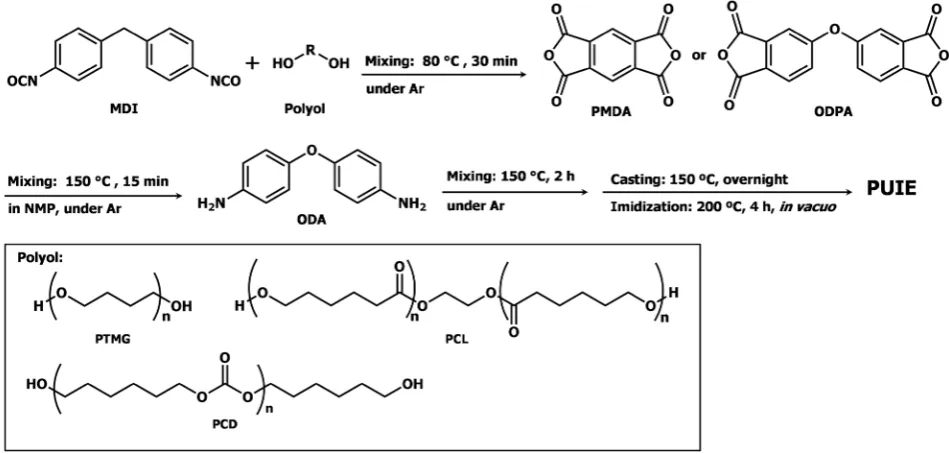
4,4'-Diphenylmethane diisocyanate (MDI) and polyols (polytetramethylene glycol (Mw = 1000) (PTMG1000), polycaprolactone diol (Mw = 1000) (PCL1000), and polycarbonate diol (Mw = 1000) (PCD1000)) were supplied by Tosoh Industry, and they were purified by distillation or dried prior to use. Pyromellitic dianhy-dride (PMDA), 4,4'-oxydiphtaric anhydianhy-dride (ODPA), and 4,4'-oxydianiline (ODA) were purchased from Tokyo Chemical Industry. N-Methyl-2-pyrrolidone (NMP) was purchased from Nacalai Tesque, Inc., purified by distillation, and stored over 4Å molecular sieves.
2.2. Synthesis
DOI: 10.4236/ojpchem.2018.81002 13 Open Journal of Polymer Chemistry Scheme 1. Solution-phase synthesis of PUIEs.
Table 1. Synthesis of PUIEs.
Sample (×10MDI−3 mol) a Polyol b
(×10−3 mol) ODA
c
(×10−3 mol) PMDA d
(×10−3 mol) ODPA e (×10−3 mol)
PUIE-PMDA 4.40 2.50 1.90 3.80 -
PUIE-ODPA 4.08 2.50 1.57 - 3.14
a4,4'-MDI: Mw = 250.25; bPTMG1000: Mw = 1000; PCL1000: Mw = 1000; PCD1000: Mw =1000; cODA: Mw = 200.24; dPMDA: Mw = 218.12.
2.3. Characterization
2.3.1. Chemical Properties
Swelling tests were carried out using 0.1000g test pieces. The degree of swelling (Rs) was calculated using the formula Rs (%) = (W' − W)/W × 100, where W' is the weight of the test piece soaked in benzene for 24 h, and W is the weight of the test piece after drying at 30˚C for 24 h in vacuo.
2.3.2. Mechanical Properties
Tensile tests were performed on an OrientecRTC-1225A (Tokyo, Japan) with a model-U-4300 using a JIS 3-dumbbell as the standard sample and a crosshead speed of 100 mm/min.
2.3.3. Thermal Properties
Differential scanning calorimetry (DSC) measurements were performed on a Rigaku Thermo-Plus DSC-8230 (Tokyo, Japan) at 10˚C/min from −120 to 200˚C under an Ar atmosphere. Approximately 9.5 mg of each PUIE was weighed and sealed in an aluminum pan. The samples were rapidly cooled to −120˚C and then heated to 200˚C at 10˚C/min.
DOI: 10.4236/ojpchem.2018.81002 14 Open Journal of Polymer Chemistry atmosphere.
Thermogravimetric analysis (TGA) was performed on a Seiko Instruments TG/DTA6200 device (Chiba, Japan) at a heating rate of 10˚C/min from 30 to 500˚C under a N2 atmosphere.
2.3.4. Molecular Calculations (Gaussian)
Molecular calculations were carried out using the Gaussian09W program at the B3LYP/6-31G(d) level. The resulting molecular models were visualized using Gauss View 5.0.
3. Results and Discussion
Expression of Thermoplasticity
The definition of a thermoplastic elastomer in JIS appears to be the following: “A polymer, or blended polymer, showing a vulcanized rubber-like nature at the operating temperature that can be processed and reprocessed to recover the po-lymer, or blended popo-lymer, at high temperature.” Currently, there is no defined test method for evaluating thermoplasticity. Therefore, we defined thermoplas-ticity as follows: “An elastomer showing elasthermoplas-ticity at the operating temperature that can be reprocessed at higher temperatures. Moreover, the nature of the re-formed elastomer must demonstrate the same properties as the original material.”
Synthesis of the PUIEs was carried out using various raw materials and the PUIE films fused during the process of imidization. A heating test was carried out on the PUIE films (Figure 1). The PUIE films that contained ODPA became fused, whereas the PMDA-containing PUIEs burned and carbonized. This sug-gests that thermoplasticity only appears in the PUIEs that contained ODPA as the acid anhydride. To confirm the thermoplasticity of PUIEs synthesized with ODPA, a press molding was carried out. Then, tests for the chemical and physi-cal properties (swelling test, tensile test, DSC, DMA, and TGA) of the PUIEs be-fore and after the molding were carried out.
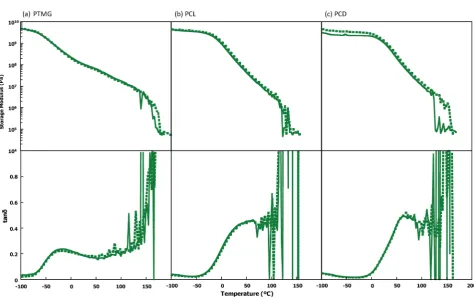
The swelling rate and Tg values of PUIEs both before and after the molding were nearly identical (Table 2). Figures 2-4 show the stress-strain curves, tanδ, and T5 and 50, respectively. The stress-strain curves, tanδ, and T5 and 50 of the PUIEs both before and after the molding were also identical.
DOI: 10.4236/ojpchem.2018.81002 15 Open Journal of Polymer Chemistry Figure 1. Heating test of PUIEs: PUIE-ODPA and PUIE-PMDA.
Table 2. Synthesis of PUIEs.
Sample Swelling ratea (%) b
g
T (˚C) 5c
T (˚C) 50c
T (˚C)
Before ODPA-PTMG 235 −26 352 432
After ODPA-PTMG 213 −25 350 433
Before ODPA-PCL 175 52 324 417
After ODPA-PCL 173 50 320 417
Before ODPA-PCD 169 62 328 374
After ODPA-PCD 157 64 328 374
aMeasurement conditions: benzene solvent at room temperature (23˚C ± 2˚C) for 24 h; bDSC was performed at a heating rate of 10 ˚C/min from −100˚C to
300˚C under an Ar atmosphere; cTGA was performed at a heating rate of 10 ˚C /min from 30˚C to 500˚C under a N
[image:5.595.58.538.429.584.2]2 atmosphere.
Figure 2. Tensile tests (stress-strain curves) of the PUIEs: solid line (before PUIE-ODPA) and dotted line (after PUIE-ODPA).
aromatic rings, is relatively high and the molecule is not restrained (Figure 5). Moreover, the flexibility of the PUIE is restrained by the π-π interactions be-tween the diamine (ODA) and the aromatic ring. The expression of thermoplas-ticity for the ODPA-containing PUIE is thought to be related to the flexibility of the PUIE molecule, and this flexibility results from the molecular structure of ODPA (Figure 5). This concept of thermoplasticity is supported by the swelling tests and the DMA results as well.
DOI: 10.4236/ojpchem.2018.81002 16 Open Journal of Polymer Chemistry Figure 3. Storage modulus and tan δ of the PUIEs as a function of temperature: solid line (before PUIE-ODPA) and dotted line (after PUIE-ODPA).
Figure 4. TGA curves of the PUIEs: solid line (before PUIE-ODPA) and dotted line (after PUIE-ODPA).
Table 3. Expression of the thermoplasticity of PUIEs.
Sample Thermoplasticitya
ODPA-PTMG ○
PMDA-PTMG ×
ODPA-PCL ○
PMDA-PCL ×
ODPA-PCD ○
PMDA-PCD ×
DOI: 10.4236/ojpchem.2018.81002 17 Open Journal of Polymer Chemistry Figure 5.Molecular models of ODPA and PMDA.
Figure 6. Molecular models of ODPA-containing PUIE and PMDA-containing PUIE.
4. Conclusion
The expression of PUIE thermoplasticity for the various PUIEs synthesized by solution-phase polymerization was investigated. The thermoplasticity of ODPA-containing PUIEs was identified by the heating tests, swelling tests, ten-sile tests, DSC, DMA, and TGA of the PUIEs both before and after a molding treatment. We found that using ODPA as the acid anhydride greatly increased the thermoplasticity of the synthesized PUIE. The knowledge obtained in this study will be useful for designing TPUIEs for various applications.
PUIE (PMDA) PUIE (ODPA)
: Hydrogen : Carbon : Oxygen : Nitrogen
[image:7.595.245.500.243.557.2]DOI: 10.4236/ojpchem.2018.81002 18 Open Journal of Polymer Chemistry
Acknowledgements
The authors are grateful to Mr. Tomohiro Nishio for taking measurements using dynamic mechanical analysis.
References
[1] Jeon, J.Y. and Tak, T.M. (1996) Synthesis and Characterization of Block Copo-ly(urethane-imide). Journal of Applied Polymer Science, 62, 763-769.
https://doi.org/10.1002/(SICI)1097-4628(19961031)62:5<763::AID-APP7>3.0.CO;2-U
[2] Zuo, M. and Takeichi, T. (1997) Novel Method for the Preparation of Poly(urethane-imide)s and Their Properties. Journal of Polymer Science Part A:
Polymer Chemistry, 35, 3745-3753.
https://doi.org/10.1002/(SICI)1099-0518(199712)35:17<3745::AID-POLA14>3.0.C O;2-D
[3] Zuo, M., Xiang, Q. and Takeichi, T. (1998) Preparation and Properties of Novel Poly(urethane-imide)s. Polymer, 39, 6883-6889.
https://doi.org/10.1016/S0032-3861(98)00179-7
[4] Asai, K., Onouchi, Y., Inoue, S. and Okamoto, H. (1998) First Evidence of Polyi-mide Elastomer Prepared from Polyurea and Pyromellitic Dianhydride. Chemistry Letters, 3, 227-228.https://doi.org/10.1246/cl.1998.227
[5] Zuo, M. and Takeichi, T. (1999) Preparation and Characterization of Poly(urethane-imide) Films Prepared from Reactive Polyimide and Polyurethane Prepolymer. Polymer, 40, 5153-5160.
https://doi.org/10.1016/S0032-3861(98)00726-5
[6] Takeichi, T., Yamazaki, Y., Ito, A. and Zuo, M. (1999) Preparation and Properties of Porous Polyimide Films Prepared by the Pyrolysis of Poly(urethane-imide) Films.
Journal of Photopolymer Science and Technology, 12, 203.
https://doi.org/10.2494/photopolymer.12.203
[7] Philip Gnanarajian, T., Padmanabha Iyer, N., Sultan Nasar, A. and Radhakrishnan, G. (2002) Preparation and Properties of Poly(urethane-imide)s Derived from Amine-Blocked-Polyuretane Prepolymer and Pyromellitic Dianhydride. European Polymer Journal, 38, 487.https://doi.org/10.1016/S0014-3057(01)00216-6
[8] Lin, M.F., Shu, Y.C., Tsen, W.C. and Chuang, F.S. (1999) Synthesis of Polyure-thane-Imide (PU-Imide) Copolymers with Different Dianhydrides and Their Prop-erties. Polymer International, 48, 433-435.
https://doi.org/10.1002/(SICI)1097-0126(199906)48:6<433::AID-PI161>3.0.CO;2-1
[9] Asai, K., Inoue, S. and Okamoto, H. (2000) Preparation and Properties of Im-ide-Containing Elastic Polymers from Elastic Polyureas and Pyromellitic Dianhy-dride.Journal of Polymer Science Part A: Polymer Chemistry, 38, 715-723.
https://doi.org/10.1002/(SICI)1099-0518(20000215)38:4<715::AID-POLA6>3.0.CO; 2-8
[10] Takeichi, T., Yamazaki, Y., Fukui, T., Matsumoto, A. and Inagaki, M. (2000) Prepa-ration and Characterization of Porous Carbonized Films by the Pyrolysis of Poly(urethane-imide) Films. Tanso, 195, 388-394.
https://doi.org/10.7209/tanso.2000.388
DOI: 10.4236/ojpchem.2018.81002 19 Open Journal of Polymer Chemistry
https://doi.org/10.2494/photopolymer.14.67
[12] Liu, J. and Ma, D. (2002) Study on Synthesis and Thermal Properties of Polyure-thane-Imide Copolymers with Multiple Hard Segments. Journal of Applied Polymer Science, 84, 2206-2215.https://doi.org/10.1002/app.10421
[13] Takeichi, T., Ujiie, K. and Inoue, K. (2005) High Performance Poly(urethane-imide) Prepared by Introducing Imide Blocks into the Polyurethane Backbone. Polymer, 46, 11225-11231.https://doi.org/10.1016/j.polymer.2005.09.075
[14] Qiu, F., Yang, D. and Li, P. (2009) Synthesis, Characterization, and Ther-mos-Optical-Properties of Poly(Urethane-Imide) Based on Azo-Disperse Dye in Its Side Chains. Iranian Polymer Journal, 18, 651-661.
[15] Kogiso, T. and Inoue, S. (2010) Synthesis and Properties of Elastic Polyure-thane-Imide. Journal of Applied Polymer Science, 115, 242-248.
https://doi.org/10.1002/app.31126
[16] Zang, L., Han, X., Xiao, W. and Li, J. (2011) Synthesis and Property Study of a New Polyurethane-Imide. Huagong Jinzhan, 30, 2491-2494.
[17] Sang, X., Wang, R., Chen, X., Zang, L., An, M. and Shen, Y. (2011) A Review on Synthesis and Property of Polyurethane-Imide. Advanced Materials Research, 284, 1746-1749.https://doi.org/10.4028/www.scientific.net/AMR.284-286.1746
[18] Ueda, T., Nishio, T. and Inoue, S. (2017) Influences of Diamines on the Morpholo-gies and the Chemical, Thermal, and Mechanical Properties of Polyurethane-Imide Elastomers. Open Journal of Organic Polymer Materials,7, 47-60.
https://doi.org/10.4236/ojopm.2017.74004
[19] Salary, J. and Smith, C.H. (1975) Polyurethane/Imide Modified Foam. Journal of Cellular Plastics, 11, 262.https://doi.org/10.1177/0021955X7501100505
[20] Sang, X., Chen, X., Hou, G. and Yu, S. (2011) Preparation and Properties of Rigid-Polyurethane-Imide Foams. Advanced Materials Research, 150, 1119.
[21] Muller-Cristadoro, A. and Prissok, F. (2014) Method for Production of Polymer Foams Comprising Imide Groups. U.S. Pat. Appl. Publ, US 20140042356 A1. [22] Wang, Y., Tian, H., Bian, Q., Xiang, A., Ge, X. and Liu, G. (2015) Effect of
Trola-mine and Dibutyltin Dilaurate on the Structure and Properties of Polyure-thane-Imide Foams. Cellular Polymers, 34, 119-135.
[23] Yeganeh, H., Barikani, M. and Noei Khodabadi, F. (2000) Synthesis and Properties of Novel Thermoplastic Poly(urethane-imide)s. European Polymer Journal, 36, 2207-2211.https://doi.org/10.1016/S0014-3057(99)00284-0
[24] Jiang, B., Hao, J., Wang, W., Jiang, L. and Cai, X. (2001) Synthesis and Thermal Properties of Poly(urethane-imide). Journal of Applied Polymer Science, 81, 773-781.https://doi.org/10.1002/app.1494
[25] Yeganeh, H. and Shamekli, M.A. (2004) Poly(urethane-imide), a New Generation of Thermoplastic Elastomers with Enhanced Thermal Stability. Polymer, 45, 359-365. https://doi.org/10.1016/j.polymer.2003.11.006
[26] Tai, M.-H., Huang, S.-H., Liu, S.-J., Chen, C.-J., Chen, P.-J. and Chen, S.-H. (2008) Synthesis and Properties of Poly(urethane-imide) Interpenetrating Network Mem-branes. Desalination, 233, 191-200.https://doi.org/10.1016/j.desal.2007.09.042
[27] Li, Z., Xu, T., Sun, J., Zhang, F., Sun, B. and Wang, Z. (2008) Preparation and Prop-erties of Polyurethaneurea-Imide Elastomer. China Synthetic Rubber Industry, 31, 312.
DOI: 10.4236/ojpchem.2018.81002 20 Open Journal of Polymer Chemistry Expo, Boston, 13-16 June 2011, Vol. 1, 445-448.
[29] Xu, T., Yan, W., Wang, S.-J., Li, Z.-F., Sun, B.-Q. and Wang, M.-X. (2008) Synthesis of Polyure Thane Modified Bismaleimide (UBMI) and Polyurethane-Imide Elasto-mer. Journal of Polymer Science, 26, 117.
[30] Mifune, Y., Nishio, T., Shibata, J. and Ueda, Y. (2010) Jpn. Kokai Tokyo koho JP 201022567.
[31] Song, J., Chen, G., Wu, G., Cai, C., Liu, P. and Li, Q. (2011) Thermal and Dynamic Mechanical Properties of Epoxy Resin/Poly(urethane-imide)/Polyhedral Oligomeric Silsesquioxane Nanocomposites. Polymers for Advanced Technologies, 22, 2069-2074. https://doi.org/10.1002/pat.1722
[32] Patel, B.P., Patel, H.S. and Patel, D.B. (2011) Glass Reinforcement of Epoxy Resin Based Poly(urethane-imide)s. International Journal of Plastics Technology, 15, 163-173.https://doi.org/10.1007/s12588-012-9021-9