COMPUTING PROCEDURES FOR A
LEARNING MACHINE
A thesis presented for the degree of
Doctor of Philosophy in Electrical Engineering
in the University of Canterbury,
Christchurch, New Zealand
by
P.M. CASHIN, B.E.(Hons), M.E.(Dist.)
Ii) ,
ACKNOWLEDGEMENTS
I am deeply indebted to Professor J.R. Andreae who
has been my supervisor and has provided cont-inual
guidance, support and enthusiasm.
I have also had
valuable assistance from his methodically indexed
library of papers and bookso
Unfortunately, it is impossible to individually
acknowledge all the people who have helped me through
discussion, argument and cooperative effort during the
course of this worko
In particular the staff and
post~graduate students in the Electrical Engineering
Department have contributed; many actively, all by
good willo
I am grateful to the University Grants Committee
for their scholarship which has supported me through
this work.
TABLE OF CONTENTS
CHAPTER 1:
INTRODUCTION
1-1
Introduction
1-2 Path Finding
1-3 Stochastic Learning Automata
1-4 Rote learning and Markov Process Theory
CHAPTER 2:
THE BANDIT ALGORITHM FOR MINIMUM COST
PATH FINDING WITH INCOMPLETE COST
'INFORMATION
2-1
Introduction
2-2 Proplem Statement
2-3 Illustrative Example
2-4 The Two Armed Bandit Problem
2~5The BANDIT Algorithm
2-6 Some Comparative Results
2-7
Extensions to Path Finding
2-8 An Admissible Algorithm
2-9
Arc Cost Estimates
2-10 On-line Algorithm
2-11 Convergence Theorem
2-12 Applications of the BANDIT Algorithm
2-13 Results
CHAPTER
3:
STOCHASTIC LEARNING AUTOMATA
3-1
Introduction
3-2 Notation
3-3
Modified Linear Reinforcement Procedure
3-4 The BANDIT Algorithm
3-5
Environments with Perception and Performance
Measures
3-6 Results
3-8 Conclusions
References
CHA~ER
4:
ROTE LEARNING AND MARKOV
PROC~SSES4-1
4-2
4-3
4-4
4-5
4-6
4~7Table Building
Operator Selection Strategy
Planning from Rote Learning
Interaction as a Markov Process
An Example of Optimal Policy Failure
Stochastic Simulation
Operator Decision Procedure
4-8 Expectance Function
4-9 Operator Decision based on Expectance
4-10
E~pectanceEntry in the Rote Learning Table
4-11 BANDIT-EXPECTANCE MaQhine
4-13 Fox and Dogs Game
CHAPTER 5: CONCLUSIONS
5-1 Reinforcement Le~rning 5-1
5-2 Against Reinforcement Learning 5~2 5-3 Learning by Being Told 5-3
5-4 Why the Gap? 5-7
5-5 Grafting Learning Ability onto a Program 5-8
5-6 Summary of Main Points 5-10
APPENDICES
---,-.-APPENDIX A: LINKN~T: A Structure for Computer Representation and Solution of Network
Problems
Abstract
A-1 IJ;ltrQduction
A-2 The Basic Structure
A-201 Graphs
202 LINKNET Elements
2.3 Lists
204 Access to apc attributes
205 Access to node attributes
A-3 Cre~tion of LINKNET
301 Construction of a LINKNET Structure
A-4 Applications of LINKNET
4.1 , Minimum length path finding
4.2 Finding Meshes and Spanning Trees
A-7
A-10
A-10
A-10
A-13
A-13
A-5 Conclusions
References
APPENDIX B:
GEAPHIC DISPLAY
SYS~EM -~.,...B~1
Introduction
B~2 Bas~c
System
Requ~r8m~ntsB-3 The Edit Phase
-
D~rectDraw Facility
-
Disp~ayLanguage Facility
B-4
The Run Time Phase
- Display Order Inter
- Display File Editing
B-5
Editor~InterpreterReferences
APPENDIX
....,...-0:
Analytic Calculation of BANDIT
Selection Probability for Normal Probability
Densitieso
APPEND~:
The BANDIT Algorithm in Heuristic
Search Algorithms,
Page
A-22
A-24
B-1
B-4
B-5
B-5
B-7
B-""10
B-11
B-15
B-19
CHAPTER ONE
1 - 1
CHAPTER ONE
1 - 1 INTRODUCTION
This thesis presents the highlights of work done
in the field of artificial intelligence - more
particul-arly machine learning. Artificial intelligence research
is accepted
[3J
as a wide ranging discipline, and noattempt will be made to define or delimit it. The
areas of most importance to this thesis are, heuristic
programming, problem solving and associated learning
models.
Such important areas as pattern recognition are
scarcely mentioned in this thesis; this is not to imply
that such areas do not contribute to or supplement the
main theme of machine learning. It is simply that the
work reported has contributed no new concepts in these
areas, or linked them any closer to machine learning 0
The view has been taken that every learning machine
must face the problem of continually having to decide on
an action on the basis of some current set of collected
data and deductions. Each action can be thought of as
producing a 'value'. The problem is that the estimated
'value' of each action is based on the current data,
while each action may produce a 'side effect' of
1 - 2
This problem is exemplified by the 'Dual Control!
problem
[4]
and in its most basic form by the 'TwoArmed Bandit Problem' [2] 0 The Two Armed Bandit
Problem is first considered in Chapter 2, where the
BANDIT algorithm is first introduced. The BANDIT
algorithm is not only contributed as an algorithm for
solving the Two Armed Bandit Problem, but i t is
designed to be a basic mechanism in the learning
machine faced with the more complex and general problem
outlined above.
The heuristic that the BANDIT algorithm is based on
can be stated like this:
If one of a number of al ternati ves has a probability
'p! of beirig the best alternative, then choose this
alternative 100.p% of the timeo
To assess the probability 'pi of one alternative
being better than any other, it is necessary to know not
only the estimated mean 'valueo of each alternative but
also the probability density of these mean 'valuei
estimates. The BANDIT algorithm provides a concise
com-putational procedure to perform this decision processo
The applications, implementation and results from
using the BANDIT algorithm form a central core to this
The second contribution that plays a major part
in this thesis is the 'expectance' function. This
function is based on the 'expectation' used by
Andreae
(1)
and Gaines and Andreae [6J
in the STeLLAlearning machine. It is similar to the expectimaxing
scheme proposed by Michie and Chambers
[9].
The purpose of the expectance function can be
thought of (for now) ,as .. a way of assessing an action's
long term 'value'. That is, not only is the immediate
'value' resulting from the use of the action considered,
but also account is taken of the future actions that
will become available, and of their expectance functions
or expected 'values i •
The development contributed by the expectance
function is its generality~ and equally important is its recursive formulation and on-line evaluation. The
expectance function is introduced near the end of
Chapter
3,
and is fully discussed ih Chapter 4.Just as important as the BANDIT algorithm and the
expectance function themselves~ is their use in linking together and extending several distinct areas of
current research interest. The three main areas
con-cerned are:
Path finding (graph searching) - considered from a
particular point of view where incomplete information
1 - 4
Stochastic automata - with the introduction of an
extended problem class for these machines, and
Markov process theory and its use in the development
of a rote-learning table-based learning machineo
These topics are dealt with in Ohapter 2,
3
and 4 respectively. A brief 'over-view' of these topics isgiven in this introductory chapter under sections 1-2,
1-3 and 1-4.
The function of the appendices is two fold. First
they contain some support material that is not
approp-riate 'in-line', but more important they contain some
originai material of their own 0 This material is not
included in the main body since i t is concerned with
computational tools that have been used (transparently)
to develop the algorithms and examples contained in the
main body. The two main topics in this class are:
10
A technique based on linked list structures that enables problems involving networks or graphs to beim-plemented in a rather uniform manner. It is not so much
that the teChniques involved are in any way new? but
rather that the particular way of applying the techniques
to the network itself - rather than to the various
information structures that may arise in the course of a
particular problem - leads to structural and procedural
convenience. The ideas here have been developed in
1 -
5
used the technique on several power system problems.
20
A discussion of work done in implementation of a graphical display system for the Electrical EngineeringDepartment's EAI 640 computer. Although this display
system was develop~d from scratch in cooperation with
M.R. Mayson, the details of this work are not
consider-ed relevant to this thesis~ The philosophy developed is considered relevant however and is based on a large
effort devoted to establishing a framework for the
software.
1 - 2
PATH FINDINGChapter 2 is concerned with a particular class of
path finding problems. Briefly these problems involve
repeated traversal of the minimum cost path that can be
found on the basis of current (incomplete) arc or path~
segment cost information. This is combined with the
upaating of the arc cost information for those arcs that
are traversed, on anyone path traversal. This problem
has been given the name 'on-line9 path finding.
Chapter 2 is written in the form of a paper describing
an operations research technique for this class of
problem.
The presentation in Chapter 2 is thus rather closer
to the basic problem than if the sophisticated heuristic
1 - 6
intelligence workers had been explicitly employed. It
should be made clear however that by the very nature of I
graph searching in problem solving or game playing they
often fall into the 'on-linev path finding class.
Oonsider for example a small board game where i t is
possible for a machine to search enough of the game
graph (tree) to establish that i t can not possibly win
if the opponent plays optimally. An example of such a
problem is considered near the end of Ohapter 4~ with
the French Military Game or Fox and Dogs.
In such situations we would like the machine to
make a move that maximized its chances of a win - that
is, try to put the opponent ~n a position where he is
most likely to blunder. Such performance is just not
possible by many successful tree searching programs,
since the basis of back-tracking up the game tree is a
mini-max strategy. On the oth~ band the efficiency of
the search (the work that i t involves) is very dependent
on the search strategy and this aspect has received
considerable attention [7][10J [11J.
A similar problem can occur in situations where a
complete search is not possibly by any strategyo In
this (normal) case the usual technique is to back-track
up the game tree from an estimation of the value or
merit of the various terminal nodes that have been
1 -
7
form is Samuel's checker player [12J.
An evaluation of
various search techniques is given by Slagel and Dixon
[14
J.
The problem arises not from the search and back up
procedures themselves but occurs as soon as the
estimates used for the value of each node are allowed to
be learned by the machine from its own experience.
In
fact as soon as the learning is directly derived from
the machine's own play we have an
'on-line'path
finding problem.
Chapter 2 shows that without an
algorithm such as the BANDIT algorithm the learning
process in such cases is liable to get istuckO below
the optimal performance level.
The above comments apply equally well to problem
solving and theorem proving - except that in these cases
it may only be required to search once for a solution.
In other words the information update from one solution
to the next is not present.
In such cases the ion-lineo
path finding problem does not exist and the best
avail-able estimate gives the best that can be achieved.
There is no benefit from the
°side-effect' of the
1 - 8
1 -
3
STOCHASTIC LEARNING AUTOMATAStochastic automata have recently been receiving
attention as models for learning behaviour and a survey
of this work is given by Fu (1970) [5Jo Chapter 3 is
concerned with this approach to learning machines,
starting with a brief introduction to the current
established work.
One recent scheme in particular [13J is then
developed and shown to be similar to a BANDIT algorithm
stochastic learning automaton, which is introduced at
this point. A benefit of this is that a proof of
con-vergence is given for the first automata scheme [13
J
anda modified BANDIT automaton can be derived which falls
within the scope of this proof 0
Stochastic learning automata schemes are viewed in
Chapter
3
as procedureso For this point of view anotation used in computer algorithm formulation is shown
as an attractive method for presenting the stochastic
learning automata procedures.
Finally the environment-automaton interaction is
generalized to enable this approach to tackle the class
of problems considered by several 'heuristic programmingi
schemes (for want of a better definitive). STeLLA [1,6J
1 -
9
1 - 4 ROTE LEARNING AND MARKOV PROCESS THE0RY
The basic memory strucpures and strategy used by
STeLLA were seen as similar to work on Markov process
theory developed by Howard
'[8J.
With this starting
point an attempt was made to bridge this gap by building
from the Markov theory towards the STeLLA strategy.
Unfortunately the complexity of the STeLLA heuristics
and special purpose parameters proved too great to allow
the theory to meet up with the STeLLA implementation.
By working in reverse a very basic STeLLA structure
was extracted in order to move closer to the Markov
theory.
This basic structure was (eventually) formed
into the BANDIT-EXPECTANCE algorithm as presented in
Chapter 4.
At this point the algorithm proved of
enough interest in its own right - and the road back to
STeLLA rather torturous - that the linking of the Markov
theory through to the BANDIT-EXPECTANCE algorithm was
considered as replacing the original objective.
Chapter 4 briefly presents the relevant Markov
theory and develops from this to end up with the
BANDIT-EXPECTANCE algorithm.
Throughout this development the
idea of a rote learning table is uS,ed to tie the
presentation together.
1 - 10
progresses from a simple record of events~ through to a more functional 9 control policyQ formo The structure of
the rote learning table is not too important in Chapter
4, except that i t contains the learning machineos long
term memoryo However, the format is developed in such
a way as to be extensible, and an indication of such
1 - 11
REFERENCES
1 Andreae, JoH., Learning Machines: A Unified View.
Encyclopaedia of Linguistics Information and
Control. Edo Meethan,AoRo and Hudson,RoAo
Pergamon Press, 1969.
2 Bellman,R. A Problem in the Sequential Design of
Experiments. SANKHYA Vol016, parts 3 and 4, 19560
pp 221-229·
3 Feigenbaum,E.A. Artificial Intelligence: Themes
in the Second Decade. Stanford Artificial
Intelligence Project Memo AI-67o Invited paper
IFIP68 Congress, Edinburgh, Aug. 1968,
4 Fel'dbaum,A.Ao Dual Control Theory I-IV in Optimal
and Self-Optimizing Control, Ed. Oldenburger,Ro
MoI.T. Press, 1966.
5 Fu,KoS. Stochastic Automata as Models of Learning
Systems. pp 393-431, Adaptive, Learning and
Pattern Recognition Systems, Edo Mendel~JoMo and Fu,K.So Academic Press, 1970.
6 Gaines,BoRo and Andreae,JoH. A Learning Machine
in the Context of the General Control Problem,
1 - 12
7 Hart,P., Nilsson9No, Raphael~Bo A Formal Basis
for the Heuristic Determination of Minimum Cost
Paths. IEEE Trans. on Syso Sci. Cybernetics,
July 1968, pp 100-1070
8 Howard,R.Ao Dynamic Programming and Markov
Processeso MIT Press 19600
9 Michie,Do and Chambers, R.Ao Boxes: An experiment
in adaptive control 0 Machine Intelligence 29
Edinburgh University Press 19680
10 Pohl?Io First Results on the Effect of Error in
Heuristic Searcho Machine Intelligence 5, Edo
Meltzer,Bo and Michie,Do Edinburgh University
Press, 1969, pp219~2360
11 Samuel,AoLo Some Studies in Machine Learning
Using the Game of Checkerso IBM Jo Reso Develop.
3 (July 1959), pp 211~229o
12 Samuel,AoLo Some Studies in Machine Learning
Using the Game of Checkerso II - Recent Progresso
IBM Jo Res. Developo 11, 6 (Novo 1967)9 pp 601~617o
13 Shapiro,I.Jo and Norendra,KoSo Use of Stochastic
Automata for Parameter Self~Optimization with Multimodal Performance Criteria. Trans 0 IEEE
Systems Science and Cybernetics, Vol. SSC-5 No04,
October 1969, pp352-3600
14 Slagle,JoR. and Dixon,JoKo Experiments with some
CHAPTER TWO
2 - 1
CHAPTER TWO
2 - 1 INTRODUCTION
The problem of finding the minimum cost path
through a graph (network) of interconnected nodes where
the arcs? or node interconnections have associated costs
has been solved in many wayso The applications of this
problem range from transportation routing problems
[1]
through automatic control, [2] to artificialintel-ligence research
[3]
02 - 2 PROBLEM STATEMENT
Existing algorithms cannot satisfactorily tackle
certain problems having incomplete cost informationo
Here we attempt to solve a class of problem that we
have termed ion-lineQ
0 These problems have the
follow-ing characteristics:
a) The graph is to be traversed from a start node to
one of a set of goal nodes N timeso
b) The costs associated with the arcs are not fully
known and may be stochastico
c) Information gained from each traversal of the
graph is to be used to update the corresponding
arc cost estimates 0
d) We wish to minimize the total cost incurred by the
2 - 2
In descriptive terms the problem is that of decid~ ing whether to travel a known path or to spend money in
exploring for a short cut. It is clear that a 'search
for the best pathQ policy may well precede a 'use the
best path that has been foundo policyo
-THE O~-LINE PROBLEM
Traverse graph from start to goal.
J
Path Cost
=
sum of costs of arcs traversed.1
C=UPdate arc cost estimates
~
'.J
-Select the next path to traverse on the
basis of the current arc cost estimateso
The object is to minimize the total cost over a number of traversals of the grapho
2 -
3
ILLUSTRATIVE EXAMPLETo illustrate the on-line path finding problem
consider the case of a transport operator who has a
contract to transport goods between city A and city Bo
The contract is such that time is the important factor,
2.- -
3
city A to city B is the travel time rather than the
mileage or fuel cost or anything else.
In this example the arcs are the separate lengths
of road that may be travelled as part of some path from
A to B. The arc cost is the travel time for an arc.
Notice that the arc cost is a random variable since
hills, bends, traffic density and so on will all
affect the travel time. Notice also that a reasonable
apriori estimate of the mean travel time is available
using road maps and so on.
Every time the transport operator runs an
assign-ment from A to B he is able to update his cost eSimates
for the roads (arcs) that he chose to travel.
Consider the simple case where there are only two
possible paths from A to Bo Assume that the paths have
costs uniformly dis.tributed in the range 0.7 to 008 and
008 to 0.9 respectively. In our ignorance we may well
assign apriori estimates of 1.0 for the cost of each
route. Making an arbitrary choice we proceed by the
second path on the first occasion and find i t better
than the apriori assumption. From this moment onwards
the simple strategy of travelling the minimum
(estimat-ed) cost path, would never get around to trying the
other route, although quite obviously i t is better.
A heuristically derived algorithm - the BANDIT
2 - 4
problems. The BANDIT algorithm accepts apriori
estim-ates not simply as a mean cost but as a probability
distribution for the mean costo
Although the BANDIT algorithm is not guaranteed to
be optimal in the sense that it will minimize the total
cost over a number of traversals, i t is shown to be
very near optimal for simple problems and is
computat-ionally feasible for large problems. All known methods
for optimal solutions are impractical (or even
currently impossible) for large problems, but they can
be used on small 'artificialv problems.
The optimal solution for simple problems will be
given by use of Bellman's method [~? which was
propos-ed for the
'two
armed bandit problem' 0 This problem(to be described in the next section) can be taken as
equivalent to the two path problem described above by
considering the two slot machines to be the two paths?
and the payoff probability as relating to the path cost.
For example, a slot machine ~YQff probability of
0075
can be interpreted as0025
mean path cost (normalized).Note that the two armed bandit problem (next
section) is considered because it is only for this
simple case that Q£timal solutions can be computedo
The BANDIT algorithm is then described and shown to
2 -
5
2 - 4 THE TWO ARMED BANDIT PROBLEM
The simplest form of the path finding problem is
equivalent to the two-armed bandit problemo This is a
classical mathematics problem that is still not
com-pletely solvedo The basic two-armed bandit problem is
outlined below:
Suppose that we have two slot machines in front of
us, one with known properties and one with unknown
propertieso When the handle on the first machine is
pulled, there is a known probability, s, of receiving a
dollar; when the second machine is played, there is a
fixed, but unknown, probability or success, ro
The process assumes the following formo We try
the second (unknown) machine a number of times to be
determined by the outcomes, and then* decide to use the
first machine from then ono
The object is to maximize the expected value of
the criterion function:
R
a
nz
n
where 0
<
a<
1 is a discount factor and zn representsthe return obtained on the nth trial.
This criterion function enables the problem to be
treated as an unbounded process with discount factor, a,
rather than a finite sequence of choices where we have
2 - 6
N trials.
Bellman's dynamic programming approach [4] to this
problem gives a computational method that is feasible
for the case of one unknown and one known payoff
prob-ability to choose between (as above).
For multiple
choice problems the co-mputation would quickly become
impractical.
No analytic solution has been derived for
an optimal policy.
Bellman defines:
f
(s)
=
the expected return obtained using an optimal
mn
policy for an unbounded process after the
second (unknown) machine has had m successes
and n failures.
It is assumed
[4Jthat the probability
distribut-ion Fmn (r) ,r/1'or r in
[0, 1J
after m successes and n
fail-ures, is updated from the apriori eSimate.
Let the
expected value of Fmn(r) be Pmn0
The basic functional equation can now be written,
Max
s/(1-a)
Bellman gives an existence and uniqueness theorem
that enables the above equation to be solved by a
Bellman's method has been outlined above since i t
shows the difficulty involved in this problem; also i t
provides a computational method for the optimal policyo
These optimal policies will be compared with the results
from a heuristic algorithm which is described belowo
2 -
5
THE BANDIT ALGORITHMWe will leave the two-armed bandit problem for a
moment in ord~r to set out a heuristic decision proced-ure that will be central to the rest of this chaptero
The heuristic that the BANDIT algorithm is based
on can be stated like this:
If one of a number of alternatives has a
probab-ility 'pi of being the best alternative, then choose
this alternative PQ100% of the timeo
To assess this probability of one alternative
being better than any other, i t is necessary to know not
only the estimated mean costs for each alternative but
also the distribution probability of these mean costso
The apriori distribution to be used is not an
objective probability corresponding to some random
ex-periment, but rather degrees of belief based on prior
analysis of conditions relevant to the particular
prob-lem. Thus apriori distributions including a zero
prob-ability for some range of values imply a complete belief
2 - 8
common apriori distribution would be a normal
(Gaussian) form, the variance reflecting the confidence
in the mean estimateo
Consider the case of only two alternatives as in
the case of two possible paths from A to Bo If the
cost of one path is estimated to be 0085 with variance
of 0015, and the other path is ~nown to have a mean cost of 0075; roughly, the BANDIT algorithm will give
the 0075 cost path preference about 84% of the timeo
The other 16% of the traversals are used to establish
a better estimate of the 0085 estimated mean cost path
-making sure that it really is a greater cost than 00750
As we become surer the variance drops and the 16% falls
lowero
We will now frame the BANDIT algorithm in a more
formal and precise manner:
Let S1~S2,S3?00,SN. be N alternatives 0 We must
select one of these and the estimated mean cost of
selecting S. is x. 0 Let f.(x) be the probability
dis-l l l
tribution for x., i t is to be understood that this is
l
the current distributlon and updating occurs to fi(x)
after S. has been selected and its cost measuredo The J.
measured cost is treated as a sample from an unknown
distribution g.(x) and the expected value of f.(x) is a
~ ~
mean estimator for gj,(x) , The object is to minimize
From the f.(x) we can calculate the current
l
probability that the cost of S. will be less than any
l
of the other alternatives, p(x
i = min {xj ij=1,2,oooN,'}).
BANDIT Algorithm
Select Si with a probability P(Si) such that
p ( S.) = P ( x . ;.:: min { x . ; j = 1 ,2 , ° ° • ,N}) Q
l l J
The direct computation of p(S.) would require
l
evaluation of the integral:
0<)
p(s.)
=1
I T ( 1 - F.(x))of.( ) dl 0 j
I
i J l X ° XX
F.(x) =
1
f.(x)odx; the cumulative distri-J 0 JWhere
bution (see Appendix C for details)o
Fortunately since we only need to select one of
the possible strategies,
Sj~{Si}'
we can employ a MonteCarlo type procedure to avoid calculating P(Si) for
each i, i. e ° { P(Si)
J.
The procedure is to take a setof random samples, {y.; i=1,2,oo.N)' where each y. is a
l . l
random sample from the probability distribution fi(x)o
If the minimum of this set is Yj' where Yj =
min { y i : i=1 ,2, 0 • oN}, then select strategy S j ° Notice
that unlike normal Monte Carlo procedures only one set
2 - 10
procedure were repeated a large number of times then
the set of probabilities of selection for each strategy,
{P(Si)}' could be evaluated.
An additional simplification can be made in the
procedure by assuming that the f.(x) are all normal
dis-1
tributions. This will usually be an acceptable
assump-tion since the central limit theory proves that the
dis-tribution of a mean estimator will tend to be normal as
the number of samples becomes large~ regardless of the form of the parent populationo Further, if the parent
population is normal in its distribution then the
dis-tribution of the mean estimator will always be normal.
2 - 6 SOME COMPARATIVE RESULTS
In order to illustrate the operation of the BANDIT
algorithm we have compared its performance on some two-·
armed bandit problems with the optimal solution
(computed by Bellman's method) 0
The optimal solution involves a switch from the
un-known machine to the un-known one after a particular
sequence of successes and failures. For any given
num-ber of trials, the probability of different sequences of
success and failure can be computed and hence the
prob-ability of a switch to the known machine.
The BANDIT algorithm has a probability of selecting
either machine that depends on the sequence of successes
2 - 11
above we compute for each given number of trials the
probability of each possible sequence of success and
failure, and hence the overall probability that the
known machine will be selected.
The above procedure has given the results for
both the optimal solution and the BANDIT algorithm in
the form of a probability that the known machine will
be selected after any given number of trials. These
results can be directly compared and this is done in
figure 2. Discount factors, a, of 005 and 008 are shown
for the optimal policy. Both methods used the same
apriori eSimate for the unknown machine payoff and also
the same updating procedure. The distribution of the
payoff probability for the unknown machine was assumed
?ROB.
of~~8
I~
___
~-.rr- _
-.J
r-
~
r-:;.
:2~]~~-~-=~;~~
OPTIMAL a=O
08
: 0
a=Oo5
I •
t
BANDIT ALGORITHM
I I
.J I '
I I
I •
PAYOFF PROBe
M/C I
known MfC II unknownI :
0.25
.= Oe10
o
~--~--~---~----~--'iTRIAL
o
10
20
30
PROBe
ofM/C
I100
PAYOFF PROBe
M/C
I known0.25
M/C II
unknown= 0.30
;
\
BANDIT ALGORITHM
OPT IMAL a=O 0 8
~I.
a=O 051
....r---~~ ... _ _ f
J
i - - ~ - ~ -t:J -IU"...,,~=-.rr~ - -~.: :~ - J - ' - - - • ~-i
I
I
O
~ I-__ -LIL; ____ ~---_,._---1TRIAL
6
10
20
30
Figure 2
PROBe
ofM/C
I1 0
OPTIMAL a = 008
.j-a =
rO~~;j
__
! - - -n-"'_::::-I
r--~-.-
-Rd-
'!=- - - ) ,
r-~.r-~.-...i
BANDIT ALGORITHM .
...J I I
I i
I I
I i '
PAYOFF PROBe
M/C
I knownM/C
I I unknownO+---~----~---~---,
TRIAL
o
10
20
30
PROBe
ofM/C
I1001
PAYOFF PROBe
M/C
I knownM/C IT
unlmown1 ',.
BAHDIT ALGORITHM
0.25
0.40
005
1 '"OPTIMAL a=008
1
~
a=0·5
1
~
-1 ;_ ~-:'~_j-.~ _ _ _ _ _ _ _
',,----. ~-~ - -~T:L~
-I t [ \ )
O~---~!~;----~---~---~I
TRIAL
I2 -
7
EXTENSION TO PATH FINDINGIt is not practical to calculate an optimal
solut-ion for even a small on-line path finding problem. We
can appreciate this by considering the extensions that
need to be made to the two-armed bandit problem:
1. Extension to an m-armed bandit problem. (m al
ter-native paths).
2. The cost of all m paths may be unknown apriori.
30
The traversal of one of the paths allows updatingof a set of arcso These sets of arcs for each of
the m paths are not necessarily mutually exclusive.
4. It requires considerable calculation to evaluate
the set of arcs that form the minimum cost path
(on the basis of the cost estimates). In general
i t is impracticable to list all of the m
alternat-ive paths an~ their costs.
Point 4 leads on to the procedure that will be used
to find a path through the network.
2 - 8 AN ADMISSIBLE ALGORITHM
We shall use the definition in
[5J
for an admiss-ible algorithm, which (briefly) is any algorithm that isguaranteed to find an optimal path from the start node
to a .. goal node. Dynamic Programming
[1]
and the A*2 - 14
An optimal path from node i to node j has the
low-est cost over all possible paths from node i to node jo
An admissible algorithm considers only the set of arc
costs it has to work with so that the optimal path that
it finds is more correctly the current-optimal patho
It is only optimal on the basis of the current arc cost
estimateso
In the on-line path finding problem the
current-optimal path on the basis of the current arc cost
estimates may not be the true minimum cost path (the
optimal based on the, unknown, true mean arc costs)o
This fact can cause the admissible' algorithm to
Isit
ion one particular path each time it is used during the
course of an on-line path finding problem, even though
this path may not be the true-optimal
0The feedback
that comes from the measured arc costs between each use
of the admissible path finding algorithm (used to
up-date the arc cost estimates) may not help simply because
only those arc costs on the current-optimal are being
measuredo
This failure of an admissible algorithm in
2 -
9
ARO OOST ESTIMATESWe will denote the cost of the arc i-j from node i
to node j as c .. , and its estimate
c. ..
TheC ..
arelJ
.
lJ
lJ
updated every time arc i-j is traversed. A form of
stochastic approximation can be used;
c. .
~ a.c. .
+ (1-a). c. . ilJ
lJ
lJ
where c .. I is the arc co st as measured, and 0 ~ a .. ~ 1. *
lJ
'
If c
ij is known to be deterministic, use a
=
o.
More sophisticated forms of this process can be found in[6J.
Figure3
illustrates this process, and shows how the variance of the estimate can be maintained in a similarmanner.
We will use O. to denote the cost of path i, one of
l
the set of possible paths from the start node to a goal
/'.
node. O. will be the estimate of 0.; i.e. the sum of
l l
c ..
for all arcs i-j on path i 0lJ
2 - 10 ON-LINE ALGORITHM
The on-line algorithm applies an admissible
algor-ithm at each traversal under the on-line conditions 0
A
'" A
If O.
<
O. for all iI-
j, and for simplicityJ l
OJ
=
OJ' then the on line algorithm will select path jA
to be traversed. However, if Ok
>
OJ and OJ> Ok for2 - 16
some k then the on-line algorithm will have converged
onto a non-optimum path since C
k
<
Cjo2 - 11 CONVERGENCE THEOREM
The on-line algorithm is guaranteed to converge
onto the optimum path under the following conditions:
A
c ..
1J
A
c ..
1J
c .. -7
c ..
1J 1J
for all i-j
as arc i-j is repeatedly
traversedo
The proof of the convergence theorem follows from
contradiction of the hypothesis of convergence onto a
non~optimum or non-convergenceo
If we cannot satisfy the conditions of the
conver-gence theorem we have shown that the use of the on-line
algorithm will not always be successful. The BANDIT
algorithm is proposed to overcome this difficult yo
2 - 12 APPLICATION OF THE BANDIT ALGORITHM
We have shown that the BANDIT algorithm performs
well in comparison to the optimal solution for some
simple two armed bandit problems, which is the basis of
the on-line path finding problem. There is no known
method that is practical for computation of the optimal
solution for the more complex on-line problem. The
BANDIT algorithm (which requires only modest
solution. Instead we must rely on the vreasonablei
nature of the algorithm - as with most heuristic
proced-ureso
We have found proof of convergence for a modified
form of the BANDIT algorithm in terms of the theory of
variable structure automata, [8Jo This is discussed in
the next chapter (Chapter
3).
This chapter howeverwill rely on an example to support the worth of the
algorithm.
The application of the BANDIT algorithm to the
on-line path finding problem requires:
10
A procedure to maintain and update a distributionfor the mean estimator for each arc cost~ If
advantage is taken of the fact that by the central
limit theorem this distribution will tend to be
normal, then only two parameters (mean and
var-iance) will be required for each arc cost
estimat-iono One possible procedure for updating these
parameters has been outlined in figure
3.
20
A procedure for obtaining a random sample from each of the mean arc cost e~mator distributions 0 Thereare many random number generators available
-again the computation is simplified if a normal
distribution is assumed.
30
An admissible algorithm that can be applied to the2 - 18
a standard minimum-cost past finding program to
hand and this could be used directlyo
The operation of these three procedures is shown
in figure
40
The application of the BANDIT algorithm to
heur-istic search algorithms used in artificial intelligence
research is discussed in Appendix Do However, the
notation for algorithm presentation developed in
Chapter
3
is used,so that a detailed study of Appendix D is best left for the presento2 - 13 RESULTS
The small network shown in figure
5
was used todemonstrate the BANDIT algorithm as applied to the
on-line path finding problemo The true mean arc costs for
this example are shown in figure
5
and the true optimalpath is shmn with the dotted lineo The apriori arc
cost estimates were all taken as equal so that the
apriori current optimal path will be either around the
top or around the bottom in figure
50
Two other methods apart from the BANDIT algorithm
were applied to the same example 0 One was the on-line
algorithm which in 'this case will not have the
condit-ions specified in the convergence theorem satisfiedo
The results from this show the trap of applying a
Probability
Unknown
Distribution
~----+---:>~ c .. c· .
lJ
lJ
~ean estimator distribution:
Probability
Approxo Normal Distribution
_ Estimated
--~----A~i---?;>Pmean cost
c ..
lJ
Lgure
3
Each traversal of arc ij lncurs a cost c· · 0
lJ Cost at time t = c .. (t) .
lJ
Estimate of c .. (t) -C . . (t) 0
lJ lJ
Variance of ~ .. (t) = v .. (t).
lJ lJ
S.T.Do of ~ .. (t) d . . (t).
lJ l J ·
Update
~ .. (t)
of mean and variance for the cost of arc ij.
lJ v . . (t)
lJ
d . . (t) lJ
a.~ .. (t-1) lJ
aov . . (t-1) lJ 1
(v . . (t))2
lJ
m
+ (1-a).c .. (t); lJ
+ (1"':'a)o(-C . . (t) lJ
2 - c .. (t))
,lJ
m = the number of samples,
m is limited to (1+a)/(1-a), the moving average sample
the exponential smoothing
that if a=(m-1)/m, and m lS number that is equivalent to
equation, Brown
[7
Jo
Noticethe total number of samples available, then the above
equations reduce to the standard (classical) mean and
variance estimators 0
I~
Mean Arc Cost Estimates Random Samples
Prob 0
-Mean 1
A
~--~---~~ Estimate
prObej,_---'---;
/f'''.
/
~.
\, Mean 2 : .... ~ ;;. EstimateI
Probo
THE BANDIT ALGORITHM APPLIED TO ON-LINE
PATH FINDING.
Apply Dynamic Prog. or A* algoritbm
/. Travel Minimum Cost Path
(Any minimum cost path finding algoritbm may be used).
1t
Update Estimates~ ----~~---~
Figure 4
I~
I
2 - 21
problem. The other method was an algorithm that
selected a path with probability inversely proportional
to the relative cost of the patho
Figure 6 has a graph of the results expressed as
incremental costs (total cost incurred divided by the
number of trials) 0 These graphs can be viewed as a
form of 'learning' curve 0 T.he BANDIT algorithm is the
only one to converge onto the true minimum cost patho
The same results obtained from the BANDIT algorithm
are shown in a different form in figure
70
Here theprobability that each of the possible paths will be
chosen is graphed against the number of trials (plotted
START
Figure
5
SMALL NETWORK EXAMPLE
True Mean Arc Costs
Apriori estimates: All arc costs
50
Std deviation
30
True arc costs: As shown above withStd deviation
=
10.GOAL
igure 6
250
200
150
100
50
Incremental Cost Total Cost Number of Runs
Probability of travel inversely proportional
r
to estimated cost./
I.
I
Traverse minimum
~
cost path (estimated)BANDIT Algorithm
-
--
-
--
-- - - -
--
-
- -
~-
-- - -
- - - - - - --Minimum Path Cost
o
+---,---,---r---r----~--_.---_r---~o
20 40 60 80Number of Runs
100 120 140
Probo of Traversal 100
'/
0.8
True Minimum Cost Path
r
Apriori Minimum Cost PathoI
-
2nd to Minimum Cost Path.004 -\.
I'
i
I
I
002
1
i
BANDIT ALGORITHM
-EXAMPLE RESULTS
I
Figure7
o
1----~~--- ~~
~~~--_, I~
2 - 14 CONCLUSIONS
A class of path finding problems that involve a
simultaneous maximization of information gain and
minim-ization of incurred cost has been described as the u
on-line' path finding problema A heuristically derived
algorithm - the BANDIT algorithm - is proposed to tackle
these problems a
Simplest form of the on-line path finding problem
is the two armed bandit problemo An optimal solution
for this problem is compared with results from the
BANDIT algorithmo
The application of the BANDIT algorithm to the full
on-line path finding problem is then outlined and some
results given for a small example problemo
The computation of the optimal solution for the two
armed bandit problem is an iterative procedure requiring
considerable computation 0 The extension of this method
to the on-line path finding problem is not practical 0
The BANDIT algorithm on the other hand requires very
little computation if the method outlined is followedo
A convergence theorem with the particular conditions
under which a standard path finding method (such as
dynamic programming) can be successfully applied to the
on-line path finding problem is given 0 The BANDIT
algor-ithm can however be applied to any standard procedure
2 - 26
problems that can be successfully tackledo
No discussion has been given for the case where the
random arc costs have time variable statistics (such as
drift in the mean cost of some arcs)o Preliminary
results show that the BANDIT algorithm is capable of
tackling such problems and the methods suggested leave
this possibility openo There is no known optimal
solut-ion to this class of problem even for the simple
two-armed bandit situation.
A convergence proof for a modified form of the
BANDIT algorithm has been found in terms of the theory of
variable - structure automata
[8]0
This will beREFERENCES
1 Kaufman, Ao, Graphs Dynamic Programing and Finite
Games, Academic Press, 19670
2 Bellman, Ro,
&
Kalaba, Ro, Dynamic Programing and Modern Control Theory, Academic Press, 196503
Slagle, JoRo&
Dixon, JoKo, Experiments with some Programs that Search Game Trees, JACM Volo116, No02April 1969; pp 189-2070
4 Bellman, Ro, A Problem in the Sequential Design of
Experiments, SANKHYA Vol0116 pt.
3
&
4, 1956; pp 221-229.5 Hart, P.E., Nilsson, N.Jo
&
Raphall, B., A Formal Basis for the Heuristic Determination of Minimum CostPaths, lEE Trans, on System Science
&
Cybernetics,SoS,C. 4 Noo 2 July 1968; pp
100-107.
6 Fu, KoSo, Stochastic Automata as Models of Learning
Systems, Computer
&
Information Sciences II, Ed. JoToTou, Academic Press, 1967; pp
177-1920
7 Brown, RoGo, Smoothing forecasting and prediction of
discrete time series, Prentice Hall, 19620
8 Chandrasekaran, Bo
&
Shen, DoW.C" On Expediency andConvergence in Variable - Structure Automata, IEEE
Trans. on Systems Science
&
Cybernetics, March 1968,CRAFTER
THREE3
~ 13 - 1
INTRODUCTIONThis introduction gives a brief survey of the
development of stochastic learning automata and develops an
algorithmic notation for the concise description of these
schemes. Following this9 a new development called the
BANDIT scheme is described and some of its advantages
considered.
The class of problems considered9 or the environment
for the stochastic learning automaton9 is then extended to a
much wider problem class that cannot be tackled by the
automata schemes described9 but has been considered in the
field of 'heuristic programmingQ for learning machines as
robots and game players. The BANDIT automaton is extended
by the development of an iexpectanceQ function in order to
tackle this extended problem classo Illustrative results are
then given"
A more detailed historical development of ~ost of
the material outlined here ~an be found in Fu (1970) [11]
The behaviour of a finite state (deterministic)
automaton operating in a random environment was first studied
, '
by Tsetlin
(1961) [15]
A simple block diagram of the system is shown in figure 10u €
Random ' U
~
Environment ]Automaton
"""
Y € Y
3 - 2
The response of the'environment can be y = 19
called a penalty response9 or Y
=
0 called a nonpenalty orreward responseo Tsetlin characterised the environment by a
vec t or C
=
(C 1 9 00. 9C ) where~r
C.
=
Pr ( y ( t)=
1I
u ( t)=
u.) j=
1 I0..
9 r ( 1 )J J
u(t)
=
automaton's output or action at time t9yet)
=
the environments response to this actionoC.
J
=
the probability of a penalty response for action Ujland (1-C.) = the probability of a reward response.
J
A stationary random environment is considered
which means that the C. are all constant values over time,
].
Following Tsetlins approach Varshavskii and
Vorontsova (1963) (16J have used a variable structure automaton
as a model of a learning system operating in a random
environment. Their approach was to modify the state
transition probabilities in such a way as to minimize the
1
probability of a penalty response. If p .. (t) is the
l.J
transition probability from Automaton state qi to state qj
for the environment's response Y=Yl, at time t, then~
r
1
Pij (t)
=
1 for all i and t. ( 2)j= 1
The idea i~ to minimize the probability of a
penal ty response by a decrease of p .. 1 every time a transition
l.J
from state q1 to qj due to response
Y1'
is followed by a penalty responseo1 follows9 then Pij
If however a nonpenalty or reward response
3 = 3
state transition probabilities constitutes a transition
probability update procedure. An admissible transition
probability update procedure must be such that (2) applies
after every update.
Fu et al (1965~1966)
[7J
[8]
hav~ extended Varshavskii and VorontsovaVs work06J
to the more general case where:1. Instead of updating the transition probabilities, any
convenient probability function is treatedo (The total
state probabilities for example).
20 The performance of the automaton is measured not by a 1
(penalty) or 0 (reward), but by any value between 0 and 1.
The system now looks like figure 20
-\
~ / Random
Environment
J
Y E Yu E U Performance
Evaluation
' - - / '
I
Automaton '"
Z
, Figure 2.
-Let the probability of the automaton taking the ith
decision, choosing the ith action9 or being in the ith state
be p. 0
~ The index i=19 000 ,r 9 ~here r is the total number of
possible (quantize~ parameter settings, or the number of states
of the automaton.
written as:
A linear reinforcement algorithm to update p. can be
~
1
p. (t+1) ::
1
Where 0 < (,)\ <. 1 ~ 0 ~. z. (t) ~~ 11 and ).
r
i:::1
1
z, (t) ;:: 1.
).
3 ~ 4
p.l(t)
=
the probability of action u. due to input (environment). J.
response) Y11 at time to
1
z. (t)
=
a performance measure evaluated from the environments ).response to action u.
Cu.
due to y]) at time t.) . ) . .
A slightly different viewpoint is to consider the
use of a learning automaton as a hill climber to maximize or
minimize some performance measure. The environment can now
be considered as providing an output that is a performance
measure I(u.) for action or parameter setting U.c
). ). The output
from the environment that is available to the automaton is
denoted g(u.) and this will be a noisy observation or
).
measurement of I(u.).
). The expectation of g(u.) will be the ).
actual performance measure for action u.,
l(u.)Q
). ). The aim of
the automaton is to give an output or parameter setting u op t
such that I(u t) is an extremumo
op From now on only a maximum
will be considered , in contrast to the minimization of a penalty
probability considered previously.
Shapiro and Narendra (1969) (14J have considered this
use of a learning automaton as a hill climber in situations
where only noisy measurements of performance are available and
the performance hill may be multi-modal. Their scheme is
outlined below because it comes closest to the BANDIT algorithm
that is to be described 1aterl and results from the scheme are
3 - 5
An important point about the scheme proposed by
Shapiro and Narendra is that it can achieve optimal performancej
whereas the schemes previously outlined can9 in genera19 only
achieve expedient performance. Convergence and expediency
have been considered for several learning procedures by
Chandrasekaran and Shen
(1968) [5]
Expediency in the context of hill climbing9 is said to occur when for;k=1j ••• r 9 klj (4 )
in the limit as t ~. 00 , the probability p.(t) of selecting
J
action j is greater than Pk(t), in either a deterministic or
probabilistic sense as the particular case may apply •
. Optimality is a stronger result than expediency
and it requires that;
1 im p. (t)
=
1t -cO J
and
1im Pk(t)
=
0 for k;lj t-+«>Before giving more details of particular procedures
some notation will be introduced to clarify the presentation.
20 NOTATION.
An algorithmic notation is used because it eliminates
an explicit reference to time which is a particular advantage
for variables that are updated but not necessarily updated
every time interval. More than this it is desirable to give
a clear indication of the uformv of a procedure
j without
restricting the procedure to a particular set of rules. The
3
=6
work of Knuth (1968)[10J and is introduced belowo
Consider for example the statement:
A 1 0 fUpda te]
Here ~ is an estimate (indicated by the hat) of a variable Xo
Whenever the step A1 is carried out ~ is updated by
replacing its current value by the evaluation of the
expression to the right hand side of the arrow (~)o The phrase in the square brackets at the start of the step~ in
this case [Update] is s brief summary of the principal content
of the stepo There will sometimes be parenthesized comments
at the end of the steps; in A1 the range for alpha is a
commento
Now consider a more detailed procedure:
B 1 [I ni t i al i z e
a
at
+- 0 9 k -+' 1 0B2 [ObservationJ X <- observationo
B3. [ppdate mean estimatorJ
'i
-1.-Q(~ + (1=c{)xoB4 [CountJ k <~. k+19 <X «- (k=1)/k9 go to step B20
This B=procedure is simply a method for evaluating
the classical mean of a set of observations (samPles) xJ.
Note that there is no final answer9 the procedure is qon line q
and simply maintains an estimator ~o
k
A 1
~--x = X·
k L... j::::1 j
( 6)
If however IX is a fixed constant:
3 - 7
C2 [Input.] X +·observationo
C3 [UPdate mean estimate~
x
4-- 0\, ~ + (1- O<)X9 go to C20The C-procedure is a moving average or exponential
smoothing procedure9 Brown (1962) (2). The procedure may also
be interpreted as a linear reinforcement learning procedurej
Bush and Mosteller (1958) [3].
In a similar manner we can maintain some estimator
of the variance of observations Xg written:
D1 [Variance updateo]
~
-4-o(~
+ (1-(1{) <£_x)2 0 (0<0(:;;1)0And for the variance'of the mean estimator:
E1 [Mean variance updateJ A W <+- B .A V
I (p~ 1/number of samples)
Where for a classical estimator of the variance
of the mean, ~ would be 1/(k-1) j k being the number of samples
or observations of Xo
Now the step A1 by itself can be interpreted as
part of a B-procedure or part of a C-procedure or any similar
procedure where 0< may be a more complex function Fu (1967) [9]
However instead of leaving a step like A1 in an
algorithm where ~ is not specified the notation:
~ ~ UPDATE (
x
9 x).~ will be used 0It is to be understood that any of the procedures
described or referred to above are appropriate for the
UPDATE functiono For that matter it may be any procedure to
do a similar job under the particular circumstances that may
3 - 8
3. MODIFIED LINEAR REINFORCEMENT PROCEDURE.
The modified linear reinforcement scheme developed
by Shapiro and Narendra [14J will now be described in terms
of the notation discussed above. Remember that
g = the environments response to the automaton9s action U ,
u €. { u
i 9 i= 1 i • 0 0 9r } 9 U is a noisy performance measureo A
the probability that
Pi = the automaton will select action ui9
the hat indicating that these probabilities are estimates
of the probabilities that will give optimum performanceo
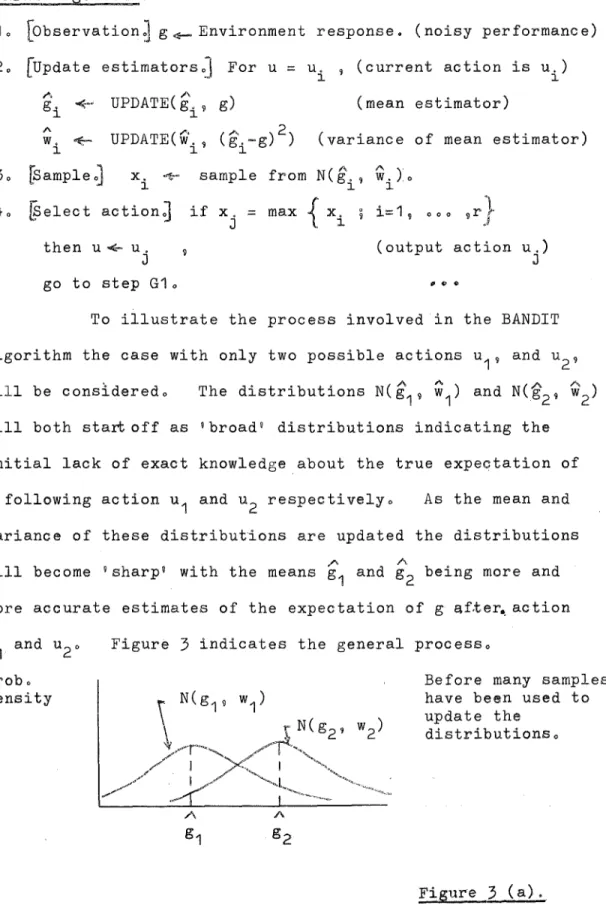
F10 [Observation 0] g ~ observed environment responseo
F2. [Reward set up
J
Let g.=
max {g.J 1.
. 1 . 1
~ 1.= 9 0 0 0 9 r
f
0If 000 ,r • (No reward.)
A
Else if g ~ g. I and u = U. 9 (The last action was u.)
J 1. 1.
o (Reward i th action).
F3. [Record performanceJ if u
=
u. (Last action was u.).1. 1.
then + (1- iT) g
k. ~ k. + 1 ,~4-( k. = 1 ) /k .•
1. 1. 1. 1.
F40 [Update.] if z. := 0, i=1, 0 0 0 9r I then go to F5.
• . 1.
(No update unless reward) 0
A A
Else p. -+-- o{p. + (1= C<)z. , for i=1, 000 ro
1. 1. 1.
(ct.=constant,O<0<.<1).
F50 [Select actionJ Select action u. with probability p. 0
1. 1.
u -+' U. (execute action u.)
1. 1.
go to step F1. • ••
A
In the above procedure g. is a mean estimator for
1.
the performance measure resulting from the use of action u. 0