
MASTER THESIS
DATA LOCATION
COMPLIANCE
IN CLOUD COMPUTING
J. Noltes
MSC COMPUTER SCIENCE
TRACK INFORMATION SYSTEMS ENGINEERING
EXAMINATION COMMITTEE dr. ir. W. (Wolter) Pieters
dr. ir. V. (Virginia) Nunes Leal Franqueira M.J. (Mark) Butterhoff RE bc (KPMG)
DOCUMENT NUMBER
Data location compliance
in cloud computing
Master thesis
MSc Computer Science
Track Information Systems Engineering
Johan Noltes
s0089990 26 August 2011 Final version
Graduation committee
dr. ir. W. (Wolter) Pieters
Management summary
The Gartner hype cycle defines 2011 as ‘the year of the cloud’. Cloud computing combines the newest techniques to deliver new services, which are rapidly scalable, are using shared resources, offer pay-per-use and are delivered via a broadband network (e.g. internet). Consumers are rapidly adopting cloud computing, but business are hesitating. An important factor for this hesitation is that businesses need to be compliant to legislation.
An example of such legislation is the EU data protection directive, which states that privacy sensitive data should always be located within the European Union. However, due to the nature of cloud computing, the location of the data is often unknown, or may change frequently. Currently, Cloud Service Providers (CSPs) do not always offer services that comply to this data location legislation, or in case they do, they do not always show compliance to their customers. This research is about how CSPs can show compliance to customer demands regarding data location.
Interviews with CSPs show that CSPs are currently in principle able to determine and control the location of data of their customers, e.g. by using the configuration of the hypervisor. However, these CSPs do not give guarantees about the location of data.
This research proposes the Cloud Computing Compliance Guideline, based on interviews and literature study. The Cloud Computing Compliance Guideline gives a process description of showing compliance, which enables CSPs to show compliance to customer demands regarding data location. The Cloud Computing Compliance Guideline comprises of four phases.
Phase 1 describes how the customer prepares the movement to the cloud, by carrying out a risk assessment, data classification, creating security demands regarding data location and CSP selection. Phase 2 describes the negotiation process between the customer and CSP. The guideline describes two frameworks that can be used for the SLA negotiation: the SLA@SOI framework and the XACML framework. After the automated negotiation, the CSP takes security measures to ensure data will be stored conform the agreements. Phase 3 describes the regular storage process. Because all security measures are taken, no extra efforts are needed. However, the CSP monitors and logs the
movement of data, to detect possible violations. Phase 4 describes how the CSP shows compliance to the customer demands regarding data location. This is done by regularly reporting the current status, and carrying out external audits to give assurance about the correctness of the process.
When these phases are carried out correctly, an auditor checks whether CSP executes the correct processes and data is stored on the allowed locations. If this is the case, the auditor can give assurance that the agreements with the customer are enforced, so the CSP can show compliance to the customer demands.
Preface
This document contains my master thesis, the final document that I produced for the master Computer Science at the University of Twente. It describes the results of my research on data location compliance in cloud computing, which I carried out at KPMG IT Advisory. During my period at KPMG, cloud computing became an important proposition for the company. I hope that the results of this research contribute to the knowledge and propositions within the company.
This master thesis would not have been possible without the support of many people, starting with my supervisors Wolter and Virginia. They helped me to get the right research approach, and continuously delivered high quality feedback. I would like to thank them for their guidance and support. In addition I would like to thank Mark, my supervisor at KPMG, for his guidance: his enthusiasm and quick reasoning helped me to make the right decisions after only a few questions.
I would also like to thank my fellow students in Enschede and my fellow colleagues at KPMG. They provided a pleasant atmosphere to work on this project, and the informal conversations brought me a lot of new insights, hints and feedback. But off course I am especially thankful for the great times we spent together and hopefully keep doing in the near future.
Finally, I would like to make a special note for my parents and family. They supported me
throughout my entire study, and encouraged all great activities like my time at the board of
Inter-Actief and the study tour to the United States. Thanks to their faith and support, I was able to finish my study and make it an great time to look back on.
I hope you will enjoy reading this master thesis about data location compliance in cloud computing. If you have any questions, please feel free to contact me.
Johan Noltes
Contents
1 Introduction ... 1
1.1 Motivation ... 1
1.1.1 Market situation ... 2
1.1.2 Risk ... 2
1.1.3 Data location legislation ... 3
1.1.4 Current situation... 4
1.1.5 Conclusion ... 4
1.2 Document structure ... 4
2 Background ... 7
2.1 What is cloud computing ... 7
2.2 Service models ... 8
2.2.1 Traditional IT ... 9
2.2.2 Infrastructure as a Service (IaaS) ... 9
2.2.3 Platform as a Service (PaaS) ... 9
2.2.4 Software as a Service (SaaS) ... 10
2.2.5 ‘X’ as a Service ... 10
2.3 Deployment models ... 10
2.3.1 Private cloud ... 10
2.3.2 Public cloud ... 10
2.3.3 Community cloud... 11
2.3.4 Hybrid cloud ... 11
2.4 Conclusion ... 12
3 Research methodology ... 13
3.1 Scope ... 13
3.1.1 Compliance aspects ... 13
3.1.2 Stakeholder perspective ... 13
3.1.3 Customer segment... 13
3.1.4 CSP segment ... 13
3.1.5 Cloud service model ... 13
3.1.6 Cloud deployment model ... 14
3.2 Problem statement ... 14
3.2.1 Research questions ... 14
3.3 Methodology ... 14
3.3.1 Expert interviews ... 15
3.3.2 CSP interviews ... 15
3.3.3 Literature study ... 16
3.3.4 Modeling ... 16
3.3.5 Validation ... 16
vi Master thesis Data location compliance in cloud computing – Johan Noltes
4 Customer demands ... 19
4.1 What makes cloud computing different for customer demands? ... 19
4.2 Compliance in cloud computing ... 20
4.2.1 What is compliance? ... 20
4.2.2 Relevant legislation ... 21
4.2.3 Consequences of non-compliance ... 22
4.2.4 Legal and regulatory versus accountability approach ... 22
4.2.5 Defining location ... 22
4.3 How do customers determine their demands in cloud computing? ... 23
4.3.1 Risk analysis ... 23
4.3.2 Data classification ... 23
4.3.3 Security demands and Service Level Agreements ... 24
4.4 Conclusions ... 25
5 Cloud Service Provider infrastructure and data location ... 27
5.1 Technical infrastructure ... 27
5.1.1 Virtualization ... 27
5.1.2 Data storage ... 27
5.1.3 Data storage virtualization ... 28
5.2 Data location determination ... 28
5.2.1 IaaS... 29
5.2.2 PaaS... 29
5.2.3 SaaS ... 30
5.2.4 From virtual locations to physical locations ... 30
5.2.5 Data location movement... 31
5.3 Conclusions ... 31
6 Current limitations for CSPs in showing data location compliance ... 33
6.1 Negotiation and agreements ... 33
6.2 Enforcing data location ... 34
6.2.1 Enforcing data location ... 34
6.2.2 Giving assurance ... 35
6.3 Chain of suppliers ... 36
6.4 Conclusion ... 37
7 Agreements and enforcement ... 39
7.1 Negotiation and agreements ... 39
7.1.1 Literature study: policy specification languages ... 40
7.1.2 Literature study: SLA negotiation frameworks ... 42
7.1.3 Conclusion ... 46
7.2 Enforcing agreements ... 47
7.2.1 General enforcing techniques ... 47
7.2.2 SLA@SOI ... 47
7.2.3 XACML framework ... 47
7.3 Chain of suppliers ... 48
7.3.1 Infrastructure as a Service (IaaS) ... 48
7.3.2 Platform as a Service (PaaS) ... 48
7.3.3 Software as a Service (SaaS) ... 49
7.3.4 Conclusion ... 49
7.4 Conclusion ... 49
8 The Cloud Computing Compliance Guideline ... 51
8.1 Phase 1: Preparation ... 52
8.2 Phase 2: Making service agreements ... 52
8.2.1 Negotiation and making service agreements ... 52
8.2.2 Enforcing agreements ... 52
8.3 Phase 3: Data storage ... 53
8.4 Phase 4: Reporting ... 53
8.4.1 Giving assurance ... 53
8.4.2 Audit results ... 55
8.4.3 Iterative loop ... 55
8.5 Conclusion ... 56
9 Validation... 57
9.1 Interview approach ... 57
9.2 Interview results ... 57
9.2.1 Cloud Computing Compliance Guideline: general overview ... 58
9.2.2 Phase 1: Data location ... 58
9.2.3 Phase 2: Negotiation and agreements ... 58
9.2.4 Phase 2 / 3: Enforcing ... 59
9.2.5 Phase 4: Reporting ... 59
9.2.6 Phase 4: Showing compliance ... 59
9.2.7 Cloud Computing Compliance Guideline: feasibility of implementation ... 60
9.2.8 External validation ... 60
9.2.9 What is missing? ... 60
9.3 Conclusions ... 61
10 Conclusions, discussion and future work ... 63
10.1 Conclusions ... 63
10.1.1 Customer demands ... 63
10.1.2 Data location ... 63
10.1.3 Current limitations ... 63
10.1.4 Making agreements ... 64
10.1.5 Enforcing agreements ... 64
10.1.6 Showing compliance ... 64
10.2 Reflection ... 65
10.2.1 Contributions ... 65
10.2.2 Limitations of research ... 65
viii Master thesis Data location compliance in cloud computing – Johan Noltes
10.3 Future work ... 67
References ... 69
Abbreviations ... 76
Appendices ... 77
Appendix A Cloud Computing Compliance Guideline ... 79
Appendix B Directive 95/46/EC of the European Parliament and of the Council ... 81
Appendix C CSP cloud architecture ... 83
Appendix D Interviews ... 85
Appendix E Cloud expert interview questions ... 87
1
Introduction
[image:13.595.75.482.226.434.2]According to the Gartner Hype Cycle [1], 2011 is ‘the year of cloud computing’. In this year, many organizations are considering to start using the cloud. But what is cloud computing, is this hype something completely new? No. Since the start of professional IT use, the commoditization and centralization of IT has increased each year. Years ago, organizations had all their IT in their own server rooms, ‘on premise’. Over the past years, the servers were shared with other businesses in shared service centers (SSC), while recently they have been outsourced to third parties. Cloud computing is the next central step in this evolution of IT, as depicted in Figure 1.
Figure 1 Paradigm shift in IT [2]
Cloud computing combines the newest techniques to deliver new services, which are rapidly scalable, are using shared resources, offer pay-per-use and are delivered via a broadband network (e.g. internet). Cloud computing can be offered in three service models which determine which components are offered by the CSP; Infrastructure as a Service (IaaS), Platform as a Service (PaaS) and Software as a Service (SaaS). This can be done using four deployment models which determine with who resources are shared; private cloud, public cloud, community cloud and hybrid cloud. These concepts are described more elaborately in chapter 2.
1.1
Motivation
Chapter 1
2 Master thesis Data location compliance in cloud computing – Johan Noltes
1.1.1 Market situation
In 2010, KPMG held a survey with 125 respondents [5], all decision makers and business managers in the Netherlands. A 59% majority of them agrees with the statement that cloud computing is the future model of IT, while only 12% disagrees. The respondents believe that cloud computing is not a hype, but an important future IT concept.
The Gartner CIO Agenda 2011 [6] shows the results of a survey held with 2,014 CIOs. The
respondents work across 27 industries and in 41 countries, and represent more than $159 billion in corporate and public sector IT spending. Cloud computing is ranked first as strategic technology priority for 2011, showing the importance CIOs attach to this technology.
Market-research firm IDC [7] expects IT cloud services spending to grow from about $16 billion in 2008 to about $42 billion by 2012 and to increase its share of overall IT spending from 4.2% to 8.5%. According to the research firm Gartner [8], global sales of cloud services rose 17% in 2010, to $68.3 billion from $58.6 billion in 2009. Global sales of cloud services are expected nearly to double by 2012, to $102.1 billion, Gartner estimates.
1.1.2 Risk
[image:14.595.73.432.463.703.2]Despite the mentioned advantages and importance given to cloud computing by practitioners, cloud computing comes with a certain risk, for example the aspects mentioned in Figure 2: hardware is owned by and located at the CSP, resources are shared with other customers and data is transported over the public internet. For many organizations, these are reasons why they do not want to use the cloud for (all of) their IT services. A 76% majority of participants in the KPMG cloud computing survey [5] considers security issues to be their main concern regarding the use of cloud computing. In addition, the participants consider legal (51%), privacy (50%) and compliance issues (50%) to be areas of risk.
Figure 2 Cloud computing aspects [2]
1.1 Motivation
to the cloud, a number of requirements has to be met. One of the requirements is that the organizations still conform to all applicable regulations and legislation. An important aspect that hinders businesses users from going to the cloud is compliance to data location legislation [5].
1.1.3 Data location legislation
EU Directive 95/46/EC [9], better known as the EU Data Protection Directive, is part of the European privacy legislation and regulates the processing of personal data within the European Union.
Personal data is defined as “any information relating to an identified or identifiable natural person”. The EU directive makes a difference between the “controller” of the data, who determines the purposes and means of the processing of personal data (data owner), and the “processor” of the data, who actually processes and stores the data. The responsibility for compliance rests on the shoulders of the controller. The data protection rules are applicable not only when the controller is established within the EU, but whenever the controller uses equipment situated within the EU in order to process data. Controllers from outside the EU, processing data in the EU, do also have to comply to data protection regulation.
In an example where a Dutch car dealer stores information about his clients in a database that is managed by an external IT company, the car dealer is the controller and the external IT company is the processor. In this example, the car dealer has to show compliance to the EU Data Protection Directive.
Chapter IV, article 25-26 of the EU Data Protection Directive [9] states that personal data may only be transferred to a country outside the European Union, if that country provides an adequate level of protection. Only four countries are listed as having an adequate level of protection. The result of this directive is that organizations located in the EU or organizations processing data in the EU, must know the location where their data is stored and processed. See Appendix B for the complete text.
An interview with an Account Executive Public Affairs at Fleishman-Hillard (see Appendix D), shows that the European Commission is currently reviewing the European Data Protection Framework. A hearing held with Viviane Reding (the European Commissioner in charge of the review) in March 2011 shows a number of new and important developments in the review: the new legal data protection framework will apply to all EU citizens regardless of where the data is collected and stored. Translated this means that EU data protection rules will also apply to organizations that process and store data of European citizens but are based outside of the EU.
The Dutch implementation of the EU Data Protection Directive is the “Wet bescherming
persoonsgegevens” (Wbp) [10]. The processing of personal data should be reported to the “College Bescherming Persoonsgegevens” (CBP, formerly known as “Registratiekamer”), which stores the registrations in a public register and monitors compliance with Wbp. The Wbp consists of the same content as the EU Data Protection described before. Chapter 12 of the Wbp states that organizations in the Netherlands may not transfer personal data outside the EU.
Chapter 1
4 Master thesis Data location compliance in cloud computing – Johan Noltes
Due to legislation, companies have to store privacy sensitive information within the EU, or other countries that provide a certain level of minimal protection. This holds for any type of storage: when data is stored on paper, within own IT systems, and on third party IT systems. The next subsection relates this legislation to cloud computing.
1.1.4 Current situation
In the case of cloud computing, the customer of cloud services is the controller, and the cloud service provider (CSP) is the processor. As mentioned in the previous section, the customer has to be compliant to the EU Data Protection Directive, and has to show that privacy sensitive data stays within the EU.
At the moment, it is difficult for cloud customers to determine what happens with their data that is stored in the cloud, because customers do no longer have (direct) control over physical servers, security measures and data location, so the customer has to trust the CSP. This is especially difficult regarding compliance; when the customer does not know the location of its data, it cannot show compliance to the EU Data Protection Directive.
In IT, it is common to have a service level agreement (SLA)in which the CSP and the customer make agreements on a minimum level of the quality of service and additional arrangements. However, for most of current well-known cloud services, customers can only accept standard, non-customizable SLAs. In these SLAs, CSPs offer certain guarantees like uptime, but other aspects like data location are not mentioned or guaranteed. E.g. Google Apps offers only one standardized SLA for all its customers [12], Salesforce.com does not have a SLA at all [13] and Microsoft Office 365 did not provide a SLA during the beta phase. Office 365 however will provide EU data location guarantees when the product is out of the beta phase.
An example that demonstrates this problem is the Dutch government [14], which has defined a ‘cloud first strategy’: all government ICT has to be taken from the cloud as much as possible; only with good arguments this rule can be deviated. However, the Dutch government has concluded that the cloud market is not mature enough yet to be able to show compliance to legislation, so it will not use any public cloud service, but it will build its own private government cloud.
1.1.5 Conclusion
2011 is ‘the year of cloud computing’, customers rapidly adopt cloud services. However, businesses are not using cloud services that much. One reason for this slow adoption is legislation that applies to these businesses. They have to store information conform this legislation, which means in case of e.g. the EU Data protection directive that data should stay within the EU. However, current market offerings do not always comply to this legislation, or in case they do, show this compliance to customers.
1.2
Document structure
The rest of this document is structured as follows. Chapter 2 gives theoretical background
1.2 Document structure
2
Background
The motivation for this research has been explained in the previous chapter. To get a better understanding about cloud computing, this chapter provides background information about the cloud computing service models and cloud computing deployment models. Understanding the different cloud computing models provides more insight in the problems that occur concerning data location compliance.
2.1
What is cloud computing
To formally describe cloud computing, the definition by the National Institute of Standards and Technology (NIST) is often used, and is used in this research:
DEF1: “Cloud computing is a model for enabling convenient, on-demand network access to a shared pool of configurable computing resources (e.g., networks, servers, storage, applications, and services) that can be rapidly provisioned and released with minimal management effort or service provider
interaction.” [15]
[image:19.595.75.496.454.657.2]The primary idea in cloud computing is that organizations do not longer manager and own their IT, but have it delivered as a service by a CSP. Over the last years, there is a trend to outsource more and more of IT to external parties. It is difficult to make a sharp distinction between shared service centers, hosting, outsourcing and cloud computing. Figure 3 shows the difference between these terms based on three aspects: delivery of service, management of IT resources and ownership of assets. The more these aspects can be plotted to the right on the arrows, the more can be spoken about (public) cloud computing.
Figure 3 Hosting, outsourcing and cloud computing [2]
To describe cloud computing, and the fundamental difference with traditional IT or outsourcing, the following characteristics [15] can be used:
Chapter 2
8 Master thesis Data location compliance in cloud computing – Johan Noltes
Rapid elasticity: cloud services can be, easily scaled up and down by the demands of the customer. Quickly and temporary scaling up processing power is called ‘bursting’.
Measured service: customers only pay for a service they use (‘pay-as-you-go’ or by subscription) instead of paying for long-term licenses and/ or investments in hardware which are not related to the actual usage.
Broad network access: although leased lines and proprietary networks can be used for cloud computing, its primary infrastructure is the public internet.
On-demand self-service: in contrast to the vast majority of traditional IT, cloud services can be used almost instantly.
An easy to understand example of cloud computing is e-mail. In the traditional IT model,
organizations had their own e-mail servers, which were managed by company IT administrators. The e-mail was only available within the office, and the IT administrators had to manage and backup their e-mail for the whole organization. When a server reached its capacity, the administrators had to deploy extra servers. With cloud computing, organizations buy e-mail as a service from a CSP, e.g. Gmail or Microsoft Office 365. The CSP stores the e-mails somewhere on its servers, manages the backups, and delivers a nearly 100% availability from anywhere over the world. And when an e-mailbox is full, it is easy and cheap to buy some extra storage space. The organization only pays for the amount of service it uses.
2.2
Service models
[image:20.595.78.513.499.723.2]To be able to talk about more specific services, cloud computing can be split into three service models, Software, Platform and Infrastructure as a Service [15]. These service models describe the degree of service / control the CSP offers, and the degree of freedom a customer has. Figure 4 gives a graphical representation of the different service models, and their components. The blue blocks (indicated with ‘you manage’) are managed by the customer, grey blocks (indicated with ‘delivered as a service’) are delivered as a service by the CSP.
2.2 Service models
To explain the different service models, a company which uses a Customer Relationship Management (CRM) application is used.
2.2.1 Traditional IT
In the traditional IT environment, all computing infrastructure is located and managed on-premise. An organization buys its own servers, IT administrators manage the complete infrastructure from networking to application levels.
In the CRM example, the company IT department buys servers for the CRM software, installs the operating system, and deploys the CRM application on the server and client computers. Backups are managed by the IT department, and also expansion of the capacity. The company pays for the buying of new servers and licenses for the CRM software.
2.2.2 Infrastructure as a Service (IaaS)
Using Infrastructure as a Service (IaaS), the customers buys infrastructure services from a CSP, but manages the layers on top of the infrastructure itself. “In this service model, the CSP offers
processing power, storage, networks, and other fundamental computing resources. The consumer is able to deploy and run operating systems and applications. The consumer does not manage or control the underlying cloud infrastructure but has control over operating systems, storage, deployed applications, and possibly limited control of select networking components (e.g.
firewalls).” [15]. Examples of IaaS are Amazon Elastic Compute Cloud [16] and Terremark Enterprise Cloud [17].
When a customer uses IaaS in the CRM software example, the customer buys computing power and storage from the CSP. The customer IT department administrators configure a virtual machine on the infrastructure, on which an operating system is installed. They deploy the middleware for communication with other applications, and install the CRM software. There is no need to buy extra servers, when the application needs more resources, extra CPUs and storage can be assigned via a web interface or via the CSP, the customer only pays for the used computing power and data storage.
2.2.3 Platform as a Service (PaaS)
In the Platform as a Service (PaaS) model, the CSP offers a development platform on top of the services delivered with IaaS. “The consumer is able to deploy applications onto the cloud infrastructure created using programming languages and tools supported by the provider. The consumer does not manage or control the underlying cloud infrastructure including, but has control over the deployed applications.” [15]. Examples of PaaS platforms are Amazon Elastic Beanstalk [18], Microsoft Azure Platform [19], Force.com [20] and Google App Engine [21].
The CSP offers a development platform, on which applications can be built. This means that the customer IT department has to develop the CRM software in a programming language that suits the CSP development platform. Developers can take full advantage of cloud opportunities like
Chapter 2
10 Master thesis Data location compliance in cloud computing – Johan Noltes
2.2.4 Software as a Service (SaaS)
In the Software as a Service (SaaS) model, the CSP offers all infrastructure as a service, including the application. “The applications are accessible from various client devices through a thin client interface such as a web browser. The consumer does not manage or control the underlying cloud infrastructure, but may be able to set limited user-specific application configuration settings.” [15]. Examples of common SaaS applications are GMail [22], Office 365 [23] and SalesForce.com [24].
With SaaS, the customer takes the full application service from the CSP. The customer IT department does not have to install or deploy any software, the application can be used via the internet. The customer IT department (or business analysts) can configure the application to the customer’s needs, but only within the boundaries offered by the CSP. The customer only pays for the capacity used, this can consist of e.g. the number of users and/or premium options in the software.
2.2.5 ‘X’ as a Service
Many applications can be delivered ‘as a service’ these days, e.g. business processes, data, identity, etc. [25]. However, these services are not described in the formal definition for cloud computing, as IaaS, PaaS and SaaS cover the majority of services that can be offered by a CSP. Therefore, this research only uses the IaaS, PaaS and SaaS service models.
2.3
Deployment models
Cloud computing can be delivered with four deployment models: private, public, hybrid or
community [15]. These deployment models describe who owns, manages and is responsible for the services.
2.3.1 Private cloud
In a private cloud, the services are completely dedicated to the customer, resources are not shared with other customers. “The cloud infrastructure is operated solely for an organization. It may be managed by the organization or a third party and may exist on premise or off premise. Resources are dedicated only to the customer.” [15].
Figure 5a shows that the private cloud is only used by one customer, resources are not shared with other customers. The cloud service may be offered by the customer’s IT department itself, or by an external CSP. The Dutch government is example of an organization which is building its own internal private cloud.
2.3.2 Public cloud
In a private cloud, the delivered services are shared with other customers. “The cloud infrastructure is made available to the general public and is owned by an provider selling cloud services. Resources are shared among all customers.” [15].
2.3 Deployment models
Figure 5 a) Private and b) public cloud deployment models [26]
2.3.3 Community cloud
The community cloud combines aspects of the private cloud and public cloud: resources are shared, but only with other customers that have the same requirements. “The cloud infrastructure is shared by several organizations and supports a specific community that has shared concerns (e.g., mission, security requirements, policy, and compliance considerations). It may be managed by the
[image:23.595.73.517.71.260.2]organizations or a third party and may exist on premise or off premise.” [15].
Figure 6 Community cloud computing delivery model (adapted from [26])
Figure 6 shows an example of a community cloud, which is in this case used for a government community. The users of this community cloud (government agencies; all purple blocks in the figure) have the same demands and security requirements for their IT. Google offers such a government cloud with the Google Gov Cloud [27].
2.3.4 Hybrid cloud
[image:23.595.75.382.398.577.2]Chapter 2
[image:24.595.71.517.72.245.2]12 Master thesis Data location compliance in cloud computing – Johan Noltes
Figure 7 Hybrid cloud computing delivery model [26]
Figure 7 gives a graphical representation of a hybrid cloud, consisting of a public cloud and private cloud. The private cloud is only used by the customer, while the public cloud is shared with other customers. The private cloud and public cloud may be offered by different service providers. At the moment, it is difficult to ‘orchestrate’ these different clouds, in terms of information exchange and identity and access management [2].
2.4
Conclusion
3
Research methodology
This chapter describes the methodology for the research. Section 3.1 describes the scope of the research, section 3.2 describes the problem statement and research questions and section 3.3 describes the methodology used to answer the research questions.
3.1
Scope
This section delimits focus of this research using the following attributes: stakeholder perspective, compliance, customer segment, CSP segment, cloud deployment model and cloud service model.
3.1.1 Compliance aspects
Customers may have several aspects on which they have to show compliance and therefore want guarantees from a CSP on these aspects, like authorization, physical access, data location, employee screening etc. This research focuses solely on the data location aspect, because market experts indicate this as a major barrier for cloud computing [5].
3.1.2 Stakeholder perspective
It is possible to approach data location compliance from a customer perspective, or from a CSP perspective. Customers are the controllers of the data, so they are responsible for showing data location compliance to legislation. However, to be able to do this, customers need information and guarantees from CSPs about the location of their data. The focus of this research is on gathering this information, so the problem is approached from the CSP perspective, as the CSP is the party to give data location information to enable customers to be compliant.
3.1.3 Customer segment
The compliance aspect is mainly applicable to businesses that process or store (privacy) sensitive and confidential data within the EU. This research focuses on enterprises, rather than on individual customers, who do not have to comply to this legislation [9].
3.1.4 CSP segment
This research focuses on CSPs that use market standards for their data centers and software, so the results of this research can be used for all CSPs using the same standards. That also means that CSPs that have developed their own data centers and software, like Google with the Google File System [28], are out of scope.
There is a focus on mid-size CSPs. A focus on small providers would result in providers with probably only data centers in one country. Large-scale CSPs do have multiple data centers all over the world, but they might be reserved in giving away information, and might use their own technology which cannot be reproduced by other CSPs. The compromise is to focus on mid-size CSPs, with multiple data centers, preferable in multiple countries.
3.1.5 Cloud service model
Chapter 3
14 Master thesis Data location compliance in cloud computing – Johan Noltes
3.1.6 Cloud deployment model
The focus of this research is on public clouds, as resources are shared as much as possible there, and customer data is transferred often between resources and possible locations. In private clouds, customer data is processed and stored on resources that are associated with the specific customers, so the data location is clear.
3.2
Problem statement
Before customers can move to the cloud, they have to show that they are compliant to regulations and legislation regarding data location. Customers demand guarantees concerning data location form their CSP, but CSPs do often not offer guarantees about these issues.
3.2.1 Research questions
The goal of this research is threefold. The first goal is to investigate the current situation customers and CSPs experience concerning data location compliance in cloud computing (G1). The second goal is to identify limitations in the current situation (G2). The third goal is to propose solutions for the identified limitations (G3). This research is driven by the following research questions:
RQ1. Which are the typical customers’ demands regarding data location compliance? RQ2. What technical solutions do cloud service providers currently have?
RQ3. What are the current limitations for CSPs to show compliance to customer demands regarding data location?
RQ4. How to make agreements about data location demands between customer and CSP? RQ5. How can CSPs enforce security policies regarding data location?
RQ6. How can cloud service providers show compliance to customer demands regarding data location in public SaaS cloud computing?
3.3
Methodology
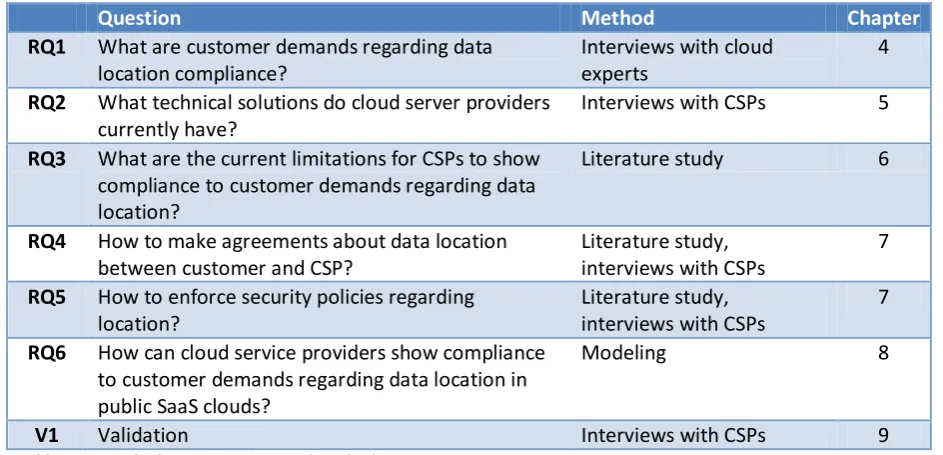
For each research question, a specific research method is used. The research questions and related research methods can be found in Table 1 and are explained in the following paragraphs.
Question Method Chapter
RQ1 What are customer demands regarding data location compliance?
Interviews with cloud experts
4
RQ2 What technical solutions do cloud server providers currently have?
Interviews with CSPs 5
RQ3 What are the current limitations for CSPs to show compliance to customer demands regarding data location?
Literature study 6
RQ4 How to make agreements about data location between customer and CSP?
Literature study, interviews with CSPs
7
RQ5 How to enforce security policies regarding location?
Literature study, interviews with CSPs
7
RQ6 How can cloud service providers show compliance to customer demands regarding data location in public SaaS clouds?
Modeling 8
[image:26.595.63.535.510.737.2]V1 Validation Interviews with CSPs 9
3.3 Methodology Customer demands CSP current technical solutions Current limitations Agreements and enforcement Conclusions Validation Showing compliance Literature study Cloud market expert interviews CSP interviews
[image:27.595.63.520.73.316.2]resource knowledge validation conclusion 4 5 6 7 8 9 10 comparison conclusion
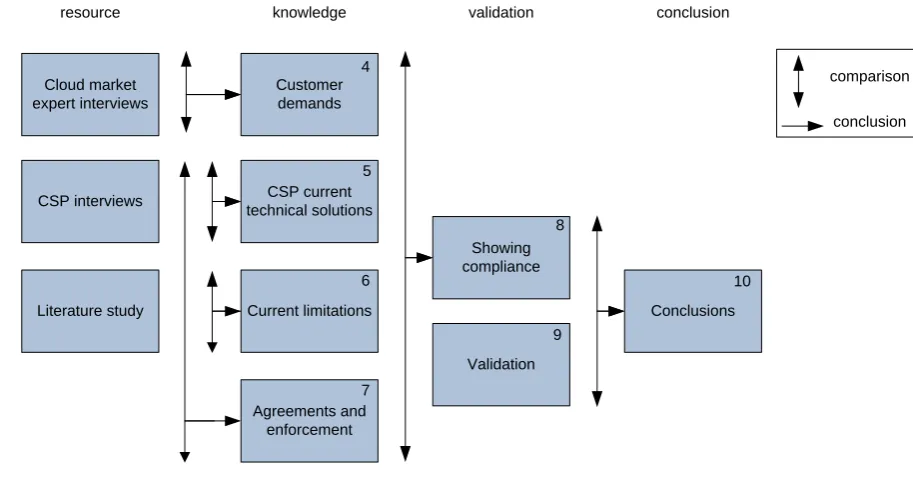
Figure 8 Research model
Figure 8 shows the structure of the outcomes needed in order to reach the goals of this research, according to the technique described by Verschuren and Doorewaard [29]. An arrow in this figure symbolizes a ‘confrontation’; a vertical arrow implies items that are compared to each other, a horizontal arrow implies a conclusion. The corresponding chapters in this thesis are shown in the upper right corners of the blocks.
3.3.1 Expert interviews
The first step of this research is to determine the changing demands customers have concerning the new environment cloud that the offers. To gain information about these customer demands, expert interviews are held. It would also have been possible to arrange interviews with actual cloud customers, but because of time constraints, KPMG experts in the cloud market are used.
The interviews have the goal to get an overview of the demands customers have in cloud computing and what the implications are for data location compliance. To achieve that goal, knowledge has to be gathered about how customers determine their demands for cloud computing, how these demands differ from traditional IT, why customers have these demands, and how customers expect think they to be fulfilled by CSPs. The questions for these semi-structured interviews can be found in Appendix E. The results of these interviews are used to determine the current limitations customers experience concerning their demands.
3.3.2 CSP interviews
Chapter 3
16 Master thesis Data location compliance in cloud computing – Johan Noltes
see possible future implementations to show compliance, with a focus on the data location. Third, data location is discussed, to see whether CSPs currently offer services, how they configure their infrastructure and how these security measures are enforced.
The interviews are held in a semi-structured way; a same list with (open) questions is used for each CSP, which can be found in Appendix F. During the interviews, new questions were added to enable a dynamic conversation, which helps to get more in-depth information, when possible.
3.3.3 Literature study
Based on the information about customer demands, and current offerings by the CSPs, a limitations analysis is carried out. The goal is to define limitations CSPs encounter to show compliance to customer demands regarding data location. The limitations are derived from the information gathered during the cloud expert and CSP interviews, and complemented with a search of literature.
To overcome the found limitations, a literature study is carried out. The literature study is carried out using a search on the internet, using related search terms on Google search, Google Scholar and SciVerse. The literature study provides pointers for the implementation of the guideline. Interesting publications are used for a backward and forward scan, to determine other interesting publications.
The goal of the literature study is to answer RQ4 and RQ5:
RQ4: How to make agreements about data location between customer and CSP? RQ5: How to enforce security policies regarding location?
To answer RQ4, the literature study focuses on security policies to specify security measures, automated negotiation and SLAs. To answer RQ5, the literature study focuses on enforcement of agreements and the enforcement of policies. In addition, the literature study focuses on how to give assurance to verify whether the security policies are actually enforced. The following keywords are used during the literature study:
(Policy OR Policies) AND (Cloud computing OR Grid computing) (Policy OR Policies) AND Specification language
Service Level Agreements AND Negotiation (Enforcing OR Enforcement) AND Agreements (Compliance OR Assurance OR Audit) AND Location
3.3.4 Modeling
The result of expert interviews, literature study and CSP interviews are used to define a guideline that describes how CSPs can show compliance to customer demands. The guideline proposes a process for CSPs to demonstrate how to make agreements about customer demands and show compliance to these demands. This guideline focuses on compliance to data location demands, but this may be easily extendable to other customer demands. The guideline also shows which
information is needed from a CSP to be able to show compliance to customer demands.
3.3.5 Validation
3.4 Conclusion
validation. Internal validation shows that the solution actually works, external validation shows whether the solution still works when the environment changes [30].
3.3.5.1 Internal validation
Wieringa states that “A solution theory is internally valid if its engineering argument is valid when 1) it is true that the interaction among Solution elements and Domain elements will produce certain Outcomes and 2) it is true that these Outcomes will take stakeholders closer to their Goals” [30].
A second round of interviews with CSPs is used to verify the internal validity of the guideline. It is checked whether the guideline is a useful addition to the current situation, and whether it is a feasible to implement the guideline. The results of the interviews are used to improve the guideline.
3.3.5.2 External validation
According to Wieringa, a solution is externally valid “if it is still internally valid when the problem changes a bit. This can be checked with a sensitivity analysis by placing the solution in future scenarios.“ [30]. During the second round of interviews with CSPs, a number of possible future scenarios with changes in the environment (customer demands, CSP technical infrastructure etc.) is discussed to check the external validity of the solution.
3.4
Conclusion
4
Customer demands
As indicated in chapter 1, many organizations would like to move to the cloud, but have concerns about security and compliance. In this chapter, the demands from cloud customers are investigated. This chapter answers RQ1:
RQ1: What are customer demands regarding data location compliance?
Section 4.1 describes which customer demands have that are specific to cloud computing, based on cloud markets expert interviews. Section 4.2 gives an introduction to compliance and related legislation and the impact for the customer demands. Section 4.3 describes how customers determine their demands in cloud computing by describing the typical process a customer carries out in before migrating to the cloud.
4.1
What makes cloud computing different for customer demands?
To determine what specific customer demands for cloud computing are, expert interviews are held. Four KPMG experts on the cloud market were interviewed using the interview questions which can be found in Appendix E.
During the interviews, KPMG experts on the cloud market indicated that the migration to the cloud creates extra points of attention for customers, compared to migrations to hosting or outsourcing. The experts indicate that customers attach importance to the following points:
Compliance to laws and regulations. Customers have to comply to applicable laws and regulations. When services are outsourced to a CSP, the customer is still responsible to show compliance, and expects information from the CSP to be able to do that. This point is discussed more elaborately in section 4.2.
Data location knowledge. To be able to comply to legislation, customers need to know the location of their data. The EU Data Protection Directive [9] states that data should be processed and stored within the EU. In addition, customers do not want their data to be stored in countries that have a legislation which allows the government to gain insight into their data, e.g. using the USA Patriot Act [31].
Security certificates. Customers expect the CSP to have an adequate level of security. CSPs can show this using e.g. a SAS 70 certification or ISO 27001 certification. This should also hold for third parties which deliver services to the CSP.
Chapter 4
20 Master thesis Data location compliance in cloud computing – Johan Noltes
performing an escrow 1. Another example is confidentiality of the data; customer require the CSP to protect the data. A CSP can indicate that it handles data secure with security certificates. Cloud readiness of applications. Not all applications are ready to be migrated to a cloud
computing platform. This especially holds for legacy applications, which cannot (or only with large investments) be migrated to the cloud. Customers need to assess which applications can be moved to the cloud, and expect CSPs to guide this process.
Internet connections. Because nearly all cloud computing services are delivered over the internet, the connections between the CSP and customer should be reliable and redundant.
These demands may be different for different types of customers. For example, banks do have strict security policies because trust is an important selling point in the financial sector, while for the shop-next-door these policies are less strict. The level and importance of the mentioned demand depends on the organization.
The KPMG survey on cloud computing shows that compliance and location issues are the biggest barriers for customers to adopt cloud computing; CSPs currently do not offer guarantees on data location compliance. In addition, the other mentioned issues can be solved with currently existing techniques, like escrows or certification for CSP track record and data ownership issues, redundant internet connections for availability and migration and legacy processes for existing applications. The focus of this research will therefore be on data location, compliance and legislation, as there are still research gaps on this topic.
4.2
Compliance in cloud computing
This section discusses what compliance is, which legislation is relevant concerning compliance in cloud computing, what hat the impact is for customer demands and how achieving compliance can be approached.
4.2.1 What is compliance?
The previous section indicated that compliance to legislation is important for customers when considering cloud computing. Compliance is an important term in this research, but this is not strictly defined with a general accepted definition. Compliance is a term that originates mainly in the financial sector, and legislation for financial institutes.
Today, the term compliance is more and more used outside the financial world, with broader definitions. The current general definition is as follows: “Compliance involves ensuring not only that an organization meets the requirements of regulations, legislation, and standards defined by
agencies that are external to the organization, but that is also enforces and ensures adherence to its own policies, procedures, standards, best practices, and plans” [32]. In this thesis, mainly compliance to legislation is discussed, as it applies to all customers.
There may be some confusion about the difference between the terms around the concepts of compliance and compliance and security. The following terminology is used during this research:
1 An escrow is an contractual arrangement made between the customer and CSP, whereby an independent
4.2 Compliance in cloud computing
Customers have to show compliance to legislation, e.g. to the EU Data Protection Directive. Customers and CSPs make agreements, e.g. the CSP will store the customer’s data within the EU. CSPs have generalsecurity policies, e.g. data center authorization policy, ISO 270001 policies. CSPs take specificsecurity measures for each customer according to agreements between the
parties, e.g. configure an environment for specific customer needs.
CSPs enforce these security measures, to ensure that the environment is setup conform the agreements with the customer.
A third party gives assurance that the security measures are enforced correctly according to the agreements.
CSPs show compliance to customer demands by allowing a third party audit to give assurance.
Note the difference between customers showing compliance to legislation, and CSPs showing compliance to customer demands.
4.2.2 Relevant legislation
In cloud computing, a number of laws and regulations is important for the customer concerning compliance:
EU Directive 95/46/EC (EU Data Protection Directive) [9]. This directive applies to companies which process privacy sensitive data within the borders of the European Union. See section 1.1.3.
Sarbanes-Oxley Act (SOx) [33]. The US legislation was enacted as a reaction to a number of major corporate and accounting scandals. It requires companies to manage their IT in such a way that software produces correct financial reports, and changes in software are logged.
Health Insurance Portability and Accountability Act (HIPAA) [34]. This US legislation has recently been expanded to include privacy clauses and security requirements for healthcare and insurance organizations.
Federal Information Security Management Act (FISMA) [35]. FISMA was introduced in response to concerns about cyber-security. The act requires all federal agencies to develop and implement agency-wide programs to secure data and information systems.
Payment Card Industry Data Security Standard (PCI DSS) [36]. PCI DDS isan information security standard for organizations that handle cardholder information for debit and credit cards. The standard was created to increase controls to reduce credit card fraud. Validation of compliance is done annually, by an external assessor for organizations handling large volumes of
transactions, or by a Self-Assessment Questionnaire for companies handling smaller volumes.
Some regulations do not specifically regulate the physical location of stored data, although an organization’s compliance and security planning may restrict location as part of its strategy. Risk management and data security analysis may be based on the properties of a particular data center. Moving data to a new location may change these analyses, leaving customers non-compliant.
Chapter 4
22 Master thesis Data location compliance in cloud computing – Johan Noltes
4.2.3 Consequences of non-compliance
In principle, an organization that stores or processes client data is responsible to show compliance to legislation (in this case the customer of the CSP is responsible to show compliance to its clients). For privacy in the Netherlands, it is the task of the ‘College bescherming persoonsgegevens’ (CBP) to monitor whether organizations are compliant to privacy legislation. A CBP compliance manual [37] describes three actions that may be carried out when a company does not comply to legislation:
A citizen can initiate actions
The public prosecutor may prosecute the company The CBP may take legal actions
In all of these cases, when non-compliance has been proven, a judge or the CBP may impose a fine. This shows the need for organizations that handle client data to be compliant.
4.2.4 Legal and regulatory versus accountability approach
Pearson and Charlesworth [38] describe two approaches to accomplish privacy for the customer in cloud computing: the ‘legal and regulatory’ approach, and the ‘accountability’ approach. The approach differs per country or jurisdiction, and has consequences for the way to show compliance. The EU Data Protection Directive is an example of the legal and regulatory approach, while
accountability is included in privacy legislation in e.g. Canada and the USA, and Pacific countries united in APEC [38].
With the legal and regulatory approach, data location is crucial to enforcement, because the location of data determines the jurisdiction and legislation that applies. With accountability, regulators enforce the law on the ‘first in the chain’, who has to give the assurance. In this case, data location is less relevant for the customer because of the assurance that data will be treated as agreed
regardless of jurisdiction. Because this research often refers to the EU Data Protection Directive, the focus of this research is on the legal and regulatory approach.
4.2.5 Defining location
This section discusses different options how data location can be defined, and how it should be defined in the context of this research. To show compliance to data location, the definition of data location plays an important role. There are various ways to define the location of data. It can be described as: [39]
a hard disk, a SAN, a data center,
a group of data centers, a country,
a geographical region, a juridical domain.
4.3 How do customers determine their demands in cloud computing?
to know the exact location of their data on a specific hard disk, SAN or server, but the country is specific enough. In this research, countries are used to define data locations.
ISO 3166-1 [40] standardizes all countries in the world, and can be by customers and CSPs as a language to exchange countries. A special note is made for the European Union, although it is not officially a country, it is often requested to standardize, so ‘EU’ is (not officially) reserved for the European Union. ISO 3166-2 describes per country the different states. This is especially useful to define data location within large countries with different jurisdictions like the United States.
4.3
How do customers determine their demands in cloud computing?
Another aspect that needs to be considered for a customer when moving to cloud computing is how to determine his demands. Before customers store data in the cloud, a process is followed to ensure it the data will be stored correctly and compliant to the relevant rules and legislation. Expert
interviews showed that the process consists of risk analysis, data classification and taking security measures. When data is stored off-premise, these security measures are negotiated with the CSP, and service level agreements are made to ensure the correct security levels. This section describes this process in more detail.
4.3.1 Risk analysis
Customers use risk analysis to determine how important their data is, how the data should be handled, to whom it may be disclosed, and which security measures the should demand from the CSP. In the case of cloud computing, customers typically carry out a risk assessment before data is moved to the cloud. In this research, it is assumed that this process results in a CIA-classification of data items.
NIST defines risk as: “a function of the likelihood of a given threat-source’s exercising a particular potential vulnerability, and the resulting impact of that adverse event on the organization” [41]. To determine the likelihood of a future negative event, it is analyzed how often threats to an IT system together with the potential vulnerabilities will occur. Impact refers to the magnitude of harm to the target that could be caused by a exploiting vulnerabilities. Risk is measured by the product of likelihood times impact; Risk = Likelihood * Impact [41].
Risk analysis can be done in a qualitative way and a quantitative way. In a qualitative risk analysis, an estimation of the impact and likelihood of the risk is made, e.g. in terms of a scale of high, medium and low. In a quantitative risk analysis, the impact and likelihood are quantified in measurable criteria, usually calculated using financial consequences.
The risk analysis results in a set of risk indicators, which show whether data is crucial to the organization, and the impact of negative events. Risk indicators can also include consequences of non-compliance. With the gathered risk indicators about possible threats, the data can be classified, which is described in the following section.
4.3.2 Data classification
Chapter 4
24 Master thesis Data location compliance in cloud computing – Johan Noltes
In this research, it is assumed that the CIA quality aspects are used for the data classification. Other data classification techniques are given by e.g. the Dutch “College Berscherming Persoonsgegevens” [42]. Because the CIA quality aspects are widely used and also is used within KPMG, these aspects are used for classification in this research project.
The NIST 800-60 guideline [43] gives a guideline for security categorization of information and information systems, based on two US federal information standards: the Federal Information Security Management Act [35] and the Federal Information Processing Standard [44]. It states three security objectives (CIA):
Confidentiality: Preserving authorized restrictions on information access and disclosure, including means for protecting personal privacy and proprietary information.
Integrity: Guarding against improper information modification or destruction, and includes ensuring information non-repudiation and authenticity.
Availability: Ensuring timely and reliable access to and use of information.
Based on the risk indicators about possible threats determined during the risk analysis, all data is given a rating for each of these three security objective, ranging from 1 (low) to 3 (high). A rating is low (1) if the loss of confidentiality, integrity, or availability could be expected to have a limited adverse effect on organizational operations, organizational assets, or individuals. A moderate (2) rating is assigned if the loss of confidentiality, integrity, or availability could be expected to have a serious adverse effect on organizational operations, organizational assets, or individuals. With a high (3) rating, the loss of confidentiality, integrity, or availability could be expected to have a severe or catastrophic adverse effect on organizational operations, organizational assets, or individuals. The combined rating for confidentiality, integrity and availability determines the classification of data [43].
4.3.3 Security demands and Service Level Agreements
Based on the classification of the data, different security measures should be taken for each class of data. For example, in the case of the EU Data Protection Directive, privacy sensitive data should be located within the European Union. In addition, ISO 27001 and ISO 27002 [45] (information security guidelines) can be used to determine which security measures should be taken. E.g. when have a high rating on availability, the network connections for that data should be carried out redundantly. When data has a high rating on confidentiality, it can be encrypted, or stringent access control mechanisms can be used.
In traditional on-premise solutions, these security measures are implemented by the customer itself. For off-premise solutions, which are managed by a CSP, agreements should be made with the CSP to guarantee a minimum level of security that complies to the classification. This is done using Service Level Agreements (SLAs). These SLAs typically describes the three CIA-aspects, but can also contain other agreements.
4.4 Conclusions
4.4
Conclusions
In this chapter, RQ1: “What are customer demands regarding data location compliance?” is answered. Interviews with experts in the cloud market have shown that customers have to show compliance to legislation, customers demand to know the location of their data, customers demand the CSP to have security certificates, customers demand a good track record by the CSP and demand assistance when migrating to the cloud. For this research, the data location compliance aspect is the most relevant.
The EU Data Protection Directive requires customers to store and process their data within the EU. To be able to show compliance to legislation, have to determine which security demands should be requested to a CSP. Therefore, customers carry out risk assessments on data, give data a
5
Cloud Service Provider infrastructure and data location
The previous chapter provided an overview of customer demands in cloud computing: to be able to be compliant, customers may only store data within certain allowed locations. With on-premise solutions, customers can take their own security measures to ensure data is stored in compliant locations, but in cloud computing, the customer depends on the CSP to take these security measures to be compliant. Therefore, the CSP has to actively manage the location of its customers data. This chapter investigates what services CSPs currently have, by giving an answer to RQ2:
RQ2: What technical solutions do cloud service providers currently have?
Section 5.1 starts with an introduction to the technical infrastructure of a typical CSP. Section 5.2 discusses how the location of data can be determined using this technical infrastructure.
5.1
Technical infrastructure
This section describes the typical setup of the technical infrastructure of a CSP, based on interviews held with 5 CSPs. As described in section 2.2, CSPs offer different services. Section 5.1.1 describes the main technical driver in cloud computing: virtualization. Section 5.1.2 describes how data is stored in cloud computing. Section 5.1.3 describes how this data storage is combined with a virtualized environment.
Please refer to Figure 4 on page 8 for a description of the cloud service models, while reading the following sections.
5.1.1 Virtualization
The main technical driver in cloud computing is virtualization. This technique allows a CSP to run multiple ‘virtual’ servers (guests) concurrently on one physical server (host). Such a virtual server is called a Virtual Machine (VM). In the IaaS service model, CSPs offer a VM and all underlying
infrastructure, i.e. processing, storage, networking. There are two options in delivering a VM: a client can create its own VM with operating system and configuration, or the CSP delivers a standard VM with pre-installed operating system.
The management of these VMs on a physical server is performed by the hypervisor, also known as virtual machine manager. The hypervisor presents a virtual operating platform to the guest
operating systems and manages the execution of the guest operating systems. The hypervisor gives the guests operating systems the impression that they are running on physical hardware, by assigning processing capacity, data storage and networking facilities. Examples of hypervisors are VMware [46], Hypver-V [47] (commercial) and Xen [48] (open source).
5.1.2 Data storage
In data centers, servers do not store data on their own hard disks, but on large storage clusters.
Chapter 5
28 Master thesis Data location compliance in cloud computing – Johan Noltes
Note that a SAN alone does not provide the "file" abstraction, but only block-level operations. In contrast to SAN, Network Attached Storage (NAS) uses file-based protocols such as NFS or SMB/CIFS where it is clear that the storage is remote, and computers request a file rather than a disk block.
5.1.3 Data storage virtualization
The hypervisor manages the data storage for the running VMs. The guest operating system thinks that it writes directly to a hard disk, while actually the hypervisor converts these operations to a virtual disk. These virtual disks are often referred to as LUNs2 (Logical Unit Numbers). A LUN is a
logical reference to a portion of a storage subsystem. A LUN can comprise a disk, a section of a disk, a whole disk array, or a section of a disk array in the subsystem. This logical reference, when it is assigned to a server in the SAN, acts as a physical disk drive that the server can read and write to. Using LUNs simplifies the management of storage resources in the SAN.
LUN Type Multiple disks Redundant Improved
performance
Simple
Spanned
Striped
Mirrored
Striped with Parity (RAID-5)
[image:40.595.73.392.261.384.2]
Table 2 LUN types and properties [50]
Table 2 gives an overview of different types of LUNs and their properties [50]. The advanced LUN types have the advantage that data is stored redundant, and/or the performance is improved. However, using multiple disks may result in different data locations and non-compliance to location demands, but interviews with CSPs indicated that VMs and attached LUNs always stay within the same data center for performance reasons.
There are two reasons why CSPs would move data to different countries with different jurisdictions. Firstly, dynamically spreading data over multiple locations leads to more redundant and delivers higher availability. When one data center becomes unavailable, other data centers can take over the tasks. Secondly, storing and processing data at different locations leads to more efficiency, when data can be stored or processed at a location with spare capacity or low processing (e.g. electricity) costs for specific moments, e.g. when solar power is available in overcapacity.
5.2
Data location determination
Appendix C shows the typical setup of a specific CSP that uses multiple connected data centers. For performance, efficiency or redundancy reasons, data may travel between these data centers. It is possible that these data centers are located in different countries. In this case it is not evident in which jurisdiction the customer data is located. The determination of the location of data differs per type of CSP; SaaS providers have to take a different approach than IaaS providers. In this section, an
2 LUN is actually not a correct reference for a virtual disk, because it refers to the addressing of the virtual
5.2 Data location determination
overview of the different service models is given to demonstrate the different ways to determine the location of data.
Server with VM’s
VM with SaaS app.
SaaS application Operating system Virtual disk 1 SAN LUN 1
VM offers PaaS
Development platform Operating system Virt. disk 2
LUN 2 LUN 3
Storage controler logic
HDD X HDD Y
Virt. disk 3
Hypervisor
VM offers IaaS
Operating system
Virtual disk 4
[image:41.595.74.333.110.449.2]LUN 4
Figure 9 Virtual disks (LUN) in cloud computing (adapted from [51])
5.2.1 IaaS
In the IaaS service model, the CSP delivers computing capacity and storage. Customers deploy their Virtual Machines (VM) with operating system and applications to the IaaS infrastructure. The virtual storage in the VM is attached to physical storage via the hypervisor. Figure 9 shows a VM with a connected SAN for data storage. The hypervisor lets the guest operating system in the VM think it is attached to a physical hard disk (HDD) directly, but redirects these hard disk operations to the connected virtual disk (LUN). This LUN is stored on one (or more) of the physical hard disks in the SAN.
VMware software is software which is often used as a hypervisor at IaaS CSPs. VMware Distributed Resource Scheduler [46] allows creating ‘affinity’ rules that govern the allocation of virtual machines and storage to physical servers. For example, certain virtual machines can always run on the same server for performance or compliance reasons, or data can be always stored on a specific virtual disk. Alternatively, specified virtual machines can always run on different servers for increased availability.
5.2.2 PaaS
Chapter 5
30 Master thesis Data location compliance in cloud computing – Johan Noltes
Microsoft Azure platform [52] gives users the choice between three zones: US, Europe and Asia. For the Google App Engine [21], no data location choices are available, Google stores the data
somewhere on its worldwide servers. On Force.com [20], users do not have any choice about the data location.
A general problem in controlling the location of the data with PaaS services is that PaaS providers might depend on third parties for their infrastructure (IaaS). This makes it more difficult to detect the location of the data. In case IaaS is used, data location can be delegated to the IaaS provider.
5.2.3 SaaS
The setup of SaaS environments might differ per provider, and with the enormous number of different SaaS applications it is difficult to make statements about data location determination that can be generalized. Some providers offer the same data location availability zones as mentioned with some PaaS providers. SaaS providers may depend on PaaS providers and/or IaaS providers. It is the question whether the data location at these service levels can be controlled by the CSP or the supplier.
A general problem with SaaS providers is that they may use third parties to provide the platform and/or infrastructure. These third parties may also depend on other parties to provider their services. For customers, it is difficult get an overview of this ‘chain of suppliers’, which makes it also difficult to exactly determine the location of customers’ data [53]. However, it stays the
responsibility of the CSP to show compliance to customer demands, even when the CSP uses
external parties for data storage. This implies that the CSP has to make agreements with its suppliers that conform to the agreements made with the customer.
5.2.4 From virtual locations to physical locations
For all service mode
![Figure 1 Paradigm shift in IT [2]](https://thumb-us.123doks.com/thumbv2/123dok_us/1197792.643119/13.595.75.482.226.434/figure-paradigm-shift-in-it.webp)
![Figure 2 Cloud computing aspects [2]](https://thumb-us.123doks.com/thumbv2/123dok_us/1197792.643119/14.595.73.432.463.703/figure-cloud-computing-aspects.webp)
![Figure 3 Hosting, outsourcing and cloud computing [2]](https://thumb-us.123doks.com/thumbv2/123dok_us/1197792.643119/19.595.75.496.454.657/figure-hosting-outsourcing-cloud-computing.webp)
![Figure 4 Cloud computing service models [4]](https://thumb-us.123doks.com/thumbv2/123dok_us/1197792.643119/20.595.78.513.499.723/figure-cloud-computing-service-models.webp)
![Figure 5 a) Private and b) public cloud deployment models [26]](https://thumb-us.123doks.com/thumbv2/123dok_us/1197792.643119/23.595.73.517.71.260/figure-private-b-public-cloud-deployment-models.webp)
![Figure 7 Hybrid cloud computing delivery model [26]](https://thumb-us.123doks.com/thumbv2/123dok_us/1197792.643119/24.595.71.517.72.245/figure-hybrid-cloud-computing-delivery-model.webp)
![Table 2 LUN types and properties [50]](https://thumb-us.123doks.com/thumbv2/123dok_us/1197792.643119/40.595.73.392.261.384/table-lun-types-and-properties.webp)
![Figure 9 Virtual disks (LUN) in cloud computing (adapted from [51])](https://thumb-us.123doks.com/thumbv2/123dok_us/1197792.643119/41.595.74.333.110.449/figure-virtual-disks-lun-cloud-computing-adapted.webp)
