Faculty EECMS - Computer Science
Database Group
Master of Science Thesis
Towards Distributed
Information Retrieval
based on
Economic Models
Author:
E.
Eerenberg
Graduation Committee:
Dr. Ir. D.
Hiemstra
K.T.T.E.
Tjin-kam-jet
, MSc.
Dr. Ir. M. van
Keulen
Acknowledgments
In February of 2010 I started to look for a challenging and fun final project, which I hoped to find by wandering around the building of Computer Sciences and talk to many different professors. I already had my own idea of using eco-nomic models in computer science problems that I came up with during a study tour I had organized. During this study tour, I witnessed a motivating presen-tation of a professor at Harvard about how he had built a successful spam-filter using an economic model instead of using traditional computer science tech-niques. During the final assignment of my Bachelor curriculum, I had already applied economic models on planning problems and that had been a fun and challenging assignment.
When I walked into Djoerd his office in February, there was a lucky coin-cidence. Djoerd turned out to be researching the use of online advertisement models (economic models) as a means to organize distributed information re-trieval. I had found my assignment! Djoerd introduced me to Kien and Almer as members of the committee, and the assignment was started. Sadly, Almer left the committee after a few weeks, but I would still like to thank him for his support with the system design.
Being a politician for the city council and running again for office, the po-litical campaign had started as well in February, intensively. So I started si-multaneously with my thesis assignment and the political campaign, which was followed by coalition negotiations. Maybe I should have waited with the start of my thesis, as I was spotted phoning a lot in the staircase. Nonetheless, I want to thank Djoerd and Kien sincerely for their trust in letting me combine these two hectic happenings.
During the past 9 months, Djoerd, Kien and I had interesting, motivating and chattering meetings about the project. I would like to thank Kien for his sharp eye, showing me the large amount of tiny mistakes that I made while typ-ing this report. Furthermore, Kien really helped me with his critical questions on the simulation setup, guiding me into the right direction. Djoerd I would like to thank for his quick mind; always rapidly grasping the essence of a problem and steering me into the right direction with only a few remarks. Especially the one time when Djoerd walked into the computer room and asked a question about what was missing in my homebrewed corpus, making me realize that the corpus was unusable and we had to skip that part of the research. Despite of this single question making a week of work useless, it also sharpened my view on the problem and I learned that it is sometimes good to rethink your approach drastically.
knowing the risks of doing so.
Maurice was asked to join the committee for the last few weeks. I would like to thank him for the support he gave me when discussing the problems I faced with the model checker. It forced me to rethink everything, and to finally come up with a useful way of applying it.
Finally, I want to think my friends, family and girlfriend. They participated in the tests (if qualified), and debated the subject with me extensively.
I had a great time, and I will certainly miss the research environment where one is free to investigate if ideas will work without being in the pressure cooker of a company.
Abstract
Introduction
With the ever increasing amount of data on the Internet, there is an in-creasing need to search this informa-tion in new and more efficient ways. A part of the data on the Internet are not accessible to traditional search en-gines, as these data can only be ac-cessed by a form for example. With distributed information retrieval sys-tems however, these types of data can be accessed. In these systems there is a central broker with multiple servers, and the broker redirects queries to the servers. Each server fetches results from its own database and returns this to the broker.
We are interested if this architec-ture can be built using an economic model, in which servers need to pay for the right to return results. We have seen from previous research that the use of an economic model might yield good results, as a successful spam fil-ter based on an economic model has already been built.
The aim of this research is to build a successful distributed information re-trieval system based on an economic model, allowing servers to open up their part of the deep web.
Methodology
This research consists of three parts: 1) selecting suitable economic models,
2) simulating these models, and 3) per-forming a real-world test.
We selected the economic models starting with a review of the cur-rent literature on economic models. With the obtained information we performed a multi-criteria analysis, a model checking phase, and a test on economic properties to select suitable models.
The remaining models were simu-lated in custom-built simulation soft-ware, in which multiple variables were modified in different runs in order to observe their effects.
The most suitable economic model was implemented in a real-world test, in which users valued the results of the system based on an economic model as well as a traditional search engine.
Results
appreci-ate both the use and administration of an information retrieval system based on an economic model. Furthermore, if we apply a perfect categorization, the economic model outperforms the com-parison engine with a 66% increase in performance.
Discussion
We conclude that it is possible to build a distributed information retrieval
Contents
Acknowledgments i
Abstract iii
1 Introduction 1
1.1 Traditional Search Engines . . . 2
1.2 The Deep Web . . . 2
1.2.1 Searching the Deep Web . . . 2
1.3 Distributed Information Retrieval . . . 3
1.4 Motivation . . . 4
1.5 Problem Description . . . 4
1.6 Research Questions . . . 5
1.7 Hypotheses . . . 5
1.8 Organization and Methodology . . . 6
1.9 Chapter Summary . . . 8
2 Background 9 2.1 Economic Models . . . 10
2.1.1 Agent-Based Computational Economics . . . 10
2.1.2 Pareto Efficiency . . . 11
2.2 Modeling Email Value and Spam . . . 11
2.2.1 Motivation . . . 11
2.2.2 Generic Economic Model . . . 12
2.2.3 Attention Bond Mechanism . . . 14
2.2.4 Summarizing Conclusions . . . 17
2.3 Query Categorization . . . 18
2.4 OpenSearch . . . 18
2.5 Information Retrieval Measures . . . 19
2.5.1 Precision . . . 19
2.5.2 Recall . . . 19
2.6 Related Work . . . 20
2.6.1 Resource Selection . . . 20
2.6.2 Results Merging . . . 20
2.6.3 Economic Models . . . 21
3 Economic Models for Distributed Information Retrieval 23
3.1 Generic Model . . . 24
3.2 Economic Model Selection . . . 24
3.2.1 Literature review . . . 25
3.2.2 Multi-Criteria Analysis . . . 26
3.2.3 Model Checking . . . 30
3.2.4 Pareto Efficiency . . . 33
3.2.5 Model Selection Summary . . . 34
3.3 Selected Economic Models . . . 34
3.3.1 Bond Redistribution Model . . . 36
3.3.2 Vickrey Auction . . . 36
3.3.3 Summary . . . 36
3.4 Chapter Summary . . . 37
4 Economic Distributed Information Retrieval System Design 39 4.1 Requirements Analysis . . . 40
4.2 System Design . . . 40
4.2.1 Functions . . . 41
4.2.2 Behavior . . . 42
4.2.3 Communication . . . 42
4.2.4 Decomposition . . . 42
4.3 Economic Model Implementation . . . 46
4.3.1 Generic Implementation . . . 46
4.3.2 Bond Redistribution Model . . . 46
4.3.3 Vickrey Auction . . . 47
4.4 Chapter Summary . . . 49
5 Simulation Results 51 5.1 Simulation Setup . . . 52
5.1.1 Fixed Variables . . . 52
5.1.2 Free Variables . . . 52
5.1.3 Summary . . . 54
5.2 Results . . . 54
5.2.1 Bond Redistribution Model . . . 55
5.2.2 Vickrey Auction . . . 56
5.2.3 Separate Results Merging . . . 61
5.2.4 Kendall’sτ Test . . . 61
5.2.5 Chapter Summary . . . 63
6 Real-World Test Results 65 6.1 Experiment Design . . . 66
6.1.1 Web Interface . . . 66
6.1.2 Real Servers . . . 66
6.1.3 Human Provided Configuration . . . 67
6.1.4 Queries . . . 67
6.1.5 Categorization Engine . . . 67
6.1.6 Comparison . . . 68
6.2 Results . . . 68
6.2.1 Administrative Usability Results . . . 68
6.3 Chapter Summary . . . 72
7 Discussion and Conclusions 73 7.1 Hypotheses Testing . . . 74
7.1.1 Summarizing Conclusions . . . 76
7.2 Discussion . . . 77
7.3 Contribution . . . 77
7.4 Future Research . . . 78
Bibliography 78
A Open Directory Project Categories 85
Glossary 87
Chapter 1
Introduction
As the Internet is expanding rapidly, many new sources of information erupt every day. In order for users to find the information that they specifically need, users need ways of searching the Internet. This searching is getting harder, with a wide variety of types of sources. Hence, there is a need for new, more efficient ways of searching the Internet. In this chapter we will introduce our research problem and research questions.
1.1
Traditional Search Engines
Traditional web search engines execute three phases to enable Internet search: 1) crawling, 2) indexing and 3) searching.
The process ofcrawling is in essence an automated manner of browsing the web. This process starts with a set of Internet pages, called a seed. For every page in the seed, all links are identified and added to a list of pages to visit. This list is then visited by the crawler, where the process is repeated for every page it visits. The crawler creates a copy of every page it visits for the next phase; indexing.
It is impossible to run every search query over every page that has been copied by the crawler, as this takes too long. This is the problem whichindexing
solves. Indexing parses the pages and extracts useful terms. For example, all occurrences of terms might be counted in a page and stored in a so-called
inverted index together with an identifier for the document. When a term is searched, the document with the highest occurrence of the term can easily be found and the document retrieved by following the identifier.
The processes of crawling and indexing are both needed and designed for the actualsearching. The user enters aquery, which describes the information the user is searching for. These queries are often unstructured and contain ambiguous terms (e.g., apple could refer to fruit or to a computer vendor). The query is therefore processed by the search engine, using a combination of technologies like language processing or query expansion [24].
The processed query is finally run on the index, where matching terms are related back to the original document and the Uniform Resource Identifier (URI) that points to the document.
1.2
The Deep Web
The process described previously s suitable and well-developed for finding parts of the Internet that are known as the visible web. The visible web are those parts of the Internet that are published and accessible by following links.
Apart from the visible web, there is a large collection of data on the Internet that is part of theinvisible web or deep web [6]. This type of data is not able to be crawled for a variety of reasons; the data might not be accessible using an URI, there might be no links pointing to the resource, or the owner of data might have excluded the resource explicitly.
The biggest part of the deep web resides in all sorts of databases and infor-mation systems. In most cases the data is actually presented to the user, but only after some sort of operation in an information system. E.g., a train sched-ule database is not directly visible on the web, but users can see the information it contains by scheduling a trip on the train company’s website. As crawlers are not able to crawl these databases, this type of data is not directly indexed and searchable by the search engine.
1.2.1
Searching the Deep Web
The top-down approach is closest to the traditional search engine process as described previously. The crawler is extended with a technique referred to assampling [9]. Whenever the crawler finds a database that is accessible by a form, the crawler will fill out the form with randomized patterns and the result pages are processed (i.e., establishing which data are retrieved from the web form and how) and indexed.
The bottom-up approach requires a completely different architecture. Data-bases should proactively make themselves known to the search engine, together with details on how to query the database. The search engine can then relay queries to each database and merge the results. This distributed architecture introduces new problems, as we will discuss in the next section.
1.3
Distributed Information Retrieval
The field of Distributed Information Retrieval (DIR) [8] studies the distributed bottom-up architecture as we described above and the problems and challenges it brings. In the remainder of this report we will refer to the central search engine in the distributed architecture (i.e., where the user types in queries) as the broker, whereas a servers is defined as an entity that hosts a collection of searchable data. A server is connected to a broker, allowing the broker to send queries to the server and process the results. This is the general naming convention used in many DIR research papers and books [2, 33].
Both servers and brokers operate in their own domain. Following the defi-nition of Wieringa [45] a domain is a part of the world with his own real-world entities, events, and messages between these entities. For example, the domain of an personnel information system consists of employees and events like hiring or firing them. These events are subject to norms like labor laws and company policies. In order for servers and brokers to communicate about their domains, they must have a shareddomain knowledge. For example, the categorization of queries is domain dependent. In order to communicate with each other about categorization the servers and brokers should share the same categorization.
The challenges that come with the distributed approach are well defined in the literature [8, 38]; 1) resource selection, 2) resource description, and 3) results merging.
The problem that is referred to as resource selection is one that intuitively follows from the distributed approach. When a large number of servers are known to a broker, it is inefficient to relay the query to each and every one of these servers as only a few of them will contain relevant information to the query. Furthermore, it will cost a lot of bandwidth and computational power. For the end-user the results will be a long wait, as every server has a different response time. Showing the results to the user as they come will yield in usability problems for the user. In short, the problem of resource selection is to know to which subset of the servers to send the query beforehand.
Related to the problem of resource selection is the problem of resource de-scription: how to formally describe the data that a server hosts. One could select the servers based on this description if one knows which kind of data is searched for with a given query.
an ordered list of results, with the top one being the most important result. Other servers will provide such a list, together with a relevance score for each result, and yet other servers will just return unordered results. However, the end-user wants to see one ordered list of results. Results merging is the problem on how to make one correct list out of all the list, differing tremendously in style and content, as delivered by the servers.
1.4
Motivation
The motivation of our research is twofold. First, we are motivated by the research done by Loder et al. on economic models solving the problem of unso-licited email (spam) [29].
The research on economic models to solve spam focuses on introducing an economic model to email. This means that both sender and receiver will have a (marginal) cost to send or read an email. In this model, there are for example emails with a high value to the sender but low value to the receiver. These emails will not be read by the receiver.
In the actual world, however, receivers cannot tell for sure beforehand what the value of an email will be. So there is a gray area where some sort of eco-nomic mechanism should cover this problem. Loder et al. researched different solutions, among others introducing a bond which is returned to the sender if the receiver values the email. The outcomes of this study show that introducing a bond for email messages eliminates the spam problem, without costly filtering techniques. Currently, there is a patent being reviewed on how to incorporate this mechanism in email protocols [30]. A detailed explanation of this research is presented in Section 2.2.
In general, their research learned us that incorporating non-computer science solutions into computer science solutions might yield surprising results.
Second, our research group is currently performing research on keyword auc-tions for distributed information retrieval [19]. These keyword auctioning is motivated by the success of search engine advertisements, where search engines are able to place relevant advertisements next to search results based on an eco-nomic model (i.e., an auction). There is an ecoeco-nomic driver for search engines to place relevant advertisements for the user, as they earn money if a user clicks on an advertisement and users will do so more often if the advertisement is relevant to them. If it is possible to show relevant advertisements based on this auctioning system, the same method could be of interest for gathering relevant search results in a distributed scenario.
Both the research by Loder et al. and the research on keyword auctioning motivated us to further investigate the possibilities of economic models in DIR.
1.5
Problem Description
Furthermore, the use of economic models is a central part of our research and hence part of the problem description. We have been inspired by Loder et al. and the success of search engine advertisement to investigate economic models, but there is no knowledge on how to apply economic models on distributed information retrieval systems.
We will not cover the problem of resource description. In fact, we will test if an economic model is suitable for selecting the servers and hence there is no further formal description of the content of a server needed.
Our problem for this research can be summarized as the lack of knowledge and experience with economic models solving the problem of resource selection and results merging.
1.6
Research Questions
The problem description that we stated above allows many viewpoints and possible solutions. However we will solely focus on three research questions that cover the two aspects (i.e., resource selection & results merging, and the use of economic models) of the research problem.
R1 Which economic models are able to contribute to the solution of the two problems with distributed information retrieval?
R2 Which type of economic model(s) yields the best results with regard to the first research question?
R3 Is a distributed information retrieval system based on an economic model feasible to use in a real world scenario?
The first two questions (R1, R2) are directly related to the problems that we described and cover the use of economic models for the problems of resource selection and results merging. Question R3 is related to the lack of (practi-cal) knowledge with economic models for distributed information retrieval. By researching economic model feasibility in a real world scenario we will intro-duce humans and their behavior in our tests, which allows us to draw lessons about both the practical implications of such a system and the effect of human behavior on the system.
1.7
Hypotheses
Given the research questions that we described and explained above, we set our hypotheses on what we expect to find and achieve within our research. In the remainder of this report, we will connect our findings to these hypotheses.
With regard to research question R1, we introduce the following hypotheses covering the problems with distributed information retrieval.
H2 Merging the results from participating servers based on the economic value of their results enables efficient results merging.
H3 Selecting the servers based on economic values enables efficient resource selection.
The hypotheses that follow from the research question about the exact eco-nomic model with the best results (R2) are described below.
H4 Auction models are most suitable for distributed information retrieval contexts if there is shared knowledge about the domain between all servers and the broker.
H5 Bond models are most suitable for distributed information retrieval con-texts if knowledge about the domain is not shared between servers and the broker.
Finally, we want to test if distributed information retrieval based on an economic model is feasible in practical situations(R3), hence the last set of hypotheses.
H6 Search engine users will favor a system built on economic models, com-pared to a centralized engine.
H7 Administrators will rate a distributed information retrieval system based on economic models as easy to implement and maintain.
1.8
Organization and Methodology
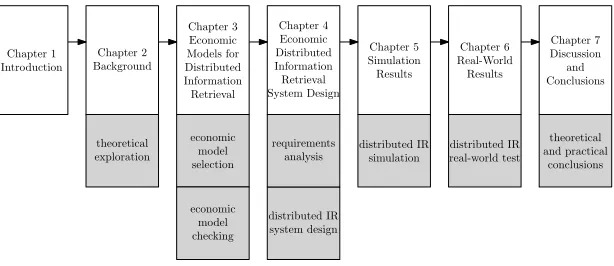
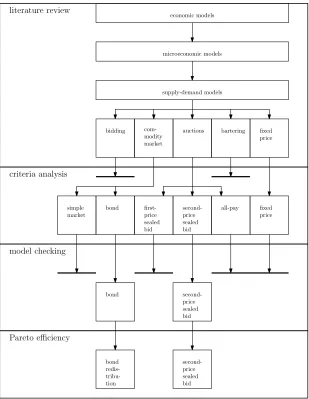
Our research is organized as shown in Figure 1.1. We start with an exploration of the current literature on distributed information retrieval, economic models and the application of economic models on computer science problems. Our research splits in two branches from this point, where one branch focuses on the development selection of suitable economic models, shown in Figure 1.1 as the upper branch. The other branch focuses on the design of an actual distributed information retrieval system, shown as the lower branch in the figure. The two branches combine at the point where we will simulate a distributed information retrieval system based on economic models. Finally, we will test the system in a real world scenario and draw conclusions.
During the steps ofeconomic model selection we will start with any economic model that will qualify according to criteria that we will set, in the economic model simulation anddistributed IR simulation steps we will drop models that do not score good enough on criteria which we will cover in the remainder of the chapters.
theoretical exploration theoretical and practical conclusions economic model selection economic model checking distributed IR simulation requirements analysis distributed IR system design distributed IR real-world test
Figure 1.1: research organization
Chapter 1 Introduction Chapter 2 Background Chapter 3 Economic Models for Distributed Information Retrieval Chapter 4 Economic Distributed Information Retrieval System Design Chapter 5 Simulation Results Chapter 6 Real-World Results Chapter 7 Discussion and Conclusions theoretical exploration economic model selection distributed IR system design distributed IR simulation theoretical and practical conclusions requirements analysis distributed IR real-world test economic model checking
[image:16.595.120.427.501.634.2]1.9
Chapter Summary
Chapter 2
Background
In the remainder of this report we will use the terminology and knowledge from economic modeling (especially the work on fighting spam with economic models by Loder et al. [29]), and information retrieval. The goal of this chapter is therefore to give an overview of the relevant scientific fields, their state of art, and to provide background information to this report. In this chapter the outcomes of the research steptheoretical exploration are presented.
Chapter 2 Background
2.1
Economic Models
The range of economic models and theories is very broad. We can divide these economic theories into two large groups: macroeconomic theories and microe-conomic theories [14].
Macroeconomics examine the world economy as one big system and study or model outcomes of such a system such as gross national income or inflation. This part of economic theory and models is of no interest for our research, as our system is not considered related to the world economy and properties like inflation are of no usage for our research.
Microeconomics however study the individual parts of the big system, espe-cially those parts where goods or services are sold and bought. These models are more bottom-up oriented, in which global behavior is mainly defined by the individual parts. This class of economic models is what we will be considering for our research. We will cover two aspects on microeconomics in more detail: 1) agent-based computational economics; and 2) the Pareto efficiency.
2.1.1
Agent-Based Computational Economics
The type of economic models that we will use as a foundation for our research is in scientific literature denoted as agent-based computational economics [44]. Basically, these economic models can be seen as bottom-up models. Small micro systems define the behavior of the final macro system.
Economies are decentralized with a number of economic agents (e.g. hu-mans, companies, artificial agents) which are involved in many local distributed interactions. From this distributed state, many global behaviors erupt such as trading protocols and socially acceptable prices. These global behaviors in-fluence the local transactions, which lead to new or updated global behaviors. These bottom-up arisen feedback loops are the key distinguishable concepts of models from the field of agent-based computational economics. Traditional quantitative economic models do not model these feedback loops, as agents are believed to behave according to top-down rules.
Researchers who use agent-based computational economics focus on mod-eling the micro level, and study the behavior of the macro system over time. This matches our approach to the previously covered problems with distributed information retrieval: we will model individual servers and study the overall information retrieval system that erupts.
Real or Simulated Economy
Economic models for agent-based economies can either be simulated or real. In the case of simulated models, there are no actual monetary transactions between agents in the model. However, the agent will behave as if there are real monetary transaction (i.e., the decisions that an agent will make are not dependent on whether or not a real transaction occurs). In the case of real models, there are actual monetary transactions and hence connections to the real economy.
research [44]. Therefore we will use the generic termcredits as the currency for a server or broker in our models.
2.1.2
Pareto Efficiency
Vilfredo Pareto was an Italian economist who performed many studies on in-come distributions in the 19thcentury[18]1. His basic idea is that there is more
to an economy than producers and consumers and finding the optimal produc-tion strategy to satisfy the highest number of consumers. Pareto stated that a economy can be improved if one of the parties can be better off, without mak-ing one of the others worse. Hence if every party is better off under one policy compared to another, the former is preferable due to a higher Pareto efficiency. Intuitively, fining parties within an economy is not Pareto efficient because paying a fine lowers the wealth of one party. However, in the definition of Pareto this is not necessarily the case. A classic example is if a monopolist is fined for being a monopolist and forced to behave less like one. The monopolist will however be compensated, as the economy will be more flexible due to this fine. This fine is therefore Pareto efficient, as everybody in the system gains [20].
Generally, a microeconomic can be Pareto efficient if the losers from a policy are compensated by the winners of the same policy. This has been formalized by Pareto, but we will not cover the formal definitions. In layman terms, Pareto introduced an economically sound definition of an honest situation between all participants in an economic system.
Pareto is a widely used validation measure for microeconomic models, as it has been shown that a good microeconomic model should be Pareto efficient [32]. We will hence use Pareto efficiency in our research to validate possible economic models.
2.2
Modeling Email Value and Spam
As we stated in the introduction of this report, we have been inspired by the work of Loder et al. They introduced an economic model as a means to solve the spam problem. In this section we will further explain their approach and results.
2.2.1
Motivation
The problem of spam is not limited to nuisances for email users, but has a worldwide impact on all sorts of organizations.
Adding up the computational power and wasted labor time, the yearly eco-nomic damage done by spam in the United States is in the range of $42 bil-lion [22] and $87 bilbil-lion [10]. The same studies show that more than 60% of the email nowadays is spam, hence a large percentage of network traffic and resource usage.
In a report from 2009 on spam and environmental impact [40], researchers from the McAfee cooperation calculated that the worldwide energy usage of
1Pareto also introduced the 80-20 rule when he noticed that 20% of the Italian population
0
− +
s s
0
− +
r r
value to senders
[image:21.595.168.476.126.263.2]value to receiverr
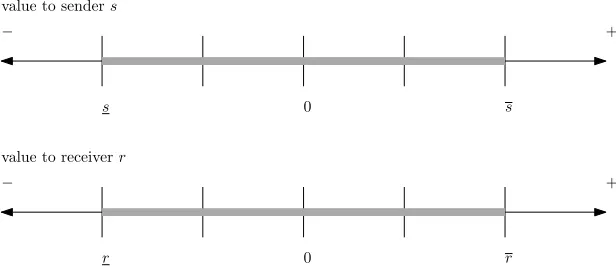
Figure 2.1: message value modeled
spam solutions totals to 33 billion kilowatt-hours (kWh): the equivalence of 2.4 million households.
Current spam solutions can be divided in two groups: legislative and tech-nological solutions, both are not successful in fighting the spam problem. The legislative solutions are dependent on definitions (i.e., which messages are con-sidered to be spam and which are not) that are very hard to agree upon and partly contradict free speech. Furthermore, the costs of controlling with police and to adjudicate offenders are high and do not guarantee that spam will stop spreading around.
Technological solutions mainly focus on filtering. As with any filtering tech-nique this yields false positives (i.e., non-spam classified as spam) and false neg-atives (i.e., SPAM is not classified as spam), both unwanted effects for a spam solution. Filtering does not decrease spam traffic on the network, as filtering is primarily done at the receiver.
Loder et al. [29] are therefore motivated to solve the spam problem, improv-ing the existimprov-ing technological solutions.
2.2.2
Generic Economic Model
The actual solution that Loder et al. introduce is to model an economy for sending and receiving email messages. Opposed to legislative and technical solutions, their economic model solves the spam problem, by having an economic model. In this subsection we will explain the actual model that inspired us, in order to make our own motivation clear.
The main driver of the model is that every email has a party-dependent
value. There are two parties in the model; a sender and a receiver. Hence every email has a valuesto the sender and a valuerto the receiver. The value of r and s is limited on two sides (i.e. a negative limit and a positive limit). The limits are denoted asr, r,s, and s. In terms of the entity-attribute-value
model [11], an email message is the entity and the economic value an attribute of this entity which has valuer ors depending on the party. In Figure 2.1 we show the modeling of message value.
Besides the values of the messages there are actual costs introduced in the model. Costscsfor sending a message and costscrfor receiving a message. The
s r
cr c
s
s r
s
[image:22.595.117.425.117.434.2]r
Figure 2.2: economic model
but are an economic measure of for example lost time by reading the email. As with the values, the costs are limited and can be both positive and negative. For example, a message with negative costs for receiving cr will theoretically
allow the receiver to earn money by receiving the message.
In the model, the sender knows the valuesof the message he wants to send as well as the actual costscsof sending it. A sender will not send a message if s≤cs. Two additional rules are set in the model. First, the sender does not
know the valuer of the message to the receiver. Second, a receiver knows his valuer only after reading the message and incurring costcr.
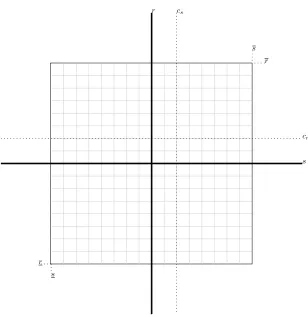
When all concepts that we depicted above are combined, we can draw an overview of the model as seen in Figure 2.2. On the two axes we represent the values, s and r, of a message. The dotted lines are the costs of sending and receiving, which are set at a small positive value for our explanation.
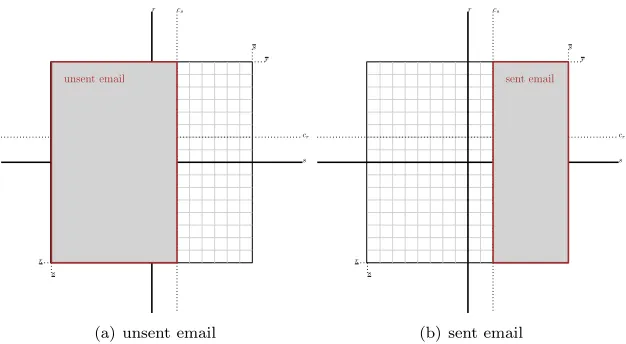
In the figure there are two categories of messages, those that will be sent (s > cs) and those who are not going to be sent (s≤cs) as depicted in Figure 2.3.
As stated before this division is logic, as messages which are more costly to send compared to the value are not sent.
s r
cr
cs
s r
s r
unsent email
(a) unsent email
s r
cr
cs
s r
s r
sent email
[image:23.595.166.479.122.294.2](b) sent email
Figure 2.3: economic model with unsent and sent email
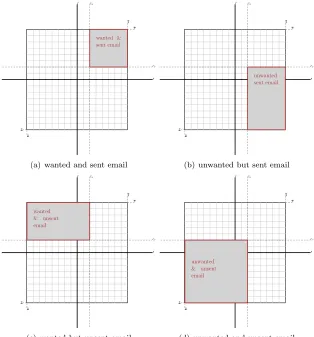
investment (r≤cr). This creates four categories as we show in Figure 2.4:
• Wanted andsent email (E.g., an invitation for a birthday party of a close
friend).
• Unwanted butsent email (E.g., a spam message on counterfeited
medici-ne).
• Wanted butunsent email (E.g., a labor-intensive personalized email with
customized information from different sources).
• Unwanted andunsentemail (E.g., an outdated notification on changes in
some regulation).
The description and explanation that we provided in this section was on a generic economic model for email value. Within this model, one can model different economic models and maximize the size of the wanted emails category. Furthermore, existing solutions can be modeled within the same model [29, 28].
2.2.3
Attention Bond Mechanism
In their paper, Loder et al. model a perfect filter in the economic model. A perfect filter is defined as a technological filter which operates without any cost, makes no mistakes, knows the preferences of every receiver and eliminates all email messages that are not worth reading (r < cr) prior to receipt. The perfect
filter is introduced as comparison case for the model that Loder et al. introduce themselves: the Attention Bond Mechanism (ABM). Loder et al. prove that their ABM is better than the perfect (technological) filter.
s r
cr
cs
s r
s r
wanted & sent email
(a) wanted and sent email
s r
cr
cs
s r
s r
unwanted sent email
(b) unwanted but sent email
s r
cr
cs
s r
s r
wanted & unsent email
(c) wanted but unsent email
s r
cr
cs
s r
s r
unwanted & unsent email
[image:24.595.114.428.239.576.2](d) unwanted and unsent email
bond posted? receive
deliver email to inbox
send request
for a
bond
is
dis-carded
deliver email to inbox
seize bond
return bond to sender
yes yes
yes
no no
no email
unwanted? sender white
[image:25.595.179.478.119.456.2]listed?
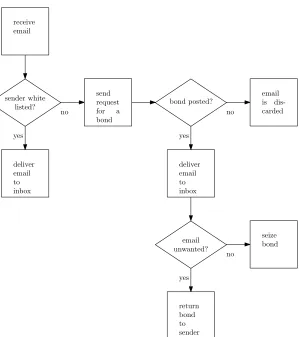
Figure 2.5: Attention Bond Mechanism flowchart
The ABM works with pre-approval using a white list. A receiver can white list certain senders (e.g., close friends). Email sent from a sender on the white list will be received by the receiver, without further interference. If the sender is not on a receivers white list, the sender is required to post a small bond in order for the email to be delivered. Economically, the sender therefore guarantees the content of the email to be useful in his opinion. The client reads the email and might either decide to seize the bond if the email was unwanted or time consuming (e.g., interesting direct marketing) or decide to not seize the bond if the email was a welcome one. The size of the bond is set by the receiver, when an email is not white listed the size of the bond is posted back. Obviously, people who want to be sure that they are not bothered with unwanted email set a high bond size, whilst people who are interested in new information might decide to set it relatively low. In Figure 2.5 we summarized this description of the ABM.
When the ABM is modeled in the economic model that we described, Loder et al. model the bond φand the probability of seizure asp. Hence the sender will not send emails for whichs >(cs+pφ) is false. This is different compared
mail which was filtered by the perfect filter. Therefore the surplus for the sender is shown to be higher compared to the perfect filter, as more messages will be read. Furthermore, the surplus for the receiver is also positive, because of the possibility to make money with (not) reading email, which was not possible with the perfect filter.
The whole system of senders and receivers is performing better with an ABM compared to the perfect filter, as the social welfare is proven to increase [29]. Social welfare is the sum of every income of each party in a system, in the email case the surplus of the sender and the receiver. The social welfare for the ABM is also proven to be higher compared to the perfect filter, hence every party in the system benefits most from this model.
Social Benefits
The findings of Loder et al. show that within the economic model which they defined, their Attention Bond Mechanism is the best solution to fight spam. However, this is an economic and theoretical conclusion. Therefore, Loder et al. also conclude on what they define associal benefits: practical benefits of the ABM for users.
First, the amount of spam will drop significantly because there will be no senders willing to warrant their message (i.e., post a bond) of which they know to be spam. This decreases the nuisance of receiving spam for users.
Second, the ABM will create a new market. There will be people who are interested in direct marketing. They will seize the bond, but Loder et al. show that the total costs of sending marketing with their solution are lower when compared to traditional direct marketing techniques (e.g., sending paper advertisements to unknown addresses).
Third, the ABM usesex postverification where filters useex anteverification to value an email. Ex post verification takes place after the message has been delivered, whilst ex ante verification takes place before the message is delivered. It is impossible to fool an ex post verification, as it is the receiver himself who decides on the quality of an email. Filters can be fooled (ex ante), by clever email writing (e.g. putting spaces in keywords which normally trigger the filter). The problem of false negatives and false positives is therefore solved by the ABM, as these problems are non-existing with ex post verification.
2.2.4
Summarizing Conclusions
The final conclusion by Loder et al. is that for a variety of reasons their proposed Attention Bond Mechanism dominates other systems. The introduction of a bond improves the welfare of both senders and receivers, as senders are forced to act on their private knowledge of the email value. Email of low value to the receiver, the ABM compensates with a small amount of money which flows from sender to receiver. On the other hand, email which is of high value to the receiver, will not bother the receiver with obligatory monetary transactions.
2.3
Query Categorization
One of the problems in distributed information retrieval is to know which types of queries need to be sent to which peers, known as resource selection. Solving this issue centrally requires knowledge about both the query and the information that servers are able to deliver (i.e., resource description). In our approach, the broker will not keep track of the knowledge within each server, as the economic models should force servers to solve the resource selection issue by themselves.
The category of the query is still needed for some of our models, see Chap-ter 3. The broker will categorize the query and will send his category together with the query to each server. This central approach ensures a leveled playing field, as there will be no errors due to different classifications. Misclassifica-tion might still occur, but at least every server has the same effect of the error introduced by the classification of the broker.
In the field of information retrieval the process of reasoning about queries and categorizing them is referred to as query categorization [2].
Query categorization uses the text of the actual query and a knowledge source to determine the category of the query. In general there are two steps within a query categorization algorithm.
First, the text of the query is analyzed and processed. Common words such as “the” might be deleted, nouns and names might be extracted, or synonyms for nouns might be added (i.e., a process called query expansion). The type of processing and analysis is algorithm dependent.
Second, the processed query is run through a knowledge source. Again, there are different strategies to this step. Some algorithm use formal taxonomies (e.g., WordNet, a lexical database of the English language [54]) to map queries to categories, others might use a search engine to fetch results for the query and analyze them (e.g., perform a word count on the results and expand the query with common found words).
2.4
OpenSearch
We will be using search engines in our research extensively as both the servers and the broker are search engines. Each of the servers in our setup will have to answer to the broker in the same format, to prevent mapping issues at the broker. Hence, we will use a standardized form of communication between broker and servers.
We will use the latest OpenSearch standard for all communication to and from search engines. The OpenSearch standard is an Extensible Markup Lan-guage (XML) standard for search engines en clients [49]. There are two main architectural components to OpenSearch.
1 TheOpenSearch Description Document. This is an XML file on the search engine’s host which describes the search engine and mainly how to query this engine.
search engine adds to its Atom-list with results an OpenSearch-element that contains the original query.
The connection between these two components is the URI where a client can post a query. This URI is defined in the OpenSearch Description Document, as well as how to properly use it. After submitting a query to this URI, results are returned back in a format that is extended with the response elements.
OpenSearch is an open format that allows for extensions, using the default XML extension methodology with name spaces. Multiple extensions already exist, such as possibilities to send search suggestions to the client while the client is typing the query.
As OpenSearch allows for easy extension of standardized messages between search engines, we will use the OpenSearch standard for the communication between the servers and brokers that we will build and cover in the rest of this report. We will extend the messages with specific elements that will contain information about the economic model.
2.5
Information Retrieval Measures
Throughout this report we will use theprecision of search results, as a measure of how well our solution performs. Precision is, together withrecall, a widely used measure in the field of information retrieval [8]. In this section we will explain the two measures and why we do not use recall as a measure.
2.5.1
Precision
For a given query an information retrieval system will return a number of doc-uments d from its corpus. From these d documents, only r documents are relevant to the search query . Precision is denoted as P = r
d and measures
the fraction of the retrieved documents that is relevant to all the retrieved doc-uments. Precision can be measured for the complete set of returned results, or only for the top-n documents. In the latter case the precision for these n
retrieved documents is denoted asP@n.
We will use precision as it measures how well our information retrieval system is in returning a set of relevant results to the user.
2.5.2
Recall
As with the precision definition, an information retrieval system returnsd doc-uments of whichrare relevant to the query. However, in the corpus is a total number of R ≥ r documents being relevant to the query. Recall measures
how good a system is in retrieving these relevant documents from the complete corpus and is calculated as r
R.
2.6
Related Work
In this section we will present related work in three areas. The areas that cover the two initial problems of our research: 1) resource selection and 2) results merging. The third area that we will cover is about the application of (micro)economic models to computer science problems.
2.6.1
Resource Selection
Research has been conducted on the problem of selecting the right servers for a query. Most of these solutions assume there is a description of the contents of each server. The most common solution is the CORI algorithm, where the
tf-idf measure is used. Tf-idf stands forterm frequency-inverse document fre-quency and is a statistical measure calculating how important a term is within a document from a corpus (i.e., the set of all documents that a server hosts). The term frequency calculates the number of times a term exists in a given document, whereas the inverse document frequency calculates the importance of the same term in the complete corpus. A document is deemed relevant if theterm frequency times the inverse document frequency is high, which is true if a document has many occurrences of the term while being among few other documents in the corpus containing the same term [17].
In a distributed scenario where CORI is used, theterm frequency for every document is calculated at every server, whereas for the inverse document fre-quency the total number of documents from all servers is used. This distributed solution is shown to have a 100% recall when 60% of servers has been searched, and an average precision of 0.4 in different distributed experiments [8].
Another proposed solution is based on language theory, where a description of each server’s content resource description is harvested by the broker. The broker queries the server with generated queries and analyzes the results, which is referred to asquery-based sampling. The results are analyzed and a language model is built. A language model is basically a set of probabilities for sequences of words from a document. For example the sequence “car is stolen” might have a probability of 0.7 to occur in document, whereas the sequence “car stolen is” has a probability of 0.2 Whenever servers need to be selected for a given query, the probability on the sequence of words from the query is determined for each language model (i.e. for each server). The servers with the highest probabilities are then selected to receive and answer the query [47, 36].
2.6.2
Results Merging
Many results merging solutions are related to the scores that each server sends together with each result. Merging the results from all results is then somehow based on these scores and referred to as Raw Score Merging [38]. Within these algorithms, there are multiple variations. One could weight each score from each server with a value that is related to the corpus of each server. For example, some systems multiply each result score with the inverse document frequency
value of the server [38].
information retrieval measures can be used to rank the results, such as count-ing search terms in every document and rankcount-ing the documents based on this counting [31].
2.6.3
Economic Models
We already extensively covered the work of Loder et al. with regard to spam problems [29] in Section 2.2. Their conclusion is that the use of an Attention Bond Mechanism (i.e., an economic model) is more effective in solving the spam problem when compared to existing techniques.
Buyya et al. [7] show that resource management in grid computing can be efficiently performed with economic models. They examined, amongst others, posted price and auction models to allocate resources for those who are demand-ing them. Their simulation only covered a model which there is a fixed price for a period of resource use. Their results show that it is possible to use economic models for a robust system.
From our literature review on the application of economic models in com-puter science, we conclude that the majority of research in this topic is applied on social sciences. A group of social scientists are interested in how people be-have when resources be-have to be shared. This can be tested with real-world field experiments involving real people, but also with simulated economic agents. In the latter case, the economic models are programmable but the framework is designed by the researchers. [21, 43, 46]
2.7
Chapter Summary
Chapter 3
Economic Models for
Distributed Information
Retrieval
In this chapter we present the results and general process of two of our research steps: economic model selection andeconomic model simulation.
The idea behind all economic models in this chapter is that the transaction of information from server to broker is ofvalue to the server (e.g. generating traffic for the provider), the broker (e.g., better search experience for the user), and the user (e.g. good results are of high value). When we consider the transaction between a server and broker, it is hard to estimate the value of the transaction beforehand. Every server will value a transaction differently, based on the expectedrevenueof the transaction to the server.
In our research we will solely focus on modeling the servers (i.e., as a sender of information) and the broker (i.e., as a receiver of information). The user does not participate in the economic process, but is represented by the broker who wants to achieve the best result for the user.
Chapter 3 Economic Models for Distributed Information Retrieval
economic model selection
3.1
Generic Model
We will use the email economic model [29] as a template for our own Distributed Information Retrieval (DIR) model. In our model there is always one broker and there can be any number of servers. The unit of trade that we will use is a result set, where in Loder et al. this unit is an email message. A result set is a fixed number of results for a given query. Users will type in a query at the broker, and participating servers might decide to submit a result set for the query.
We assume that servers want to attract visitors to their websites, either for commercial reasons (e.g., selling products) or for social reasons (e.g., providing users with correct information). Therefore, submitting a result set to a query is of value to a server, modeled ass. There are also costscsfor the server, like
bandwidth usage. We will introduce different types of additional costs for the server in the models that are being investigated in the remainder of this report. Those model-specific costs are not part ofcs.
The broker wants to achieve the best service for its users. Therefore, the received result set of a server has a valuebto the broker. Analogously to servers we will model the costs of the result sets for the brokercb. These are real costs
like computational power and data storage.
The model that we introduced is similar to the generic model of Loder et al. For example, figure 2.2 can easily be imagined with the two variables that we introduced above.
We will not model the user in this model, although one can argue that a result set has a value to the user . We will indirectly model user value though, but for the model the value to the user is represented by the value to the broker.
3.2
Economic Model Selection
There are many different economic models, each with their own established pur-poses and subject domain. To select the most suitable economic model(s) for our research problem, we start with a literature review on economic models. From this review we will select economic models which will be further investigated in four steps:
1 Multi criteria analysis on economic models. In the next section we will state criteria an economic model should fulfill in order to be of interest to our research goals. This step of our research is covered in Section 3.2.2.
2 Formal modeling of economic models. We will model the remaining economic models in a modeling checking tool, and check properties (e.g., will there be no deadlock situation). This step of our research is covered in Section 3.2.3.
3 Check for Pareto efficiency. As a good microeconomic model should be Pareto efficient, we will check if the economic models are Pareto efficient and when this is not the case how to change them to become Pareto efficient. This part of our research is covered in Section 3.2.4.
re-trieval that actually runs on the remaining models. This is extensively covered in the Chapter 5.
Our goal is to end up with one or two models that are suitable for the two scenarios (i.e., a scenario where broker and server share the same domain knowledge and a scenario where there is no shared domain knowledge) that we described in Chapter 1, by decreasing the number of suitable economic models in each of the steps described above.
3.2.1
Literature review
The term “economic model” is very broad. It includes economic models that describe how the world economy behaves, models that predict stock values, models that connect educational systems to a country’s welfare, and so on and so forth [3].
We want to model the situation as described in Section 3.1: servers want to provide users with relevant results and draw traffic to their websites. Therefore, the right to send results to the broker is of value to the server. In short, the model should allow for one broker and multiple servers. The object of value is the right to send a result set, servers are buyers and the broker is the seller of this right.
According to economics, we are therefore interested insupply-demand mod-els or market models, a subcategory of microeconomic models [16]. In these models there is a market function as there are parties interested in a certain commodity which is offered by other parties. Depending on the availability of the commodity, the value is estimated by the economic model and transactions between supplier and consumer will occur. Within the supply-demand mod-els there are multiple modmod-els that describe how the value of a commodity is determined.
The following type of models are defined within the supply-demand models
and possibly of interest to our research. This classification is not standard in literature, but our own combination of economic models from different scientific sources [3, 26, 29, 25, 7].
1 BiddingorTendering. Within these models, the consumer of a commodity asks suppliers to make a bid and state their conditions. The consumer chooses the best bid (lowest price with the best conditions). This model is suitable if there is plenty of the commodity available, and there is time to make elaborate decisions.
2 Commodity Market. Within these models more complex financial products are used to trade. Examples are bonds and future contracts. This model is suitable for trading large quantities of commodities in short amounts of time.
3 Auctions. Within these models a consumer sells the commodity to multiple consumers who will bid against each other. The highest bidder receives the commodity. This model is suitable if there is a low availability of the commodity and a huge demand.
to the consumer, if the consumer returns a different commodity to the supplier. These models are suitable if both parties have commodities that are of interest to the other party.
5 Fixed Price. Within these models, a central organization sets the price of a commodity. Suppliers and the consumer will trade according to this fixed price. These models are suitable when there is a need to fully control the market as a third party.
These five types of economic models will be further investigated, starting with a multi criteria analysis in the next section.
3.2.2
Multi-Criteria Analysis
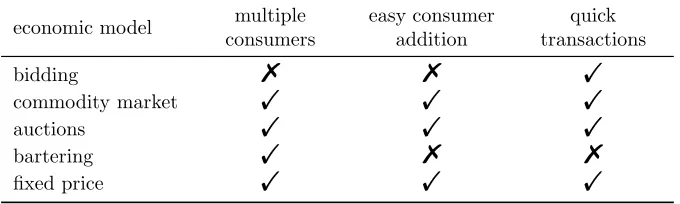
In the previous section we have shown that there are five categories of economic models that might be of interest to our research. Criteria will be used to se-lect the categories of models (or specific models from the categories) which are suitable for further analysis, and described and listed below.
• The model should allow for multiple consumers (servers) of the same
com-modity (the right to publish queries).
• The model should allow for easy addition of new consumers, as new server
might decide to join the system.
• The model should allow for quick transactions; time-consuming
transac-tions which ask consumers and suppliers to communicate often are of no interest as servers should answer queries directly.
We will cover each model and its relationship to the criteria in the next subsections.
Bidding
In the general model that we depicted previously, we have one supplier and many consumers. With bidding models there is the opposite situation: there is one consumer with many suppliers. The criteria analysis for this model is listed below.
• multiple consumers. As the bidding model requires one consumer, this
criterion is not met by this model. We could model a broker as a consumer (of search results) with many suppliers (servers), and where suppliers will place bids to be the preferred supplier. As we want our general model to be valid, the unit of transaction is the right to submit results. Turning the model around would make the unit of transaction the result set and invalidate our general model.
• easy consumer addition. With only one consumer in the model, it is not
• quick transactions. Transfer of the commodity can take place quickly with
the bidding model. Each supplier places one bid and the consumer chooses the lowest bidder. Hence there are only two messages between supplier and consumer, which is considered quick and fulfills the criterion. Models which allow for multiple bids are considered auctions and do not fall within this type of economic models.
Commodity Market
There are many different types of commodity markets, the most simple on is where suppliers sell their commodity to consumers for a price that is set by the supplier. On the other end of the spectrum are complex financial products, where the right to buy commodities at a certain point in time for a certain price are considered commodities themselves. We will not consider the complex types of commodity markets, as the complexity will make it hard to allow easy consumer addition and quick transactions.
We will consider the elemental commodity market, in which the supplier sells commodity for a price and a bond model in which bonds are used to pay on a later moment under certain conditions. Loder et al. [29] also use a model based on bonds, which is why we will continue investigating bond models. The criteria analysis for this model is listed below.
• multiple consumers. Commodity markets allow for multiple suppliers and
multiple consumers to trade their commodities on the market. Therefore, we can model our situation with one supplier and multiple consumers using a commodity market.
• easy consumer addition. As we only consider an elemental commodity
market and a bond model, consumers can easily be added. In the first case, consumers can join just by buying the commodity (if available), and in the second case the model involves placing a bond. The size of the bond is known beforehand, so a consumer can join by paying the bond to receive the commodity (under the bond conditions).
• quick transactions. Transactions are simple in the two commodity markets
that we will consider. In the case of consumers buying the commodity from the supplier, there is one message: the supplier stating the price. Bond models require more messages, but the first step only involves placing the bond. The actual calculation of the bonds happens after the conditions are met or broken. For our situation, this means that bonds are still of interest, only if queries do not have to wait for the final bond calculations. In the next step of our investigation we will investigate the bond models further.
Auctions
There are many different types of auctions, but four main categories of auc-tions [34]:
2 second-price sealed bid auctions. Consumers place their bids, but they cannot see bids of other consumers. The highest bidder wins the auction and pays the bid of the second-placed consumer.
3 English auctions. Consumers place their bids, but they can see bids of other consumers. They are allowed to place multiple bids, and react on each other, thereby raising the price. The highest bidder wins the auction and pays his bid.
4 Dutch auctions. There is a central price which is visible to all consumers. This price drops over time and the first consumer to accept the price pays this price for the commodity.
Besides these four main categories there is also the all-pay auction, which is used in some Internet systems like auctioning jobs for contractors [13]. This auction is a first-price sealed bid auction, but every consumer pays his bid re-gardless if the auction has been won or not.
We will not consider Dutch auctions. The continuously dropping value in reversed auctions will create many messages between parties and requires all servers to be on-line once an auction has started. This will by definition lead to a slow and unfair system and fails the third criterion.
Furthermore, we will not consider English auctions as they allow multiple bids (bidding against each other) and will slow down the process, failing the third criterion as well.
The other three auction types (i.e. first-price sealed bid auctions, second-price sealed bid auctions,all-pay auctions) are of interest for our research. The criteria analysis for this model is listed below.
• multiple consumers. Auctions are designed to sell a commodity from a
supplier among different consumers and therefore compliant with our cri-terion and generic economic model.
• easy consumer addition. Consumers can place their bids according to the
known auction rules. After placing the bids (once per auction, as we ruled out auctions with multiple bids), the highest bidder is selected. It does not matter how many consumers participate in this process, allowing easy addition of new consumers.
• quick transactions. As with the bidding models, auctioning involves two
messages which we consider to be quick. One message is needed for placing a bid and one message is needed to communicate the winner of the auction.
Bartering
In essence, bartering is about swapping commodities. The supplier delivers the commodity to the consumer, only if the consumer delivers a commodity in return. This returning commodity must be wanted by the supplier and valued equally to the original commodity of trade. The criteria analysis for this model is listed below.
• multiple consumers. The bartering model allows for multiple consumers;
economic model consumersmultiple easy consumeraddition transactionsquick
bidding % % !
commodity market ! ! !
auctions ! ! !
bartering ! % %
[image:38.595.103.443.127.229.2]fixed price ! ! !
Table 3.1: multi-criteria analysis of economic models
• easy consumer addition. It is hard to add consumers to a bartering model,
as the supplier does not request an unlimited return of commodities of a certain type. Hence, new consumers should bring unique new commodi-ties that are demanded. In our model with only one supplier and many consumers, it is expected that after a given amount of consumers, new con-sumers will not bring valuable commodities to the supplier. This criterion is therefore not met by the bartering model.
• quick transactions. Transactions are slow with the bartering model. There
is a negotiation phase about the commodities that the supplier wants in return. In case the consumer does not have any demanded commodity in return, the transaction even halts. This criterion is therefore not met by the bartering model.
Fixed Price
The fixed price model meets all of our criteria, because of its simple form. The costs of a commodity is preset by some party in the system and every other parties agrees to pay this fixed price. The criteria analysis for this model is listed below.
• multiple consumers. There is no reason why there could not be more
then one consumer in a model where the price of a commodity is fixed. Therefore, this criterion is met.
• easy consumer addition. Joining this model as a consumer is very easy;
the consumer knows what the price of a commodity is and can buy it directly.
• quick transactions. As there are no negotiations or biddings in this model,
transactions are kept to the minimum: only paying the price that is set beforehand.
Model Selection
As stated previously, these categories of economic models are broad and not every model from the selected categories is suitable for our research. Therefore, we select from the commodity market models thesimple marketandbond mod-els. From the auction models, we select the first-price sealed bid auction, the
second-price sealed bid auction and theall pay auction. Thefixed pricemodel is a model on itself. The individual reasons for selecting these models are covered in the individual sections on each model category.
3.2.3
Model Checking
From the criteria analysis step we ended with six models: 1) simple market, 2) bond, 3) first-price sealed bid, 4) second-price sealed bid, 5) all-pay auction, and 6) fixed price. These models are worthwhile to investigate, but before we will actually build a system and incorporate them, we will model them in a model checker. There are two reasons to model check our economic models: 1) it allows us to check if a model respects certain properties (e.g. no deadlock), and 2) it allows us to study the model without having to build a complete information retrieval system. The latter reason is very helpful as we will check if we implemented the model correctly. Mistakes made in this phase are more easily to correct compared to correcting mistakes in a more complete software system.
We will use UPPAAL 4 [52] as our modeling tool. UPPAAL is designed to model networks oftimed automata; a network of entities which can change their state either based on signals (as with traditional automata) or based on a change in time [4]. This is helpful for our situation, as we can model that servers are not allowed to bid after a certain moment in time has passed. Furthermore, UPPAAL has the ability to visualize the system, which allows rapid develop-ment. UPPAAL allows to check global properties of a system, expressed in a notation that allows to express time and system states; calledtemporal logic [5]. Each of our models is made out of three types of entities; a broker, and two types of servers: 1) good servers and 2) bad servers. Good servers behave like they have relevant information for queries and will act accordingly in the model. Bad servers are modeled to behave like they have no relevant results at all and hence to not participate in the economic model. We abstract from the actual information retrieval part of the servers, they simply return relevant (good server) or irrelevant (bad servers) results. This is an extreme situation, but as it is the same for all the six models we can still draw conclusions.
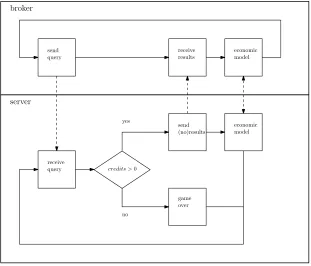
We created a general model that follows a basic cycle of steps (i.e. a path in UPPAAL terms): 1) a query is send to each server, 2) a server either sends back results or sends back a no-results-message, 3) the broker waits for a result-message or no-results-result-message from each server and starts the process over. There is also agame over path, in which a server remains if there are no more credits available. This general model is depicted as a flow graph in Figure 3.1. The upper part resembles the general model for the broker whereas the lower part resembles the general model for a server. De dashed arrows resemble com-munication between broker and server.
We checked two global properties on this general model with UPPAAL. First, we checked if the combination of a broker and any number of servers is deadlock free. In temporal logic this is stated as ∀2¬deadlock, meaning that in every
receive query
send (no)results
game over
credits >0
yes
no
economic model send
query
receive results
economic model broker
[image:40.595.117.428.125.391.2]server
Figure 3.1: generic UPPAAL model
no deadlock (¬deadlock). Second, we checked if the generic model rewards
good behavior and punishes bad behavior, by checking if servers submitting bad results will eventually end up in thegame over state. We added servers to the system which submit only bad results and checked if they always end up in the game over state: ∀3server.gameover. Where∀3means that in every
state a future property will hold (i.e., server.gameover). Both properties are successfully with the general model.
We implemented the six remaining economic models using this generic model but in a very elemental way: we did not model the value of submitting results to a server (i.e. the increase in credits if a server is selected by the economic model) and we did not model the possibility that multiple server might win one round of the model. As every model is modeled with these restrictions, they are still comparable to each other.
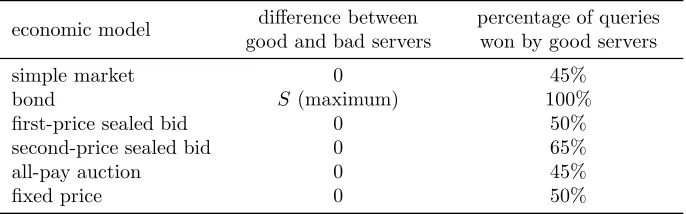
With each of the six models implemented by extending the general model and hence respecting the checked global properties, we observed the time it takes for a model to stabilize. Our goal of this step is to further decrease the amount of economic models that we will further investigate, as we will only select the strongest models. I.e., models needing many cycles to punish bad servers and reward good servers are dropped and stronger ones are selected. We measure this with two measures. First, the difference between the amount of credits a good server has and a bad server has, once the model stabilized. We introduce two variables in order to express this difference: the starting amount of credits for a serverS, and the credits a server had at a given point in time
model. The second measure is the percentage of good servers being the winner from 100 executed queries, the more often a good server wins a query the better the model is for DIR usage.
Simple Market
The simple market has the downside that both good and bad servers pay a price for returning result sets, there is no distinction in behavior. The price that a server pays differs per query and per server, bu