University of Warwick institutional repository: http://go.warwick.ac.uk/wrap
A Thesis Submitted for the Degree of PhD at the University of Warwick
http://go.warwick.ac.uk/wrap/35620
This thesis is made available online and is protected by original copyright. Please scroll down to view the document itself.
Game-based learning in formal educational
contexts: how subject matter experts and
game experts could collaborate to design and
develop games
by
Tan, Wee Hoe
A thesis submitted in partial fulfilment of the requirements for the degree
of
Doctor of Philosophy in Education
University of Warwick, Institute of Education
i
TABLE OF CONTENTS
LIST OF TABLES ... ix
LIST OF FIGURES ... xiii
ABBREVIATIONS ... xv
DEFINITIONS OF TERMS ... xvii
ACKNOWLEDGEMENTS ... xviii
DECLARATION ... xix
ABSTRACT ... xxi
CHAPTER 1: INTRODUCTION ... 1
1.0 Overview ... 1
1.1 Game-based learning in brief ... 1
1.2 Formal education contexts and the modes of learning ... 2
1.3 The use of electronic games in UK formal education ... 3
1.4 Introducing the experts: subject matter experts and game experts ... 6
1.5 In search of a key research question ... 8
1.6 The research aim and research outcomes ... 9
1.7 Thesis structure ... 10
CHAPTER 2: CONCEPTS ASSOCIATED WITH GBL ... 12
2.0 Introduction ... 12
2.1 Definitions of ‘game’ ... 14
2.2 Elements of games ... 16
2.3 Other concepts related to games ... 21
2.3.1 Play and game playing ... 22
2.3.2 Gameplay and game design ... 24
2.3.3 Simulations and simulation games ... 25
ii
2.4 Electronic games (e-games) ... 29
2.4.1 The essence of e-games ... 30
2.4.2 Classification of e-games ... 32
2.5 e-Games for education ... 35
2.6 GBL and learner-centred learning ... 37
2.7 Evaluation of games used in education ... 39
2.8 Summary ... 41
CHAPTER 3: ISSUES ASSOCIATED WITH GBL ... 42
3.0 Introduction ... 42
3.1 In search of a research position in academia and the game industry ... 46
3.2 From e-learning to game-based e-learning and then GBL... 53
3.3 Issues of GBL practices ... 54
3.3.1 Generalisation of the findings about games ... 55
3.3.2 The perceived potential of games ... 58
3.3.3 Game playing, violence and gender ... 60
3.3.4 The use of commercial games in formal education ... 62
3.3.5 Developing and using educational or instructional games ... 64
3.4 Reflection in the search for research issues ... 70
3.5 Selecting a specific research topic ... 71
3.6 Focus of this thesis ... 73
3.7 Summary ... 74
CHAPTER 4: RESEARCH DESIGN ... 75
4.0 Introduction ... 75
4.1 The nature of inquiry ... 77
4.1.1 The researcher's role in data analysis ... 79
4.1.2 Research diary... 80
4.2 The reflection–reflexion continuum ... 80
iii
4.3.1 Exploratory–confirmative–explanatory nature of studies ... 86
4.3.2 Choosing case study as the basis of the research approach ... 87
4.3.3 Individual participants as the units of analysis ... 88
4.4 Ensuring reliability and validity ... 89
4.4.1 Multi-method approach... 91
4.4.2 Semi-structured interview ... 95
4.4.3 Focus group... 96
4.4.4 Cross-sectional questionnaire survey... 97
4.5 Ethical issues ... 97
4.6 Beyond mixed methods design: the Spiral Research Model ... 98
4.6.1 Evolutive: temporal focus shift ... 98
4.6.2 Why spiral-segregated and how are studies linked to each other? ... 99
4.6.2.1 Whorl 1: preparatory stage ... 102
4.6.2.2 Whorls 2–4: exploratory stage ... 102
4.6.2.3 Whorl 5: confirmative stage ... 104
4.6.2.4 Whorl 6: explanatory stage ... 104
4.6.2.5 The thesis ... 105
4.7 Using the Spiral Research Model as an alternative to triangulation ... 105
4.8 Summary ... 105
CHAPTER 5: FINDINGS OF THE EXPLORATORY STUDIES ... 107
5.0 Introduction ... 107
5.1 Findings of Exploratory Study 1 (ES1) ... 107
5.1.1 The perceived potential of GBL ... 108
5.1.2 The self-justification of the perceived potential ... 111
5.1.3 The self-evaluation of the justification ... 111
5.1.3.1 Objective and evidence-based White Hat: facts and figures ... 111
5.1.3.2 Critical and judgmental Black Hat versus objective and positive Yellow Hat ... 112
5.1.3.3 Subjective and emotional Red Hat: How do I feel about the idea?... 113
5.1.3.4 Speculative, creative and innovative Green Hat ... 113
5.1.4 The gap of knowledge and skills in game design ... 114
5.2 Findings of Exploratory Study 2 (ES2) ... 114
5.2.1 The perceived definitions of game, game playing and learning ... 114
5.2.2 The perceived educational potential of games ... 116
5.2.3 How games should ideally be used in education ... 118
iv
5.2.3.2 The best time or place to use games ... 120
5.2.4 Perceptions of teachers who use games in teaching ... 121
5.2.5 Perceptions of studios that produce games for use in formal educational contexts ... 122
5.2.6 How teachers and game experts can collaborate to design and develop games used in education ... 123
5.3 Findings of Exploratory Study 3 (ES3) ... 125
5.3.1 Perceptions on how SporeTM is related to biology studies and what the students think they learned from playing SporeTM. ... 126
5.3.2 How the students compared GBL and the way they normally approach their studies. ... 126
5.3.3 How the students perceived the usefulness of GBL as compared to the way they would normally study. ... 127
5.3.4 How the students perceived their teacher who used technology-enabled practices in teaching... 128
5.3.5 The perceived educational potential of GBL and other technology-enabled practices. ... 128
5.3.6 Extracts of the knowledge, attitude and skills of the students as deep learners ... 129
5.4 Interim discussion and cross-case synthesis ... 130
5.4.1 Perceived potential of GBL in formal education ... 130
5.4.1.1 Diverse views of engagement ... 131
5.4.1.2 Fun or serious? ... 132
5.4.2 Characteristics of teachers who use games in teaching ... 133
5.4.3 The extent to which the participants in exploratory studies could design and develop games for use in formal educational contexts ... 136
5.4.4 Perceived GBL collaboration... 137
5.4.5 Hypothetical propositions for the questionnaire survey ... 138
5.5 Summary ... 141
CHAPTER 6: FINDINGS OF THE CONFIRMATIVE STUDIES ... 142
6.0 Introduction ... 142
6.1 Questionnaire surveys ... 142
6.1.1 The questionnaires ... 143
6.1.2 The sampling and response rate ... 143
6.1.3 Demographic profile of respondents ... 145
v
6.3 Attitude to teachers who use games in teaching ... 150
6.3.1 GBL teachers per se ... 150
6.3.2 Characteristics of effective GBL teachers ... 151
6.4 Attitude to studios that produce games for use in formal educational contexts ... 152
6.4.1 The games produced by educational game studios ... 152
6.4.2 The studios that produce educational games ... 154
6.4.3 Stealth learning in GBL ... 155
6.5 Attitude to GBL collaboration: comparing SMEs and game experts ... 157
6.5.1 The factors in successful GBL collaboration ... 157
6.5.2 The types of mutual understanding needed ... 159
6.5.3 The roles and responsibilities in GBL collaboration ... 161
6.6 Interim discussion and cross-case analysis ... 163
6.7 Targeted themes of analysis for follow-up interviews ... 166
6.8 Summary ... 167
CHAPTER 7: FINDINGS OF THE EXPLANATORY STUDY ... 169
7.0 Introduction ... 169
7.1 Semi-structured interviews ... 169
7.1.1 Demographic profile ... 169
7.1.2 Interview methods... 172
7.1.3 Top-down analysis approach ... 172
7.2 The benefits of GBL ... 173
7.2.1 The benefits of GBL for teachers ... 173
7.2.1.1 On-the-job training and support ... 174
7.2.1.2 Teaching and learning interaction ... 175
7.2.2 The benefits of GBL for game experts ... 176
7.2.2.1 Financial benefit and business opportunities ... 176
7.2.2.2 New markets and new domains of games ... 177
7.2.2.3 Social contribution and motivation to produce educational games ... 178
7.2.2.4 Learning opportunities ... 180
7.2.2.5 Job opportunities ... 182
7.2.2.6 Research and development ... 183
7.3 GBL practice in formal educational contexts ... 183
7.3.1 Challenges faced in GBL practice ... 183
vi
7.3.1.2 The economic challenges ... 186
7.3.1.3 The technical challenges ... 188
7.3.2 Positive GBL experience ... 190
7.3.2.1 The technical factors ... 190
7.3.2.2 The social factors ... 192
7.3.2.3 The economic factor ... 193
7.3.3 The ideal GBL practice ... 193
7.4 Lessons learnt from the usual GBL collaboration ... 194
7.4.1 Problems faced in GBL collaboration ... 194
7.4.1.1 The social problems ... 195
7.4.1.2 The technical problems... 196
7.4.1.3 The economic problems ... 198
7.4.2 Positive usual experience... 199
7.4.2.1 Collaboration between a mathematics teacher and a game designer ... 199
7.4.2.2 Collaboration between a game level designer and primary literacy teachers ... 200
7.4.2.3 Success stories of a CEO ... 200
7.4.2.4 Insights of an instructional system design manager ... 201
7.4.2.5 Teachers as game experts ... 202
7.5 The ideal GBL collaboration ... 202
7.5.1 Effective communication: the key success factor ... 203
7.5.1.1 Pre-production communication ... 203
7.5.1.2 Communication in game production ... 204
7.5.1.3 Communication throughout a collaboration ... 204
7.5.2 The reason for mutual understanding ... 205
7.5.2.1 Understanding games and GBL ... 206
7.5.2.2 Understanding players / learners ... 206
7.5.2.3 Understanding trends and policies ... 207
7.5.2.4 Being understanding to each other... 207
7.5.3 Roles and responsibilities delineation ... 208
7.5.3.1 Idea incubation ... 209
7.5.3.2 Art style and game architecture design and development ... 210
7.5.3.3 Educational contents design and development... 211
7.5.3.4 Evaluation and quality assurance ... 213
7.5.4 Roles and responsibilities beyond SMEs and game experts ... 214
7.5.5 Steps and sequences in collaboration... 214
7.5.5.1 SMEs‘ preferences ... 214
7.5.5.2 Game experts‘ preferences ... 216
vii
CHAPTER 8: DISCUSSION ... 219
8.0 Introduction ... 219
8.1 Results of cross-case analysis and synthesis ... 219
8.2 The gaps in and between the perceived potentials and recognised benefits of GBL ... 221
8.3 The characteristics of GBL teachers: a reference for GBL teacher training ... 225
8.4 The rubrics of ideal GBL practice ... 226
8.5 Dilemmas for educational game studios and experts ... 228
8.6 The pressing need for models of GBL collaboration ... 229
8.6.1 Idea incubation, explanation and negotiation ... 232
8.6.2 Game production iteration ... 233
8.6.3 Incorporating GBL practice into GBL collaboration ... 235
8.7 Learning from peers and practitioners in both academia and the game industry ... 238
8.8 Involvement in the FPS Trainer project ... 239
8.8.1 Highlighting the necessity of a suitable SME ... 240
8.8.2 Setting the learning domains for FPS game coaching and learning ... 240
8.8.3 Resolving communication challenges ... 240
8.8.3.1 Daily scrum ... 241
8.8.3.2 Google Wave ... 244
8.8.3.3 MediaWiki ... 245
8.8.4 Revealing the lack competence of the ID in playing the SME‘s role ... 246
8.8.5 Capturing the subject matter knowledge using flowcharts of use cases ... 247
8.9 Summary ... 248
CHAPTER 9: CONCLUSIONS ... 249
9.0 Introduction ... 249
9.1 A critical overview of the research ... 249
9.1.1 The nature of research participants ... 250
9.1.1.1 Teachers and academics as subject matter experts ... 250
9.1.1.2 Practitioners in the game industry as game practitioners ... 252
9.2.2 The limited observational data ... 252
viii
9.1.4 The involvement of learners in the study... 256
9.1.5 Alternative design models ... 257
9.2 The contributions of the thesis ... 259
9.2.1 The conceptualisation of GBL for formal educational contexts ... 260
9.2.2 Research methodology for GBL studies ... 261
9.2.3 GBL practice among teachers in formal educational contexts ... 261
9.2.4 The collaboration between SMEs and game experts to design and develop games and GBL ... 262
9.3 Limitations of the thesis ... 262
9.3.1 Narrow research territories and small samples ... 263
9.3.2 Segregated studies and interview biases ... 263
9.3.3 Questions left unanswered ... 264
9.3.4 Balancing the depth and height of the research ... 264
9.4 Summary ... 265
REFERENCES ... 266
APPENDICES ... 287
I. Research degrees: Application for Ethical Approval ... 287
II. Information sheet ... 291
III. Consent form... 293
IV. Questionnaire: Covering letter 1... 294
V. Questionnaire: Covering letter 2 ... 295
VI. Questionnaire: Questions related to the demographic profile in Survey 1 ... 296
VII. Questionnaire: Questions related to the demographic profile in Survey 2 ... 298
VIII. Questionnaire: Perceptions of subject matter experts / game experts... 299
IX. Challenges faced in GBL practice ... 301
X. Factors of positive GBL practice ... 305
XI. Problems faced in GBL collaboration ... 307
XII. The rubric of knowledge for being the ideal SMEs and game experts involved in GBL practices or collaboration (Adapted from Hays, 2006, p. 197–200) ... 309
XIII. The rubric of intellectual abilities and skills for being the ideal SMEs and game experts involved in GBL practices or collaboration (Adapted from Hays, 2006, p. 200–204) ... 310
XIV. The rubric of attitudes for being the ideal SMEs and game experts involved in GBL practices or collaboration (Adapted from Hays, 2006, p. 208–215) ... 313
XV. Internalisation and externalisation in the research journey ... 316
ix
LIST OF TABLES
Table 1.1: The characteristics of four modes of learning, adapted from OECD (2007, p. 5). ... 3 Table 2.1: Meanings of the word ‗game‘ extracted from Oxford English dictionaries and thesauruses... 15 Table 2.2: The characteristics of the key structural elements of games, adapted from Prensky (2007, p. 119–124) ... 17 Table 2.3: The characteristics of the elements of games, adapted from Berne (1964, p. 48–52) ... 19 Table 2.4: The explanation of game components in game theory, proposed by
x
Table 4.3: The types of participants involved in each stage of this research ... 89
Table 4.4: Types of validity and the corresponding instruments used in this research. (Adapted from Bryman 2008; Krishnan Guru 2005) ... 91
Table 4.5: The types of instruments used and the nature of data collected in the first exploratory study ... 92
Table 4.6: Identification codes used in this research to substitute participants‘ names ... 98
Table 4.7: The grouping of activities carried out in each whorl under three research stages ... 101
Table 5.1: The number of ideas generated by trainees. (Male: female = 48:47) ... 108
Table 5.2: Themes proposed by Trainee No. 16 and Trainee No. 19 ... 109
Table 5.3: The typology of top ranked ideas grouped under three domains ... 110
Table 5.4: Rationale justifying the top ranked GBL idea ... 111
Table 5.5: Self-evaluation of why perceived GBL ideas will work / will not work. Ref = references; S = sources ... 112
Table 5.6: Positive words mentioned when the red hat was virtually worn ... 113
Table 5.7: Basic information on the game design ideas gathered in this study ... 114
Table 5.8: The number of perceived educational potentials of GBL proposed by interviewees... 116
Table 5.9: Themes of arguments about the educational potential of games, grouped into four beneficiary groups ... 117
Table 5.10: Rationale for using games in education (conventions as Table 5.9)... 119
Table 5.11: Collated arguments of the game experts about how teachers and game experts should collaborate to design and develop GBL (conventions as Table 5.9) 125 Table 5.12: Classification of themes based on the perceived advantages of GBL as compared to normal learning approaches ... 127
Table 5.13: Perceptions of teachers who adopt technology-enabled practices ... 128
Table 5.14: Perceived educational potential of technology-enabled practices ... 129
xi Table 5.16: Comparison of the characteristics of the perceived potential of GBL in formal education... 131 Table 5.17: Classification of instructional activities carried out by the teacher who used SporeTM to promote deep learning ... 134 Table 5.18: Comparison of the capability to design and develop games for use in formal education contexts. ... 137 Table 5.19: Identified GBL issues and their associated hypothetical propositions . 140 Table 6.1: Questionnaire distribution channels and the corresponding response rate ... 144 Table 6.2: Demographic profile of valid respondents in Survey 1 ... 146 Table 6.3: Demographic profile of valid respondents in Survey 2 ... 148 Table 6.4: Types of nonparametric statistical analyses conducted in this research . 150 Table 6.5: Respondents‘ attitudes towards teachers who use games in teaching (GX: game experts; SA: strongly agree; A: agree; N: neutral; D: disagree; SD: strongly disagree; d: direction of significance; ↓: reduction, r = effect size) ... 151 Table 6.6: Respondents‘ attitudes towards the requirements for effective GBL
xii Table 7.3: Perceived GBL benefits for teachers in on-the-job training and support 173 Table 7.4: Perceived GBL benefits for game experts. (f: frequency) ... 176 Table 7.5: Classification challenges faced in GBL practice (Ref = the count of
references in Appendix IX; NB: One source could mention more than one aspect of a single issue) ... 184 Table 7.6: Classification factors of positive GBL practice (Ref = the count of
references in Appendix X) ... 190 Table 7.7: Classification of problems faced in GBL collaboration. (Ref = the count of references in Appendix XI) ... 195 Table 7.8: Themes of suggestions related to effective communication in GBL
xiii
LIST OF FIGURES
Figure 1.1: Research outcomes articulated for this research... 11
Figure 2.1: The hierarchical association of key concepts and terms in this research 13 Figure 2.2: Primary, secondary and tertiary concepts related to ‗game‘ ... 16
Figure 2.3: The classic key structural elements of games proposed by Prensky (2007) ... 18
Figure 2.4: Crawford‘s (2003) taxonomy of creative expression ... 22
Figure 2.5: Prensky‘s (2007) positioning of games as a form of play ... 22
Figure 2.6: Caillois‘ (1961) four rubrics of play ... 23
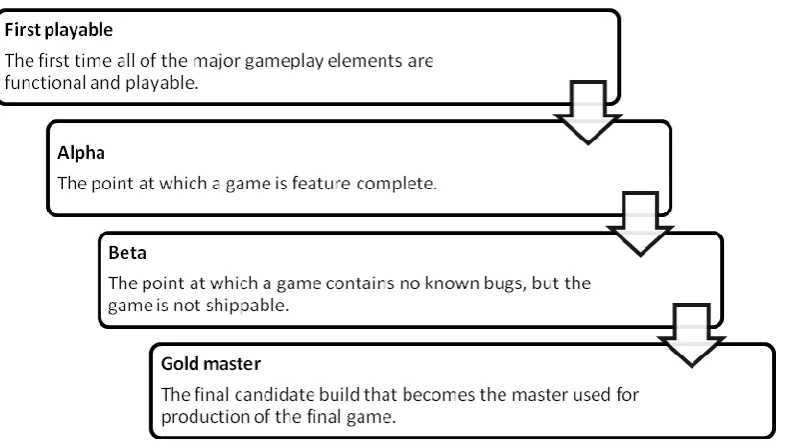
Figure 2.7: Stages in game production in relation to QA and testing ... 40
Figure 3.1: The structure of Chapter 3; organised into three hierarchical levels ... 42
Figure 3.2: Position of GBL studies in academia ... 47
Figure 3.3: Position of learning-related research in the game industry ... 49
Figure 3.4: General perceptions of games by game experts and game researchers ... 52
Figure 3.5: The illustrated journey of exploration between March 2008 and February 2009 in searching GBL issues that were feasible and worth researching at doctoral level ... 71
Figure 4.1: Factors and entities which have shaped the research design of this study, a representation of reflection and reflexivity at work ... 76
Figure 4.2: How knowledge could be constructed to answer research questions ... 79
Figure 4.3: The reflection–reflexion continuum ... 81
Figure 4.4: Triangulated inquiry model. Source: Patton 2002 ... 85
Figure 4.5: The mixed methods design of this research... 87
Figure 4.6: GBL model version 1.1, the logical model developed based on the preliminary literature review ... 94
Figure 4.7: Two phases of the spiral research model. The legend of this model is attached to Table 4.7 ... 100
xiv Figure 5.2: Surface–deep learning matrix, adapted for this study (Tan,
Johnston-Wilder, Neill in press). ... 129
Figure 5.3: Mapping the game experts‘ views onto game production and instructional design processes ... 138
Figure 8.1: Interrelationship of the scope of findings in different stages of this doctoral research ... 220
Figure 8.2: Example of research design which could use the rubrics of ideal GBL practice ... 228
Figure 8.3: The integrated GBL collaboration model ... 231
Figure 8.4: The pre-production phase of GBL collaboration ... 233
Figure 8.5: Game production iteration in GBL collaboration ... 234
Figure 8.6: GBL design, development, deployment and evaluation in GBL collaboration ... 236
Figure 8.7: A sample daily scrum created in the FPS Trainer project ... 243
Figure 8.8: Collaborative discussion through Google Wave ... 245
Figure 8.9: The internal MediaWiki used by the project team ... 246
Figure 9.1: The overall appearance of the FIDGE model, proposed by Akilli (2007) ... 258
Figure 9.2: Six-step method for designing serious games, proposed by Marfisi-Schottman et al. (2010) ... 259
xv
ABBREVIATIONS
3D : three dimensional
BBC : British Broadcasting Corporation
Becta : British Educational Communications and Technology Agency BESA : British Educational Suppliers Association
BETT : British Education and Training Technology CEO : chief executive officer
Consolarium : Scottish Centre for Games and Learning DiGRA : Digital Game Research Association
ECGBL : European Conference of Games Based Learning ES1 : The first exploratory study
ES2 : The second exploratory study ES3 : The third exploratory study
ESRC : Economic and Social Research Council FE : Further education
FPS : first-person shooter GBL : game-based learning GX : game experts
HCI : human-computer interaction HE : higher education
ICT : information and communication technology ID : instructional designer
IGDA : International Game Developers Association Indies : independent game developers
IP : intellectual property
ITTE : Association for Information Technology in Teacher Education JISC : Joint Information Systems Committee
LSC : Learning and Skills Council MA : Master of arts
MoLeNET : Mobile Learning Network N/A : not available
Naace : National Association of Advisers in Computer Education NCET : National Council for Educational Technology
xvi
ORO : Oxford Reference Online
PGCE : Postgraduate Certificate in Education QA : quality assurance
QS : questionnaire surveys R&D : research and development
SAGSET : Simulations and Games Society for Education and Training SMART : specific, measurable, achievable, result-oriented and time-bound SMEs : subject matter experts
SPSS : Statistical Package for the Social Sciences SR Model : Spiral Research model
TEEM : Teachers Evaluating Educational Multimedia VLE : virtual learning environment
xvii
DEFINITIONS OF TERMS
The following terms are used repeatedly in this study to refer to technical terms and groups of people involved in the collaboration of GBL. While some are fixed definitions within the practice of the game industry and the educational research community, the others are applied strictly for the purpose of this study.
concept A mental construct of a group or class of objects, which may be abstract or concrete, seen as mediating between a term and whatever it denotes or is used to refer to (The Concise Oxford Dictionary of Linguistics 2007).
education The process of receiving or giving systematic instruction (The Oxford Dictionary of English 2005).
formal education
The hierarchically structured, chronologically graded education system, running from primary school through the university and including, in addition to general academic studies, a variety of specialised programmes and institutions for full-time technical and professional training (Coombs, Posser & Ahmed 1973).
game An activity, either a form or spell of play or sport, engaged in for amusement, especially an organised, competitive one played according to rules and decided by skill, strength or luck.
game-based learning
A form of learner-centred learning that uses electronic games for educational purposes (Tan, Johnston-Wilder & Neill 2008).
game experts Professionals with expertise in the field of game production.
game industry The branch of economic and commercial activity that is concerned with the production of games in studios and the distribution of games through publishers. gameplay The heart of the player‘s mental experience of a game, which consists of ‗the
challenge that a player must face to arrive at the object of the game, and the actions that the player is permitted to take to address those challenges‘ (Adams 2010). indies Game developers who do not receive money from a game publisher to create their
game (Michael 2003); whereas [paid] game developers are individuals or businesses that produce games.
issue Topic or problem which becomes important for debate or discussion. learn-based
gaming
A form of game design and development strategy that uses learning or coaching to support game playing and marketing.
learner-centred learning
Learning that urges learners to actively construct meaning and understanding during every phase of the learning process (Yilmaz 2008).
media The agency or means of learning (The Oxford Dictionary of English 2005). perception The way in which something is regarded, understood, or interpreted (The Oxford
Dictionary of English 2005), i.e. the intuitive understanding of and insight into GBL for formal education contexts.
potentials The hidden qualities of games that need to be developed and converted into overt benefits to make GBL useful and successful. In the contexts of formal education,
overt benefits mean measurable learning outcomes which could prove the learners‘ attainment of pre-determined objectives in GBL.
subject matter experts
Professionals with expertise in the field of education but usually without technical Game production knowledge.
xviii
ACKNOWLEDGEMENTS
I would like to give my deepest appreciation to my supervisors Assoc Prof Dr Sean Neill and Assoc Prof Sue Johnston-Wilder for their constant support, encouragement and inspiration which were extremely crucial to me throughout this doctoral journey. I enjoyed working with them, learning from them and debating with them. Without them the chances of this research being completed within a tight schedule would be very slim.
I wish to express my gratitude to my employer, Universiti Pendidikan Sultan Idris (UPSI) and Malaysian Ministry of Higher Education for funding this research and providing me a three-year paid study leave. It would be impossible for me to pursue a PhD in the University of Warwick without this generous financial support. I am indebted to my research mentors— Assoc Prof Dr Stanley Richardson and Emeritus Prof Carol Aubrey. Their role as my sounding boards was wonderful especially when I faced difficulties in certain aspects of research and life. I would like to thanks colleagues in Warwick Institute of Education, Warwick Graduate School and IT Services for designing, developing and conducting research training programmes and courses, in which I gradually constructed the foundations to be a professional educational researcher.
I also like to express my sincere thanks to all the participants who took part in my pilot studies, focus group, questionnaire surveys and interviews. Their contributions are vital for me to complete this research.
xix
DECLARATION
The work in this thesis was developed and conducted by the author between March 2008 and October 2010. I declare that, apart from work whose authors are explicitly acknowledged, this thesis and the materials contained in the thesis represents original work undertaken solely by the author. None of the work has been previously
submitted for any other degree.
Papers published by the author during the doctoral study:
Tan, W.H. (2010a). In search of research methodology: a doctoral research design journey. Paper presented at Malaysia–Glasgow Doctoral Colloquium 2010, Glasgow, Scotland, January 20–21, 2010.
Tan, W.H. (2010b). Subject matter experts' attitudes to game-based learning practice and collaboration: an interim survey report [Online]
http://www2.warwick.ac.uk/fac/soc/wie/courses/degrees/docs/who/students/edrhal/re search/publications/survey1.pdf
Tan, W.H. (2010c). Game experts' attitudes to game-based learning practice and collaboration: an interim survey report. [Online]
http://www2.warwick.ac.uk/fac/soc/wie/courses/degrees/docs/who/students/edrhal/re search/publications/survey2.pdf
Tan, W.H., Johnston-Wilder, S. & Neill, S. (2008). Examining the potential of game-based learning through the eyes of maths trainee teachers, In: Joubert, M., ed.
Proceedings of the British Society for Research into Learning Mathematics Day Conference, 28 (3), King‘s College, London, November 15, 2008, pp. 120–124.
Tan, W.H. Johnston-Wilder, S. & Neill, S. (2010). Exploring the educational potential of game-based learning through the eyes of game industry practitioners, International Journal of Technology, Knowledge and Society, 6(1), 41–54. Tan, W.H., Johnston-Wilder, S. & Neill, S. (in press). Game-based learning with dialogic teaching approach: deep learning and the use of SporeTM in A-Level Biology Lessons. In: Felicia, P., ed. Handbook of Research on Improving Learning and Motivation through Educational Games: Multidisciplinary Approaches. Hershey: IGI Global.
Tan, W.H., Neill, S. & Johnston-Wilder, S. (2009). Deep learning and the use of SporeTM in A-Level Biology lessons, In: Pivec, M., ed. Proceedings of the Third European Conference on Games Based Learning, FH JOANNEUM University of Applied Sciences, Graz, Austria. October 12-13, 2009. Reading: Academic Publishing Limited, pp. 354–361.
xx Meyer, B., ed. Proceedings of the Fourth European Conference on Games Based Learning, University of Aarhus, Copenhagen, October 21–22, Reading: Academic Publishing Limited, pp. 478-486.
Tan, W.H., Neill, S. & Johnston-Wilder, S. (2010b). Subject matter experts' attitude to game-based learning for formal education contexts. Paper presented at the
Interactive Technologies and Games Conference: Education, Health and Disability, Nottingham Trent University, Nottingham, October 26–27, 2010.
Tan, W.H. & Wu, W. (2010). Reflection and meta-reflection in doctoral studies. Paper presented at the Early Career Researcher Conference (BERA Conference),
University of Warwick, Coventry, September 1, 2010.
Tan, W.H. & Xu, L. (2009). Deep learning and innovative skills development: a potential solution to education dilemma in China, selected as an excellent paper in
xxi
ABSTRACT
This doctoral research aimed to investigate how subject matter experts (SMEs) and game experts can collaborate to design and develop games for use in formal educational
contexts. The research began with a literature review of key concepts and issues associated with game-based learning (GBL), which led to the process of defining and redefining the overarching research question, along with its scope and position in
academia. A three-phase strategy was adopted to segregate the research into exploratory, confirmative and explanatory phases, wherein each phase comprised interrelated studies. These studies were integrated through the Spiral Research model to enable temporal focus shift, cross-case analyses and cross-case syntheses. In the exploratory studies, the perceived potentials of games and GBL in the formal educational context were examined revealing the differing views between SMEs and game experts. This in turn guided the conduct of the confirmative studies which compared the attitude of SMEs and game experts in both the ‗usual‘ and the ‗ideal‘ conditions towards GBL practice and collaboration that involves teachers, SMEs and educational game experts. Two questionnaire surveys were carried out, and the findings revealed that, under ideal
conditions, both SMEs and game experts held positive attitudes to GBL—the games used, the teachers who use games in teaching, the studios that develop educational games, and the collaboration between SMEs and game experts. However, the respondents were uncertain whether the perceived ‗ideal‘ GBL conditions were usually the case or not. Follow-up interviews were conducted in the explanatory phase in order to uncover the reasons behind these changes in attitudes. While a variety of reasons were found and presented as parts of the findings of the research, particularly the challenges faced in GBL practice and the problems encountered in GBL collaboration, this thesis asserts that effective communication between SMEs and game experts is the key success factor in resolving issues associated with GBL. Besides, there was a pressing need for models of GBL collaboration; hence the integrated GBL model was also developed. The model not only incorporates GBL practice into GBL collaboration, but also highlights the
CHAPTER 1:
INTRODUCTION
1.0
Overview
This thesis explores the similarities and differences between subject matter experts (SMEs) and game experts in perceptions of game-based learning (GBL) for formal education contexts. This introduction briefly outlines the motivation which lies behind the conduct of this research, the key research questions, the research aims, the hypothetical propositions and a short preview of each chapter.
1.1 Game-based learning in brief
GBL is defined in this research as a form of learner-centred learning that uses electronic games or e-games for educational purposes (Tan, Johnston-Wilder, & Neill 2008). The term GBL semantically combines two concepts, game and learning, and its focus is learning, rather than game; otherwise it would be called ‗learn-based gaming‘. To distinguish the difference between GBL and learn-based gaming, the term learn-based gaming is defined as a form of game design and development strategy that uses learning or coaching to support game playing and marketing. Yilmaz‘s (2008) definition of learner-centred learning is learning that ‗urges learners to actively construct meaning and understanding during every phase of the learning
process,‘ an idea lying in the constructivist learning theory tradition.
2 focuses on the method and practice of teaching, rather than learning, especially as an academic subject or theoretical concept (The Oxford Dictionary of English 2005). To avoid misleading conception and interpretation, this thesis discards the use of
‗pedagogy‘ and adopts the term ‗education‘ which covers both teaching and learning. Therefore, ‗educational purposes‘ means teaching and learning purposes.
1.2 Formal education contexts and the modes of learning
This research studied e-games used in formal education contexts. Formal education is the hierarchically structured, chronologically graded education system, running from primary school through the university and including, in addition to general academic studies, a variety of specialised programmes and institutions for full-time technical and professional training (Coombs, Posser & Ahmed 1973). In other words, non-formal and informal education contexts are beyond the coverage of this study. Coombs (1976, p. 282) defined non-formal education as ‗a convenient label covering
a bewildering assortment of organised educational activities outside the formal
system that are intended to serve identifiable learning needs of particular subgroups
in any given population;‘ while informal education was defined as the truly lifelong process whereby every individual acquires attitudes, values, skills and knowledge from daily experience and the educative influences and resources in his or her environment (Coombs et al. 1973). This tripartite categorization of education contexts should not be confused with the different approaches to learning. After clarifying definitions related to the contexts of education, OECD (2007) shifted the focus of delineation from educational contexts to approaches to learning, based on two criteria: whether the learning is intentional and whether the activity has (a) learning objective(s). This leads to the definitions of four modes of learning, which are formal learning, semi-formal learning, non-formal learning and informal learning. The characteristics of each mode of learning according to OECD are depicted in Table 1.1.
3 such contexts. Also, the participants of this study have direct or indirect interaction with the phenomena in formal education contexts.
Table 1.1: The characteristics of four modes of learning, adapted from OECD (2007, p. 5).
Mode of learning Characteristics
Formal learning Learners may learn during courses or during training sessions in the
workplace.
The activity is designed as having learning objectives.
Learners attend with the explicit goal of acquiring skills, knowledge or competence.
Semi-formal learning Learners may learn during activities with learning objectives but they learn
beyond the learning objectives.
Learners have the intention of learning about something and, without knowing it, learn also about something else.
Non-formal learning Learners may learn during work or leisure activities that do not have
learning objectives but they are aware of learning occurrence/s.
Learners observe or do things with the intention of becoming more skilled, more knowledgeable and/or more competent.
Informal learning Learners may learn in activities without learning objectives and without
knowing they are learning.
1.3 The use of electronic games in UK formal education
The use of games in formal UK education contexts started to take form since the 1960s, when associations like the Simulations and Games Society for Education and Training (SAGSET) was established (Tansey & Unwin 1969). However, the use of e-games was not begun until the BBC Micro computer became popular in British schools in the early 1980s through the BBC Computer Literacy Project (Radcliffe & Salkeld 1983). Many text-based adventure educational games, such as ‗L‘ A
Mathemagical Adventure and Granny‘s Garden, attracted the interests not only of the players but also of school teachers, who were the pioneers that laid the
foundation of today‘s GBL practices in the UK. The unique success of the BBC micro computer in formal education made the UK an atypical nation in global GBL history as compared to some other developed Western countries—which did not seek to support a home grown computer industry and had not promoted the micro in schools to such an extent.
4 was renamed as British Education and Training Technology (BETT) in January 1985 (BETT 2010). This exhibition has become an annual showcase for members of the British Educational Suppliers Association (BESA) to display their latest information and communication technology (ICT) and new media products to UK educators and educationalists ever since. In order to improve the quality of teaching and learning with ICT, associations like the Association for Information Technology in Teacher Education (ITTE) and National Association of Advisers in Computer Education (Naace) were formed in the mid-1980s. The membership of ITTE is opened
specifically to those who are involved in teacher education and researchers of ICT in education, while Naace‘s membership covers a wide range of professionals,
including teachers, school managers, curriculum leaders, lecturers, local authority advisors, software developers and designers, sales personnel, etc. One encouraging effort carried out by Naace is an accreditation scheme called ‗ICT Mark for Schools‘ which recognises ‗schools achieving a good standard of mature and effective use of
technology (Naace 2010).‘
In 1998, the British Educational Communications and Technology Agency (Becta) arose from the National Council for Educational Technology (NCET) to promote and integrate ICT in education in Britain. Treating e-games as a form of ICT, Becta funded a research series that was related to the use of e-games in formal education (e.g. Becta 2001, 2006b; Williamson 2009). Besides Becta, other publicly funded bodies like the Joint Information Systems Committee (JISC), Teachers Evaluating Educational Multimedia (TEEM), the National Endowments for Science,
Technology and the Arts (NESTA), the Economic and Social Research Council (ESRC) and the Learning and Skills Council (LSC) also initiated or commissioned research on GBL. Some of these researches were pilot studies such as Becta‘s
Computer Games for Education (Becta 2006b), while others were large scale like the MoLeNET programme which involves 20,000 learners and 4000 staff (Attewell, Savill-Smith & Douch 2009). The outcomes of selected research reports are reviewed in Chapter 3.
5 International Digital Lab, Consolarium (aka the Scottish Centre for Games and Learning) and MirandaMod to name a few. GBL conferences, workshops and seminars were organised annually in various regions of the UK, such as the first European Conference on Games Based Learning (ECGBL) in Glasgow (2007), the first (2009) and the second (2010) GBL Conference in London, GBL Symposium 2010 in Milton Keynes, Naace Conferences, Annual Games Education Conference in Brighton, and SAGSET Annual Conference, providing platforms for schools
teachers, academics and game experts to meet, communicate and learn from each other.
Despite significant amounts of money, time and effort injected into the research and development (R&D) on the use of games in education, important issues like how and why games should be used in teaching remain the concerns of many UK teachers (Williamson 2009). School teachers find themselves coping with the work pressure incurred from endless evaluation and forever changing policies; thus justifying how and why games could be used in association to the evaluation and the policies
becomes a continuous challenging task. While teachers are concerned more about the effectiveness or even usefulness of e-games for students‘ attainment in formal
examinations (Williamson 2009); both academic researchers and game developers are attempting to identify and realise the potential and value of GBL (Egenfeldt-Nielsen 2007; Felicia 2009; Seeney & Routledge 2009).
Since research into GBL is a relatively new and developing field of study, academics from nearly all other fields have various degrees of interest in this phenomenon. For instance, there are at least five different game-related theories: Fisher‘s (1930) evolutionary game theory, Vygotsky‘s theory on play (1933), the mathematical game theory of Neumann and Morgenstern (1944), Berne‘s (1964) psychological game theory and Koster‘s (2005) theory of fun for game design. This scenario is
6 The scenario in the game industry, on the other hand, is focusing on learn-based gaming rather than GBL. Unlike GBL, learn-based gaming focuses on game playing, and learning becomes a medium for playing. As indicated by Wilson (2008) in Gamasutra, Nintendo, the top game publisher in the world since 2008, published series after series of such commercial game titles, including Big Brain Academy series, Professor Layton series, Brain Trainer series, Wii Music, Nintendogs and
Mario Kart which have been used, for example, by many school teachers in the UK, for example those who participated the Consolarium project in Scotland (Robertson 2009); and in the MoLeNET Project in England (Attewell, Savill-Smith & Douch 2009).
1.4 Introducing the experts: subject matter experts and game
experts
This research is about a series of perception and attitude comparisons between subject matter experts (SMEs) and game experts. As depicted in the previous section, school teachers, academics and game developers face different issues in GBL
practices but these issues might possibly be related. Therefore, examining experts‘ perceptions through comparison is necessary in order to propose solutions that could resolve the potential issues related to GBL.
Perception, according to The Oxford Dictionary of English (2005), is the way in which something is regarded, understood, or interpreted, i.e. the intuitive
understanding of and insight into GBL for formal education contexts. In this sense, this thesis adopts the term ‗perception‘ as a count noun (many perceptions) rather than mass noun. When perception is denoted as a mass noun, it means ‗the ability to
see, hear, or become aware through the senses (as in human perception or the perception of pain),‘ which is inappropriate for the contexts of this research.
Attitude, on the other hand, is a settled way of thinking or feeling about something (The Oxford Dictionary of English 2005), i.e. the thinking or feeling about
7 The perceptions and attitudes of two kinds of experts were collected and analysed; herewith is a description of who these experts are and how the terms ‗SMEs‘ and ‗game experts‘ were selected to represent research participants.
SMEs are professionals with expertise in the field of education but usually without technical game production knowledge. They know how subject matter should be structured to ensure learning. Three types of SMEs participated in this research, namely school teachers, Postgraduate Certificate in Education (PGCE) trainee teachers, and academics in higher education.
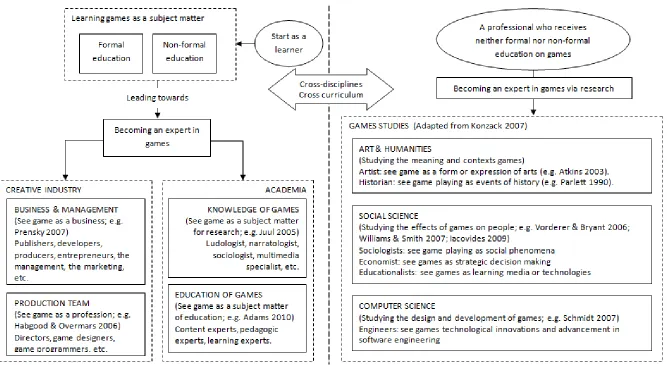
Game experts are professionals with expertise in the field of game production. They can be broadly classified based on the nature of games they produce, such as leisure games and serious games, and each of the game types can be further subdivided into other categories based on the contexts where the games are played or used (see Section 2.4.2 in Chapter 2 for more explanation). The game experts who joined this research were those who work in commercial games or educational games studios, doctoral researchers or academics who study games as a subject of interest, and undergraduate students who develop games as independent game developers (commonly known as ‗indies‘ in the game industry) or as part of their coursework. Indies are game developers who do not ‗receive money from a game publisher to
create their games (Michael 2003, p. xvii);‘ whereas game developers are individuals or businesses that produce games. In this specific context, a game is a piece of
software and the game developers are in fact software developers. The term ‗game developers‘ was not used to denote game experts because some professionals who work in the game industry are not software developers, for example, game designers, animators, sound engineers, playtesters, etc. Furthermore, game production involves pre-production, production and post-production processes; treating a game as a piece of software only begins in the game programming task of the production process. As a result the notion of ‗game experts‘ was chosen to reflect the actual scenario in the game industry.
8
manufacture of goods in factories (The Oxford Dictionary of English 2005).‘
Therefore, the game industry is the branch of economic and commercial activity that is concerned with the production of games in studios and the distribution of games through publishers. The game industry is a subset of the creative industries, which are those industries that focus on ‗creating and exploiting intellectual property or
providing creative services for business (A Dictionary of Geography 2009).‘
1.5 In search of a key research question
‗Research solves problems by answering questions objectively, but the
questions have to be the right ones! Evolving the ―right‖ questions is often
the most difficult part of research.‘
Richardson 2005
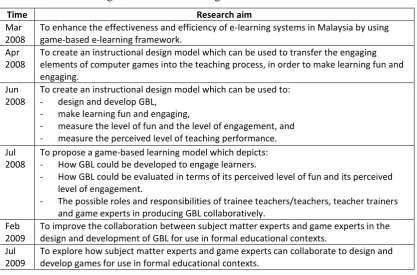
When this research was officially embarked on in March 2008, the research question was ‗how to enhance the effectiveness and efficiency of e-learning using computer games‘. E-games were presumed at that time to be a potential component of e-learning which can definitely enhance the effectiveness and efficiency of e-learning. This presumption was challenged and collapsed as the preliminary literature review (Tan, Johnston-Wilder & Neill 2008; Tan, Johnston-Wilder & Neill 2010; Tan, Neill & Johnston-Wilder 2009; Tan & Xu 2009) indicated the following:
- GBL has emerged as a field of academic study of its own in the UK, thus the research should focus on GBL rather than e-learning, which is
relatively general in term of research scope.
- There are two types of GBL literature—academic research publications and game experts‘ writing on game productions.
- There were concepts related to GBL which were not well defined and classified, causing miscommunication and misunderstanding among people involved in GBL practices.
9 before any attempt at enhancing learning through games becomes
practical.
While keeping abreast with the up-to-date GBL literature, three exploratory studies were conducted, aiming to identify the key research questions for this research (described further in Chapter 5). A major conclusion of these studies was that there was a discrepancy in the perceived potential of games between trainee teachers, game experts and advanced learners. After synthesizing the findings of these studies, the perceptions of SMEs and game experts about the following issues were
recognised as important for the deployment of, and collaboration in, GBL and were worth further research:
- Differing attitudes of teachers who use games in teaching.
- Differing attitudes within studios that produce games for use in formal education contexts.
- How SMEs and game experts could collaborate to design and develop games for use in formal education contexts.
The key research question derived from the third issue, because the perceptions of the first two issues were conjectured to contribute to the experts‘ understanding of how GBL collaboration could be realised.
1.6 The research aim and research outcomes
The aim of this research is to investigate how SMEs and game experts could collaborate to design and develop games for use in formal education contexts. A research aim is defined as one indispensable potential result plus important
10
1.7 Thesis structure
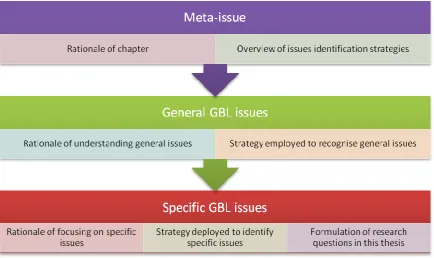
12
CHAPTER 2:
CONCEPTS ASSOCIATED WITH GBL
2.0 Introduction
This chapter examines concepts associated with GBL. The aim of the chapter is twofold: to juxtapose and compare the meanings of key concepts found in
dictionaries and the perceived understanding of those concepts held by academics and game experts in the literature; and to recognise how these concepts shape the use of games in formal educational contexts.
Concept is a mental construct of a group or class of objects, which may be abstract or concrete, seen as mediating between a term and whatever it denotes or is used to refer to (The Concise Oxford Dictionary of Linguistics 2007). It determines the application of a term, thus plays a part in the use of reason or language (The Oxford Dictionary of English 2005). Having a concept means being able to express a term in making judgement, i.e. connecting a term with the group or class of objects when the term is applied, and understanding the consequences of its application (The Oxford Dictionary of Philosophy 2008). A concept is formed through ‗exposure to examples
of items that belong to the concept category and items that do not belong to it‘—a
process that involves ‗learning to distinguish and recognise the relevant attributes
according to which items are classified and the rules governing the combination of
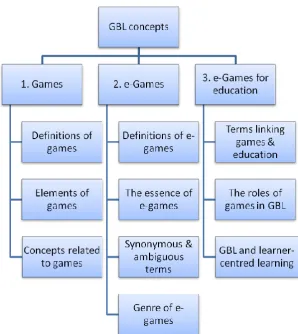
relevant attributes (A Dictionary of Psychology 2009).‘ Therefore, identifying key concepts and then juxtaposing and comparing the meanings of these concepts are essential tasks for constructing a foundation in academic research into GBL. Key concepts and terms associated with this research are divided into three levels. As shown in Figure 2.1, the first level consists of the definitions and elements of games, plus explanation of how other concepts, such as play, game playing, gameplay, game design, simulations, simulation games, fun and engagement are linked to games. The second level focuses on electronic games or e-games; explaining how e-games inherit the essence of modern technology which
13 where the concept of game-based learning (GBL) is re-introduced with three
[image:36.595.159.458.334.669.2]extended definitions, which involves seeing games used as learning media, games used as learning technology, and a combination of both. This research positions GBL as a form of educational approach which could embrace the dual-role played by games in education. The relationship between GBL and learning, gambased e-learning and learn-based gaming are also briefly discussed. The last section of this chapter explains the genesis of the definition of GBL adapted for this research, and how and why GBL is highlighted as a form of learner-centred learning. Apart from referring to academic literature and game experts‘ writings, Oxford Reference Online or ORO was chosen as the main reference for defining the concepts related to GBL in all three levels (ORO 2010).
14
2.1 Definitions of ‘game’
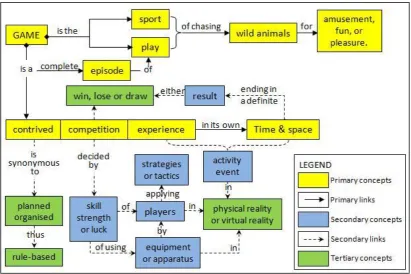
The definitions of game were studied through analysis and synthesis of meanings gathered from ORO (2010). These meanings of ‗game‘ were regarded as analytic propositions. An analytic proposition is one that is true by definition, hence definitional truths (Tiles 1987).
According to the Oxford Dictionary of Word Origin (ORO 2010), ‗amusement, fun,
or pleasure‘ were the original meanings of game, dating back to Old English. It was a form of ‗sport derived from the chase, hence wild animals pursued for sport (The Concise Oxford Dictionary of English Etymology 1996).‘ In the Oxford Dictionary of Sports Science and Medicine (2007), ‗game‘ was defined as ‗a contrived
competition experience existing in its own time and space,‘ which directed the search for meanings of ‗contrived competition experience‘. Thus from the sports science perspective, games are planned, competitive and experiential in nature.
Collectively, 24 meanings of ‗game‘ were extracted from nine English dictionaries and thesauruses in ORO (see Table 2.1). All sources of reference including the earlier definition of ‗wild animals hunted for sport or food‘ as part of their meanings used to denote ‗game‘ include the concept of rules, reflecting that the conventions of game hunting are related to rules, e.g. the Migration Game Birds Convention Act regulated by the Federal Government of Canada (Environment Canada 2010). Instead of choosing one meaning among the sources, a synthesized meaning is proposed for use in this thesis: an activity, either a form or spell of play or sport, engaged in for amusement, especially an organised, competitive one played according to rules and decided by skill, strength or luck.
15 Table 2.1: Meanings of the word ‗game‘ extracted from Oxford English dictionaries and thesauruses
Meanings Source f
1. Wild animals hunted for sport or food; the flesh of these animals, used as
food (A7 = wild fowl, prey, big game).
A–I 9
2. A form or spell of play or sport, esp. a competitive one played according to
rules and decided by skill, strength, or luck.
A–F, H 7
3. a single portion of play forming a scoring unit in a match or contest A–C, E–H 7
4. The equipment or apparatus used in playing a board game, computer
game, etc.
A, B, D–F, H 6
5. A meeting for sporting contests, athletic event, esp. track and field. A–F 6
6. Athletics or sports as a lesson or activity in school. D–F, H 6
7. One’s level of achievement, performance, standard in a game A–C, E, F, H 6
8. A piece of fun; jokes; tricks; jest; dodges; practical jokes; prank; hoax A, E–I 6
9. A scheme or undertaking, regarded as a game A, E–I 6
10. A type of activity or business, esp. when regarded as a game. B–D, I 4
11. A winning score in a game; the state of score in a game A, E, F, H 4
12. A policy or line of action (A1 = game plan). A, E, F, H 4
13. A hunted animal; a quarry or object of pursuit or attack A, E, F, H 4
14. An activity engaged in for amusement. C, D, G 3
15. A complete episode or period of play, ending in a definite result. B–E 3
16. An diversion, pastime, entertainment, recreation, distraction A, G, I 3
17. A kept flock of swans E, F 2
18. A person’s method or style of play A, B 2
19. A secret and clever plan or trick B, D 2
20. Match, tournament, round, bout G, I 2
21. Business, line, occupation, trade, profession, industry, enterprise, activity,
calling
G 1
22. Plot, ploy, stratagem, strategy, cunning plan, tactics, artifice, device,
manoeuvre
G 1
23. An instance of deception or psychological manipulation A 1
A = The Canadian Oxford Dictionary; B = The New Oxford American Dictionary; C = OED; D = The Concise Oxford English Dictionary; E = The Australian Oxford Dictionary;
16 Figure 2.2: Primary, secondary and tertiary concepts related to ‗game‘
2.2 Elements of games
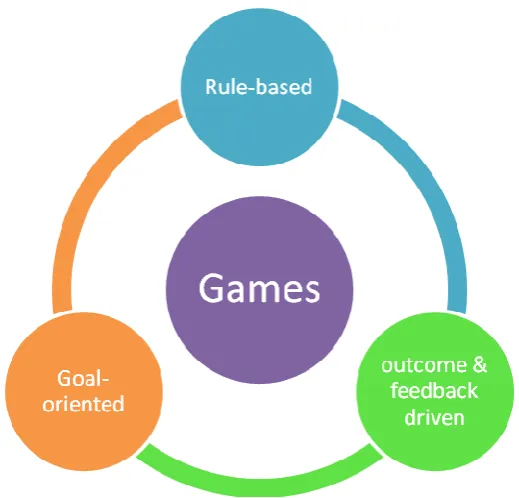
17 Table 2.2: The characteristics of the key structural elements of games, adapted from Prensky (2007, p. 119–124)
Elements Characteristics
Classic games
Rules Games are rule-based, hence organised play. Rules differentiate games
from free or spontaneous play. The limits imposed by rules force players to take specific paths to reach goals and ensure that all players take the same paths, which also draw the boundary between inside and outside of a game world.
Outcomes and feedback
Outcomes and feedback are the mechanism in which players measure their progress against the goals. The outcome is the win-lose state of play; while feedback occurs when something in the game changes in response to what players do, hence making game playing interactive. It is from the feedback in a game that learning takes place. This includes learning how the game works, what the game designer’s underlying model is, how to succeed and win. Through feedback, players either get rewarded for mastering something or they get word that they have failed at something, and have to try again or seek help, until they can do it. The goal of feedback is to enhance players’ experience and move them along in the game.
Goal or objectives
Games are goal-oriented. Goals or objectives differentiate games from toys, which are a form of non-goal-oriented play. The goal is often stated at the beginning of the rules, which requires players to devise strategies for achieving despite being limited by the rules. The process of achieving the goal within the rule-based conditions makes most of the players enjoy game playing.
e-games Problems Conflict, competition, challenge and oppositions are four forms of
problems in e-games players try to solve in safe and non-threatening conditions. In e-games, players can set their level of difficulty—a unique feature compared to classic games. Keeping the level of problem in synch with the player’s skills and progress is called ‘balancing’ in game design.
Interaction There are two aspects of interaction in game playing. The first is the
interaction of the player and the computer, which is a key element in classic e-games. The second is the inherently social aspect of games, involving one player with another, hence multiplayer.
Representation A game is about something, abstract or concrete, direct or indirect. Representation includes narrative, story or fantasy elements in the game.
18 unique features of Caillois‘ social perspective on games. This could be interpreted as- game playing does not accomplish anything useful (in the short term) because players are aware of the fictional reality when playing games. In the long term the skills learnt from games can be applied to real challenges.
Figure 2.3: The classic key structural elements of games proposed by Prensky (2007) Caillois‘ view of games as social activity was echoed by Berne (1964), who analysed games from a psychological perspective (see Table 2.3). In Berne‘s (1964)
classification of human behaviour, games were positioned as the third class of
human behaviours, which are socially programmed, partly exteropsychic—‗a portion
of the external world that has become an integral part of the internal world (Erskine 2002).‘ Other behaviours under the same order include pastimes, operations and manoeuvres and intimacy; but two unique characteristics: the ulterior quality and the pay-off, differentiate games from others (Berne 1964). Psychologically speaking, ‗a
game is an ongoing series of complementary ulterior transactions progressing to a
19 readers, Berne‘s (1964) Games People Play: the Psychology of Human Relationships
contained many psychological jargon terms in describing the nature of games, thus the elements are more appropriate to use in psychological studies, rather than education.
Table 2.3: The characteristics of the elements of games, adapted from Berne (1964, p. 48–52)
Elements Characteristics
Thesis A general description of the game, including the immediate sequence of events and
information about their psychological background, evolution and significance.
Antithesis The presumption that a certain sequence constitutes a game, which is tentative
until it has been existentially validated. This validation is tested by a refusal to play or by undercutting the payoff. For clear understanding of a game, the antithesis should be known and its effectiveness demonstrated in practice.
Aim A statement of the general purpose of the game, which sometimes may have
alternatives.
Roles A way to describe games: two-handed, three-handed, many-handed, etc.,
according to the number of roles offered. Sometimes the ego state of each player corresponds to the role, sometimes it does not.
Dynamics The psychodynamic driving forces behind each case of a game. There are
alternatives in stating dynamics, but it is usually possible to pick out a single psychodynamic concept which usefully, aptly and meaningfully characterises the situation.
Examples Cognates which are worth-while to search for in making formal descriptions of
games. The cognates could be the childhood origin of a game, or its infantile prototypes that are instructive to study.
Transactional paradigm
A paradigm where the transactional analysis of a typical situation is presented, giving both the social and psychological levels of revealing ulterior transaction.
Moves Elements of a game that correspond roughly to the strokes in a ritual. As in any
game, the players become increasingly adept with practice. Wasteful moves are eliminated, and more and more purpose is condensed into each move.
Advantages The general advantages of a game consist in its stabilising or homeostatic functions.
Biological homeostasis is promoted by the stroking, and psychological stability is reinforced by the confirmation of position. The advantages are further divided into internal psychological advantage that has a direct effect on the psychic economy (libido); external psychological advantage which is the avoidance of the feared situation by playing the game; internal social advantage that is designated by the name of the game as it is played in the individual’s intimate circle; and external social advantage which is designated by the use made of the situation in outside social contacts.
20 (ORO 2005). The theory has been further studied and applied in disciplines beyond mathematics and economics, such as the study of convention in philosophy (Lewis 1969; Skyrms 1996), evolutionary biology and ecology (Maynard Smith & Harper 2003; Maynard Smith & Price 1973), interactive computation modelling in computer science (Goldin, Smolka, & Wegner 2006), and voting systems in political science (Brams 1976). Interestingly, some philosophers or ideologists were regarded as game theorists although their work ceased long before the field of game theory came into being in 1944. The ideas of game theory were ‗seriously‘ included in Thucydides‘
History of the Peloponnesian War and Plato‘s Republic: the Challenge to Socrates
(Stanford Encyclopedia of Philosophy 2010); Sun Tzu‘s The Art of War (Tao 2006); Wang Chan‘s 鬼谷子(Gui Gu Zi, a classic text of Taoism) (Mei 2006) and Niccolò Machiavelli‘s The Prince (Binmore et al. 1993, p. 23).
Some contemporary GBL researchers stress that game theory should not be confused with games studies, particularly in games for use in education and training. Simon (2007) argued that ‗game theory and games studies obviously hardly ever met,‘ because game theory ‗is very much interested in games with outcomes that have very
serious non-negotiable consequences.‘ Based on this argument, the singular ‗game‘ in ‗game theory‘ was limited to refer to the mathematical-logical studies of games, while the plural ‗games‘ in ‗games studies‘ refer to the humanities based research of games (Simons 2007). However, this avoidance approach may prompt more
arguments rather than clarifying the overlapping situations as it would be
21 Table 2.4: The explanation of game components in game theory, proposed by
Straffin (1993, p. 3)
Components Explanation
Player An entity who makes a choice in a game or who receives a payoff from the outcome
of those choices. There are at least two players, but the entity does not have to be human being.
Strategies Courses of action which each player may choose to follow in a game.
Outcome The outcome of the game is determined by the strategies chosen by each player.
Payoffs A collection of numerical representation associated with each possible outcome of
the game, one to each player. These payoffs represent the value of the outcome to the different players.
In terms of interactivity, the game in game theory is either sequential or
simultaneous, which are two types, each of many moves, that could be taken by players as feedback in the structure of a classic game, as proposed by Prensky (2007). The emphasis on goal or objectives orientation in game theory is limited to achieving either zero-sum (where gain to one player is loss to another) or non-zero-sum (where both or all players can gain or lose simultaneously) outcome. These limitations are indeed reflecting the ‗rule-based‘ nature of classic games. As a result, a typical game in the game theory is not contradictory to the essence of classic games; it is just the rules of the game that are set to suit specific game playing contexts, and the playing is focusing on the strategies‘ deployment and the payoffs, rather than winning the game. Therefore, game theory could be a theory applicable to game playing if the conditions of the playing meet the rules set by the theory. In other words, discarding game theory from games studies is actually a non-issue.
2.3 Other concepts related to games
As shown in Figure 2.1, concepts related to games can be grouped according to their hierarchical linkage with the ‗game‘. Some of these concepts, particularly play, game playing, gameplay, game design, simulations, fun and engagement are synonymous or ambiguous to games across various disciplines and in day-to-day life. For
22 chapter was not meant to prove whether a perception is better or worse than others, instead it demonstrates the presence of multiple perspectives on games and other concepts related to games. Acknowledging this vision is important before
juxtaposing concepts related to games. The intention of this juxtaposition is to expose the relationship among these concepts in relation to games.
Figure 2.4: Crawford‘s (2003) taxonomy of creative expression 2.3.1 Play and game playing
[image:45.595.115.409.185.421.2]Games are just one form of play. Apart from games, there are other forms of play such as role play, drama, toy play, simulations, etc. Figure 2.5 shows the hierarchical relationship between play and game, a diagram adapted by Prensky (2007) from Encyclopaedia Britannica.