Artemis Lykou
Supervisor: dr.ir. R.W. van Delden (Robby) Supervisor: dr.ir. R. Klaassen (Randy) April 2018
University of Twente
Educating children about asthma from a
Contents
1. Introduction ... 1
1.1 Context... 1
1.2 Approach ... 2
2. State of the Art ... 4
2.1 Literature Review about Asthma in Children ... 4
2.1.1 Triggers of Asthma ... 5
2.1.2 Treatments of Asthma ... 7
2.2 Serious Game ... 8
2.2.1 Serious Games for Health ... 8
2.2.2 Mobile applications that help people who have asthma ... 9
2.2.3 Mobile applications for asthmatic children ... 11
3. Ideation ... 16
3.1 Concept development ... 17
4. Realization ... 21
4.1 Construction of the game ... 21
4.2 Game mechanics ... 26
5. Evaluation ... 29
5.1 Ethical aspect ... 29
5.2 Participants ... 32
5.2.1 Playtesting ... 32
6. Conclusion ... 35
Appendix I ... 36
Appendix II ... 38
Appendix III ... 41
1
1. Introduction
1.1 Context
This research thesis focuses on an overview of asthma in children. Therefore, understating about asthma, it will help to add information for the graduation project, which is an educational, gamified mobile application that teaches children to learn about asthma in an exciting and fun way.
Asthma troubles a vast majority of population on Earth. It reaches the 14th most severe disorder in the world (Global Asthma Network, 2014). According to American College of Allergy, Asthma and Immunology, asthma occurs when a person regularly undergoes shortness of breathing or is having wheezy or whistling sounds in the chest while breathing. A constant disease gives rise to swelling and shrinking of the bronchial tubes. It happens when the air goes in and exits from the lungs. Furthermore, focusing specifically on asthmatic children, it was discovered from the latest research that was conducted by The International Study of Asthma and Allergies in Childhood that approximately 14% of the children on Earth were possible to have had asthma issues. The problems that children face in their daily lives cause them to end up in critical care facilities. They get admitted to hospital for treatment and miss days in school1. The same logic underlies from van den Bemt (2010)that asthma influences the children physically, emotionally and socially. Therefore, we can conclude that children need to learn from an early age to cope with their condition and try to live with this unpleasant condition daily.
The existing methods of educating children who have asthma are not entirely encouraging them thoroughly to understand and learn how to cope with their condition. The learning procedure usually starts at the doctor's office. The doctor tries to explain to the child and the parent about asthma. According to Boyse (2012), which is a guide that informs parents about chronic conditions, shows toddlers, preschool and early school-aged children have little sense of understanding clearly about their health condition. They may get distracted or not interested in listening to the doctor's instructions during the appointment. Therefore, there is a high chance that
2
the patient's health would become severe and uncontrollable. There are many different types of asthma, and each patient needs to be a master of his condition to minimize asthma attacks and visits to hospitals. After focusing on how children receive education about asthma, another equally important factor is, how the children feel about their condition and how do they manage it.
A problem that asthmatic children face in their daily lives happens at school. They experience bullying and teasing from children who have no health problems. They feel intimidated to request support or display any symptoms of asthma because they have a fear of being in an uncomfortable situation. There is also a possibility that the children would not take their illness seriously due to their peers who also do not consider it (Stewart, Masuda, Letourneau, Anderson, & McGhan, 2011). Therefore, educating not only asthmatic children but also healthy children: it is possible that bullying can be eliminated. If all children start learning about asthma, then asthmatic children will not feel discouraged or different from their peers. They will feel comfortable with taking care of their health without feeling shy and thinking that is not serious to treat it.
Currently, many applications are based on self-management of asthma. The children learn how to use their inhalers with the help of games. However, a few mobile applications on the market only educate children about asthma interactively and interestingly. As a result, there is a gap in assuring that children learn about their condition successfully. Based on this problem definition, the research questions is “How to educate children about asthma through gamification?”
Additionally, the sub-question is "What kind of game tasks should be included in the mobile app to help the children learn about asthma?" Answering this question will help to have a concrete direction of what it is necessary to be incorporated in the upcoming mobile application.
1.2 Approach
The goal of this research is to create a gamified application that helps children to learn about asthma. In order to build the mobile application, it needs to be developed in a platform. There are two ways to approach this problem. Most of the mobile applications are developed for either Android or iOS. Due to time restrictions of the project, only one platform is chosen since these two operating systems require different programming languages to develop applications. The platform of choice is Android.
3
Thio from a MST hospital and literature research. The conclusion of the interview was that children need to be well informed of what is asthma. They should know what kind of asthma they have and how to treat it. After they get diagnosed with asthma by the doctor, it would be beneficial for the children to learn in a fun and efficient way about their condition. In this way, two factors get eliminated. Firstly, the more the child knows about his illness, the better it can protect himself from having severe asthma attacks. Secondly, it will be cost-efficient. The application will teach the children what is asthma. It will introduce them the triggers that cause asthma and it will show them different ways of prevention. This way, the patients will fully understand how to take care of their health and it will prevent them to end up in emergency rooms as much as possible.
4
2. State of the Art
The following Chapter State of the Art is divided into 2 parts. The first part shows a detailed description of what is asthma. It introduces the triggers that cause asthma and the treatments that already exist. The second part is divided into 3 sections. The first section investigates whether educational games indeed assist children to learn and cope with their health condition. The second part shows a short selection of the application that asthmatic people currently use. Lastly, the third section focuses on available gamified mobile applications that help only asthmatic children.
2.1 Literature Review about Asthma in Children
Asthma attack varies in types and intensity, but have one characteristic in common: they recur throughout time, usually at random intervals. Understanding when a person is having an asthma attack is by looking at the symptoms. In other words, if the symptoms of the child are becoming worse, then there is a possibility that the child is having an asthma attack. The noticeable symptoms are coughing, chest pain, wheezing sound, feeling tired, sleeping problem and trouble breathing. It can also be observed when the medication is not helping the patient. That is to say, an asthma attack occurs when the muscles shrink around the passageways of where the air comes in and goes out (Figure 1). In medical terms is called bronchospasm. Besides, throughout the asthma attacks, two more factors appear. The air passages of the patient are puffed up or inflamed and clogged with mucus, causing blockage of airways. Therefore, taking into consideration all these three aspects, asthma attack causes difficulty in breathing. Additionally, the patient might also reveal other symptoms such as anxiety, difficulty in talking, rapid breathing, tight chest, showing pale, sweaty face and blue lips or fingernails2. Asthma attacks can appear from different
cases, especially when it is not properly under control. Therefore, in the next section, it will be discussed analytically, the triggers that cause children to have asthma.
5
Figure 1: The picture shows on the left how asthma attack causes the muscles in the airway to shrink; hence, we see an unhealthy patient. On the right side, the patient's lungs are healthy.3
2.1.1 Triggers of Asthma
Even though the phenomenon of childhood asthma is not entirely comprehended, discussing what causes children to develop asthma, can give plenty resources of understanding what triggers them to have it. In this way, knowing in advance what can make their condition worse and prevent them from having severe asthma attacks. Asthma is a broad topic with many possible triggers. In this paper, the most important causes are divided into sections. These are the physical health of the mother, outdoor and indoor pollution and allergens, smoking, weather conditions and the physical health of the patient.
The mother’s health can affect the child’s health. Several studies (Davidson et al., n.d; Willers et al., 2011; Neuman et al., 2012stress the importance of being a healthy mother. For instance, if a mother is overweight or smokes during her pregnancy, the child can get asthma in his future life. Additionally, asthma can be inherited, if both of the parents had or have experienced asthma or if one of the parents had or had asthmatic issues (Partners Asthma Center, 2010). However, Chen (2014) explains that a child can also have problems with asthma based on his physical health, especially when a child has abdominal obesity. Abdominal obesity is when excess fat gets around the stomach area. Lack of physical exercise and excess sedentary lifestyle affects the health of children and makes them prone to developing asthma. Summing up, both the mother and the child needs to be in good health to order to avoid having severe asthma issues.
6
Moving to indoor and outdoor pollution, Breysse (2010) and Gasana (2012) show that being in a polluted environment it can exacerbate the children’s asthma. It can be indoors pollution such as mouse allergen or outdoor pollution such as airborne pollutants, which usually occur in high traffic roads. Furthermore, Radic (2011) claims that parents who smoke can result in an adverse effect on the child's health who has asthma. Children who are susceptible to air pollution end up having more problems with their condition. Breysee (2010) concludes that if air pollution is decreased and if mouse allergen is reduced, it may help children from having severe asthma problems in their homes. As a result, more people will breathe better have less discomfort of showing any signs of an asthma attack.
Additionally, indoor and outdoor allergens also affect the child’s asthma. Pawankar (2012) explains that this a combination of allergic and asthmatic illness. Both Quansah (2012) and Sheffield (2011) prove that when severe moisture in the air takes place, it results on a high concentration of outdoor pollen and mold in the atmosphere which makes it prone to severe allergic disease. Cold weather and especially cold spells can also grow the possibility of getting asthma. Guo (2012), suggests that children should be better kept safe from freezing temperatures in the winter. Furthermore, according to Gent (2012) household allergies can also play a significant role in increasing asthma. These are dust mites or pet allergens. Quansah (2012) adds that molds inside the house are also causes of developing asthma. In other words, mold, pollen, cold spells, dust mites and pet allergens cause children to have asthma, or it worsens the symptoms of children who have asthma.
7
2.1.2 Treatments of Asthma
Since asthma is a chronic disease and cannot be cured, inhalers with a different type of medication are available. They focus on prevention and long-term control, which are vital in stopping asthma attacks before they start. There are three ways of treatments. It consists of two type of inhalers; inhaled steroid and bronchodilators, the second treatment is facemasks and nebulizers for children who find difficult to use an ordinary inhaler, and the third therapy is allergy shot for children who have allergic asthma.
Two types of inhalers exist to treat the patient who has asthma. One is the inhaled steroids and the second therapy is bronchodilators inhalers. The first time of inhalers are anti-inflammatory drugs, especially the inhaled steroids are one of the most effective treatments that help the majority of asthma patients to recover4.Kerrebijn (1987) also proves that inhaled corticosteroids are a successful treatment for children with bronchial receptivity. These types of inhalers can be used in daily bases, and it is recommended for asthmatic children to have it always with them.
The second type of inhalers is bronchodilators. Bronchodilators immediately alleviate the symptoms of asthma and help to open up the airways. They are not used as daily treatment because their purpose is mostly used only to save the patient after a severe cough. According to Price (2014), anticholinergic bronchodilators might profit patients to maintain their asthma after using it in a long-term. In other words, asthma inhalers are the most common medications. The patient uses it every day. As soon as the patient is having a problem, he can immediately get the medicine that goes straight to his lungs. There are different types of medication usually in a powder form. Barnes (2005) states that there are researchers who still try to improve this type of drug. For instance by making it more accurate, being reliable and comfortable to hold it or having a beautiful design.
The second type of therapy works if the patients are at the age of 4 and older. It might be required using asthma nebulizer. Nebulizers are used mostly for infants, and it is a machine that gives the medicine by wearing a mask. There was a comparison between the inhaler with spacer and nebulizer. Taking a dose of 2 puffs equals to a higher dose of mobilizer (Schuh et al., 1999). The third type of therapy is allergy shots. Möller (2002) proves that pollen immunotherapy can help to decrease asthma in children who have seasonal allergies. That is why; some children might
8
experience a combination of allergies and asthma health problems. Therefore, allergy shots are used.
Understanding how children receive medication and treatment, it gave a deeper insight into how complicated this condition is. At the end of this part, there is a full overview of asthma, the symptoms, the causes and the treatments; the children usually receive in the medical centers. It was important to become aware to continue the investigation with the second part, which is other possible gamified mobile applications that exist in the market.
2.2 Serious Game
The second section of the State of the Art focuses on gamified mobile applications for patient who have asthma. Before going deeply on gamified mobile application that exist on the market, a definition of gamification will be described. Serious games strategies can play an important role in learning outcomes. It is a new way of educating people through games. Gamification also boosts performance. Two significant elements a user needs in order to complete a goal are recognition and rewards. This is what motivates users to be part of the learning strategy. This way they feel engaged to win; thus, learn. A few of the desired factors for a successful gamification in learning are capturing the user’s attention, challenging them, entertaining them and teaching them. The rules of the game have to be clear with achievable tasks. People like to be challenged in a fun and enjoyable way.
2.2.1 Serious Games for Health
9
educational game for children who have asthma could be the most efficient and reliable way to make children acquire knowledge, obtain higher self-confidence and gain better health.
2.2.2 Mobile applications that help people who have asthma
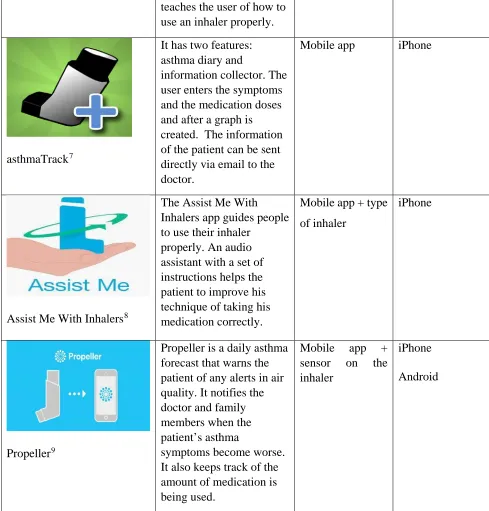
A selection of the most popular mobile applications with the best ratings that help asthmatic people was made. The following table (Table 1) describes briefly, what each application does. The focus of this section was to make a research of already existing application on the market. The mobile applications did not need to have a gamified theme because the important points were the features that apps provide to patients. Overall, the insight of these five applications is that patients are interested in keeping on track of their progress and like to be reminded or instructed of how to take their medication. There is not really an educational concern of learning about asthma but mostly instructions for users.
Product Description Tools Operating
System
AsthmaMD5
The app traces
medications, and asthma triggers. It includes personalized action plan. The asthma diary and graph of the patient can be shared with the doctor, which is added on the medical record.
Mobile app + AsthmaMD peak flow meter
iPhone Android
Asthma Buddy6
An app reminds the patient to take their asthma medication every day. Additionally, it keeps track of any changes in the symptoms of the patient. It includes first-aid instructions and educational videos that
Mobile app iPhone Android
5http://www.asthmamd.org/
10
teaches the user of how to use an inhaler properly.
asthmaTrack7
It has two features: asthma diary and
information collector. The user enters the symptoms and the medication doses and after a graph is created. The information of the patient can be sent directly via email to the doctor.
Mobile app iPhone
Assist Me With Inhalers8
The Assist Me With Inhalers app guides people to use their inhaler
properly. An audio assistant with a set of instructions helps the patient to improve his technique of taking his medication correctly.
Mobile app + type of inhaler
iPhone
Propeller9
Propeller is a daily asthma forecast that warns the patient of any alerts in air quality. It notifies the doctor and family members when the patient’s asthma
symptoms become worse. It also keeps track of the amount of medication is being used.
Mobile app + sensor on the inhaler
[image:12.612.71.560.73.584.2]iPhone Android
Table 1: A selection of the most important and well-rated applications for people with asthma is shown in this table.
7https://itunes.apple.com/us/app/asthmatrack/id412530732?mt=8 8https://use-inhalers.com/assist-me-ios-app-description
11
2.2.3 Mobile applications for asthmatic children
GeckoCap
[image:13.612.187.416.295.448.2]In 2012, the team Gecko Health Innovations created a product called Gecko Cap. The user uses the smart inhaler with the combination of a mobile application. The inhaler consists of a sensor that is connected to the application. Therefore, there is a platform of data analytics of the patient who uses the application and the patient is able to access it. He can also keep on track of his condition. The company focused on kids. Hence, gamification and rewards were included in the application in order to inspire children to use their inhaler (Figure 2).
Figure 2: GeckoCap won at MIT Media Lab Health and Wellness Innovation event in 2012 (Heong Weng Mak, n.d.).
Rafi-tone
12
Figure 3: A mask with a Flo-Tone whistle and an Able spacer from the company Clement Clarke International10.
Figure 4: The child on the picture is inhaling through the spacer in order to receive his medication. After a sound is produced from the mask, the application receives the sound and Rafi Robot eliminates the bad characters of the game9.
Alvio
Another breathing device called Alvio helps children with asthma to become stronger over time. The breathing trainer is connected wirelessly with the mobile app. The device can be adjusted according to the patient's needs. It also keeps track of the patient's progress and sends alerts to the parent when the symptoms are getting worse. This way the parent is aware of and can interfere before an asthma attack occurs. There are two aims of this game. First, the user controls breathing by blowing on the device that makes the fish in the game swim higher or lower in the water. Second, it keeps track of the severity of asthma symptoms by exhaling.
[image:14.612.185.427.224.371.2]
13
Figure 5: Alvio is a mobile game with a breathing device that helps children with asthma to become stronger by completing breathing exercises in the app11
Easy Breathing
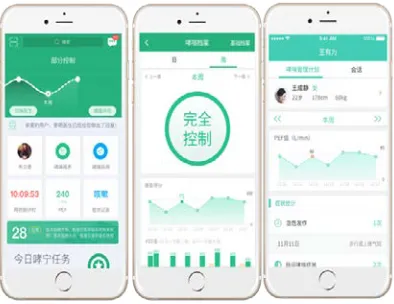
Another application that keeps track of the condition of the patient is called Easy Breathing system. This app also enables the doctor to keep on track of the patient’s data by accessing through their mobile phones. Additionally, the project includes a PEF meter which is a smart sensor that checks whether the lungs of the patient are inflated. The application consists of 6 parts: educational module, medical review module, lifestyle modification module, risk factor avoiding module, action plan advising module and medical resources accessing module. The patient’s interface (Figure 6) contains a full overview of personalized data. However, this project is missing gamification and there is a lot of information that might make the child confused. Taking into consideration the educational module and action plan advising module from this project, it will be a good idea to include these two functions on the upcoming project.
14
Figure 6: The interface of the patient's personal data on asthma. It includes all the information a child should know in order to cope with his chronic condition (Hu et al., 2016).
WizdyPets
[image:16.612.185.428.448.586.2]The WizdyPets application gives a meaningful inspiration of what the project should incorporate. WizdyPets is created to teach kids to control their asthma by taking care of a virtual pet that also has asthma (Figure 7). The app conveys three aspects. The child understands how to use the inhaler properly, it recognizes the asthma triggers and it uses an Asthma Action Plan through gamification. There is no use of an external device such as inhalers. A mobile app helps children to understand their health condition and treatment.
Figure 7: WizdyPets application teaches children to know how to control their asthmatic condition by taking care of a virtual pet that also has asthma12
15 Huff&Puff
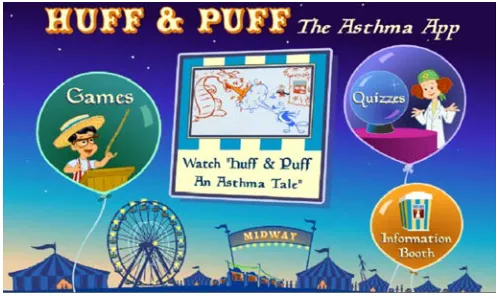
[image:17.612.181.429.232.381.2]A well-known educational app that helps children with their asthma is called Huff&Puff. It contains videos, quizzes, and games that help kids to become self-aware about asthma. The usage of this game is only for educational and informational purposes. It is not used to substitute the doctors, nurses, and medical experts. The character of the game is a big bad wolf who has asthma. The children learn about asthma through asthma tales which are well presented in a sensible and clear way. It is a great resource incorporating it into the research paper.
Figure 8: An education app that explains complicated terms of asthma in an easy a way for children13.
Taking into consideration the previous six mobile applications, the most noteworthy applications are the WizdyPets, and Huff and Puff. GeckoCap, Rafi-Tone, and Alvio focus on teaching asthmatic children on how to use an inhaler properly. Easy Breathing displays the patient’s personal data on asthma. However, this research focuses only on the educational aspect of asthma. Therefore, the last two applications match the criteria. They do not include external factors such as smart inhalers. They successfully use cartoon characters with the combination of interactive games. They have transformed complicated medical terms into simplified and interesting videos and games. For that reason, the two applications will be used as an inspiration for making a mobile application that educates children in English and Greek.
16
3. Ideation
Implementing a storyline in the upcoming application as Huff&Puff does and adding gamification as the WizdyPets, it will be a good idea to combine those two ideas together. After playing both of the games, the first game makes the user understands very well about his condition. He comprehends the whole process of a patient having asthma. It consists of seven episodes. Every video explains the process of a person who has asthma. In this game, it is a young wolf where tries to blow to destroy the house of the three pigs. Unfortunately, he does not succeed and he goes to the hospital, an introduction start of what is asthma by the doctor. Then the doctor explains the signs and symptoms of asthma. The young wolf is examined and diagnosed by the doctor, to make sure that he has indeed asthma. After the patient is informed of what triggers he should avoid not worsening up his condition. The last episode, the wolf learns how to use his medication about asthma properly. After watching the videos, the player can take a quiz according to the video he/she watched. The mobile application also has a game called tic tac blo where the player tries to answer questions about asthma. Explaining gradually, simply through animation about asthma seems to be an effective way. However, the videos in Huff&Puff were long and monotonous. Children can get distracted easily and in this way when the video explains important medical terms that the person needs to focus and remember important information might be missed.
The second game WizdyPets helps the child to learn how to use the inhaler properly, so it can help the virtual pet to breathe again because it feels tired and cannot breathe well. The enemies that the small virtual animal needs to alleviate are only triggers. There is no explanation of why they need to be eliminated because there is no description nor a story before playing the game. Thus, the child does not fully learn about asthma. Playing first the Huff&Puff, the player understands all the terms about asthma and when playing the WizdyPets after, he enjoys playing it because it is interactive and fun. It is also more understandable if the user plays the two games in this order. First, he learns about asthma and second, what he has learned, he implements them in the second game. The two games complement each other.
17
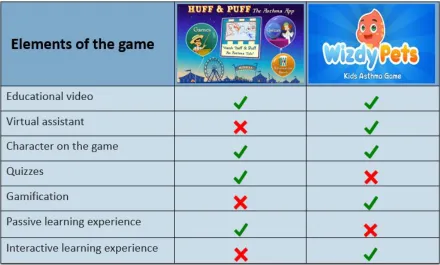
there is not any gamification included. It only contains quizzes. On the other hand, WizdyPets includes gamification thus it is an interactive play.
Table 2: A comparison of the different type of elements that exist between Huff and Puff and WizdyPets games.
3.1 Concept development
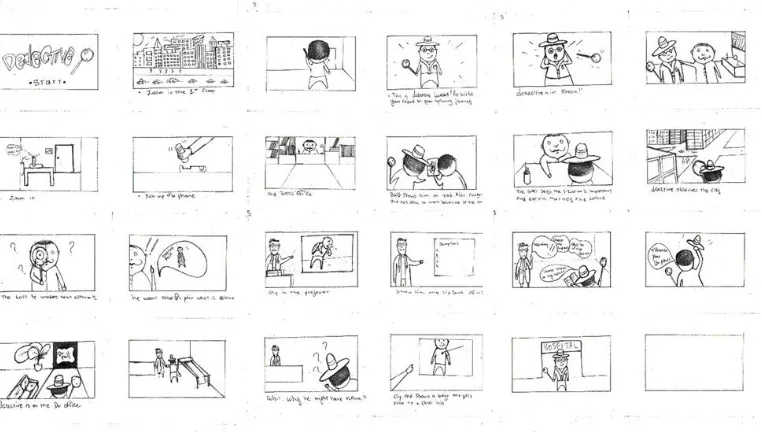
[image:19.612.74.514.121.386.2]18
The first scenario introduces the main character from close-ups. After, the detective ends up at the mayor’s office where the mayor informs the detective about a serious problem that makes the children of this city weak. The name of the villain is called asthma. The detective does not know about asthma, so he goes to Doctor Phil. Doctor Phil explains what asthma is and he introduces him to the signs and symptoms of asthma that a child gets. The doctor points out that if a child shows signs of coughing, wheezing, trouble to breathe, chest pain, feeling tired and problems sleeping then the detective has to send the child to the doctor to get diagnosed if it has indeed asthma. However, there are also children who are officially diagnosed by the doctor; the detective can recognize them by wearing special badges on them (star sign). At this point, the child who watches the video can identify himself with the main character. He/she understands that the detective has a duty to help the children who have symptoms of asthma by sending them to the doctor.
19
[image:21.612.78.459.81.297.2]Figure 9: Scenario 1: An introduction of who is the main character of the game and the detective learns about the symptoms of asthma.
[image:21.612.74.459.370.682.2]20
Figure 11: A diagram of the mobile app how should have looked with four levels.
21
4. Realization
4.1 Construction of the game
Software platform
The game has been built on a platform called Buildbox14. It is a drag and drop building
software that allows creators to concentrate on game creation only. It does not require any programming, coding or scripting skills. The software already contains already made platforms, which a creator can choose and create a project. After selecting a platform that suits the best according to the preferences of the maker, a menu editor appears. This is the mind map of the game. The menu editor already includes a basic menu, a pause menu, and a game over the menu (Figure 12). It also has worlds, which is where all the construction of characters, enemies, and levels are made. The world UI is connected to the world because this is where the buttons for the user interface will be implemented. The original idea was to construct a game in Unity but unfortunately, the project would take a lot of time on coding the game and a little time on focusing on the mechanics, visuals, and sounds of the game. It would not be enough to have a complete game that plays on a smartphone. At the end of this project, the goal is to have a complete mobile application that does not work only locally on a smartphone but it is also published on the PlayStore.
22
Figure 12: This is a premade Game Mind Map of the game. It appears when the user selects a platform from Buildbox’s projects.
[image:24.612.74.542.418.652.2]As it has been mentioned in the previous section, the game had to be divided into two games; the symptoms and the triggers. Therefore, the mind map changed to three Worlds with three Worlds UIs (Figure 13). The third world, which is the End scene, connects the Worlds Symptoms and Triggers together after the two games are finished. This way each game ends when it reaches the last level. Having games that are endless would not work. There are possibilities that the player might never reach all the levels of the game because of how difficult they will be. As a result, he/she might become frustrated after many trials, which will end up not finishing the game, thus never see each level. The level of difficulty has to be moderate and not impossible to pass because the target is to make the player see all the levels of symptoms and all the levels of triggers as many times as possible. It important because the player can memorize the elements easily through playing. Furthermore, the main menu consists of a Coin Shop; when the player has collected enough symptoms, he can buy a new character for the game. It also contains an information button; there is a small description of the game and an explanation of what is the goal of this game (Figure 14).
23
24 Visuals
The theme of the game is colorful and the objects are in 2D. Vecteezy15 and Freepik16
[image:26.612.118.494.268.489.2]websites helped to get inspired by how every object will be displayed. A few vectors were taken from these two websites but all of them were modified in Adobe Illustrator. The Buildbox software allows only png pictures, so every flat vector is saved as a picture and then resized in the software. Below there are two tables that show the elements that are in the symptoms game and the enemies that are in the triggers game.
Figure 15: The six symptoms that a child sees and understands that there is a possibility that he/she has asthma.
15https://www.vecteezy.com/
25
Figure 16: The eight triggers a child should avoid when playing the game.
Sounds and sound effects
The background sounds were taken from Incompetech: Royalty-Free Music17 and from
free copyrighted websites. After, they were edited in Audacity and then converted to mp3 files. In the game, there are five main sounds; Fluffing a Duck, Merry Go, Meatball Parade, Professor Umlaut and win. The sound effects for the buttons were taken from the preset of Buildbox. The mood of the sounds is comedic and funny. Asthma is a serious condition and showing to children about this complicated disorder in an enjoyable way, children will not feel intimidated and embarrassed by it. Making the children feeling comfortable and not frighten, the game can make them accept their illness better.
26
4.2 Game mechanics
In the first game, six symptoms are displayed (Figure 17). The purpose of the game is to collect as many symptoms as possible. Every symptom has each own level. Each symptom was simulated accordingly. Starting from the first level. Chest pain is interpreted as a feeling of the sharp stab and a burning sensation inside the lungs18. The level contains a set of flames, which are placed left and right as boarders with a set of random thorns. It conveys a feeling of discomfort. The next level, coughing is a scratchy or a tickle feeling at the back of the throat. It is dry and stiff. Therefore, representing it with dry yellow wheat is the best approach. Pointy needles appear from the side, which the player needs to avoid. Imitating a wheezing sound was the most challenging. A whistling sound appears while breathing. It occurs when the airways are narrowed down. Therefore, a representation of pathways that shrink from both sides was a good idea. However, it was not enough. Adding a wheezing sound to the game was risky because it is an unpleasant sound. It might frighten the children during the game. For this reason, the wheezing sound was replaced with a sound of a deflating balloon. When a child has trouble breathing, the feeling of trying to get air is similar to a labyrinth. The person is trying to get out of the labyrinth as the child is trying to get air. Adding dark blue frames with stars, alarm clocks and zzz, it and adding a snoring sound, it made it clear that a patient is having problems with sleeping. The last symptom, feeling tired is a sensation of dizziness, loss of balance and loss of energy. Hence, adding spiral symbols made it work.
27
28
[image:30.612.84.533.205.548.2]In the second game, eight triggers appear (Figure 18). The levels in the game are divided into five sections. Cigarettes, car's exhaust, factory's chimney are simulated by having a grey smoke around the frames of the game. A wooden frame is implemented in the level of bed bugs and a grass frame for the pollen. The next level, it has borders that look like a moldy cheese. Lastly, icebergs, snowflakes, and frames from snow are included on the level that displays cold weather and children having the flu.
Figure 18: This is the triggers game. Every trigger is represented in each picture. The purpose of the game is to avoid the triggers. If the player touches them, he loses.
29
5. Evaluation
5.1 Ethical aspect
The first and most crucial step when conducting research with children is the ethical issues that require to be addressed. Obtaining permission for a child to participate in research is usually a more complicated approach than gaining authorization from another group of people. The people do not see the children as independent individuals who are ready to make their own decisions. Both (Greig, 2007 and Tisdall, 2009) support that by legislation those who are under 18 years old are not in accordance with the law to give consent. Parents and other adults who are responsible for the children such as teachers and social workers usually take their decisions. Moreover, an essential part of obtaining consent is guarantying that contributors are fully informed of, and comprehend the purpose and results of the research (Tisdall et al., 2009). Therefore, in reality, researchers are obliged to gain permission from appropriate adults and obtain consent from the child. If research is organized in school or sports community club, the researcher will need to gain the approval of the person who is in charges, such as the head-teacher, sports coach or club leader. It is significant to outline the purpose of the project, the degree of a child's involvement and the outcomes of the project. Since they will not be any testing at school and only ten children will participate in the research, the parents/guardians of the children will have to sign the consent form that allows their child to participate in the study. The second step, once the consent has been requested and gained from parents or other relevant gatekeepers the researcher is then required to gain permission from the children. According to (“Society for Research in Child Development SRCD,” 2007), the children do not have to sign any written form to show that they are willing to participate. They can just give a signal that they are eager to join.
30
Another critical factor that needs to be taken into consideration is protecting the children from any harm during the research. According to (BERA, 2004), when researching with children, the primary concern is the interests and the rights of the children. Hence, the researchers have a responsibility to protect their subjects from harm. The method needs to be appropriate and will ensure not to cause any physical or psychological damage (Alderson, Morrow, & Alderson, 2011). A few of the possible risks that may cause harm are; over-research might occur when children are being asked to take part in too many studies, and misunderstanding can happen. All forms such as consent, debrief information, questionnaires and instructions should be well understood. Otherwise, they can cause distress regarding causing anxiety or confusion. Alderson & Morrow, (2011) indicate that these factors can create emotional pain, feelings of embarrassments and have an effect on children's self-esteem. If the child feels uncomfortable or does not to continue playing the game app, he has the right to stop and not finish the game.
31
Moreover, the cyber safety needs to be addressed for the online security and privacy of the users. So far, the mobile game app does not include any information about the user. It does not collect the name, the age or the condition of the child. It collects and saves only the points the user receives when he plays the game. The reason why it is not included is that of some technical issues that occurred while building the game in the platform Buildbox. The information of the user might be included in the future.
Before, releasing the mobile application in public, the app needs to be tested. If the plan is to do research with human subjects, then a proposal needs to be submitted for ethical assessment. When the Ethics Committee from the University of Twente approves the proposal, an informed parental consent for research involving children and an information brochure will be given to parents, and only then, the testing can start. Moreover, protecting the children from any harm during the research is a responsibility of the researchers. They have a duty to assure that no harm will occur on the participants. Building a gamified mobile app that educates children about asthma is an exciting idea. However, dealing with humans and especially with small children, needs a particular approach.
[image:33.612.166.455.454.679.2]After getting the approval from the Ethics Committee and making some fixes in the game, the mobile app was uploaded to PlayStore successfully, so it can be tested officially and with more children (Figure 19).
32
5.2 Participants
5.2.1 Playtesting
Participants
The number of children for the playtesting was ten. Half of them were boys and half of them girls. There was no restriction of requiring children with good gaming skills nor requiring children from a specific target group. It was a random choice of ten children, from the age of 8 to 11 who volunteered to play the game for fun.
Methods
33 Results
[image:35.612.164.447.295.457.2]In the first game (symptoms), the number of tries the players made, was more than the second game. None of the children won the first game. On the second, game three boys won and only one girl won. On average, the number of tries in the first game is 18 times for boys and for girls is 13 times. On the triggers game, the average number of tries for boys was 10 times and for girls was 9 times. Overall, in the symptoms game the average is 15 and in the triggers game, the average is 10 times. The girls were not so persistent to continue playing the first game; they wanted to move to the second game. The boys were more eager to continue playing the games than the girls were because they wanted to win both of the games. The participants who had the more tries were the ones who were willing to complete the game.
Figure 20: The number of tries of boys and girls who played the symptoms game.
[image:35.612.161.451.501.666.2]34 Conclusion
35
6. Conclusion
As the research has demonstrated, asthma is a severe condition that troubles the 14% of children on Earth throughout their lives. It affects them physically, emotionally, and socially. Due to the majority of children who have it, a new way was considered. The new method was to build a gamified mobile app that educates children about asthma. This app is not intended only for children who have asthma but also for children who are healthy or for children who have friends that have asthma. The main research question: “How to educate children about asthma through gamification?” was answered to some extent. It seems that it might be possible for children to have understood the symptoms and triggers of asthma. It cannot be concluded, that the children got educated because first, the user group was too small and second this research is not a medical research. The sub-questions: “What kind of game tasks should be included in the mobile app to help the children learn about asthma?” is answered. The two important tasks the game has are the symptoms and triggers.
Two important factors are necessary for the game. First, the child has to be aware of the symptoms of asthma. This way before an asthma attack occurs; the child will be able to notice in advance if something goes wrong with his/her symptoms. Thus, contacting the parents and visit the doctor will be a good idea. Second important factor that will in the game are the triggers. After the doctor diagnoses a child that he/she has asthma, it is significant to know how to protect himself/herself from any triggers that may cause severe asthma attacks. Avoiding triggers that exacerbate asthma is good for the health of the child. It may be possible to result in less usage of inhalers and fewer emergency visits.
36
Appendix I
Informed parental consent for research involving children (Children from age 8-11)
I declare that I have been informed in a way that is clear to me about the nature and method of the study as outlined in the brochure. The answers to my questions were given to me in a satisfactory way. I declare that I agree to have my child participate voluntarily in the research, on the implementation of asthma for children by student Artemis Lykou of Twente University in the Netherlands.
If I ask for more research information, now or in the future, I may contact the researcher Dr. ir. R. W. van Delden (Robby), Tel: +31534893925 or e-mail: [email protected]; address: Drienerlolaan 5, 7522 NB Enschede, University of Twente, building, room: Zilverling.
If you have any complaints about this research, please direct them to the Secretary of the Ethics Committee of the Department of Electrical Engineering, Mathematics and Computer Science of the University of Twente, ir. J.F.C. Verberne, P.O. Box 217, 7500 AE Enschede (NL), telephone: +31 (0) 53 489 3700, e-mail: [email protected]).
Artemis Lykou: email ([email protected]) mobile: 6942045638
Stefanos Kyritsopoulos: email ([email protected]) mobile: 6985744727
Signed in duplicate 26 /06/2018
Name of guardian: ... Signature: ... ..
37
Ενημερωτικήγονικήσυγκατάθεση
(για έρευνα που αφορά παιδιά ηλικίας 8-11)
Δηλώνω ότι έχω ενημερωθεί με τρόπο που μου είναι σαφές για τηφύση και τη μέθοδο της έρευνας, όπως περιγράφεται στο ενημερωτικό φυλλάδιο. Οι απαντήσεις στις ερωτήσεις μου, δόθηκαν με ικανοποιητικό τρόπο μου. Δηλώνω ότι συμφωνώ να συμμετέχει το παιδί μου εθελοντικά στην έρευνα για την πραγματοποίηση εφαρμογής με θέμα το άσθμα για παιδιά , της φοιτήτριας Άρτεμις Λύκου του Πανεπιστημίου Twente στην Ολλανδία.
Εάν ζητήσω περισσότερες πληροφορίες σχετικά με την έρευνα, τώρα ή στο μέλλον, ενδέχεται να έρθω σε επαφή με τον ερευνητή Δρ ir. R. W. van Delden (Robby), τηλ .: +31534893925 ή ηλεκτρονικό ταχυδρομείο: [email protected]; διεύθυνση: Drienerlolaan 5, 7522 NB Enschede, Πανεπιστήμιο του Twente, κτίριο, αίθουσα: Zilverling.
Αν έχετε οποιεσδήποτε καταγγελίες σχετικά με αυτήν την έρευνα, παρακαλείσθε να τις παραπέμψετε στον γραμματέα της επιτροπής δεοντολογίας του Τμήμα Ηλεκτρολόγων Μηχανικών, Μαθηματικών και Επιστήμης Υπολογιστών του Πανεπιστημίου του Twente, dr. ir. J.F.C. Verberne, Ρ.Ο. Box 217, 7500 AE Enschede (NL), τηλέφωνο: +31 (0) 53 489 3700, ΗΛΕΚΤΡΟΝΙΚΗ ΔΙΕΥΘΥΝΣΗ: [email protected]).
Άρτεμις Λύκου: email ([email protected]) κινητό: 6942045638
Στέφανος Κυριτσόπουλος : email ([email protected]) κινητό: 6985744727
Υπογράφηκε σε δύο αντίτυπα στις 26/06/2018.
Oνοματεπώνυμο κηδεμόνα:... Υπογραφή:………..
38
Appendix II
Departments:
Electrical Engineering, Mathematics and Computer Science (EEMCS) Human Media Interaction (HMI)
University of Twente
Athens, Greece Date: 26/06/18 Information brochure
In this letter, we would like to inform you about the research you have applied. The experiment will take place on 26/06/18 in the house of Kirizopoulos Stefanos, at Riga Ferraiou 36, Pefki, Athens. The interview will be conducted via Skype from the Netherlands. Artemis Lykou as the creator of this application will observe the participant, and Stefanos Kyritopoulos will ask the questions from the questionnaire that was created to conduct the research. We would like to allow your kid to participate in this research by testing a mobile phone application that has a theme about asthma.
There are two games in the app: First, is the symptoms game and second is the triggers game. There will be no recording of the process either in the form of a video recording or of a voice recording. During the process, the child can leave the process whenever he/she wants. The rules of the game are to collect as many symptoms as the participant can to win the game. The second game is the triggers. You have to avoid the triggers. If you touch the triggers, you lose.
I permit to use the child's anonymous photograms by playing the game without the face being shown for use in the evidence of the investigation.
39
Name of guardian: ... Signature: ... ..
Name of participant: ...
Τμήματα: Ηλεκτρολόγων Μηχανικών, Μαθηματικών και Επιστήμης Υπολογιστών (EEMCS)
Ανθρώπινη αλληλεπίδραση μέσων (HMI)
University of Twente
Αθήνα, Ελλάδα
Ημερομηνία: 26/06/18
Φυλλάδιο πληροφοριών
Στην επιστολή αυτή, θα θέλαμε να σας ενημερώσουμε για την έρευνα στην οποία υποβάλατε αίτηση συμμετοχής. Το πείραμα θα πραγματοποιηθεί στις 26/06/18 στην οικεία του Κυριτσόπουλου Στέφανου, στη διεύθυνση Ρήγα Φερραίου 36 πεύκη Αττικής. Η συνέντευξη θα πραγματοποιηθεί με σύνδεση στην Ολλανδία μέσω του Skype. Η Άρτεμις Λύκου ως δημιουργός
της εφαρμογης αυτής, θα παρακολουθήσει τον συμμετέχοντα και ο Στέφανος Κυριτσόπουλοςθα θέσει τις ερωτήσεις από ερωτηματολόγιο το οποίο έχει δημιουργηθεί για τη πραγματοποίηση της έρευνας. Θα θέλαμε να επιτρέψετε στο παίδι σας να συμμετέχει σε αυτήν την έρευνα, δοκιμάζοντας μια εφαρμογή κινητού τηλεφώνου, που έχει ως θέμα το παιδί να γνωρίσει το άσθμα.
Υπάρχουν δύο παιχνίδια στην εφαρμογή:
40
Το δεύτερο παιχνίδι είναι οι αιτίες. Πρέπει να αποφύγει τις αιτίες. Εάν αγγίξει τις αιτίες, χάνει το παιχνίδι.
Δεν θα υπάρξει καταγραφή της διαδικασίας είτε σε μορφή βιντεοσκόπησης είτε σε μορφή ηχογράφησης. Κατά τη διάρκεια της διαδικασίας, μπορεί το παιδί να αποχωρήσει από τη διαδικασία όποτε θελήσει και ας μην έχει ολοκληρωθεί.
Δίνω την άδεια να χρησιμοποιηθούν ανώνυμες φωτοφραφίες του παιδιού παίζοντας το παιχνίδι
χωρίςόμως να φαίνεται το πρόσωπο, με σκοπό να χρησιμοποιηθούν στα αποδεικτικά της έρευνας.
Ναι
Όχι
Oνοματεπώνυμο κηδεμόνα:... Υπογραφή:………..
41
Appendix III
Questionnaire about Asthma Game 26/06/18 Name of child:
Parent Name: Child’s Age:
Phase 1:
Playing the first game (symptoms)
Question 1: Do you remember the number of symptoms you saw in the game? Can you now tell me all the names of the symptoms? (It does not matter if he/she does not remember everything.) Answer:
Question 2: Did you understand that you have to collect the symptoms?
Yes No
Question 3: When a child has symptoms in the game (a cough, difficulty in breathing, wheezing, etc.) What should he/she do? (Contact your doctor)
Answer:
42
Answer:
Question 5: What part of the game didn’t you like?
Answer:
Question 6: Was the game easy or difficult?
Easy
Difficult because:
Question 7: Did you like the graphics/drawings of the game?
Yes
No, because:
Question 8: Did you like the sounds of the game?
Yes
No, because:
Phase 2:
43
Question 9: Do you remember the number of reasons you saw in the game? Can you now tell me all the names of the causes? (It does not matter if you do not remember everything.)
Answer:
Question 10: Did you understand that you should avoid all the triggers?
Yes No
Question 11: Did you understand that when you touch the causes, the character in the game gets sick?
Yes No
Question 12: What part of the game did you like the most?
Answer:
Question 13: What part did you not like in the game?
Answer:
Question 14: Was it an easy game or difficult?
Easy
Difficult because:
44
Yes
No, because:
Question 16: Did you like the sounds of the game?
Yes
No, because:
Question 17: Have you learned something new today? What did you learn?
Answer:
Question 18: Would you play the game again?
Answer:
45
Έρευνα για το Asthma Game 26/06/18
Όνομα παιδιού:
Όνομα γονέα:
Ηλικία παιδιού:
Έχει άσθμά; Ναι Όχι
Φάση 1:
Παίζοντας το πρώτο παιχνίδι (συμπτώματα)
Ερώτηση 1:Θυμάσε τον αριθμό των συμπτωμάτων που είδες στο παιχνίδι; Μπορείς να πεις τώρα
όλα τα ονόματα των συμπτωμάτων; (Δε πειράζει αν δεν τα θυμάσε όλα.)
Απάντηση:
Ερώτηση 2:Κατάλαβες ότι πρέπει να συλλέξεις τα συμπτώματα;
Ναι
Όχι
Ερώτηση 3: Όταν ένα παιδί έχει συμπτώματα στο παιχνίδι (βήχας, δυσκολία στην αναπνοή,
συριγμό, κλπ.) Τι πρέπει να κάνει; (Να επικοινωνήσει με το γιατρό)
46
Ερώτημα 4:Ποιο μέρος του παιχνιδιού σου άρεσε περισσότερο;
Απάντηση:
Ερώτηση 5:Ποιο μέρος του παιχνιδιού δεν σου άρεσε;
Απάντηση:
Ερώτηση 6: Ήταν εύκολο το παιχνίδι ή δύσκολο;
Εύκολο
Δύσκολο, γιατί:
Ερώτηση 7:Σου άρεσαν τα γραφικά/σχέδια του παιχνιδιού;
Ναι
Όχι, γιατί:
Ερώτηση 8:Σου άρεσαν οι ήχοι του παιχνιδιού;
Ναι
Όχι, γιατί:
Φάση 2:
Παίζοντας το δεύτερο παιχνίδι (αιτίες)
Ερώτηση 9:Θυμάσε τον αριθμό των αιτιών που είδες στο παιχνίδι; Μπορείς να πεις τώρα όλα τα
ονόματα των αιτιών; (Δε πειράζει αν δε τα θυμάσαι όλα.)
47
Ερώτηση 10: Κατάλαβες ότι έπρεπε να αποφύγεις όλες τις αιτίες;
Ναι
Όχι
Ερώτηση 11: Κατάλαβες ότι όταν αγγίξεις τις αιτίες, ο χαρακτήρας στο παιχνίδι μπορεί να
αρρωστήσει;
Ναι
Όχι
Ερώτηση 12:Ποιο μέρος του παιχνιδιού σου άρεσε περισσότερο;
Απάντηση:
Ερώτηση 13: Ποιο μέρος το παιχνιδιου δε σου άρεσε;
Απάντηση:
Ερώτηση 14: Ήταν εύκολο το παιχνίδι ή δύσκολο;
Εύκολο
Δύσκολο, γιατί:
Ερώτηση 15: Σου άρεσαν τα γραφικά/σχέδια του παιχνιδιού;
Ναι
48
Ερώτηση 16: Σου άρεσαν οι ήχοι του παιχνιδιού;
Ναι
Όχι, γιατί
Ερώτηση 17:Έμαθες κάτι καινούργιο σήμερα; Τι έμαθες?
Απάντηση:
Ερώτηση 18: Θα έπαιζες ξανά το παιχνίδι;
Απάντηση:
49
References
Alderson, P., Morrow, V., & Alderson, P. (2011). The ethics of research with children and young
people : a practical handbook. SAGE.
Barnes, P. J. (2005). Introduction: how can we improve asthma management? Current Medical
Research and Opinion, 21(sup4), S1–S3. https://doi.org/10.1185/030079905X61712
Boyse Kyle,RN, Boujaoude Lina, L. J. (2012). Children with Chronic Conditions: Your Child: University of Michigan Health System. Retrieved April 13, 2018, from
http://www.med.umich.edu/yourchild/topics/chronic.htm
Breysse, P. N., Diette, G. B., Matsui, E. C., Butz, A. M., Hansel, N. N., & McCormack, M. C. (2010). Indoor Air Pollution and Asthma in Children. Proceedings of the American
Thoracic Society, 7(2), 102–106. https://doi.org/10.1513/pats.200908-083RM
British Educational Research Association (BERA). (2004). Revised Ethical Guidelines for Education Research. Educational Research, 13.
Brown, S. J., Lieberman, D. A., Germeny, B. A., Fan, Y. C., Wilson, D. M., & Pasta, D. J. (n.d.). Educational video game for juvenile diabetes: results of a controlled trial. Medical
Informatics = Medecine et Informatique, 22(1), 77–89. Retrieved from
http://www.ncbi.nlm.nih.gov/pubmed/9183781
Chen, Y.-C., Tu, Y.-K., Huang, K.-C., Chen, P.-C., Chu, D.-C., & Lee, Y. L. (2014). Pathway from Central Obesity to Childhood Asthma. Physical Fitness and Sedentary Time Are Leading Factors. American Journal of Respiratory and Critical Care Medicine, 189(10), 1194–1203. https://doi.org/10.1164/rccm.201401-0097OC
Davidson, R., Roberts, S. E., Wotton, C. J., & Goldacre, M. J. (n.d.). Influence of maternal and perinatal factors on subsequent hospitalisation for asthma in children: evidence from the Oxford record linkage study. Retrieved from
https://bmcpulmmed.biomedcentral.com/track/pdf/10.1186/1471-2466-10-14
50
https://doi.org/10.1016/J.ENVRES.2012.05.001
Gent, J. F., Kezik, J. M., Hill, M. E., Tsai, E., Li, D.-W., & Leaderer, B. P. (2012). Household mold and dust allergens: Exposure, sensitization and childhood asthma morbidity.
Environmental Research, 118, 86–93. https://doi.org/10.1016/J.ENVRES.2012.07.005
Global Asthma Network. (2014). The Global Asthma Report 2014 (Vol. 5). https://doi.org/ISBN: 978-0-473-29125-9\r978-0-473-29126-6 (ELECTRONIC)
Greig, A., Taylor, J. and MacKay, T. (2007). Doing Research with Children (3r edition). http://dx.doi.org/10.4135/9781526402219
Guo, Y., Jiang, F., Peng, L., Zhang, J., Geng, F., Xu, J., … Tong, S. (2012). The Association between Cold Spells and Pediatric Outpatient Visits for Asthma in Shanghai, China. PLoS ONE, 7(7), e42232. https://doi.org/10.1371/journal.pone.0042232
Heong Weng Mak. (n.d.). Gamifying Asthma Inhalers For Kids with Gecko Health - Gamification Co. Retrieved April 9, 2018, from
http://www.gamification.co/2016/05/10/gecko-health-delivers-asthma-meds-with-double-dose-of-smart-and-fun/
Hu, R., Cancela, J., Fico, G., Vera-Muñoz, C., Sheng, W., & Arredondo, M. T. (2016). Easy Breathing—Definition of a Gamification System to Support the Chronic Care of Childhood Asthma. Journal of Biomedical Science and Engineering, 9(10), 122–128.
https://doi.org/10.4236/jbise.2016.910B016
Kato, P. M., Cole, S. W., Bradlyn, A. S., & Pollock, B. H. (2008). A Video Game Improves Behavioral Outcomes in Adolescents and Young Adults With Cancer: A Randomized Trial.
PEDIATRICS, 122(2), e305–e317. https://doi.org/10.1542/peds.2007-3134
Kerrebijn, K. F., van Essen-Zandvliet, E. E., & Neijens, H. J. (1987). Effect of long-term treatment with inhaled corticosteroids and beta-agonists on the bronchial responsiveness in children with asthma. The Journal of Allergy and Clinical Immunology, 79(4), 653–659. https://doi.org/10.1016/S0091-6749(87)80163-X
51
rhinoconjunctivitis (the PAT-study). The Journal of Allergy and Clinical Immunology,
109(2), 251–256. https://doi.org/10.1067/MAI.2002.121317
Moore James. (2014). Why Are Children So Obsessed With Super Heroes? Retrieved June 20, 2018, from https://www.huffingtonpost.co.uk/2014/08/14/why-are-children-so-obsessed-with-super-heroes_n_7357530.html
Neuman, Å., Hohmann, C., Orsini, N., Pershagen, G., Eller, E., Kjaer, H. F., … Consortium, as part of the E. (2012). Maternal Smoking in Pregnancy and Asthma in Preschool Children.
American Journal of Respiratory and Critical Care Medicine, 186(10), 1037–1043.
https://doi.org/10.1164/rccm.201203-0501OC
Partners Asthma Center. (2010). Is Asthma Inherited? Retrieved April 6, 2018, from http://www.asthma.partners.org/NewFiles/BoFAChapter34.html
Pawankar, R., Canonica, G. W., Holgate, S. T., & Lockey, R. F. (2012). Allergic diseases and asthma. Current Opinion in Allergy and Clinical Immunology, 12(1), 39–41.
https://doi.org/10.1097/ACI.0b013e32834ec13b
Poondej, C., & Lerdpornkulrat, T. (2016). The development of gamified learning activities to increase student engagement in learning. Australian Educational Computing, (2), 31. Retrieved from
https://pdfs.semanticscholar.org/d692/1ac0724ee4554a9f2e0de566521c8a311f21.pdf Price, D., Fromer, L., Kaplan, A., van der Molen, T., & Román-Rodríguez, M. (2014). Is there a
rationale and role for long-acting anticholinergic bronchodilators in asthma? Npj Primary
Care Respiratory Medicine, 24(1), 14023. https://doi.org/10.1038/npjpcrm.2014.23
Quansah, R., Jaakkola, M. S., Hugg, T. T., Heikkinen, S. A. M., & Jaakkola, J. J. K. (2012). Residential Dampness and Molds and the Risk of Developing Asthma: A Systematic Review and Meta-Analysis. PLoS ONE, 7(11), e47526.
https://doi.org/10.1371/journal.pone.0047526
52
http://www.ingentaconnect.com/content/iuatld/ijtld/2011/00000015/00000002/art00024 Schuh, S., Johnson, D. W., Stephens, D., Callahan, S., Winders, P., & Canny, G. J. (1999).
Comparison of albuterol delivered by a metered dose inhaler with spacer versus a nebulizer in children with mild acute asthma. The Journal of Pediatrics, 135(1), 22–27.
https://doi.org/10.1016/S0022-3476(99)70322-7
Sheffield, P. E., Weinberger, K. R., & Kinney, P. L. (2011). Climate change, aeroallergens, and pediatric allergic disease. The Mount Sinai Journal of Medicine, New York, 78(1), 78–84. https://doi.org/10.1002/msj.20232
Society for Research in Child Development SRCD. (n.d.). Retrieved June 18, 2018, from https://www.srcd.org/about-us/ethical-standards-research
Stewart, M., Masuda, J. R., Letourneau, N., Anderson, S., & McGhan, S. (2011). “I Want to Meet Other Kids Like Me”: Support Needs of Children with Asthma and Allergies. Issues
in Comprehensive Pediatric Nursing, 34(2), 62–78.
https://doi.org/10.3109/01460862.2011.572638
Tisdall, E. K. M., Davis, J. M. (Lecturer), & Gallagher, M. (n.d.). Researching with children and
young people : research design, methods, and analysis.
van den Bemt, L., Kooijman, S., Linssen, V., Lucassen, P., Muris, J., Slabbers, G., & Schermer, T. (2010). How does asthma influence the daily life of children? Results of focus group interviews. Health and Quality of Life Outcomes, 8(1), 5. https://doi.org/10.1186/1477-7525-8-5
Willers, S. M., Wijga, A. H., Brunekreef, B., Scholtens, S., Postma, D. S., Kerkhof, M., … Smit, H. A. (2011). Childhood diet and asthma and atopy at 8 years of age: the PIAMA birth cohort study. The European Respiratory Journal, 37(5), 1060–1067.