1
H R P r a c t i c e I m p l e m e n t a t i o n i n M N C s –
W h y m a n a g e r s d o w h a t t h e y d o
MSc Business Administration
Author: Sören Labrenz University of Twente P.O. Box 217, 7500AE Enschede
The Netherlands [email protected]
ABSTRACT
Purpose – This study aims at exploring why managers in MNCs’ subsidiaries sometimes implement HR practices differently as intended and which factors influence their attitude towards HRM implementation. Multifaceted and complex implementation scenarios, i.e. ignorance, imitation, internalisation and integration, are examined to learn more about effective HRM implementation in MNCs.
Methodology – A single case study is conducted which utilises semi-structured interviews and document analysis. In total two HR managers and six line managers were interviewed, covering various levels in the hierarchy as well as a broad range of departments and responsibilities. Through coding, 70 codes were found divided in 6 code-families.
Findings –Line managers’ perceptions and attitudes largely influence how HR practices are implemented. In addition to the scenarios mentioned in the HRM implementation literature we found another scenario in which line managers deviate from intended practices albeit not completely ignoring it. Line managers ignore, deviate from, imitate, internalise or integrate HR practices. The found scenarios of HRM implementation, although described distinctively, often overlap, evolve or coexist in MNCs.
Practical Implications – The findings show that it is necessary to communicate the value of HR practices to line managers for effective HRM implementation and to ensure internalisation of a practice’s meaning and its integration with other organisational processes and the competitive strategy. Line managers request to be incorporated into the design process of HR practices, thereby ignorance or imitation of HR practices can be avoided.
Theoretical Implications –HRM implementation can manifest in various scenarios exceeding the dichotomy of implemented vs. not implemented HR practices. These scenarios are not static and clear-cut, rather they overlap and evolve over time. Finally, line managers themselves initiate HR practices – a phenomenon that requires further investigation.
Supervisors: Anna C. Bos-Nehles Tanya Bondarouk
Keywords
2 1. INTRODUCTION
“The primary reason why MNCs [multinational corporations] exist is because of their ability to transfer and exploit knowledge more effectively and efficiently in the intra-corporate context than through external market mechanisms.” (Gupta & Govindarajan, 2000, p. 473) MNCs often strive to transfer HR practices within the organisation from headquarters (HQ) to subsidiaries to increase effectiveness and efficiency of HRM. However, in practice, organisations often struggle to successfully transfer practices (Dalton & Druker, 2012; Dickmann, 2003) and even HR practices designed at subsidiary level are not always implemented as intended (Khilji & Wang, 2006). A crucial step in the transfer of HR practices is the actual implementation of transferred practices at the subsidiaries of a MNC. The implementation of HR practices in MNCs is a very complex process as highlighted by Benbasat, Goldstein, and Mead (1987, p. 378): “[…] The process of implementation takes place over time, is a complex process involving multiple actors, and is influenced by events that happen unexpectedly.”
Whether line managers at a subsidiary implement a transferred practice as intended or not determines the effect of HRM in MNCs. The implemented-intended gap is especially prevalent in MNCs as these organisations and their HRM systems are exposed to differences in national law and culture. Additionally, the voice of different key players in HRM as corporate management, subsidiary management, works councils etc. further adds to the complexity under which HR-practices are implemented. A well-designed HR practice does not necessarily lead to desired outcomes if implemented poorly. A major contribution to the intended-implemented gap stems from different organisational actors among which line and HR managers are viewed to
have a prominent role (Balogun & Johnson, 2005; Purcell & Hutchinson, 2007). HRM implementation in this paper is seen as a process in which an intended HR practice is incorporated into daily organisational life by line managers. The current literature acknowledges the importance of managers as actors in the implementation process and their impact on the outcome of HR practices. However, only few studies go beyond mentioning line managers’ relevance. Hence implementation behaviour of managers is not well explained and it remains difficult to steer managers’ attitude and behaviour in HRM implementation (Alfes, Shantz, Truss, & Soane, 2013; Almond, 2011; Björkman & Lervik, 2007; Bos‐Nehles, Van Riemsdijk, & Looise, 2013). Revealing the reasons why managers depart from the intended course may allow us to close the gap and thereby bring MNCs’ HRM practices closer to the subsidiaries’ needs to ensure that investments made in HRM pay off and do not elapse in the organisational complexity of MNCs (Björkman & Welch, 2015).
3 disciplinary considerations against the
operational requirements of the immediate work context” (Jones & Saundry, 2012, p. 254) which led line managers to push forward their own procedures. Conway and Monks (2011) found that managers made sense of problems they were faced with in their daily operations and then initiated change processes to tackle these obstacles. As such, line managers attitudes are seen as critical for successful organisational change (Huy, 2002). Instead of a top-down relationship between HRM and line management the connection is often a partnership where both parties have the role of recipient and sender (Currie & Procter, 2001). To gain insights into why subsidiary managers initiate the design of HR practices may prove useful; knowing what managers aim for when introducing practices may allow us to respond to their desire with targeted and practice-informed designs of HRM processes.
A need for further examination within the international human resource management (IHRM) field becomes apparent when we look at the different forms of HR practice implementation. The vast majority of studies in this field distinguish between the scenarios of imitation - i.e. implemented practices simply mirror the rules attached to proposed HR procedures – and ignorance, i.e. proposed practices are not implemented at all (Caligiuri & Stroh, 1995; Dickmann, 2003; Ferner, Almond, & Colling, 2005; Prodan, Clipa, & Clipa, 2008; Quintanilla & Ferner, 2003). However recently, scholars increasingly recognise that this dichotomy is too simple to explain the various scenarios of HRM implementation which practitioners encounter every day (Björkman & Lervik, 2007; Björkman & Welch, 2015; Kostova & Roth, 2002).
Next to ignorance and imitation other scenarios are also found in practice. The implementing managers exert influence on the implementation process and therefore on the outcome of HR practice
implementation. How managers implement practices depends on their perception of the organisation’s context (Brewster & Bennett, 2010; Stanton & Nankervis, 2011; Watson, Maxwell, & Farquharson, 2007). Whether managers see value in a proposed practice and perceive it as “this is how we do things around here” can have an impact in how they implement said practice and ultimately determines its effect on proximal outcomes (Kostova & Roth, 2002). Thus managers internalise a transferred practice instead only of ignoring or imitating it.
Moreover, HR practices do not operate in a vacuum – rather they are part of the subsidiary’s strategic context and interact with other HR practices to form an HRM system (Delery & Doty, 1996). Therefore, how managers integrate a practice with the corporate strategy (vertical fit) and other HR practices and organisational procedures (horizontal fit) will influence the success of an HR practice (Björkman & Lervik, 2007).
Current studies already started to explore the different scenarios and strived to illuminate the boundaries and distinctions of these scenarios. However, such a separation, although helpful in statistical observations, does not reflect the complicated reality of HRM implementation, when scenarios may go hand-in-hand, reinforce each other, overlap, freeze, co-exist, and evolve. In other words, we need to build on current studies towards an understanding of multifaceted complex implementation scenarios. All in all, it can be argued that it is insufficient to only take two implementation scenarios into account, instead HR practice implementation can manifest in different, overlapping and evolving scenarios, that is ignorance, imitation, internalisation and integration.
4 managers are recognised as key players in
the implementation, but we do not know what motivates them to implement practices differently as intended. Secondly, the current literature examines the top-down implementation of practices, failing to acknowledge line managers’ proactive position instead of the role as a static implementer of HRM. In order to fully understand the gap between intended and implemented HRM in MNCs we need to know more about the reasons why managers pursue their own HR practice design instead of solely relying on proposed practices from corporate HQ. Thirdly, a variety of implementation scenarios can be found in practice, which are currently underrepresented in the literature. By investigating various scenarios, the future literature may provide advice on how to achieve certain scenarios and their related outcomes.
By putting the implementers of HRM in the research focus the purpose of this paper is to reveal why certain practices are integrated while others are only imitated or ignored entirely and thus uncover multifaceted implementation scenarios. Thereby, the root causes of the gap between intended and implemented HR practices can be identified which enables a targeted response by management to improve the HR practice implementation and thus effectiveness and efficiency of HRM. The corresponding research question is: What are reasons for managers in MNCs’ subsidiaries to ignore, imitate, internalise or integrate HR practices?
In what follows we elaborate on four different scenarios of HR practice implementation in MNCs, describe different factors that influence the implementation of transferred practices and illustrate how subsidiary managers shape HR practice design and implementation. Afterwards the methods used to investigate the issue at hand are portrayed, followed by the findings and
analysis. Finally, it is discussed that HR practice implementation in MNCs is a complex phenomenon in which line managers are crucial actors who affect how intended practices come to existence. 2. HRM IMPLEMENTATION IN
THE CONTEXT OF MNCs
2.1FOUR SCENARIOS OF HR PRACTICE IMPLEMENTATION
The implementation of HR practices can manifest in multiple scenarios. The implementing managers determine whether a practice is ignored, imitated, internalised or integrated. In the following we define the different scenarios and illustrate their impact on proximal outcomes.
Ignorance
5 more likely to lead to intended results
(Kostova, 1999).
As empirical studies show, when managers ignore HR practices negative implications on HRM outcomes might follow. Thornhill and Saunders (1998) found that when line managers ignored their responsibility to implement HR practices, employees felt uninformed. Additionally, line managers ignoring HR practices leads to lower employee involvement (Fenton-O'Creevy & Nicholson, 1994; Fenton‐O'Creevy, 2001). In the worst case, line managers may even show counterproductive behaviour (Analoui, 1995).
Imitation
An HR practice comprises two major elements: it entails (1) (un)written rules of how a certain HRM function should be conducted and (2) a set of underlying values and beliefs on the practice’s purpose (Kostova, 1999). Similarly, the implementation of an HR practice has two components as well: the “development of patterned behaviours and development of symbolic properties attached to these behaviours at the adopting unit.” (Kostova & Roth, 2002, pp. 216-217) Whether both components are accepted and which effect the implementation has depends on the perception of the line managers. When subsidiary‘s managers simply adhere to formal rules, without adopting the underlying values and beliefs the practice is only imitated. This ceremonial adoption without perceiving a practice as valuable is likely to have less favourable outcomes compared to a practice where both elements - rules as well as underlying values and beliefs - are adopted by implementing managers (Kostova, 1999; Kostova & Roth, 2002; Martin & Beaumont, 2001). Ceremonial in this context means practices are executed for the sake of executing it instead of its intended purpose: for example, employees
need to be rewarded since this is the generally accepted procedure; whether the reward increases employees’ motivation or not is of minor importance to the manager (Meyer & Rowan, 1977).
Internalisation
The translation of intended HR practices to actual HR practices is not only focused on the application of rules but also incorporates a psychological dimension of value and meaning (Kostova, 1999). It is necessary to add an attitudinal dimension when investigating the implementation of HR practices. In contrast to the imitation scenario, managers do adopt and internalise underlying values and beliefs attached to an HR practice in the internalisation scenario. Hence, internalisation can be defined as a state in which subsidiary‘s managers attach meaning and value to a practice and as such it becomes part of the organisational identity at the subsidiary (Kostova, 1999; Kostova & Roth, 2002). Moreover, internalised practices can be used more flexibly while not jeopardising its originally intended purpose. When managers have internalised the practice’s meaning and value, they are able to adapt a practice to a specific situation rather than merely following protocol (Reiche, 2008). By doing so, practices are used flexibly to reach proximal goals as high employee retention or employee satisfaction.
Integration
6 specifically addresses the process
dimension of HR practices. It does not only matter which practices are implemented but also how they are aligned with corporate strategy and other practices. One benefit of vertical fit is that managers perceive HRM as more useful when HR practices are aligned with competitive strategy (Rupidara & McGraw, 2011). The support for HR practices is higher across the hierarchy when they are in line with organisational goals (Marchington, Rubery, & Grimshaw, 2011). Therefore, increasing vertical fit does not only ensure that practices contribute to organisational goals, but it also facilitates the effect of HR practices as they are supported throughout the organisation.
The recent HRM literature favours to see HR practices as bundled to explore and validate their integrated and coherent effect (Kepes & Delery, 2007; MacDuffie, 1995). For example, synergistic effects can be built by aligning compensation schemes with the goals set in appraisals (horizontal fit). The combined effect of both practices then is likely to be more impactful than the mere sum of both practices acting in isolation (Boxall & Macky, 2009; MacDuffie, 1995). In addition, bundled - in contrast to isolated - practices are likely to increase the consistency of HRM which facilitates a shared understanding of HRM content among employees which ultimately influences organisational effectiveness (Bowen & Ostroff, 2004). However, it has been noticed that “a problem in achieving integration is that so much depends on the line managers responsible for delivering HRM in practice.” (Marchington et al., 2011, p. 331) It becomes clear that the implementing managers play a key role when it comes to aligning HR practices with other practices as well as the corporate strategy.
2.2DIFFERENT FACTORS INFLUENCE TRANSFERRED PRACTICES ON MULTIPLE LEVELS
“The process of [HR practice] transfer does not occur in a social vacuum but, rather, is contextually embedded.” (Kostova, 1999, p. 312) How the implementing managers perceive the context of HR practice transfer can determine whether they ignore, imitate, internalise or integrate transferred practices. The IHRM literature states numerous elements that influence the HR practice transfer from MNCs’ headquarters to subsidiaries on multiple levels.
Country level context
7 Similarly, differences in national culture
between the HQ country and the subsidiary country influence how managers implement transferred practices (Dalton & Druker, 2012; Fey, Morgulis-Yakushev, Park, & Björkman, 2009). However, we argue that actual differences between national cultures and perceived differences have different effects. It is possible that managers ignore a transferred practice as they perceive it as not fitting to the national culture of their subsidiary – regardless of whether this difference in national culture exists or not. Likewise, managers may be aware of a difference in national cultures but they do not perceive it as problematic for the transfer of an HR practice and internalise the HR practice regardless of cultural context.
Organisational level context
The HRM literature found a vast array of organisational factors that are likely to influence how transferred practices are implemented. The most frequently mentioned factors are: company structure, size, strategy (Jackson & Schuler, 1995), culture and heritage (Dickmann, 2003), role of the HR function (Björkman, Fey, & Park, 2007), transfer approach taken and characteristics of HR systems (Björkman & Lervik, 2007; Budhwar & Sparrow, 2002). A shortcoming is that only the ignorance and imitation scenario are considered while neglecting the fact that more nuanced scenarios are possible. A factor may be impactful in a transfer situation but is not perceived by the implementing managers as relevant or problematic, which then changes the influence of the factor on the implementation.
Individual level context
The characteristics of individuals have to be taken into account when HR practices are transferred. The ability and motivation of individuals is said to influence whether
transferred knowledge can be absorbed or not (Minbaeva et al., 2003). How a manager perceives the ability and motivation of colleagues and subordinates to utilise a transferred practice can shape the practice’s implementation. Another reason on an individual level to ignore, imitate, internalise or integrate an HR practice is whether managers think they possess the time and resources to implement it (McConville & Holden, 1999).
Another facet that needs to be considered is the fact that relationships between management of headquarters and subsidiary may affect the implementation of transferred practices (Martin & Beaumont, 2001). If a practice is mandated by HQ’s management to a subsidiary, while the relationship between both management teams is characterised by interpersonal trust, then the implementing managers feel obligated to move beyond the scenario of ceremonial adoption of a transferred practice (Yahiaoui, 2014). Summarising, the current literature discovered several influencing factors, albeit often only two scenarios are investigated. We add that the implementing managers’ perception of the organisation’s context has a large impact which makes it necessary to explore managers’ perception and not only the factors as such.
2.3SUBSIDIARY-DRIVEN HR PRACTICES
8 managers can become proactive and are
motivated to shape HR practices instead of merely executing them (Currie & Procter, 2001; Renwick, 2003).Hence, HR practices in MNCs are not always transferred from the HQ but may stem from the subsidiary as well. Similar to the implementation of transferred practices, the implementation of practices designed at the subsidiary level can also manifest in different scenarios.
To fully understand why certain practices are implemented successfully while others fall short it is necessary to consider managers’ reasons for ignoring, imitating, internalising or integrating designed HR practices from the subsidiary as well. Why would a manager ignore a practice which was designed at the subsidiary, specifically tailored to the subsidiary’s needs? Even a practice designed by a management team within the subsidiary may not be perceived as beneficial or applicable to all departments which may lead to different scenarios in different teams or departments (Bellini & Canonico, 2008; Marchington & Grugulis, 2000). Additionally, the relevance of a designed practice may change over time which leads to the state of imitation as it does not fit with other practices and the company’s strategy (integration) anymore and hence is only ceremonially executed (imitation).
Different factors influence managers’ perception of subsidiary HR practices and hence how they implement these practices. Moreover, it is relevant to investigate why line managers at subsidiaries perceive the need to design their own HR practices. In regards to practices designed on subsidiary level, influences on an organisational or individual level are more relevant than country level influences – the differences in national culture between HQ and subsidiary are of minor importance here compared to transferred practices. For example, on a relational level the
relationship between HR managers and line managers can affect how they perceive the usefulness and applicability of HR practices (Currie & Procter, 2001). Thus, whether line managers are treated as partners of HRM or as administrative executors can substantially affect their attitude towards certain practices and also whether they see the opportunity to be involved in HR practice design or not (Harris, 2001).
There are also factors which are relevant to the implementation of both, transferred and subsidiary designed practices. Managers may think that they lack the resources and time to implement practices effectively (McConville & Holden, 1999) and also their ability and motivation determine whether and how they strive to design and implement HR practices.
9 employee innovativeness, managers are
likely to integrate this transferred practice as well. Alternatively, management at HQ may opt to only transfer practices which suit the desires of subsidiary’s managers and thereby increase the success rate of HR practice transfers.
3. METHODOLOGY
3.1EXPLORATIVE RESEARCH
Since the process of implementation takes place over time, is a complex process involving multiple actors, and is influenced by events that happen unexpectedly, a case study methodology is well-suited to identifying key events and actors and to linking them in a causal chain. (Benbasat et al., 1987, p. 378)
To answer the research question, this paper follows an explorative research approach, focusing in-depth on a single case as proposed by Benbasat et al. (1987). Semi-structured interviews were conducted to explore the issue at hand, complemented by document analysis and observations made at the MNC’s subsidiary site. The qualitative nature of semi-structured interviews reveals attitudes and perceptions of managers – attributes that are often difficult to study with other methods. We strived to reveal perceptions of managers to support or inhibit which are currently not recognised in the literature. A single case allows to develop what Coppedge (1999) calls “thick concepts” and “thick theory”, i.e. case studies allow to analyse complex and multifaceted relationships, as is the case with HRM implementation.
The Case
The argumentation in this paper is based on data collected from a MNC, Benchmark Electronics, Inc., with its headquarters in the USA and (amongst others) a subsidiary
in the Netherlands. The organisation was selected for this case study as it is a MNC with various subsidiaries around the globe where HRM implementation is indeed a complex process with multiple actors involved. In addition, the Dutch subsidiary under examination is large enough to have its own HR department, but not too large, so that it is still possible to study the HRM implementation process on the subsidiary level comprehensively.
Benchmark Electronics is a MNC designing and manufacturing electronics-related products for Original Equipment Manufacturers (OEM). The MNC had revenues of US$2.8 billion in the fiscal year 2014 and employs totally 12,000 employees distributed over 19 global locations. The Dutch subsidiary is split into two branches, the design department and the manufacturing department. Each department has its own management, financial reports and are spatially divided. To cover the entire subsidiary, line and HR managers from the designing and manufacturing departments are interviewed for this paper.
In terms of IHRM structure the subsidiary HRM department has to ask for approval from corporate HRM for all issues that involve spending budget. However, while corporate management exerts tight financial control over the Dutch division, it does not dictate HR practices to subsidiary management, i.e. HR practices are not actively transferred from the corporate organisation to subsidiaries.
10 as a service company nowadays. With the
shift in culture also work processes were changed and HR also had its share in changes. The cultural shift is still an on-going project and will remain on-on-going for the Dutch division.
3.2DATA COLLECTION
Line and HR managers are the implementers of HRM; accordingly it is necessary to interview these managers to learn more about HRM implementation. Data were collected from semi-structured interviews with two HR managers and six line managers located at the subsidiary from various levels. Documents from the organisation and observations at the Dutch site of Benchmark Electronics were used to complement data gathered from interviews. For the interviews, we selected managers with varying positions and tasks to cover different aspects of the organisation and various perspectives on the implementation process. All HR managers from the Dutch subsidiary were interviewed to cover both, the product development, as well as the manufacturing departments. Managers were selected for interviews when they were directly responsible for the supervision of employees and executed HR practices frequently. The positions and responsibilities of line managers varied widely, ranging from first line managers to the vice president of product development. Interviewed managers were responsible for supervising manufacturing teams, engineering teams or a team of supervisors. To maintain anonymity, pseudonyms are used when referring to interviewees. All interviews with line managers were conducted in one-to-one talks within the timespan of one month at the site of the Dutch subsidiary. Each interview lasted between 45 and 75 minutes totalling in 6 hours and 45 minutes of interviews. A guideline with questions for the interview
was developed beforehand and adjusted after each interview to cover emerging topics. Questions were based on insights from the current literature and the responsibilities and function of the interviewee. Furthermore, questions were phrased openly to allow interviewees to express their opinion freely.
Information were collected from interviewees on: implementation of transferred HR practices, implementation of HR practices designed at subsidiary level, role of line managers in HRM implementation, outcome of HRM implementation, motivation to ignore, imitate, internalise or integrate HR practices, motivation to initiate design of subsidiary practices. Topics that emerged during the interviews were: deviation from proposed practices, reasoning for deviation, organisational culture as tool for alignment.
3.3DATA ANALYSIS
Interviews were transcribed using the easytranscipt software and data were coded and analysed by using the software ATLAS.ti.
11 implementation in MNCs and the role of
line managers is developed.
4. FINDINGS & ANALYSIS
4.1WHY DO MANAGERS IGNORE HR PRACTICES?
When an HR practice was not executed by managers the main reason was that the practice was perceived by line managers as not valuable: “Typical Dutch behaviour: you see a procedure, you perceive it as non-value adding, you do not do it. […] because you do not see the use of it, so you do not do it.” (Line Manager 3) However, this ignorance led to problems, especially when an HR practice came from the American headquarters and was ignored. Not only were managers frustrated as they were forced by corporate headquarters to comply in the end, but also the image of the Dutch division at headquarters suffered and the relationship between management at HQ and subsidiary worsened. Time was spent on non-valuable discussions to avoid executing a (seemingly) non-valuable HR practice: “Instead of just doing the job in five minutes it was an hour discussion, over and over and over again. That does not help, because then corporate also has a negative perception of the entity and that harms us all.” (LM3) Hence, productivity went down which ultimately led managers to “just do it”, i.e. just execute HR practices, in order to increase productivity again. Managers did not perceive certain processes as valuable since they were considered inappropriate or redundant for the Dutch division which led to ignorance. When forced by corporate management, line managers executed the processes but only in a ceremonial manner, i.e. they only imitated HR procedures.
From a process perspective line managers criticised the lack of clear processes and that processes took too long. These factors were reasons for line managers to not
execute certain activities related to recruitment and personnel allocation as an HR manager highlights:
If an [recruitment] agency sends a resume to a manager's desk it was not uncommon that the resume would lay there for a month and they did not even respond, not even say that they received it. […] We want to have the process clearer; we want to make our own role clear towards the managers: that no vacancy can be given without HR involvement, because that also used to happen. […] We also made progress in how we communicate with line managers, who are the decision making parties here. We make it clear to them that these are the steps to take, this is what you can expect from an agency, but this is also what is expected from you. (HRM2)
As HR managers at Benchmark had to learn, not only the content of an HR practice is relevant to line managers’ adoption of a practice, but also the process design. Line managers evaluate a practice’s process based on the requirements of their day-to-day operations: if the idea behind a practice is perceived as valuable, but the process is not suitable for a division, ignorance is the likely result. Not only HR managers but also line managers see problems when processes are not designed well enough:
You see the [corporate] influence at the resource request system of course. This is a pain in the ass to work with. I understand it but from day-to-day working experience: if I need somebody tomorrow the resource request system is taking too long, the lead time is too long. So there I see problems. In the past, five or six years ago, I could force occasionally a person to start within hours or within a day. That is not possible when you follow corporate rules. (LM2)
12 in projects – a reason for managers to
ignore HR practices from headquarters. Not only what a practice is (content), but also how it should be executed (process) influences line managers attitude towards HR practices. The desire of early involvement at the concept stage was also expressed by line managers at Benchmark:
If someone in the ivory tower thinks about a new process and says "this is the way you should do it from now on", well then in most cases it is not optimal, because when you involve the people who are executing the processes in these kind of processes you will get better results in my opinion. Because they have the real hands-on experience with a lot of things. (LM4)
When asked why it is important to be involved in practice design as a line manager, one manager responded:
Because otherwise it is a rule and they just tell me "do it like this" and I do not understand why and I really detest it and I really have a problem following the rule. So for me personally: If I am personally involved it is easier to follow the rule. This is an advantage and I really think I can bring good thoughts into these concepts in the early stage because I have to work with it every day. (LM2)
Remarkably, line managers did not complain about the content of HR practices, i.e. they were often satisfied with the actual practice but not with the way how it was communicated to line management or employees.
Next to the process design, also differences in national law led to ignorance and conflicts between corporate HR management in the USA. and line management in the Netherlands:
[…] there are sometimes options and we just ignore the American people as Dutch law is very clear. CAO increase of salary is all down in the law and the Americans
say "we do not do that" and we say "well we just do it, it is in the Dutch law and we are operating on the Dutch law." So basically we just ignore them and in the end they agree with us, but I do not see a lot of compromises. It is either their way or our way but nothing in between. (LM2)
As happened at Benchmark, management has to comply with foreign laws, there is no alternative possible.
All in all, HR practices were ignored by line managers when processes were perceived as taking too long, not value-adding or where processes lacked clarity. The lack of clear processes led line managers to not executing a proposed practice at all or doing it different than intended. In fact, in multiple situations managers did not ignore an HR practice but rather developed and executed their own way of implementing an HR practice. The following section elaborates on this scenario and on the motivation for managers to operate in that manner.
4.2WHY DO MANAGERS DEVIATE FROM INTENDED HR PRACTICES?
13 present practice as not suitable to attain
goals and desired outcomes and therefore adjust the practice to their needs and beliefs.
Especially in executing recruitment activities line managers found their own way of operating - often in cooperation with HR:
Sometimes we have a customer that comes in tomorrow and says "okay, I want to do a project with you and I want to start tomorrow." Then we know the customer wants to pay and we will make margin on the project and maybe we have to hire someone for a temporary period and then we have to go through the whole process in requesting and adding a certain resource request in the corporate system and it has to be approved by a lot of people. It is a long way and even to the CEO, he also has to approve and then we are officially allowed to hire that person in most cases. When we would do it like that it would be too late already. (LM4)
Line managers deviate from the proposed practices to jump on opportunities as they emerge, rather than waiting for approval as the opportunity might then be gone:
[…] why not start right away? We do sometimes, because we know the customer will go away otherwise. But it is formally not the way to go within Benchmark and sometimes we have some tricks so that we can hide it somewhere else, if someone else leaves and then we replace the person instead of doing a new hiring request. We have some tricks there, but it is not the way it should go. Sometimes it feels like there is too much control from corporate level. Of course they have to be aware of what is going on, but we have to have some flexibility to really switch fast between opportunities and people. (LM4)
If line managers experience that their flexibility and their ability to seize opportunities is hampered by e.g. too much corporate control, they develop
workarounds. Remarkably, they still pursue the intended goal of recruitment – “to get the right people to the right place” (HRM1) – instead of deviating to achieve personal benefits. Another line manager supports this:
If the three preferred suppliers [recruitment agencies] are not able to deliver a good candidate, I have some contacts myself, from which I used to get the right people on board. […] Because following the procedure will not lead to the results I need. With doing it in a different way, I hope to get the best people in, in this case. They will contribute to our growth etc. Then we have to be a little bit creative. […] If that is needed we have to do it. (LM6)
The intended purpose of an HR practice is valued higher than the compliance to prescribed procedures. When asked how HR reacts to his deviation, the line manager said:
They understand that the business is the most important […]. The business is more important than procedures. On the other hand I will never get people in without a resource request, because I know I will be fired then. So you have to know where you can skip the procedures and where not. (LM6)
To summarise, line managers used different recruitment agencies than proposed and skipped steps in the hiring procedure where possible and needed. The main reasons for doing so were to flexibly seize opportunities and to ensure that high-quality personnel is hired.
14 managers added or adjusted the appraisal
form:
I added an additional appendix to that and I told people it is not part of the appraisal but you will get it for free from me. And more or less I said: "If I were in your shoes I would work on these areas, because when you do this I will see it in the end results of the projects you are working on and then you will get a higher grade in the appraisal probably." I do not judge them whether they do that. For instance I have someone, in my opinion he has the skills to become a leader, but he does not do anything with that. And then I say "if I were in your shoes, I would try to get more responsibility in a small project maybe. Stand-up as a leader of that project and when you do so it will probably result in better results in the goals we are setting and you can grow faster." (LM4)
Managers agreed that the ultimate goal is to help the employees grow, even if that means deviating from suggested HR practices and more work for the line manager. Moreover, line managers adjusted the appraisal form when it was not suitable to their employee group in their perception:
We talk about quality of work, but what is quality of work? Yes, if I just fill out my form I can have a lot of definitions what is quality of work and what is quantity of work? […] They [HRM] just come with one form for the whole company and I adjust it always by myself. You can also say, we have professionals so we will handle them this way, we have manufacturing people we handle them that way. (LM5)
Line managers at Benchmark strive to go beyond simply adhering to formal rules and ceremonial adoption; they want to utilise the appraisals to develop and evaluate their employees. Phrased differently, they see the deeper meaning of an HR practice and not only the procedures
that have to be executed - this awareness of the desired HR outcome enables them to adjust the appraisal form without jeopardising its purpose. The focus on goals instead of procedures is also apparent in the following quote:
The actual appraisal form is quite extend and too rigid. We have to fill in the scores and in the end there is a 3.2 or 3.3 and it is too precise. […] What I try to do is to give some headlines, if I can give three tops and three tips it is okay. […] Because most people cannot handle four or five improvement points at the same time. If someone can handle two improvement points and really makes progress on it, it is much more valuable than focusing on five or six. (LM6)
Finally, only slight adjustments were made by line managers in regards to compensation mechanisms, because the compensation schemes are strictly determined without much leeway for modifications. The main reason to deviate from given rewarding mechanisms was to support employee development and motivation:
There are rules from HR and sometimes I do things differently. […] Because I want to make sure this person is motivated to work for a couple of months outside of the company at another company to gain knowledge or make some cash so to say. (LM2)
4.3WHY DO MANAGERS IMITATE HR PRACTICES?
Especially when line managers were not involved in practice design and were just presented with a set of rules, their response was to imitate without perceiving much value in a practice or even ignoring a practice when possible:
15 it, but not gladly and every time they do
not look at it I will not do it. (LM2)
The lack of flexibility in executing a HR practice was often a reason for managers to ceremonially adopt a practice and obeying to the rules. Especially when the HR related procedures or rules came from corporate, no compromise was possible in the view of line managers:
[…] you have corporate and corporate has procedures. It is an American system - it could be a German system, could be a Japanese system - use the system in your advantage, you cannot fight, you have to use it to your advantage. When you fight it and you do not like it, you do not like the forms, you do not like the procedures - you lose energy. (LM3)
The response of the manager to those strict rules was to just execute the practices to avoid spending additional time on those seemingly redundant tasks:
Take care that all your stakeholders are happy and you execute it swiftly. Quick, quick, quick, quick. Even if you cannot see the immediate use of it, just get it of your desk, do not put bad energy in it. Automate it, delegate it, get the job done. So no criticism from corporate [comes] that you did not follow the procedure, otherwise it is a lot of negative energy. (LM3)
Line managers valued being involved at the early stage of practice design and having influence on how an HR practice looks like. However, in working together with corporate headquarters this level of cooperation was not present due to cultural differences:
American culture is more black and white. It is extremely black/white; if a person is good - "he is good!" and if a person is not good - "get rid of him". […] There is no compromise. The compromise is you just listen. […] Mainly, what you try to do is make a Dutch-Dutch of the
American rules but do not try to change the fundaments of those rules. (LM2)
All in all, managers at the Dutch Benchmark division imitated HR practices only in few instances. It was usually not about complete practices which were imitated but rather about details where no compromise was possible and managers just followed the rule to reduce conflicts and avoid wasting time.
The main reasons for line managers to ceremonially adopt HR practices and thus only imitate HR practices were differences in national culture and the perceived lack of flexibility in executing an HR practice. Additionally, line managers missed willingness for compromise of the American HQ management, which facilitated line managers’ “just do it – get rid of it” attitude and hampered them from seeing value in some HR processes.
4.4WHY DO MANAGERS
INTERNALISE HR PRACTICES?
Managers at the Dutch division of Benchmark valued HR practices highly, which became apparent as they internalised the value and meaning of many HR activities. For managers the importance of employees for the company success was the main reason to internalise them: “I think 80 % of the success of the company is because of the people. So in fact you need to pay attention to those activities in the same ratio.” (LM1)
Managers perceived that training and development help employees to develop themselves further and “if the engineers work on their own development - added value - then it is in the end good for the company.” (LM1)
16 success factor (CSF) according to
managers. When asked about the goal a line manager pursued with sending employees to trainings, the manager answered:
[Our goal was] of course that we have some knowledge in-house afterwards. The training is one of the things to accomplish this, and if someone gets so enthusiastic about this subject of the training that he is introducing it in his personal life, then the course has been very successful, because the person will be enthusiastic about it and will go on and on. He will start looking in his web browser at eleven o'clock in the evening. Then you have an ambassador of this subject within the company and then everybody knows he is the knowledge person on this matter. (LM2)
When internalising the meaning of an HR practice, managers are able to tailor the content of HRM to a specific situation without relying completely on formal rules and without compromising the meaning of an HR practice. An example of such behaviour became apparent in this statement:
[…] courses can be helpful but in the end, I think, I try to do it with day-to-day practice, so typically if someone is not good in communication […] or somebody is a little bit shy, he does not like to present things. A course can solve something here, like going to a communication course, but you could start with having some focus on that. "Could you help me out with this matter and could you present it to our team for a start?“ Which is a little bit more comfortable than something else. Then you can grow to making a presentation for the complete company. (LM2)
By doing so, line managers hoped to reduce expenses and to be more efficient while still achieving the same result as intended by more formal HR practices. To get this line of thought a step further, line
managers even initiated new HR procedures in order to achieve the intended value of HR practices when they felt existing HR procedures are insufficient:
[…] The personal development plans - I have introduced them not human resource management. I said to HR "I am going to do this" and I worked out a plan and presented it to HR and they said "well that looks nice let's do that." So I introduced that in my team and now every team is doing it. And it looked good and I made a small explanation with the template and I went to every team meeting in this department and introduced it to all employees: "This is the basic idea behind the personal development plan, the initiative is with you all, it is your future and when you want to learn something, to improve something - and training is part of that - we will make a plan." (LM4)
The manager internalised the meaning of trainings at Benchmark: employees are responsible for their own development but need and deserve support from line managers. To facilitate achievement of this objective, the line manager established a new process.The focus on improving employees’ abilities and knowledge was also observable in performance management.
17 continuously improving themselves.
(LM4)
Continuous improvement through performance management is perceived to help prepare employees and thus the company to be able to deal with changes in the external environment. Additionally, formal appraisals are seen as a helpful tool to engage employees:
Sometimes there are some people who do not want to have regular conversations and then in the appraisal system you can go into a discussion over the goals for the next year. There you can show interest and you can have nice brainstorming with the people to say: "how does your development plan look like? What will you do next year?" (LM2)
Line managers have internalised the value of appraisals and say about the appraisal form: “It is just a method it is not the goal, the goal is to reward people, to give them the feeling they are rewarded and appreciated and to give them some improvement points.” (LM6)
A prerequisite for internalisation by line managers was transparency and perceived fairness in HR practices:
In general, for me as a manager the human resource part is important. So it is good to have a structure and to have uniform processes on appraisals, about training, about recruitment, about illness. For me it is also important that the rules count for the whole company. It is very important that everybody gets the same treatment. […] If every supervisor does an appraisal form himself, it would be possible that some people in one area are appraised much better than my people or the other way around. (LM6)
According to the line managers, the processes of HR practices must be transparent and fair to every employee, otherwise it is difficult for managers to
internalise a practice and to perceive it as “our practice”.
In short, the main reasons for managers to internalise HR practices were the perception that employees’ ability and knowledge are critical success factors and to prepare employees and the organisation for changes in the external environment. Line managers internalised and utilised HR practices in order to foster employee development, motivation and satisfaction, which ultimately should improve the company’s performance in the long run:
For me it is why I am a manager, I am responsible for 150 people and they are making the difference - I am not. How can I help them to make the difference? That is all in the HR part, to reward people, to motivate them, to stimulate them, to get the best out of them, to get them on the right positions, that is how I get my results. (LM6)
4.5WHY DO MANAGERS INTEGRATE HR PRACTICES?
18 from the market. Line management and
HRM should foster employee development and are responsible for communicating which mind-set Benchmark requires from its employees and to support employees in developing and challenging themselves.
The strong relation between all those activities is the “We 3.0” things that we discussed a lot and about the culture we want to have. […] I think given this situation there is a relation between the kinds of people we are looking for but also how we do the appraisals and how we stimulate them to do this and with the personal development plan, how we can support them in that. (LM4)
The We 3.0-vision facilitates the integration of HR practices. The subsequent question is, whether line managers perceive a connection between the We 3.0 and HR practices and what the reasons were for making this connection. Vertical integration
Line managers showed that they integrated recruitment practices with the competitive strategy of being the best solution provider for clients while continuously improving. Especially, when capabilities were tested, line managers referred to the organisation’s strategy as a point of reference for new hires:
We look at how active are people with learning - gaining and maintaining their knowledge. Communication skills that people have - we think it becomes more and more important, because we are a service provider and nearly every engineer has direct contact with our customers. So we think it is very important how people communicate with our customers. […] By doing this I think we really made an improvement in the new people we hired the past period of time. (LM4)
The reason for managers to integrate recruitment with the competitive strategy is
that they perceive knowledge as a critical success factor and they think that recruitment can make an improvement to the company’s knowledge base. Knowledge is a CSF for managers, because in their perception the environment is constantly changing and the Dutch division must be nimble and adaptable as “we are in a service business that means we support or we help customers to be successful and we never know what questions they will have and what they need and it is different every day.” (LM3) Organisational knowledge is perceived as enabling factor for Benchmark to respond to the changes in the external environment in kind.
Although managers are aware of how HR practices contribute to the CSFs of Benchmark, they do not deliberately connect HR practices with strategy. When asked why HR practices are not directly linked with the competitive strategy a line manager responded:
It starts here with our general manager who is not doing that, I am not doing it, my team is not doing it. If we had that kind of structure and way of work, I think it helps you to reach your goals. You define your goals to reach something, you do not do it for nothing, so that is an improvement point. Of course we are all doing things, which contribute to this kind of goals, but it is not touchable or measureable. (LM6)
19 Horizontal Integration
Line managers at the Dutch division of Benchmark frequently connected performance management with training and development by identifying lack of knowledge in appraisal talks and then filling this gap by offering trainings to employees. When asked how a manager decides which employees need training the response was:
It is part of the performance appraisal, we are discussing it. People come asking for it of course in their one-to-ones, in the regular meetings. Where I recognise a need for a training I will discuss it and I expect them to do the same. (LM6)
The reason to combine both practices is to improve employees’ capabilities “because we are a service provider - we sell our services to customers and in fact we sell our people to the customer, so the people have to make the difference.” (LM4) Appraisals were combined with compensation schemes as managers felt they could thereby ensure fair treatment of employees and increase employee motivation as well as satisfaction: “In their salary scale somebody can get more salary by height of his appraisal. So the appraisal is in a 1:1 relation with the salary increase.” (LM2) Line managers perceived that combing salary increases with appraisal scores enables targeted allocation of salary changes where deserved and needed. All in all, managers integrated practices where they perceived practices are contributing to critical success factors as employees’ knowledge and motivation. Moreover, manager valued fairness highly which facilitated the integration of HR practices.
5. DISCUSSION
The case study was focused on one case in order to go in depth in interviews and with its explorative approach, depth is more important than quantity to gain first-hand
insights. Focusing on a single case allowed to fully explore the organisation’s context and internal relationships. Analysing multiple organisations with their distinct contexts increases the difficulty to infer meaningful results. Line managers with varying responsibilities, positions and attitudes were interviewed to reveal relevant information, as Flyvbjerg (2006, p. 229) phrases it:
Atypical or extreme cases often reveal more information because they activate more actors and more basic mechanisms in the situation studied. In addition, from both an understanding-oriented and an action-oriented perspective, it is often more important to clarify the deeper causes behind a given problem and its consequences than to describe the symptoms of the problem and how frequently they occur.
20 focus of this study lies on line managers
and how they implement and perceive HR practices. Interviewing corporate managers would only add to the context of this study but not to the core of findings.
5.1LESSONS LEARNED ABOUT THE FACTORS INFLUENCING HRM IMPLEMENTATION IN MNCS
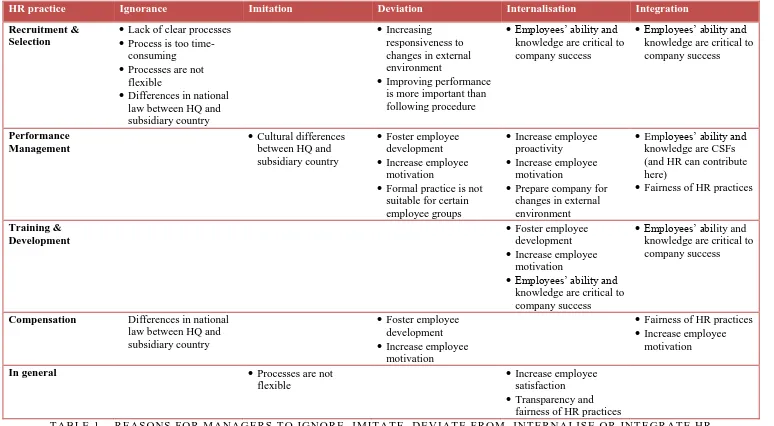
When we compare the factors that are said to influence managers’ perception and thus HRM implementation with the reasons found in this case study (table 1) it appears that country level factors as differences in national law and culture led to ignorance or imitation. Where line managers do not have any control, as is the case with law or national culture, they tend to ignore or imitate HR practices rather than commit to them. Not even deviation seems to be a possibility for managers in this case as national law is often very strict and does not provide leeway for alternatives. We can confirm that institutional and cultural distance does affect line managers’ attitude towards HRM implementation (Dalton & Druker, 2012; Kostova & Roth, 2002). As predicted by Björkman and Lervik (2007) the characteristics of an HRM system, i.e. its rules and processes seem to prevent line managers from internalising or integrating HR practices as processes took too long, were inflexible or simply not clear enough. Often the result was ignorance of an HR practice. The desire for clear processes emphasises the need to not only pay attention to the content of HR practices but also to the process side of HR practices. HRM has to take care that line managers are aware of the processes in place and HRM needs to remain open to criticism to continuously adjust and improve processes.
Line managers internalised or integrated HR practices because they aim to increase employees’ skills and motivation as these
are crucial to the company’s success and necessary to respond to requests from the external environment. These reasons are closely related to factors as company strategy and culture as well as role of the HR function (Jackson & Schuler, 1995). When line managers perceive an HR practice as helpful to support the competitive strategy and to boost the company’s performance, they are likely to internalise and integrate HR practices. Therefore, HR professionals need to emphasise these elements in HR practices when communicating to line management. When the goal is to motivate line managers to internalise and/or integrate HR practices, restraining forces are in place in MNCs as for example national law or the inflexibility of processes which often led to ignorance. Where possible, it is the responsibility of HR managers to remove the restraining forces. However, trying to find workarounds to deal with differences in national law is likely a pitfall for investments in time and manpower as national laws can hardly be changed. Therefore, HRM needs to focus on the improvement of processes to achieve internalisation and integration. An emphasis on driving forces as the contribution of practices to CSFs may help to stimulate managers to internalise the value and meaning of HR practices and guides them to integrate practices with current procedures and the competitive strategy.
21 As assumed, factors on the individual level
affected whether line managers initiated practices or not. Especially the ability, motivation (Minbaeva et al., 2003) and the relationship between subsidiary HRM and line management (Martin & Beaumont, 2001; Yahiaoui, 2014) enabled line managers to initiate HR practices, as happened with the personal development plans. The idea was spread to other teams within the development department, however not to a corporate level. When a corporate HR manager visited the Dutch site he was introduced to the personal development plans and was impressed, but never contacted the initiating line manager again. Leaving resources like these unutilised is a mistake, the HR practice is developed and tested at the Dutch site and can be transferred to other subsidiaries where needed. As stated in the very beginning, MNCs exists because of their ability to exchange knowledge within the organisation. If this ability is not used, the MNC does not utilise the available resources and risks to be at a competitive disadvantage (Barney, 1991). Consequentially also in HRM it is necessary to exchange knowledge and practices – in both directions. Providing line managers with the freedom and ability to initiate HR practices and to establish feedback loops for them is a start for exchanging knowledge.
5.2LESSONS LEARNED ABOUT IMPLEMENTATION SCENARIOS
Ignorance
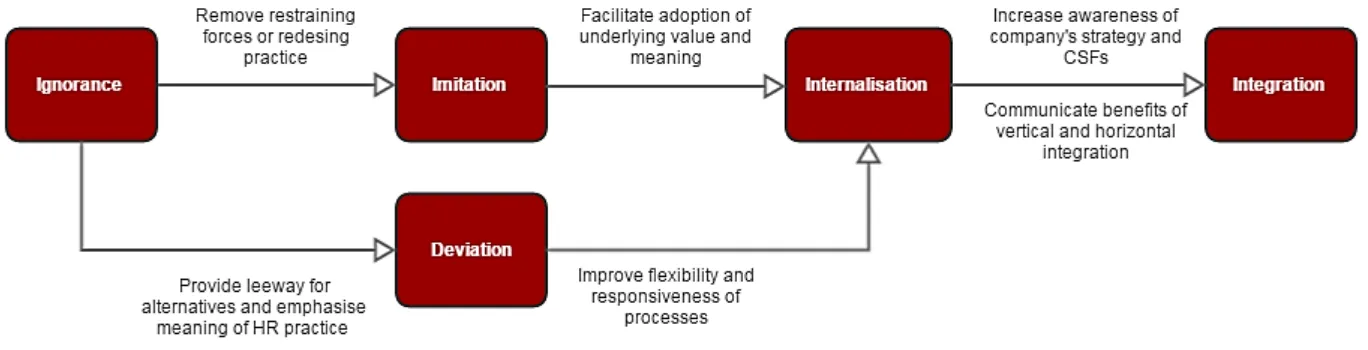
When HR practices are ignored the intended effect comes to nothing. To avoid the scenario of ignorance it is necessary to demonstrate line managers which value an HR practice might have for a division, i.e. the content of an HR practice must be relevant to line managers’ day-to-day operations.
It is necessary to pay particular attention to the applicability and utility of a practice during the design stage of HR practice implementation to ensure that line managers perceive an HR practice’s content and its process as useful and easy to use. Then HRM implementation can move beyond the scenario of ignorance. To borrow terms from the IT implementation literature: to increase the “perceived ease of use” and the “perceived usefulness” of an HR practice, line managers should be involved at an early stage in HR practice design (Venkatesh, Morris, Davis, & Davis, 2003).
22 Deviation
Deviation is a scenario in which line managers see the value and meaning of an HR practice but consider the present practice as not suitable to attain goals and desired outcomes and therefore adjust the practice to their needs and beliefs. The question arises whether deviation is a beneficial or detrimental scenario. One benefit is that business opportunities could be exploited through deviation which might otherwise be gone. However, when line managers decide to deviate to pursue an opportunity they spend time on tasks which are not planned by upper management. Moreover, due to the lack of control the effect of deviation is hard to measure and subsequent decisions are tougher to make as less information are available. An advantage is that desired outcomes are achieved as managers are able to modify a practice to a given situation, which might not be possible otherwise or at least not to the same degree.
It appears that line managers are more than mere executors of HRM, they have their own beliefs and values about how HR should be conducted and about how a practice can be used to attain the intended results. However, when line managers deviate, HRM has less control and less information about how HR practices are delivered to the employee. Nevertheless, inhibiting deviation does not seem to be the correct response as this is likely to reduce line managers’ willingness to cooperate with HRM and an enforcement of procedures does not guarantee better HRM outcomes. Instead, HR managers should involve line managers early in the design process of HR practices to make sure line managers are willing to use proposed practices and to ensure that practices are valid and useful in the operational context of line managers and employees.
Interestingly, the subsidiary HRM department was informed and even supported line managers in deviating, only the corporate headquarters were left out and were perceived as a restraining force, impeding goal attainment. Deviation might be utilised by HR managers: line managers adjusting an HR practice to attain intended results is per se not disadvantageous, however, allowing leeway may lead to exploitation of this freedom. A tool must be found to align deviation by line managers with company interests. Such a tool is organisational culture (Alavi, Kayworth, & Leidner, 2005; Den Hartog & Verburg, 2004). By aligning the underlying values and beliefs of line managers with the values of the organisation, HR managers can foster that line management does not exploit the freedom they are provided with for their personal benefit but rather for the organisational benefit. At the Dutch Benchmark division the We 3.0 vision is a manifested example of such an alignment tool and HR managers are seen as architects of organizational culture: “I like HR to be the culture engineers and not the firing and hiring people […]. So I see HR as the almost number one person who can determine in the end what kind of culture we will have.“ (LM3)
Imitation
23 but already with corporate HR managers.
They have to make sure that benefits of HR practices are visible and that processes are clear and efficient. Line managers highlighted that not the content of HR practices but the lack of clear processes and inefficiency in HR processes were reasons for ignorance, corporate HRM has to forestall this by paying particular attention to the perceived usefulness and ease of use of HR practices.
Internalisation
The HR practice initiation by line managers can only occur when the underlying value and meaning of HRM is internalised by managers. Organisational culture should be utilised as means for alignment of values and beliefs and HRM needs to create channels to allow line managers to initiate HR practices. HRM implementation is not a downward stream of HR practices from corporate HRM to subsidiary HRM to line managers to employees, but rather feedback loops are present which influence the HR practices to tailor them to the day-to-day needs of line managers and employees. However, these feedback loops need to be created by subsidiary HR managers: they are the single point of contact for corporate management and subsidiary line management and thereby are in the position to understand the needs of both parties and able to bring these needs together. For this to happen HR managers need to be receptive to ideas and criticism from the line. Finally, transparency and fairness of HR practices also determine whether line managers internalised an HR practice or not, accordingly HRM needs to pay attention fairness issues when designing practices.
Therefore, including transparency and fairness as design criteria in the development of HR practices as well as communicating it gains importance. It is
not only important to employees but also to line managers and their attitude towards HR practices.
Integration
The reasons for managers to integrate an HR practice have two parts: One, the manager perceives e.g. knowledge as a key to success for the company and two, the manager perceives an HR practice as performance management to contribute to knowledge, i.e. the line manager internalised the value of performance management in this case. Only when both perceptions are in place integration will be the result. Line managers’ perception is very important to success of HRM; they interpret intended HR practices, judge the value of those practices, and decide whether the outcome of executing a practice is related to a CSF for the company. This determines then whether a practice is ignored, deviated from, imitated, internalised or integrated.