Recent Progress on Supercomputer Modelling of High-Speed
Rarefied Gas Flows Using Kinetic Equations
Anna A. Frolova1, Vladimir A. Titarev2
c
The Authors 2018. This paper is published with open access at SuperFri.org
Numerical solution of the Boltzmann equation for stationary high-speed flows around com-plex three-dimensional bodies is an extremely difficult computational problem. This is because of high dimension of the equation and lack of efficient implicit methods for the calculation of the collision integral on arbitrary non-uniform velocity grids. Therefore, the use of the so-called model (approximate) kinetic equations appears to be more appropriate and attractive. This article uses the numerical methodology recently developed by the second author which includes an implicit method for solving the approximating kinetic equation of E.M. Shakhov (S-model)on arbitrary unstructured grids in both velocity and physical spaces.
Since most of model equations have a well-known drawback associated with the velocity-independent collision frequency it is important to determine the deviations of solutions of these equations from the solution of the complete Boltzmann equation or DSMC for high-speed gas flows. Our recent comparison of the DSMC and S-model solutions for monatomic gases with a soft interaction potential shows good agreement of surface coefficients of the pressure, heat transfer and friction, which are most important for industrial applications.
In this paper, we compare the solution of model equations and the Boltzmann equation for the problem of supersonic gas flow around a cylinder when molecules interact according to the law of hard spheres. Since this law of molecular interaction is the most rigid, the difference in solutions can show the maximum error that can be obtained by using model equations instead of the exact Boltzmann equation in such problems. Our high-fidelity computations show that the use of model kinetic equations with adaptation in phase space is very promising for industrial applications.
Keywords: Boltzmann kinetic equation, S-model, rarefied, high-speed, unstructured.
Introduction
At present there is a large number of studies devoted to the analysis of highly non-equilibrium external rarefied gas flows at high-speed (M∞ ≥ 10) regimes. Since for high-speed flows over convex body there appears strong non-equilibrium boundary layer, it is important to use the so-called kinetic approaches in the analysis. However, this class of flows requires the use of considerable computing resources in case of three-dimensional geometries if one uses the direct simulation Monte-Carlo methods (see e.g. [1]), and especially the Boltzmann kinetic equation with the exact collision integral (BKE). Therefore, for engineering applications the use of the approximate (so-called model) kinetic equations appears to be an attractive alternative from the computational point of view.
It is important to estimate possible error of such an approach, by comparing the numerical solutions of the model kinetic equations with the corresponding solutions of BKE or the direct simulation Monte-Carlo (DSMC) solutions. Calculations presented in [8] demonstrate that the pressure, friction and heat transfer coefficients on the surface of the body in case of monatomic gas at super- and high-speed flow regimes are very close to the DSMC results for the S-model kinetic equation of E.M. Shakhov [5] and relatively “soft” viscosity law.
In this work we compare the numerical solutions of the model kinetic equations and BKE for the supersonic flow over the circular cylinder using the viscosity law, which corresponds to
the hard-sphere intermolecular interaction. Since such a viscosity law is the most “rigid”, the difference between solutions will show the maximum possible error which can occur due to the usage of the model kinetic equations instead of BKE.
1. Formulation of the Problem and Governing Equations
Let us consider the supersonic (M∞ = 10) flow of argon over the circular cylinder of
rcyl = 6 inches (15.24 cm) radius. The free stream density, velocity and temperature are
ρ∞ = 1.127×10⁻⁶ kg/m3, u
∞ = 2624 m/s, T∞ = 200 K, respectively. The viscosity law is µ=µ∞pT /T∞ (hard-sphere intermolecular interaction), where the free-stream viscosity coef-ficient µ∞ = 1.554409×10⁻⁵ Pa·s [3]. The fixed surface temperature T
w = 2.5T∞ is used, at
which we assume the diffusive boundary condition with the complete temperature accommoda-tion. The rarefaction parameter is δ = (p∞rcyl)/(µ∞
p
2RT∞) = 1.59, which corresponds to the Knudsen number Kn = λ∞/rcyl= 0.56. Therefore, the flow regime is rarefied and requires the
use of the kinetic approaches.
The state of rarefied gas is determined by the velocity distribution functionf(t,x,ξ), where
t is physical time, ξ = (ξx, ξy, ξz) are the components of the molecular velocity vector in the spatial directions x = (x1, x2, x3) = (x, y, z). The macroscopic quantities are defined as
three-dimensional integrals of the velocity distribution function over the molecular velocity space as
ρ=m
Z
f dξ, ρuk=m Z
ξkf dξ, 3 2p+
1
2ρuαα= 1 2m
Z
ξ2f dξ.
The distribution function is found by solving the kinetic equation with appropriate boundary conditions at free stream and surface of the body:
∂f
∂t +ξ∇f =J(f).
For the collision integral J(f) we consider both the exact expression (BKE) and approximate form by E.M. Shakhov [5] (the so-called S-model kinetic equation). BKE collision integral in-volves complicated five-dimensional integration over the velocity space and two impact param-eters, whereas for the S-model it is a much simpler relaxation term.
To compare the numerical results of BKE and S-model equation, we use the non-dimensional surface pressure, friction and heat transfer coefficients, defined as follows:
cp =
pn−p∞ ρu2
∞/2
, cf = pτ ρu2
∞/2
, ch = En ρu3
∞/2
, (pn, pτ, En) =m Z
ξn(ξn, ξτ, 1 2ξ
2)f dξ,
where ξn andξτ are normal and tangential projections of the molecular velocity vector ξ.
2. Kinetic Solvers and Details of the Calculations
(a) “Nesvetay”mesh (b) UFS mesh (part of the domain)
Figure 1.Spatial meshes, used in computations
method and high CFL numbers up to 105 are used to construct the steady-state solution of the problem, which speeds up convergence at rarefied regimes by 3 orders of magnitude. For present calculations the physical mesh inx−y plane contains 115×40 and 3 cells in thezdirection, see Fig. 1. The first cell size near the surface ish/rcyl= 10−4. For this simple flow it is possible to use
a relatively fine three-dimensional molecular velocity mesh with ∆ξ/√2RT∞ = 0.5, consisting of 247656 nodes. The total number of cells in the 6-dimensional mesh in the phase space is thus up to ≈3.5 billions.
The second computation package used in the present study is the kinetic module of the Unifed Flow Solver (UFS) [2] which can solve both BKE and model kinetic equations. The numerical solution is found by the discrete ordinate method on the uniform molecular velocity mesh. In the physical space the solver uses a cubical mesh with adaptive mesh refinement and a finite-volume TVD scheme. The surface of the body is approximated using the cut cell approach. The steady-state solution is found by marching in time using an explicit time evolution method. The number of cells in the planar physical domain changes during calculation from 2000 to 6000 due to mesh refinement. The first cell size near the surface h/rcyl= 3.2×10⁻³ is much smaller
than the local Knudsen number λlocal/rcyl = 10−2. To compute the exact collision integral, the
Korobov sequences for the velocity nodes, and conservative two-point projection method for post-collision velocities are used [6]. The number of velocity cells Nv is kept constant during calculation, with the cell size of ∆ξ/√2RT∞≈1. For the model kinetic equation reducedξx−ξy velocity domain contains Nv = 5000 nodes, whereas for BKE we have Nv ≈ 30000 (the half-sphere domain is used). The number of collisionsNcol ≈106. The total number of cells for BKE is up to≈0.2 billions.
It should be emphasised that despite much smaller number of cells, the numerical solution of BKE is extremely computationally intensive due to the five-dimensional BKE collision integral and the use of the explicit time evolution.
3. Results
by “Nesvetay” were carried out on “Lomonosov-2” supercomputer at Lomonosov Moscow State University [4], using up to 512 CPU cores.
The parallel implementation of the UFS is single-level and uses the decomposition in the physical space. An optimal balance between processors is archived by using the space filling curves. This approach is especially efficient for hieratical adaptive meshes, e.g. octree in 3D. The calculations were run at Joint Supercomputing Center of Russian Academy of Sciences using up to 512 CPU cores.
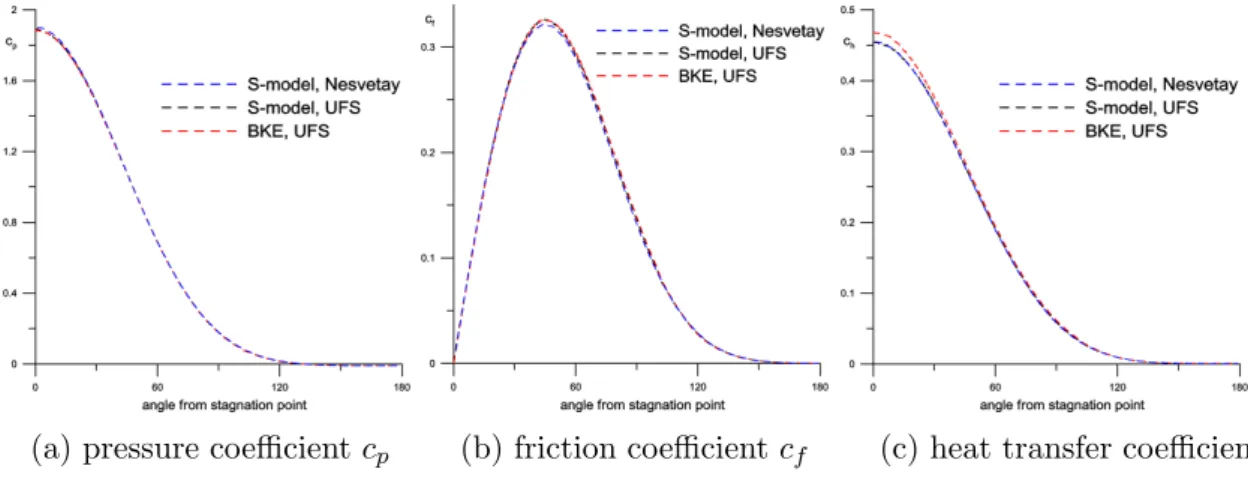
(a) pressure coefficientcp (b) friction coefficientcf (c) heat transfer coefficientch
Figure 2.Surface distributions as predicted by BKE and S-model equations. Blue line – S-model, “Nesvetay”code; black line – S-model, UFS code; red line – BKE, UFS code
Fig. 2 shows comparison of numerical results from UFS solvers (BKE and S-model) and “Nesvetay” solver (S-model) for M∞ = 10, δ = 1.59 (Kn = 0.56). Firstly, we see that the S-model equation results from both solvers agree perfectly even though these solvers use very different meshes and numerical methods. Secondly, BKE and S-model equation results coincide for pressure and skin friction coefficients and are very close for the most sensitive heat transfer coefficient. The difference for ch is around 2% at the stagnation point.
Conclusions
We have computed supersonic rarefied flow of argon over circular cylinder, using the Boltz-mann kinetic equation with the exact collision integral and Shakhov model collision integral. Fine spatial and velocity meshes have been used to obtain accurate results. Our calculations have good to excellent agreement between solutions of exact and approximate (model) kinetic equations for this supersonic external flow. Especially important is the agreement of heat trans-fer coefficient, which is a very sensitive quantity to compute. This result allows us to conclude that model kinetic equations, such as S-model equation [5], can potentially complement DSMC approach for high-speed flows of rarefied gas in industrial applications, such as modelling of aerodynamics and heat transfer of existing and future spacecraft.
Acknowledgments
facilities of HPC computing resources at Lomonosov Moscow State University supported by the project RFMEFI62117X0011 and Joint Supercomputing Center of Russian Academy of Sciences.
This paper is distributed under the terms of the Creative Commons Attribution-Non Com-mercial 3.0 License which permits non-comCom-mercial use, reproduction and distribution of the work without further permission provided the original work is properly cited.
References
1. Kashkovsky, A., Bondar, Y., Zhukova, G., Ivanov, M., Gimelshein, S.: Object-oriented software design of rReal gas effects for the DSMC method. In: 24th International Sympo-sium on Rarefied Gas Dynamics. AIP Conference Proceedings. vol. 762, pp. 583–588 (2004). DOI: 10.1063/1.1941599
2. Kolobov, V., Arslanbekov, R., Aristov, V., Frolova, A., Zabelok, S.: Unified solver for rarefied and continuum flows with adaptive mesh and algorithm refinement. J. Comput. Phys. 223, 589–608 (2007). DOI: 10.1016/j.jcp.2006.09.021
3. Lofthouse, A.: Nonequilibrium hypersonic aerothermodynamics using the direct simulation Monte Carlo and Navier-Stokes models. In: Ph.D. thesis. The University of Michigan (2008)
4. Sadovnichy, V., Tikhonravov, A., Voevodin, Vl., Opanasenko, V.: ”Lomonosov”: Supercom-puting at Moscow State University. In: Contemporary High Performance ComSupercom-puting: From Petascale toward Exascale. pp. 283–307. Chapman & Hall/CRC Computational Science, CRC Press, Boca Raton, USA (2013)
5. Shakhov, E.: Generalization of the krook kinetic relaxation equation. Fluid Dynamics 3(5), 95–96 (1968), DOI: 10.1007/bf01029546
6. Tcheremissine, F.G.: Solution to the Boltzmann kinetic equation for high-speed flows. Computational Mathematics and Mathematical Physics 46(2), 315–329 (2006). DOI: 10.1134/s0965542506020138
7. Titarev, V.A.: Efficient deterministic modelling of three-dimensional rarefied gas flows. Com-mun. Comput. Phys. 12(1), 161–192 (2012). DOI: 10.4208/cicp.220111.140711a