University of Warwick institutional repository: http://go.warwick.ac.uk/wrap
A Thesis Submitted for the Degree of MD at the University of Warwick
http://go.warwick.ac.uk/wrap/38292
This thesis is made available online and is protected by original copyright. Please scroll down to view the document itself.
TlIE
DEVELOI)lVIEN1~AND TESTING OF A
STRUCTURED TRAINER'S REPORT FOR SUMMA
l~IVEASSESSl\1ENT IN GENEIu\L I)IU\CTICE
Peter Neil JOlINSON
TI-IESIS FOR DOCTOR OF MEDICINE DEGREE
Subluitted to The Deparhnent of Postgraduate Medical
Education, University of'Var,vick.
Based on work undertaken at the Department of IJublic Health and Primary Care,
University of Oxford, 1994-7.
CONTENTS
Acknowledgements
Declaration
Summary
Chapter 1 - INTRODUCTION
1.1 Background
1.2 A guide to the thesis 1.3 Glossary of terms
Chapter 2 - BACKGROUND: TilE RATIONALE FOR A
SUl\ll\lATIVE ASSESSMENT PROCESS IN
GENERAL I'RACTICE
2.1 Introduction
2.2 Definitions - what is summative assessment?
2.3 The purpose: why have summative assessment in general medical practice in the United Kingdom?
2.3.1 Forces driving assessment
2.3.2 The current system of regulation
2.4 The arguments against summative assessment 2.5 Conclusions
Chapter 3 - BACKGROUND: ASSESSl\IENT METHODS
AND TilE REQUIREMENTS OF A TRAINER'S
REPORT
3.1 What form should a summative assessment process take? 3.1.1 General principles
3.1.2 The application of these principles within the setting of
general medical practice in the United Kingdom 3.1.3 Conclusions
3.2 What are the technical requirements of assessment instruments?
3.2.1 Issues of academic rigour 3.2.2 Issues of utility
3.2.3 Relative importance of the requirements 3.2.4 Conclusions
3.3 Current experience of reports provided by trainers 3.3.1 Experience outside general medical practice 3.3.2 Experience within general medical practice 3.3.3 Conclusions
3.4 What research questions need to be answered in the development and testing of a new trainer's report for summative assessment in general practice?
3.4.1 The broad question
3.4.2 Selecting answerable questions
3.4.3 Conclusions and a research hypothesis 3.4.4 A programme of research
Chapter 4 ·l\IETIIODS
4.1 General methodological themes 4.1.1 Seeking views
4.1.2 Testing properties 4.2 Detailed methods
4.2.1 Study 1: Determining an appropriate structure for a
trainer's report
4.2.2 Study 2: Selecting appropriate contents
4.2.3 Study 3: Assessing content validity
4.2.4 Study 4: Setting standards
4.2.5 Study 5: Assessing overall validity, inter-rater
reliability and feasibility
4.3 Conclusions
Chapter 5 - RESULTS
5.1 Study I: Determining an appropriate structure for a trainer's report
5.1.1 Aims
5.1.2 Results
5.1.3 Summary of findings
5.2 Study 2: Selecting appropriate contents
5.2.1 Aims
5.2.2 Results
5.2.3 Summary of findings
5.3 Study 3: Assessing content validity
5.3.1 Aims
5.3.2 Results
5.3.3 Summary of findings
5.4 Study 4: Setting standards
5.4.1 Aims
5.4.2 Results
5.4.3 Summary of findings
5.5 Study 5: Assessing overall validity, inter-rater reliability and feasibility
5.5.1 Aims 5.5.2 Results
5.5.3 Summary of findings 5.6 Conclusions
Chapter 6 - CONCLUSIONS FUOl\l TilE UESEARCII 6.1 The structure of a trainer's report (study one)
6.1.1 Main results
6.1.2 Methodological issues 6.1.3 Issues arising
6.1.4 The findings in context 6.1.5 Conclusions
6.2 The content ofa trainer's report (studies two and three) 6.2.1 Main results
6.2.2 Methodological issues 6.2.3 Issues arising
6.2.4 The findings in context 6.2.5 Conclusions
6.3 Setting standards (study four)
6.3.1 Main results
6.3.2 Methodological issues 6.3.3 Issues arising
6.3.4 The findings in context 6.3.5 Conclusions
6.4 Field tcsting the report form (study fivc)
6.4.1 Main results
6.4.2 Methodological issues
6.4.3 Issues arising
6.4.4 The findings in context
6.4.5 Conclusions
6.5 Overall conclusions and the continuing agenda
6.5.1 Implementation of the report
6.5.2 The remaining research agenda
6.5.3 Continuing development of the report
6.5.4 Quality assurance
6.6 Summary
Chapter 7 - DISCUSSION
7.1 Is this summative assessment process likely to address the concerns which forced its introduction?
7.2 How does this summative assessment process help us in our thinking about assessment within education?
7.3 How does this trainer's report help us in our thinking about assessment instruments? 7.4 Conclusions BIBLIOGRAPHY 191 191 191 194 198 199 200 201 204 208
21 I
TABLES,
FIGUI~ESAND APPENDICES
TABLES
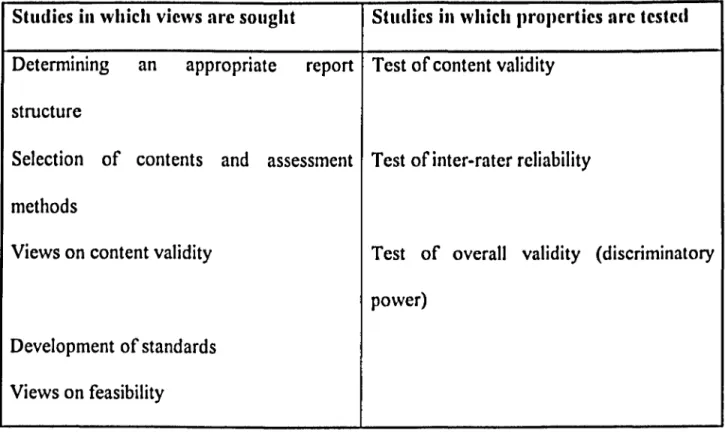
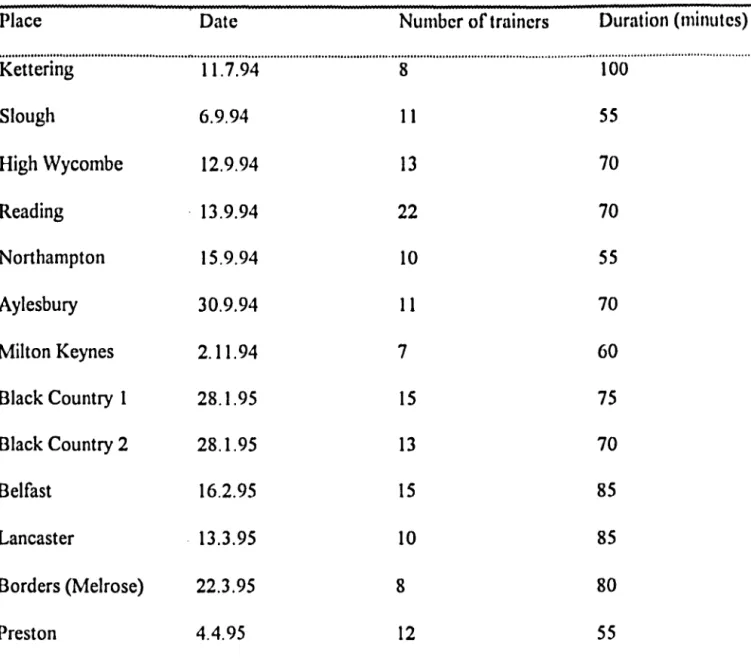
4.1 The types of study contained in the research proposals 5.1.1 Details of interviews held with trainers' groups
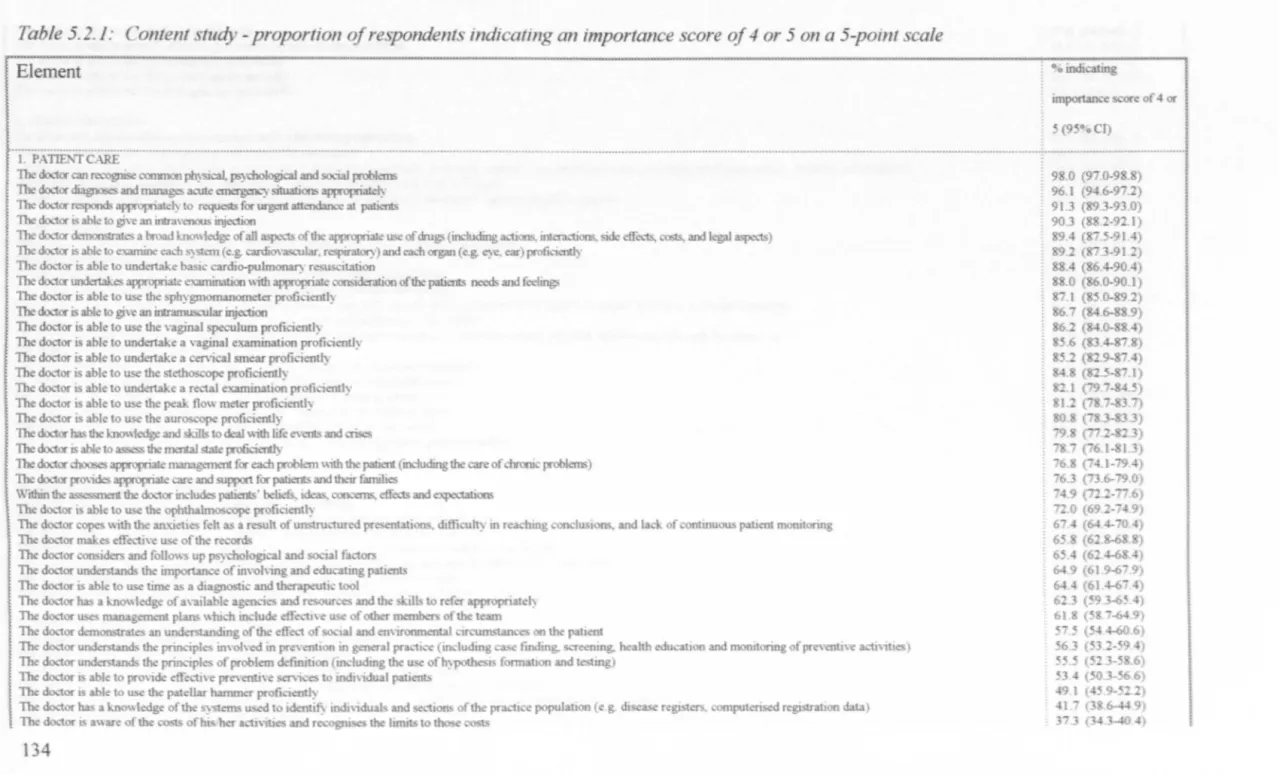
5.2.1 Content study - proportion of respondents indicating an importance score of 4 or 5 on a 5-point scale
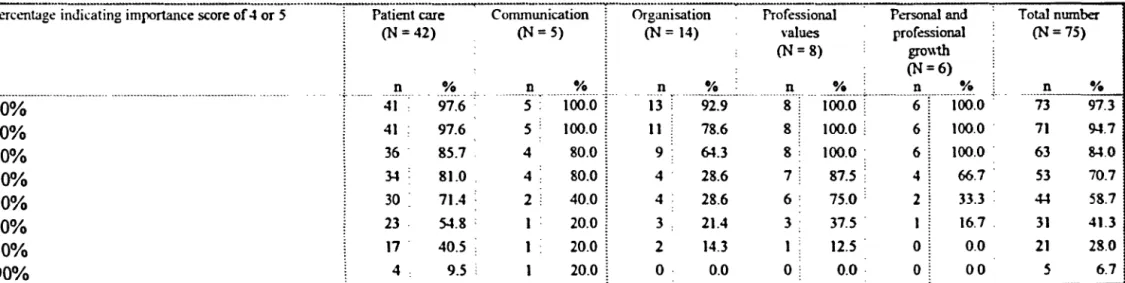
5.2.2 Content study - effect of different cut-off importance scores on the number of items to be included from each category
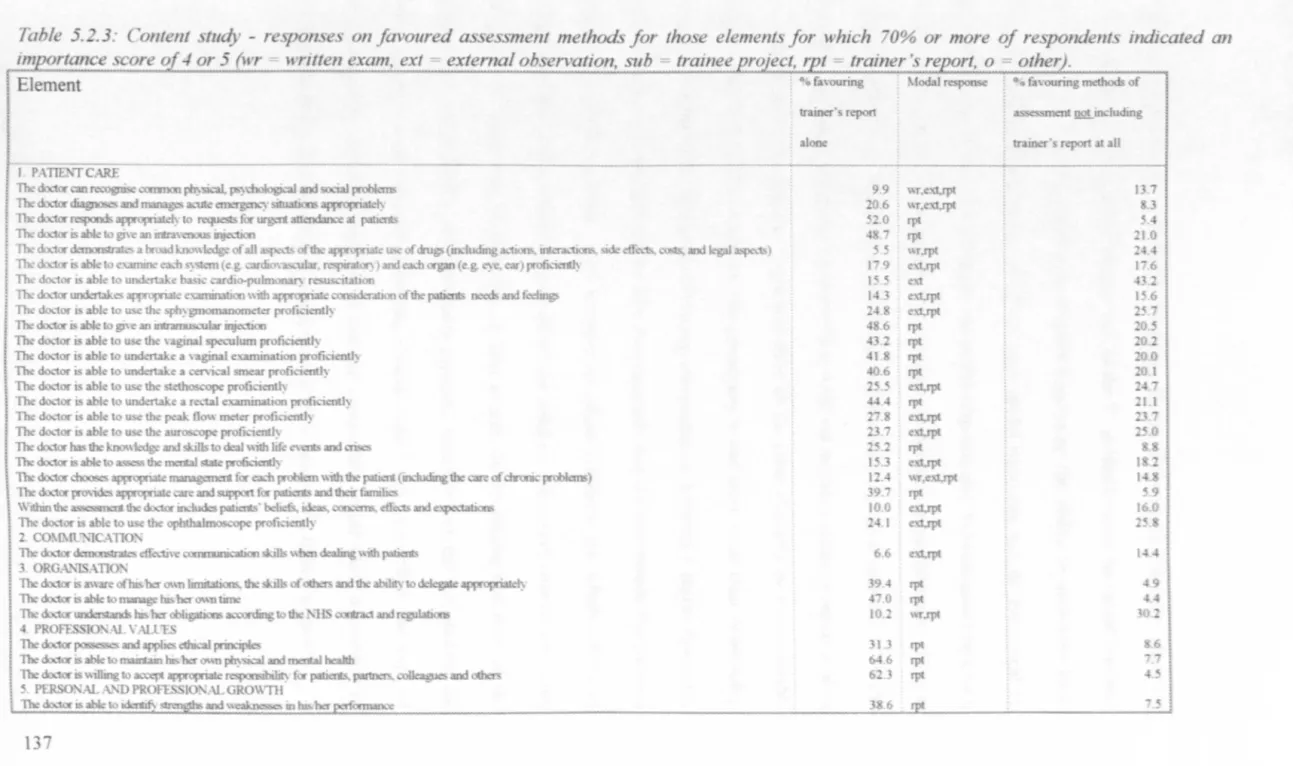
5.2.3 Content study - responses on favoured assessment
methods for those elements for which 70% or more of respondents indicated an importance score of 4 or 5 5.3.1 Content validity study - percentage of respondents
indicating agreement with the statements for each item 5.3.2 Content validity study - percentage of respondents
agreeing, disagreeing or neither with assessment of items by means ofa trainer's report
5.3.3 Content validity study - summary offreetext comments made by respondents
5.4.1 Standards study - suggested methods of assessment for the 79 proposed standards
5.4.2 Standards study - acceptable sources of evidence for assessment for the 31 proposed items
5.5.2 Field testing study - results on inter-rater reliability,
relative likelihood of failure and feasibility for the items in the draft trainer's report
5.5.3 Field testing study - the three freetext comments made most frequently by trainers in the three main categories 6.1 Perceived strengths and weaknesses of two approaches to a
trainer's report FIGURES
4.1 Content study - example of question format
4.2 Content validity study - example of question format 4.3 Standards study - illustration of standard-setting process 4.4 Field testing study - example of recording format on draft
trainer's report
4.5 Field testing study - example of format for standards in draft trainer's report
APPENDICES
1. 1 Literature search strategy
4.1 Contents questionnaire for study two
4.2 Questionnaire to doctors recently completing training 4.3 Guidelines for the standards group members
4.4 Examples of standards being sought 4.5 Worksheet used by the standards groups
4.6 Questionnaire to trainees involved in field study 4.7 Questionnaire to trainers involved in field study 5.1 Results of interviews with trainers' groups
5.2 Draft trainer's report resulting from studies 1-4 6.1 Final version of the structured trainer's report
303 316
ACKNO'VLEDGEl\1EN1~S
I am most grateful to all those who have had some involvement in this project. I recognise that without all the support I have received it would not have been possible to design the project, to undertake the studies involved, and to submit this thesis. However, there are a number of people to whom I should like to pay particular tribute.
I am deeply indebted to the Department of Health for their very substantial financial support for this project. In particular I should like to highlight the complete absence of any attempts to influence this project in any way.
I should like to record particular thanks to Dr John Hasler who was of enormous help, both when the original idea was being formulated and refined and throughout the project; his ability to facilitate motivation, clear thinking and scholarly reporting provided inspirational support throughout this project.
Dr John Toby and Professor Janet Grant also provided enormous support as part of the steering group for this project; their ability to criticise ideas and reports in a constructive way was of particular value.
I should like to record my thanks to Dr John \Vilmot and Dr Dob Strachan for acting as my supervisors for this doctorate; in particular. their willingness to provide time for meetings and to read draft reports (and, in particular, draft versions of this thesis) was very welcome. I am also most grateful to Professor Jeremy Dale for his support in the latter stages of developing this thesis. Additional support was also provided by Dr Roger Gadsby, Dr Ala Szcepura and Dr Mike Graveney
I am very grateful to Professors Robert Burgess and John Dligh for examining and providing detailed advice on the thesis.
I would like to record my thanks to my partners at the Medical Centre, Shipston-on-Stour (Graham Williams, Theo Schofield, Chris Thorogood, Caroline Nixon, Jane Gilder and David Williams) for allowing me to have protected time for this project.
I am grateful to all those who work in the Postgraduate Office at the Medical School in Oxford (in particular Darbara Vaughan, Joan Watts and Gill Pattinson) for helping to coordinate the financial arrangements and steering group meetings.
I should like to record my considerable feelings of gratitude to all those who were willing to be involved in the various studies; in particular I should like to record thanks to the following people: all the regional advisers who were so supportive to the project and were willing to supply information about the trainers in their regions; all the trainers in the thirteen groups who allowed me to join their groups and interview them; all the
trainers who responded to the questionnaire regarding the contents of the report form; all those who gave up their time to attend the consensus conference to set standards (Dr P Lane, Dr M McGhee, Dr A Darker, Dr A Robinson, Dr C Halliday, Dr C Matheson, Dr
G MacKinnon. Dr J Schofield, Dr R King, Wing Cdr SLaw, Lt Col G Lawrenson, Dr A Rogers, Dr B Ormston, Dr J den Bak, Dr R Bethel, Dr G Boulos, Dr A Membrey, Dr I McLean, Dr S Lazar, Dr J Oubridge, Dr R Milne, Dr W Patterson, Dr M Rhodes, Dr A
Dunn, Dr A Brzezicki, Dr T Veil, Dr K Emerson, Dr J Allen, Dr A Watson, Dr A Wilkinson) and to those who took part in the subsequent consultation exercise; all those doctors who had recently completed their vocational training who completed
questionnaires to look at the content validity of the report; to all those trainers (Drs Priestman and Dean, Hassey and Wilkinson, Hartley-Brewer and CoUee, Hughes and Vernon, Maxmin and Masters, D Mercer and J Mercer, Little and Miller, Parrish and Norris, Paul and Walters, Cox and McDermott, Purce and Rea, Rowlands and Butcher, Peppiatt and Corbett, Poll and Law, M Rogers and A Rogers, Moy and Angus, Benett and Greenaway, McGill and Hodgson, Tew and Deakin, Buchan and Skinner, Denny and Allan, Gallagher and Ball, Blick and Levitt, Lees and Bee, Tinkler and Williams, Hinton and Jones, Stott and Cowlard, Merchant and Hall, Wilkes and Walker, Keeling and Flynn, Gilmore and Baird, House and Diack, Curson and Pietroni, Kingsland and Thomas, Mulka and Vaughan, Robinson and Merry, Harris and Hasenfuss, Browne and Brant, Martin and Ross, ~fiddleton and Hanlon, Grace and Godby, Lloyd-Smith and Dowling, Redmond and Redmond, Shaw and Duncan, Smith and Patton, Syme and Cunningham, Dummer and Sutherland, Wookey and Shapley, McCann and Osborne, Stone and \Vebster, Cassels and Coughlin, Jenkins and Reid, Robertson and Hamilton, Jenns and Kent, Strachan, Leigh and Knott), and all their trainees, who undertook the field testing of the trainer' s report~ and finally to those doctors, whose identities are unknown to me, who provided considerable help in clarifying the issues in their role as peer reviewers for the journals to which the reports from this project were submitted.
I leave my greatest thanks until last~ my wife, Helen, has been hugely supportive of me undertaking this project despite the considerable sacrifices that this has meant to our time together - without her support none of this would have been possible. Similarly, my
children Bryony and Thomas have learnt to accept that much of my free time has been devoted to completing both the project and the thesis - I am grateful for their understanding!
DECLARATION
As each of the studies reported in this thesis was completed they were submitted to peer· reviewed journals for consideration for pUblication. This has resulted in the following publications:
1. Jolmson N, Hasler J, Toby J, Grant 1. The contents of a trainer's report for summative assessment in general practice: the views of trainers. Dr J Gen Pract
1996; 46: 135·139.
2. Johnson N, Hasler J, Toby J, Grant 1. Consensus minimum standards for use in a trainer's report for summative assessment. Dr J Gen Pract 1996; 46: 140-144.
3. Johnson N, Hasler 1. Content validity ofa trainer's report for summative assessment in general practice. Med Educ 1997; 31: 287·292.
4. 10hnson N, Hasler J, Toby J, Grant J. Pilot testing ofa structured trainer's report for summative assessment in general practice. Education for General Practice 1997; 8: 308-315.
The multiple authorship of these papers acknowledges the role of the steering group in developing the project and discussing the presentation of the results. However the actual studies described in this thesis and these papers were all undertaken solely by myself
SUMMARY
The central theme of this thesis is the place of a report provided by the trainer on the performance of the trainee as part of a process of regulating entry to independent general medical practice in the United Kingdom (summative assessment). The thesis aims both to analyse the place of a such a report within a process of summative assessment and to consider whether it is possible to develop a report form for this purpose that enables aspects of the general practitioner trainee's skills, knowledge, attitudes and practice to be assessed by the trainer in a feasible, valid and reliable way.
It is argued that the certification process for entry to independent general practice in the United Kingdom needs review and that tests of performance, such as a trainer's report, have a particular role in such a process; that such tests should be criterion-referenced; and that a number of properties are of particular importance in the development and testing of a trainer's report in the context of the assessment of doctors completing general practitioner training in the United Kingdom.
A set of research objectives are delineated for a sequential series of five research studies. Using a variety of methods (semi-structured group interviews, postal questionnaire surveys, consensus conference, and pitot testing), these studies demonstrate: that there is a specific place for a trainer's report; that valid contents can be selected and minimum standards set; that the report form that has been developed is reliable and feasible and allows discrimination; and that, should it be widely adopted, there is a strong need for further testing, a continuing quality assurance system and further developmental work. It is concluded that summative assessment does have a role in providing an initial step in assuring the public of the quality of doctors entering independent general practice and that the report form developed here is suitable for wide application within such a process. It is also reasoned that a number of lessons about the application of such a process, and the inclusion of such a report, in other settings can be learnt. In particular it is suggested that a report provided by a trainer may have a particular role in assessment when the requirement is the assessment of performance of complex attributes within the context of training designed to enable the trainee to carry out a particular purpose but that it should rarely be used as the sole instrument.
CIIAPTER ONE -
IN1~RODUCTION1.1 /lackl!rmllu/
In 1992 the body responsible for regulating entry into general medical practice in the United Kingdom (the Joint Committee on Postgraduate Training for General Practice (JCPTGP» announced a plan to introduce a system of assessment designed to ensure that doctors completing training for general medical practice were fit to practise independently (Joint Committee on Postgraduate Training for General Practice Working Party on Assessment, 1992a). It was suggested that this system, known as "summative assessment", should consist of four components one of which would be a report provided by the general practitioner trainer on the performance of the doctor-in-training.
The proposal makes three assumptions: that a summative assessment process will perform a useful function, that a report provided by the trainer is a desirable method as part of such an assessment process, and that it is possible to design a report form that will enable accurate assessment. The aim of this thesis is to examine these three assumptions. Firstly the thesis aims to analyse the role of a summative assessment process and the place of a trainer's report within it. Secondly, through the research component, a consideration is made of whether it is possible to design a report form to
be completed by a trainer that does enable feasible, valid and reliable assessment of the performance of a doctor training within the context of general medical practice in the United Kingdom.
The research took place between mid-1994 and the end of 1996. When the research project started the exact proposals for summative assessment were not widely known,
and trainers were largely unaware of the move to have a summative assessment process. By the time the research was concluded, the requirement of trainers to submit the trainee to an assessment based on a report form designed for the purpose was widely understood. This required a rapid shift in the way that trainers were expected to think and behave. Consequently the research was conducted on a background of continuous political negotiation within the profession, and aspects of the discussion of the results will reflect this.
Summative assessment for doctors completing training for general medical practice in the United Kingdom was introduced on a professionally-led basis on the 4th September, 1996 and became mandatory from 311t
January, 1998 (Anonymous, 1997).
1.2 A gllMe to the the ... ; ...
Following this introductory chapter there are five main components to the thesis.
In the first component, chapter two, an analysis of the place of summative assessment within training is made with particular reference to the application of such a process to general medical practice in the United Kingdom. The chapter considers the question "why is summative assessment needed?".
The second component, chapter three, examines more specifically the place of a trainer's report within such a process. Three issues are examined: "if there is to be summative assessment what form should such a process take?'\ "if there is to be a trainer's report
within summative assessment, what are the technical requirements of such an assessment
instrument?"~ and "if these technical requirements are to be met, what specific research
questions need to, and can, be answered?".
The third component, chapters four and five, contains the research component of the thesis. Chapter four considers methodological issues for the research, and concludes with the detail of the methods selected for each study. Chapter five describes the results of the studies, in particular focusing on the degree to which desired technical requirements for a trainer's report have been met.
The fourth section, chapter six, draws conclusions from the results of the research through an analysis of the main results of the research, the methodological issues that affect the weight that can be placed on the research findings, the principal issues that arise from the results, and an examination of the place of these findings within the broader context of work previously published. A discussion of the areas in which research and continuing development are still needed is also included.
In the final component, chapter seven, the wider issues raised in the first component of this thesis are reconsidered. In particular an attempt is made to generalise the messages that arise from the analysis undertaken and research findings made in this thesis by a
consideration of three questions. The first question returns to the themes discussed in chapter two, namely: "is this summative assessment process likely to address the concerns which forced its introduction?". This is followed by two more general
questions: "how does this summative assessment process help us in our thinking about assessment within education?" and "how does this trainer's report help us in our thinking about such assessment instruments?".
1 .. 1 Glo.nary o(tl'r"'.~
Below is a list of the definitions of a number of terms used in this thesis.
Assessmellt illstrllmellt/methot/: this refers to an individual technique for measuring an attribute of the individual being assessed.
Assessmellt system/process: this refers to a combination of instruments which. together. provide a mechanism for the assessment of a broad range of attributes.
Assessor: the individual undertaking the assessment.
Assessee: the individual being assessed.
Traillee: the individual being trained.
Trailler: the individual training others.
GP Traillee (Registrar): a doctor training in a general practice for a career in general medical practice in the United Kingdom.
Professiollal seif-reglliatitm: the process by which a professional group determines whether or not individuals should become. or remain. members of that profession.
l
ClIAI}TER T\VO - BACKGI{OUND:
~rlIE I{A~rIONALEFOR A SUl\1l\1A TIVE ASS ESSl\/1 EN1' JlI{OCESS IN
GENERAL I1RACTICE
2.1 /IItrntillctirm
The proposal for the introduction of a summative assessment process at the point of entry to independent general medical practice in the United Kingdom (Joint Committee on Postgraduate Training for General Practice Working Party on Assessment, 1992a) rests upon the assumption that such a process will perform an important function. In this chapter this basic assumption is examined - it considers the question "why have a process of summative assessment?".
Firstly, the definition of summative assessment is clarified. Secondly, an analysis is made of the forces driving the introduction of such a process within general practice and the current position. Thirdly, an analysis of the problems inherent in such an assessment process is made. The chapter concludes by assessing whether the weight of arguments support or refute the development of summative assessment in general practice.
2.2 lJefillitinll.~ - what i.~ .\·II"",llIti,'C! 1I.\'.';e.umellt?
The term assessment is derived from the Latin verb adsidere, the translation of which is "to sit beside someone" (Anonymous, 1989). Rowntree develops this notion by describing assessment as "an attempt to know that person", going on to define assessment within an educational setting as "occurring whenever one person, in some kind of interaction, direct or indirect, with another. is conscious of obtaining and
interpreting information about the knowledge and understanding or abilities and attitudes of that other person" (Rowntree. 1977). Bloom adds a predictive component. defining assessment as "the act of gathering and processing evidence about human behaviour under given conditions for purposes of understanding, predicting, and controlling future human behaviour" (Bloom, 1968). From these definitions I would highlight two particular aspects of assessment: firstly, that the purpose of assessment is to know about particular attributes of an individual in some detail~ secondly that assessment requires both the gathering of evidence and an interpretation to be made of the meaning of that evidence.
A distinction needs to be made between assessment and a term that is sometimes used synonymously - namely evaluation. Rowntree states "if assessment tries to discover what the student is becoming or has accomplished, then evaluation tries to do the same for a course or learning experience or episode of teaching" (Rowntree. 1977); that is. evaluation is concerned with knowing the strengths and weaknesses of an educational intervention (or institution), whilst assessment is concerned with the strengths and weaknesses of the individual.
Within education, numerous authorities (Bloom et al. 1971; Rowntree, 1977; Black and Devine, 1986) have divided assessment into two forms - namely, formative (or pedagogic) and summative (or classificatory) assessment. In formative assessment the assessment activity is aimed at informing the teacher and learner about what further learning is needed - the purpose is to "form or alter the course of study for each student" (Haile, 1977) through a "diagnostic" approach (Black and Devine, 1986); the emphasis is on development. In summative assessment the assessment activity is focused on the
"final overall impact of the instructional sequence" (Haile. 1977); the emphasis is on achievement. A large range of possible purposes for both of these forms of assessment have been defined (Cronbach, 1964; Klug, 1974; Rowntree. 1977; Broadfoot. 1979). The principal purpose for which summative assessment is used is the "selection" of individuals who are likely to perform adequately in the future (Cronbach 1964; Broadfoot, 1979; Desforges, 1989), thereby "maintaining the standards" of the group which the individual is to join (Rowntree. 1977). This process may include the awarding of a certificate or license, and may therefore be termed licensure or certification (Black, 1993).
In the setting of medical education and training, summative assessment has become synonymous with a process of assessment of the individual, timed to coincide with the end of training, in which the practice of an individual doctor is assessed as a means of ensuring that minimum standards of practice have been reached prior to entry to the profession (Joint Committee on Postgraduate Training for General Practice Working Party on Assessment, 1992a). In this way the process is being used as a process of certification; the process is obligatory (or "imperative" (Black and Devine, 1986» rather than optional.
2 .. 1 rite purpo.\'e: wltv IIlll'e .Wllllllfltil'e Il.HC.'\.'Wlellt ill I!ellcrtli met/icill practice ill tlte
Ullited Kim:tiolll?
It is crucial to clarify why summative assessment might be desirable in general medical practice in the United Kingdom. In particular, what is/are the problems that a summative assessment process is designed to solve? This analysis considers two issues: what forces
are driving the introduction of more rigorous assessment, and to what extent does the current system meet these expectations?
2.3.1. Force.v l/r;";"g ll.'t.'ieHllle"t
Five types of force appear to be driving the development of a summative assessment process for general practitioners in the United Kingdom. These are political forces. societal forces. educational forces, international forces and professional forces.
Political forces
The strongest drive seems to arise. perhaps unsurprisingly, from politicians - as Raven suggests "competence in modem society (is) ... primarily dependent on political competence" (Raven, 1991)~ that is, definitions of professional competence will be highly dependent on the political will of the time.
There has undoubtedly been in recent years a considerable political drive to improve both quality and accountability throughout the National Health Service. In 1989 the Prime Minister (the Rt. Hon. Margaret Thatcher MP) stated clearly the desire of the U.K. Government of the time for the National Health Service to become more directly answerable to patients - "the government's desire for a health service that gives patients more choice and rights as consumers" (Thatcher. 1989). Subsequent governments have focused particularly on the issue of quality within the National Health Service. including the need for standards to be maintained in the medical profession; as the Rt. Hon. Stephen Dorrell MP (Secretary of State for Health. 1995-7) stated 'there is no higher priority in the Health Service than the maintenance and development of professional standards ... Patients and the public have a right to expect that doctors'
professional performance is of the highest quality' (Hibbs, 1995). The signals are clear· the government is demanding accountability and high standards.
At the same time the profile of primary care, traditionally performing in the shadow of the secondary sector, is being enhanced. Successive governments have shown a determination to have a National Health Service led by primary care (NBS Executive.
1996~ Department of Health (England), 1996; Department of Health (England), 1997). Although one ostensible reason given for this is that "family doctors (are) regarded by the government as the jewel in the crown of the NHS" (Fletcher, 1996) it is probable that a major reason for focusing closely on primary care is a belief that, through its role in gatekeeping access to expensive secondary care services, primary care could be an important tool in the desire to control expenditure on health care.
The combination of these two drives means that there is now considerable political pressure to ensure that the clinical standards of doctors working in primary care are of a high standard (NHS Executive, 1996).
Socictal forccs
Does this political will reflect the concerns of the people who will use the service? Two
forms of evidence are available - evidence about the views of groups of patients on their doctors, and evidence about changes occurring in the relationship between society and its general practitioners.
Whilst much of the evidence from patients has focused on practices (rather than individuals) as deliverers of a service (Baker and Streatfield. 1995; Baker, 1996), there is
a limited body of evidence concerning the views of patients about their doctors. In a study that considered the views of consumers about general practitioners in the United Kingdom Williams and Calnan demonstrated that the key dimensions in maintaining the satisfaction of the public with their general practitioners were "communication". "the relationship", and the "professional skills" of the general practitioner (\Villiams and Calnan, 1991). Similarly, in a review of consumer satisfaction with primary care in four European countries, Calnan et at. demonstrated that the nature of the patient-doctor
relationship and the professional skills of the doctors were key to consumer satisfaction in all four countries (Calnan et at. 1994); stepwise regression analysis of their results suggested that medical skills were judged to be second in importance only to the amount of information that doctors gave (which, in itself, might be considered to be part of the communication skills of the doctor). On a global scale, Wensing et at. have recently undertaken a systematic review of the literature from around the world on patient priorities for general practice care (Wensing et at. 1998). Their findings confirm that patients are particularly concerned about "informativeness", "humaneness" and "competence/accuracy". In summary, there is strong evidence to suggest that patients are concerned about the clinical and communication skills of their general practitioners.
The evidence on the relationship between society and its general practitioners suggests that the doctor-patient relationship in primary care has moved considerably from one of
paternalism to one that is more consistently based on partnership. Cartwright undertook extensive interviews with patients and their general practitioners in 1964 (Cartwright, 1967) and again in 1977 (Cartwright and Anderson, 1981). From the first study she concluded that people appeared to select their doctor is a "casual" way; she also declared that "people .... probably realise that they cannot assess (the doctor's) professional
competence" (Cartwright, 1967). In her subsequent study she found that 30% of patients over the age of 25 and 57% of doctors believed that in the previous ten years patients had become more likely to question whether their doctor was right (Cartwright and Anderson, 1981). This change embraced a number of areas of care including clinical skills and judgement, and communication skills. She found few other major changes between the findings of the two studies. thus suggesting that this change had occurred despite the fact that most change in the relationship between society and its doctors appears to occur at a much slower rate. This change in the relationship has subsequently been borne out in a number of publications (Zeitlyn. 1979; Stocking. 1991; Doyle, 1996; Kee, 1996; Quality and Consumers Branch, 1996). The consequence of such a change is that patients are more questioning about the ability of their doctors to perform and less willing to accept it on trust alone; whether this has driven. or been driven by, the politicians, the inevitable result is again one of increasing emphasis on quality and accountability.
El/ucatiollal forces
The third driving force is educational. This argument stems from the view that education and assessment are closely intertwined - assessment ensures that the educational process is working. Assessments provide information both on individuals who have undertaken their education within that system and on the education system as a whole. A number of authors have highlighted the closeness of this relationship (Kandel. 1936; Rowntree, 1977) arguing that, just as there should not be an assessment process without an
educational process to support it, so there should not be an educational process without an associated assessment process to provide a measure of institutional and individual success.
Currently there does seem to be political pressure to target education to deliver trainees fit for a particular purpose rather than seeing education purely as an acceptable academic exercise in its own right (Hickox, 1995)~ the corollary of such a drive is that the associated assessment processes must enable assessment of fitness for the particular purpose at which the educational process is targeted.
International forces
The international support for assessment has three components. Firstly there is now a vast international experience of assessment methods (e.g. for assessment in a medical setting see Fabb and Marshall, 1983 or Anonymous, 1994)~ it is not tenable to argue that there can be no assessment through lack of experience. Secondly. the general drive for greater accountability within education is not confined to the United Kingdom (Broadfoot, 1979). Thirdly. the increasing movement of people between countries (particularly between the United Kingdom and Europe) requires qualifications to be transferable (defined. for medical education. in a European Council Directive (Anonymous, 1993»~ consequently it must be possible to scrutinise the basis on which qualifications are granted to analyse their acceptability in other countries.
Professional forces
Pressure from within the profession has arisen in two ways. Firstly, Gray has argued that education for general practice must. in common with education elsewhere. be based on a paradigm one component of which is assessment (Gray. 1977). Secondly. concern about a small number of trainees not being of the required standard was openly expressed some years ago (Royal College of General Practitioners. 1985). To address these concerns the
body controlling entry to general medical practice in the U.K. (the JCPTGP) established some years ago that the certificate issued to indicate "satisfactory completion" of training should be considered to indicate "satisfactory performance" (Irvine et al. 1990). The JCPTGP has developed this view further and has recognised the need for the introduction of a formal system of assessment if the credibility of the profession is to be maintained (Joint Committee on Postgraduate Training for General Practice \Vorking Party on Assessment, 1992a) and has been the principal professional body driving its introduction.
2 .• 1. 2 Tlte Cllrrellt ,w.'.tcm nfrcgulafitm
Regulation of tlte medical professioll
Within the medical profession in the United Kingdom the regulatory system that has developed has been based on the principle of professional self-regulation - that is. it is the professionals themselves who regulate entry to the profession.
The earliest recorded professional qualifying examinations were those for the medical profession. Established in 1815 by one of the professional groupings within medicine their function was "to determine the competence and limit access to membership of the
profession" (Gipps and Stobart, 1993). A statutory framework for the regulation of entry to the medical profession was initiated by the Medical Act of 1858 (Anonymous, 1858); it was this act that established the General Medical Council as a professional self-regulatory body for the medical profession. A number of reviews (Ministry of Health and Department of Health for Scotland. 1944; Royal Commission on Medical Education. 1968; United Kingdom Parliament House of Commons Social Services, 1975) and Acts
of Parliament (Anonymous, 1886; Anonymous. 1978~ Anonymous. 1983) have established a position in which the General Medical Council clearly recognises the need for training beyond that provided by undergraduate medical courses for those who seek to practise independently. Consequently, if adequate regulation is to be achieved through a guarantee of the knowledge and skills necessary for independent practice, assessment placed solely at the completion of undergraduate training is insufficient • further assessment during or at the end of such a period of extended training is required.
The principal rationale for vesting regulation within the professions themselves is that each profession has a "specialised body of knowledge ... which the average citizen cannot fully comprehend" (Cruess and Cruess, 1997) and that, as a consequence, only the professionals themselves can undertake regulation. Nevertheless, self-regulation does pose considerable problems - in particular the problem of how experts are to be held accountable to non-experts. Self-regulation is predicated on an assumption that "professionals will put the welfare of both the patient and society above their own" (Cruess and Cruess, 1997). But, as Gold enquires "how (can) the principle that decisions should be made by those most affected be reconciled with the principle that decisions should be made by those with experience and training in the area" (Gold,
1981). Consequently, as the current President of the General Medical Council points
out, the independence that a profession gains by the allowance of self-regulation must be considered to be a privilege and not necessarily a right - if the profession fails to regulate itself properly it would be reasonable for society to demand that the privilege of independence was removed (Irvine, 1997). It is therefore essential that public confidence in the system is preserved; the public must be able to trust the profession "to undertake
proper regulatory action when individuals do not perform competently or ethically" (Irvine, 1997).
What does this mean in the late twentieth century - should regulation of the professions
remain with the professions or should it be replaced? I believe that there are two arguments which suggest that self-regulation. with appropriate safeguards, should remain. The first is a practical reason - in reality, what is the alternative to self-regulation? The alternative would be some form of external social control (Johnson, 1972), through some form of review body. Such a body would still need to command the respect both of the public (and their politicians) and the profession. Decause it is quite probable that their regulatory methods would need to be very similar. the only substantial difference between such a body and a self-regulatory body would be one of public and professional perception. If this is true then the corollary is that, provided that public and professional expectations are maintained in an appropriately balanced way, a professional self-regulatory body could still undertake the function of regulation. In other words, with adequate safeguards, a system of professional regulation may provide an acceptable regulatory function. The second argument is a more profound sociological one. Johnson argues that professions use the power of "mystification" to increase their social distance from their clients - "the greater the social distance. the greater the
helplessness of the client" (Johnson. 1972); he concludes by arguing that the greater the helplessness. the greater the risk is of exposure of the client to exploitation by the professional, and the greater the need for social control of the professions. If he is correct, then the corollary must surely be that the less the helplessness. the less the need for social control. If, as was argued on p.24. paternalism is being replaced by a greater
sense of doctor-patient partnership, the need for social control rather than self-regulation may be lessening.
Regulatioll witltill gelleral medicalprllctice
Following extensive lobbying (College of General Practitioners, 1966) the Royal Commission on Medical Education recommended that a specific period of training should precede independent general medical practice (Royal Commission on Medical Education, 1968); this is now known as vocational training. As a consequence training schemes were first developed in a number of areas in the nineteen-seventies (Gray, 1992). The regulatory framework for vocational training was finally enshrined in the NHS (Vocational Training) Regulations of 1979 (Anonymous, 1979) which resulted in vocational training becoming compulsory for those doctors entering general practice after 1981. As a consequence doctors wishing to enter general practice have to undertake a minimum of three years of post-registration experience. of which at least one year must take place in a general practice approved for the purposes of vocational training. The outcome of this regulation has been the establishment of a strong educational system. with over three thousand general practitioners being approved as trainers, supported in turn by Course Organisers (who coordinate training between the hospital posts and general practice posts); ultimate control of the vocational training lies
with the Directors of Postgraduate General Practice Education (formerly known as Regional Advisers) working in conjunction with the Postgraduate Deans.
Unfortunately, this development has not been supported by the development of adequate
assessment; there remains no nationally accepted compulsory end-point assessment within general practice. The regulation of entry to general practice in the United
Kingdom is controlled by the JCPTGP, a professional self-regulatory body formed of representatives of the two main bodies representing the interests of general practitioners in the United Kingdom - the Royal College of General Practitioners and the General Medical Services Committee of the British Medical Association. This body issues certificates indicating competence in the specialty of general practice; it acts as the "U.K. Competent Authority" for general practice (Anonymous, 1993). Certification is based on the cotJection of an acceptable combination of certificates. At the end of each component of training, the supervising doctor (hospital consultant or general practitioner) is asked to provide a "certificate of satisfactory completion" of the post (the so-catJed VTRI form for general practice training posts and VTR2 form for hospital posts). Questions about the validity of this system can be raised. The rate of failure of certification is extremely low, the most recent failure rates being in the region of 0.26% (Joint Committee on Postgraduate Training for General Practice, 1992; Joint Committee on Postgraduate Training for General Practice. 1993; Joint Committee on Postgraduate Training for General Practice, 1994), a failure rate that must call into question the validity of the system - can it reatly be true that virtually atl doctors (399 in every 400) completing vocational training are competent? The question of validity has been further reinforced by the findings of a pilot study of a summative assessment process which resulted in a failure rate closer to 5% (Campbell and Murray, 1996). \Vhilst the reasons
for this low failure rate have not been formally investigated, I would suggest that there are at least four problems with this current system. The first two are to do with the process of assessment - it is not clear as to what areas of performance should be assessed (i.e. the "content" of the assessment). nor is it clear what standards arc being used for the assessment (i.e. the "referencing" of the assessment). The second two are to do with the
role of the assessor· namely the risk ofa doctor being signed up without any observation of actual performance taking place, and the risk of collusion between trainer and trainee.
Many doctors currently completing vocational training do submit themselves to a voluntary end-point assessment which exists in the form of the membership examination of the Royal College of General Practitioners. This examination could not be considered to be an adequate summative assessment process for four reasons. Firstly, the Royal College of General Practitioners alone does not have a professional mandate to act as the regulatory body. Secondly, the examination is voluntary~ it is not taken by all doctors and so can not be considered to safeguard all members of the public. Thirdly, the aim of the examination is to support excellence (Haslam, 1998) rather than to ensure minimum
standards~ consequently, because the standard is high, there may be a risk that a
substantial body of doctors whose performance is above a minimum standard but who fall short of excellence will fail the test thereby undennining its credibility. Fourthly, it is not comprehensive; the test does not include any test of the clinical performance of the doctor. Consequently the membership examination is very limited as an assessment instrument for regulatory purposes.
Sum" Illry
In the introduction to this chapter, the question was posed: "what is/are the problems that a summative assessment process is designed to solve?". In summary I would identify three particular problems that a summative assessment process could help to solve. These are: social credibility - doctors need to be able to demonstrate that those
entering the profession are of an adequate standard to undertake the service required by society and its politicians; professional credibility • the assessment process needs to
command the respect of those who will be subject to it • with adequate safeguards, a summative assessment process led by the profession could ensure social credibility whilst also commanding the respect of the profession; educatiollal credibility. a sophisticated educational system must be supported by an adequate assessment process.
The current regulatory system both for the medical profession as a whole and for general medical practice in particular, does not adequately address these issues. The pursuit of a new system of assessment at the completion of vocational training is therefore justified. What are the arguments against such a process?
2.4 rite argulllent.Ift again.",t .m"'IIIatil'e aueUlllellt
Rowntree has suggested a number of potential negative effects of assessment (Rowntree, 1977). Of his extensive list. the following components seem to be of particular importance in the context of an assessment process designed for the selectionldeselection of doctors for independent practice:
• stereotyping. assessment is affected by the previous knowledge of the assessee; the assessor notices most those features that correspond to an initial diagnosis (the "selective perception" effect).
• observation effects • the certainty of the conclusions drawn from observations of performance is reduced because the act of observing alters the performance (either for the better or for the worse); this effect may be even more pronounced when the assessee knows what the trainer already thinks about the assessee's performance (the performance starts to follow as a "self-fulfilling prophecy").
• extrinsic rewards· whilst Rowntree is concerned mainly with the assessee being more interested in obtaining the certificate than the learning. for a summative assessment
process focusing on deselection it is the converse effect that is likely to pose the greater problem - namely that the assessee is more concerned with avoiding failure than with learning~ this effect may vary according to the testing method used - for example a test of knowledge based on multiple-choice questions may drive the assessee to concentrate on the techniques required for such answer formats rather than on the knowledge required.
• bureaucracy effects - a system that is highly bureaucratic may produce failures purely as a result of failing to overcome the bureaucratic hurdles. rather than true failures. A system that is highly bureaucratic may also cause resistance within those who will be implementing it.
Gipps and Stobart identify another major potential side-effect - the so-called "curriculum backwash effect" (Gipps and Stobart, 1993). This is the effect of the assessment on the curriculum being taught~ for a national assessment method the result would be that the curricula of training programmes throughout the country would be geared more to ensuring passes in the examination and less to the learning required to develop good doctors. It is the institutional form of the "extrinsic rewards" side-effect listed above.
SllIIIIIWry
It can not be assumed that the introduction of a system of summative assessment would
be an unqualified success. Any new assessment process will produce some side-effects. Crucially, a judgement will have to be made about whether the benefits of such a system outweigh, or are outweighed by. these problems.
2.5 C{mc/w;;mu
The arguments put forward in the first section of this chapter suggest that the drive for public accountability of the medical profession, and general practice in particular. is strong. Despite a sophisticated educational system, the profession can not currently be considered to be adequately protecting the public at the point of entry to general practice. If the profession wishes to retain self-regulation, rather than find itself subject to external social control, the profession will need to find an answer.
Summative assessment as a process for regulating entry to general practice looks attractive. Nevertheless, there are risks with such an approach. Do the potential benefits outweigh the potential risks? My view is that continuation of the current system is no longer tenable. Although certain, predictable, risks do exist, I believe that the risks to the credibility of the medical profession. and general practice in particular, through a failure to address the limitations of the current system are significantly greater. Indeed, because the predictable risks are only risks to members of the profession. the usc of such risks as a rationale for resisting change may well serve only to increase a belief that the profession is failing to act to provide adequate protection for patients.
Consequently I believe that there is considerable merit, and some urgency, to a
consideration of the development of an acceptable summative assessment process.
Chapter three builds on the conclusion that the introduction of a system of summative assessment for general medical practice is desirable through an analysis of the practical
issues involved - in particular: what form should summativc assessment for general practice take?; if there is to be a trainer's report, what arc the requirements of such a
report?~ and if a new trainer's report is needed, what are the research questions that need to be answered?
CI-IAI)TER TI-IREE
nACKGI~OUND:ASSESSl\IIEN'T
METI-IODS
AND
TlIE
OF
A
TRAINER'S REI)ORT
In chapter two it has been concluded that, within the setting of general medical practice in the United Kingdom, a number of forces are driving a review of the system of regulation of entry to the profession. In particular, a number of legitimate expectations are not being adequately met by the current system. It is concluded that the proposal of the JCPTGP to introduce a system of summative assessment prior to entry to independent practice is justified. It is now necessary to consider how this assessment might be undertaken.
The purpose of this chapter is to examine what methods might be used for such a summative assessment process with a particular focus on the potential role of a report provided on the performance of the trainee by the trainer.
To do this, three issues are examined. Firstly, from a range of possible assessment methodologies, which are likely to be the most suitable methods and how should they be
selected? This section begins by reviewing general principles which are then applied to the particular context of doctors entering independent general medical practice. Secondly, if a trainer's report is considered to be a suitable assessment method in this particular context, what are the technical requirements of such a report? This section begins with an examination of the general principles followed by an examination of existing experience of the use of such reports. Thirdly. if such a report is to be
developed de 1I0VO for this particular purpose, what are the research questions that need
to be answered? This section begins with an examination of how the technical requirements for assessment instruments might be addressed through research and then moves on to consider what specific questions should be included in the research programme of this thesis.
3.1 'Vltat (orm ... lwllltl (I ."""",,atil'e (u ... e ... lllent prncc ... tllke?
~?1.1 General principle ...
An educational paradigm - "blueprintillg"
To select appropriate assessment methods from a range of options many educational authorities (Bean, 1953; Hudson, 1973; Rowntree, 1977; Ward, 1980; Cangelosi, 1990)
have advocated an approach that has come to be known as "blueprinting". In this approach a matrix is drawn up. One axis of the matrix consists of those attributes that are to be assessed. The second axis is made up of the range of possible assessment methods. For each attribute a decision is made about the most suitable method for assessing that attribute. This results in the development of an "assessment blueprint". This approach has two particular advantages. Firstly, it ensures that all attributes that are to be assessed are matched to an appropriate assessment method~ conversely assessment holes can be identified - that is attributes for which no obvious assessment method currently exists and for which new methods need to be identified or developed. Secondly, it enables the identification of contextually-emcient assessment methods - that is methods which, in a particular setting, enable the assessment of a large number of the attributes under scrutiny. The rigour of this approach has been endorsed by those involved in the assessment of doctors (Hart, ] 992).
What this approach does require is both a comprehensive description of the attributes to
be tested (the content of the assessment must be defined) and that suitable assessment methods are available or can be developed. Failure either to identify the content of the assessment or to provide suitable assessment methods would undermine the use of this approach.
Defining tlte cOllte"t of tlte Ilssessme"t
How might the content of a summative assessment process be defined? I believe that there are two approaches to this question.
The first approach. called here an "educational model". is to base the contents of the assessment process on the educational objectives of the training programme, in the same way that it might be expected that the curriculum of the training programme would be based on such objectives. This model has been termed "outcome-based" education (Spady, 1988); the term "educational model" is preferred because the second approach detailed below (p.4l) is also a form of outcome-based education. The "educational model" is illustrated diagramatically in figure 3.1 below:
Figurc 3.1. Thc relationship bctwccn educational objeclil'Cs. curriclIllIlII Clllci
asscssment in {Ill educCltionlllmodel of deftllill}.: the cOlltellls of Cl Sllllll1wtil'C ClsseJ'J11Ielll
process.
Objectives
Curriculum Assessment
Such an approach has been advocated by Bloom et a1. (Bloom et a1. 1971) as a natural extension of the taxonomy of educational objectives originally described by Dloom and others (Bloom 1956; Bloom et a1. 1964). These authors divide educational objectives into a "cognitive domain" (which includes knowledge and intellectual abilitieS/skills). an "affective domain" (which deals with the attitudes and values). and a "psychomotor" domain (that deals with technical (as opposed to intellectual) skills). The natural consequence of this approach is that an assessment process derived in this way will be centred on the assessment of these domains.
The strength of this "educational model" of defining the contents of an assessment process is that the educational intervention and the assessment process arc inextricably linked through the educational objectives. Consequently, it might be expected that. provided the trainee follows the educational intervention diligently, there should be no problem in completing the assessment successfully.
There are two weaknesses to this approach to defining the content. The first is the risk that the assessment and the curriculum become directly linked - that is without reference to the educational objectives. Whilst this can be a strength (if there is a national form of assessment, all education institutions are likely to attempt to ensure that their curriculum will enable students to pass the assessment - the so-called "curriculum backwash" effect (Gipps and Stobart, 1993» there is a real risk that the assessment itself becomes the prime driving force to the curriculum; "you get what you assess" (Resnick and Resnick. 1992). With time, if the requirements of the assessors change, the curriculum may come to have a more and more distant relationship to the original objectives.
The second problem occurs where education is vocational· that is. it is intended to equip a trainee to be fit for a particular purpose. Unless the educational objectives are clearly related to this purpose there is a risk that the assessment will fail to assure the fitness of the trainee for the purpose for which the training is designed~ it will simply act as a measure of the effectiveness of the educational intervention in fulfilling its particular objectives. It is this issue that is central to the basis of the second model.
This second approach, called here the "vocational model", is to base the contents directly on the needs of the service that the trainee is entering. This is illustrated diagramatically in figure 3.2 below:
Figure 3.2. The relationship betweell educatiollal objectil't!s, curriculum alld assessmellt ill a vocational model of defilling the cOlltellts of Cl SlII1111wti,'e assessmellt
process.
Service
/
Objectives
l
Curriculum Assessment
In this model the crucial focus is the service for which the training is designed. It is this purpose that defines both the educational objectives (and thereby the curriculum) and the content of the assessment. Although there is still the potential risk of the assessment and the curriculum becoming directly linked, because the underlying link is less direct it is
likely that this risk is smaller - in this instance. if it is true that "you get what you assess" (Resnick and Resnick, 1992), the assessment is likely to drive the curriculum towards the needs of the service.
Such an approach is a derivative of the 'competence-based assessment' model advocated by Wolf (Wolf. 1995; Wolf. 1996). Originally advocated by Super as a "job analysis" approach (Super, 1949) Wolf defines competence-based assessment as "a form of assessment that is derived from the specification of a set of outcomes; that so clearly states both the outcomes - general and specific - that assessors, students and interested third parties can all make reasonably objective judgements with respect to student achievement or non-achievement of these outcomes; and that certifies student progress on the basis of demonstrated achievement of these outcomes. Assessments are not tied to time served in educational settings" (\Volf. 1995). I have used the title 'vocational' rather than 'competence-based' to signify the importance of basing the assessment on the specific requirements of the service for which the trainee is undertaking training rather than on a concept of competence that is not necessarily directly related to the needs of a particular service.
Some specific features of the vocational model merit highlighting. Firstly, the assessment
process is less directly linked to the educational objectives; consequently this model may allow the assessment process to move closer to the strict definition of assessment of the individual rather than sitting closer to an evaluation of the educational intervention. Secondly, both the training and the assessment are driven by the needs of the service: as a consequence the control of the process lies less with the educators and more with the service providers and the consumers; as such it is likely that the validity of both the
education and the assessment will be improved. This second feature is of particular significance if the political and societal forces driving the revision of the system of regulating entry to general medical practice are to be addressed.
Derivations of this model could be applied at various stages in vocational training. In those professions in which there is some form of specialisation (e.g. the legal. medical. nursing and teaching professions) an "early vocational model" would be used in which the objectives and assessment were targeted at the requirements of initial entry to the profession (the assessment being designed to assess fitness to practice). whilst an "end-vocational model" would be used to set the objectives and assessment process for those entering specialised practice (the assessment being designed to assess fitness for purpose).
Selecti"c assessment methods
The second axis of the assessment blueprint matrix is the list of potential assessment methods. In selecting appropriate methods I believe that the categorisation of assessment methods into those which are primarily concerned with the assessment of "competence". and those which are primarily concerned with the assessment of "typical
performance" is crucial. \Vhat is this difference. why does it matter. and what conclusions result from this distinction?
Messick defines competence as that which "refers to what a person knows and can do under ideal circumstances" whilst performance "refers to what is actually done under
existing circumstances" (Messick. 1984). \Vood and Power intertwine their definitions· "competence is the possession and development of sumcient skills. knowledge,