University of Warwick institutional repository: http://go.warwick.ac.uk/wrap
This paper is made available online in accordance with publisher policies. Please scroll down to view the document itself. Please refer to the repository record for this item and our policy information available from the repository home page for further information.
To see the final version of this paper please visit the publisher’s website. Access to the published version may require a subscription.
Author(s): Sushama Murty and R. Robert Russell
Article Title: On modeling pollution-generating technologies Year of publication: 2010
Link to published article:
http://www2.warwick.ac.uk/fac/soc/economics/research/workingpapers/ 2010/twerp_931.pdf
On modeling pollution-generating technologies
Sushama Murty and R. Robert Russell
No 931
WARWICK ECONOMIC RESEARCH PAPERS
On modeling pollution-generating technologies.
Sushama Murty
∗and R. Robert Russell
∗∗April 2010
∗Department of Economics, University of Warwick: [email protected]
Abstract
We distinguish between intended production and residual generation and introduce the con-cept of by-production. We show that by-production provides the fundamental explanation for the positive correlation that is observed between intended production and residual genera-tion. Most of the existing literature attributes the observed positive correlation to abatement options available to firms. We show that abatement options of firms add to the phenomenon of by-production in strengthening the observed positive correlation. The existing literature usually does not explicitly model abatement options of firms, but considers a reduced form of the technology, which satisfies standard disposability assumptions with respect to all inputs and intended outputs. We show that more than one implicit production relation is needed to capture all the technological trade-offs that are implied by by-production. From our model, we are able to derive a reduced form of the technology that is in the spirit of the one that is usually studied in the literature. However, we find that our reduced form technology violates standard disposability with respect to inputs and intended outputs that cause pollution. We derive implications from the phenomenon of by-production for the econometric and Data Envelopment Analysis (DEA) specifications of pollution-generating technologies. We derive a DEA specification of technologies that satisfy by-production. Such a specification can be used to study issues relating to measurement of efficiency, marginal abatement costs, pro-ductivity, etc., of firms with technologies that generate pollution.
Journal of Economic Literature Classification Number: D20, D24, D62, Q50
On modeling pollution-generating technologies.
by
Sushama Murty and R. Robert Russell
1. Introduction.
Our reading of the environmental economics literature reveals three broad features of pol-lution that economists aim to capture. First, the generation of polpol-lution/residuals seems to proceed hand-in-hand with the processes of consumption and production.1 Second, the residuals so generated require the use of the assimilative capacity of the environment for their disposal. Third, the generation of the residuals and the consequent use of environmen-tal resources for their disposal generate external effects on both consumers and producers and hence the need for policies to regulate the generation of pollution.2
In this paper, we confine ourselves to addressing the first feature alone. In particular, we focus on pollution generated by firms. We distinguish between outputs that firms intend to produce and outputs that unintentionally (incidentally) get generated by firms when they engage in the production of intended outputs. Pollution is such an unintended output. We are mainly concerned with studying the specification of technology sets that best captures the link between production of outputs intended by firms and the generation of pollution. Our work has a bearing on the literature that is concerned with measurement issues, such as measuring technical efficiency, marginal abatement cost, productivity, and growth when economic units also produce incidental outputs like pollution. Both Data Envelopment Analysis (DEA)3 and econometric approaches are employed in this literature. Thus, we
1 See, especially, Ayres and Kneese [1969] and Førsund [2009].
2 See Murty [2010] for a general equilibrium study of the second feature in the light of the first feature. See,e.g.,Murty and Russell [2005] for analysis of the third feature.
are also interested in exploring DEA and econometric specifications for sound estimation/ construction of pollution-generating technologies from data.
It is reasonable to say that, in the case of pollution generated by firms, there are some specific aspects about the process of transformation of inputs into intended outputs (e.g.,
the use of certain inputs such as coal or the production of certain outputs such as varieties of cheese that have an offensive odor) that trigger additional reactions in nature andinevitably
result in the generation of pollution as a by-product (abstracting from abatement activities). In this paper, we refer to these natural reactions, which occur alongside intended production by firms, as by-production4 of pollution.
In the case of technologies exhibiting by-production, we observe an inevitability of a certain minimal amount of the incidental output (the by-product), given the quantities of certain inputs and/or certain intended outputs. Inefficiencies in production could generate more than this minimal amount of the unintended output. At the same time, in such technologies, we also observe the usual menu ofmaximalpossible vectors of intended outputs, given an input vector. Such a menu generally reflects the negative tradeoffs in the production of intended outputs when inputs are held fixed, as production of each of these commodities is costly in terms of the inputs used. Inefficiencies in intended production may imply that less than this maximal amount may get produced. An increase in the amounts of the inputs used increases the menu of intended output vectors that are technologically feasible. At the same time, it increases the minimal amount of the unintended output that can be generated.5
The above underscores two crucial points to note about pollution-generating technolo-gies:
(i) technologies of pollution-generating firms do not satisfy free disposability of by-products such as pollution (pollution cannot be disposed of below the minimal level described above if inputs and intended outputs are held fixed) and
4 A word that is not in the dictionary but perhaps should be.
(ii) in such technologies there is a mutual interdependence between changes in inputs, in-tended outputs, and pollution—an interdependence that we will argue is more correla-tion than causacorrela-tion.
We show that a single implicit production relation is not rich enough to capture, simul-taneously, all the trade-offs between commodities that are implied by the phenomenon of by-production. At the same time, a sound foundation must be identified for introducing mul-tiple production relations to capture correctly the features of by-production. We feel that the resolution to the problem lies in early work of Frisch [1965] on production theory, in which he envisaged situations where the correct functional representation of a production technology may require more than one implicit functional relation between inputs and outputs. More recently, Førsund [2009] explores these ideas of Frisch.6 In this paper, we build on the works of Frisch and Førsund to identify the production relations that can simultaneously capture all the aspects of by-production.
In most of the existing literature, the standard building block employed in constructing pollution-generating technologies is the positive correlation between intended and unintended outputs that is usually observed in such technologies. This literature attributes this observed positive correlation to abatement activities by firms rather than directly to the phenomenon of by-production. Abatement activities of firms involve a diversion of their resources (inputs) to mitigate or clean up the pollution they produce.7 The production of these abatement activities is hence costly, given fixed amounts of resources: the more resources are diverted to abatement activities, the less they are available for producing intended outputs. Hence,
6 He employs a welfare maximization problem to show that the optimal government policies are counter-intuitive and meaningless when a single production relation is used to represent a pollution-generating technology.
an increase in the level of abatement activities leads concomitantly to both lower residual generation and lower production of intended output.
In this literature, however, abatement activities are not explicitly modeled as another set of outputs produced by firms.8 Rather, what is proposed is a “reduced form” of the technology in the space of inputs, by-products, and intended outputs. Special assumptions are made to ensure that such a technology exhibits a positive correlation between by-products and intended outputs, which is implicitly explained by abatement options open to firms. At the same time, it is also assumed that the technology satisfies the standard disposability assumptions with respect to all inputs and intended outputs. The approaches taken in the literature to model the positive correlation include: (a) a single equation functional formulation of the “reduced form” technology that treats pollution as a standard input,9 (b) a single-equation distance function representation of the reduced form technology that treats pollution as an output and employs the assumptions of weak disposability and null-jointness with respect to intended and unintended outputs,10 and (c) a non-parametric set-theoretic approach that also treats pollution as an output and employs weak disposability and null-jointness with respect to intended and unintended outputs.11
We propose a model of pollution-generating technologies that captures the salient fea-tures (i) and (ii) of the phenomenon of by-production identified above. Even without any reference to explicit abatement efforts by firms, the model generates a positive correlation
8 For an exception, see Barbera and McConnell [1998].
9 See, e.g., Baumol and Oates [1988] and Cropper and Oates [1992]. (Unlike Cropper and Oates [1992], we abstract from the distinction between pollution and emissions.)
10 See, e.g., Pittman [1983], F¨are, Grosskopf, Noh, and Yaisawarng [1993], Coggins and Swinton [1994], Hailu and Veeman [1999], Murty and Kumar [2002, 2003], and Murty, Kumar, and Paul [2006]. A technology satisfies weak disposability of intended and unintended outputs if the latter can be disposed of only in strict tandem with the disposition of the former, and it satisfies null jointness if zero pollution implies all intended output quantities are zero as well. See Section 4 for formal definitions of these concepts. The distance function (inaptly named since it does not satisfy the properties of a mathematical distance function) is a particular (homogeneous) representation of multiple-output technologies first formulated by Malmquist [1953] and Shephard [1953]. See F¨are and Primont [1995] for a thorough treatment of this concept.
between pollution generation and intended outputs. This is because the model recognizes and subsumes a residual generation mechanism that is set in motion when firms undertake production of intended goods. The residual generation mechanism is a relationship between pollution and commodities that cause pollution. If we assume that it is some inputs (e.g.,
coal) that cause pollution, then an increase in these inputs causes an increase in pollution. At the same time, an increase in these inputs results also (under standard assumptions) in an increase in intended outputs (say electricity). Thus, the positive correlation between by-products and intended outputs exists, even in the absence of abatement activities.
We show that abatement options available to firms can also be explicitly factored into our model. When they are available, they form a part of both the production of intended output (as their production is also costly in terms of resources/inputs of the firm) and the residual generation mechanism (as they mitigate residual generation). From the full tech-nology, we derive a reduced form technology that is in the spirit of those studied in the usual literature. We find, however, that while our reduced form technology satisfies stan-dard disposability properties with respect to inputs and outputs that donotaffect pollution generation, the disposability properties of this technology with respect to abatement and commodities (e.g., coal) that cause pollution are ambiguous. In general, this reduced form technology does notsatisfy free disposability in these inputs and outputs, contrary to com-mon assumptions in the literature.
turn to DEA and econometric specifications of technologies that best capture the features of by-production that we have identified and provide some examples to explicate the differences between the DEA technologies derived using our specification and those derived using the assumptions of weak disposability and null-jointness. We conclude in Section 6.
2. Single equation representation of pollution-generating technologies.
2.1. The case without abatement output.
The vectors of input quantities (indexed by i = 1, . . . , n), intended-output quantities (indexed by j = 1, . . . , m), and incidental-output quantities (indexed by k = 1, . . . , m0), are given, respectively, by y∈Rm+, z ∈R+m0, and x∈Rn+.
Suppose pollution is caused by the use of certain inputs like coal or because of the production of certain intended outputs like bleached paper. Suppose also that the firm does not participate in any abatement activity to reduce the pollution that it generates. A single equation formulation of such a pollution-generating technology, an extension of the standard functional representation of a multiple-output technology, is as follows:
T =hx, y, zi ∈R+m+m0+n f(y, z, x)≤0 ,
wheref is differentiable, with derivatives with respect to inputs and intended outputs given by
(a) fi(x, y, z)≤0, i= 1, . . . , n, (b) fj(x, y, z)≥0, j = 1, . . . , m,
(2.1) (where subscripts onf indicate partial differentiation with respect to the indicated variable). The constraints (a) and (b) are standard differential restrictions to impose “free dispos-ability” of, respectively, inputs and intended outputs:
and
hx, y, zi ∈T ∧ y¯≤y=⇒ hx,y, z¯ i ∈T. (2.3) To capture the fact that pollution is an output of the production process whose disposal is not free, Murty [2010] introduces and formalizes an assumption that is the polar opposite of free output disposability with respect to the unintended outputs:
hx, y, zi ∈T ∧ z¯≥z=⇒ hx, y,z¯i ∈T. (2.4) Following Murty [2010], we refer to this property as “costly disposability” of residuals.12 The differential restriction required to impose costly disposability on T is
fk(x, y, z)≤0, k= 1, . . . , m0. (2.5) Quantity vectors satisfying f(x, y, z) = 0 are points on the frontier of the technology; those satisfying f(x, y, z)<0 are inefficient: more intended output could be produced with given quantities of inputs and pollution; less pollution could be generated with given intended output and input quantities; and smaller input quantities could be used to produce the given output quantities, given the pollution level.13
Assume, in this section and without loss of generality, thatm0= 1. Supposefk(ˆx,y,ˆ zˆ)< 0 for some hx,ˆ y,ˆ zˆisatisfyingf(ˆx,y,ˆ zˆ) = 0. Then, from the implicit function theorem, there exist neighborhoods U ⊆ Rm++n and V ⊆ R+ around hy,ˆ xˆi ∈ Rm++n and ˆz ∈ R+ and a
function ζ :U →V such that
ˆ
z =ζ(ˆy,xˆ) (2.6)
and
f y, ζ(y, x), x= 0. (2.7)
12 Costly disposability implies the possibility of inefficiencies in the generation of pollution. If a given level of coal generates some level of smoke, then inefficiency in the use of coal may imply that this level of coal can also generate a greater amount of pollution. See also footnote 16 in Section 3.1.
The trade-off between each intended output and unintended output k (with inputs and all other outputs held fixed) implied by the implicit function theorem is
∂ζ(x, y)
∂yi
=−fj(x, y, z)
fk(x, y, z) ≥0, j = 1, . . . , m. (2.8) The trade-off between each input and unintended output k (with intended outputs and all other inputs held fixed) is
∂ζ(ˆy,xˆ)
∂xi
=−fi(x, y, z)
fk(x, y, z) ≤0, i= 1, . . . , n. (2.9) Noting that all these trade-offs are evaluated at points in the technology set that are tech-nically efficient (that is, f(y, x, z) = 0), the foregoing formulation of a pollution-generating technology seems to be inconsistent with the phenomenon of by-production for the following reasons:
(a) The existence of the functionζ satisfying (2.8) as a strict inequality implies that there exists a rich menu of (technically efficient) hy, zi combinations, with varying levels ofz, that are possible withgiven levels of all inputs. If pollution is generated by input usage, then this menu is contrary to phenomenon of by-production, since the phenomenon implies that at fixed levels of inputs (e.g.,coal), there will be only
one technically efficient (minimal) level of pollution.14
(b) Furthermore, if pollution is generated by inputs such as coal, as is very often the case, the negative trade-offs between pollution generation and inputs (derived by holding the levels of intended outputs fixed), apparent in (2.9), are inconsistent with by-production, which implies that this trade-off should be positive.
How should one interpret the trade-offs observed under single equation modeling of pollution-generating technologies when one abstracts from abatement options? As discussed
above, these trade-offs are not reflective of the phenomenon of by-production. Rather, the positive trade-offs observed in (2.8) between each intended output and pollution and the negative trade-offs observed in (2.9) between each input and pollution suggest that this ap-proach treats pollution like any other input in production: first, increases in its level, holding all other inputs fixed, increases intended outputs and, second, pollution is a substitute for all other inputs in intended production—the same level of intended outputs can be produced by decreasing other inputs and increasing pollution. This also does not seem to be intuitively correct: it is not a correct description of the role pollution plays in intended production.15
2.2. The case with abatement output.
Consider the case where the technology of a pollution-generating firm is defined by a single restriction on all inputs and outputs, including the abatement output:
T =hx, y, z, yai ∈Rn+m+m0+1 f(y, z, x, ya)≤0 . (2.10)
We assume that
fa(x, y, z, ya)≥0. (2.11) This restriction captures the fact that the abatement output is also freely disposable:
hx, y, ya, zi ∈T ∧ y¯a ≤ya =⇒ hx, y,y¯a, zi ∈T, (2.12) so that producing it is costly in terms of input usage, implying a negative trade-off between it and the other intended outputs. In that case, the implicit function theorem can again be invoked to show that, the trade-off between the abatement output and pollution, evaluated in a local neighborhood of a (technically efficient) pointhy,ˆ z,ˆ x,ˆ yˆai ∈Rn+m+m
0+1
+ such that
f(ˆx,y,ˆ z,ˆ yˆa) = 0 and fk(ˆx,y,ˆ z,ˆ yˆa)<0, is
∂ζ(x, y, ya)
∂ya =−
fa(x, y, z, ya)
fk(x, y, z, ya)
≥0 (2.13)
3. A by-production approach to modeling pollution.
The above analysis reveals that a single implicit production relation between outputs and inputs is not rich enough to capture, simultaneously, all the trade-offs between com-modities that are implied by the phenomenon of by-production. We build on the works of Frisch [1995] and Førsund [2009] to show that the phenomenon of by-production can be cap-tured by employing more than one production relation when specifying pollution-generating technologies. In particular, the by-product generating mechanism needs to be explicitly distinguished from the production relation that describes the production of intended com-modities. We show that when this is done the inconsistencies among trade-offs elucidated in Section 2 get resolved.
3.1. A by-production approach: the case without abatement.
In this sub-section, we abstract from explicit abatement efforts. The production of the intended output sets a residual-generation mechanism in motion, leading to the generation of the by-product. To fix our ideas on the salient aspects of by-production and to simplify notation, we continue to assume, without loss of generality, that m0 = 1 and that the pollution is generated by usage of a single input (such an input could be coal), say input ı, and the production of one of the firm’s intended outputs, say output . Denote the input and output quantity vectors purged of the quantity of input ı and quantity of the output
byx1 and y1, respectively. Specify the technology as
T =T1∩T2, (3.1)
where
T1=hy1, y, z, x1, xıi ∈Rm+n+1
f(y1, y, x1, xı)≤0 , (3.2)
T2 =
hy1, y, z, x1, xıi ∈Rm+n+1
z ≥g(y, xı) , (3.3)
and f and g are continuously differentiable functions. The set T1 is a standard technology
standard free disposability properties (2.3) and (2.4) can be imposed on this set by assuming that f satisfies
fi(x, y)≤0, i= 1, . . . , n, and
fj(x, y)≥0, j = 1, . . . , m.
(3.4) Note, (3.2) imposes no constraint on z, that is, it is implicitly assumed that the by-product does not affect the production of intended outputs.16
The set T2 reflects nature’s residual-generation mechanism. T2 satisfies costly
dispos-ability of pollution as defined in (2.4), with the function g defining the minimal level of pollution that gets generated for given levels ofxı and y.17 The derivatives ofg satisfy
gı(xı, y, z)≥0,
g(xı, y, z)≥0
(3.5) The conditions in (3.5) capture the fact that the efficient (minimal) level of pollution rises with the increase in the usage of input xı or the production of the intended output y. This means, however, that T2 violates standard free disposability of input xı. In fact it satisfies the polar opposite condition in these goods:18
hx1, xı, y1, y, zi ∈T2 ∧ z¯≥z ∧ x¯ı ≤xı ∧ y¯ ≤y =⇒ hx1,x¯ı, y1,y¯,z¯i ∈T2. (3.6)
It is easy to infer the disposability properties of T from the disposability properties of the intended production technology T1 and the residual generation mechanism T2
16 This could be generalized, of course, allowing pollution to have an effect on intended production as well; e.g.,smoke could adversely affect the productivity of labour engaged in producing intended outputs. In that case, suitable adjustments can be made to the analysis below to take account of this generalization. These adjustments may impinge on the disposability assumptions that the pollution-generating technology satisfies and on the trade-offs among various commodities.
17 Costly disposability, as defined in (2.4), could be considered to be too extreme. It implies that an infinite amount of z can be generated by given amounts of xı and y. In general, there may also be an upper bound for the generation of z. Let the set T2 reflect the realistic bounds on the generation of the
by-productz. ThenT2⊆T2and both sets have a common lower boundary defined by the functiong(in fact,
T2 is a particular monotonic hull ofT2). From the point of view of technical efficiency and the econometric
and DEA approaches for constructing technologies of pollution-generating firms and using the constructs for measurement issues, it is only this lower bound that is important. Hence, we focus only on the setT2.
Theorem 1: T satisfies free disposability with respect to all intended outputs and
non-pollution causing inputs. However, it violates free-disposability with respect to the non-pollution
causing input xı. It satisfies costly disposability with respect to pollution z.
The technology violates standard disposability conditions with respect to the pollution causing input xı because, while T1 satisfies standard free-disposability conditions in xı, T2
satisfies the polar opposite conditions with respect to this input.
Quantity vectors in hx, y, zi ∈ T that satisfy f(x, y) = 0 and z = g(xı, y) are the frontier points of T. If a quantity vector in hx, y, zi ∈ T is such that f(x, y) <0, then it is technologically possible to increase the levels of the non-pollution causing intended outputs or decrease the levels of the non-pollution causing inputs without changing the production levels of the remaining goods. If a quantity vector in hx, y, zi ∈T is such that z > g(xı, y), then it is technologically possible to decrease the level of pollution without changing the production levels of all other goods.
To sign the trade-offs between z and a non-pollution-causing intended output yj at a frontier point ofT, we invoke the implicit function theorem. Let hy,ˆ z,ˆ xˆi be a frontier point of T. Then
f(ˆy,xˆ) = 0 ˆ
z−g(ˆy,xˆı) = 0.
(3.7) Denotey−j to be the vector obtained by purging thejthelement from vectory, wherej 6=. Suppose that fj(ˆy,xˆ)6= 0 and gı(ˆxı,yˆ)6= 0. Then the matrix
fj(ˆy,xˆ) fı(ˆy,xˆ) 0 −gı(ˆxı,yˆ)
(3.8) has full row rank. By the implicit function theorem, there exists a neighborhood U around
hyˆ−j,xˆ1,zˆiinR+m+n, a neighborhoodV aroundhyˆj,xˆıiinR2+, and continuously differentiable
mappings ψj :U →ψj(U) and h:U →h(U) with images
yj =ψj(y−j, x1, z)
xı =h(y−j, x1, z)
such that
ψj(y−j, x1, z), h(y−j, x1, z)
∈V and
f(ψj(y−j, x1, z), y−j, x1, h(y−j, x1, z)) = 0
z−g(h(y−j, x1, z)) = 0.
(3.10) In that case, assuming thatgı(xı, y)>0, the trade-off between yj and z is19
∂ψj(y−j, x1, z)
∂z =−
fı y, x
hk(y−j, x1, z)
fj(y, x)
≥0. (3.11)
How should one interpret this non-negative “trade-off” between yj and z seen in (3.11)? Starting at hy,ˆ x,ˆ zˆi ∈ T, an increase in z is attributable, because of the by-production phenomenon inherent in T2, to an increase in xı if y is held fixed at ˆy (as hı(ˆz,yˆ) > 0). Under the conventional assumptions on intended production in (3.4), the trade-off between the pollution-generating input ıand intended outputj is
−fı(y, x)
fj(y, x)
;≥0, (3.12)
hence, the increase in xı implies an increase in yj. The “trade-off” in (3.11), thus, reflects a non-negative correlation between the residual and an intended output via xı, because a change in xı affects both yj (non-negatively in intended production) and z (positively with respect to residual generation); this is not a trade-off in the usual economic sense.
To summarize, the non-negative “trade-off” between an intended and an unintended output in the reduced form model is explained by (a) the phenomenon of by-production, which relates the use of inputs such as xı to the by-product z, and (b) the non-negative marginal product of input xı in producing intended outputs like j.
19 Note that the function h is the inverse of g: h(y−j, x1, z) = g−1(z, y), so that, if z = g(xı, y) and
gı(xı, y)>0, then the derivative ofhwith respect toz ishk(z, y) =g 1
3.2. A by-production approach: incorporating abatement activities.
We again keep the analysis simple by sticking to a single abatement output (as well as a single unintended output). On the other hand, we make the model more general to allow the possibility of input substitutability in the generation of the by-product.20 We do so by partitioning the vector of all n inputs into n1 non-residual-generating inputs and n2
residual-generating inputs. Denote the respective input quantity vectors by x1 and x2. Let
ya denote the level of the firm’s abatement activities, which are also costly in terms of the input resources of the firm. Similarly to the previous section, we specify the technology as
T =T1∩T2, where
T1=
hy, ya, z, x1, x2i ∈Rm+n+2 f(y, ya, x1, x2)≤0
T2=
hy, ya, z, x1, x2i ∈Rm+n+2 z ≥g(ya, x2) .
(3.13)
T reflects both the transformation of inputs into intended outputs and abatement output (as indicated by the definition of T1) and the use of the abatement output by the firm to
control the by-production of the residual that results from use of pollution-generating inputs in producing intended outputs (as indicated by the definition of T2 in (3.13)). We confine
ourselves again to a local analysis and posit the following signs of the partial derivatives at a frontier point hy,ˆ yˆa,xˆ1,xˆ2,zˆi of T:
fj(ˆy,yˆa,xˆ1,xˆ2)≥0, j = 1, . . . m,
fa(ˆy,yˆa,xˆ1,xˆ2)>0,
fi(y,yˆa,xˆ1,xˆ2)≤0, i= 1, . . . n,
ga(ˆya,xˆ2)<0,
gı(ˆya,xˆ2)≥0 for all ı=n1+ 1, . . . , n,
gı(ˆya,xˆ2)>0 for some ı=n1+ 1, . . . , n.
(3.14)
It is easy to see that (3.13) and (3.14) imply that T1 satisfies standard free disposability
conditions for inputs, abatement output, and intended outputs. In addition, there is a
negative (or at least non-positive) trade-off between standard outputs and the abatement output and a positive (or a non-negative) trade-off between each intended output and the inputs in intended production.
With respect to residual generation, (3.13) and (3.14) imply that T2 satisfies costly
disposability for z and a condition that is polar opposite to standard input and output free disposability for ya and x2:
hx1, x2, y, ya, zi ∈T2 ∧ z¯≥z ∧ x¯2≤x2 ∧ y¯a ≥ya =⇒ hx1,x¯2, y,y¯a,z¯i ∈T2. (3.15)
We call (3.15) “costly disposability of pollution, abatement output, and inputs that generate pollution.”21 The trade-offs betweenzand each of the pollution-generating inputsx2ı implied by (3.14) are non-negative and that between z and abatement output ya is negative. Thus, the sign of ga captures the mitigating effect abatement has on residual generation and the sign of gı captures the increase in pollution attributable to the increase in inputs causing pollution.
It is easy to infer the disposability properties of T from the above characteristics of T1
and T2:
Theorem 2: T satisfies free disposability with respect to all intended outputs and
non-pollution causing inputs. However, it violates free disposability with respect to each of the
pollution-causing inputs and the abatement output. It satisfies costly disposability with respect
to pollution.
Let the inequalities in (3.14) hold. We now sign the trade-off betweenz and an intended output yj at a frontier point of T. As in the previous section, we do so by employing the implicit function theorem. Let hy,ˆ yˆa,z,ˆ xˆ1,xˆ2i be a frontier point of T. Then
f(ˆy,yˆa,xˆ1,xˆ2) = 0 ˆ
z−g(ˆx2, ya) = 0.
(3.16) Letfj(ˆy,yˆa,xˆ1,xˆ2)6= 0 andga(ˆx2, ya)6= 0. Then the matrix
fj(ˆy,yˆa,xˆ1,xˆ2) fa(ˆy,yˆa,xˆ1,xˆ2) 0 −ga(ˆx2,yˆa)
(3.17) is full-row ranked. The implicit function theorem implies that there exists a neighborhood
U around hyˆ−j,x,ˆ zˆi in R+m+n, a neighborhood V around hyj, yai in R2+, and continuously
differentiable mappingsψj :U →ψj(U) and h:U →h(U) with images
yj =ψj(y−j, x, z)
ya =h(y−j, x, z) =g−1(z, x2)
(3.18) such that ψj(y−j, x, z), h(y−j, x, z) ∈V and
f(ψj(y−j, x, z), y−j, x, h(y−j, x, z)) = 0
z−g(h(y−j, x, z), x2) = 0.
(3.19) In that case, the trade-off between yj and z is
∂ψj(y−j, x, z)
∂z =−
fa y, x, ya
hk(y−j, x, z)
fj(y, x, z, ya)
≥0. (3.20)
As in the previous section, this non-negative trade-off between an intended output and pollution at a frontier point of T reflects a correlation between these commodities; in this case, this correlation is effected by abatement effort of the firm to mitigate by-production of pollution.22 Precisely, holding the levels of all inputs (including pollution-causing inputs) fixed, an increase in z must have come about because of reductions in abatement efforts ya
by firms, and hence an increase in resources diverted towards production of other intended outputsy (assuming, of course, that firms are operating efficiently).
From our analysis above, we can derive the reduced-form functional representation of the technology T. By substituting out abatement efforts from the function f in (3.13), we can rewrite T equivalently as
T =hy, ya, z, x1, x2i ∈Rm+n+2 f x, y, z˜
≤0 ∧ ya ≥h(y−j, x, z) , (3.21) where
˜
f x, y, z :=f y, h(y−j, x, z), x). (3.22) Using (3.21), we can define a reduced-form technology in the space of intended and unin-tended outputs and inputs as
˜
T :={hy, z, x1, x2i ∈R+m+n+1 | f˜(y, z, x)≤0}. (3.23) It is easy to check that, in the neighborhood of a frontier pointhy, ya, z, xiofT, the trade-off between an intended and an unintended output, −f˜j x, y, z
/f˜k x, y, z
, is given by (3.20) and hence is non-negative.
4. A comparison of conventional formulation of a pollution-generating
technol-ogy and the by-production approach.
only in reduced form because, although this literature attributes the positive correlation to abatement options available to firms, abatement activities are not explicitly modeled.
These approaches either treat pollution as a standard input (specifying a function de-cidedly in the spirit of ˜f in Section 3.2, with derivatives satisfying sign restrictions (2.1) and (2.5)) or they treat pollution as an output (with novel disposability conditions). In the latter case, the reduced-form technology is represented by either a parametric distance function or a set-theoretic DEA fconstruction. Here, too, all intended outputs and inputs are assumed to satisfy standard disposability conditions, but two key assumptions are made regarding the unintended outputs. The first,
hx, y, zi ∈T˜ ∧ λ ≤0 =⇒ hx, λy, λzi ∈T ,˜ (4.1) is called “weak disposability”, a concept originally attributable to Shephard [1953, 1974]. The second,
hx, y, zi ∈T˜ ∧ z = 0 =⇒y= 0, (4.2) is called “null jointness”. Weak disposability and null-jointness imply that, (a) while pollu-tion is not freely disposable, it is possible to jointly and proporpollu-tionately decrease pollupollu-tion and the intended outputs and (b) production ofany positive level of intended output always results in positive amounts of the residual being generated. This literature is predicated on the belief that these two assumptions can capture the fact that, starting at any efficient point of the technology, it is not possible to decrease pollution without decreasing the production of the intended outputs, and hence that, together, they model the reduced-form positive correlation between pollution and other intended outputs.
intended production.24 It will be seen in the next section that the weak-disposability restric-tion on pollurestric-tion-generating technologies does not preclude a negative correlation between intended and unintended outputs (a fact already noted in the literature cited in footnote 11 above). Moreover, it is possible to rationalize situations with abatement activities where no pollution is generated until a high-enough (positive) level of intended output is produced, a violation of null-jointness.
By explicitly modeling abatement activities as a part of both the process of intended production and the process of residual generation, the analysis in Section 3.2 above provides a theoretical foundation for the positive correlation between intended outputs and residuals that is assumed at the outset in the conventional literature. Moreover, the analysis in Section 3 demonstrates the existence of a much more fundamental cause of the positive correlation than the existence of resource-costly abatement options, namely, the use of certain inputs like coal or the production of certain intended outputs that generate pollution. The fact that pollution is caused by such inputs or outputs implies that a positive correlation between intended and unintended outputs exists even in the absence of abatement options. In other words, the models of technology in the conventional literatures can be interpreted as ones where the production relation that characterizes the residual generation mechanism (or the setT2) involves only the abatement activities of the firm and the unintended outputs. In the
model of by-production developed in Section 3, however, the residual-generating mechanism is primarily a relation in nature between inputs and intended outputs that cause pollution, with the level of pollution generated being conditioned also by the abatement activities of the firm.25
24 In the literature, the treatment of pollution as any other productive input is often justified by considering the amount of pollution generated as a proxy for the amount of the assimilative capacity of environmental resources such as air and water used to absorb the pollution generated. However, a clear distinction needs to be made between these environmental resources, which definitely serve as inputs into the production process, and pollution, which is an output of production. A given environmental resource like air can absorb different types of unintended outputs like CO2, SO2,etc., and its assimilative capacity can be different for different
pollutants. See Murty [2010] for this distinction and its general equilibrium consequences. In this paper we abstract from the possible use of environmental resources as inputs into the production process.
Further, we find that, in general, the assumptions made in the conventional literature about the disposability properties of the reduced-form technology are not borne out by ˜T, which was derived in Section 3 from the intended production technology and the residual generation mechanism.26 In particular, with respect to the reduced-form function ˜f, note that
˜
fi(y, x1, x2) =fa(y, ya, x1, x2)hi(z, x2) +fi(y, ya, x1, x2), i=n1+ 1, . . . , n. (4.3)
Given the sign conventions in (3.14), the sign of ˜fi is ambiguous for a pollution-generating input i.
5. Implications of by-production for econometric and DEA modeling of
tech-nologies.
The foregoing analysis reveals that modeling the phenomenon of by-production requires more than one implicit production relation among inputs and outputs. One of these rela-tions captures intended production activities of firms (that is, describes the set T1), while
the other captures the inevitability of residual generation when firms engage in intended production (that is, describes the set T2). Technical efficiency of pollution-generating
tech-nologies requires both efficiency in intended production and technical efficiency in residual generation. The former identifies an upper bound for the intended outputs of firms for ev-ery given level of inputs, while the latter identifies a lower bound for pollution generation given every level of intended outputs and inputs that are responsible for causing pollution. Combined with appropriate disposability assumptions, the implications of by-production are clear for econometric and DEA models of pollution-generating technologies.
associated with residual generation will be the lower frontier of T2. These production
rela-tions should satisfy the trade-offs implied by (3.14).
We now turn to understanding how we can capture multiple production relations in-volved in pollution-generating technologies using the activity analysis (DEA) approach. We consider a more general model than the one presented above, incorporating multiple pollution generating inputs and multiple pollutants.27 We use the following notations.
(i) D decision making units, indexed by d.
(ii) M intended outputs, indexed by j, with quantity vectory ∈RM+. The D×M matrix of observations on intended output quantities is denoted by Y.
(iii) N inputs, indexed byi. The firstN1 are non-pollution-generating, while the remaining
N2 =N−N1 are pollution generating. The quantity vector isx=hx1, x2i ∈RN+. The
D×N matrix of observations on the input quantities is denoted by X =hX1, X2i. (iv) M0 pollutants, indexed by k, with quantity vector z ∈ R+M0. The D×M0 matrix of
observations on pollutants is denoted by Z.
(v) The level of the abatement output is denoted by ya ∈ R+. The D ×1 matrix of
observations on these is denoted by A.
As discussed above, by-production implies that the pollution-generating technology is
T =T1∩T2. Thus, a data set coming from pollution-generating units must simultaneously
belong to both T1 and T2.
5.1. Constructing T1.
We assume thatT1satisfies free disposability of inputs, abatement output, and intended
outputs (as defined in (2.2), (2.3), and (2.12)) and that it is closed, convex, and exhibits decreasing returns to scale.28 In addition, T1 satisfies the following assumption, which we
call “independence of T1 from z” and which states that pollution does not directly affect
production of intended outputs:29
hx, y, ya, zi ∈T1 =⇒ hx, y, ya,z¯i ∈T1 ∀ z¯∈RM
0
. (5.1)
The intended output technologyT1that satisfies these assumptions is obtained in a standard
way using DEA techniques as follows:
T1=
n
hx, y, ya, zi ∈RN+M+M0+1 λX ≤x, λY ≥y, λA≥ya,
X
d
λd ≤1 for someλ∈RD+
o
. (5.2)
5.2. Constructing T2.
We assume T2 satisfies costly disposability of pollution, abatement output, and inputs
that cause pollution (as defined in (3.15)). Also note that, since we have assumed that only
x2 and ya affect residual generation,T2 also satisfies “independence ofT2 from x1 and y”:
hx, y, ya, zi ∈T2 =⇒ hx, x¯ 2,y, y¯ a, zi ∈T2 ∀ hx¯1,y¯i ∈RN1+M. (5.3)
The DEA version of T2, which satisfies these assumptions, is obtained as
T2 =
n
hx1, x2, y, ya, zi ∈RN1+N2+M+M0+1 | µX2≥x2, µA≤ya, µZ ≤z,
X
d
µd ≤1 for someµ∈RD+
o
. (5.4)
28 Extensions to constant or variable returns can be done in the usual way. (See,e.g., F¨are, Grosskopf, Lovell, and Pasurka [1989].)
The first inequality in (5.4) sreflects costly disposability of inputs that cause pollution, the second reflects costly disposability of abatement output, and the third reflects costly disposability of pollution. Since T2 is independent of x1 and y, no inequalities need to be
specified for x1 and y.
5.3. Constructing T =T1∩T2.
The overall technology T, the intersection of T1 and T2, is constructed as follows:
T =nhx1, x2, y, ya, zi ∈RN1+N2+M+M0+1 | λ[X1 X2]≤ hx1, x2i, λY ≥y, λA≥ya,
µX2 ≥x2, µA≤yaµZ ≤z,
X
d
λd ≤1, and
X
d
µd ≤1 for some hλ, µi ∈R2+D
o
.
(5.5) The above construction ofT using activity analysis involves two sets of production relations. These are reflected in the two different intensity vectorsλ andµ, each of which is applied to the same data set.
5.4. Examples and comparison with DEA technologies based on weak disposability and null
jointness.
The DEA specification of a reduced-form, pollution-generating technology based on de-creasing returns to scale, weak disposability, and null-jointness (see F¨are, Grosskopf, Lovell, and Pasurka [1989]) is:
˜
TW D =nhx, y, zi ∈RN+M+M0 λX ≤x, λY ≥y, λZ =z, X
d
λd ≤1 for some λ∈RD+
o
. (5.6)
In the by-production approach, T1, T2, and T can be constructed from the data using
(5.2), (5.4), and (5.5). We also construct restrictions (level sets) of T1, T2,and T to output
space and denote themP1(x),P2(x), andP(x), respectively. P(x) is constructed as follows:
P(x)≡nhy, ya, zi ∈RM+M0+1| hx1, x2, y, ya, zi ∈To
=nhy, ya, zi ∈RM+M0+1| λ[X1 X2]≤ hx1, x2i, λY ≥y, λA≥ya, µX2 ≥x2, µA ≤yaµZ ≤z,
X
d
λd ≤1, and
X
d
µd≤1 for somehλ, µi ∈R2+Do.
(5.7)
The projection ofP1(x) into hya, yi space is given by
ˆ
P1(x) =
n
hy, yai ∈RM+1| hy, ya, zi ∈P1(x) for some z ∈RM
0o
, (5.8) and the projection of P2(x) into hya, zi space is
ˆ
P2(x) =
n
hz, yai ∈RM0+1| hy, ya, zi ∈P1(x) for some y∈RM
o
. (5.9) The projection ofP(x) into hz, yi space is then given by
ˆ
P(x) =
n
hy, zi ∈RM+M0| hy, yai ∈Pˆ1(x) ∧ hz, yai ∈Pˆ2(x) for someya ∈R+
o
. (5.10) In the DEA approach based on weak disposability and null jointness, the reduced form technology ˜TW D can be constructed as in (5.6). We can then study its restriction:
˜
PW D(x) :=
n
hy, zi ∈RM+M0 λX ≤x, λY ≥y, λZ =z, X
d
λd≤1 for some λ∈RD+
o
The difference between the two DEA approaches is elucidated by a comparison between ˆP(x) and ˜PW D(x).
In both of the following examples, N2= 1, N1= 0, M =M0= 1, and x= 1.
Example 1: D= 5. The data are as follows:
x ya y z
1 1 4 9 1 2 6 6 1 3 2 6 1 4 4 3 1 5 2 2
(5.12)
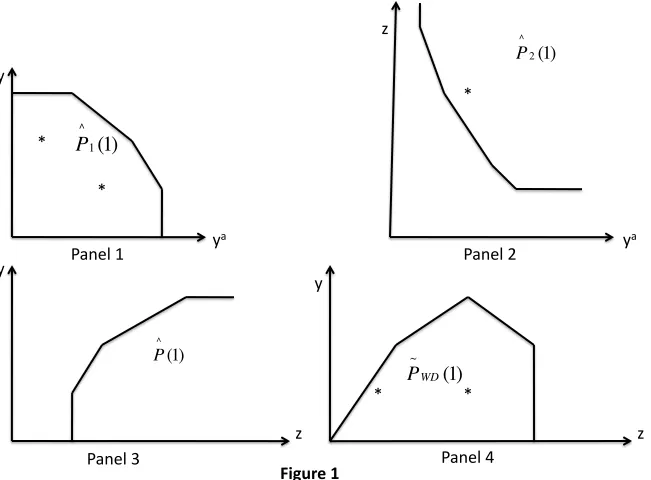
After plotting the data, we find that ˆP1(1) and ˆP2(1) can be represented functionally by
piece-wise linear functions: ˆ
P1(1) ={hya, yi ∈R2+| y≤ρ1(ya)}and
ˆ
P2(1) ={hya, zi ∈R2+|z ≥ρ2(ya)},
(5.13) where
ρ1(ya) = 6, ya ∈[0,2] = 8−ya, ya ∈[2,4] = 12−2ya, ya ∈[4,5]
(5.14) and
ρ2(ya) = 12−3ya, ya ∈[1,2] = 9−3
2y
a, ya ∈[2,4] = 7−ya, ya ∈[4,5] = 2, ya ≥5.
(5.15)
The sets ˆP1(1) and ˆP2(1) are shown in Panels 1 and 2 of Figure 1. ˆP(1), shown in Panel 3
of Figure 1, is constructed as follows: ˆ
frontier of the set ˆP(x) in terms of the parameter ya. No reference was made, however, to data on ya in the construction of ˜PW D(x).30 As seen in Panel 4 of Figure 1, ˜PW D(x) satisfies weak disposability and null jointness, but, the frontier has negatively sloped regions, indicating a negative correlation between intended and unintended outputs. The frontier of
ˆ
P(x), on the other hand, is everywhere non-negatively sloped.
Example 2: D= 7. The data are as follows:
x ya y z
1 0 8 9 1 1 7 6 1 2 6 8 1 3 6 3 1 4 1 2 1 5 4 0 1 6 2 0
(5.17)
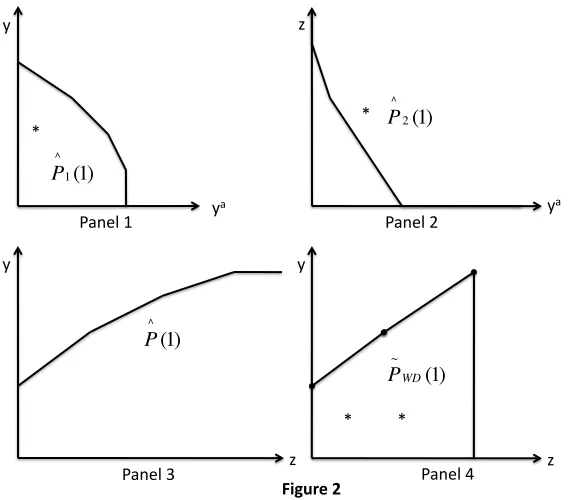
Plotting the data reveals that ˆP1(1) and ˆP2(1) can be represented functionally by two
piece-wise linear functions: ˆ
P1(1) ={hya, yi ∈R2+| y≤ρ1(ya)}and
ˆ
P2(1) ={hya, zi ∈R2+|z ≥ρ2(ya)},
(5.18) where
ρ1(ya) = 8− 2
3x, y a ∈
[0,3] = 9−ya, ya ∈[3,5] = 14−2ya, ya ∈[5,6]
(5.19)
and
ρ2(ya) = 9−3ya, ya ∈[0,1] = 15
2 − 3 2y
a, ya ∈[1,5] = 0, ya ≥5.
(5.20)
The sets ˆP1(1) and ˆP2(1) are shown in Panels 1 and 2 of Figure 2. ˆP(1), shown in Panel 3
of Figure 2, is constructed as follows: ˆ
P(1) =hz, yi ∈R2+| z ≥ρ2(ya) ∧ y≤ρ1(ya) ∧ ya ∈[0,5] . (5.21) The frontier of ˆP(x), as seen in Panel 3 of Figure 2, is non-negatively sloped. As seen in Panel 4 of Figure 2, ˜PW D(x) satisfies weak disposability but violates null jointness. In our example, this is rationalized by the fact that abatement output of a firm can completely mitigate pollution even when it is producing positive amounts of the intended outputs. Of course, in this example, we have only one output; if there were multiple outputs, some generating pollution and others not, the possibility of positive quantities of non-pollution-generating outputs combined with zero pollution would seem to be perfectly feasible even in the absence of abatement activities.
6. Conclusions.
Pollution is an unintended output that cannot be freely disposed of. Underlying its pro-duction are a set of chemical and physical reactions that take place in nature when firms engage in the production of intended outputs. These natural reactions define nature’s resid-ual generation mechanism, which is a relation between the residresid-uals generated and some inputs that are used or some intended outputs that are produced by the firm: hence, the inevitability of a certain minimal amount of pollution being generated when firms engage in intended production. We call this phenomenon by-production of pollution. The larger is the scale of intended production, the more are the pollution causing inputs being used or the more are the pollution causing intended outputs being produced, and hence, the more is the pollution generated. This provides the fundamental explanation for the positive correlation that is observed between intended production and residual generation.31
Most of the existing literature attributes the observed positive correlation to abatement options available to firms. We show that abatement options of firms add to the phenomenon of by-production in strengthening the observed positive correlation between pollution gen-eration and the production of intended outputs. The existing literature usually does not explicitly model abatement options of firms, but considers a reduced form of the firm’s tech-nology, which satisfies standard disposability assumptions with respect to all inputs and intended outputs.
We show that more than one implicit production relation is needed to capture all the technological trade-offs that are implied by the phenomenon of by-production. In partic-ular, we show that by-production can be modeled by decomposing the technology into an intended-production technology and a residual-generation technology. The latter must ex-hibit costly disposal of pollution, as discussed in Murty [2010]. Abatement activities of firms can be added to the model as an additional factor in both the intended-production technol-ogy and the residual-generation technoltechnol-ogy. From this general model, we are able to derive a reduced form of the technology in the space of inputs, intended outputs, and unintended outputs that is in the spirit of that usually studied in the literature. Contrary to the usual literature, however, we find that the reduced-form technology violates standard disposability assumptions with respect to inputs and intended outputs that cause pollution. We derive implications from the phenomenon of by-production for the econometric and DEA specifi-cations of pollution-generating technologies. We derive a DEA specification of technologies that satisfies by-production. Such a specification can be used to study issues relating to the measurement of efficiency, marginal abatement costs, productivity etc. of firms with pollution-generating technologies.
APPENDIX
Rn++m be such that f(¯x,y¯) = 0 and the m×m matrix ∇yf(¯x,y¯) is full-row ranked (has a non-zero determinant). Then there exist neighborhoodsU and V around ¯xand ¯yinRn+ and Rm+, respectively, and a continuously differentiable function Φ :U →V with image Φ(x) = y
such that, for all x∈U, we have f(x,Φ(x)) = 0 and
∇xΦ(x) = − [∇yf(x,Φ(x))]−1 ∇xf(x,Φ(x)). REFERENCES
Aryes, R. U., and A. V. Kneese [1969], “Production, Consumption and Externalities,”
American Economic Review 59: 282–297.
Barbera, A. J., and V. McConnell [1990], “The Impact of Environmental Regulation on Industry Productivity: Direct and Indirect Effects,” Journal of Environmental Economics and Management 18: 50–65.
Baumol, W. J., and W. E. Oates [1988],The Theory of Environmental Policy, Second Edition, Cambridge: Cambridge University Press.
Boyd, G. A., and J. D. McClelland [1999], “The Impact of Environmental Constraints on Productivity Improvement in Integrated Paper Plants,” Journal of Environmental Economics and Management 38: 121–142.
Coelli, T., L. Lauwers, and G. van Huylenbroeck [2007], “Environmental Efficiency Mea-surement and the Materials Balance Condition,” Journal of Productivity Analysis 28: 3–12.
Coggins, J. S., and J. R. Swinton [1996], “The Price of Pollution: A Dual Approach to Valuing SO2 Allowances,” Journal of Environmental Economics and Management 30:
58–72.
Cropper, M. L., and W. E. Oates [1992], “Environmental Economics: A Survey,”Journal of Economic Literature 30: 675–740.
F¨are, R., S. Grosskopf, C. A. K. Lovell, and C. Pasurka [1989], “Multilateral Productivity Comparisons When Some Outputs are Undesirable: A Nonparametric Approach,” The Review of Economics and Statistics 71: 90–98.
F¨are, R., S. Grosskopf, C. A. K. Lovell, and S. Yaisawarng [1993], “Derivation of Shadow Prices for Undesirable Outputs: A Distance Function Approach,” The Review of Economics and Statistics 75: 374–380.
R. F¨are, S. Grosskopf, and C. Pasurka [1986], “Effects of Relative Efficiency in Electric Power Generation Due to Environmental Controls,” Resources and Energy8: 167–184.
F¨are, R., and D. Primont [1995], Multi-Output Production and Duality: Theory and Appli-cations, Boston: Kluwer Academic Press, 1995.
Hailu A., and T. S. Veeman [2000], “Environmentally Sensitive Productive Analysis of the Canadian Pulp and Paper Industry, 1959–1994: An Input Distance Function Approach,”
Journal of Environmental Economics and Management 40: 251–274.
Førsund, F. [2009], “Good Modelling of Bad Outputs: Pollution and Multiple-Output Production,” International Review of Environmental and Resource Economics 3: 1–38. Frisch, R. [1965], Theory of Production, Dordrecht: D. Reidel Publishing Company.
Malmquist, S. [1953], “Index Numbers and Indifference Surfaces,” Trabajos de Estatistica, 4: 209–242.
Murty, M. N., and S. Kumar [2002], “Measuring Cost of Environmentally Sustainable Industrial Development in India: A Distance Function Approach,” Environment and Development Economics 7: 467–86.
Murty, M. N., and S. Kumar [2003], “Win-Win Opportunities and Environmental Regu-lation: Testing of Porter Hypothesis for Indian Manufacturing Industries,” Journal of Environmental Management 67: 139–44.
Murty, M. N., S. Kumar, and M. Paul [2006], “Environmental Regulation, Productive Efficiency, and Cost of Pollution Abatement: A Case Study of Sugar Industry in India,”
Journal of Environmental Management 79: 1–9.
Murty, S. [2010], “Externalities and Fundamental Nonconvexities: A Reconciliation of Ap-proaches to General Equilibrium Externality Modeling and Implications for Decentral-ization,” Journal of Economic Theory145: 331-53.
Murty, S., and R. R. Russell [2005], “Externality Policy Reform: A General Equilibrium Analysis,” Journal of Public Economic Theory 7: 117-150.
Pittman, R. W. [1983], “Multilateral Productivity Comparisons with Undesirable Outputs,”
The Economic Journal 93: 883–391.
Shephard, R. W. [1953], Cost and Production Functions, Princeton: Princeton University Press.
Shephard, R. W. [1974],Indirect Production Functions, Meisenheim Am Glan: Verlag Anton Hain.
*
*
*
*
*
y
y
ay
ay
y
z
z
Panel 1
Panel 2
Panel 3
Panel 4
€
P
^1
(1)
€
P
^ 2(1)
€
P
^(1)
[image:35.792.66.717.75.555.2]*
*
*
*
€
P
^(1)
€
P
^
2
(1)
€
P
^1
(1)
P
~WD