Exploring the Future Development in Employee
Involvement: The Influence of Formalization on
Managerial Job Crafting Expectations
Author: Guus J. L. van Emmerik
University of Twente P.O. Box 217, 7500AE Enschede
The Netherlands
ABSTRACT:
Previous research often recommends the analysis of the relationship between job crafting and various organizational antecedents. This research tries to examine such a relationship, namely the one between formalization and managerial expectations towards the future of job crafting. It was hypothesized that managers working in formal organizations would expect more cognitive job crafting than task- and relational job crafting, while managers working in informal organizations would expect more task- and relational job crafting than cognitive job crafting. Responses to an initial quantitative survey on formalization were used to divide respondents into two research groups, being managers working in formally and informally structured firms. Then, the Delphi method was used to first ask respondents for qualitative expectations towards the future of job crafting, after which respondents were asked to reflect on all general job crafting expectations that were found in the first stage by assessing their expected likelihood in future practice on a five point Likert scale. Analysis of the differences in means and consensuses within the ratings of the two research groups lead to confirmation of the first hypothesis, while the second hypothesis was rejected since informal managers did not expect task- and relational job crafting to a larger extent than cognitive job crafting. An additional conclusion that could be derived from the results was that informal managers, in comparison to formal managers, were more aware of job crafting in general. Also, informal managers reached more agreement on the future occurrence of job crafting than formal managers.
Supervisors: dr. J. G. Meijerink & dr. A. A. M. Wognum
Keywords
Job Crafting, Formalization, Future Development, Managerial expectations, Human Resource Management, Employee Involvement.
Permission to make digital or hard copies of all or part of this work for personal or classroom use is granted without fee provided that copies are not made or distributed for profit or commercial advantage and that copies bear this notice and the full citation on the first page. To copy otherwise, or republish, to post on servers or to redistribute to lists, requires prior specific permission and/or a fee.
5th IBA Bachelor Thesis Conference, July 2nd, 2015, Enschede, The Netherlands.
1.
INTRODUCTION
This research is about the role of job crafting within the future of employee involvement in human resource management. Job crafting is defined as the physical and cognitive changes individuals make in the task- or relational boundaries of their work (Wrzesniewski & Dutton, 2001), and it is a relatively new practice in human resource management. Employees often proactively alter the content and composition of their jobs for all kinds of purposes, like creating a more positive work identity or making the job more meaningful (Wrzesniewski & Dutton, 2001). To achieve such goals, employees display creative behavior in their attempt to seize and utilize job crafting opportunities that are present within an organization. In fact, Wrzesniewski and Dutton (2001) define three kinds of job crafting, namely; task crafting, which means that employees change the range or content of their tasks, cognitive crafting, which comes down to employees changing the ways in which they see their jobs, and relational crafting, which means that employees change the interactions they have with colleagues and other stakeholders of the organization. By crafting their jobs, employees can create different trajectories through an organization (Wrzesniewski & Dutton, 2001), or in other words; it enables them to create their own unique job. To examine the role of the different types of job crafting within the future of employee involvement in human resource management, the degree of formalization within a company will be used as an independent variable. In the past decades there has been a growing need for new, more flexible approaches to business design to fit rapidly changing environments. In other words, companies are becoming more informally structured to deal with new challenges. This is in contrast with the more traditional view of formalized organizations that strive for control over every aspect of their company structure. I want to investigate what different effects a formal or informal organizational structure has on future expectations on job crafting, so that the most probable implications of the informalization tendency can be determined for future developments in job crafting. This exploration of the future can help managers and other practitioners in designing their businesses in such a way that job crafting among employees is encouraged or rejected more effectively, depending on the goals one wants to achieve. Boddy (2011) defines formalization as the practice of using written or electronic documents to direct and control employees. Formalization concerns the definition of rules which are then institutionalized and it determines to what extent employees are bound to protocols and procedures in carrying out their job (Kieser & Walchenbach 2007, cited in Mattes, 2014).
The phenomenon of formalization is chosen because it can be seen as a restraining factor to one of the key notions of job crafting, namely employee proactivity (Wrzesniewski & Dutton, 2001). Job crafting is a practice that requires employees to be at the starting point; the employees’ initiative is key in the whole process. When conducted successfully, job crafting can enable employees to proactively shape their job on various aspects, which might lead to positive outcomes for both the individual and the organization. However, for job crafting to occur there has to be a certain leeway for this proactivity, otherwise employees might not perceive any opportunities to craft their jobs (Wrzesniewski & Dutton, 2001). A formal organizational structure likely causes employees to behave more reactively instead of proactively since they have to obey the various rules and protocols that are used by a company, leaving no or little space to perceive and utilize opportunities for job crafting. The above clarifies
why I think that formalization and deformalization, which is about the decrease in the extent to which documentations and regulations are used, might be relevant factors when discussing the future of job crafting. In summary it comes down to the notion that the extent to which an organization is formalized might determine to what extent opportunities to job craft can be perceived and used by employees.
Since the current research is directed toward the future of job crafting, only literature study will not get us far. After all, the future is something that is not yet certain, which means that it can only be predicted. Therefore, it would be most useful to analyze the expectations among the experts in the field towards the future of job crafting. I chose managers to be these experts since they have a helicopter view over an organization and they most probably have to deal with the organizational consequences of job crafting, which can be either positive or negative. It is also a managers’ task to evaluate and correct employees where needed, which means that he is in a position to reject or encourage job crafting by employees. A further explanation of the sample and the respondents will follow in the methods section.
Combining the concepts of job crafting and formalization with a management perspective that is directed towards the future then results in the following research question:
What are the differences between expectations of managers working in formal versus informal companies regarding the types of job crafting that will occur within 5 years from now?
never been put to an empirical test. Given the assumption that a large extent of formalization negatively influences individual and firm performance, an analysis regarding the negative effects of formalization on job crafting might prove useful since job crafting can be an important determinant for both individual and organizational performance (Wrzesniewski & Dutton, 2001). Next to that, Benería (2001) mentions that processes of informalization or deformalization of jobs have been observed during the last decades of the 20th century. This statement is supported by Wrzesniewski & Dutton (2001), who state that organizations are embracing less limiting or controlling practices such as casual dress, flexible work hours and flexible work places, which might increase the perceived opportunities to job craft. Checking if this deformalisation tendency really entails implications for job crafting can add to the existing knowledge base.
2.
THEORY
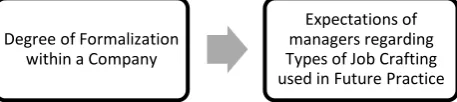
[image:3.595.58.287.345.396.2]The expectations about the future that will be researched can be hypothesized using a simple two-factor model, which is given below in figure 1. The model implies that the degree of formalization within a company, with extremes called ‘formal’ and ‘informal’, influences the expectations of managers regarding the types of job crafting that will be used by employees in future practice, being task-, cognitive- and relational job crafting.
Figure 1: Simplified hypothetical model regarding the formalization – job crafting relationship
2.1
Job Crafting
Job crafting is a type of employee behavior that involves employees to proactively change the boundaries of a job to alter their work identity or the meaning of the work (Wrzesniewski & Dutton, 2001). The main premise of job crafting is that employees refine or change aspects of their jobs to fit their motivations and talents, through which more commitment and enthusiasm is created (Visser, Tjepkema & Spruyt, 2012). Job crafting is the opposite of the more commonly known practice of job design in the sense that it represents a bottom-up instead of top-down change process. In job design often a one-size-fits-all approach is chosen by management, while job crafting is about individualized changes in a job that are initiated by employees themselves (Berg, Dutton & Wrzesniewski, 2013). Job crafting entails proactive changes in the job design that are not specific arrangements that are negotiated with the organization (Tims & Bakker, 2010), and such changes even might happen without managers consciously knowing it (Wrzesniewski & Dutton, 2001). Job crafting also does not per definition happen in line with organizational goals (Tims & Bakker, 2010), which implies that although successful job crafting creates a better work identity or more meaning for one specific employee, it might not lead to positive outcomes for the organization as a whole. According to Wrzesniewski & Dutton (2001), job crafting by employees can manifest itself in three ways.
The first one, which is called task crafting, involves employees changing the number, scope, and type of job tasks in which one participates (Wrzesniewski & Dutton, 2001). Generally this means that employees can make changes in the nature of certain tasks; the amount of time and effort they put
into their tasks; or the composition of their total package of tasks (Berg et al., 2013). An example of task job crafting might be cashiers working in supermarkets who start helping customers to pack their groceries into bags, which provides the cashiers with more meaning in their job since they provide better service for the customers. Here it can already be seen that job crafting can have both positive and negative effects on a company’s performance. On the one hand, helping customers more extensively most likely improves the customer experience and also their satisfaction with the specific supermarket. On the other hand, helping customers to a larger extent also increases the service time per customer, causing a longer waiting time and thus less satisfaction for the average customer. In this situation, a manager might for example forbid cashiers to help customers in the above described way to decrease waiting time, although he also might hire more cashiers so that more customers can be helped simultaneously.
The second job crafting type is relational job crafting, which is defined as changing the quality and/or amount of interactions with others encountered within the job (Wrzesniewski & Dutton, 2001). More precisely, it is about how, when or with whom employees interact while executing their job, and this can be done by building new relationships; by reframing the purpose of relationships; or by adapting the content of relationships (Berg et al., 2013). Here, one might think of employees who start asking for regular feedback by colleagues or superiors while it is not required to do so by company structure. This type of job crafting can increase the meaning employees attribute to their job, since they then have a better understanding of how they have enhanced individual but also organizational performance. Moreover, the example used in explaining task crafting also partially applies to relational crafting, since the cashiers in this specific example also changed the quality of their interaction with customers, providing them with better service.
Lastly, cognitive crafting concerns changing the cognitive task boundaries of a job, or in other words; changing the ways in which one cognitively parses their own job (Wrzesniewski & Dutton, 2001). Cognitive job crafting does not entail any changes in physical or objective parts of a job, which is in contrast to task- and relational job crafting, and it might arise when employees expand, focus or link their perceptions of tasks, relations or the job as a whole (Berg et al., 2013). For example, hospital cleaners might see their work as the simple cleaning of equipment and rooms, or as a vital supplementing function towards health care, which provides the job with more meaning. In the example, the first way of perceiving entails that employees see their job as a subdivided package of tasks, while the second way of perceiving causes employees to see their job as an interconnected whole that has a higher purpose.
2.2
Formalization
Formalization and informalization were already briefly introduced in the first section of this paper, but I will draw on these phenomena a bit further to shape a clearer distinction between them. In a formal organizational structure, managers and employees rely on guidelines, documents or procedures that set out how the organization’s activities are divided and coordinated (Boddy, 2011). In a formal structure tasks and lines of authority are clearly defined in for example organization charts, so that every single employee knows the duties and responsibilities he or she has within the firm. So, the larger the extent to which predetermined institutionalizations and documentations are present within a Degree of Formalization
within a Company
company structure, the higher the degree of formalization within that company. An informal structure, on the other hand, puts emphasis on the undocumented relationships between members of the organization that emerge as people adapt systems to new conditions and as they satisfy personal and group needs (Boddy, 2011). A firm that makes no or little use of the various ways of formal control can thus be regarded as an informal organization, while a company that makes frequent use of such guidelines and procedures can be labeled as a formal organization. Boddy (2011) also states that there always has been a tension between formality and informality, which implies that the one is not by default better than the other. The success of the two structures largely depends on both the company’s strategy and the environment in which it operates.
2.3
Hypotheses
The above theory raises two main hypotheses. The first one states that managers working in formal organizations will expect that employees are going to participate more in cognitive crafting than in task- and relational job crafting. This is supported by Wrzesniewski & Dutton (2001), who state that more controlling and monitoring by management most probably influences the perceived opportunities employees have to craft their jobs in a negative way. According to them, job crafting is better visible and less welcomed in a formal company structure. So, in an organization where the job is largely specified and predetermined by higher management it would be most likely that there are few opportunities for employees to expand or change the structure of a job by themselves. Especially task- and relational job crafting can be largely regulated within a company since they are mainly about tangible and visible actions that can be observed by management, and in a largely formalized company this will most likely be the case. I expect that proactivity, which is per definition required for job crafting, will be discouraged in formalized systems, leading to less opportunities for task- and relational crafting since they are the ones that are subject to company rules in most cases. This assumption although does not apply to cognitive crafting because of the fact that it mainly occurs in the employees’ mind, making it immune to protocols and regulations. Within a formally structured firm, the execution of a job, among which are tasks and relations, is largely determined by institutionalized rules (Kieser & Walchenbach 2007, cited in Mattes, 2014), but this cannot be said about the ways in which employees think or reason about their job. To summarize; I expect that cognitive job crafting is less subjected to company rules than task- and relational crafting. Next to that, I assume that employees would want to prioritize task- and relational crafting over cognitive crafting since they lead to more straightforward and tangible changes in the structure of their job. After all, task crafting leads to different tasks, relational crafting leads to different relations and cognitive crafting only leads to a different mindset but not to any actual changes in the boundaries of the job. When opportunities for task- or relational crafting are then taken away by a formal organizational structure, employees might start to see cognitive crafting as a viable substitute, enabling them still to craft their job. Cognitive job crafting most probably does not lead to any changes in the job structure itself because it does not involve any tangible aspects of the job (Berg et al., 2013), but it still enables employees to create more meaning or a better work identity by parsing their job differently. So, instead of crafting the tasks and relations of their jobs, employees will try to give different meaning to their job by
cognitively crafting their job when in a formal organizational structure.
H1: Managers working in a formalized organizational structure will expect that employees are going to participate more in cognitive crafting than in task- and relational crafting.
Furthermore, Wrzesniewski and Dutton (2001) also state that more autonomy and increased responsibility in a job lead to more perceived opportunities to job craft, which brings us to the second hypothesis. The second hypothesis entails that managers working in informal organizations will expect that employees are going to participate more in task and relational crafting than in cognitive crafting. In an informal system there are less rules and regulations, making it easier for employees to expand and change the content or range of their tasks. Also, employees will be more enabled to change the relations with colleagues or other actors like suppliers or customers since these relations are not fully defined in company regulations. As already stressed at hypothesis one, I assume that employees would want to prioritize task and relational crafting over cognitive crafting. In an informal system there would be no longer a significant need for cognitive crafting since there are enough opportunities to craft the task and relational aspects of the job. The needs to create a positive work identity and also more meaningfulness in a job (Wrzesniewski & Dutton, 2001) would then already be answered by crafting a job’s tasks and relations, making cognitive job crafting more or less redundant. The structure of an informal organization, which is more about undocumented relationships and the adaptation of systems to emerging new conditions (Boddy, 2011), also might enable employees to already see the bigger picture or consistent whole in which their job plays a part, making cognitive job crafting no longer relevant since cognitive needs are already satisfied.
H2: Managers working in an informal organizational structure will expect that employees are going to participate more in task and relational crafting than in cognitive crafting.
3.
METHODS
Qualitative research was the best way to investigate the various types of job crafting that are expected by managers to occur in the near future. This because through qualitative research the motives and expectations of individuals can be measured more in depth, providing better explanatory data for this specific research. The most viable way to execute this field research is through the Delphi-method since it causes experts to reach some form of consensus (Okoli & Pawlowski, 2004). Such a consensus is useful for an expectations oriented research because then there will be a more uniform expectation towards the future among experts in the end, making the study more generalizable and better applicable to practice. To measure the extent of formalization within a company a quantitative approach was used. I chose to use a quantitative survey since I wanted formalization to be expressed in a specific value, so that it is clear to what degree a company can be considered formalized. Those numbers then provided the data on which the managers were divided into the ‘informal’ and ‘formal’ research groups, as will be explained later on in this section.
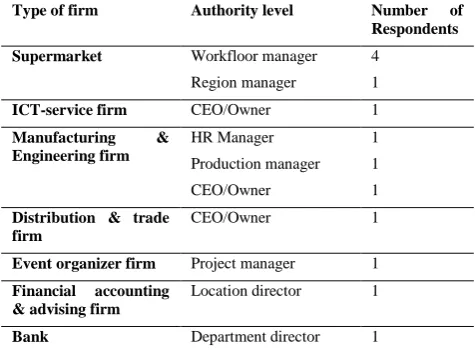
expectations regarding the future of job crafting. Managers have a helicopter view over an organization, and it is their task to evaluate, reward and correct employees when needed. So, when job crafting has certain consequences for the organization, which can be both negative or positive, managers are most probably the ones to first find out about it. Their experiences with such situations might be valuable when asking them for expectations towards the future of job crafting. A limitation of this view is that managers might not always be aware of cognitive job crafting among employees since cognitive crafting only happens in the employees’ mind, as opposed to task- and relational job crafting, which means that it does not have any consequences for the organization that are directly visible. Managers could possibly get an image of cognitive job crafting by employees if employees are willing to share or express their way of thinking through regular conversations with management, but this might not always be the case in every organization. The sample consisted of 13 managers from various firms and of various authority levels as can be seen below in table 1. The literature suggests that for a Delphi-method a sample should ideally contain between 10 and 18 respondents (Okoli & Pawlowski, 2004), which means that a sample of 13 should be sufficient.
Table 1: Respondent characteristics overview Type of firm Authority level Number of
Respondents Supermarket Workfloor manager 4
Region manager 1 ICT-service firm CEO/Owner 1 Manufacturing &
Engineering firm
HR Manager 1 Production manager 1 CEO/Owner 1 Distribution & trade
firm
CEO/Owner 1
Event organizer firm Project manager 1 Financial accounting
& advising firm
Location director 1
Bank Department director 1
The generalizability and representativeness of the findings are likely to be improved by the respondent diversity, which is expressed in both authority levels and types of organizations. This because managers working in different organizations and contexts might have different views on job crafting and employee behaviour, providing me with a more varied dataset. If consensus can then be reached to some extent, the findings will be more robust since managers from differing backgrounds agreed on them. Finding consensus on the other hand might also be a problem, simply because of the varying backgrounds of the respondents. The main criterion for the managers to be considered experts on this particular field of study was that they interacted frequently with their colleagues, and especially their subordinates, in the day-to-day workflow, so that they would have a good view on current and future employee behavior, as was already mentioned earlier. All participants had frequent interaction with their subordinates and colleagues at work, so this criterion was met. Also, participants were required to be well informed about their company’s structure, so that they could indicate the level of formalization in their firm accurately. Since all participants were managers it can be assumed that this is the case, because managers are the ones that create and execute policy. The participants were mainly found by using my own network; I approached suitable persons myself when I knew them
directly, or I would ask around in my network if someone knew a person that could fit the criteria. Hence, respondents were not specifically selected on their varying characteristics; selection was merely done by utilizing opportunities that presented themselves within my own network. This also means that respondents were not randomly selected from the population, being all managers that would meet the above criteria, and this is a limitation to the current study in that it reduces the generalizability and reliability of the findings. This limitation could probably not have been prevented although, given the fact that I had no additional resources or time that would enable me to find respondents in any other, more reliable way.
Therefore, I also used this criterion for assessing consensus in the current study.
Throughout the various steps in the Delphi method respondents were not allowed to interact with each other; they were only required to individually reflect on the sum of responses in the second step. This isolation is put in place to take away the negative effects of direct confrontation and group thinking among respondents such as the hasty formulation of preconceived notions, the inclination to close one’s mind for new ideas, the tendency to defend a stand once it is taken and the predisposition to be swayed by persuasively stated opinions by others (Dalkey & Helmer, 1963). The whole Delphi process can also be repeated multiple times using different questionnaires each time to get a more uniform or refined consensus among participants when needed (Hasson, Keeney & McKenna, 2000).
Both the open and closed questionnaires were distributed via e-mail and the online service “thesistools.com” was used to allow respondents to fill out the questionnaires easily. The questionnaires were in Dutch, since all of the respondents’ native language was the Dutch language. At step one, two respondents who live in the same area as me even offered to do a face-to-face interview instead of the online questionnaire because it would deepen their understanding of the research, next to the fact that they had some time available. This opportunity enabled me to ask for expectations in a more precise and refined way, which could eventually improve the research findings. During both steps it was needed to send one reminder e-mail to seven and six respondents respectively for filling out the questionnaires. All respondents that participated in the first Delphi round also participated in the second Delphi round, causing a 100% response rate.
3.1
Formalization Survey
First, the extent of formalization within the company in which participants were working was measured. This was done by using a Likert scale including nine scale-based survey questions on for example the extent to which formal policies and documented communications are present in the firm. The survey was already used by Fiss (2011) and it was originally created by the ESRC Centre for Business Research at the University of Cambridge. The answer to each question was rated on a scale anchored by 1, “almost never”; 2, “infrequently” 3,“about half the time”; 4, “most of the time” and 5, “nearly always” (see appendix 1). Also, the scale showed very good reliability (α=.83), as was found by Fiss (2011). The average score of the rated answers to these questions provided a numerical outcome which indicated the perceived level of formalization within a company by managers. The cross-over point was set at 3,62; where a value below the cross-over means a relatively informal organizational structure, and a value above the cross-over means a relatively formal organizational structure. This value was chosen since it was the average of all responses given, although one could argue that this cross-over point is too high since the objective middle value of a five point scale is three. When considering the logical assumption that every organization needs some formal structure to prevent random and irrational behavior it however probably is an accurate cross-over point. The above assumption is also supported by the findings in that the value of one, which entails the response of “almost never”, only was given five times at a specific question by all respondents. Based on the formalization score the managers were then divided into two groups, namely; ‘managers working in an informal organization’, and ‘managers working in a formal
organization’, so that I was enabled to compare the expectations of the two groups in the second Delphi stage.
3.2
Delphi Method Stage 1
In the first Delphi stage participants were asked to express their future expectations on job crafting, especially regarding the task-, relational-, and cognitive job crafting types. This is also called the divergent stage, in which participants are asked to respond to open ended questions in isolation. To measure the future expectations of managers regarding the above, I used the concepts of an interview protocol that was already put into practice by Berg, Wrzesniewski & Dutton (2010). Their questions are very useful since they particularly address the different types of job crafting that are also studied in the current research. Since the questions mainly addressed job crafting from an employee- and present-time perspective, they had to be modified into questions that were more fitting to this specific study (see appendix 2). I first took the main themes of the protocol, being the content and amount of tasks, the content and amount of relations and the purpose employees assign to their jobs, after which I framed questions around these themes in such a way that they became more fitting to a study that examines the future from a management perspective. Also, I added a general question on job crafting to give respondents the possibility to suggest other expected forms of job crafting next to the task-, relational- and cognitive ones (see appendix 2). This because the current study focuses on the future, and it could well be that new or sub forms of job crafting are expected by experts.
know in advance in which category or code every general expectation would be, and this could bias their responses while filling out the questionnaire.
3.3
Delphi Method Stage 2
In stage two, participants were asked to reflect on the list that was created at stage one by reporting their opinion on the extent to which the 27 general expectations would be likely to occur within their firm in the coming five years. For this stage, again a five point Likert scale was used and the answer to each question was rated on a scale anchored by 1, “not at all likely”; 2, “not very likely” 3,“moderately likely”; 4, “very likely” and 5, “utmost likely” (see appendix 3). I chose to use a Likert-scale since it enabled me to test the expected likelihood of all general expectations among all respondents in a numerical way so that consensus percentages and means for every expectation could be calculated in the end. Also, it enabled respondents to quickly state their expectation or opinion without having to elaborate further, which prevented them from losing motivation to complete the survey. This second stage is also called the convergent phase, in which participants critically reflect on the sum of all responses. The APMO cut off rate for assessing consensus is found by firstly calculating the percentages of disagreements and agreements for every statement (Heiko, 2012). For disagreements I used the values of one and two of the Likert scale since these are the categories that assess an expectation as not or not very likely to occur. For agreements I used the values of four and five of the Likert scale since these are the categories that assess an expectation as very or utmost likely. The value of three was left out in this calculation since it represents the value that does not tend towards real disagreement or agreement. A certain agreement or disagreement percentage was then regarded as a majority if it had a value above 50 (Heiko, 2012). Then, according to literature, the majorities from all statements should be counted, and the sum of them should be divided by the total amount of statements. This would then result in a percentage that could be used as a cut off value for the successful achievement of consensus for all statements (Heiko, 2012). Since this study involved two separate research groups, I found it although most fitting to first calculate the APMO per research group, after which I used the mean of them as eventual cut off rate. I used this method because it would give both research groups an equal influence on the final cut off rate. The cut off rate was calculated by dividing the sum of the APMO of informal managers, being 62,96%, and the APMO of formal managers, being 100%, through two, resulting in an APMO cut off rate of 81,48%. Then, for each expectation per research group, I considered consensus to be achieved when the percentage of ratings that fell within two adjacent categories was greater than the cut off value. Subsequently, consensuses on the lower half category groups, being one and two or two and three, were considered to imply a negative or disagreeing form of consensus, while consensuses on the upper half category groups, being three and four or four and five, were considered to imply a positive or agreeing form of consensus. For each of the two research groups I was then able to check to what extent consensus was reached on the various expectations, through which consensus percentages for each sub code and job crafting type could be calculated. Also, means of ratings per sub code were calculated, which could indicate the expected likelihood of every sub code and job crafting type per research group. I then used the consensus percentages to assess the strength of the various means to see to what extent the means were actually supported by
respondents’ agreements. After all, a mean without supporting consensus does not really represent the total opinion of a research group. By comparing the datasets of the two research groups I was eventually enabled to evaluate the two hypotheses.
4.
RESULTS
In this section the results of the various questionnaires are going to be analyzed and discussed through which the two hypotheses eventually can be tested.
4.1
Formalization
[image:7.595.317.546.289.408.2]The total score of each respondent on the perceived degree of formalization within their company was calculated by dividing the sum of the scores given at each question by nine, since there were nine questions (see appendix 1). Total scores ranged between 2,22 out of 5, which implies a low perceived degree of formalization, and 4,56 out of 5, which implies a high perceived degree of formalization. The total scores of all respondents and the mean of all total scores, which was 3,62 out of 5, are summarized in figure 2.
Figure 2: Respondents’ perceived degree of formalization within their companies
The mean, which was chosen as cross-over point in the previous section divided the respondents into two groups. The six managers who were beneath the mean were assigned to the ‘informal organizational structure’ group, and the seven managers who were above the mean were assigned to the ‘formal organizational structure’ group. The data regarding formalization will be further used in the second Delphi stage, where the rated expectations of both formal and informal managers will be analyzed.
4.2
Delphi Method Stage 1
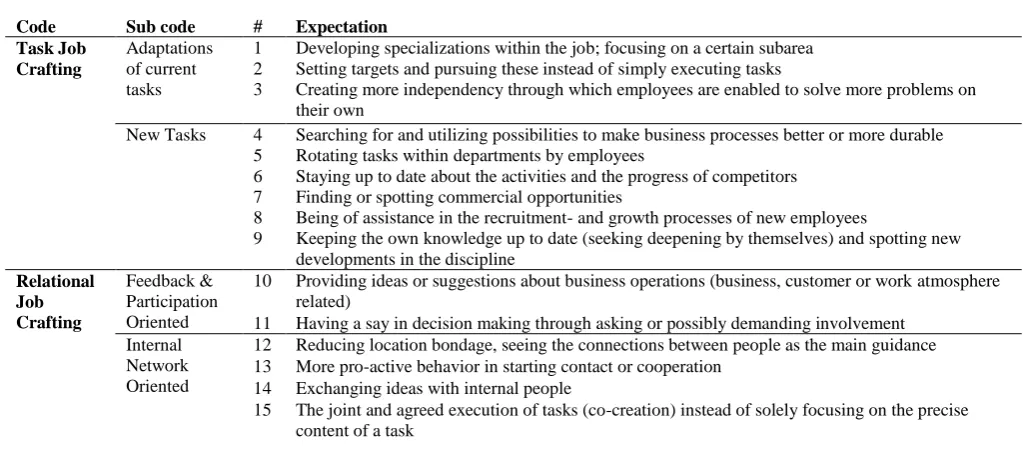
All responses to the open ended questions (see appendix 2) were generalized, as was described in the previous section, and then assigned to a sub code within a specific type of job crafting (see table 2). The responses to the sixth question that addressed job crafting in general did not deliver any totally new types of job crafting; the responses to this specific question could all be classified under one of the three main job crafting types. Most respondents expressed various expectations regarding different themes, although it should be noted that some managers, especially those who were working in a supermarket, expressed very few expectations towards the future of job crafting in the open ended questionnaire. Noteworthy is that almost all of these managers perceived their company as being formally structured. On the other hand, most respondents that stated that pro-active behavior among employees is and will be a key notion in business practice perceived their company as informally structured. Also, the managers who described their company as informal provided a wider variety of qualitative responses than the managers who described their company as formally structured. The content of table 2 will be discussed below to
0 1 2 3 4 5
1 2 3 4 5 6 7 8 9 10 11 12 13
Perceived degree of formalization by
give insight into the expectations of all respondents. At every job crafting type the line of reasoning behind the different sub codes that were used in coding all responses will also be explained.
4.2.1
Task Job Crafting
For task job crafting sub codes that were derived from the initial open ended questions about task crafting were used (see appendix 2). Expectations were categorized either under “adaptations of current tasks” or under “new tasks”, which is similar to the way Berg, Wrzesniewski & Dutton (2010) distinguished their responses regarding task job crafting. Respondents expected or desired that their employees would expand the manner in which they execute their current tasks in several ways. Developing specializations, setting targets and creating more independency were the main expectations that managers expressed, and these are all ways in which employees can alter their current tasks within a job. Also, managers expected or desired that employees would take on new tasks within their jobs. It should although be noted that the notion of “new tasks” is quite relative in this case, since a new task within one company might be an already present task in another company. Rotating tasks within departments is an example of this relative notion, since this practice might be already present in some companies, but not in others. Other mentioned expectations were among others finding or spotting commercial opportunities, being of assistance in the recruitment- and growth process of new employees and monitoring competitor activities.
4.2.2
Relational Job Crafting
For relational job crafting it was not of much use to derive sub codes from the initial open ended questions since respondents did not often make a distinction between adaptations of current relations and the creation of new relations, which were the themes that the two open ended questions addressed. It was not uncommon that respondents, when answering the second question on relational job crafting, would refer to the first question or would give an answer that was more or less similar. While analyzing the data on relational job crafting I discovered that there were three main themes that respondents often addressed, being job crafting oriented at feedback and participation, internal networks, which are relations with people from inside the firm, and external networks, which are
relations with people from outside the firm. Since these three themes repeated themselves throughout the majority of responses, I decided to use them as sub codes for relational job crafting. Regarding feedback and participation there were two relevant themes that were addressed by respondents. One was providing ideas or suggestions about business operations, and the other was asking or demanding involvement in decision making. Also, expectations towards the internal network were often raised by respondents. More co-creation, less location bondage and more pro-activity in starting contact and cooperation were among others themes that were expected or desired by managers regarding inter-employee relations in the near future. The last relational category includes relational job crafting aimed at external networks. Here respondents spoke among others about involving customers in the business process and the progress that was being made. Also expanding or adjusting relationships with external parties that matter to the organization, introducing customers to new distribution channels and exchanging knowledge with external parties were mentioned as possible ways in which employees could craft their jobs on the relational aspects.
4.2.3
Cognitive Job Crafting
[image:8.595.46.558.544.769.2]For cognitive job crafting there was only one interview question, from which the first sub code, being the “view on the job or company as a whole”, was derived. At other interview questions respondents sometimes also expressed expectations that could be classified as cognitive job crafting, considering its definition, but they did not fit well with the first sub code. Therefore, a second sub code was created, which was about “the way of thinking when performing in the tasks and relations that are within a job”. This sub code has a link with tasks and relations since the expectations that are within this sub code were often mentioned at other interview questions, as was already stated above. Regarding the view on the job or company as a whole there was only one main expectation, and it was about giving meaning to the company vision in the own mindset. Under the second sub code there were more expectations listed, such as developing a collective way of thinking, taking initiative and showing a pro-active attitude, developing a broader view on the job than just the task description and always putting the customer in the first place while executing the job.
Table 2: General expectations towards the future of job crafting by all respondents from Delphi Method stage one
Code Sub code # Expectation Task Job
Crafting
Adaptations of current tasks
1 2 3
Developing specializations within the job; focusing on a certain subarea Setting targets and pursuing these instead of simply executing tasks
Creating more independency through which employees are enabled to solve more problems on their own
New Tasks 4 Searching for and utilizing possibilities to make business processes better or more durable 5 Rotating tasks within departments by employees
6 Staying up to date about the activities and the progress of competitors 7 Finding or spotting commercial opportunities
8 Being of assistance in the recruitment- and growth processes of new employees
9 Keeping the own knowledge up to date (seeking deepening by themselves) and spotting new developments in the discipline
Relational Job Crafting
Feedback & Participation Oriented
10 Providing ideas or suggestions about business operations (business, customer or work atmosphere related)
11 Having a say in decision making through asking or possibly demanding involvement Internal
Network Oriented
12 Reducing location bondage, seeing the connections between people as the main guidance 13 More pro-active behavior in starting contact or cooperation
14 Exchanging ideas with internal people
4.3
Delphi Method Stage 2
The responses per research group regarding the 5 point Likert scales that were used to measure the expected likelihood of the 27 general expectations are summarized in table 3. Consensuses were only reached on the upper half category groups, being three and four, meaning moderate or much expected likelihood, and four and five, meaning much or
utmost expected likelihood. Per sub code the mean of the Likert scale and the percentage of positive consensus is shown. Also, it is shown on which specific expectations positive or no consensus was reached. Consensus on a specific expectation was considered to be reached when the percentage of ratings that fell within two adjacent categories was greater than the cut off value, being 81,48%
Table 3: Consensuses and means of formal and informal managers’ ratings per sub code from Delphi method stage two
16 Expanding or adjusting relationships with colleagues External
Network Oriented
17 Expanding or adjusting networks with external parties that matter to the organization, such as customers and suppliers
18 Guiding customers to new ways in which they can come in contact with the firm (new distribution ways)
19 Involving customers in the progress of the business process
20 Exchanging ideas and knowledge with external people, such as customers and suppliers
Cognitive Job Crafting
View on the job and company as a whole
21 Giving meaning to the company vision in the own mindset
Way of thinking when performing in the tasks and relations that are within a job
22 Taking initiative and showing a pro-active attitude, as well as within the firm as towards customers 23 Developing a collective way of thinking, which enables employees to check and oversee each
other
24 Developing a broader view on the job than just the task description. One has to go outside the box if this is required
25 Being capable to connect different events and reason about why these connections exist 26 Always putting the customer in the first place; an employees’ activities should always serve the
customer’s interest
27 Always considering important characteristics of the company vision during the execution of tasks
Type of organization: FORMAL INFORMAL
Code Sub code # Positive
Consen- sus
No Consen- sus
Overall % of positive consensus
µ Positive Consen- sus
No Consen- sus
Overall % of positive consensus
µ
Task Job Crafting
Adaptations of current tasks
1 - 3 1,2,3 0 3,76 1,2,3 100 3,84
New Tasks 4 - 9 4,5,6,7,8 9 83,33 4,17 4,5,7,8,9 6 83,33 3,86
Overall 1 - 9 55,55 4,03 88,88 3,85
Relational Job Crafting
Feedback & Participation Oriented
10 - 11
10,11 100 3,93 11 10 50 3,67
Internal Network Oriented
12 - 16
12,13,14, 15
16 80 3,79 12,13,14,
15,16
100 3,70
External Network Oriented
17 - 20
19 17,18,20 25 3,81 18,20 17,19 50 3,63
Overall 10 - 20
63,63 3,82 72,72 3,67
Cognitive Job Crafting
View on the job and company as a whole
21 21 100 3,86 21 100 3,67
Way of thinking when performing in the tasks and relations that are within a job
22 - 27
23,24,25,2 6,27
22 83,33 3,92 22,23,24,2
5,26,27
100 3,72
Overall 21 - 27
4.3.1
Job Crafting Expectations of Managers
working in Formally Structured Companies
The average ratings by formal managers regarding the three different job crafting types were close to each other; they were respectively 4,03, 3,82 and 3,91, where there was a maximum value of 5. When only looking at means this entails that all types were expected to a quite large degree, and task job crafting was slightly more expected than cognitive job crafting, while relational job crafting was the least expected. The data on consensus per job crafting type however bring some differences into the comparison. For task crafting, there was no consensus reached on any expectation that related to “adaptations of current tasks”. Consensus was however reached on all but one of the expectations that related to “new tasks”. Also, there was a lot of agreement on the likelihood of both “feedback and participation oriented” job crafting as well as “internal network oriented” relational job crafting. “External network oriented” relational crafting was although not seen as a prominent type of job crafting in future practice; consensus towards agreement was only reached once within this sub code. The general expectations towards cognitive job crafting were largely agreed on by respondents’ ratings. On only one general expectation, which related to the “way of thinking when performing in the tasks and relations that are within a job” there was no real agreement, but on all others there was positive consensus. To summarize; positive consensus was reached on 55,55% of task crafting expectations, on 63,63% of relational crafting expectations and on 85,71% of cognitive crafting expectations. This means that formal managers agreed much more on cognitive job crafting expectations than they did on task- and relational job crafting expectations.
4.3.2
Job Crafting Expectations of Managers
working in Informally Structured Companies
The averages of the expected likelihood per job crafting type were also close to each other; they were respectively 3,85, 3,67 and 3,71, where there was a maximum value of 5. Task job crafting was thus slightly more expected than cognitive job crafting, while this did not apply to relational crafting. These means also indicate a quite large degree of expected likelihood towards the three job crafting types. Managers that perceived the structure of their company as informal reached positive consensus on almost all job crafting subtypes. On only four of the twenty-seven expectations no consensus regarding their likelihood was reached. For task job crafting consensus was not always reached for the sub code “new tasks”, while this was also the case for the “feedback and participation oriented” and “external network oriented” sub codes within relational job crafting. Regarding cognitive job crafting positive consensus was reached on all general expectations. To summarize; positive consensus was reached on 88,88% of task crafting expectations, on 72,72% of relational crafting expectations and on 100% of cognitive crafting expectations. This means that informal managers largely agreed on the future likelihood of all three job crafting types, although positive consensus was more often reached on the future likelihood of cognitive job crafting than on task- and relational job crafting.
5.
DISCUSSION
Now, after the collection of results, the two hypotheses will be reconsidered and various interpretations of the results and conclusions will be given. Also, the implications of this research for both theory and practice will be illustrated. The first hypothesis was about the expectations of managers who are working in formal organizational structures:
H1: Managers working in a formalized organizational structure will expect that employees are going to participate more in cognitive crafting than in task- and relational crafting.
When looking at the results on the job crafting types in general it can be concluded that hypothesis one is confirmed. Means on the three job crafting types were almost equal, but the differences in consensus percentages show that expectations towards cognitive job crafting were collectively valued more by formal managers.
The fact that formal managers agree more on cognitive job crafting than on task- and relational job crafting, which also means that they collectively expect more cognitive job crafting than task- and relational job crafting, could perhaps be explained by using the previously mentioned definition of formal systems. A formal organizational structure relies on guidelines, documents and procedures that set out how the organization’s activities are divided and coordinated (Boddy, 2011). Since task- and relational job crafting are job crafting types that can interfere with or change the structure of the job (Berg et al., 2013), and thus also the company structure as a whole, it might be that formal managers prefer cognitive job crafting simply because it doesn’t involve changes in the system that might conflict with the above mentioned guidelines, documents and procedures. Also, within the task job crafting type, formal managers did not reach any form of agreement on the “adaptations of current tasks” sub code, while task job crafting regarding “new tasks” was largely agreed on. This implies that formal managers expect that employees will come up with new tasks in future practice, but that they find expectations concerning adaptations of already present tasks rather questionable. This is also in line with the above assumption that formal managers might prefer a situation in which employees do not interfere too much with company structure. It should although be noted that a certain degree of consensus was nevertheless reached on task- and relational crafting, meaning that the above described scenarios most probably do not apply to all formally structured firms and managers.
The second hypothesis was about the expectations of managers working in informal organizational structures: H2: Managers working in an informal organizational structure will expect that employees are going to participate more in task and relational crafting than in cognitive crafting.
When looking at the results on the job crafting types in general it can be concluded that hypothesis two is rejected. Based on means and consensus percentages it can be seen that task- and cognitive job crafting were more or less equally expected by informal managers, while relational crafting, in comparison to task- and cognitive job crafting, was expected to a lesser, but still fairly large, extent.
The results of this study can have further relevant implications for both theory and practice. First of all, managers in general seem to have a very welcoming attitude towards cognitive job crafting since both formal and informal managers largely agreed on the future likelihood of this job crafting type. A possible explanation for this preference might be the fact that cognitive job crafting does not change tangible structures (Berg et al., 2013) of for example jobs, relations or the company as a whole; it only creates a mindset that motivates an employee to a larger extent. It might be that this is something managers wish for the most since the company structure, which is often created by themselves, is not adjusted by employees, while the same employees are getting better motivated for executing their jobs. The results can however also be explained by the fact that a transformation in mindset, or in other words a cognitive change, is key to creating and sustaining changes and improvements within an organization (Anderson & Anderson, 2010), and that therefore cognitive job crafting among employees might be a welcome event for improving business when considering it from the managers’ perspective.
Additionally, when looking at the overall results on relational job crafting, it appears that this job crafting type was the least expected and agreed on by all managers. Little consensus was especially found regarding the sub code “external network oriented” relational crafting. It is likely that not all employees within a firm come in contact with external parties like customers, suppliers and competitors, while this would also probably differ per firm. This could be an explanation for the results on relational crafting since managers might see little opportunities for job crafting within the external relations, causing them to value “external network oriented” relational crafting less than other types of relational crafting.
Also, it seems that the concept of job crafting might not be very relevant for supermarkets, or more generally, the retail business. This because a large part of the respondents who worked for a supermarket expressed no or little expectations towards the future of job crafting in the first stage of the Delphi method. Respondents who came from other industries, like manufacturing firms or an accountancy firm, generally provided more expectations towards the future of job crafting. This however might also have to do with the authority levels of respondents, since those working in supermarkets were mainly work floor managers, while others often occupied a higher level management function, such as CEO or department director. So, when looking at authority levels, it might be that managers of higher authority levels are more knowing about job crafting behaviors and opportunities than lower level managers.
Furthermore, the most relevant responses in the first stage of the Delphi method came from managers who perceived their company as informal. Also, informal managers reached positive consensus more often than formal managers on every job crafting type. This evidence suggests that managers working in informal organizations are more aware of job crafting and the proactive role of employees than managers working in formal organizations. Such a proposition is in line with statements of Wrzesniewski & Dutton (2001), who say that more controlling and monitoring, which are characteristics of a formal company, most probably negatively influences the perceived opportunities employees have to craft their jobs. They also state that more autonomy and increased responsibility, which are characteristics of an informal company, might lead to more perceived opportunities to job craft. To summarize: formal characteristics decrease the perceived job crafting opportunities while informal
characteristics increase them. The finding that managers working in formal systems are less aware of job crafting than managers working in informal systems is in line with this proposition and it could therefore be a valuable addition to job crafting theory.
Another remarkable finding was that while informal managers offered a wider variety of qualitative responses in the first Delphi stage, their various means from Delphi stage two were each approximately 0,2 points lower than those of formal managers. A possible explanation for this can be found when considering the earlier made assumption that informal managers are more aware of job crafting behaviors, since it could be that they, in comparison to formal managers, had a more critical and refined opinion on the various job crafting expectations. The consensus percentages also show that informal managers agreed on the job crafting expectations to a larger extent, irrespective of the slightly lower means. The main addition this study can make to practice is that it offers a detailed list of 27 general managerial job crafting expectations. When combined with the answers to the two hypotheses, this list might help managers to assess which types of job crafting could occur within their specific firm or industry. When looking at the employee point of view the results of this study could indicate which types of job crafting would be more appreciated by management when this employee knows if he or she is working in a more formally or informally structured organization.
6.
CONCLUSION
This research has provided three main conclusions as answers to the research question which is given below.
What are the differences between expectations of managers working in formal versus informal companies regarding the types of job crafting that will occur within 5 years from now?
First, managers working in formal companies generally expected more cognitive job crafting than task- and relational job crafting in future practice. Second, managers working in informal companies generally expected that all three types of job crafting, but especially task- and cognitive job crafting, were likely to occur in future practice. Third, managers working in informal companies agreed more on the future occurrence of job crafting and also seemed more aware of job crafting in general than managers working in formal organizations.
7.
LIMITATIONS AND FUTURE
DIRECTIONS
their company structure and how this enables or disables them to craft their jobs.
The methodology of this study also brought up some limitations that should be discussed. First of all, using my own network for finding respondents is without doubt not the best way to create a representative sample. Another way of selecting respondents would most probably not have been viable although, because of the limited time span and resources that were available to this study. Nevertheless, new and more rigid results are likely to be found when this study is repeated with more resources and especially more time, since a better sampling method could then perhaps be feasible. Also, almost all respondents were asked questions through online questionnaires, while face-to-face interview would be very likely to provide better results. By using online surveys I was not able to explain the interview questions and statements further or ask for any additional clarifications, which might have lead to misunderstanding among respondents or less substantial responses from respondents. In the light of the limited resources that were already addressed earlier, another interview method would although not have been feasible to use in this case. A repetition of this study in which face-to-face interviews are used might however help to overcome the above limitation and it could possibly provide new and more substantial results.
Another drawback of the current study is the closeness of some respondents to the mean that divided the respondents into the formal and informal groups. This means that there was not much difference between the formalization scores of some respondents who were nevertheless assigned to different groups. This leads to a certain extent of similarity between the two research groups, and this might have influenced the results of this study. A research that can create a clearer distinction between formal and informal structured firms might therefore find clearer differences between them in terms of job crafting.
Also, this study only focused on the influence of formalization on future expectations regarding job crafting, while other organizational features might also be of importance for job crafting. One could for example think of centralization within firms, education and authority levels of both employees and managers or the type of industry a company is in. The effects of such features are not or barely taken into account in the current study, but they might have had an impact on the results. Therefore, future studies could focus on other organizational features that might influence job crafting behaviours among employees, as was already suggested by Wrzesniewski & Dutton (2001). This study tried to explore a specific organizational feature, being formalization, but there are still a lot of other organizational features that could be examined to shape a better picture of the antecedents that affect job crafting behavior and its future.
8.
ACKNOWLEDGEMENTS
I want to thank all respondents for participating in this study through which they enabled me to graduate. Also, I want to thank my supervisors for guiding me through the process of writing a first research paper. Lastly, I want to thank the University of Twente for giving me this opportunity and learning experience.
9.
REFERENCES
Anderson, D., & Anderson, L. A. (2010). Beyond change management: How to achieve breakthrough results through conscious change leadership. John Wiley & Sons.
Benería, L. (2001). Shifting the risk: New employment patterns, informalization, and women's work. International Journal of Politics, Culture, and Society, 15(1), 27-53. Berg, J. M., Grant, A. M., & Johnson, V. (2010). When callings are calling: Crafting work and leisure in pursuit of unanswered occupational callings. Organization
Science, 21(5), 973-994.
Berg, J. M., Wrzesniewski, A. & Dutton, J. E. (2010). Perceiving and responding to challenges in job crafting at different ranks: When proactivity requires adaptivity. Journal of Organizational Behaviour, 31(2/3), p158-186.
Berg, J. M., Dutton, J. E., & Wrzesniewski, A. (2013). Job crafting and meaningful work. Purpose and meaning in the workplace, 81-104.
Boddy, D. (2011). Management, an Introduction. Edinburgh Gate: Pearson Education.
Dalkey, N., & Helmer, O. (1963). An experimental application of the Delphi method to the use of experts. Management science, 9(3), 458-467.
Fiss, P. C. (2011). Building better causal theories: A fuzzy set approach to typologies in organization research. Academy of Management Journal, 54(2), 393-420.
Gibson, C. B., & Birkinshaw, J. (2004). The antecedents, consequences, and mediating role of organizational ambidexterity. Academy of management Journal, 47(2), 209-226.
Hasson, F., Keeney, S., & McKenna, H. (2000). Research guidelines for the Delphi survey technique. Journal of advanced nursing, 32(4), 1008-1015.
Heiko, A. (2012). Consensus measurement in Delphi studies: review and implications for future quality
assurance. Technological Forecasting and Social Change, 79(8), 1525-1536.
Hsu, C. C., & Sandford, B. A. (2007). The Delphi technique: making sense of consensus. Practical Assessment, Research & Evaluation, 12(10), 1-8.
Kozlowski, S. W. J., & Klein, K. J. 2000. A multilevel approach to theory and research in organizations: Contextual, temporal, and emergent processes. In K. J. Klein & S. W. J. Koslowski (Eds.), Multilevel theory, research, and methods in organizations: 3–90. San Francisco: JosseyBass.
Mattes, J. (2014). Formalisation and flexibilisation in organisations–Dynamic and selective approaches in corporate innovation processes. European Management Journal, 32(3), 475-486.
Visser, T., Tjepkema, S., & Spruyt, M. (2012). Ruimte voor talent door job crafting. Opleiding & Ontwikkeling, 2, 21-26.