Evaluating alternative gait strategies using evolutionary
robotics
William I. Sellers (1), Louise A. Dennis (2), Wang Weijie (3), Robin H. Crompton (3)
(1) Department of Human Sciences, Loughborough University, Loughborough, UK.
(2) School of Computer Science and Information Technology, University of Nottingham, Nottingham, UK.
(3) Department of Human Anatomy and Cell Biology, University of Liverpool, Liverpool, UK.
Short title: Alternative gait strategies
Correspondence: Dr W. I. Sellers, Department of Human Sciences, Loughborough
University, Loughborough LE11 3TU, UK. Tel: UK (0)1509 228228, Fax: UK (0)1509 223941, Email: [email protected]
Abstract
mechanical requirements for efficient walking in bipeds. This paper demonstrates a bipedal simulator that spontaneously generates walking and running gaits. The model can be
customised to represent a range of hominoid morphologies and used to predict performance parameters such as preferred speed and metabolic energy cost. Since it does not require any motion capture data it is particularly suitable for investigating locomotion in fossil animals. The predictions for modern humans are highly accurate in terms of energy cost for a given speed thus the values predicted for other bipeds are likely to be good estimates. To illustrate this the cost of transport is calculated for Australopithecus afarensis. The model allows the degree of maximum extension at the knee to be varied causing the model to adopt walking gaits varying from chimpanzee-like to human-like. The energy costs associated with these gait choices can thus be calculated and this information used to evaluate possible locomotor strategies in early hominids.
Keywords: BIPEDALISM, BIOMECHANICS, LOCOMOTION, EVOLUTIONARY
COMPUTING
Introduction
avoidance, but one aspect when dealing with legged-robots is the automatic generation of walking and running gaits. Early work in this area looked at static gaits in 6-legged robots: either using simulations (Beer & Gallagher 1992) or by building physical robots (Lewis et al. 1992). In static gait the centre of mass is always above the support polygon formed by the feet on the ground which means that the robot cannot fall over. More recently dynamic gaits have been generated such as a trotting and pacing quadruped (Hornby et al. 1999). In dynamic gaits the centre of mass is continuously displaced inside and outside the support polygon which means that it is very easy for the robot to fall over and consequently makes it much harder to generate a reliable gait. In all these experiments the morphology of the robot is fixed and an optimisation procedure based on so called evolutionary algorithms used to program a control system that drives the actuators in the legs. This process is directly analogous to the reconstruction of gait in fossil vertebrates. The morphology is defined by the fossil record and the control system is assumed to be a sophisticated pattern generator that can generate efficient locomotion (Sellers et al. 2003).
Corporation, Santa Ana), SIMM (Musculographics Inc., Santa Rosa), and MADYMO (TNO Automotive, Delft). Similarly there are a number of general rigid body dynamics simulators designed primarily for robotic use including several freely downloadable ones such as Dynamechs (http://dynamechs.sourceforge.net) and Open Dynamics Engine
(http://opende.sourceforge.net). These provide the necessary flexibility to allow them to be customised for biological use. Using such simulators and also custom written software a large number of biomimetic simulations have a been produced (e.g. Sellers 1996; Crompton et al. 1998; Ogihara & Yamazaki 2001; Li et al. 2002). The second component required is a control system. This can be a simple finite state machine (Brooks 1989; Sellers et al. 2003) or a more complex neural network (Yamasaki et al. 1996; Ijspeert et al. 1999). The
controller generates the activation pattern required for locomotion and is itself controlled by a number of parameters. When using finite state controllers the parameters directly reflect muscle activation levels and are therefore very easy to interpret. With neural network-based controllers the parameters represent the weights associated to the interconnection in the neural net. This approach has the advantage of allowing easy inclusion of feedback
mechanisms and sensors but the effects of the components and parameters are much harder to interpret in mechanical terms.
as inspiration for developing computation techniques, and evolution is no exception. It has been observed that evolutionary processes have led to highly optimised solutions to
complex problems and since the 1950s evolutionary theory has been used by computer scientists as a source of inspiration for optimisation and machine learning algorithms. Evolutionary strategies (Rechenberg 1965) are the most developed of these early
techniques. They encode the problem under consideration as a sequence of real numbers and then randomly mutate these numbers. Each time a mutation is created it is compared with the previous solution and, if it performs better according to some metric, it replaces the original solution: otherwise it is discarded. By using a Gaussian mutation (adding a random value selected from a Gaussian probability distribution with a mean of zero) it is possible to generate any sequence although the new sequences are more likely to be similar to the previous sequence than otherwise. This approach takes advantage of the fact that sequences close to the “best” solution are likely to be similar to that solution. Genetic Algorithms were invented by John Holland in the 1960s (Holland 1975). The genetic algorithm uses a
for difficult computational search problems and are ideal for finding sets of parameters in gait controller that produce high quality gait.
The GaitGen Bipedal Simulator
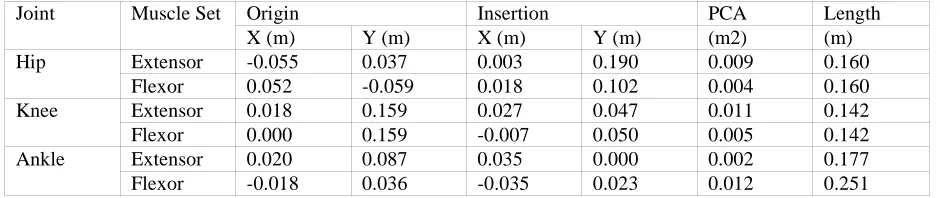
The GaitGen system is a bipedal walking simulator. There is always a compromise between biofidelity and computational cost and to minimise the latter the current implementation is relatively simple. It is essentially 2D and uses 7 rigid segments: HAT, left and right thighs, legs, and feet. These segments are attached to each other by hinge joints representing the hip, knee and ankle joints. Segment movement is effected by 6 muscle sets acting around these joints. The foot interacts with the substrate via contact points representing the 1st
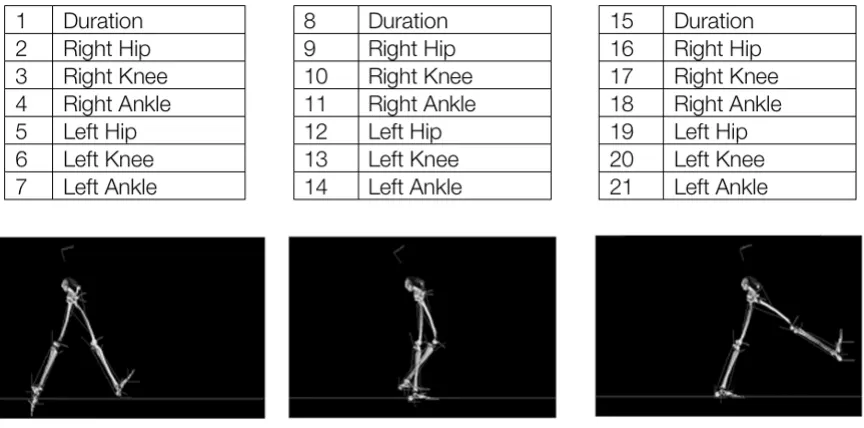
metatarsal head and the heel. These contact points generate a ground-normal reaction force and ground-tangential frictional force to allow forward progression. This represents a simplified morphology without spring elements or biarticulate muscles, although these could easily be added in future versions. The control system is a finite-state engine. It has 3 states with each state having a duration and activation levels for the 6 muscle sets. The 3 states represent half a gait cycle: the second half of the gait cycle is obtained by swapping the left and right side activation levels. Thus the controller has 21 parameters and these are translated to a genome as a list of floating point values between -1.0 and 1.0 (for the duration the sign is simply ignored). Figure 1 illustrates the genome encoding used. The system is implemented in C++ using the Dynamechs library to provide the mechanical simulation and a set of custom written programs to provide the genetic algorithm
application running on multiple computers using BSD sockets via the PTypes library (http://www.melikyan.com/ptypes/) to provide interprocess communication. This allows extremely flexible deployment with versions running on Linux, Solaris, Irix, Windows and MacOSX and running at multiple sites connected via the internet. This allows the fitness of the individual genomes within the population to be tested in parallel on separate computers rather than sequentially on a single computer which very greatly increases the overall speed. The master genetic algorithm program runs on a single computer and multiple client
programs are run on other computers. The master program instructs a client to perform a particular genome, and the client sends back the fitness score when the simulation has finished.
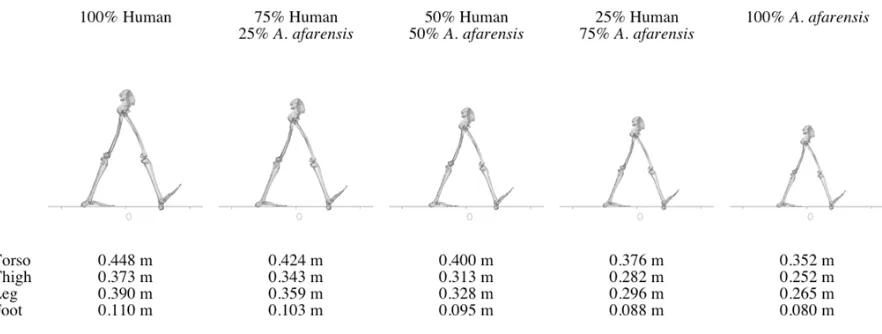
This system has been used previously to generate bipedal gait from a standing position (Sellers et al. 2003) and has successfully produced walking, running, skipping and ankle-walking (where swing-leg ground clearance is achieved by flexing the ankle joint rather than the leg joint) gaits. However starting from a standstill requires extra states in the finite-state engine which increases the number of required parameters and hence the difficulty of the search problem. This can be overcome by a gait morphing technique. From previous work we already have good solutions for normal walking in humans. The morphology can be gradually morphed to a new target (such as the morphology of A. afarensis) and instead of starting out from standstill with each new optimisation experiment, the starting conditions (joint angles and angular velocities) are taken from the outcome of the previous successful simulation. In addition since the morphology is only being changed a small amount between each optimisation run the population of previous good solutions is likely to contain
solutions for the new morphology. This greatly reduces the number of simulation repeats required. This process is illustrated in Figure 2.
Simulating Australopithecus afarensis
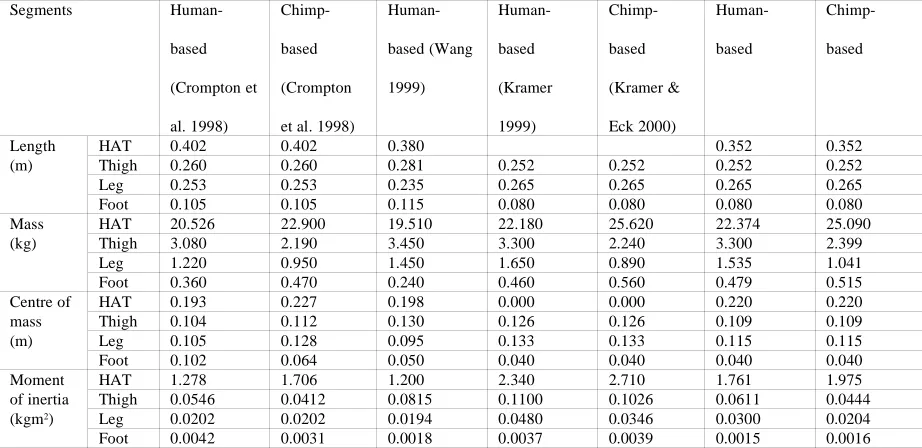
The first step in simulating A. afarensis is to produce a mechanical model representing the morphology of this animal based on reconstruction of the AL 288-1 fossil: the famous “Lucy” skeleton (Johanson et al. 1982). A number of similar models have been produced previously (Crompton et al. 1998; Wang 1999; Kramer 1999; Kramer & Eck 2000)
were taken from Crompton et al. (1998). These were then used, along with the previously calculated segment lengths, to calculate centre of mass locations and moments of inertia according to the formula given in Winter (1990). Moments of inertia in particular are highly variable between individual humans and there is only very limited empirical hominoid data available which suggested that there was little justification in using the various more complex techniques for calculating moments of inertia (for a review of inertial parameter calculation see Nigg 1994). Table 1 shows a comparison between the values chosen and those recommended by other authors. The values in this table have been normalised as much as possible with HAT properties calculated from the individual components and moments of inertia recalculated to be about the proximal joint except for the HAT which is about the hip joint. However the length comparisons should be treated with care since the HAT values given are the torso lengths in Crompton et al. (1998) and Wang (1999), and the foot lengths in these papers are total foot lengths so the value in the table has been estimated using human foot proportions.
To make the simulator produce bipedal locomotion it must find appropriate values of the 21 parameters used in the finite-state control system. The model is given a set of starting conditions (position, orientation, velocity and angular velocity of the HAT segment; angles and angular velocities of the left and right hip, knee and ankle joints) from the middle of a previously successful simulation. Ultimately this derives from a standing-start human model (Sellers et al. 2003) but otherwise it is chosen from previous simulations that are judged to be as similar as possible to the current one. The starting values of the 21 parameters are also taken from the set of solutions that produced in a previously successful run. If the conditions are very similar to those of the previous run then these parameters may be able to produce stable locomotion but it is much more likely that initially these parameter values will cause the simulation to fall over in the first step or two. The quality of the parameters is judged by the distance the simulant is able to walk before using up a fixed amount of energy so a simulant that falls over scores badly. The most efficient stable walker will score the highest. The genetic algorithm optimisation scheme described previously is applied iteratively until it is unable to find any better sets of parameters and the cost of travel can then be measured for the simulant. Genetic algorithm optimisation is a stochastic process. It relies on applying many small, random changes to the parameter list so that each time it is applied it will produce different outcomes. Since it is searching for the most efficient locomotion only the best value found after a number of repeats is of interest. This also means that a particular optimisation run can be “unlucky” and only relative poor solutions found. To avoid this all optimisation runs were repeated at least 5 times.
this animal walked fully upright or with a chimpanzee-like bent-knee, bent-hip (BKBH) style of bipedalism (Crompton et al. 1998; Stern 1999). To simulate this the degree of extension available at the knee joint of the model can be altered from 0° in the fully erect state to 40° representing the maximum amount of knee flexion seen in chimpanzee bipedalism (Alexander 1991). To achieve 0° bipedal walking the human model was
morphed to the human-based AL 288-1 model allowing the optimisation procedure to find efficient walking at each stage of the morphing process. The model was then morphed to the chimpanzee-based AL 288-1 model once again allowing efficient walking to be achieved at each stage. Both these models were then morphed to versions where the maximum knee extension was limited to 40°. At all stages multiple optimisations were carried out and the best ones used as starting points for subsequent morphs. Overall an extremely large number of individual simulations were carried out. An optimisation run required between 5,000 and 50,000 simulations to find a good set of control parameters. Morphing generally used a 5% change between morphs and each morph was repeated at least 5 times to make sure a good solution was found. This means that at least 10,000,000 simulations were performed. Each simulation took approximately 10 seconds to run depending on the speed of the computer, equating to over 1000 days of computer time. Fortunately the ability to use multiple
computers running simultaneously means that the actual run time was considerably less than this.
Results
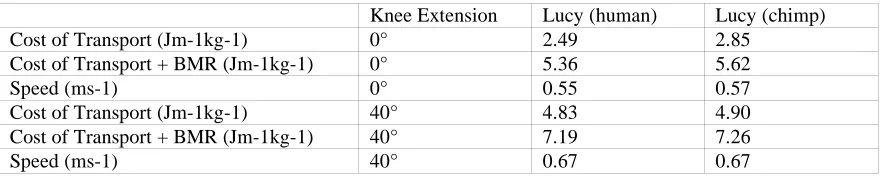
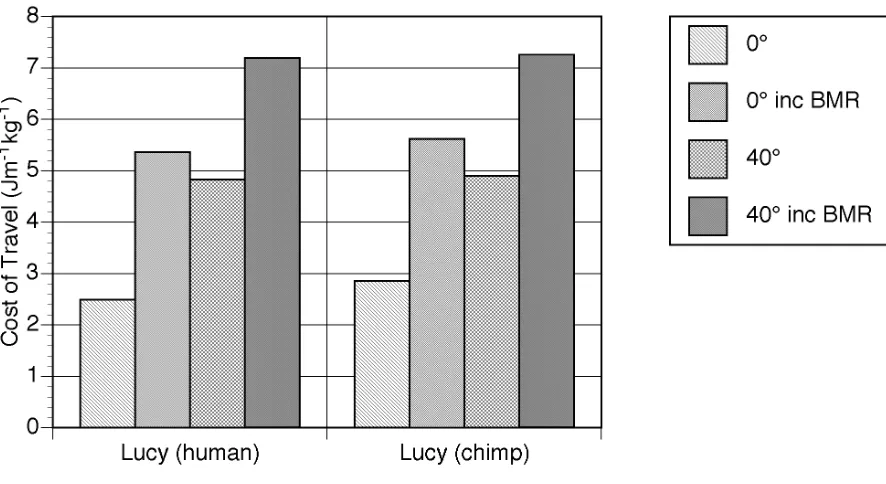
This figure shows the results both for the human-like and the chimpanzee-like inertial parameters. These values represent the energy required by the locomotor muscles alone and do not include the significant cost of maintaining the body itself. To allow a more
meaningful comparison with the experimentally derived costs of travel a value for basal metabolic rate (BMR) of 51.9 W was calculated for AL 288-1 based on the standard empirical relationship between mammalian body mass and BMR (Schmidt-Nielsen 1983). The average value for a 33 kg human female child is very similar at 55.7 W (Department of Health 1991). This additional energy cost was then incorporated into the results from the model. Figure 4 shows the effect of knee extension angle on the cost of travel both with and without BMR. 40° of knee extension increases the cost of locomotion by 82% if BMR is ignored and by 32% if included. The model also allows the calculation of speed of travel and these values, along with the numerical values for travel cost are shown in Table 3.
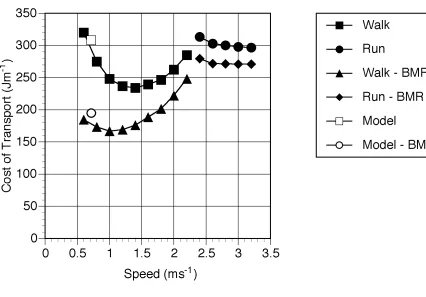
When interpreting these results it is important to compare with the results obtained from the human simulation. The values obtained using the previous human simulant (Sellers et al. 2003) but without the standing start and allowing for a BMR of 80.1W for a 68 kg human (Schofield et al. 1985) are shown in Figure 5. For comparison the figure also shows experimentally derived values recalculated with and without BMR (Alexander 1992). As can be seen the simulation values agree very closely with the experimentally derived values and are certainly within the normal variation seen between subjects.
From Figure 5 it can be seen that there is very close agreement between experimentally derived values and those produced using the human simulant. This is interesting since the model must be underestimating the cost of locomotion since it does not include any of the postural costs associated with maintaining an upright stance in 3D such as the necessary activation of the hip abductor muscles to maintain the orientation of the pelvis (Aiello & Dean 1990). However it is likely that this underestimation is balanced by the overestimation caused by the lack of human energy saving mechanisms such as biarticulate muscles, spring elements, and complex joint morphology. It is difficult at present to estimate the size of these under- and overestimates. Postural costs are variously reported as 0.21 Wkg-1
(Alexander 1990), 7% (Aiello & Dean 1990) and a physical activity ratio (PAR) of 1.2 (Department of Health 1991) suggesting that these values might be somewhere in the order of 10% of the cost of travel. What is clearer from Figure 5 is that the preferred walking speed is being significantly underestimated. The choice of optimum walking speed is
somewhat more complex than suggested by this figure. Among primates where a significant part of the day is spent resting it is often more economic to walk at the speed indicated by the minimum of the line where BMR has been removed than at the higher speeds suggested by the line that includes BMR. Figure 6 shows the total cost of a human walking a particular distance in 1 hour assuming that any spare time in the hour is spent resting. At low distances the best strategy is to walk at 1 ms-1 and rest for any spare time, not the 1.4ms-1 predicted by
the upper curve. Only when larger distances are required is it necessary to walk faster.
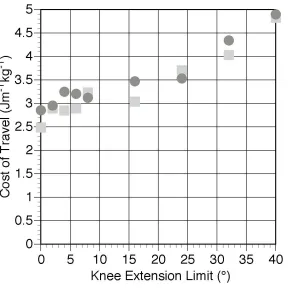
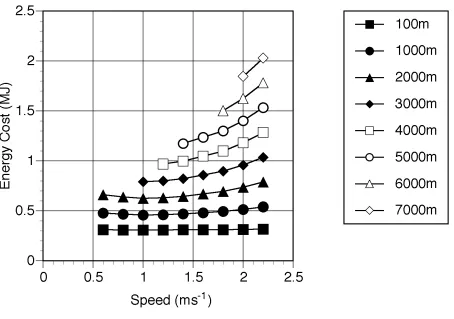
travel (which is fortunate since these values are extremely uncertain). This finding agrees with studies on human biomechanics (Yoko et al. 1998). However the effect of restricting the maximum extension at the knee joint is unsurprising. As shown in Figure 3 there is a more or less linear increase in travel costs with knee angle reflecting the postural cost of maintaining the flexed knee. The 82% increase in purely locomotor costs is extremely large and certainly supports the findings found in previous simulation experiments (Crompton et al. 1998; Crompton pers. comm.), and the 32% increase when the fixed cost of BMR is taken into consideration agrees with experimental values of 38% for a 45° extension limit in humans (Stern 1999). Identifying the role of BMR goes a large way to reconciling the differences found between simulation and experimental studies. Purely on the grounds of locomotor efficiency it seems unlikely that any hominin would opt to use a BHBK gait unless the time spent bipedally was very small. This suggests that more work needs to be done on why chimpanzees maintain a BHBN gait and whether these selective pressures would still apply to A. afarensis.
two problems. Firstly the simulation itself would then take longer to compute which would increase the duration of the fitness evaluation. Secondly a more complex model would require a larger genome to specify the parameters and this would very greatly increase the size of the search space. The simulation problem is not completely intractable, especially given the parallel nature of the genetic algorithm approach. It would run efficiently on the next generation of 1000 processor clusters with very little overhead. This would reduce the current experimental time of weeks to hours so that considerable increase in model
complexity would be possible. The search space problem is more difficult to solve since the size of the space grows far too rapidly to be overcome by simply increasing the
computational power available. However an incremental evolutionary approach may be the answer since we can evolve a set of good parameters from the current model and use these as the starting point for a series of more complex models. In this way we should be able to restrict the search to a region of the search space that is likely to be profitable.
Conclusion
allow us to add more points to the cost of travel graph so that we can identify the minima and calculate the preferred speed in any context.
References
Aiello L, Dean C (1990) An introduction to Human Evolutionary Anatomy. An introduction
to human evolutionary anatomy. London: Academic Press.
Alexander RMcN (1991) Characteristics and advantages of human bipedalism. In
Biomechanics in evolution, (ed. Rayner JMV, RJ Wooton), pp. 255–266.
Cambridge: Cambridge University Press.
Alexander RMcN (1992) Human Locomotion. In The Cambridge Encyclopedia of Human
Evolution, (ed. Jones S, RD Martin, D Pilbeam), pp. 80–85. Cambridge: Cambridge
University Press.
Beer RD, Gallagher JD (1992) Evolving dynamical neural networks for adaptive behaviour. Adapt. Behav. 1, 91–122.
Brooks RA (1989) A robot that walks: Emergent behaviours from a carefully evolved network. Neural Comp. 1, 253-262.
Crompton RH, Li Y, Wang W-J, Günther MM, Savage R (1998) The mechanical effectiveness of erect and "bent-hip, bent-knee" bipedal walking in Australopithecus
afarensis. J. Human Evol. 35, 55–74.
Davis L (1991) Handbook of genetic algorithms. New York: Van Nostrand Reinhold.
Department of Health (1991) Report on Health and Social Subjects 41. Dietary reference
values for food energy and nutrients for the United Kingdom. London: HMSO.
Holland JH (1975) Adaptation in Natural and Artificial Systems. Michigan: University of Michigan Press; Mitchigan.
Hornby GS, Fujita M, Takamura S, Yamamoto T, Hanagata O (1999) Autonomous evolution of gaits with the Sony quadrupedal robot. In GECCO-99: Proceedings of
the Genetic and Evolutionary Computation Conference, (ed. Banzhaf W, J Daida,
Ijspeert AJ, Hallam J, Willshaw D (1998) From lampreys to salamanders: evolving neural controllers for swimming and walking. In From Animals to Animats, Proceedings of
the Fifth International Conference on the SImulation of Adaptive Behaviour, (ed.
Pfeiffer R, B Blumberg, J-A Meyer, SW Wilson), pp. 390–399. Cambridge, MA: MIT Press.
Johanson DC, Lovejoy CO, Kimbel WH, White TD, Ward SC, Bush MB, et al. (1982) Morphology of the Pliocene partial hominid skeleton (AL 288-1) from the Hadar Formation, Ethiopia. Am. J. Phys. Anthropol. 57, 403–451.
Kramer PA (1999) Modelling the locomotor energetics of extinct hominids. J. Exp. Biol. 202, 2807–2818.
Kramer PA, Eck GG (2000) Locomotor energetics and leg length in hominid bipedality. J.
Human Evol. 38, 651–666.
Lewis MA, Fagg AH, Solidum A (1992) Genetic programming approach to the construction of a neural network for control of a walking robot. In Proceedings of
the IEEE International Conference on Robotics and Automation, (ed. ), pp. . New
York: IEEE Press.
Li Y, Crompton RH, Wang W-J, Günther MM (2002) Reconstructing the mechanics of quadrupedalism in an extinct hominoid. Zeits. Morphol. Anthropol. 83, 265–274. Minetti AE, Alexander RMcN (1997) A theory of metabolic costs for bipedal gaits. J.
theor. Biol 186, 467–476.
Nigg BM (1994) Inertial properties of the human or animal body. In Biomechanics of the
musculoskeletal system, (ed. Nigg BM, W Herzog), pp. 337–364. Chichester: John
Wiley & Sons.
Nolfi S, Floreano D (2000) Evolutionary Robotics. Cambridge, Mass.: MIT Press.
Ogihara N, Yamazaki N (2001) Generation of human bipedal locomotion by a bio-mimetic neuro-musculo-skeletal model. Biol. Cybern. 84, 1–11.
Rechenberg I (1965) Cybernetic Solution Path of an Experimental Problem. Ministry of
Aviation. Royal Aircraft Establishment (UK): Ministry of Aviation.
Schmidt-Nielsen K (1983) Animal Physiology: Adaptation and environment. Cambridge: Cambridge University Press.
Sellers WI (1996) A biomechanical investigation into the absence of leaping in the locomotor repertoire of the Slender Loris (Loris tardigradus). Folia Primatol. 67, 1– 14.
Sellers WI, Dennis LA, Crompton RH (2003) Predicting the metabolic energy costs of bipedalism using evolutionary robotics. J. Exp. Biol. 206, 1127–1136.
Stern JT (1999) The cost of bent-knee, bent-hip bipedal gait. A reply to Crompton et al. J.
Human Evol. 36, 567–570.
Wang W-J (1999) The mechanics of bipedalism in relation to load carrying:
biomechanical optima in hominid evolution. Ph.D. Thesis, University of Liverpool.
Weaver KF, Brill DL, Matternes JH (1985) The search for our ancestors. National
Geographic 168, 560–623.
Winter DA (1990) Biomechanics and motor control of human movement. New York: John Wiley and Sons.
Yamazaki N, Hase K, Ogihara N, Hayamizu N (1996) Biomechanical analysis of the development of human bipedal walking by a neuro-musculo-skeletal model. Folia
Primatol. 66, 253–271.
Segments Human-based (Crompton et al. 1998) Chimp-based (Crompton
et al. 1998)
Human-based (Wang 1999) Human-based (Kramer 1999) Chimp-based (Kramer & Eck 2000) Human-based Chimp-based
Length HAT 0.402 0.402 0.380 0.352 0.352
(m) Thigh 0.260 0.260 0.281 0.252 0.252 0.252 0.252
Leg 0.253 0.253 0.235 0.265 0.265 0.265 0.265
Foot 0.105 0.105 0.115 0.080 0.080 0.080 0.080
Mass HAT 20.526 22.900 19.510 22.180 25.620 22.374 25.090
(kg) Thigh 3.080 2.190 3.450 3.300 2.240 3.300 2.399
Leg 1.220 0.950 1.450 1.650 0.890 1.535 1.041
Foot 0.360 0.470 0.240 0.460 0.560 0.479 0.515
Centre of HAT 0.193 0.227 0.198 0.000 0.000 0.220 0.220
mass Thigh 0.104 0.112 0.130 0.126 0.126 0.109 0.109
(m) Leg 0.105 0.128 0.095 0.133 0.133 0.115 0.115
Foot 0.102 0.064 0.050 0.040 0.040 0.040 0.040
Moment HAT 1.278 1.706 1.200 2.340 2.710 1.761 1.975
of inertia Thigh 0.0546 0.0412 0.0815 0.1100 0.1026 0.0611 0.0444
(kgm2) Leg 0.0202 0.0202 0.0194 0.0480 0.0346 0.0300 0.0204
[image:19.595.67.528.131.355.2]Foot 0.0042 0.0031 0.0018 0.0037 0.0039 0.0015 0.0016
Joint Muscle Set Origin Insertion PCA Length
X (m) Y (m) X (m) Y (m) (m2) (m)
Hip Extensor -0.055 0.037 0.003 0.190 0.009 0.160
Flexor 0.052 -0.059 0.018 0.102 0.004 0.160
Knee Extensor 0.018 0.159 0.027 0.047 0.011 0.142
Flexor 0.000 0.159 -0.007 0.050 0.005 0.142
Ankle Extensor 0.020 0.087 0.035 0.000 0.002 0.177
[image:20.595.64.534.101.200.2]Flexor -0.018 0.036 -0.035 0.023 0.012 0.251
Knee Extension Lucy (human) Lucy (chimp)
Cost of Transport (Jm-1kg-1) 0° 2.49 2.85
Cost of Transport + BMR (Jm-1kg-1) 0° 5.36 5.62
Speed (ms-1) 0° 0.55 0.57
Cost of Transport (Jm-1kg-1) 40° 4.83 4.90
Cost of Transport + BMR (Jm-1kg-1) 40° 7.19 7.26
[image:21.595.67.507.100.188.2]Speed (ms-1) 40° 0.67 0.67