warwick.ac.uk/lib-publications
Manuscript version: Author’s Accepted Manuscript
The version presented in WRAP is the author’s accepted manuscript and may differ from the
published version or Version of Record.
Persistent WRAP URL:
http://wrap.warwick.ac.uk/110276
How to cite:
Please refer to published version for the most recent bibliographic citation information.
If a published version is known of, the repository item page linked to above, will contain
details on accessing it.
Copyright and reuse:
The Warwick Research Archive Portal (WRAP) makes this work by researchers of the
University of Warwick available open access under the following conditions.
Copyright © and all moral rights to the version of the paper presented here belong to the
individual author(s) and/or other copyright owners. To the extent reasonable and
practicable the material made available in WRAP has been checked for eligibility before
being made available.
Copies of full items can be used for personal research or study, educational, or not-for-profit
purposes without prior permission or charge. Provided that the authors, title and full
bibliographic details are credited, a hyperlink and/or URL is given for the original metadata
page and the content is not changed in any way.
Publisher’s statement:
Please refer to the repository item page, publisher’s statement section, for further
information.
A TRAJECTORY CLUSTERING APPROACH TO CROWD FLOW
SEGMENTATION IN VIDEOS
Rahul Sharma, Tanaya Guha
Electrical Engineering, Indian Institute of Technology Kanpur, India
ABSTRACT
This work proposes a trajectory clustering-based approach for seg-menting flow patterns in high density crowd videos. The goal is to produce a pixel-wise segmentation of a video sequence (static cam-era), where each segment corresponds to a different motion pattern. Unlike previous studies that use only motion vectors, we extract full trajectories so as to capture the complete temporal evolution of each region (block) in a video sequence. The extracted trajectories are dense, complex and often overlapping. A novel clustering algorithm is developed to group these trajectories that takes into account the in-formation about the trajectories’ shape, location, and the density of trajectory patterns in a spatial neighborhood. Once the trajectories are clustered, final motion segments are obtained by grouping of the resulting trajectory clusters on the basis of their area of overlap, and average flow direction. The proposed method is validated on a set of crowd videos that are commonly used in this field. On comparison with several state-of-the-art techniques, our method achieves better overall accuracy.
Index Terms— Crowd Flow Segmentation,Trajectory Extrac-tion, Trajectory Clustering, DBSCAN
1. INTRODUCTION
With the increasing security threats across the world, the need for video surveillance in crowded places is growing faster than ever. In highly populous countries, like India, even crowd mismanagement has caused loss of human lives in several occasions [1, 2]. Automatic monitoring of crowded areas is hence important for securing public safety, and for better management of events involving a large crowd, such as, rallies, festivals and sports matches.
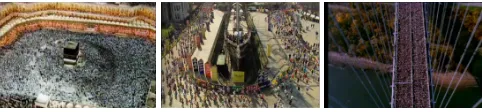
A crucial step in such monitoring systems involves identifying the dominant motion patterns and directions of crowd flow. Al-though motion-based video segmentation is a well studied problem, the majority of standard object detection-based tracking methods does not perform well on high density crowd videos [3]. This is due to the complex dynamics of the crowded scenes, and the pres-ence of a large number of very small objects, which are difficult to track simultaneously (see Fig. 1 for examples).
[image:2.612.317.558.196.252.2]In the recent past, several methods have been developed to ad-dress the problem of identifying (and later, segmenting) the domi-nant coherent flow patterns in high density crowd videos [4, 5, 6, 7, 8, 9, 10]. A supervised machine learning method [4] has pro-posed to train an offline system that can identify certain classes of crowd behavior. This pretrained system is used to label each patch in a given test video, based on its motion pattern. Among the unsu-pervised methods, a region growing technique has been proposed to segment crowd flows based on an optical flow field [5]. Another ap-proach has addressed the problem from the perspective of scattered motion field segmentation, where the optical flow is computed only
Fig. 1. Sample frames from high density crowd videos.
at salient locations, and a local translational domain segmentation model is developed [6].
A fluid dynamics perspective has also been successfully adopted to address the problem of crowd flow segmentation [7]. This method has used finite time Lyapunov exponent field to detect the La-grangian coherent structures (LCS) present in the underlying flow of crowd. These LCS are then used to locate the flow boundaries. More recently, researchers have attempted to solve this problem by directly using the motion vector information from the compressed video files [8, 9]. One such approach involves clustering the motion vectors using a standard expectation-maximization (EM) algorithm, and finally merging the clusters to a single flow [9]. Following the similar line of research, another work has modeled the motion vectors as conditional random fields (CRF) [8], and the motion segments are obtained by labeling the motion vectors such that the global energy of the CRF model is minimized.
In this paper, we develop a trajectory clustering-based approach for high density crowd flow segmentation. Following an unsuper-vised paradigm, our approach exploits the rich temporal information contained in trajectories, which is expected to capture the complex motion patterns better. Our method relies on tracking video regions (blocks) to extractblock-basedtrajectories. Since object detection and tracking is not practical in the high density videos, and tracking individual points is too noisy, we consider tracking a mid-level struc-ture (block) in a video sequence. The proposed trajectory clustering algorithm takes into account the shape, location, and the neighbor-hood density of trajectory patterns. Our segmentation results are compared with the state-of-the-art methods on a set of benchmark video sequences. The performance of the proposed approach is eval-uated using both visual and objective measures (Jaccard similarity), and superior results are obtained.
2. THE PROPOSED APPROACH
a neighborhood. (iii)Flow segmentation: Labeling each pixel based on their motion pattern to generate the final motion segments. Each step is described below in detail (see Fig. 2 for result at each step).
2.1. Trajectory extraction
The videos under consideration are densely populated with the mov-ing objects, very small in size. For such videos, standard object detection and tracking algorithms perform very poorly due to the presence of large number of small objects that often get occluded [3]. So, instead of focusing on objects, we concentrate on tracking blocks in a video frame. We divide a frame into non-overlapping blocks of sizep×p. For each block, a set of interest points are detected using Harris corner detector [11]. The centroid of the inter-est points associated with each block is tracked using the standard Kanade-Lucas-Tomasi (KLT) tracking algorithm to obtain a trajec-tory for each block.
In a high density crowd video, new moving objects keep appear-ing into the video frame over time. In order to account for these newly appearing objects, we refresh our existing set of blocks after everyrnumber of frames. The blocks which had gone out of the frame are removed and the ones which have the newly appearing objects, are added to the feature tacker.
Only the trajectories of length greater than a chosen thresholdτ
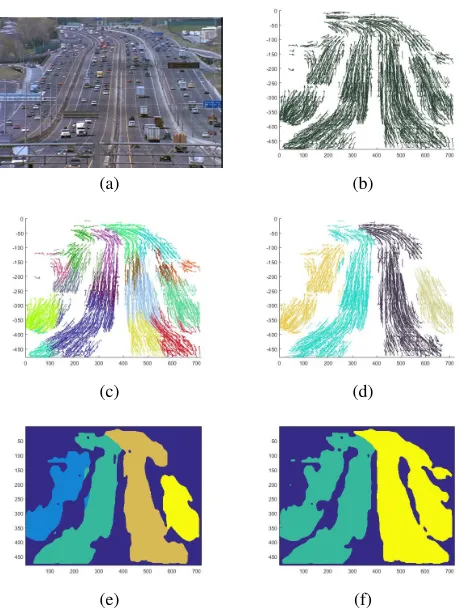
are retained (see Fig. 2(b) for extracted trajectories).
2.2. Trajectory clustering
A new trajectory clustering algorithm is developed in this section. The proposed algorithm exploits the shape and location information of the trajectories along with their neighborhood density.
2.2.1. Trajectory representation
Consider a trajectory T = {(xs, ys),(xs+1, ys+1)...,(xe, ye)},
where (xj, yj) represent the coordinates of the trajectory at jth
frame, andsandedenote the start and end frame.
Shape: To capture the spatiotemporal shape of a trajectory, we model it separately alongx and y dimensions, using third order polynomial functions of time.
x(t) =a0+a1t+a2t2+a3t3 (1)
y(t) =b0+b1t+b2t2+b3t3 (2)
wheret∈(1, l)andl=e−s. The shape of a trajectory is thus repre-sented by itsshape featurefs, given byfs= [a0, ..., a3, b0, ..., b3]T
Location: While clustering dense trajectories, the location infor-mation of a trajectory is important, because trajectories far apart in space, even similar in shape, often belong to different clusters. To account for location information of a trajectory in a video frame, we use its meanxandycoordinates. This is denoted as the following
location featurevector,fl= [x, y]T.
Flow direction: Another feature that we extract is called theflow directionfeature. We first determine the dominant flow direction in a video, using the median directions of trajectories as the respective representative direction. For simplicity, we only consider horizontal and vertical flow directions. Each trajectory is then associated with a scalar variablefmwhich can take the value of+1or−1
depend-ing on whether its direction is along or against the dominant flow direction.
Density:Inspired by the success of density-based clustering meth-ods [12], we extract amulti-scale density featurefrom each trajec-tory. For a trajectoryTj
, its density in a neighborhood of radiusis
(a) (b)
(c) (d)
(e) (f)
Fig. 2. (a) Sample frame from a test video, (b) All extracted trajec-tories, (c) Trajectory groups obtained using the proposed clustering algorithm, (d) Crowd flow segments in trajectory domain (e) Crowd flow segments in pixel domain (f) Crowd flow segments in pixel do-main with higher value of∆.
computed as follows:
nTj,=|{Ti|∀i=6 j, d(fj,fi)< }| (3)
whered(.)denotes the Euclidean distance, andfj= [fsjfljfmj]. For
robustness, we compute a multiscale density feature, corresponding to three values of epsilon. Our multiscale density featurefdis given
byfd= [nj,1, nj,2, nj,3]
T
.
Finally, all features extracted from a trajectoryTjare concate-nated to build a corresponding feature vectorFjfor the trajectory.
Fj=
fsj
flj
fj m fdj
(4)
2.2.2. The clustering algorithm
[image:3.612.319.549.73.379.2]Algorithm 1Trajectory clustering
Require: Features from all trajectories:Fall
Ensure: Trajectory clusters:C1, .., CN
kcluster←kmeans(Fall)
2: models←getModels(Fall, kcluster
)
.select models from k-means clusters
4: P ←preferenceSet(models, trajecF eat)
.compute preference set usingeq(5)
6: P W dist←pwdist(P,P, J accard)
.compute pairwise Jaccard distance usingeq(6)
8: fori = 1:num trajecdo
Ci←[i]
10: whilemin(P W dist)<1do [i, j]←findPos(min(P W dist))
12: Ci←[Ci, Cj]
.Merge clusters
14: RemoveCj
UpdateP(i)
16: RemoveP(j) UpdateP W dist
18: returnC1, .., CN
a fraction (5%) of trajectories is randomly selected, and denoted by
{M1, M2, .., Mρ}. These are considered as themodels. Selecting
the models this way using k-means ensures that there are represen-tatives from all trajectory patterns.
As suggested in [13], each trajectory is compared against all the
models, and a ‘match’ is obtained in case the similarity is above a predefined threshold. The idea is that the trajectories from the same motion segment should be similar to the same subset of mod-els. Thus, a binary matrixP, called thepreference setis obtained which represents the vote of each trajectory to all the models (1for ’match’, and0otherwise).
Pji= (
1 if||Tj−Mi||<∆
0 if||Tj−Mi|| ≥∆
(5)
Using thePmatrix, we now perform an agglomerative cluster-ing where the distance between any two trajectories,d(Ti, Tj), is
computed using the Jaccard distance.
d(Ti, Tj) =|Q
i∪
Qj| − |Qi∩Qj|
|Qi∪Qj| (6)
whereQi
andQj
represent the two sets ofmodelsassociated with
TiandTj. Starting with each trajectory as a singleton cluster, we
keep merging the clusters with the least Jaccard distance at every iteration, and also compute updatedPmatrix accordingly. The pro-cess terminates when the minimum Jaccard distance between two clusters is greater thanδ(see Fig. 2(c) for the clustered trajectories). The algorithm is described in Algorithm 1 in detail.
2.3. Crowd Flow Segmentation
The final step is to obtain the crowd flow segments from the tory clusters, and this is not trivial. We notice that, different trajec-tory clusters constitute one flow segment. For example, in Fig. 2(c) and Fig. 2(d), multiple trajectory clusters constitute one flow. This kind of situations occur due to objects (in the same crowd flow) hav-ing different starthav-ing and terminathav-ing points in the trajectories, which are eventually grouped into different clusters.
To address the above issue, we propose a slightly modified ver-sion of the density-based clustering method [12]. For a clusterCi,
let us define its neighborhoodNicomprising all clustersCj(j6=i)
that satisfy the following conditions.
(a) Spatial overlap betweenCiandCjshould be greater thanα.
(b) Difference in flow direction betweenCiandCjshould be smaller
thanβ, where flow direction of a cluster is defined as the mean of the directional featurefm, over all its member trajectories.
(c) Spatial distance between the mean locationsCiandCjshould be
smaller thanγ, where mean location of a cluster is computed as the mean of the location featureflover all its member trajectories.
Starting with an arbitrary trajectory clusterCi, we compute its
neighborhoodNi (according to above conditions), and merge all
clusters inNiwithCi. The same process is repeated for every newly
added clusters, until the neighborhood is empty. Each of the re-maining unvisited clusters is retrieved and processed similarly. The method is summarized in Algorithm 2 (see Fig. 2(e) for final crowd flow segments).
Algorithm 2Crowd flow segmentation from trajectory clusters Require: Trajectory clusters:C1, C2, ..., CN
Ensure: Crowd flow segments:S1, S2, ..., SM
C= 0andm= 0
2: forevery unvisited clusterCido
constructNi
4: incrementm
expandCluster(Ci,Sm,Ni)
6: markCias visited
functionEXPANDCLUSTER(Ci,Sm,Ni)
8: addCito segmentSm
foreveryCjinNido
10: ifCjnot visitedthen
constructNj
12: mergeNiandNj
markCjvisited
14: ifCjnot a member of any segments yetthen
AddCjto the segmentSm
16: returnS1, S2, ...SM
3. PERFORMANCE EVALUATION
The database: The proposed approach is validated on a publicly available database of high density crowd videos [7]. This database contains 38 videos of a variety of moving objects such as, traffic and marathon runners, collected from the BBC Motion Gallery and Getty Images website. Among these videos, some are graphic videos and others consist of real life scenes. For evaluation purpose, only the real life videos are considered.
Experimental details: We used the following parameter settings in our experiments. In trajectory extraction: p = 16,r = 40and
Sample Frame Ground Truth Ali [7] Kurthi [8] Proposed
Seq #2
Seq #3
Seq #4
[image:5.612.92.525.68.375.2]Seq #5
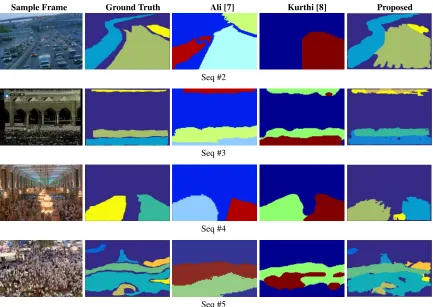
Fig. 3. Qualitative results on crowd flow segmentation
Results:We compare the performance of our approach with several recent works against manually generated ground truth. The objective quality of segmentation results is measured using the Jaccard simi-larity. For a ground truth segmentation denoted as a labeled setA, and an output denoted as a setB, the Jaccard similarity is given by the intersection over union of the two sets.
J(A, B) = |A∩B|
|A∪B| (7)
The intersection counts the number of matches between the two labeled sets. The union counts the number of pixels rendered as crowded region in any of the two labeled sets. The quantitative com-parisons are shown in Table 1. As the set of common videos for which the results from other authors [7, 8, 10] are available, is very small, our comparative study is limited to just 6 videos. Our method outperforms the existing methods by a large margin for sequences 1, 2, and 5. For sequence6, our system’s performance is not as good. In this video, the objects move at a very high speed staying less than 5 frames in the camera. The extracted trajectories are hence too short to be clustered reliably by the proposed algorithm.
The qualitative results in Fig. 3 demonstrates that the proposed system can handle complex crowd scenes (with larger number of segments) much better than other existing methods (see Seq#5). Note that our method can even handle intersecting crowd flow, where all previous approaches have failed. Overall, the proposed approach outperforms the fluid dynamics-based approach [7], and handles complex crowd patterns better than the state-of-the-art1.
1More results available at https://goo.gl/G1qugt
Table 1. Objective evaluation of segmentation performance mea-sured in terms of Jaccard similarity with respect to the manually generated ground truth.
Test samples Ali [7] Biswas [10] Kurthi [8] Proposed Seq #1 0.72 0.25 0.92 0.94
Seq #2 0.68 0.64 0.47 0.78
Seq #3 0.56 0.69 0.61 0.66 Seq #4 0.74 0.70 0.82 0.76 Seq #5 0.42 0.57 0.40 0.63
Seq #6 0.47 0.63 0.63 0.51 Overall 0.60 0.58 0.64 0.71
4. CONCLUSION
[image:5.612.315.567.461.565.2]5. REFERENCES
[1] “1954 kumbh stampede,” in /theguardian.com/world/
2003/aug/28/india.maseehrahman). 1954, The Gurdian. [2] “South asia stampede tragedy at hindu shrine,” in
http : //news.bbc.co.uk/2/hi/southasia/255518.stm.
1999, BBC News.
[3] S. Ali and M. Shah, “Floor fields for tracking in high density crowd scenes,” inComputer Vision–ECCV 2008, pp. 1–14. Springer, 2008.
[4] M. Rodriguez, J. Sivic, I. Laptev, and J. Y. Audibert, “Data-driven crowd analysis in videos,” in2011 International Con-ference on Computer Vision, Nov 2011, pp. 1235–1242. [5] S. Wu, Z. Yu, and H. S. Wong, “Crowd flow segmentation
us-ing a novel region growus-ing scheme,” inAdvances in Multime-dia Information Processing - PCM 2009, 2009, pp. 898–907.
[6] S. Wu and H.S. Wong, “Crowd motion partitioning in a scat-tered motion field,”IEEE Trans. Systems, Man, and Cybernet-ics, Part B, vol. 42, no. 5, pp. 1443–1454, Oct 2012.
[7] S. Ali and M. Shah, “A lagrangian particle dynamics approach for crowd flow segmentation and stability analysis,” inCVPR ’07., June 2007, pp. 1–6.
[8] S.S. S. Kruthiventi and R.V. Babu, “Crowd flow segmenta-tion in compressed domain using CRF,” inImage Processing (ICIP), 2015 IEEE International Conference on, Sept 2015, pp. 3417–3421.
[9] R.G. Praveen and R.V. Babu, “Crowd flow segmentation based on motion vectors in H.264 compressed domain,” inIEEE Int. Conf. Electronics, Computing Comm Tech (CONECCT), Jan 2014, pp. 1–5.
[10] S. Biswas, R.G. Praveen, and R.V. Babu, “Super-pixel based crowd flow segmentation in H.264 compressed videos,” in
Int. Conf. Image Processing (ICIP), Oct 2014, pp. 2319–2323.
[11] C. Harris and M. Stephens, “A combined corner and edge de-tector.,” inAlvey vision conference. Citeseer, 1988, vol. 15, p. 50.
[12] M. Ester, H.P. Kriegel, J. Sander, and X. Xu, “A density-based algorithm for discovering clusters in large spatial databases with noise,” 1996, pp. 226–231, AAAI Press.