warwick.ac.uk/lib-publications
Original citation:
Lu, Xiaoxuan, Wen, Hongkai, Zou, Han, Jiang, Hao, Xie, Lihua and Trigoni, Niki (2016) Robust
occupancy inference with commodity WiFi. In: IEEE 12th International Conference on
Wireless and Mobile Computing, Networking and Communications (WiMob), New York City,
USA, 17-19 Oct 2016. Published in: IEEE 12th International Conference on Wireless and
Mobile Computing, Networking and Communications (WiMob)
Permanent WRAP URL:
http://wrap.warwick.ac.uk/83224
Copyright and reuse:
The Warwick Research Archive Portal (WRAP) makes this work by researchers of the
University of Warwick available open access under the following conditions. Copyright ©
and all moral rights to the version of the paper presented here belong to the individual
author(s) and/or other copyright owners. To the extent reasonable and practicable the
material made available in WRAP has been checked for eligibility before being made
available.
Copies of full items can be used for personal research or study, educational, or not-for profit
purposes without prior permission or charge. Provided that the authors, title and full
bibliographic details are credited, a hyperlink and/or URL is given for the original metadata
page and the content is not changed in any way.
Publisher’s statement:
© 2016 IEEE. Personal use of this material is permitted. Permission from IEEE must be
obtained for all other uses, in any current or future media, including reprinting
/republishing this material for advertising or promotional purposes, creating new collective
works, for resale or redistribution to servers or lists, or reuse of any copyrighted component
of this work in other works.
A note on versions:
The version presented here may differ from the published version or, version of record, if
you wish to cite this item you are advised to consult the publisher’s version. Please see the
‘permanent WRAP url’ above for details on accessing the published version and note that
access may require a subscription.
Robust Occupancy Inference with Commodity WiFi
Xiaoxuan Lu
†, Hongkai Wen
†, Han Zou
§, Hao Jiang
∗, Lihua Xie
§, and Niki Trigoni
††
Department of Computer Science, University of Oxford, United Kingdom
§
School of Electrical and Electronics Engineering, Nanyang Technological University, Singapore
∗College of Electrical Engineering and Automation, Fuzhou University, China
Abstract—Accurate occupancy information of indoor
envi-ronments is one of the key prerequisites for many pervasive and context-aware services, e.g. smart building/home systems. Some of the existing occupancy inference systems can achieve impressive accuracy, but they either require labour-intensive calibration phases, or need to install bespoke hardware such as CCTV cameras, which are privacy-intrusive by default. In this paper, we present the design and implementation of a practical end-to-end occupancy inference system, which requires minimum user effort, and is able to infer room-level occupancy accurately with commodity WiFi infrastructure. Depending on the needs of different occupancy information subscribers, our system is flexible enough to switch between snapshot estimation mode and continuous inference mode, to trade estimation accuracy for delay and communication cost. We evaluate the system on a hardware testbed deployed in a 600m2workspace with25occupants for6weeks. Experimental
results show that the proposed system significantly outperforms competing systems in both inference accuracy and robustness.
I. INTRODUCTION
Occupancy awareness has become a fundamental build-ing block for various ubiquitous services, and attracted a lot of interest from both academia and industry. For instance, building automation systems [7] rely on instant occupancy to dynamically adjust the heating, ventilation and air-conditioning (HVAC) facilities to reduce energy consumption while improving user comfort. Workplace co-ordination systems [13] leverage the room-level presence and availability of users to enable social interactions and foster potential collaborations. Furthermore, smart homes learn the behaviour pattern of users from their occupancy over the long term, which is the key for many applications such as activity recognition, elderly monitoring and breach detection. There has been a solid body of work on inferring occupancy in indoor environment. Early systems use passive infrared (PIR) sensors [2] and magnetic reed switches [17] to detect motion or door open/shut events. However, those sensors only provide binary information and are inherently noisy, and thus are not suitable for accurate inference. Other systems [9] use only the historical occupancy data to infer live occupancy, but they need long-term calibration to work. On the other hand, systems using information-rich sensors, such as Kinect [11] or cameras [8], are very accurate in tracking human movement, but are privacy-intrusive and
not suitable for many environments such as homes and hospitals. In addition, transmitting and processing visual data is typically expensive, which requires significant amount of computation and communication resources. Recently, WiFi infrastructure in buildings has been considered for the task of occupancy inference [15, 4]. For example, [15] harvests beacons emitted from nearby WiFi access points (APs), and is able to determine room-level occupancy information. However, it needs to install a dedicated app on mobile devices and constantly perform WiFi scans, which requires extra user effort and would drain the battery quickly. The system in [4] considers a different approach, which infers user occupancy by looking at the connections between mobile devices and APs. If a device is connected to an AP, the system then assigns the occupant to the area near that particular AP. However, in practice a device is not always connected to the closest APs, which significantly limits its inference accuracy.
RSS Pre-processing Packets
Sniffing
Instant RSS values
Anchor-based classification
Risk-sharing Re-classification
State Inference Individual
Tracking MAC
Address
Snapshot Occupancy Estimation
Feature Extraction
Continuous Occupancy Inference
Outlier Detection
Historical Occupancy Latency Window
1 2
[image:3.612.60.557.77.209.2]3
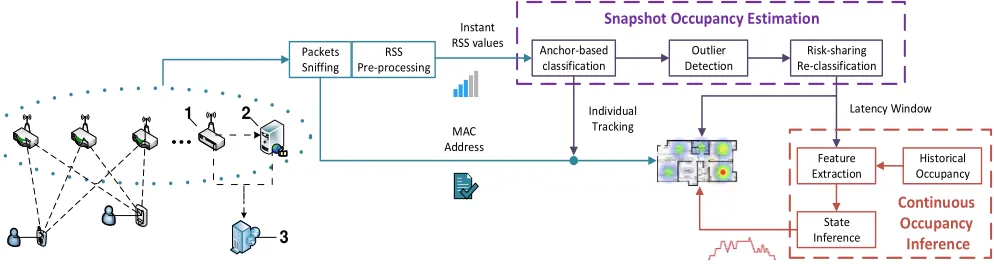
Figure 1: Architecture of the proposed WiPin system. 1. front-end nodes; 2. back-end server; 3. occupancy information subscribers. WiPin includes two major components; snapshot occupancy estimation runs on the front-end nodes while continuous occupancy inference runs on a back-end server.
occupancy with historical occupancy data, to infer much finer-grained occupancy and cope with challenging events, e.g. when users change rooms without bringing their phones. In this way, WiPin dynamically tasks the front-end and back-end, to cater for the needs of different subscribers, e.g. building automation systems typically require crisp response to control heating/cooling/lighting, while activity recognition applications would prefer accurate occupancy information, but are more delay tolerant.
Concretely, the technical contributions of this paper are:
• We build WiPin, a practical end-to-end occupancy
in-ference system, which uses commodity WiFi hardware, requires minimum user effort and is able to robustly infer room-level occupancy.
• We design an efficient snapshot occupancy estimation
algorithm, which can determine the occupancy of users solely based on the signal strength of their mobile devices, and runs in real-time on resource-constrained wireless routers.
• We propose a continuous occupancy inference approach to further improve the estimated occupancy, by taking the temporal correlations between snapshot occupancy, and historical occupancy data into account.
• We implement the proposed WiPin system in a
hard-ware testbed, and evaluate its performance over 6 weeks. Extensive experiments show that WiPin is su-perior to the competing systems in both accuracy and robustness.
The rest of the paper is organised as follows. Sec. II provides an overview of the proposed WiPin system. Sec. III presents the proposed snapshot occupancy estimation algo-rithm, while Sec. IV discusses the continuous occupancy inference approach. Sec. V evaluates our system in real world, and the related work is covered in Sec. VI. Sec. VII concludes the paper and discusses directions of future work.
II. SYSTEMOVERVIEW
To be practically useful, the WiPin system is designed to satisfy the following criteria: a) it should require mini-mum effort from the occupants, and should not seek their persistent participation, e.g. installing dedicated apps or running daemon processes on their devices; and b) it should be flexible, and is able to seek the best trade-off between inference accuracy and delay. To this end, we build WiPin as a special wireless distribution system, where the com-mercial WiFi routers are alsosensornodes to sniff wireless traffic generated from the occupants’ mobile devices. Fig. 1 illustrates the architecture of the proposed WiPin system. Front-end: At runtime, the WiFi routers log the Received Signal Strength (RSS) of the captured packets, together with the associated device identifiers (i.e. MAC addresses). The data is then forwarded to the front-end of the proposed WiPin system. In our implementation, the front-end runs at the sink node, which estimates the snapshot occupancy
based on the RSS measurements, i.e. the current number of occupants within azone, e.g. a room or working area. Back-end: In the cases where higher quality occupancy information is needed, the estimated snapshot occupancy is forwarded to the end for further inference. The back-end caches the stream of estimated snapshot occupancy, and infers the continuous occupancy by exploiting their temporal correlations. When historical occupancy data is available, WiPin also incorporates such prior to further improve occupancy inference.
Now we are in a position to present the proposed approaches of snapshot occupancy estimation as well as continuous occupancy inference.
III. SNAPSHOTOCCUPANCYESTIMATION
S R4 R3 R2 R1 R1
R2
R3
R4
S
[image:4.612.60.303.72.156.2]-99dBm -8dBm
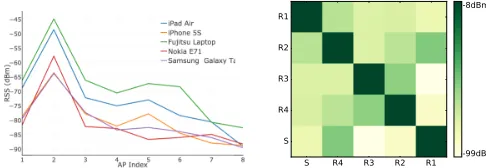
Figure 2:{a}. WiFi RSS by different mobile devices at the same location (each curve is averaged out from multiple measurements; {b}. Visualization of RSS matrix of 5 an-chors:1 sink node (S) and4 remote nodes (R1-R4), where
−8dBm is the offline calibrated value for self-sensed RSS.
(referred to asanchorshereafter), whose location is known beforehand. Note that although such configuration requires dense infrastructure, it will become standard in the near future, since the next generation WiFi 802.11ad operates on 60GHz, whose communication range is much smaller. Therefore in this case, the problem of estimating occupancy (i.e. determining which zone a use is in) is equivalent with assigning the devices of the occupants to the nearby anchors based on their proximity.
As discussed in the previous section, the proposed WiPin system estimates the snapshot occupancy in real-time given the current observed RSS measurements. However, it is well known that in practice, RSS measurements can vary significantly under environmental dynamics, which makes occupancy estimation inaccurate. To address this problem, WiPin considers a two-step estimation approach, where it firstly performs an initial estimation step by clustering the occupants devices based on their RSS signatures, and then it reconciles the current assignment to remove possible outliers caused by environmental dynamics, e.g. signal blockage.
A. Initial Estimation
RSS Normalisation: In practice, for a given anchor, the observed RSS measurements of different devices can vary significantly, even when the devices are fixed at the exact same position (see Fig. 2{a}). This may jeopardise occu-pancy estimation, since such variation in RSS will introduce significant errors during clustering. To address this issue, WiPin uses the ordinary Procrustes analysis method [23] to normalise the RSS measurements among heterogeneous devices, by exploiting the fact that their RSS variations across different anchors tend to be similar (see the shapes of the lines are very similar in Fig. 2{a}).
Zone Assignment: At a fixed timestamp, for a given devices, let o be the vector of normalised RSS measure-ments, where o = [o1, ..., oM], and oi is the observed
RSS (of the mobile devices) from the i-th anchor. Given o, the task of zone assignment is to find the anchor that is closest to the devices, i.e. assigning this occupant to a particular zone (assuming one to one mapping between
anchors and zones). A naive approach could be proximity-based, i.e. just picking up the anchor with strongest RSS. However, this is very unreliable in the presence of wireless signal variations. The state of the art systems (e.g. [15]) consider a fingerprinting-based approach, which cope with the enviornmental dynamics by periodically surveying and re-calibrating the radio map of the indoor space.
WiPin considers a different approach, which uses the anchors as thereferences, to adaptively evaluate the “base-line” of RSS measurements. The key observation here is that an anchor of the WiPin system also generates wireless traffic when operating, which can be overheard by others in the same way as that of the occupants’ mobile devices. Therefore, we can compute the pairwise RSS measurements between anchors (as visualised in Fig. 2{b}). Let ri =
[r1, ..., rM]be the reference RSS vector of the i-th anchor,
whererj,1≤j≤M is the RSS measurement made by the
j-th anchor. In other words,ri is essentially the “expected”
device signal strength values of the i-th zone, observed by all anchors. In this way, the problem of assigning a device to a zone can be cast into that of finding the anchor whose reference RSS vector ri is the closest to the RSS
measurementso of that device:
f(o) = argmin
i
D(ri,o) (1)
whereD(·,·)is a distance metric (in our case we consider the Euclidean distance), andf(·) is a function that assigns the devices to a zone. Therefore, at the current timestamp, the RSS measurements of all devices assigned to thei−th
zone can be represented as:
Ψi:={o∈R1×M|f(o) =i} (2)
where the population of thei-th zone is the cardinality of the set|Ψi|. Note that our approach is inherently robust to RSS
variations, since the reference RSS vectorsriare subject to
the same signal variation as the RSS measurements of the occupants’ devices.
B. Mis-assignment Mitigation
1 2 (B) (A)
Occupants Anchors
LOS path
Blocked Propagation
3 4
(D) (C)
[-22, -57, -59, -85]
[-55, -63, -26, -60] [-26, -61, -48, -80]
[-35, -48, -57, -70] [-52, -46, -60, -74]
[-64, -22, -73, -52]
[-67, -29, -65, -43]
[-76, -61, -46, -30] [-82, -50, -40, -18]
[-67, -8, -76, -60]
[image:5.612.87.268.74.260.2][-8, -67, -70, -85] Alice
Figure 3: An occupant Alice in zone 1 is misclassified to zone 2 due to signal attenuation. Shaded circles represent the equal-range clusters formed by her peers. Among these centroids of clusters, Alice is closest to the one of zone 1.
system is able to a) for the i-th zone, detect such mis-assignment events; and b) re-assign the devices to the correct zone.
Detect Mis-assignment: Recall that in the initial estima-tion, WiPin computes a set of RSS measurementsΨfor each zone. We define the mean of RSS measurements for a given zone as:
¯
o= 1
|Ψ| |Ψ|
X
j=1
oj (3)
Intuitively,o¯specifies the centroid RSS measurements of the given zone, and the distance between a RSS measurements vector oj and ¯oi indicates how well the j-th occupant can
be clustered into the current zone. If a device with oj that is very far away from the computed centroid, it is very likely to be mis-assigned to that zone, i.e. it is an outlier. To detect such outliers, let us first define the assignment error of a given occupantj as a random variableej, where
ej =oj−o. Then the assignment error for a given zone can
be represented as e = [e1, ...,e|Ψ|], where |Ψ| is the total number of occupant currently assigned to this zone.
Ideally if there is no mis-assignment, the assignment error (i.e. residual) e for a given zone should be bounded. Formally, we require the following restricted residual (RR) constraint to hold for every zone:
P(kek ≥ξ+ε)≤η (4)
Hereξis the confidence threshold,εis a slack variable, and
η∈[0,1]denotes the maximum tolerance. It can be shown
Algorithm 1: Sequential Outlier Detection Algorithm Input: Ψ- The set of RSS vector defined in (2)
ξ- The confidence threshold
η - The maximum tolerant probability of deviation
ε- The slack variable Output:Ψoutlier - All the outliers
c
Ψi - The inliers ofΨi
1 Ψoutlier←∅
2 foreach zonei∈ {1,2, . . . , M} do
3 Ψci←Ψi // Initialize Ψci
4 while |Ψci|>2do
// Check RR by Equ. (5)
5 if kΣee+¯e T¯ek
(ξ+ε)2 >
η
M then
6 q←argmax
oj
kejk // Outlier
detection
7 Ψci←Ψci\ {q} // Set difference
8 Ψoutlier←Ψoutlier∪ {q} // Set
union
9 else
10 break
11 return Ψoutlier,[Ψc1, ...,ΨdM]
that a sufficient condition for Eq. (4) to hold is [19]:
kΣee+¯eT¯ek
(ξ+ε)2 ≤
η
M (5)
where¯eandΣee are the mean and covariance of e
respec-tively.
Algo. 1 shows how the proposed WiPin system applies the above Eq. (5) to each zone, and detects the outliers. The idea is that we iteratively move the occupants whose RSS measurements are “far away” from the centroid of the current assigned zone to the outlier set, until the RR constraint holds on the inlier set. The complexity of Algo. 1 is cubic in the worst case, but in practice, we found it is very efficient since RR constraint tends to converge in just a few iterations. Note that different ξandη may affect the performance of WiPin, e.g. smaller ξ and η means WiPin may produce more outliers.
Re-assign Outliers: Given the outliersΨoutlier, WiPin
re-assigns them to different zones with a probabilistic mem-bership function. Concretely, for a given RSS measurement o, the likelihood that it belongs to zone iis:
µi(o) =
(
1 o∈Ψci ko−¯oik
PM i=1ko−¯oik
o∈Ψoutlier (6)
Then the number of occupants in zone i can be evaluated as Pµi(o).
IV. CONTINUOUSOCCUPANCYINFERENCE
The snapshot occupancy estimation algorithm discussed in the previous section is extremely efficient, and runs in real-time on commodity WiFi routers. However, it only considers the data captured at single timestamps, and assumes the occupants should carry their mobile devices with them all the time. In practice this may not always be the case, e.g. an occupant might go out for lunch but forget to bring her phone. To cope with such challenging scenarios, the proposed WiPin system also considers a continuous occupancy inference approach, which exploits the temporal correlation of the sequence of estimated snapshot occupancy, and incorporates historical data to improve inference perfor-mance.
Let us assume at each timestamp t (t = 1 : T within one day), the frond-end of WiPin generates a collection of snapshot occupancy estimation (i.e. number of occupants) zt = [zt1, .., zit, ztM] for all M zones. On the other hand,
we also assume that we possess certain historical occu-pancy information [h1′, ...,hT′], whereht′ is the historical
occupancy of the indoor environment at time t′, obtained
through a previous offline calibration phase. Note that here we assume the historical timestamps t′ can be mapped
uniquely to the currentt, i.e. they represent the same time of the day (e.g. 12pm on Monday), but during different weeks. Intuitively, the historical occupancy represents the “expected” occupancy status of the building learned from the past. With a slight abuse of notation, we denote the historical occupancy of the environment as[h1, ...,hT]hereafter. Let
st be the actual occupancy at t, which is unknown. Then
the task is to infer the sequence the real occupancy S = [s1, ...,sT], given the observations[z1, ...,zT]and historical
[h1, ...,hT]. In the following text, we first explain who the
proposed WiPin system extracts informative features from the raw observations, and then show how it reliably infers the latent states, i.e. the real occupancy with the extracted features.
Feature Functions: WiPin considers the following fea-ture functions. f1(st,zt) and f2(st,ht) checks how the
current observed occupancy zt and the corresponding
his-torical occupancy ht support the latent state st. On the
other hand, feature functionsf3(st, µ([zt−w, ...,zt+w])and
f4(st, σ([zt−w, ...,zt+w]) evaluates the comparability
be-tween the state st and a window of 2w observations
[zt−w, ...,zt+w], where µ(·)and σ(·)return the mean and
standard deviation of the measurements, respectively. Fi-nally, functionf5(st−1,st,[zt−w, ...,zt+w])models the
cor-relation between the observed occupancy during[t−w, t+w] and the state transitions, which is defined as:
f5=ln
1 1 +σ√2π −
(zt−zt−1)(st−st−1)
[image:6.612.314.566.75.223.2]1 + 2σ2 (7)
Figure 4: Testbed of the proposed WiPin System.
where σ computes the standard deviation of the measure-ments.
State Inference: Given the feature functions, the proposed WiPin system considers a state inference approach based on Conditional Random Fields (CRFs) [16]. In practice, CRFs are discriminative models, which directly capture the conditional dependencies between states and observations. Such correlation can be factored as the product of potentials:
p(s1:T|z1:T,h1:T) =c−1· T
Y
t=2
Φ(st−1,st,z1:T,h1:T) (8)
where c is a normalising constant. The potentials Φ is the log-linear combination of the above defined feature functions f = [f1, ..., f5], and Φ = exp{w·f}. w is the relative
weights between feature functions, and is learned from the data. Finally, our system uses Viterbi decoding to compute the most likely state sequence given the observations and historical data, which is:
s∗1:T = argmaxp(s1:T|z1:T,h1:T) (9)
V. EVALUATIONS A. Experimental Setup
Experiment Site: We built a 600 m2 testbed in an office environment, which can be partitioned into 7 zones, as shown in Fig. 4. In the testbed, we deploy 8 commercial off-the-shelf WiFi routers, which forms a star network with the sink node placed in the centre.
2 4 6
Errors (persons)
0 0.2 0.4 0.6 0.8 1
CDF Connection
Adaptive-Finger. Snapshot Est. Conti.Infer.-SVM Conti.Infer.-CRFs
Figure 5: Overall performance comparison.
1 2 3
Errors (persons)
0 0.2 0.4 0.6 0.8 1
CDF 5 min.
[image:7.612.221.345.70.174.2]10 min. 15 min. 20 min.
Figure 6: Impact of query in-tervals.
0.05 0.1 0.15 0.2 0.25 0.3
NRMSE 0
50 100 150 200
CPU time (ms)
Connection Adaptive-Finger. Snapshot Est. Conti.Infer.-SVM Conti.Infer.-CRFs
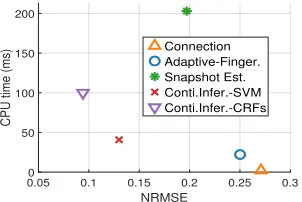
Figure 7: Computational overhead of dif-ferent approaches.
B. Competing Approaches
Snapshot Estimation: For snapshot estimation, we com-pare it with two competing approaches:Connection
based-The WiFi connection based approach is similar to the one adopted in [4], in which WiFi connection logs of APs are used to estimate occupancy levels. Adaptive-fingerprinting based-This method can be seen an enhanced version of the WiFi fingerprinting method [15], in which they offline cal-ibrated WiFi fingerprints as references for online matching. To mitigate the effects of environmental dynamics, we use real-time RSS index of anchors as dynamic fingerprints. Continuous Inference:To validate the superiority of CRFs in continuous inference, we compare it with a SVM [20]. Considering the inference is a multi-class problem while basic SVMs only give binary solutions, we employ an one-against-all method [14] to fuse multiple SVMs binary decisions to a multi-class result.
C. Evaluation Methods
Parameter Learning: To train the CRFs and SVM, we partitioned the30days of RSS measurements and occupancy data into training and testing sets. 5-fold cross validation is performed on the training data spanning a period of 25 days, randomly picked out from the permutated dataset. Hyper-parameters of WiPin, e.g., thresholds of Algo. 1 regularization weights of classifiers, are derived from grid searching on the basis of validation accuracy.
Performance Metrics:In order to comprehensively quantify the accuracy of WiPin, 5 metrics are adopted in total. 1)NRMSE: we use the normalized root mean squared error (NRMSE) [6] to measure the overall accuracy. Given the time series of estimated zonal occupancy s1:T and ground
truth data g1:T, the NRMSE between s1:T and g1:T is
defined as
N RM SE(g1:T,s1:T) = k
g1:T −s1:Tk/ √
T max(g1:T)−min(g1:T)
where max(·) and min(·) takes the max/minimum value of the time series. Same as [5], we study the 2) mean, 3) standard deviation and 4) 95% percentile of ℓ1 errors
respectively. We propose a new metric 5) worst-case ratio
that quantifies the system robustness. The worst case of occupancy inference is when a zone is occupied by at least 1 people but the system estimates empty occupancy. The proportion of such errors in instances is referred as worst-case ratio, which is crucial for real-world implementations.
D. Experiment Results
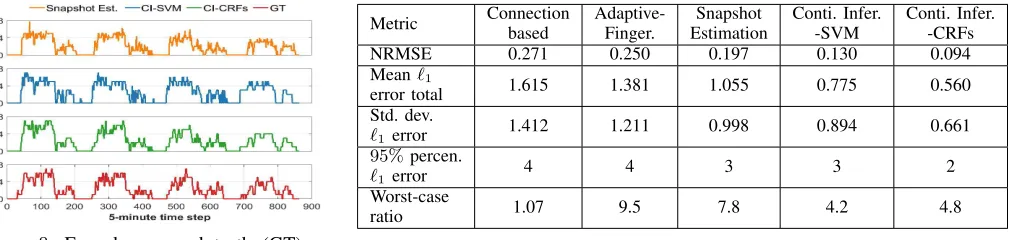
Front-end: Tab. I summarizes the accuracy of different front-end implementations. It’s noteworthy that snapshot estimation outperforms its two competing opponents by37% and27% respectively in terms of NRMSE. Meanwhile, its robustness is justified by95%percentile error and worst-case ratio. Moreover, as shown in Fig. 5, the worst (max) error of the snapshot estimation approach is only4.66, which is also lower than Connection and Adaptive-fingerprint approaches (5 and 6 respectively). It indicates that by re-labeling outliers, WiPin is able to improve tentative estimations. Note that WiPin achieves this directly on the front-end. The Connection based approach is suffering form the AP handover problem that phones may stick their connections to a router till it loses signal reception totally. Therefore, errors will be introduced since the connected router for a device is not necessary the nearest one. In addition, RSS is a more agile indicator for device mobility, hence the Adaptive-fingerprint based approach performs better than the Connection one (see Fig. 5).
[image:7.612.377.528.72.173.2]Figure 8: Four-day ground truth (GT) v.s. various predictions of Public Office (B).
Metric Connection
based
Adaptive-Finger.
Snapshot Estimation
Conti. Infer. -SVM
Conti. Infer. -CRFs
NRMSE 0.271 0.250 0.197 0.130 0.094
Meanℓ1
error total 1.615 1.381 1.055 0.775 0.560
Std. dev.
ℓ1 error 1.412 1.211 0.998 0.894 0.661
95% percen.
ℓ1 error 4 4 3 3 2
Worst-case
ratio 1.07 9.5 7.8 4.2 4.8
Table I: Specific Performance Comparison of all metrics.
in obviously unoccupied periods. This is because SVM does not exploit the intrinsic structure among outputs but predicts on separate samples. In contrast, CRFs are able to provide smooth predictions and identify some critical periods, e.g., work hours and off-duty hours. Although such smoothness in CRFs occasionally results in skips of sharp transitions from the ground truth data. It seems like that CRFs act like another filter posed on the SVM’s results by considering the structure in the sequence.
Impact of query interval: WiPin is designed to provide system subscribers with accurate occupancy levels when they have different query intervals. To examine this, we downsample measurements of interval sizes from5minutes to 20 minutes and investigate its performances. As shown in Fig. 6, the accuracy of continuous inference decreases slightly with the increase of interval length. This is because temporal correlations between occupancy samples decay with the increase of delay length, which blurred the chain structure in outputs. However, when analyzing the error distributions, we found that though the exact classification (0 error cases) rates fluctuate, most errors quickly converge to 1 person for all the interval lengths. As a result, the degree of declining brought by longer delay lengths is limited, and WiPin is still able to infer relatively accurate results. Consid-ering that commonly query intervals of occupancy systems are below 20 minutes [5], WiPin is able to accommodate subscribers with various needs in practice.
Computational Cost: We evaluate the overheads of differ-ent methods in WiPin. Specifically, we measure the CPU time when the number of mobile devices is of around80% capacity in each monitored zone. The result in average is shown in Fig. 7. For front-end occupancy estimation implemented on the router, connection based and adaptive fingerprints are superior to snapshot estimation in terms of computational efficiency. However, the overhead of snapshot estimation is far below the1-second updating interval which incur very limited delay in processing. When it comes to continuous inference, CRFs outperforms SVM by ∼50%. The computation bottleneck of SVM lies in that it has to use multiple binary SVMs to give multi-class predictions, while
CRFs infer the state directly with Viterbi algorithm. VI. RELATEDWORK
Occupancy SensingA major distinction among occupancy inference systems lies in different sensors adopted in the system. Popular sensors for occupancy detection include PIR motion sensors [1], magnetic reed switches [17] and CO2 sensors [5]. Nevertheless, due to the sensor intrinsic
limitation, it’s difficult for them to detect occupants when they are relatively motionless. To address this problem, POEM [8] combined the ceiling mounted camera and motion sensors to largely improve the occupancy detection accuracy (94%) in a power-efficient way. In the context of radio based sensing, Sentinel [4] leverages the requests received by the RADIUS server and is able to output near real-time occupancy. Sentinel takes the initiative to leverage the ex-isting WiFi infrastructure and requires minimal calibration. However, such WiFi connection based systems suffer from AP handover problem especially in personal networks. Ariel [15] requires intrusive app installation, and its accuracy is affected by environmental dynamics.
In contrast, the proposed system makes use of the ex-isting WiFi infrastructure and sniffs the RSS packets in a non-intrusive way. No applications are required for usage. Moreover, WiPin is self-contained and cost-efficient to be accessed by various occupancy information subscribers. State InferenceModel based inference techniques are well established for occupancy prediction [10, 9] and most of them are developed on the basis of Markov chain theory. The states to be inferred are vectors in which each component represents the number of occupants in each zone. How-ever, these methods solely depend on historical information, which blinds the system to solve the issue incurred by deviations of online occupancy from historical calibration.
Fingerprinting-based Indoor Positioning Mobile device based wireless localization approaches typically calibrate and build radio map offline and estimate locations by online fingerprint matching [3, 22]. Not only the fingerprints survey is labor-intensive [12] but the developed radio map gradually becomes obsolete along with environment changing [18]. However, WiPin does not require fingerprinting calibration process at all. The adaptiveness of anchors makes WiPin free of war-driving site surveys and re-calibrations.
VII. CONCLUSIONS
In this paper, we design WiPin, a robust occupancy inference system based on commercial WiFi hardware. The proposed system contains a front-end and a back-end, where the front-end runs directly on the WiFi routers, and estimates the snapshot occupancy of the indoor environment in real-time. On the other hand, when accuracy is the primary concern, our system is able to exploit the temporal correlations between the estimated snapshot occupancy, and incorporate historical data to improve inference accuracy, at the cost of certain fixed delay. We implemented and tested the proposed WiPin system on a real-world testbed, and experimental results show that: a) The front-end of our system outperforms the existing approaches significantly, by reducing the inference error up to 37%; b) when the back-end is activated, it is able to further double the inference accuracy; c) our system is robust to environmental changes and works well under different parameter settings, without incurring much computational overhead; d) in certain cases, the proposed system is accurate enough to infer room-level positions of individual occupants. For future work, we plan to improve WiPin, so it is able to cope with certain extreme cases, e.g. when the first occupant arrives without her phone.
Acknowledgments.This work was supported in part by the EPSRC through grants EP/J012017/1 and EP/L00416X/1; in part by the Republic of Singapore National Research Foundation (NRF) through a grant to the Berkeley Educa-tion Alliance for Research in Singapore (BEARS) for the Singapore-Berkeley Building Efficiency and Sustainability in the Tropics (SinBerBEST) Program; in part by the Repub-lic of Singapore NRF under Grant NRF2013EWT-EIRP04-012 and Grant NRF2011NRF-CRP001-090.
REFERENCES
[1] Y. Agarwal, B. Balaji, S. Dutta, R. K. Gupta, and T. Weng. Duty-cycling buildings aggressively: The next frontier in hvac
control. InIEEE IPSN, 2011.
[2] Y. Agarwal, B. Balaji, R. Gupta, J. Lyles, M. Wei, and T. Weng. Occupancy-driven energy management for smart
building automation. InACM BuildSys, 2010.
[3] P. Bahl and V. N. Padmanabhan. RADAR: An in-building
RF-based user location and tracking system. InIEEE INFOCOM,
2000.
[4] B. Balaji, J. Xu, A. Nwokafor, R. Gupta, and Y. Agarwal. Sentinel: occupancy based HVAC actuation using existing
WiFi infrastructure within commercial buildings. In ACM
SenSys, 2013.
[5] C. Basu, C. Koehler, K. Das, and A. K. Dey. PerCCS: person-count from carbon dioxide using sparse non-negative matrix
factorization. InACM UbiComp, 2015.
[6] A. Beltran, V. L. Erickson, and A. E. Cerpa. Thermosense:
Occupancy thermal based sensing for hvac control. InACM
BuildSys, 2013.
[7] R. Clark, W. Cronje, and M. A. v. Wyk. Design optimization of a hybrid energy system through fast convex programming. InInternational Conference on Intelligent Systems, Modelling and Simulation, 2014.
[8] V. L. Erickson, S. Achleitner, and A. E. Cerpa. POEM:
Power-efficient occupancy-based energy management system. InIEEE IPSN, 2013.
[9] V. L. Erickson, M. ´A. Carreira-Perpi˜n´an, and A. E. Cerpa.
OBSERVE: Occupancy based system for efficient reduction
of hvac energy. InIEEE IPSN, 2011.
[10] V. L. Erickson, Y. Lin, A. Kamthe, R. Brahme, A. Surana,
A. E. Cerpa, M. D. Sohn, and S. Narayanan. Energy
efficient building environment control strategies using
real-time occupancy measurements. InACM BuildSys, 2009.
[11] X. Gao and S. Keshav. Optimal personal comfort management
using SPOT+. InACM BuildSys, 2013.
[12] S. He, S.-H. G. Chan, L. Yu, and N. Liu. Calibration-free fusion of step counter and wireless fingerprints for indoor
localization. InACM UbiComp, 2015.
[13] E. Horvitz, P. Koch, C. M. Kadie, and A. Jacobs. Coordinate:
Probabilistic forecasting of presence and availability. In
Proceedings of the Eighteenth conference on Uncertainty in Artificial Intelligence (UAI), 2002.
[14] C.-W. Hsu and C.-J. Lin. A comparison of methods for
multiclass support vector machines. IEEE Transactions on
Neural Networks, 13(2):415–425, 2002.
[15] Y. Jiang, X. Pan, K. Li, Q. Lv, R. P. Dick, M. Hannigan, and L. Shang. Ariel: Automatic wi-fi based room fingerprinting
for indoor localization. InACM UbiComp, 2012.
[16] J. Lafferty, A. McCallum, and F. C. Pereira. Conditional ran-dom fields: Probabilistic models for segmenting and labeling
sequence data. InICML, 2001.
[17] J. Lu, T. Sookoor, V. Srinivasan, G. Gao, B. Holben,
J. Stankovic, E. Field, and K. Whitehouse. The smart
thermostat: using occupancy sensors to save energy in homes. InACM SenSys, 2010.
[18] X. Lu, C. Yu, H. Zou, H. Jiang, and L. Xie. Extreme learning machine with dead zone and its application to WiFi based
indoor positioning. InIEEE ICARCV, 2014.
[19] X. Lu, H. Zou, H. Zhou, L. Xie, and G.-B. Huang. Robust extreme learning machine with its application to indoor
positioning. IEEE Transactions on Cybernetics, 46(1), 2016.
[20] B. Scholkopf and A. J. Smola.Learning with kernels: support
vector machines, regularization, optimization, and beyond. MIT press, 2001.
[21] H. Wen, Z. Xiao, A. Markham, and N. Trigoni. Accuracy
estimation for sensor systems. IEEE Transaction on Mobile
Computing, 14(7):1330–1343, 2015.
[22] M. Youssef and A. Agrawala. The horus wlan location
determination system. InACM MobiSys, 2005.
[23] H. Zou, B. Huang, X. Lu, H. Jiang, and L. Xie. A robust indoor positioning system based on the procrustes analysis
and weighted extreme learning machine. IEEE Transactions