1
Dynamics of state feelings
State Affect: A longitudinal study with the use of
experience sampling
Bachelor Thesis
Negar Sadeghi Hassanabadi (1761188)
27.06.2019, Enschede
University of Twente
Department of Positive Psychology & Technology
First supervisor:
Dr. P.M ten Klooster
2
Abstract
Background: Feelings vary over time, they are not stable but are often measures as trait-like
concepts. Recently, researchers have raised their interest in finding ways to measure state feelings
and moods of people. Experience Sampling Method (ESM) is a method that is often used for
momentary assessments of feelings or behaviors. In contrast to cross-sectional designs, it allows
us to measure feelings, the moment they occur and therefore allows for a broader understanding of
participants emotional life. Russel and Watson & Tellegen (1985) suggested that feelings are not
discrete entities rather they are dimensional. Alexithymia refers to people who have difficulties to
define or differentiate between their feelings. Surprisingly 1/5 of the general population shows
signs of alexithymia. Objective: The aim of this study was to get an impression of the dynamic of
state feelings with the use of experience sampling. Another aim was to assess whether ESM is
suitable for measuring state feelings. A different aim was to investigate whether there are
differences in state and trait feelings of people who show or not show signs of alexithymia.
Method: The sample was derived from a non-clinical young population, with the age between 18
and 30 years. Either being students or full-time employees. In a longitudinal ESM study, the
relationship between state and trait feelings was measured. The participants were asked to fill out
the affect grid via the TiiM application for seven days four times a day at specific time points. At
the eight-day participants were asked to fill out the Positive and Negative Affect Scale (PANAS)
and Toronto-Alexithymia Scale 20 (TAS20). Results: A series of Linear mixed model (LMM)
analyses were conducted. State pleasure significantly covariates with the positive affect of the
PANAS. A significant main effect for the negative affect of the PANAS and state pleasure was
found. A strong significant negative correlation between the level of pleasure of participants and
the negative affect of participants was found with a post-hoc analysis. For the TAS20, it was shown
that pleasure and energy scores of participants with signs of alexithymia are strongly positively
correlated, in contrast to the scores of pleasure and energy of participants without signs of
alexithymia. Scores of PA and NA affect of the PANAS and their state pleasure strongly positively
correlate as well. Scores of NA affect of the PANAS and pleasure scores of the affect grid of
participant’s without sings of alexithymia do significantly and strongly correlate. Conclusion: It
was found out that state feelings do vary over time and that ESM is a valid method to measure state
feelings because, in this study, trait and state feelings do correlate but not too strong, suggesting
3
found that participants who have signs of alexithymia have difficulties differentiate between
pleasure and energy, as well as positive and negative affect.
Introduction
Feelings and Mood differ. They differ not just within populations but also within persons
themselves. There are a spectrum of feelings and moods people can feel and the dynamics make it
possible for them to change not only within the day but also within seconds (Watson & Clark,
1984; Kuppens, Stouten, & Mesquita,2009). Research in psychology regarding mood has a long
tradition. It is not only interesting to investigate them because it underlies a variety of psychological
disorders or corresponds to a part to personality characteristics but also because humans experience
them in a wide spectrum within a day (Tellegen, 1985; Watson & Clark, 1984); Kuppens, Stouten,
& Mesquita,2009; Ebner-Priemer, Eid, Kleindienst, Stabenow, & Trull, 2009). It is a highly
discussed topic, and therefore, there are many opinions and theories, aimed to explain underlying
mechanisms (Tellegen, 1985; Watson & Clark, 1984; Russel, Weiss, & Mendelsohn, 1989;
Kuppens, Oravecz, & Tuerlinckx, 2010).
There are several frameworks by which psychologists classify emotions, feelings, and
moods. These can be classified into two fundamental viewpoints. The first one proposes that
emotions are discrete and fundamentally different constructs. It is originated from Darwin (1872)
and based on this Tomkins (1962), proposed that emotions and moods are products of evolution
and genetically determined. Tomkins argues that they are distinguishable not only on the basis of
their neural features but also on behavioral and expressive features. His views influenced the work
and ideas of Paul Ekman and Carrol Izard, who are known for their theory of discrete emotions
(Colombetti, 2009). It has to be acknowledged that the limitations of this approach progressively
became apparent. Researchers found out that measures of different affects are not as discrete as
supposed, rather they are strongly and systematically interrelated (Watson & Clark, 1997).
Thus, researchers started to assume that affects are not discrete, rather they are dimensions,
thus creating the second viewpoint. The dimensional models of emotions underlie the hypothesis
that a common and interconnected neurophysiological system is responsible for all affective states
(Russel, 2009). Many of the commonly used frameworks of affect belong to the second viewpoint
4
dimensions, pleasurable versus un-pleasurable, arousing or subduing, and strain or relaxation. In
order to conceptualize human emotions, dimensional models of emotions define where they lie in
two or three dimensions. Since then deprived of evidence, a general consensus has been made that
two broad factors are incorporated in the dimensions of affect. Thus, nowadays most models
incorporate valence and arousal or intensity dimensions (Watson & Clark, 1997). The most
commonly used models are the circumplex model (Russel, 1980), and the Positive Activation –
Negative Activation (PANA) model by Watson and Tellegen (1985) (Rubin & Talarico, 2009).
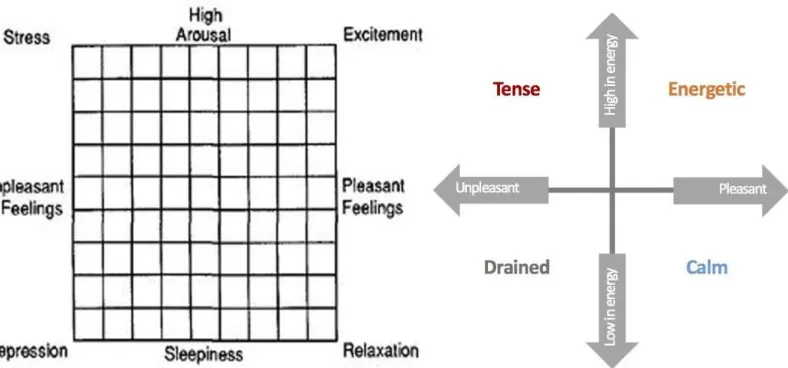
The circumplex model, developed by Russel (1980), suggests that emotions are
operationalized in a two-dimensional circular space, containing arousal and valence dimensions.
The horizontal axis represents valence while the vertical axis represents arousal. The center of the
circle presents a neutral valence and a medium level of arousal (see Figure 2). Russel (1980)
describes his model as representative of core affect, which consists of the most elementary feelings
that are not necessarily directed toward anything. Essentially, it is how we feel at a particular point
in time. Researchers have suggested that core affect is fundamentally a combination of two types
of feelings continuums; Valence (pleasant to unpleasant) and arousal (low to high arousal) (Russel,
1980). Within the years the term arousal has been replaced by energy (low to high energy) (Schutz, Quijada, De Vries, & Lynde, 2010). Accordingly, Russel (2009) describes core affect as a "pre-conceptual primitive process, a neurophysiological state, accessible to consciousness as a simple
non-reflective feeling: feeling good or bad, feeling lethargic or energized". He further elaborates
on the continuum which incorporates two types of feelings, stating that core affects although being
two dimensional, is subjectively perceived as a single feeling. This means that when combining
the two dimensions with each other, the result is a unified feeling. For example, being high in
energy while experiencing high unpleasantness results in being tense. Core affect, although it can
account for a broad range of emotional states and provides a solid basis for discussing similarities
and differences among affective states, is not the same as emotions, and is more similar to moods
(Russel, 2009). Different types and intensities of feelings and moods can be experienced,
depending on the quality, intensity, and content of the individual's experience on the
above-mentioned dimensions (Plass & Kaplan, 2016). In order to test his circumplex model theory Russel (1980) introduced the affect grid which was designed to assess two dimensions of affect,
pleasure-displeasure, and arousal-sleepiness. It is suitable for any study that requires judgments of affect of
5
that is short and easy to fill out and, therefore could be used rapidly and repeatedly. It has been
proven to be a valid instrument to assess mood (Russel, 1980).
The PANA model, invented by Watson and Tellegen (1985), does not specifically
incorporate arousal. Instead, it suggests that positive and negative affect are two separate systems.
This is due to the fact that the PANAS is based on an orthogonal rotated variant of the
pleasure-arousal scale, which has shown that positive and negative moods are largely independent of another
(Watson & Tellegen, 1985). States of higher arousal tend to be defined by their valence and states
of lower arousal tend to be more neutral in terms of valence. Positive affect (PA) reflects the extent
to which a person feels enthusiastic, active and alert. Thus, high PA is a state of high energy, full
concentration and pleasurable engagement whereas low PA is characterized by sadness and
lethargy (Watson & Tellegen, 1985). Contrasting to this, negative affect (NA) is a general
dimension of subjectively perceived stress and un-pleasurable engagement with a variety of
aversive mood states, with low NA being a state of calmness and serenity (Watson & Tellegen,
1985). It has to be highlighted, that the model of Watson and Tellegen (1985) has been the more
prominent scale for measuring mood and has been used far more often than the circumplex model
of Russel (1980). Hence, it has been far more often validated and there are different reliable and
valid versions of the PANAS. In contrast to that, the affect grid has not been used that often
although it provides a valid and reliable measurement for mood.
Particularly, but not exclusively, researchers have raised their interest towards moods
because many psychological disorders express themselves with a variety of moods and
fluctuations, called mood disorders (Solomon, Leon, Coryell, Endicott, Fiedorowicz, & Keller, 2010; Kessler, Avenevoli, & Merikangas, 2001; Ebner-Priemer, Eid, Kleindienst, Stabenow, & Trull, 2009). Until now, most of the research concerning moods or feelings have focused on it as a trait-like concept (Watson & Tellegen, 1985; Kuppens, Stouten, & Mesquita, 2009; Scherer,
2000).
A trait is defined as a more permanent presence and a stable level of emotion. It refers to
the stable, consistent and enduring disposition of the individual, including emotional reactions
and temperament, rather than situational, variable and temporary factors. On the opposite, a State
refers to a temporary emotional fluctuation, which is a momentary emotional reaction to internal
and/or external triggers. It evolves physical, behavioral, cognitive and psychological reactions
(Zelenski & Larsen, 2000). Feelings as a state are not stable, they can change from moment to
6
this is typically the case, such as bipolar disorders and depressive disorders. This is due to the fact
that people with those disorders most of the time have a general emotional state or mood which is
distorted or inconsistent with the circumstances that they are in. Thus, interfering with their
ability to function (emotions (Taylor, Ryan, & Bagby, 1985; Munoz 1995).
Moreover, many people who suffer from mood disorders display alexithymia. Alexithymia
refers to difficulties in perceiving and describing the emotions of others and themselves (Taylor,
Ryan, & Bagby,1985; Gross & Munoz, 1995; Linehan, 1993). The core characteristics of alexithymia are marked dysfunction in emotional awareness, social attachment, and interpersonal
relating. Furthermore, individuals suffering from alexithymia also have difficulty in distinguishing
and appreciating the emotions of others, which is thought to lead to un-empathic and ineffective
emotions (Taylor, Ryan, & Bagby, 1985). One aspect to consider is that 18% of the general
population have difficulties in verbalizing and expressing their emotions or the emotions of others
(Mattila et al. 2006). Thus, it is important to check if participants display symptoms of alexithymia
while measuring mood or feelings. In this study, it is hypothesized that participants who have signs
of alexithymia have difficulties differentiating or maybe even confuse their daily mood and thus
their levels of pleasure and energy, should either be the same or totally different. Likewise, it is
assumed that they have difficulties differentiating between positive and negative affect as measured
by the PANAS.
Changes and fluctuations in feelings do occur in non-clinical populations as well,
although in the past not well acknowledged (Davidson, 1998; Scherer, 2000; Kuppens, Stouten,
& Mesquita, 2009).People are capable of experiencing a variety of feelings throughout the day
and their dynamic nature makes it possible to switch within a day or even within hours
(Davidson, 1998). Past research in psychology concerning emotions and feelings has been mostly
focused on emotions or moods as a trait (Watson & Tellegen, 1985; Kuppens, Stouten, &
Mesquita, 2009; Scherer, 2000). Therefore, there are various tests and scales that measure
feelings as a trait, as mentioned above yet, questionnaires and measurements for feelings as a
state have been considered too little (Watson & Tellegen, 1985). Although this led to meaningful
outcomes and important information like questionnaires that measure the trait of mood (e.g;
PANAS), it does not account for the situational dynamics and variety of moods (Watson &
Tellegen, 1985). The currently used tests regarding moods are not sensitive enough to catch the
7
accounting for the dynamics of moods because they are applied in cross-sectional designs thus,
only once and retrospectively.
Another aspect that may have affected this, is the fact that in the past, research in
psychology was more interested in differences within populations and not within the individual
itself (Watson & Tellegn, 1985, Russel, 1980). For example, Smallwood, Fitzgerald, Miles & Phillips (2009) conducted a study in which they examined the effect of mood states on mind wandering, with the use of PANAS. Although they applied the PANAS before and after the mood induction, they did not take into account that moods change far more often. Another Study by Kennedy-Moore, Greenberg, Newman, & Stone (1992) examined the relationship between daily
events and mood by applying the PANAS and another mood scale. Here again, they asked the participants retrospectively to fill out the PANAS asking about their mood of today. Yet they did not consider that moods differ throughout the day and in order to get a better view on the
relationship between daily events and moods it might have been better to apply the PANAS throughout various time points within the day to be able to catch which events accounted for which moods.
Nowadays, a paradigm shift can be seen, researchers are more and more interested in the
differences within an individual (Palmier-Claus, Myin-Germeys, Barkus, Bentley, Udachina, Delespaul, & Dunn, 2011). In this way, in-depth information about the individual can be gained, which then provides the means to target the needs of the individual even more (Palmier-Claus et
al., 2011). Thus, there is a need for a study design, which is able to catch the dynamic affect within
a person and uncovers how emotions or specifically moods unfold themselves in daily life. In order
to acquire such measurements about a person's state feelings and moods, the experience sampling
method (ESM) can be used. In the last years, it has become an increasingly popular tool for
measuring feelings but since this is a rather new method, it has not often been used yet. It originates
from dairy studies, which is a popular research method in which participants are asked to fill out
behaviors, activities or feelings each day (Van Berkel, Ferreira, & Kostas, 2018). Csikszentmihalyi et al. (1977) were one of the first researchers who conducted an ESM study. They analyzed
adolescent activity and experience in the late 1970s, instructing them to complete a paper
self-report form upon each incoming paper signal which they received from a pager. The Introduction
and the emerging usage of Smartphones have made it easier to make use of experience sampling
as a method of acquiring self-reported data from participants. Using smartphone applications as a
8
ESM requires participants to answer an identical set of short questions, multiple times per
day, within a certain amount of time. This can be done for weeks or even months. Nowadays with
the rise of smartphones, it allows researchers to send out notifications when they need to fill out
the questionnaire occur (Van Berkel, Ferreira, & Kostas, 2018). This method allows researchers to get detailed information about an individual's feelings and changes in feelings at the moment they
occur (Van Berkel, Ferreira, & Kostas, 2018). Correspondingly, the change in feelings can be monitored and associated with existing or assumed psychopathologies, personality differences, and
gender (e.g. Ebner-Priemer et al., 2009; Ebner-Priemer, Eid, Kleindienst, Stabenow, & Trull,
2009). ESM is helpful in order to measure state emotions and to assess to what extent or if they
differ from participants’ trait emotions (Versluis, Verkuil, Lane, Hagemann, Thayer, & Brosschot, 2018.
For example, Kuppens, Allen, and Sheeber (2010) conducted a study on Emotional Inertia
and Psychological Maladjustment by using the method of experience sampling. They found out
that emotional fluctuations of individuals who have depression and low self-esteem as expected
were characterized by higher levels of inertia in both positive and negative emotions, as opposed
to people who did not exhibit low self-esteem or depression. Also, Versluis, Verkuil, Lane,
Hagemann, Thayer, and Brosschot (2018) conducted a small study about emotional awareness with
the use of experience sampling, they found out that indeed Emotional Awareness varies over time
and is not as stable as often assumed. Zelenski and Larsen (2000) were one of the first researchers
studying the distribution of basic emotions from a state and trait perspective using experience
sampling. They asked undergraduate university students to fill in a daily report form, three times a
day (around noon; in the early evening; and in the late evening). Zelenski and Larsen (2000), found
out that positive emotions were rated higher than negative emotions. Also, negative emotions, in
the total sample were rated lower. Besides, their study showed that happiness was rated more
intensively compared to the other emotions. An interesting finding was that overall positive
emotions seemed to be much more blended than the negative ones. Hence, negative emotions were
experienced much more distinctly. Another interesting finding was, that their study, support the
assumption of Watson and Tellegen (1985), that trait emotions are perceived in, two dimensions,
positive and negative affect. Their study resulted in the conclusion that when emotions were
assessed within-subject states, these states conform much more to discrete emotions model, in
contrast, they found out that when emotions as traits are measured, they conform to a dimensional
9
In the current study, the aim is to get an impression of the different states of feelings with
the use of experience sampling and to evaluate whether ESM is a suitable way of measuring
emotional states over time. Another aim is to explore the convergent validity of state measures with
trait measures, this is done in order to check whether ESM data is a valid way to measure feelings.
A different aim is to see whether participants display signs of alexithymia and if participants who
display signs of alexithymia are able to differentiate between their feelings. The target group a
non-clinical young population of people from the age of 18 till 30, as people in that age period, are more
prone to displaying fluctuations throughout the day in their emotions and feelings (Klerman, 1988).
Methods
Design
This quantitative study was conducted with the experience sampling method (ESM). ESM is an
approach in which data is collected via self-reports multiple times per day at the moment they
occur, in order to sample experiences and feelings of an individual in their natural setting (Van Berkel, Ferreira, & Kostakos, 2018). Participants get notified when they are required to answer a short, identical set of questions. An ESM study usually has a duration of at least three days to
three weeks, involving multiple reports, usually four to ten times (Van Berkel, Ferreira, & Kostakos, 2018). It is very different from cross-sectional study designs, in which data is only retrieved once, retrospectively or beforehand. The experience sampling design was chosen due to
the fact that data can be collected repeatedly over the day for each participant and measurements
of feelings can be retrieved within the moment. This allows studying both the variability of levels
of pleasure and energy over time.
The Duration of the study was set to be eight days which is aligned to Hektner, Schmidt, &
Csikszentmihaly (2007), who advised that a minimum of one week is necessary to have a
representative sample of people’s activities or feelings. At day eight participants were required to
fill out the Positive and Negative Affect Scale (PANAS), which asks about participants feelings or
moods regarding last week and the Toronto-Alexithymia Scale 20 (TAS20, once. This study was
conducted with the use of TiiM, created by the BMS lab of the University of Twente (Appendix
3), therefore it was chosen to use signal contingent sampling, in which participants are required to
10
questions. In the first seven days starting from a Tuesday morning at 10:00 am, the participants
were asked to fill out the Affect Grid four times a day, in a specific time slot, determined by the
researcher. It was chosen to assess feelings, four times a day in order to assess the variability of
moods participants felt throughout the day. The times of measurement were chosen randomly
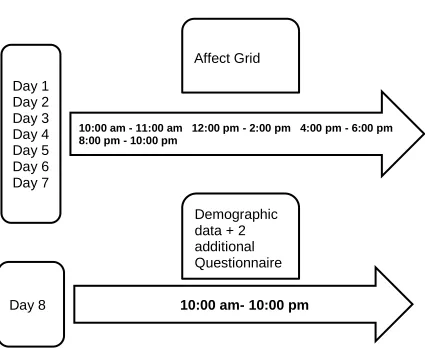
within the 4-time intervals by rolling a dice. The first time slot was between 10:00 a.m. to 11:00
a.m., the second time slot was between 12:00 p.m. to 2:00 p.m., the third time slot was between
4:00 p.m. to 6:00 p.m. and the last time slot was between 8:00 p.m. to 10:00 p.m. Participants had
the opportunity to delay the measurement for one time and were reminded to fill in the Affect Grid
[image:10.612.73.498.316.665.2]half an hour later, within the specific time slot.
Figure 1. Study Layout of ESM Study
Day 1
Day 2
Day 3
Day 4
Day 5
Day 6
Day 7
10:00 am - 11:00 am 12:00 pm - 2:00 pm 4:00 pm - 6:00 pm 8:00 pm - 10:00 pm
Day 8
10:00 am- 10:00 pm
Affect Grid
11 Participants
Twenty-six participants were recruited through convenience sampling out of the general
population, this is aligned with previous studies. Traditionally, in order to estimate how many
participants are needed, a power analysis is done. This is different in an ESM design because
reliability is achieved with many measurements instead of many respondents. In this study, it was
chosen to have at least 25 participants because Van Berkel and his colleagues (2018) provided in
their research article that a median number of 19 participants provides representative insight into
experiences or feelings. In ESM Studies the sample size is most of the time small because ESM
studies tend to employ analyses with substantially larger power such as linear mixed models that
adequately deal with the nested structure of the data. Participants were approached through various
social media channels or through family, friends or other acquaintances.
The inclusion criteria were (1) the participants had to be over 18 years old, (2) they had to
be studying at a university or university of applied science and/or be employed, (3) they had to
have an iOS or Android-capable smartphone, (4) they were able to properly understand and
comprehend the English language. Participants were excluded from this study by the following
exclusion criteria; (1) did not agree with the informed consent, or (2) did fill in the affect grid less
than 13 times.
Materials
TiiM (The incredible intervention machine)
In order to take part in the study, participants had to download the TIM application. This is an
application that was developed by researchers from the University of Twente and functions as a
means of conducting research online. Participants received a registration link with which they were
able to register for the study and create an account in TiiM. With the start of the study, participants
received notifications regarding the questions they needed to fill out each day (Appendix 3).
Affect Grid
The Affect Grid is a single item scale that was developed to measure a person's emotional state. It
is based on the circumplex model of affect, in which a person’s emotional state can be mapped
onto a two-dimensional Cartesian plane where the x-axis represents a pleasure-displeasure
12
version of the affect grid had the form of a 9x9 grid and participants had to mark an X in the square,
to indicate how he or she is feeling at the moment. Since the original affect grid was a pen and
paper version, it resulted in participants only making use of the space within the square, not being
aware that they also could mark their X everywhere within the grid. Thus, the outcome tended to
be skewed (Russel, Weiß, & Mendelsohn, 1989). Over time, the Affect Grid and the wordings of
the x and y-axis were altered. Nowadays, the most common wordings are a pleasure for the x-axis
and energy for the y-axis (Russel, Weiß & Mendelsohn, 1989). The Affect Grid was chosen due to
the fact that it is quickly filled out and consequently can be used rapidly and repeatedly. In this
study, the Affect Grid is used to measure state feelings and moods of participants throughout the
study. The original Affect Grid was altered in order to be used in this study, in a digital form and
also to undermine the probability of getting skewed data. Participants in this study could mark their
emotional state with a dot, anywhere within the Affect Grid, which they moved with the
touchscreen of their mobile phone. In figure 2, the original version as well as the altered version,
[image:12.612.85.479.420.604.2]used in this study, are depicted.
Figure 2. Original Affect Grid (left) and altered Version of the Affect Grid used in this study
(right).
Positive and Negative Affect Scale (PANAS)
The Positive and Negative Affect Scale (PANAS) was developed to measure mood or emotion
13
PANAS is a self-report scale and consists of 20 items, with 10 measuring positive affect (PA) and
10 measurings negative affect (NA). Items are rated on a five-point Likert Scale ranging from 1
being very slightly not at all to 5 being extremely. It was designed to measure affect in various
contexts such as; the present day, past day, week, or year, or in general (Watson, Clark, & Tellegen, 1988). Since for this study the PANAS is used for a trait measure, the questions were asked with the intonation on "the past week". The final score is measured by taking the sum of
the 10 terms on the positive scale and the sum of the 10 terms on the negative scale. Scores on
each scale can range between 10 to 50 with higher scores on the PA scale representing higher
levels of positive affect and vice versa for the NA scale. Values assigned are positive for answers
on the positive scale and negative for answers on the negative scale (Watson, Clark, & Tellegen, 1988). In a sample of international students, with 9 females and 9 males (the average age was 28) Thompson (2007) found high reliability for the NA scale with Cronbach’s alpha being 0.82 and
for the PA scale, Cronbach’s alpha being 0.85. The PANAS has a strong convergent validity with
such measures as general distress, depression and state anxiety (Thompson, 2007). In this study,
the Positive affect scale of the PANAS also showed high reliability with Cronbach’s alpha being
0.74. Likewise, the negative affect scale has shown high reliability with a Cronbach’s alpha of
0.87.
Toronto Alexithymia Scale (TAS-20)
Besides the PANAS, the Toronto Alexithymia Scale (TAS-20) was used. It was developed to
measure alexithymia and is one of the most commonly used tests for that. The TAS-20 is a
self-report scale and consists of 20 items with three different subscales. The Items are rated by using a
five-point Likert scale whereby 1 is "strongly disagree" and 5 is "strongly agree". In order to get a
total alexithymia sore, responses are summed over all 20 items. For the subscales, each subscale
factor is the sum of the responses to that subscale. The TAS-20 uses cutoff scoring which means
that a score of equal to or less than 51 means non-alexithymia, a score equal or greater than 61
means alexithymia and scores between 52 to 60 mean possible alexithymia (Bagby, Parker, &
Taylor, 1994).
In a sample of 389 male and 576 female students from a Canadian university with 21.8
(SD=5.6) being the mean age, Bagby, Parker, and Taylor (1994) found high reliability, with Cronbach’s alpha being 0.81. In this study, the TAS20 has shown high reliability with Cronbach’s
14 Pilot Study
In order to check the usability of the application and the understanding of the questions, before the
final study, a pilot was conducted. Two people were asked to take part in the pilot test which took
place for three days. Also, both researchers and the supervisor of this bachelor's project took part.
Both participants understood the questions asked but for the use of the application it was decided
to provide future participants with a handout, in which it was explained step by step how to
download the application and set up an account. Likewise, for the final study, instructions were
added in the application on how to deal with the tools such as the Affect Grid and the Likert scales.
Procedure
This study was approved by the BMS Ethics Committee of the University of Twente (#190452).
Participants were recruited via convenience sampling through various Social Media channels. First
participants were informed about the purpose of the study, confidentiality regarding their data, and
agreed on the terms and conditions of the study (Appendix 1). A handout was offered, in which it
was explained which steps have to be done in order to participate and how the application TIIM
application works (Appendix 2). All questionnaires and scales mentioned above were merged into
one “intervention” in TiiM. In the first seven days starting from a Tuesday morning at 10:00 am,
the participants were asked to fill out the Affect Grid and two additional questions regarding
anxiety and depression four times a day, in a specific time slot, determined by the researcher. On
the last day of the study, participants had to fill out the PANAS and the TAS-20 and the HADS.
The two questions regarding anxiety and depression and the HADS were used by another
researcher. Also, they had to fill in socio-demographics including age, occupation or study, study
program, nationality, and gender. After the study, the obtained data was stored and retrieved from
TiiM.
Data analysis
The statistical program SPSS (version 25) and Microsoft Excel (16.14.1) were used for the data
analysis. Since on the last day of the study the application did not work for some participants, it
was required to make use of Qualtrics and send the baseline questionnaires PANAS, TAS20, and
questions about the demographics to five participants who were not able to fill out these
questionnaires via TiiM. First of all, the data from TiiM and from Qualtrics were transformed into
15
included in the analysis, due to the fact that all completed the questionnaire in TiiM frequently, (all
participants completed the questionnaires at least 13 times). In order to get information about the
demographic variables such as age, gender, nationality and student and/or job, descriptive statistics
such as means, standard deviations, frequencies, were used. For the reliability of the questionnaires,
a reliability analysis was conducted, to get the score of Cronbach’s alpha. For PANAS and TAS20,
the sum scores of participants and means and standard deviations were calculated.
In order to make use of Linear Mixed Modeling (LMM), the data set was changed into a
long format. Linear Mixed Modeling was used to analyze the data of this study because it accounts
for the nested structure and missing data and therefore is especially useful for ESM data. Thus, a
series of LMM analyses with an autoregressive covariance structure was conducted to analyze the
hierarchical structure of the repeated measurements per participants and/or time. All mean values
gathered by LMM take missing data into account and are as a consequence estimated and referred
to as marginal means. In each LMM analysis, the subjects were the participants, the measuring
point was repeated and the repeated covariance type was AR(1). The dependent variable was either
x (pleasure) or y (energy), of the Affect Grid. The measuring point was set as a fixed factor and
was added to the model. This was done in order to get the estimated marginal means for each
measurement point to be able to compare the data over the different time points and to see how
participants feelings changed or varied throughout the study. In order to get information about each
participant, the fixed factor participant was added to the model. In this way estimated marginal
means for each participant were estimated, to be able to compare participants. The output of the
analysis mentioned above provided a mean estimation of the dependent variables pleasure and
energy, of the affect grid. Next, PA and NA of the PANAS and the grouped TAS20 scores were
added as a fixed factor into a series of separate LMM analyses, in order to get an estimation of
F-values. In the same analysis, either PA or NA affect of the PANAS were added as covariates in
order to estimate their correlation to the dependent variables pleasure or energy of the affect grid.
To be able to estimate the correlation of the grouped TAS20 scores to the dependent variables was
added as a covariate but measurement point was not added as a fixed factor because otherwise,
SPSS did not provide an output. To be able to compare the estimated means of the variables and to
create graphs to visualize how the various variables were related to each other, Excel was used.
Graphs were created for measurement points over time and between participants.
In order to confirm the outcome of the LMM analyses, a series of post-hoc bivariate
16
participant's overall mean state of pleasure or energy on the different time points of measurement.
Likewise, a post-hoc bivariate correlation analysis was used to examine the relationship between
the overall mean state of pleasure and energy of participants, with the overall positive and negative
affect of the PANAS of the participants.
Based on the outcomes of the TAS20 questionnaire, participants were divided into two
groups. Participants without alexithymia (0) and Participants with alexithymia (1). This
questionnaire is used to see in what degree participants are able to identify their emotions and
whether people who have no signs of alexithymia have a different level of state emotions
throughout the day. It was decided that participants with a sum score of 55 or higher, have
alexithymia and participants below that score do not. It was decided because 55 is approximately
the middle score. Thus, 15 participants showed no signs of alexithymia whereas 11 participants
did. This allows evaluating differences between individuals showing signs or no signs of
alexithymia. Furthermore, these groups' pleasure and energy levels were analyzed with bivariate
correlation analysis. A bivariate correlation for the groups' pleasure/energy and their positive or
negative affect was as well analyzed, to get information regarding their trait and state measures,
and to check whether the participants who have alexithymia differ in that aspect as well from the
participants who do not. The effect sizes of the analyses were interpreted on the basis of Cohen's
conventions (1988), in which a coefficient of .10 is considered as a weak correlation, a coefficient
of.30 a moderate and a coefficient of 0.50 a strong correlation.
For the purpose of getting in-depth information about participants with extreme scores, 2
individuals were picked. Their scores of pleasure and energy of the affect grid were visualized in
graphs, likewise, their affect grid was replicated.
Results
Demographic variables
In total, there were 26 participants who downloaded the TiiM application and completed the study.
The mean age of the participants was 23.7 (SD= 3.71), with 15 being female and 11 male. There
were 16 students, of which 11 had a student job, the rest of the sample consisted of people who
have a full-time occupation (Table 1). All 26 participants were included in the analysis. The
17
Table 1. Demographic variables of participants.
Item Category Frequency %
Gender Male
Female
11
15
42.3
57.7 Nationality German
Dutch Other (British) 23 2 1 88.4 7.7 3.8
Job Yes
No
21
5
80.8
19.2
Student Yes
No 16 10 61.5 38.5 Descriptive statistics
State pleasure and energy over the time of 7 days
By running a Linear mixed model analysis, the participants' pleasure and energy throughout the
study were analyzed. The estimated marginal means of all 28 measuring points of all participants
can be seen in Figure 2. The average amount of pleasure was estimated being 19.50 (SD=9.30),
over the 28 measuring points. The average level of energy was -7.16 (SD=10.1). Overall there was
a wide variation in mean scores across the measurement points. Participants scored the highest
pleasure, with the mean being 33.66 (SD=10.30), on the 17th measurement, which equals to
Saturday morning (Time of measurement 8:00 - 10:00 a.m.). Their lowest pleasure level was on
the 21st measurement with a mean of 2.85 (11.86), this measurement was taken Sunday morning
18
measurement with a mean of 12.2 (SD=9.86), which was taken Wednesday (12:00 - 2:00 p.m.). On
the contrary, their lowest energy was on the 20th measurement, with a mean of -26.34 (SD=10.13),
which equals to Saturday evening (8:00 - 10:00 p.m.) (Figure 2). Having a look at the graph,
suggested that higher pleasure levels do not indicate higher energy levels.
Figure 2. Estimated marginal means of pleasure and energy for all 28 measuring points, of all
participants
State Pleasure and Energy per Person
Analyzing the data for each participant, overall it shows that there were great variations between
participants and their feelings. Participant 9 scored the lowest overall pleasure with a mean of -
60.24 (SD=10.74) and participant 15 having the highest pleasure overall with a mean of 67.70
(SD=9.96) (Figure 3). Regarding the energy scale, it resulted in participant 6 having the highest
overall energy with a mean of 16.20 (SD=12.98) and participant 13 having the lowest overall
[image:18.612.72.541.151.397.2]19
Figure 3. Estimated marginal means for pleasure and energy of all 26 participants
Comparing both the overall means of time point and participants or overall emotions in
participants showed that there was substantial variation in both. Specifically, in the pleasure scale
participants scores varied strongly. Furthermore, there was more variation and outbreaks in energy
levels throughout the weekend than on weekdays, which can be seen in Figures 2 and 3.
Additionally, the participants had higher levels of pleasure than energy throughout the week
compared to weekends.
PANAS
On the eight day of the study, participants were asked to fill out questionnaires such as the PANAS
and the TAS20. The PANAS is used, in order to check how their trait affect is associated with their
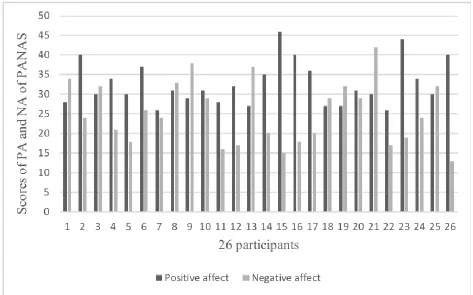
state affect. The participants' overall positive affect was 33.10 (SD=5.60) and the overall negative
affect was 25.41 (SD=11.79). Meaning that the participants all together perceived more positive
than negative affect. Overall, in Figure 6, it can be seen that in most participants the levels of
positive affect are much higher than the negative affect. But for example, in 9 participants, the
scores of negative affect are higher than the positive affect. Participant 9, also as can be seen in
figure 4, had very low pleasure levels, this suggests that state feelings, do reflect themselves in the
20
the lowest was 26, for participant 7. The highest score for negative affect 42, for participant 21 and
[image:20.612.69.542.130.425.2]the lowest score was a 13, for 26.
Figure 6. Sum scores of the positive and negative affect of the PANAS for all 26 participants
TAS20
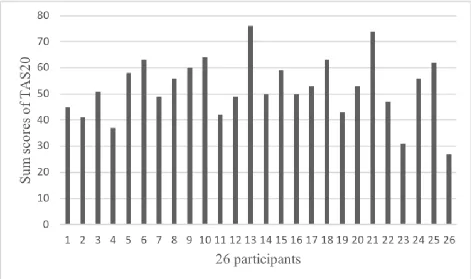
The participants average of the scores of the TAS20 was 52.27 (SD=11.70). Meaning overall
participants possible show signs of alexithymia. From the 26 participants, 11 show no signs of
alexithymia, 6 showed signs of it and 9 showed possible signs of alexithymia (Figure 7). Participant
21
Figure 7. Sum scores of TAS20 of all 26 participants
After changing the cut-off score to 55, in order to divide participants into two groups, no signs of
alexithymia and signs of alexithymia the following was found out. After this grouping, fifteen
participants had no signs of alexithymia and eleven had signs of alexithymia. In figure 8, it can be
seen that there appear to be less variation in the scores of pleasure and energy from people with
signs of alexithymia. The mean pleasure of participants with alexithymia was 15.1 (SD=31.3), their
mean energy was -1.1 (SD=17.3). The highest score of pleasure was 67.7, which belongs to
participant 7, the lowest score of pleasure was measured of participant 4, with a value of -60.2.
Participant 2, had the highest overall energy with a score of 16.2, in contrast, participant 6 had the
22
Figure 8. Estimated marginal means of pleasure (x) and energy (y) of the 11 participants with
alexithymia
As opposed to what was mentioned before, in figure 9 it can be seen that scores of pleasure and
energy of people without signs of alexithymia have huge variations. The mean pleasure of
participants without signs of alexithymia was 21.87 (SD=14.01), their mean energy was -11.98
(SD=12.87). Overall, participant 13 had the highest pleasure with a score of 40.82 and participant
11, the lowest with a score of -4.51. The highest energy was measured in participant 6, with a score
of 6.84, in contrast, participant 9 had the lowest energy with a score of -35. Considering both and
comparing figures 8 and 9, it can be seen that there are differences in levels of pleasure and energy
[image:22.612.72.546.68.361.2]23
Figure 9. Estimated marginal means of pleasure (x) and energy (y) of the 15 participants without
24 Linear Mixed model
Table 2. Using different variables as covariates in the Linear mixed model
Dependent Fixed factors Covariates F-value (df1, df2) p-values
Pleasure (x) Measurement point Energy (y)
PA (PANAS)*
NA (PANAS)*
No_Yes Alexithymia*
1.060 (27, 309.0289)
14.539 (1, 126.076)
42.546 (1, 137.351)
2.068 (1, 123.210)
p=.387
p=.000
p=.000
p=.153
Energy (y) Measurement point PA (PANAS)*
NA (PANAS)*
No_Yes Alexithymia*
0.000 (1, 174.080)
0.105 (1, 175.426)
5.976 (1, 178.873)
p=.978
p= .746
p=.015
*Measurement point was not added as a fixed factor to the model otherwise the model would not provide an output
State and Trait Measures
By running a bivariate correlation analysis, Pearson's correlation revealed a weak non-significant
negative correlation between state pleasure and state energy throughout the 28 measuring points
(r= -0.128, p =.516). This implies that pleasure and energy levels did not correlate with each
other over the 28 measuring points. Another Pearson’s correlation revealed a strong significant
negative correlation for the trait positive affect and trait negative affect of the PANAS (r=-.520,
n=26, p=.007). This indicates that when Positive affect increases in a person, then negative affect
decreases (Appendix 5).
Association between dependent and independent variables
By adding trait positive affect as a covariate, in the LMM analysis, it showed that positive
affect did significantly covariate with state pleasure F (1, 126.076) =14.539, p=.000. The
post-hoc bivariate correlation analysis confirmed the effect because a moderately significant positive
25
their trait positive affect was found. Indicating that when participants' pleasure increased, their
overall positive affect increased as well. Trait negative affect was added to the LMM analysis as
a covariate of state pleasure of participants, it revealed a significant main effect F (1, 137.351)
=42.546, p=.000. Afterwards a post-hoc bivariate analysis was conducted. A strong significant
negative correlation was found between the estimated mean pleasure of participants and the
negative affect of participants (r=-.664, n=26, p=.000). This suggests that when levels of pleasure
of participants increased, their overall negative affect tended to decrease.
In separate LMM analysis, each positive and negative affect were added as covariates, but
both did not have a significant effect on energy levels (Table 2). A post-hoc analysis for the level
of energy and positive affect of persons, there was a weak non-significant positive correlation
found (r=.048, n=26, p=.814). For the level of energy and negative affect, there was also a weak
non-significant positive correlation found (r=.057, n=26, p=.781). Both suggesting that state energy
does not influence the individual's overall positive or negative affect (Appendix 5).
Association of TAS20 scores with the Affect Grid and PANAS
Adding the overall score of the TAS20 of the participants as a covariate to the state pleasure
of participants, in the LMM, resulted in a strong significant main effect F (1, 123.210.) =2.068,
p=.153. As well adding the overall TAS20 score as a covariate to state energy of participants
resulted in a strong significant main effect F(1,178.873)=5.976,p=.015. Indicating that TAS20
scores correlate with both pleasure and energy scores, thus when TAS20 scores are higher, both
state pleasure and energy are higher as well.
Two bivariate correlation analyses were conducted for the participants who showed signs
of alexithymia and the participants who did not show signs of it. The bivariate correlation analysis
of the pleasure and energy scores of the 11 participants with signs of alexithymia revealed a strong
significant positive correlation (r=.643, n=11, p=.034). It indicated that when pleasure levels
increased, energy levels of participants with signs of alexithymia increased as well. On the
contrary, after conducting a bivariate correlation analysis for the scores of pleasure and energy of
the 15 participants with no signs of alexithymia revealed a moderate non-significant negative
correlation (r=-.321, n=15, p=.243). Suggesting that, levels of pleasure and energy did not increase
or decreased, when one of them increased or decreased, in participants without signs of alexithymia
26
Lastly, to check whether there are different associations of scores of the affect grid and the
PANAS of participants with and without signs of alexithymia several bivariate correlation analyses
were conducted. For PA and pleasure levels of participants with alexithymia, it revealed a strong
significant positive correlation (r=.633, n=11, p=.037). Implying that when pleasure levels
increased, positive affect increased as well, similar to what was found with the bivariate correlation
analysis of all 26 participants levels of pleasure and PA. For the participant's levels of pleasure and
their negative affect, the analysis revealed a strong negative significant correlation as well (r=-.672,
n=11, p=.024). This is likewise similar to what was found when doing the analysis with all 26
participants. For participants with signs of alexithymia with regard to their overall PA and their
energy levels, the Pearson correlation indicated a moderate positive non-significant correlation
(r=.357, n=11, p=.281). This suggests that when their energy levels increased, their overall PA did
not increase. On the contrary, with regards to their overall NA and their energy levels, it indicated
a strong negative significant correlation (r=-.544, n=11, p=.084). Indicating that when levels of
energy increased, their NA decreased (Appendix 6).
For participants without signs of alexithymia, there was only one significant finding.
Correlating their overall NA with their pleasure levels revealed a strong negative significant
correlation (r=-.745, n=15, p=.0013). Suggesting that when their pleasure levels increased, their
NA decreased. These findings, implicate that participants with alexithymia and participants without
alexithymia do differ in how they perceive their feelings (Appendix 6).
Individual analysis
Having a closer look at participant 9, resulted in the findings of figure 4. It can be seen that
throughout the study, the participants' levels of pleasure are very low most of the time, on the
contrary, the energy levels of the participants vary a lot throughout the study. Considering the affect
grid, the participant most of the time feels drained, with a few times feeling calm. This can also be
27
Figure 4. Scores of the Affect Grid of Participant 9 throughout the study
In figure 5, the scores of pleasure and energy of participant 15 have been put into a graph. It can
be seen that the pleasure levels are mostly stable and high throughout the study. Opposed to that,
are the energy levels. They vary a lot throughout the study. Especially in the measuring points 9 to
11, which equals to Thursday noon, afternoon and evening. Here it can be seen that the participants
experience the lowest levels of energy on Wednesday afternoon but in the evening, the energy is
very high with a score of 99. The same results can be seen for the measuring points 12 through15,
which equal to Friday morning to evening. In the mornings, the level of energy is the lowest, with
28
Figure 5. Scores of Pleasure and Energy of Participant 15 throughout the study
In Figure 6, the scores of the affect grid of participant 15 are displayed. Here it can be seen that the
participant felt tense most of the time but a few times, the participant felt energetic. This is similar
to what can be seen in Figure 6, where it is displayed that the participants' levels of energy vary
29
Figure 6. Scores of Affect Grid of Participant 15.
Discussion
This study's objective was to gain an impression of the variety of momentary emotional states and
how they differ throughout the day and within persons themselves. One of the main findings of this
study was that when comparing the trait feelings and the state feelings of participants, there are
indeed variations. Feelings as already mentioned in the introduction, are not stable, but change,
considerable also within a day. This study indicated that experience sampling appears to be a
suitable method to catch the dynamic of feelings because it provided information about the
variations of feelings, participants had throughout the study. It showed that state feelings and trait
feelings do correlate but not too strong, indicating that state measures do give insight into the
dynamics of feelings in a way that trait measures cannot. Thus, ESM in this study was a valid way
of measuring feelings.
Another result showed that, in this sample, pleasure and energy levels differ a lot as well,
meaning that they are not associated with each other. A person can feel energized without having
pleasure or vice versa. Accordingly, this confirms the independence of the two axes in the Affect
30
are not correlated, this again confirms the independence of the different axis of the affect grid.
Nevertheless, it has to be mentioned that a person perceives higher levels of energy/pleasure when
she or he already feels higher levels of pleasure/energy (Russel, 1980). Based on this, it can be
concluded that an effective way of measuring state emotions are scales which treat emotions as
dimensions and not as discrete entities. This is in accordance with Russel (2009), who found out
that it is more effective to measure emotions in a dimensional way since in dynamic models of
emotions, emotions are not treated as discrete entities but rather are dimensional.
Overall, the participants scored higher on pleasure than energy. This is in accordance with
the study of Zelenski and Larsen (2000), in which they found out that their participants overall
perceived much more positive emotions than negative ones. Logically, they perceived more
pleasure on Saturday morning. This can be assumed since the sample consisted of people with a
job or students, meaning that they had free time and were able to choose which activities to do.
Likewise, great variations among participants were found. this was expected due to the fact that in
a sample derived from a normal population, people differ in their feelings. Again, this is similar to
what Zelenski and Larsen (2000) found out when comparing undergraduate students with each
other. An interesting finding was when looking at the participant which scored the lowest overall
pleasure over the duration of the study, the participant's levels of pleasure throughout the study
were very low and did not vary much. In contrast to that, the energy levels varied a great amount.
Also, the trait negative affect was lower than his/her positive affect, implicating that state
levels indeed give information about the trait behavior of emotions of the person. This is in
concordance to what Watson and Tellgen (1985) found out. The PANAS is orthogonally rotated to
the pleasure-arousal dimensions, indicating that pleasure measures do provide the same
information as positive affect measures. This again, indicates that an ESM study is able to capture
detailed information about a person's emotional life, which trait-like tests such as the PANAS,
which are applied only on one-time point, cannot capture or account for. Another finding which
supports this indication was illustrated by the case study of pleasure and energy levels throughout
the study of participant 15. The pleasure levels were high and stable, but the energy level varied
much. When looking at specific days and time periods of dates, it showed that the participant
experienced lower energy levels in the morning and much higher energy levels in the evenings.
This detailed information cannot be provided with traditional ways of studying feelings and moods,
31
result is similar to what Klerman (1988) had found, people perceive higher energy levels in the evenings and perceive depressive-like symptoms in the mornings.
Versluis and her colleagues (2018) did an ESM study, in which they checked whether
emotional awareness varies over time or is stable. Their results have shown that indeed, emotional
awareness varies over time. Thus, this provides evidence that emotions are not stable rather they
vary. This study found similar results in that respect as well. The results have shown that emotions
vary over time. Compared to the PANAS, which is only applied once and retrospectively, the ESM
with the use of the affect grid provides evidence that feelings vary and change, even within days.
Both the Versluis study (2018) and this study did not determine what these variations are due to,
meaning that they did not measure the context, thus there is no clear explanation for the variations.
Another aspect they are similar is that the real-life variations in emotions meaningfully capture the
variability within subjects in the complexity of emotional experience over time.
Comparing the findings of this study, to one of the first studies which studied trait and state
emotions while using ESM, showed interesting findings (Zelenski & Larsen, 2000). First of all,
similar to what Zelenski and Larsen (2000) have found, is that feelings do vary over time and there
are a variety of feelings, people experience throughout the day. Their results with regards to
positive and negative emotions were similar, indicating that in a non-clinical population, positive
emotions are much more prominent. This study, similar to what Zelenski and Larsen (2000) found
out, supported the assumption of Watson and Tellegen (1985) that trait emotions are perceived in
a dimension of positive and negative affect. Since this study did not check for the intensity of
feelings, no comparison with regards to the results of Zelenski & Larsen can be made. Likewise,
no comparison of the amount of blend within the categories of negative and positive emotions can
be made. Surprisingly, their results concluded that state emotions conform more to discrete
emotions model rather than dimensional ones, in contrast, trait emotions did conform to the
dimensional model. The current study cannot come to such a conclusion since for both state and
trait measurements, dimensional models of emotions were used.
Participants on average had a higher trait positive affect than negative affect, this implies
that participants generally have more positive emotions than negative ones. Again, this is in
concordance to what Zelenski & Larsen (2000) found out when comparing state and trait
feelings. Besides this study confirms what Zelenski & Larsen (2000) found out, negative
emotions were rated lower than positive ones. Comparing the state levels of pleasure of people
32
account for 16% variance of positive affect, indicating that there is a difference and thus
measuring state is important. They correlate with each other, indicating that the more pleasure
they perceived throughout the week of measuring, the higher their trait score of positive affect
was. This is in accordance with what was expected because the PANAS asks about the emotions
the participants experienced in the last week. Thus, higher scores of pleasure throughout the week
indicate higher positive affect scores. Also comparing the state levels of pleasure of people with
their trait negative affect, provided an interesting finding. The more pleasure they perceived
throughout the week, the lesser their negative affect score was.
Surprisingly, state pleasure did account for 44% of the variance for negative affect, this
indicates that state feelings are associated with trait feelings but catch dynamics in feelings which
trait measurement of feelings cannot. As already mentioned above, since the PANAS asks for
emotions participants experienced last week, this result is aligned with the one mentioned
beforehand. Meaning that higher scores of pleasure indicate lesser negative affect in persons.
Once more, this is in accordance with the Zelenski and Larsen study (2000), the more positive
emotions participants perceived, the lesser were the negative emotions they perceived. On the
contrary, when comparing the state energy of people with either the trait positive or negative
affect, there were no associations. The state energy of people did not affect their trait positive
affect, this means that regardless of how high or low their energy was in the week, their positive
affect score did not change. This is also an interesting outcome since energy is one of the axes of
the affect grid which measures mood. This is aligned with Russel, Weiss, & Mendelsohn (1989)
had found out when they studied the relationship between PA and NA affect of the PANAS with
pleasure-arousal of the Affect grid. Neither PA nor NA were correlated with arousal (or energy in
this case), indicating that the PANAS does not measure the same thing as arousal (energy), when
orthogonally rotated, although it measures pleasure, when rotated.
With regards to the TAS20, it has been shown that this sample, in general, using the
validated cut-off scores, shows no signs or some signs of alexithymia, which means most
participants do not have difficulties to identify or describe their feelings. After categorizing the
sample into two different groups with different cutoff scores, one having no signs of alexithymia
and, one having signs of alexithymia, almost half of the sample does show signs of alexithymia.
Findings have shown that participants with signs of alexithymia do not differ too much in their
pleasure and energy levels. This implicated that in this sample, people with signs of alexithymia
33
energy. As hypothesized, on the contrary participants without signs of alexithymia showed a lot of
variation, suggesting that these participants had no difficulties differentiating or identifying their
emotions throughout the week. Furthermore, it has been revealed that the higher the alexithymia
scores, the lower the pleasure and energy levels of the participants have been. This is in accordance
with the literature, stating that people who show signs of alexithymia have difficulties
differentiating between various emotions (Taylor, Ryan, & Bagby, 1985).
Comparing the scores of pleasure and energy of participants with and without signs of
alexithymia, showed that overall, participants with signs of alexithymia score lower in both
pleasure and energy. Previous studies about alexithymia and mood disorders such as the one from
Ebner-Priemer, Eid, Kleindienst, Stabenow, and Trull (2009), had found out that people with alexithymia show more negative emotions than positive ones. This is due to the fact that people
who show signs of alexithymia are much more prone to psychopathological symptoms such as
depressive episodes and mood swings (Ebner-Priemer, Eid, Kleindienst, Stabenow, & Trull 2009). Interestingly, when participants with alexithymia levels of pleasure increased, their energy levels
increased as well, indicating that they do not differentiate between those dimensions, again
confirming what Taylor, Ryan, and Bagby (1985) had found out. In contrast to that, it has been
revealed that increases in the level of pleasure do not indicate increased levels of energy for
participants without signs of alexithymia. Indicating that participants without signs of alexithymia
differentiate between the different dimensions of the affect grid.
Interpreting the results of the study, a few limitations have become prominent. First of all,
the study was done via an application that showed to have some malfunctions. Participants
complained that the app did occasionally not save their answers, or even when choosing an answer,
the application still indicated that no answer was chosen which raise difficulties continuing with
the surveys. Thus, participants sometimes needed much more time to fill out the questionnaires,
which left them annoyed and frustrated. This could have influenced their levels of pleasure and
energy throughout the study and hence altering the results. Another limitation is the fact that this
study was compiled with another researcher, which made use of other questionnaires for the ESM
and for the trait questionnaires. The fellow researcher studies depression and anxiety, therefore
maybe the participants were biased with negative wordings before filling out the Affect Grid,
meaning an ordering effect could have been possible. This could have led to declines in pleasure
34
question regarding depression, the question regarding anxiety were organized was randomized
throughout the day.
Nonetheless, a major strength of this study was the use of Linear Mixed models, which
accounted for the missing data and since it was much data that was acquired, the missing data was
no burden. A linear mixed model is a powerful analysis but when using bivariate correlation
analysis as a post-hoc analysis, the study was underpowered. Another major advantage of this study
is the use of ESM, in this way current feelings and mood states of the participants in their natural
environment have been acquired. This gives in-depth inside about the emotional state's participants
perceives not just throughout the week but also throughout the day. In line with this advantage is
the fact that ESM is a rather new approach to studying emotions and therefore has not been often
used. ESM makes it possible to study emotional states of participants throughout the day in their
natural life. Particularly in the way this study is designed, it has not been used yet. Although there
are already a few studies that make use of ESM in order to get in-depth information about emotional
states, none of them validates them with a trait questionnaire in order to see whether ESM data is
valid. Likewise, the use of the TAS20 to screen for persons with signs of alexithymia has not been
acknowledged even though one study uses the emotional awareness scale, which has a subscale for
alexithymia. The fact that this study, made use of the affect grid, which can be filled out in a few
seconds, made it more bearable to conduct a longitudinal study and thus made it more applicable
for the use with students or full-time employees. Another aspect to consider is the fact that this
study did not ask in particular what the individuals did during the time slots where they had to fill
out the questionnaires. Hence, no detailed information can be given, why in specific time points,
participants scored high or low in pleasure and energy dimensions of the affect grid.
With regard to this study, it has become more certain, that feelings and moods vary a lot,
not just within a person but also through different time points. The use of ESM provides a good
and valid way to assess state feelings as well it enriches our understanding of emotions. Likewise,
it has become evident that Alexithymia does not only appears in clinical but also in non-clinical
populations. Alexithymia needs to get further acknowledged in studies conducting research about
feelings or emotions in general. Concluding this, the study provides evidence for the fact that state
feelings differ from trait feelings and that there are variations within feelings and moods, not just
within populations but within persons and days as well.
In order to raise awareness of this aspect of emotions and to go from differences within