THE CONTEXTUAL INTERFERENCE EFFECT
FOR A SEVEN-KEY MOVEMENT SEQUENCE
DURING EXTENDED PRACTICE
Bente Rootmensen
Bachelor Thesis
DEPARTMENT OF HUMAN FACTORS & ENGINEERING PSYCHOLOGY
First supervisor: Willem Verwey Second supervisor: Rob van der Lubbe
2
Abstract
The acquisition of new motor skills is important for every individual and has a great impact on daily
life. This study focused on the contextual interference (CI) effect with seven-key sequences in an
extended practice environment. This effect was tested with the use of the Discrete Sequence Production
Task. The CI-effect was expected to be present in the blocked (BP) and random practice (RP) condition.
Participants in BP condition practised the three sequences separately, while participants in RP condition
practised the sequences in random order. The hypothesis was partly accepted, because the expected
appearance of the CI-effect was only present during the practice phase, while it was not in the retention
phase. Two possible factors can explain this. First, the extended practice influences the CI-effect in some
cases. Second, the development of motor chunks could have influenced the practice of a sequence in a
way that one sequence is represented as a few shorter sequences in a row. In this way, the BP condition
has more similarities with the RP condition, which weakens the CI-effect. Future research should focus
on the complexity of a motor sequence and the possible non-existence of the CI-effect in both laboratory
3
1.
Introduction
Every individual has learned a variety of motor skills in daily life and every motor skill, even a simple
one, requires practice to execute it correctly. Various practice strategies can improve the performance
of a motor skill. It is generally understood that the extensive practice of a new motor skill highly
improves later performance. Furthermore, extensive practice influences the flexibility of a specific
motor skill. For example, participants who had practised extensively could adapt better to unexpected
disruptions in the task than participants who did not do this (de Souza Fonseca, Benda, da Silva Profeta,
& Ugrinowitsch, 2012). Not only the duration of the practice, but also the practice schedule influences
the learning and later performance of a motor skill.
Shea and Morgan (1979) studied the effect of practice on motor learning and introduced the
Contextual Interference (CI) effect in motor learning research, which was earlier identified for verbal
learning. The CI-effect is present in the comparison between two types of practice schedules, in which
two different ways of the same motor sequences are practised. In the so-called random practice (RP)
condition, different variations of a task are practised in random order. During the practice of these
different variations, sequence performance is hindered because of the high levels of interference.
However, performance on later retention is improved, because participants spent more effort during
acquisition (Hodges, Lohse, Wilson, Lim, & Mulligan, 2014; Kim, Rhee and Wright, 2016; Wright,
Black, Immink, Brueckner and Magnuson, 2004).
In contrast to the RP condition, the blocked practice (BP) condition results in low contextual
interference. It involves repeated execution of the same sequences in separate blocks, which means that the sequences are practised separately. The performance in the practice phase is relatively high
compared to the RP condition. However, performance in the BP condition on retention is reduced,
because of the low levels of interference during the practice phase (Brady, 2004; Hodges et al., 2014;
Magill & Hall, 1990). This later retention phase takes place approximately 24 hours after the practice
phase for both conditions. During retention, familiar sequences are tested, which means that it is tested
which condition (either RP or BP) had more benefit from the earlier practice phase (Abrahamse,
Ruitenberg, de Kleine and Verwey, 2013). This retention or test phase is blocked, so both conditions are
tested equally. Also, it is least likely to facilitate the RP condition during the test phase (Kim, Chen,
Verwey, & Wright, 2018; Shea & Morgan, 1979).
The performance of individuals in the practice phase can be influenced by the development of
so-called motor chunks (E.g., Abrahamse et al., 2013; Sakai, Kitaguchi, & Hikosaka, 2003; Verwey,
1994). Motor chunks develop during the extensive practice of a sequential motor skill. A combination
of the same repeated keypresses is represented in memory as if it is one single chunk of information,
instead of distinct keypresses (Abrahamse et al., 2013). This helps participants to perform better on the
4 The use of motor chunks is different for participants in the RP and BP condition. Kim et al.
(2018) found that forgetting during retention by individuals in the BP condition was significantly more
severe than by individuals in the RP condition. Participants in both conditions used the advantage of
motor chunks, but this was short-lived for individuals in the BP condition. The researchers showed an
advantage forthe RP condition in later acquisition, especially in the concatenation of keypresses and the
execution of the elements within the motor chunks.
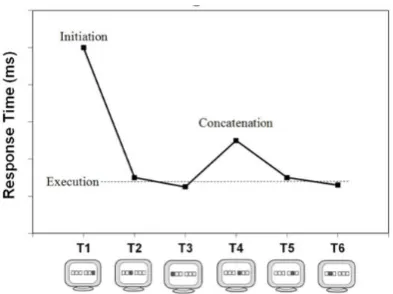
The concatenation of different keypresses can be
detected when examining the reaction times of a single
sequence (Abrahamse et al., 2013). Initiation is the
starting point of the sequence, which takes more time,
while the following execution is faster (Figure 1: T1, T2
and T3). The third phase, concatenation, takes place
halfway through the sequence, primarily in sequences
with more than four key presses. The response time of
the participant in the concatenation is slower than the
previous execution phase, because the next motor chunk
is started (Abrahamse et al., 2013). Sequences longer
than 4 keypresses usually contain such a concatenation point (Bo & Seidler, 2009).
To show the diversity in this concatenation point, Verwey and Eikelboom (2003) found
differences in the development of motor chunks in executing three-key sequences versus six-key
sequences. The three-key sequences were all chunked in the same way, namely in one motor chunk,
while the chunks in six-key sequences were patterned differently per participant. Furthermore, the
differential use of motor chunks does appear in the difference between performance in the RP and BP
condition (Kim et al., 2018), which was also stated earlier. Thus, long sequences (e.g. six or seven
keypresses) appear to be learned in more than one motor chunk, which is represented differently per
individual.
In the present study, the CI-effect was tested with seven-key sequences in an extended practice
environment. This study was part of a twin-study, in which the present research studied the effect of
extended practice on the performance of participants in the RP and BP condition. The parallel research
studied this in a limited practice environment.
Based on the effect of Contextual Interference and the results from earlier motor sequence
learning studies (Kim et al., 2018; Kim et al., 2016), it was expected that a significant difference would
be found between the response times of the RP and BP condition. Therefore, the hypothesis of this study
was: Participants in the RP condition will respond slower during the practice phase, but faster during
the test phase than participants in the BP condition, so the CI-effect will be present. However, it is
possible that the CI-effect could be influenced by the following factors. Firstly, Perez, Meira and Tani
[image:4.595.327.524.194.341.2]5 This would mean that the CI-effect weakens with extended practice. Secondly, motor chunks develop
in sequences longer than 4 keypresses (Abrahamse et al., 2013; Bo & Seidler, 2009). With extended
practice, the motor chunks develop strongly. This could lead to the unconscious thought of the
participant that the motor chunks are independent short sequences. In this case, the long sequence is
separated in shorter ones. Those short sequences are individually different from each other, which leads
to the notion that the BP condition has more similarities with the RP condition. The contextual
interference in the BP condition is, therefore, perhaps increased, and lies closer to the high contextual
interference of the RP condition.
These factors imply that the overall CI-effect may be small or even absent in the present
experiment. In this case, participants in the BP condition would be relatively slow during the practice
phase compared to studies with short sequences or limited practice (Verwey & Eikelboom, 2003; Kim
et al., 2018), because of the higher contextual interference. In addition, participants in the BP condition
were expected to be relatively fast in the test phase. Again, because of the higher contextual interference
during the practice phase. Overall, both response times of the practice and the test phase would be closer
6
2. Method
2.1 Participants
Participants were between 18 and 30 years old (7 males, 17 females), with a mean age of 21 (SD
= 1.92). They were right-handed, did not smoke and they were not permitted to drink alcohol 24 hours
before participation (N = 24). The sampling method of this study was Convenience Sampling, because
only participants who were willing to come to the University of Twente could participate. A part of the
participants received course credits for their participation, others were participating voluntarily. The
participants were allocated to the two different conditions in the order in which they signed up (e.g. the
first participant who signed up got participant number 1, etc.). In which one condition was the Random
Practice (RP) condition and the other the Blocked Practice (BP) condition. Prior to their participation,
all participants had filled out a written informed consent.
2.2 Materials
The Discrete Sequence Production (DSP) task (Abrahamse et al., 2013; Verwey, 2001) with
sequences of seven keypresses was used to test the motor sequence learning in the RP and BP condition.
This DSP task ran by the program EPrime 2.0 on a Dell OptiPlex 7050 computer with a 24 inch and 144
Hz monitor of AOC Freesync. It had a Logitech Deluxe 250 QWERTY keyboard connected with a PS2
port to the computer. This results in a fast response to the computer. The keys “C”, “V”, “B” and “N”
and the spacebar were used during the task.
2.3 Task
In the DSP task, the keys “C”, “V”, “B” and “N” were associated with four corresponding
placeholders on the screen. For example, participants should respond to the leftmost placeholder with
the key "C" and the rightmost placeholder with the key "N" on the keyboard. The placeholders on the
screen were presented as four empty squares. The participant responded to the visual stimulus, which
was presented as a green filled placeholder. The keys were pressed by the index, middle, ring and little
finger of the right hand of the participant. He or she was instructed to push the corresponding key when
the visual stimulus appeared in one of the placeholders. Four unique sequences of seven keypresses were
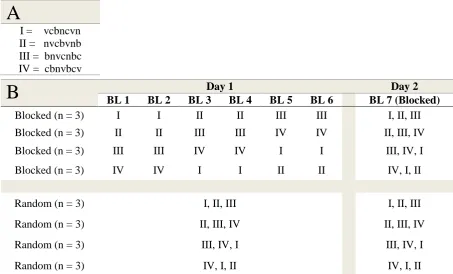
used in both the blocked and the random practice group (see Table 1A). Between each successive
sequence, there was a pause of one second, so the participant could separate the different trials from
each other. Furthermore, the participant had to wait for five seconds when he or she made a mistake.
The forced pause after making a mistake acted as a motivation to make as few errors as possible, because
7 Note. A. The four sequences that were used in the experiment, distributed across the different participants. B. Day 1: The distribution of participants among the order of sequences executed by the participant during the experiment. Day 2: The same sequences were performed as participants had practised the day before. The test phase was performed in a blocked practice regime for both conditions.
2.3 Procedure
The study was conducted in the Behavioural, Management and Social sciences lab of the
University of Twente. When participants entered the lab, they were welcomed and thanked for coming.
The experimenter provided written (see Appendix A) and spoken instruction of the experiment to the
participant and wrote down the date and the time. Furthermore, the participants signed the informed
consent in which they declared that they agreed on the stated requirements of the experiment and that
their information would be treated anonymously (see Appendix B). The experimenter took the cell
phone of the participant to prevent disturbance during the experiment. After entering the participant
number and block number in the computer, the researcher left the room and watched the participant and
the computer screen via a camera.
Participants were allocated to one of the two practice conditions, the blocked (BP) or random
condition (RP). Participants in both conditions were asked to come back approximately 24 hours after
the first part of the experiment, in which day 1 was used as the practice phase of the different sequences.
Day 2 was used as the test phase of the sequences participants practised on day one.
During the practice phase on day 1, participants practised six blocks of 252 trials with a pause
of four minutes between each block. Every block was divided into two subblocks, with a short 30-second
pause in between. Half of the participants were allocated to the BP condition in which one unique
A
I = vcbncvn II = nvcbvnb III = bnvcnbc IV = cbnvbcv
B
BL 1 BL 2 BL 3 Day 1 BL 4 BL 5 BL 6 BL 7 (Blocked) Day 2Blocked (n = 3) I I II II III III I, II, III
Blocked (n = 3) II II III III IV IV II, III, IV
Blocked (n = 3) III III IV IV I I III, IV, I
Blocked (n = 3) IV IV I I II II IV, I, II
Random (n = 3) I, II, III I, II, III
Random (n = 3) II, III, IV II, III, IV
Random (n = 3) III, IV, I III, IV, I
[image:7.595.70.524.96.370.2]Random (n = 3) IV, I, II IV, I, II
Table 1
8 sequence was practised in one block. The order of the practised sequences was balanced across 24
participants (see Table 1B). The other half of the participants were allocated to the RP condition in
which the three different sequences were performed randomly within each block. In this condition, three
sequences were randomly presented to the participant for six blocks. However, every sequence was
presented the same number of times. This means that every block consisted of, for example, 84 trials of
sequence I, 84 of sequence II and 84 of sequence III. Participants were only using their right hand to
press the four keys which corresponded to the four squares on the screen.
All participants returned approximately 24 hours after the practice phase. The test phase on day
2 was the same for both groups and consisted of three short blocks. For both conditions, the three blocks
contained three familiar sequences participants had already practised (see Table 1B). Every sequence
9
3. Results
3.1 Practice phase Reaction Time
Mean Response Time (RT) from the practice phase of each key in each block for every participant was
submitted to a 2 (Practice Schedule: RP, BP) x 6 (Block: 1-6) x 7 (Key: 1-7) mixed analysis of variance
(ANOVA), with Practice Schedule as a between-participants variable. Degrees of freedom and the
p-values were corrected with the Greenhouse Geisser estimates of sphericity. The ANOVA showed that
participants in the RP condition were significantly slower (309 ms) than participants in the BP condition
(244 ms), F(1,22) = 4.85, p < .05, ηp2= .18. Also, the other two main effects were both significant,
Block, F(5,110) = 50.39, p < .001, ηp2 = .70, and Key, F(6,132) = 54.05, p < .001, ηp2 = .71. The
interaction between Block x Practice Schedule is displayed in Figure 2, F(5,110) = 16.64, p < .001, ηp2
= .43. It indicates that every block showed different response times for participants in the RP and BP
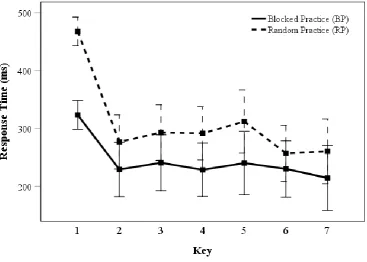
condition. Also, the interaction of Key x Practice Schedule was significant (Figure 3), F(6,132) = 6.59,
p = .001, ηp2= .23. This means that every key contained different response times for participants in the
RP and BP condition. In contrast, the Block x Key interaction had a non-significant effect, F(30,660) =
2.09, p = .13 Also, the Block x Key x Practice Schedule interaction was not significant, F(30,660) =
[image:9.595.75.444.402.664.2]1.68, p = .20.
10 Figure 3. Response Time and error barsper key in the practice phase of the participants in the BP condition and RP condition. Error bars indicated the precision of the error proportions in a 95% confidence interval.
3.2 Practice phase errors
Error analyses involved an ANOVA on arcsine transformed error proportions, because error proportions
are usually not normally distributed (Winer, Brown, & Michels, 1991). After this transformation, the
data were submitted to a 2 (Practice Schedule: RP, BP) x 6 (Block: 1-6) x 7 (Key: 1-7) mixed ANOVA,
with Practice Schedule as a between-participants variable. The main effects of Block, F(5,110) = 4.19,
p = .007, ηp2= .16, and Key, F(6,132) = 13.32, p < .001, ηp2= .38, were both significant. The error
proportions were slightly different between the BP (1.2%) and the RP condition (1.5%). However, this
effect was not significant, F(1,22) = 0.73, p = .40. Furthermore, the interaction between Key x Practice
schedule showed that there was a significant difference between the two groups in the error proportions
per key, F(6,132) = 4.51, p = .002, ηp2= .17, which means that the errors per key were different between
the RP and BP condition. Further interactions were all not significant.
3.3 Test phase Reaction Time
The task on the test day was the same for both groups. The RTs of every key for every participant were
submitted to a 2 (Practice Schedule: RP, BP) x 7 (Key 1-7) mixed ANOVA, with Practice Schedule as
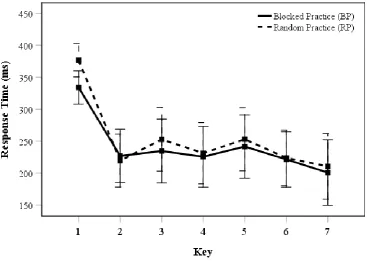
a between-participants variable. No significant difference was reported between the two practice
schedule groups, F(1,22) = 0.21, p = .65. Furthermore, the main effect for Key resulted in a significant
11 Key x Practice schedule had a non-significant effect, F(6,132) = 0.79, p = .49. Thus, there was no
[image:11.595.73.444.136.397.2]significant difference between the two practice groups in the RT per key.
Figure 4. Response Time and error bars per key in the test phase of the participants in the BP condition and RP condition. Error bars indicated the precision of the response times in a 95% confidence interval.
3.4 Test phase errors
A 2 (Practice Schedule: RP, BP) x 7 (Key 1-7) mixed ANOVA was performed on the arcsine
transformed proportions of errors of every key for every participant, with Practice Schedule as a
between-participants variable. It showed that the participants in the BP condition did make significantly
less mistakes (0.8%) than participants in the RP condition (1.6%), F(1,22) = 5.93, p = .02, ηp2= .21.
Also, the main effect of Key was significant, F(6,132) = 3.83, p = .008, ηp2 = .15. However, the
12
4. Discussion
The present study examined the contextual interference effect for a task with seven-key movement
sequences in an extended practice environment. The effect of contextual interference was studied using
the data of participants in a random practice and a blocked practice schedule. The Discrete Sequence
Production task with seven-key sequences was used to study this CI-effect. Based on earlier studies
(Kim et al., 2018; Kim et al., 2016), it was expected that the CI-effect would be found. This would
indicate that there is a difference in response time between the RP and BP condition. However, because
of the extended practice and the development of motor chunks, it was possible that the CI-effect would
be weakened.
The hypothesis was based on the response times and error proportions of participants in both
conditions. It can be stated that the hypothesis was partially accepted, because the effect of contextual
interference was only found during the practice phase. All main and half of the interaction effects of the
response times were significant. This means that the response times of participants in the RP condition
were significantly higher than those of participants in the BP condition. The CI-effect was observed
during the practice phase, which corresponds with other CI-effect research (Hodges et al., 2014; Kim et
al., 2018; Kim et al., 2016). The effort of the participants in the RP condition was higher during the
practice phase, which explains the high response times. While participants in the BP condition
experienced less effort.
In addition, a finding which does not correspond to most CI researches is the non-appearance of
the CI effect in the test phase. No significant difference was found between the two practice groups.
This implies that the hypothesis was partially rejected. As already predicted in the introduction, a limited
CI effect was taken into account. This could explain the results from the retention phase. First, the
extended practice during the practice phase influences the improvement of performance in the test phase
(Perez et al., 2005). Second, the use of motor chunks influences the execution of long sequences. Motor
chunks could be viewed as being independent short sequences. Consequentially, the long sequence is
separated in numerous shorter sequences. Wright et al. (2004) also discussed this second point and
compared the creation of motor chunks in the RP and BP condition in a 4-element, limited practice
motor task. During retention, participants in the RP condition executed the sequences as one single unit.
Participants in the BP condition were executing these sequences as if they were separated in numerous
components. One could imagine that this reinforces with a longer sequence and more extended practice.
The concatenation of the motor chunks becomes stronger (Abrahamse et al., 2013), but the motor chunks
continue to exist.
One other result, concerning the error proportions, should further be explained. The error
proportions in the test phase did not correspond with the usual line of results in other CI-effect research
(Hodges et al., 2014). The difference was small, but participants in the BP condition made significantly
13 (Hodges et al., 2014), participants in the BP condition usually make more errors than participants in the
RP condition. Too little or too much challenge during practice can harm the later retention of the task.
This Challenge Point of Guadagnoli and Lee (2004) can explain the effect of participants making fewer
mistakes in the BP condition. Namely, there is a possibility of too little challenge in the BP condition,
or too much challenge in the RP condition. This could have influenced participants making fewer errors
in the BP condition during the test phase.
A few limitations of this research should be pointed out. First, Jelsma and van Merriënboer
(1989) made a distinction between reflectivity, in which the accuracy of the task is most important for
people, and impulsivity, in which the response time of the task is most important. These two learning
styles showed different results concerning the CI-effect. Impulsive subjects showed a typical CI-effect,
while reflective subjects did not. Their explanation was that the reflective subjects have controlled
processing by themselves, which means that the difference in practice schedule does not have a strong
effect anymore. Impulsive subjects are still sensitive to the difference between the RP and BP condition.
This would mean that the CI-effect only is present for individuals who are focussed on response time.
So, not applicable to every individual in the population.
Second, the laboratory setting could be the next limitation of the current study. The present
research was executed in a controlled setting, which means that many distracting variables were
controlled or not present. Skills which are executed in these settings are called closed skills (Magill &
Hall, 1990). In open skills, these other variables are fully present during motor learning in daily life, e.g.
playing a musical instrument or sports. As stated by Barreiros, Figueiredo and Godinho (2007), it is
therefore difficult to measure the CI-effect in applied practice. They reported that 60 per cent of 27
applied practice studies did not observe a high contextual interference condition. A few factors could
explain this lack of CI-effect, in which one of them is the complexity of the task and its so-called inherent
variability. When the task becomes more complex, it also becomes longer in duration. Participants tend
to forget previous motor solutions caused by the duration of the time between activities or different
activities with other required motor skills. This is called the forgetting hypothesis (Lee, 1983).
Together with this forgetting hypothesis (Lee, 1983), an interesting point to focus on in future
research is the length of the movement sequence and followed by this, its complexity. It may be that a
similar task with sequences of more keypresses does not demonstrate the CI-effect at all, because of its
high complexity. In this case, the effect of motor chunks being represented as if they are short individual
sequences could weaken the later CI-effect. Especially in combination with extended practice (Perez et
al., 2005).
Both limitations indicate that the CI-effect is only present in specific cases. This raises the
question of whether the CI-effect does exist in all situations of motor learning. The hypothesis of the
current research was not entirely supported and indicated that the CI-effect was not fully present. This
also supports that the CI-effect is not present in all cases. It can be concluded that many factors and
14 of human motor learning in general. Therefore, much further motor research should be done in
15
References
Abrahamse, E. L., Ruitenberg, M. F. L., de Kleine, E., & Verwey, W.B. (2013). Control of
automated behavior: insights from the discrete sequence production task. Frontiers in Human
Neuroscience, 7(82), 1-16.
Barreiros, J., Figueiredo, T., & Godinho, M. (2007). The contextual interference effect in
applied settings. European Physical Education Review, 13(2), 195-208.
Bo, J., & Seidler, R. D. (2009). Visuospatial working memory capacity predicts the organization
of acquired explicit motor sequences. J Neurophyiol, 101, 3116-3125.
Brady, F. (2004) Contextual interference: A meta-analytic study. Perceptual and Motor Skills,
99, 116-126.
Guadagnoli, M. A., & Lee, T. D. (2004). Challenge point: A framework for conceptualizing the
effects of various practice conditions in motor learning. Journal of Motor Behavior, 36(2), 212-224.
Hodges, N. J., Lohse, K. R., Wilson, A., Lim, S. B., & Mulligan, D. (2014). Exploring the
dynamic nature of contextual interference: Previous experience affects current practice but not learning.
Journal of Motor Behavior, 46(6), 455-467.
Jelsma, O., & van Merriënboer, J. G. (1989). Contextual interference: Interactions with
reflection-impulsivity. Perceptual and Motor Skills, 68, 1055-1064.
Kim. T., Chen, J., Verwey, W. B., & Wright, D. L. (2018). Improving novel motor learning
through prior high contextual interference training. Acta Psychologica, 182, 55-64.
Kim, T., Rhee, J., Wright, D. L. (2016). Allowing time to consolidate knowledge gained through
random practice facilitates later novel motor sequence acquisition. Acta Psychologica, 163, 153-166.
Lee, T. D. (1983). On the locus of contextual interference in motor skill acquisition. Journal of
Experimental Psychology: Learning, Memory and Cognition, 9, 730-746.
Magill, R. A., & Hall, K. G. (1990). A review of the contextual interference effect in motor skill
acquisition. Human Movement Science, 9, 241-289.
Perez, C. R., Meira, C. M., Jr., & Tani, G. (2005). Does the contextual interference effect last
over extended transfer trials? Perceptual and Motor Skills, 100, 58-60.
Sakai, K., Kitaguchi, K., & Hikosaka, O. (2003). Chunking during human visuomotor sequence
learning. Exp Brain Res, 152, 229-242.
Shea, J. B., & Morgan, R. L. (1979). Contextual interference on the acquisition, retention and
transfer of a motor skill. Journal of Experimental Psychology: Human Learning and Memory, 5,
179-187.
de Souza Fonseca, F., Benda, R. N., da Silva Profeta, V. L., & Urgrinowitsch, H. (2012).
Extensive practice improves adaptation to unpredictable perturbations in a sequential coincident timing
16 Verwey, W. B. (1994). Evidence for the development of concurrent processing in a sequential
keypressing task. Acta Psychologica,85, 245-262.
Verwey, W. B. (2001). Concatenating familiar movement sequences: the versatile cognitive
processor. Acta Psychologica, 106, 69-95.
Verwey, W. B., & Eikelboom, T. (2003). Evidence for lasting sequence segmentation in the
discrete sequence-production task. Journal of Motor Behavior, 35(2), 171-181.
Winer, B. J., Brown, D. R., & Michels, K. M. (1991). Statistical principles in experimental
design. New York: McGraw-Hill.
Wright, D. L., Black, C. B., Immink, M. A., Brueckner, S., & Magnuson, C. (2004).
Long-term motor programming improvements occur via concatenation of movement sequences during
17
Appendix A
April 2019
Participant Instruction
You will participate in an experiment that is aimed to understand better how people learn movement skills. Even if you do not always understand the meaning of certain tasks, remember these are compared with those performed by other participants.
The experiment is composed of 7 blocks, 6 on Day 1 and 1 on Day 2. After each part, you have a break of 4 minutes. You can do whatever you want during this break, but we ask you to give your phone to the experimenter to prevent intrusion of the experiment.
It is important for you to react as fast as possible without making too many errors (try less than 8%!). If you make more errors, the experiment will take you longer to complete.
The instructions will be displayed on the screen. If something is not clear, please ask the experimenter.
The experiment will take about 4 hours on Day 1 and 30 min on Day 2 and will get you 4.5 SONA credits. During the experiment, you will be asked to fill in a short survey. Any remarks about the experiment can be made there.
Good luck with the experiment, and thanks for participating!
18
Appendix B
Informed consent form
Title research: Learning a sequencing skill - CI study
Responsible researcher: Bente Rootmensen, Maik Wigand,prof. Willem Verwey