http://wrap.warwick.ac.uk/
Original citation:Zupan, Zorana, Watson, Derrick G. and Blagrove, Elisabeth. (2015) Inhibition in time-based visual selection : strategic or by default? Journal of Experimental Psychology: Human Perception and Performance . (In Press)
Permanent WRAP url:
http://wrap.warwick.ac.uk/67708 Copyright and reuse:
The Warwick Research Archive Portal (WRAP) makes this work of researchers of the University of Warwick available open access under the following conditions. Copyright © and all moral rights to the version of the paper presented here belong to the individual author(s) and/or other copyright owners. To the extent reasonable and practicable the material made available in WRAP has been checked for eligibility before being made available.
Copies of full items can be used for personal research or study, educational, or not-for-profit purposes without prior permission or charge. Provided that the authors, title and full bibliographic details are credited, a hyperlink and/or URL is given for the original metadata page and the content is not changed in any way.
Publisher statement:
© APA 2015. This article may not exactly replicate the final version published in the APA journal. It is not the copy of record.
http://www.apa.org/pubs/journals/xhp/index.aspx A note on versions:
The version presented here may differ from the published version or, version of record, if you wish to cite this item you are advised to consult the publisher’s version. Please see the ‘permanent WRAP url’ above for details on accessing the published version and note that access may require a subscription.
Inhibition in time-based visual selection: Strategic or by default?
Zorana Zupan
Derrick Watson
Elisabeth Blagrove
University of Warwick, UK
Corresponding author:
Zorana Zupan
Department of Psychology
University of Warwick
Coventry CV4 7AL
UK
Telephone: + 44 (0)2476 50583
Email: [email protected]
Acknowledgements
This work was supported by a University of Warwick Chancellor’s International Scholarship
awarded to Zorana Zupan. We would like to thank Mieke Donk and Naseem Al-Aidroos for
Abstract
The Visual Marking mechanism (Watson & Humphreys, 1997) allows new objects to be
prioritized by applying top-down inhibition to a set of previewed distractors, increasing the
efficiency of future visual search. However, if this inhibition results in little or no search
facilitation, do people continue to apply it or do they strategically withhold it? Here we
present six experiments in which we examined how participants control this inhibitory
mechanism. Experiments 1 to 3 showed that in difficult search contexts, participants did not
modulate the extent to which they applied inhibition based on the proportion of trials in
which inhibition would have been useful. This was the case, even when explicitly cued before
each trial as to the utility of applying inhibition (Experiment 4). In contrast, when search was
conducted in predominantly easy search contexts, there was some evidence that inhibition
was applied strategically (Experiments 5 and 6); however, the extent of this control was
relatively modest. The findings are discussed in terms of the mechanisms of top-down
Introduction
Humans possess numerous top-down attentional mechanisms that provide a volitional
ability to select among competing items. As such, attention can to some extent be directed
freely, without being controlled exclusively by the changing nature of our surroundings. This
top-down attentional system serves an active role in guiding our behavior in goal-relevant
ways. It is often claimed that top-down control allows processing to be strategically applied
in effortful tasks. For example, strategic, volitional behavior has been previously observed in
visual search tasks that investigate the deployment of selective attention (Smilek, Enns,
Eastwood, & Merikle, 2006; Bacon & Egeth, 1994). In the current study, we examine
whether and to what extent people exercise strategic control over a top-down inhibitory
mechanism in selective attention.
Top-down attentional inhibition
In order to process aspects of our environment which are most relevant to our current
needs efficiently, our cognitive system needs to deprioritize and filter out irrelevant
information. A critical way in which this can be achieved is through inhibiting the
representations associated with redundant information (Treisman & Sato, 1980; Moher et al.,
2014).
Evidence for the use of inhibition in enabling attentional selection over time can be
found in the visual marking literature. In a preview search task (Watson & Humphreys,
1997), distractors in a visual search procedure are separated in time, with one set of
distractors (e.g., green Hs) shown (i.e., previewed) before another set of distractors (e.g., blue
As). The target (e.g., a blue letter H) is only ever present in the second set of items, making
the first set of items irrelevant to the goal of finding the target. Search efficiency in this
preview task is typically found to be more efficient than if all the display items had been
search is often as efficient as if only the second set of items had been presented (a
half-elementbaseline; HEB). This suggests that, in some situations, people can ignore fully the set
of old, task-irrelevant stimuli, to restrict their processing to newly-arriving information. Thus,
the visual system appears to be capable of selecting stimuli on the basis of their time of
appearance. Specifically, new items can be selected at the expense of task-irrelevant items
which were presented at an earlier point in time. This finding captures the remarkable ability
of the brain to increase the efficiency of our behavior; irrelevant information is filtered out,
enabling us to achieve our overall goal faster.
Further work has shown that, when searching for a single target, the capacity to
prioritize new items is remarkably large. For example, efficient preview search has been
found with displays of up to 15 new items (Theeuwes, Kramer, & Atchley, 1998) and up to
30 old items (Jiang, Chun, & Marks, 2002). However, in some situations, capacity limits
appear to emerge. For example, Emrich, Ruppel, Al-Aidroos, Pratt, and Ferber (2008)
showed that the probability of fixating an old item in preview search (see also Watson &
Inglis, 2007) increased as a function of the number of eye movements made. By
approximately the fifth saccade, people were more or less equally likely to fixate new or old
items. Nonetheless, in terms of RT search slope measures, a robust preview benefit still
emerged, even with this apparent decay in eye movement selectivity for new/old items.
Subsequent work has shown that such capacity limitations are most likely to occur when
multiple responses, such as mouse clicks or touch responses, have to be made to all new
items (Watson & Kunar, 2012).
That said, the ability to ignore old items does not mean that those items are lost to our
cognitive processing. If old preview items change in potentially ecologically-relevant ways
(i.e. a change in their shape or identity), they then re-capture our attention. In contrast, less
effect, and the altered items remain ignored (Watson & Humphreys, 1997, 2002; Watson,
Braithwaite, & Humphreys, 2008).
Other findings show that moving, as well as stationary items can be effectively
ignored (Watson & Humphreys, 1997, 1998, 2000), and that establishing prior
representations of the old items can result in them being more easily ignored (Kunar,
Humphreys & Smith, 2003; Hodsoll & Humphreys, 2005). Lastly, more behaviorally-salient
stimuli, such as faces, might be more difficult to ignore than ones that are more abstract
(Blagrove & Watson, 2010, 2014).
Three main proposals have been put forward to account for how old stimuli might be
excluded from subsequent search. First, newly-appearing items might capture attention
automatically, based on the luminance transients that they produce within the visual system
(e.g., Donk, 2005, 2006; Donk & Theeuwes, 2001, 2003; Donk & Verburg, 2004; Kiss &
Eimer, 2011). Second, the set of old and new items might be segregated for processing, based
on some kind of temporal asynchrony signal. Grouping, based on common temporal signals,
would then work to define two sets of stimuli (i.e., old and new) to which processing could be
directed differentially (e.g., Jiang et al., 2002). Third, old items might be actively inhibited,
which would reduce their competition for attention when new items arrive; a process that
Watson and Humphreys (1997) called Visual Marking.
The most likely position is that all three processes contribute to generating a preview
benefit to some degree, depending on the exact situation. Indeed, studies continue to explore
the relative contributions of inhibition and automatic luminance onset capture in the
prioritization of new stimuli. For example, the onset account predicts that a preview benefit
should not be obtained if the stimuli are isoluminant with their background (Donk &
Theeuwes, 2001, 2003; Pratt, Theeuwes, & Donk, 2007). However, a preview benefit can be
time is allowed for the locations of the previewed items to be perceived and encoded
(Braithwaite, Hulleman, Watson, & Humphreys, 2006; see also Al-Aidroos, Emrich, Ferber,
& Pratt, 2012).
A luminance onset only account also has difficulty in explaining why past
representations of the old items influence the ability to find new items (Kunar et al., 2003;
Hodsoll & Humphreys, 2005), and the finding that detecting probe stimuli at old item
locations is more difficult than at new item or neutral, no-item locations (Watson &
Humphreys, 2000; but see also Agter & Donk, 2005). Lastly, this account cannot explain the
effect of semantic consistency when visual changes to old items occur (Osugi, Kumada, &
Kawahara, 2010), the finding that a preview effect occurs when new items are presented
during a blink (von Mühlenen, Watson, & Gunnell 2013), or why the detection of new items,
carrying the features of old items, is impaired (i.e., the color carry-over effect; Olivers &
Humphreys, 2003; Braithwaite, Humphreys, & Hodsoll, 2003, 2004), particularly with
moving stimuli (Andrews, Watson, Humphreys, & Braithwaite, 2011).
The findings provided evidence for a robust, but partial preview benefit, suggesting a
role for both the inhibition of old items and capture by the onset signals associated with the
new elements (see Watson & Humphreys, 1997). To sum up, it is likely that a number of
mechanisms contribute to the selection of new elements, depending on the specific task
conditions (see also Al-Aidroos, et al., 2012; Herrero, Crawley, van Leeuwen, & Raffone,
2007).
Strategic attentional control
Previous work has shown that asking participants to adopt particular cognitive
strategies can influence general visual search efficiency. Illustrating this, Smilek, Enns,
Eastwood, and Merikle (2006) found that instructing participants to search actively or to
efficiency depending on whether the task was easy or difficult. Passive search instructions led
to more efficient search when the task was difficult, most likely because participants relied
more on fast automatic processes than on slower executive control processes. Similarly,
Bacon and Egeth (1994) have shown that participants can adopt a singleton search mode, in
which any featurally unique target (e.g. a unique shape or color), captures attention.
Alternatively, they can adopt a feature-based mode, in which only targets possessing a
particular feature (e.g., a specific shape), capture attention (but see Theeuwes, 2004).
Importantly, the type of search mode or strategy that participants adopt can be
manipulated by the contextual factors of the task. For example, if the target is always the
unique item in a display, then a singleton mode is likely to be adopted, while if the target is
not reliably defined by being the only singleton in the display, then a feature-based mode will
be used (Bacon & Egeth, 1994; see also Folk & Anderson, 2010; Folk, Remington, &
Johnston, 1992; Folk, Remington, & Wright, 1994, Horstmann & Becker, 2008, for related
work on contingent involuntary attentional orienting).
In terms of time-based selection, some previous studies have indicated that the
inhibition of old items might also be strategic and intentional. For example, in Watson and
Humphreys’ (2000) work, participants performed a preview search task on the majority
(76%) of trials within a single block. On the remaining 24% of trials, a tone indicated that
participants should look for a small probe dot which was presented at either the location of an
old or a new item, rather than completing the search task. In this situation, successful probe
dot detection was much poorer for old-location probes than for new-location probes (see also
Osugi, Kumada, Kawahara, 2009). In contrast, when participants were instructed to detect a
probe dot on every trial, performance did not depend on the location of the probe dot. This
indicates that the inhibition of the old items had been withheld (Watson & Humphreys,
when there is an advantage for people to do so, and that it is flexibly controlled depending on
observer instructions (Watson & Humphreys, 1997, 2000). However, it is not known whether
observers will spontaneously choose to adopt the process of ignoring old items, and what
factors affect their strategy to do so.
Previous work has also argued that intentionally ignoring old stimuli is an effortful
process, requiring both visual and attentional resources (e.g., Watson & Humphreys, 1997;
Humphreys, Watson, & Jolicoeur, 2002; Olivers & Humphreys, 2002). Given the resource
limited nature of visual processing, we might expect that a cognitively consuming process
would not be implemented in situations in which it is of little use. Furthermore, if this
inhibitory process is susceptible to strategic control, one might ask whether it is modulated in
an all-or-none fashion, or continuously. For example, if there is little benefit from applying
inhibition to increase task performance, participants might choose to abandon the use of
inhibition altogether, or they might apply inhibition selectively to certain trials based on the
perceived value it brings.
Another possibility is that participants follow a default state of always ignoring the
old items, in order to enhance the selection of new stimuli (which could arguably be an
overriding ‘objective’ for the visual system). For example, ‘knowing’ that the target is not
present in the current set of (previewed) items might trigger participants to apply inhibitory
processes by default. Thus, observers might invest resources in inhibiting old items in all
time-based selection situations, irrespective of whether it helps them or not, or potentially
impairs task performance overall.
Overview of the Experiments
We report six experiments in which we examined spontaneously-generated strategic
inhibition in preview search. In Experiments 1-4, the general approach was to present
items was beneficial for task performance on the majority of trials, and so would produce an
overall improvement in target search and task efficiency. In another condition, on the
majority of trials, the old items changed in ways which would disrupt any inhibition that
might have been applied to them. As a result, old items would compete strongly for attention
with the new items. In this situation, applying inhibition to the old items would provide an
advantage on only a minority of trials. Thus, in the first four experiments, we tested whether
disruption of inhibition would encourage participants to modify their attentional strategy. In
Experiments 5 and 6 we presented a highly salient target on the majority of the trials, making
the search sufficiently easy for the target to be detected without having to ignore the old
items. This tested whether inhibition is more likely to be strategically modulated when on the
majority of occasions search can be performed without the need to suppress previously
presented items, and can be performed using an alternative and more efficient strategy.
Experiment 1: Disrupting Location-based Inhibition
The aim of Experiment 1 was to establish whether disruptions of location-based
inhibition would encourage strategic behavior. There were two main trial types, Standard
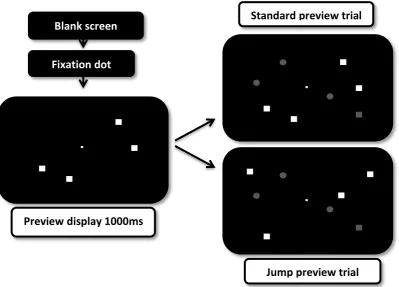
Preview and Jump. On a Standard Preview trial, one set of distractors (the preview items)
was added to the display, followed 1 second later by a second set. The target was only ever
present in the second set (as in Watson & Humphreys, 1997). On a Jump trial, the first set of
items ‘jumped’ (i.e., moved abruptly to new locations) when the second set of stimuli was
added to the display. Based on previous work, we anticipated that such a jump would disrupt
any inhibition applied to the old items (Watson & Humphreys, 1997, but see also Kunar,
Humphreys, Smith, & Hulleman, 2003). These two types of trials were presented in differing
ratios in two separate blocks of trials. In the Standard Preview block, the majority of trials
were standard preview trials and the minority were jump trials. In the Jump block, this was
If participants apply inhibition to the old items strategically, they should be more
likely to apply it in the Standard Preview block, and less likely to apply it in the Jump block.
This would result in efficient search for standard preview trials in the Standard Preview block
(where it would be advantageous overall to apply inhibition) and less efficient search for
standard preview trials in the Jump block (where applying inhibition would only be useful on
a relatively small number of trials). However, if 1) inhibition in preview search is not applied
strategically, or 2) disruptions in location-based inhibition are not sufficient to drive a change
in inhibitory strategy, or 3) changing old item locations is not sufficient to disrupt the
inhibition of old items (cf. Kunar et al., 2003), then we would expect no difference in
performance in the standard preview trials across the two blocks. Note that in this design,
there is no requirement for the typical FEB and HEB conditions to be included. This is
because the most important comparison is between search performance in the standard
preview trials across the two main conditions (i.e., performance on standard preview trials in
the Standard Preview block vs. performance on standard preview trials in the Jump block).
Method
Participants. Participants were 12 undergraduates (all female) from the University of
Warwick, who received course credit for participating. Their ages ranged from 18-44 (M =
21.3, SD = 7.34 years). Participants reported normal or corrected to normal visual acuity in
this and all remaining experiments.
Stimuli and Apparatus. A Samsung 550P5c-S03 laptop was used to present the
displays and record the participants’ responses. Stimuli were displayed on the 15-inch laptop
monitor, at the panel’s native resolution of 1366 × 768 pixels and 60 Hz update rate. Displays
were generated and responses recorded by a custom written computer program. The target
was a light blue [RGB values = 68, 164, 176; CIExy = .234, .225; lum = 34 cd/m2] square
.333, 236; lum = 30 cd/m2] squares, presented against the black monitor background. The
sides of the squares measured 8 mm and the circles had a diameter of 10 mm. There was an
equal number of blue and pink items present in each search display, with the target taking the
place of one of the blue distractors. Search displays were generated by placing items at
random into the cells of an invisible, centrally-placed 6 × 6 grid, with the constraint that there
was an equal number of each type of distractor on the left and right side of the display. Grid
spacing was 110 pixels (28 mm) center-to-center and stimulus locations were further jittered
by +/- 20 pixels (5 mm) in the x- and y-axes, in order to reduce stimulus regularity. The
number of items in the final search display in all conditions (the display size) was 4, 8, or 12.
The target item was constrained to fall into the two most leftward or rightward columns
(columns 1, 2, 5, or 6). This ensured that the target was always unambiguously to the left or
right of display center. Responses were recorded via an 8-button gamepad interface device,
connected via a USB interface.
Design and Procedure. There were two types of trials, StandardPreview and Jump.
A trial in the StandardPreview condition consisted of a blank screen (500 ms), followed by a
central white [RGB = 180,180,180] fixation dot (2 mm × 2 mm), and then 2, 4, or 6 pink
squares. After a further 1000 ms, 1, 3, or 5 blue circles, respectively, were added to the
display, along with the blue square target, to form a final display size of 4, 8, or 12 items.
Search displays remained visible until participants responded, which started the next trial.
Participants indicated the location of the target by pressing the left-shoulder button of the
game pad, if the target was on the left side of the display, or the right-shoulder button if it
was on the right side of the display. A trial in the Jump condition was similar, except that the
set of previewed items ‘jumped’ to new locations when the second set of stimuli (which
the stimuli would jump, nor of the 80:20 split in the block, in order to encourage spontaneous
and ecologically valid behavior.
Importantly, a preview item could not jump to a location previously occupied by a
different preview item. In addition, the items in the second set of stimuli could not be placed
in the location of a previously-occupied preview item. This ensured that any residual
location-based inhibition across displays could not impact on search efficiency.
The two types of trials were combined in different proportions to form two types of
search blocks. In the Standard Preview block, 80% (144 trials) of trials were standard
preview trials and 20% (36 trials) were jump preview trials. In the Jump block, 80% (144
trials) of trials were jump preview trials and 20% (36 trials) were standard preview trials.
Each block contained 180 search trials, with each combination of target location and display
size represented equally. In addition to the search trials, each block also contained 18 (10%)
catch trials, in which no target was present. On catch trials, participants responded by
pressing a third button on the gamepad. These target-absent catch trials prevented participants
from being able to respond by searching only half of the display (e.g., concluding that the
target is on the right, if it is not found on the left; see e.g., Al-Aidroos et al., 2012; Blagrove
& Watson, 2010, for previous uses of this method). Trial order was individually randomized
for each block, and block order was counterbalanced across participants. Participants
completed an 18 trial practice block before each of the full blocks of trials. Within each
block, there was a break after 60 trials. The break was self-paced by the participant, and
lasted until the participant pressed any key on the keyboard.
Results
Reaction Times: Trials with RTs less than 200 ms or greater than 10,000 ms were
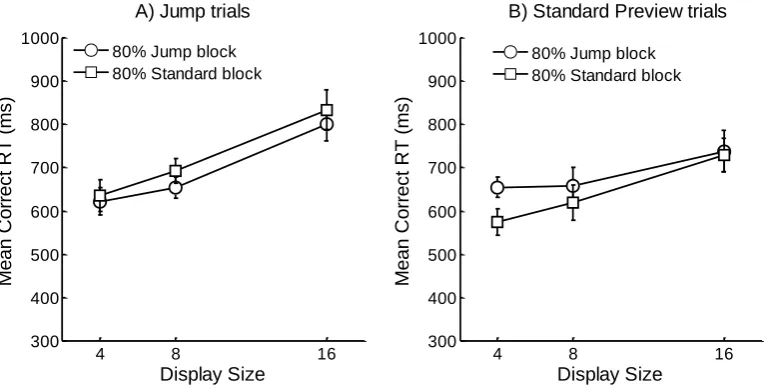
removed as outliers (0.86% of the data). Overall mean correct RTs are shown in Figure 2 and
80% Jump or 80% Standard Preview) × 2 (Trial Type: Jump or Standard Preview) × 3
(Display size) repeated measures ANOVA. There was no main effect of Block, F < 1, but
there were significant main effects of Trial Type F(1,11) = 13.07, MSE = 13588.25, p < .005,
and Display Size F(2,22) = 49.18, MSE = 4431.19, p < .001. RTs were longer for Jump trials,
and increased as the Display Size increased. There was a significant Trial Type × Display
Size interaction F(2,22) = 18.97, MSE = 3539.66, p < .001. Jump trials were more
influenced by Display Size than Standard Preview trials. Neither the Block × Trial Type nor
the Block × Display Size interactions reached significance, both Fs < 1. The three-way Block
× Trial Type × Display Size interaction was also non-significant F(2,22) = 1.07, MSE =
8873.43, p = .36. These analyses suggest that the strength or likelihood of applying inhibition
to the old items did not depend on the proportion of Jump versus Standard Preview trials
within a single block. However, as further confirmation of this, we conducted two planned
comparisons comparing the Jump trials from each type of block and the Standard Preview
trials from each type of block separately.
Jump trials only: A 2 (Block: 80% Jump or 80% Standard Preview) × 3 (Display size)
repeated-measures ANOVA showed that RTs increased with display size, F(2,22) = 104.57,
MSE = 2456.55, p < .001. There was a numerical trend for the search slope of the 80% Jump
block to be shallower than the 80% Standard Preview block, however, neither the main effect
of Block nor the Block × Display Size interaction reached significance, both Fs < 1.
Standard Preview trials only: RTs increased with display size, F(2,22) = 5.11, MSE =
5514.31, p < .05. There was also a numerical trend for search in the 80% Standard block to
be more efficient than in the 80% Jump block. Nevertheless, neither the main effect of Block
nor the Block × Display Size interaction approached significance, both Fs < 1.
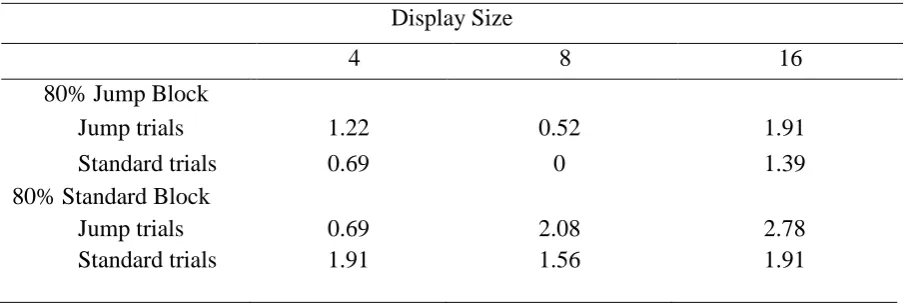
Errors: Mean percentage errors were low overall (1.46%) and are shown in Table 2.
Jump or Standard Preview) × 3 (Display size) repeated measures ANOVA. The main effects
of Block, Trial Type, and Display Size were not significant, nor were the Block × Trial Type,
Block × Display Size interactions, all Fs < 1. The Trial Type × Display Size interaction was
also not significant F(2,22) = 1.48, MSE = 17.09, p = .12, nor the three-way Block × Trial
Type × Display Size interaction, F < 1. The overall error rate on catch trials was 3.70%,
which confirms that participants were searching over the whole display. Due to the small
number of trials, catch trial errors were not analyzed further.
Discussion
The first consideration, given that we did not include the typical HEB and FEB
conditions, was whether we obtained any evidence that the old items were being suppressed
and the new items prioritized. Clearly this was the case, with a significant difference in
search efficiency between the Standard Preview trials and the Jump trials, and Standard
Preview search slopes being less than a third of the Jump slopes. This confirms that having
old items jump to new locations when the new items were added was sufficient to disrupt the
preview benefit substantially (see also Kunar, et al., 2003). The implication is that the new
items were being prioritized for search in the Standard Preview conditions.
However, the main goal of Experiment 1 was to determine whether participants would
spontaneously adopt different inhibitory strategies if applying inhibition helped improve their
search (most of the time), compared to if it would have no benefit (most of the time). The
results showed that there was a robust preview benefit, even in conditions in which, 80% of
the time, inhibiting the old items would not have been useful – presumably here because the
jumping of the old items served to abolish or reset the suppression of previewed items.
Moreover, search efficiency (in terms of search slopes) on Standard Preview trials did not
Preview trials) or not useful (80% Jump trials). This suggests that participants were not
applying inhibition strategically.
Several possibilities might account for these findings. First, it might be that
participants have no choice but to inhibit old items when they are looking out for new items.
This might seem at odds with the findings from Watson and Humphreys (2000), in which
detecting a probe dot was poor for probes presented at old item locations, when participants
were engaged in a search task on the majority of trials. When all the trials were probe dot
trials, there was no difference between detection of probes at old item locations, compared
with probes at new item locations. However, note that in this case, when all trials were probe
trials, there was never any need to inhibit the old items and new items never had to be
prioritized over the old. It might be that whenever a task involves search for new items, the
default is to inhibit old items, irrespective of whether the inhibition is advantageous or not.
According to this account, inhibitory processing of old items is the default state and is
mandatory whenever new items must be prioritized.
Second, numerous studies have suggested that there is a location-based inhibitory
component involved in generating the preview benefit with stationary stimuli (e.g., Olivers,
Watson, & Humphreys, 1999; Osugi, et al., 2009; Watson & Humphreys, 2000). However,
there is evidence that a single change in location (i.e. a jump) might not always be sufficient
to disrupt the inhibition created during the preview of the old items (Kunar, et al., 2003).
Even though our ‘jumps’ were essentially random relocations, and the configuration of the
old items was disrupted (cf. Kunar, et al., 2003; Watson, 2001), it is possible that a single
jump was not able to fully abolish the preview benefit, leading participants to continue to
apply inhibition to the old elements.
Third, a single jump might not have been noticed by our participants. Change
demonstrate that people are very poor at noticing changes that occur when the transients that
would normally be associated with such changes are rendered less visible. This is typically
achieved by interleaving a blank screen (i.e., an artificial eye blink) between the changed
images (e.g. Cole, Kentridge, & Heywood, 2004), presenting the changes during a real eye
blink (O’Regan, Deubel, Clark, & Rensink, 2000), or by presenting competing transients
(‘mudsplashes’, see O’Regan, et al., 1999) at the time when the change occurs. In terms of
time-based selection, Watson and Kunar (2010) showed that shape changes in old items, that
would normally disrupt the preview benefit, are rendered less effective if the changes are
masked by moving occluders. When the change was not directly visible, it had less of a
disruptive influence. In Experiment 1, it is possible that participants did not notice that the
old items had changed their locations because the jumps were effectively masked by the onset
of the new set of (relevant) search items. That is, the transients associated with the onset of
the new items might have acted as ‘mud splashes’ (O’Regan, et al., 1999), which masked the
motion of the old items. If participants were not aware of the jumps in the old items, then
they might not have had a sufficiently strong explicit signal for changing their inhibitory
strategy across the two different blocks of trials.
In order to test these possibilities, in Experiment 2 we made it much more obvious
that the old items changed their locations before the new items arrived. Furthermore,
although not approaching significance, we note that, numerically, the search rate on Standard
Preview trials in the 80% Jump condition was over twice as slow as Standard Preview trials
in the 80% Standard Preview condition (11.40 ms/item vs. 4.49 ms/item), which would be
consistent with the strategic application of inhibition. Hence, Experiment 2 also provided a
useful confirmation of the robustness of the current findings.
Experiment 2 was similar to Experiment 1, except that the old items jumped locations
four times during the preview period, and a fifth time when the new items appeared. If the
lack of strategically controlled inhibition in Experiment 1 was due to participants not noticing
the changes to the old items, or due to a single jump not being sufficiently disruptive, then we
should now obtain evidence for the strategic application of inhibition.
Participants. Participants were 12 students at the University of Warwick (11 female,
1 male), aged between 19 and 23 years (M = 18.8, SD = 1.47) and participated in exchange
for course credit or payment.
Stimuli, Apparatus, and Procedure. The apparatus and procedure were identical to
those of Experiment 1. The stimuli were similar, except that on Jump trials, the previewed
items jumped five times before the new items appeared, and the largest display size was 16
items. On a Jump trial, the previewed items appeared for 800 ms, they then jumped to new
locations and remained visible for 300 ms, before jumping to another set of new locations and
so on. On the fifth jump, the new items were added and the display remained unchanged until
participants responded. On Standard Preview trials, the previewed items appeared for 800 ms,
after which the new items were added to the display.
Results
Reaction Times: Trials with RTs less than 200 ms or greater than 10,000 ms were
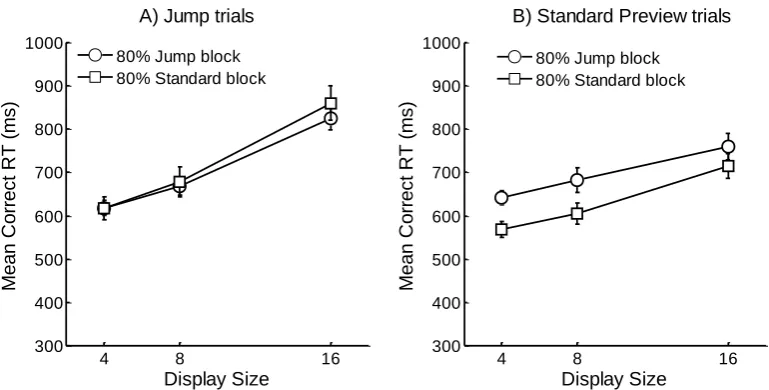
removed as outliers (0.49% of the data). Mean correct RTs for the Jump and Standard
Preview trials are shown in Figure 3 and search slope statistics in Table 3. As in Experiment
1, search data were calculated using a 2 × 2 × 3 repeated-measures ANOVA, which revealed
a significant main effect of Trial Type F(1,11) = 17.83, MSE = 70,650.08, p < .005, and
Display Size F(2,22) = 64.53, MSE = 7528.64, p < .001. The main effect of Block was not
significant, F < 1. RTs on Standard Preview trials were shorter than on Jump trials, and RTs
interaction F(1,11) = 9.79, MSE = 4603.21, p < .05. Jump trial RTs were shorter in the 80%
Jump block and Standard Preview trial RTs were shorter in the 80% Standard Preview block.
The Trial Type × Display size interaction was borderline1 significant F(1,11) = 3.27, MSE = 4775.80, p = .057. However, the Block × Display size interaction did not approach
significance F(2,22) = 2.26, MSE = 2999.48, p = .13, nor did the Block × Trial Type ×
Display size interaction, F < 1. As in Experiment 1, planned follow-up comparisons
compared the two Standard Preview and two Jump conditions individually.Jump trials only:
RTs increased with Display Size, F(2,22) = 39.76, MSE = 5934.16, p < .001, however,
neither the main effect of Block, F(1,11) = 1.01, MSE = 14153.72, p = .34, nor the Block ×
Display Size interaction were significant, F < 1.
Standard Preview trials only: As with the Jump trials, RTs increased with display
size, however, neither the main effect of Block, F(1,11) = 1.03, MSE = 31615.17, p = .33, nor
the Block × Display Size interaction proved significant, F(2,22) = 1.75, MSE = 4436.64, p =
.19. Moreover, the numerical trend was for more efficient search in the 80% Jump block than
in the 80% Standard Preview block (7.4 ms/item vs. 13.1ms/item respectively), which is the
opposite of what would be expected if inhibition was being applied strategically.
Error rates. Error rates were low overall (1.53%) and are shown in Table 4. A 2
(Block) × 2 (Trial type) × 3 (Display size) repeated-measures ANOVA showed that the main
effect of Display Size was marginally significant F(2,22) = 2.89, MSE = 3.41, p = .08.
However, all other main effects and their interactions were non-significant, Block × Display
Size, F(2,22) = 2.49, MSE = 5.17, p = .11, Block × Trial Type × Display Size F(2,22) = 2.54,
1
MSE = 2.64, p = .10, remaining Fs < 1. The overall error rate on catch trials was low
(4.39%), and these errors were not analyzed further.
Discussion
The main aim of Experiment 2 was to determine whether a strategic use of inhibition
would emerge when the changes to the old items were made more salient, by having the old
items jump several times. Despite these changes, there was no evidence that old items were
being strategically inhibited. As in Experiment 1, search slopes of the Standard Preview trials
did not differ between the two blocks of 80% Jump and 80% Standard Preview trials. Again,
search on Jump trials was less efficient than on Standard Preview trials, suggesting that the
stimulus jumps had been effective in disrupting the preview benefit. Taken together,
Experiments 1 and 2 suggest that inhibition is not spontaneously withheld even when, 1)
items move location, rendering any old item inhibition ineffective, and 2) when location
changes are more salient and should be noticed easily.
Note that the old items in Experiments 1 and 2 moved location before the new items
arrived and this would have had the effect of disrupting any location-based inhibition of those
items. However, previous work has shown that old items can also be excluded by inhibition
applied at the level of feature maps, that is, the item’s color (Watson & Humphreys, 1998;
Andrews, et al., 2011; Braithwaite, et al., 2003, 2004). In this way, old items remain
deprioritized (even if they move), without the need for the involvement of complex tracking
procedures (Watson & Humphreys, 1998), which are likely to be of low capacity (Pylyshyn
& Storm, 1988). Accordingly, it is possible that participants might have continued to apply
inhibition, because the old items maintained their color throughout the jump period, allowing
a potential role for color-based inhibition to remain effective. Experiment 3 assessed this
possibility by changing both the color and the locations of the previewed items before the
Experiment 3: Disrupting both feature and location-based inhibition
Even if participants realized that location-based inhibition was ineffective on 80% of
the trials, they might still have tried to inhibit the previewed items because the color of the
old items remained constant throughout the preview period. Furthermore, this maintenance of
color could have encouraged them to continue to apply both location- and feature-based
based inhibition, even when the old items jumped to new locations on the majority of trials.
This possibility was tested in Experiment 3 by having the old items change both their
locations and their color during the preview period. This aim of using this procedure was to
disrupt both location- and feature-based inhibition.
Importantly, the color change of each old item was independent of the color changes
of other items (i.e., the intermediate preview displays were of mixed colors). This procedure
should make it more difficult to group the old items (Jiang, et al., 2002) into a single set,
based on a common color (see also Duncan & Humphreys, 1989). In turn, this should prevent
participants from being able to apply inhibition to a single color-feature map, and increase the
likelihood that feature-based inhibition would be disrupted, due to the associated changes of
activity within multiple color maps (Watson & Humphreys, 1998). Taken together, these
aspects of the design should produce maximal disruption to both location- and feature-based
inhibition, as well as providing highly-noticeable changes in terms of participants’ subjective
experience. As in the previous experiments, the proportion of Jump trials and Standard
Preview trials was manipulated in an 80:20 ratio, across two different blocks of trials.
Method
Participants. Twelve students from the University of Warwick (6 male, 6 female)
aged between 19 and 45 years (M = 24.4, SD = 7.74) and participated in exchange for course
Stimuli, Apparatus and Procedure. The stimuli and procedure were similar to those
of Experiment 2, except that each preview item also changed color each time it jumped to a
new location. Thus, a preview jump trial consisted of a set of pink squares, within which each
square then jumped to a new location (after 800 ms), at the same time changing to a new
color, independently within the set. The possible colors consisted of: light green [RGB = 50,
205, 50; CIExy = .323, 442; lum = 39 cd/m2] , orange [RGB = 255, 265, 0; CIExy = .451,
454; lum = 79 cd/m2], yellow [RGB = 238, 238, 0; CIExy = .441, 448; lum = 66 cd/m2], olive
green [RGB = 142, 142, 56; CIExy = .356, 352; lum = 26 cd/m2] and bright red [RGB = 238,
0, 0; CIExy = .564, 318; lum = 19 cd/m2]. The color change was randomized individually for
each item, with every item having the same probability of changing into one of the five
possible colors. After a further 300 ms, the items jumped and changed their color again. On
the fifth jump, all items returned to the initial pink color, and at the same time the new (blue)
items were added, together with the target, if presented. Having the items change back to
their start color ensured that the final display on jump trials matched that of the Standard
Preview condition and hence, allowed performance in the two trial types to be compared
directly. The Standard Preview condition was identical to that of Experiment 2.
Results
Reaction times. Trials with RTs less than 200 ms or greater than 10,000 ms were
removed as outliers (0.01 % of the data). Mean correct RTs for trials in the Jump and
Standard Preview blocks are shown in Figure 4, and search slope statistics are shown in Table
5. Mean correct RTs were analyzed using a 2 (Block type: 80% Jump or 80% Standard
Preview) × 2 (Trial Type: Jump or Standard Preview) × 3 (Display size) repeated-measures
ANOVA. Standard Preview trials had shorter RTs than the Jump trials, F(1,11) = 12.03, MSE
= 8715.81, p < .01, and RTs increased as the Display Size increased F(2, 22) = 53.72, MSE
F(1, 11) = 32.62, MSE = 2150.44, p < .001, indicating that the RTs for the Standard trials
were longer overall in the 80% Jump block. A Trial Type × Display Size interaction revealed
that the Jump trials were affected more by the Display Size than the Standard Preview trials
F(2, 22) = 15.99, MSE = 3019.19, p < .001. However, there was no main effect of Block
F(1, 11) = 2.92, MSE = 23228.80, p = .12, and neither the Block × Display Size, nor the
three-way Block × Trial Type × Display Size interaction reached significance, both Fs < 1.
Two planned comparisons compared the two Standard Preview and two Jump conditions
individually, similarly to the previous experiments.
Jump trials only: RTs increased with display size, F(2, 22) = 57.26, MSE = 7820.29,
p < .001, however, neither the main effect of block, F < 1 nor the Block × Display Size
interaction approached significance, F(2, 22) = 1.48, MSE = 4042.89, p = .25.
Standard Preview trials only: RTs increased with Display Size, F(2, 22) = 26.08,
MSE = 5122.59, p < .001, and RTs were shorter overall in the 80% Standard Preview block
than in the 80% Jump block, F(1,11) = 9.39, MSE = 14688.32, p < .05. However, of most
relevance, search efficiency, as measured by the Block × Display Size interaction, did not
differ between the two types of block (F < 1), with slopes of approximately 12 ms/item for
both blocks.
Error rates. Error rates were low overall (1.44%) and are shown in Table 6. A 2
(Block: 80% Jump or 80% Standard) × 2 (Trial type: Jump or Standard) × 3 (Display size)
repeated-measures ANOVA revealed that there were no significant main effects or their
interactions; Block, F(1, 11) = 3.02, MSE = 8.98, p = .11, and Display Size, F(2, 22) = 2.42,
MSE = 5.52, p = .11, all remaining Fs < 1. The overall error rate on catch trials was 4.17%
and these were not analyzed further.
Experiment 3 aimed to determine if the strategic use of inhibition would emerge when
the old items changed both their locations and their colors throughout the preview period. As
in the previous experiments, search efficiency was reduced in the Jump trials compared with
the Standard Preview trials, demonstrating that the color/location manipulation abolished the
preview benefit. However, of most relevance, there was again no reliable difference between
search efficiency on the Standard Preview trials in the 80% Standard Preview and 80% Jump
blocks2. Thus, participants continued to apply inhibition to the old items, even when: 1) it
would only have been effective on 20% of the trials and, 2) it was clear that the old items
changed their locations and colors before the new items arrived. It follows that the constant
color of the old items throughout the preview period in Experiments 1 and 2 was unlikely to
be responsible for the continued application of inhibition, even when the inhibition would
clearly be ineffective on the majority of trials.
Comparison of Experiments 2 and 3
In order to increase statistical power and to compare any potential differences
between Experiments 2 and 3 directly, we combined the data from Experiments 2 and 3,
adding ‘Experiment’ as a between-subjects factor. Mean combined correct RTs for trials in
the Jump and Standard Preview blocks are shown in Figure 5 with the combined search slope
statistics and error rates shown in Tables 7 and 8.
Response times. The overall pattern of results was similar to that of the individual
analyses for Experiments 2 and 3. There was a significant main effect of Trial Type, F(1, 22)
=27.42, MSE = 6339.48, p < .001 and of Display Size, F(2, 44) = 122.51, MSE = 7412.06, p
< .001, but no effect of Block, F(1, 22) =1.44, MSE = 8.98, p = .24. In addition, the main
effect of Experiment was also non-significant, F < 1. The Block × Trial Type interaction did
prove significant, F(2, 44) = 122.51, MSE = 7412.06, p < .001, as did the Trial Type ×
Display Size interaction, F(2, 44) = 15.09, MSE = 3897.47, p < .001. No other main effects
or their interaction were significant, all Fs < 2.08, ps > 0.13. Importantly, the absence of a
Block × Display Size interaction suggests that there is no strategic control when
location-based or both location-location-based and feature-location-based inhibition is disrupted. Planned comparisons
assessed the two Standard Preview and the two Jump conditions individually.
Jump trials only: There was no significant main effect of Block, F < 1, while the main
effect of Display Size was significant, F(2, 44) = 96.97, MSE = 6877.21, p < .001. The
Block × Display Size interaction was not reliable, F(2, 44) = 1.21, MSE = 3419.87, p = .31,
and neither was the Display Size × Experiment interaction, F(2, 44) = 2.45, MSE = 6877.32,
p = .09. In addition, the between-subjects main effect of Experiment, the Block ×
Experiment, and the Block × Display Size × Experiment interaction did not reach
significance, Fs < 1.
Standard Preview trials only: There was a significant effect of Block, indicating
longer overall RTs in the 20% Standard Block, F(1, 22) = 6.59, MSE = 23151.56, p < .05.
The main effect of Display Size was also significant, F(2, 44) = 50.97, MSE = 4432.21, p <
.001. The between-subjects effect of Experiment did not prove to be significant, nor did the
< 1. The Block × Display Size × Experiment interaction was also not significant F(2, 44) =
1.73, MSE = 4366.05, p = .19.
Error rates. Errors were analyzed in the same way as the RT data. There was a
significant main effect of Display Size, F(2, 44) = 5.17, MSE = 4.47, p < .05, indicating that
error rate increased with display size. There was no significant main effect of Block, F(1, 22)
= 1.62, MSE = 23151.56, p = .05, nor Block × Trial Type, F(1, 22) = 1.05, MSE = 5.16, p =
.32, Block × Display Size × Experiment, F(2, 44) = 1.97, MSE = 7.65, p = .15 and Block ×
Display Size × Trial Type × Experiment, F(2, 44) = 2.65, MSE = 3.60, p = .08 interactions.
The Block × Display Size, Block × Experiment, Trial Type × Experiment, Block × Trial
Type × Experiment, Trial Type × Display Size interactions, Display Size × Experiment, Trial
Type × Display Size × Experiment, and Block × Trial Type × Display Size interactions were
all non-significant, Fs < 1.
The findings suggest that: 1) having the items change both location and color was no
more disruptive to the preview benefit than having them simply change location, and 2)
location and color changes in the previewed items were no more effective at prompting the
strategic use of inhibition than location changes alone. Taken together, the results from
Experiments 1 to 3 show that, even when inhibition is disrupted on the majority of trials,
people continue to apply it.
So far, the effectiveness of applying inhibition has been manipulated by disrupting the
inhibition applied to the old items (i.e., via changes in their location/color). Participants
appeared insensitive to these disruptions and continued to apply inhibition. However, given
that the blocks consisted of an 80:20 mix of different trials, participants might have chosen to
adopt a single inhibitory strategy, because it would still have been effective in improving
search efficiency, even if only on a minority of trials. Furthermore, there was no way for
and so, they would not have been able to modulate their inhibition on a trial-by-trial basis. In
Experiment 4, we examine whether participants will modulate their application of inhibition
if given advance information regarding the type of trial that will appear.
Experiment 4: Cued location-based disruptions of inhibition
In Experiments 1-3, we showed that participants continued to apply inhibition
throughout both Standard Preview and Jump blocks. However, even though cognitive
resources are consumed by applying inhibition, alternative strategies might have created even
greater cognitive costs. For example, participants did not know whether a Jump or a Standard
Preview trial was going to occur until sometime into the actual trial. By that stage, it might
have been difficult or costly to reconfigure their attentional set (i.e., apply or withhold
inhibition). Thus, a simple strategy of always applying inhibition might have appeared the
easiest and most efficient approach. Furthermore, participants might have placed more
decisional weight on the trials in which inhibition would have been helpful, and might have
been unaware of the full extent of the 80:20/20:80 ratio of trials (i.e., on which inhibition
would have been useful). If this is the case, then we might expect participants to apply
inhibition strategically if they know in advance of each trial, whether the application of
inhibition would be effective or not. In Experiment 4 we tested this by providing participants
with advance information directly before each trial as to whether the trial would be 1) a
Standard Preview trial (in which inhibition would be useful), or 2) a Jump trial (in which any
inhibition would be disrupted, and therefore not effective). Specifically, directly before each
trial we presented participants with an 80% valid visual cue, which informed them whether
the next trial would be a Jump trial or a Standard Preview trial (see Figure 6).
If participants applied inhibition strategically, we would expect search to be more efficient on
validly cued Standard Preview trials (participants would expect a Standard Preview trial and
Jump trial and not apply inhibition). In contrast, on Jump trials, cue validity should have little
effect. This is because on validly cued Jump trials, participants would not apply inhibition
(i.e., because they were expecting a jump). On invalidly cued Jump trials, participants would
expect a Standard Preview trial and apply inhibition, but the inhibition would be rendered
ineffective because of the Jump (as in Experiment 1).
Method
Participants. Twelve students from the University of Warwick (3 male, 9 female)
aged between 21 and 37 years (M = 25.25, SD = 4.71) participated in exchange for payment.
Stimuli, Apparatus and Procedure. The apparatus and procedure were similar to
those of Experiments 1-3. However, in Experiment 4, each trial was preceded with the words
(the cue) ‘Jump’ or ‘No Jump’ presented for 1500 ms displayed at the screen center.
Following the cue there was a blank screen (500 ms), followed by a central fixation dot (750
ms), after which the preview/search displays were presented. Consistent with previous
experiments, there were two blocks with 180 search trials and 18 catch trials. Whereas blocks
in the preceding experiments contained an unequal proportion (80:20/20:80) of Jump and
Standard Preview trials, in the current experiment both blocks were identical. Each block
consisted of 50% Jump trials and 50% Standard Preview trials. For both types of trials, the
pre-trial cue was 80% valid. That is, 80% of Jump trials were cued validly as Jump trials, and
20% were cued invalidly as No Jump trials. Similarly, 80% of the Standard trials were cued
validly as No Jump trials and 20% were cued invalidly as Jump trials.
The stimuli were the same as in Experiment 1, because the multiple jumps or color
changes as used in Experiments 2 and 3 would have provided additional cues of trial type,
prior to the final search display. This could have discouraged participants from following the
written cues, and would have confounded trials that were invalidly cued.
Reaction times. There were no outliers in the data (RTs less than 200 ms or greater
than 10,000 ms). Mean correct RTs for Jump and Standard trials are shown in Figure 7 and
Table 9 shows the search slope statistics. Mean correct RTs were analyzed using a 2 (Cue
Validity: Valid or Invalid) × 2 (Trial Type: Jump or Standard Preview) × 3 (Display Size)
within subjects ANOVA. Standard Preview trials were faster than Jump trials, F(1,11) =
106.03, MSE = 3326.79, p < .001, and RTs increased with Display Size, F(2,22) = 63.39,
MSE = 5511.80, p < .001. RTs also increased more as display size increased on Jump trials
than on Standard Preview trials, F(2,22) = 29.45, MSE =2654.61, p < .001. There was no
significant effect of Validity, nor was there significant interactions of Validity × Trial Type,
Validity × Display Size, and Validity × Trial Type × Display Size, all Fs < 1. As above, to
confirm these results for the two trial types individually, two separate planned comparisons
were carried out.
Jump trials. RTs increased as Display Size increased, F(2,22) = 67.01, MSE =
5654.65, p < .001. However, neither the main effect of Cue Validity, nor the Cue Validity ×
Display Size interaction reached significance, Fs < 1.
Standard Preview trials. RTs increased with Display Size, F(2,22) = 19.38, MSE =
2511.77, p < .001. However there was no significant effect of Cue Validity and Cue Validity
did not interact with Display Size, both Fs < 1.
Error rates. Overall error rates were low (0.99%) and are shown in Table 10. A
three-way repeated-measures ANOVA showed that there was a borderline significant effect of
Trial Type, F(1, 11) = 4.42, MSE = 11.47, p = .06. However, the main effects of Validity,
Display Size, and all interactions were non-significant, all Fs < 1. On catch trials, the overall
error rate was 3.01% and these data were not analyzed further.
One possibility for why participants did not apply inhibition strategically throughout
Experiments 1 to 3 is that there was no information available to them directly before each
trial indicating whether or not inhibition would be useful. Given that inhibitory processing
would still have been useful overall (even if only on a minority of trials), participants might
have chosen to apply it on every trial. Furthermore, even though the presence of changes in
the previewed items would have been very salient on a trial-by-trial basis (especially in
Experiments 2 and 3), the extent of the 20:80/80:20 trial distribution might not have been as
salient. This is especially the case if participants had weighted their decisional focus or
overall strategy on trials in which inhibition would have helped task performance. To test
this, in Experiment 4 participants were explicitly cued in advance of each trial as to whether
it would be a Jump or a Standard Preview trial.
If inhibition was applied in a strategic manner then we would expect to find a
difference in search performance, when comparing validly cued Standard Preview trials (in
which participants should have applied inhibition to the preview items) with invalidly cued
Standard Preview trials (in which participants should have withheld inhibition). However,
there was no hint that this was the case, with search slopes on validly cued Standard Preview
trials being 7.13 ms/item, compared with 7.61 ms/item for invalidly cued Standard Preview
trials. As in previous experiments, search on Jump trials was much less efficient than on
Standard Preview trials (~20 ms/item vs. ~7 ms/item), confirming that changing the locations
of previewed items when new elements were added was sufficient to abolish a preview
benefit. The find of a relatively large difference in search slopes between the Standard
Preview and Jump trials also confirms that there was enough ‘room’ for Standard Preview
search to become less efficient, if participants had chosen not to apply inhibition on the
Overall, the findings confirm the conclusions obtained from Experiments 1 to 3 that
participants appear to apply inhibition in time-based visual selection without strategic
modulation. Moreover, the results of Experiment 4 show, 1) that this is not simply because
participants were unaware of changes, 2) nor was it because there were unsure of the overall
distribution of trials in which inhibition would have been helpful, and 3) the lack of strategic
inhibitory control was not due to insufficient time for participants to readjust their attentional
sets within a trial.
Of note in Experiments 1 to 4, participants had to search through the display in order
to find the target item. Search was relatively inefficient, with search slopes on Jump trials of
approximately 20 ms/item, which equates to a search rate of around 40 ms/item3. It is
possible that inhibition might be applied by default in any time-based selection tasks in which
a relatively inefficient search has to be made. This type of behavior might well be adaptive, if
the cost of applying inhibition is relatively low compared to the potential cost of missing a
predator in complex (i.e., inefficient) search conditions. To examine this possibility, in
Experiment 5 we changed the global ‘search environment’ by introducing trials in which the
target was easily detected without the need for search processes.
Experiment 5: Inhibition in Salient Preview Search Contexts
In Experiment 5, we assessed whether inhibition is applied strategically when target
detection can be performed without having to search the display on a minority or majority of
occasions. It is possible that inhibition is applied by default (a safe strategy) only when target
detection requires effortful search. If a majority of trials do not require the engagement of
search processes to find the target then this might trigger participants to stop applying
inhibition.
3
In outline, the Standard Preview trials were the same as those presented in
Experiments 1 to 4, consisting of a preview display of pink squares, followed by the addition
of a search display containing blue circles and a blue square target item. However, the Jump
trials were replaced with Salient trials. On a Salient trial, pink squares appeared for 1000 ms,
followed by the addition of a single blue square target. Thus, on Salient trials, the target
would be easily detected, because it would be a singleton blue item which was accompanied
by a unique luminance onset within the display. Accordingly, on Salient trials, there would be
no need to inhibit the old previewed items, because the target would pop-out (Treisman &
Gelade, 1980) from the display.
If top-down inhibition operates by default, then it should be applied whenever the
previewed items are presented – here, we should expect no difference between blocks of
trials with many Salient trials, compared with few Salient trials. However, if inhibition is
subject to the observer’s control, then it might not be applied if it is expected that the
subsequent search will be easy (i.e. the target will be obvious and minimal, if any, search will
be needed to locate it).
Method
Participants. Twelve students (6 male, 6 female) from the University of Warwick
aged 20 to 26 years (M = 23.41, SD = 1.92) participated for course credit or payment. .
Stimuli, Apparatus, and Procedure. The stimuli, apparatus, and procedure were
similar to those of Experiment 1-4, except that, Jump trials were replaced by Salient trials.
Thus one block of trials consisted predominantly of 80% Standard Preview trials and 20%
Salient trials and the other block consisted of 20% Standard Preview trials and 80% Salient
trials. A Salient trial consisted of the presentation of pink squares displayed for 1000 ms,
after which a single blue square target was added to the display. There were no additional
5, and 9 items in total (see Figure 8). The Standard Preview trials were identical to those in
Experiment 1.
Results
Response times. Trials with RTs less than 200 ms or greater 10,000 ms were removed
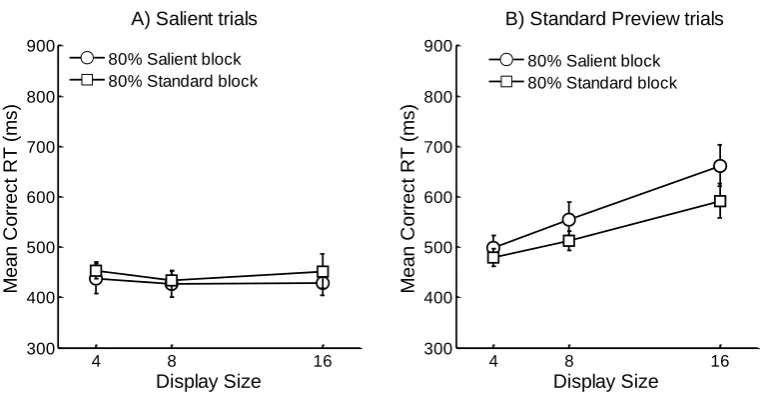
as outliers (0.26 % of the data). Mean correct RTs for Salient and Standard Preview trials are
shown in Figure 9, and the mean search slope statistics are shown in Table 11. As the display
sizes for the Salient and Standard preview trials differed (3, 5, and 9 items vs. 4, 8, and 16
items), two separate 2 (Block: 80% Salient or 80% Standard Preview) × 3 (Display Size)
ANOVAs were performed for each trial type in order to compare search efficiency in each
block.
Standard Preview Trials: For the Standard Preview trials, there was a marginally
significant effect of Block F(1,11) = 4.29, MSE = 8178.49, p = .062, and a significant effect
of Display Size F(2,22) = 67.64, MSE = 1761.18, p < .001. However, of most relevance was
a significant Block × Display Size interaction F(2,22) = 4.18, MSE = 912.58, p < .05,
indicating that the Display Size affected the RTs of Standard Preview trials more in the 80%
Salient block than in the 80% Standard Preview block.
Salient Trials: There were no significant main effects or their interaction; Block,
F(1,11) = 2.19, MSE = 2048.30, p = .17, Display size, Block × Display size, both Fs < 1.
Error rates. Error rates were low overall (1.41%) and are shown in Table 12. Again,
due to the difference in display sizes, separate 2 (Block: 80% Salient or 80% Standard
Preview) × 3 (Display Size) ANOVAs were performed for each trial type.
Standard Preview trials: There were more errors overall in the 80% Salient block
than the 80% Standard Preview Block, F(1,11) = 5.17, MSE = 21.90, p < .05. However,
× Display Size interaction approached significance, F(2,22) = 1.94, MSE = 22.89, p = .17.
The overall error rate on catch trials was 4.16 %, and these data were not analyzed further.
Salient trials: Errors increased as the Display Size increased, F(2,22) = 4.34, MSE =
5.22, p < .05. However, there was no significant main effect of Block, F < 1, or a significant
Block × Display Size interaction, F(2,22) = 1.24, MSE = 2.24, p = .31.
Discussion
The main purpose of Experiment 5 was to determine whether inhibition would be
applied strategically, if the target was salient on a minority/majority of trials. Search slopes
on salient trials were essentially flat, confirming our prediction that salient trials would
produce efficient target detection. However, of most interest, and in contrast to Experiments 1
to 4, we now found a difference in performance between the Standard Preview trials across
the two blocks of trials in which the ratio of Standard to Salient trials was manipulated.
Specifically, when the block contained a minority of Salient trials, RTs on Standard Preview
trials were marginally faster overall, and search slopes were flatter than when the block of
trials contained a majority of Salient trials. This suggests that when the majority of trials
within a search task do not require attentional search, participants do not apply (or are less
likely to apply) inhibition to old, previewed distractors.
Experiment 6: Testing alternative accounts
Although the results of Experiment 5 are compatible with an account that suggests the
strategic application of inhibition, there remain alternative explanations. First, it is possible
that increasing the number of easy pop-out searches within a block of trials encouraged
participants to change their style of search. Specifically, a greater ratio of pop-out trials might
encourage participants to adopt a more passive style of visual search compared with a more
active search style. For example, Smilek et al. (2006) found that actively instructing
search slopes) than instructing participants to adopt an active style of search. However, this
account seems unlikely, because if more passive search results in increased search efficiency,
then we would expect that search would have been more efficient in the 80% Salient block of
trials than in the 80% Standard Preview block of trials. However, we found the opposite, with
search in the 80% Standard Preview block being more efficient than search in the 80%
Salient block.
An alternative version of this account might, however, still hold. If passive search is
less influenced by top-down preview inhibition, or if adopting a passive search strategy
interferes with the deployment of top-down inhibition, then search would become less
efficient in the 80% Salient block of trials. By this account, adopting a passive attentional set
might prevent the adoption of a more active and top-down inhibitory set against the
previewed items. This account has some links to the finding that maintaining an attentional
set for secondary load tasks can reduce the preview benefit (Humphreys, Watson, &
Jolicoeur, 2002).
A further alternative account can be developed on the basis of intertrial priming.
Previous work has shown that when the target and distractor features do not change over
consecutive trials, RTs can decrease (e.g., Becker, 2008ab; Lamy, Antebu, Aviani & Carmel,
2008; Maljkovic & Nakayama, 1994). Recall that in the Standard Preview trials, participants
searched for a blue square among blue circles and pink squares. On the Salient trials,
participants only needed to search for a blue luminance-onset square. Now, in the 80%
Standard Preview block, there would have been many trials on which the Standard Preview
trial target and distractor identities would have been repeated over consecutive trials. Such
repetition of target and distractor features might have led to a reduction in RTs/improved
search efficiency as the number of repeats increased. In contrast, when only 20% of the trials