warwick.ac.uk/lib-publications
Original citation:Andrew, Rhiann E., Ferdani, Dominic W., Ohlin, C. André and Chaplin, Adrian B. (2015) Coordination induced atropisomerism in an NHC-based rhodium macrocycle. Organometallics, 34 (5). pp. 913-917.
Permanent WRAP URL:
http://wrap.warwick.ac.uk/76675
Copyright and reuse:
The Warwick Research Archive Portal (WRAP) makes this work by researchers of the University of Warwick available open access under the following conditions. Copyright © and all moral rights to the version of the paper presented here belong to the individual author(s) and/or other copyright owners. To the extent reasonable and practicable the material made available in WRAP has been checked for eligibility before being made available.
Copies of full items can be used for personal research or study, educational, or not-for profit purposes without prior permission or charge. Provided that the authors, title and full bibliographic details are credited, a hyperlink and/or URL is given for the original metadata page and the content is not changed in any way.
Publisher’s statement:
This document is the Accepted Manuscript version of a Published Work that appeared in final form in Organometallics, copyright © American Chemical Society after peer review and technical editing by the publisher.
To access the final edited and published work see: http://dx.doi.org/10.1021/om501292k
A note on versions:
The version presented here may differ from the published version or, version of record, if you wish to cite this item you are advised to consult the publisher’s version. Please see the ‘permanent WRAP URL’ above for details on accessing the published version and note that access may require a subscription.
Revised manuscript (om-2014-01292k)
Coordination Induced Atropisomerism in a NHC-based Rhodium Macrocycle
Rhiann E. Andrew,a Dominic W. Ferdani,a C. André Ohlinb and Adrian B. Chaplin*a
a Department of Chemistry, University of Warwick, Gibbet Hill Road, Coventry CV4 7AL, UK.
E-mail: [email protected]
b School of Chemistry, Monash University Clayton, Victoria 3800, Australia.
Abstract
Reversible interaction with carbon monoxide results in the onset of dynamic atropisomerism at 298 K in an otherwise static NHC-based rhodium pincer complex, [Rh(C^N^C-(CH2)12)(CO)][BArF4] (1, ArF =
3,5-C6H3(CF3)2). The mechanism of this process has been comprehensively interrogated by a combination of
variable temperature NMR spectroscopy, IR spectroscopy, and computational modeling. In addition, a structural analogue of a high-energy symmetrical intermediate species – invoked in the process but not directly observed spectroscopically – has been prepared and characterised in solution and the solid-state.
Introduction
Pincer ligand architectures featuring N-heterocyclic carbene (NHC) donors are becoming increasingly prominent in organometallic chemistry, combining the strong σ-donor characteristics of NHCs with the favourable thermal stability and reaction control possible with a mer-tridentate geometry.1,2 In particular,
CCC and CNC ligands featuring trans-NHC donors have been partnered with a wide variety of transition elements and subsequently exploited in numerous catalytic transformations.3,4 The structures of xylene- and lutidine-based CCC and CNC variants exhibit characteristically twisted C2 geometries, which orientate
the NHC wingtips (R in Scheme 1) onto opposite faces of the coordination plane. Interconversion between the chiral conformations, atropisomerism, can result in structural fluxionality, even at ambient temperature, and has important consequences for the steric profile of the ligand.5 ,6,7 Notably, such
dynamics are undesirable in any potential applications of CCC and CNC ligands in asymmetric catalysis.8
Scheme 1: Atropisomerism in xylene- (E = C–) and lutidine-based (E = N) NHC pincer complexes
E
N N
N N
[M] R
R
E
N N
N N
[M] R
R
C2 symmetry C2 symmetry
Atropisomerism
Chart 1
[BArF 4]
N
N N N N
Rh CO
1
Previously, the atropisomerism of NHC-based pincer systems has almost exclusively been investigated using Pd(II) complexes, with lutidine-based pincer complexes characterised by ca 20 kJ·mol-1 lower barriers than
comparable xylene variants.5,6 Broadly speaking little barrier height variation is found between systems
containing n-alkyl wingtips or macrocyclic variants with flexible methylene-based linkers;5,6,9 bulky aryl
appendages appear to attenuate atropisomerism.10 Mechanistic work by Faller, Eisenstein and Crabtree has
firmly established mechanisms involving Cs symmetric intermediates, with the more facile atropisomerism
of Pd(II) CNC complexes suggested to proceed via pathways involving partial or complete lutidine dissociation.5 This suggestion was upheld computationally and by experimental observations that
implicated coordination of the counter anion during the process. With a view to exploiting their unique steric profile and topology in organometallic and supramolecular chemistry, some of us have recently become engaged in the investigation of macrocyclic CNC-based complexes such as rhodium(I) complex 1
(Chart 1, ArF = 3,5-C
6H3(CF3)2).9,11 In this report, we describe atropisomerism of 1 that is unusually induced
Results and discussion
Complex 1 adopts C2 symmetry in CD2Cl2 solution across a wide temperature range (185 – 308 K).11 The high
symmetry purports conformational rigidity of the lutidine-based CNC backbone and facile accommodation of the carbonyl ancillary ligand within the macrocycle cavity. To ascertain the barrier for atropisomerism, 1
was studied at higher temperatures by variable temperature 1H NMR spectroscopy using C
6D6 as a solvent
(298 – 350 K, 500 MHz). Coalescence of the diastereotopic methylene bridge (pyCH2) and N-methylene
(N-CH2CH2) resonances is apparent at 350 K and an activation barrier of ΔG‡(298 K) = +66 ± 8 kJ·mol−1 was
obtained by simulation of the 1H NMR data and an Eyring analysis (Figures S9 and S10; ΔH‡ = +62 ± 4
kJ·mol−1, ΔS‡ = -15 ± 13 J·mol−1·K-1). Placing a solution of 1 in CD
2Cl2 (11 mM) inside a J. Young’s NMR tube
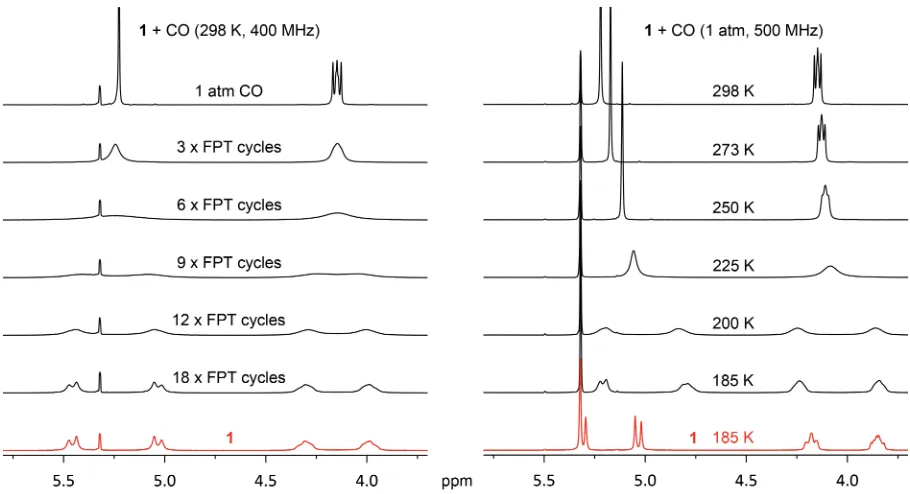
under 1 atmosphere of carbon monoxide12 results in the observation of time-averaged C
2v symmetry in the 1H NMR spectrum indicating a reversible reaction between 1 and CO that involves atropisomerism (400
MHz, Figure 1). Removing carbon monoxide by successive freeze-pump-thaw (FPT) cycles gradually halts the dynamics and regenerates 1, but only after ca 18 cycles. To further investigate this fluxional process, we again turned to variable temperature 1H NMR spectroscopy (1 atm CO, CD
2Cl2, 500 MHz; Figure 1). Cooling
to 185 K resulted in (partial) decoalescence and a barrier height of ΔG‡(298 K) = +40 ± 9 kJ·mol−1 was
determined from the data by line shape analysis as function of temperature and ascribed to atropisomerism of the pincer backbone (Figure S11 and S12; ΔH‡ = +38 ± 4 kJ·mol−1, ΔS‡ = -9 ± 17 J·mol−1·K -1). At 185 K the signals observed do not correspond directly to 1 and are consistent with the presence
of/dynamic exchange with a new C2 or Cs symmetric species: the chemical shifts of the diastereotopic
methylene bridge resonances (δ 5.21/4.80; 2JHH = 14.2 Hz) are notably disparate from those observed for 1
at 185 K (δ 5.31/5.03; 2J
[image:4.595.70.525.491.738.2]HH = 15.0 Hz).11
On the basis of previous work on related palladium compounds (vide supra) and using a more amenable N-methyl analogue (1’),13 two alternative fluxional mechanisms have been computationally evaluated for the
dynamics of 1: a one-step process involving C2 symmetric intermediate 2’ and a two-step process, where
twisting of the pincer ligand is preceded by coordination of carbon monoxide (Scheme 2). All calculations were carried out using density functional theory (DFT) using the dispersion-inclusive exchange correlation functional M06,14 and combinations of the Stuttgart RSC 1997 ECP (Rh) and 6-31G(d,p) (C,H,N,O) basis
sets.15,16Pathways invoking dissociation of CO and formation of low-coordinate 3’ are unlikely under the
experimental conditions and associated with a prohibitively large calculated reaction enthalpy (+240 kJ·mol -1) and associated free energy (+198 kJ·mol-1).
Scheme 2: Mechanic schemes associated with the atropisomerism of 1’. Calculated free energies in kJ·mol-1 at 298 K.
N
N NMe
N NMe
Rh+ CO
N NMe
N NMe
Rh CO+
N N NMe N NMe Rh CO + N OC N N NMe N NMe Rh CO + CO barrier-less + CO N N NMe N NMe Rh+
+ 2 CO + CO
3', ΔG = 198 2', ΔG = 47 1', ΔG = 0 4', ΔG = 2 5', ΔG = 17
ΔG‡ = 55 ΔG‡ = 42
Using the Nudged Elastic Band (NEB) method17 the overall barrier for the one step atropisomerism
mechanism via twisting of the κ3-coordinated pincer ligand (1’ 2’) was calculated to be
ΔH‡(298 K) +53 /
ΔG‡(298 K) +55 kJ·mol-1, consistent with the relatively high value observed experimentally for 1 in the
absence of CO (ΔG‡(298 K) = +66 ± 8 kJ·mol−1). The lutidine remains tightly coordinated throughout the
process; the transition state is characterised by a Rh–N bond length of 2.24 Å, only marginally longer than for 1’ (2.19 Å) and very similar to 2’ (2.25 Å) – the associated calculated (NAO) bond order changes by less than 5% (Table S2). The alternative mechanism proceeds with a significantly exothermic, but marginally endergonic addition of CO to 1’ to form intermediate 4’ (ΔH(298 K) -41 /ΔG(298 K) +2 kJ·mol-1). The
calculated NEB trajectory for this process showed only a smooth increase in energy, inferring a barrier-less process. The coordination of a second CO ligand results in significant elongation of the Rh–N bond (2.41 Å) and corresponding reduction in NAO bond order (by 18%). Such characteristics enable a much lower barrier for atropisomerism (4’ 5’; ΔH‡(298 K) +46 / ΔG‡(298 K) +42 kJ·mol-1), with Cs symmetric intermediate 5’
featuring an essentially κ2-coordinated pincer ligand (Rh···N = 2.63 Å; 54% lower Rh···N NAO bond order
than 1’). These characteristics are in excellent agreement with the variable temperature 1H NMR data; in
particular the measured barrier for atropisomerism: ΔG‡(298 K) = +40 ± 9 kJ·mol−1. In view of the calculated
To further experimentally probe the apparent dynamics observed by 1H NMR at 185 K, the interaction of 1
with CO was studied by in situ IR spectroscopy using a sealed solution cell (1 atm CO, CH2Cl2, 298 K). In
addition to the ν(CO) band associated with 1 (1978 cm-1), carbonyl signals are observed at 2007 and 1953
cm-1 in the difference spectrum which we attribute to 4 (aided by comparison to the spectrum of 6, vide
infra); the two compounds are now in slow exchange relative to the rapid IR time scale (Figure 2).18 The IR
[image:6.595.195.403.260.428.2]spectrum is, however, heavily dominated by the carbonyl stretching of 1, experimentally establishing it as the ground state configuration under CO at 298 K. The relative intensity of the bands attributed to 4, and the presence of only two species provides strong corroboration of the calculated trends in free energies described above for the intermediates involved in the atropisomerism of 1’.
Figure 2: IR spectra of 1 (black), 1 + CO (1 atm, red) and 6 (green) recorded in CH2Cl2 (298 K, transmission mode). Difference spectrum (1 + CO, 1) in blue was taken using normalized transmissions at 1978 cm-1.
In parallel to the computational and spectroscopic studies, rhodium(I) bis-carbonyl 6 was prepared as a structural analogue of the calculated intermediate 5’. Complex 6 was obtained from a readily accessible bis(imidazolium)-xylene pro-ligand using our previously described Ag2O-based transmetallation strategy in
combination with [Rh(CO)2Cl]2 and Na[BArF4], and ultimately isolated in 46% yield following purification by
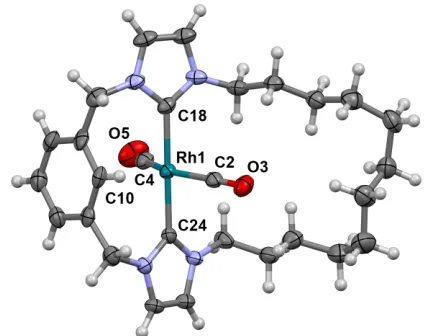
column chromatography (Scheme 3). Alongside the solid-state structure determined by X-Ray diffraction, the structure of 6 was fully corroborated by NMR and IR spectroscopy, together with ESI-MS and elemental analysis (Figure 3). The relative frequencies of the v(CO) bands add experimental support to the attribution of the additional bands observed when 1 is placed under CO, i.e. to 5-coordinate bis-carbonyl adduct 4
rather than 4-coordinate bis-carbonyl adduct 5. The solid-state structure of 6 is particularly notable for the distinctly bent trans-carbonyl ligands (OC-Rh-CO = 151.8(2)º) and the tilted aryl group, which is held in close proximity to the metal centre (Rh1···C1 = 2.585(5) Å). Although similar distorted saw-horse geometries have been reported for d8-metal bis-carbonyl compounds, e.g. trans-[Ir(PPh
3)2(CO)2]+ (OC-Ir-CO = 165.9(2)º),19
the only structurally characterised NHC precedent to our knowledge, trans-[Rh(IBioxMe4)2(CO)2]+, features
an essentially linear configuration (OC-Rh-CO = 173.46(11)º; ν(CO) = 2024 cm-1).20 The measured 1J CH
suggesting that no agostic interaction is presentdespite the proximity of the bond to the metal centre.21
Instead, we suggest the presence of a weak C(pπ)-based interaction; consistent with this suggestion there is
a non negligible Rh···C NAO bond order in the computed N-methyl analogue 6’, which is of very similar magnitude to that calculated for the Rh···N interaction in 5’ (see Table S2) – helping validate the use of 6 as a model for 5.
Scheme 3: Preparation of model intermediate 6.a
N N
N N 2Br
N N
N N
Rh CO OC
[BArF 4]
(i), (ii)
6
a Reagents and conditions: (i) Ag
2O and Na[BArF4], CH2Cl2,
RT; (ii) [Rh(CO)2Cl]2, CH2Cl2, RT. Figure 3: Solid-state structure of 6.Thermal ellipsoids drawn at the 50% probability levels; anion and solvent molecule omitted for clarity. Selected bond lengths (Å) and angles(º): Rh1-C2, 1.895(6); Rh1-C4, 1.914(6); Rh1···C10, 2.585(5); Rh1-C18, 2.067(5); Rh1-C24; 2.050(5); C2-Rh1-C4, 151.8(2); C18-Rh1-C24, 178.8(2).
Summary
Insights into the structural dynamics of C2 symmetric NHC based-pincer complexes have been gained
through a combined computational and experimental investigation of a macrocyclic CNC-based rhodium(I) complex (1). In isolation,atropisomerism of 1 is encumbered by coordination of the central lutidine moiety to the metal centre throughout the process (ΔG‡(298 K) = +66 ± 8 kJ·mol−1). Under a CO atmosphere
structural fluxionally is induced, with reversible coordination of CO promoting a more facile atropisomerism mechanism involving dissociation of the lutidine moiety, twisting of the pincer backbone, and re-coordination of the lutidine bridge (ΔG‡(298 K) = +40 ± 9 kJ·mol−1) – giving an overall barrier for the
atropisomerism of 1 of approximately ΔG‡(298 K) = +42 kJ·mol-1. The presence of a low-energy bis-carbonyl
intermediate (4) has been directly verified by in situ IR spectroscopy and a structural analogue (6) of a second (high energy) C2 symmetric intermediate species (5) has been prepared to help substantiate the
[image:7.595.315.527.179.347.2]Experimental
General experimental methods
Manipulations were performed under an inert atmosphere, using Schlenk (nitrogen) and glove box (argon) techniques unless otherwise stated. Glassware was oven dried (150ºC) and flamed under vacuum prior to use. Anhydrous solvents (<0.005% H2O) were purchased from ACROS or Aldrich and used as supplied:
CH2Cl2, CHCl3, 1,4-dioxane and MeCN. CD2Cl2 was dried over CaH2, vacuum distilled, and stored under
argon. C6D6 was dried over sodium, vacuum distilled, and stored under argon. Na[BArF4],22 [Rh(CO)2Cl]2,23
1,12-bis(imidazole)dodecane9 and 111 were synthesised using literature procedures. All other reagents are
commercial products and were used as received. NMR spectra were recorded on Bruker DPX-400, AV-400, AV-500 (variable temperature experiments) and AVIII-500 HD spectrometers at 298 K unless otherwise stated. Chemical shirts are quoted in ppm; coupling constants are given in Hz. IR spectra were recorded in CH2Cl2 (1.2 mM) using a cell with a Perkin Elmer spectrum100 spectrometer. ESI-MS were recorded on a
Bruker MaXis mass spectrometer. Microanalyses were performed at the London Metropolitan University by Stephen Boyer.
Synthesis of new compounds
[C^CH^C-(CH2)12](Br)2
Solutions of α,αʹ-Dibromo-m-xylene (1.00 g, 3.79 mmol) and 1,12-bis(imidazole)dodecane (1.25 g, 3.79 mmol) in 1,4-dioxane (ca 0.075 M) were simultaneously added dropwise over 30 minutes to a flask charged with warm 1,4-dioxane (150 mL, 90°C). The suspension was heated at reflux for 16 hours, cooled, and the solvent removed in vacuo. The resulting off-white residue was extracted with MeCN (ca 200 mL) with vigorous stirring. The MeCN solution was filtered, concentrated and excess Et2O added. The resulting
precipitate was isolated by filtration and washed with excess Et2O to obtain the product as a white
crystalline solid. Yield: 0.50 g (23%). 1H NMR (500 MHz, CD
2Cl2):δ 10.66 (app. t, J = 1, 2H, imid), 8.23 (app. t,
J = 2, 2H, imid), 8.10 (app. t, J = 2 Hz, 1H, aryl), 7.62 (dd, 3J
HH = 7.7, J = 2, 2H, aryl), 7.34 (t, 3JHH = 7.6, 1H,
aryl), 7.32 (app. t, J = 2, 2H, imid), 5.63 (s, 4H, (aryl)CH2), 4.27 (t, 3JHH = 7.2, 4H, N-CH2), 1.90 (app. p, J = 7,
4H, CH2), 1.18 – 1.32 (m, 16H, CH2). 13C{1H} NMR (126 MHz, CD2Cl2): δ 137.8, 135.4, 131.5, 130.4, 130.4,
123.9, 122.0, 54.0, 53.0, 50. 5, 29.7, 28.6, 28.3, 28.2, 25.8. 13C NMR (126 MHz, CD
2Cl2, selected signal only):
δ 131.5 (d app. p, 1J
CH = 159, J = 4, aryl C10). ESI-MS (CH3CN, 180 °C, 3 kV) positive ion: 203.155 m/z [M]2+
(calc. 203.154). Anal. Calcd. for C26H38Br2N4 (566.144 gmol-1): C, 55.13; H, 6.76; N, 9.89. Found: C, 55.20; H,
6.90; N, 9.80.
[Rh(C^CH^C-(CH2)12)(CO)2][BArF4] (6)
To a Schlenk flask charged with [C^CH^C-(CH2)12](Br)2 (0.140 g, 0.247 mmol), Ag2O (0.057g, 0.247 mmol)
and Na[BArF
4] (0.239g, 0.269 mmol) was added CH2Cl2 (5 mL). The resulting solution was stirred at room
temperature for 16 hours, a solution of [Rh(CO)2Cl]2 (0.048, 0.124mmol) in CH2Cl2 (2 mL) added, and then
product was precipitated as a yellow solid by addition of excess pentane. Yield = 0.162 g (46%). 1H NMR
(500 MHz, CD2Cl2): δ 8.52 (s, 1H, aryl C10H), 7.70 – 7.75 (m, 8H, ArF), 7.56 (s, 4H, ArF), 7.52 (t, 3JHH = 7.7, 1H,
aryl), 7.36 (dd, 3J
HH = 7.6, J = 2, 2H, aryl), 7.20 (d, 3JHH = 2.0, 2H, imid), 7.12 (d, 3JHH = 2.1, 2H, imid), 5.09 (d, 2J
HH = 13.0, 2H, (aryl)CH2), 5.02 (d, 2JHH = 13.0, 2H, (aryl)CH2), 4.19 (t, 3JHH = 8.2, 4H, N-CH2), 1.66 – 1.81 (m,
4H), 1.25 – 1.42 (m, 16H). 13C{1H} NMR (126 MHz, CD
2Cl2): δ 187.8 (d, 1JRhC = 74, carbonyl), 182.4 (d, 1JRhC =
69, carbonyl), 167.7 (d, 1J
RhC = 37, carbene), 162.3 (q, 1JCB = 49, ArF), 139.5 (s, aryl), 135.4 (s, ArF), 130.8 (s,
aryl), 129.4 (qq, 2J
FC = 32, 3JBC = 3, ArF), 129.4 (s, aryl), 125.1 (q, 1JFC = 272, ArF), 124.8 (s, imid), 122.0 (s,
imid), 118.1 (sept, 3J
FC = 4, ArF), 110.8 (s, aryl C10), 54.8 (s, (aryl)CH2), 54.4 (s, N-CH2), 31.2 (s, CH2), 27.3 (s,
CH2), 27.2 (s, CH2), 25.8 (s, CH2), 25.6 (s, CH2). 13C NMR (126 MHz, CD2Cl2, selected signal only): δ 110.8 (d
app. p, 1J
CH = 157, J = 4, aryl C10). ESI-MS (CH3CN, 180 °C, 3 kV) positive ion: 563.189 m/z, [M]+ (calc.
563.188). Anal. Calcd. for C60H48BF24N4O2Rh (1426.75 gmol-1): C, 50.51; H, 3.39; N, 3.93. Found: C, 50.35; H,
3.24; N, 4.14. IR (CH2Cl2): v(CO) 1993 cm-1 (s), 2065 cm-1 (w). Full crystallographic details for 6 are
documented in CIF format and have been deposited with the Cambridge Crystallographic Data Centre under CCDC 1038863. These data can be obtained free of charge from The Cambridge Crystallographic Data Centre via www.ccdc.cam.ac.uk/data_request/cif.
Computational details
Geometry optimizations, normal mode analyses and nudged elastic band (NEB) reaction modeling were all performed using NWChem 6.5; NEB was carried out using a step size and spring constant of 1.0.17,24 Natural
Bond Order analyses were carried out using Gaussian 09.25 All calculations were carried out using the M06
exchange correlation functional,14 using the Stuttgart RSC 1997 ECP (Rh) and 6-31G(d,p) (C,H,N,O) basis
sets.15 Initial NEB trajectories were generated by linear interpolation between the optimised geometries of the starting material and the product, and the resolution of the reaction path was increased by interpolating between the structures in the path using a custom script (see ESI). Thermodynamic properties and reaction barrier heights are reported as non standard-state corrected gas phase energies.
Supporting information
Selected NMR spectra; details of the line shape analyses; selected calculated thermodynamic, spectroscopic, geometric, and electronic properties of 1, 1’ – 6’; X-ray crystallographic data for 6 in CIF format; optimized geometries in Cartesian coordinates (.xyz); and a python script for calculating NEB trajectories (.txt). This material is available free of charge via the Internet at http://pubs.acs.org.
Acknowledgements
References
1 (a) Dröge, T.; Glorius, F. Angew. Chem. Int. Ed. 2010, 49, 6940–6952; (b) Hahn, F. E.; Jahnke, M. C.
Angew. Chem. Int. Ed. 2008, 47, 3122–3172.
2 (a) van Koten, G., Milstein, D. Eds.; Top. Organomet. Chem. 2013, 40, 1-352; (b) Albrecht, M.; Lindner,
M. M. Dalton Trans. 2011, 40, 8733–8744; (c) van der Boom, M. E.; Milstein, D. Chem. Rev. 2003, 103, 1759–1792; (d) Albrecht, M.; van Koten, G. Angew. Chem. Int. Ed. 2001, 40, 3750–3781.
3 (a) Poyatos, M.; Mata, J. A.; Peris, E. Chem. Rev. 2009, 109, 3677–3707; (b) Pugh, D.; Danopoulos, A.
A. Coord. Chem. Rev. 2007, 251, 610–641; (c) Peris, E.; Crabtree, R. H. Coordin. Chem. Rev. 2004, 248, 2239–2246.
4 Representative examples in catalysis: (a) Filonenko, G. A.; Cosimi, E.; Lefort, L.; Conley, M. P.;
Copéret, C.; Lutz, M.; Hensen, E. J. M.; Pidko, E. A. ACS Catal. 2014, 4, 2667–2671; (b) Chianese, A. R.; Drance, M. J.; Jensen, K. H.; McCollom, S. P.; Yusufova, N.; Shaner, S. E.; Shopov, D. Y.; Tendler, J. A. Organometallics 2014, 33, 457–464; (c) Knapp, S. M. M.; Shaner, S. E.; Kim, D.; Shopov, D. Y.; Tendler, J. A.; Pudalov, D. M.; Chianese, A. R. Organometallics 2014, 33, 473–484; (d) Hernández-Juárez, M.; Vaquero, M.; Álvarez, E.; Salazar, V.; Suárez, A. Dalton Trans. 2013, 42, 351–354; (e) Chianese, A. R.; Shaner, S. E.; Tendler, J. A.; Pudalov, D. M.; Shopov, D. Y.; Kim, D.; Rogers, S. L.; Mo, A. Organometallics 2012, 31, 7359–7367; (f) Serra, D.; Cao, P.; Cabrera, J.; Padilla, R.; Rominger, F.; Limbach, M. Organometallics 2011, 30, 1885–1895; (g) Sun, Y.; Koehler, C.; Tan, R.; Annibale, V. T.; Song, D. Chem. Commun. 2011, 47, 8349–8351; (h) Inamoto, K.; Kuroda, J.-I.; Kwon, E.; Hiroya, K.; Doi, T. J. Organomet. Chem. 2009, 694, 389–396; (i) Wei, W.; Qin, Y.; Luo, M.; Xia, P.; Wong, M. S. Organometallics 2008, 27, 2268–2272; (j) Bauer, E. B.; Andavan, G. T. S.; Hollis, T. K.; Rubio, R. J.; Cho, J.; Kuchenbeiser, G. R.; Helgert, T. R.; Letko, C. S.; Tham, F. S. Org Lett 2008, 10, 1175–1178; (k) Loch, J. A.; Albrecht, M.; Peris, E.; Mata, J.; Faller, J. W.; Crabtree, R. H. Organometallics 2002, 21, 700–706.
5 Miecznikowski, J. R.; Gründemann, S.; Albrecht, M.; Mégret, C.; Clot, E.; Faller, J. W.; Eisenstein, O.;
Crabtree, R. H. Dalton Trans. 2003, 831–838.
6 (a) Saito, S.; Azumaya, I.; Watarai, N.; Kawasaki, H.; Yamasaki, R. Heterocycles 2009, 79, 531–548; (b)
Hahn, F. E.; Jahnke, M. C.; Pape, T. Organometallics 2007, 26, 150–154; (c) Hahn, F. E.; Jahnke, M. C.; Gomez-Benitez, V.; Morales-Morales, D.; Pape, T. Organometallics 2005, 24, 6458–6463; (d) Gründemann, S.; Albrecht, M.; Loch, J. A.; Faller, J. W.; Crabtree, R. H. Organometallics 2001, 20, 5485–5488.
7 Schultz, K. M.; Goldberg, K. I.; Gusev, D. G.; Heinekey, D. M. Organometallics 2011, 30, 1429–1437.
8 For an example illustrating a correlation between structural dynamics and enantioselectivitiy in a
series of rhodium NHC complexes see: Jeletic, M. S.; Lower, C. E.; Ghiviriga, I.; Veige, A. S. Organometallics 2011, 30, 6034–6043.
10 (a) Danopoulos, A. A.; Tulloch, A. A. D.; Winston, S.; Eastham, G.; Hursthouse, M. B. Dalton Trans.
2003, 1009–1015; (b) Tulloch, A. A. D.; Danopoulos, A. A.; Tizzard, G. J.; Coles, S. J.; Hursthouse, M. B.; Hay-Motherwell, R. S.; Motherwell, W. B. Chem. Commun. 2001, 1270–1271.
11 Andrew, R. E.; Chaplin, A. B. Inorg. Chem. 2015, 54, 312 – 322.
12 At 298 K and 1 atm partial pressure, the [CO] in CHCl
3 and 1,2-C2H4Cl2 are 8.5 mM and 6.0 mM,
respectively (R. W. Cargill, Ed. IUPAC Solubility Data Series: Carbon Monoxide; Pergamon Press: Oxford, 1990, Vol. 43). The [CO] in CH2Cl2 under these conditions is presumably of similar magnitude.
13 As justification for the use of N-methyl analogues, we note the highly flexible nature of the
dodecamethylene spacer apparent from preceding experimental work using CNC-based pincer complexes [ref. 9,11].
14 Zhao, Y.; Truhlar, D. G. Theor. Chem. Acc. 2008, 120, 215-241.
15 (a) Hehre, W. J.; Ritchfield, R. ; Pople, J. A. J. Chem. Phys. 1972, 2257-2261; (b) Francl, M. M.; Petro,
W. J.; Hehre, W. J.; Binkley, J. S.; Gordon, M. S.; DeFrees, D. J.; Pople, J. A. J. Chem. Phys. 1982, 77, 3654-3665.
16 Implicit solvent models were avoided as these are generally inaccurate for charged species: see for
example, Ohlin, C. A.; Rustad, J. R.; Casey, W. H. Dalton Trans. 2014, 43, 14533-14536.
17 Mills, G.; Jónsson, H. Phys. Rev. Lett. 1994, 72, 1124-1128.
18 Although only applicable to isolated ions in the gas phase, the calculated ν(CO) frequencies and
intensities for 1’, 4’ and 5’ are fully consistent with this assignment (see Table S1).
19 Douvris, C.; Reed, C. A. Organometallics 2008, 27, 807–810.
20 Chaplin, A. B. Organometallics 2014, 33, 3069–3077.
21 M. Brookhart, M. L. H. Green, G. Parkin, Proc. Natl. Acad. Sci. USA 2007, 104, 6908–6914.
22 Buschmann, W. E.; Miller, J. S.; Bowman-James, K.; Miller, C. N. Inorg. Synth. 2002, 33, 83−91.
23 McCleverty, J. A.; Wilkinson, G.; Lipson, L. G.; Maddox, M. L.; Kaesz, H. D. Inorg. Synth. 1990, 28,
84−86.
24 Valie, M.; Bylaska, E. J.; Govind, N.; Kowalski, K.; Straatsma, T. P.; Van Dam, H. J. J.; Wang, D.;
Nieplocha, J.; Apra, E.; Windus, T. L.; De Jong, W. A. Comput. Phys. Commun. 2010, 181, 1477-1489.
25 Frisch, M. J.; Trucks, G. W.; Schegel, H. B. et al., Gaussian 09 Revision D.01, Gaussian inc., Wallingford