Further Reading
Batley GE (1989) Trace Element Speciation: Analytical Methods and Problems. Boca Raton: CRC Press.
Howard AG and Statham PJ (1993)Inorganic Trace Analy-sis Philosophy and Practice. New York: John Wiley and Sons, Inc.
Minczewski J, Chwastowska J and Dybczynski R (1982) Separation and Preconcentration Methods in Inor-ganic Trace Analysis. New York: John Wiley and Sons Inc.
Mizuike A (1983) Enrichment Techniques for Inorganic Trace Analysis. New York: Springer-Verlag.
Ruthven DM (ed) (1997)Encyclopedia of Separation Tech-nology. New York: John Wiley and Sons Inc.
Swaddle TW (1990)Applied Inorganic Chemistry. Calgary: University of Calgary Press.
Tatsuya S and Yuko H (1977)Solvent Extraction Chem-istry:Fundamentals and Applications. New York: Mar-cel Dekker, Inc.
Vandecasteel C and Block CB (1993)Modern Methods for Trace Element Determination. New York: John Wiley and Sons Inc.
VanLoon JC (1985)Selected Methods of Trace Metal Anal-ysis. New York: John Wiley and Sons, Inc.
Zolotov YA (1970) Extraction of Chelate Compounds. Ann Arbor: Humphrey Science Publishers.
Extraction With Supercritical Fluid
See II / EXTRACTION / Supercritical Fluid Extraction
Inorganic Extractions
See II / EXTRACTION / Analytical Inorganic Extractions
Microwave-Assisted Extraction
V. Lopez-Avila, Midwest Research Institute, Cupertino, CA, USA
Copyright^ 2000 Academic Press
Introduction
Common extraction techniques for solid matrices in-clude Soxhlet extraction, sonication extraction, supercriticalSuid extraction (SFE), microwave-assist-ed extraction (MAE), and acceleratmicrowave-assist-ed-solvent extrac-tion (ASE).
Soxhlet extraction allows use of large amount of sample (e.g. 10}30 g), no Rltration is required after
the extraction, the technique is not matrix dependent, and many Soxhlet extractors can be set up to perform in unattended operation. The most signiRcant draw-backs of Soxhlet extraction are: long extraction times (e.g. up to 24}48 h), large amount of solvent usage (300}500 mL per sample), and the need for evapor-ation after sample extraction.
Sonication extraction is faster than Soxhlet extrac-tion (30}60 min per sample) and allows extraction of
large amount of sample with a relatively low cost, but it still uses about as much solvent as Soxhlet extrac-tion, is labour intensive, and Rltration is required after extraction.
The newer extraction techniques such as SFE, MAE, and ASE are very attractive because they are a lot faster, use much smaller amounts of solvents, and are environmentally friendly techniques. For example, SFE uses carbon dioxide or modiRed carbon dioxide (e.g., carbon dioxide contain-ing a small amount of an organic solvent known as modiRer) for extraction. Carbon dioxide is a nontoxic, nonSammable, and environmentally friendly solvent. Furthermore, the extraction selectiv-ity can be controlled by varying the pressure and temperature of the supercriticalSuid and by the addi-tion of modiRers.
solvent, MAE is very fast since the heat is transferred directly to the solvent (provided that the solvent ab-sorbs microwaves). MAE is promising because: it is fast (e.g. 20}30 min per batch of as many as 12
samples); MAE uses small amounts of solvents as compared to Soxhlet and sonication extraction (30 mL in MAE versus 300}500 mL in Soxhlet
ex-traction); it allows full control of extraction para-meters (time, power, temperature); stirring of the sample is possible in MAE; allows high temperature extraction; and no drying agents are needed in MAE since water absorbs microwaves very fast and thus can be used to heat up the matrix. MAE has several drawbacks that contributed to its slow acceptance such as: extracts must be Rltered after extraction, which slows down the operation; polar solvents are needed; cleanup of extracts is needed because MAE is very efRcient (e.g. ‘everything’ gets extracted); and the equipment is moderately expensive.
Accelerated solvent extraction is a fairly new ex-traction method that was approved recently by the U.S. Environmental Protection Agency (EPA) as Method 3545. The extraction is done in a closed-vessel at elevated temperatures (503to 2003C) and pressures (1500}2000 psi). This technique is
attract-ive because it is fast (e.g. extraction time is approxim-ately 15 min per sample), uses minimal solvent (15}40 mL), noRltration is required after the
extrac-tion, and the instrumentation allows extraction in unattended operation. At least 24 samples can be processed sequentially and different sample sizes can be accommodated (e.g. 11, 22, and 33-mL vessels are available).
Theoretical Considerations in MAE
Microwaves are high-frequency electromagnetic waves placed between radio frequency and the in-frared regions of the electromagnetic spectrum (their frequency range from 0.3 to 300 GHz corresponding to wavelengths of 1 m to 1 mm). In contrast to con-ventional heating where the heat penetrates slowly from the outside to the inside of an object, in MAE the heating appears right in the core of the body that is being heated, and the heat spreads from the inside to the outside of that body. The microwave energy affects molecules by ionic conduction and dipole ro-tation. In ionic conduction, the ions in solution will migrate when an electromagneticReld is applied. The resistance of solution to thisSow of ions will result in friction and, thus, heating of the solution. Dipole rotation means realignment of the dipoles with the applied Reld. At 2450 MHz, the dipoles align and randomize 4.9;109 times per second; this forced
molecular movement results in molecular ‘friction’ and, thus, heating of the solution.
Selection of proper solvents is the key to a success-ful extraction. In selecting solvents, consideration should be given to the microwave-absorbing proper-ties of the solvent, the interaction of the solvent with the matrix, and the analyte solubility in the solvent (the principle of ‘like dissolves like’ is still applicable in MAE). The larger the dipole moment of the solvent the faster the solvent will heat under microwave ir-radiation. For example, hexane (dipole moment is
(0.1 Debye) will not heat, whereas acetone with a dipole moment of 2.69 Debye will heat in a matter of seconds. Thus, a mixture of hexane and acetone is an ideal solvent for compounds of environmental signiRcance, and many applications described here use hexane}acetone (1 : 1).
Other important factors under considerations in-clude: 1. the compatibility between the extraction solvent and the analytical method used in the analysis of the extract (the less polar solvents seem to be preferred for gas chromatographic analysis, whereas the more polar ones for liquid chromatographic anal-ysis and immunoassay techniques) and 2. the selectiv-ity of the solvent. Little has been reported in the literature on the selectivity of MAE because the tech-nique is so efRcient that it can not be regarded as a selective extraction technique. ‘Everything gets ex-tracted’ so a cleanup step after the extraction is needed in almost all cases.
When MAE is conducted in closed vessels, the temperature achieved during the extraction will be greater than the boiling points of the solvents. For most of the solvents (e.g. acetone, acetone}hexane,
dichloromethane}acetone), the temperature inside
the vessel is two to three times the boiling point of the solvent. These elevated temperatures result in im-proved extraction efRciencies of the analyte from the sample matrix. The reader should refer toTable 1for a listing of solvents and their maximum closed-vessel temperatures achieved at 175 psi.
Instrumentation for MAE
Table 1 Solvent boiling point and closed vessel temperaturea
Solvent Boiling
point (3C)
Closed vessel temperature (3C) at 175 psi
Dichloromethane 39.8 140
Acetone 56.2 164
Methanol 64.7 151
Ethanol 78.3 164
Acetonitrile 81.6 194
2-Propanol 82.4 145
Acetone}hexane (1 : 1) 52# 156
Acetone}cyclohexane (70 : 30) 52# 160
Acetone}petroleum ether (1 : 1) 39# 147
DichloromethaneIacetone (1 : 1) b 160c
Toluene}methanol (10 : 1) b 110I112c
TolueneImethanol (1 : 10) b 146c
aAdapted from Kingston and Haswell.
bInformation not available.
CTaken from Reference 2.
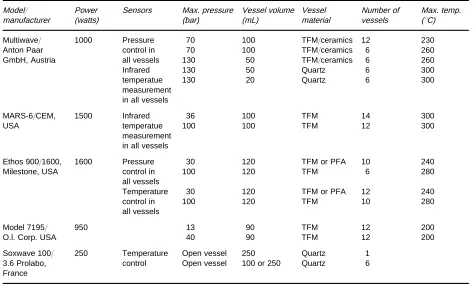
Table 2 Features of commercially available MAE systemsa
Model/ manufacturer
Power (watts)
Sensors Max. pressure
(bar)
Vessel volume (mL)
Vessel material
Number of vessels
Max. temp. (3C)
Multiwave/ Anton Paar GmbH, Austria
1000 Pressure
control in all vessels
70 100 TFM/ceramics 12 230
70 100 TFM/ceramics 6 260
Infrared temperatue measurement in all vessels
130 50 TFM/ceramics 6 260
130 50 Quartz 6 300
130 20 Quartz 6 300
MARS-6/CEM, USA
1500 Infrared
temperatue measurement in all vessels
36 100 TFM 14 300
100 100 TFM 12 300
Ethos 900/1600, Milestone, USA
1600 Pressure
control in all vessels
30 120 TFM or PFA 10 240
100 120 TFM 6 280
Temperature control in all vessels
30 120 TFM or PFA 12 240
100 120 TFM 10 280
Model 7195/ O.l. Corp. USA
950 13 90 TFM 12 200
40 90 TFM 12 200
Soxwave 100/ 3.6 Prolabo, France
250 Temperature
control
Open vessel 250 Quartz 1
Open vessel 100 or 250 Quartz 6
aLopez-Avila V (1999)Critical Reviews in Analytical Chemistry 29: 195, reprinted with permission of CRC Press, Boca Raton, FL.
microwave cavity and shuts off the microwave energy whenever solvent vapour is detected in the instrument cavity), an expansion container (the extraction vessels are connected to this expansion container through vent tubing; in case the membrane ruptures, due to increased pressure in the vessel, then vapour is
re-moved through the rupture vent tube), and an isolator located in the wave guide that diverts reSected wave energy into a dummy load to reduce the micro-wave energy within the cavity. One manufacturer of microwave equipment uses resealable vessels. In this case, vessels are placed on a sample rotor and secured with a calibrated torque wrench for uniform pressure. If the pressure exceeds the vessel limits, a spring device (Milestone’s patented technology) allows the vessel to open and close quickly, thus releasing the excess pressure. These sample rotors are available with (perSuoroalkoxy)polymer (PFATM) and (tetra-Suoroalkoxy)polymer (TFMTM) liners with pressure
ratings of 435 psi to 1450 psi. Another safety feature which was added to the microwave system is the ‘movable wall’. To prevent the door from being blown away, a door frame on spring-loaded, high-impact steel bars was added such that the door moves out and in to release pressure from the microwave cavity.
[image:3.568.48.522.414.699.2]Figure 1 Schematic diagram of a closed vessel MAE system.
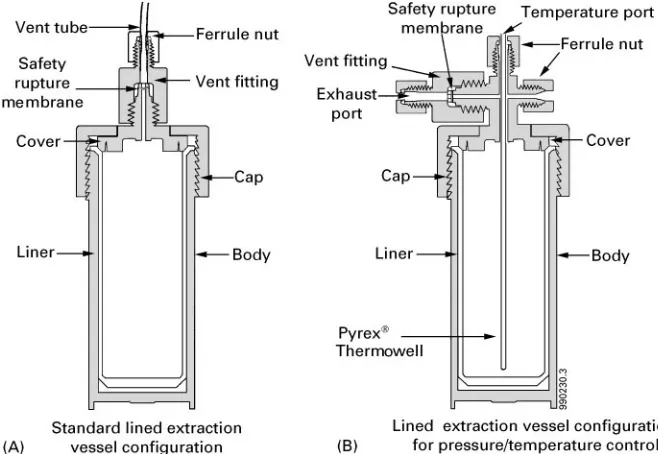
Figure 2 (A) Standard lined extraction vessel and (B) lined extraction vessel with pressure temperature control.
and Plazmatronika’s UniClever system. In the Mile-stone system, for example, if the operating pressure inside the vessel exceeds the vessel limits, a special spring device will allow the vessel to open and close, thus reducing the pressure.
The vessels are typically made of microwave trans-parent materials (e.g. polyetherimide, or TFM) and are lined with perSuoroalkoxy or TeSon2+liners. A new microwave system introduced recently by one
manufacturer uses magnetic stir bars, which allow extraction with polar and nonpolar solvents while agitating the sample and solvent to achieve efRcient mixing and improve analyte recoveries.
Figure 2 shows a schematic of CEM’s lined digestion vessel with and without temperature and pressure control. Vessel body and cap are made of UltemTM, a polyetherimide. The cap and
[image:4.568.116.445.462.689.2]a pressure-sensing tube and aRbre optic temperature probe. TheRbre optic probe is microwave transpar-ent and is positioned in the control vessel using a glass thermal well. Infrared temperature sensors are also used to monitor the temperature inside the vessel. As the turntable revolves, the infrared sensor measures the temperature of each vessel. More detail on the pressure and temperature feedback control can be found elsewhere.
Additional features such as magnetic stirring of the extraction solvent inside multiple sample vessels is possible, at least on one commerical system (Ethos 1600 Labstation from Milestone, Inc.), Moreover, nonpolar solvents, such as hexane, can now be heated at elevated temperatures by use of magnetic stir bars made of Milestone’s proprietarySuoropolymer Wef-lonTM. (This polymer absorbs the microwave energy
and subsequently transfers heat to the surrounding medium.)
All closed vessel systems that are available com-mercially are multivessel systems which evenly space the vessels on a carousel or rotor and rotate them through a pattern on 3603oscillating turntable.
Speci
\
c Applications for MAE
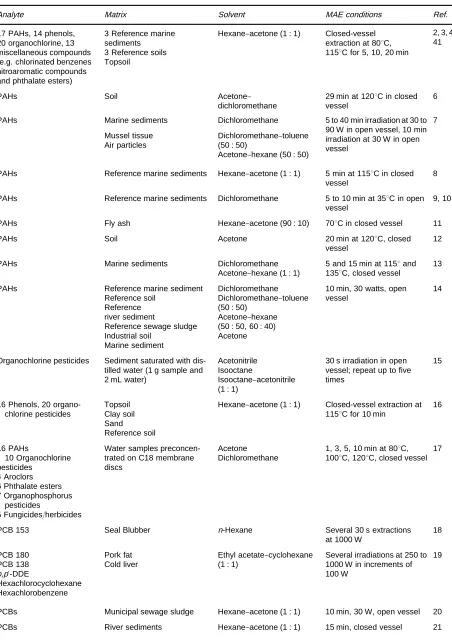
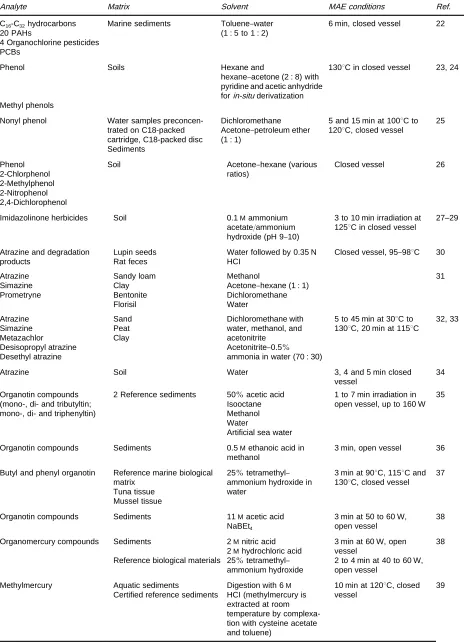
Selected MAE applications are identiRed inTable 3.
Polycyclic Aromatic Hydrocarbons (PAHs)
Work done by V. Lopez-Avila et al. indicated that PAHs, with the exception of more volatile com-pounds such as naphthalene, can be extracted quant-itatively (recovery'80%) from soil and sediment matrices with hexane}acetone (1 : 1) at temperatures
of 1153C. Typical extraction times for batches of up
to 12 samples (5 g each) are 10 min at 100% power (1000 watts). The lower recoveries of naphthalene, acenaphthene, and acenaphthylene were attributed to the presence of water in the soil matrix (to prepare a representative aged soil sample, water was added to the soil matrix to bring its water content to 30%).
Other successful microwave-assisted extractions of PAHs from soils, sediments, and Sy ash have been reported with hexane}acetone (1 : 1), acetone alone,
dichloromethane alone, dichloromethane}toluene
(50 : 50), acetone}petroleum ether (1 : 1), methanol}
toluene (9 : 1), and toluene}water.
Dean et al. reported on a direct comparison be-tween Soxhlet, MAE, and SFE for PAHs and con-cluded that the major advantage of MAE is the speed of extraction, but they also acknowledged that with-out additional cooling after extraction it takes ap-proximately 30 min until the vessels can be opened and extracts processed. Barnabas, Dean and
coworkers also investigated the effects of pressure, temperature, extraction time, and percent of meth-anol modiRer added to the extraction solvent in order to optimize the extraction.
Chee et al. reported a 5-min heating at 1153C
with 30 mL hexane-acetone (1 : 1) as the optimum extraction conditions for a 5 g sample, conditions which are very similar to those reported by V. Lopez-Avilaet al.
Optimization of MAE of PAHs using open-vessel technology was conducted by Budzinskiet al., who reported that the optimum conditions are 30% water, 30 mL dichloromethane, and 10 min heating at 30 W power. When considering that the time needed to reach the boiling point is about 2 min (for dich-loromethane), a heating time of 10 min is more than sufRcient to extract PAHs quantitatively from the matrix, especially when adding water which is sup-posed to cause swelling of the matrix.
Organochlorine pesticides (OCPs)
Onuska and Terry extracted aldrin, dieldrin, and DDT from soils and sediments using acetonitrile, isooctane, or a mixture of isooctane}acetonitrile (1 : 1, v/v) and achieved quantitative recoveries using
Rve or seven 30-s irradiations with microwave en-ergy. They also reported that MAE recoveries in-creases as the moisture content of the soil inin-creases up to 15%. Fish and Revesz used hexane}acetone as
extraction solvent and reported that OCP recoveries improved when changing from 1 : 1 hexane}acetone
to 2 : 3 hexane}acetone. The latter solvent has a
com-position similar to the azeotropic vapour in the Sox-hlet extractor.
Lopez-Avilaet al. extracted 45 OCPs from freshly spiked and 24-h aged soil samples with hexane}acetone (1 : 1, v/v). For the freshly spiked soil, 38 compounds had recoveries between 80 and 120%, six compounds had recoveries between 50 and 80%, and the recovery of captafol was above 120%. For the spiked soil samples aged for 24 h, 28 com-pounds had recoveries between 80 and 120%; 12 compounds had recoveries between 50 and 80%; three compounds including captafol, captan, and dichlone were poorly recovered; and chloroneb and 4,4-DDT had recoveries above 120%.
Table 3 Selected MAE applications reported in the literature
Analyte Matrix Solvent MAE conditions Ref.
17 PAHs, 14 phenols, 20 organochlorine, 13 miscellaneous compounds (e.g. chlorinated benzenes nitroaromatic compounds and phthalate esters)
3 Reference marine sediments
3 Reference soils Topsoil
Hexane}acetone (1 : 1) Closed-vessel
extraction at 803C,
1153C for 5, 10, 20 min
2, 3, 4, 41
PAHs Soil Acetone}
dichloromethane
29 min at 1203C in closed
vessel
6
PAHs Marine sediments Dichloromethane 5 to 40 min irradiation at 30 to
90 W in open vessel, 10 min irradiation at 30 W in open vessel
7
Mussel tissue Air particles
Dichloromethane}toluene
(50 : 50)
Acetone}hexane (50 : 50)
PAHs Reference marine sediments Hexane}acetone (1 : 1) 5 min at 1153C in closed
vessel
8
PAHs Reference marine sediments Dichloromethane 5 to 10 min at 353C in open
vessel
9, 10
PAHs Fly ash Hexane}acetone (90 : 10) 703C in closed vessel 11
PAHs Soil Acetone 20 min at 1203C, closed
vessel
12
PAHs Marine sediments Dichloromethane
Acetone}hexane (1 : 1)
5 and 15 min at 1153and
1353C, closed vessel
13
PAHs Reference marine sediment
Reference soil Reference river sediment
Reference sewage sludge Industrial soil
Marine sediment
Dichloromethane Dichloromethane}toluene
(50 : 50) Acetone}hexane
(50 : 50, 60 : 40) Acetone
10 min, 30 watts, open vessel
14
Organochlorine pesticides Sediment saturated with dis-tilled water (1 g sample and 2 mL water)
Acetonitrile Isooctane
Isooctane}acetonitrile
(1 : 1)
30 s irradiation in open vessel; repeat up to five times
15
16 Phenols, 20 organo-chlorine pesticides
Topsoil Clay soil Sand Reference soil
Hexane}acetone (1 : 1) Closed-vessel extraction at
1153C for 10 min
16
16 PAHs
10 Organochlorine pesticides
Water samples preconcen-trated on C18 membrane discs
Acetone Dichloromethane
1, 3, 5, 10 min at 803C,
1003C, 1203C, closed vessel
17
4 Aroclors 6 Phthalate esters 7 Organophosphorus
pesticides
5 Fungicides/herbicides
PCB 153 Seal Blubber n-Hexane Several 30 s extractions
at 1000 W
18
PCB 180 Pork fat Ethyl acetate}cyclohexane
(1 : 1)
Several irradiations at 250 to 1000 W in increments of 100 W
19
PCB 138 Cold liver
p,p-DDE
Hexachlorocyclohexane Hexachlorobenzene
PCBs Municipal sewage sludge Hexane}acetone (1 : 1) 10 min, 30 W, open vessel 20
Table 3 Continued
Analyte Matrix Solvent MAE conditions Ref.
C16-C32hydrocarbons 20 PAHs
Marine sediments Toluene}water
(1 : 5 to 1 : 2)
6 min, closed vessel 22
4 Organochlorine pesticides PCBs
Phenol Soils Hexane and
hexane}acetone (2 : 8) with
pyridine and acetic anhydride forin-situ derivatization
1303C in closed vessel 23, 24
Methyl phenols
Nonyl phenol Water samples
preconcen-trated on C18-packed cartridge, C18-packed disc Sediments
Dichloromethane Acetone}petroleum ether
(1 : 1)
5 and 15 min at 1003C to
1203C, closed vessel
25
Phenol Soil Acetone}hexane (various
ratios)
Closed vessel 26
2-Chlorphenol 2-Methylphenol 2-Nitrophenol 2,4-Dichlorophenol
Imidazolinone herbicides Soil 0.1Mammonium
acetate/ammonium hydroxide (pH 9}10)
3 to 10 min irradiation at 1253C in closed vessel
27I29
Atrazine and degradation products
Lupin seeds Rat feces
Water followed by 0.35 N HCI
Closed vessel, 95}983C 30
Atrazine Sandy loam Methanol 31
Simazine Clay Acetone}hexane (1 : 1)
Prometryne Bentonite Dichloromethane
Florisil Water
Atrazine Sand Dichloromethane with
water, methanol, and acetonitrite
5 to 45 min at 303C to
1303C, 20 min at 1153C
32, 33
Simazine Peat
Acetonitrite}0.5%
ammonia in water (70 : 30)
Metazachlor Clay
Desisopropyl atrazine Desethyl atrazine
Atrazine Soil Water 3, 4 and 5 min closed
vessel
34
Organotin compounds (mono-, di- and tributyltin; mono-, di- and triphenyltin)
2 Reference sediments 50%acetic acid
Isooctane
1 to 7 min irradiation in open vessel, up to 160 W
35
Methanol Water
Artificial sea water
Organotin compounds Sediments 0.5Methanoic acid in
methanol
3 min, open vessel 36
Butyl and phenyl organotin Reference marine biological matrix
Tuna tissue
25%tetramethyl}
ammonium hydroxide in water
3 min at 903C, 1153C and
1303C, closed vessel
37
Mussel tissue
Organotin compounds Sediments 11Macetic acid
NaBEt4
3 min at 50 to 60 W, open vessel
38
Organomercury compounds Sediments 2Mnitric acid 3 min at 60 W, open
vessel
38 2Mhydrochloric acid
Reference biological materials 25%tetramethyl}
ammonium hydroxide
2 to 4 min at 40 to 60 W, open vessel
Methylmercury Aquatic sediments Digestion with 6M 10 min at 1203C, closed
vessel
39 Certified reference sediments HCI (methylmercury is
of the solvent. (The recovery of dichlone from solvent was only 5.5% after heating at 1453C for 5 min and
2.6% after 20 min at the same temperature.) Micro-bial degradation may be responsible for the low re-coveries of captafol and captan, whereas in the case of dichlone, it is quite likely that this compound is not stable under the conditions used. Nonetheless, these recoveries are higher than those obtained by Soxhlet or sonication extraction.
Water samples can also be extracted by MAE; however, they have to be preconcentrated Rrst on a membrane disc or some adsorbent material. Chee
et al. used C18-membrane discs and then extracted the
discs with 20 mL solvent (acetone and dichloro-methane) in a closed-vessel MAE system at 803C,
1003C and 1203C for 1, 3, 5 and 10 min. Acetone was
found to give higher recoveries than dichloro-methane. This approach would allow extremely low detection limits since several discs generated by pro-cessing a large volume of sample can be extracted in one vessel.
Vetter and coworkers extracted OCPs from fatty tissues (e.g. seal blubber) with solvents such as hexane and ethyl acetate (1 : 1). To transfer heat to hexane, which is microwave transparent, discs of WeSonTM (2.5 cm in diameter ;0.3 cm thickness)
were used in the extraction vessel. The yield of ex-tractable fat and recoveries of OCPs after seven ir-radiation cycles were comparable to those obtained by Soxhlet extraction. Since ethyl acetate}
cyclo-hexane (1 : 1, v/v) seems to extract more fat than hexane, a gel permeation chromatography step after extraction is a must.
Polychlorinated Biphenyls (PCBs)
MAE of PCBs was reported by Lopez-Avila et al. Onuska and Terri, Cheeet al., Pastoret al., Dupont
et al. and Kodba and Marsel. Lopez-Avilaet al. used hexane}acetone (1 : 1, v/v) and reported that the
average recoveries from typical soil matrices were greater than 70% for the Aroclors 1016 and 1260 and the method precision was better than 7%. Fur-thermore, there was no degradation of PCBs upon heating of solvent/soil suspensions with microwave energy. Three reference materials and 24 soils from a Superfund site, most of which contained Aroclors, were extracted by MAE and analysed by both GC/ECD and enzyme-linked immunosorbent assay (ELISA). Because ELISA is very sensitive and its de-tection range is quite narrow, the hexane}acetone extracts were Rrst diluted with methanol and sub-sequently with the assay buffer (which contained 50% methanol) to bring the Aroclor concentrations to less than 5 ng mL\1. These data indicate excellent
agreement between the certiRed Soxhlet/GC/ECD data and the MAE}ELISA data (correlation
co-efRcient 0.9986; slope 1.0168) and the MAE}
GC/ECD data and the MAE}ELISA data (correlation
coefRcient 0.9793; slope 1.0468).
Other solvents used successfully to extract PCBs from environmental samples include isooctane, acetone and dichloromethane, and toluene}water.
Phenols
MAE of phenolic compounds was reported by Lopez-Avilaet al., Llompartet al. Cheeet al. and Egizabalet al. Acetone}hexane seems to be the preferred
solvent for 16 phenolic compounds and dichloro-methane, acetone}petroleum ether (1 : 1) were
re-ported to work well for extraction of nonylphenol. The only compounds found to degrade during MAE are 2,4-dinitrophenol and 4,6-dinitro-2-methyl-phenol. MAE recoveries for phenolic compounds are usually higher than the classical extraction method recoveries, and the method precision is signiRcantly better for MAE (e.g. coefRcient of variation of 3% for MAE as compared to 15% for Soxhlet and 20% for sonication).
Herbicides
Imidazolinones (e.g. imazapyr, imazmetapyr, imazethapyr, imazaquin, etc.) are extracted from soil with 0.1Mammonium acetate/ammonium hydroxide
(pH 9}10) in a 10-min extraction. A variety of soil
samples fortiRed at 1 to 50 p.p.b. exhibited an aver-age recovery of 92% (standard deviation 13%).
Triazine herbicides have been successfully extrac-ted from soil by MAE with water, methanol, acetone}hexane (1 : 1), dichloromethane, acetonitriled
0.5% ammonia in water (70 : 30), dich-loromethane}water (50 : 50), methanol} dich-loromethane (10 : 90). Water seems to be preferred since it is very polar solvent and can interact strongly with polar matter in soils to enhance the desorption of triazines; it is a cheap, safe, and environmentally friendly solvent; and it heats up very quickly when irradiated with microwave energy microwave energy. Xionget al. reported that direct heating of soil with water gave a 73.4% recovery for atrazine from soil and, therefore, stated that ‘MAE is not only a simple heating’.
Organotin and Organomercury Compounds
Open-vessel MAE was recommended to accelerate the leaching with 50% acetic acid aqueous solution, and the data showed that a 3-min irradiation at 60 W was sufRcient to recover tributyl tin from certiRed reference sediments. Ethanoic acid (0.5M in
meth-anol) was also reported. When dealing with bio-logical matrices (e.g., tuna tissue, mussel tissue), solubilization with tetramethylammonium hydroxide (TMAH) for a 3 min at 903C, 1153C, and 1303C in
a closed vessel was demonstrated to be as efRcient as the hot-plate procedure. Schmittet al. reported on the integration of the solubilization step with the derivat-ization/extraction step by using 11Macetic acid for
solubilizationm and NaBEt4for derivatization using
an open vessel MAE system.
Organomercury compounds can be extracted from sediments with 6M hydrochloric acid at 1203C for
10 min in closed vessel or 2M nitric acid and 2M
hydrochloric acid after 3 min irradiation at 60 W in open vessel. Pure acetic acid and 1M sulfuric acid
could only extract 85% and 55%, respectively. Microwave-assisted digestion of the biological tissue with 25% TMAH for 2}4 min at 40}60 W gave
quantitative recovery of both organomercury and in-organic mercury.
Additives in Polymers
Antioxidants such as the Irganox 1010, Irganox 1076, and Irgaphos 168, which are added to poly-mers to protect them during end-use applications, can be extracted with '95% efRciency by MAE with n-heptane}acetone in a few minutes. Higher
temperatures (e.g. 1403C) were used by Jordi
et al. with cyclohexane}chloroform}triethylamine
(45 : 45 : 10) to dissolve polyethylene and extract compounds such as Tinuvin 770, Tinuvin 622, Tinuvin 144, and Chimasorb 81.
Natural Products
Extraction of oils from mint leaves and other mater-ials of biological origin is a patented process known as the ‘microwave-assisted process’. Other reports on MAE of natural products include that of Young, Bichiet al. and Mattinaet al. Young extracted ergo-sterol from fungi and spores by MAE with methanol and 2Msodium hydoxide. Bichiet al. extracted
pyr-rolizidine alkaloids from Senecio palvadosos and Senecio cordatus dried plants by MAE with methanol at 65 to 1003C for 20 to 30 min. Mattina et al.
reported on the extraction of taxanes from Taxus biomass by MAE with ethanol. Using 5 g of freshly harvested needles (moisture content 55 to 65%) soaked in 5 mL of water prior to MAE and 10 mL ethanol at 853C for 9 min resulted in about 90%
recovery. This procedure would signiRcantly reduce the costs of the extraction of taxanes from biomass with no reduction in the extraction yields.
See also: II /Extraction: Supercritical Fluid Extraction; Ultrasound Extractions. III /Environmental Applications: Soxhlet Extraction. Solid-Phase Extraction with Disks.
Further Reading
1. For a comprehensive text on MAE, see Microwave-Enhanced Chemistryedited by H.M. (Skip) Kingston and Stephen J. Haswell, Amertican Chemical Society, 1997.
2. Lopez-Avila V, Young R and Beckert WF (1994) Analytical Chemistry66: 1097}1106.
3. Lopez-Avila V, Young R, Benedicto J, Ho P, Kim R and Beckert WF (1995) Analytical Chemistry 67: 2096}2102.
4. Lopez-Avila V, Young R and Teplitsky NL (1995) Journal of AOAC International79: 142}156. 5. Fish JR and Revesz R (1996)LC-GC14: 230}234. 6. Dean JR, Barnabas IJ and Fowlis IA (1995)Analytical
Proceedings Including Analytical Communications32: 305}308.
7. Budzinski H, Baumard P, Papineau A, Wise S and Garriques P (1995) Presented at the15th PAC Sympo-sium, Belyirule, Italy, 1995.
8. Chee KK, Wong MK and Lee HK (1996) Journal of Chromatography A723: 259}271.
9. Budzinski H, Papineau A, Baumard P and Garrigues P (1995)Analytical Chemistry321: 69}76.
10. Letellier M, Budzinski H, Garrigues P and Wise PS (1996/7)Spectroscopy13: 71}80.
11. Hsu TB and Chen YS (1996)Organohalogen Com-pounds27: 450}454.
12. Barnabas IJ, Dean JR, Fowlis IA and Owen SP (1995) Analyst120: 1897}1904.
13. Chee KK, Wong MK and Lee HK (1996)Journal of Chromatography A723: 259}271.
14. Budzinski H, Letellier M, Garrigues P and Le Menach K (1999) Journal of Chromatography A837: 187}200.
15. Onuska FE and Terry KA (1993)Chromatographia36: 191}194.
16. Lopez-Avila V, Young R, Kim R and Beckert WF (1995) Journal of Chromatographic Science 33: 481}484.
17. Chee KK, Wong MK and Lee HK (1996)Analytica Chimica Acta330: 217}227.
18. Hummert K, Vetter W and Luckas B (1996) Chromatographia42: 300}304.
19. Vetter W, Weichbrodt M, Hummert K, Glotz D and Luckas B (1998)Chemosphere37: 2439}2449. 20. Dupont G, Delteil C, Camel V and Bermond A (1999)
Analyst124: 453}458.
22. Pastor A, Vasquez E, Ciscar R and de la Guardia M (1997)Analytica Chimica Acta344: 241}249. 23. Llompart MP, Lorenzo RA, Cela R, PareH JRJ, BeHlanger
JMR and Li K (1997) Journal of Chromatography A757: 153}164.
24. Llompart MP, Lorenzo RA, Rosa A, Cela R, Li K, BeHlanger JMR and Pare JRJ (1997) Journal of Chromatography A774: 243}251.
25. Chee KK, Wong MK and Lee HK (1996)Journal of Liquid Chromatography and Related Technology19: 259}275.
26. Egizabal A, Zuloaga O, Etxebarria N, Fernandez LA and Madariaga JM (1998)Analyst123: 1679}1684. 27. Stout SJ, da Cunha AR and Allardice DG (1996)
Analytical Chemistry68: 653}658.
28. Stout SJ, da Cunha AR, Picard GL and Safarpour MM (1996)Journal of Agriculture and Food Chemistry44: 3548}3553.
29. Stout SJ, da Cunha AR and Safarpour MM (1997) Journal of AOAC International80: 426}432. 30. Steinheimer TR (1993) Journal of Agriculture and
Food Chemistry41: 588}595.
31. Xiong G, Tang B, He X, Zhao M, Zhang Z and Zhang Z (1999)Talanta48: 333}339.
32. Hoogerbrugge R, Molins C and Baumann BA (1997) Analytica Chimica Acta348: 247}253.
33. Molins C, Hogendoom EA, Heusinkveld HAG, Van Harten DC, Van Zoonen P and Baumann RA (1996)Chromatographia43: 527}532.
34. Xiong G, Liang J, Zou S and Zhang Z (1998)Analytica Chimica Acta371: 97}103.
35. Donard O, Lalere B, Martin F and Lobinski R (1995) Analytical Chemistry67: 4250}4254.
36. Lalere B, Szpunar J, Budzinski H, Garrigues P and Donard OFX (1995)Analyst120: 2665}2673. 37. Rodriguez I, Santamarina M, Bollain MH, Mejuto MC
and Cela R (1997) Journal of Chromatography A 774: 379}387.
38. Schmitt VO, de Diego A, Cosnier A, Tseng CM, Moreau J and Donard OFX (1996/7)Spectroscopy13: 99}111. 39. Vazquez MJ, Carro AM, Lorenzo RA and Cela R
(1997)Analytical Chemistry69(2): 221}225.
40. Lopez-Avila V, Benedicto J, Charan C, Young R and Beckert WF (1995)Environmental Science and Tech-nology29: 2709}2712.
41. Onuska FI and Terry KA (1995)Journal of High Res-olution Chromatography18: 417}421.
42. Freitag W and Angew JO (1990) Makromolecular Chemistry175: 181}185.
43. Jordi HC, Savage W and Bichard F (1995) Paper pre-sented atPittcon ’95, Paper No. 1209.
44. Pare JRJ (1991) US Patent 5,002,784.
45. Young JC (1995) Journal of Agriculture and Food Chemistry43: 2904.
46. Bichi C, Beliarab FF and Rubiolo P (1992)Lab 20006: 36
47. Mattina MJI, Berger WAI and Denson CL (1997) Journal of Agriculture and Food Chemistry45: 4691.
Multistage Countercurrent Distribution
G. Johansson, Chemical Center, Lund, Sweden
This article is reproduced from Encyclopedia of Analytical Science, Copyright ^ 1995 Academic Press.
Theory
The separation of chemical compounds by partition-ing between two liquid phases, so-called liquid}liquid
extraction, can be made more effective by using it as a cascade process. One way in which this can be carried out is by multiplicative partitioning, also called countercurrent distribution (CCD). This pro-cess, in which complete partition equilibrium is achieved in each step, is presented schematically in
Figure 1. The principle is that two sets of liquid phases, the upper and lower phase, come into contact with each other stepwise. The bottom phases are numbered 0, 1, 2 and so on. The sample to be ana-lysed (fractionated) is included in the Rrst system (containing bottom phase number 0). Before each transfer of the upper phases (to the right in Figure 1) the two-phase systems are equilibrated by mixing and
the sample components are distributed between each pair of phases (each full two-phase system). The par-titioning of a pure substance between the phases of a two-phase system can be expressed either by a parti-tion coefRcient,K, deRned as the ratio of the concen-trations (C) of the component in the phases:
K"C(in phase I)
C(in phase II) [1]
or by a partition ratio,G, deRned as the ratio of the masses (m) of the components in the phase:
G"m(in phase I)
m(in phase II) [2]
KandG are related by eqn [3]:
G"K Volume (phase I)
Volume (phase II) [3]