Cross-Site Personalisation
A thesis submitted to the
University of Dublin, Trinity College
For the degree of
Doctor of Philosophy
Kevin Koidl
Knowledge and Data Engineering Group, Department of Computer Science,
Trinity College, Dublin
ii
Declaration
I declare that this thesis has not been submitted as an exercise for a degree at this or any other university and it is entirely my own work.
iii
Permission to Lend or Copy
I agree to deposit this thesis in the University’s open access institutional repository or allow the library to do so on my behalf, subject to Irish Copyright Legislation and Trinity College Library conditions of use and acknowledgement.
iv
Acknowledgements
"It is not the destination that makes the journey worthwhile." Proverb
This journey was full of adventures beyond my wildest expectations and it was the support and guidance of the people around me that allowed me to overcome the many obstacles along the way.
Firstly, I would like to thank my supervisor, Prof. Owen Conlan, whose knowledge and encouragement has guided me through this research. Special thanks are also reserved for Prof. Vincent Wade, my co-supervisor, whose support and insightful advice was invaluable.
I would like to thank my parents for their unconditional and unfailing love, encouragement, belief and guidance throughout my life. You are my role models and have set an example that I will always aspire to live up to. My brother Roman for always being there when I needed him. My wife Niuscha, whose love, kindness and encouragement gave me balance when things got hard.
I would also like to thank my colleagues and friends in the Knowledge and Data Engineering Group for helping me along the way. My special thanks goes to John McAuley, Brian Gallagher, Dr. Cormac Hampson, Luca Lungo, Dr. Alex O’Connor, Prof. Seamus Lawless, Dr. Dominic Jones and Hilary McDonald.
I also would like to thank my wider circle of friends assisting me with the write up of this thesis, especially Dr. Emmett P. Tracey and Dr. Bahman Honari.
Finally, I would like to express my gratitude to Science Foundation Ireland for funding the research detailed in this thesis through the Centre of Next Generation Localisation (CNGL).
v
Es gibt noch eine andere Welt zu entdecken – und mehr als eine! Auf die Schiffe, ihr Philosophen!"
“There is still another world to discover – and more than one! Aboard ship, ye philosophers!”
vi
Abstract
Web users are continuously confronted with vast amounts of information. This phenomenon is known as the information explosion and can lead to disorientation and decreased productivity as users attempt to navigate through information to discover what they need. Web Personalisation techniques, such as Adaptive Hypermedia, have been employed to overcome this issue. However, these techniques are typically focussed on closed collections of content, housed on a single website. This is at odds with the typical web browsing paradigm, where users navigate across multiple sites to identify relevant information.
This thesis introduces the Cross-Site Personalisation (CSP) approach to Web Personalisation. This approach seamlessly personalises the support offered to each individual user as they browse across multiple websites. The approach models the user’s interactions and then tailors the information on each independent website to support their needs. The Cross-Site Personalisation approach is realised as a third-party personalisation service that interfaces with multiple websites via standard extension modules. The approach is non-intrusive and does not negatively impact on the user’s web browsing experience. It is also sensitive to the user’s privacy concerns by not divulging information about a user to the websites being personalised. Rather, this approach recommends how each website may adapt their information and navigation structures to meet the user’s needs. To evaluate the appropriateness of this approach two authentic use cases have been scoped, designed and developed. The first use case focuses on CSP within closed domains, such as those typically seen in enterprise website federations. The second use case addresses open domains, where the user is navigating across websites on the open web.
vii
Table of Contents
Declaration ... ii
Permission to Lend or Copy ... iii
Acknowledgements ... iv
Abstract... vi
1. Introduction ... 1
1.1. Motivation ... 1
1.2. Research Question ... 4
1.3. Research Objective, Goals and Challenges ... 5
1.4. Methodology... 6
1.5. Contribution ... 6
1.6. Scope ... 8
1.7. Thesis Overview ... 8
2. State of The Art Review ... 10
2.1. Introduction ... 10
2.2. Information Overload and the Limitations of the Current Search Paradigm ... 13
2.3. Gap in the State of the Art ... 15
2.4. Web User Dimension ... 17
2.4.1. Introduction ... 17
2.4.2. Understanding and Assisting the Web Users in Addressing Information Needs 17 2.4.3. Modelling Information Needs... 24
2.4.4. User Identification, Online Privacy and Trust ... 29
2.4.5. Summary ... 30
2.5. Web Content Dimension ... 33
2.5.1. Introduction ... 33
2.5.2. Extracting Meaning from Pre-Structured Web Content ... 33
2.5.3. Extracting Meaning from Unstructured Web Content ... 35
2.5.4. Closed and Open Corpus ... 37
2.5.5. Summary ... 38
2.6. Web Application Dimension ... 39
2.6.1. Introduction ... 39
viii
2.6.2.1. Information Retrieval ... 41
2.6.2.2. Recommender Systems ... 42
2.6.2.3. Rule-based Systems ... 44
2.6.3. Non-Invasive Integration of Web Personalisation Techniques ... 45
2.6.3.1. Non-Invasive integration of Web Personalisation at design-time ... 46
2.6.3.2. Non-Invasive integration of Web Personalisation at run-time ... 47
2.6.4. Interoperability of Web Personalisation Approaches ... 49
2.6.4.1. Adaptive Hypermedia Systems ... 50
2.6.4.2. Scout approaches ... 53
2.6.4.3. Intermediary Approaches (Portal approaches) ... 54
2.6.4.4. Browser Extensions/Plug-ins ... 55
2.6.5. Summary ... 56
2.7. Conclusions ... 59
3. Design ... 60
3.1. Influences from the State of the Art ... 60
3.1.1. Web User Dimension Requirements ... 60
3.1.2. Web Content Dimension Requirements ... 62
3.1.3. Web Application Dimension Requirements ... 62
3.1.4. Summary ... 63
3.2. High-Level Design ... 65
3.2.1. High-Level Design Considerations ... 65
3.2.2. CSP Architecture Overview and Component Responsibilities... 67
3.2.3. Summary ... 71
3.3. Cross-Site Personalisation in Closed Domains ... 74
3.3.1. Characteristics of a Closed Domains in the Context of CSP ... 74
3.3.2. CSP Design Considerations for Use cases in Closed Domains ... 75
3.3.3. CSP Architecture Components and Responsibilities in Closed Domains ... 76
3.3.4. Summary ... 79
3.4. Cross-Site Personalisation in Open Domains ... 84
3.4.1. Characteristics of a Closed Domains in the Context of CSP ... 84
3.4.2. Design Considerations for CSP Use cases in Open Domains ... 85
3.4.3. CSP Architecture Components and Capabilities ... 86
ix
3.5. Conclusions ... 94
4. Implementation ... 96
4.1. Prototype Implementation for Cross-Site Personalisation in Closed Domains .... 96
4.1.1. Closed Domain Characteristics ... 97
4.1.2. Use case Example and Pre-Requisites ... 97
4.1.3. Content Considerations ... 99
4.1.4. Technological Architecture and Components ... 102
4.1.5. Process Overview ... 110
4.1.6. Summary ... 111
4.2. Prototype Implementation for Cross-Site Personalisation in Open Domains .... 118
4.2.1. Open Domain Characteristics ... 118
4.2.2. Use case Example and Pre-Requisites ... 118
4.2.3. Content Considerations ... 120
4.2.4. Technological Architecture and Components ... 121
4.2.5. Process Overview ... 130
4.2.6. Summary ... 131
4.3. Conclusion... 138
5. Evaluation ... 140
5.1. Chapter Overview ... 140
5.2. Initial User Survey ... 143
5.2.1. Survey Objectives and Setup ... 143
5.2.2. Findings ... 143
5.2.3. Discussion ... 149
5.3. Cross-Site Personalisation in Closed Domains ... 151
5.3.1. Experiment Objectives ... 151
5.3.2. Experimental Setup ... 151
5.3.3. Baseline Comparison ... 153
5.3.4. Results ... 154
5.3.5. Discussion ... 163
5.4. Two-Phased User Study: CSP-based Visual Assistance and Relevance... 165
5.4.1. Phase 1: Investigation of Link-based Visual Assistance ... 165
5.4.2. Phase 2: Behavioural Tracking and Recommendation Creation ... 168
x
5.5. Cross-Site Personalisation in Open Domains ... 170
5.5.1. Experiment Objectives ... 170
5.5.2. Experimental Setup ... 170
5.5.3. Baseline Comparison ... 172
5.5.4. Results User Performance ... 173
5.5.5. Results Self-Reported Feedback ... 178
5.5.6. Further Findings ... 183
5.5.7. Discussion ... 185
5.6. System Related Evaluation Considerations ... 188
5.7. Concluding Discussion ... 191
6. Conclusion... 196
6.1. Achievements ... 196
6.2. Contribution to the State of the Art ... 204
6.3. Future Work ... 206
6.3.1. User Profile Management and Social Media ... 206
6.3.2. Term Identification ... 207
6.3.3. Information Need Detection ... 208
6.3.4. Flexible Intrusiveness ... 208
6.3.5. Mobile and Localisation ... 209
6.3.6. Web Narratives ... 210
Bibliography ... 212
Appendices... 226
Appendix I – State of the Art Survey of Web-based Content Management Systems ... 226
Introduction ... 226
Survey Outline ... 227
Comparison of Web Content Management Systems ... 230
MediaWiki ... 237
References of Study ... 241
Appendix II – Online Survey to investigate the browsing experience of users in an across different Web-based Content Management Systems ... 243
Section I: General questions about browser usage ... 243
xi
Section III: Questions related to the usage of different WCMS for the same
interest/goal/intent... 246
Section IV: Questions about personalisation in WCMS ... 247
Appendix III – First Experiment (Closed Domains) ... 250
A.1. Tasks ... 250
A.2. Task performance metrics (through logging) ... 253
A.3. Pre-test Questionnaire ... 254
A.4. Usability Questionnaires... 256
A.5 Additional Questions ... 261
Selected data outputs ... 263
Appendix IV – Two-Phased Design Study: Relevance, Usability and Visual Assistance 265 Phase 1 Questionnaires: Investigation of Visual Assistance Types ... 265
Phase 1 Findings: Investigation of Visual Assistance Types ... 270
Phase 2 Questionnaire: Behavioural Tracking and Recommendation Creation ... 274
Phase 2 Findings: Behavioural Tracking and Recommendation Creation ... 282
Appendix V – Second Experiment (Open Domains) ... 288
A.1. Tasks ... 288
A.2. Task performance metrics (through logging) ... 293
A.3. Pre-test Questionnaire ... 295
A.4. Post Questionnaires ... 296
A.5. Concluding questions and comments to overall personalisation approach ... 298
Findings User Performance ... 299
Findings Self-Reported Feedback ... 307
Integration Overview of CSP in Open Domains Part 1 (Figure is split into two parts) ... 313
xii
List of Figures
Figure 1 Web Personalisation Dimensions ...12
Figure 2 Taxonomy of Adaptive Hypermedia assistance mechanisms(Brusilovsky, 2001, 1996) ...22
Figure 3 Overarching CSP application areas to address ...40
Figure 4 High-Level Service View ...66
Figure 5 High-Level CSP Architecture ...68
Figure 6 High-level Example Use case of CSP in a Closed Domain Environment...98
Figure 7 Concept Ontology (excerpt) based on DocBook extraction...101
Figure 8 Technical CSP Architecture for Closed Domain ...103
Figure 9 CSP interaction example in relation to search ...106
Figure 10 Example of Personalised Link Annotations in Drupal ...108
Figure 11 CSP Closed Domain Website Integration Process ...109
Figure 12 Process Overview Closed Domain Use case ...111
Figure 13 High-level Example CSP Use case in a Open Domain ...119
Figure 14 Technical CSP Architecture for Open Domains ...122
Figure 15 Process Overview for Open Domain Use cases ...130
Figure 16 Evaluation Overview ...141
Figure 17 Usages of WCMS ...144
Figure 18 Content Type Preferences...144
Figure 19 The use of the same WCMS implementation for the same interest/goal/intent ...145
Figure 20 Information Overload Related Phenomena ...145
Figure 21 Usefulness of personalisation in and across WCMS ...146
Figure 22 Rating of Assistance Type ...147
Figure 23 Usages of Browser Plug-Ins ...147
Figure 24 Creation of User Profile based on Browsing Behaviour ...148
Figure 25 Storing of User Profile in WCMS...148
Figure 26 Allowing a third-party Service to Access User Model ...148
Figure 27 Allowing a third-party Service to use a User Model across different WCMS...149
Figure 28 Cross-Site Personalisation indicated as Link Annotation ...154
Figure 29 Task Completion Time Closed domain use case Evaluation ...155
Figure 30 Overall Mean Task Completion Time Closed Domain Use case Evaluation ...156
Figure 31 Overall Clicks per Task and Website Closed Domain Use case Evaluation ...157
Figure 32 Total Clicks per System Setting Closed Domain Use case Evaluation ...157
Figure 33 Box Chart Overall Clicks Closed Domain Use case Evaluation ...158
Figure 34 Self-Reported Findings Closed Domain Use case Evaluation Related to Relevancy of Adaptive Hints ...159
Figure 35 Self-Reported Findings Closed Domain Use case Evaluation: Adaptive Hints In Relation To Adaptive Hint Usefulness ...160
Figure 36 Self-Reported Findings Closed Domain Use case Evaluation: Awareness of Adaptive Hints ...160
Figure 37 Self-Reported Findings Closed Domain Use case Evaluation: Feeling of being lost ...161
Figure 38 Link Highlighting ...166
Figure 39 Link Annotation with a star symbol ...166
Figure 40 Link Annotation with a circular symbol ...166
xiii
Figure 42 Example of CSP Based Annotation on a website ...173
Figure 43 Mean Clicks Each Websites Open Domain Use case Evaluation ...174
Figure 44 Mean Overall Clicks Open Domain Use case Evaluation...175
Figure 45 Mean Clicks Killarney and Dingle Open Domain Use case Evaluation ...175
Figure 46 Overall Mean Times Open Domain Use case Evaluation ...176
Figure 47 Mean Time Killarney and Dingle Open Domain Use case Evaluation ...177
Figure 48 Box Plot Task Completion Time Open Domain Use case Evaluation ...177
Figure 49 Self-Reported Frustration Open Domain Use case Evaluation ...179
Figure 50 Self-Reported Motivation Open Domain Use case Evaluation...179
Figure 51 Self-Reported Task Relevance Open Domain Use case Evaluation ...180
Figure 52 Self-Reported Usefulness of System Guidance Open Domain Use case Evaluation ...181
Figure 53 Self-Reported Difficulty in Browsing Open Domain Use case Evaluation ...181
Figure 54 Self-Reported Performance Open Domain Use case Evaluation...182
Figure 55 Self-Reported Privacy Concerns Open Domain Use case Evaluation ...183
Figure 56 Overall Average Time by Category Open Domain Use case Evaluation ...184
Figure 57 Average Time per Category Killarney and Dingle Open Domain Use case Evaluation ...184
Figure 58 Drupals Layer Architecture (Drupal, 2009) ...233
Figure 59 Illustrating Drupals Technology Stack (vanDyk, 2008)...234
Figure 60 An Overview of Drupals core (vanDyk, 2008) ...234
Figure 61 Drupals Semantic Web Architecture (http://semanticsearch.org/) ...236
Figure 62 Sematic MediaWiki (Volkel, 2006)...240
Figure 63 Mean Total Links Visited All Websites ...299
Figure 64 Box chart Total Links Visited ...300
Figure 65 Box chart Total Links Vi sited Killarney and Dingle ...301
Figure 66 Line Chart Average Relevant Links Visited ...301
Figure 67 Line Chart Average Irrelevant Links Visited ...302
Figure 68 Overall Mean Completion Time All Websites ...302
Figure 69 Box Plot Aggregation of Overall Time All Websites ...303
Figure 70 Line Chart Killarney and Dingle Average Overall Time ...303
Figure 71 Boxplot Overview Overall Time Killarney and Dingle ...304
Figure 72 Average Time per Category Overall ...305
Figure 73 Average Time per Category Killarney Dingle ...305
Figure 74 Average Time per Category Killarney ...306
Figure 75 Average Time per Category Dingle ...306
Figure 76 Overall Word Count ...307
Figure 77 Self-Reported Frustration Second Experiment ...307
Figure 78 Self-Reported Motivation Second Experiment...308
Figure 79 Self-Reported Task Relevance Second Experiment ...308
Figure 80 Influence of Browsing Skill Second Experiment ...309
Figure 81 Self-Reported Importance of the Recommendations Second Experiment...309
Figure 82 Self-Reported Usefulness of System Guidance Second Experiment ...310
Figure 83 Integration Overview of CSP in Open Domains Part 1 ...313
xiv
List of Tables
Table 1 High-Level Design Requirements ...64
Table 2 High-level requirements related to design components ...73
Table 3 Closed Web Design Requirements ...83
Table 4 Open Web Design Requirements ...93
Table 5 Design Requirements Addressed by a Closed Web Use Environment Use case Prototype Implementation ...117
Table 6 Design Requirements Addressed by CSP Prototype Implementation for Open Domains .137 Table 7 Design Requirements Addressed by the Evaluation ...195
Table 8 90% Confidence Interval Total Links Visited ...299
Table 9 95% Confidence Interval Total Links Visited ...300
Table 10 90% Confidence Interval Average Time Dingle and Killarney ...304
1
1.
Introduction
“One of the effects of living with electric information is that we live habitually in a state of information overload. There's always more than you can cope with.” (Marshall McLuhan)
1.1. Motivation
The Web1 has become an essential commodity within modern societies allowing the access,
creation, management and distribution of vast amounts of information. Especially in the last decade the amount of information and the rate at which information is created has increased vastly.2 This information explosion results in an increased difficulty in organising
digital information to meet the user’s information needs. To allow users to find and use information most effectively, it is essential to develop novel and innovative approaches. Several publications across different research areas, such as library and information science (Case, 2012; Korth and Silberschatz, 1997), cognitive science (Kirchhoff, 2013), social science (Chen et al., 2009) and medical science (Epstein, 2009) have voiced this need, and the failure to address it properly can result in increased costs to the economy and the wider society (Edmunds and Morris, 2000a).
In relation to the economic costs, Vivisimo3, a leader in information optimization, estimates
that the exponentially growing pool of generated content is estimated to be costing U.S. businesses $1.5 trillion in lost productivity.4 This is a result of people spending additional
time to find and organise information that is needed for a task (Feild et al., 2010).
In recent years, computer science has addressed this challenge by introducing systems that assist the user’s information needs. Examples of such systems are keyword-based search
1 The term ‘Web’ is used throughout the thesis as abbreviation of ‘World Wide Web’ or WWW.
2 The number of blogs in 2006 alone was estimated to be 35 Million doubling every 6 months (“Sifry’s Alerts: State of the
Blogosphere, April 2006 Part 1: On Blogosphere Growth,” n.d.).
3 http://vivisimo.com/
4 NewsRoomAmerica.com - Explosion of Data at Work Contributes to $1.5 Trillion in Lost Productivity. Found in
2
engines (Brin and Page, 1998; Broder, 2002), browser based support mechanisms, such as bookmarking and browsing history tools (Heymann et al., 2008; Noll and Meinel, 2007), recommender systems to identify and recommend content related to the user’s current interest (Adomavicius and Tuzhilin, 2005) and Web Personalisation techniques that adapt different aspects of the web experience to the needs and preferences of the individual user (Anand and Mobasher, 2005; Gao et al., 2009). Web Personalisation techniques, in particular, have become very prominent in recent years. An example of such a technique is Personalised Information Retrieval (PIR) (Speretta and Gauch, 2005) - deployed by Google5,
Yahoo6 and Bing7, where the search result list is re-ranked based on the user’s individual
search history (Speretta and Gauch, 2005). Facebook, as a second example, uses the social graph of their users to socially connect users with content and products that friends and peers ‘like’.8
Even though current approaches prove to be successful in providing fast and accurate results for simple information needs, such as finding facts related to a product via a search engine or recommendation system, most applications cannot assist the user in more complex conditions. For example, if a user’s information needs span different subject domains the user may need to gather information from several independently hosted websites.9 This cross-site browsing process can introduce friction based on different website
layouts the user has to adapt to in order to identify the relevancy of the navigation choices presented. Phenomena introduced in this context have become known as lost in hyperspace and information overload. Both can negatively impact task success and the
5 http://www.google.com/ 6 http://www.yahoo.com/ 7 http://www.bing.com/
8 Social media applications have a major impact on how individual users find and access information with several
applications using the social interactions the users are providing to filter information based applications (Dieberger et al.,
2000).
9 Examples of complex information needs can be found in diverse areas, such as consumer purchasing and holiday planning,
but also be found within research and commercial projects (Kellar et al., 2006a). Planning a holiday for example can take several weeks and require the access and information to several individually hosted websites such as airlines, car hire, hotels and local amenities. Purchase interests may require continuously seeking of background information and pricing and in research projects students seek and explore information about a specific topic across various different sources (Terai
3
user’s decision-making performance (Ahn et al., 2008; Berghel, 1997; Edmunds and Morris, 2000a; Hiltz and Turoff, 1985; Speier et al., 1999).
To appropriately support the user a unified and seamless browsing experience within and across different websites (e.g. wikis, blogs, forums, general content repositories, enterprise and retail websites) is required.
Current limitations in providing such support are that most websites don’t offer any cross-site communication, leading to a browsing experience that is mostly confined within a website; thus if a user is gathering information about a specific topic on a website and then decides to browse to a different website, the latter will not be informed about the user’s previous information needs (Abel et al., 2013; Brusilovsky and Maybury, 2002). Furthermore any personalisation techniques used by one websites will not be able to assist the user in relation a wider information needs across a second (independent) website. The effect of this silo-ing of information and personalisation techniques can lead to the repetition of user actions, such as keyword based search queries, and navigational patterns throughout the different websites, such repetitive interaction is both frustrating and time consuming for the user (Feild et al., 2010).
Even if websites were able to cross‐communicate, most websites would be unable to provide effective assistance based on the individual user’s vast amount of needs and preferences. To ensure effective assistance the website a user browses across will have to integrate a consistent cross-site support mechanism. This engineering challenge is currently time and cost intensive.
4
Failing to provide transparency relates to a further notable problem of Web Personalisation techniques. It lies in ensuring the user is able to freely browse without any limitations or control (O’Callaghan, 2011). This freedom however should be balanced by providing the user with non-intrusive guidance that provides assistance, but doesn’t limit the user’s browsing experience. In relation to this problem users are currently confronted with two interconnected web domains. The first, closed domain is introduced as a browsing space that is limited to a specific number of websites and a specific user group. The content is usually subject-specific and structured based on strict editorial guidelines (e.g. Enterprise level website federations). The second, open domain, introduces a browsing space not limited to a specific number of websites or a specific user group. The content is heterogeneous and mostly not limited to editorial guidelines or structures (e.g. blogs). A further gap of Web Personalisation techniques is the increased engineering effort to apply Web Personalisation to existing websites. Most approaches are deeply integrated into website in the design-phase. For Web Personalisation to offer a more seamless experience across different Websites it is necessary to investigate non-invasive techniques allowing Web Personalisation to be introduced to Websites more flexibly and without any substantial engineering effort.
A key problem therefore remains in providing Web Personalisation techniques that assist users across the web and not only on isolated Websites. To address this problem Web Personalisation techniques have to balance both the needs of the website user and website publishers. For website users the introduced Web Personalisation technique should provide assistance across different websites, but in doing so honour the user’s privacy needs and browsing freedom. For the website publisher the introduced Web Personalisation techniques should include simple and cost effective integration of Web Personalisation to existing websites and honour the website publisher control over the website.
1.2. Research Question
5
By appropriate it is meant “to what extent can Web Personalisation techniques be utilised to satisfy the needs and concerns of the web user10 and, if necessary, the needs and concerns of website publishers11”.
1.3. Research Objective, Goals and Challenges
To address the above research question, the objective of this thesis is to introduce and evaluate a novel Cross-Site Personalisation (CSP) approach to assist users in addressing information needs that span independently hosted websites (Abel et al., 2013; Koidl et al., 2009; Yudelson, 2010).
The main goals of this thesis are -
To identify the key requirements, techniques and impact of current Web Personalisation and Adaptive Hypermedia techniques in assisting users in addressing information needs that span independently hosted Websites.
To design and develop a Cross-Site Personalisation approach to support users in addressing cross-site information needs.
To evaluate the appropriateness of the developed approach based on a series of case-study prototype implementations and experiments.
To address these research goals the design and research challenges are -
To investigate the applicability of Cross-Site Personalisation in open and closed domains.
To investigate the system requirements to consider the user’s privacy concerns. To investigate the engineering effort on the underlying website to ensure minimal integration effort of Cross-Site Personalisation into websites.
10 In this thesis a user is referred to as a website consumer with the purpose or goal to address information needs.
11 By website publisher this thesis refers to a person or organisation that controls websites and therefore provides means to
6
1.4. Methodology
This research focuses on introducing and evaluating a Web Personalisation approach that assists users in addressing information needs that span independently hosted websites. This is achieved through a sequence of exploratory and formative research studies. For exploration the type of research methods applied is descriptive and executed through user-focused surveys, fact-finding enquiries and task-based evaluations. For confirmation comparative and correlative methods are used.
The conducted research can be categorised as applied research based on the investigation and development of a novel Web Personalisation approach that is applied to websites with the goal to assist users in addressing information needs that span independently hosted websites.
Qualitative and quantitative research techniques were applied to address the research question of this thesis. Qualitative research techniques were applied to understand the underlying motivation of how and why users relate to the topic of information overload, Web Personalisation and online privacy. Based on focused and semi-structured interviews, attitudes, opinions and behaviour in relation to the research question were identified. This led to the design and development of a novel Web Personalisation approach, assisting users in addressing information needs that span individually hosted websites. Quantitative research techniques were applied to study the effect the introduced Web Personalisation approach has on the user addressing cross-site information needs. The underlying approach for these quantitative studies are experimental by controlling the conditions through task-based assignments in pre-set browsing environments task-based on real-world use cases and real-world content.
1.5. Contribution
7
across the web. Moreover this approach is a novel engineering contribution to Web Personalisation by ensuring the integration of Cross-Site Personalisation in existing websites is as simple and cost effective as possible (Koidl and Conlan, 2008).
A minor contribution consists of studying, highlighting and addressing the challenges of evaluating Web Personalisation techniques with limited resources and budget. This challenge is addressed through a series of case-based evaluations with different user groups and content types. The evaluations indicate a positive impact of Cross-Site Personalisation based on the user-performance results and the self-reported feedback provided by the participants. Moreover the evaluation results demonstrate that the proposed approach in assisting users in addressing information needs across independently hosted websites is appropriate in both open and closed domains.
This investigation has resulted in the following publications:
Koidl K., Conlan C., Wei L. and Saxton A.M. (2011) Non-invasive Browser Based User Modeling Towards Semantically Enhanced Personalisation of the Open Web. FINA-3A: Semantic Web and Systems, AINA 2011, Singapore.
Koidl K., Conlan O., Wade V. (2009) Non-Invasive Adaptation Service for Web-based Content Management Systems (AH2009), International Workshop on Dynamic and Adaptive Hypertext: Generic Frameworks, Approaches and Techniques, Torino, Italy.
Koidl, K., Conlan, O. (2008) Engineering Information Systems towards facilitating Scrutable and Configurable Adaptation, Fifth International Conference on Adaptive Hypermedia and Adaptive Web-based Systems (AH2008), Springer Lecture Notes in Computer Science 5149, Hannover, Germany, 28 July - 1 August 2008, pp405-409.
8
1.6. Scope
The scope of the thesis is focused on assisting users in areas related to information overload, such as navigational guidance, online privacy and user model scrutiny. Closely related research areas are Adaptive Hypermedia Systems, Information Retrieval and Recommender Systems.
The overarching motivation is to assist users in addressing cross-site information needs by focusing on identifying and understanding information needs that require browsing independently hosted websites.
In relation to Adaptive Hypermedia (AH) the thesis focuses on heterogeneous content sources, decentralisation, user modelling and the open-corpus problem (Brusilovsky and Henze, 2007). Furthermore AH techniques, such as link annotation are discussed and applied. Related and studied research areas are Recommender Systems and Information Retrieval.
To allow the semi-automatic and automatic extraction of topics and terms from web content text analytics techniques are discussed and applied.12
To investigate the engineering challenge of assisting users across independently hosted websites, Web-based Content Management Systems (WCMS) were identified as initial proof of concept platform.
1.7.Thesis Overview
The thesis starts with the State of the Art review (chapter two) discussing different research and technological approaches related to Cross-Site Personalisation. The State of the Art review is focused on identifying and discussing challenges in the research area of Web Personalisation. This discussion results in the structuring of the remainder of the State of the Art in three interconnected web dimensions of Cross-Site Personalisation: (a) The Web User Dimension, focusing on identifying and understanding the user’s information needs,
12 Creating a unified abstraction layer across the different content types hosted on the different websites the user browses
9
how information needs can be modelled and what impact privacy has on modelling information needs; (b) The Web Content Dimension, focusing on Web Personalisation across different web content types and domains; (c) The Web Application Dimension, discussing Web Personalisation systems and architectures that facilitate Web Personalisation. The focus of the application dimension is on non-intrusive Web Personalisation techniques, interoperability (portability of models and/or other elements of the approach) and the non-invasive integration of Web Personalisation in existing websites. The latter investigates web system architectures, such as WCMS to identify and reflect web-engineering challenges.
The State of the Art discussion is followed by an investigation of Cross-Site Personalisation use cases in open and closed domains. The investigation is based on an initial user survey and subsequent web-based analysis of subject domains and websites.
10
2.
State of The Art Review
"The web is continuously transforming itself from providing a 'one size fits all' experience across all users to a space within which people can carve out their own niches" (Berners-Lee et al., 2006)
2.1. Introduction
This chapter discusses the State of the Art in Web Personalisation techniques and methods with the objective to identify challenges for assisting users in addressing cross-site information needs.
Web personalisation can be defined as any action that tailors the web experience to a particular user, or set of users, by providing the information users want or need without expecting them to ask for it explicitly (Keenoy and Levene, 2005; Mobasher et al., 2000; Mulvenna et al., 2000). Methods and techniques enabling Web Personalisation have become important for both research and commercial applications (Liewehr and Laplante, 2011; Mobasher et al., 2000). The main motivation of Web Personalisation is to assist the user in managing the access to vast amounts of rapidly growing information spaces (Belkin and Croft, 1992; Nanas et al., 2009). This development, often referred to as information explosion (Rudd and Rudd, 1986; Sweeney et al., 2001), has led to an increase of psychological phenomena's known as information overload13 (Berghel, 1997; Edmunds and Morris, 2000b) and lost in hyperspace (Edwards and Hardman, 1999). The former referring to the user being overwhelmed by the amount of information choices and the latter referring to orientation difficulties of the user within and across different websites.
This thesis argues that in order to assist the user across the web it is important to develop Web Personalisation techniques and methods that assist the user in addressing information needs seamlessly across independent websites.
13 Information Overload is strongly connected to the concept of cognitive overload, a state in which the working memory can
11
Adaptive Hypermedia (AH) can be noted as one of the main research fields addressing the challenge of assisting the user addressing in information needs. Especially in domain specific application, such as e-Learning, the use of AH techniques and methods have been proven to be successful by increasing the learning performance of the student (Bailey et al., 2002; Brusilovsky, 2001; Conlan and Wade, 2004). However, this domain focus has also lead to a shortcoming known as the open-corpus problem and described as: ‘The problem to provide adaptation within a set of documents that is not known at design time and, moreover, can constantly change and expand’ (Brusilovsky and Henze, 2007).
This thesis seeks to extend the open-corpus problem of AH by introducing the open-web problem of personalisation: The web problem of personalisation extends the open-corpus problem of Adaptive Hypermedia by adding ‘[…] and which may reside in individually hosted websites on the open web.’
To address the open-web problem of personalisation this thesis introduces the concept of Cross-Site Personalisation (CSP) as a process in which a web user is individually assisted in addressing information needs that span independently hosted websites.
In the context of this thesis information needs that spans independently hosted websites are referred to as cross-site information needs: A perceived lack of information that the user requires to complete a task or intent or to pursue an interest that requires browsing several independently hosted websites.
12
Figure 1 Web Personalisation Dimensions
13
2.2. Information Overload and the Limitations of the Current Search Paradigm
It has become increasingly difficult for information systems to effectively assist the user in addressing information needs. The main reason is an abundance of data due to advancements in web technologies that allow users to easily create, share and publish information. One side effect of this information explosion has become known as information overload14, which can result in disorientation and the risk of misinterpretation of
information (Chen and Sycara, 1998).
To address the effects of information overload various information access technologies have been introduced, including Information Retrieval (Salton and McGill, 1986) following the needle in the haystack notion, Text Mining (Tan, 1999) to extract meaningful information and behaviour patterns from large information spaces, Recommendation Systems (Adomavicius and Tuzhilin, 2005) using mostly user data correlation techniques to recommend relevant content, and finally Adaptive Hypermedia (Brusilovsky, 2001; Keenoy and Levene, 2005) providing adaptive assistance based on the user's needs and preferences. It can be argued that currently the most applied approach in addressing information overload on the web is Information Retrieval. This approach is highly effective in addressing the user’s partial information needs, which is expressed in a sequence of keywords provided by the user.
14 Based on the above description this thesis follows the notion that information overload is a state in which a user is
14
The current search paradigm has three limitations: (1) The user’s expression of need is based on the interaction within the website of a search engine. It is difficult for a search engine to assist a user outside of the confines of the search engines website; (2) The search query of the user is only a partial representation of the user’s overall information needs; (3) Search engine technology can lead to a filtering effect that narrows the choice and informational self-determination of the user (O’Callaghan, 2011).
In addition to search related approaches to information overload, browsing related techniques have been introduced. The main focus of browsing assistance mechanisms is to guide the user to the right content through manipulating the websites link structure (Brusilovsky, 2001; Teevan et al., 2004).15 Typical approaches are known as link highlighting
and content recommendation, which range from a simple colour overlay to more intrusive techniques, such as reordering and hiding mechanisms (Brusilovsky, 2008; Pazzani and Billsus, 2007). The main shortcoming of these techniques is that they are deeply integrated in the application making it difficult to apply across different applications. This shortcoming becomes relevant in cases the user addresses overarching information needs across several different applications and/or websites and may result in increased disorientation and user frustration due to isolated personalisation’s (Feild et al., 2010). In addition to isolated application based approaches, browser or device-based techniques have been introduced (Perugini and Ramakrishnan, 2003).
This thesis argues that the current search paradigm provided by search engines, as well as the current isolation of personalisation techniques, such as provided through Adaptive Hypermedia Systems and Recommender Systems, have not sufficiently addressed the challenge of information overload in information needs that span independently hosted websites. To assist the user in cross-site information needs several different challenges need to be identified and addressed.
15 Navigation in hyperspace has been referred to as ‘orienteering’ in comparison to search which has been mentioned as
15
2.3. Gap in the State of the Art
Web personalisation, as stated in the introduction of this chapter, can be defined as a process that allows tailoring of the user’s web experience to assist the user in addressing information needs (Keenoy and Levene, 2005). The main objective of Web Personalisation therefore is to influence the interaction between the website and the user through means of information access and presentation with the goal to assist the user in experiencing the most relevant content. Based on this goal, Web Personalisation has become popular in mass user web applications, such as social media (Stewart et al., 2009), retail (Schafer et al., 1999) and search platforms (Keenoy and Levene, 2005; Pazzani and Billsus, 2007).16
Even though Web Personalisation has reached a high-level of maturity it still has several technical and non-technical challenges (Kim, 2002; Liewehr and Laplante, 2011; Shahabi and Chen, 2003). The main challenges are related to user identification (Carmagnola and Cena, 2009; Pazzani and Billsus, 1997; Yinghui, 2010), understanding user behaviour (Berendt and Spiliopoulou, 2000; Yinghui, 2010; Žumer, 2012), user modelling (Carmagnola et al., 2011; Dolog and Nejdl, 2003; Stadnyk and Kass, 1992), entity extraction (Johnson and Kumar Gupta, 2012; Mobasher et al., 2000), content modelling (Oard and Kim, 2001), as well as web engineering challenges (Ginige and Murugesan, 2001; Koch et al., 2008), such as integration of Web Personalisation techniques and finally privacy concerns (Kim, 2002; Lee and Cranage, 2011).
This thesis identifies and addresses a gap in the State of the Art related to Web Personalisation. Currently Web Personalisation techniques provide an isolated experience only effective on the current website the user is browsing, but not across different websites. Reasons for this can be found in the continuing isolation of web experience referred to as
16 Within these applications mostly two types Web Personalisation techniques are applied: (1) Information filtering
16
walled gardens (Berners-Lee, 2010; Koidl et al., 2009). This isolated Web Personalisation experience can result in a fractured browsing experience possibly disrupting the overall browsing process especially if the user is browsing the web with overarching information needs. As motivated in the introduction of this section, this shortcoming relates to the open-corpus problem identified by various research groups (Bailey et al., 2002; Brusilovsky and Henze, 2007; Brusilovsky and Maybury, 2002; Henze and Nejdl, 2001).
This thesis seeks to address this gap in the State of the Art by designing, implementing and evaluating a CSP approach that assists users in addressing information needs across individually hosted websites.
17
2.4. Web User Dimension
“What information consumes is rather obvious: it consumes the attention of its recipients. Hence a wealth of information creates a poverty of attention, and a need to allocate that attention efficiently among the overabundance of information sources that might consume it.” (Herb Simon) 2.4.1. Introduction
Identifying, understanding and subsequently assisting the web user in addressing information needs is a wide and complex undertaking and far outreaches the scope of this thesis. However, in the following, a focused attempt is made to highlight and discuss the current State of the Art of understanding the user’s information needs.
For this, the discussion is split into three separate sections. The first section discusses approaches in understanding and assisting the web users in addressing information needs. The second section focuses on modelling information needs. Finally, the third section discusses approaches reflecting user identification, online privacy and trust.
2.4.2. Understanding and Assisting the Web Users in Addressing Information Needs
To assist the user across independently hosted websites, it is important to identify and understand the information needs of the web user. This section will start by briefly discussing what information need are and how these originate. This initial discussion is followed by a discussion about how the user’s information needs are identified followed by a discussion on approaches that assist the user in addressing information needs.17
What are information needs and how do they originate?
17 It should be noted that the understanding of the web user is a complex and comprehensively researched topic that extends
18
Research in investigating the understanding of the user’s information needs can be traced back to the early 60s. Then library catalogues moved from purely paper card based item-search to computer supported topic-item-search (Licklider et al., 1968). This fundamental shift in how a user expresses information needs, not by searching for an item, but searching for topic, opened the door to a wider discussion in both the source of this need and how this need can be assisted most effective.
Mackay (1960) defines information needs as: “[…] certain incompleteness in his [the inquirer’s] picture of the world – an inadequacy in what we may call his ‘state of readiness’ to interact purposefully with the world around him in terms of a particular interest”. A focused investigation of the user’s information needs was conducted by Taylor (Licklider et al., 1968) resulting in the following four types of information needs: (1) visceral needs as actual, but unexpressed need for information; (2) conscious needs as a within-brain description of a need; (3) formalised needs as a formal statement of information needs and finally (4) compromised needs as a question presented to the informational system. Following the investigation of Taylor, Belkin (Belkin et al., 1982) studied the origin of information needs further. He defines information needs as a perceived lack or problem that the user wants to address or solve. Belkin’s main contribution is to view information needs as a problem identification process that leads to an Anomalous Knowledge State (AKS). The ASK is described as a state that arises if the user's state of knowledge about a topic is inadequate and the user thinks to be missing the ability to solve a problematic situation. The importance of Taylors and Belkin’s work in relation to this research lies in introducing the understanding that the user mostly addresses information needs through a sequence or process and not one single interaction, query or request. In a later stage the notion of a process has been argued by Dervin (2012) in relation to sense making. Here, a user seeks to bridge the AKS by seeking for information18 that makes sense in relation to
information needs. Once relevant information has been found the user moves forward to the next informational item until the need is fully addressed (Hellerstein et al., 1996).
How to identify the user’s cross-site information needs
18 It should be noted that Dervin does not see information as an individual object or entity, but as embedded information in
19
The activities the user conducts to address information needs is mostly based on a process that includes a mixture of searching and browsing (Olston and Chi, 2003). Even though browsing is an essential part of this process most research groups have focused on identifying the user’s information needs within web-based search engines. The main reason for this lies in the user expressing their need in a sequence of explicitly stated keywords. Identifying the user’s needs in browsing activities is far more complex. The two main reasons are: Firstly, the user’s expression of need is implicit, such as based on the time users spend on specific pages, what patterns the users navigate and any other track able actions, such as keyboard presses and mouse clicks. Secondly, and more significantly, websites are mostly isolated from each other, not facilitating a centralised storage of the user’s interactions; thus making the identification of user needs a complex undertaking.19
User need identification is usually divided into the two areas of explicit feedback and implicit feedback. Examples of explicit feedback are user stated preferences and ratings, such as based on a 5-star rating, thumbs up or down and social media buttons (e.g. ‘Like’ and ‘+1’). It offers simple means to gain a precise understanding of the user’s needs and preferences. However, three shortcomings can be identified: (1) The user is required to interrupt the current task to provide a rating. In some cases this even requires signing into a service or website. (2) Users don’t rate everything they perceive interesting. Finally, (3) an interest stated through explicit rating may only be relevant and accumulate the moment the users provides the rating and not at any later stage.
Implicit feedback provides a good alternative to these shortcomings by relying on less intrusive measures, such as reading time and clicks. In relation to accuracy research conducted by Claypool et al. (2001) indicated no significant difference in the accuracy of both feedback mechanisms.20 A further challenge of implicit feedback is the identification if
19 A research field addressing the analysis and understanding of the user’s browsing patterns has become known as web
usage mining. Here, log analysis provides various interesting outcomes, such as identifying users based on browsing patterns (Mobasher et al., 2000) or using the stored log information for Web Personalisation. However, based on the disparity of websites especially if not related and/or independently hosted, this technique is only useful within the confines of one website and not across websites.
20
the user is viewing the page even though no action (e.g. clicking or scrolling) is performed (Morita and Shinoda, 1994; Resnick et al., 1994). Identifying viewing and idle time may be important to identify how relevant the content of the page is. There is no clear research on how long idle time should be before concluding that the user is not actively reading the content. An approximation can be found in analytical tools were 30 minutes (1800 Seconds) idle time on a web page is usually considered as a threshold (Google Analytics, 2012; Ledford et al., 2010).
After discussing how to identify information needs the following discussion focuses on how to assist the user.
How to assist the user in cross-site information needs
Early research in assisting the user co-insides with Taylor’s early work on identifying and classifying information needs (Licklider et al., 1968). The interesting notion introduced by Taylor was the introduction of trained human intermediary that ensured the user’s needs are correctly identified, understood and assisted. For this, Taylor defined five steps of interaction between the information seeker and the intermediary defined as filters (Licklider et al., 1968)
1. Identify the subject of information needs.
2. Identify the objective and motivation behind information needs.
3. Identify various personal characteristics of the subject who has information needs. 4. Establish the relationship between the description of information needs, the file
organisation and the language.
5. Determine expected or acceptable answers.
It seems plausible that the length of the page has a strong correlation on the reading time. However, research conducted by Morita and Shinoda (1994) indicate that there is no significant correlation between the time a user spends on an interesting page and the length of the page with an average reading time on interesting articles of 20 seconds. Examinations conducted by White et al. (2002) in relation to reading time and page length were also inconclusive. Identifying the main indicators expressing interest based on implicit feedback therefore should have a focus on time on page. Considering time on page however should take user actions into account, such as scrolling, clicking and key presses to ensure only active reading time is taken into account. Hauger et al. (2011) identified a strong correlation between the gaze of a user and the
21
The importance of Taylors filters in relation to this research is the process-based approach to understanding how the user wants to be assisted by an intermediary.21
Following Taylor’s early pioneering work many research fields have concentrated on the development of an intelligent intermediary to assist users in addressing information needs. However, even with this considerate effort, it still remains difficult to successfully assist a user in addressing information needs, especially if they span separate information sources. One of the main reasons for this difficulty is to find the right balance between helping and getting in the way. Especially in Web Personalisation ensuring this balance can be the difference in the user feeling lost or controlled, overwhelmed with choices or guided towards more of the same.
One of the most prominent research projects investigating this balance was the Lumière Project (Horvitz et al., 1998). The project resulted in the offline office application assistant known as ‘ClipIt’ or ‘Clippy’. The mechanism uses a sophisticated probabilistic Bayesian user modelling approach to reason about the user’s time varying goals and needs throughout the application. Even though comprehensive research has been conducted it can be concluded that the project failed due to the user perceiving the interaction with the assistant as negative and highly intrusive (J. Xiao et al., 2003). The important contribution coming from the Lumière Project was in identifying the challenges in understanding and assisting the user. The main challenges identified can be summarised as: (i) Discovering the type of
21 Related research by Taylor (1967) and Parker and Paisley(Parker and Paisley, 1966) also indicated that a user seeking
22
assistance a user wants and (ii) learning when (and if) to assist the user (Schiaffino and Amandi, 2004).
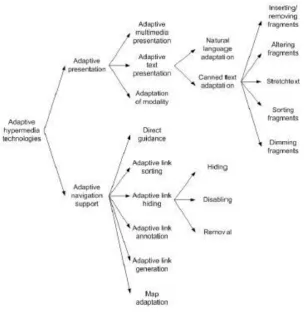
[image:36.595.145.450.227.540.2]Assisting the user the right way has been extensively researched in the context of Adaptive Hypermedia Systems (AHS) (Brusilovsky, 2001, 1996). The two main support mechanisms introduced in AHS are adaptive presentation and adaptive navigation support. The following Figure 2 illustrates the different support mechanisms applied in AHS.
Figure 2 Taxonomy of Adaptive Hypermedia assistance mechanisms(Brusilovsky, 2001, 1996)
23
domain expertise impacts the user’s sense of disorientation. It is also not obvious from a systems standpoint if the user is just snooping around, spending time, hoping for serendipitous finding or if the user is actually trying to fulfil information needs.22
This challenge has been investigated by Ahuja and Webster (2001) through the design of a user questionnaire that helps in use the pre-stated preferences of a user to identify disorientation. A more dynamic approach has been taken by using the amount of revisits to specific webpage as an indicator of disorientation (Herder and van Dijk, 2005). Some studies also indicate weak navigation styles (Herder and Juvina, 2004) and backtracking in browser usability (Catledge and Pitkow, 1995) as source of disorientation. A further interesting approach is introduced by Smith (1996) by introducing the concept of lostness. Lostness is calculated using three values: (N) The number of different web pages visited, (S) the total number of pages visited including revisits and (R) the minimum number of pages required to fulfil the task. Lostness is calculated by using the following formula:
A score above 0.5 may indicate that the user is lost. Even though the concept of lostness provides simple means to calculate the level of disorientation (and compare the score with other users) its main shortcoming lies in the need to identify the exact number of pages necessary to fulfil a task. Therefore lostness may be useful in experimental settings, but its applicability in open web, and more explorative use cases, may be difficult.
In the following the State of the Art in modelling the identified user needs and preferences is discussed. The focus herein lies in discussing challenges in modelling the user’s information needs.
22It can be argued that both techniques can be applied in different phases. Adaptive navigation support provides assistance
24
2.4.3. Modelling Information Needs
User modelling is a wide and complex research area. The following discussion is focused on identifying and addressing challenges in current State of the Art in assisting users across separate websites. The following topics are discussed: User model types, implicitly modelling the user across separate websites, cold start problem, modelling temporal aspects, model gaps and addressing separate needs
User Model Types
User models are often implemented as an overlay model based on or laid over the concepts of the application (Brusilovsky et al., 2005a). The main benefit is increased accuracy and performance. The shortcoming, however, is a limitation of the models interoperability within other applications or subject domains (Carmagnola et al., 2011).
User models that allow a higher-level abstraction are often referred to as user profiles. User profiles can be defined as a subclass of user modeling with user profiles being less sophisticated and more suited for applications that require a more general abstraction of information needs (Koch and Wirsing, 2001). User profiles can be based on implicit or explicit data. Due to the browsing notion within CSP the following discussion focuses on implicit user data. The three main user profile types discussed are keyword-based profiles, semantic network profiles and concept profiles (Gauch et al., 2007).
Keyword based profiles
Keyword based profiles are based on keywords extracted from web pages, such as tags, metadata and keywords explicitly provided by the user. This type of profile typically consists of keywords from websites associated with a form of weighting typically ranging from 0 to 1. Keyword based profiles are usually based on a single term vector and use a TF-ID approach to extract terms from content (Salton and McGill, 1986). Examples of approaches using TF-ID based keyword extraction are Amalthaea (Moukas and Maes, 1998) and Webmate (Chen and Sycara, 1998).
25
bank can relate to a riverbank or a financial institution. Approaches extracting keywords based on information retrieval mechanisms, such as TF-IDF, are strongly affected by this shortcoming (Meadow, 1992). PSUN (Sorensen and McElligott, 1995), as one example, addresses this shortcoming by using weighted n-grams allowing the user to gain a better understanding of the terms meaning. Alipes (Widyantoro et al., 1999), as a second example, assigns three keyword vectors to a higher-level interest. Finally, to extract the higher level interest implicitly PEA (Montebello et al., 1998) uses the user’s bookmarks by indicating a bookmark as a higher level interest and associating a term vector to the bookmark.
Semantic Network Profiles
To allow the user to gain a deeper understanding in the meaning of the extracted terms and to overcome the problem of polysemy semantic term networks can be used. Semantic networks usually consist of a term structure, which entails an order or relationship. Based on the example above, the term Bank relates to the term pair (n-gram) Financial Institute. This allows a system to understand that the term Bank does not relate to a riverbank. A further advantage of Semantic Network Profiles over keyword-based profiles is that the connection between the keywords and the higher-level concept can be maintained. This leads to a graph like structure in which the nodes represent keywords or concepts and the arcs connections. Following the example above the concept node Financial Institute may have several different keyword nodes associated with it, such as bank, coffer and credit union. The main shortcoming of creating Semantic Network Profiles is that they can be time consuming to create and keep up to date.
Concept Profiles
26
example of a concept-based profile is based on a thesaurus. For example, Wordnet23 allows
the extraction of term relationships and synonyms to facilitate the construction of a concept profile. Open Directory Project (ODP)24 (White et al., 2009) as a second example, allows the
extraction of a yellow page based hierarchy of terms. The main shortcoming of concept profiles is that usually rely on taxonomy or ontology25, which are time and cost consuming to
create and update.
In the following further identified challenges modelling the user’s cross-site information needs are discussed. These are modelling the user across separate websites, cold start problem, modelling temporal aspects, model gaps and modelling different types of information needs.
Modelling the user across separate websites
In relation to CSP it can be argued that modelling the user’s needs and preferences across independent websites creates a type of conundrum, in which it is necessary to assist the user not only in one website, but across several websites with different subject domains. To address this challenge a possible approach is the introduction of a shared conceptualisation of the overall browsing space of the user. A shared conceptualisation could consist of an overarching vocabulary reflecting the user’s browsing space. This would allow the user to receive a constant and unifying browsing experience towards addressing cross-site information needs (Gruber, 1993).26
Cold Start Problem
23 http://wordnet.princeton.edu/ 24 http://www.dmoz.org/
25 A taxonomy can be defined as a concept or term structure (Maedche and Staab, 2001). A more advanced concept to
represent relationships of terms is an ontology, which, in addition to only relying on the structure i.e. connection between the concept and terms, adds relationships to allow logical reasoning.
26 The terminology of a shared conceptualisation is often used in ontology based research and the semantic web. In the
27
A further challenge in the context of modelling user needs is known as the cold start (or new user) problem. This problem relates to the necessity of bootstrapping the model of new users (Fischer, 2001). In e-Learning applications the cold start problem is usually addressed by asking the user to fill out a questionnaire in which the user provides initial information that populates the model. Recently social media has been introduced as an alternative solution to the cold start problem (Abel et al., 2010). It can be argued that both approaches are not ideal for browsing that may include spontaneous and unpredictable actions. A questionnaire is usually tied to the specific application. The latter, social media based solution, bears the challenge of figuring out what information provided in the social stream of the user is relevant. 27
A third possible approach to the cold start problem is the use of collaborative approaches known as item-to-item collaborative filtering. Here the algorithm tries to correlate the navigational behaviour of groups of users. This approach is very successful with retail website where the application uses the purchase information of their users to correlate purchase tendencies. This allows recommendations, such as 'customers that bought x also bought y' (Linden et al., 2003). However, most approaches target a specific need that has been expressed through an explicit interaction, such as a purchase. If this interaction is missing, the cold-start problem may occur.
Modelling Temporal Aspects
As discussed in the previous section, the main challenge implicit user profile creation faces is to ensure the information of the user is described accurate and up to date (Stadnyk and Kass, 1992). A negative example of missing temporal aspects is a system using a user profile that represents a need that has passed, such as assisting a user in exploring holiday locations after the holiday is over.
27 A balancing approach has been introduced by the social platform Facebook27 by offering a social plugins27 making a
28
To address temporal aspects two different categorisations can be introduced: (1) Indefinite information needs and (2) definite information needs. The former relates to needs for which a start and end cannot be defined. The latter relates to interests with a definite start and end (e.g. exploring possible presents for an upcoming birthday). The main difference between both types is that there is no factual evidence of when indefinite information needs starts or ends. It can only be argued that the intention in addressing this need will vary over time. Addressing this aspect may require the introduction of a deprecation factor, which can be used to either increase or decrease the impact of current need within the user’s profile. An example system using a deprecation factor is Letizia (Lieberman, 1995). Here the idle time is used to gauge an understandi