B-GL-314-006/AM-001
LAND MAINTENANCE SYSTEM
STATIC OPERATIONS
(BILINGUAL)
Issued on Authority of the Chief of the Defence Staff
LIST OF EFFECTIVE PAGES
Insert latest changed pages; dispose of superseded pages in accordance with applicable orders.
NOTE
The portion of the text affected by the latest change is indicated by a black vertical line in the margin of the page. Changes to
illustrations are indicated by miniature pointing hands or black vertical lines.
Dates of issue for original and changed pages are:
Original ... 0...1987-05-19 Ch ...3 ...
Ch... 1... Ch...4 ...
Ch... 2... Ch...5 ...
Zero in Change No. Column indicates an original page. The use of the letter E or F indicates the change is in English or French only. Total number of pages in this publication is 381 consisting of the following: Page No. Change No. Cover...0
Title ...0
A to E ...0
i to xlvi ...0
1-1 to 1-12...0
2-1 to 2-32...0
2A-1 to 2A-6 ...0
3-1 to 3-66...0
3A-1 to 3A-4 ...0
3B-1 to 3B-6 ...0
3B1-1 to 3B1-6 ...0
3B2-1 to 3B2-8 ...0
3B3-1 to 3B3-6 ...0
3B4-1 to 3B4-4 ...0
3B5-1 to 3B5-4 ...0
3B6-1 to 3B6-4 ...0
3B7-1 to 3B7-4 ...0
3B8-1 to 3B8-4 ...0
3B9-1 to 3B9-4 ...0
3B10-1 to 3B10-6 ...0
3B11-1 to 3B11-6 ...0
3B12-1 to 3B12-6 ...0
3B14-1 to 3B14-4 ...0
3C-1 to 3C-4 ...0
3C1-1 to 3C1-4 ...0
3C2-1 to 3C2-4 ...0
4-1 to 4-58...0
4A-1 to 4A-4 ...0
4B-1 to 4B-4 ...0
4C-1 to 4C-4 ...0
5-1 to 5-22...0
6-1 to 6-28...0
FOREWORD
1. B-GL-314-006/AM-001, Land Maintenance System in Static Operations, is issued on authority of the Chief of Defence Staff.
2. This publication is effective on receipts
PREFACE GENERAL
1. This manual states the doctrine, policy and guidelines for the conduct of land equipment maintenance functions in static operations. It amplifies B-GL-314-001/AF-001, Land
Maintenance System, which describes the basic principles, doctrine, and policies governing the organization, personnel and equipment that form the Land Maintenance System (LMS). The official terminology for EME organization in a static role is defined in A-AE-219-003/AG-101, Chapter 34, as Base Maintenance Land Section. In this publication, Base Maintenance Land Section is also referred to as: base maintenance static EME workshop, static workshop and/or workshop. Other related manuals are:
a. B-GL-314-001/AF-001, Land Maintenance System;
b. B-GL-314-002/AM-001, Maintenance in Battle;
c. B-GL-314-005/FT-001, Recovery Manual;
d. B-GL-314-005/FT-002, Recovery Handbook; and
e. BGL314008/AM002, LEME Officer's Handbook, Part 1 Field, Part 2 -Administration.
2. This manual is intended to:
a. state the policy and outline the procedures to be used in the organization, management and operation of static EME workshops;
b. provide guidance for officers, warrant officers, and senior and junior NCOs in the operation of static EME workshops;
c. describe static workshop organizations and their relationships with other elements of the LMS;.and
d. describe the interface and detail the division of responsibilities between static EME workshops and functional organizations external to the system.
3. This manual applies to all static EME workshops.
4. Terms in general use in this publication and within the LMS are contained in B-GL-314-001/AF-001, and in C-02-007-024/JX-001, the Canadian Forces Technical Glossary.
FUNDAMENTAL MAINTENANCE CONCEPT OF THE LAND MAINTENANCE SYSTEM
6. Static EME workshops are established to perform the maintenance function (as described in Chapter 1 of B-GL-314-001/AF-001) in fulfillment of the EME role. Workshop operations are guided by the fundamental maintenance concept, "to provide the best possible service while making the most efficient use of the available resources". This concept dictates that workshops first endeavour to provide the most effective service to those supported, and then strive for efficient use of available resources. To achieve effectiveness and efficiency the workshop must:
a. forecast and plan to meet user requirements;
b. organize to minimize downtime;
c. monitor performance and quickly refer persistent problems to the next higher level of command; and
d. provide and solicit user feedback on the service provided.
INVOLVEMENT OF MAINTENANCE COMMANDERS
7. To achieve the best service possible, this manual stresses that maintenance commanders -at all levels within the workshop - must be involved in the management of workshop oper-ations. Workshop officers are required to issue direction, monitor performance and provide guidance to ensure performance meets or exceeds stated goals. Leaders must ensure that the command and administrative responsibilities of subordinate leaders at all levels are of a manageable magnitude to permit their involvement in both workshop management and operations.
TRAINING RESPONSIBILITIES OF THE WORKSHOP
8. The manual stresses that all static EME workshops have a general military and technical training function as a basic responsibility. The workshop must meet both the immediate needs of the workshop itself, and the projected needs of the LMS in time of war. The LMS must be capable of both expansion to create third line organizations, and provision of reinforcements for field workshops on mobilization. Static EME workshops must prepare their military tradesmen for these eventualities.
DOCUMENTATION
10. Maintenance management is a science based on facts and data. Therefore, there is a need for documentation which will produce the information necessary for effective management. Accurate, useable information on work done and work to be done will determine priorities and enhance the service provided by the workshop.. Effective documentation will also assist NDHQ staffs in their life cycle management and personnel establishment review activities. It will also aid CHQ staffs in monitoring and guiding the activities of subordinate workshops, and using equipment and parts.
11. For documenting activities, both this manual and C-04-025-000/AG-000, Workshop Operating Procedures, present a flexible and simple method designed to meet the needs of local maintenance commanders. The manual provides the tools needed to support decision-making and the involvement of maintenance commanders within the workshop, as well as summaries and accounting information for submission, collation and return by LOMMIS, the national
information system.
UPWARD REFERRAL OF PROBLEMS
12. The need to identify and to promptly refer persistent problems to the next higher level after corrective action has been unsuccessfully attempted is emphasized throughout this manual. To provide accurate and early feedback and make the best use of the expertise at senior levels within the workshop, this upward referring of unresolved problems must be a part of all workshop operations.
PARTS SUPPORT MANAGEMENT
13. The provision of repair parts is a supply responsibility, and the importance of ensuring the effectiveness of this support is stressed throughout the manual. The workshop's responsibilities for scaling local parts stocks is also emphasized. This manual and C-04-025-000/AG-000, Workshop Operating Procedures, both underscore the importance of proper parts ordering, and expediting procedures. These functions require that a cell within all but the smallest workshops be dedicated to providing the coordination between repair sections and supply agencies. The cell will also identify and analyse unnecessary parts usage so that corrective action can be taken.
ORGANIZATIONAL PRECEPTS
15. In addition to the principles of organization and current LEME policy the following three concepts have been applied in formulating the general organization of the workshops presented in this manual:
a. the complementary roles and employment of LEME officers and artificers;
b. the importance of the planning and control cell; and
c. the platooning of production sub-sections in large workshops.
16. Officers and Artificers. LEME officers and artificers are considered to be
complimentary rather than interchangeable in the workshops depicted in this manual. The employment of both must be consistent with the best use of their respective and distinctly different skills.
a. Artificers possess a detailed technical expertise and familiarity with land technical equipment for which the LMS is responsible. They have a less detailed knowledge of workshop management and the LMS. Their skills are acquired through trades advancement courses and in their employment and progression primarily within the production sections of workshops.
b. Officers are combat service support and systems oriented. They possess a detailed knowledge of workshop management and the LMS and they have a general technical familiarity with land technical equipment. They bring an engineer's analytical approach to problem solving, and abilities in planning and forecasting in both the equipment and management fields.
17. The Planning and Control Cell. In this manual, the activities and responsibilities
assigned to the planning and control cell have been significantly increased so that its performance will have a direct influence upon the standards of service provided by the workshop. As the operations and intelligence staff of the workshop commander, this cell is responsible for short-and long-term forecasting short-and planning, for detailed implementing of the commshort-ander's direction for the overall operation of the workshop, and for monitoring the performance of all sections within the workshop. These tasks demand that the workshop's most proficient and experienced officers and artificers be employed in this cell. The development of workshop long-term plans, projections, and performance goals, and of a monitoring system on workshop progress towards such goals have generally been neglected in workshops, and considerable expertise and
18. Production Sub-Sections. Given the points raised in paragraphs 4 and 14 above, the normal progression for officers within a static EME workshop will be from a junior maintenance commander of a production sub-section, to a workshop support officer to the workshop
operations officer in order to provide development necessary to assume the responsibilities of workshop commander. The average inexperience of production sub-section commanders and the need to divide their activities between leadership, training and general management of
CONTENTS
CHAPTER 1 - FUNDAMENTALS AND MAINTENANCE SECTION RESPONSIBILITIES
Section 1 - Fundamentals of the Land Maintenance System
Aim Role
Principles and Tenets
Fundamental Maintenance Concept
Section 2 - Responsibilities of Static Maintenance Sections
Introduction
Responsibilities in Support of the Units assigned to the Base or Station Responsibilities in Support of the Land Maintenance System
CHAPTER 2 - FUNCTIONAL GROUPINGS
Section 1 - General
Introduction
Maintenance Functions
Section 2 - Function Descriptions
Command
Planning and Control Technical Administration Parts Support Management Production
Training
Workshop Support Technical Staff
Section 3 - Functional Groupings
Introduction Command Group
Planning and Control Group Production Group
Workshop Support Group
Annex A - Technical Staff Function
CHAPTER 3 - MAINTENANCE SECTION ORGANIZATIONS AND RESPONSIBILITIES
Section 1 - Introduction
Section 2 - Typical Maintenance Section Organizations
Basic Model of Maintenance Section Organization Influencing Factors
Example Organizations Production Sections Organizing Process
Section 3 - Responsibilities
General
Section 4 - Responsibilities of the Maintenance Section Commander
General
RESPONSIBILITY GROUPINGS
Command Administration
MANAGEMENT OF MAINTENANCE SECTION OPERATIONS
TECHNICAL ADVICE AND SUPPORT
TRAINING
STATEMENT OF RESPONSIBILITIES
Section 5 - Responsibilities of the Planning and Control Cell
GENERAL
DEVELOPMENT AND MAINTENANCE OF THE LTP
PLANNING, PROCESSING AND CONTROLLING WORK FLOW
Planning Work Flow Processing Work Monitoring Work Flow
Expediting and Resolving Problem Areas
PARTS SUPPORT MANAGEMENT
Scaling
Parts Acquisition
MANAGEMENT OF OUT-OF-WORKSHOP WORK
QUALITY ASSURANCE
LIAISON
Section 6 - Production Sub-Sections Commanders
General
Commanding and Administering Subordinates Production
Training
Technical Advice and Direction Statement of Responsibilities
Section 7 - The Work Centre Supervisor
General
Scheduling Work Centre Workload Assigning Resources
Monitoring Work in Progress Ensuring Section Work Quality Technical Administration Upward Referral of Problems Commanding his Work Centre Training Subordinates Statement of Responsibilities
Section 8 -Workshop Support Sub-Section
GENERAL
ADMINISTRATION CELL
General
Personnel Administration Financial Administration
Facilities and Equipment Administration
Administering Technical Documents and Publications Administrative Liaison
Clerical Support Command and Training
THE TRAINING AND DISCIPLINE CELL
Training Discipline
THE TECHNICAL STAFF CELL
Reserve Militia and Cadet Unit Technical Inspections
Technical Investigations User Liaison
STATEMENT OF RESPONSIBILITIES
Annex B - Statement of Key Responsibilities
Annex C - Small and Station Organizations
CHAPTER 4 - FUNDAMENTALS OF MAINTENANCE SECTION OPERATIONS AND MANAGEMENT
Section 1 - General
General
Section 2 - General Fundamentals of Maintenance Section Operations
INTRODUCTION
WORK DOCUMENTATION
TIME ACCOUNTING
EQUIPMENT ACCEPTANCE
Closed Door Policy Open Door Policy
EQUIPMENT RECEIPT
WORK AUTHORIZATION
EARLY INSPECTION
EARLY IDENTIFICATION OF PARTS
METHOD OF REPAIR
Section 3 - Maintenance Section Management
Introduction
Section 4 - Maintenance Management at Maintenance Section Level
PLANNING PROCESS
Commander's Guidance Forecasting Work Arising
Forecasting Productive Man-hours Available Forecasting Service
DIRECTING PROCESS
ORGANIZING (COORDINATING) PROCESS
Section 5 - Maintenance Management for Single Jobs
GENERAL
PLANNING PROCESS - SINGLE JOB PLANNING
Prioritizing Work
Equipment Essentiality Code Date Required by User Date Request Received Method of Repair
Calculating/Estimating Date of Completion (EDC)
DIRECTING PROCESS
COORDINATING PROCESS
Confirming Work Content Obtaining Parts Support
Assigning of Technicians and Tools/Test Equipment
CONTROLLING PROCESS
Controlling - Section Level Controlling - Platoon Level
Controlling - Maintenance Section Level
Section 6 - Management Reports and Returns
MAINTENANCE SECTION PERFORMANCE MEASUREMENT
EFFECTIVENESS MEASUREMENT
Equipment Availability Report Target Date Report
Backlog Report
Preventive Maintenance Backlog Backlog Other Than PM
EFFICIENCY MEASUREMENT
Maintenance Section Productivity Reports Repair Task Duration
Section 7 - Land Ordnance Maintenance Management Information System (LOMMIS) Interface
Introduction
Interface with the Maintenance Section
Annex A - Chart of Weekly Time Utilization - Based on ESTB Strength
Annex B - Total Civilian Hours Available Per Week
CHAPTER 5 - THE MAINTENANCE SECTION WITHIN THE LAND MAINTENANCE SYSTEM
Section 1 - General
Introduction
Section 2 - Technical Control Channels
GENERAL
NDHQ LEME STAFF
LCMMs DLES
Relationship With the Maintenance Section
CHQ LEME STAFFS
BTSO LEME STAFFS
Section 3 - Regional Land Maintenance System Coordinators
General Responsibilities
Section 4 - Regional Maintenance Responsibilities
General
Support to Stations and Detachments Support to Reserve and Cadet Units Recovery Support
Security Containers
Regional Support of Land Tactical Communications Equipment
Section 5 - Supporting Fourth Line Organizations
General
CHAPTER 6 - MAINTENANCE SECTION INTERFACES OUTSIDE THE LAND MAINTENANCE SYSTEM
Section 1 - Introduction
General
Section 2 - Interfaces With Supply
INTRODUCTION
SUPPLY AS CUSTOMERS
Condition Classification Returned Repairable Equipment
SUPPLY IN SUPPORT OF MAINTENANCE SECTION
Repair Parts Stocks Providing Repair Parts Equipment Holding Lists
DIVISION OF RESPONSIBILITY
Section 3 - Interfaces With Transport
Introduction
Transport as Customers
Transport in Support of the Maintenance Section
Division of Responsibility
Section 4 - Interfaces With Construction Engineering
Introduction
Division of Responsibility
Section 5 - Interfaces With Telecommunications
General
Section 6 - Interfaces With Air Maintenance
General
LIST OF FIGURES
FIGURE TITLE
2-1 Table of Maintenance Functions
2-2 Table of Basic Maintenance Section Model Functional Groupings
2-3 Table of Command Group Functions
2-4(a) Table of Planning and Control Group Functions
2-4(b) Table of Planning and Control Group Functions
2-4(c) Table of Planning and Control Group Functions 2-5 Table of Production Group Functions
2-6 Table of Section Supervisor Functions 2-7(a) Table of Workshop Support Group
2-7(b) Table of Workshop Support Group Functions
2-8 Table of Training Functions Within the Workshop 2A-1 Table of Technical Staff Function
3-1 Table of Maintenance Section Organizational Model
4-1 Table of Examples of the Components of Downtime and Delay Times
4-2 Table of Equipment Availability Report
4-3 Table of Target Date Report
4-4 Table of Preventive Maintenance Backlog Report
4-5 Table of Backlog Report (Other Than PM)
4-6(a) Table of Land Maintenance - Weekly Time Schedule
4-6(b) Table of Land Maintenance - Time Schedule
4-7 Table of Repair Task Duration Report
CHAPTER 1
FUNDAMENTALS AND MAINTENANCE SECTION RESPONSIBILITIES
SECTION 1
FUNDAMENTALS OF THE LAND MAINTENANCE ENGINEERING SYSTEM
AIM
1. Military Forces are an instrument of government. Under the ultimate commitment, military forces must wage war, and win war. Therefore, the aim of Military Forces in peace time is to prepare for war.
2. Consistent with this larger aim, the aim of the Land Maintenance System is to prepare for war.
ROLE
3. The role of the LMS is to ensure the operational fitness of all assigned land based equipment.
PRINCIPLES AND TENETS
4. Maintenance in a static environment is subject to the principles and tenets detailed in Chapter 1 of B-GL-314-001/AF-001, The Land Maintenance System. They are fundamental to the system and are to be used as a guide in the operation and management of all workshops. Their application in practice in static operations is detailed in subsequent chapters.
FUNDAMENTAL MAINTENANCE CONCEPT
5. The role of all LEME organizations is to ensure the fitness for operations of the land technical equipment of supported organizations. To fulfill this role, the fundamental maintenance concept for maintenance sections is "to provide the best possible service while making the most efficient use of the available resources."
7. Maintenance section resources are often severely limited and must be judiciously used to ensure economy. The maintenance section must, therefore, also strive for efficient use of
resources.
8. As a guiding principle the effective provision of support normally takes precedence over efficient use of resources. It is the workshop commander's responsibility to strike a balance between the two and thus optimize the performance of the maintenance section in its support of its customers. In times of operational urgency, the superior commanders may direct an even greater emphasis be placed upon effectiveness at the expense to efficiency. Conversely, during quiet periods when resources are restrained, they may order efficiency to take precedence over effectiveness. In either case the maintenance section commander has the responsibility to inform superiors of the impact of these policies on maintenance operations.
SECTION 2
RESPONSIBILITIES OF STATIC WORKSHOPS INTRODUCTION
10. Static EME maintenance sections provide a broad range of services predominantly from a static location on a Canadian Forces (CF) base or station. Their specific responsibilities are defined in Canadian Forces Organization Orders (CFOOs), Canadian Forces Technical Orders (CFTOs), Equipment Logistics Directives (ELDs), and other orders and instructions. These responsibilities can normally be classified into two categories as follows:
a. responsibilities for maintenance support to their base or station; and
b. other LEME responsibilities.
RESPONSIBILITIES IN SUPPORT OF THE UNITS ASSIGNED TO THE BASE OR STATION
11. In accordance with the organizational concepts for the Canadian Forces contained in A-AE-219-001/AG-001, Organization General, static maintenance sections are established to provide maintenance services to the land technical equipment held by the units assigned to the base or station. These responsibilities normally include:
a. maintenance of all land based technical equipment including the following activities
-(1) preventive and corrective maintenance,
(2) inspections,
(3) recovery,
(4) preservation and depreservation of equipment in storage,
(5) modifications,
(6) condemnation, and
(7) equipment preparation for special conditions of use (eg; swimming, arcticization, etc);
b. limited manufacturing as detailed in C-04-005-O11/AG-000;
d. provision of advice on all maintenance matters affecting the operational fitness of land based equipment.
12. It is important to note that these responsibilities apply to all land technical equipment held by the base or station and its units, including equipment held in stock by supply sections and lodger supply units. This might include such anomalies as maintenance and repair of naval reserve vessels or equipment of other units as specified in the Canadian Forces Organization Orders (CFOO) of the respective base.
RESPONSIBILITIES IN SUPPORT OF THE LAND MAINTENANCE SYSTEM
13. In addition to those maintenance support services of paragraph 11, which are provided to a base/station, static maintenance sections have additional responsibilities as part of the LMS. These responsibilities include:
a. the training and development of maintenance section personnel to meet technical and military requirements of LEME;
b. the provision of additional LMS support services to a geographical area or group of units/locations. These services may include
-(1) recovery responsibilities as stated in C-04-005-003/AG-000, Recovery in Canada,
(2) maintenance support and forcible entry for security containers as detailed in C-04-005-040/AG-000,
(3) the conduct of reserve unit inspections as described in C-04-020-002/AG-000, Land Maintenance Inspection System.
(4) maintenance support to land tactical communications equipment for an assigned area as detailed in C-02-005-012/AM-000, Maintenance Policy for Land Tactical Communications Equipment, and
(5) those arranged by the applicable regional LMS coordinator in accordance with CFAO 4-12;
c. the provision of additional or special EME support services as tasked by a
superior headquarters for example, Explosive Ordinance Disposal (EOD) services when the maintenance section is established and staffed to do so;
d. the requirement to report and investigate deficiencies in equipment and procedures, and to recommend improvements to superior LEME staff; and
CHAPTER 2
FUNCTIONAL GROUPINGS
SECTION 1 GENERAL INTRODUCTION
1. This chapter defines the basic maintenance functions that must be performed in any maintenance section so that it can fulfil its role. It also describes the optimum grouping of these functions for the section to achieve its objective.
MAINTENANCE FUNCTIONS
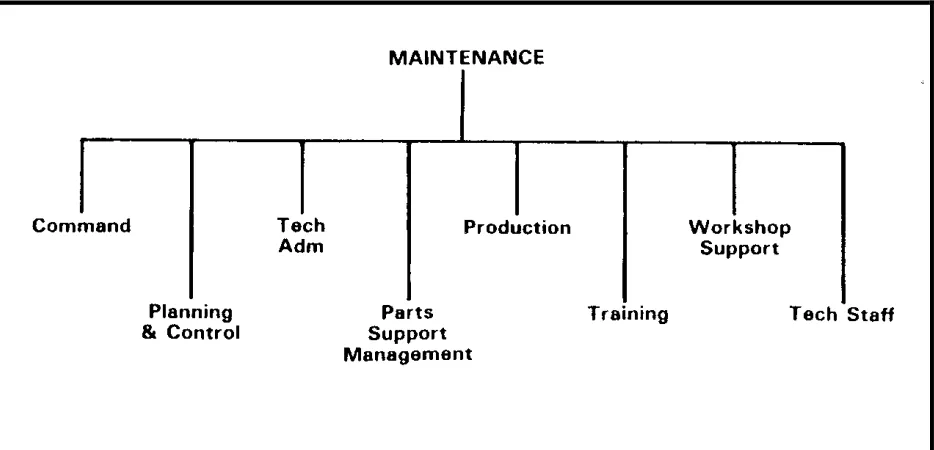
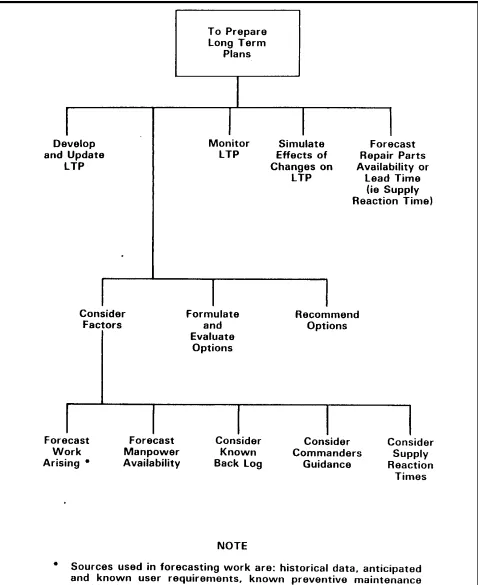
[image:34.612.77.544.378.603.2]2. A detailed study of existing maintenance sections has identified the activities that must be carried out by all maintenance sections. These activities, can be classified into eight maintenance functions (a function being a set of activities contributing to the achievement of an objective). These functions are illustrated in Figure 2-1.
3. With the exception of the activities described in paragraph 13, all the activities carried out in a maintenance section can be grouped under one of the eight functions. These functions
represent what is done; they do not represent an attempt at defining maintenance section organization. A function can be shared by many different persons occupying different positions or performed by a single Person. Similarly, one person may perform many functions, as
SECTION 2
FUNCTION DESCRIPTIONS COMMAND
4. The command function is the sum of the activities necessary to guide the workshop towards the accomplishment of its goals. It includes powers of discipline and punishment as detailed by Queens Regulations and Orders (QRandO).
PLANNING AND CONTROL
5. This function is made up of two functions but, since neither can exist without the other, they are presented as one. Planning without control would be a futile exercise; control cannot be done in the absence of a plan.
6. Planning consists of forecasting and influencing events in the future to meet a goal. It can be done at the workshop level to achieve a given level of a service, as well as at the single job level to meet a deadline.
7. Control encompasses all the activities involved in monitoring a situation against a plan, and those activities performed to correct either the situation or the plan.
TECHNICAL ADMINISTRATION
8. The technical administrative function is the set of administrative activities necessary to direct and document the flow of a single job through the maintenance section, and to prepare reports from the data gathered on single jobs. It also includes tasks of an administrative nature related to describing technical problems or failures.
PARTS SUPPORT MANAGEMENT
9. The parts support management function is the sum of the activities needed to perform the work requested in good time. This function is also designed to ensure that adequate parts support is received from supply.
PRODUCTION
TRAINING
11. The training function is the sum of the activities performed to upgrade and maintain the technical and military knowledge and skills of all maintenance section personnel. Amplification of training functions is in Figure 2-8.
WORKSHOP SUPPORT
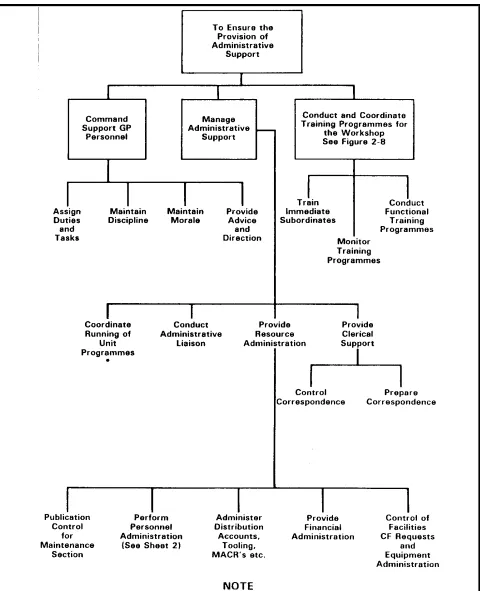
12. The maintenance section support function is the set of administrative activities necessary for the smooth functioning of the maintenance section as an organization.
TECHNICAL STAFF
13. Technical staff activities, in field formations, are carried out by the formation LEME staff under the direction of the G4 maintenance. In static organizations these functions must be carried out by the area, or the local maintenance authority. One of the activities undertaken by this cell is monitoring the service provided to militia units by the supporting maintenance section, and by the militia servicing section detachments of the designated base. Such checks are best carried out by a separate cell to ensure an unbiased approach. The technical staff function is further
SECTION 3
FUNCTIONAL GROUPINGS INTRODUCTION
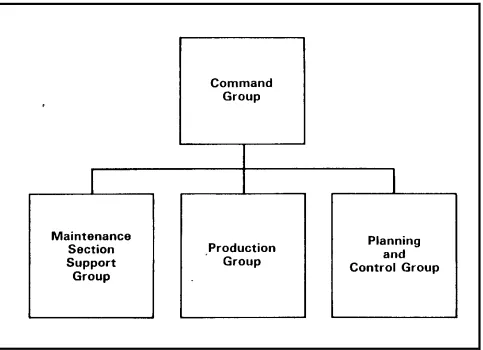
14. The next step involves the creation of an organization where the eight functions are grouped on the basis of logic, interrelationships, and sound military judgement. In describing organizations, the term group is used instead of appointment since more than one person may be required to perform a given function. Figures 2-2 to 2-7 show how the functions are distributed between groups within a maintenance section.
15. Figures 2-2 through 2-8 do not imply, however, that every maintenance section should have a full-time training group or a full-time technical staff group but rather that, in every section, one or more persons must spend some or all of the time doing the training function and the technical staff function - A brief description of the groups, their work, and their objectives are given in the following articles.
COMMAND GROUP
16. The command function is distributed through every level of supervision in the maintenance section. However, the maintenance section commander has the overall
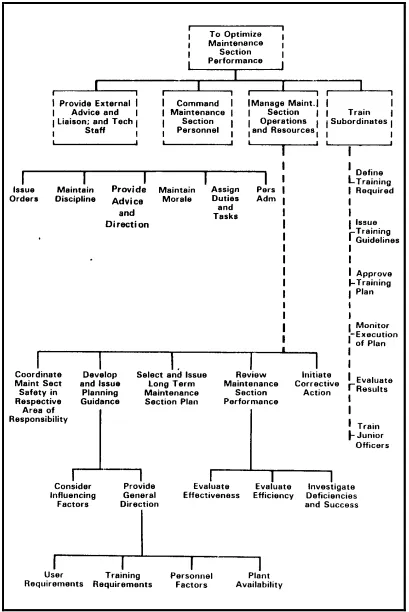
responsibility to perform the command function. The objectives of the command group are to ensure that the goals of the maintenance section are accomplished. This is achieved by managing assigned resources, and by commanding unit personnel. In a typical maintenance section, the maintenance of morale and discipline, and the assignment of secondary duties, requires considerable effort and it is necessary to include a maintenance section sergeant-major in the command group. The aim, functions and activities of the command group are depicted in Figure 2-3.
PLANNING AND CONTROL GROUP
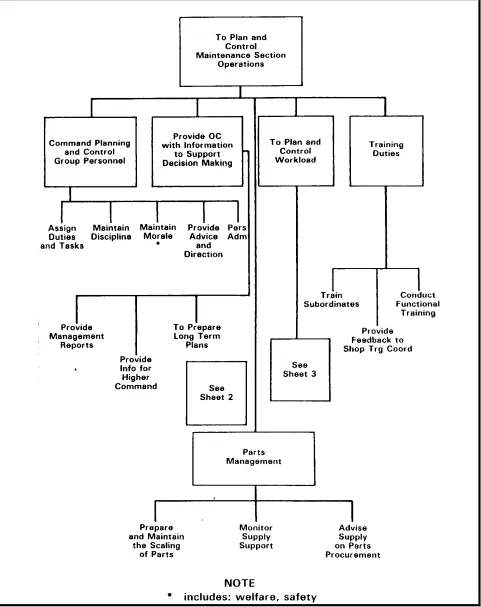
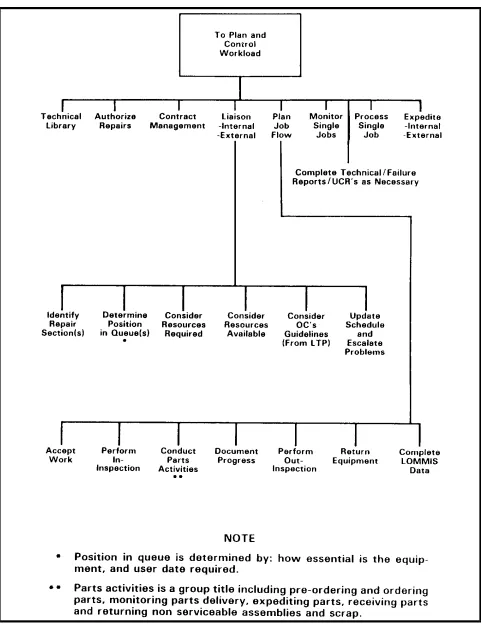
17. The objectives of the planning and control group are to forecast the support to be provided, and to identify areas where problems may occur so that preventive action may be taken. The group must also assess the current performance of the maintenance section and compare it to the overall plan so that deviations may be identified and corrective action be applied, as necessary. The planning and control group also performs most of the technical administration function which guides jobs through the maintenance section and provides; the data necessary for the execution of the planning and control function. Because of the close link between parts support management and the processing of single jobs, the parts support
management function is also assigned to the planning and control group. The aim, functions and activities of the planning and control group are depicted in Figure 2-4.
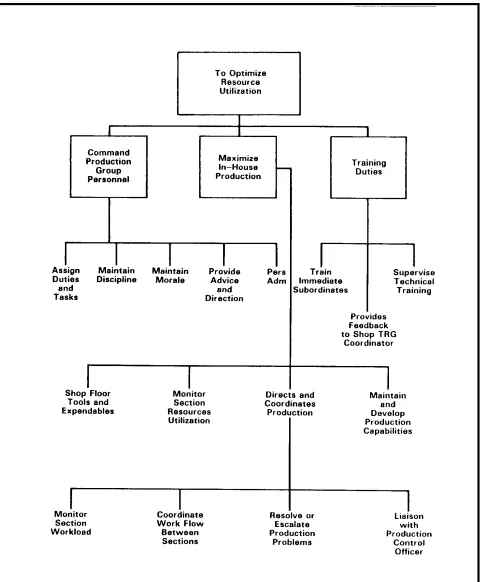
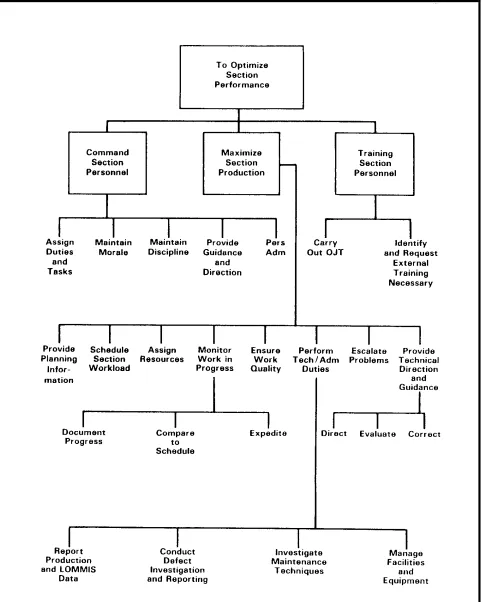
18. The objective of the production group is to perform the maximum amount of work assigned while making the best possible use of their resources. The production group is divided into repair :subsections based on the equipment types supported, and the levels of maintenance performed. For certain equipment, the production group may also be divided into level one and level two work centres in order to improve the service provided to the equipment user. The aim, function, and activities of the production group are depicted in Figure 2-5. The aims, functions, and activities of a sub-section supervisor are also depicted in Figure 2-6 to assist the
understanding of the production group.
WORKSHOP SUPPORT GROUP
[image:39.612.67.550.278.628.2]19. The objective of the maintenance section support group is to provide effective administrative support to the maintenance section. The aim, functions, and activities of the maintenance section support group are depicted in Figure 2-7.
ANNEX A, CHAPTER 2 TECHNICAL STAFF FUNCTION
1. This function can be described as shown in Figure 2A-1 below.
RESERVE UNIT LAND MAINTENANCE INSPECTIONS
2. The aim of Land Maintenance inspections of reserve units is to conduct a independent evaluation of the state or reserve unit equipment, and t evaluate the adequacy of maintenance procedures and resource Emphasis is placed on unit maintenance responsibilities and the interfaces with the supporting base workshop. This inspection i further described in C-04-020-002/AG-000, the Land Maintenance Inspection System.
Figure 2A-1 Table of Technical Staff Function
3. This inspection is conducted on behalf of the base commander, reserve formation
TECHNICAL INVESTIGATIONS
4. Another activity within the technical staff function is the conduct of technical
investigations. These investigations may be performed by many members of the maintenance section, and are usually related to recommending solutions to identified equipment shortcomings, or determining causes of failures. They may be initiated by direction of maintenance commanders at any level in the maintenance section as well as external commanders and staffs. Again, a dedicated staff may be assigned this responsibility if the workload warrants.
5. From time to time commanders may direct the supporting maintenance section to investigate real or perceived procedural shortcomings in supported units. Such investigations must be conducted with particular care and discretion, but should generally follow the Land Maintenance inspection format as discussed in paragraph 2 above.
TECHNICAL ADVICE
CHAPTER 3
MAINTENANCE SECTION ORGANIZATIONS AND RESPONSIBILITIES
SECTION 1 INTRODUCTION GENERAL
SECTION 2
TYPICAL MAINTENANCE SECTION ORGANIZATIONS BASIC MODEL OF MAINTENANCE SECTION ORGANIZATION
2. The model depicted in Figure 3-1 is the basic framework for the maintenance section organization. It represents the optimum arrangement of functional groupings developed in Chapter 2, and illustrates the relationships between the elements.
INFLUENCING FACTORS
3. The factors listed below will influence the number and rank of personnel in charge of the various elements, and the merging of elements:
a. maintenance section responsibility, including the number of customers and levels of maintenance support provided;
b. the number of production workers;
c. the number of production work centres;
d. physical layout and. dispersion of the maintenance section;
e. volume, range and complexity of work; and
f. reserve unit responsibility.
4. Maintenance Section Responsibility. The number of units supported, their operational roles, their size and location, and the size and complexity of the equipment dependency will influence the number, type, and size of repair work centres, and the maintenance section's requirements for supervisors. The number of supported users will also influence the complexity of the planning and control function within the maintenance section due to numerous contacts and often conflicting priorities and activities.
5. Number of Production Workers. In maintenance sections with more than 40
technicians and first level supervisors within the production group, it is advantageous to split the production group into sub-sections. Each sub-section should be commanded by an officer and would normally contain 20 or more technicians. This organization will permit the sub-section commander to have enough time to both command subordinate workers, and provide effective maintenance management of subordinate production work centres.
6. Number of Production Work Centres. The number of subsection commanders is also influenced by the number of production work centres. The span of control of a sub-section commander should be optimized at 5 work centres or approximately 39 technicians.
7. Physical Layout. The physical layout of the maintenance section will also influence the number of supervisors required. A maintenance section operating in many sites will require more supervisors than one operating out of a single location.
8. Volume, Range and Complexity of Work. The volume, range and complexity of work will influence the number of production workers and the size of the planning and control cell. Where workload justifies it, the planning and control cell should contain both an experienced captain to supervise the planning and management reporting activities, and a CWO to perform the controlling and expediting activities.
EXAMPLE ORGANIZATIONS
10. Example organizations are presented in Annexes A and C: to illustrate the normal
responsibility distributions expected in a typical workshop, and in smaller maintenance sections. It is important to note that these are examples only, and a detailed assessment of the influencing factors in paragraphs 3 to 9 is necessary before these examples can be applied to a particular static location.
PRODUCTION SECTIONS
11. The organization in Annex A shows the various production work centres in detail. Though the number and size of these work centres will depend on specific workloads and maintenance responsibilities, a maintenance section will normally include most or all of the following work centres within its production sub-section:
a. Quick Repair Detachments. These detachments may be established in or near the supported organization's location to provide immediate support by completing short duration tasks when the workload or the priority justifies it. This may also be a part-time service provided from other work centres.
b. Vehicle Servicing. These work centres provide level one, and limited level two, support to selected organizations. A significant workload is due to periodic preventive maintenance inspections.
c. Light Vehicle Repair. These work centres provide level two, and limited level three, repair to light vehicles, ie, low cost high density vehicles.
d. Heavy Vehicle Repair. These work centres provide level two, and limited level three, repair to larger equipment including engineer plant diesel and tracked vehicles (ie, high cost low density vehicles.
e. Components. These work centres primarily perform level two and level three reconditioning of assemblies and components.
f. Material. These work centres provide repair services in the areas of metals, machining, refinishing, textiles and carpentry tasks.
g. Recovery. These work centres perform equipment recovery, and heavy lift. h. Weapons. These work centres provide up to limited level three maintenance tasks
for weapons, and miscellaneous equipment, and may have responsibility for maintenance of security containers.
k. Communications. These work centres perform up to limited level three maintenance tasks for land tactical and ground based telecommunications equipment (as stated in C-02-005-012/AM-000), and common user electronic equipments.
ORGANIZING PROCESS
12. Where the workload is sufficient, it is effective to organize the static maintenance section into lines to reduce downtime. In such cases the maintenance section can be divided into first and second line repair sections for certain equipment. The first line sub-section should be located as close as possible to the unit being supported. It should only do level one work and thus will be able to return a good portion of the equipment to the user in a short time. As a general rule, repairs taking less than four hours should be done at the first line. This figure car) vary depending on the amount of work at the first line, its separation from the second line sub-section, and the characteristics of the equipment.
SECTION 3 RESPONSIBILITIES GENERAL
14. With an organizational model established, it is possible to consider the responsibilities of the key appointments within the workshop. These responsibilities evolve from distribution of the functional groupings shown in Figures 2-2 to 2-7, and reflect the normal division of tasks
between important members of the workshop models depicted in Figure 3-1 and Annexes A and C of this chapter.
15. The responsibilities of key appointments are discussed in the following sections of this chapter and are summarized in Annex B.
SECTION 4
RESPONSIBILITIES OF THE MAINTENANCE SECTION COMMANDER GENERAL
17. The responsibilities of a maintenance section commander can be grouped into five main areas as follows:
a. command;
b. administration;
c. management of maintenance section operations;
d. technical advice and support; and
e. training of subordinates.
RESPONSIBILITY GROUPINGS COMMAND
18. The term "command" implies the authority to issue orders and the power to enforce compliance. Officers commanding maintenance section are normally granted the powers of a delegated officer in accordance with QR&O 108.10.
19. Commanders of all maintenance sections (regardless of rank) have responsibilities in the broader sense of command. They are responsible both for maintaining a high standard of morale, discipline, and military proficiency among subordinates, and for the efficient performance of the maintenance section.
20. For the commander to have sufficient time for genuine command, responsibilities must be clearly defined and authority must be delegated where possible, so that individuals know their roles and know to whom they are directly responsible. A key to achieving this is a sound organization displayed in chart form, and supplemented by comprehensive and up-to-date unit standing operative procedures (S.O.P.).
ADMINISTRATION
22. It is the maintenance section commander's responsibility to ensure that administrative arrangements for both the maintenance section and for the individuals within it are effective. Good administration requires correct and timely application of regulations and the adoption of standard procedures whenever feasible. The commander is not expected to have a detailed knowledge of all regulations, but must know of their existence and know where to find the information when it is required.
MANAGEMENT OF MAINTENANCE SECTION OPERATIONS
23. The maintenance section commander's primary responsibility is to ensure that the maintenance section provides effective service and makes efficient use of resources available. This requires careful planning, good organization, monitoring of performance, identification of problems and the issuing of clear, sound direction.
24. The first step in this process is planning. As foresight is one of the basic principles of the LMS, it is mandatory that workshop commanders strive to identify user needs and potential equipment failures early, and then project the maintenance section's future capabilities to satisfy those needs. This will enable them to correctly allocate resources against foreseen administrative, training, and productive requirements to achieve the best possible performance. The primary tool in this planning is the workshop long term plan (LTP).
25. Detail of how the LTP is developed is contained in C-04-025-000/AG-005. The end result is to create a model of future maintenance section performance based on projections of the
"peaks and valleys" of incoming work and maintenance section productive capability. While many of the factors affecting the model are beyond the maintenance section commander's
control, there will be direct control over such things as manpower, facilities, and contract funding resources. Careful evaluation of possible courses of action will lead to valid decisions on
direction given to subordinates.
26. The LTP is also used to:
a. simulate the effect of desired or unexpected administrative and training activities;
b. assess the impact of unexpected constraints or special projects;
c. phase in low priority work; and
d. evaluate possible courses of action.
27. Having decided on a planned use of resources based on the LTP, the maintenance section commander issues directions and guidelines to subordinates to ensure their efforts are in concert with the plan. These directives may include:
a. policies on overtime, leave, and training;
c. planned contract expenditures over specified periods;
d. direction on project target dates;
e. policy on backloading or reallocation of work; and
f. direction on preventive maintenance programs.
28. The commander monitors the execution of the LTP with management reports. Where significant differences are noted or problem areas identified, the maintenance section commander must evaluate and direct the necessary corrective action to resolve deficiencies. This may require revising the LTP and resulting. direction, or amending a particular instruction. While prompt action is desired, the maintenance section commander must always consider the destabilizing effect of change on subordinates and try to avoid unnecessary revision of previous direction.
TECHNICAL ADVICE AND SUPPORT
29. The commander's main technical responsibilities lie in two areas:
a. implementing technical orders and directives from higher headquarters; and
b. providing technical advice on EME matters, and on the capabilities of the a maintenance section.
30. It is important that the maintenance section commander establish an effective liaison with the commanders of supported organizations as well as with other external agencies. The feedback received will help gauge user satisfaction in the performance of the maintenance section, and assist in identifying areas of concern for further action.
31. As a senior LEME commander, the maintenance section commander is frequently required to provide technical advice to external agencies. Though investigations and
recommendations may be conducted by the staff, he or she alone must verify the quality and validity of advice given.
32. The maintenance section commander must establish and use the technical control channels to superior technical authorities (at formation, CHQ and NDHQ) to ensure stated
TRAINING
33. The training responsibilities of the maintenance section commander can be divided into two categories:
a. the training required to meet the particular technical and operational needs of the base or station; and
b. the training needed to meet the requirements of the EME system and the CF.
34. Maintenance section military personnel are soldiers and technicians. Their training must be carefully balanced to satisfy the duality of their roles. It is essential that they be prepared and able to perform their complex technical tasks within a demanding operational environment.
35. While much of the technical and military training is carried out by external agencies, the maintenance section commander is responsible for the continuation of adequate military and technical training for all personnel in the maintenance section. To achieve this, the maintenance section commander must define the individual and collective training requirements of
subordinates and, with the assistance of the training cell, create a maintenance section training plan as part of the LTP. As for other areas of maintenance section performance, the commander must monitor and evaluate the training portion of the LTP, and undertake action to correct observed deficiencies.
36. In addition to the overall training of maintenance section personnel described above, the maintenance section commander must pay particular attention to the training and development of officers, and NCM's, and will take a personal interest in necessary rotation of employment and development of their leadership skills.
STATEMENT OF RESPONSIBILITIES
SECTION 5
RESPONSIBILITIES OF THE PLANNING AND CONTROL CELL GENERAL
38. The planning and control cell performs a staff function for the maintenance section commander. In a large maintenance section, it is commanded by the maintenance section
operations officer who is also second-in-command of the maintenance section. The main duty of the cell is to plan and control the workload to ensure that user requirements are met. The main areas of responsibility are:
a. development, maintenance and evaluation of the workshop LTP;
b. planning, processing and controlling the workflow;
c. provision of management information;
d. parts support management;
e. management of out-of-workshop work;
f. quality control; and
g. liaison.
39. Amplification of the activities performed in each area and the duties of key appointments are detailed in the articles below.
DEVELOPMENT AND MAINTENANCE OF THE LTP
40. The LTP is essentially a forecast of expected maintenance section performance. It serves as a means of assessing progress as well as being a tool to aid maintenance commanders in the efficient management of their assigned resources. To ensure the optimum performance of the maintenance section, the establishment and updating of its LTP by the maintenance section commander is of critical importance. The judicious marshalling of resources against accurate forecasts of user requirements will serve to improve both customer satisfaction and workshop efficiency.
41. To help the maintenance section commander evaluate options and prepare directions, the planning and control cell must first provide valid information to create the LTP. It must:
a. consider all significant factors which will affect future maintenance section performance, including
(2) forecasts of user requirements based on historical data and projected corrective/preventive maintenance work from all users. Known special projects and guidance issued by the OC must also be considered in projecting the peaks and valleys of expected work,
(3) forecasts of seasonal work and work generated by technical inspections,
(4) forecasts of future maintenance section productivity. This primarily involves predicting productive manpower availability based on historical data and projected manning, but it may also be affected by projected limitations of facilities and equipment, and
(5) any direction or guidance affecting resources or customer requirements that has been received from the OC;
b. develop and evaluate possible plans to meet the forecasted user requirements; and
c. recommend the most suitable plans to the OC for consideration.
42. Once the LTP is issued by the maintenance section commander, the planning and control cell is responsible for monitoring maintenance section activity against the forecasts contained in the LTP. Another activity of the planning and control cell concerning the LTP involves assessing the impact of perceived or considered changes to the plan. By conducting simulations in reply to what if questions from maintenance commanders, the planning and control cell can provide good recommendations concerning changes for the use of decision makers at all levels.
43. Amplification on the long term planning and monitoring process can be found in Chapter 4 and in C-04-025-000/AG-005.
PLANNING, PROCESSING AND CONTROLLING WORK FLOW
44. The planning and control cell devotes a major portion of its resources to ensuring that single jobs entering the maintenance section are completed in time to meet the supported units' requirement. The major activities involved in this process are:
a. planning work flow;
b. processing work;
c. monitoring work flow; and
d. expediting and resolving problem areas.
PLANNING WORK FLOW
45. Sound work flow planning is required to:
a. ensure single jobs are worked on in an order that will give the best possible customer service;
b. ensure a smooth and efficient flow of work through the workshop; and
c. minimize disruptions caused by changing priorities or short-fused taskings.
46. Workflow planning involves creating a queue of single jobs by repair section, listing repair requests in order of priority, and assigning target dates for repair work centres. The considerations involved in creating and maintaining the queues are described in Chapter 4.
PROCESSING WORK
47. Processing work relates to the activities involved in:
a. Accepting Work. This includes, authorizing work, calling in work, receipt of equipment and initial inspection.
b. Documentation. From the time that the work request is received, the planning and control cell must maintain accurate records on work status, progress and resource expenditure of single jobs in order to
-(1) answer user and other queries,
(2) provide data for comparing status with the plan, and for identification of problem areas,
(3) provide data for workflow planning,
(4) provide data for preparing management reports and historical data for forecasting, and
(5) provide equipment life cycle maintenance management data for CHQ and NDHQ LEME staff s.
MONITORING WORK FLOW
48. The workflow plan must be monitored on a continual basis to assess how the maintenance section is doing in comparison with the plan. When differences are noted the reasons must be identified and the impact of the differences, determined.
EXPEDITING AND RESOLVING PROBLEM AREAS
49. Careful monitoring should identify potential delays or problems early. Once identified, action must be taken quickly to resolve them at the lowest possible level. Problems that cannot be resolved must be escalated to the OC for consideration and action. Supported units must also be notified as early as possible of any unavoidable delays to help them accommodate expected equipment non-availability.
PARTS SUPPORT MANAGEMENT
50. Parts support management involves three key areas:
a. scaling;
b. parts acquisition activities including ordering, monitoring and expediting; and
c. monitoring supply performance in provisioning repair parts.
SCALING
51. The parts support management section is responsible for coordinating the creation and maintenance of local maintenance section scales for each repair work centre. Careful and
accurate scaling is essential for obtaining good parts support. The importance of scales cannot be over-emphasized. Scales are living documents and must be reviewed and updated continually to be useful. They must be adapted to meet changing requirements, due to seasonal, financial or operational considerations.
PARTS ACQUISITION
52. The parts support management section is also responsible for:
a. parts ordering;
b. parts receipt;
c. expediting; and
MANAGEMENT OF OUT-OF-MAINTENANCE SECTION WORK
53. Within the commander's guidelines contained in the LTP, the planning and control cell is responsible for managing the maintenance resources outside the maintenance section that are allocated to provide additional or special support to users. This is normally local contract support which is used to augment the capabilities of the maintenance section and involves some financial administration. It also includes work that is crossloaded or backloaded to other EME
maintenance sections, and work performed by other support facilities on the base or station as described in Chapter 6.
QUALITY ASSURANCE
54. The planning and control cell is responsible for monitoring the quality of work produced by the maintenance section. All work leaving the workshop must be out-inspected to ensure that requested repairs have been completed, and that the work is of a high standard. The inspection must also confirm that all potential safety faults have been corrected.
55. The planning and control cell has an inspection section which out-inspects all vehicles. Quality assurance for all other repair sections is normally coordinated through the repair section NCO IC. If there is sufficient work in other repair sections to justify a full-time inspector,
separate quality assurance should be conducted by the planning and control cell to help provide a standard, independent check on work quality within the workshop.
LIAISON
56. The planning and control cell conducts extensive liaison with agencies both in and out of the maintenance section to ensure the smooth loading and flow of work. Communications with both the user, and the production platoons and sections are necessary to ensure that the best services are being provided to the user. Close liaison is required during the monitoring and expediting process to keep interested parties informed of changes, and to assess and minimize the impact of problems. It is important that the planning and control cell act as the main contact point on job progress and work problems as it has the most current information on the many factors and guidelines affecting the support the maintenance section provides.
57. Another liaison channel which is of critical importance to the planning and control cell is that with the local supply agency supporting the maintenance section. Ensuring that needed repair parts flow rapidly to technicians, and that delays due to back-orders are minimized, is critical to the workshop's provision of service to the user.
STATEMENTS OF RESPONSIBILITIES
SECTION 6
PRODUCTION SUB-SECTIONS COMMANDERS GENERAL
59. The production sub-sections contain the repair work centimes that make up the
maintenance section. The objective of the production sub-section commander is to optimize the use of the resources within the sub-section.
60. The major responsibilities of the production sub-section commander include:
a. commanding and administering subordinates;
b. managing production;
c. training subordinates; and
d. other technical activities.
COMMANDING AND ADMINISTERING SUBORDINATES
61. Of necessity, a large portion of the activities of the production sub-section commander is dedicated to command and administrative responsibilities. Often, these activities may conflict with producing work, but they are listed first because the effective leadership of subordinates is a prerequisite to success.
PRODUCTION
62. The sub-section commander is responsible for the productive output of the sub-section. The main activities related to this responsibility are:
a. monitoring sub-section workload including comparisons of repair sections job progress to the maintenance section production plan;
b. monitoring each repair work centre's use of available manpower and facilities to ensure meeting assigned target dates; and
c. expediting and resolving production problems to achieve the best service possible.
TRAINING
64. The production sub-sections must devote a significant effort towards training. Sub-section commanders will ensure that all members participate in training in accordance with the maintenance section training plan. They must also strive to fully develop the capabilities of subordinates, providing training and guidance as required. Normally, the production sub-sections will be responsible for supervising the technical training conducted within their repair work centres in accordance with the Canadian Forces Training Development Centre (CFTDC).
TECHNICAL ADVICE AND DIRECTION
65. Sub-section commanders must continually monitor their production capabilities and ensure that they are adequate to meet the needs. They must strive to improve maintenance procedures, facilities, and equipment in order to provide the best possible support. Where deficiencies are identified, the sub-section commander must identify the personnel, training, materiel authorization, or construction engineering requirements necessary to correct shortfalls.
STATEMENT OF RESPONSIBILITIES
SECTION 7
THE WORK CENTRE SUPERVISOR GENERAL
67. Work centre supervisors are the first level of maintenance management. Their personal efforts and abilities will have a major impact on the service the maintenance section provides. Though they form part of the production sub-sections, their activities are described here to provide a better insight into maintenance section operations.
68. The objective of the work centre supervisor is to optimize section performance. Major activities include:
a. scheduling section workload;
b. assigning resources to tasks;
c. monitoring work in progress;
d. ensuring section work quality;
e. performing technical administrative tasks relating to his section and his particular technical expertise;
f. promptly advising superiors of problems which may require their attention;
g. commanding a section; and
h. training and developing subordinates.
SCHEDULING WORK CENTRE WORKLOAD
69. Work centre supervisors work closely with the planning and control cell in the loading of their work centres. They provide accurate information to the planning and control cell on
70. Work centre supervisors schedule the flow of work through their work centres based on the production plan created by the planning and control cell. They verify the estimated work content of each job, confirm availability of work centre resources to complete the job, and commit their resources for the estimated period needed to complete the job. They will normally schedule work in the priority order assigned by the planning and control cell, but their detailed knowledge of equipment characteristics and their resources may cause them to rearrange the order to maximize output. They must meet frequently With the planning and control cell and advise it of any delays that will cause the user target date to be missed. They must also keep their subsection commander advised of all such situations.
ASSIGNING RESOURCES
71. When a job is actually received at the work centre, the supervisor will allocate the required manpower, tools, test equipment, and facilities to promptly complete the task.
MONITORING WORK IN PROGRESS
72. Most of the work centre supervisor's activities are devoted to monitoring work in progress. These include:
a. supervising and guiding subordinates (directing, evaluating and correcting their work efforts and techniques);
b. documenting work status and resources used;
c. comparing the progress of his own work to the maintenance section production plan;
d. expediting delays and problems to improve the job flow through the work centre; and
e. assessing the impact of early completions/delays on following jobs, and advising his sub-section commander and the planning and control cell of significant problems.
ENSURING SECTION WORK QUALITY
TECHNICAL ADMINISTRATION
74. The work centre supervisor performs numerous tasks related to technical administrative duties, including:
a. accounting for equipment under repair;
b. investigating equipment defect and failure within his or her area of expertise;
c. developing and evaluating work procedures to improve work centre repair capabilities;
d. managing the facilities and equipment held by the work centre including replacement, repair, or updating to improve its capabilities; and
e. maintaining and controlling technical documents and publications held by the work centre.
UPWARD REFERRAL OF PROBLEMS
75. While supervisors are in a position to identify and resolve numerous problems related to optimizing work centre performance, it is important that they promptly notify their own
supervisors of matters which are beyond their scope or responsibilities. As often as possible, they should present their assessments of the importance of the problem, as well as suggestions for possible solutions.
76. For routine work planning and job flow that affect the planned schedule of work for a section, the supervisor deals with the planning and control cell. It is important that he or she notify the cell promptly concerning job delays or early completions to permit it to provide feedback to users, and maintain an efficient work flow. Supervisors must also keep sub-section commanders current on routine workflow.
77. For all other matters, including particularly delays to critical or priority equipment, the supervisor deals with the production subsection commander to seek resolution.
COMMANDING HIS WORK CENTRE
78. The supervisor is the military commander of all his subordinates, and is responsible for assigning duties and tasks issuing and transmitting necessary instructions and orders, maintaining a high standard of discipline, providing advice and guidance, and fostering section morale.
TRAINING SUBORDINATES
80. As their immediate superior, the work centre supervisor bears a major responsibility to develop and train tradesmen to capably perform all tasks, both trade-related and those of a general military nature.
81. The supervisors direct efforts ensure that both section formal on-the-job-training, and skill development through experience improve the section's capabilities. Where external training is required, he or she must identify and request such training through the production sub-section commander.
82. The supervisor must also develop and train subordinated in the military skills necessary to ensure they are prepared for war. He or she must actively participate in the maintenance section general military training program and lead the section towards meeting assigned standards. Here again, the work centre supervisor must balance the training requirements of the section with its productive efforts.
STATEMENT OF RESPONSIBILITIES
SECTION 8
WORKSHOP SUPPORT SUB-SECTION
GENERAL
84. The workshop support sub-section has three main areas of responsibility:
a. administration;
b. training and discipline; and
c. technical staff.
ADMINISTRATION CELL GENERAL
85. The major activities of the administration cell include:
a. administration of the following
-(1) personnel,
(2) public and non-public funds,
(3) workshop facilities and equipment, and
(4) technical documents;
b. conduct of administrative liaison;
c. provision of clerical support; and
d. commanding and training group personnel.
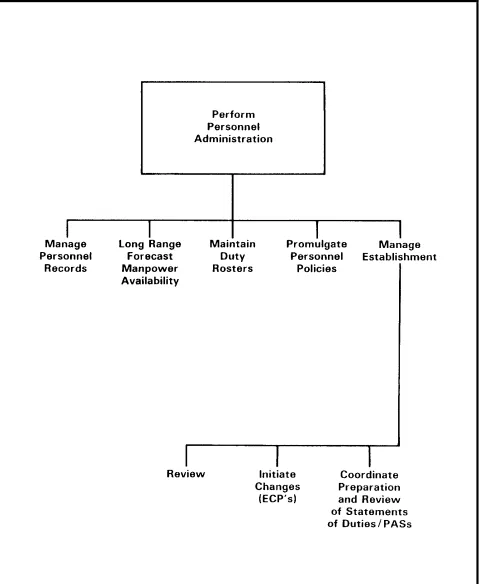
PERSONNEL ADMINISTRATION
86. The administration cell is responsible for personnel administration within the workshop. These activities include:
b. providing advice on all administrative matters;
c. promulgating personnel policies either from superior commanders or the workshop commander (including preparation of workshop,routine orders);
d. maintaining personnel availability records as an aid to long range forecasting of manning (including civilian and military attendance records); and
e. managing the workshop personnel establishments including, review, initiation of changes (ECPs), and coordination of the periodic review of statements of
duties/PASs.
FINANCIAL ADMINISTRATION
87. The administration cell is responsible for administering the public and non-public funds of the workshop, including:
a. coordinating the workshop budget forecasts;
b. managing the workshop TD budget;
c. administering the workshop local contract budget (the expenditure of this budget is assigned to the planning and control cell, with the administration cell's
responsibilities limited to monitoring expenditures and providing accounting services);
d. administering the workshop civilian overtime budget; and
e. managing the workshop NPF budgets.
FACILITIES AND EQUIPMENT ADMINISTRATION
88. The administration cell is involved in a number of activities related to administering the workshop facilities and equipment, including control and coordination of:
a. the various distribution accounts of the workshop;
b. requests for changes to materiel authorizations (MACRs) raised by workshop sections including staffing and control of these requests;