Proof of Constructive Version of the
Fan-Glicksberg Fixed Point Theorem Directly by
Sperner’s Lemma and Approximate Nash
Equilibrium with Continuous Strategies: A
Constructive Analysis
Yasuhito Tanaka,
Member, IAENG
Abstract—It is often demonstrated that Brouwer’s fixed point theorem can not be constructively proved. Therefore, Kakutani’s fixed point theorem, the Fan-Glicksberg fixed point theorem and the existence of a pure strategy Nash equilibrium in a strategic game with continuous (infinite) strategies and quasi-concave payoff functions also can not be constructively proved. On the other hand, however, Sperner’s lemma which is used to prove Brouwer’s fixed point theorem can be con-structively proved. Some authors have presented a construc-tive (or an approximate) version of Brouwer’s theorem using Sperner’s lemma. Thus, Brouwer’s fixed point theorem can be constructively proved in its constructive version. It seems that constructive versions of Kakutani’s fixed point theorem and the Fan-Glicksberg fixed point theorem can be constructively proved using that of Brouwer’s theorem. Then, can we prove a constructive version of the Fan-Glicksberg fixed point theorem directly by Sperner’s lemma? We present such a proof, and we will show the existence of an approximate pure strategy Nash equilibrium in a strategic game with continuous strategies and quasi-concave payoff functions. We follow the Bishop style constructive mathematics.
Index Terms—constructive version of the Fan-Glicksberg fixed point theorem, approximate pure strategy Nash equi-librium, continuous strategy, quasi-concave payoff function, Sperner’s lemma.
I. INTRODUCTION
I
T is often demonstrated that Brouwer’s fixed point theorem can not be constructively proved. Therefore, Kakutani’s fixed point theorem, the Fan-Glicksberg fixed point theorem and the existence of a pure strategy Nash equilibrium in a strategic game with continuous (infinite) strategies and quasi-concave payoff functions also can not be constructively proved. On the other hand, however, Sperner’s lemma which is used to prove Brouwer’s fixed point theorem can be constructively proved. Some authors have presented a constructive (or an approximate) version of Brouwer’s theorem using Sperner’s lemma. Thus, Brouwer’s fixed point theorem can be constructively proved in its constructive version. See [4] and [9]. It seems that constructive versions of Kakutani’s fixed point theorem and the Fan-GlicksbergManuscript received December 29, 2010; revised April 20, 2011. This work was supported in part by the Ministry of Education, Science, Sports and Culture of Japan, Grant-in-Aid for Scientific Research (C), 20530165, and the Special Costs for Graduate Schools of the Special Expenses for Hitech Promotion by the Ministry of Education, Science, Sports and Culture of Japan in 2010.
Yasuhito Tanaka is with the Faculty of Economics, Doshisha University, Kyoto, Japan. e-mail: [email protected].
fixed point theorem can be constructively proved using that of Brouwer’s theorem.
Then, can we prove a constructive version of the Fan-Glicksberg fixed point theorem directly by Sperner’s lemma? We present such a proof, and we will show the existence of an approximate pure strategy Nash equilibrium in a strategic game with continuous strategies and quasi-concave payoff functions.
Let(pi)i∈I be a family of semi-norms on a locally convex space where I is an index set, for example, the set of positive integers, and F be a finitely enumerable subset of I. A constructive version of the Fan-Glicksberg fixed point theorem states that for any compact and convex val-ued multi-function (multi-valval-ued function or correspondence) with closed graph from a compact and convex set in a locally convex space to the set of its inhabited (nonempty) subsets, there exists an approximate fixed point. We consider a uniform version of the property of closed graph for multi-functions, and call such a multi-function a multi-function with uniformly closed graph, or say that a multi-function uniformly has a closed graph. An approximate fixed pointx
of a multi-function Φ for each ε > 0 is a point such that ∑
i∈Fpi(x−Φ(x))< ε is satisfied for eachF ⊂I, where
pi(x−Φ(x)) = infy∈Φ(x)pi(x−y). An approximate pure strategy Nash equilibrium is a state where strategies chosen by all players are best responses each other within the range ofε. We call such strategies approximate best responses.
In the next section we prove Sperner’s lemma. Our proof is a standard constructive proof. In Section 3 we prove a constructive version of the Fan-Glicksberg fixed point theorem by Sperner’s lemma. In Section 4 we will show the existence of an approximate pure strategy Nash equi-librium in a strategic game with continuous strategies and quasi-concave payoff functions. We follow the Bishop style constructive mathematics according to [1], [2] and [3].
II. SPERNER’S LEMMA
To prove Sperner’s lemma we use the following simple result in graph theory, Handshaking lemma1. Agraphrefers
to a collection of vertices and a collection of edges that connect pairs of vertices. Each graph may be undirected or directed. Fig. 1 is an example of an undirected graph. The degree of a vertex of a graph is defined to be the number of
1For another constructive proof of Sperner’s lemma, see [7].
IAENG International Journal of Applied Mathematics, 41:2, IJAM_41_2_08
A B C
D
E F
[image:2.595.309.550.52.281.2]G H
Fig. 1. Example of graph
edges incident to the vertex, with loops counted twice. Each vertex has odd degree or even degree. Letv denote a vertex andV denote the set of all vertices.
Lemma 1 (Handshaking lemma): Every undirected graph contains an even number of vertices of odd degree. That is, the number of vertices that have an odd number of incident edges must be even.
It is a simple lemma. But for completeness of arguments we provide a proof.
Proof: Prove this lemma by double counting. Let d(v)
be the degree of vertex v. The number of vertex-edge incidences in the graph may be counted in two different ways: by summing the degrees of the vertices, or by counting two incidences for every edge. Therefore,
∑
v∈V
d(v) = 2e,
where e is the number of edges in the graph. The sum of the degrees of the vertices is therefore an even number. It could happen if and only if an even number of the vertices had odd degree.
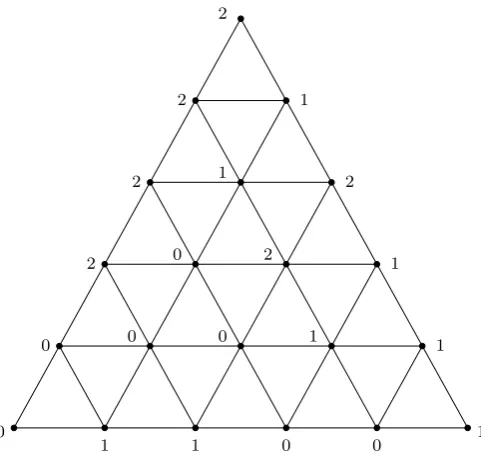
Let ∆ denote an n-dimensional simplex. n is a positive integer at least 2. For example, a 2-dimensional simplex is a triangle. Let partition or triangulate the simplex. Fig. 2 is an example of partition (triangulation) of a 2-dimensional simplex. In a 2-dimensional case we divide each side of∆
inmequal segments, and draw the lines parallel to the sides of∆. Then, the 2-dimensional simplex is partitioned intom2 triangles. We consider partition of∆inductively for cases of higher dimension. In a 3 dimensional case each face of ∆
is an 2-dimensional simplex, and so it is partitioned intom2 triangles in the way above mentioned, and draw the planes parallel to the faces of ∆. Then, the 3-dimensional simplex is partitioned intom3trigonal pyramids. And so on for cases of higher dimension.
Let K denote the set of small n-dimensional simplices of ∆ constructed by partition. The vertices of these small simplices ofK are labeled with the numbers 0, 1, 2,. . .,n
subject to the following rule.
1) The vertices of ∆ are respectively labeled with 0 to n. We label a point (1,0, . . . ,0) with 0, a point
(0,1,0, . . . ,0) with 1, a point (0,0,1. . . ,0) with 2,
. . ., a point (0, . . . ,0,1) with n. That is, a vertex
0 1
2
1 1 0 0
0 2
2 2
1 1 2 1
0 0 1
0 2
[image:2.595.72.264.57.221.2]1
Fig. 2. Partition and labeling of 2-dimensional simplex
whose k-th coordinate (k = 0,1, . . . , n) is 1 and all other coordinates are 0 is labeled with k.
2) If a vertex of simplices ofKis contained in ann−1 -dimensional face of∆, then that vertex is labeled with some number which is the same as the number of a vertex of that face.
3) If a vertex of simplices ofK is contained in an n− 2-dimensional face of ∆, then that vertex is labeled with some number which is the same as the number of a vertex of that face. And so on for cases of lower dimension.
4) A vertex contained in inside of ∆ is labeled with arbitrary number among 0, 1,. . .,n.
A small simplex ofKwhich is labeled with the numbers 0, 1,. . .,nis called afully labeled simplex. Now let us prove Sperner’s lemma.
Lemma 2 (Sperner’s lemma): If we label the vertices of
K following above rules 1) ∼ 4), then there are an odd number of fully labeled simplices. Thus, there exists at least one fully labeled simplex.
Proof:Our proof is standard. But again for completeness of arguments we provide a proof in Appendix A.
Sincenand partition of∆are finite, the number of small simplices constructed by partition is also finite. Thus, we can constructively find a fully labeledn-dimensional simplex of
K through finite steps.
III. CONSTRUCTIVE VERSION OF THEFAN-GLICKSBERG FIXED POINT THEOREM
In this section we will prove a constructive version of the Fan-Glicksberg fixed point theorem using Sperner’s lemma. The classical Fan-Glicksberg theorem ([5] and [6]) is stated as follows.
Theorem 1 (The Fan-Glicksberg fixed point theorem):
Let X be a compact and convex subset of a locally convex space E, and Φ be a compact and convex valued multi-function with closed graph from X to the set of its inhabited subsets. Then,Φhas a fixed point.
IAENG International Journal of Applied Mathematics, 41:2, IJAM_41_2_08
A locally convex space consists of a vector space E and a family (pi)i∈I of semi-norms on X, where I is an index set, for example, a set of positive integers. For each finitely enumerable subset F of I we define a basic neighborhood of a set S as follows2;
V(S, F, ε) ={y∈X|∑
i∈F
pi(y−z)< εfor somez∈S}.
The closure ofV(S, F, ε)is denoted byV(S, F, ε), and it is represented as follows;
V(S, F, ε) ={y∈X|∑
i∈F
pi(y−z)≤εfor somez∈S}.
We call it a closed basic neighborhood ofS. Compactness of a set in a locally convex space in constructive mathematics means total boundedness with completeness. According to [3] we define total boundedness of a set in a locally convex space as follows.
Definition 1: (Total boundedness of a set in a locally convex space)
LetX be a subset ofE,F be a finitely enumerable subset of I, andε >0. By an ε-approximation toX relative to F
we mean a subset T of X such that for each x∈ X there existsy∈T with∑i∈Fpi(x−y)< ε.
X is totally bounded relative toF if for eachε >0there exists a finitely enumerableε-approximation toX relative to
F. It is totally bounded if it is totally bounded relative to each finitely enumerable subset of I.
An approximate fixed point of a multi-function is defined as follows;
Definition 2: (Approximate fixed point of a multi-function in a locally convex space) For each ε > 0 x∗ is an approximate fixed point of a multi-function Φ from X to the set of its inhabited subsets if
∑
i∈F
pi(x∗−Φ(x∗))< ε,
for each finitely enumerableF ⊂I, wherepi(x∗−Φ(x∗)) =
infy∈Φ(x∗)pi(x∗−y).
A graph of a multi-function Φ from X to the set of its inhabited subsets is
G(Φ) =∪x∈X{x} ×Φ(x).
IfG(Φ)is a closed set, we say thatΦhas a closed graph. It implies the following fact.
Consider sequences (x(n))n≥1 and (y(n))n≥1 such that y(n) ∈ Φ(x(n)). If x(n) −→ x and
y(n)−→y, theny∈Φ(x). According to [3] this means
If for each basic neighborhood U(x, F, ε) of x
there exists n0 such thatx(n)∈ U(x, F, ε) when
n≥n0, then for the union of basic neighborhoods
∪y∈Φ(x)V(y, G, ε) of points in Φ(x) there exists
n′0 such that y(n) ∈ ∪y∈Φ(x)V(y, G, ε) when
n≥n′0.
If X is a metric space, the semi-norm in the definition of a basic neighborhood is replaced by the metric. n0 andn′0 depend on xand ε. Further we consider a uniform version 2A setF is finitely enumerable if there exists a natural numberNand a mapping of the set{1,2, . . . , N}ontoF.
of this property for functions, and call such a multi-functiona multi-function with uniformly closed graph, or say that a multi-function uniformly has a closed graph. It means thatn0 andn′0 depend on onlyε not onx.
If X is totally bounded relative to each finitely enu-merable subset of I, there exists a finitely enumerable τ -approximation{x0, x1, . . . , xm}toXrelative to each finitely enumerable F ⊂ I, that is, for each x ∈ X we have ∑
i∈Fpi(x−xi) < τ for at least one xi, i = 0,1, . . . , m for eachF. Let
Φτ(x) =V(Φ(x), F, τ),
whereV(Φ(x), F, τ)is a closed basic neighborhood ofΦ(x). IfΦuniformly has a closed graph,Φτ also uniformly has a closed graph. Now let
XV = { n
∑
i=0
αixi|xi ∈X, n ∑
i=0
αi= 1, αi≥0 }
. (1)
This is the convex-hull of{x0, x1, . . . , xm}. IfX is convex and compact, forx∈X we have
Φ(x)⊂X ⊂V(XV, F, τ).
Thus,
Φ(x)∩V(XV, F, τ)̸=∅,
and so
Φτ(x)∩XV ̸=∅.
Let
ΦXV(x) = Φτ(x)∩XV forx∈XV.
Then, it is a compact and convex valued multi-function with uniformly closed graph from XV to the set of its inhabited subsets. If the dimension of XV is n, XV is homeomorphic to an n-dimensional simplex ∆ = {(α0, α1, . . . , αn)| ∑n
i=0αi = 1}. A multi-function with uniformly closed graph from ∆ to the set of its inhabited subsets corresponds one to one to a multi-function with uniformly closed graph fromXV to the set of its inhabited subsets.
The contents of our constructive version of the Fan-Glicksberg fixed point theorem are described in the following theorem.
Theorem 2: (Constructive version of the Fan-Glicksberg fixed point theorem) Let X be a compact (totally bounded and complete) and convex subset of a locally convex spaceE, andΦbe a compact and convex valued multi-function with uniformly closed graph from X to the set of its inhabited subsets. Then,Φhas an approximate fixed point.
Proof:
1) Let consider a compact and convex valued multi-function Γ with uniformly closed graph from an n -dimensional simplex∆to the set of its inhabited sub-sets. We show that we can partition∆so that the con-ditions of Sperner’s lemma are satisfied. We partition
∆ according to the method in the proof of Sperner’s lemma, and label the vertices of simplices constructed by partition of∆. Consider a sequence(∆(m))m≥1of partitions of ∆. The larger m, the finer the partition and the smaller the diameter of simplices constructed by partition of ∆. Let x(m)0, x(m)1, . . . andx(m)n
IAENG International Journal of Applied Mathematics, 41:2, IJAM_41_2_08
be the vertices of a simplex in∆(m). The values of
Γat theses vertices are Γ(x(m)0),Γ(x(m)1), . . . and
Γ(x(m)n). We can consider a sequence of vertices including the verticesx(m)0, x(m)1, . . . andx(m)nof the same simplex. Denote the sequence by(x(N))N≥1. And consider a sequence of the values of Γ at these vertices, and denote it by (Γ(x(N)))N≥1. By the uniform version of the closed graph property ofΓ,
Suppose x(N)−→x, and lety(N)∈Γ(x(N)). If there existsN0 such that|x(N)−x|< εwhen
N ≥N0, then there existsN0′ such that|y(N)−
Γ(x)| < ε (it means |y(N)−y| < ε for some
y ∈Γ(x)) whenN ≥N0′.
Consider a simplex in a sufficiently fine partition of∆. Letx0 be a vertex of a small n-dimensional simplex constructed by partition of ∆ which is labeled, for example, with 0 by the labelling method which will be explained below. We take a pointφ(x)∈Γ(x)for all other vertices of this simplex so that|φ(x0)−φ(x)|<
εis satisfied3. It is important how to label the vertices
contained in the faces of ∆. We label a vertex x
according to the following rule,
If xk > φk or xk+τ > φk, we labelxwith k,
whereτ is a positive number, and xk denotes the k -th coordinate of x. If there are multiple k’s which satisfy this condition, we labelxconveniently for the conditions for Sperner’s lemma to be satisfied. We do not randomly label the vertices. For example, letxbe a point contained in ann−1-dimensional face of∆
such that xi = 0 for one i among 0,1,2, . . . , n (its
i-th coordinate is 0). With τ > 0, we have φi > 0 or φi < τ4. When φi > 0, from
∑n
j=0xj = 1, ∑n
j=0φj= 1 andxi= 0, n ∑
j=1,j̸=i
xj > n ∑
j=1,j̸=i
φj.
Then, for at least onej(denote it byk) we havexk>
φk, and we label x with k, where k is one of the numbers which satisfy xk > φk. Since φi > xi, i does not satisfy this condition. Assumeφi< τ.xi = 0 implies∑nj=0,j̸=ixj = 1. Since
∑n
j=0,j̸=iφj ≤1, we obtain
n ∑
j=0,j̸=i
xj ≥ n ∑
j=0,j̸=i
φj.
Then, for a positive numberτ we have n
∑
j=0,j̸=i
(xj+τ)> n ∑
j=0,j̸=i
φj.
There is at least onej(̸=i)which satisfiesxj+τ > φj. Denote it by k, and we label x with k. k is one of the numbers other than i such that xk +τ > φk is satisfied.i itself satisfies this condition (xi+τ > φi). 3There may exist a case such that we can not take a pointφ(x)for some vertexxso that|φ(x0)−φ(x)|< εis satisfied. See 3) of this proof about
such a case.
4In constructive mathematics for any real numberxwe can not prove that x≥0orx <0, thatx >0orx= 0orx <0. But for any distinct real numbersx,yandzsuch thatx > zwe can prove thatx > yory > z.
But, since there is a number other thaniwhich satisfies this condition, we can select a number other thani. We have proved that we can label the vertices contained in an n−1-dimensional face of ∆ such that xi= 1 for oneiamong0,1,2, . . . , nwith the numbers other than
i. By similar procedures we can show that we can label the vertices contained in ann−2-dimensional face of
∆ such that xi = 0 for two i’s among 0,1,2, . . . , n with the numbers other than those i’s, and so on.
Consider the case where xi =xi+1= 0. We see that whenφi>0 orφi+1>0,
n ∑
j=0,j̸=i,i+1
xj> n ∑
j=0,j̸=i,i+1
φj,
and so for at least one j(denote it byk) we have
xk > φk, and we label x with k. On the other hand, when φi < τ andφi+1< τ, we have
n ∑
j=0,j̸=i,i+1
xj≥ n ∑
j=0,j̸=i,i+1
φj.
Then, for a positive numberτ we have n
∑
j=0,j̸=i,i+1
(xj+τ)> n ∑
j=0,j̸=i,i+1
φj.
Thus, there is at least one j(̸= i, i+ 1) which satisfies xj+τ > φj. Denote it by k, and we labelxwithk.
Next consider the case where xi = 0 for all i other thann. If for somei φi>0, then we have
xn> φn, and labelxwithn. On the other hand, ifφj< τ for allj ̸=n, then we obtainxn≥φn. It implies xn +τ > φn. Thus, we can label x withn.
Therefore, the conditions for Sperner’s lemma are satisfied, and there exists an odd number of fully labeled simplices inK.
2) Consider a fully labeled simplex constructed by a sufficiently fine partition of ∆. Denote vertices of the fully labeled simplex by x0, x1, . . ., xn. We name these vertices so thatx0, x1, . . . , xn are labeled, respectively, with 0, 1, . . ., n. Then, from 1) of this proof |xj −x0| < ε and |φ(xj)−φ(x0)| < ε for eachj ̸= 0. Thei-th components ofx0 andφ(x0)are denoted byx0
i andφ(x0)i, and so on. Supposeτ >0. About x0, from the labeling rules we have x0
0+τ >
φ(x0)
0. Aboutx1, also from the labeling rules we have
x1
1+τ > φ(x1)1 which implies x11 > φ(x1)1−τ.
|φ(x0)−φ(x1)|< εmeansφ(x1)
1> φ(x0)1−ε. On the other hand, |x0−x1| < ε means x0
1 > x11−ε. Thus, from
x01> x11−ε, x11> φ(x1)1−τ, φ(x1)1> φ(x0)1−ε
we obtain
x01> φ(x0)1−2ε−τ > φ(x0)1−2ε−τ
By similar arguments, for each iother than 0,
x0i > φ(x 0
)i−2ε−τ. (2)
IAENG International Journal of Applied Mathematics, 41:2, IJAM_41_2_08
0
1
[image:5.595.59.278.55.262.2] [image:5.595.72.542.159.756.2]x
1x
∗x
0Fig. 3. A multi-function in 1-dimensional case
Fori= 0we have x0
0+τ > φ(x0)0. Then,
x00> φ(x 0
)0−τ (3)
Adding (2) and (3) side by side except for some i
(denote it byk) other than 0, n
∑
j=0,j̸=k
x0j >
n ∑
j=0,j̸=k
φ(x0)j−2(n−1)ε−nτ.
From ∑nj=0x0 j = 1,
∑n j=0φ(x
0)
j = 1 we have 1−
x0
k >1−φ(x0)k−2(n−1)ε−nτ, which is rewritten as
x0k< φ(x0)k+ 2(n−1)ε+nτ.
Since (2) impliesx0 k > φ(x
0)
k−2ε−τ, we have
φ(x0)k−2ε−τ < x0k < φ(x 0)
k+ 2(n−1)ε+nτ.
Thus,
|x0k−φ(x0)k|<2(n−1)ε+nτ (4)
is derived. On the other hand, adding (2) from 1 ton
yields n ∑
j=1
x0j >
n ∑
j=1
φ(x0)j−2nε−nτ.
From∑nj=0x0 j = 1,
∑n j=0φ(x
0)
j= 1 we have
1−x00>1−φ(x0)0−2nε−nτ. (5) Then, from (3) and (5) we get
|x00−φ(x0)0|<2nε+nτ. (6)
Sincenis finite, redefining2nε+nτ asε, (4) and (6) yield
|x0i −φ(x0)i|< εfor alli. (7)
Note that φ(x0) ∈ Γ(x0). Let ∆ be X
V and Γ be
ΦXV. Then,
x0∈V(Φ(x0), F, ε+τ).
Thus,x0 is an approximate fixed point ofΦ.
3) There may exist a case such that we can not take a pointφ(x)for some vertexxso that|φ(x0)−φ(x)|<
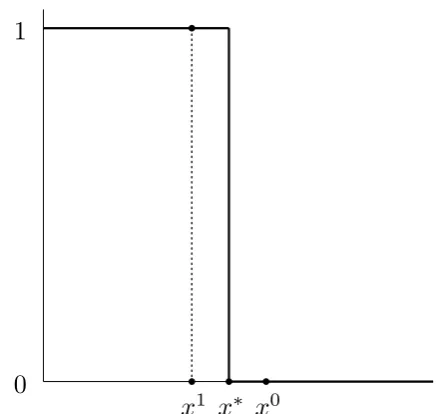
ε is satisfied. An example in a 1-dimensional case is a multi-function from [0,1] to [0,1] depicted in Fig. 3. The coordinates of the points 0 and 1 are, respectively,(0,1)and(1,0). And coordinates of other points in [0,1] are similar. Even if|x0−x1|< ε for any ε < 0, |φ(x0)−φ(x1)| > 0. x0 and x1 are, respectively, numbered with 0 and 1. We consider finer and finer partition of ∆, and sequences (x0(n))n≥1 and (x1(n))n≥1 such that x0(n) is labeled with 0,
x1(n)is labeled with 1, x0(n)−→x∗,x1(n)−→x∗
and |φ(x0(n)) −φ(x1(n))| > 0. By the uniform version of the closed graph property of Γ there are pointsφ0(x∗)andφ1(x∗)such that φ0(x∗)∈Γ(x∗),
φ1(x∗)∈Γ(x∗) and
x∗0> φ0(x∗)0−τ andx∗1> φ 1(x∗)
1−τ.
Since x∗0+x∗1 = 1 andφ1(x∗)0+φ1(x∗)1 = 1, the latter implies
x∗0< φ1(x∗)0+τ.
Thus,
φ0(x∗)0−τ < x∗0< φ 1(x∗)
0+τ.
Define a point inΓ(x∗)by
φ∗(x∗) =αφ0(x∗) + (1−α)φ1(x∗), 0≤α≤1.
By the convexity ofΓ(x∗),φ∗(x∗)∈Γ(x∗). Let
α= φ
1(x∗)
0+τ−x∗0
[φ1(x∗)
0+τ−x∗0] + [x∗0−φ0(x∗)0+τ]
= φ
1(x∗)
0+τ−x∗0
φ1(x∗)
0−φ0(x∗)0+ 2τ
,
and
1−α= x ∗
0−φ0(x∗)0+τ
φ1(x∗)
0−φ0(x∗)0+ 2τ
.
Then,
φ∗(x∗)0=
φ0(x∗)
0(τ−x∗0) +φ1(x∗)0(τ+x∗0)
φ1(x∗)
0−φ0(x∗)0+ 2τ
.
And so we have
x∗0−φ∗(x∗)0=
τ[2x∗0−φ0(x∗)
0−φ1(x∗)0]
φ1(x∗)
0−φ0(x∗)0+ 2τ
.
Since τ is arbitrary, for anyε >0we obtain
|x∗0−φ∗(x∗)0|< ε.
Similarly
|x∗1−φ∗(x∗)1|< ε
is derived. A case of higher dimension is similar. We have completed the proof.
IAENG International Journal of Applied Mathematics, 41:2, IJAM_41_2_08
IV. APPROXIMATE PURE STRATEGYNASH EQUILIBRIUM OF A STRATEGIC GAME WITH CONTINUOUS STRATEGIES
AND QUASI-CONCAVE PAYOFF FUNCTIONS
In this section, using the constructive version of the Fan-Glicksberg fixed point theorem proved in the previous section, we will prove the existence of an approximate pure strategy Nash equilibrium in a strategic game with continuous (infinite) strategies and quasi-concave payoff functions. Consider a strategic game such that there are m
players with an infinite number of pure strategies for each player. The set of pure strategies of player i is denoted by Si, i = 1,2, . . . , m.Si is a compact and convex subset of a locally convex space. Let S = Πmi=1Si be the set of profiles of strategies of all players. Denote a pure strategy of player i by si, a profile of strategies of all players by
s = (s1, s2, . . . , sm), and a profile of strategies of players other than iby s−i. There exists a family(pj)j∈I of semi-norms onSi for eachi, and we define the semi-norm on S by the sum of the semi-norms onSi over alli.
The payoff function of playeriis denoted byπi(si,s−i).
πi(si,s−i) is uniformly continuous and quasi-concave. We define, constructively, quasi-concavity of payoff functions with respect tosi as follows;
Definition 3 (Quasi-concavity): πi(si,s−i) is quasi-concave if for anysi, s′i∈Si,δ >0we have
πi(λsi+ (1−λ)s′i,s−i)>min(πi(si,s−i), πi(s′i,s−i))−δ.
Each player chooses one of strategies si satisfying the following condition.
πi(si,s−i)> πi(si′,s−i)−εfor alls′i∈Si.
ε is a positive number. We call such a strategy si an
approximate best responseof playeritos−i, and denote the set of approximate best responses of playeribyABRi(s−i).
Sinceπi(si,s−i)is uniformly continuous andSiis totally bounded, there existssupπi(si,s−i). Thus, for some s∗i ∈ Si and ε2, we have πi(s∗i,s−i) >
supπi(si,s−i)−2ε. From total boundedness ofSi, for any δ and each F ⊂ I there exists a finitely enumerableδ-approximation{t1, t2, . . . , tm}toSi such that for any t∈Si
∑
j∈Fpj(ti−t)< δ for at least one ti. Uniform continuity of πi(si,s−i) implies that there exists some δ > 0 such that when∑j∈Fpj(ti−s∗i)< δwe have|πi(ti,s−i)−
πi(s∗i,s−i)| < 2ε. Therefore, we can construc-tively find at least one ti such that πi(ti,s−i) >
supπi(si,s−i)−εfor each F⊂I.
A set of approximate best responses of all players at a profile s is a multi-function from S = (S1, S2, . . . .Sm) to the set of its inhabited subsets, and it is denoted by
ABR(s) = (ABR1(s−1), ABR2(s−2), . . . , ABRm(s−m)).
An approximate Nash equilibrium is a state where all players choose their approximate best responses each other, that is, an approximate fixed point of ABR(s) is an approximate Nash equilibrium. Now we show thatABR(s)satisfies the conditions for the constructive version of the Fan-Glicksberg fixed point theorem.
1) ABR(s)is convex.
Lets,s′∈ABR(s). Denote s= (s1, s2, . . . , sn)and
s′= (s′1, s′2, . . . , s′n). By the quasi-concavity of payoff functions we have, for each playeri
πi(λsi+ (1−λ)s′i,s−i)> πi(si,s−i)−δ,
or
πi(λsi+ (1−λ)s′i,s−i)> πi(s′i,s−i)−δ.
Since si, s′i ∈ABRi(s−i), we have
πi(λsi+ (1−λ)s′i,s−i)>πi(s′′i,s−i)−δ−ε
for alls′′i ∈Si.
Thus,λsi+ (1−λ)s′i is an approximate best response of playeri tos−i, andABR(s)is a convex set. 2) ABR(s) uniformly has a closed graph. Consider a
sequence of profiles of strategies of players other than i (s−i(m))m≥1 and a sequence of strate-gies of player i (si(m))m≥1 such that si(m) ∈
ABRi(s−i(m)). Let s−i(m)−→s−i and si(m)−→
si. By the uniform continuity of πi(si,s−i), for
m ≥ M with some natural number M we have πi(si,s−i(m)) > πi(si(m),s−i(m))−ε and
πi(si,s−i)> πi(si,s−i(m))−ε. Thus,
πi(si,s−i)> πi(si(m),s−i(m))−2ε.
Since si(m)∈ABRi(s−i(m)),πi(si(m),s−i(m))>
πi(s′i,s−i(m))−ε for alls′i ∈ Si, and again by the uniform continuity of πi(si,s−i), πi(s′i,s−i(m)) >
πi(s′i,s−i)−ε. Then
πi(si,s−i)> πi(s′i,s−i)−4εfor alls′i∈Si.
Therefore, si ∈ ABRi(s−i). This holds for all i, and so ABR(s) uniformly has a closed graph. The conditions for the constructive version of the Fan-Glicksberg fixed point theorem are satisfied.
There exists a points∗ such that for anyδ and eachF ∈I, ∑
j∈F
pj(s−s∗)< δ for somes∈ABR(s∗).
This means ∑
j∈F
pj(si−s∗i)< δ for somesi∈ABRi(s∗−i). (8)
Sinceπi(si,s−i)is uniformly continuous with respect tosi, (8) implies
πi(s∗i,s−∗i)> πi(s′i,s∗−i)−τ−εfor all s′i∈Si,
for τ > 0 and ε > 0. The value of τ is determined corresponding to the value ofδ. Then,s∗i is an approximate best response of playeritos∗−i, and we have completed the proof of the existence of an approximate pure strategy Nash equilibrium.
V. CONCLUDINGREMARKS
In this paper we have presented a proof of a constructive version of the Fan-Glicksberg fixed point theorem for multi-functions in a locally convex space using Sperner’s lemma, and applied it to a proof of the existence of a Nash equilib-rium in a strategic game with continuous strategies and quasi-concave payoff functions. We are studying some related
IAENG International Journal of Applied Mathematics, 41:2, IJAM_41_2_08
0 1 2
1 1 0 0
0 2
2 2
1 1 2 1
0 0 1
0 2
1
A
B
[image:7.595.62.271.54.297.2]C
Fig. 4. Sperner’s lemma
problems such as the existence of an approximate equilibrium of a competitive economy with multi-valued demand and supply functions, and the existence of an approximate core in a NTU (non-transferable utility) game. A related paper is [8] in which a constructive version of Tychonoff’s fixed point theorem for single-valued functions in a locally convex space has been proved.
APPENDIXA
PROOF OFSPERNER’S LEMMA
We prove this lemma by induction about the dimension of
∆. Whenn= 0, we have only one point with the number 0. It is the unique 0-dimensional simplex. Therefore the lemma is trivial. Whenn= 1, a partitioned 1-dimensional simplex is a segmented line. The endpoints of the line are labeled distinctly, with 0 and 1. Hence in moving from endpoint 0 to endpoint 1 the labeling must switch an odd number of times, that is, an odd number of edges labeled with 0 an 1 may be located in this way.
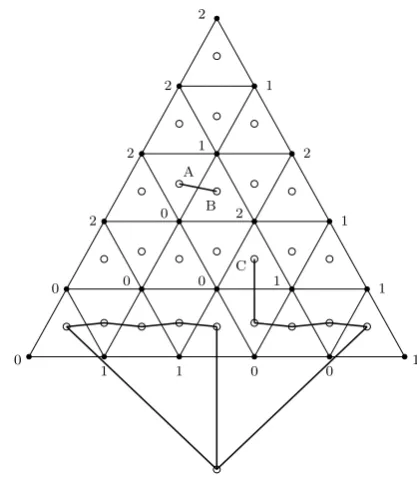
Next consider the case of 2 dimension. Assume that we have partitioned a 2-dimensional simplex (triangle) ∆ as explained above. Consider the face of ∆labeled with 0 and 15. It is the base of the triangle in Fig. 4. Now we introduce a
dual graph that has its nodes in each small triangle ofKplus one extra node outside the face of ∆ labeled with 0 and 1 (putting a dot in each small triangle, and one dot outside∆). We define edges of the graph that connect two nodes if they share a side labeled with 0 and 1. See Fig. 4. White circles are nodes of the graph, and thick lines are its edges. Since from the result of 1-dimensional case there are an odd number of faces ofK labeled with 0 and 1 contained in the face of∆
labeled with 0 and 1, there are an odd number of edges which connect the outside node and inside nodes. Thus, the outside node has odd degree. Since by the Handshaking lemma there
5We call edges of triangle∆facesto distinguish between them and edges of a dual graph which we will consider later.
are an even number of nodes which have odd degree, we have at least one node inside the triangle which has odd degree. Each node of our graph except for the outside node is contained in one of small triangles of K. Therefore, if a small triangle ofK has one face labeled with 0 and 1, the degree of the node in that triangle is 1; if a small triangle of K has two such faces, the degree of the node in that triangle is 2, and if a small triangle ofK has no such face, the degree of the node in that triangle is 0. Thus, if the degree of a node is odd, it must be 1, and then the small triangle which contains this node is labeled with 0, 1 and 2 (fully labeled). In Fig. 4 triangles which contain one of the nodesA,B,C are fully labeled triangles. Now assume that the theorem holds for dimensions up ton−1. Assume that we have partitioned ann-dimensional simplex ∆. Consider the fully labeled face of∆ which is a fully labeledn−1 -dimensional simplex. Again we introduce a dual graph that has its nodes in small n-dimensional simplices of K plus one extra node outside the fully labeled face of∆(putting a dot in each smalln-dimensional simplex, and one dot outside
∆). We define the edges of the graph that connect two nodes if they share a face labeled with 0, 1,. . .,n−1. Since from the result ofn−1-dimensional case there are an odd number of fully labeled faces of small simplices of K contained in then−1-dimensional fully labeled face of∆, there are an odd number of edges which connect the outside node and inside nodes. Thus, the outside node has odd degree. Since, by the Handshaking lemma there are an even number of nodes which have odd degree, we have at least one node inside the simplex which has odd degree. Each node of our graph except for the outside node are contained in one of small n-dimensional simplices of K. Therefore, if a small simplex of K has one fully labeled face, the degree of the node in that simplex is 1; if a small simplex ofK has two such faces, the degree of the node in that simplex is 2, and if a small simplex ofK has no such face, the degree of the node in that simplex is 0. Thus, if the degree of a node is odd, it must be 1, and then the small simplex which contains this node is fully labeled.
If the number (label) of a vertex other than vertices labeled with 0, 1, . . ., n−1 of ann-dimensional simplex which contains a fully labeled n −1 -dimensional face is n, then this n-dimensional simplex has one such face, and this simplex is a fully labeledn-dimensional simplex. On the other hand, if the number of that vertex is other thann, then then-dimensional simplex has two such faces. We have completed the proof of Sperner’s lemma.
ACKNOWLEDGMENT
The author would like to thank anonymous referees for their helpful comments.
REFERENCES
[1] E. Bishop and D. Bridges,Constructive Analysis, Springer, 1985. [2] D. Bridges and F. Richman, Varieties of Constructive Mathematics,
Cambridge University Press, 1987.
[3] D. Bridges and L. Vˆıt¸˘a, Techniques of Constructive Mathematics, Springer, 2006.
[4] D. van Dalen, “Brouwer’sε-fixed point from Sperner’s lemma”,Logic Group Preprint Series, No. 275, 2009.
IAENG International Journal of Applied Mathematics, 41:2, IJAM_41_2_08
[5] Ky Fan, “A generalization of Tychonoff’s fixed point theorem”,Math. Annalen, vol. 132, pp. 301-310, 1961.
[6] I. L. Glicksberg,“A further generalization of the Kakutani fixed point theorem, with Application to Nash equilibrium”.Proceedings of the American Mathematical Society, vol. 3, pp. 170-174, 1952.
[7] F. E. Su, “Rental harmony: Sperner’s lemma for fair devision”, Ameri-can Mathematical Monthly, vol. 106, pp. 930-942, 1999.
[8] Y. Tanaka, “On constructive versions of Tychonoff’s and Schauder’s fixed point theorems”,Applied Mathematics E-Notes, National Tsing Hua University (Taiwan), forthcoming, 2011,
[9] W. Veldman, “Brouwer’s approximate fixed point theorem is equivalent to Brouwer’s fan theorem”, inLogicism, Intuitionism and Formalism, edited by Lindstr¨om, S., Palmgren, E., Segerberg, K. and Stoltenberg-Hansen, Springer, 2009.