A Compact Finite Difference Method for Solving
the General Rosenau–RLW Equation
Ben Wongsaijai, Kanyuta Poochinapan
∗, and Thongchai Disyadej
Abstract—In this paper, a compact finite difference method to solve the Rosenau–RLW equation is proposed. A numerical tool is applied to the model by using a three–level average implicit finite difference technique. The fundamental conser-vative property of the equation is preserved by the presented numerical scheme, and the existence and uniqueness of the numerical solution are proved. Moreover, the convergence and stability of the numerical solution are also shown. The new method gives second– and fourth–order accuracy in time and space, respectively. The algorithm uses five–point stencil to approximate the derivatives for the space discretization. The numerical experiments show that the proposed method improves the accuracy of the solution significantly.
Index Terms—finite difference method, Rosenau–RLW equa-tion.
I. INTRODUCTION
A
nonlinear wave phenomenon is the important area of scientific research, which many scientists in the past have studied about mathematical models explaining the wave behavior. There are mathematical models which describe the dynamic of wave behaviors–for example, the KdV equation, the RLW equation, the Rosenau equation, and many others [1]–[10]. The KdV equation has been used in very wide applications, such as magnetic fluid waves, ion sound waves, and longitudinal astigmatic waves [4]–[6]. The RLW equation, which was first proposed by Peregrine [7], [8] provides an explanation on a different situation of a nonlinear dispersive wave from the more classical KdV equation. The RLW equation is one of models which are encountered in many areas, e.g. ion–acoustic plasma waves, magnetohydro-dynamic plasma waves, and shallow water waves. Since the case of wave–wave and wave–wall interactions cannot be described by the KdV equation, Rosenau [9], [10] proposed an equation for describing the dynamic of dense discrete systems; it is known as the Rosenue equation. The existence and uniqueness of the solution for the Rosenau equation were proved by Park [11], [12]. For the further consideration of the nonlinear wave, a viscous termuxxtneeds to be included:ut−uxxt+uxxxxt+ux+ (up)x= 0, (1)
where p ≥ 2 is an integer and u0(x) is a known smooth function. This equation is usually called the Rosenua–RLW equation. Ifp= 2, then Eq. (1) is called the usual Rosenau– RLW equation. Moreover, if p = 3, then Eq. (1) is called the modified Rosenau–RLW equation. The behavior of the
∗Kanyuta Poochinapan, Corresponding Author, Department of Mathemat-ics, Faculty of Science, Chiang Mai University, Chiang Mai 50200, Thailand (email: [email protected], [email protected])
Ben Wongsaijai, Department of Mathematics, Faculty of Science, Chiang Mai University, Chiang Mai 50200, Thailand (email: [email protected])
Thongchai Disyadej, Electricity Generating Authority of Thailand, Phit-sanulok 65000, Thailand (e-mail: [email protected])
solution to the Rosenau–RLW equation with the Cauchy problem has been well studied for the past years [13]–[18]. It is known that the solitary wave solution for Eq. (1) is
u(x, t) =eln{(p+3)(3p+1)(p+1)/[2(p2+3)(p2+4p+7)]}/(p+1)×
sech4/(p+1)
"
p−1 p
4p2+ 8p+ 20(x−ct) #
,
wherep≥2is an integer andc= (p4+ 4p3+ 14p2+ 20p+ 25)/(p4+ 4p3+ 10p2+ 12p+ 21).
The Rosenau–RLW equation has been solved numerically by various methods (for example, see [13]–[18]). Zuo et al. [13] have proposed the Crank–Nocolson finite difference scheme for the equation. The convergence and stability of the proposed method were also discussed. Obviously, the scheme in [13] requires heavy iterative computations because the scheme is nonlinear implicit. Pan and Zhang [14], [15] developed linearized difference schemes which are three– level and conservative implicit for both the usual Rosenau– RLW (p = 2) and the general Rosenau–RLW (p ≥ 2)
equations. The second–order accuracy and unconditional stability were also proved.
In this paper, we consider the following initial–boundary value problem of the general Rosenau–RLW equation with an initial condition:
u(x,0) =u0(x), (xl≤x≤xr), (2)
and boundary conditions
u(xl, t) =u(xr, t) = 0,
uxx(xl, t) =uxx(xr, t) = 0, (0≤t≤T). (3)
The initial–boundary value problem possesses the following conservative properties:
Q(t) = Z xr
xl
u(x, t)dx= Z xr
xl
u0(x,0)dx=Q(0),
and
E(t) =kuk2
L2+kuxk
2
L2+kuxxk
2
L2 =E(0).
When −xl À 0 and xr À 0, the initial–boundary value
problem (1)–(3) is consistent, so the boundary condition (3) is reasonable.
By observation, the total accuracy of a specific method is affected by not only the order of accuracy of the numerical method but also other factors. That is, the conservative approximation property of the method is another factor that has the same or possibly even more impact on results. Better solutions can be expected from numerical schemes which have effective conservative approximation properties rather than the ones which have nonconservative properties [19], [20]. To create the discretization equation, a finite difference
IAENG International Journal of Applied Mathematics, 44:4, IJAM_44_4_05
method is applied in the present research since conservative approximation analysis by the mathematical tools has been developing until now.
The content of this paper is organized as follows. In the next section, we describe a conservative implicit finite difference scheme for the general Rosenau–RLW equation (1) with the initial and boundary conditions (2)–(3). Some preliminary lemmas and discrete norms are given and the invariant property Qn is proved. We discuss about the
solvability of the finite difference scheme, and the existence and uniqueness of the solution are also proved in the Section 3. Section 4 presents complete proofs on the convergence and stability of the proposed method with convergence rate O(τ2+h4). The results of validation for the finite difference
scheme are presented in Section 5, where we make a detailed comparison with available data, to confirm and illustrate our theoretical analysis. Finally, we finish our paper by concluding remarks in Section 6.
II. FINITEDIFFERENCESCHEME
In this section, we introduce a finite difference scheme for the formulation of Eqs. (1)–(3). The solution domain
Ω = {(x, t)| xl ≤ x ≤ xr, 0 ≤ t ≤T} is covered by a
uniform grid:
Ωh={(xi, tn)|xi=xl+ih, tn =nτ,0≤i≤M,
0≤n≤N},
with spacings h = (xr−xl)/M and τ = T /N. Denote
un
i ≈u(xi, tn),
¯
Ωh={(xi, tn)|xi=xl+ih, tn=nτ, −1≤i≤M+1,
0≤n≤N},
andZ0
h={un= (uni)|u0=uM = 0, −1≤i≤M + 1}.
We use the following notations for simplicity:
un+12
i =
uni+1+un i
2 , u¯
n
i =
uni+1+uni−1
2 ,
(un i)t=
uni+1−un i
τ , (u
n i)ˆt=
uni+1−uni−1
2τ ,
(uni)x=
un i+1−uni
h , (u
n i)¯x=
un i −uni−1
h ,
(uni)ˆx=
un
i+1−uni−1 2h , (u
n, vn) =h MX−1
i=1
univni,
kunk2= (un, un), kunk
∞= max
1≤i≤M−1|u
n i|.
By setting w=uxxt−ux−uxxxxt−(up)x, Eq. (1) can be
written asw=ut. By the Taylor expansion, we obtain
wn
i = (∂tu)ni = (uni)ˆt+O
¡
τ2¢, (4)
and
wn
i =
· (un
i)xx¯ˆt−
h2 12 ¡
∂4
x∂tu
¢n i
¸
−
· (un
i)xˆ−
h2 6 ¡ ∂3 xu ¢n i ¸ − · (un
i)xxx¯x¯ˆt−
h2 6
¡
∂6
x∂tu
¢n i
¸
−
· [(un
i) p
]xˆ−h
2
6 ¡
∂3
xup
¢n i
¸
+O¡h4¢. (5)
From Eq. (4), we have
¡
∂6
x∂tu
¢n
i =
¡
∂4
x∂tu
¢n i − ¡ ∂3 xu ¢n i− ¡ ∂3
xup
¢n i− ¡ ∂2 xw ¢n i . (6)
Then,
wn
i =
· (un
i)xx¯ˆt−
h2 12 ¡
∂4
x∂tu
¢n i
¸
−
· (un
i)xˆ−
h2 6 ¡ ∂3 xu ¢n i ¸ − · [(un
i)p]xˆ−
h2 6
¡
∂3
xup
¢n i
¸
−
· (un
i)xxx¯x¯ˆt
−h
2
6 h¡
∂x4∂tu
¢n
i −
¡
∂x3u
¢n
i −
¡
∂3xup
¢n
i −
¡
∂2xw
¢n i
i ¸
+O¡h4¢. (7)
This implies that
wn
i = (uni)xx¯ˆt+
h2 12 ¡
∂4
x∂tu
¢n i −(u
n
i)xˆ−[(uni) p
]ˆx
−(un
i)xxx¯¯xtˆ−
h2 6 ¡ ∂2 xw ¢n
i +O
¡
h4¢. (8)
Using second–order accuracy for approximation, we obtain
¡
∂4
xu
¢n i =(u
n
i)xxx¯x¯+O ¡
h2¢, ¡
∂2
xw
¢n i = (w
n i)x¯x+O
¡
h2¢.
The following method is a proposed finite difference scheme to solve the problem (1)–(3):
(uni)ˆt−
µ 1−h
2
6 
(uni)x¯xˆt+
µ 1−h
2
12 
(uni)xxx¯x¯ˆt
+ (uni)ˆx+ [(uni)p]xˆ= 0;
1≤i≤M −1, 1≤n≤N−1, (9)
where
u0i =u0(xi), 0≤i≤M, (10)
un
0 =unM = 0, (un0)xx¯= (unM)x¯x= 0, 1≤n≤N.
(11)
A three–step method is used for the time discretization of the above described scheme. After the new time discretiza-tion of Eq. (9) is performed, three– and five–point stencils approximating the derivatives for the space discretization are used to obtain an algebraic system. The matrix system of Eq. (9) is banded with penta–diagonals and we use a standard routine of the MATLAB to solve the system (9)–(11). The nonlinear term of Eq. (1) is handled by using the linear implicit scheme. Therefore, the equations are solved easily by using the presented method since it does not require extra effort to deal with the nonlinear term.
Lemma 1: (Pan and Zhang [15]) For any two mesh func-tionsu, v∈Z0
h, we have
(uxˆ, v) =−(u, vˆx),
(ux, v) =−(u, v¯x),
(v, uxx¯) =−(vx, ux),
(u, uxx¯) =−(ux, ux) =−kuxk2.
Furthermore, if(un
0)xx¯= (unM)x¯x= 0, then it implies
(u, uxxx¯¯x) =kux¯xk2.
IAENG International Journal of Applied Mathematics, 44:4, IJAM_44_4_05
Theorem 2: Suppose thatu0∈H02, then the scheme (9)–
(11) is conservative in sense:
Qn = h
2
MX−1
i=1 ¡
un+1
i +uni
¢
= Qn−1 =. . . =Q0, (12)
under assumptions u−1=u1= 0anduM−1=uM+1= 0. Proof: By multiplying Eq. (9) byh, summing up for i from0 toM−1, considering the boundary conditions, and assuming u−1=u1= 0anduM−1=uM+1= 0, we get
h
2
MX−1
i=1 ¡
un+1
i −uni−1
¢ = 0.
Then, this gives Eq. (12).
Lemma 3: (Discrete Sobolev’s inequality [21]) There exist two constants C1 andC2 such that
kunk
∞≤C1kunk+C2kunxk.
Theorem 4: Suppose u0 ∈ H02[xl, xr], then the solution
un satisfies kunk ≤ C and kun
xxk ≤ C, which yields kunk
∞≤C .
Proof: It follows from the initial condition (10) that u0≤C. The first levelu1 is computed by the fourth–order
method. Hence, the following estimates are gotten about
°
°u1°° ≤ C and °°u1°°
∞ ≤ C. Now, we use the induction argument to prove the estimate. We assume that
° °uk°°
∞≤C for k= 0,1,2, . . . , n. (13) Taking the inner product of Eq. (9) with 2¯un and using
Lemma 1, we obtain
°
°un+1°°2−°°un−1°°2+ µ
1−h2
6 ¶ ³°
°un+1
x
° °2
−°°un−1
x
° °2´
+ µ
1−h
2
12 ¶ ³°
°un+1
xx¯ ° °2
−°°un−1
xx¯ ° °2´
=−2τ((un)
ˆ
x,2¯un)−2τ([(un) p]
ˆ
x,2¯un).
According to the Cauchy–Schwarz inequality and direct calculation, it gives
kunxˆk ≤ kunxk,
and
((un)
ˆ
x,2¯un)≤
µ
kun xk
2 +1
2 °
°un+1°°2+1 2 ° °un−1°°2

.
From Eq. (13), the Cauchy–Schwarz inequality, and Lemma 1, we get
([(un)p
]xˆ,2¯un) =−h MX−1
i=1 (un
i) p¡
un+1
i +uni−1
¢ ˆ
x
≤C
µ
kunk2+1 2
° °un+1
x
° °2+1
2 ° °un−1
x ° °2 ¶ . Setting
Bn =kunk2+°°un−1°°2+ µ
1−h2
6 ¶ ³
kun xk2+
° °un−1
x
° °2´
+ µ
1−h2
12 ¶ ³
kun xx¯k2+
° °un−1
x¯x
° °2´
,
then
Bn+1−Bn≤τ C¡Bn+1+Bn¢.
If τ is sufficiently small, which satisfies τ ≤ k−2
kC and
k >2, then
Bn+1≤ (1 +τ C) (1−τ C)B
n≤(1 +τ kC)Bn≤exp (kCT)B0.
Hence°°un+1°°≤C,°°un+1
x
°
°≤C, and°°un+1
x¯x
°
°≤C, which
yield°°un+1°°
∞≤C by Lemma 3.
III. SOLVABILITY
In this section, we prove the existence and uniqueness of our proposed scheme that implies the unique solvability.
Theorem 5: The finite difference scheme (9)–(11) is uniquely solvable.
Proof: By using the mathematical induction, we can determine u0 uniquely by an initial condition and then
choose a fourth–order method to computeu1. Now, suppose
u0, u1, u2, ..., un to be solved uniquely. By considering Eq.
(9) forun+1, we have
1 2τu
n+1
i −
1 2τ
µ 1−h
2
6 
¡
uni+1¢xx¯+
1 2τ
µ 1−h
2
12 
¡
uni+1¢xx¯xx¯= 0. (14)
By taking an inner product of Eq. (14) withun+1, we obtain
1 2τ
°
°un+1°°2− 1 2τ
µ 1−h2
6 
° °un+1
x ° °2 + 1 2τ µ 1−h2
12 
° °un+1
xx¯ ° °2
= 0.
By the Cauchy–Schwarz inequality and Lemma 1, we have
° °un+1
x
° °2
= (un+1, un+1
xx¯ )≤ 1 2 °
°un+1°°2+1 2 ° °un+1
x¯x
° °2 . Then, 1 2 °
°un+1°°2+ µ 1 2− h2 12 ¶ ° °un+1
xx¯ ° °2
= 0.
Therefore, Eq. (14) has the only one solution and Eq. (9) un+1 is uniquely solvable. This completes the proof of
Theorem 5.
IV. CONVERGENCE AND STABILITY
In this section, we prove the convergence and stability of the scheme (9)–(11). Let en
i =vni −uin, where vni and uni
are the solutions of (1)–(3) and (9)–(11), respectively. Then, we obtain the following error equations:
rn
i = (eni)ˆt−
µ 1−h2
6 
(en i)xx¯ˆt+
µ 1−h2
12 
(en i)xxx¯x¯ˆt
+ (en
i)xˆ+ [(vin)p]xˆ−[(uni)p]xˆ, (15)
wherern
i denotes the truncation error. By using the Taylor
expansion, it is easy to see that rn
i =O(τ2+h4) holds as
τ, h→0. The following lemmas are essential for the proof of convergence and stability of our scheme.
Lemma 6: (Discrete Gronwall’s inequality [21]) Suppose that ω(k) and ρ(k) are nonnegative functions and ρ(k) is nondecreasing. IfC >0 and
ω(k)≤ρ(k) +Cτ
kX−1
l=0
ω(l), ∀k,
IAENG International Journal of Applied Mathematics, 44:4, IJAM_44_4_05
then
ω(k)≤ρ(k)eCτ k, ∀k.
Lemma 7: (Pan and Zhang [15]) Suppose that u0 ∈
H2
0[xl, xr], then the solutionun of Eqs. (1)–(3) satisfies kukL2 ≤C, kuxkL2 ≤C,
kuxxkL2≤C, kukL∞ ≤C.
The following theorem shows that our scheme converges to the solution with convergence rateO(τ2+h4).
Theorem 8: Suppose u0 ∈ H02[xl, xr], then the solution
un converges to the solution for the problem in the sense of k·k∞ and the rate of convergence isO(τ2+h4).
Proof:By taking an inner product on both sides of Eq. (15) with2¯en≡(en+1+en−1), we get
³°
°en+1°°2−°°en−1°°2´+ µ
1−h
2
6 ¶ ³°
°en+1
x
° °2
−°°en−1
x
° °2´
+ µ
1−h
2
12 ¶ ³°
°en+1
xx¯ ° °2
−°°en−1
x¯x
° °2´
= 2τ(rn,2¯en)
−2τ(en
ˆ
x,2¯en)−2τ([(vn)p]xˆ−[(un)
p]
ˆ
x,2¯en). (16)
According to the Schwarz inequality, Lemma 1, Theorem 2, and Lemma 7, we obtain
µ [(vn)p
]xˆ−[(un)p
]ˆx,2¯en

= 2h
MX−1
i=1 ·
[(vn i)
p
]xˆ−[(un i)
p
]ˆx ¸
¯
en i
=−2h
MX−1
i=1 ·
(vn
i)p−(uni)p
¸ (¯en
i)xˆ
= 2h
MX−1
i=1 ·
en i
p−2 X
k=1 (vn
i) p−k−2
(un i)
k
¸ (¯en
i)xˆ
≤C³kenk2+ke¯n
ˆ
xk2
´
≤C
µ
kenk2
+°°en−1 ˆ
x
° °2
+°°en+1 ˆ
x
° °2
. (17)
By the Cauchy–Schwarz inequality, Lemma 1, and a direct calculation, we obtain
kenxˆk ≤ kenxk, (18)
kenxk=−(en, enx¯x)≤
1 2
³
kenk2+kenx¯xk2
´
, (19)
(en
ˆ
x,2¯en)≤ kenˆxk
2 +1
2 ³°
°en+1°°2+°°en−1°°2´, (20)
(rn,2¯en)≤ krnk2+1 2
³°
°en+1°°2+°°en−1°°2´. (21)
From Eqs.(16)–(21), they yield
³°
°en+1°°2−°°en−1°°2´
+ µ
1−h
2
6 ¶ ³°
°en+1
x
° °2
−°°enx−1
° °2´
+ µ
1−h2
12 ¶ ³°
°en+1
xx¯ ° °2
−°°en−1
xx¯ ° °2´
≤2τkrnk2+τ C
µ°
°en−1°°2+kenk2
+°°en+1°°2
+°°en−1
x
° °2
+ken xk
2
+°°en+1
x
° °2
. (22)
Setting
En=kenk2
+°°en−1°°2+ µ
1−h
2
6 ¶ ³
ken xk2+
° °en−1
x
° °2´
+ µ
1−h
2
12 ¶ ³
kenxx¯k2+ ° °en−1
xx¯ ° °2´
,
then Eq. (22) can be rewritten as
En+1−En≤2τkrnk2+τ C¡En+1+En¢,
and
(1−2τ C)¡En+1−En¢≤τkrnk2+ 2τ CEn.
Ifτ is sufficiently small, which satisfies1−2Cτ >0, then
En+1−En≤τ Ckrnk2+τ CEn. (23)
Summing up Eq. (23) from1 ton, we have
En+1≤E1+Cτ
n
X
k=1 °
°rk°°2+Cτ n
X
k=1
Ek. (24)
Thus, we can use a fourth–order method to computeu1such
that
E1≤O(τ2+h4)2,
and τ n X k=1 °
°rk°°2≤nτ max
0≤l≤n−1 °
°rl°°2≤T·O(τ2+h4)2.
By Lemma 6, we obtainEn≤O(τ2+h4)2, that is
kenk ≤O(τ2+h4), ken
xx¯k ≤O(τ2+h4).
From Eq. (20), we obtain
kenk ≤O(τ2+h4), kenxk ≤O(τ2+h4),
and
ken
x¯xk ≤O(τ2+h4).
By Lemma 3,
kenk∞≤O(τ2+h4).
This completes the proof.
Theorem 9: Under the conditions of Theorem 8, the so-lutionun of Eqs. (9)–(11) is stable in normk · k
∞.
V. NUMERICALEXPERIMENTS
In this section, we present numerical experiments on a test problem to confirm and illustrate the accuracy of our proposed method. The accuracy of the method is measured by the comparison of numerical solutions with exact solu-tions as well as other numerical solusolu-tions from the method in the literature [15] by using k · k and k · k∞ norm. The initial condition associated for the Rosenau–RLW equation takes the form:
u0(x) =eln{(p+3)(3p+1)(p+1)/[2(p2+3)(p2+4p+7)]}/(p+1)×
sech4/(p+1)
"
p−1 p
4p2+ 8p+ 20(x) #
.
IAENG International Journal of Applied Mathematics, 44:4, IJAM_44_4_05
TABLE I
COMPARISON OF ERRORS WITHτ= 0.1,h= 0.25,xl=−60,AND xr= 120ATt= 40.
kek ×10−2 kek
∞×10−3
p Present Pan&Zhang Present Pan&Zhang
2 0.23608 0.78777 0.88670 2.88972
4 0.47254 1.73066 1.81252 6.47969
8 0.46713 1.80583 1.75739 6.66740
16 0.38438 1.37857 1.30630 5.05919
TABLE II
COMPARISON OF ERRORS WITHτ= 0.1,h= 0.5,xl=−60,AND xr= 120ATt= 40.
kek ×10−2 kek
∞×10−2
p Present Pan&Zhang Present Pan&Zhang
2 0.230294 3.25288 0.086284 1.19460
4 0.447881 7.45173 0.171122 2.78712
8 0.431841 8.03730 0.161891 2.95337
16 0.357253 6.13044 0.118759 2.25471
−600 −40 −20 0 20 40 60 80 100 120
0.005 0.01 0.015 0.02 0.025
Present Pan and Zhang [15]
Fig. 1. Absolute error distribution atp= 4, h= 0.5, τ=h2, andt= 40.
For u1, we employ a two–level method to estimate the
solution by
(uni)t−
µ 1−h
2
6 
(uni)xxt¯ + µ
1−h
2
12 
(uni)xx¯xxt¯
+ ³
uni+12
´
ˆ
x+ [(u n
i)p]xˆ= 0;
1≤i≤M −1, 1≤n≤N−1. (25)
We make a comparison between the scheme (9)–(11) and the scheme proposed in [15]. The rate of convergence is computed using two grids, according to the formula:
Rate=log2
kehk keh/2k
.
The results in term of errors at t = 40, τ = 0.1, and differentp, by usingxl=−60andxr= 120, withh= 0.25
andh= 0.5are reported in Tables I and II. It is clear that the results obtained by the scheme (9)–(11) are more accurate than the ones obtained by the scheme in [15].
Absolute error distributions for the two methods withτ= 0.25, h= 0.5, andt= 40are drawn atp= 4and8in Figs. 1 and 2, respectively. The results obtained by the scheme (9)– (11) are greatly improved when compared to those by the scheme in [15]. It can be easily observed that the maximum
−600 −40 −20 0 20 40 60 80 100 120
0.005 0.01 0.015 0.02 0.025
Present Pan and Zhang [15]
Fig. 2. Absolute error distribution atp= 8, h= 0.5, τ=h2, andt= 40.
0 10 20 30 40 50 60
0 0.01 0.02 0.03 0.04 0.05 0.06 0.07 0.08 0.09 0.1
Present Pan and Zhang [15]
Fig. 3. Errorkekversustatp= 4, h= 0.5, andτ=h2.
0 10 20 30 40 50 60
0 0.005 0.01 0.015 0.02 0.025 0.03 0.035
Present Zhang and Pan [15]
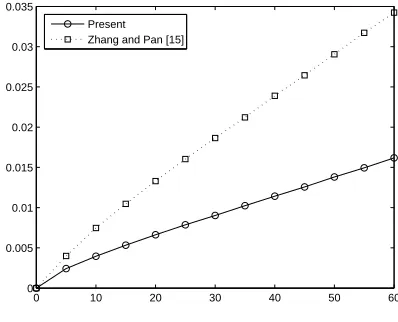
Fig. 4. Errorkek∞versustatp= 4, h= 0.5, andτ=h2.
error is taken place around the peak amplitude of the solitary wave and then the scheme (9)–(11) is applied in this area.
Figs. 3–6 show errors at t ∈[0,60] with τ = 0.25, h= 0.5, andp= 4,8by comparing with the Pan&Zhang method [15]. It is observed that both errors increase with time quite linearly but the error of the present method is less than that of the Pan&Zhang method [15].
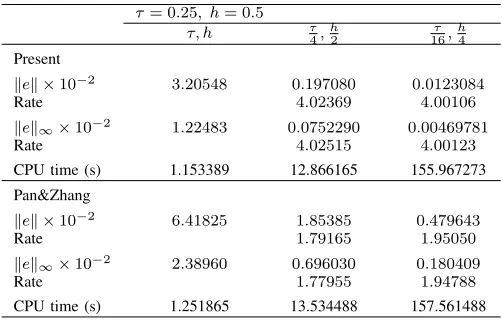
As shown in Tables III and IV, on one particular choice of the parameters, the estimated rate is close to the theoretically
IAENG International Journal of Applied Mathematics, 44:4, IJAM_44_4_05
[image:5.595.324.523.268.426.2] [image:5.595.323.522.473.634.2]0 10 20 30 40 50 60 0
0.02 0.04 0.06 0.08 0.1 0.12
Present Pan and Zhang [15]
Fig. 5. Errorkekversustatp= 8, h= 0.5, andτ=h2.
0 10 20 30 40 50 60
0 0.005 0.01 0.015 0.02 0.025 0.03 0.035 0.04
Present Pan and Zhang [15]
Fig. 6. Errorkek∞versustatp= 8, h= 0.5, andτ=h2.
predicted fourth–order rate of convergence. We can also say that when we use smaller time and space steps, numerical values are almost the same as exact values. The CPU time for two methods are listed in Tables III and IV. It can be seen that the computational efficiency of the present method are slightly better than that of Pan&Zhang method [15], in term of CPU time. However, the construction of the novel scheme requires only a regular five–point stencil at a higher time level, which is similar to the standard second–order Crank– Nicolson scheme and Pan&Zhang scheme [15].
As in Tables V and VI, the values of Qn andEn at any
time t ∈ [0,40], which results from the present method, coincide with the theory. The quantities Qn and En seem
to be conserved on the average, i.e. they are contained in a small interval but there are fluctuations.
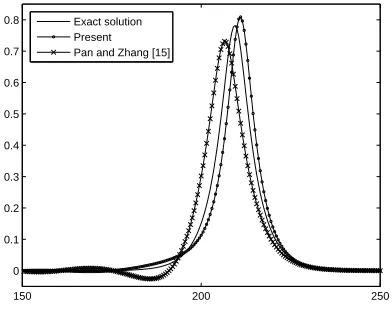
Figs. 7 and 8 show numerical solutions at t = 200with p= 4 and8. The results from the Pan&Zhang method [15] are slightly oscillate at the left side of the solitary wave in case ofp= 8. However, the results from the present method are almost perfectly sharp in both casesp= 4and8. From the point of view for the long time behavior of the resolution, the present method can be seen to be much better than the method in [15].
The solitary waves obtained by the present scheme are plotted in Figs. 9 and 10 using τ = 0.25, h = 0.5, xl = −60, xr = 200, and p = 4,8. The solitons at t = 60 and
TABLE III
RATE OFCONVERGENCE ANDCPUTIME WITHp= 4ANDt= 40.
τ= 0.25, h= 0.5
τ, h τ4,h2 16τ,h4
Present
kek ×10−2 3.20548 0.197080 0.0123084
Rate 4.02369 4.00106
kek∞×10−2 1.22483 0.0752290 0.00469781
Rate 4.02515 4.00123
CPU time (s) 1.153389 12.866165 155.967273 Pan&Zhang
kek ×10−2 6.41825 1.85385 0.479643
Rate 1.79165 1.95050
kek∞×10−2 2.38960 0.696030 0.180409
Rate 1.77955 1.94788
CPU time (s) 1.251865 13.534488 157.561488
TABLE IV
RATE OFCONVERGENCE ANDCPUTIME WITHp= 8ANDt= 40.
τ= 0.25, h= 0.5
τ, h τ
4,h2 16τ,h4
Present
kek ×10−2 3.18080 0.194284 0.0121337
Rate 4.03315 4.00108
kek∞×10−2 1.19513 0.0727869 0.00454621
Rate 4.03734 4.00094
CPU time 1.21464 13.868260 174.397644
Pan&Zhang
kek ×10−2 6.44908 1.99919 0.525426
Rate 1.68968 1.92785
kek∞×10−2 2.35870 0.739615 0.194938
Rate 1.67314 1.92376
CPU time 1.371416 14.862871 175.068007
TABLE V DISCRETE MASSQn.
τ= 0.25, h= 0.5
t p= 4 p= 8
t= 10 6.26580620079700 9.74208591413665
t= 20 6.26580620078861 9.74208595412127
t= 30 6.26580619948382 9.74208578472995
t= 40 6.26580617252808 9.74208558745239
Q(0) 6.26580620079328 9.74208618205024
TABLE VI DISCRETE ENERGYEn.
τ= 0.25, h= 0.5
t p= 4 p= 8
t= 10 2.86723006370139 4.73479863443071
t= 20 2.86725271321602 4.73481771538282
t= 30 2.86726739317968 4.73483391314363
t= 40 2.86727839480750 4.73485101919594
E(0) 2.86718872840474 4.73477831492679
120 agree with the soliton at t = 0 quite well, which also shows the accuracy of the scheme.
VI. CONCLUSIONS
The new conservative finite difference scheme for the Rosenau–RLW equation is introduced and analyzed. The present method gives an implicit linear system, which can be easily implemented. This method shows the second– and fourth–order accuracy in time and space, respectively. In
IAENG International Journal of Applied Mathematics, 44:4, IJAM_44_4_05
[image:6.595.303.554.79.247.2] [image:6.595.303.553.279.437.2]200 210 220 230 240 250 0
0.1 0.2 0.3 0.4 0.5 0.6 0.7
[image:7.595.324.531.61.188.2]Exact solution Present Pan and Zhang [15]
Fig. 7. Numerical solutions atp = 4, xl=−60, xr = 300, h= 0.5,
τ=h2, andt= 200.
150 200 250
0 0.1 0.2 0.3 0.4 0.5 0.6 0.7
0.8 Exact solution Present Pan and Zhang [15]
Fig. 8. Numerical solutions atp = 8, xl=−60, xr = 300, h= 0.5,
τ=h2, andt= 200.
−50 0 50 100 150 200
−0.1 0 0.1 0.2 0.3 0.4 0.5 0.6 0.7
t = 0 t = 60 t = 120
Fig. 9. Numerical solutions atp= 4.
addition, the numerical experiments show that the present method supports the analysis of convergence rate.
It is obvious from numerical experiments that the present method, the scheme (9)–(11), gives the well resolution for the Rosenau–RLW equation. It is possible that the solitary wave obtained by this novel method can be smoothed out, at long time, by type of the high–order accuracy.
ACKNOWLEDGMENT
This research was supported by Chiang Mai University.
−50 0 50 100 150 200
−0.1 0 0.1 0.2 0.3 0.4 0.5 0.6 0.7 0.8
t = 0 t = 60
t = 120
Fig. 10. Numerical solutions atp= 8.
REFERENCES
[1] K. Mohammed, “New Exact Travelling Wave Solutions of the (3+1) Dimensional Kadomtsev–Petviashvili (KP) Equation,”IAENG Interna-tional Jounal of Applied Mathematics, vol. 37, no. 1, pp. 17–19, 2007. [2] J.V. Lambers, “An Explicit, Stable, High–Order spectral Method for the Wave Equation Based on Block Gaussian Quadrature,” IAENG International Jounal of Applied Mathematics, vol. 38, no. 4, pp. 233– 248, 2008.
[3] JC Chen and W. Chen, “Two–Dimensional Nonlinear Wave Dynamics in Blasius Boundary Layer Flow Using Combined Compact Difference Methood,”IAENG International Jounal of Applied Mathematics, vol. 41, no. 2, pp. 162–171, 2011.
[4] A.R. Bahadir, “Exponential Finite–Difference Method Applied to Korteweg–de Vries Equation for Small Times,”Applied Mathematics and Computation, vol. 160, no. 3, pp. 675–682, 2005.
[5] S. Ozer and S. Kutluay, “An Analytical–Numerical Method Applied to Korteweg–de Vries Equation,”Applied Mathematics and Computation, vol. 164, no. 3, pp. 789–797, 2005.
[6] Y. Cui and D.-k. Mao, “Numerical Method Satisfying the First Two Conservation Laws for the Korteweg–de Vries Equation,”Journal of Computational Physics, vol. 227, pp. 376–399, 2007.
[7] D.H. Peregrine, “Calculations of the Development of an Undular Bore,”
Journal of Fluid Mechanics, vol. 25, pp. 321–330, 1996.
[8] D.H. Peregrine, “Long Waves on a Beach,”Journal of Fluid Mechanics, vol. 27, pp. 815–827, 1997.
[9] P. Rosenau, “A Quasi–Continuous Description of a Nonlinear Trans-mission Line,”Physica Scripta, vol. 34, pp. 827–829, 1986.
[10] P. Rosenau, “ Dynamics of Dense Discrete Systems,” Progress of Theoretical Physics, vol. 79, pp. 1028–1042, 1988.
[11] M.A. Park, “On the Rosenau Equation,” Mathematica Aplicada e Computacional, vol. 9, no. 2, pp. 145–152, 1990.
[12] M.A. Park, “Pointwise Decay Estimate of Solutions of the Generalized Rosenau Equation,”Journal of the Korean Mathematical Society, vol. 29, pp. 261–280, 1992.
[13] J.-M. Zuo, Y.-M. Zhang, T.-D. Zhang, and F. Chang, “A New Con-servative Difference Scheme for the General Rosenau–RLW Equation,”
Boundary Value Problems, vol. 2010, Article ID 516260, 13 pages, 2010.
[14] X. Pan and L. Zhang, “On the Convergence of a Conservative Numerical Scheme for the Usual Rosenau–RLW Equation,” Applied Mathematical Modelling, vol. 36, pp. 3371–3378, 2012.
[15] X. Pan and L. Zhang, “Numerical Simulation for General Rosenau– RLW Equation: An Average Linearized Conservative Scheme,” Mathe-matical Problems in Engineering, vol. 2012, Article I517818, 15 pages, 2012.
[16] X. Pan, K. Zheng, and L. Zhang, “ Finite Difference Discretization of the Rosenau–RLW Equation,”Applicable Analysis, vol. 92, no. 12, pp. 2578–2589, 2013.
[17] N. Atouani and K. Omrani, “Galerkin Finite Element Method for the Rosenau–RLW Equation,”Computers and Mathermatics with Applica-tions, vol. 66, pp. 289–303, 2013.
[18] R.C. Mittal and R.K. Jain, “ Numerical Solution of General Rosenau– RLW Equation Using Quintic B–Splines Collocation Method,” Com-munication in Numerical Analysis, vol. 2012, Article ID cna-00129, 16 pages, 2012.
[19] J. Hu, Y. Xu, and B. Hu, “Conservative Linear Difference Scheme for Rosenau–KdV Equation,”Advances in Mathematical Physics, vol. 2013, Article ID 423718, 7 pages, 2013.
IAENG International Journal of Applied Mathematics, 44:4, IJAM_44_4_05
[image:7.595.74.270.62.220.2] [image:7.595.73.269.278.434.2] [image:7.595.68.280.489.614.2][20] F.E. Ham, F.S. Lien, and A.B. Strong, “A Fully Conservative Second– Order Finite Difference Scheme for Incompressible Flow on Nonuni-form Grids,”Journal of Computational Physics, vol. 177, pp. 117–133, 2002.
[21] Y. Zhou, “Application of Discrete Functional Analysis to the Finite Difference Method,”Inter. Acad. Publishers, Beijing, 1990.