Abstract—The world today is faced with challenges of energy production, management and sustainability due to overuse of fossil fuel in automobiles, power generation and other thermal applications. Various governments and other global regulatory bodies have imposed regulations on the emission of certain gases in other to reduce environmental pollutions and climatic change. This work investigates the use of sawdust, domestics and municipal waste as alternative source of fuel production. An up-draught gasification plant has been built due to its simple design and less sensitivity to moisture content, size and geometry of the solid fuel. Sample of the abundant quantity of sawdust in Nsukka, Nigeria has been tested and gasified. The results shows that 12.56kg of sawdust gives shows 82.6% carbon mono-oxide, 12.8% of hydrogen and 4.6% of methane. The heating value is 17.0 MJ/kg and the 12.56kg of saw-dust yields power output of 13.872MJ. These results show that gasification of waste such as sawdust is beneficial since it serves as a clean energy source, frees up landfills and dump sites, eliminates pollution and spread of diseases and mitigates climatic change.
Index Terms—Gasification, Pyrolysis, Producer gas, Equivalence ratio.
I. INTRODUCTION
NERGY is essential for human development, hence there is need to exploit several sources of energy such as renewable energy power generation option using gasification technology. Gasification is the process of converting waste materials into combustible gases under controlled supply of air. This technology is an efficient and clean way of providing fuel for powering generators [1]. Waste is available in large quantity in most countries at no cost, especially developing nations like Nigeria. Management of these waste has been challenging to individuals and government at large. Presently in Nigeria, landfill constitutes approximately 60% [2] of the residential and factory wastes disposals and this takes up land space, Chinyere O. Chidume is with University of Nigeria, Nsukka, Enugu Nigeria ([email protected]).
Uche C. Ogbuefi, is with University of Nigeria, Nsukka, Enugu Nigeria (phone number: e-mail: [email protected]).
Victor O. Ajah is with Laboratory of Industrial Electronics, Power Devices and New Energy Systems (LIEPNES) University of Nigeria, Nsukka, Enugu Nigeria (e-mail: [email protected]).
Ejike K. Okoye is with Mirai Denchi Inc., Japan; Email: (e-mail:
Emenike C. Ejiogu is with University of Nigeria, Nsukka, Enugu Nigeria (e-mail: [email protected] )
spreads diseases and becomes an eyesore in the environment. Open field burning waste poses danger to human health and climatic change.
Gasification of waste such as saw-dust is done by breaking down of the material into gases like hydrogen (H2),
carbon monoxide (CO), Nitrogen and little methane (CH4) by the application of heat under limited supply of oxygen. The “synthetic gas” or “producer gas” as they are called can be used to run internal combustion engine for generation of electricity[1, 2]. This energy generation method contributes to the reduction of greenhouse effect and in developing countries, biomass is ranked fourth energy source as it provides 35% of their energy [3].
Gasification process is easy, however, obtaining it in the proper quantity and quality for continuous running of generators is a challenging task [4]. This work will check the availability of saw-dust in Nsukka Nigeria, test its chemical compositions and gasification parameters for possible synthetic gas production. Also build a prototype gasifier plant with gas filtration system to produce clean syngas and carryout analysis on the gas. Some of the benefits of this work will be to provide alternative way for power generation and less dependence on fossil fuel, making landfill and dump sites available for other use, eradication of diseases outbreak from dump sites, elimination of environmental pollution, reduction of climatic change due to elimination of open field burning, employment opportunities and saving of foreign currency as a result of decrease in the importation of petroleum products.
II. OVERVIEW
A. Gasification Technology
Gasification process has been in use since the 18th century; the first application was the production of town gas from coal [7]. In the 1920s, gasification was used to produce synthetic chemical and the most well-known is the production of fischer-Tropsch oil out of synthesis gas in Germany which was used to run the military machinery during the Second World War [7]. This process involves conversion of waste to energy through thermal/chemical reaction, or starved air as agent of combustion. Which means that stoichiometric amount of air or oxygen needed is little or less for the process. Therefore, solid wastes were converted into a producer gas that can be used in furnace applications, internal combustion engine system and gas turbines for electricity generation [8, 5]. These arrangements
Renewable Gas Production System for
Electricity Generation by Gasification
Technology
Chinyere O. Chidume, Uche C. Ogbuefi, Victor O. Ajah, Ejike K. Okoye and Emenike C. Ejiogu
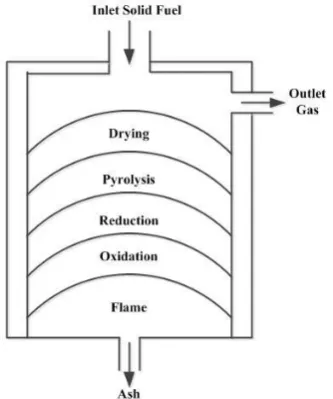
are in order of up-draught gasification process as represented in Fig 1.
The process has different stages as shown in figure 1. Drying stage is where the moisture contents of the solid fuel (waste materials) are removed by evaporation. Pyrolysis is de-volatilization and decomposition of biomass in absence or insufficient supply of air. This process takes place at a temperature above , 75 - 95% of the volatile component goes into steam together with gases and condensable hydrocarbons. These volatile gases are, methane, other hydrocarbons and the remaining product is char [9].
In the reduction stage, Carbon dioxide (CO2) and water
(H2O) are reduced by char to form producer gas in the
presence of heat. This producer gas comprises of hydrogen (H2), carbon-monoxide (CO), water (H2O) and Nitrogen
(N2) if air is used as gasifier agent [1, 9]. The water and air
reacts with hot char in a heterogeneous reversible water gas reaction as follows:
(1)
According to [8, 9], the following water gas shift reaction occurs
(2) (3) The most important reactions are the water gas reaction of (1) and (3). The endothermic reactions increase the gas volume of at a higher temperature and lower pressure, however, high pressure suppresses the gas volume. According to [7] and [9] the producer gas contains little methane as a result of methanisation reactions of (4) and (5) below.
(4)
(5)
The oxidation stage is an exothermic reaction that releases the heat necessary for reduction, pyrolysis and drying stage. The important oxidation reactions are shown in (6) and (7):
(6) (7)
B. Gasification Determinants Variables
These are variables that must be considered before building a gasifier plant. They include equivalence ratio, superficial velocity of the gas, hearth load, turn-down ratio, heating value, gas flow rate, gas production, fuel consumption and efficiency.
III. METHODOLOGY
A. Sawdust Availability and Composition Analysis
Waste materials such as sawdust is found in large quantity in Nsukka Nigeria. Sample has been collected and proximate analysis is carried out to determine product distribution. Ultimate analysis is conducted as well to know the basic component of the fuel.
Table I shows the results of proximate analysis of sawdust sample in percentage while Table II shows the results from ultimate analysis
.
B. Design Procedure
The design is done base on the parameters in Table III. Gasification plant of 2.7kVA capacity is desired at assumed feedstock input power of 3.5kVA. Other parameters are obtained from work done previously on gasification as referenced in the table.
g
n
Q
Pg
1
(8)are the input and output of the gasifier (kW), is the efficiency (%)
[image:2.595.61.228.101.301.2]Therefore, if input power is taken to be 3.5kVA, then the fuel consumption rate which is the amount of energy needed for the gasifier in terms of biomass fuel for it to produce the
TABLE II ULTIMATE ANALYSIS Parameters Values
Carbon –monoxide 29 %
Hydrogen 4.52%
Methane 1.6%
Nitrogen 42%
Sulphur 0.03%
Oxygen 0.6%
Higher heating value 17.01 kJ/.kg-1
Low heating value 11.2kJ/kg-1
TABLE I PROXIMATE ANALYSIS Parameters Values (%) Moisture content 8.2 Volatile mater 48.55 Fixed carbon 42.26 Ash content 0.98 Fig. 1. The order of gasification process in updraft
[image:2.595.307.460.462.608.2]required output power can be calculated [13], as shown in (9)
(9) FCR is the fuel consumption rate in , is the higher heating value of fuel in . Therefore, the consumption rate is determined to be .
The amount of air flow rate needed to gasify the saw-dust can be determined based on the fuel consumption rate, equivalence rate ( ), air density and stoichiometric air of the biomass [14].
(10) The stoichiometric Air, SA is given by
(11) here is the air to uel ratio on olar mass, and
are the molecular weight of air and fuel respectively. The air to fuel ratio on molar mass was determined from combustion reaction (12)
.
(12) The constants a, b, c and d is calculated from the elemental balance of the equation. The air to fuel ratio on molar basis and stoichiometric air were taken to be 5.8 and 6.1kg of air of fuel respectively. Based on this, air flow rate was determined to be .
Producer Gas Suction Pressure Pump 140mm
425m
m 700mm
300m m
Temp. Gauge
Press. Gauge Gasifier
lock
Sawdust
Temp. Gauge
180mm 150m
m 390mm
Stainless Gasket Second
filtratio n chamb
er
Section B
Final Filter Feedstock
drying Saw dust
Pyrolysis
Reduction
First filtratio
n chamb
er
Tar & Water Vapor Collector Oxidation
Air Nozzl e Ash Collector
The Stand
Section C
[image:3.595.61.469.392.705.2]Fig. 2. Schematic of Up-draught Gasifier System. Section A
TABLE III GASIFIER DESIGN
Description Value Remark
Gasifier output ( ) 2.7kVA /3.5kVA Assumed
Efficiency in (%) 92 [27]
LHV of the producer gas (LHVg) (kJ/M3) 4 [28]
Specific gasification rate (SGR) kg. (kg.m-2h-1) 110 [29]
Duty cycle (Time) 7 Assumed
Equivalence ratio ( ) 0.3 [30]
Density of air (air) (kg-m-3) 1.29 [31]
Biomass molecular formula CH1-28 O0.02 Calculated
C. Principle of Operation of Up-draught Gasifier System
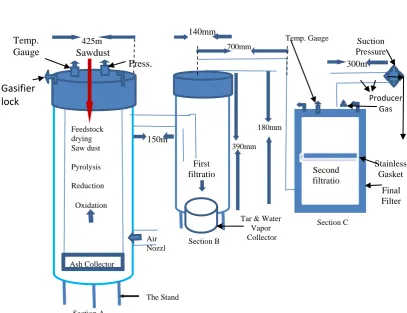
Fig. 2 shows schematic of wood (sawdust) gasification system. The section A is the reaction chamber. Sawdust is loaded into it and ignited at the bottom. Controlled amount of air is introduced through the air nozzle, as the wood burns heat is generated. The oxidation process continues to release heat that aids reduction reaction, pyrolysis and drying of fresh wood on the upper chamber. Due to insufficient oxygen the processes produce carbon (II) oxide (CO), hydrogen (H2) and methane (CH4). The gases are
extracted to section B, for first filtration where water vapor and tar are removed from the gas. Further filtration is done in section C with heat exchange to bring down the temperature of the producer gas.
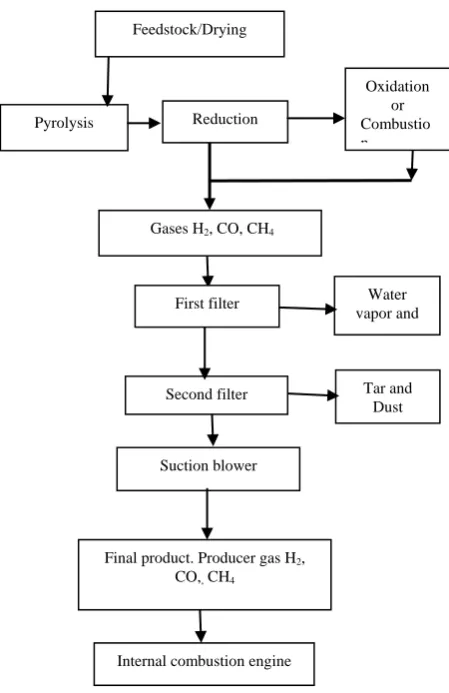
Fig. 3 is the block diagram of the gasification process. It shows the feed stock which is the sawdust being dried and moved to the pyrolysis section. Then, reduction and oxidation. It also shows the gases produced and various filtration stages. The suction blower helps in extracting the final producer gas. The gas is fed to internal combustion engine for electricity generation.
Some of the important reactions that takes place in the system are:
(13) (14) (15)
Other important gasification reactions include:
(16) (17) (18)
IV. IMPLEMENTATION
A prototype of gasifier plant is implemented. Fig. 4 is the picture of experimental setup of the prototype and sawdust. Little quantity of charcoal is charged up to 3000C before introducing the sawdust. Airflow meter measures the amount of air supply and gas produced. Thermocouple is used to measures the temperature.
The 12.56kg of saw-dust heats to about 5000C to 6000C where pyrolysis occurs to give carbon monoxide, hydrogen gas and methane. Above 6000C gives more of hydrogen gas and carbon with little methane but below this temperature range, has more of methane formation.
V. EXPERIMENTALRESULTANDANALYSIS
A. Comparison of Experimental and Theoretical Results
Comparison of the experimental results to calculated results is shown in Table IV. Due to leakages in gasifier process variable such as air flow ratio, pressure and temperature that are not under control; the experimental result is less than the calculated values. 1kg of saw-dust gave 2.5kg ( ) of producer gas and 12. 56kg of
saw-dust will give 31.4kg.
The heating value of 1kg of producer gas produces is 17.01kJ = 17010J;
(19) [image:4.595.47.272.226.573.2]
but if 1kg of saw dust burns per second, then 42525 watts is
Fig. 4. Picture of the Implemented Gasifier Plant and sawdust Feedstock/Drying
Pyrolysis Reduction
Oxidation or Combustio n
Gases H2, CO, CH4
First filter Water vapor and
tar
Second filter Tar and Dust
Suction blower
Final product. Producer gas H2,
CO,, CH4
Internal combustion engine
Fig. 3. Block Diagram of Gasification Process
TABLE IV
EXPERIMENTAL AND THEORETICAL RESULTS ANALYSIS
Gas Composition
Experimental Results (kg)
Theoretical Results(kg)
Difference (%)
Carbon-Monoxide
9.106 29.26 68.88
Hydrogen 1.419 4.14 65.72
Methane 0.502 1.670 69.94
Total Gas Generated
[image:4.595.312.539.237.320.2] [image:4.595.318.553.572.688.2]1 minute to burn, the power produced will be 42525/60=708.75w.
B. Electrical Energy Conversion
The electrical power produce from sawdust depends on the quantity that burns per unit time. For an internal combustion engine of 1500 rpm, maximum gas intake of and assumed volumetric efficiency of 0.8 (% efficiency), therefore, the real gas intake (grin) is
Thermal power on the gas is
Engine efficiency , depends on the compression ratio. For a compression ratio of 9.5:1, efficiency is estimated to be 28% [12].
Electrical power
Real power =
Energy produced
VI. CONCLUSION
This work presents gasification of sawdust as alternative means of electricity generation. Sawdust is found to be in large quantity as waste material in Nsukka Nigeria. A prototype gasifier plant is built and sample of sawdust gasified. The result shows 82.6% carbon mono-oxide, 12.9% of hydrogen and 4.6% of methane in the synthetic gas produced. Comparing the gas produced to the calculated value shows wide margin which is attributed to leakages on the plant and implemented control limitations. Conversion of the gas to electrical energy indicates that the process is useful to generate electricity.
VII. RECOMMENDATION
Conversion of sawdust to electricity is advantages for the generation of electricity, thermal applications and environmental sanitation. This work has shown that it is possible to gasify sawdust. To increase the quantity of producer gas, it is recommended that the sawdust be pelleted and the gasifier plant of larger size built to enhance burning rate. Also, robust control method can be used to monitor and control temperature, air and gas flow as well as to maintain the system at optimal condition for maximum gas production
REFERENCES
[1] Alexander Klein, “Gasi ication; n lternative process or Energy Recovery and Disposal on Municipal solid wastes”, Department of Earth and Environment Engineering Foundation School of Engineering and Applied Science, Columbia University, May, 2002.
[2] A. Buekens, H. Huang, “Co parative evaluation o techniques for controlling the formation and emission of chlorinated dioxins/furans in municipal solid waste incineration” Journal o Hazardous aterials, 1998.
[3] A. Sanjeen, Gandhi, T. Kannadsan and R. Suren “Bio ass downdraught gasifier controller using intelligent technologies In tech,2012.
[4] P.C Roy, . Deth, N. Chakra Borty. “Kinetic odel o the reduction in zone o a down draught” international journal o emergine technology and advanced engineering vol3: special issue 3:ICERTD, pp 591-597, Feb, 2013.
[5] Erik Karlsson “Modeling o a highly e icient gasi ier engine system for small scale CHP and Sweden, 2013.
[6] V. Domburg, A.V. Faaij, P. Erweij, H. Langveld, G. Van de Ven, . ester, et.al, “ Bio ass Assessment. Global biomass potential and their links to food, water, biodioversity, energy de and and econo y, ain report” (cli ate change scienti ic assessment and policy analysis). The Netherland Environmental Assessment Agency (MNP) Bilthoven, The Netherland pp,1-2, 2007.
[7] nkur Scienti ic Energy Technologies ltd; “ nkur gasi ier in 100% producer gas ode or power generation”
www.Ankurscientificcom/listofinstalk+ion.html. Accessed on 10th March, 2002.
[8] A. J. Johnson & G. H. Auth, Fuel and Combustion Handbook, Mc Graw-Hill book Company; New York pp.2-3, 1951 [9] . Kirkel and G.P.J Verbong “Bio ass Gasi ication Still
Pro ising? 30years global overview” Renewable and Sustainable Energy Review, View at Publisher, View at Google Scholar, View at Scopus. No.1,pp 471-481 Vol.15, 2011.
[10] P & T Generation Project; “Investigation into unicipal solid waste gasi ication or power generation” Dra t report to
the public utilities
board,www.alamedamo.com/newsroom/reports/PUB accessed on 25th-march 2009
[11] R. akhral, “Bio ass Energy” Lecture on Renewable Energy Technology, MJ2411, Sustainable Energy Engineering, Royal Institute of Technology (KTH), Department of Energy Technology, Stockhorm, Sweden, 2007.
[12] . M. K. Harile, “Handbook Bio ass Gasi ication”. BTG biomass technology group, Enschede, Netherlands, 2005. [13] R. J. Evans, J. T. . Milne, “Che istry o Tar or ation and
Maturation in the Ther oche ical Conversion o Bio ass” Development in Thermochemical, Biomass Conversion, Vol 2, 1997.
[14] L. P. M. Rabou, R. W. R. Zwart, B. J. Vreugdenhil, A. Bos, “Tar in Bio ass Producer Gas”. Experience an Enduring Challenge. Energy and fuel, the Energy Research Centre of the Netherlands, 2003.
[15] A. Vander Drift, C. M. Vander Meijdan, S.D., Strating-Yts a, “ ays to increase the carbon conversion o a IC B gasifier: In: The 12th European Conference on Biomass for Energy, Amsterdam, the Netherlands 17-21, June 2002. [16] P. J. Bois, Weight of Sawdust Southern Appalachian Wood