Participatory democracy
in action - a pilot
December 2011
WE’RE READ
Y
TO PARTICIP
ATE
OUR V
OICES
MATTER
WE’VE
SPOKEN UP
NOW IS
THE TIME
CITIZENS
’
ASSEMBLIES
WORK
www.wethecitizens.ie
W
e the C
itiz
ens
D
ec
ember 2011
Par
ticipa
tor
y democr
ac
y in ac
3
Foreword from the Chairperson Page 4
Executive summary Page 6
Chapter 1 Purpose and content Page 8
1.1 Purpose of this report Page 8 1.2 How We the Citizens came about Page 10 1.3 So what is Participatory Democracy? Page 12 Chapter 2 How we tested participatory democracy in Ireland Page 15 2.1 Regional citizens’ meetings Page 16
2.2 The polling process Page 30
2.3 The Citizens’ Assembly Pilot Page 33 2.4 Communicating ‘We The Citizens’ Page 37
Chapter 3 Analysis and Results Page 41
3.1 Outcome 1: What the results tell us about whether
deliberative democracy really works Page 41 3.2 Outcome 2: Outputs from the Citizens’ Assembly Deliberations Page 50 3.3 Outcome 3: What the surveys tell us about people in Ireland in 2011 Page 58
Chapter 4 Conclusions Page 67
Appendices Page 71
4
Foreword from the Chairperson
We the Citizens set out with optimism, and indeed hope, to test the value to our democracy of including citizens more directly in decision-making. That hope has been truly vindicated. We now have unequivocal proof that citizens’ assemblies will work in this country, as they have in many others. We have shown that when you give people objective information and the opportunity to deliberate, not only do they make informed decisions, they also feel a greater connection to the democratic process.
Ireland has changed and people are looking for new ways to engage in the civic and democratic life of their communities and their country. That was the message we heard as we travelled through Ireland this summer of 2011. What we found was that a great deal of common sense is generated when people get together to work things out. People came together at our events, not because of vested interests or political persuasions, but as individual citizens willing and ready to contribute to the future of our country.
People were rightly angry about the economic and social crisis they did not create. But significantly, they were ready to step up and become part of the solution.
We are grateful to every man and woman who engaged with We the Citizens at our events around the country, at our pilot Citizens’ Assembly in Dublin and online through our website and social media. We owe it to them and to all citizens to ensure that the Government and other political parties see the value of this form of participatory democracy. After all, this model would support politics at both national and local level.
Above all, it would help to restore trust.
Fiach Mac Conghail
5
Réamhfhocal ón gCathaoirleach
Bhí sé mar mhian ag We the Citizens, le misneach agus muinín, an buntáiste a bhaineann le saoránaigh a bheith níos rannpháirtí sa phróiseas cinniúna dár ndaonlathas a mheas. Bhí toradh maith ar an mian sin. Níl amhras ar bith anois orainn ach go
n-oibreoidh tionól saoránaigh sa tír seo, mar a oibríonn sé i dtíortha eile. Chonacthas dúinn nuair a thugtar eolas cruinn agus an deis plé do dhaoine ní amháin go ndéanann siad cinntí bunaithe ar an eolas ach braitheann siad go bhfuil baint acu leis an bpróiseas daonlathais.
De bharr go bhfuil Éirinn athraithe, tá muintir na hÉireann ag lorg modhanna nua chun páirt a ghlacadh sa tsaorántacht agus sa daonlathas ina bpobal agus ina dtír. Is í sin an teachtaireacht a fuair muid agus muid ag taisteal na tíre i rith samhradh na bliana 2011. Is é an rud a fuair muid amach ná go dtagann go leor den chiall cheannaithe chun cinn nuair a thagann daoine le chéile chun cúrsaí a phlé. Ní hé gur tháinig daoine le chéile ag ár n-imeachtaí mar gheall ar a leasa féin ná a dtuairimí polaitíochta, ach tháinig siad chucu mar shaoránaigh aonair a bhí ag iarraidh agus a bhí sásta leas na tíre a chur chun cinn.
Bhí fearg ar dhaoine faoin ngéarchéim shóisialta agus gheilleagrach agus an ceart sin acu mar nárbh iad ba chúis leis. Mar sin féin, ba shuntasach an rud é go raibh siad sásta a gcuid a dhéanamh agus a bheith rannpháirteach i réiteach na faidhbe.
Ba mhaith linn buíochas a ghabháil le gach uile dhuine a ghlac páirt ag imeachtaí We the Citizens ar fud fad na tíre, ag
céadiarracht Tionól na Saoránach i mBaile Átha Cliath, ar an idirlíon, ar ár suíomh gréasáin agus ag úsáid na meáin shóisialta. Ar son na ndaoine sin agus gach saoránach, tá an freagracht orainn anois a chur ina luí ar an Rialtas agus páirtithe polaitíochta eile fiúntas rannpháirtíocht na saoránaigh sa daonlathas a thuiscint.
Gach ní ráite, bheadh an tsamhail seo mar bhonn taca don pholaitíocht ag leibhéal áitiúil agus ag leibhéal náisiúnta.
Thar gach ní eile, chuideodh sé le muinín a athchothú.
Fiach MacConghail
6
Every experiment starts with a question. The experiment that eventually became We the Citizens started with this: is there something that we can do to enhance our democracy, especially at a time when Irish people feel cast adrift and disconnected from power?
We the Citizens was a pilot project to test whether a more participatory form of democracy could work in Ireland. The model tested was a Citizens’ Assembly, which is a form of deliberative democracy.
A representative group of citizens was randomly chosen, by an independent polling company, to attend the pilot Citizens’ Assembly on 25th and 26th June 2011 in the Royal Hospital Kilmainham.
t Seven regional citizens’ events had been held in May and June 2011 to inform the agenda of the Citizens’ Assembly.
t A series of independent surveys – also informed by the issues raised by citizens at the regional events - was conducted to monitor and evaluate changes in the views of participants.
t At the assembly, participants were given expert information and the opportunity to deliberate on particular policy issues.
t They were surveyed afterwards to see whether deliberation had led them to change their views about the issues discussed. Control groups who had not taken part in the Citizens’ Assembly were also polled.
Findings
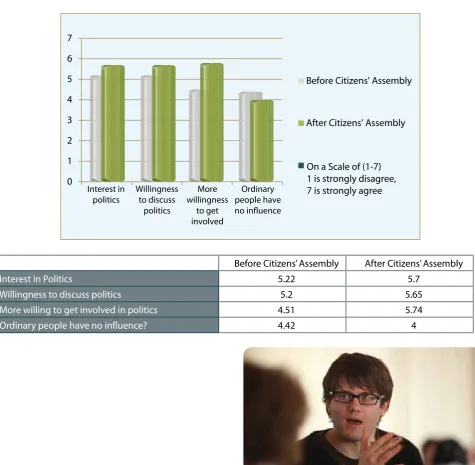
The findings from the research are conclusive. As a result of their participation, citizens showed significant shifts of opinion and felt more positive about their influence on politics, compared to those who had not taken part. After the Citizens’ Assembly, participants:
t showed a greater interest in politics
t expressed more willingness to discuss and become more involved in politics
t felt more positive about the ability of ordinary people to influence politics
t demonstrated large shifts in opinion on the economic issues they had discussed, such as tax, spending and the sale of state assets
t revealed important shifts in opinion regarding the role of Dáil deputies
t became more aware of the complex trade-offs to be made in the areas of political reform and fiscal policy. In other words, deliberation works.
Citizens’ Assembly model
will work in Ireland
Based on the evidence of our academic research and on what we heard and recorded from citizens all over the country, We the Citizens:
trecommends that government adopts a citizens’ assembly mechanism to complement and enhance our representative democracy
trecommends that if reform programmes are to be successful, citizens must feel that they have some ownership in the process. A citizens’ assembly allows that to happen
trecommends that this model of democratic
engagement be used to make a positive contribution to democracy in Ireland
thas shown that a Citizens’ Assembly strengthens our democracy by helping to restore trust in the democratic system of government.
This report provides a manual for any government, group or organisation on how deliberative methods can help give citizens a greater influence on decision-making and policy formation.
7
Key factors for success
For a citizens’ assembly to be successful:
t It must be set up for a specific purpose, and once that purpose has been achieved, the Citizens’
Assembly ceases to exist. In other words, the assembly cannot and should not act as another House of the Oireachtas: its work and membership are limited by time and purpose
t The members must be selected randomly to give a balanced social and demographic representation. They are not elected, nor are they there as
representatives of particular sectors. There is therefore no risk of specific interests subverting the work of the assembly
t The members must be given balanced briefing notes and have the opportunity to hear from and to question experts
t The members should be given sufficient time and space to debate and deliberate over the issues
t It should be made clear what will happen to the
outcomes of the Citizens’ Assembly. Three possible models:
- The Citizens’ Assembly produces a specific proposal for change, that may be directly acted upon by the government in the form of a legislative act
- In a case where a matter has constitutional significance, the Citizens’ Assembly produces the wording for the referendum question. This may go to a parliamentary committee for consideration or be put to the people in a referendum
- In the case where the matter in question relates to local budgetary issues, the decision of the Citizens’ Assembly should have a direct impact on a portion of budgetary expenditure in the local area.
A citizens’ assembly can be used nationally, regionally or locally. What is important is that citizens have a voice, not just a vote.
8
Pur
pose and C
on
te
xt
Purpose and Context
1.1 Purpose of this report
The purpose of this report is to record the work and the experience of the We the Citizens project. It describes the process that was followed, the decisions that were made and why, and how people became involved both as volunteers and participants. It looks at how the project was received and examines in detail the findings from the research element of the project.
At its heart, We the Citizens was a research project to establish whether or not more participative mechanisms for citizen involvement, specifically where deliberation was involved, would have a positive impact on our democracy. We tested a form of citizens’ assembly where participants are selected randomly on a demographically representative basis. However, along the way, we asked other questions and gained other insights from the citizens who took part about the issues that were of concern and of interest to people in Ireland in the summer of 2011. We have tried to reflect this in the report.
In their election manifestos, both coalition partners identified a need for a more participative political mechanism to complement the existing decision-making and policy formation process in our representative democracy. Labour identified a constitutional convention and Fine Gael a citizens’ assembly as possible approaches. The concept also appears in the Programme for Government.
This document is intended as a guide for any authority or structure organising a citizens’ assembly or similar initiative in the future – both in terms of what worked and what did not.
A common shared future built on the spirit of co-operation, the collective will and real participation in every aspect of the public world is achievable and I believe we can achieve it together. In our rich heritage some of our richest moments have been those that turned towards the future and a sense of what might be possible. It is that which brought us to independence. It is that which has enabled us to overcome adversity and it is that which will enable us to transcend our present difficulties and celebrate the real Republic which is ours for the making.
9
Pur
pose and C
on
te
[image:8.595.55.540.180.569.2]xt
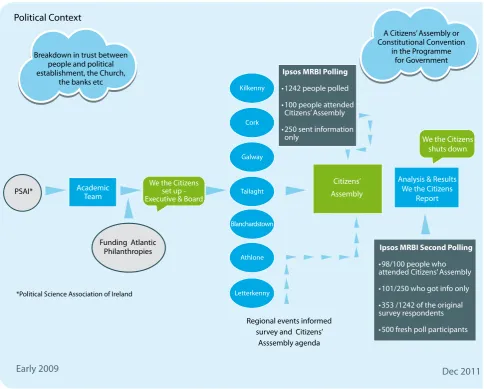
Fig 1.1 | We the Citizens – The Journey
Early 2009 Dec 2011
Tallaght Galway
Blanchardstown
Athlone
Letterkenny Cork Kilkenny
Academic Team
We the Citizens set up - Executive & Board
We the Citizens shuts down
Citizens’ Assembly
Ipsos MRBI Polling
t1242 people polled
t100 people attended Citizens’ Assembly
t250 sent information only
Regional events informed survey and Citizens’
Asssembly agenda
*Political Science Association of Ireland
Political Context
Ipsos MRBI Second Polling
t98/100 people who attended Citizens’ Assembly
t101/250 who got info only
t353 /1242 of the original survey respondents
t500 fresh poll participants Analysis & Results
We the Citizens Report
PSAI*
Funding Atlantic Philanthropies Breakdown in trust between
people and political establishment, the Church,
the banks etc
A Citizens’ Assembly or Constitutional Convention
10
Pur
pose and C
on
te
xt
1.2 How We the Citizens came about
Responding to the climate
A working group was set up in 2009 by members of the political science departments of Irish universities under the aegis of the Political Studies Association of Ireland (PSAI). Its primary mission was to respond to the ongoing crisis and to the increasingly vocal debate on the need for changes to the political system and wider public life. The group – of no uniform ideological bent – did not always agree on the nature of reforms needed, but all agreed on the importance of informed debate. Four of them – Dr Elaine Byrne of Trinity College Dublin, team leader Professor David Farrell of University College Dublin, Dr Eoin O’Malley of Dublin City University and Dr Jane Suiter of University College Cork - were invited in 2010 to submit a proposal to the Atlantic Philanthropies
for a project relating to participatory democracy which would be transparent, independent and objective. We the Citizens was organised in association with the Irish Universities Association, the representative body for the seven Irish universities.
What was proposed was a citizens’ assembly, which would be supported by a series of public events around the country combined with extensive polling. The gatherings would be an opportunity for people to share ideas and concerns that in turn would feed into the agenda of the national Citizens’ Assembly. The polls or surveys allowed the team to assess whether the opportunity to take part in a citizens’ assembly had an impact on people’s views on a range of topics. The aim
Context of decline in trust
In the 2009 Eurobarometer poll, Ireland recorded virtually the lowest level of public trust in its political institutions across the 27 European countries surveyed, with only Hungary, Latvia, Lithuania and Greece returning lower degrees of trust. This was not normal for Ireland. In June 2008, confidence in government was at 46 per cent. The depth and nature of the economic crisis dramatically reduced trust in politics, which dropped to an incredible 10 per cent only a year later in an Irish Times/MRBI poll in September 2009. Moreover, according to the RTÉ exit poll on the day of the 2011 general election, the main reason people voted the way they did was because they felt angry and let down by politics.
The decline of trust in politics and institutions is not unique to Ireland. A growing civic disengagement and the weakening of the civic relationship between the government and people is increasingly evident across
11
Pur
pose and C
on
te
xt
was that the Citizens’ Assembly membership would reflect a cross-section of Irish society. It was based on models used successfully in other countries, such as Canada and the Netherlands.
We the Citizens was set up as a support organisation for the research project to test whether a form of citizens’ assembly would work in an Irish context. Its primary purpose was to encourage people to take part in the events, through creating awareness and interest in the regional and national media, online, and in local communities around the country. This work was carried out by We the Citizens’ three staff members, including Executive Director, Caroline Erskine. They also organised the logistics and attendance at the various events around the country. The academic team, led by Professor David Farrell, was responsible for commissioning and analysing the polls and designing the content of the Citizens’ Assembly. The project was overseen by a Board of Directors, chaired by Fiach Mac Conghail and advised by an international scientific advisory board (Appendix 1 for details).
We the Citizens was established for a defined period from January 2011 to December 2011.
12
Pur
pose and C
on
te
xt
Why are we talking about participatory democracy now?
People have started to expect more from democracy than just the opportunity to vote for a party every few years. Across established democracies like Ireland, although electoral participation is generally declining, participation is expanding into new forms of action. Today, more people are signing petitions, joining citizen interest groups and engaging in unconventional forms of political action. The large expansion of public interest groups, social movements and NGOs creates new opportunities for participation. These trends suggest that the public’s preferred mode of democratic decision-making is moving toward new forms of more direct
involvement in the political process - so people might not vote, but they will take part in a demonstration against the closure of a local hospital or lobby their politicians for increased funding for education.
Political establishments across the world are reacting to this trend in a number of ways. In France, for example, for the first time in October 2011, the Parti Socialiste held primaries to allow voters to choose their preferred candidate for the presidential election. In a country where political party membership is very low, with fewer than 6 per cent of people being members of any party, the primary approach allows the electorate to make the candidate choice and, therefore, perhaps to identify more closely with the candidate and the election process.
What is deliberative democracy?
Is it different? Basic definition: Deliberative democracy =ordinary citizens using discussion to reach an agreement and make recommendations to government on issues of importance. It is a form of participatory democracy. Academic definition: Deliberative democracy can be defined as ‘a process of reaching reasoned agreement among free and equal citizens’ ensuring that they have an opportunity to express their views and preferences and justify their decisions within a deliberative process for the purpose of reaching conclusions that are collectively binding (Bohman and Rehg, 1997: 321; Gutmann and Thompson 2004: 7).
1.3 So what is participatory democracy?
Participatory democracy is a process emphasising the broad participation of citizens in the direction and operation of political systems. All democracy depends on the participation of citizens at election time. However, participatory democracy tends to advocate more involved forms of citizen participation than traditional representative democracy.
13
Pur
pose and C
on
te
xt
What is deliberative polling?
The Center for Deliberative Democracy at Stanford University describes its process as follows: “A random, representative sample is first polled on the targeted issues. After this baseline poll, members of the sample are invited to gather at a single place for a weekend in order to discuss the issues. Carefully balanced briefing materials are sent to the participants and are also made publicly available. The participants engage in dialogue with competing experts and political leaders based on questions they develop in small group discussions with trained moderators. Parts of the weekend events are broadcast on television, either live or in taped and edited form. After the deliberations, the sample is again asked the original questions. The resulting changes in opinion represent the conclusions the public would reach, if people had opportunity to become more informed and more engaged by the issues.”
What is a citizens’ assembly?
A citizens’ assembly can be used to rebuild trust among citizens in the political process by taking ownership of the decision-making process. It is a mechanism of deliberative democracy. It is an approach that has had good results in many parts of the world - Canada, Iceland and Brazil.
How does it work?
It involves rational, reasoned discussion with a cross - section of an entire population and uses various methods of inquiry such as directly questioning experts. It is not adversarial, although disagreement is inevitable and is valued, not stifled. A citizens’ assembly values creativity and tends to build consensus rather than creating winning and losing sides – but there is no requirement of unanimity. Deliberative processes are not meant to replace representative or direct democracy, but to enhance and support it.
Examples of where citizen participation has worked - Brazil
14
Pur
pose and C
on
te
xt
Citizens’ Assembly on electoral reform – Canada
In 2007, a government sponsored citizens’ assembly was held in British Columbia in Canada. The purpose of the Citizens’ Assembly was to discuss electoral reform. The question answered by the assembly was what electoral system would work best for the province.
“In the end, 160 strangers from all walks of life, with formal education levels ranging from six years to an Oxford doctorate, managed to come to a remarkable degree of consensus on what electoral system would be best for British Columbia—a Single Transferable Vote system similar to the one used in Ireland” (Lang, 2007: 37).
“While the idea of citizens’ assemblies is immediately appealing to anyone who believes that democracy should be inclusive, the question remains: is it really possible to have an independent process where people make binding decisions? Evidence from the British Columbia Citizens’ Assembly on Electoral Reform suggests that if citizens are to be empowered by a citizens’ assembly there needs to be a way of keeping that assembly independent of existing political institutions. Once the conditions for an independent assembly are set up the second question is how citizen interests and arguments crystallize over the course of a participatory process” (Lang, 2007: 35).
Views of any individual citizen are as valid as those elected to the highest office
An obvious question is: ‘Will citizens make better decisions than elected politicians?’ In modern
democracies, all citizens are equal. This means whether you are well educated or not, wealthy or poor, male or female, you have equal citizenship. Proponents of
participatory democracy say that the views of any individual citizen are as valid as those elected to the highest office.
In theory, a group of citizens can make as good a decision as a group of legislators, if the conditions are right. We the Citizens set out to test this idea.
15
Ho
w w
e t
est
ed par
ticipa
tor
y democr
ac
y in I
reland
2. How we tested participatory democracy in Ireland
This chapter looks at how we tested participatory democracy in Ireland. It looks in detail at:
t The open door, open agenda regional citizens’ events, issues from which were used to set the agenda for the Citizens’ Assembly
t The polling/survey process – how it was organised and why
t How the Citizens’ Assembly was organised and the types of recommendations that it produced
t The role of communications activity in the initiative. The rationale underlying We the Citizens was to test whether participatory democracy can work, and more importantly, can work in Ireland. The mechanism or instrument that was chosen as most likely to be useful in an Irish context was a citizens’ assembly, similar to that used in Canada and the Netherlands. In order to test the impact of the Citizens’ Assembly, it was necessary for We the Citizens to survey the Irish population so as to produce hard evidence of this.
For evidence of impact, the survey work would be expected to produce the following outcomes:
t Opinions on the policy issues discussed would be expected to shift as the citizens become better informed and able to debate at length the issues and the trade-offs associated with them
t There should be evidence of the citizens feeling more empowered as a consequence of being involved in such a process.
The extent to which these expectations were met is examined in the next chapter. To produce conclusive results, comprehensive polling work was carried out and this was preceded by a series of door, open-agenda meetings at seven locations around the country. The issues raised at these regional meetings formed the backbone of the surveys and the agenda for the Citizens’ Assembly to follow.
“As citizens, we need to get out of our comfort zone. We need to question more and every citizen needs to give up more time.”
“It’s not enough to volunteer; active citizenship also involves politics and informing policy making.”
“It’s important we have leaders we can respect.” “We need to be visionary and plan better.”
16
Ho w w e t est ed par ticipa tor y democr acy in I
reland
2.1 Regional citizens’ meetings
A key part of the integrity of the Citizens’ Assembly organised by We the Citizens was the concept that the agenda be set, not by a group of academics, but by the people of Ireland. To do this, We the Citizens organised seven meetings around the country between May 10th and June 14th in Kilkenny, Cork, Galway, Blanchardstown, Tallaght, Letterkenny and Athlone. At the We the Citizens launch on April 12th 2011, an open invitation was issued to the general public to attend citizens’ events being held across the country. The aim of the events was to provide an independent platform where people could share their ideas on how to renew Ireland. The prominent themes to arise from the seven events helped to determine the agenda of the national Citizens’ Assembly held on June 25th and 26th 2011. This was to ensure that the issues deliberated upon at the national citizens’ assembly came from the grassroots in a bottom-up fashion.
Setting up the regional citizens’ events
The events were free of charge and open to everyone. To ensure the widest possible awareness of and interest in the events in each area, the We the Citizens team met with local media providers as part of preparations for the events. Radio advertisements were booked and interviews given to local radio stations in order to reach as large an audience as possible. Newspaper editors were also willing to carry copy both before and after each event.
In addition to using local media channels, the We the Citizens team also spent time in each area prior to an event, meeting volunteers who had contacted We the Citizens online. They helped to poster their area and spread the word amongst their communities about the forthcoming event. 133 people volunteered through the website to help with the initiative. Most of the volunteers were young people who had heard about We the Citizens through social media and wanted to do something positive for their country at this time of crisis.
Kilkenny Blanchardstown Tallaght Galway Letterkenny Athlone Cork
Volunteers also helped the We the Citizens team to set up the venue for each meeting and assisted participants as they arrived. As the We the Citizens full-time
executive team consists of just three people, the help of volunteers was invaluable and the success of the events was very much dependent on their support.
The We the Citizens team tapped into local networks including people in community groups, youth groups, chambers of commerce, local businesses and centres for the unemployed, encouraging them to disseminate information about the events. Leafleting the towns was another great way of spreading the word and We the Citizens distributed thousands of fliers on the streets with the help of volunteers.
17
Ho
w w
e t
est
ed par
ticipa
tor
y democr
ac
y in I
reland
The solution was to take a “World Café” style approach1,
which involved tables of 8-10 people with a facilitator to moderate the discussion and try to ensure that everyone got their say. This approach was successful from the beginning and it was used not only for the regional events but also for the Citizens’ Assembly. In the initial meetings, We the Citizens also organised live political comedy, to round off the evening. However a decision was taken to stop this after three events as it became clear that it was unnecessary: participants were there for the serious business of sharing their ideas and discussing important topics.
All seven events around the country took place in just over four weeks. This tight schedule was dictated by the holding of an early general election in February 2011 and the need to complete the events, including the Citizens’ Assembly, by the end of June 2011 before the holiday season. While this had the advantage of creating a sense of momentum, it proved very challenging from an organisational and promotional perspective. With the earlier meetings, the We the Citizens executive team of three had time to put into building local relationships and promoting the events in the locations well in advance. This resulted in high turnouts. The later events, which were also closer in time to the Citizens’ Assembly, suffered somewhat in terms of the preparation time available to spend on the ground in the location. Despite this, more than 1,000 people overall signed up online to attend the events, while over 700 participated. A key learning point from the regional events is that there are significant human resources required to promote and run such events effectively. We the Citizens found that where there are a number of events taking place in quick succession, the lead time to promote the later events becomes too limited. We would therefore recommend either a greater time between individual events or additional resources to ensure that both the organisation and promotion can be completed within the time available.
1 The World Café solution and facilitator training was provided
18
Ho
w w
e t
est
ed par
ticipa
tor
y democr
ac
y in I
reland
19
Ho
w w
e t
est
ed par
ticipa
tor
y democr
ac
y in I
reland
Running the regional citizens’ events
The format of the events was designed to foster an open and lively discussion among citizens themselves.
t A roundtable, facilitated approach was adopted - participants were invited to take a seat at tables with eight to ten others.
t There was no top table, no keynote speakers.
t We the Citizens Chairperson, Fiach Mac Conghail, welcomed participants and briefly explained the purpose of the evening and its timetable.
t A number of very general, non directive themes were suggested to give a starting point but the groups were under no obligation to stick to or address these questions if the group had other issues they wished to discuss. Those who attended the events determined what would be discussed.
Role of the facilitator
Each table had a facilitator who welcomed those who had come to participate. The role of the facilitator was to foster dialogue, to ensure that everyone got an opportunity to speak and that no single person dominated the conversation. The We the Citizens team of facilitators for the regional events were all doctoral students who had earlier received professional facilitator training. They already came to the project with high levels of knowledge about politics and with experience of conducting tutorials in their colleges.
The deliberative, round-table format was designed to give everyone the opportunity to raise their own viewpoints and to allow for disagreement. However, a tone of mutual respect underpinned the discussions, even if agreement was not reached on a particular issue. The common sense that a gathering of people from different backgrounds brought to the discussion was powerful. It happened repeatedly at the citizens’ events.
‘As a facilitator I was apprehensive before the first night that the usual complaining voices would emerge at this kind of event. However, I was most struck when a participant in Cork (male, approx late 50s) introduced himself at the start of the discussion and explained that he had never been a member of a political party or taken any interest in politics in his life, but he regrets that now. Though he had never attended anything like We the Citizens, he decided to come along to try and make a change for himself and to learn more’ (Susie Donnelly, facilitator).
Themes presented for discussion were broad and non-directive. They were designed to encourage a constructive rather than negative dialogue. In the first stage of the evening, citizens were asked to reflect on the following questions for an hour:
20
Ho
w w
e t
est
ed par
ticipa
tor
y democr
ac
y in I
reland
t What would need to change for your picture to become a reality?
The citizens were invited to visualise and communicate their image of a better Ireland and to then focus on areas that currently present an impediment to it and would need to change. In the second hour of the event citizens were asked to discuss the following questions:
t If we accept that each citizen has a responsibility for our democracy, what things would you do to make things better?
t Consider what choices or compromises you would be willing to make to get what you wish for.
The emphasis in running the regional events was to facilitate a diverse group of people to feel comfortable with participating and putting across their own viewpoint.
As this Galway attendee said at the tea break, ‘I got more out of this than I expected, I assumed it would be just another whinge-fest.’ These comments were echoed by a participant in Cork who said that the ‘facilitated discussions were the best part of my experience. There was mutual respect and even on the topics that divided the table, everyone discussed things very calmly and listened to one another. I wasn’t expecting that.’ A Kilkenny attendee remarked, ‘Even though I was on the losing side of the debate I felt that my contribution was welcomed and that my concerns were somewhat addressed.’
Each person was also given marker pens so that they could, if they wished, write/draw their ideas and viewpoints on their tablecloths – the idea being that some prefer to express their views in the written form rather than verbally. The thoughts, opinions, doodles and cartoons that resulted, many of which appear in this document, are a rich resource in their own right and are currently being analysed by the academic team.
At the end of third round of discussions, there was a tea break during which the We the Citizens team collated the ideas, which had already been documented by each facilitator.
A PowerPoint presentation was created showing the prominent themes that emerged from each table. Regularly the same issues, ideas and solutions coincided across the tables.
After the break, there was a plenary session, where the citizens were invited to speak openly about the main issues that arose throughout the course of the evening. Microphones were passed around the venue as citizens shared their views and opinions with the entire room. Inputs from the participants were also filmed and uploaded to the We the Citizens website in the following days. A short written report of the event was emailed to each attendee following each event.
Who attended the regional events?
21
Ho
w w
e t
est
ed par
ticipa
tor
y democr
ac
y in I
reland
Some risks inherent in this approach are:
t That the events and the agenda might be taken over or heavily influenced by some organised political or lobby group
t That the event and the project would not appeal across the board and that the self-selected participants would be ’of a type’
t That the events would attract too many and the team would not be able to manage the numbers on the night
t That the events would not attract enough participants.
While nobody was asked to state their occupation, it was evident that the mix of people who attended included employers, the unemployed, public and private sector workers, students, small business people as well as people who worked in the home. The ages ranged from approximately 15-80.
The main themes that emerged from the regional events
Each event was different, reflecting the fact that they took place in seven diverse locations around Ireland. However, it was striking how consistently certain themes emerged across the country.
The controversial bailout of the banks was expected to feature more prominently at the events. Surprisingly, that issue did not arise nearly as much as had been anticipated. Instead, other general themes were repeatedly raised in Kilkenny, Cork, Galway, Blanchardstown, Tallaght, Letterkenny and Athlone:
t Transparency, accountability, honesty in public life
t Strengthening of politics at the local and community level
t Reforming the political system - role of TDs, type of TDs elected to reflect 21st Century Ireland
t Taxation and public spending
t Greater citizen involvement in decision making
t Improved and more effective civic education curriculum at second level.
At all seven regional meetings there was a strong sense that the people taking part were seeking alternative ways to constructively engage in democracy. The acts of voting or, indeed, of joining a political party or running for election, were no longer seen as sufficient options.
“We need reform of our oversight governance structures.”
“Educational reform – target funding to primary school, improve civics education which will improve the quality of citizenship, reform the leaving cert away from the points race.” “Local government reform – tax raising powers and more power and responsibility needed.” “There needs to be consequences for people who are taking advantage of their position in ways that have a negative impact on the people they are representing.”
“There needs to be a structure in place that allows people to express their opinion in a way that something constructive can be done to facilitate their opinions.”
22
Ho
w w
e t
est
ed par
ticipa
tor
y democr
ac
y in I
reland
In every regional session there were repeated demands for mechanisms to allow citizens to have a say in decision making. While participants acknowledged the exceptional access that the people of Ireland have to their local TDs, many believed that the relationship between elected representatives and their constituents had to change. What was needed, it was suggested, was a civic space where citizens could communicate collectively with their TDs and assess what work was being done in their name at a national level.
Reform of the structures that govern us, in particular, tackling the centralised nature of our political system, was another major issue which emerged. Devolving power to local government was seen as essential by many participants.
At every event, men and women called for much more accountability and transparency in public life.
“Why cooperate with a ruling class that treats its citizens with contempt?”
(Blanchardstown)
Spontaneously and strikingly at every event across the country there were calls for a reformed civic education curriculum that would help to create a greater civic ethos.
“Teach children to ask why. Encourage and foster critical and creative thinking which contributes to accountability” (Letterkenny)
Participants said that education is the key to helping people to understand what it means to be a citizen. Civic education would inform people as to the responsibilities as well as the rights that come with citizenship, to the betterment of society as a whole.
“From entitlement to responsibility.” (Athlone)
23
Ho
w w
e t
est
ed par
ticipa
tor
y democr
ac
y in I
reland
Kilkenny – Transparency, accountability and honesty in public life
The inaugural citizens’ event took place in Kilkenny. 119 people signed up online prior to the event with 120 people attending on the night itself. People could sign up either by registering online on www.wethecitizens.ie or by ringing the We the Citizens office. As with all the We the Citizens events, many travelled from beyond the host county to attend. The core themes of transparency, accountability and honesty in public life dominated discussions in Kilkenny.
There was a strong sentiment that politics in Ireland is too centralised and that more decisions need to be made at a local level. There was also a view expressed that people would be willing to pay more tax if it was spent and administered locally in an accountable and open fashion. The desire for a reformed civic education curriculum was another strong theme to emerge in Kilkenny. This was to prove a dominant theme at all the ensuing We the Citizens events across the country.
“We cannot reinvent the past but we can re-invent the future.”
“We need more civic spirit. Moral philosophy and civics needs to be taught in secondary school.” “The problem is that in Ireland, money is the only measure of success.”
‘’The political system as a decision-making structure rewards short term, popular decisions. Politicians are afraid to make the hard decisions.”
24
Ho
w w
e t
est
ed par
ticipa
tor
y democr
ac
y in I
reland
Cork – Citizens taking responsibility
At the second We the Citizens event in Cork, 115 people were in attendance (197 people had signed up online). What distinguished this gathering was that some of those who attended were already active in their community and involved in reform groups of their own e.g. Second Republic, Ballyhea Says No. There was a strong desire for citizens to have a greater involvement in political decision making between elections. One proposal was to hold elected representatives to account at regular public meetings with constituents.
There was also a call for more decision-making at a local level with many believing that if solutions could be found locally to issues, TDs could focus on national political questions. A demand for more transparency and accountability in public life echoed the sentiment expressed in Kilkenny. Active citizenship was deemed essential for the well-being of communities and the country. As a result, civic education in schools needed to be taught more rigorously from a younger age. There was a call in Cork for citizens themselves to take responsibility for the part they play in the political life of the country. If citizens want to enjoy greater levels of political decision-making, they must also take greater responsibility for the political choices they make.
“Not only do we need greater citizen engagement in politics but citizens also need to take greater responsibility in decision making.”
“We are responsible for the situation we are in now. We did not act as an electorate.”
“The three big words should be transparency, responsibility and accountability – we have none of those things.”
“Politics should not be a career, it should be something that you take time out of your career to serve in the short term and get out again.” “Irish people are too loyal to political parties and need to take responsibility for the governments they elect.”
“Citizens need to pressure local constituency offices to get participatory models introduced into local government.”
25
Ho
w w
e t
est
ed par
ticipa
tor
y democr
ac
y in I
reland
Galway – Ireland’s value system
The third We the Citizens event in Galway was attended by 85 people although 160 had signed up online. RTĖ Radio One’s ‘Late Debate’ programme was broadcast live from the venue. The theme of participatory democracy emerged over and over again in different guises. Citizen participation, it was argued, should be defined not only by the act of voting. There should be alternative opportunities for people to make meaningful contributions to decision-making. The last two years of economic crisis had diminished the feeling of control people believed they had traditionally enjoyed over their lives. Participants called for alternative mechanisms of political engagement where their voices would be listened to.
In Galway, there was particular focus on Ireland’s value system. It was felt that the only way an altruistic commitment to the community would be valued was if a national mindset which centred on indicators of wealth as a measure of success was challenged. The need for a complete re-orientation of the education system and in particular the development of a more meaningful civic education curriculum was expressed.
Equality - or lack of it - particularly in the health system was addressed. When individuals discussed what they would be willing to sacrifice to achieve their vision of a fairer society, the issue of a re-introduction of local government rates was a prominent theme. But it was felt that such tax trade-offs would need to be balanced with discernable evidence of services.
“Reform for the sake of reforming without looking at our value system is a wasted exercise.”
“If you have an active, interested, engaged people – then the government will react.”
“The most powerful speak, and then the rest of us don’t bother.”
“We asked the politicians to look after everything while we went on holidays and watched the X-Factor.”
26
Ho
w w
e t
est
ed par
ticipa
tor
y democr
ac
y in I
reland
Blanchardstown – Bottom-up participation and devolution
of power to local level
The first Dublin We the Citizens event took place in Blanchardstown. Out of the 222 people who signed-up to attend the event, 110 attended. There were repeated calls for more bottom-up participation in democracy and more devolution of power to local level. As at previous events, citizens also asked for the opportunity to question their elected representatives at regular public fora on the decisions being made in their name. Once again there were repeated demands for
more open government, more transparency and accountability. Participants were frustrated that no one in public life seemed to be saying that ‘the buck stops here.’ There seemed to be no consequences for those whose mismanagement had undermined the common good.
Many in attendance spoke of the need for citizens, as well as politicians, to take responsibility for renewing Ireland, by becoming more involved in active
citizenship. Many wanted to see structures developed that would give citizens a real role in decision-making in their communities. Some expressed a willingness to pay a ‘civic tax’ as long as it was to directly benefit the community. Again, there were repeated calls for more civics to be taught in schools from a very young age, including political culture and philosophy. It was felt
that this would foster a sense of both the rights and the responsibilities that come with citizenship and would benefit society as a whole.
“Bottom-up civic involvement is a cliché. We need mechanisms built into the Constitution to allow it to happen.”
“Maybe we all need to start social initiatives of our own, even if it starts in the pub with our mates.” “We are governed as a people by a cabal of political parties who represent narrow self interests.”
“We need to give a time commitment to citizenship. We have to move from passive to active citizens.”
“There should be total transparency from everyone who gets public money.”
“Our country is run in a way that would not be acceptable for any club, community group or business.”
27
Ho
w w
e t
est
ed par
ticipa
tor
y democr
ac
y in I
reland
Tallaght – Political reform and the need for civic education
On the following evening, We the Citizens headed south to Tallaght for the fifth citizens’ event. 118 people attended on the night out of the 255 people who had signed-up online. Tallaght confirmed a clear mood in the country for more citizen engagement with the political process. There was an acknowledgement that each citizen had a responsibility to get involved in the civic life of their communities. There was also a desire for political culture to change to ensure that TDs are elected to act in the common good, rather than devoting so much time to the needs of constituents.
There were repeated calls for more openness in political decision-making. In cases where bad decisions were taken due to incompetence, mismanagement or worse, the people who were responsible should be held accountable.
To give effect to these values, attendees at Tallaght focused on political reform and the need for greater civic education. There was a strong sense that the current Civic Social and Political Education (CSPE) course in second level schools is inadequate and that
an education on citizenship, ethics and how democracy works would be beneficial to society as a whole. There were also calls to redefine our values so that we become ‘a society rather than an economy’. A willingness to pay higher taxes for better services emerged at many of the tables.
“People want first class health care, they want first class everything, but they will drive North to avoid VAT.”
“Politicians aren’t encouraged to think about the future, they’re encouraged to think about 5 years hence.”
‘’We (the citizens) were a part of the problem.” “The common good is the opposite of self interest – equality benefits everyone.”
28
Ho
w w
e t
est
ed par
ticipa
tor
y democr
ac
y in I
reland
Letterkenny – More control over issues and decisions
that affect our lives
A week later, the We the Citizens team were in the North-West. The Donegal event was held in Letterkenny. 75 people attended the event with 74 signing-up online prior to the event.
The need for citizens to have more control over issues and decisions that affect their lives was an overarching theme. This was expressed particularly strongly in Donegal as a sense of physical and psychological distance from the centre. A sense of powerlessness in the face of centralised government and wider global economic forces was coupled with an acknowledgement that each citizen has a personal responsibility to help to bring about change. This call to action echoed calls across the country for local citizens’ fora where people would be allowed a say in decisions affecting their communities and where they could call in their elected politicians to hold them to account for the decisions made on their behalf.
Expressions of the need for active citizenship were accompanied by anger at what was perceived to be a failure of the institutions of the state to serve its citizens well. Much discussion focused on how to make the institutions that govern us more transparent in the way that decisions and appointments to top jobs are made, as well as more accountable when they get it wrong. Yet again, there were calls for more civic education in order
to teach children from an early age about citizenship and democracy, with the aim of encouraging children to think for themselves about political values.
“Make things local, then we know what’s going on. Local power has been completely and utterly eroded.”
“Schools don’t foster good thinking. It is all about answering the questions in the exam. In primary and secondary schools, students are taught not to question things and this feeds into the apathy of the nation.”
“The country has never been a republic in the original sense of the word, where everyone is treated equally.”
“We didn’t elect politicians to represent us at funerals.”
“We need ways of communicating with the government in between elections.”
“We need a system in place that brings information from the centre of power in the Oireachtas back to the local area.”
29
Ho
w w
e t
est
ed par
ticipa
tor
y democr
ac
y in I
reland
Athlone – Empowerment of local communities
The final citizens’ event took place in Athlone ten days prior to the national Citizens’ Assembly. 65 people attended while 58 people had signed-up online. A major theme that emerged in Athlone was the need for the empowerment of local communities by giving them increased responsibility in decision-making.
One concept that attracted a lot of attention was that of ‘civic republicanism’. This was expressed as a call for citizens to become more proactive not just in volunteering but also in the political and policy making decisions of our country. There was a hope expressed that people would have a say between elections in how their communities and their country are run through citizens’ fora and assemblies. While concern was articulated at the lack of accountability and transparency in the way we are governed, it was again acknowledged that citizens themselves have to take responsibility for challenging the system.
As at We the Citizens events in other parts of the country, many participants said they would be prepared to pay more taxes if they could see how money was being spent. There were also calls for a more progressive taxation system, which it was felt, would lead to a more equal and sustainable society.
The Athlone participants also shared a view that has been expressed all over Ireland for more civic education at school and bottom-up participation in democracy underpinned by an education system that challenges students to think for themselves rather than focusing on rote learning.
“Give people a little bit more responsibility and see where it takes us.”
“Education has ill-served us – the ability for critical thinking is wanting, especially in the context Ireland finds itself in.”
“We need to think of what we expect from politicians. We should consider the system into which they are voted.”
“People really do feel powerless. We’ve just come through a general election and people are still feeling powerless. That’s not a good sign of things.”
30
Ho w w e t est ed par ticipa tor y democr acy in I
reland
Ensuring a citizen-led agenda for the Citizens’ Assembly
The themes gathered from the regional sessions were collated by the academic team led by Professor David Farrell and fed into the next stage of the We the Citizens process – a national poll of 1,242 people in Ireland. It was conducted by Ipsos MRBI. The themes from the regional events were integrated into the questions for the survey. When the survey was carried out, all survey participants were asked whether they would be willing to attend a citizens’ assembly later in the summer.
From those who had said they would be interested in attending, 150 were selected to attend the national Citizens’ Assembly, 100 of whom could make it on the day. They represented a cross-section of Irish society in terms of age, gender, region and socio-economic background.
It was the Citizens’ Assembly which was to be the conclusive test of whether deliberative democracy would prove to be a valuable model of democratic engagement in Ireland. The fact that the agenda of the national Citizens’ Assembly had derived from the citizens’ events, ensured that this initiative was truly citizen led.
2.2 The polling process
The polls were a critical instrument employed to measure whether statistically significant changes in people’s views and attitudes emerged due to their taking part in the Citizens’ Assembly. Before the Assembly was held, the first in a series of polls was carried out by professional polling company Ipsos MRBI. People were asked their views on a range of questions that had been raised in the regional events. The survey questionnaire can be seen in Appendix 4.
The process was as follows:
t In early June, We the Citizens commissioned a telephone poll from Ipsos MRBI of a representative sample (1,242) of the Irish population. The survey questions were based on the issues emerging from the regional events
t Ipsos MRBI recruited 100 people from this original sample of 1,242 people to attend the Citizens’ Assembly. It was originally hoped that up to 150 Citizens’ Assembly members would be recruited. To that end, Ipsos MRBI provided a list of 195 respondents who had indicated an interest in being involved in the Citizens’ Assembly, when they were polled originally. Given the tight timing and the date of the event falling in the summer months,
recruitment proved to be quite a challenge, which resulted in the recruiting of 100 members, 50 less than the original target, but still statistically valid
t As Table 2.1 shows, the 100 participants were nonetheless a good representative sample of the Irish population (age, gender, region, socio-economic background)
t From the original survey sample of 1,242 respondents, another separate group of 250 were sent the briefing documents relating to one of the sessions of the Citizens’ Assembly, in this case, the Sunday morning sessions on the economy. The objective was to try to separate out information and deliberation effects, (i.e. whether it was receiving balanced expert information on the topics, or having the chance to discuss and deliberate which was creating any opinion changes)
t In the weeks following the Citizens’ Assembly, Ipsos MRBI carried out a second series of surveys, as follows: - They re-interviewed the Citizens’ Assembly members
(the ‘experimental group’)
31
Ho w w e t est ed par ticipa tor y democr acy in I
reland
- They re-interviewed another 353 of the original 1,242 respondents
- They carried out a fresh set of interviews with a sample of 500 respondents who had not been surveyed at all in the first round (were not part of the 1,242 initially polled).
In all instances, precisely the same survey questions were asked. The reason for all this survey work is to measure scientifically the impact on the Citizens’ Assembly members of their involvement in the Citizens’ Assembly.
Technical definition of a control group: A group of subjects or conditions that is matched as closely as possible with an experimental group, but is not exposed to any experimental treatment. A control group is used as a standard against which to detect and measure changes that may occur in the experimental group due to experimental treatment.
As described above, there were a number of ‘control’ groups established whose survey responses were compared with those of the Citizens’ Assembly members. The control groups were:
t 101 respondents surveyed twice, who in the interim had been given additional information about the economic and fiscal issues discussed on the Sunday of the Citizens’ Assembly
t 353 respondents surveyed twice who neither received any information from We the Citizens nor were they involved in the Citizens’ Assembly
t a fresh survey of 500 respondents surveyed only on one occasion. The purpose of this fresh control group was to allow for the possibility that having been asked the questions before might have affected the respondents opinions over time.
Table 2.1 | Demographics of Citizens’ Assembly members
GENDER
Men WomenREGION
Dublin Munster LeinsterConnaught / Ulster
AGE GROUPINGS
18-24 23-34 35-44 45-54 55-64 65+SOCIAL CLASS
AB C1 C2 DE F1-F2 50 50 49.5* 50.5* 34 25 22 19 28 28 26 18 6 20 19 18 19 18 12 23 20 16 14 16 18 30 23 23 6 13 27 23 27 7t *CSO preliminary figures for 2011
A B C1 C2 D E F1 F2
Standard Research Classifications Upper Middle Class
Middle Class Lower Middle Class Skilled Working Class Other Working Class Lowest Levels Large Farmers Small Farmers
Citizens’
32
Ho
w w
e t
est
ed par
ticipa
tor
y democr
ac
y in I
[image:31.595.57.541.168.451.2]reland
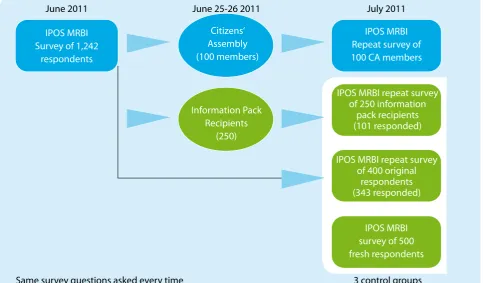
Fig 2.1 | Surveys carried out
The purpose of the control groups
The purpose of having the group who were sent the briefing document, was to separate out the effect of new information from the act of deliberation. With this we can determine if people’s opinions shifted as a result of the information they were sent or because of the act of deliberation itself. We know of no previous experiment in deliberative democracy that has tried to disentangle these two possible mechanisms for change. Furthermore the experimental research design allows us to take account of the impact of being surveyed. There is a legitimate fear that when you measure something, you affect it. So if a person is surveyed on their political opinions, the mere act of being surveyed makes them more interested in politics, and this could also affect how they behave before being resurveyed. By including a large (500) fresh control sample that were only surveyed once after the Citizens’ Assembly, we were able to measure the extent to which surveying caused
changes to the respondents’ views. In summary, the expectation was that:
t there would be significant shifts in opinion among the Citizens’ Assembly participants,
t perhaps also some smaller shifts among those respondents who received the briefing document, and
t little or no change among the other survey respondents.
We found that these expected results were very much in line with what we discovered when we carried out the polls, showing that deliberation does have a significant impact on opinions and attitudes of those taking part. The detailed findings will be discussed in more depth in the next chapter.
IPOS MRBI Survey of 1,242
respondents
Citizens’ Assembly (100 members)
Information Pack Recipients
(250)
IPOS MRBI Repeat survey of 100 CA members
IPOS MRBI survey of 500 fresh respondents IPOS MRBI repeat survey
of 400 original respondents (343 responded) IPOS MRBI repeat survey
of 250 information pack recipients (101 responded)
33
Ho
w w
e t
est
ed par
ticipa
tor
y democr
ac
y in I
reland
2.3 The Citizens’ Assembly pilot
The June 2011 Citizens’ Assembly was designed as a pilot. Clearly, in a full-fledged Citizens’ Assembly things would be different: the government of the day would set an agenda for the Citizens’ Assembly to consider, and it would also be made clear what would happen to the outcome of the assembly.
The Citizens’ Assembly also differed from a full-scale Citizens’ Assembly in how the agenda was set. The agenda for the Citizens’ Assembly was set on the basis of the topics and issues raised in the regional events that had been held around the country in May and early June.
Those who attended the Citizens’ Assembly were taken from the group of 1,242 people polled in the original survey. They had not attended the regional events and were not representing any area or group. They were individuals chosen randomly, the only selection criterion, other than that they be part of the original survey group, was that the overall group be as representative as possible of the Irish population. As can be seen from the figures in table 2.1 on page 31, it is really only the 18-24 age group that was not attracted in the proportion one would have liked, this despite significant efforts to ensure proportionality.
Holding a citizens’ assembly
In running a citizens’ assembly, there are two important considerations:
t To provide the participants with detailed, unbiased information that will help them to reach informed positions - both in terms of briefing documents and access to a panel of experts who can answer technical questions and provide context and background
t To set up the conditions, and allow sufficient time, for the participants to be able to deliberate fully on a question.
34
Ho
w w
e t
est
ed par
ticipa
tor
y democr
ac
y in I
[image:33.595.57.541.165.462.2]reland
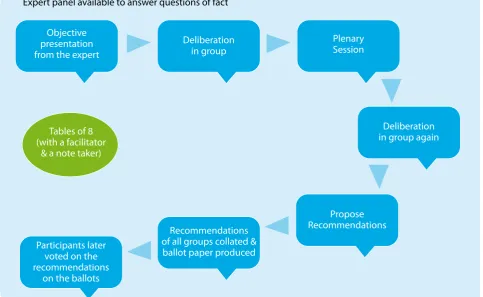
Fig 2.2 | The deliberative process
How the deliberations were organised in the Citizens’ Assembly
t Citizens’ Assembly members were distributed into tables of eight, each having a facilitator and note-taker, with paper tablecloths and markers to give the Citizens’ Assembly members an opportunity to write down their own unmediated thoughts and comments
t The session started with a brief presentation by one or more experts, summarizing the key arguments that were set out in the briefing documents circulated the evening before. The purpose of the briefing documents and the expert panel was to provide the participants with the background information they needed to have an informed discussion
t The Citizens’ Assembly members were then given an opportunity to deliberate among themselves, with the experts available to answer additional questions of detail or fact
t This was then followed by a plenary session, in which the Citizens’ Assembly members were invited to comment on their initial sets of recommendations. In most cases, the tables nominated a spokesperson to share the table’s recommendations with the assembly, though there were also individual contributions
t The Citizens’ Assembly members were then given another opportunity to deliberate in small groups to finalise and word their recommendations
t As the session drew to a close they were asked to propose recommendations about the issue at hand and these were gathered in for each table
t Once the recommendations had been collated, a ballot paper was produced and the Citizens’ Assembly members were given an opportunity to vote on their recommendations.
To maximize the capacity of measuring the impact of this pilot Citizens’ Assembly, it was decided to break
Objective presentation from the expert
Tables of 8 (with a facilitator
& a note taker)
Expert panel available to answer questions of fact
Deliberation in group
Plenary Session
Deliberation in group again
Propose Recommendations Recommendations
of all groups collated & ballot paper produced Participants later
voted on the recommendations
35
Ho w w e t est ed par ticipa tor y democr acy in I
reland
the content of the Assembly into two main themes. The Saturday session focused on a series of political reform issues. On Sunday the question of whether to focus on tax rises or spending cuts in resolving our current economic crisis was discussed. The role of the expert panel was to provide a balanced introduction to the topics being discussed, so that participants could have an informed discussion. Participants were also free to ask questions of the experts during the course of the deliberation, an opportunity that was actively taken up by citizens across all the sessions of the assembly. The questions were brought to the experts by the note-takers and the most appropriate expert went over to the table to answer the question. The panel of experts and the academic team answered hundreds of questions during the deliberations.
The nature and tone of the debates
Over the two days, the Citizens’ Assembly members were asked to deliberate on the following questions:
On Saturday morning
t Should our TDs do less constituency work?
t Should we have a different electoral system to choose our TDs?
t Should we have fewer TDs?
On Saturday afternoon
t Should the parties be forced to field more women candidates?
t Should there be limits on how long a TD can serve in the Dáil?
t Should we allow the appointment of ministers who have not been elected to the Dáil?
On Sunday morning
t In dealing with the economic crisis, should we focus more on tax rises or spending cuts?
t Among the specific issues the government is talking about are the following: property taxes, water charges, sale of state assets and student fees. What do you think?
These questions were identified based on the subjects raised most often at regional events. In a government-mandated Citizens’ Assembly, the whole weekend would likely be spent discussing one question, as in the British Columbia example in 2007. For the pilot assembly, a larger number and range of questions were chosen for pragmatic reasons. It was important that the topics chosen were ones on which there was a divergence of opinion. Where there was large scale consensus, a shift in opinion was unlikely.
“What’s really interesting is who chooses the candidates at a local level. We want a greater say in nominating the candidates.”
“There’s a feeling that the TDs end up in the constituency doing the donkey work for someone on the dole, somebody looking for planning permission. We have councillors and paid civil servants to do that. If they’re not functioning, that’s not the TD’s issue. The system should be put right first. It’s not the TD’s job to do that.”
“We want to feel represented, but we don’t. We want to empower local government and get councils doing what they’re supposed to be doing. Let them raise their own funds so somebody in Cork doesn’t feel like they’re paying for the Luas in Dublin.”
“The main issue is accountability in the Dáil system. We feel that TDs should sign a code of conduct that’s legally binding and can’t be got around. So if they’re caught doing something – they’re signed up to a code of conduct and fired on the spot. It should bring more integrity to the Dáil.”
36
Ho w w e t est ed par ticipa tor y democr acy in I
reland
The general tone of the debates was constructive, with participants listening to each other’s views and giving each other the opportunity to speak, even when their views were very different. The groups made good use of the experts, to clarify specific points and to provide international or best practice examples, when, for instance, there was a point or a disagreement on which the group was stuck. As one would expect, some groups were more talkative than others. There were a small number of instances where a very strong personality dominated the discussion, though gener