C H A P T E R 1
O R D N A N C E
A M M U N I T I O N U N I T S
This chapter describes the types of ammunition units and the roles they play in conventional ammunition unit operations. It includes explanations of missions, capabilities, support orga-nizations, and organizational structures.
CONVENTIONAL AMMUNITION
ORDNANCE COMPANIES
US ammunition units provide Class V support in both GS and DS roles. The GS ammunition company provides support to EAC, corps, and divisions. The DS ammunition company is a corps asset. It provides support to divisional and nondivisional corps organi-zations. It is normally assigned to a CSB under a CSG.
GS and DS ammunition companies provide Class V support throughout the theater of operations from the theater storage area (TSA) in the communications zone (COMMZ) to the ATP in the division support area (DSA). These companies are organized under the L-series TOE. They can be task organized to meet temporary support requirements. These units provide responsive Class V support to deployed US forces any-where in the world. The mission, the capabilities (based on TOE at 100-percent strength and operating at Level 1), and the support organizations peculiar to each company are described in the text that follows. The basic organizational structure described later in this section is the same for the GS and the DS com-pany.
ORDNANCE COMPANY, AMMUNITION,
CONVENTIONAL, GENERAL SUPPORT
(TOE 09488L000)
Mission
The mission of the GS company is to establish and operate a corps storage area (CSA) or a TSA respon-sible for the receipt, storage, rewarehousing, shipping, and issue of ammunition. The CSA has the additional mission of building CCLs.
Capabilities
Based on a 24-hour-a-day operation at Level 1, the GS ammunition company provides a daily lift capabil-ity of about 5,300 short tons (STONs), assuming a 50-percent mix of containerized and breakbulk ammunition. STONs are used in ammunition opera-tions because their weight (2,000 pounds) is easier to calculate than long tons (2,240 pounds). The company can perform DS maintenance and limited modifica-tion of ammunimodifica-tion and its components. The company can also perform emergency destruction of ammunition. Individuals of this company can help the supporting military police (MP) company, or other supporting physical security forces, in the coordinated defense of the area or installation. A GS company can perform unit maintenance on all organic equipment.
Support Organizations • The GS ammunition company depends on the
fol-lowing organizations for support:
• At the theater level, the headquarters and head- • quarters company (HHC) of the ordnance
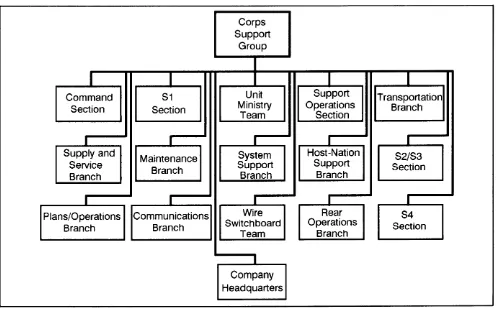
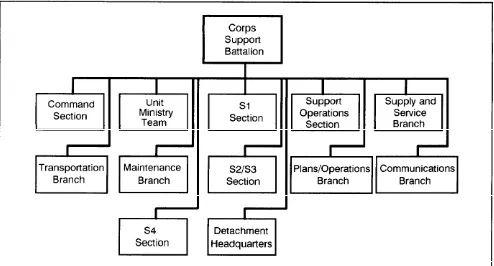
ammunition group or the ordnance ammunition battalion is used for C2, technical direction, and • administrative support. Refer to Figures 1-1 and 1-2 for organizational diagrams of these groups. • At the corps level, the HHCs of the CSG and the
CSB are used for C2
, technical direction, and administrative support. Refer to Figures 1-3 and 1-4 (page 1-4) for organizational diagrams of these units.
• Appropriate elements of the Theater Army Area Command (TAACOM) or corps support com-mand (COSCOM) for medical, religious, legal, financial, personnel, and administrative support services.
• A signal brigade for area communications sup-port.
• The corps, TAACOM, or theater materiel man-agement centers (MMCs) for Class V management.
• Engineer units for site preparation and site maintenance beyond the company’s organic
Corps and theater transportation assets for the movement of ammunition stocks (movement control center [MCC] or movement control team [MCT]).
Explosive ordnance disposal (EOD) units (TOE 09527LA00) for EOD support,
An MP heavy-security company for external security (TOE 19497L000).
ORDNANCE COMPANY, AMMUNITION
(MOADS), DIRECT SUPPORT
(TOE 09483L000)
Mission
The mission of the DS ammunition company is to establish and operate three dispersed ASPS and to establish and operate one ATP under the direction of the division ammunition officer (DAO). This com-pany is responsible for the receipt, storage, rewarehousing, combat configuration, shipment, ret-rograde, and issue of ammunition from the ASP. Receipt, issue, and retrograde operations are con-ducted at the ATP. Refer to ST 9-38-1 for additional information on ATP operations. There are three ATPs in the brigade support area (BSA). These ATPs are attached to and operated by the supply companies
[image:12.611.55.542.455.699.2]capability. of the forward support battalion (FSB).
Figure 1-2. Conventional ammunition ordnance battalion (DS/GS) (TOE 09666L000).
Figure 1-3. Corps support group (TOE 63422L000).
[image:13.610.79.575.391.700.2]Figure 1-4. Corps support battalion (TOE 63426L000). Capabilities
At Level 1, this company can provide three ASPS with a total daily lift capability of about 2,100 STONs and an ATP with a daily lift capability of about 970 STONs. The company can perform DS maintenance and limited modification of ammunition and its com-ponents at the ASP site. It can also perform emergency destruction of ammunition. Individuals from this company can help in the coordinated defense of the area or installation. A DS company can perform unit maintenance on all organic equipment.
Support Organizations
The DS ammunition company depends on the fol-lowing organizations for support:
●
●
●
●
The HHC of the CSG or CSB for C2
, technical direction, and administrative support. Refer to Figure 1-4 for an organizational diagram of this unit.
Appropriate elements of the COSCOM for medi-cal, religious, legal, financial, personnel, and other administrative support services.
A signal brigade for area communications sup-port.
A corps materiel management center (CMMC) for management and movement of Class V stocks.
●
●
●
● ●
●
An MP heavy-security company for external security (TOE 19497L000).
Engineer units for site preparation and site maintenance beyond the company’s organic capability.
Corps transportation assets for the movement of ammunition stocks.
EOD units (TOE 09527LA00) for EOD support. DAO representative for operational C2
manage-ment of ATP operations.
Logistical support (petroleum, oils, and lubri-cants [POL], maintenance, subsistence, medical, security, and so on) for the DS ATP will be pro-vided by division rear base-cluster units as directed by the division support command (DISCOM) DAO in coordination with the DS ammunition company commander.
ORGANIZATIONAL STRUCTURE
Figure 1-5. Conventional ammunition ordnance company (GS) (TOE 09488L000).
Figure 1-6. Ammunition ordnance company (MOADS) (DS) (TOE 09483L000).
[image:15.610.77.576.391.699.2]Company Headquarters
The company headquarters section performs C2 functions. It ensures that standing operating proce-dures (SOPS) are adequate and comply with the directives and policies of higher headquarters. It pro-vides administrative support, unit supply, and food service facilities for the company.
Control Section
The control section coordinates and manages mis-sion activities to include supply and maintenance operations. It prepares and maintains ammunition accountable records and reports and operates the communications center. It provides the ammunition supply platoon with directives for shipments, issues, receipts, rewarehousing, retrograde, and storage of Class V materiel. It provides the appropriate MMC with information on transactions that affect ammuni-tion stocks at the ASP. The control secammuni-tion of the DS ammunition company provides a point of contact for the DAO on the status and support requirements, including transportation assets of the DS ATP.
Quality Assurance/Quality Control Section
The quality assurance/quality control (QA/QC) section ensures that all ammunition operations in the unit are conducted properly and safely. The QA/QC section inspects ammunition and reports directly to the battalion commander. The section collects, records, files, and disseminates QA/QC data, reports, and Class V serviceability records.
Maintenance and Service Platoon
The maintenance and service platoon has three sections. The headquarters section plans and directs the activities of the platoon. The maintenance section performs organizational maintenance on organic equipment and operates both the unit motor pool and the POL storage and dispensing facilities. The service section provides engineer equipment, POL vehicles, specialized equipment, operators, drivers, and special-ists necessary to support the operation of the supply facilities.
Ammunition Supply Platoon
The ammunition supply platoon has four sections. The headquarters section directs all receipt, storage, rewarehousing, retrograde, shipment, and issue opera-tions, including ammunition preparation. The forklift and crane sections are responsible for ammunition receipt, storage, rewarehousing, shipment, retrograde, and issue actions involving their equipment. The
technical support section performs DS maintenance, provides technical assistance, destroys ammunition, conducts inventories, and packs, crates, and bands stocks.
Ammunition Transfer Point Section
The ATP section (MOADS DS company only) operates an ATP in the DSA. Its mission is to provide ammunition support to corps and division units oper-ating in its sector, as directed by the DAO. Refer to ST 9-38-1 for further information.
WARTIME HOST-NATION SUPPORT
AMMUNITION UNITS
This section implements STANAG-2135,
Procedures for Emergency Logistics Assis-tance.
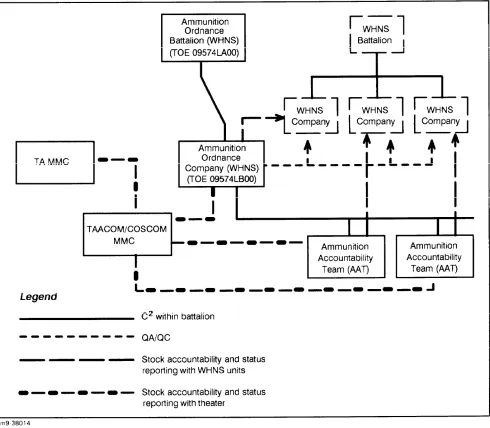
WHNS is a critical element of the ammunition support structure. In a theater of operations and the corps rear, WHNS ammunition units may supplement some US ammunition units. STANAGs detail how host-nation support (HNS) units operate, the support they provide, and how they interface with the US ammunition support structure. For more details, refer to FM 9-6. WHNS units provide Class V support in a GS role based on geographical location. WHNS frees US assets and allows more flexibility by assigning these assets to other missions and theaters, thus gen-erating more combat power. Personnel working in these WHNS units may be active military and/or trained civilian personnel who have been converted to reserve status under the mobilization agreements. The military support structure includes battalion and reg-imental operational levels. Under STANAGs, WHNS personnel remain under the command of the WHNS authorities when hostilities break out. Refer to Figure 1-7 to see how WHNS units and US units interface.
Figure 1-7. Interface between WHNS units and US units.
ORDNANCE BATTALION, AMMUNITION
(WHNS) (TOE 09574LA00)
Mission
The mission of the TOE-designated ordnance bat-talion is to provide C2
for assigned ammunition companies (TOE 09574LB00). Organizational dia-grams of the battalion and company are given in Figure 1-8, page 1-8.
Organization
This battalion is usually assigned to a CSG but may be assigned to a TAACOM ammunition group. The battalion depends on the COSCOM or TAACOM
for religious, legal, medical, financial, and personnel support services.
ORDNANCE COMPANY, AMMUNITION
(WHNS) (TOE 09574LB00)
Mission
Figure 1-8. Ammunition ordnance battalion (WHNS) (TOE 09574LA00) and ammunition ordnance company (WHNS) (TOE 09574LB00).
WHNS ammunition units. They also provide an interface from the supporting MMC on Class V direc-tives to the WHNS US battalion C2
activities, These companies monitor all ammunition operations and ensure that they are done to US QA/QC standards. They assist in the coordinated defense of the unit’s area.
Organization
Ammuniton WHNS companies are assigned to an ammunition WHNS ordnance battalion (TOE 09574LA00). In the theater, the company headquar-ters section collocates with the WHNS battalion headquarters section. Refer to Figure 1-8. The com-pany headquarters section serves as the command, control, and communications (C3) logistics operations center (LOC) to interface with the supporting ord-nance ammunition group and the CLTs. The QA/QC section is also collocated with the WHNS battalion. It is mobile, enabling the section to perform its mission
throughout the battalion in support of all assigned WHNS ammunition companies. Class V transactions and accountability data are passed from the compa-ny’s control section to the Standard Army Ammunition System (SAAS) level operating at the TAACOM MMC.
In the corps, the command relationship is from the company’s headquarters section to the battalion head-quarters and from the battalion headhead-quarters to a CSG. One exception is Class V transactions and accountability data. These SAAS data are passed from the company’s control section to the SAAS level operating at the TAACOM or COSCOM MMC. These same transaction data are also provided to the company’s headquarters section.
Operating Sections
The headquarters section provides C2
over the unit. It is collocated with the WHNS battalion headquar-ters. It consists of the commander, the first sergeant, and a supply sergeant. The control element of the headquarters section consists of a control officer, ammunition technicians, and communications sup-port personnel.
The QA/QC section enforces US QA standards for all US and WHNS operations unless the host nation’s standards are more stringent. In this section are a chief ammunition inspector and several other ammu-nition inspectors.
The control section is collocated with the WHNS company’s operations section. It provides the neces-sary expertise to establish and maintain the stock record accounts necessary for the control of ammuni-tion received, stored, shipped, retrograded, and issued by the WHNS ammunition company. It prepares reports on stock status, daily issues, and receipt trans-actions. These reports are sent to the appropriate MMC using ammunition management communica-tions equipment. In this section are ammunition stock control and accounting sergeants and special-ists.
AMMUNITION ACCOUNTABILITY TEAM
(WHNS)
Mission
These AATs will be designated by TOE when FM 9-6 is revised in fiscal year 1994, AATs provide technical expertise in stock accountability and status reporting and act as a forwarding agency for ammuni-tion management reports. They also assist in the coordinated defense of the unit’s area.
Organization
AATs are assigned to a US WI-INS ammunition company and are collocated with the WHNS ammu-nition company. AATs are supported by the following US organizations:
●
●
●
The HHCs of the ordnance ammunition group, CSG, or CSB provide command and staff plan-ning, technical direction, and administrative support.
Elements of the TAACOM or COSCOM provide Class I, H, III, IV, V, VI, VII, and IX supplies as well as medical, legal, religious, personnel, finan-cial, mail, and inspector general support.
COSCOM and TAACOM MMCs provide Class V management.
The WHNS unit provides support based on STANAGs. This support may include the following:
Billets. Food service.
POL (bulk and packaged). Limited communications support.
Transportation augmentation for relocation. Organizational maintenance.
Rear-area security.
Decontamination of personnel and equipment. Medical services.
Mortuary affairs.
Class V (within its capability).
ROLE OF THE CONVENTIONAL
AMMUNITION UNIT
SUSTAINMENT
No combat unit can be effective in battle unless it has adequate logistical support. To ensure this sup-port, tactical and logistical planners must understand the organization, mission, abilities, and limitations of supported and supporting units. Effective support is possible only through clearly defined objectives and operational concepts in doctrine and through coordi-nation among support units, planners, and combat units.
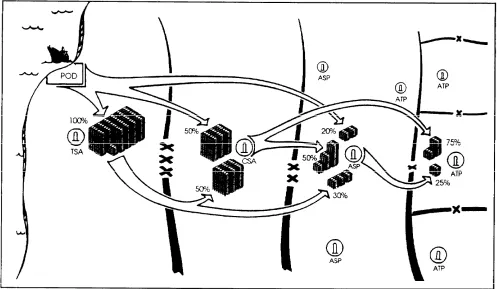
On the AirLand battlefield during intense combat, arming and rearming fighting units may be the larg-est, most time-sensitive task of sustainment. As a provider of a combat necessity, the ammunition unit’s supply operations must be synchronized with other support elements (such as transportation and commu-nications) to provide a responsive Class V support system. The MOADS concept of operation provides this highly responsive Class V support to combat units by combining technological advances in data automation, communications, materials handling equipment (MHE), transport systems, and packaging. Figure 1-9, page 1-10, illustrates MOADS in a theater of operations. With these capabilities, the ammunit-ion unit’s supply operatammunit-ions are streamlined throughout the theater of operations. For an in-depth discussion of MOADS, refer to FM 9-6. MOADS also provides the following:
• User-oriented support.
• Reduced vulnerability of ammunition storage and supply areas.
Figure 1-9. Flow of ammunition within the theater utilizing MOADS.
• Increased flexibility in ammunition operations. • Support to the AirLand Battle doctrine.
Under the L-series TOE, the DS ammunition com-pany can operate three ASPS and one DS ATP. The DS ATP, organic to and operated by the DS ammuni-tion company, supports corps, divisional, and nondivisional units operating in the DSA. These units are able to draw ammunition from the ATP, eliminat-ing some of the need to go back to the ASP. This reduces the user’s resupply travel time.
In addition to the DS ATP, there are three more ATPs in the division area. These ATPs are organic to and operated by the supply companies of the battal-ions that directly support the maneuver brigades. The primary goal of MOADS is to deliver as close as pos-sible to 100 percent of the user’s Class V requirements through these ATPs. In addition to these combat users, other units operating in the brigade sector receive ammunition support from the ATP closest to their unit.
Most ammunition is received at the ATPs as CCLs, a packaging configuration that reduces the user’s labor-intensive ammunition handling at the battal-ion’s trains. The ammunition is transported on corps
line-haul semitrailers and on PLS vehicles. The PLS is the emerging method of ammunition transport. See Appendix A for the interim operational concept of the PLS.
TRAINING
EXPLOSIVE ORDNANCE DISPOSAL
UNITS
MISSION
EOD accentuates the commander’s combat power. EOD units work with engineer and other units to ensure maneuverability, serviceability, and support-ability in the main battle area and back through logistical supply routes. It does this while protecting critical logistical assets threatened by unexploded ord-nance (UXO) in the rear area. EOD eliminates or reduces the hazards of domestic or foreign conven-tional, nuclear, and chemical ordnance and improvised explosive devices (IEDs) that threaten personnel, operations, installations, and materiel.
ORGANIZATION
C2
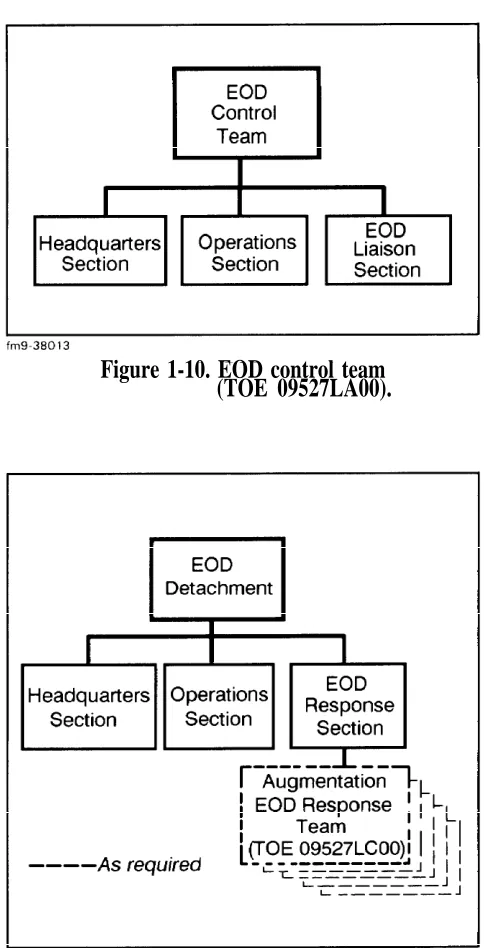
[image:21.611.333.577.70.544.2]of EOD units at the theater army (TA) level are provided by the ordnance group (EOD) that monitors all Army EOD activities in the theater. Each TAACOM and COSCOM is provided with 1 EOD control team (EODCT) (TOE 09527LA00). Refer to Figure 1-10 for a diagram of this team. Each EODCT is assigned from 8 to 10 EOD detachments (TOE 09527LB00). Refer to Figure 1-11. Each of these EOD detachments consists of a small headquarters section, an operations section, and a response section that consists of 5, three-person response teams (TOE 09527LC00). The headquarters and operations sec-tions provide C2 for the 5 response teams. These response teams can work together on multiple UXO incidents with parts of the headquarters and opera-tions secopera-tions providing direct coordination at the incident site. Also, each response team can operate independently of the unit on individual UXO inci-dents for up to 72 hours. For more information on EOD missions and organization, refer to FM 9-15.
Figure 1-10. EOD control team (TOE 09527LA00).
Figure 1-11. EOD detachment (TOE 09527L1300) and augmentation EOD response team (TOE 09527LC00).
C H A P T E R 2
W A R / C O N T I N G E N C Y
A M M U N I T I O N F I E L D
F A C I L I T I E S
This chapter describes WCTO ammunition field storage and supply facilities, types of stor-age areas, and the basic storstor-age systems used to store ammunition in the field. The ATP, a designated temporary area from which ammunition is transferred from corps transportation to using unit vehicles, is also discussed as a field facility. This chapter also contains guidance on site selection and the development and layout of a combat storage facility. Specifically, site selection criteria, the storage plan, and development of the area layout plan are discussed.
AMMUNITION STORAGE AND
ment, the TSA may be relocated to a fieldSUPPLY FACILITIES
environment where ammunition stocks are kept inopen storage. If so, it should have as much hardstandAmmunition storage and supply facilities include the TSA, the CSA, and the ASP. There are also four ATPs per division in the theater of operations that provide a temporary site for the transfer of ammuni-tion. The type of storage facility is decided on a case-by-case basis.
THEATER STORAGE AREA
as possible and a good road network to support heavy traffic. The TSA must be set up to move both break-bulk and containerized ammunition onto and off of both railcars and line-haul transporters. To ensure smooth shipment operations, the TSA should be located where there is ready access to highway, rail, air, and port facilities. Other units in or near the TSA (such as transportation and terminal support units) help the GS ammunition company conduct railhead operations as well as transload operations when The TSA is the largest ammunition facility in the changing from one mode of transportation to another. theater. It is operated by one or more GS ammunition
companies and provides direct support, by area, to units operating in the COMMZ and provides GS to the corps within the theater. The TSA can be a fixed, semifixed, or field storage location. The TSA main-tains up to a 30-day supply of ammunition. The number, size, and stockage objective of TSAs are METT-T dependent.
The TSA is normally a permanent or
receipts are containerized, the containers must be effectively managed by both ammunition and trans-portation personnel to ensure accountability and to retrograde them efficiently for reuse.
CORPS STORAGE AREA
The CSA is the primary source of Class V ammu-nition for the division. Operated by one or more GS ammunition companies, the CSA also provides DS, by area, to units operating in the corps, The CSA can be a fixed, a semifixed, or a field storage facility. It should be located near improved roads and rails in order to allow access by theater and corps assets. The stockage objective of the CSA should be from 10 to 15 days of supply at the time of deployment. Following the initial combat drawdown, the CSA should main-tain from 7 to 10 days of supply. The number, size, and actual stockage objective of CSAs are METT-T dependent.
In established theaters, initial stockage of the CSA is 100-percent breakbulk from prepositioned war reserve stocks (PWRS). Once the supply system is established, the CSA receives about 50 percent of its ammunition from the POD. The remainder is from the TSA. Generally, ammunition resupply from the POD is both breakbulk and containerized, while ship-ments from the TSA are single-DODIC loads. Ammunition is normally shipped from the CSA to an ASP in single-DODIC and multi-DODIC loads and as CCLs. The ammunition shipped from the CSA to the ATPs is configured into CCLs.
Like the TSA, the CSA can also expand to about 40 square kilometers. The storage environment depends on the tactical situation. A medium truck company that works in DS of the GS ammunition company that operates the CSA should be collocated in or near the CSA.
AMMUNITION SUPPLY POINT
Located in the division rear and operated by the DS ammunition company, the ASP provides Class V support to corps, divisional, and nondivisional units. An ASP is a field site. It should be located near an improved road network in order to ensure access by theater/corps transportation assets. It maintains a one- to three-day supply of ammunition in order meet routine, surge, and emergency requirements supported units. The actual stockage level and size an ASP are METT-T dependent.
to of of
The ASP can expand to 5 or 6 square kilometers or even larger depending on the factors of METT-T. Ammunition storage in an ASP is more temporary than at the CSA and the TSA. Unlike the CSA and TSA, ASP stocks are most often stored on the ground on unimproved surfaces. An ASP should be laid out so that vehicles can enter and leave any one area without crossing any of the other areas. The ASP should also have a good road network to support heavy traffic.
Under MOADS, 50 percent of the ammunition arriving at the ASP is shipped from the CSA as single-DODIC loads. About 30 percent is shipped from the TSA, usually as single-DODIC loads. The remaining 20 percent is shipped from the POD. Once in the ASP, the ammunition is issued in single-DODIC loads or as CCLs.
AMMUNITION TRANSFER POINT
ATPs are the most mobile and responsive of all Class V supply facilities. In fact, ammunition may be transferred to using-unit vehicles immediately upon their arrival, depending upon the intensity of combat and the criticality of need, Normally, if the ammuni-tion is loaded on PLS sideless containers (SCs), the SCs are placed on the ground. If PLS is not used, loaded semitrailers minus their tractors are parked in the ATP area. The ATP Class V assets remain in this temporary location until they are transferred to the organic vehicles of the using units. A one-day supply of ammunition is maintained in this manner.
Ammunition is transferred from corps semitrailers, flat-bed trucks, or PLS vehicles and/or trailers to the user’s tactical vehicles using either resupply vehicles with MHE (such as, heavy-expanded mobility tactical trucks [HEMTTs]) or organic ATP MHE. When emptied, the trailers are backhauled by departing empty tractors or PLS vehicles. Trailers or PLS SCs are often used to retrograde unserviceable and/or cap-tured enemy ammunition (CEA) back to the corps. Enemy prisoners of war (EPW) may also be trans-ported by these vehicles. Refer to FM 55-10 for additional information,
ATPs receive about 75 percent of their ammuni-tion requirements from the CSA. The remainder comes from an ASP. The CCLs issued from the CSA and ASPS together make up 90 to 95 percent of the ATP’s assets. The remaining 10 percent is received as single-DODIC items from the ASP.
ATPs are located in the goal of an ATP is to provide percent of the ammunition
BSA and the DSA. The as close as possible to 100 requirements of all units
within its sector. Within each maneuver brigade, the FSB operates an ATP. This ATP provides ammuni-tion support to units in the brigade sector. It receives mission guidance from the DAO, who responds to pri-orities established by the division commander and brigade commanders.
The DS ammunition company provides personnel and equipment to operate an additional ATP in the DSA. This ATP supports all corps, divisional, and nondivisional units in the DSA. It receives mission guidance from and responds to priorities established by the DAO. This ATP increases the flexibility of the division commander by cutting travel time for those units supporting the division’s mission. Units do not have to go to the ASP for Class V support. To support corps slices and division artillery, this additional ATP provides an additional transload capacity of about 970 STONs for high-volume, high-tonnage artillery and Multiple-Launch Rocket System (MLRS) ammuni-tion.
Based on the division commander’s concept of operation, the DAO specifies the units to be sup-ported by each ATP. The DAO also recommends locations for the ATPs (based on METT-T) to the command organization responsible for positioning them. ATPs should be located near a main supply route (MSR) or an adequate road network in order to ensure access by corps vehicles. These vehicles have limited cross-country capability. ATPs should be established on firm ground that is well drained and that provides easy access for using-unit vehicles and for recovery of pallets and trailers. MHE must have enough space to maneuver. As with any other tactical site, good cover and concealment are important.
A DAO representative is assigned to each ATP to coordinate with the DAO. The DAO representative reports all daily transactions to the DAO via ammuni-tion management computers or communicaammuni-tions equipment. ATP personnel also maintain close com-munications with their respective commands.
Security at the ATP is critical. Normally, the ATP is located within a base cluster. However, due to safety reasons, the ATP is separated from the other units within the cluster. Therefore, the base-cluster commander must decide what additional security requirements are needed for the ATP as per local SOPS. ATPs must be prepared to move often. When an ATP is relocated, the move must be closely coordi-nated with the DAO and, in the case of the DS ATP, with the D S ammunition company commander. When cut off from its company’s support, an ATP should be able to attach to the nearest base cluster.
STORAGE AREAS
A TSA, CSA, or ASP can be a field, a fixed-site, or a semifixed storage area. The type of storage area is decided on a case-by-case basis.
FIELD STORAGE AREA
A field storage area provides Class V support to combat and CSS units based on their combat require-ments. Class V assets in a field storage area are usually stored on the ground, on an unimproved sur-face, or in built-up areas using existing buildings.
The number of sections and subdivisions within a field storage area depends on the following things:
Quantity-distance requirements. Size of the area.
Arrival time and size of incoming shipments. Site characteristics.
Estimated length of time to relocate (to ensure adequate operational control and dispersion of stocks are maintained).
For more information, refer to FM 9-13, AR 385-64, and TM 9-1300-206. FM 9-13 provides a more detailed discussion of sections and subdivisions. Sev-eral storage areas may be planned, but only one area is prepared immediately. The initial storage plan may be expanded after the site becomes operational.
There are five storage systems that may be used for field storage of ammunition and explosives: area stor-age, roadside storstor-age, combination area and roadside storage, modular storage, and urban/village built-up storage.
Area Storage System
In area storage, the storage area may be divided into sections. The stacks of ammunition are arranged in a checkerboard pattern and spaced according to the quantity-distance requirements in TM 9-1300-206.
Roadside Storage System
Combination Area and Roadside Storage
System
In this system, both area and roadside storage are used. This combination is often used to make the most effective use of the storage area.
Modular Storage System
In modular storage, ammunition is stored on pads within earth-barricaded areas called cells. These cells are joined to form modules; and, in turn, these mod-ules may be arranged to form module blocks. Requirements for this type of storage are in TM 9-1300-206.
Urban/Village Built-Up Storage System
The possibility of setting up ammunition supply operations in a village or other built-up area is very real and requires consideration when planning war-time operations. In the urban/village built-up storage system, the real estate could be in an existing small city, a village, or a structure in the outlying country-side. The physical configuration layout is based on safety requirements for Class V storage found AR 385-64 and TM 9-1300-206.
the in
FIXED-SITE STORAGE AREA
A fixed-site storage area provides Class V support to combat, CS, and CSS units based on their require-ments. Fixed-site areas are established in CONUS and outside CONUS (OCONUS) based on identified support requirements and contingency plans. They are permanent magazine storage structures used dur-ing the transition to war and durdur-ing the war.
SEMIFIXED STORAGE AREA
A semifixed storage area is a storage area that has been opened and has structures (buildings and bun-kers). It can be used for Class V storage and may become a fixed site. It can be closed out when the Class V organization moves.
SITE SELECTION
GENERAL CONSIDERATIONS
When selecting a WCTO field storage site (ASP, CSA, TSA, or a temporary holding site [ATP]), the ammunition unit commander and division support unit commanders should first consider safety and effi-ciency. Site selection and layout of an ATP are covered in ST 9-38-1.
When selecting a storage site, a primary site and an alternate site should be selected in case the unit’s position becomes untenable due to enemy action or the effect of weather on the terrain. A map reconnais-sance and, if possible, a ground reconnaisreconnais-sance of the proposed sites should be made to ensure that the sites are suitable for performing safe operations and pro-viding service to using units. Sites should also be easily defended, yet suitable for tactical operations. A map reconnaissance provides information on the ter-rain and natural cover and concealment. A ground reconnaissance reveals terrain features that have changed since the map was printed. Based on recon-naissance information, the proposed sites are then drawn on the map, showing possible storage locations and operating areas. Then, if time permits, the unit commander and key personnel should make another ground reconnaissance to verify storage locations and the site plan and to ensure that operational needs are met.
TACTICAL CONSIDERATIONS
Tactical conditions and METT-T factors must be considered to reduce conflict between the tactical and safety requirements of an ideal site. These require-ments are often not compatible, and defense risks must be weighed against the operational mission. Storage of ammunition in urban areas is a real possi-bility and should be considered in war/contingency operations plans and training. The urban/village built-up storage system was discussed earlier in this chapter. The procedures outlined in this section apply to all storage and supply areas. The tactical situation may require that the procedures be modified or sup-plemented. Ammunition unit commanders and division support unit commanders should consider transportation, nearby facilities, defense, road net-work, railheads, terrain, and fire safety when deciding on a storage site. Other tactical
found in FM 71-100, FM 100-15, tion of FM 90-23.
considerations are and the EAC
Transportation
Storage sites should be located near the MSR and supported units to allow easy access to customer units and resupply vehicles. The distance to supported units must be reduced in keeping with security constraints.
Facilities
Storage sites should have ready access to, but be located as far as possible from, hospitals, important military installations, airfields, docks, fuel storage and/or distribution activities, factories, and similar facilities, especially those sites subject to enemy attacks. Downwind distances to populated areas must also be considered, since chemical agents may be a part of the on-hand assets.
Defense
A storage site should be easy to defend against ground attack using the fewest personnel and materi-als possible. The site should be large enough to allow for dispersion of stocks to protect against heavy loss by fire or explosion,
Road Network
There must be as good a road network as possible into and within the site. Roads must be easily pass-able for large vehicles under all weather conditions. They should require as little maintenance as possible. A one-way traffic pattern is preferred to minimize confusion and congestion.
Railhead
A railhead nearby is desirable for those Class V storage sites that may later be developed into larger sites.
Terrain
Storage sites should be established on firm, level ground with good drainage and provide easy access for using unit vehicles and for recovery of SC pallets and trailers. Level ground with natural barriers at proper intervals to segregate field storage units (FSSs) and categories of ammunition is desirable. As with any other tactical site, good cover and concealment are important.
Fire Safety
Attention must be given to fire hazards when establishing a storage site. The field fire control SOP should be followed to reduce fire hazards.
STORAGE AREA PLAN
A detailed storage plan for a new storage area must be developed at the earliest practical time. It should be based on the following factors:
• • • • • • • • • • • • • • •
The time available before the first and subse-quent shipments will arrive.
The estimated tonnage for each type of Class V materiel to be received, stored, issued, and shipped.
The estimated time the storage area will be in operation.
The type of storage area—ASP, CSA, or TSA (field or fixed).
The amount of time and resources available to lay out or reconfigure and prepare the storage area.
The storage system to be used—area storage, roadside storage, combination area and roadside storage, modular storage, or urban/village built-up storage.
The use of planographs to show the exact loca-tion of ammuniloca-tion in a field storage or fixed-site storage area. In order to meet the requirements of their particular situation, units may create local planograph layout forms according to TM 743-200-1.
The use of signs to mark field storage or fixed-site storage areas. Enough signs should be put up along the MSRs to the storage area to guide sup-ported units to the site. Signs should be used liberally inside the storage area to indicate routes, entrances, exits, and storage locations. They should be large enough to be read easily. Directional arrows should be used as needed. The signs should be written in the language of the host nation as well as in English. All signs are removed when the area is closed.
The assistance needed from other units,
The physical characteristics of the selected site (such as road network, terrain, size of the area, and cover).
The emergency destruction plan. Engineer support requirements.
Security requirements, to include defense against enemy action and theft.
Section and FSU pad or module designations to ensure rapid location of Class V assets.
AREA LAYOUT PLAN
GENERAL CONSIDERATIONS
In operating an ASP and an ATP, the DS ammu-nition company has more well-defined layouts than the GS company does in operating the TSA and CSA. However, there are fundamental rules that apply to the layout of all types of ammunition supply and stor-age facilities. For example, general safety procedures for all operations are the same and should be consid-ered first in any site layout. Basic operating procedures are also the same. In any field storage environment, an ASP should be divided into three sections so that issue, transfer, and receipt operations can all be performed at the same time.
Both the CSA and the TSA can operate in a deserted ASP that has been or can be expanded to meet the characteristics of a CSA or a TSA. They may also have to operate in a completely undeveloped area. Although an undeveloped area is the least favor-able location, the tactical situation may dictate its use. The key differences between TSA and CSA field sites and ASP and ATP field sites are that the TSA and CSA should have larger, more stable storage areas and better road networks.
TACTICAL CONSIDERATIONS
One of the most important steps in developing a site for an ammunition supply area is preparing the area layout plan. Area layout requirements for each unit vary according to the tactical situation, the ter-rain, the nearness to forward areas, and the type and amount of materiel handled. A good layout is one that makes the work flow easier or more efficiently; mini-mizes the movement of ammunition, tools, and equipment; permits easy entry and exit for heavy traf-fic; provides effective control of unit operations; and permits defense of the area. Proper positioning of weapons, construction of defensive works and obsta-cles, organization of unit defense, and security are other prime considerations.
A map overlay should be prepared to include the defense plan and the operational layout for the new area. If appropriate, a route overlay or schematic dia-gram is also prepared. The overlays are used by the advance, main, and rear parties. A copy is submitted to higher headquarters.
When WHNS is available, area layout is a combi-nation of’ mutual coordicombi-nation between US services
and allied HNS activities. If the unit is being sup-ported by WHNS, the planning guidance in the sections that follow applies to the US ammunition battalion (TOE 09574LA00) and the WHNS allied battalion that is augmenting the GS mission in the corps or at EAC. Refer to Chapters 1 and 6 for addi-tional guidance on WHNS.
PLANNING CONSIDERATIONS
For safety, all storage areas should be arranged into three separate sections when possible. Each section should make the arrangement of stocks for receipt, issue, and inventory/rewarehousing as easy as possi-ble. Each section consists of a number of storage locations (or modules), depending upon the type of storage system used. During WCTO, the storage loca-tions within each section are separated according to the quantity-distance requirements in AR 385-64. Each storage section should contain a similar amount of each type of ammunition to be stocked. A field-developed storage plan that is based on the initial stockage objective should be prepared before stocks are received in order to ensure a smooth flow of receipts to the proper storage locations. To maintain efficient operations and to prevent using units from waiting unnecessarily, the following guidelines should be followed:
• Make sure signs are posted showing traffic direc-tion, entrances, and exits.
• Draw maps of the storage areas, Use copies of them to direct using units to the proper storage area.
• Group ammunition by storage categories. Refer to AR 385-64 for further information on storage categories.
The ammunition company commander may assign the operation of each section of the storage area to various elements of the company (for example, to the supply platoon or a section of the supply platoon). This enables the platoon or sections of the platoon to remain intact so far as operations are concerned. It also fixes responsibility and increases operational con-trol of each section. In the interest of uniformity, sections should be designated by number. Storage locations should be designated by number and letter. Each storage location contains several ammunition stacks. Each stack contains a single type of ammunit-ion. Ammunition stored in a single stack should follow the field storage category requirements FM 9-13 and TM 9-1300-206. However, based METT-T, ammunition unit commanders may
in on be
faced with tactical situations that require the storage of ammunition under less strict conditions. For more information, refer to AR 385-64. CCLs are an exam-ple of how wartime supply facilities may store ammunition in order to provide more responsive sup-port to the combat forces. CCLs are matching quantities of ammunition that are delivered to the user in complete rounds on one carrier. For example, a CCL might have fifty 155-millimeter projectiles, 50 propelling charges, 50 primers, and 50 fuzes.
LAYOUT CONSIDERATIONS
A typical area layout plan for an ammunition sup-ply area is shown in Figure 2-1, page 2-8. Separation distance is discussed in AR 385-64. Each area should have the following areas, based on METT-T:
• • • • • •
Bivouac Area. The bivouac area is the living area for company personnel. It should be upwind from the ASP and outside the fragmentation and blast areas.
Storage Area. The storage area is where the stocks of ammunition are actually stored. Storage Area Command Post (CP). This CP is located at the main entrance to the storage area in order to provide a control point for supported units. It should be conveniently located to the vehicle holding area so that arriving convoys can pull off the road while awaiting instructions. In larger storage facilities, such as the TSA and the CSA, section CPs are also used in order to ser-vice supported units efficiently.
Vehicle Holding Area. The vehicle holding area is established to reduce congestion. It is located near the storage area office where vehicles will not interfere with the flow of traffic. Ammuni-tion vehicles are held in the area until they can be loaded or unloaded. Incoming vehicles should be inspected in this area. Parking areas should allow for the required minimum safe distance between loaded vehicles and the storage area office as required by TM 9-1300-206.
Vehicle Assembly Area. The vehicle assembly area is conveniently located to the exit of the storage area. Here, loaded vehicles are formed into convoys prior to leaving the area.
Demolition Area. The demolition area is used for the destruction of unserviceable ammunition.
• ● • • • • •
This area should be cleared of vegetation and should not be used for anything else.
Captured Enemy Ammunition Storage Area. The CEA storage area is used to store CEA separately from other munitions. It should be well isolated by firebreaks. Accountability of CEA is discussed in Chapter 6.
Segregation Area. The segregation area is used to isolate ammunition that could be hazardous. This ammunition includes items damaged in transit, unidentified items, unit turn-ins, small arms brass that has not been inspected, and mixed lots of ammunition on the same pallet. Inert Salvage Area. The inert salvage area is used to store nonexplosive ammunition salvage mate-rial (boxes and brass). It should be conveniently located near the vehicle holding area so that returned salvage material can be unloaded from the users’ vehicles before they enter the storage area to draw ammunition.
Surveillance and Maintenance Area, The surveil-lance and maintenance area is used for the inspection and classification of ammunition and for maintenance operations.
C H A P T E R 3
C O N T I N G E N C Y
O P E R A T I O N S P L A N N I N G ,
T R A N S I T I O N T O W C T O ,
A N D P O S T - W C T O
T R A N S I T I O N
This chapter describes ammunition operations in wars and contingencies. WCTO planning, to include the development of a contingency plan and SOPs, is discussed. Prepackaging of material, retrograde of ammunition, and how to request transportation are also covered. This chapter also provides information and guidance on a unit’s transition to a WCTO. Transi-tion to WCTO is enhanced by the use of the contingency plan and field SOPs to train unit personnel. Chapter 3 also discusses the stand-down and retrograde operations associated with the post-WCTO transition.
WAR AND CONTINGENCIES
War is a major conflict between nations that may or may not be declared. Most wars last longer than a year. Contingencies are crises, often with complex political implications. These crises may happen any-where in the world any-where US interests are threatened. Their military mission and threat are often uncertain and vague. Although contingencies may evolve slowly, the decision to use a military option is usually made within short deadlines; and a quick, clear victory is expected. Therefore, contingency operations are short, usually less than a year. They almost always take place in a new or a maturing theater as defined in FM 9-6, where no or few US forces are established. In a contingency, US services will be fighting jointly, possibly with allied participation. The terms “war” and “contingency tactical operations” in this manual are synonymous for Class V support operations. The
main differences are the size of the combat force being supported, the size and makeup of the support struc-ture on the ground, and METT-T.
Present and future battlefields require that DS and GS ammunition units be mobile and agile, particu-larly the DS units. Future battles may be nonlinear, with rapid movement and changes. Thus, ammunition support units must adapt to operating in many differ-ent scenarios and configurations. Units could be supporting small-, medium-, or full-corps task forces. In support of any of these forces, an ammunition unit may not operate as a unit but as a fraction of the unit. It is possible that one-third of the unit would be deployed to support a brigade task force. It is impor-tant that the security and operation of these factions be self-sustaining and 100-percent mobile using organic transportation.
circumstances becomes an essential element of readi-ness, effectivereadi-ness, and success.
The unstable, uncertain nature of a WCTO means a radical change in how ammunition units are situ-ated. In peacetime, both DS and GS ammunition units operate out of fixed sites, with all associated support and facilities in place. In contingency opera-tions, the unit enters a country, not always friendly, to support a rapidly deploying force.
There is no one scenario for a WCTO. For example, a DS or GS ammunition unit may find itself the sole Class V support activity. Another operation might find DS units operating an airhead or port for the receipt of Class V stocks instead of an ASP activity. Still another operation might result in a less-than-company-sized ammunition unit providing support to special operations forces in a counterinsurgency oper-ation. While the tonnage figures in the last instance might be low, stock management would be critical.
Ammunition support, like other logistical support operations in a WCTO, requires that the right equip-ment in the TOE, in the right quantity, and expendable supplies be brought with the unit to per-form its support mission. If they are not, the unit will have to “do without” for a possibly unacceptable length of time. With the fast pace and all of the unknowns of any contingency operation, no unit can afford to “do without” for any length of time and still expect to complete its mission.
PLANNING CONTINGENCY OPERATIONS
A review of recent US Army involvement in con-tingency operations clearly indicates the need for better logistical planning in order to support our forces. To this end, plans must be developed to sup-port brigade through corps operations in theaters of operation to include low- to high-intensity conflicts. In these plans, it is critical that Class V support plan-ning be detailed and threat based.
The above factors, plus the variety of situations in which a unit may find itself, should be considered by both DS and GS ammunition units when they develop support plans. Because units must deploy quickly, they do not have time for detailed last-minute plan-ning. For example, when a unit deploys to a maturing theater, a battalion S4/G4 may not be there to pro-vide the unit with the required logistical information that the unit will need to perform its mission. The unit commander should know where to go and what to do in order to get logistical support. Thus, contin-gency planning must be done in peacetime. This
planning must include the development of a detailed contingency plan and local and field SOPs.
As a minimum, the items listed below must be con-sidered for WCTO plans. Refer to FM 100-5 for additional information. Simplified local and field SOPs should be developed to cover each item.
• • • • • • • • • • • • • • • • • ● • • • • •
Local points of contact for support: computer, engineer, signal, security, defense, transporta-Personnel, equipment, and ammunition basic load (ABL) status charts.
“What if” situations.
Replacements for equipment, personnel, autho-rized stockage list (ASL), and prescribed load list (PLL).
Factors affecting the mission: site location (grid coordinates), units to be supported, and stockage objectives.
Points of contact for the turnover of Class V stocks.
Shipment staging location and procedures. Organization of march units.
Organization of duties of the advance party, the rear party, and the reconnaissance element. Densities and speeds for different types of moves.
Maintenance of ammunition accountability and serviceability records.
Command and control.
Actions to take in the event of enemy attack. Maintenance procedures.
Accident procedures. Refueling procedures. Messing procedures. Communications methods.
Vehicle loading plans for personnel, equipment, and ABL materiel.
Night operations.
Continuity of Operations Plan (COOP).
Enough directional signs, fire symbols, and FSU stack signs for three storage locations.
Retrograde operations.
STANDING OPERATING PROCEDURES
DS and GS ammunition units must prepare field SOPS based on the logistical field SOPS of the C2
ele-ment that the units will be working with. Both external field SOPS for supported units and field
SOPs for the ammunition unit itself should be pre-pared. It should be understood that the SOPs will have to be adapted to the actual conditions of a con-tingency situation. Regardless of the SOP being written, the key to useful, effective planning is to include worse-case situations.
As a minimum, typical external SOPs should cover the following items:
• • • • • • • • • Unit HNS. Class V WHNS. Engineer support. Transportation support. Communications support. Safety.
How to get ammunition. How to turn in ammunition.
How to protect ammunition from the elements. As a minimum, typical field SOPs should cover the following items: • • • • • • •
Deployment (staging procedures).
Field setup (to include a storage plan, perimeter defense plan, and an ASP layout plan).
Operational procedures (to include ammunition receipt, storage, issue, and maintenance opera-tions).
Destruction plans.
Fire-protection plans (and other safety matters). Retrograde.
During actual combat, there will not be much time for personnel to develop plans and procedures. There-fore, simple, realistic field SOPs are essential for completion of the unit’s Class V mission and the sup-ported unit’s mission.
PREPACKAGING
To make any plan work in the changing environ-ment of a contingency operation, everything possible must be done ahead of time. Units and personnel must realize that whatever they do not have ready to take with them, they might not have for a long time— maybe for the duration of the operation.
The most helpful action a unit can take is prepack-aging. All expendable material, including all blank forms used for day-to-day operations, should be pre-packaged. Such things as ASP road directional signs can be packaged and/or palletized for transport. Other expendable material includes banding, paint, stencils,
and so on. The basics necessary to perform any war-time task should be prepacked. Consider using preprepared packing lists that cover a variety of METT-T environments. It may be possible to pre-package subgroups on a packing list, saving even more time.
Another critical asset to be prepackaged is a com-plete Class V reference library. It should include applicable transportation publications as well. Com-manders must ensure that the basic manuals required to complete their wartime tasks are prepacked.
TRANSPORTATION
Since organic transportation does not permit movement of a whole unit at one time, augmenting transportation must be requested. Transportation requests are normally made to CSB headquarters. Battalion headquarters, in turn, places the require-ment with the nearest MCT and/or local transportation activity. Information concerning Army motor transportation request procedures are in FM 55-10. As a minimum, the request for transporta-tion should include the following informatransporta-tion:
• • • • • •
Date of the move. Routes.
Destination.
Time and place the transportation is required. Number of personnel to be moved.
Quantity, type, weight, and cube of materiel to be moved.
RETROGRADE
Retrograde of ammunition most often includes the return of unserviceable ammunition, CEA, and ser-viceable US ammunition to the rear. The high cost and low density of current and emerging high-technology munitions mandate the planning and development of a system to retrograde items that are not needed at this force level or that are not within repair capabilities, Retrograde operations must be covered in a field SOP.
TRANSITION TO WCTO
transition process must be well understood and well trained by all officers and noncommissioned officers (NCOs) of these units. This understanding and train-ing prepare the unit to deploy to its assigned area and perform its mission in less time.
The unit moves because it has been directed to or because it must—as in the case of the unit moving from a theater, post, camp, or fixed-site installation. Conventional ammunition units must be able to plan and execute contingency plans and tactical operations when moving to a new location. When a move is to be made, important considerations are as follows:
• • • • • • • Planning.
Equipment and personnel. Transportation,
Site selection. Reconnaissance.
Area preparation and layout,
Defense, security, and area damage control. The command structure must base its decision to deploy a unit on the following facets:
• • • • • • • •
To where are the deployment orders (in the warning order) ?
What is the situation (forced entry or unopposed entry)?
What is the date and time of deployment? What is the support structure on the ground? Is deployment to be as a unit (not using advance, main, and rear parties)?
Will deployment be in phases (using advance, main, and rear parties)?
What organization is the point of contact in the deployment theater?
What is the deployment mission (first ASP established at airhead or port for the theater or forward in support of a corps- or division-size force)?
What information is briefed to the parties on their mission?
What is the theater situation?
The warning order for deployment (moving) nor-mally includes the general location of the area in which the unit will conduct its operations, the move-ment date, and a list of any special requiremove-ments or special instructions. When notified of an impending move, the company commander alerts unit personnel and begins planning for the move. The move is coor-dinated with the supporting battalion, the local provost marshal or MP unit, and the supporting transportation activity that can provide information and assistance. The commander determines the type of move to be made (unless specified by battalion), requests additional transportation as necessary, takes steps to phase out current operations, and plans a reconnaissance of the area.
An aid to rapid-transition deployment (movement) is the detailed contingency plan and the simplified field SOPs discussed earlier in this chapter. To ensure a successful move under stressful conditions, the unit should use the SOPs and the contingency plan to practice moving until it becomes second nature to all personnel within the unit. During this practice, the SOPs and the contingency plan should be reviewed.
POST-WCTO TRANSITION
One of the major missions that could be assigned to a DS and GS ammunition unit is stand-down opera-tions for the theater. The major function in a stand-down operation is to retrograde Class V materiel and components (to include the shipment of CEA) back to depots, installations, and other ammunition activities outside the theater.
Retrograde operations include identifying, inspect-ing, repackinspect-ing, markinspect-ing, preparing shipment documentation, loading, blocking, bracing, container-izing, and coordinating the transport of the materiel to the port of embarkation. To support retrograde operations, a strong emphasis must be placed on the return of packaging material by using units.
It may also be necessary to reconstitute the unit’s library. The basic manuals required to complete the unit’s wartime tasks should be available for stand-down operations.
C H A P T E R 4
W A R / C O N T I N G E N C Y
T A C T I C A L O P E R A T I O N S
This chapter provides a general description of tactical operations. It provides information on unit operations during a war or contingency operation, to include guidance on unit move-ment, communications, and prioritizing those actions to be taken after the move. It also covers unit defense and security, to include preparing a defense plan and an area damage control plan to support tactical operations. HNS and WHNS are significant factors in tacti-cal operations. Finally, Army ammunition accountability is discussed.
BACKGROUND
Tactical military operations focus primarily on winning battles and engagements. These tactical oper-ations support the operational level goal of winning campaigns and major operations. The operational level provides the vital link between strategic aims and tactical employment of forces on the battlefield. Strategic level goals employ armed forces to achieve national security objectives. To support strategic level goals, theater commanders plan and execute cam-paigns.
Armies normally design the major ground opera-tions of a campaign, while corps and divisions usually fight battles and engagements. A corps commander may be a joint task-force commander. The corps com-mander may plan and execute a campaign to achieve strategic objectives, then the divisions and brigades fight battles and engagements and the battalions and companies attack and defend. Division commanders integrate maneuver battalions, field artillery, aviation, engineers, air-defense artillery, tactical air support, and sometimes naval fire support to accomplish bri-gade and division missions. Corps combine arms in a similar fashion. They employ different types of divi-sions, separate brigades, and cavalry requirements. They arrange CS and CSS and integrate the support
of other services to accomplish their missions. Corps may be responsible for operational level planning and execution.
Tactical success depends on the ability to concen-trate on many things. Some of these are as follows:
•
• • • • • • • • • • •
Ensuring plans are flexible with several options. Avoid reaching culminating points before exer-cising other options.
Anticipating enemy operations. Indirect approaches.
Deception. Security.
Speed and violence.
Flexibility and reliance on junior leaders. Rapid decision making.
Clearly defined objectives and operational con-cepts.
Clearly designated main effort.
Actions throughout the depth of the battle area. Joint operations with other services.
TACTICAL UNIT MOVEMENT
The unit arrives at an airport or seaport of debar-kation in a theater of operations. The unit then moves to a designated marshaling area to link up with unit equipment and prepare for onward movement to its final destination. Logistical support for the unit dur-ing reception and onward movement is provided by the COSCOM or the TAACOM. Transportation ser-vices are provided by the COSCOM or the transportation command (TRANSCOM) and coordi-nated by the movement control element operating at the POD and marshaling areas. Units coordinate with the MCT or element for transportation support and road movement clearance. Units may move to their final destination by highway, rail, air, inland waterway, or a combination of these modes. Once the unit arrives at its final destination, subsequent move-ments may be made based on METT-T.
PLANNING
The intra-theater supporting logistics battalion, based on informational data, provides the warning order for displacement (moving). As stated in Chapter 3, this order normally includes the general location of the area in which the unit will conduct its operations, the movement date, and a list of any spe-cial requirements or spespe-cial instructions. The move is coordinated through S4 channels with the servicing MCT. The MCT is the single point of contact to obtain additional transportation support and to coor-dinate routes and times for movements. Requirements for MP support are provided in the movement bid and are coordinated by the MCT.
The variables and SOPs discussed in Chapter 3 must be considered and used. Transportation consid-erations were also discussed in Chapter 3.
RECONNAISSANCE
After the new area has been selected, the com-mander should obtain planning guidance from the S4. The S4, based on the highway regulation plan and traffic circulation plan, will provide the commander information on routes available to begin planning. The commander should also (time permitting) make a personal reconnaissance of the route and the new area. If this is not possible, a map reconnaissance must be made. As a minimum, the route, the sur-rounding terrain, and the road network in the new
area are evaluated. The strength and clearance of underpasses; the durability, capacity, and width of roads and bridges; and terrain characteristics that would favor an ambush of the convoy en route must be noted. A thorough reconnaissance is extremely important, as the results determine defense planning for the convoy en route and may even mean a differ-ent route must be used. Technical aspects of route reconnaissance are in FM 5-36.
AREA PREPARATION
After reconnaissance of the route and the new area, an advance party (METT-T dependent) is sent to mark the route and to prepare the new area for occu-pancy. The advance party usually consists of personnel from all sections of the unit. It is advisable to include mess personnel and equipment in the advance party so that the main body can be fed a hot meal when it arrives at the area. There must be enough personnel in the advance party to carry out the following tasks:
•
•
• •
•
Clear the route of obstacles and warn the main body of known or suspected enemy activity along the route.
Under chemical or nuclear conditions, check the area for chemical and radiological contamination by conducting chemical agent detection and radiological monitoring operations.
Place route markers at appropriate points. Assign guides from each platoon or section to guide vehicles within the new area to their assigned area.
Secure the new area. o 0 0 0 0 0 0 0
Clear the area of enemy forces.
Check the area for mines and booby traps. Set up and staff temporary outposts. Lay communications wire from the CP to defensive positions and work areas.
Establish an external communications sup-port area.
Prepare positions for crew-served weapons. Prepare hasty fortifications to cover likely avenues of approach.
Prepare kitchen sumps and latrines.
Depending on METT-T, and after the main body or unit arrives at the specified grid coordinates given in the warning order, the unit must set up the area.
SET UP THE AREA
The CSB commander must be informed of the new location. The commander is also briefed on the situa-tion at the new area, the units supported, and any problems or specific requirements relating to the sup-port mission. Other tasks to be performed upon arrival at the new area include the following:
•
•
• •
Complete perimeter defense and coordinate with the defense operations center or base-cluster operations center.
Prepare for technical operations and concur-rently establish liaison with supported units. The company will revise its support plans or devise new ones to meet any new requirements.
Complete housekeeping facilities for unit person-nel.
Coordinate defenses with adjacent units.
CLOSE OUT THE MOVE
In the last phase of unit movement, the rear party (METT-T dependent) closes out operations at the staging area. The composition of the rear party depends on how much work is required to close out operations at the staging area. Communications are kept up between the rear party and higher headquar-ters until the CP at the new area is operational.
COMMUNICATIONS
Effective communications are essential to the mis-sion. A good communications and data transfer system also eases control and direction of the unit by its higher headquarters. It permits transmission of vital tactical information, NBC attack warnings, radiological fallout warnings, rear-area security infor-mation, and changes in the situation that may increase or decrease the unit’s workload. The most secure means of communications available must be used. Since radio communications are relatively inse-cure, they may be used only when no other method will suffice.
NEEDS AND MEDIA
Information needs to flow between DS and GS ammunition companies and their headquarters. Refer to Figures 4-1, 4-2, and 4-3 on pages 4-4, 4-5, and 4-6.
A number of communication media are available (for example, tactical radio, telephone, and automatic data processing equipment [ADPE] to ADPE). The actual hardware varies depending on the situation and avail-able resources.
Battalion
Ordnance ammunition groups or battalions and CSGs or CSBs must be able to exchange command, logistical, and administrative information. The medium used to exchange information must allow lat-eral and vertical communications between the battalion commander, staff elements, and subordinate companies. If tactical radio is used, the battalion or group headquarters serves as the net control station for the command net and the administrative logistics net.
The battalion or group materiel section may com-municate with subordinate support companies on the battalion’s logistics administrative net. Specific com-munications procedures are found in group or battalion SOPs, Communications-Electronics Opera-tion InstrucOpera-tions (CEOIs), letters of instrucOpera-tion (LOI), or operations orders.
Company
The company has several communications needs that affect its mission. The unit must communicate with the group or battalion materiel section to discuss mission-related information. The control section may need to communicate directly with supported units or the supporting MMCs. If so, direct communication is coordinated and approved through local agreements between the supported unit, the MMC, and the sup-port group or battalion. The method used to communicate and the net control responsibilities are designated in the agreement.
RESPONSIBILITIES
Communications Officer
The position of communications officer may be an additional duty. The battalion or company communi-cations officer (or equivalent position) allocates the type and extent of electrical communications within the command. Unit communications policies must conform to those established by higher headquarters.
Radio Operators
Radio operators are responsible for the proper use of the radio, to include using correct radio procedures and safeguarding communications security material. Operation of the radio is frequently an additional duty. Good operators are thoroughly trained in com-munications discipline and operation of the radio control panel. Emphasis on military communications discipline and functions of the control panel are abso-lutely essential. Operators must:
• Be trained and proficient in the use of CEOIs. • Be responsible for performing operator
preven-tive maintenance checks and services on radio equipment.
• Be familiar with the capabilities and limitations of the radio equipment.
• Be familiar with the other facilities incorporated into the radio net of which the unit is a part.
Switchboard Operators
Switchboard operators install, operate, and main-tain the unit switchboard. They