R E S E A R C H A R T I C L E
Open Access
Access to palliative care for homeless
people: complex lives, complex care
Anke J E de Veer
1*, Barbara Stringer
2, Berno van Meijel
3,4,5,6, Renate Verkaik
1and Anneke L Francke
1,7,8Abstract
Background:People experiencing homelessness often encounter progressive incurable somatic diseases in combination with psychiatric and psychosocial problems, and many need palliative care at the end of their lives. Little is known about how palliative care for this group can be started in good time and provided optimally. The objective of this paper is to give insight into the extent people experiencing homelessness have access to good palliative care.
Methods:Qualitative in-depth interviews were held to reconstruct the cases of 19 people experiencing
homelessness in the Netherlands. Eight cases concerned persons being in the palliative phase (using the surprise question) and the other 11 cases concerned persons recently died after a period of ill health due to somatic illness. We used purposive sampling until data saturation was reached. The total number of interviews was 52. All
interviews were transcribed verbatim and analysed inductively.
Results:Three key themes were:‘late access’,‘capricious trajectory’and‘complex care’. The first key theme refers to the often delayed start of palliative care, because of the difficulties in recognizing the need for palliative care, the ambivalence of people experiencing homelessness about accepting palliative care, and the lack of facilities with specific expertise in palliative care for them. The second key theme refers to the illness trajectory, which is often capricious because of the challenging behaviour of people experiencing homelessness, an unpredictable disease process and a system not being able to accommodate or meet their needs. The third key theme refers to the complexity of their care with regard to pain and symptom control, psychosocial and spiritual aspects, and the social network.
Conclusions:The care for in the palliative phase does not satisfy the core requirements of palliative care since there are bottlenecks regarding timely identification, the social network, and the assessment and management of physical symptoms and psychosocial and spiritual care needs. Education in palliative care of outreach professionals, training staff in shelters in the provision of palliative care, and building a network of palliative care specialists for people experiencing homelessness.
Keywords:Palliative care, People experiencing homelessness, End-of-life care, Psychiatric care, Interviews, Qualitative study
Background
The United Nations states that health facilities, goods and services must be accessible to all, especially the most vul-nerable or marginalized sections of the population [1]. This also accounts for palliative care. Palliative care “improves the quality of life of patients and their families facing the problem associated with life-threatening illness, through
the prevention and relief of suffering by means of early identification and impeccable assessment and treatment of pain and other problems, physical, psychosocial and spirit-ual.”[2] People working with the homeless, however, often have doubts about whether they have equal access to good palliative care. Palliative care facilities and expertise are often organized with the general population in mind. In the Netherlands, palliative care is preferably provided at home or, for those who need care that cannot be delivered at home, in nursing homes or hospices.
* Correspondence:[email protected]
1Netherlands Institute for Health Services Research (Nivel), P.O. Box 1568,
3500, BN, Utrecht, The Netherlands
Full list of author information is available at the end of the article
However, for people experiencing homelessness good palliative care, preferably ‘at home’, is not a matter of course. A‘person experiencing homelessness’is someone without permanent housing who may live on the streets, in a shelter, in temporary accommodation, or in some other unstable or non-permanent situation [3]. Based on the number of people known to the Dutch social shelter system, the number of people experiencing homelessness is estimated at 30,000, and this number is thought to be growing [4, 5]. In the Netherlands, ill people experien-cing homelessness often stay in special shelters at the end of their lives, which can be seen as their ‘home’. Types of shelters, usually organized by the municipality or the Salvation Army, vary across towns. There are temporary shelters for those who are ill or frail, nursing home wards, and shelters offering hospice care.
People experiencing homelessness are a specific target group not only because of their living conditions but also because they have a short life expectancy, their high prevalence of illness and symptom burden, their concerns how their life will end, and the reduced availability of palliative care. In a cohort study in one of the largest cities in the Netherlands, life expectancy at age 30 was 11.0 (95% CI 9.1–12.9) years less for men experiencing homelessness compared to men in the general popula-tion and 15.9 (95% CI 10.3–21.5) less for women
ex-periencing homelessness [6]. People experiencing
homelessness aged 50 and older were found to have higher rates of age-related conditions (functional im-pairments, cognitive imim-pairments, falls, urinary incon-tinence) than the general population aged 20 years older [7]. Those who do not die suddenly, for instance in an accident, by suicide, or from a drug overdose, vio-lence or hypothermia, often need palliative care in the final phase of their life.
Heart diseases, respiratory diseases, diseases of the di-gestive system and alcohol-related diseases (such as liver problems or cancer) have been cited as major chronic diseases causing death among people experiencing homelessness [8–11]. Complex comorbidity may occur due to the co-occurrence of physical illness, psychiatric conditions (such as depression, psychosis, post-traumatic stress disorder, and schizophrenia) and addictions [7, 12]. When nearing the end of life, people experiencing home-lessness suffer a high incidence of symptoms, especially pain, fatigue, and psychological symptoms such as worry-ing and feelworry-ing sad [13].
Previous studies have reported that people experien-cing homelessness often have concerns about how their life will end, e.g. about dying anonymously and being undiscovered or unidentified after death [14, 15]. They also frequently worry about the funeral and notification
of family members [14]. Older people experiencing
homelessness often see a good death as dying peacefully,
not suffering, experiencing spiritual connection, and making amends with significant others [16].
These concerns and the diversity and complexity of health problems and needs in different areas of life pose challenges to the access to good palliative care, i.e. people-centred care. Studies indicated that such care is less widely available to people experiencing homeless-ness [15,17–22].
Hence the objective of this paper is to give an insight into the extent good palliative care is accessible for people experiencing homelessness in the Netherlands. Answers on this question may give a better understanding of how palliative care for this target group can be improved.
Methods Design
Qualitative interviews were held with people experien-cing homelessness at the end of life, as well as with people who were close to them at the end of life. In this way we tried to collect as much information about a case as possible.
Recruitment and participants
With the surprise question (see below), we purposively recruited people experiencing homelessness, both men and women, in different living circumstances, who were at the end of their lives. We also included cases of per-sons who were already deceased. The interviewees and deceased cases were selected through contact persons at 13 different shelters, e.g. run by the Salvation Army or municipalities. In the Netherlands, the national health-care policy is to have no one sleeping rough on the streets, but instead to have them sleep in night-care shelters for the homeless, for instance. Those who do not want to live on the streets anymore have access to sheltered accommodation. There are also special conva-lescence care shelters for sick people [23]. The shelters involved in our study were in seven cities located in dif-ferent parts of the Netherlands. This diverse range of settings was selected to take into account the variety of possible palliative care circumstances, since the facilities for people experiencing homelessness can vary between municipalities.
the researchers’information letter plus an informed con-sent form to the person. After interviewing the person experiencing homelessness, we asked their consent for also interviewing the professionals closest to them, spe-cifically at least one professional who knew their per-sonal circumstances (e.g. a social worker) and one professional who knew their medical circumstances (i.e. physician or nurse). Information of social workers and medical professionals supplemented each other because the nature of their contacts with the person experiencing homelessness was different. After this informed consent, we contacted the professionals for an interview.
In addition, contact persons were asked to identify cases of deceased persons who had died less than 1 year ago after a period of ill health due to a somatic illness. The contact person informed the professionals who had been most closely involved about the research and gave them an information letter with an informed consent form. After obtaining their informed consent, we con-tacted the professionals for an interview.
We also tried to find a family member or friend to interview (via the person experiencing homelessness or, if deceased, via the professionals). However, about half of the persons in the study cases did not have any con-tact with family or friends. In the other half of the cases, the relatives refused to participate or professionals were ambivalent asking them.
Participants were provided with a €20 gift voucher, participants who were homeless received€20 in cash.
Data collection
In total 52 individual in-depth interviews were held deal-ing with 19 cases of people experiencdeal-ing homelessness: seven interviews with people themselves (n= 7), 13 with social workers, 12 with physicians, 16 with registered nurses, three with nurse assistants, and one interview with a sheltered housing facility coordinator.
The interviews were almost always held in the shelter in which the person was living or had lived. The inter-views with people experiencing homelessness were con-ducted by the first author (AdV), where another author (BS) was co-interviewer during the first three interviews. The interviewers were a psychologist (AdV) who worked in a walk-in centre for homeless people, and a mental health nurse specialized in treatment of patients with se-vere personality disorders (BS). Both are experienced qualitative researchers. BS – with her experience in mental health nursing - trained AdV in how to interact with people from our target group and how to develop trust. After three interviews, each extensively evaluated afterwards, AdV carried out the interviews. The inter-views lasted between 20 and 90 min. Open questions were used, encouraging interviewees in their own words
to describe the care the person needed and the care they received.
The interviews with the people experiencing homeless-ness started with a general question concerning their per-ceived health (“Can you tell me something about your health?”), followed by questions about the care they needed and the care they received. The first question for professionals was: “Can you tell me something about the care you give/gave?” Depending on the answer, questions were asked about the palliative care that was needed and the care provided. A topic list (Table1) was used to see if the different aspects of palliative care were being ad-dressed. For all groups we used the same topic guide, reminding the interviewer of possible topics to cover and areas to probe. However, during the interview this topic guide was individualized taking into account the specific situation of the interviewee and the findings from previous interviews. The primary focus was on the information the interviewee had and what the interviewee found import-ant to tell. Because people experiencing homelessness and facing the end of their life are very vulnerable in many ways [24] the interviewers continuously paid attention to whether topics could be addressed.
Analysis
Each interview was audiotaped and transcribed verbatim. The analysis was part of a cyclical process of data collec-tion – data analysis – new data collection, ultimately ending in data saturation [25]. Data saturation was ob-tained after 52 interviews based on 19 cases.
The data were analysed inductively. All transcripts were analysed by the first author (AdV), while each of the other authors analysed at least three transcripts. Initially, codes were generated that remained close to the words of the in-terviewees. Subsequently, the meaning of clusters of codes was discussed within the research team and key themes
Table 1Topic list used in the interviews
•The care needed and the care provided (physical, ADL, psychosocial, spiritual, social, symptoms)
•The beginning of the palliative phase
•Proactive care
•Communication with the person experiencing homelessness, wishes of the person
•Autonomy of the person experiencing homelessness
•Family and friends
•Communication and cooperation between professionals
•End-of-life decisions
•After-death care
•Care for other residents
•Care for professionals
were identified. Transcripts of previous interviews were reanalysed and new interviews analysed, guided by these themes, which in turn were sometimes refined or refor-mulated during the analysis process. Interim analyses were discussed by several pairs of authors. Differences between the researchers in the analysis and interpretations were discussed until consensus was reached. Thus the coding scheme was jointly refined over time. Finally, the tran-scripts were coded with the final themes and subthemes, which are also used as the headings and subheadings in the Results section (see below).
Strategies to ensure rigour in our data were purposive sampling aimed to reflect the diversity in the population and multiple interviews per person experiencing home-lessness aimed to capture rich, descriptive data. Interviews were analysed by the researchers from early on and after 19 cases and 52 interviews data saturation was reached.
The software program MAXQDA (release 11.0.9b) was used to facilitate the process of data analysis ( www.MAXQ-DA.com). To validate the results, we discussed the central themes that emerged from our analyses in two focus groups with professionals and a representative of the homeless group (11 participants in total).
Results
Characteristics of people experiencing homelessness
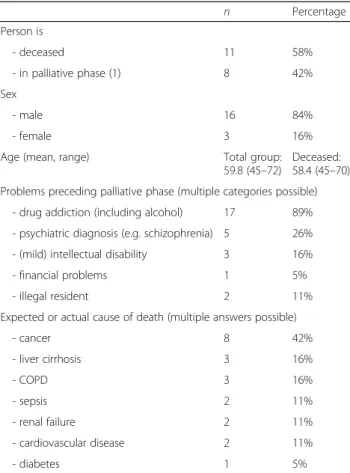
Table 2 shows that the cases consisted of 16 men and three women: eight were in the palliative phase and 11 were people who were deceased. Five of the latter group died in the shelter, three in a hospice, two in a nursing home and one in a hospital. The mean age at death was 58. All had a background of homelessness, and most of them also had a history of drugs and/or alcohol abuse.
Three key themes
The interviews revealed three key themes in the provision of palliative care for people experiencing homelessness: late access to palliative care, capricious healthcare trajectories, and the high degree of complex-ity of the care (Table 3). These key themes were subdi-vided into eight subthemes. To illustrate the themes, we present the cases of Jane, John, Mitch, Anthony and William (Table4). John and William were interviewed in the study. Jane, Mitch and Anthony were deceased at the time of the study.
Late access
People experiencing homelessness were found to have late access to palliative care. Three subthemes were fac-tors in this late access: difficulty among professionals in recognizing palliative care needs, the ambivalence felt by them towards searching for and accepting care, and the lack of services specialized in palliative care for people experiencing homelessness.
Difficulty in recognizing palliative care needs People experiencing homelessness often do not have a recorded medical history due to their often chaotic lifestyles and the paths their lives have taken. Earlier somatic prob-lems were often not documented, which made current signals difficult to interpret. Interpretation was also diffi-cult because people experiencing homelessness mostly had a combination of psychiatric symptoms, addiction
Table 2Characteristics of the people experiencing homelessness (n= 19)
n Percentage
Person is
- deceased 11 58%
- in palliative phase (1) 8 42%
Sex
- male 16 84%
- female 3 16%
Age (mean, range) Total group:
59.8 (45–72)
Deceased: 58.4 (45–70)
Problems preceding palliative phase (multiple categories possible)
- drug addiction (including alcohol) 17 89%
- psychiatric diagnosis (e.g. schizophrenia) 5 26%
- (mild) intellectual disability 3 16%
- financial problems 1 5%
- illegal resident 2 11%
Expected or actual cause of death (multiple answers possible)
- cancer 8 42%
- liver cirrhosis 3 16%
- COPD 3 16%
- sepsis 2 11%
- renal failure 2 11%
- cardiovascular disease 2 11%
- diabetes 1 5%
(1) One person initially agreed to participate in an interview but refused when the interviewee arrived. This person gave permission for interviews with his caregivers
Table 3Map with the three key themes and eight subthemes characterizing the provision of palliative care in people with a background of homelessness
Late Access •difficulties in recognizing need
•ambivalence towards accepting care
•no palliative care facilities Capricious trajectory •challenging behaviour
•unpredictable disease progression
Complex care •pain and symptom control
•psychosocial and spiritual care
problems, intellectual disabilities and challenging behav-iours. A social worker: “There is not much continuity in my relationships with people experiencing homelessness. They come and go again. This makes it extra difficult to notice changes in health care needs.”
The professionals involved were often social workers who were not trained in recognizing medical problems and potential palliative care needs. As Jane’s case illus-trates, for most professionals it was difficult to recognize that someone was incurably somatically ill and in need of palliative care (Table5, E1).
Ambivalence towards accepting care People experien-cing homelessness did not readily ask for help, even when they experienced healthcare needs. They had often suffered many losses in the past (e.g. their job, home, family and friends, dreams and hopes, and now their health), suffered from social exclusion, and had learned to solve things themselves. They often had no confi-dence in professionals due to previous disappointing contacts, feelings of not being treated equally, perceived stigmatization and being disparaged by professionals. Feelings of shame, for instance because of physical neg-lect or persistence in addiction, were also mentioned as a barrier to seeking help. The maintenance of autonomy and self-control was generally very important for them. From this perspective they did not easily ask for help, nor did they easily accept help, even if they had a strong need for help. Members of an assertive community treat-ment (ACT) team said that it was difficult to remain in touch with people experiencing homelessness. Despite this difficulty, the ACT team members said that they did not abandon the person (Table5, E2).
No palliative care facilities In the Netherlands, there are a limited number of nursing-home facilities with specific expertise in palliative care for people experien-cing homelessness. However, in most parts of the Netherlands there is insufficient capacity in specialized
nursing homes for people experiencing homelessness and so these people depend on mainstream care, for in-stance in hospitals, nursing homes, hospice facilities or shelters. Just as people experiencing homelessness are ambivalent about accepting care, so mainstream care fa-cilities are also ambivalent about providing care for them, or even reluctant to do so. If a person failed to show up to an appointment in a hospital, for instance, the physician generally did not undertake further initia-tives and in the worst-case scenario they just closed the file. Nursing homes and hospices had difficulty with their way of life, especially if they persisted in their ad-diction. People experiencing homelessness were gener-ally not willing or able to make changes in their way of life, such as refraining from drugs.
At the same time, shelters for people experiencing homelessness were not able to offer palliative care. Social workers were not trained in providing the nursing care, or even the ADL care that is often needed at the end of life. As a social worker put it:“We always focus on reso-cialisation, resoreso-cialisation, and resocialisation…, whereas another strategy is needed.” Shelters for convalescent care primarily provided ADL care; other nursing care was not available 24/7. Many professionals in shelters thought that palliative care and terminal care were the same, not realizing that many of their clients were in need of palliative care even though they were not in the terminal stage of life. But the professionals in the shel-ters were very skilled in providing a safe environment and trusting relationships for and with their clients. If the person became sicker, professionals struggled with the dilemma of whether the client could stay or should go to a mainstream palliative care facility (Table5, E3).
Capricious trajectory
Access to palliative care facilities was often impeded by big fluctuations in care provision. Two subthemes under-lie these fluctuations. Firstly, the behaviour of people experiencing homelessness presents a challenge for a
Table 4Cases illustrating the results of the analysis
Jane*was a woman without family or friends, diagnosed with schizophrenia. After a period of homelessness she lived in an assisted living facility. She died of colon cancer in a hospital aged 60. In the final two years of her life she had a small apartment and received assertive community treatment.
Johnis an illegal resident in the Netherlands aged 52, addicted to alcohol and drugs. Because of his bad health and with the support of a street doctor, he got permission to stay in a shelter. After a hospitalization, he moved to a nursing ward for people experiencing homelessness.
Mitchwas a former offender, aged 56, diagnosed with an antisocial personality disorder and long-lasting and severe drugs abuse. He was a drugs dealer and had received several convictions for serious violent crimes. He had been living for some years with his wife in his own apartment and had been receiving assertive community treatment. He died in a hospice of oesophageal cancer.
Anthonywas born with a mild intellectual disorder and was addicted to alcohol. Lived in a shelter for people with addiction problems or severe psychiatric problems with somatic complaints. Remarkably, Anthony still had close ties with his family: every day they met each other in his mother’s home to play games and drink beer. He died of throat cancer at the age of 53 in a hospice.
Williamis a friendly man aged 52. He is addicted to alcohol and drugs and his aggression regulation is distorted. He suffers from COPD and is oxygen dependent. He lives in a shelter for people experiencing homelessness with somatic health problems.
continuous, workable relationship with professionals. Sec-ondly, professionals experienced the disease progression as unpredictable.
Behaviour that is challenging for professionals Many of the professionals interviewed, both in facilities for people experiencing homelessness and professionals elsewhere, mentioned that the behaviour of people experiencing homelessness is often challenging and diffi-cult for them to handle. If addicted, they spent a great deal of their time arranging and using alcohol or drugs. Social contacts were mainly based on drugs use. This in-strumental behaviour was experienced as often impeding genuine social contacts and communication with profes-sionals. The professionals used a variety of labels when describing frequently occurring difficult behaviours of people experiencing homelessness: aggressive, rejecting, passive, manipulative, norm-breaking and rule-breaking, and an associated loss of decorum (Table5, E4).
Intellectual and cognitive disabilities, sometimes congeni-tal and sometimes resulting from long-term addiction, fur-ther complicated communication and effective interactions. Some had schizophrenia, psychoses or other psychiatric disorders hindering communication. These challenges for professionals threatened the continuity of the care and of the relationship with the professional. Professionals invested a lot of energy in ensuring continuity in medical care by reminding people of their appointments with physi-cians and accompanying them to the hospital, despite the challenging behaviour they exhibited. The ACT nurse about Mitch’s contacts with the medical specialist in the hospital:“He behaved very pettishly, very badly. He let hap-pen what had to haphap-pen, but he was absolutely condescend-ing…He could not accept authority at all.”
Unpredictable disease progression The state of phys-ical health often stabilized or even got better when the sick person moved from living on the streets into a
Table 5Examples (indicated as E1 to E8) illustrating the characteristics of palliative care provision
Subtheme No. Quote
Difficulty in recognizing need
E1 Jane’s social worker described their search:“Jane complained about her stomach and intestines…we thought that was part of her psychiatric illness. In retrospect I think these were the first signs of cancer….We arranged admission to a psychiatric hospital…a forced admission because she refused to go voluntarily. If you work in psychiatry, you sometimes focus too much on mental issues, you forget that it may just be something somatic.”
In the psychiatric hospital no further medical examinations were done. After discharge from the psychiatric hospital, the social workers noticed that Jane was rapidly losing weight. Because Jane had not visited a GP for years and occasionally made remarks about hospital experiences, the social workers contacted all the hospitals in the region to search for more medical information, but no file on Jane was found. Gradually they realized that Jane was probably very ill. Her social worker:“If there had been a medical file, we might have spotted signs of digestive problems earlier”.
Ambivalence towards accepting care
E2 A nurse talking about Mitch:“I persist in motivating him to come to our yearly somatic screening, for instance, but some will never come…Every time, we try to make contact with a person again. We can be very persistent. Even when I see someone on the street or in a shop I talk to him, both during working hours and during my free time.”
No palliative care facilities
E3 A nurse at Anthony’s shelter:“I work in this shelter two days a week, mainly to arrange all kinds of things.…We can do a lot, that’s not the problem. Anthony wants to stay here and, however fragile, some of us sometimes have a little talk with Anthony. But there are different points of views in the team as to how far we can go in offering care for the dying…In this shelter there are no nurses or nurse assistants. But Anthony didn’t want to leave and, besides, what nursing home will tolerate his behaviour?”
Challenging behaviour E4 The nurse involved with John explained why John had not yet transferred to a nursing home, despite his care needs which they could not meet properly:“John can’t go to the nursing home yet. He won’t stick to the rules. He will persist in smoking in his room. In the past someone was refused care in the nursing home because he persisted in smoking, despite warnings. Some nurses didn’t dare enter the room because they were afraid of him. Therefor John will only be transferred to the nursing home when this behaviour has faded…so, for the final days of his life.”
Unpredictable disease progression
E5 John’s nurse:“..we thought…this will not last long. But one way or another, he recovered again. He was admitted to hospital and we thought this is the end. But then...suddenly…after two days he returned and was on the streets to take his heroin. As if he rose from the dead…I’ll never forget his will to live.”
Pain and symptom control
E6 A social worker:“Anthony persisted in smoking. The pain medication made him muzzy. Even when he couldn’t leave his bed anymore he still wanted to smoke. Because we were afraid he might fall asleep, some member of staff had to go to his room to let him smoke. But often we don’t have enough time to sit there several times a day. Then it is either medication, or smoking…”
Psychosocial and spiritual care
E7 William, who had to stay in his room because of a lack of mobile oxygen:“I would like to arrange some things, the funeral, that I have a bit of certainty…It’s just a surprise to me now. It is in the surprise package. [Laughing] [I: Did you ask for this?] I don’t know. No, well, I’ve mentioned it here a few times…but yes ... that would be nice. They know I’m very ill ... No one has come to me yet, what do you want when you’re dead, what should happen? [I: What do you want] Well, for now I want a mobility scooter ...Now it’s still possible, so I can meet some people.”
shelter. There, the person not only received somatic care but was also supported in having a regular structure to their day, a day-night rhythm and better food intake, and they received personal attention. The person was also supported in their adherence to the medical treat-ment. As a consequence, the person’s condition could improve more than would have been expected if the sick person had continued in their normal living conditions.
The fact that the temporary improvement was unexpected was also due to a lack of knowledge among professionals, for instance about the course of COPD. If the person had recovered from an exacerbation, many professionals inter-preted the improvement as genuine recovery, not realizing that this process of recurring exacerbations characterizes COPD.
Finally, it was also difficult for professionals to get good insight into the disease progression because a person experi-encing homelessness often wanted to pick up their usual way of life as quickly as possible. If, after a deterioration, the health status improved slightly, the person often tended to go back to living on the streets. The professionals said people experiencing homelessness had learned to survive from early on in life and did not easily give up. Sometimes their craving for drugs made them leave the shelter or hos-pital as soon as possible (Table5, E5). These circumstances made it particularly difficult for professionals to predict the disease progression.
Complex care
The third key theme that prevents people experiencing homelessness from having access to good palliative care is the complexity of this care. In particular the control of pain and other symptoms, the psychosocial and spiritual care, and the care for relatives were perceived as difficult.
Pain and symptom control Many of the professionals interviewed experienced difficulties with pain manage-ment and control. Recommendations in general pallia-tive care guidelines or protocols often do not take into account the specific characteristics of persons who use or have used cocaine, methadone, mood stabilizers or antidepressants. People who already use or have used these drugs were found to react differently to the usual doses of pain medication. Some people got suboptimal pain control because professionals believed higher doses might increase the risk of premature death (Table5, E6).
End-of-life decisions such as palliative sedation also turned out to be different, i.e. the prescribed doses did not have the expected effects due to a long history of drug use. Physicians involved in the health care for resi-dents in shelters sometimes noticed that pharmacists and psychiatrists could not give them appropriate advice either and this made them insecure and reticent about giving higher doses of pain medication than usually
recommended. Anaesthesiologists in hospitals were sometimes approached as consultants able to give useful advice in the event of problems with pain control.
In addition to the control of pain, psychological symp-toms were also seen as difficult to control. In the case of psychological symptoms such as anxiety and depression, this was often due to the difficulties the people experien-cing homelessness had communicating their feelings. ‘Self-medication’ (the use of alcohol or drugs) made it more difficult to take a satisfactory decision about what should best be prescribed to control the symptoms. A lack of knowledge about what the proper treatment is in the case of long-term use of all kinds of medicines in the past further hindered symptom control.
The interviewees also mentioned dyspnoea as a frequently occurring symptom that was difficult to control. For ex-ample, many people experiencing homelessness suffer from COPD and frequently have shortness of breath with regular exacerbations in COPD symptoms. They are very anxious about choking but also experience suboptimal symptom treatment. Smoking when oxygen dependent was sometimes considered as an unacceptably high fire risk in the shelter. The policy then was the suboptimal treatment of low levels of oxygen in the blood.
Psychosocial and spiritual care Except for the shelters run by the Salvation Army, additional psychosocial and spiritual palliative care was not always available in the shelters. Professionals often did not know that psycho-social and spiritual care is also part of palliative care. Some professionals were afraid to talk about dying with the person experiencing homelessness. Others said that they sometimes tried to speak to the person about the fact that they were going to die, but that many people experiencing homelessness avoided having that conver-sation. The explanation they gave was that talking about the past and meaningful events in their lives could bring back memories that were too painful. Just ‘being there’ for the sick person was seen as the most important thing, trying to grab an opportunity to talk about it. They tried to indulge the person with attention, comfort, good food, sweets and kindness. Psychosocial and spirit-ual care was sometimes particularly difficult at the end of life when the person was too ill to leave the room and spend time in a common room. Professionals in shelters said that they usually did not have enough time to go to the person’s room to talk with that person, other than bringing them meals and offering physical care. There-fore most of the time the person was all alone in their room (Table5, E7).
drink or use drugs. If someone got sick, these contacts usually faded. Family ties were mostly broken due to painful events in the past. As William told about his re-lationship with his sister:“I have neglected her entire life. I only called her when I was in jail. Then I ordered her to buy a game computer…that kind of things.”It usually cost a lot of time to find an address and restore family ties. Renewed relationships were often painful and fra-gile, and needed continuous supervision so that the rela-tionship did not break again. In most cases there were no family or friends available who could help the person experiencing homelessness to discuss complaints with medical specialists and to increase the chance of receiv-ing good palliative care (Table5, E8). The lack of a social network also increased the chance of dying without the presence of the immediate family or other relatives.
Discussion
The main aim of this paper was to give insight into whether people experiencing homelessness in the Netherlands have access to good palliative care. We must conclude that there are some serious barriers that make good palliative care for this target group particularly challenging. These barriers can be clustered into three key themes:‘late access’,‘ capri-cious trajectory’and‘complex care’.
The first theme refers to the often limited use of pallia-tive care because of the difficulties in recognizing the need for palliative care, the ambivalence people experiencing homelessness towards accepting palliative care, and the lack of facilities with specific expertise in palliative care for the homeless.
The difficulties in recognizing a need for palliative care in this target group as identified in our study might be related to the phenomenon of diagnostic overshadowing, which is often seen in the care for people with a mental illness [26]. The person’s physical symptoms are misat-tributed to their mental illness, which leads to a worse physical condition.
Ambivalence towards accepting care also increases the chance of worse care. We found that this ambivalence was related to perceptions that people experiencing homeless-ness often have of being stigmatized. Other research shows that these perceptions are based on frequent actual preju-dice and stigmatizing attitudes in services [27,28]. The am-bivalence seems to result from an interplay between the person experiencing homelessness and the social and health care services. This phenomenon in the system is also de-scribed as‘care paralysis’, referring to the inability to help cli-ents with multiple and complex problems by social services and care facilities [29]. Care avoidance and care paralysis can be considered as reinforcing and recalling each other. Late access to palliative care also relates to our finding that mainstream care facilities in the Netherlands often lack ex-pertise in care for people experiencing homelessness while
shelters often lack expertise and facilities regarding palliative care. An international review of studies showed that in other countries comparable challenges lie in providing good pallia-tive care in for the target group both in hostels for people experiencing homelessness and in mainstream healthcare systems [30].
The second theme refers to the illness trajectory, which is often capricious because of the challenging behaviour of people and the unpredictable disease process. The illness trajectories of people experiencing homelessness were often found to be difficult to predict for a number of rea-sons, not least because care in a shelter, after having lived on the streets, might temporarily improve health. This phenomenon makes it more difficult to arrive at a proper estimation of the evolving healthcare needs of the person in question. Previous research [31] showing significant im-provements in health status after a person enters the shel-ter system, confirms these observations. The capricious illness trajectories were also described in other research as a barrier for palliative care discussions [32].
In addition, we found that maintenance of autonomy and self-control was generally very important for the target group, which often resulted in an avoidance of care, non-cooperative behaviour and subsequently late access to palliative care. Professionals might face a dilemma in how to support the person experiencing homelessness in maintain-ing their autonomy: whether no further insistence to accept care or to continue to discuss the situation and the need for care with them. No further insistence respects their wish to avoid care, but ongoing discussion of the person’s situation and needs provides an opportunity for advance care plan-ning and puts the person in control of the future situation. Although the effectiveness of existing advance care planning interventions, such as completing advance directives, has not yet been fully proven for the population of people ex-periencing homelessness [33], planning may help the person maintain autonomy and self-control. Further research should be done on how this dilemma can best be handled. Care providers who establish contact and win trust employ ‘non-judgemental appreciation’. They show empathy, accept what is and try to connect with the client and their world [28,34].
often difficult to control dyspnoea because many of these people want to carry on smoking, giving a risk of fire when oxygen is used. This may cause undertreatment.
The care is also complex because of difficulties to in-volve relatives. Whereas in the general population relatives are often directly involved in palliative care, in the home-less population the family is often absent, also at the end of life. Supporting individuals experiencing homelessness in restoring family bonds is an exceptionally challenging task for professionals. The absence of family is also illus-trated by the fact that we were not able to involve immedi-ate family or other relatives, either because they had their own problems or because they did not want to resurrect the past. The lack of a social network and the ambivalence felt by professionals about contacting the immediate fam-ily or other relatives are also found in other research among people experiencing homelessness [14,15,36].
In addition, we found that providing good psychosocial and spiritual care is often difficult. Professionals sometimes did not know that this kind of care is also part of palliative care, were afraid of talking about dying, or did not have enough time for it. People experiencing homelessness also often avoid such conservations. Our study however also showed that some wanted to talk to someone else about psychosocial and spiritual issues, such as reflecting about their life and the near future. This is in accordance with studies showing that people experiencing homelessness do worry about the end of life [11–13]. Respect for the person is a precondition for developing trust and improving the engagement with them, which is needed for tailored psy-chosocial and spiritual care [36].
Strengths and limitations
A strength of this study is the multi-perspective approach: the cases of 19 people experiencing homelessness in need of palliative care were described incorporating information of all the people most closely involved. A second strength is that we selected a variety of cases of people experiencing homelessness, receiving care from a variety of services. This variety contributed to the validity of the results.
A limitation is that no immediate family members or other relatives were interviewed. Family members refused, mainly because the memories were too painful and/or they wanted to close the book on this. Often, there were no con-tact details for family members. Underlying processes and how to deal with them are worthwhile studying.
Practice implications
Late access to palliative care, a capricious illness trajec-tory and the complexity of care have consequences for professionals involved in the care for people experien-cing homelessness at the end of life.
Based on the results we recommend the following for timely, good palliative care for the homeless:
– Informing outreach professionals, such as street workers, about palliative care. They can play an important role they can play in signalling,
documenting and reporting whenever they suspect that someone is seriously ill. People experiencing homelessness themselves or those who were formerly experiencing homelessness can easily make contact with other people experiencing
homelessness. They may also have a role in signalling a need for palliative care.
– Training staff in shelters in palliative care and the ways palliative care can be organized is a first step towards improving palliative care for people experiencing homelessness living in shelters. Staff in mainstream palliative care facilities (nursing homes, hospices) can be trained and supported to deal with clients with challenging behaviour and the special needs they may have (e.g. regarding addiction, pain and symptom control, and involvement of family and friends).
– Building a network of palliative care specialists for people experiencing homelessness, who can advise professionals in mainstream facilities, e.g. regarding the complexities of pain and symptom management in this target group. This can stimulate growth of the body of knowledge about palliative care for people who are homeless.
There is some evidence that interventions aimed at ad-vance care planning, documenting wishes, and better co-operation may be a potentially effective ways to encounter the concerns and needs of homeless people in the final phase of their life [14,17,33]. However, further research is needed on the effectiveness of these interventions.
Conclusion
network challenging. Assessment and treatment of pain and other problems is complicated by in particular the am-bivalence towards accepting care, challenging behaviour, and (former) use of alcohol or drugs. We conclude that the palliative care currently provided to the people experien-cing homelessness does not meet the core requirements of palliative care due to bottlenecks regarding timely identifi-cation, care for the social network, and the assessment and management of physical symptoms and psychosocial and spiritual care needs.
Abbreviations
ACT:assertive community treatment; ADL: Activities of Daily Living; CI: Confidence Interval; COPD: Chronic Obstructive Pulmonary Disease; FNO: Fonds Nuts Ohra; RCOAK: Roomsch Catholijk Oude Armen Kantoor; WHO: World Health Organization
Acknowledgements
We are grateful to the persons who were experiencing homelessness and all professionals for participating in the study.
Funding
The study was funded by FNO and RCOAK.
Availability of data and materials
The datasets generated and analysed during the current study are not publicly available due to privacy of participants and recognizable situations, but are available from the corresponding author on reasonable request.
Authors’contributions
RV, AF and BvM wrote the research proposal and contributed to the design of the study. AdV and BS conducted the interviews. All authors were involved in the analysis and interpretation of data and the critical revision of the paper. All authors read and approved the final manuscript.
Ethics approval and consent to participate
The research protocol was approved by the Medical Ethics Review Committee of VU University Medical Center. Before the interview, interviewees received an information letter and informed consent form. Before starting the interview information was given verbally and the interviewee signed an informed consent form, including consent to publish parts of the interview anonymously.
Consent for publication
Interviewees signed a consent for publication.
Competing interests
The authors declare that they have no competing interests with respect to the research, authorship, and/or publication of this article.
Publisher’s Note
Springer Nature remains neutral with regard to jurisdictional claims in published maps and institutional affiliations.
Author details
1Netherlands Institute for Health Services Research (Nivel), P.O. Box 1568,
3500, BN, Utrecht, The Netherlands.2Center for Consultation and Expertise, Gouda, The Netherlands.3Inholland University of Applied Sciences, Amsterdam, The Netherlands.4University Medical Center, VU, Department of Psychiatry, Amsterdam Public Health Research Institute, Amsterdam, The Netherlands.5Parnassia Psychiatric Institute, The Hague, The Netherlands. 6GGZ-VS, Academy for Masters in Advanced Nursing Practice, Amsterdam,
The Netherlands.7University Medical Center, VU, Department of Public and Occupational Health, Amsterdam Public Health Research Institute, Amsterdam, The Netherlands.8Expertise Center for Palliative care, Amsterdam, The Netherlands.
Received: 30 April 2018 Accepted: 1 October 2018
References
1. UN. CESCR General Comment No. 14: The Right to the Highest Attainable Standard of Health (Art. 12). Adopted at the Twenty-second Session of the Committee on Economic, social and cultural rights, on 11 August 2000 (Contained in Document E/C.12/2000/4).
2. World Health Organization. WHO definition of palliative care. 2002.http:// www.who.int/cancer/palliative/definition/en/(accessed date 8 August 2017). 3. National Health Care for the Homeless Council. Official definition of
homelessness.https://www.nhchc.org/faq/official-definition-homelessness/. Accessedon March 21, 2018.
4. Van Straaten B. On the way up? Exploring homelessness and stable housing among homeless people in the Netherlands. IVO Addiction Research Institute Available from:http://hdl.handle.net/1765/93459. Accessed June 6, 2017. 5. CBS Statline. Daklozen; persoonskenmerken. 2017. Available from:http:// statline.cbs.nl/Statweb/publication/?VW=T&DM=SLNL&PA=80799ned&D1= a&D2=a&D3=a&HD=150303–1405&HDR=T,G2&STB=G1. Accessed June 6, 2017. 6. NusselderWJ SMT, Krol L, Slockers CT, CWN L, van Beeck EF. Mortality and
life expectancy in homeless men and women in Rotterdam: 2001–2010. PLoS One. 2013;8(10):e73979.
7. Fazel S, Geddes JR, Kushel M. The health of homeless people in high-income countries: descriptive epidemiology, health consequences, and clinical and policy recommendations. Lancet. 2014;384:1529–40. 8. Aldridge RW, Story A, Hwang SW, Nordentoft M, Luchenski SA, Hartwell G,
Tweed EJ, Lewer D, Katikireddi SV, Hayward AC. Morbidity and mortality in homeless individuals, prisoners, sex workers, and individuals with substance use disorders in high-income countries: a systematic review and meta-analysis. Lancet. 2018;391:241–50.
9. Baggett TP, Hwang SW, O'Connell JJ, Porneala BC, Stringfellow EJ, Orav EJ, Singer DE, Rigotti NA. Mortality among homeless adults in Boston: shifts in causes of death over a 15-year period. JAMA Intern Med. 2013;173(3):189–95. 10. Stenius-Ayoade A, Haaramo P, Kautiainen H, Gissler M, Wahlbeck K, Eriksson
JG. Mortality and causes of death among homeless in Finland: a 10-year follow-up study. J Epidemiol Community Health. 2017;0:868–75.https://doi. org/10.1136/jech-2017-209166.
11. Vuillermoz C, Aouba A, Grout L, Vandentorren S, Tassin F, Moreno-Betancur M, Jougla E, Rey G. Mortality among homeless people in France, 2008-10. Eur J Pub Health. 2016;26(6):1028–33.
12. Podymow T, Turnbull J, Coyle D. Shelter-based palliative care for the homeless terminally ill. Palliat Med. 2006;20(2):81–6.
13. Tobey MT, Manasson J, Decarlo K, Ciraldo-Marynuk K. Homeless individuals approaching the end of life. J Pain Symptom Manag. 2017;53(4):738–44. 14. Hubbell SA. Advance care planning with individuals experiencing
homelessness: literature review and recommendations for public health practice. Public Health Nurs. 2017;34(5):72–478.
15. Song J, Bartels DM, Ratner ER, Alderton L, Hudson B, Ahluwalia JS. Dying on the streets: homeless persons' concerns and desires about end of life care. J Gen Intern Med. 2007;22(4):435–41.
16. Ko E, Kwak J, Nelson-Becker H. What constitutes a good and bad death?: perspectives of homeless older adults. Death Studies. 2015;39(7):422–32. 17. Klop HT, de Veer AJE, van Dongen SI, Francke AL, Rietjens JAC,
Onwuteaka-Philipsen BD. Palliative care for homeless people: a systematic review of the concerns, care needs and preferences, and the barriers and facilitators for providing palliative care. BMC Palliative Care. 2018;17(67).https://doi.org/10. 1186/s12904-018-0320-6.
18. Krakowsky Y, Gofine M, Brown P, Danziger J, Knowles H. Increasing access-a qualitative study of homelessness and palliative Care in a Major Urban Center. American Journal of Hospice and Palliative Medicine. 2013;30(3):268–70. 19. McNeil R, Guirguis-Younger M. Illicit drug use as a challenge to the delivery
of end-of-life care services to homeless persons: perceptions of health and social services professionals. Palliat Med. 2012;26(4):350–9.
20. Mac Williams J, Bramwell M, Brown S, O’Connor M. Reaching out to ray: delivering palliative care services to a homeless person in Melbourne, Australia. Int J Palliat Nurs. 2014;20(2):83–8.
21. Webb WA. When dying at home is not an option: exploration of hostel staff views on palliative care for homeless people. Int J Palliat Nurs. 2015;21(5):236–44. 22. Shulman C, Hudson BF, Low J, Hewett N, Daley J, Kennedy P, et al.
23. Van Laere I, de Wit M, Klazinga N. Shelter-based convalescence for homeless adults in Amsterdam: a descriptive study. BMC Health Serv Res. 2009;9(208).https://doi.org/10.1186/1472-6963-9-208.
24. Koffman J, Morgan M, Edmonds P, Speck P, Higginson IJ. Vulnerability in palliative care research: findings from a qualitative study of black Caribbean and white British patients with advanced cancer. J Med Ethics. 2009;35:440–4. 25. Guest G, Bunce A, Johnson L. How many interviews are enough? An experiment
with data saturation and variability. Field Methods. 2006;18(1):59–82. 26. Jones S, Howard L, Thornicroft G.‘Diagnostic overshadowing’: worse
physical health care for people with mental illness. Acta Psychiatr Scand. 2008;118(3):169–254.
27. Canavan R, Barry MM, Matanov A, Barros H, Gabor E, Greacen T, et al. Service provision and barriers to care for homeless people with mental health problems across 14 European capital cities. BMC Health Serv Res. 2012;12:122. 28. Klop HT, Evenblij K, Gootjes JRG, de AJE V, Onwuteaka-Philipsen BD. Care
avoidance among homeless people and access to care: an interview study among spiritual caregivers, street pastors, homeless outreach workers and formerly homeless people. BMC Public Health. 2018;18(1):1095.https://doi. org/10.1186/s12889-018-5989-1.
29. Schout G, de Jong G, Zeelen J. Beyond care avoidance and care paralysis: theorizing public mental health care. Sociology. 2011;45(4):665–81. 30. Hudson BF, Flemming K, Shulman C, Candy B. Challenges to access and
provision of palliative care for people who are homeless: a systematic review of qualitative research. BMC Palliative Care. 2016;15:96.
31. Schanzer B, Boanerges Dominguez MPH, Shrout PE, Caton CLM. Homelessness, health status, and health care use. Am J Public Health. 2005;97(3):464–9. 32. Hudson BF, Shulman C, Low J, Hewett N, Daley J, Davis S, Brophy N,
Howard D, Vivat B, Kennedy P, Stone P. Challenges to discussing palliative care with people experiencing homelessness: a qualitative study. BMJ Open. 2018;7:e017502.https://doi.org/10.1136/bmjopen-2017-017502.
33. Sumalinog R, Harrington K, Dosani N, Hwang SW. Advance care planning, palliative care and end-of-life care interventions for homeless people: a systematic review. Palliat Med. 2017;31(2):109–19.
34. Schout G, de Jong G, Zeelen J. Establishing contact and gaining trust: an exploratory study of care avoidance. J Adv Nurs. 2010;66(2):324–33. 35. Engels G, Francke AL, van Meijel B, Douma JG, de Kam H, Wesselink W,
Houtjes W, Scherder EJA. Clinical pain in schizofrenia: a systematic review. Journal of pain. 2014;15(5):457–67.