Original Research Article
Correlates of picky eating behaviour in children and its effect on growth
Shweta Shettiwar, Minal Wade*
INTRODUCTION
Rare is the child who will eat pretty much anything. Most toddlers develop habits of eating specific favorite foods and, of more concern, absolute no-go foods. The latter is of major concern for parents. who find picky eating one of the most-difficult-to-deal-with feeding problems.1
During first year, infants’ transition from consuming a single food (i.e., breast milk or formula) to consuming a variety of foods more characteristic of an adult diet? This transition allows infants to learn about food through direct experience, as well as through observation of others' eating behaviours. Children who exhibit picky eating behaviours typically consume a limited variety of foods, resist trying new foods, eat small portions, skip
meals, eat slowly, demonstrate strong food preferences and/or show little interest in food. Consequently, for some children, picky eating behaviours have the potential to adversely affect growth and development.
The development of picky eating may be affected by factors such as pressure to eat, personality factors, and parental practices/ feeding styles, including parental control and social influences, as well as specific factors, such as the absence of exclusive breastfeeding, the introduction of complementary foods before 6 months, and the late introduction of chewy foods (ALSPAC Study Team).2,3 ‘Picky eating’ is a widely used descriptive term,
but without a clear or consistent definition. This lack of operationalization has contributed to limitations in ABSTRACT
Background: Picky eating is common in preschool-aged children. Children’s picky eating behaviour has been linked both to being overweight and underweight. Authors objectives was to study the factors associates of picky eating behaviour on growth and nutritional status of children.
Methods: A Cross-sectional study done in 200 parents of children between 1-5 year age visiting outpatient department. Picky eating behaviours were assessed using questions from children eating behaviour questionnaire.
Results: In the study, the estimated prevalence rate was 25%, maximum 38% at 49 to 60 months. 26% of subjects with picky eating behaviour had height for age <-3SD (severely stunted) 38% of subjects with picky eating behaviour had weight for height <-3SD (severely wasted) as compared to only 4% in non-picky eating behaviour subjects. Low birth weight and exclusive breast feeding for less than 6 month, were found to be significant risk factor for development of picky eating behaviour, while no significant association was seen with the time of introduction of semisolid complimentary feeds.
Conclusions: Picky eating is major parental concern and impacts growth of children. The children with picky eating behaviours need to be monitored for growth.
Keywords: Children, Correlates, Eating behaviours, Picky eating, Undernutrition
Department of Pediatrics, HBT Medical College and Dr R. N. Cooper Hospital, Mumbai, Maharashtra, India
Received: 19 September 2019
Accepted: 27 September 2019
*Correspondence:
Dr. Minal Wade,
E-mail: [email protected]
Copyright: © the author(s), publisher and licensee Medip Academy. This is an open-access article distributed under the terms of the Creative Commons Attribution Non-Commercial License, which permits unrestricted non-commercial use, distribution, and reproduction in any medium, provided the original work is properly cited.
existing research. This study aims to find out prevalence and also correlation of age of introduction of complementary feeding with picky eating behaviour. We also observed effects of picky eating behaviour on nutrition of the child and factors contributing to development of picky eating behaviour.
METHODS
A Cross-sectional study done in 200 parents of children between 1 to 5 year age visiting pediatric outpatient department of a tertiary care centre during July 2017 to June 2018. Children with history of significant NICU stay, major congenital malformations, children with chronic infections and diseases were excluded. Data was collected through face-to-face interview with predesigned questionnaire administered to 200 mothers who consented for the study. It included demographic data on age, religion, place of residence, parent’s employment, education, family’s monthly income and anthropometric parameters. Picky eating behaviours were assessed using survey questions from children’s eating behaviour questionnaire (CEBQ).4 Mothers were asked to respond
to each question using a five-point response scale of 1 (almost never) to 5 (almost always). The higher score demonstrate greater picky eating behaviour, so the reverse-described questions were transposed. The four specific picky eating behaviours viz, i) Eating small amounts, ii) Neophobic behaviour, iii) Refusal to eat specific food groups (4 food groups) and iv) Preference for a specific food preparation method were considered so as to define it further into particular type as well not to miss any borderline type. It was assumed that the children have potential picky eating characters if the response score to each question was higher than neutral. The responses were summated rating scales to get four construct Therefore, the children whose mean score of responses was >3 were classified as “picky eaters”, for that particular construct. Children who had any three of the picky eating 4 constructs, were classified as Definitive picky eaters and those with any 2 construct were Borderline Picky eater.5
A structured questionnaire was used to assess knowledge and practices towards breast feeding and complimentary feeding and its effect on children’s picky eating behaviour. IYCF (Infant and young child feeding) guidelines 2016
Statistical analysis
All the data were entered in Microsoft Excel Sheet and then transferred to SPSS software version 17 for analysis. Qualitative data was presented as frequency and percentages. Association between variables was assessed using chi square test of Fisher’s exact test (in case of 2 x 2 contingency tables).Quantitative data was presented as mean and SD and P value <0.05 was taken as level of significance.
RESULTS
A total of, 200 mothers visiting pediatric outpatient department who consented to be assessed were included in the study. The demographic profile of study subjects showed maximum number of study cases belonged to age group 12-24 months, 88 in numbers (44%) as seen in (Table 1). The male to female ratio was 1:1.1 and 52.5 % (105) of study subjects were females. The mean age of mothers in study group was 30±4.9 years. Of the total study subjects, 44.5% of mothers were educated up to secondary high school while 47.5 % of fathers were educated up to secondary high school, 12.5 % mothers illiterate and only 7.5% mothers and 20% of fathers were graduate.
Table 1: Demographic profile of parents of study subjects (n=200).
Age group
(months) Number (n) Percentage (%)
12-24 88 44.0
25-36 38 19.0
37-48 39 19.5
49-60 35 17.5
Total 200 100
Mothers education
Illiterate 25 12.5
Primary 71 35.5
Secondary 89 44.5
Graduate and above
15 7.5
Mothers Occupation
Employed 20 10
Homemaker 180 90
Fathers Occupation
Skilled Worker 49 24.5 Unskilled Worker 151 75.5 Modified
Kuppuswamy scale
Upper 3 1.5
Upper middle 19 9.5
Lower middle 154 77
Upper lower 21 10.5
Lower 3 1.5
Total 200 100%
Table 2: Responses for characteristics related to picky eating behaviour (n=200).
Type of eating
behaviour Yes No
Eating small amount 127(63.5%) 73(36.5%) Neophobia 145(72.5%) 55(27.5%) Refusal of specific food 68(34.0%) 132(66.0%) Preference for a specific
Table 3: Classification of subjects in Picky eating
behaviour vs. non picky eating depending on four constructs.
Responses Number
(N)
Picky / Non Picky eating None
Non picky eaters
16(8%)
Total 150 (75%) One response
Yes 57(28.5%)
Two
responses Yes
Borderline picky eaters
77 (38.5%)
Three
responses Yes Definitive picky eaters
47(23.5%) Picky Eaters - Total 50 (25%) Four
responses Yes 3(1.5%)
Total 200
Responses for characteristics related to picky eating behaviour (n=200)
Table 2 describes responses for questions related to picky eating behaviour. Among the 4 constructs intake of small amount and Neophobia were major problems. 72.5% subjects had Neophobia while 63.5% subjects were eating small amount as per mothers. Refusal of specific food was present in 34% subjects and 12% subjects preferred specific food only.
Table 4: Age group wise distribution of subjects among two groups (n=200).
Age group
Picky eaters
Non picky eaters
Total
p value X2 =
34.68 p <0.0001 12 - 24 13(26%) 75(50%) 88(44%)
25 - 36 3(6%) 35(23.3%) 38(19%) 37 - 48 15(30%) 24(16%) 39
(19.5%) 49 - 60 19(38%) 16(10.7%) 35
(17.5%)
Total 50 150 200
Table 5: Co-relation of variables with picky eating behaviour (n=200).
Mothers education Picky Non picky Total p Value
Illiterate 4(8%) 21(14%) 25(12.5%)
X2 = 11.45
p = 0.009
Primary 15(30%) 56(37.3%) 71(35.5%)
Secondary 22(44%) 67(44.7%) 89(44.5%)
Graduate and above 9(18%) 6(4%) 15(7.5%)
Total 50 150 200
Birth weight
<2.5 kg 38(76%) 77(51%) 115(57.5%)
X2 = 9.33
p = 0.002
>2.5 kg 12(24%) 73(49%) 85(42.5%)
Total 50 150 200
Exclusive breast feeding
<6 months 43(28.8 %) 106 (71.2 %) 149
X2 = 4.64
p = 0.03
>6 months 7 (13.7 %) 44 (86.3 %) 51
Total 50 (25%) 150 (75%) 200
Initiation of semisolid foods
<6 months 6(40%) 90(60%) 15
X2 = 2.5
p = 0.27
6-8 months 28(26%) 80(74%) 108
>8 months 16(21%) 61(79%) 77
Total 50(25%) 150(75%) 200
Knowledge of Complementary feeding
1: No of times complementary feeding should be given at the age of 9 to 11 months
Correct 37(74.0%) 81(54.0%) 118(59.0%)
(59.0%)
X2 = 1.94
p = 0.16
Incorrect 13(26 %) 69(46.0%) 82(41.0%)
2: What should be the consistency of complementary food at the time of weaning?
Correct 18(36.0%) 40(26.7%) 58(29.0%) X2 = 1.58
p = 0.21
Incorrect 32(64.0%) 110(73.3%) 142(71.0%)
(71.0%)
refused by children (49%) followed by milk (35.5%), vegetables (22.5%) and eggs (10%) (Figure 1).
Figure 1: Prevalence of refusal to specific foods.
The prevalence of picky eaters increased as age increased (table 4). Prevalence of picky eaters was more in age group of 49 to 60 months (38%) with p value <0.0001.We studied association between education of mother in picky versus non picky subjects, it was found that picky eating behaviour is more common in subjects with graduate mothers, statistically significant (p =0.009).
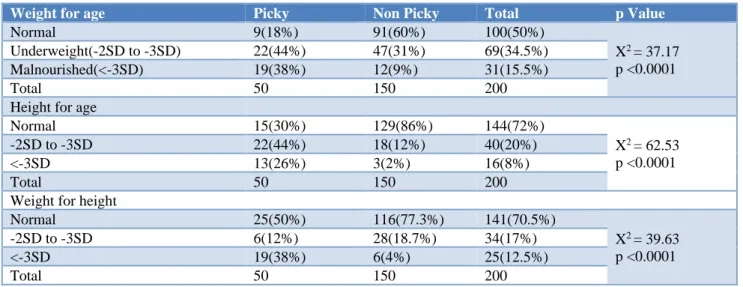
As shown in Table 5, among picky eaters, 76% of subjects had birth weight <2.5 kg as against 51% of non-picky eaters (p value of 0.002). There was significant correlation between exclusive breast feeding <6 months while we found no association with age of starting of semisolid foods. Comparison of anthropometric parameters in the two groups, demonstrates weight, height for age, weight for height were significantly associated with Picky eating habit (Table 6).
Table 6: Comparison of anthropometric parameters among picky eaters and non picky eaters (n=200).
Weight for age Picky Non Picky Total p Value
Normal 9(18%) 91(60%) 100(50%)
X2 = 37.17
p <0.0001 Underweight(-2SD to -3SD) 22(44%) 47(31%) 69(34.5%)
Malnourished(<-3SD) 19(38%) 12(9%) 31(15.5%)
Total 50 150 200
Height for age
Normal 15(30%) 129(86%) 144(72%)
X2 = 62.53
p <0.0001
-2SD to -3SD 22(44%) 18(12%) 40(20%)
<-3SD 13(26%) 3(2%) 16(8%)
Total 50 150 200
Weight for height
Normal 25(50%) 116(77.3%) 141(70.5%)
X2 = 39.63
p <0.0001
-2SD to -3SD 6(12%) 28(18.7%) 34(17%)
<-3SD 19(38%) 6(4%) 25(12.5%)
Total 50 150 200
DISCUSSION
Research on picky eating face difficulties due to a lack of widely-accepted definition and appropriate measurement tools. Different definition used by different researchers may indicate that picky eating behaviour is not simple, but rather has complex characteristics that cannot be defined by one single aspect. Thus, in the present study, different aspects of picky eating were evaluated and then measured separately for their associations with nutritional status.
In this study we have used two main constructs as defined in study done by Shim ,J.E “eating small amounts” and “limited variety” in picky eating behaviours. The later has the three sub-constructs, of “neophobic behaviour”,
“refusal of specific food groups”, and “preference for a specific preparation method”. While children show more than one construct behaviour simultaneously and there is overlap in classification of children. We assessed picky eating behaviour knowledge and practices towards breast feeding and complimentary feeding and its effect on children’s picky eating behaviour.6,15
Prevalence
In the present study, the prevalence of picky eating was 25% (50 children). This was similar to other studies in the literature. This figure compares with the rates of 17% in China in 15.6% in USA, 20% in New Zealand , from studies conducted among comparable age groups. In contrast, much lower rates of 5.6% in the Netherlands , 7.3% in Denmark, and 8.3% in UK have been reported 0
50 100
98
45
71
20
Nu
mber
of
Ch
il
dren
by other workers among under-fives. In an Indian study the mean prevalence was 58.9%, which is very high as compared to present study.7-11
When divided into four sub constructs of picky eating, eating small amount and neophobia were major problems with 63.5% and 72.5% subjects, respectively. Refusal of specific food was present in 34% subjects and 12% subjects preferred specifically prepared food only. Most children showed more than one kind of picky behaviour. 47% of the children had picky eating behaviour and 1.5% had all of these picky eating behaviours, while 8% had none of the picky eating behaviours.
Refusal to eat specific food groups
Majority (49%) of the refusal was seen with Beans, some (35.5%) with milk, few (22.5%) refused having vegetables while few others (10%) refused having Eggs. In a study which showed that the three most frequently refused food groups were shellfish, beans, and vegetables, and the three least refused food groups were fish, fruits, and eggs.5
Preference for a specific food-preparation method
It was observed in their study that many children were having preference for certain food items only if they are cooked in a specific way. Out of 200, 47 children (23.5%) for Beans, 108 children (54%) for Vegetables, 30 children (15%) for Meat and 33 children (16.5%) for Eggs. A study by Mascola et al, also stated that picky eaters eat a limited variety of foods and required food be prepared in specific ways which had significant association too.12 The study also found Parents of picky
eaters were more likely (58%) to prepare a separate meal for their child than parents of non-picky eaters (18%).
Nutritional status in children with picky eating behaviour
This study assessed the effect of picky eating behaviour on nutritional status in the children from 1 to 5 years with peak age between 49 to 60 months. Out of total 200 study population, 50% had normal weight for age and 72% normal height for age and 70.5% were in normal weight for height. On correlating picky eating behaviour with nutritional status, we found that the children in the Picky eating group had significantly lower anthropometric measures weight for age, height for age, weight for height compared with the non- picky eating group in our study. 38% amongst the picky eaters were underweight compared to 12% of non-picky eaters. Picky eaters were more stunted i.e. 26% than 3% in non-picky eaters (p <0.0001). Similarly author found that wasting was more prevalent in picky eaters (38%) than non-picky (4%) with p <0.0001.
These are significant findings, because being underweight is an important risk factor for poor cognitive
development, learning disabilities, long-term behavioral problems, micronutrient deficiency increased prevalence and severity of infection, and high mortality rates. A number of studies have examined the possible effect of picky eating on growth, usually in children older than 3 years, with inconsistent results.13 In a large longitudinal
study of 1498 children, Dubois et al, assessed eating behaviours at 2.5, 3.5, and 4.5 years of age, and body mass index (BMI) was calculated from children’s measured height and weight only at 4.5 years. The authors found that children with picky eating habits were twice as likely to be underweight at 4.5 years as children who had never had picky eating habits.14
Birth weight
In this study authors found a strong association between low birth weight and picky eating with p value 0.002. 76%of children with birth weight <2.5 kg were picky eaters than 24% of >2.5 kg. The similar trend was observed by a study cohort in UK.15
Duration of breast feeding and initiation of complimentary feeding
In present study strong correlation was found between duration of exclusive breast feeding and development of picky eating. Out of total 149 children who were exclusively breast fed for less than 6 month 28% were picky eaters compared with 13.7% who were exclusively breast fed till 6 months of age. A study of Canadian children done by Morrison H, illustrated that 4-year-old children who were exclusively breastfed for 3 or more months had significantly higher adjusted odds of consuming 2 or more servings of vegetables per day when compared to children who were formula-fed or partially breastfed.16
Knowledge and attitude of mother regarding feeding practices and its effect on development of eating behaviours
All the mothers of study participants had good knowledge about common mealtime, 100% correct response for the question about whether eating together is important for child (No significant association). Fruh et al, reported many benefits of family meals on children and adolescents, including healthy food selection, academic success, having positive values and fewer behavioral issues (e.g., school problems, substance abuse and excessive weight loss).17 Several studies suggested that
family meals help to improve dietary intakes and eating behaviours of children or adolescents.18,19
development of eating behaviours. Our study has some limitations. First, in this study, the prevalence of Picky eating behaviour was based on the mothers’ subjective opinion of their child’s attitudes. Also this study was conducted in a small convenience sample. More studies to define picky eating behaviour, for greater clarity about its core characteristics, to understand whether it is related to temperament of the child, genetic association or if micronutrient deficiency is a cause or effect, are necessary for advance research. Additionally, more longitudinal research is needed to distinguish between clinically significant problem behaviour and behaviour that can be considered part of normal development. The pediatrician needs to guide these parents to handle children with picky eating behaviour to ease worries pertaining it.
ACKNOWLEDGEMENTS
The authors wish to acknowledge the constant support given during study by Dr. Anupama Mauskar, Professor and Head of the Department, Pediatrics and Dr. Pinakin Gujjar, Dean of HBT. Medical College and Dr. R.N. Cooper Hospital, Mumbai.
Funding: No funding sources Conflict of interest: None declared
Ethical approval: The study was approved by the Institutional Ethics Committee
REFERENCES
1. Micali N, Simonoff E, Elberling H, Rask CU, Olsen EM, Skovgaard AM. Eating patterns in a population-based sample of children aged 5 to 7 years: association with psychopathology and parentally perceived impairment. J Development Behavioral Pediatr. 2011 Oct 1;32(8):572-80. 2. Taylor CM, Wernimont SM, Northstone K, Emmett
PM. Picky/fussy eating in children: review of definitions, assessment, prevalence and dietary intakes. Appetite. 2015 Dec 1;95:349-59.
3. Ntouva A. Timing of complementary feeding: Its association with growth, diet, iron status, and eating behaviours in infants and toddlers (Doctoral dissertation, University of Brighton).
4. Wardle J, Guthrie CA, Sanderson S, Rapoport L. Development of the children's eating behaviour questionnaire. J Child Psycholo Psychi Allied Disciplines. 2001 Oct;42(7):963-70.
5. Kwon K, Shim J, Kang M, Paik HY. Association between picky eating behaviors and nutritional status in early childhood: Performance of a picky eating behavior questionnaire. Nutrients. 2017 May;9(5):463.
6. Sukandar D, Khomsan A, Anwar F, Riyadi H, Mudjajanto E. Nutrition Knowledge, Attitude, and Practice of Mothers and Children Nutritional Status Improved after Five Months Nutrition Education
Intervention. Internat J Sci Basic Appl Resea (IJSBAR). 2015;23(2):424-42.
7. Li Y, Shi A, Wan Y, Hotta M, Ushijima H. Child behavior problems: prevalence and correlates in rural minority areas of China. Pediatrics international. 2001 Dec 16;43(6):651-61.
8. van der Horst K, Eldridge A, Deming D, Reidy K. Caregivers’ perceptions about picky eating: associations with texture acceptance and food intake (379.3). FASEB J. 2014 Apr;28(1_supplement):379. 9. Tharner A, Jansen PW, Kiefte-de Jong JC, Moll
HA, van der Ende J, Jaddoe VW, et al. Toward an operative diagnosis of fussy/picky eating: a latent profile approach in a population-based cohort. Internat J Behavioral Nutrition Physical Activity. 2014 Dec;11(1):14.
10. Wright CM, Parkinson KN, Shipton D, Drewett RF. How do toddler eating problems relate to their eating behavior, food preferences, and growth?. Pediatrics. 2007 Oct 1;120(4):e1069-75.
11. Kumar KP, Srikrishna S, Pavan I, Chary E. Prevalence of picky eating behavior and its impact on growth in preschool children. InternatJ Contemporary Pediatr. 2018 May;5(3):714-19. 12. Mascola AJ, Bryson SW, Agras WS. Picky eating
during childhood: a longitudinal study to age 11 years. Eating behaviors. 2010 Dec 1;11(4):253-7. 13. Boquin MM, Moskowitz HR, Donovan SM, Lee
SY. Defining perceptions of picky eating obtained through focus groups and conjoint analysis. J Sensory Studies. 2014 Apr;29(2):126-38.
14. Dubois L, Farmer A, Girard M, Peterson K, Tatone-Tokuda F. Problem eating behaviors related to social factors and body weight in preschool children: A longitudinal study. Internat J Behavioral Nutri Physical Activity. 2007 Dec;4(1):9.
15. Robinson S, Fall C. Infant nutrition and later health: a review of current evidence. Nutrients. 2012;4(8):859-74.
16. Cano SC, Hoek HW, Bryant-Waugh R. Picky eating: the current state of research. Current opinion in psychiatry. 2015 Nov 1;28(6):448-54.
17. Lee SY, Ha SA, Seo JS, Sohn CM, Park HR, Kim KW. Eating habits and eating behaviors by family dinner frequency in the lower-grade elementary school students. Nutrition research and practice. 2014 Dec 1;8(6):679-87.
18. Blissett J, Meyer C, Farrow C, Bryant‐Waugh R, Nicholls D. Maternal core beliefs and children's feeding problems. Internat J Eating Disorders. 2005 Mar;37(2):127-34.
19. Ventura AK, Birch LL. Does parenting affect children's eating and weight status?. Internat J Behavioral Nutri Physical Activity. 2008 Dec;5(1):15.