ISSN: 1305-578X
Journal of Language and Linguistic Studies, 13(1),336-351; 2017
The role of composing process andcoherence/cohesion in FFL writing
Veda AslımYetişa*
a
Anadolu University, Eğitim Fakültesi Fransız Dili Eğitimi Anabilim Dalı, Eskişehir, 26470, Turkey
APA Citation:
AslımYetiş, V. (2017). The Role of Composing Process and Coherence/Cohesion in FFL Writing. Journal of Language and Linguistic Studies, 13(1), 336-351.
Submission Date:.05/09/2016 Acceptance Date:03/04/2017
Abstract
The aim of this paper is to examine the role of composing process and knowledge about coherence/cohesion in French foreign language writing skill. Research sample consists of 35 Turkish students studying French language teaching at a Turkish university. The participants were first given a test containing of three parts in order to determine their level of knowledge about the rules of coherence-cohesion; then, they were asked to write an argumentative essay to see how good they were at writing. Right after the completion of essays, students were administered a 29-item questionnaire concerning the use of composing process. Findings have revealed the following conclusions: 1-Turkish FFL students who know the rules of coherence/cohesion have better writing skills; 2-The participants with better writing skills are those who can employ the composing process; 3-Knowing only the rules of coherence/cohesion or only employing the composing process is not enough to have advanced writing skills in French: bothare necessary to be successful. According to the results, it is possible to suggest that rules of coherence/cohesion and composing process be incorporated into the syllabus of writing course and writing course be heavily based on these two topics. Teachers should explicitly teach the process and rules. © 2017JLLS and the Authors - Published by JLLS.
Keywords:writing;composing process; coherence; cohesion; French as a foreign language
1.
Introduction
1.1.
Literature review
Expression is of two types, written and oral; although mostly oral channel is preferred during daily life, written mode is also often used as a medium of communication. Unlike oral communication which tolerates slips of tongue, allows immediate correction of mistakes, admits use of mimes and gestures to express what cannot be worded, and which even permits the use of tools such as dictionaries especially during communicating in a foreign language, written channel is permanent with no way to go back (Verbavolant, scriptamanent). Therefore, a writer should know that writing does not mean merely putting some meaningless words or grammatically correct sentences in an order. Having the primary aim of conveying a message to the reader, a writer should be careful about being clear and precise, using unambiguous statements, and enhancing the plain sentences with feelings and opinions. In short, writing entails producing a text established through crystal clear statements, filled with
* Corresponding author. Tel.: +90-222- 3350580 (3594)
enough amount of knowledge, and separated into parts and paragraphs in accordance with opinions and notions; it also requires creating a sense of unity and meaning in order to make the text as understandable as possible. In other words, expressing opinions and feelings in written medium means considering the rules of coherence/cohesion during the writing activity. Coherence helps maintaining meaningful links among the words and sustaining semantically meaningful sentences whereas cohesion is more about grammatical and lexical linking among the words and sentences (Fayol, 1994, p.111; Charaudeau&Maingueneau, 2002, pp.98-99) It should also be noted that “cohesion facilitates coherence” (Beaudet, 2001, p.7). Violating the principles of coherence and cohesion leads to incomprehensibility or ambiguity. In addition, since writing is a cognitive activity, a writer wishing to communicate with the readers and trying to be as precise as possible concerning the message of the text should never ignore this cognitive aspect. Agreeing that writing is a process-oriented skill, many researchers have offered different models. However, developed by Hayes and Flower (1980, cited in Dezutter, 2015, p.95), the model containing three distinct but related steps is the most commonly employed one in the literature due to the reasons given below. In this model, the cognitive processes a writer goes through are described in detail; 3 steps of writing process are not employed in a rigid order, rather they are used repeatedly.
Another factor that underpins the significance of this model and differentiates it from the others is that it utilizes „think aloud‟ technique on the selected sample during the construction of the model. Hayes and Flower (1980) confirmed their findings with what their students said loudly during the writing activity. The three steps of this process, based on information processing, is as follows:
1- Planning: in this step, the writer defines the task, examines the communication (who is the audience? What is the goal?), selects the text type, collects information about the topic, integrates the information in his/her long term memory with new data, analyzes them, picks up the necessary ones, and organizes his/her ideas according to a plan. S/he can always fall back onto this step, make modifications, add or subtract opinions.
2- Translating: the writer puts his/her ideas that s/he generated and organized during the planning step into sentences in paragraphs. Considering the audience and goal defined in the first step, s/he produces a text compatible with the rules of coherence/cohesion and by paying attention to the wording and sentence structures. S/he can refer back to the planning step if necessary, can add or subtract any ideas, and can reform the plan. The writer can always get back to the writing step, too.
3- Reviewing: this is the step that a writer assesses and improves his/her text. The writer re-reads the text, corrects both grammatical and semantic mistakes, checks the relevance and meaning of the sentences, and especially controls the match between planning and translating processes. In other words, it is not a superficial check down but a detailed control of the text. This step should not be spared as the last step, rather it should be employed during the first two stages. The best way is to review in each step(Hayes and Flower,1980).
Studies conducted on writing in a foreign language in the literature indicate that students who are good at writing are those who can apply planning, translating, and reviewing stages (Zamel, 1983; Silva, 1993; Hirose & Sasaki, 1994; Tognotti, 1997; Préfontaine, 1998; Victori, 1999; Sasaki, 2000;Brown, 2001;Baroudy, 2008; Dezutter, 2015). As for Zamel (1983: 180), “these students clearly understand what writing entails. They know what to anticipate, how to pace themselves, and what to focus on as they write and rewrite.” Similarly, Baroudy (2008: 60) thought these students “fight writing observing a linear movement rather than getting bugged in by a forward and a non-backward linear path.” Other research conclusions underscore obeying the principles of coherence/cohesion. Celce-Murcia (1991) stated that expressing one‟s opinions in a foreign language in accordance with the rules of coherence/cohesion is a considerable success.
1.2.
Research questions
successful at writing in French. Accordingly, based on Retrospective Composing Process Questionnaire developed by Kamimura (2000), the answers have been sought for the following questions on a sample consisting of 35 Turkish participants studying French:
1-Does having a good command of knowledge concerning the principles of coherence/cohesion influence the writing skill of students learning French? In other words, is there a relation between writing success and these principles?
2-Does composing process influence these students‟ writing success?
3-Does being successful in writing skill entail both following the principles of coherence/cohesion and employing composing process? Or, is applying one of them effectively enough for Turkish students learning French?
2.
Method
2.1.
Sample / Participants
The sample is composed of 35 students attending to Program in French Language Teaching of an Education Faculty in Turkey after completing a preparatory year. The reason why this group of students was selected as the sample is that they took writing classes for two terms in the prep school, another two terms in the freshman year, and finally they completed Advanced Reading and Writing Skills course during the sophomore year.
2.2.
Data collection procedures
First of all, the test was examined by two experts who are French language teachers, and relevant corrections and improvements were completed on the test. Then, the participants were given a two-step writing exam to be able to answer the research questions.
Test 1, the first step, consisted of 3 parts and attempted to identify what the participants had known about the rules of coherence/cohesion. In the first part, the students were asked to answer multiple-choice questions concerning the unity of meaning (see App. 1 for sample questions). Students were asked to choose the best choice that would complete the meaning in the paragraph. For all the 20 questions in this part, each correct and incorrect answer was scored as 1 and 0 respectively. The participants were asked to sequence the scrambled sentences to form a meaningful paragraph in the second part of Test 1 (See App. 2 for sample questions). Likewise, each correct and incorrect answer for the 20 questions in this part was scored as 1 and 0 respectively. For the last part of Test 1, the participants were supposed to fill in the blanks in a text with the best connective devices such as conjunctions and transitions in order to test their knowledge of cohesion (App. 3). The text had a total of 10 blank spaces, and each correct and incorrect answer was scored as 2 and 0 respectively, reaching up to 20 as the maximum score. Time limit for Test 1 was 50 minutes, and the highest possible score was 60.
scores obtained is 10,6/20, grades between 0 to 10 indicate students with low levels of writing skill while those between 11 to 20 point to students with high levels of writing skill.
Immediately after writing their essays, the participants were asked to answer the 29-item Retrospective Composing Process Questionnaire (App. 4). This questionnaire served determining if students had employed composing process or not to write their essays; and the reason as to why the questionnaire was administered right after the completion of essays was to help participants give more objective answers. First 7 items in the questionnaire were for pre-writing stage, next 10 items were about while-writing stage, and final 12 items concerned re-writing stage. The students had to answer 29 items in the questionnaire either as „yes‟ or „no‟. Based on Sasaki and Hirose (1994, cited in Kamimura, 2000), positive answers in this questionnaire were scored between 1 and 3 while negative answers were worth 0 points (App. 4). Within the scope of this research, only positive answers were taken into account. Being English originally, the questionnaire was translated via back translation technique, and was administered in Turkish.
Back translation technique means translating a text from the original language into the target language by an expert speaking the two languages, and then translating it back to the original language from the target language by another expert with a good command of knowledge about the two languages. The aim here is to confirm that the content stays intact and nothing is left behind. Since the measurement tool in question is not a scale but a questionnaire, there was no need for validity-reliability study: consulting to expert opinion, which is an analytic approach, is required for questionnaires whereas validity-reliability calculations are needed for scales.
2.3.
Data analysis
According to Can (2014: 84-85), the ratios of Skewness and Kurtosis values to their standard errors have to range between -1.96 and +1.96 for a data set to be accepted within normal distribution. Whether the present study meets the conditions of normal distribution or not has been determined in accordance with this approach. Analyzing the ratios of Skewness and Kurtosis values to their standard errors for the scores that successful and less successful students got from all three parts of Test 1 and from Retrospective Composing Questionnaire have indicated that these values are within +1.96 range. Similarly, Q Plots and histograms of the distribution also support this finding. Since the data set meets normal distribution conditions, Independent t-test, one of the parametric tests, have been employed for paired comparisons.
Statistical calculations such as percentages, frequency tables, t-test, and x2 (chi-square) were employed to interpret the research data collected to answer the research questions. All data were analyzed via SPSS 20.0, and significance value was set as 0.05.
3.
Results
Table 1.Distribution of successful and less successful students Student # Grade by Teacher 1 Grade by Teacher 2 Mean
1 15 13 14 Successful
2 17,5 17,5 17,5 Successful
3 13 15 14 Successful
4 10 10,5 10,25 Less Successful
5 15 14 14,5 Successful
6 7,5 7 7,25 Less Successful
7 7,5 5,5 6,5 Less Successful
8 13,5 15 14,25 Successful
9 16,5 17 16,75 Successful
10 5 7,5 6,25 Less Successful
11 3,5 7,5 5,5 Less Successful
12 14 16 15 Successful
13 10 11 10,5 Less Successful
14 3 5,5 4,25 Less Successful
15 7 7 7 Less Successful
16 16 15 15,5 Successful
17 16 17 16,5 Successful
18 6 9 7,5 Less Successful
19 10 10 10 Less Successful
20 8,5 11,5 10 Less Successful
21 17 15 16 Successful
22 7 8 7,5 Less Successful
23 10 11 10,5 Less Successful
24 5,5 7,5 6,5 Less Successful
25 7,5 8,5 8 Less Successful
26 14 13 13,5 Successful
27 5 6,5 5,75 Less Successful
28 5,5 6,5 6 Less Successful
29 6 7,5 6,75 Less Successful
30 17,5 16,5 17 Successful
31 7,5 6 6,75 Less Successful
33 5,5 7,5 6,5 Less Successful
34 13,5 12,5 13 Successful
35 14,5 15,5 15 Successful
CLASS AVERAGE 10,24 10,94 10,6
As can be seen in Table 1, of all 35 participants within the sample, 14 (40% of learners) were successful and 21 (60%) were less successful in writing in French.
Independent groups‟t-test was administered to see if there was a statistically significant difference across coherence/cohesion scores in terms of level variable (first research question). To achieve this, scores obtained from each part (totally three parts) of Test 1 conducted to determine students‟ knowledge about coherence/cohesion were linked with students‟ levels in writing (successful-less successful). Tables 2, 3, and 4 show the relevant results and indicate the relations between students‟ mean scores obtained from Part 1, 2, and 3 and their writing skills respectively.
Table 2. Independent group t-test results in terms of coherence/cohesion variable (Test 1 Part 1)
*p<.05
Table 3.Independent group t-test results in terms of coherence/cohesion variable (Test 1 Part 2)
*p<.05
Table 4. Independent group t-test results in terms of coherence/cohesion variable (Test 1 Part 3)
*p<.05 Groups
n X ss t P
Successful 14 14.43 2.50 4.53 .000*
Less Successful 21 10.09 2.93
Groups
n X ss t P
Successful 14 15.00 3.74 2.21 .034*
Less Successful 21 12.28 3.42
Groups
n X ss t P
Successful 14 10.57 5.79 4.22 .001*
A closer examination of Tables 2, 3, and 4 reveals that mean scores that the students who are more successful at writing in French got on all three parts of Test 1 measuring the knowledge about coherence/cohesion are higher than those of participants who are less successful. Successful students‟ mean scores are especially high for the 3rd Part, which only evaluates the knowledge of cohesion. The mean score of successful students for Part 1 is 14.43 whereas that of less successful students is 10.09 (Table 2). Similarly, successful students‟ mean score for Part 2 is 15 while that of less successful ones is 12.28 (Table 3). Interestingly, the mean score of successful students (10.57) is almost three times higher than that of less successful ones (3.71) for Part 3 (Tablo 4). As for the statistical significance of the difference among these mean scores, all p values obtained from all three parts are lower than .05 (95% confidence interval), which indicates that the difference is significant. Accordingly, successful students apply the principles of coherence/cohesion more often. In other words, the use of these principles is correlated with writing skills in French; the more students know about these principles, the more successful they are at writing in French.
The relation between participants‟ levels of writing skill (successful/less successful) and the results of composing process questionnaire was examined in order to answer the second research question whether composing process influences students‟ success in writing In this sense, independent groups t-test was conducted to determine if students employing composing process were more successful in writing or not and similarly, if those not using the composing process were less successful or not.
Table 5. Independent t-test results according to composing process questionnaire
*p<.05
According to Table 5 showing the mean scores of the answers the participants gave to the questions in composing process questionnaire, successful students make use of composing process more often than less successful ones. The percentages of successful and less successful students employing composing process are 44.28 and 27.48 respectively, which leads to a statistically significant difference (p<.05).
The number of both successful and less successful students who responded each item of the questionnaire positively were compared in order to further analyze this difference (Table 6).
Table 6. The number of successful and less successful students who responded the questionnaire positively Groups
n X ss t p
Successful 14 43.64 11.00 4.89 .000*
Less Successful 21 27.47 8.53
Composing Process
Item no S*(n=14)
F* - %*
LS**(n=21)
F - %
X2 P***
*
S=Successful; F= Frequency; % = Percentage
**LS=Less Successful; F= Frequency; % = Percentage ***P<.05
Table 6 yields that the majority of students who responded the questionnaire positively except for items 4, 8D, 8F, 9D, and 9F is the more successful group at writing in French. For instance, 71.4% of successful students replied the item 2B positively while only 33.3% of less successful students‟ replies were positive for the same item. Besides, all successful students said „Yes‟ for item 7A whereas only 28.5% of less successful students noted the same positive answer. Likewise, while students in the successful group stated „Yes‟ for the item 8C concerning post-writing, the percentage of less successful students saying „Yes‟ for the same item is 38.1.
Pre-writing
1B 11-78.5% 5-23.8% 8.064 .005
1C 10-71.4% 5-23.8% 5.955 .015
2A 8-57.1% 10-47.6% .043 .836
2B 10-71.4% 7-33.3% 3.474 .062
2C 9-64.2% 6-28.5% 3.038 .081
2D 8-57.1% 5-23.8% 2.697 .101
While writing
3 8-57.1% 10-47.6% .043 .836
4 8-57.1% 14-66.6% .046 .830
5 8-57.1% 10-47.6% .043 .836
6 11-78.5% 11-52.3% 1.474 .225
7A 14-100% 6-28.5% 14.705 .000
7B 10-71.4% 6-28.5% 4.610 .032
7C 12-57.1% 8-38.1% 5.955 .015
7D 12-57.1% 18-85.7% 0.000 1.000
7E 14-100% 10-90.4% .199 .656
7F 14-100% 18-85.7% .744 .388
Post-writing
8A 12-57.1% 10-47.6% 3.717 .054
8B 10-71.4% 5-23.8% 5.955 .015
8C 9-64.2% 8-38.1% 1.377 .241
8D 9-64.2% 15-71.4% 0.006 .941
8E 10-71.4% 14-66.6% 0.000 1.000
8F 12-57.1% 14-66.6% .754 .385
9A 13-92.8% 6-28.5% 11.518 .001
9B 10-71.4% 4-19.0% 7.545 .006
9C 10-71.4% 8-38.1% 2.521 .112
9D 7-50% 14-66.6% .402 .526
9E 10-71.4% 13-61.9% .048 .827
Chi-square independence test was conducted to determine if the difference between two groups was statistically significant. The aim was to identify if students‟ answers as „Yes‟ and „No‟ varied across their success levels (successful/less successful) in writing meaningfully. According to the results displayed in Table 6, there is a statistically significant difference among the items 1B, 1C, 7A, 7B, 7C, 8B, 9A, and 9B because their p values are lower than .05: 1B, p=.005 ; 1C, p=.015 ; 7A, p=.000 ; 7B=.032 ; 7C=.015, 8B, p=.015 ; 9A, p=.001 ; 9B, p=.006. With respect to items 4, 8D, 8F, 9D, and 9F whose percentages higher for less successful students, the difference was not meaningful. So, it is reasonable to note that there is no relation between these items and success in writing skill. However, all the items determined to be statistically significant are those that successful students responded with a „Yes‟. Accordingly, one can conclude that successful students take their time and think about their audience and how to organize their ideas before they start writing. Similarly, two groups of students differ in terms of while-writing behaviors as well: Successful students always take their audience, the organization of their ideas, and the content into account during writing their texts. Furthermore, another meaningful difference has also been noted between two groups regarding post-writing stage: successful students re-read their texts to make it clear for their audience, control the content of the text, and re-write any part if necessary.
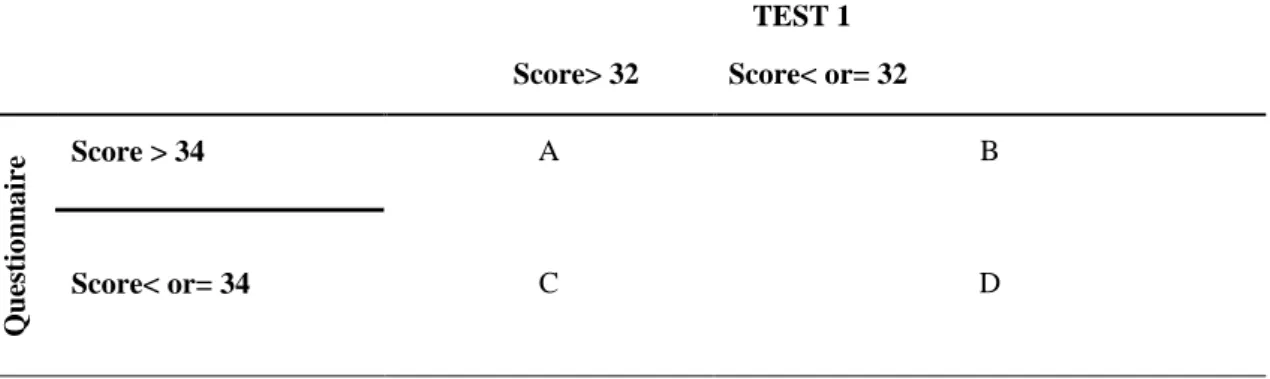
Findings distilled so far indicate that coherence and cohesion and composing process have a positive effect over writing performances and success of students learning French. Yet, the 3rd research question investigates whether the two variables should be utilized simultaneously or one of them is enough to be able to produce successful texts in French. In this sense, the sample was divided into 4 categories as follows:
Category A - Those who scored high both on the questionnaire and Test 1; Category B - Those who scored high on Test 1, but low on the questionnaire; Category C - Those who scored low on Test 1, but high on the questionnaire; Category D - Those who scored low both on Test 1 and the questionnaire.
The mean points that the participants scored on both Test 1 and the questionnaire were calculated in order to place students in each category. Since the average is 32 for the scores obtained from Test 1, all students who got 33 and above were classified as high scoring students. Again, all those who got 35 and above on the questionnaire formed the high scoring group because the average score for the questionnaire was 34 (Table 7).
Table 7. Classification of students according to mean scores of Test 1 and the questionnaire
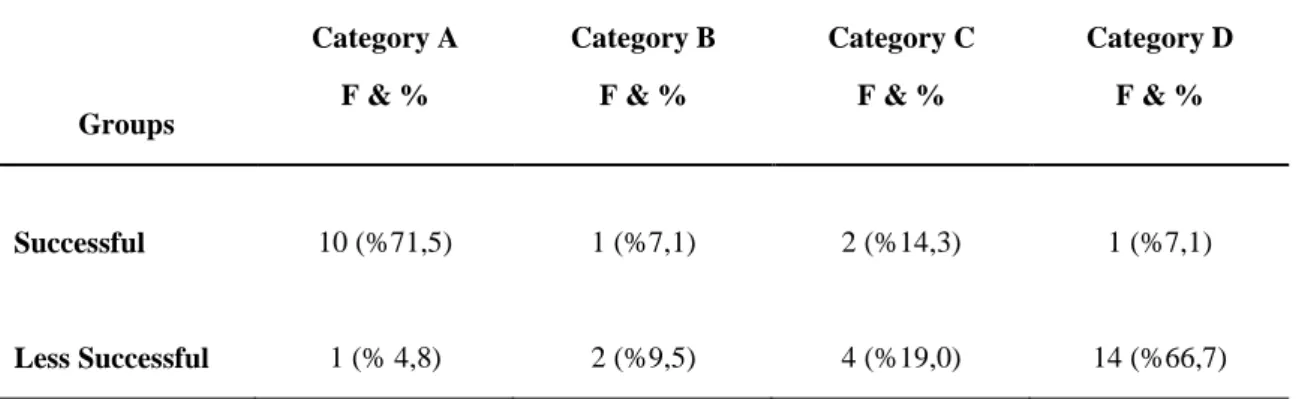
Table 8 shows the distribution of frequencies and percentages for the students who were grouped into two as successful or less successful ones depending on their argumentative essays.
TEST 1
Score> 32 Score< or= 32
Q
ues
tio
nn
a
ire
Score > 34 A B
Table 8. Distribution of successful and less successful students across categories
A closer look at Table 8 indicates that the majority of successful and less successful students was placed in Categories A and D (the lowest level of this classification) respectively. As it is shown in Table 8, 71.5% of successful students both have a good command of rules regarding coherence/cohesion and make use of composing process at a high level whereas 66.7% of less successful students know little about the rules of coherence/cohesion and employ composing process less frequently. However, the difference between successful and less successful students in Categories B and C is a small one: 1 successful and 2 less successful students are highly knowledgeable about the rules of coherence/cohesion (Category B). On the other hand, 4 less successful and 2 successful students were noted to utilize the composing process at a high level (Category C). Moreover, both A and D categories, which are the top and bottom level groups, host 1 successful (D) and 1 less successful (A) student. What Table 8 clearly points is that students who are successful at writing in French are those who know the rules of coherence/cohesion and who use the composing process. Therefore, it won‟t be wrong to conclude that two variables are necessary simultaneously in order to be successful at writing in French, and being good at one of them is not enough.
4.
Discussion/Conclusions
Following conclusions have been drawn based on the results of the present study aiming to determine how knowing the principles of coherence/cohesion and employing composing process influence writing skill in French, if any:
1- Students who know the rules of coherence/cohesion have better writing skills in French. Those who got poor grades for the argumentative essays they wrote (Test 2) also scored low on (Test 1) measuring knowledge about the rules of coherence/cohesion;
2- Students with better writing skills have been noted as those who could actually make use of the composing process (Planning– Translating– Reviewing). Participants who got high scores on Test 2 stated that they frequently employed the composing process whereas those who got low scores mentioned little or no use of the process.
3-It is not enough to only utilize the composing process or to only know about the principles of coherence/cohesion in order to produce a well-developed text in French: being a successful writer entails being good at both variables.
Groups
Category A
F & %
Category B
F & %
Category C
F & %
Category D
F & %
Successful 10 (%71,5) 1 (%7,1) 2 (%14,3) 1 (%7,1)
These findings are also consistent with those of other studies focusing on writing skill in a foreign language. They report that less successful students at writing in a foreign language have clouded perception about building clear, comprehensible, and well-developed texts, that they ignore the consistency of the ideas in their texts, and that they neglect constructing links between different parts and different opinions in their texts (Zamel, 1983; Silva, 1993; Victori, 1999; Kamimura, 2000; Chenoweth and Hayes, 2001). Préfontaine (1998, p.25) noted that less successful students at writing in a foreign language often ignored clarifying their texts, establishing links among their ideas, relating different points in their texts, and reflecting the flow of their texts.
Especially the findings of studies focusing separately on each stage of composing process point that successful students are those who can make use of these stages more efficiently:
- Zamel (1983, p.172) reported that 6 successful students at writing in English spared lots of time to pre-writing stage, listed their ideas, and combined them in a diagram before they started writing. Similarly, Victori‟s (1999, p.545) two successful English learning students stated that they planned their writing either on a paper or in their minds prior to putting their pens onto the paper. On the other hand, less successful students said that they didn‟t allocate much time to planning and they wrote with their inspiration (Victori, 1999, p.546). Likewise, Sasaki (2000:282) reported that “The experts spent a longer time before starting to write, planning a detailed overall organization, whereas the novices spent a shorter time making a less detailed plan.” Items 1B and 1C of the retrospective composing process questionnaire utilized in this research support these findings (a significant difference was recorded between successful and less successful students): successful participants stated that they thought about the content and the audience prior to writing.
- Working on while-writing stage, Raimes (1987, p.242) noted that less successful students at writing in a foreign language developed very poor contents because they were more concerned about grammaticality of their sentences and finding the right words, which left no time to think and generate ideas. Successful writers, on the contrary, focus on developing opinions regarding the ideas they want to convey without paying much attention to proper wording, they try not to lose their ideas due to linguistic difficulties (Zamel, 1983, p.175), rather they check if what they write matches with their ideas or not (ibid p.173). Furthermore, successful writers “did not stop and think while writing as frequently as the novices” (Sasaki, 2000, p.282) in while-writing stage. These findings are endorsed by 7A and 7C items of the composing process questionnaire in this research (significant difference): Successful students expressed that they paid attention to the content and organization of their ideas while writing their texts. Interestingly, the results of Kamimura (2000) conducted on a sample of Japanese students learning English showed that there was no difference between successful and less successful students with respect to while-writing stage although successful students employed the composing process more often. In this study, on the other hand, a statistically significant difference was noted between successful and less successful students in terms of while-writing stage.
responses for the items 8B and 9A in the composing process questionnaire support these findings as well (chi-square test results pointed a statistically meaningful difference).
It seems that successful students at writing in a foreign language are those who internalized the requirements of writing activity: They take writing as a way to convey meaning and messages, and they know that writing does not only mean sequencing words or sentences grammatically, but also it stipulates use of coherence and cohesion rules. Besides, they are also aware that a writer has to be involved in planning, reviewing, editing, and re-writing stages.
Briefly, this study has indicated that writers should have a good command of knowledge about the principles of coherence/cohesion and should effectively employ the composing process in order to produce a text contains a meaningful message, reflecting the ideas, and easily understandable for the readers. Therefore, it is inevitable to incorporate these two components into the instructional curriculum of writing course since they are both indispensable to be successful at writing in a foreign language and to develop writing skills of foreign language students. Foreign language teachers should definitely include them into their syllabi, courses should mainly be about these two components, writing courses should start with the instruction on these two topics, students should be tested to see how well they learned them and to make sure that they learn them. For instance, teachers can integrate planning and reviewing charts into their classes, can design studies on how to use them, and can make use of activities such as in Test 1. Teachers are advised to teach the process and rules explicitly via direct instruction in order to raise students who are good at expressing their feelings and opinions in a foreign language.
References
Baroudy, I. (2008). Process Writing: Successful and Unsuccessful Writers; Discovering Writing Behaviours. International Journal of English Studies, 8 (2): 43-63.
Beaudet, C. (2001). Clarté, lisibilité, intelligibilité des textes : Un état de la question et une proposition pédagogique. Recherches en Rédaction Professionnelle, 1(1) : 1-17. Retrieved on 31 March, 2017 from: http://www.vcharite.univ-mrs.fr/redactologie/IMG/pdf/Beaudet2.pdf
Brown, H. D. (2001). Teaching by Principles: An Interactive Approach to Language Pedagogy, 2nd ed. White Plains: Addison Wesley Longman.
Can, A. (2014). SPSS ile Bilimsel Araştırma Sürecinde Nicel Veri Analizi(2nd edition). Ankara: PegemAkademi.
Celce-Murcia, M. (Ed.). (2001). Teaching English as a second or foreign language (3rd edition.). Boston: Heinle&Heinle.
Charaudeau, P., &Maingeuneau, D. (2002). Dictionnaire d’analyse du discours. Paris: Seuil. Chenoweth, N. & Hayes, J. (2001). Fluency in writing. Generating text in L1 and L2. Written
Communication,18: 80–98.
Dezutter, O. (2015). Repenser la didactique de l‟écriture pour les apprenants universitaires de FLES. In Defays, J.M. et al. (Eds), Pratiques – 20 ans de FLES. Faits et gestes de la didactique du Français Langue Etrangère et Seconde de 1955 à 2015 (Vol.3). Bruxelles: Proximités EME. Fayol, M. (1994). Le récit et sa construction. Lausanne: Delachaux et Niestlé.
Hirose, K. & Sasaki, M. (1994). Explanatory variables for Japanese students' expository writing in English: An exploratory study. Journal of Second LanguageWriting, 3 (3), 203-229.
Kamimura, T. (2000). Integration of process and product orientations in EFL writing instruction. RECL Journal31, 2: 1-28. DOI: 10.1177/003368820003100201
Lefrançois, P. (2001). Le point sur les transferts dans l‟écriture en langue seconde. Canadian Modern LanguageReview 58, 2. DOI: 10.3138/cmlr.58.2.223
Préfontaine, C. (1998). Ecrire et enseigner à écrire. Québec : Les Editions Logiques.
Raimes, A. (1987). Language proficiency, writing ability, and composing strategies: a study of esl college student writers. Language Learning 37: 439-467. DOI:
10.1111/j.1467-1770.1987.tb00579.x
Roca de Larios, J., Manchon, R.M. et Murphy, L. (2002). A temporal analysis of formulation processes in L1 and L2 writing. Language Learning, 51: 497– 538.
Sasaki, M. (2000). Toward an Empirical Model of EFL Writing Processes: An Exploratory Study. Journal of Second Language Writing, 9 (3): 259-91.
Stevenson, M., Schoonen, R. & de Glopper, K. (2006). Revising in two languages: A multidimensional comparison of online writing revisions in L1 and FL. Journal of SecondLanguage Writing, 15: 201-233.
Silva, T. (1993). Towards an understanding of the distinct nature of L2 writing: the esl research and its implications. TESOL Quarterly 27, 4: 655-677. DOI : 10.1111/j.1467-1770.1987.tb00579.x Tognotti, S. (1997). Etude d’un dispositif de coopération rédacteur-lecteur pour l’apprentissage de la
rédaction technique.(Mémoire – Université de Genève).
Victori, M. (1999). An analysis of writing knowledge in EFL composing: a case study of two effective and two less effective writers. System27: 537-555. DOI: 10.1016/S0346-251X(99)00049-4
Zamel, V. (1983). The composing process of advanced ESL students: six case studies. TESOL Quarterly 17, 2: 165-187. DOI: 10.2307/3586647
Appendix A. Sample for multiple-choice questions about unity of meaning (Test 1,
Part 1)
Appendix B. Sample for multiple-choice questions about sequencing sentences to
produce a meaningful text (Test 1, Part 2)
Appendix C.Test on Cohesion (Test 1, Part 3)
Ajoutez les connecteurs suivants au texte donné ci-dessous : cependant/puis/pourtant/à cette époque/mais/du reste/et puis un jour/un jour/ des années plus tard/alors
La fée du robinet
[…] ____________, la Gaule devint chrétienne, et monsieur le curé interdit aux gens du pays de porter des offrandes et de venir danser autour de la source. Il prétendait qu‟ils y perdraient leurs âmes, et que la fée était un diable. Les villageois savaient bien que ce n‟était pas vrai ; ____________ ils n‟osaient rien dire, parce qu‟ils avaient peur du curé. _____________les plus vieux d‟entre eux continuaient de venir, en cachette, pour déposer leurs dons près de la source. Quand le curé s‟en aperçut, il se fâcha tout rouge. Il fit dresser en cet endroit une grande croix de pierre, __________ il organisa une procession et prononça au-dessus de l‟eau un tas de paroles magiques, en latin, pour chasser la fée. […]
Contes de la Rue Broca P.GRIPARI http://cepecdoc.superdoc.com/Uploads/sitereecrire/Textes_connecteurs/connecteurs_fee_robinet.doc
Appendix D.Retrospective Composing Process Questionnaire and Scores for positive
answers (English version).
Read the following statements. Answer “Yes” or “No”.
Pre-writing Point
STATEMENTS YES NO
1.A I thought about content before beginning to write
3 1.B I thought about organization before
beginning to write
3 1.C I thought about audience before
beginning to write
2.A I read the instructions in the task several times
1
2.B I wrote an outline 1
3.C I listed ideas 1
3.D I jotted down words 1
Post-Writing STATEMENTS Point
YES NO 8. After I wrote, I reread my
composition by paying attention to the following aspects of writing:
A. Content 3
B. Audience 3
C. Organization 3
D. Vocabulary 2
E. Grammar 2
F. Spelling/Punctuation 1
9. I revised my composition by paying attention to the following aspects of
writing:
A. Content 3
B. Audience 3
C. Organization 3
D. Vocabulary 2
E. Grammar 2
F. Spelling/Punctuation 1
While-Writing STATEMENTS Point
YES NO 3. I thought and wrote in English from
the beginning
1 4. I avoided writing whatever idea came
into my mind
1
5. I tried to write as much as possible 1
6. I seldom stopped in the middle 1
7. While I wrote my composition, I paid attention to the following aspects of
writing:
A. Content 3
B. Audience 3
C. Organization 3
D. Vocabulary 2
E. Grammar 2
Yazma Sürecinin ve Bağdaşıklık/Bağdaşıklık‟ın Fransızca Yazma Becerisi
Üzerine Etkisi: Türk öğrencileriyle bir uygulama
Öz
Çalışmamızın amacı yazma sürecinin ve bağdaşıklık-bağlaşıklık kurallarını bilmenin Fransızca yazma becerisi üzerindeki rolünü değerlendirmektir. Örneklemimiz Türkiye‟de bir üniversitenin Eğitim Fakültesinde 3 yıldır Fransızca eğitimi gören 35 Türk öğrenciden oluşmaktadır. Bu öğrencilere öncelikle, bağdaşıklık-bağlaşıklık kuralları konusunda bilgilerini ölçmek amacıyla, 3 bölümden oluşan bir sınav (Test 1) uygulanmış, yazma becerileri düzeylerini belirlemek amacıyla ise yaklaşık 40-45 satırlık tartışmacı anlatım biçiminde bir metin yazmaları (Test 2) istenmiştir. Metni yazdıktan hemen sonra ise, öğrencilerden yazma süreci kullanımlarına ilişkin 29 maddeden oluşan bir ölçeği cevaplandırmaları talep edilmiştir. Bu ölçeğin kullanım amacı öğrencilerin metni yazarken yazma sürecini kullanıp kullanmadıklarını belirlemektir. Elde edilen sonuçlara göre: 1-Bağdaşıklık-bağlaşıklık kurallarını bilen öğrenciler yazılı anlatım becerileri daha iyi olan öğrencilerdir. 2-Yazılı anlatım becerileri yüksek öğrencilerin aynı zamanda yazma sürecini uygulamayı bilen öğrenciler olduğu anlaşılmıştır. 3- Gelişmiş bir yazma becerisine sahip olmak için sadece yazma sürecini kullanmak veya sadece bağdaşıklık-bağlaşıklık kurallarına uymak yeterli değildir: başarılı olmak için her ikisi de gereklidir. Çalışmadan elde edilen sonuçlar doğrultusunda, yazma sürecinin ve de bağdaşıklık-bağlaşıklık kurallarının yazılı anlatım dersinin içeriğinde yer alması, bu dersin önemli bir kısmını oluşturması gerektiği söylenebilir. Öğretmenlerin söz konusu sürece ve kurallara açık bir şekilde değinmeleri ve öğrencilerden bu kuralları uygulamalarını istemeleri gerekmektedir.
Anahtar sözcükler: yazılı anlatım; Yazma süreci; Bağdaşıklık; Bağlaşıklık; yabancı dil olarak Fransızca
AUTHOR BIODATA