THE MATH TEACHING GAP: A STUDY OF THE RELATIONSHIP BETWEEN DIFFERENT LEVELS OF MATHEMATICS TEACHER EFFECTIVENESS AND STUDENT
ACHIEVEMENT
Jennifer Persson
A dissertation submitted to the faculty of the University of North Carolina at Chapel Hill in partial fulfillment of the requirements for the degree of Doctor of Philosophy in the School of
Education.
Chapel Hill 2014
ABSTRACT
Jennifer Persson: The Math Teaching Gap: A Study of the relationship between different levels of mathematics teacher effectiveness and student achievement
(Under the direction of Dr. Catherine Scott and Dr. Jocelyn Glazier)
Findings from previous studies suggest that the effectiveness of students’ teachers can have a significant impact on student achievement outcomes. However, scholars have not updated research on the short- and long-term effects of this experience, nor have they tied the information to highly effective and highly ineffective teachers’ beliefs on teaching and learning. Using mixed research methods, I sought answers to the following research questions:
Question 1 – Does mathematics teacher effectiveness affect student achievement when compounded over multiple years?
Question 2 – What are effective/ineffective mathematics teachers’ beliefs about teaching and learning?
teacher assignment group, as well as statistically significant differences in students’ SAT Math projections by teacher assignment group.
This dissertation is dedicated to my parents, Debbie and Benn Vennesland,
who convinced me I could do anything I put my mind to, my children, Shane Hudson Persson and Alana Debra Persson,
who inspire me to be a better person, and my husband, Kenny,
ACKNOWLEDGEMENTS
Since I entered preschool at the age of three, I have been in school as a student and/or as a teacher for my entire life thus far. This dissertation represents my most substantial academic accomplishment to date. This work would not have been possible without the support of many people along the way. First, I would like to thank the ten teachers who graciously participated in the qualitative portion of this study. Their honest expressions offered a rich tapestry of
information for the field of education. I would also like to thank my committee for their direction throughout this process. Specifically to my advisor, Catherine Scott, my chair, Jocelyn Glazier, and my chief statistician, John White, I thank you for being with me every step of the way. This work would not have been possible without your unwavering guidance and support. I would also like to thank many other people who assisted behind the scenes, including Sue DiMaggio, Sandy Horn, Beth Obenshain, Michael Thelen, and Paul Wright. Each of you carried a heavy lift at various times throughout this project, and for that I am truly grateful. And a special thank you goes out to Jennifer Preston for the tremendous amount or support you offered in this final year – when the task of finishing seemed completely insurmountable – I only hope I can return the favor when it is your turn. Furthermore, I would like to thank June Rivers and Bill Sanders for paving the way for this type of research. Their guidance kicked off this entire project.
without you. For those who are still working toward their own summits, I hope I can return the favor.
Finally, I would like to thank my family. Mom, Dad, Jason, Claudia, and Kenny, you encouraged me to keep going, night after night, year after year. You are my rocks. To my
TABLE OF CONTENTS
LIST OF FIGURES ... xv
CHAPTER 1 ... 1
INTRODUCTION ... 1
Background...4
Statement of the Problem ...6
Purpose of the Study ...7
Research Questions ...11
Conceptual Framework ...12
Definition of Terms ...14
Assumptions of the Study ...17
Summary...18
CHAPTER 2 ... 20
LITERATURE REVIEW ... 20
Factors Impacting Student Achievement...21
Math Teacher Attributes and Student Achievement: The Math Wars ...30
Defining and Evaluating Effective Teaching ...39
CHAPTER 3 ... 48
METHODS ... 48
PHASE I: Quantitative Methods ...50
Quantitative Research Questions ... 52
Study Design ... 52
Participants and Site ... 59
Data Collection ... 60
Instruments and their Reliability and Validity ... 60
Data Analysis ... 62
PHASE II: Qualitative Methods ...69
Qualitative Research Questions ... 72
Qualitative Methodology & Design ... 72
Research Participants and Purposeful Sampling ... 79
Data Analysis Procedures ... 82
Methods of Validation ... 87
Research Questions and Anticipated Results ...88
CHAPTER 4 ... 90
RESULTS FROM PHASE I: QUANTITATIVE ... 90
Descriptive Statistics ...90
Results for Question 1a ...91
Profile of the Entire Cohort of Students Used ... 92
Part (1): Overall Effects of Being Assigned to 3 High/Low Teachers ... 92
Part (2): Effects by Achievement Level... 95
Part (3): Differences in Effects by Achievement Level ... 101
Results for Question 1b ...104
Part (1): Effect on Algebra I ... 104
Part (2): Effect on SAT Math ... 108
Question 1b: Summary of Findings ... 111
Summary of Chapter 4: Phase I Results ...114
CHAPTER 5 ... 120
RESULTS FROM PHASE II: QUALITATIVE ... 120
Descriptive Information of the Participants ...121
Personal Characteristics (reported blind) ... 121
Instructional Time & School Characteristics (reported blind) ... 123
Range of Students Taught (reported blind) ... 126
Results for Question 2a: The Math Wars ...127
Results for Question 2b ...144
Question 2b: Summary of Findings ... 168
Summary of Chapter 5: Phase II Results ...174
CHAPTER 6 ... 177
THE CURIOUS CASE OF AN OUTLIER ... 177
The Contradiction: When Quantitative and Qualitative Results Collide ...177
The Intricacies of Measuring Teaching Effectiveness ...183
Summary...187
CHAPTER 7 ... 189
DISCUSSION & CONCLUSIONS ... 189
Summary of the Major Quantitative Results (Phase I) ... 191
Discussion of the Major Quantitative Results (Phase I) ... 194
Summary of the Major Qualitative Results (Phase II) ... 196
Discussion of the Major Qualitative Results (Phase II) ... 201
Implications for Value-Added Models and Teaching Effectiveness ... 204
Importance of the Study ... 205
Limitations of the Study ...206
Implications for Future Research ...209
Conclusions ...210
APPENDIX A: EVAAS PREDICTOR SETS ... 214
APPENDIX B: INTERVIEW PROTOCOL ... 215
Setting up the Interview ... 215
Conducting the Interview ... 215
Interview Guide ... 215
Following the Interview ... 218
APPENDIX C: RECRUITMENT LETTER ... 219
APPENDIX D: QUALITATIVE CODES USED TO ANALYZE THE INTERVIEWS ... 221
MATH WARS CODES (developed prior to analyses) ... 221
FINAL SET OF CODES USED (including those that emerged during the analyses) ... 224
Constructivist Codes ...224
Traditional Codes ...225
Other Codes ...226
LIST OF TABLES
Table 1: The Comparison between Two Different Sets of Teacher Beliefs
and Student Instruction and Evaluation Practices ... 32 Table 2: The Comparison between Two Different Sets of Teacher Beliefs
and Math Learning Environments ... 34 Table 3: The Comparison between Two Different Sets of Teacher Beliefs
and Teachers’ Instructional Plans ... 36 Table 4: Common Characteristics of Teachers who hold an Entity Theory
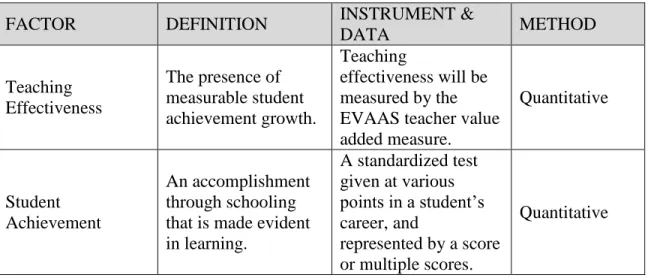
of Student Ability ... 38 Table 5: Rationale for Using Mixed Methods based on Factors,
Definitions, Instruments, and Data ... 49 Table 6: Overview of Phase I: Quantitative Methods ... 51 Table 7: School Years A and B used to Calculate Each Teacher’s
Two-Year Combination, Excluding the Grade Each Teacher had this Cohort of
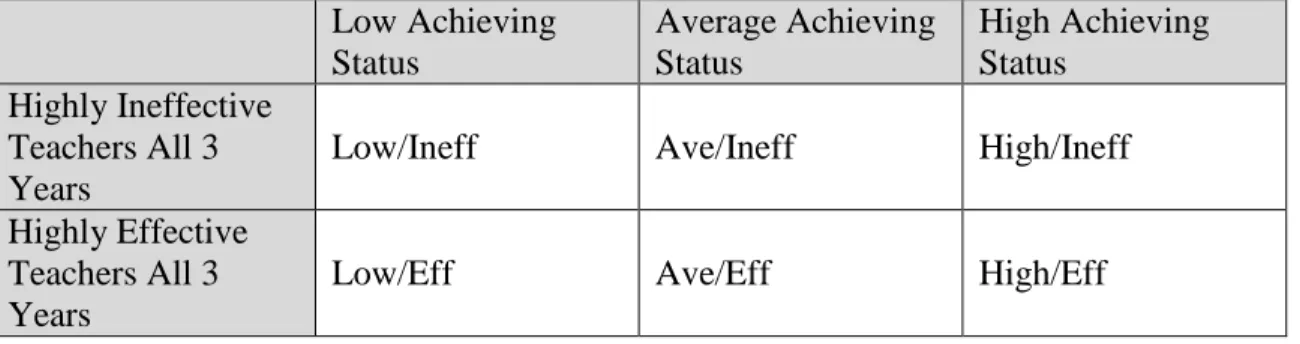
Students (X) ... 53 Table 8: Distinguishing Three Levels of Student Achievement Status
(Low, Average, High) as Paired with Three Years of Highly Ineffective or
Highly Effective Teachers ... 59 Table 9: Quantitative Questions and Their Tests for Significances ... 68 Table 10: Overview of Phase II: Qualitative Methods ... 70 Table 11: The Entire Cohort’s Entering and Exiting Academic
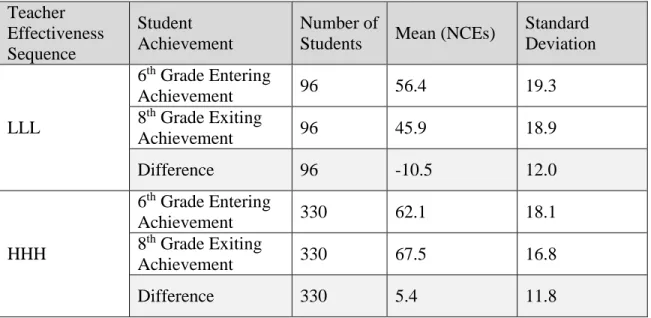
Achievement ... 92 Table 12: Students’ Entering and Exiting Academic Achievement based
on Teacher Effectiveness Sequences ... 93 Table 13: Statistical Significance of Students’ Entering and Exiting
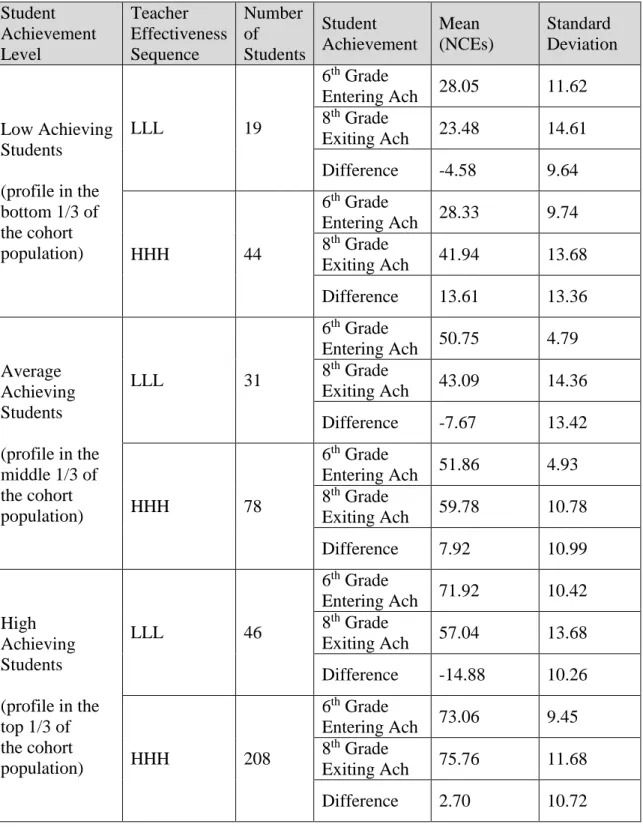
Academic Achievement based on Teacher Effectiveness Sequences... 94 Table 14: Students’ Entering and Exiting Academic Achievement based
Table 15: Statistical Significance of Students’ Entering and Exiting Academic Achievement based on Teacher Effectiveness Sequences, by
Student Achievement Level: ... 99
Table 16: Students’ Algebra I Impact based on Teacher Effectiveness Sequences ... 105
Table 17: Students’ Algebra I Impact based on Teacher Effectiveness Sequences, by Student Achievement Level ... 106
Table 18: Students’ SAT Math Impact based on Teacher Effectiveness Sequences ... 108
Table 19: Students’ SAT Math Impact based on Teacher Effectiveness Sequences, by Student Achievement Level ... 109
Table 20: Quantitative Questions and the Results of Their Tests for Significances ... 118
Table 21: Phase II – Basic Description Information of the Ten Interviewed Teachers ... 122
Table 22: School Demographics ... 125
Table 23: Phase II – Range of Students Taught by the Ten Interviewed Teachers ... 126
Table 24: Phase II – Basic Description Information of the 5 Highly Effective Teachers ... 130
Table 25: School Demographics for the 5 Highly Effective Teachers ... 135
Table 26: Phase II – Basic Description Information of the 5 Highly Ineffective Teachers ... 136
Table 27: School Demographics for the 5 Highly Ineffective Teachers ... 141
Table 28: Teacher Effectiveness & Race ... 145
Table 29: Teacher Effectiveness & Gender ... 146
Table 30: Teacher Effectiveness & Years of Experience ... 147
Table 31: Teacher Effectiveness & Entry into the Profession ... 148
Table 33: Teacher Effectiveness & School Size / Title I ... 151 Table 34: Teacher Effectiveness & Instructional Time ... 153 Table 35: Student Gains by Student Achievement Levels and Teacher
LIST OF FIGURES
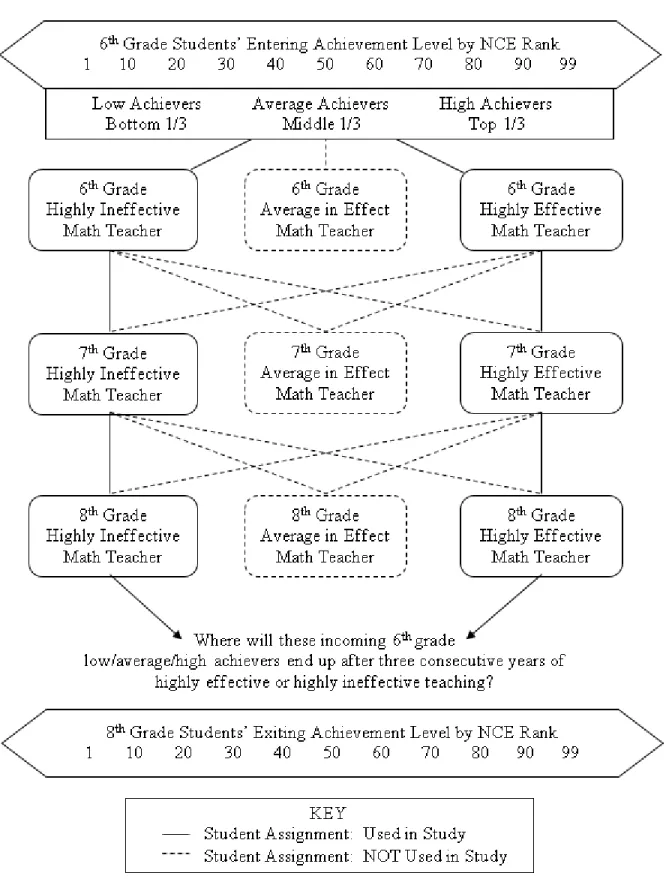
Figure 1: Various Paths of Student Assignment to Teacher Effectiveness
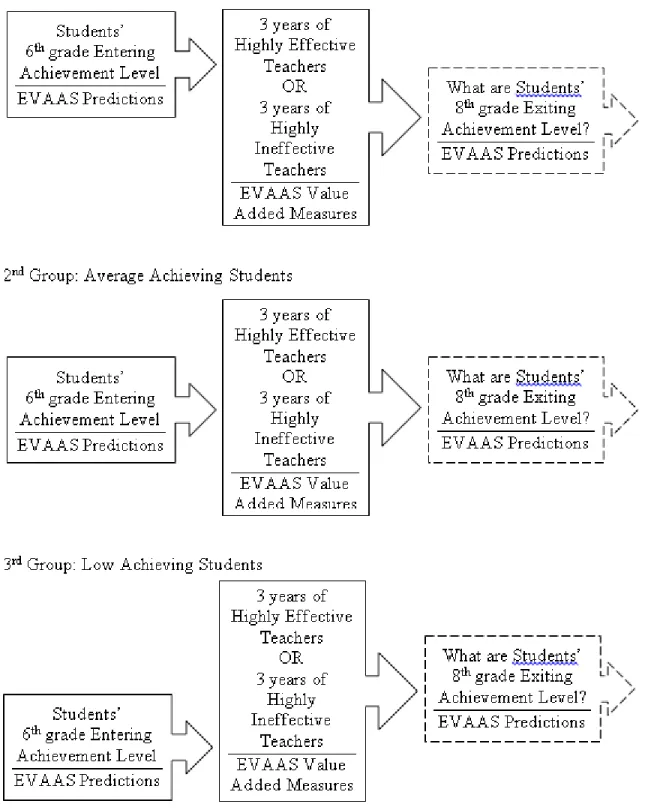
Levels by Grade ... 57 Figure 2: Three Groups were analyzed to Determine the Impact of Teacher
Assignment on Exiting Student Achievement Level based on Varying
Levels of Entering Student Achievement ... 66 Figure 3: Student Achievement and Teacher Effectiveness Sequences ... 94 Figure 4: Student Achievement and Teacher Effectiveness Sequences by
Achievement Level ... 98 Figure 5: Teachers' Interview Answers that Related to the Math Wars ... 129 Figure 6: Teachers' Interview Answers that Related to the Math Wars,
with EVAAS value added measures ... 143 Figure 7: The Highly Effective Teacher’s Responsibilities ... 161 Figure 8: The Highly Ineffective Teacher’s Responsibilities ... 164 Figure 9: Teacher Effectiveness versus Percent Constructivist, with Jeff
CHAPTER 1 INTRODUCTION
Major examinations of K-12 curriculum and instruction were undertaken during the last two decades. Beginning decades ago with the publication of A Nation at Risk (NCEE, 1983), the public has become more concerned about the quality of education in America’s schools and our competitiveness in the global economy. Since that time, several publications such as the Report of the Academic Competitiveness Council (U.S. Department of Education, 2007) and Before It’s Too Late (Glenn, 2000) have further focused attention on the United States’ education program, especially on the achievement gaps that exist between white students and students from minority groups.
The election of President George W. Bush brought a renewed focus on education to the political landscape and galvanized political support for sweeping changes to federal education policy. The No Child Left Behind Act (NCLB) of 2001 (U.S. Department of Education) is federal legislation that enacted the theories of standards-based education reform, which is based on the belief that setting high standards and establishing measurable goals can improve
individual outcomes in education. The Act required states to develop assessments for specific content areas to be given to all students in certain grades, if those states are to receive federal funding for schools (U.S. Department of Education, 2001). The NCLB legislation was followed up by the Race to the Top (RttT) initiative designed to assist states in improving student
As in many other states, the North Carolina State Board of Education saw a need to increase the rigor of the academic content standards taught to students; this increased rigor would better prepare students for success in post-secondary education and the. More rigorous content standards result in a higher bar for the state’s for the state’s graduation requirements. Failure to meet these graduation requirements in a timely manner can have severe consequences for the students including course repetition and grade retention, potentially leading to long term consequences such as high school dropout and other adverse outcomes.
The State Board of Education in North Carolina revised its policies to create a system in which Algebra I serves as a “gateway course” to higher level mathematics courses now required for high school graduation (State Board of Education, 2009). The term “gateway course”
captures the fact that Algebra I is the first math course in a series of math graduation requirements; students cannot advance to the next course until they have demonstrated
proficiency in Algebra I as measured by the state’s standardized Algebra I End of Course (EOC) exam. Prior to 2009, the policy stated that students could receive a high school diploma by passing Algebra I and any two other math courses which could be taken non-sequentially. After 2009, a new policy (State Board of Education, 2009) went into effect requiring students to pass Algebra I, Geometry, Algebra II, and a 4th math course in order to graduate, which epitomizes the reality of high stakes consequences. In previous years, students could take courses in whichever sequences they wanted. Under the new policy, these courses had to be taken in the specific order listed above.
school graduation. One of the consequences of the new mandate is that students who do not successfully complete Algebra I in middle school and fail it in the 9th grade will need to take summer classes in order to catch up or accept a longer tenure in high school. For some students this reality results in a failure to graduate. Now more than ever before, successful and timely completion of Algebra I is essential for all students.
North Carolina’s 2009 graduation requirements assume students’ academic achievement outcomes in Algebra I are due to their own academic abilities regardless of their teachers, but research clearly indicates that teachers have a tremendous effect on student achievement (Darling-Hammond, 1999; Haycock, 1998; Jordon, Mendro & Weerasinghe, 1997; Sanders & Rivers, 1996; Wright, Horn & Sanders, 1997) and therefore teacher effectiveness must be accounted for when addressing student achievement. If teaching effectiveness has a measurable effect on student achievement, then equitable access to effective teachers should be of immediate concern to all involved, as current research indicates that access is currently not equitable (Peske & Haycock, 2006; Clotfelter, Ladd, & Vigdor, 2005; Darling-Hammond, 2004). To determine the degree to which this relationship is true, a larger study that goes above and beyond current research is needed (Carter, 2008). Understanding with clarity just how much teachers matter for the success of their students is only part of the picture. How effective and ineffective teachers differ from one another can inform many other facets of the educational arena as well, including policy makers, K-12 teacher professional development and support programs, and teacher preparation programs. Teachers can differ on many fronts, including beliefs about teaching and learning, instructional styles, skills, and so on. I set out to conduct this study in part to
In order to address both components of this issue – (1) the degree to which access to effective teachers can influence a student’s academic achievement and (2) how effective and ineffective teachers differ in their approaches to instruction – I conducted this study in two phases using a mixed model methodology (Creswell & Plano Clark, 2007). Phase I measured teacher effectiveness through the use of Education Value Added Assessment System (EVAAS) and I used those results to identify teachers who profile at varying levels of effectiveness. During Phase II, I interviewed those teachers in order to look for differences in their instructional
strategies and beliefs.
Background
Sanders & Rivers, 1996; Wright, Horn & Sanders, 1997). Combining these bodies of research on the importance of math education and teacher effectiveness brings us to the realization that not only do students need more time engaging in math instruction, but they also need highly effective teachers to succeed in these advanced math courses. To further complicate this issue, we have policy that holds students themselves solely accountable for their academic
achievement, or lack thereof, which is in conflict with research that indicates that teachers have a significant influence on the academic achievement of students. Research shows that whether or not a student is assigned to an effective teacher can account for some of that student’s
achievement (Sanders & Horn, 1994; Thum, 2003; Webster & Mendro, 1997). Furthermore, if a student is assigned to successively effective or ineffective teachers over a series of years, the effects on that student’s achievement could compound significantly. The implications of this relationship would have a tremendous impact on equitable learning opportunities for students, and need to be addressed if a state such as North Carolina truly wishes to raise student
achievement outcomes.
The concept of teacher effectiveness has been brewing underneath the surface of educational reform initiatives for more than a century (see Carter, 2008). In 1885, it was noted that, while most teachers were of similar academic aptitude, some were able to pass along this knowledge to their students better than others, calling into question the differences in teaching methods (Page, 1885). In the 1920s, research on teacher effectiveness began to focus on
experimental studies were set up to expose students to different teaching styles and compare student outcomes in an attempt to investigate the effectiveness of different teaching styles such as formal/informal and progressive/traditional (Mitzel, 1960). From the 1960s on, much of the research on teaching effectiveness has focused on the relationship of teacher knowledge and beliefs with student progress (Campbell, Kyriakides, Muijs, & Robinson, 2003). As early as 1963, Medley and Mitzel assert that the teacher is an important factor in determining student learning.
In 1983, a federal report titled A Nation at Risk caused a heightened state of concern across the country due to its portrayal of the American education system as one falling behind other countries (NBPTS, 2002). Public response to the report provoked a wave of reform
initiatives that saturated the world of education, such as Goals 2000, among others (Heise, 1994). Unfortunately, most of the programs sidestepped a critical component of the education equation that so many researchers had highlighted in the preceding decades: the classroom teacher. Recently there has been a renewed focus on the power of effective teaching. This emphasis has been prompted by federal pressure to drastically improve instructional programs that ensure all students are being served. Federal, state, and district officials, as well as school administrators, are calling upon teachers to meet and exceed professional standards and to ground their work in research-proven methods of instruction (Posamentier & Jaye, 2006). No Child Left Behind (NCLB) and Race to the Top (RttT) represent the next big reform movement and its quest to provide effective teachers for every student.
Statement of the Problem
improved life choices beyond high school (State Board of Education, 2009). While schools do bear some accountability for low test scores, a single-track graduation policy positions the majority of the accountability on the shoulders of the students who are ultimately responsible for their own test results in order to obtain a high school diploma. Not clearly stated in the policy is the recognition that a student’s assigned sequence of effective or ineffective teachers in the years preceding the exam might have an impact on student performance. These effects may affect student pass/fail rates on the state exams as well. Furthermore, by minimizing the potentially powerful influences of effective teaching on student achievement, the quality of instruction afforded to each student every year is minimized as well. Equitable access to effective teachers needs to be a vital component of this statewide initiative to increase student achievement. Unfortunately we lack sufficient knowledge of the characteristics of highly effective teachers, including their beliefs and practices, first, to identify effective teachers accurately and second, to ensure that all students have equitable access to these educators.
In summary, North Carolina’s policy decision to increase high school graduation requirements in order to raise student prospects for higher education and employment requires effective teachers for all students. If it can be shown that (1) teacher effectiveness significantly influences student achievement, then (2) ensuring equitable access to effective teachers and working to improve the effectiveness of teachers should become a human rights issue in regard to this statewide policy.
Purpose of the Study
SAS value-added model used in North Carolina to determine the degree to which student mathematics achievement is affected by teacher assignment; and (2) assigned teachers to high/low effectiveness groups for further study.
Although there is a growing consensus among educators that teachers impact student learning, the definitions of teaching effectiveness are vast and varied. Some definitions are coalescing on the use of student standardized test score gains attributed to a particular teacher to determine teacher effectiveness (Sanders & Horn, 1994; Thum, 2003; Webster & Mendro, 1997), otherwise known as a value-added model (VAM). While the term has been used in other fields of study (see Cowan, 2003 for the use of value-added concepts in agriculture), in education the term value-added refers to the use of longitudinal test data to measure adjusted comparisons of student data and its changes over time (Doran & Izumi, 2004). The models are designed to track value added within a specific time frame in order to (a) examine how much progress is made toward a goal and/or (b) to use as a tool to evaluate the effectiveness of programs and personnel (Doran & Izumi, 2004). Carter (2008) describes it this way: students enter the classroom at varying
achievement levels; a value-added approach enables one to compare the entering achievement level to that which has been obtained at a later point in time. These adjusted comparisons represent how much value has been added to a student’s learning. In other words, instead of simply measuring student achievement by examining a student’s score at a single point in time, researchers are able to look at how that score relates to that individual’s previous scores (Sanders & Horn, 1994).
learning that can be attributed to a teacher in a given year (McCaffrey, Lockwood, Koretz, & Hamilton, 2003; Thum & Bryk, 1997; Sanders & Horn, 1998; Webster & Mendro, 1997). North Carolina utilizes a value-added model within the Education Value Added Assessment System (EVAAS) to track student growth in the public school system. EVAAS was developed in the 1980s by Dr. William Sanders and uses mixed-model methodology to address many of the traditional statistical problems that have been cited as impediments to the use of student
achievement data when trying to assess programs, including incomplete student testing histories (Sanders, Saxton, & Horn, 1997). The EVAAS methodology is also used in Ohio, Pennsylvania, and Tennessee, among others. An important distinction between EVAAS and other VAMs is that EVAAS does not adjust for student background variables directly: the model measures each individual student’s prior learning and then determines growth from previous learning (Sanders & Horn, 1994). Other models adjust student growth based on an average of the learning of other students with similar economic and ethnic backgrounds, whereas EVAAS does not; each
individual student serves as his/her own control. The EVAAS model is viewed as a robust, fair, reliable, and valid statistical value-added method (Stronge and Tucker, 2000). Furthermore, four U.S. Department of Education peer review committees have approved the reliability of the EVAAS student prediction methodology (SAS Institute Inc., n.d.).
The use of VAMs like EVAAS have led to quite a few research studies that examine questions including: how much of the increase in student test scores can be attributed to
with three consecutive years of ineffective teachers. The students with three consecutive years of effective teachers appeared academically gifted, accounting for more than a 50 percentile point spread between students in each group despite starting with similar achievement levels (Sanders & Rivers, 1996). In this study, I replicated this research on a significantly larger scale. Not only did I set out to examine a larger set of teachers and students, but I also went beyond the VAM data to examine whether or not results correlated with qualitative data gathered from
conversations with teachers about their practice. In this research, I strove to study the impact of multiple years of effective/ineffective teaching on student achievement, and then study the differences between effective and ineffective teachers’ beliefs on teaching and learning.
Significance of the study. By incorporating a large-scale quantitative study that helped identify the connection between mathematics teaching effectiveness and student achievement, coupled with a more intimate qualitative component that helped to ascertain some of what is going on behind the scenes in the classrooms of these teachers, this study sheds light specifically on the nuances of what effective teachers do. As colleges of education work to better prepare their teachers-in-training and current practitioners seek to improve their own effectiveness in the classrooms, research on the power of effective teaching coupled with specific practices and beliefs that are linked to improved student achievement can inform university coursework as well as current instructional practices. Schools and districts can also utilize information on effective instructional practices for mathematics to guide the selection of meaningful professional development programs, thereby further strengthening the effectiveness of the current mathematics teaching workforce. Local, state, and national education policy decisions can utilize these connections to identify the role of educator responsibility in student
Furthermore, decision makers will be more aware of the realities of effective teacher distribution issues and student assignment concerns, which are closely connected to matters of equity in educational opportunity and instruction.
If teachers do in fact demonstrate a significant influence over the educational outcomes of their students here in North Carolina, then it would also be beneficial to look at how the highly effective teachers differ from their counterparts. Understanding the real and profound
educational impact of effective/ineffective teachers and getting a glimpse of their practical differences in the classroom can influence current North Carolina policies regarding graduation requirements. But more importantly it will adjust the role that other parties play in this quest for increased student achievement, for the responsibilities of the student will need to be combined with those of the teacher/school/district/state in helping students obtain the academic
achievement required for graduation, including effective instructional practices and equitable teacher assignment policies.
In all arenas of education, decisions are made daily in an effort to improve our
educational system for all students. Better decisions can be made if decision makers are given a more reliable measure of effective teaching and student achievement. This study explored the issues of teaching effectiveness on student achievement and identified differences in
effective/ineffective teacher beliefs in an effort to inform the educational community with meaningful results that can immediately affect the work of classrooms, schools, districts, states, and universities.
Research Questions
The following research questions guided this mixed-methods study:
1a. Short-term effects: When students are assigned to effective/ineffective middle school mathematics teachers for three years in a row, what is the measurable effect on student achievement? What is the measurable effect on student achievement for students at varying levels of entering achievement? Is the measurable effect different depending on the entering achievement level of students?
1b. Long-term effects: Is there an effect on the students’ projected Algebra I Normal Curve Equivalent (NCE) score? On their projected SAT Math scale score?
Question 2 – What are effective/ineffective mathematics teachers’ beliefs about teaching and learning?
2a. Compared to research: How do instructional practices and beliefs of
effective/ineffective mathematics teachers relate to what research indicates are qualities of effective teachers?
2b. Compared to each other: How do instructional practices and beliefs differ among effective/ineffective mathematics teachers?
Conceptual Framework
What are the connections between teacher practices and beliefs, teaching effectiveness, and student achievement? In this study, I examined this relationship through a quantitative analysis of teaching effectiveness and student achievement results coupled with a qualitative look at teacher instructional practices and beliefs at various levels of teaching effectiveness, as measured by EVAAS. I used student outcomes on standardized tests to identify highly effective and highly ineffective teachers. I interviewed randomly selected teachers from each of the two groups to identify instructional practices and beliefs, without my knowledge of their effect on student learning.
achievement: 5th graders scored at the 83rd percentile in math after three consecutive years of very effective teachers, while students with similar starting achievement levels who had ineffective teachers for three years in a row scored in the 29th percentile, a difference of more than 50 percentiles (Sanders & Rivers, 1996). These initial findings indicate that substantial differences in student math achievement are attributable to differences in teacher effectiveness, implying that teachers are crucial to students’ opportunities to learn and to their learning of math in particular.
While some claim that highly effective teachers using proven teaching methods produce high-progressing and high-achieving students (Izumi & Evers, 2002), others argue that teachers cannot be held accountable for student learning since there are so many factors outside of the teachers’ control that affect each student. Other advocates strongly disagree, claiming that outside factors have little impact; even with the plethora of constraints that exist on each classroom teacher, the teacher does the final decision-making about instructional activities (Fennema, Sowder, & Carpenter, 1999). These researchers would argue further that the influence of the teacher does not stop at the classroom, as teachers have a powerful, long-lasting influence on their students, affecting how students learn, what they learn, how much they learn, and ways they interact with each other and the world (Stronge, 2002). Considering the potential degree of the teacher’s influence, it is important to understand what teachers can do to promote positive student achievement.
still much work to be done as we seek to connect teacher practices and beliefs with teacher effectiveness. This study aims to help fill that gap.
In this study, the first task was to use quantitative data generated by EVAAS to identify the existence of the relationship between effective teaching and student achievement in North Carolina. The strength of this relationship laid the foundation for the second task. Once highly effective and highly ineffective teachers were identified, I looked at the differences in
instructional practices and beliefs among teachers who profile at various levels of effectiveness. I needed to determine the strength of the relationship between effective teaching and student achievement before that layer could then be peeled away to reveal the next level:
effective/ineffective teachers’ instructional practices and beliefs. In other words, I first verified quantitatively that there is in fact a difference in student achievement progress among teachers at varying levels of effectiveness and then I went one step further in a quest to qualitatively explore those differences. It is important to note there are other factors involved in student achievement, but this study was limited to those directly related to the teacher and the instructional practices and beliefs tied to his or her effectiveness.
Definition of Terms
District Effect: a measure of the influence of a school district on indicators of student learning (Sanders and Horn, 1995).
gains (Brophy, 1986), rather than simply reaching a proficient achievement level. With a focus on closing the achievement gap, it is vital to consider how effective teachers are in helping their students’ progress. Therefore in this study, effective teaching is defined by the presence of measurable student achievement growth. Teaching effectiveness was measured by the EVAAS teacher value added measure, presented as a change in scale scores and is standardized using its standard error. Teachers with a teacher effect score significantly above 0 are determined to be more effective than those with a teacher effect score significantly below 0.
EOC: “The North Carolina End-of-Course [EOC] Tests are used to sample a student’s knowledge of subject-related concepts as specified in the North Carolina Standard Course of Study [SCOS] and to provide a global estimate of the student’s mastery of the material in a particular content area” (NCDPI, 2011, para. 1). These results are used as part of the EVAAS data analyses.
EOG: “The North Carolina End-of-Grade [EOG] Tests are designed to measure student performance on the goals, objectives, and grade-level competencies specified in the North Carolina Standard Course of Study [SCOS]” (NCDPI, 2011, para. 1). These results are used as part of the EVAAS data analyses.
Mixed Methodology: a study conducted with the use of two different methodologies (Creswell & Plano Clark, 2007). In this study an explanatory sequential design was used, such that
quantitative data collection and analysis was followed up by qualitative data collection and analysis, and then the results from both analyses were interpreted (Creswell, 2008).
School Effect: a measure of the influence of a school on indicators of student learning (Sanders and Horn, 1995).
SCOS: “North Carolina established a Standard Course of Study [SCOS] in 1898 as an attempt at determining competencies for each grade level and each high school course, with a rigorous set of academic standards that is uniform across the state… The Standard Course of Study [SCOS] includes the curriculum that should be made available to every child in North Carolina's public schools” (NCDPI, 2011, para. 2).
Student Achievement: In many educational settings, academic achievement is defined by a standardized test given at various points in a student’s career, and delineated by a score. This score represents the accomplishments of the student on that test, at a particular point in time. (Carter, 2008)
Teacher Effect: a measure of the influence of a teacher on indicators of student learning (Sanders and Horn, 1995, p. 3).
Teacher Instructional Practices and Beliefs: that which a teacher does (practices) in the classroom with his/her students and the propositions (beliefs) that are used to create or justify those practices.
Assumptions of the Study
Teacher Influence. The underlying assumption of this study is that teachers can influence student achievement growth. Research confirms that teaching quality is an essential factor in student achievement (Harris & Sass, 2011; Hill, Rowan, & Ball, 2005; Rockoff, 2004; Kaplan & Owings, 2002; Darling-Hammond, 1999). For better or worse, what teachers do affects student achievement. In fact, the teacher is the most influential school-related force in student
achievement (Stronge, 2002). Effective teaching affects all achievement levels at all schooling levels (Kaplan & Owings, 2002). As Minner (2001) said, “Teacher quality is not just an
important issue in addressing the many challenges facing the nation’s schools: It is the issue” (p. 33).
Strength of EOCs/EOGs. The EOCs and EOGs provide a reliable and valid measure of student performance on the goals, objectives, and grade-level competencies specified in the North Carolina Standard Course of Study (SCOS) (Sanford, 1996a), provided they are
administered in a standardized setting with appropriate modifications. The North Carolina SCOS sets content standards for what students should know and be able to do (NCDPI, 2011).
Summary
Like other states, the state of North Carolina has established high standards of excellence for its graduates. However, the public education system that is assumed to support students of all ability levels in reaching these standards may be underestimating teacher effectiveness. Little is known about the academic consequences for those students who spend multiple years with a series of very effective or very ineffective teachers. The primary focus of this study was to discern the relationship between student achievement scores and teacher effectiveness when that effectiveness (or lack thereof) is compounded over multiple years. The secondary focus of this study was to begin to explore possible relationships between teacher practices and beliefs and teaching effectiveness. Chapter 2 contains a review of the relevant literature concerning teacher practices and beliefs, effective teaching, and student achievement. Chapter 3 describes the methodology of both the quantitative and qualitative components of the study, as well as the rationale for choosing both. Chapter 4 reveals the results of the study from Phase I, including the quantitative relationship between student achievement scores and teacher effectiveness. Chapter 5 reveals the results of the study from Phase II, including the possible qualitative relationships between teacher practices and beliefs and teaching effectiveness. Chapter 6 explores the
CHAPTER 2 LITERATURE REVIEW
Several research studies have documented the importance of developing mathematics competencies for K-12 students. According to Ball (2003), solid mathematics education creates options for people’s futures as their opportunities and choices are formed by whether they know and are able to use math. Yet for many students, an educational system plagued by large,
persistent disparities in math achievement related to race and socioeconomic status crushes their opportunities (National Mathematics Advisory Panel (NMAP), 2008). There are those who are promoted to excel in math and go on to bright futures, and there are those who perpetually struggle in math, often through little fault of their own, and potentially succumb to a life of fewer opportunities (Ball, 2003). We can no longer deny that math serves as a gateway, and yet only some get to partake in the prospects it affords.
In this study, I set out to determine the impact of teaching effectiveness on student achievement, and then to understand the differing beliefs between effective and ineffective teachers. Therefore, three fields of knowledge informed this study: (1) factors impacting student achievement, (2) mathematics teacher attributes identified within the math wars, and (3) defining and evaluating effective teaching. In this chapter, I gather and review the abundant literature from these three fields.
Question 1 – Does mathematics teacher effectiveness affect student achievement when compounded over multiple years?
1a. Short-term effects: When students are assigned to effective/ineffective middle school mathematics teachers for three years in a row, what is the measurable effect on student achievement? What is the measurable effect on student achievement for students at varying levels of entering achievement? Is the measurable effect different depending on the entering achievement level of students?
1b. Long-term effects: Is there an effect on the students’ projected Algebra I NCE score? On their projected SAT Math scale score?
Question 2 – What are effective/ineffective mathematics teachers’ beliefs about teaching and learning?
2a. Compared to research: How do instructional practices and beliefs of
effective/ineffective mathematics teachers relate to what research indicates are qualities of effective teachers?
2b. Compared to each other: How do instructional practices and beliefs differ among effective/ineffective mathematics teachers?
Since all questions address effective teaching and student achievement, it is important to
understand what research currently conveys about these two primary concepts. There is a lot of literature on both topics, which is reviewed here in this chapter, but there is little research on the specific characteristics of effective and ineffective math teachers. This study aims to help fill that gap.
As discussed above, the goal of many education policies in North Carolina is to improve education for all students by raising standards. With this goal in mind, I also looked at how the intersection of these two factors (effective teaching and student achievement) affects the mathematics achievement gap.
Factors Impacting Student Achievement
of its constituents. The effects of this inequality are vast and varied. It is important to understand the forces at play, as well as all the intricate connections between what the issue is and how it is perpetuated.
Lack of Opportunity. It is not possible to talk about factors affecting student achievement without discussing the gap in learning opportunities, for the most consistently replicated findings link student achievement to the opportunity to learn the material (Brophy, 1986), thus identifying an opportunity gap. Opportunity to learn is built on many components, including curriculum coverage, test item coverage, and curriculum / test alignment (Brophy, 1986; Williams, 2003; Kaplan & Owings, 2002), as well as access to resources, quality teachers, and appropriate class sizes (DeShano da Silva, Huguley, Kakli, & Rao, 2007). Educational institutions are expected to correct these opportunity gaps rather than exacerbate them, but unfortunately that is often not the case (Diamond, 2006).
The U.S. education system is saturated with inequality (Darling-Hammond, 1997). Starting with traditions of local control that produce unequal finances, continuing with a history of legal methods for segregation, and maintained by tracking systems for students with different backgrounds that provide qualitatively different learning experiences, the system is built on a foundation of all of these components the assures unequal educational opportunity. This
students graduating from college (Kamras, 2010). For those who qualify for free or reduced-price lunch, only about half will graduate from high school, whereas in some wealthy communities, graduation rates are between 98 and 99 percent (Farr, 2010). Despite some evidence of improvement by African American, Hispanic and students of poverty from 1970 to 1988, the education reform efforts of the last two decades have still not enabled significantly more students to become educationally competitive or to close the achievement gap (Williams, 2003).
Consider one powerful example. One Los Angeles school starts with 1000 students in the freshman class, but finishes with 240 left in the senior class, with only about 30 students who have the prerequisites for college (Farr, 2010). There have been a few recent glimmers of hope: for 4th graders nationwide, the average mathematics score in 2011 was 1 point higher than in 2009, and 28 points higher than in 1990, but there were no significant changes in the
White/Black or White/Hispanic score gaps from 2009 to 2011 nationwide (National Center for Education Statistics (NCES), 2011). Admittedly, some states are starting to see some progress (NCES, 2011):
4th grade:
White/Black score gaps narrowed from 1992 to 2011 in 16 of 35 participating states with samples large enough to report results for Black students.
White/Hispanic score gaps narrowed from 1992 to 2011 in 4 of 21 participating states with samples large enough to report results for Hispanic students.
8th grade:
Score gaps between higher- and lower-income students narrowed from 2003 to 2011 in four states.
When looking at math specifically, the achievement gap permeates all levels of school. Most children acquire basic number and math knowledge before they start kindergarten, which is important because this entering math knowledge is related to math learning through elementary, middle, and high school (NMAP, 2008). Unfortunately, most economically disadvantaged children enter school with far less knowledge than their economically advantaged peers, and the math achievement gap progressively widens through the next twelve years. Mathematics has been traditionally used as a reason to further separate students (Malloy & Malloy, 1998). Math courses have always been gatekeeper courses, and many math teachers have excluded students from those courses when they thought the students did not exhibit a sufficient math
understanding. The results of this trend for students of minority or socioeconomically
disadvantaged backgrounds have been devastating – about 1 in 30 Latinos and 1 in 100 African Americans can do multistep problem solving and elementary algebra, compared to about 1 in 10 white students; only 4 in 10 Latino and 3 in 10 African American 17-year-olds have mastered fractions, percentages, and averages, compared to 7 in 10 white students (Haycock, 2001). By the end of high school, African American and Latino students have reading and math skills that are the same as those of white students in the 8th grade (Haycock, 2001).
There are long-term effects of this lack of opportunity. Success in math education
The high-wage low-skilled factory jobs that afforded generations to buy homes, send their children to college, and provide for their families are now a dusty memory in our shiny new global economy (Secada et al., 1998). In a more global perspective, algebraic reasoning and the use of algebraic representations such as graphs, tables, spreadsheets, and formulas are among the most powerful intellectual devices our society has developed, and without them there could be no higher math and no quantitative science – hence no technology and way of life as we know them. Clearly, success in math matters to our nation (NMAP, 2008).
Parent Socio-Economic Status. American children are the poorest population by age group within this country; 12 million children comprise this group, with over one third of those children living in extreme poverty (family income below 50 percent of the poverty line) (US Census Bureau, 2001). Even with early indications from Coleman (1966), there now is
substantial research to support the strong relationship between socio-economic status (SES) and student achievement (Barry, 2006; Majoribanks, 1996; Baharudin & Luster, 1998; Hochschild, 2003; McNeal, 2001; Lopez, 1995). Students with low SES earn lower test scores and are more likely to drop out of school (Eamon, 2005, Hochschild, 2003). It is believed that low SES negatively affects student achievement because low SES inhibits access to vital resources and causes additional stress in the home (Eamon, 2005; Majoribanks, 1996), including decreased parenting time, increased family conflicts, and increased likelihood of parental depression (Eamon, 2005).
While these experiences can lead to decreased student achievement, other household experiences have been shown to increase student achievement or aspirations, including
child-bearing (Eamon, 2005), smaller family size (Majoribanks, 1996), and higher quality neighborhoods (Eamon, 2005). No doubt many of these characteristics that are connected to higher student achievement are also connected to increased SES.
Parent status may also play a role in student tracking: strong evidence suggests that schools more frequently track students on the basis of their parents’ privilege than on their own ability, which may explain why efforts to end within-school racial segregation via detracking are generally threatening to parents with higher SES, for the stakes of status and power are quite high and it challenges their position at the top of the hierarchy (Wells & Serna, 2007). Thus, in this case, it appears that the education system not only mirrors the structures of society but also significantly contributes to maintaining them, thereby perpetuating what it is ideologically believed to eradicate – class barriers to social and economic equality (Rist, 2007).
Government Interventions. As discussed so far, there has been a litany of factors that influence student achievement, including students’ lack of opportunity and parent socio-economic status. Another crucial element of student achievement that cannot be overlooked is the United States government. For as long as our country has been forming, the government has had an interest in, and an impact on, education; a universal funded and government-controlled education system was the goal even before this nation was founded (Butts, 1978). From our start, it was believed that a well-educated citizenry was essential to protect liberty and the general welfare of the people, with some colonies passing laws requiring the education of all children in a government-run public education system and some initial state constitutions
requiring mass education of its residents (Allison, 1998).
Washington’s plans to establish a national university (McCluskey, 2007). And now education is one of the largest state government expenditures (Poterba, 1996). While the federal government plays a role in education, state and local governments account for the vast majority (92 percent) of primary and secondary educational services funding (Poterba, 1996). There are many
rationales offered for why education should be administered by governments rather than left up to the parents and the private sector. For example, since minors are not responsible for choosing the quantity or quality of their education, that decision could lie with their parents. But if parents choose to underinvest in their offspring’s education, government intervention may be justified on the grounds that it protects children from the decisions made by their parents (Poterba, 1996). Government interventions include policies about who is required to get an education and how much is required, which then become publicly funded. It is undeniable that these policies on education and education funding decisions, as well as the politics behind them, have a significant impact on student achievement.
Teaching Effectiveness. Finally, among all of the factors affecting student achievement, teachers play the biggest role: an extensive body of research has found that much of the
achievement gap is due to substantially different access to high-quality teachers and teaching (see Flores, 2007; Roza & Hill, 2004; Wiener, 2006; Darling-Hammond, 1997), rather than per pupil expenditure, textbooks, curricula, or the facilities, especially when comparing high-performing, high-poverty classrooms to their low-performing counterparts (Kamras, 2010). In fact, effective teaching can make up for the typical deficits we see in students from
disadvantaged backgrounds (Izumi & Evers, 2002). Research suggests that students with three consecutive years of effective teaching as compared to ineffective teaching can appear
each group despite starting with similar achievement levels (Sanders & Rivers, 1996). Data from the 1998 NAEP also indicate that effective teaching makes a difference in minority student achievement (see Kaplan & Owings, 2002). Moreover, we can close the achievement gap between affluent white students and poor and minority students if the best teachers are assigned to the students who need them the most (Haycock, 1998). Clearly effective teaching is directly related to student achievement.
Effective teaching is a crucial component in the mission to close the achievement gap (Flores, 2007; Kamras, 2010). Studies strongly suggest that students with effective teachers make significant gains in achievement, while students with less effective teachers may actually lose ground (see Kaplan & Owings, 2002), and so perhaps the single greatest source of
educational inequality is the unequal distribution of well-qualified teachers (Darling-Hammond, 1997; Flores, 2007). Low-income and minority students are nearly twice as likely to be assigned to the least effective teachers and only half as likely to be assigned to the most effective teachers (Kaplan & Owings, 2002). In California, the size and rigor of a school’s college preparatory program vary with the race and socio-economic status of its students, and some poor and
The U.S. education system’s failure to focus on teaching quality has taken a huge toll (Darling-Hammond, 1997), for teachers’ work is extremely important: “as agents of the public interest in a democracy, teachers… contribute to the dialogue about preserving and improving society, and they initiate future citizens into this ongoing public discourse” (National Board of Professional Teaching Standards (NBPTS), 2002, p. 21). The subject of teachers is strikingly absent from much of the debate about schooling and poverty, which carries important
consequences for education as a cultural enterprise is constituted in and through teachers’ labor (Connell, 2007). As the U.S. moves from a manufacturing economy to a much more complex system based on information technologies and knowledge work, its schools are going through a “once-in-a-century transformation,” for never before has the success of a nation been so closely related to their ability to learn, and therefore on our ability to teach (Darling-Hammond, 1997, p. 2). It is time to take note of the importance of effective teaching and utilize this information to the best of our individual, local, and national abilities: “the common denominator in school improvement and student success is the teacher” (Stronge, Ward, & Grant, 2011, p. 351).
were so strong that after controlling for socioeconomic status, the large disparities in
achievement between African American and white students were almost entirely accounted for by differences in their teachers’ effectiveness. The impact on the achievement gap is not the only benefit: research has shown that replacing a poor teacher with an average on would raise a single classroom’s lifetime earnings as adults by about $266,000 (Lowrey, 2012). The states that repeatedly lead the nation in math and reading student achievement have among the most highly qualified teachers in the country, and have consistently made investments in the quality of teaching. Clearly, students’ abilities to meet high academic standards and have increased life options depend on having good teachers (Kaplan & Owings, 2002; Flores, 2007). But what does it take to be an effective math teacher? This topic has been highly debated over the years,
dividing many stakeholders into bitterly opposing points of view. In order to understand the traits of effective math teachers, it is important to first understand this battle that is brewing.
Math Teacher Attributes and Student Achievement: The Math Wars There is little doubt that math matters both for the success of the individual and the success of the nation, and that, currently, we are not developing high levels of math achievement for all of our children. Research has shown that effective teaching is the key to increasing math achievement and that there are specific qualities of effective teaching that best support this endeavor. The National Council of Teachers of Mathematics (NCTM) adopted new mathematics standards in 1989, strongly advocating for the use of inquiry-based instruction in math
with this inquiry-oriented approach (see Geary, 1994), promoting more traditional forms of instruction. This divide between inquiry-based instruction and more traditional approaches has been coined as the current ‘math wars’ of modern mathematics education (Van de Walle, 2003; Klein, 2007). These two opposing camps have identified specific characteristics of teacher practices, which I discussed below.
The New Camp: Inquiry-based instruction and effective math teaching. Before looking at the details of the two sides of this ‘math war,’ I discuss where the push for inquiry-based
instruction has come from and what its advocates are trying to accomplish. Previous methods of lecture-based instruction or traditional instruction have led to our current situation – a minute number of math-proficient graduates and a shallow understanding of math for most students across the board – and numerous studies over the past two decades have documented the need for changes in mathematics education at all levels (Smith, Ware, Cochran, & Shores, 2009). By producing the Curriculum and Evaluation Standards for School Mathematics, NCTM (1989) sought to promote such reforms in mathematics education and emphasized inquiry-based instruction. Mathematics achievement data continue to point to the need for improvements in mathematics instruction; the Third International Mathematics and Science Study (Mullis, et.al., 2003) concluded that many elementary and middle school mathematics teachers do not have a deep enough knowledge of mathematics to teach it in a conceptual way. Universities continue to offer an alarming number of remedial mathematics classes (McCray, et.al. 2003). For many students, the typical lecture style of mathematics instruction is not always effective.
in the hopes that inquiry-based instruction will help teachers be more effective. While some studies have reported gains in student performances through incorporating the practices and beliefs of inquiry-based instruction (Schoenfeld, 2002; Manswell-Butty, 2001), some claim that there is still much work to be done if we are to meet our national goals for broader and deeper math knowledge, and subsequent achievement (see Smith, Ware, Cochran, & Shores, 2009).
Debate #1: Effective math instruction and evaluation. Some believe that in their constant quest to improve instruction, effective math teachers should diligently monitor student progress, reflect on the evidence, and adjust accordingly (Farr, 2010). Furthermore, they should employ a variety of assessments to help the teacher and the students reflect on their work and redirect as needed (NBPTS, 2002). Of particular focus here is how teacher beliefs influence their student instruction and evaluation practices. Research has shown that those teachers who hold a more traditional view of education in which the teacher is in control tend to display inherently
different methods of student instruction and evaluation than those who believe in a more inquiry-oriented, constructivist view of education (Stipek, Givvin, Salmon, and MacGyvers, 2001), as displayed in Table 1 below:
Table 1: The Comparison between Two Different Sets of Teacher Beliefs and Student Instruction and Evaluation Practices
Teachers who hold…
Traditional Beliefs (teacher control) Constructivist Beliefs (inquiry-oriented) …about education tend to exhibit the following characteristics
when instructing and evaluating students… - Promote the learning of specific
procedures to get the correct answer
- Focus on the correctness of the answer
- Acknowledge student effort and creativity
- Encourage exploration of math problems
- Value student independence (as evident by those who do not ask questions or ask for help) - Utilize extrinsic motivation
strategies
- Value social interaction among students
- Employ scaffolding by fostering interactions between the learner and a more knowledgeable peer or adult
(Stipek, Givvin, Salmon, and MacGyvers, 2001) The practices that tend to be exhibited by these two differing belief structures paint very divergent images of mathematics education as it is manifested within a teacher’s classroom, and both parties believe that their way is the best way to increase student achievement.
Debate #2: Effective math learning environments. There are many views on how math classrooms should look; effective math teachers understand how crucial student engagement is to the learning process (Kaplan & Owings, 2002), and work diligently to promote a safe learning environment where students are free to take risks and engage with the content (Farr, 2010), while utilizing stellar classroom management skills through the use of well-designed lessons
(Posamentier & Jaye, 2006; Stronge, 2002) and consistent student behavior plans (Stronge, 2002; Nichols, Meyers, & Burling, 2009). In effective math classrooms, students see themselves as capable and worthy of success (Kaplan & Owings, 2002). Educators and other students honor their thoughts and encourage creative solutions (Secada & Berman, 1999). The students
understand what is expected of them, for guidelines are clearly posted and consistently followed (Nichols, Meyers, & Burling, 2009). There is little opportunity for boredom, as activities are varied, challenging, and flow smoothly from one to the next (Stronge, 2002).
where incorrect answers are regarded as a natural part of the learning process and can be used to address misunderstandings (see Stipek, Givvin, Salmon, and MacGyvers, 2001; Stipek 1996, 1998). These practices are supported by motivation researchers and are consistent with
mathematics reformers who recommend that teachers should emphasize the learning process and encourage students to pursue alternative solutions rather than to find a single correct answer (Stipek et al., 1998). Further research highlights the value of focusing student attention on learning, including incorporating insufficient student solutions into classroom instruction, scaffolding responses to higher levels of understanding, and providing substantive feedback that can help students’ future problem-solving efforts (see Carpenter & Fennema, 1991; Cobb, Wood, & Yackel, 1993; Lampert, 1991; Prawat, Remillard, Putnam, & Heaton, 1992; Stipek et al., 1998). When studying the connection between teacher beliefs and practices, Stipek, Givvin, Salmon, and MacGyvers (2001) found the following characteristics (see Table 2 below):
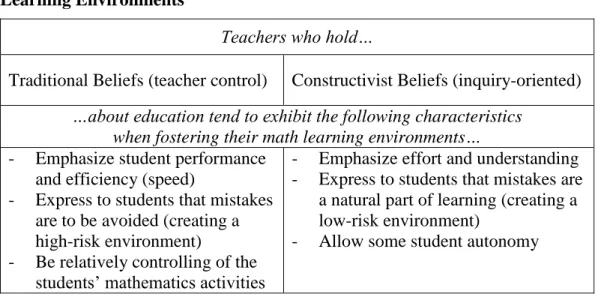
Table 2: The Comparison between Two Different Sets of Teacher Beliefs and Math Learning Environments
Teachers who hold…
Traditional Beliefs (teacher control) Constructivist Beliefs (inquiry-oriented) …about education tend to exhibit the following characteristics
when fostering their math learning environments… - Emphasize student performance
and efficiency (speed)
- Express to students that mistakes are to be avoided (creating a high-risk environment)
- Be relatively controlling of the students’ mathematics activities
- Emphasize effort and understanding - Express to students that mistakes are
a natural part of learning (creating a low-risk environment)
- Allow some student autonomy
efficiency in getting to the correct answer, discourage mistakes, and dictate the activities of the math classroom. Those with more constructivist beliefs focus on student effort, encourage mistakes, and support student autonomy in what and/or how math is learned. These are two vastly different views on what effective math education looks like in the classroom. Perhaps the most disconcerting of these findings is that the teachers who promoted student performance rather than student learning also believed that student mathematics abilities are stable and not very amenable to change (Stipek, Givvin, Salmon, and MacGyvers, 2001). This concept represents an entity theory and will be discussed further momentarily.
Debate #3: Effective math lesson planning. There are myriad views on what appropriate teacher beliefs and practices should be when developing effective math lesson plans. Effective math teachers hold very high expectations for their students (Farr, 2010; Stronge, 2002). They stress student responsibility and accountability in meeting those expectations (Stronge, 2002; Nichols, Meyers, & Burling, 2009) and emphasize higher-level thinking in all math classes, regardless of their tracks (Posamentier & Jaye, 2006). Students learn to develop strategies that effective learners use to succeed (NMAP, 2008). Educators deliberately scaffold new ideas and connect to what students already know (NMAP, 2008), and incorporate learning styles into aptly paced lessons (Stronge, 2002). They encourage students to express their thinking processes, which promotes active learning and enhanced levels of understanding (Secada & Berman, 1999). Effective teachers further promote student learning and motivation by utilizing tools and
array of examples, students have numerous opportunities to ask questions and practice their newly learned skills extensively, and students are provided with extensive feedback. With regular use of explicit instruction, struggling math students increase their foundational skills and conceptual knowledge (NMAP, 2008). Effective teachers actively support their students as they are held to high academic standards through the use of engaging methods with unwavering expectations, and students consistently rise to the challenge, achieving more than they ever have before.
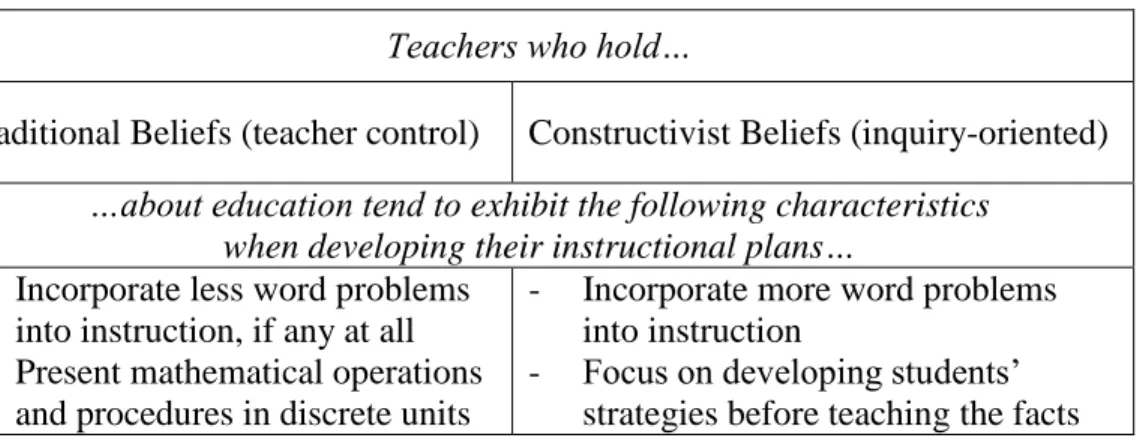
Research has shown that mathematics teachers develop their instructional plans according to two primary belief structures, and exhibit the following behaviors in their instructional
delivery:
Table 3: The Comparison between Two Different Sets of Teacher Beliefs and Teachers’ Instructional Plans
Teachers who hold…
Traditional Beliefs (teacher control) Constructivist Beliefs (inquiry-oriented) …about education tend to exhibit the following characteristics
when developing their instructional plans… - Incorporate less word problems
into instruction, if any at all - Present mathematical operations
and procedures in discrete units
- Incorporate more word problems into instruction
- Focus on developing students’ strategies before teaching the facts
process the math topics and apply them to more tangible concepts, and view problem-solving strategies as being more important to student success than simply remembering disconnected facts. Clearly, both sides have something to say about how effective math teachers should be planning and delivering their lessons.
Debate #4: Effective math teachers’ responsibilities. Some feel that math teachers are responsible for teaching math, while others feel that math teachers, like all teachers, are
responsible for teaching students. This is a very distinct difference, as the latter is a much more holistic view of education and an encompassing representation of what teachers should strive for, including some of the following examples:
Under the tutelage of an effective teacher, students should be provided with an abundance of respect and encouragement (Benard, 1998); students’ backgrounds should be fully utilized as effective teachers incorporate aspects of student identity, language, culture, and learning styles into the lessons and activities (Darling-Hammond, 1997; Nieto, 2010).
Student development should be extended out into the community by enlisting the support of the family into the learning process (Darling-Hammond, 1997; Kaplan & Owings, 2002) with authentic involvement of parents and other community members (Zeichner, 2003).
By helping students believe in themselves, incorporating their backgrounds into the classroom, and recruiting family support, effective math teachers can dramatically changing the lives of their students in real and profound ways.