The Journal of Sri Krishna Research & Educational Consortium
ECONSPEAK:
A J O U R N A L O F A D V A N C E S I N M A N A G E M E N T , I T & S O C I A L
S C I E N C E S
I n t e r n a t i o n a l l y I n d e x e d & L i s t e d R e f e r r e d e - J o u r n a l
TRENDS OF AGEING AND AGED CARE:
AN INDIAN EXPERIENCE
CHARANJEEVSINGH*
*Associate Professor, Department of Public Administration, Panjab University, Chandigarh, India.
ABSTRACT
The population is ageing worldwide. The demographic change accompanied with fast changing family structure due to forces like urbanization and migration necessitate that vast resources will be required towards support, care and treatment of older persons. With massive increase in older population and ageing people, unprecedented challenges are found in the field of Aged Care. The commitment for comfortable and dignified living of older persons is mentioned in recent Government Policy documents (eg. National Policy on Older Persons). This paper tries to capture some of these new projected trends and initiatives and suggest future trends in the area of Ageing and Aged Care in Indian context.
Ageing is an inevitable process in human development, which follows a time course that can only be delayed by proper lifestyle, good dietary practices and regular physical activities. It can also be hastened by inappropriate lifestyle, chronic illness and undesirable events. The factors which affect the ageing process can be delayed, but not prevented. Ageing in general refers to all time – related changes during the life span of an individual, where as senescence refer to the detrimental changes with time during adulthood. Senescence leads to the decrease in the ability of the organism to survive. So, senescence can be called as subset of ageing.
Physiological deterioration takes place with advancing chronological age, however the pace differs from person to person as a result of interaction of large number of intrinsic and extrinsic factors. All organs and organ systems exhibit deterioration in functional capacity with old age, if not seen in all persons, at least in a significant fraction of population.
optimally. Subsequently there comes a stage where the decline in the functional capacity of organ systems and the individual as a whole starts. This process of ageing is sequential and gradual. Old age is therefore a social category rather than a physiologically different populationi.
______________________________________________________________________________
INTRODUCTION
WHO IS CALLED ELDERLY?
There is still no agreement on the age at which a person becomes old. Demographers, traditionally, use a particular age as the beginning of old age, assuming that calendar age and biological age are synonymous. This age, set at 60 years, varies from country to country and from time to time reflecting cultural and social class differences and other criteria related to the degree of biological decline. The use of one particular age to denote old age as an ascriptive status has become anachronistic in the contemporary world. The attributes, which did in fact, characterize a high proportion of the relatively small group who survived old age can no longer be used to characterize the current older population. This change vividly demonstrates that the elderly cannot simply and homogeneously be defined as the group of persons above a certain age. The relatively low open interval used in the past not only reflected the smaller size of the group but also the poor quality of data, especially misreporting about the age.ii
DEFINITION OF AN OLDER PERSON/SENIOR CITIZEN
At what age should a person be known as older person/senior citizen in a country? The answer to this question, today, is not one and uniform thus different countries have different answers to the query. In India the National Policy on Older Persons (NPOP), adopted by the Government of India in January, 1999, confers the status of a senior citizen to a person (male or female) who has attained the age of 60. The Ministry of Social Justice and Empowerment, the nodal agency at the central level responsible for the welfare of senior citizens, has also stressed upon various other Ministries and Departments for adopting the age of 60 for extending facilities/concessions at the Inter-Ministerial Committee meeting.iii
Moreover, due to improved life expectancy and quality of life of the older persons it has created crucial policy challenges on several fronts. Two areas distinctly stand out; one is the social security system i.e. payments to pensioners for longer duration and the second is the increasing social and health needs of the elderly, who are increasing both in absolute and relative numbers. These issues add to the financial burden and conflicts of governments already facing needs of other age groups and having to deal with new health and social problems. Hence, the issues in front of the policy makers and planners are to collect adequate data, concepts and methodologies to understand these new developments, to find out the future course of mortality for the elderly and whether the increased length of life can be accompanied by sufficiency of quality of life of the elderly.iv
biologically possible duration of life, changed from around 85 years in the early 1700‟s to the current figure of around 120 years around the world.v As more people survive to old age and as the survival curve thus becomes more rectangular, the less meaningful as an indicator of mortality change becomes the notion of life expectancy (the number of additional years a person can expect to live if current mortality patterns prevail).
AGEING TRENDS: GLOBAL SCENARIO
The rise in the proportion of the ageing population represents one of the most significant demographic shifts in history.
The twenty first century is often called the age of ageing. The matrix below reflect the present scenario of ageing in general.
TABLE 1
Period Change in proportion of population aged 60 and over
1950 Out of every 13 individuals 1 aged 60 and above
Present day scenario
(As per United Nation Population Division)
Out of every 10 individuals 1 aged 60 and above
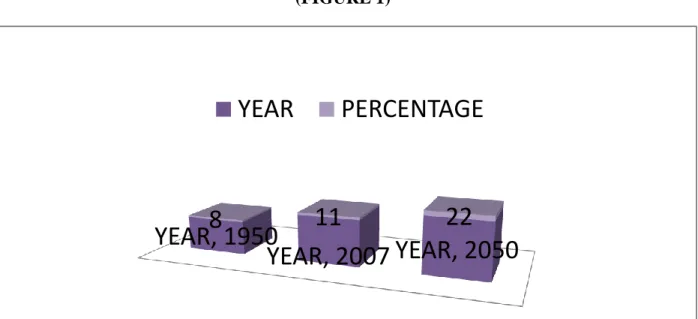
ROPORTION OF POPULATION 60 YEARS 0R OVER: WORLD 1950-2050
(FIGURE 1)
Source: World Population Ageing 2007; United Nations Department Of Economic And Social Affairs, Population Division
The pillar presentation (figure 1) of the present and projected figures of the world population of 60 years or above between the period 1950-2050 clearly marks alarming trends as can be seen that in the year 1950 there were only 8 per cent elderly population which increased to 11 per cent by the end of the year 2007 and is likely to rise to 22 per cent by the year 2050.
TABLE 2: GLOBAL SCENARIO OF TOTAL POPULATION AND AGED PERSONS, 1995-2150
Year Total world
population (in Billions)
Percentage of aged
(60+)
Percentage of aged
(65+)
Percentage of aged
(80+)
1995 5.687 9.5 6.5 1.1
2000 6.091 9.9 6.8 1.1
2025 8.039 14.6 10.8 1.7
2050 9.367 20.7 15.1 3.4
2075 10.066 24.8 19.1 5.3
2100 10.414 27.7 22.0 7.1
YEAR, 1950
YEAR, 2007 YEAR, 2050
8
11
22
2125 10.614 29.2 23.6 8.6
2150 10.806 30.5 24.9 9.8
(Source: United Nations. World Population Projections to 2150, Department of Economic and Social Affairs, Population Division, United Nations, New York, 1998 and 2003).
The likely future projection (assuming medium fertility) of ageing trends has been highlighted in the Table2, which reveals the global scenario of the total population and the aged persons estimated from 1995 to 2150. It can be seen that the population of the world in 1995 was 5.7 billion (57 Crores) and it is expected to reach 10.8 billion (108 Crores) by 2150. Interestingly, between 1995 and 2000, nearly 81 million people were added to the world population each year.
It can also be seen from projections in Table 2 that the population of older people in the world‟s population is expected to increase rapidly from 9.5 per cent in 1995 to 20.7 in 2050 and to 30.5 per cent in 2150. This means an increase in old population from 542 million in 1995 to 1.9 billion in 2050 and to 3.3 billion in 2150. Although, in 1995 the number of children below 15 years was estimated to be 3.3 times higher than those aged 60 and above, older people are expected to surpass the number of children by the year 2050.vii
Among older people the number of the oldest-old i.e. those aged 80 years and over-will increase more rapidly in the times to come. According to the above projections, the number of those aged 80 years and over will get multiply 17 times between the year 1995 and year 2150 i.e. from 61 million (6.1 Crores) in the year 1995 to 320 million (32 Crores) by the year 2050 and to 1054 million (105 Crores and 40 lakh) by the year 2150*.
According to the assessment of the UN, only Western Europe in the whole world had a proportion of older people above 15 per cent in year 1959. In year 2000, all the three regions of Europe, except Eastern Europe, registered growth of older persons by 20 per cent. In the next 50 years, the proportion of the older persons is expected to grow more rapidly. As of today, Southern Europe has the highest proportion of elderly people (21.5 per cent) and it is expected to reach 37.2 per cent by year 2050. In developing countries, one in every 12 is now an older person and the number is expected to grow to one in five by the year 2050. In developed countries, the ratio is already one in five now and it is projected to go up to one in three by the year 2050.
AGEING TRENDS: THE ASIAN SCENARIO
TRENDS AND PATTERNS OF AGEING DEMOGRAPHIC DATA
THERE EXISTS MARKED DIFFERENCE BETWEEN REGIONS OF THE WORLD REGARDING THE AGEING PRESENT TRENDS. (TABLE 3)
Region Change in proportion of population aged 60
and over
Europe Out of every 5 individuals 1 aged 60 and above
Africa Out of every 20 individuals 1 aged 60 and above
Asia Out of every 10 individuals 1 aged 60 and above
WITHIN ASIA (TABLE 4)
Asia 2000 2050
Eastern Asia 11 Per Cent One in Four aged 60 and above
Western Asia 7 Per Cent One in Six aged 60 and above
South Asia 7 Per Cent One in Five aged 60 and above
FUTURE PROJECTION OF THE DEMOGRAPHIC DATA: AGEING TRENDS (TABLE 5)
Year Change in proportion of population aged 60
and over
Present Phase Out of every 10 individuals 1 aged 60 and above
2050 Out of every 5 individuals 1 aged 60 and above
2150 Out of every 3 individuals 1 aged 60 and above
*As per United Nations Population Division
The Asian scenario is presently the opposite to that of the European Continent. Though Asia as a whole accounts for only 9 per cent of the world‟s elderly population, there are variations among different regions within the continent. While Eastern Asia led the continent with 11 per cent older persons in year 2000, the corresponding figure for other regions was only 7 per cent. By 2050, one in four in Eastern Asia, one in five in South and Central Asia and one in six in Western Asia are expected to be elderly. Out of 36 countries studied by UN, not a single country had a proportion of older persons above 10 per cent till year 1950, whereas, presently seven countries in Asia have crossed the 10 per cent mark and one country i.e. Japan in Eastern Asia, has already reached the mark of 23 per cent of elderly population.
It is estimated that by the year 2050, the proportion of elderly persons in 33 countries of Asian Continent, except Afghanistan, Oman and Yemen is projected to be above 10 per cent. Among them, in 10 countries the proportions are likely to cross 20 per cent, six countries having 25 per cent older persons and two countries supporting high proportion of 35 per cent older population of which Hong Kong is predicted to lead with 39 per cent older people, followed by Japan. The two most populous countries of the world i.e. China and India will share the major proportion of the world‟s elderly population. Currently, one in ten Chinese is an elderly person and this ratio is expected to reach one in four by the year 2050; similarly, one in 12 Indians is an elderly and this ratio is likely to be one in five by the year 2050.
AGEING TRENDS: INDIAN SCENARIO
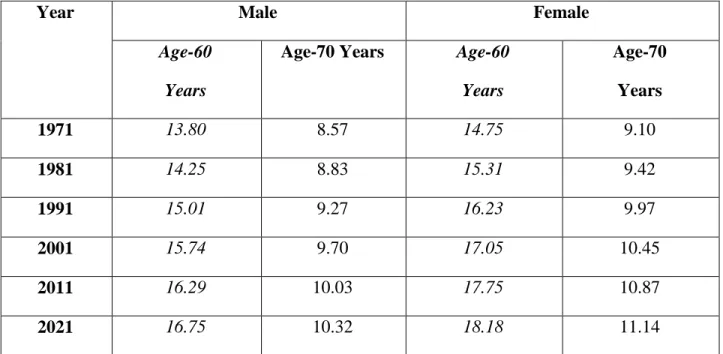
growth of ageing population was much slower in India during the year 1961-91 but has been ever since on increase. The States such as Goa, Kerala, Tamil Nadu and Union Territory Chandigarh, which are ahead in the demographic transition, have shown a higher index value meaning thereby higher proportions of older age groups against younger age groups. Though the proportion of the aged population for the whole country was only around 7 per cent in the year 1991, yet it has the highest number of elderly persons in South Central Asia. Moreover, the ageing process is intensified owing to higher survival of elderly persons beyond age of 60 and 70 years as can be observed from the data presented in Table 2. It can be seen that males are expected to live 17 years beyond the age of 60 years and 10 years beyond the age of 70 years and the corresponding life-years for females in the same age group are 18 and 11 years respectively, by the year 2021.viii
TABLE 6: EXPECTATION OF LIFE AT AGES 60 AND 70 YEARS FOR INDIA (BY YEARS)
Year Male Female
Age-60
Years
Age-70 Years Age-60
Years
Age-70
Years
1971 13.80 8.57 14.75 9.10
1981 14.25 8.83 15.31 9.42
1991 15.01 9.27 16.23 9.97
2001 15.74 9.70 17.05 10.45
2011 16.29 10.03 17.75 10.87
2021 16.75 10.32 18.18 11.14
Source: United Nations Population Division (2003), India Demographic Profile-World Population Prospects.
Going by the trends the elderly population of India rose from 20 million in the year 1950 i.e. 5.5 per cent of the total population to 55 million (5 Crore and 50 lakh) in the year 1991, i.e. 6.5 per cent of the population and is projected to be around 76 million (7 Crore 60 lakh) in the year 2001 i.e. 7.6 per cent of the total population. Thus, as per United Nation‟s classification, the Indian society would progress from a graying society (i.e. the elderly population between 4-7 per cent of the total population) to an ageing society (i.e. elderly population more than 7 per cent) by the turn of this century.
of 4.7 per cent and 5.3 per cent in the year 1981, respectively and are projected to grow at 5.6 per cent by the year 2021. Thus young-old have been increasing at much faster pace than oldest-old in India, whereas global maximal growth is recorded in later but not in the former category of the elderly.
TRENDS AND PATTERNS OF AGEING DEMOGRAPHIC DATA: INDIA
The future projection of the elderly population has been projected in the Table 3 which clearly indicate that there has been ten times increase in the elderly population nearly 8 decades.
FUTURE PROJECTION OF THE DEMOGRAPHIC DATA IN INDIA (TABLE 7)
year Present population of Elderly (60 + )
1947 1.9 Crore (approximately)
Present Phase 7.6 Crore (approximately)
2013 10 Crore (approximately)
2030 19.8 Crore ( approximately)
The projection of the data in the Table 7 is indicating the ageing scenario in India. The rapid growth rate of elderly in India and likely projection by 2030 are sending message to the policy makers and administration and other partners including Non- Government Organizations to grid up their loins to meet the challenge of ageing in the country.
It is not going to be easy and simple situation to handle the aged population in the country as the patterns and trends suggest that by the year 2030, we will have nearly 20 crores people in this category not only the estimated population of elderly is the cause of worry but there are other attached reasons and associated features which makes the task of handling this problem much more worst.
TRENDS IN AGED CARE IN INDIA
The above discussed trends are enough to draw the attention of the society, the government and other related agencies to ponder over the issue of aged care arising out the suggested ageing patterns.
After all whose responsibility is to care for the elderly? Should the onus rest on the government or the children or for that matter any other social institution? The answer needs to be addressed keeping in mind the enormous rise in population ageing. The government alone cannot take up the challenge and children are more to their future than their past and other agencies seeing the cause are finance starved or politically marred.
The entire societal setting is responsible for making this elderly-care an issue rather a burning issue. The rapid urbanization leading to large-scale migrations of the population from villages to the urban areas leaving behind their old and fragile elders, who do not wish to shift along them for their own emotional, social and psychological reasons. The Indian family system has undergone tremendous change from joint family to the mono-family set up where the elders do not find place or do not find the place to be worth. Oriental, Far East traditions and ancient traditions known for close knit family are vanishing from the society leaving the elders in the family in the lurch. The fast urban life style does not meet the social, psychological and welfare needs of the elderly people in the family nor is it to their comfort and liking.
The change in the role and status of the women in the society has also put pressure on the elderly care as more of the females are more into the employment these days thus leaving the kids and elders to take care of themselves which was not the case in earlier times when women ended up only in the household engagements.
The increased life span has added further to the woes of the elders especially that of oldest old (80+) as their dependency on the family is much more for their social and medical care whereas the family role is heading for opposite direction that “Care for yourself”.
Rightly has been observed by Mathew Cherian, Chief Executive, Helpage India, that “like all other areas of human development when it comes to the elderly, we are in self-denial mode”x
.
In the recent past the government has been compelled to pass the maintenance of parents and senior citizens Act which makes neglects of ageing parents a cognizable offence. In other words acts provide that “Look after your family elders else go to jail”xi
but act seems to lack teeth and then bottom line can love for parents be legislated? Says Mathew Charian.
The National Policy on older persons (NPOP-1999) assures the older persons that their concerns are concerns of the nation and the Policy aims to strengthen and legitimate status for them in the society thus elderly people will not live unprotected, ignored or marginalized but will also get opportunities for development and use of the potentials. The UN General Assembly has designated 1st October of every year as International Day of Older Person the creator of National Council for older persons under the Chairmanship of Minister of Social Justice and to advice and aid the Government on Policies and Programmees for older persons. There are other initiatives taken by the Governments to Care for the Aged such as NICE (National Initiative for Care of Elderly) OASIS (Old Age Social and Income Security Scheme) and AADHAR.
These all efforts appear dwarf in the face of gigantic issues of Aged Care as projected by the the trends and patterns of aging in India.
To look for solution to the problem, we find that there are not adequate number of old age home in the country (1200 approx.). The NPOP yet to take off to the expected level. Other initiatives are working within financial and social limitations. Lack of awareness in the society about this captivating issue, the aging and the aged care is going to be challenge in this country and the century to come. Satisfying indicator is not adding years to the life but to add life to the years. The stake holders have many aspects to examine, evaluate and execute in this up coming monstrous challenge from Aging and Aged Care.
Population ageing is posing serious and unique challenge to every society alike. Unlike other population variables such as fertility and mortality, which to considerable extent can be influenced by government‟s policies and interventions, the process of population ageing is neither amenable to change nor can be easily modified. Thus, all governments should focus their attention to the basic issues arising out of population ageing rather than changing the process of ageing as such the aged care be on the top of welfare agenda of every government.
REFERENCES
i
S.C. Mahapatra and Shraddha Mahapatra, Physiological Changes in Old Age, Journal of Research in Ayurveda and Siddha, Volume XXVIII (4), October-December, 2007, pp123-124.
ii
iii
NPOP, “National Policy on Older Persons”, Government of India: Ministry of Social Justice and Empowerment- policy paper,2001.
iv
K. Dandekar, Elderly in India, Sage Publications, New Delhi, p.10-12.
v Irudaya Rajan and U.S. Mishra, India‟s Elderly Burden or Challenge, Sage Publications,
New Delhi 1999,pp.232-250.
vi
Ala Narayana, Thrigulla Saketh Ram and Varanasi Subhose, Geriatric Health Care- A Historical Perspective, Journal of Research in Ayurveda and Siddha, Volume XXVIII (4), October-December, 2007, p2.
vii United Nations Population Division (2003). “India Demographic Profile-World
Population Prospects:The 2002 Revision Population
Database”.http://esa.un.org/unpp/p2k0data.asp. September 24, 2003.
viii
B. Nalini, Institutional care for the Aged-The Issues and Implications”, Ageing and Society, (6)3-4, 1996, pp. 69-90.
ix
B. Bytheway, Ageism, Buckingham: Open University Press, 1995, p. 7.
x
Nonika Singh, Life in the last lap, The Tribune, 1st March, 2009, p.8.
xi