Fannie H Ouyang. Using Cookbooks from the North Carolina Collection as Cultural Historical Documents. A Master’s Paper for the M.S. in L.S degree. December, 2017. 47 pages. Advisor: Denise Anthony
Cookbooks do not have to function merely as objects in the kitchen space. They are versatile, primary resources that can provide researchers with a range of insight into social, economic, and cultural histories. Through the careful examination of the books, a researcher can parse an array of characteristics to produce a narrative about the people who created and used the cookbooks and the times in which they lived. This master’s paper describes such an analysis of thirty cookbooks published between 1872 and 1979 and housed in the University of North Carolina – Chapel Hill’s North Carolina
Collection. Here we found that the cookbooks from the Piedmont region of North Carolina presented an assortment of information that tells of the types of foods that were being eaten over the course of a century according to availability and food ideologies, the transforming roles of men and women, and ultimately, the transforming cookbook.
Headings:
Cookbooks
Cooking – North Carolina
Food habits – United States – History Cooking, American – History
USING COOKBOOKS FROM THE NORTH CAROLINA COLLECTION AS CULTURAL HISTORICAL DOCUMENTS
by
Fannie H Ouyang
A Master’s paper submitted to the faculty of the School of Information and Library Science of the University of North Carolina at Chapel Hill
in partial fulfillment of the requirements for the degree of Master of Science in
Library Science.
Chapel Hill, North Carolina December 2017
Approved by
Table of Contents
Introduction 2
Literature Review 4
Methodology 11
Findings and Analysis 20
The Audience and the Contributors 20
The Physical Aspects 25
The Visuals 27
Advertisements 30
The Anatomy of the Recipe 32
The Recipes 33
The Ingredients 34
Staple Foods 36
The Unreliable Cookbook 37
Orthography 38
Discussion and Conclusion 40
Introduction
When a person initially picks up a cookbook, their first thought is not usually to study it as an artifact. Typically, they use it as a guide to making breakfast, lunch, or dinner for the day. They look at the recipes, gather the ingredients, make the food, and then place the cookbook back on the shelf. It is a rather mindless activity. This is regrettable, however, because cookbooks represent and present much more. They are filled with material that can help people learn about the cultural and social histories of past societies. Wheaton (1998) has described them as “magician’s hats,” objects that can reveal much more than they would initially appear (p. 3). By studying and treating them as cultural artifacts, cookbooks can be extremely enlightening, providing insight into the changes that have come to define the boundaries of each era’s public sphere (Tobias, 1998, p. 3).
assess the numerous changes and developments that have occurred in a specific location. All this may seem obvious, but it is not something that is often considered. With such possibility for discovery, this paper seeks to apply the method of utilizing cookbooks as cultural historical artifacts to a select number of cookbooks from the Piedmont region of North Carolina housed in the University of North Carolina – Chapel Hill’s North
Literature Review
Undoubtedly, it can be argued that cookbooks are not the most reliable resources for understanding the time and place surrounding their creation. This is most likely due to the fact that recipes were often passed down from different generations and borrowed from various cooks and chefs (Wheaton, 1998, p. 3 and Albala, 2012a, p. 3). Though this can certainly be true, by studying a large enough sample of cookbooks from around the same place and time, a researcher can discover trends. They simply have to remain mindful of the fact that although many of the recipes found in the cookbooks can be representative of their time and place, there will also be a few that will not be. These particular recipes may be from past generations or copied from cookbooks that are from other geographical locations. Yet, the fact that these foods continue to be included within a cookbook is representative of what people continue to want to consume. It is easy to make the claim that cookbooks are unreliable, but it is foolish to believe that they do not provide any practical information. If one were to look at a series of cookbooks over the course of several decades, there will certainly be visible changes in the ingredients, recipes, household tips, and even language.
1796, Amelia Simmon’s American Cookery, was published in Hartford, Connecticut (Ridley, 1999; Miller, 2017, p. 14; and American Antiquarian Society, 2016). This was the first cookbook by an American author. Prior to these, the earliest written recipes existed on three Akkadian tablets from ancient Mesopotamia (Carter, 1985) that date back to about 1700 BC. For quite some time, the next known set of recipes came from De re coquinaria or Apicius, a collection of Roman recipes that is believed to have been
compiled around the 4th century and is attributed to Marcus Gavius Apicius. He was a Roman gourmet and socialite who spent his fortune on lavish banquets (Adamson, 2002, p. 6-7). Many of the ingredients found in this cookbook used exotic ingredients such as ostrich, flamingo, and dormice (Albala, 2012b, p. 41).
Cookbooks continued to exhibit foods for the wealthy through the 15th and 16th centuries in Western Europe, but they eventually came to be written for the less wealthy (Notaker, 2017b). With this knowledge, it can be inferred that cookbooks were not initially intended for all people. To use a cookbook implies that one must be literate and literacy was not a privilege that was available to all populations (Joseph, 2016, p. 196). This would suggest that those who used and owned cookbooks were typically wealthier and had educational opportunity (Iomaire, 2013). This is seen in Mitchell’s study of cookbooks in which she finds a poultry and game section, which features hare, pheasants, grouse, and partridge – foods that were only accessible to the upper classes (Mitchell, 2001, p.16). With social class in mind, undoubtedly, the later cookbooks would have also had more expensive ingredients along with more elegant recipes for parties and
When analyzing these cookbooks, one must ask who was the reader as well as who was the cook, because the two were not always synonymous. Though the intended audience for early cookbooks may not have been the uneducated, it does not mean that they were not the ones who actually cooked from them or indirectly created them. For example, at the end of the nineteenth century, white southern women often wrote mammy cookbooks. These were cookbooks written by white authors in the voice of the African American domestic servant (Walden, 2014, p. 51). The authors were not the ones who created the recipes or cooked them for the household; this task was often left to the African American women, either slaves or domestic workers of the households (p. 57). These mammy cookbooks reinforced racial hierarchies – the mammy archetype being that of an older, overweight, and dark skinned black woman who worked as a nanny or housekeeper for a white family (Walker-Barnes, 2014, p. 85-88).
Furthermore, cookbooks have the potential to indicate who consumed the food. Just as the reader and cook did not have to be the same person, the cook and the person eating the meal did not have to be a single individual. The cook could have used the cookbook to cook for a larger household while he or she ate a different meal. As researchers study cookbooks, these questions are important to ponder for they can provide extensive information on the audience.
Book. After his death in 1818, his publisher published the second edition under the
pseudonym, Priscilla Homespun because presumably, female authors brought in greater profits (Vester, 2015, p. 70).
Domestic kitchens became feminine spaces. Ruth Schwartz Cowan argues that men lost their place in the kitchen when technology became more advanced, shifting from the open fire to the wood stove to the coal stove (p. 70). This released men from their duty of having to keep the fire going. Cookbooks reflected this shift by the addition of tips and advice addressed towards women for running a successful household,
emphasizing their responsibilities as domestic figures (Tobias, 1998, p. 9). Though cookbooks continued to be created for women, recipes and ingredients changed to
accommodate the evolving roles of women. For example, in the 1940s around the time of World War II, women started to populate the work force. When this happened, recipes became quicker and more convenient with the introduction of canned and processed goods into everyday cooking (Neuhaus, 2012). These products were already in existence, but women did not actively utilize them until they needed the additional help to getting meals on the table more quickly. This trend continued through the 1960s when recipes were no longer made completely from scratch; instead, they called for canned or frozen vegetables (Mitchell, 2001, p. 19). Progressively, cookbooks changed as societies changed, portraying new recipes that adopted health trends and incorporated new technologies such as the rotary eggbeater.
the 1950s had casseroles (Bon Appétit, 2012). These are stereotypes of those decades, but they continue to hold some truth of the popularity of these foods during their times, just as bacon on everything will be what the 2010s will be known for. The popularity, but especially the availability or unavailability of ingredients is telling of what certain parts of the world were enduring or what specific classes of people were eating at any given time.
To adjust the focus away from the contents, one should look at the cookbook as an object. The construction and quality of the materials can convey information. The size, the binding, and the type of paper used can easily give hints to the purpose of the
cookbook and its audience (Iomaire, 2013). An affordable straight-forward cookbook might be intended for a popular audience, while a beautifully bound and illustrated cookbook might be for someone who is willing to spend the money on a show piece (Albala, 2012a, p. 7). This would suggest that a book with a wire or spiral binding was intended for frequent use due to its functional format. Additionally, a small format allowed for easy transport. One might also look to see if the cookbook was created for anyone in particular, such as a patron or an employer. This could indicate the writer’s role. Additionally, the appearance of advertisements tells how the cookbook came to be. The writers or contributors may have needed to go to businesses for help with the publishing of their cookbooks, usually through providing advertisement space in the book.
that express wartime patriotism. As seen with a number of cookbooks that were written in the 1940s, during World War II, the covers typically displayed some type of red, white, and blue motif with an accompanying patriotic tagline that said something like “Help win the war on the kitchen front.”
Cover of "Recipes for Today," published by General Foods Corporation, 1943 This is the most obvious example of when a cookbook relayed specific information about its era. Along similar lines, publishing dates are also quite descriptive. They provide an initial sense of the types of recipes to expect from the cookbook.
Methodology
Cookbooks are capable of delivering substantial amounts of information. They can inform users about social and economical histories, changing food sources, and even evolving food trends. Due to this often-overlooked capability, one must consciously shift their perspective on what they expect to get out of using a cookbook. Rather than
assuming that it will only provide ingredients and instructions for making recipes, one must analyze a cookbook closely with the intention of discovering more. The first steps towards demonstrating their use as cultural historical documents is to create questions that will allow this project to move towards an objective. The overlying questions that must be constantly reflected upon are:
What knowledge can one obtain from cookbooks outside of the recipes? How do cookbooks go about providing people with this information? The secondary questions ask:
How is the Piedmont region of North Carolina represented in these cookbooks?
How does the region’s culinary characteristics compare to what has been written in food history?
In what ways did historical events influence food? How does food influence culture?
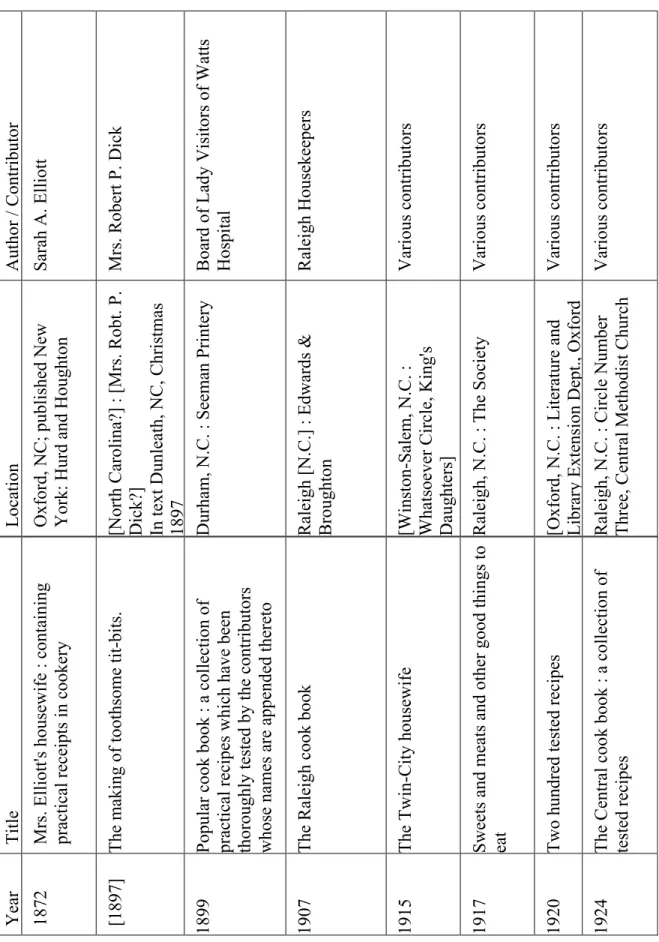
sources must first be analyzed, but to understand what information is best to search for within the primary sources, secondary sources must be consulted – it is a cyclical process. The primary sources that I assessed are thirty cookbooks that exist in the North Carolina Collection, spanning the years 1872-1979 (see Table 1). These objects were all created and published in the Piedmont region. The region was chosen due to familiarity and convenience. The time range was chosen because it roughly makes up a century of cookbooks starting with 1872, the earliest available cookbook from the Piedmont region in the North Carolina Collection. To provide comparative information, the secondary resources are about the larger American diet and culture as well as those specific to the Piedmont area. To find these secondary resources, I use the following search strings in UNC’s general catalogue: Food habits -- United States -- History; United States -- Social life and customs; Cooking, American -- Southern style -- History; Cooking -- North Carolina -- Durham County; and Cooking -- North Carolina -- Orange Country.
Additionally, I used Google for quick history searches and to find websites that specifically write on food, such as Bon Appétit, which I consulted for popular food trends.
These secondary resources provide a general view of the history, culture, and diet of America and the state of North Carolina. As a result of this research, the data gathered from the cookbooks can be analyzed to understand how similar or different the findings from the books will stand in comparison to the popular perspective that are
The paper will explore the cookbook’s audience and contributors, the physical aspects of the cookbooks (pertaining to size, shape, binding, and cover material), the imagery, the advertisements, the anatomy of the recipes, the recipes, the individual ingredients, the staple foods, the cookbook’s unreliability, and the orthography. By doing so, one can obtain a complete overview of a cookbook. This allows the researcher to assess the object from the outside in, first considering the book’s physical attributes and finally moving inward towards the details. As I move through this evaluation, the important elements will surface and become more evident. Since cookbooks come in all forms, there is no exact and correct way to analyze a cookbook. The best way to do so is to handle the book and slowly look through it, remaining conscious of any information that appears to be useful and pertinent to the shaping of a larger narrative.
advertisements also helped to deliver a sense of who had money versus who needed money for the production of such an object. The cookbooks that had advertisements were sponsored by businesses, while the cookbooks that did not have any ads, were created through the use of personal funds. The anatomy of the recipes further allows for the analysis of the audiences, presenting a sense of who the cooks were, either
knowledgeable housewives or less versed cooks. The recipes and individual ingredients allow for the discovery of trends that were occurring throughout history, concerning food beliefs, food popularity, and food availability. A few of these recipes fell parallel to what was occurring in the world, such as the increased use of canned meats and making of casseroles which were direct reflections of the effects of the Great Depression and World War II. In noticing the staple foods, researchers are offered the opportunity to further investigate why these may have been and whether they provided economic stability to the people of a region or state. Since cookbooks cannot be trusted in their entirety, the
reasoning behind this must be understood. Thus, by doing so, researchers can place more faith in trusting them as primary resources. Lastly, cookbooks can also offer interesting facts about a more general history through orthography. This was not a characteristic that was initially approached, but upon constant examination of the cookbooks, it became a fun observation that stood out.
Table 1. Analyzed cookbooks A ut hor / Cont ri but or S ara h A . E ll iot t M rs . Robe rt P . D ic k Boa rd of L ady V is it ors of W at ts H os pi ta l Ra le igh H ous eke epe rs V ari ous c ont ri but ors V ari ous c ont ri but ors V ari ous c ont ri but ors V ari ous c ont ri but ors L oc at ion O xf ord, N C; publ is he d N ew Y ork: H urd a nd H ought on [N ort h Ca rol ina ?] : [M rs . Robt . P . D ic k? ] In t ext D unl ea th, N C, Chri st m as
1897 Durha
m , N .C. : S ee m an P ri nt ery Ra le igh [N .C.] : E dw ards & Brought on [W ins ton -S al em , N .C. : W ha ts oe ve r Ci rc le , K ing' s D aught ers ] Ra le igh, N .C. : T he S oc ie ty [O xf ord, N .C. : L it era ture a nd L ibra ry E xt ens ion D ept ., O xf ord W om an' s Cl ub] Ra le igh, N .C. : Ci rc le N um be r T hre e, Ce nt ra l M et hodi st Churc h
Title Mrs
. E ll iot t's hous ew if e : c ont ai ni ng pra ct ic al re ce ipt s i n c ooke ry T he m aki ng of toot hs om e t it -bi ts . P opul ar c
ook book :
a c ol le ct ion of pra ct ic al re ci pe s w hi ch ha ve be en thoroughl y t es te
d by t
he c ont ri but ors w hos e na m es a re a ppe nde d t he re to The Ra le igh c ook book T he T w in -Ci ty hous ew if e S w ee ts a nd m ea ts a nd ot he
r good t
hi
ngs
to
eat Tw
o hundre d t es te d re ci pe s T he Ce nt ra l c
ook book :
a c ol le ct ion of te st ed re ci pe s
A ut hor / Cont ri but or W ri tt
en by M
ary L ee S w ann but re ci pe s gi ve n t o he
r by f
ri ends D orc as c o-w orke rs of the S al em hom e V ari ous c ont ri but ors V ari ous c ont ri but ors W ri tt
en by M
ari on Brow n, S out he rn re ci pe s ga the re d f rom a va ri et y of pe opl e a nd ve nue s V ari ous c ont ri but ors f rom N .C. S ta te Col le ge V ari ous c ont ri but ors Be tt y F ee zor, hos t of the te le vi si on progra m : “ T he Be tt y F ee zor S how ” L oc at ion [Ra le igh, N .C. : E dw ards & Brought on] W ins ton -S al em , N .C. : [Chi ldre n' s H om e P ri nt shop] [H ic kory, N ort h Ca rol ina ] : [W om en' s G ui ld of Cori nt h E va nge li ca l a nd Re form ed Churc h] S pe nc er, N .C. : Ce nt ra l M et hod ist Churc h Cha pe l H il l, U ni ve rs it y of N ort h Ca rol ina P re ss [Ra le igh, N .C. : S ta te Col le ge W om an' s Cl ub] Conc ord, N ort h Ca rol ina : Ca ba rrus M em ori al H os pi ta l Cha rl ot te , N .C. : W BT V
Title My f
avori te re ci pe s : m ore tha n f ive hundre d choi ce re ci pe s f or eve ry da y a nd pa rt y cooke ry Page s f rom O ld S al em c ook books F avori te re ci pe s (T it le is " Cori nt h G ui ld Cook Book" on c ove r) T he G ert rude Bobbi tt Ci rc le c
ook book :
re ci pe s of the S out hl and, ye st erda y a nd toda y. T he S out he rn c ook book. F oods tha t ra te a t N .C. S ta te T he vol unt ee rs c ook book. Be tt y F ee zor' s be st : re ci pe s, m ea l pl anni ng, low c al ori e m enus a nd re ci pe s, f ood pre se rva ti on, pa rt y pl ans , hous ehol d hi nt s.
A ut hor / Cont ri but or V ari ous c ont ri but ors V ari ous c ont ri but ors f rom the A la m anc e Count y H om e D em ons tra ti on Cl ub E udora G arri son Be tt y F ee zor M ary Broc kw el l (s chool lunc h l ady) Com pi le
d by M
em be rs of the Re li ef S oc ie ty of T he Ra le igh W ard, Ra le igh, N C a s a bui ldi ng f und proj ec t V ari ous c ont ri bu tors W om an' s S oc ie ty of Chri st ia n S ervi ce (t he w om en of the c hurc h) L oc at ion D urha m , N .C. : T he E pi sc opa l Churc h W om en of S t. P hi li p' s P ari sh [Nort h Ca rol ina : A la m anc e Count y H om e D em ons tra ti on Cl ubs ] P ubl is he d: [Cha rl ot te , N .C.] : [Cha rl ot te O bs erve r] Cha rl ot te , N ort h Ca rol ina : W BT V ; Ri chm ond, V irgi ni a : W W BT , Cha pe l H il l, N .C. : [Cha pe l H il l Coope ra ti ve P re sc hool ] [Ra le igh, N ort h Ca rol ina ] : Ra le igh W ard Re li ef S oc ie ty [Ra le igh, N ort h Ca rol ina ] W ins ton -S al em , N .C. : W ins ton P ri nt . Co.
Title The pa
ri sh pa nt ry A la m anc e Count y hom e de m ons tra ti on c ook
book Eudora
's c ook book Be tt y F ee zor' s Ca rol ina re ci pe s : re ci pe s, m ea l pl anni ng, l ow c al ori e m enus , s pe ci al di et re ci pe s, f ood pre se rva ti on, hous ehol d he lps . Chi ldre n t es te d re ci pe s. Ra le igh W ard c ook book H is tori ca l Ra le igh c
ook book. Book num
be r one . Ce nt ena ry c ookbook.
Year 1959 (f
irs t pri nt ing i n
A ut hor / Cont ri but or Ire na K irs hm an V ari ous Cont ri but ors Ire na K irs hm an A lum na e, f ac ul ty, a nd s ta ff f rom Peace Col le ge P roduc
ed by t
he F ood Indus tri es D eve lopm ent S ec ti on, D ivi si on of E conom ic D eve lopm ent , D ept . of N at ura l a nd E conom ic Re sourc es V ari ous c ont ri but ors f rom the S oc ie ty for t he P re se rva ti on of H is tori c O akw ood L oc at ion G re ens boro, N .C. [W ins ton -S al em , N .C. : W ake F ore st U ni ve rs it y Cl ub] G re ens boro, N .C. : P ot pourri P re ss G ra phi c P re ss , Ra le igh, N .C. Ra le igh, N .C. [Ra le igh, N .C.]
Title Souf
fl é s pe ct ac ul ars W ake F ore st U ni ve rs it y Cl
ub Cook Book
Salt -F re e Cooke ry P ea ce c ookbook N ort h Ca rol ina bl ue c ra b re ci pe s F rom the ki tc he ns of hi st ori c O akw ood
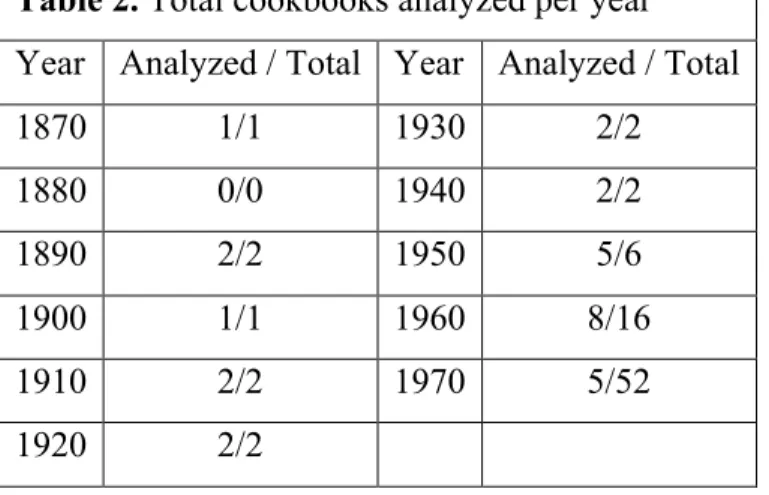
The following table lists the number of University of North Carolina – Chapel Hill cookbooks that have been analyzed out of the total number available from each decade:
Table 2. Total cookbooks analyzed per year Year Analyzed / Total Year Analyzed / Total
1870 1/1 1930 2/2
1880 0/0 1940 2/2
1890 2/2 1950 5/6
1900 1/1 1960 8/16
1910 2/2 1970 5/52
Findings and Analysis
After carefully examining the cookbooks, I came to create the categories that were previously presented in the methodology section. When the characteristics are read separately, they provide insight into different parts of the cookbook on a micro scale. These various aspects are significant because they have the ability to tell short stories about people, events, and food. When all the characteristics are read together, however, they create a narrative about the people of North Carolina.
The Audience and the Contributors
In the late 1800s, the majority of women held roles as housewives. They were bound to their homes and were expected to cook, clean, and ensure that their husbands stayed happy and their households flourished. If the family were wealthy, they would have had hired help in the home. Not uncommonly so, housekeepers were great sources for recipes. As was recognized in the 1899 Popular Cook Book, the recipes were not original and had been used by housekeepers of little reputation. Though the cookbook creators gave grateful acknowledgement to the housekeepers, these contributors were not acknowledged by name. This is seen again in the 1907 Raleigh Cook Book, which states that all the recipes have been “kindly furnished by Raleigh housekeepers,” but
Robert P. Dick, a housekeeper of fifty years. This was quite particular since housekeepers were not typically named, let alone able to publish their own books. Upon further
investigation of the author, it was discovered that Mrs. Robert P. Dick’s husband was an attorney, a North Carolina Supreme Court justice, and a United States District Court judge (Dick Family Papers, 1843-1930s). His wife, Mrs. Robert P. Dick, was Mary Eloise Adams, the daughter of George Adams and Justinia Madeliene Watkins Adams, of Pennsylvania County, Virginia. With the misinformed idea that housekeepers were typically women of a lesser status, it initially appeared suspicious for a woman of such stature to be a housekeeper, especially one of fifty years. In the process of further
researching housekeepers, however, it was discovered that the role is defined as a person who manages a large staff, keeps track of household expenses, and maintains most aspects of daily life in the home (Ross, 2015). With this information in mind, a
housekeeper could have easily been a housewife. To this extent, Mrs. Robert P. Dick was most likely the housekeeper of her own home. If this was so, it becomes less peculiar to see her name on the cookbook. Additionally, though the book is brief, it does not include advertisements that were so often seen in independently or group published cookbooks – the topic of advertisements will be further discussed later on in the paper. This would indicate a certain amount of wealth available for such a project, which can be confirmed by the Dick family’s ability to build a mansion on a large plot of land in Dunleath, North Carolina (Wharton, 2016).
comparatively less expensive outside services (Domestic Service, n.d.). Progressively, hired help fell out of the norm and women had to be the primary domestic housekeepers. The cookbooks of the Piedmont region reflect this by including tips and advice on how to run a successful household. This is often seen in the older cookbooks such as the 1872 Mrs. Elliott’s Housewife, where it has explicit phrases that indicate the role of a wife:
“God made woman a help-meet for man. He made her for work and not for an expensive luxury.” Though World War II allowed women to enter the workforce, the mindset of the good wife continued into the late 1950s appearing in commercial cookbooks such as the 1958 Betty Feezor’s Best, which claims that “homemaking is one of the most rewarding jobs that a woman can have.” This statement clearly shows that certain people wanted to go back to a time when a woman’s only job was to be the sole caretaker at home.
by men. Quite amusingly, in the 1968 Centenary Cookbook, male contributors are sectioned off into their own chapter titled “Men’s Specialties.” They take on their own special category, away from the women’s recipes. This is entertaining yet strange, since one must wonder if this was a stylistic choice for this particular cookbook since men appeared as regular contributors in other earlier cookbooks as was mentioned in My Favorite Recipes as well as in the 1953 The Volunteers Cook Book.
As one traverses through the years and moves towards the cookbooks that were published more recently, a shift in the intended audience can be seen. Instead of addressing women in their role as housewives, the cookbooks become more
mainstreamed for general use. Prior to the 1960s, the tips and advice presented in the cookbooks pertained to directions for housewives as well as general food preparation. By the 1960s, however, these tips primarily focused on the latter. These come in the form of cooking times for meats (steak, lamb, and pork) or guidelines for filleting fish and butchering meats. Taking note of the changing audience, cookbooks can indicate the transforming roles of men and women as well as the progressive developments in society. As more cookbooks became published and available, they became increasingly specific and directed at audiences with particular interests or preferences. For example,
her family; instead, the cookbooks were directed towards specific groups with certain interests and ideologies about food.
This brings us towards the types of cookbooks that exist within the realm of the studied cookbooks. There are three categories – those that were created through
collaboration, those that were individually published, and those that were commercially produced – these would refer to the cookbooks that were associated with celebrity chefs and popular cookbook editors such as the Betty Feezor cookbooks and Eudora’s
cookbook. The three different types of cookbooks had more or less the same audiences throughout the decades. Both individually and collaboratively published cookbooks directed their content towards a female audience until the 1930s, but after this time the books tended to not address any specific group of people. In the studied sample, commercial cookbooks first begin appearing in the latter end of the 1950s. They are directed towards fans and those who tune in for the television show.
The Physical Aspects
By looking at the physical attributes of a cookbook, one can immediately make preliminary assumptions about a cookbook’s intended purpose. One can look at the size, the shape, the material, and the binding type. The analyzed books are quite varied in all these aspects. Some are short and wide while others are long and thin. Five have hardcovers while the other twenty-five have soft covers. The types of bindings range from comb (ten books) to side stitch to hard cover or case to staple. These physical variations are not surprising if one takes notice of the fact that although these cookbooks all come from North Carolina’s Piedmont region, they were produced by an assortment of groups and people. These books span the course of a century and come from those who already had money to create cookbooks to those who needed to obtain and gather funds from businesses.
Keeping in mind that the intention of this research is to analyze cookbooks as cultural artifacts, the first thing that a researcher might assess is the size. Scanning through the array of books, it quickly came to my attention that twenty-four of the
example, The 1915 Twin-City Housewife was on the longer side, approximately 1’ x 4.5” – 5” and so was quite difficult to use. Due to the long length and short width of the book, it needed to be weighed down to prevent it from flipping shut. Unfortunately, even with the weights, it was difficult to keep the book open. With larger books, it was not
uncommon for them to be intended purely for display rather than use as is mentioned in Ken Albala’s article titled Cookbooks as Historical Documents. This may have been the case for the Twin-City Housewife cookbook, noting its long shape and cumbersome handling. This would imply that usage was not necessarily considered as an end factor for the large, irregular sized books. Those that are smaller and lighter are undoubtedly easier to handle. Their small size would have allowed users to easily move them around the kitchen and elsewhere. When handling all the various sizes of cookbooks, it is easy to become acquainted with those that were more user-friendly and those that were not. Size, however, was not the only factor effecting use. Binding types must also be considered.
such as churches, schools, or hospital committees. Assuming that these groups were not extremely wealthy, a comb binding would have been an effective yet inexpensive choice.
The materials used on the books also have the potential to indicate cookbook purpose. Most of these cookbooks had soft covers with only a few that had hard covers. Undoubtedly, soft covers would have been less expensive, indicating the creator’s budget. These covers, like the comb bindings, were prevalent in the group cookbooks. Cookbooks with hard covers may imply that the creator had money. This inference can be further supported by additional factors such as a lack of advertisements, which will be further touched upon later in the paper. Unfortunately, additional analysis of the materials used for the creation of the cookbooks such as paper type and cover material were not made, so this subject cannot be further expanded, but a researcher interested in the materiality of cookbooks can easily assess the different types of paper used as well as the various mediums used for the binding.
The Visuals
These would encourage those using the cookbooks, typically women, to be conscious of the current war economy and their social role. Unfortunately, this type of significant and strong imagery was not seen in the analyzed cookbooks, but it is a good example of how these objects were used to visually reflect and affect the people from the time that they were made.
Some cookbooks explicitly express the pride that is felt for a community through the images. The 1979 book From the Kitchens of Historic Oakwood displays historic houses from the historical Victorian Oakwood neighborhood in downtown Raleigh. Images of the houses are dispersed throughout the book with their corresponding addresses.
Cookbooks that were published by universities include images of the campus. Outside of these two categories of illustrations, the 1915 Twin-City Housewife displayed silhouettes of hired help throughout the book with a black woman rolling out dough on the cover.
Her ethnicity can be made out according to her facial features. From this, one could infer that the creator probably had hired help and found them integral to the kitchen. Typically the simple imagery that appear in cookbooks can easily provide an abundance of
information about the creators, the area of production, as well as the cultural and societal norms of the time. Unfortunately the examined sample did not display very many images that provided insight and so, the illustrations were not a useful measure for cultural analysis in this specific research though it can be in other cases.
Advertisements
The advertisement is featured on paper that is far more premium, almost feeling as if it is out of place. Two cookbooks, the 1920 Two Hundred Tested Recipes and the 1924 Central Cook Book, advertise Knox products throughout, featuring a product or tagline at
the tops of almost every page. The advertisements provided funding for the creation of the cookbooks. This was quite common and easily discerned, as the books would often have acknowledgements at the beginning or introduction to give thanks to all the
businesses that had helped with the financing of the publication. This recognition is given in several books including the 1917 Sweets and Meats and Other Good Things to Eat where they “thank the business men whose advertisements appear herein, without which this book could not have been published.” Since this was such a common sight when going through the cookbooks, it was always surprising when advertisements were not present in older books that preceded the 1960s. Not every cookbook has advertisements, but this could indicate an availability of funds for cookbook publishing. Alternatively, a very small batch of community cookbooks that uses inexpensive materials can avoid having to feature advertisements if they had another source of funds. As one moves through the century, advertisements continue to exist in the cookbooks through the 1950s, but soon after that, they taper off and are no longer evident. This does not necessarily mean that cookbooks are no longer sponsored by businesses, but rather that, the
promote their popped wheat cereal, Newport Fluffs (Driver, 2008, p. 923). The recipes used the cereal as an ingredient.
The Anatomy of the Recipe
Shifting focus further into the contents of the cookbook, one comes to assess the recipes. What first comes to attention is the anatomy of the recipe. In the older
cookbooks, the recipes are written in a narrative format. There is no separation between the ingredients and the instructions. Rather, the ingredients, measurements, and times are woven into the instructions so that the recipe is condensed into a single comprehensive paragraph. For example, in the 1872 Mrs. Elliott’s Housewife, one of the recipes reads: “Kill and clean a turtle very early in the morning and lay it in cold water. Wash and scrape the shell nicely. …At one o’clock put in the juice of one lemon.” This format is seen consistently until the 1920s when there is a gradual move towards separating the ingredients from the instructions. Through the 1930s, both formats are present until the 1940s when all recipes are separated into the two parts. Looking at the older recipes, one might infer that these are formatted in such a way due to the assumption that the
cooking. This undoubtedly suggests that this particular cookbook is intended for the experienced cooks. As one shifts to the more recent books around the end of the 1940s and the beginning of the 1950s, they come to be less about the preparation of meals by housewives for families and more about the sharing of moments and experiences or inspiring people to cook as the 1970 Wake Forest cookbook asserts. With this change in priority and audience, it seems to make sense that the creators of the cookbooks remove the assumption that the users are avid cooks. Additionally, when the shift happens from a narrative format to an instructional-based format in the 1940s, it was a time of
convenience and efficiency and so by listing ingredients before the instructions would have allowed cooks to easily see and gather their ingredients before beginning the cooking process.
The Recipes
Having already looked at articles on popular food trends through the decades, from fruit cocktails of the 1920s to aspics of the 1930s, casseroles in the 1950s and fondue in the 1970s, I was able to spot every prevalent recipe that reflected a trend. These trends ring true to a certain degree within the analyzed texts. For one, there was gelatin in everything. Beginning with the 1907 Raleigh Cook Book up to the 1958 Betty Feezor’s Best cookbook, there was at least one gelatin recipe per book. There were gelatin salads,
Cake on Electric Mixer,” and “Seven Minute Frosting.” Undoubtedly, developments in technology allowed for speedier food preparation, yet products such as stand mixers were not widely used before the 1920s (Nebeker, 2009, p. 131 and p. 238). Though fast recipes were quite popular during World War II, after the war, women were expected to move back to their kitchens and revert back to making meals completely from scratch rather than using convenient ingredients (Inness, 2006, p. 20 and Climent, 2015). This sentiment was seen in the 1961 Eudora’s Cook Book, which purposefully avoided
convenience foods to cherish how food used to be cooked. Eventually, with minds on the topic of health, cookbooks that suggest cooking with only fresh ingredients are released. This transition can be seen in the individual ingredients that are dictated within the recipes. People shift from using only fresh ingredients and even making their own yeast as was seen in the 1872 Mrs. Elliott’s Housewife to utilizing canned goods, frozen items, and all types of processed and convenience foods. Eventually by the 1960s and 1970s, however, some people went back to making meals from scratch.
The Ingredients
When studying the cookbooks, one can infer that in the late 19th century and
author includes a recipe titled “Hog-Killing Pie” with a description that says that the food was made and used to feed the hands during hog-killing time. Aside from the use of whole animals, I also observed that people used to eat animals that are not typically consumed today such as turtles, robins, squirrels, and opossum. These meats are no longer commonplace but were quite normal in a diet up to the 1910s. Opossum was even indicated as a favorite dish of Chapel Hill students in the 1872 book Mrs. Elliott’s Housewife. These unusual animals were phased out as food, but cow, pig, lamb, and
chicken organs continued to appear as ingredients in cookbooks for much longer.
Progressively, these also became less used towards the end of the 1970s. When one looks at the shift from cooking everything from scratch to convenience cooking, there is an obvious shift in the type and quality of ingredients, as was briefly mentioned.
Progressively, over the course of a century, people begin to use more varieties of canned goods, the earliest being canned tomato products and eventually using anything from canned soups to canned seafood. The canned goods have been in existence since the 1800s, but do not appear in the series of cookbooks until the 1900s. There is also a rise in the use of pre-prepared products such as pasta sauces and processed foods such as
is seen in the 1971 Salt-Free Cookery cookbook when it was believed that any amount of salt would cause people to keel over. During this time, food became much blander and there was an insistence on finding new ways to make food taste good, which forced cooks to look back towards the use of only natural ingredients. This came in the form of
increasing the use of herbs and animal bones for tasty broths. As one follows the
changing trends in food, they come to see how cookbooks were written as a reflection of the people. They come to see how events affect the way people cook and perceive food as well as how food, itself, changes the way people live. Though there is constant change in the diets, there are also certain foods that remain staples, especially in the Piedmont region of North Carolina. This is seafood.
Staple Foods
When analyzing the cookbooks, one particular food stood out – oysters. These shellfish were a large part of the Piedmont region diet. Going through the cookbooks, there were countless numbers of recipes for the preparation of this particular shellfish. The 1915 Twin-City Housewife featured all types of methods, ranging from kebobbed to minced to pickled to fried. Upon further research, one comes to learn that North Carolina is one of the largest harvesters of oysters in the United States. The History of Oyster Management Over the Past Century presented by Dr. Louis B. Daniel III of the N. C.
economics of North Carolina from this particular angle. This information is not relayed directly from the cookbooks, but the presence of such a large number of oyster recipes brings up speculation, allowing for additional research into the topic. It is found that Virginia pays $2.20 per bushel while North Carolina only pays $1.00, creating a significant gap between the two states (Daniel III, n.d.).
This observation was purely accidental. The cookbooks displayed a variety of seafood recipes, but oysters continuously appeared throughout the sample. This is a worthy example of how cookbooks can unexpectedly present information that would not be typically anticipated. Even when following a formula for cookbook analysis,
researchers must be hyper alert for such seemingly trivial information. It is such minute detail that will allow the emergence of a larger scope of knowledge.
The Unreliable Cookbook
the cookbook’s publishing. The same can be said about the Southern Cook Book. Rather than compiling recipes from one group of people, this cookbook seeks to gather recipes from the entire South to produce a comprehensive southern cookbook that can represent the entire region. Marion Brown, the author, goes about collecting recipes from a variety of entities, creating an in-depth view into Southern cuisine, but obstructing the possibility of using the book as a somewhat accurate first-hand resource. Due to examples like these, it can be acknowledged that cookbooks are not always true reflections of what people are eating at any one particular moment in time, but they continue to provide a certain amount of insight into people’s lives of specific decades.
Orthography
Orthography is the conventional spelling system of a language. Directing attention away from the food and the ingredients, one characteristic that came to be especially interesting was the variations in spelling. This was not a peculiarity that occurred throughout all the cookbooks, but there were several words that continually stood out. Within the thirty cookbooks, fourteen words displayed variations in their spelling. The list is as follows: yelk (yolk), catchup and catsup (ketchup), muscle (mussle), sour-kraut (sauerkraut), pine-apple (pineapple), cocoanut (coconut), caromel (caramel), piegeon (pigeon), cold slaw (coleslaw), tumeric (turmeric), oleo and
While sour-kraut, pine-apple, cold slaw, oleo and oleomargarine could have been regional spellings. Oleo and oleomargarine, however, both refer to what is now commonly known as margarine. The long version of the name is oleomargarine, but people have shortened the word differently in different states to either oleo or margarine. This is not necessarily a variation in spelling, but it still stood out as a particular
difference in word usage.
It was difficult to find detailed articles on the transformation of spelling, specifically pertaining to the words that were discovered in the cookbooks, but alas, complaints about the spelling of the word “coconut” was discovered in the Simmons’ Spice Mill from 1915. People had written in, explaining their desire for the
standardization of the word. The Franklin Baker Co. explains: “We have adopted the spelling principally because our advertising is oftentimes confused with ‘Baker’s Cocoa’ – hence the reason for our desire to get away from the spelling of the word with an ‘a.’” V. L. Price, the chairman of the National Confectioners’ Association whole-heartedly agreed with Mr. Franklin Baker, Jr. of the Franklin Baker Co. by explaining his own concerns: “Confectioners have had some trouble with the old way of spelling… by using the word COCOA, which is the name of a distinct product, to abbreviate the word COCOANUT. It seems to me that the habit could be easily formed.” Within this
Discussion and Conclusion
As predicted, the thirty analyzed cookbooks delivered an abundance of information. They worked well as primary resources and presented a convincing
depiction of the roles that people played in the North Carolina Piedmont region, the way food was treated, and the way people went about producing cookbooks. Moving through the cookbooks, I was admittedly not quite sure what contents I was searching for. I knew that I wanted to spot trends in the cookbooks, but not until I had looked at several of these objects did the information begin to become apparent. When moving through the process, every time a new significant aspect came to attention, I had to loop back to the cookbooks that had already been analyzed to note down the new points. As expected, the entire process was very cyclical. This ultimately slowed down the evaluation process and limited the number of books that could have been studied.
cookbooks were illustrious in describing a location where people lived very similarly as is described in written histories. Trends that were being experienced in the larger United States were also being encountered in the Piedmont region.
Hopefully, researchers can use this project as a jumping off point or reference to utilizing cookbooks as primary resources. They have the potential to mislead, but as with anything, larger sample sizes will deliver much more accurate information that will allow for the formation of highly insightful narratives. As seen with this project, it required thirty cookbooks to be examined for the presentation of a few substantial points.
Bibliography
Adamson, M. W. (2002). The Greco-Roman World. In Regional cuisines of medieval Europe : a book of essays (pp. 1–18). New York: Routledge.
Albala, K. (2012a). Cookbooks as Historical Documents. In The Oxford Handbook of Food History. : Oxford University Press. From
http://www.oxfordhandbooks.com.libproxy.lib.unc.edu/view/10.1093/oxfordhb/9 780199729937.001.0001/oxfordhb-9780199729937-e-13.
Albala, K. (2012b). Three world cuisines: Italian, Mexican, Chinese. Lanham, Md. : AltaMira Press.
American Antiquarian Society. (2016, December 06). Cookbooks. Retrieved from http://www.americanantiquarian.org/cookbooks.htm.
Ammon, U., & Hellinger, M. (1996). Contrastive sociolinguistics (p. vii, 504 p. : ill.). Berlin ; New York: Mouton de Gruyter.
Bon Appétit. (2012, October 11). Weird Food Trends through the Decades. Retrieved from https://www.bonappetit.com/restaurants-travel/article/weird-food-trends-through-the-decades
Carter, S. (1985, May 23). Chef Breaks Code to Ancient Recipes : Babylonian Collection Now the Oldest Known to Man. Los Angeles Times. Retrieved from
http://articles.latimes.com/1985-05-23/food/fo-8362_1_ancient-recipes
Daniel III, L. B. (n.d.). The History of Oyster Management Over the Past Century. North Carolina Oyster Blueprint: An Action Plan for Restoration and Protection.
Retrieved from https://ncoysters.org/oysters/history/
Dick Family Papers. (1843-1930s). In Greensboro History Museum. Retrieved from http://archives.greensborohistory.org/manuscripts/dick-family
Domestic Service. (n.d.). In Encyclopædia Britannica online. Retrieved from https://www.britannica.com/topic/domestic-service
Driver, E. (2008). Culinary Landmarks: a Bibliogrpahy of Canadian Cookbooks, 1825- 1949. Toronto: University of Toronto Press.
Dunn, A. D. (1972). Notes on the Standardization of Paper
Sizes. http://www.cl.cam.ac.uk/~mgk25/volatile/dunn-papersizes.pdf
Inness, S. A. (2006). Secret ingredients : race, gender, and class at the dinner table. New York: Palgrave Macmillan.
The Franklin Baker Co. (1915, January). Spell It “Coconut.” Simmons Spice Mill: Devoted to the Interests of the Coffee, Tea and Spice Trades, pp. 890.
Joseph, N. B. (2016). Cookbooks are our texts: Reading an immigrant community through their cookbooks. Religious Studies and Theology, 35(2),
12-195A,196A,197A,198A,199A,200A,201A,202A,203A,204A,205A,206A. Retrieved from http://libproxy.lib.unc.edu/login?url=https://search-proquest-com.libproxy.lib.unc.edu/docview/1870932759?accountid=14244
Miller, T. (2017). American Home Cooking: A Popular History. Rowman & Littlefield. Mitchell, J. (2001). Cookbooks as a social and historical document. A Scottish case
study. Food Service Technology, 1(1), 13-23.
Nebeker, F. (2009). Dawn of the electronic age : electrical technologies in the shaping of the modern world, 1914 to 1945 (p. xi, 536 p. : ill.). Hoboken, NJ: Institute of
Electrical and Electronics Engineers.
Neuhaus, J. (2012). Manly Meals and Mom's Home Cooking : Cookbooks and Gender in Modern America. Retrieved from
https://ebookcentral-proquest-com.libproxy.lib.unc.edu
Notaker, H. (2017a). A history of cookbooks : from kitchen to page over seven centuries. Oakland, California: University of California Press.
Notaker, H. (2017b, October 27). Cookbooks as Status Symbols: Tracing the path from 15th-century royal kitchens to 1992’s The Lifestyles of the Rich and Famous Cookbook and beyond. The Atlantic. Retrieved from
https://www.theatlantic.com/business/archive/2017/10/cookbooks-status-600-years/544164/
Ridley, G. (1999). The First American Cookbook. Eighteenth-Century Life 23(2), 11-123. Duke University Press. https://muse.jhu.edu/article/10494.
Ross, J. (2015). More than a housekeeper – a central figure in Biltmore House. Open House: The Official Blog of Biltmore. Retrieved from
http://www.biltmore.com/blog/article/more-than-a-housekeepera-central-figure-in-biltmore-house
Language and Literature, 34(1), 3-18.
Vester, K. (2015). A Taste of Power: Food and American Identities. Berkeley: University of California Press.
Walden, S. (2014). Marketing the Mammy: Revisions of Labor and Middle-Class Identity in Southern Cookbooks, 1880-1930. In D. A. Davis & T. Powell (Eds.), Writing in the kitchen : essays on Southern literature and foodways (pp. 50–68). Jackson:
University Press of Mississippi.
Walker-Barnes, C. (2014). Jezebels, Mammies, and Matriarchs. Too Heavy a Yoke: Black Women and the Burden of Strength. Eugene, Oregon: Cascade Books.
Wharton, D. (2016, October 12). Names in the Aycock Historic District. A Little Urbanity. Retrieved from http://littleurbanity.blogspot.com