ABSTRACT
The Resource Conservation and Recovery Act (RCRA), an
amendment to the Solid Waste Disposal Act, was enacted in
1976 to address waste disposal practices and existing
disposal sites. Subtitle C of RCRA provides a regulatory
framework for the safe management of hazardous waste from
initial production to ultimate disposal.
Hazardous waste facility inspections are the primary
means by which EPA, or states authorized by EPA to
administer the RCRA program, assure themselves that RCRA
regulatory requirements are being met. The purpose of the
current investigation was to assess the effectiveness of
RCRA inspections; the types of statutory and regulatory
violations identified in these inspections; the types of
waste being managed; and the general quality of hazardous
waste treatment, storage, and disposal in North Carolina.
There were fourteen (14) facilities permitted to treat
and store hazardous waste in N.C. as of September 1991.
However, only nine (9) of these facilities actually treated
waste on-site for the years 1987-1990.
Ninety percent or more of all hazardous waste generated
in the U.S. and in North Carolina is treated by the
generator on-site. Together, the nine N.C. permitted
hazardous waste facilities generated an average of 1,069
million pounds of hazardous waste each year during the
period 1987-1990. During this same time period they treated
an average of 946 million pounds each year.
From 1981-1992 there were 252 inspections conducted at
the nine permitted hazardous waste facilities. There were
140 violations identified as a result of the inspections,
forty-eight (48) of which were waste handling violations.
However, only twenty-three (23) of the waste handling
violations involved the actual treatment or storage of
hazardous waste.
Twenty-three waste handling violations identified at
the nine facilities over an eleven year period indicates a
high quality of hazardous waste treatment in N.C. when the
amounts of hazardous waste being treated and stored on-site
CONTENTS
PAGE
Introduction 1
Background 2
Results
- Hazardous vaste managed on-site 7
in N.C.
- Types of hazardous waste treated 10
on-site in N.C.
- Inspection of N.C. hazardous waste 12
facilities
- Violations at N.C. hazardous waste 15
facilities
Conclusions 18
Recommendations 21
Appendix A
- Annual report data (Waste generated) 22
- Annual report data (Waste treated 22
on-site)
Appendix B
- Major waste being treated on-site 23
Appendix C
- Types of inspections performed on 24
a yearly basis for individual
facilities
Appendix D
- Position description for commercial 28
inspectors
- Position description for waste 28
management specialists
Appendix E
- Commercial hazardous waste facility 29
inspectors quarterly report
References 30
TABLES
Page
1.1 Composite profile of the nine N.C. 9
permitted facilities
2.1 Major types of waste being treated 11
3.1 Number of annual inspections and 13
total violations for individual
companies
3.2 Categorical types of inspections 14
for individual facilities
4.1 Types of violations at TSD facilities 16
A.1 Annual report data - Waste generated 22
A.2 Annual report data - Waste treated on-site 22
B.1 Major waste being treated on-site 23
C.1-C.9 Types of inspections performed 24
INTRODUCTION
The Resource Conservation and Recovery Act (RCRA), an
amendment to the Solid Waste Disposal Act, was enacted in
1976 to address waste management practices and existing
disposal sites. Subtitle C of RCRA was designed to provide
a regulatory framework for the safe management of hazardous
waste from initial production to ultimate disposal.
In 1986 and 1987, at the request of Congress, the U.S.
General Accounting Office (GAO) evaluated the inspection of
a select number of RCRA treatment and disposal facilities
across the country. They concluded that these inspections
were not as thorough and complete as they should be.
The purpose of the current investigation was to assess
the effectiveness of RCRA inspections; the types of
statutory and regulatory violations identified in these
inspections; the types of waste being managed; and the
general quality of hazardous waste treatment, storage, and
disposal in North Carolina.
As of September 1991, there were fourteen (14)
commercial and non-commercial facilities permitted to treat
and store hazardous waste in North Carolina. There were an
additional twenty-five RCRA facilities in N.C. that were
only permitted to store hazardous waste. However, this
study was limited to those facilities holding a RCRA permit
time period. Of the fourteen facilities permitted to treat
and store hazardous waste, only nine (9) treated waste In
the time 1987-1990. The two commercial facilities were
Ecoflo Inc. (Greensboro) and Heritage Environmental Services
Company (Charlotte). The seven non-commercial facilities
were Burroughs Wellcome (Greenville), duPont (Duart),
General Electric (Wilmington), National Institute of
Environmental Health Sciences (Research Triangle Park),
Sandoz Chemicals (Charlotte), Singer Furniture (Lenolr), and
UNC-Chapel Hill.
BACKGROUND
Hazardous waste facility inspections are the primary
means by which EPA, and states authorized by EPA to
administer the RCRA program, assure themselves that RCRA
regulatory requirements are being met.(1) These inspections
serve three enforcement functions: 1) to detect and
document violations and discover Imminent hazards; 2) to
support enforcement actions; and 3) to determine conformance
with compliance and other enforcement orders.(2)
The authority for conducting inspections is granted
under Section 3007 of RCRA.(3) This section allows EPA, an
authorized state, or a representative of either of these to
enter any premises where hazardous waste is handled to
of generators and handlers of hazardous waste.
The Hazardous and Solid Waste Amendments of 1984 (HSWA)
established required inspection frequencies. HSWA requires
annual inspections of all Federal and State operated
facilities and biennial inspections of all other treatment,
storage, and disposal facilities (TSDFs).(5) However,
facilities may be inspected at any time the EPA or the State
has reason to believe a violation has occurred.
The second phase of the compliance monitoring program
involves taking enforcement actions to bring handlers into
compliance with applicable Subtitle C regulations.(6) The
goals of enforcement actions are to compel: 1) proper
handling of hazardous waste; 2> compliance with RCRA
recordkeeping and reporting requirements; and 3) monitoring
and corrective actions in response to releases of hazardous
waste.(7) RCRA enforcement may include administrative,
civil, or criminal actions. (8) The nature and severity of
the problem dictates which enforcement action is pursued.
For the RCRA enforcement program to be successful, there
must be a certain technical integrity of the inspections.(9)
Simply stated, this means that inspections are of little
value if violations are not detected.
Commercial hazardous waste facility inspectors have
been employeed by the Division of Solid Waste Management
the purpose of monitoring the operations of these facilities
to assure compliance with all laws and rules administered by
the Division and any other division of the Department of
Environment, Health and Natural Resources. The personnel
initially hired began inspecting facilities on June 3, 1991,
as required by the ratified bill and its amendment. During
the month of June all eleven facilities in the State were
visited and/or inspected by either assigned inspectors
and/or members of the Division Staff and Hazardous Waste
Section. There were a total of eighty-one (81) applicants
for the inspector positions, from which (4) were hired.
Each person was put through an intensive 4-6 week training
course tailored to their entry level, individual knowledge
and degree of expertise. This training included a 40 hour
course on the Resource Conservation Recovery Act (RCRA) and
40 hours of OSHA hazardous waste site workers training. Due
to the number of inspections required under the rules
adopted by the Commission for Health Services, it was
determined that four inspectors were sufficient at this time
(Commercial Hazardous Waste Facility Inspectors Quarterly
Report. October 1, 1991...See appendix E).
In 1986, the Chairman, Subcommittee on Transportation,
Tourism, and Hazardous Materials, House Committee on Energy
and Commerce, requested GAO to determine if EPA was
inspections were thorough and complete.<10) In response to
this request, the GAO accompanied EPA inspectors on 26 RCRA
inspections performed from December 1986 to May 1987 by
either EPA regional, state, or EPA contract inspectors.<11>
The results of that study showed RCRA hazardous waste
handler inspections were not as thorough and complete as
they should be. EPA regional, state, and EPA contract
inspectors were missing a substantial number of regulatory
violations during inspections, and the inspectors were not
covering all waste handler activities in their
inspections. <12) In addition, inspectors were not
adequately documenting the deficiencies being found. The
inspectors identified a total of 200 RCRA violations at 22
of the facilities. According to the EPA experts who
observed these inspections, an additional 181 violations
were not detected. Two-thirds of the missed violations were
Class I violations which, according to the EPA, could
represent an immediate and serious threat to the
environment. Furthermore, the inspection reports prepared
by the inspectors for 15 inspections were found to be
incomplete. The primary causes for these deficiencies were
identified as lack of inspector training and limited
~'Wp^^Ej^^i^'-S
RESULTS
In North Carolina, RCRA inspections are conducted
primarily by the State. The records of these inspections
provide a valuable data source that can be used to evaluate
compliance with RCRA and to determine the quality of
hazardous waste treatment and disposal at North Carolina
RCRA permitted facilities. These inspection files were
reviewed to determine the types and numbers of inspections
being conducted on a yearly basis at each facility. The
data were then classified as Compliance Evaluation
Inspections <CEI), Record Reviews, Compliance Schedule
Evaluations (CSE), Comprehensive Ground-Water Monitoring
Evaluations (CME), and Additional Inspections. The most
important information obtained from the inspection data was
not the number/types of inspections, but the violations
being detected during the inspections. After compiling the
violations being identified at individual facilities, the
violations were broken down into the following categories:
1) Waste Handling; 2) Records; 3) Financial; 4) General
Facility; and 5) Other. However, before presenting those
results, it is necessary to discuss on-site hazardous waste
management, and the types of hazardous waste being treated
Hazardous Waste Managed On-Slte In North Carolina
Ninety percent or more of all hazardous waste generated
in the U.S. and North Carolina is treated by the generator
on-site.<14> Excluding small quantity generators, N.C.
industries generated 3,026 million pounds of hazardous waste
in 1990, of which 2., 802 million pounds was hazardous
wastewater, 128 million pounds of recurring hazardous waste
and 96 million pounds from one time site cleanups.(15) Only
6. a>i of this waste was shipped off-site for treatment or
disposal.
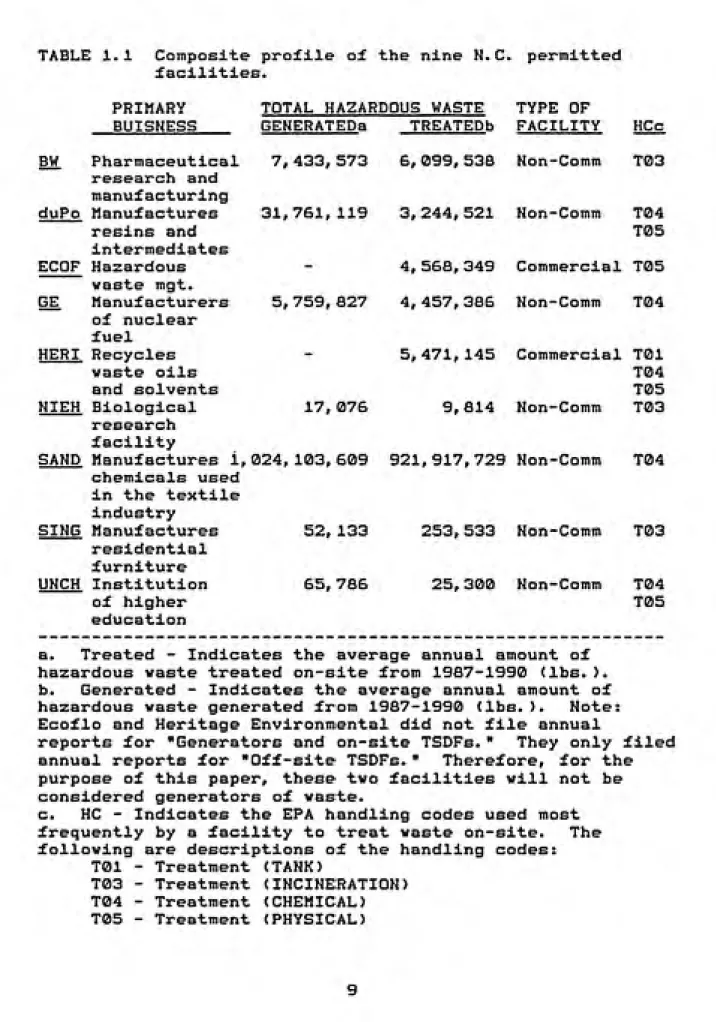
Together, the nine N.C. permitted hazardous waste
facilities treated an average of 946.1 million pounds of
hazardous waste on-site each year during the period
1987-1990. During this same time period they generated an
average of 1,069.1 million pounds each year (Table 1.1).
Ninety-seven percent (97.4y.) of the waste managed by these
nine facilities was treated by Sandoz Chemical Corporation
in Charlotte, N.C. Sandoz's waste is primarily hazardous
wastewater and is treated by chemical processes. Each of
the other eight facilities treat relatively small amounts of
hazardous waste each year using incineration, chemical and
physical methods.
Ecoflo and Heritage Environmental, the two commercial
operational services which generate hazardous waste,
however, both accumulate treatment residues which must be
shipped off-site for treatment or disposal. Heritage's
primary buisness is the recycling of waste oils and
TABLE
1.1 Composite
profile of the nine N. C. permittedfacilities.
PRIMARY TOTAL HAZARDOUS WASTE TYPE OF
BUISNESS GENERATEDa
7, 433, 573
TREATEDb
6, 099, 53S
FACILITY Non-Comm HCc Pharmaceutical T03 research and manufacturing
Manufactures 31,751, 119 3,244,521 Non-Comm T04
resins and T05
intermediates
Hazardous
-4, 568, 349 Commercia 1 T05
waste mgt.
Manufacturers 5, 759, 827 4,457,386 Non-Comm T04
of nuclear fuel
Recycles
-5,471,145 Commercia1 T01
waste oils T04
and solvents T05
Biological 17,076 9,814 Non-Comm T03
research
facility
Manufactures 1, 024,103,609 921,917,729 Non-Comm T04
BW duPo ECOF 6E HERI NIEH SAND chemicals used in the textile
industry
SING Manufactures residential furniture UNCH Institution of higher education52, 133 253,533 Non-Comm T03
65,786 25,300 Non-Comm T04
T05
a. Treated - Indicates the average annual amount of
hazardous waste treated on-site from 1987-1990 (lbs.).
b. Generated - Indicates the average annual amount of
hazardous waste generated from 1987-1990 (lbs.). Note:
Ecoflo and Heritage Environmental did not file annual
reports for "Generators and on-site TSDFs." They only filed
annual reports for "Off-site TSDFs." Therefore, for the
purpose of this paper, these two facilities will not be
considered generators of waste.
c. HC - Indicates the EPA handling codes used most
frequently by a facility to treat waste on-site. The
following are descriptions of the handling codes:
T01 - Treatment (TANK)
The amount of hazardous waste treated by these
facilities varies significantly from year to year (N.C.
annual report data in appendix A). Sandoz significantly
reduced the volume of waste generated and treated over the
four year period 1987-1990. They reduced the generation of
hazardous waste by 75% and the amount of waste treated by
over 99% during this period. The trend in waste management
at the University of North Carolina at Chapel Hill was the
opposite. The amount of waste generated increased from
32,712 pounds in 1987 to 84,932 pounds in 1990 (61%), and in
the waste treated from 1,042 pounds in 1988 to 65,171 pounds
in 1990 (98%), however, these amounts are insignificant when
compared to the most recent volumes for Sandoz.
Types Of Hazardous Waste Treated On-Site In N.C.
The generic description of "characteristic" hazardous
waste as used by the North Carolina Division of Solid Waste
Management is:
Characteristic Wastes - a waste is hazardous if it
exhibits one or more of the following
characteristics:a. Ignitability - Ignitable waste can create fires
under certain conditions. Examples include liquids
that readily catch fire, and friction-sensitive
substances.
b. Corrosivity - Corrosive wastes include those
that can burn the skin and those capable of
c. Reactivity - Reactive wastes are unstable under
normal conditions. They can create explosions
and/or toxic fumes, gases, and vapors when mixed
with water. Examples are cyanide plating wastes,
bleaches.
d. Toxicity - Toxic wastes are harmful or fatal if
ingested or absorbed.
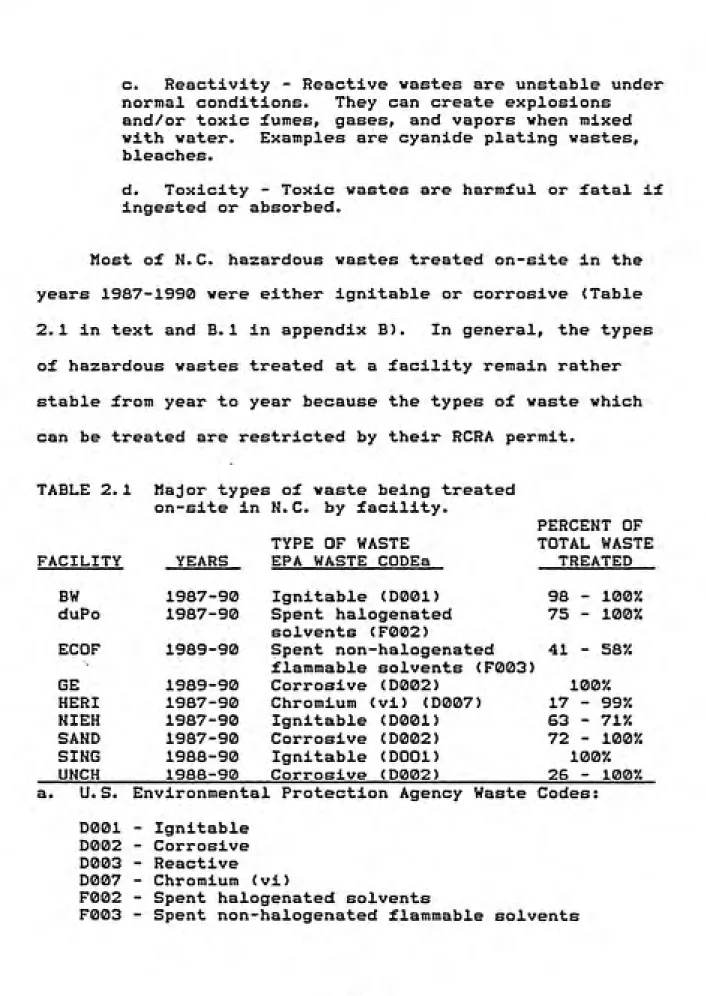
Most of N.C. hazardous wastes treated on-site in the
years 1987-1990 were either ignitable or corrosive <Table
2.1 in text and B.1 in appendix B). In general, the types
of hazardous wastes treated at a facility remain rather
stable from year to year because the types of waste which
can be treated are restricted by their RCRA permit.
TABLE 2.1 Major types of waste being treated
on-site in N.C. by facility.
TYPE OF WASTE FACILITY YEARS EPA WASTE CODEa
BW 1987-90 Ignitable (D001)
duPo 1987-90 Spent halogenated
solvents (F002)
ECOF 1989-90 Spent non-halogenated
flammable solvents (F003) GE 1989-90 Corrosive (D002)
HERI 1987-90 Chromium (vi> (D007)
NIEH 1987-90 Ignitable (D001)
SAND 1987-90 Corrosive (D002)
SING 1988-90 Ignitable (DOOl)
UNCH 1988-90 Corrosive (D002)
PERCENT OF TOTAL WASTE
TREATED
98 - 100*/. 75 - 100*/.
41 - 58%
100*/. 17 - 99*/. 63 - 71*/.
72 - 100% 100%
26 - 100%
a. U.S. Environmental Protection Agency Waste Codes:
D001 - Ignitable
D002 - Corrosive
D003 - Reactive
D007 - Chromium (vi)
F002 - Spent halogenated solvents
In 1990, forty five percent (100.9 million pounds) of
the hazardous vaste generated in North Carolina was K series
wastes [wastewater treatment sludge from woodtreating
(K001), spent potliners (K008), emission control dust/sludge
from steel production <K083), solvent caustic or water
washes and sludges from ink formulation <K0S6), etc...];
twenty five percent (56.1 million pounds) was D series
wastes (ignitable, corrosive, reactive, toxic); and twenty
four percent (53.8 million pounds) was F series wastes
[spent halogenated solvents (F002), spent non-halogenated
flammable solvents (F003), electroplating wastewater sludge
(F006)]. The other six percent was P and U series wastes
(discarded chemical products).
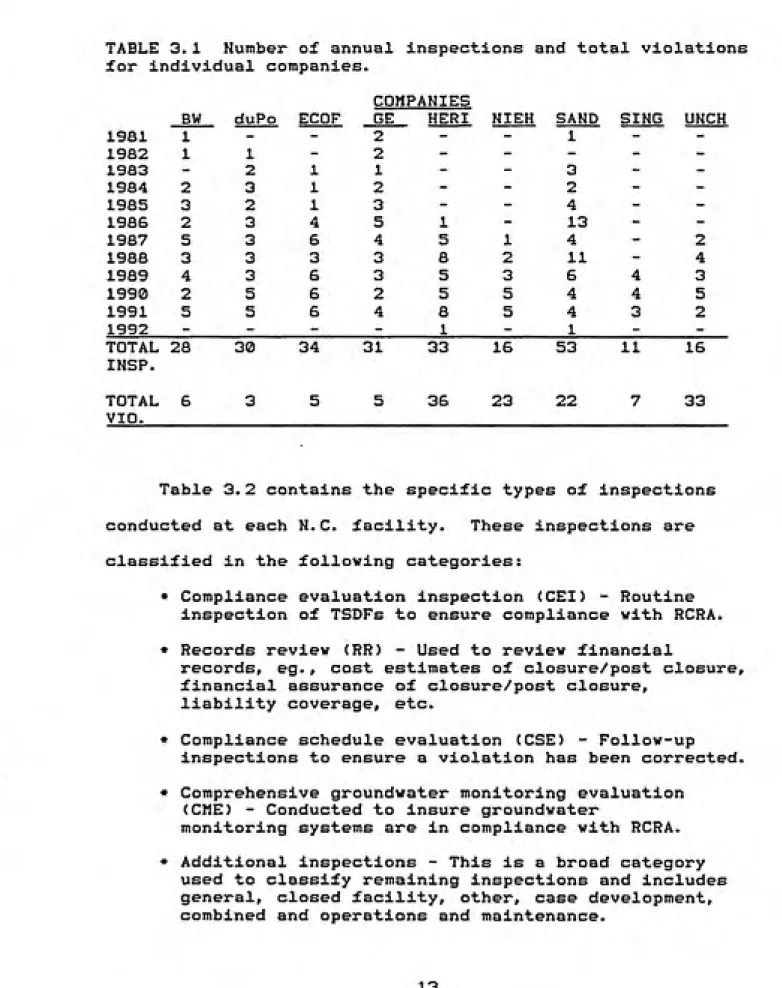
Inspection Of N.C. Hazardous Waste Facilities
The Hazardous and Solid Waste Amendments Act (HSWA)
requires annual inspections of all Federal and state
facilities and biennial inspections of all other facilities.
Table 3.1 shows the total number of inspections and
violations for N.C. on-site treatment facilities for the
TABLE 3.1 Number of annual inspections and total violations
for individual companies.
COMPANIES
BW duPo ECOF GE HERI NIEH SAND SING UNCH
1981 1 -
-2 -
-1 -
-1982 1 1
-2 - - - -
-1983
-2 1 1 -
-3 -
-1984 2 3 1 2 -
-2 -
-1985 3 2 1 3 -
-4 -
-1986 2 3 4 5 1
-13 -
-1987 5 3 £ 4 5 1 4
-2
1988 3 3 3 3 8 2 11
-4
1989 4 3 G 3 5 3 6 4 3
1990 2 5 6 2 5 5 4 4 5
1991 5 5 6 4 8 5 4 3 2
1992 - - -
-1
-1 -
-TOTAL 28 30 34 31 33 16 53 11 16
INSP.
TOTAL 6 3 5 5 36 23 22 7 33
VIO.
Table 3.2 contains the specific types of inspections
conducted at each N.C. facility. These inspections are
classified in the following categories:
* Compliance evaluation inspection (CEI) - Routine
inspection of TSDFs to ensure compliance with RCRA.
* Records review (RR) - Used to review financial
records, eg., cost estimates of closure/post closure,
financial assurance of closure/post closure,
liability coverage, etc.
• Compliance schedule evaluation (CSE) - Follow-up
inspections to ensure a violation has been corrected.
« Comprehensive groundwater monitoring evaluation
(CME) - Conducted to insure groundwater
monitoring systems are in compliance with RCRA.
Additional inspections - This is a broad category
used to classify remaining inspections and includes
general, closed facility, other, case development,
BW 16 6 2
duPo 16 8 3
ECOF 17 13 3
GE 19 9 3
HERI 10 12 10
NIEH 8
-6
SAND 17 16 9
SING 5 3 3
UNCH 9
-6
28 1981-91
30 1982-91
34 1983-91
31 1981-91
33 1986-92
16 1987-91
53 1981-92
11 1989-91
16 1987-91
TABLE 3. 2 Categorical types of inspections for individual
facilities.COMPANY TOTALS
CEI RR CSE CME ADDITIONAL TOTAL YEARS
4
3 - 1
1 2 6 5
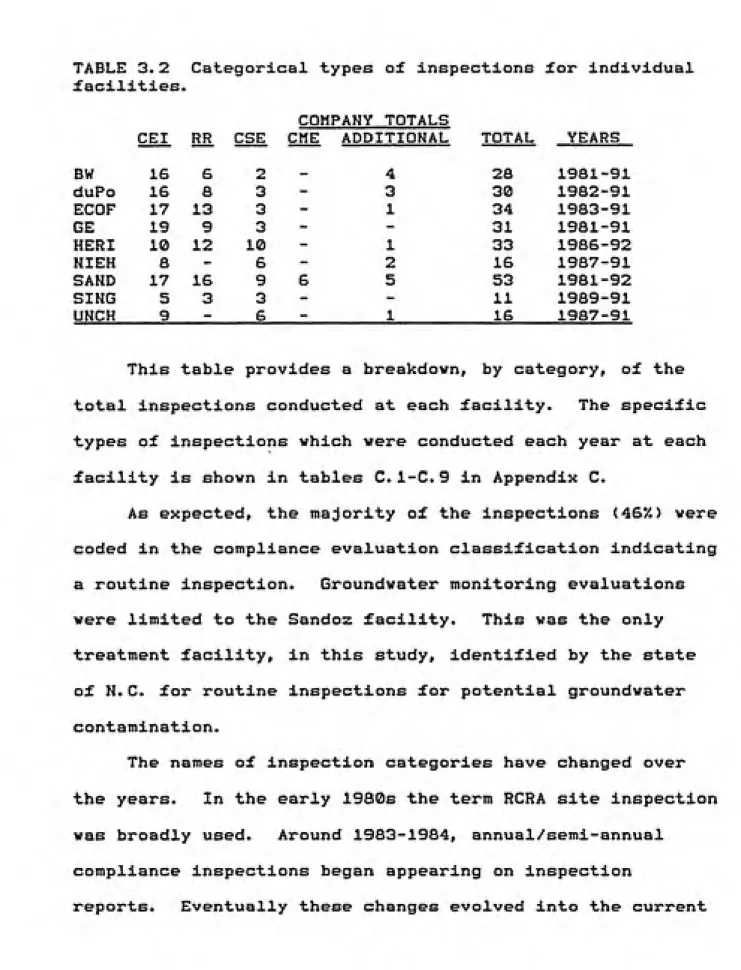
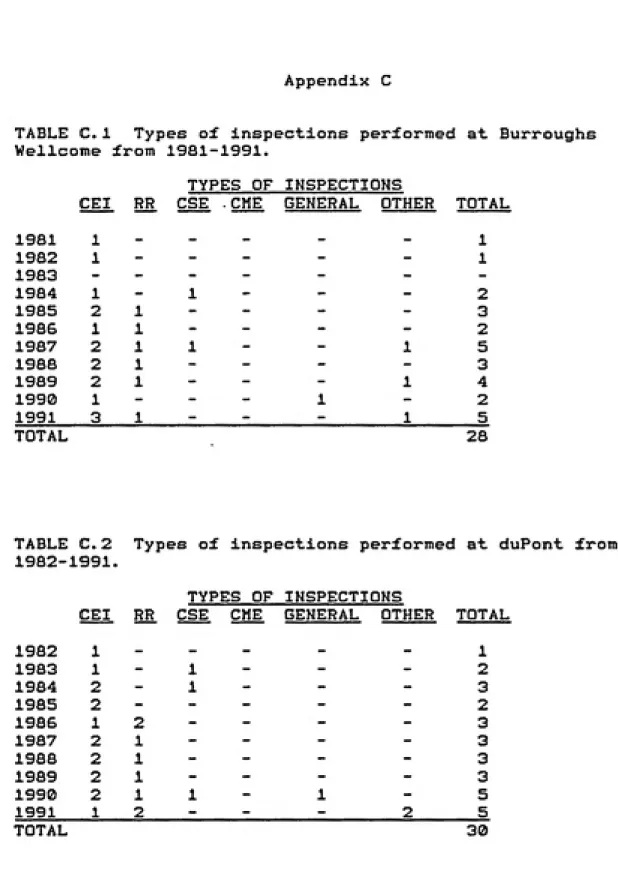
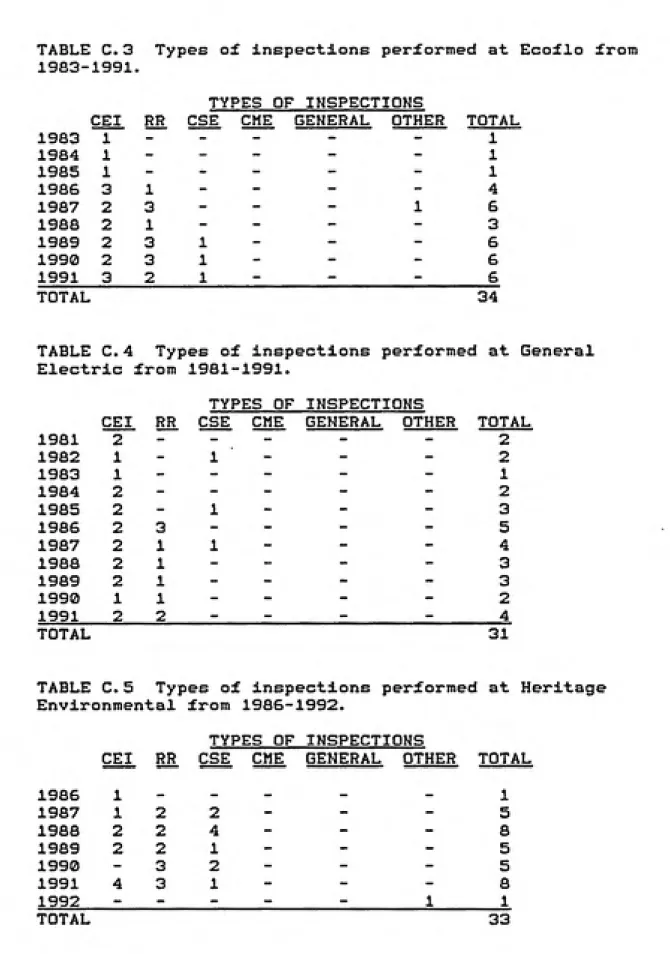
This table provides a breakdown, by category, of the
total inspections conducted at each facility. The specific
types of inspections which were conducted each year at each
facility is shown in tables C.1-C.9 in Appendix C.
As expected, the majority of the inspections (46%) were
coded in the compliance evaluation classification indicating
a routine inspection. Groundwater monitoring evaluations
were limited to the Sandoz facility. This was the only
treatment facility, in this study, identified by the state
of N.C. for routine inspections for potential groundwater
contamination.
The names of inspection categories have changed over
the years. In the early 1980s the term RCRA site inspection
was broadly used. Around 1983-1984, annual/semi-annual
compliance inspections began appearing on inspection
compliance evaluation inspection category. For the purpose
of this evaluation, both the early RCRA site inspections and
the annual/semi-annual compliance inspections have been
included in the CEI category. Please note that this
explanation of the changes in inspection names and forms
over the last 10-12 years has been greatly simplified.
Violations At N.C. Hazardous Waste Facilities
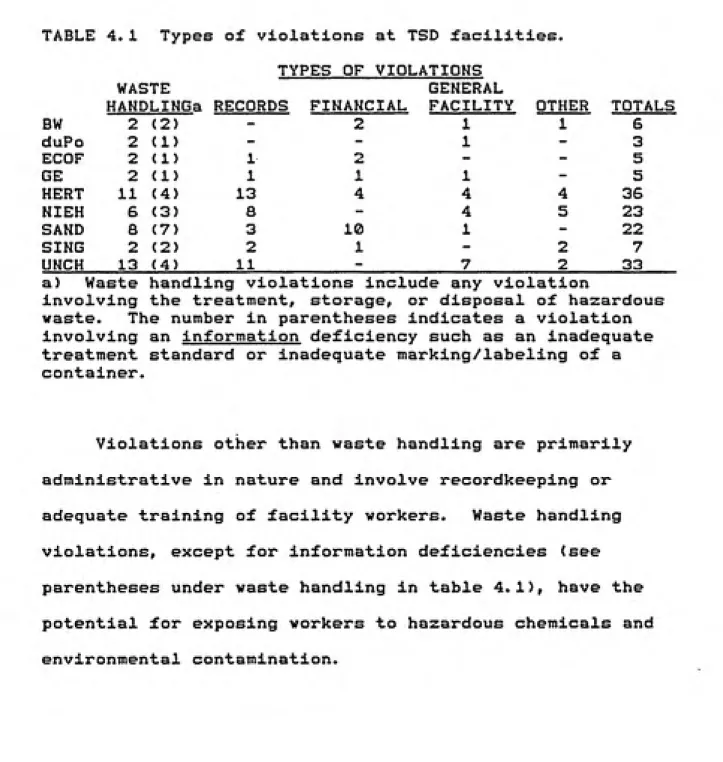
The types of violations detected at each facility are
shown in table 4.1. The following categories were used to
classify these violations:
« Waste Handling - Violations involving the treatment,
storage, or disposal of hazardous waste.
Records - Violations involving record keeping. In
most cases, these involved some type of paper work
error such as no I.D. number on a manifest form,
failure to include something in an annual report,
failure to record daily/weekly inspection information
in an inspection log.
« Financial - Violation of the many financial
requirements such as certificate of insurance for
liability requirements not in order, financial test
and corporate guarantee not updated and/or timely
submitted, financial test not adjusted for inflation,
letter of credit for closure was in violation.
• General Facility - includes violations such as
failure to post a sign such as "Danger" or "No
Smoking", annual review of training for facility
personnel was not conducted, the contingency plan
was inadequate, required aisle space was not met.
* Other - this final category includes all other
violations that did not fit into the other
TABLE 4.1 Types of violations at TSD facilities.
TYPES OF VIOLATIONS
WASTE GENERAL
HANDLINGa RECORDS FINANCIAL FACILITY OTHER TOTALS
BW 2 (2) - 2 1 1 6
duPo 2 (1) - - 1 - 3
ECOF 2 (1) 1 2 - - 5
GE 2 <1) 1 1 1 - 5
HERT 11 (4) 13 4 4 4 36
NIEH 6 (3) 8
-4 5 23
SAND 8 (7) 3 10 1
-22
SING 2 (2) 2 1 - 2 7
UNCH 13 (4) 11 - 7 2 33
a) Waste handling violations include any violation
involving the treatment, storage, or disposal of hazardous
waste. The number in parentheses indicates a violation
involving an information deficiency such as an inadequate
treatment standard or inadequate marking/labeling of a
container.
Violations other than waste handling are primarily
administrative in nature and involve recordkeeping or
adequate training of facility workers. Waste handling
The twenty-three (23) non-informational waste handling
violations observed at N.C. facilities over the 1981-92
period included:
« Waste containers not tightly closed 6 Violations
* Leaking waste containers 4
« Waste containers in poor condition 3
Waste containers without adequate 3
secondary containment
Improper storage of waste containers 3
« Number of drums of waste exceeded 3
permit limits
* Acids and reactives not stored in 1
fire proof cabinet
These kinds of violations were consistent with those
found by the General Accounting Office. The GAO identified
22 violations , which were missed by RCRA inspectors,
involving the use and management of containers; 10 were open
container violations, 4 violations concerned the poor
condition of containers and 2 violations involved
incompatible storage of waste. The GAO classified 20 of the
22 violations as Class I violations which, according to the
EPA, could represent an immediate and serious threat to the
CONCLUSIONS
GAO has stated that "Waste handler inspections are the
primary means by which EPA and states authorized by EPA to
administer the RCRA program assure themselves that
regulatory requirements are being met." There were a total
of 252 inspections conducted at the nine N.C. permitted
facilities from 1981-1992. The number of inspections at
each facility exceeded regulatory requirements. These
inspections resulted in the identification of 140
violations. Of the 140 violations, there were only 48 waste
handling violations. However, 25 of the waste handling
violations only involved information deficiencies. This
means that out of 140 violations detected at the nine
facilities from 1981-1992, only 23 violations involved the
actual storage/treatment of hazardous waste and 16 of these
violations were observed at only two of the nine facilities.
As reported by the GAO, when EPA inspection experts
accompanied RCRA inspectors on 26 inspections, 200
violations were identified at 22 of the facilities and an
additional 181 were not detected. Using only existing
records it was not possible to determine the number of
not appear that many violations, particularly those that
might present an immediate hazard to human health and the
environment, went undetected. During the period covered by
the N.C. inspection records, no RCRA facility was inspected
less than an average of 2.5 times each year and two
facilities were inspected, on the average, more than 4 times
each year. Through 1991, every facility, with only four
exceptions, was inspected annually for waste handling
operations.
All of the data for this evaluation were obtained from
N.C. inspection records. It would have been beneficial, in
the interpretation of the results, if the 23 waste handling
violations had been classified with respect to the degree of
danger/hazard they presented to human health and the
environment. However, this was not possible due to the
nature of the inspection records. In most cases, each
violation was cited by the RCRA provision violated as well
as a brief description of the violation (eg. RCRA 265.35
-insufficient aisle space to inspect hazardous waste storage
containers). With the information available, it would have
been purely speculation to rank each violation with regard
to potential hazards to human health and the environment.
Even though the hazard these violations may have
violations are a very small number considering they were
identified over an 11 year period at nine facilities.
Second, only 13 of the 23 waste handling violations would
appear to be a threat of significant proportions [waste
containers not tightly closed (6), leaking waste containers
<4), waste containers in poor condition (3)D. When the
amount of waste these facilities are treating on-site is
taken into consideration, there are very few waste handling
violations being committed.
There are a number of ways to interpret these data.
First, the number of waste handling violations being
detected at permitted hazardous waste facilities in North
Carolina indicates a high quality of waste handling. On the
otherhand, it could be argued, with reference to the 1987
GAO report titled "Hazardous Waste Facility Inspections Are
Not Thorough And Complete," that the small number of waste
handling violations being identified may indicate nothing
about the quality of hazardous waste treatment in N. C. In
other words, there may actually be more waste handling
violations being committed but the inspectors are missing
them. However, the nature of this study was to evaluate
North Carolina's RCRA inspection program based on existing
RECOMMENDATIONS
The following recommendations are suggested for
documenting and assuring the quality of the North Carolina
RCRA inspection program:
1. On a regular schedule, an experienced independent
RCRA inspector should accompany N.C. inspectors as
they evaluate RCRA treatment and disposal
facilities. This oversight is particularly
important for less experienced inspectors. The GAO
report recommended that each EPA region oversee 10
percent of state RCRA inspections.
2. N.C. inspectors should be regularly provided with
inservice training. The EPA expert inspectors who
assisted the GAO evaluation cited a lack of
training as a major factor contributing to poor
inspector performance.
3. Even though EPA has not established minimum
qualification standards for RCRA inspectors,
according to the GAO report, N.C. uses minimum
requirements for employing these inspectors (See
appendix D - State Personnel form PD-102R-89 for
commercial inspectors and waste management
APPENDICIES
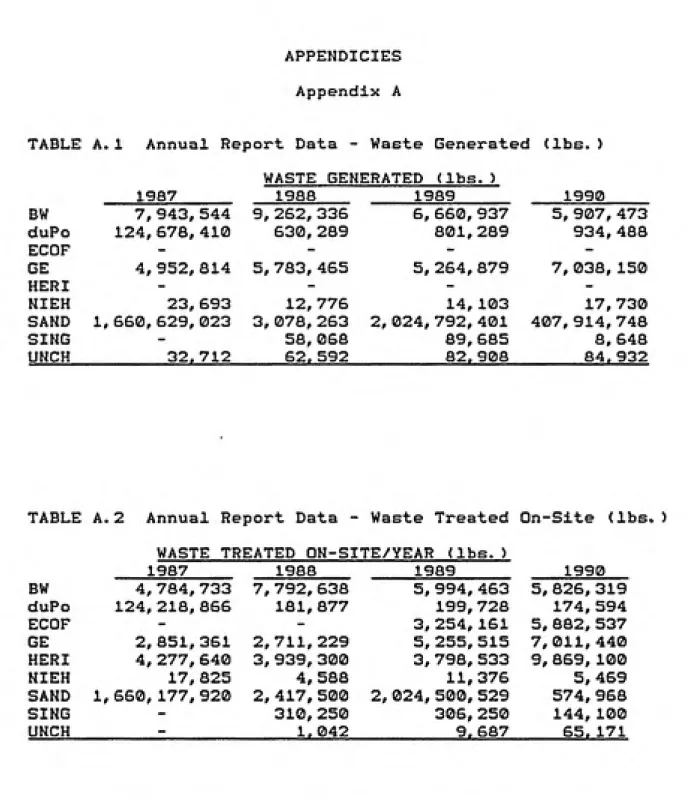
Appendix A
TABLE A.1 Annual Report Data - Waste Generated (lbs.)
WASTE GENERATED (lbs.)
19S7______ 1988 1989______ 1990
BW 7, 943, 544 9, 262, 336 6, 660, 937 5, 907, 473
duPo 124,678,410 630,289 801,289 934,488
ECOF
-GE 4,952,814 5,783,465 5,264,879 7,038,150
HERI _ _
-NIEH 23,693 12,776 14,103 17,730
SAND 1,660,629,023 3,078,263 2,024,792,401 407,914,748
SING - 58,068 89,685 8, 648
UNCH__________32.712______62. 592__________82. 908________84.932
TABLE A.2 Annual Report Data - Waste Treated On-Site (lbs.)
WASTE TREATED ON-SITE/YEAR (lbs.)
1987 1988 1989 1990
BW 4,784,733 7, 792, 638 5, 994, 463 5,826,319
duPo 124,218,866 181,877
199,728
174,594ECOF -
-3,254, 161
5, 882, 537
GE
2,851,361
2,711,229 5,255,515 7,011,440HERI
4, 277, 640
3, 939, 300
3, 798, 533 9,869, 100NIEH 17,825
4,588
11,376 5, 469SAND
1, 660, 177, 920
2,417,500
2, 024, 500, 529
574,968
SING
-310,250
306,250
144, 100Appendix B
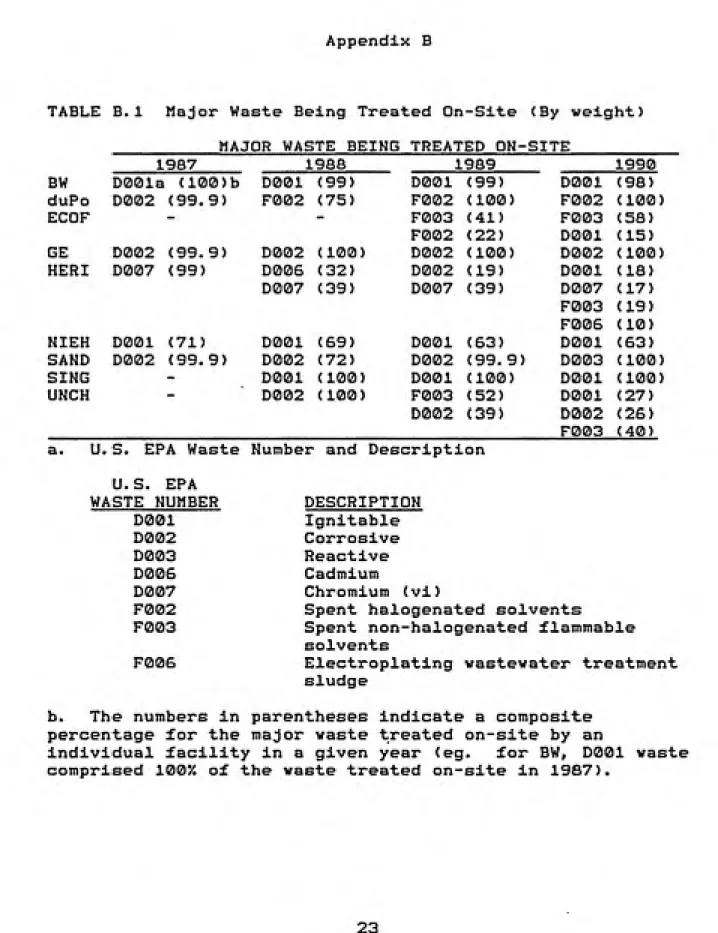
TABLE B.1 Major Waste Being Treated On-Site (By weight)
MAJOR WASTE BEING TREATED ON-SITE
1987 1988 1989
D001
1990
BW D001a (100)b D001 (99) D001 (99) (98)
duPo D002 (99. 9) F002 (75) F002 (100) F002 (100)
ECOF — ~
F003 F002 (41) (22) F003 D001 (58) (15)
GE D002 (99. 9) D002 (100) D002 (100) D002 (100)
HERI D007 (99) D006 (32) D002 (19) D001 (18)
D007 (39) D007 (39) D007
F003
F006
(17) (19) (10)
NIEH D001 (71) D001 (69) D001 (63) D001 (63)
SAND D002 (99. 9) D002 (72) D002 (99.9) D003 (100)
SING
-D001 (100) D001 (100) D001 (100)
UNCH D002 (100) F003
D002 (52) (39) D001 D002 F003 (27) (26) (40) a. U .S. EPA Waste
Number and Description
U.S. EPA
WASTE NUMBER DESCRIPTION
D001
Ignitable
D002 Corrosive
D003 Reactive
D006 Cadmium
D007 Chromium (vi)
F002
Spent hal ogenated solvents
F003 Spent non-halocjenated flammable
F006
solvents
Electroplating wastewater treatment
sludge
b. The numbers in parentheses indicate a composite
percentage for the major waste treated on-site by an
individual facility in a given year (eg. for BW, D001 waste
Appendix C
TABLE C.1 Types of inspections performed at Burroughs
Wellcome from 1981-1991.
TYPES OF INSPECTIONS
CEI RR CSE CUE GENERAL OTHER TOTAL
1981 1 - - - -
-1
1982 1 - - - 1
1983 - - -
-1984 1
-1 - - - 2
1985 2 1 - - -
-3
1986 1 1 - - -
-2
1987 2 1 1 - - 1 5
1988 2 1 - - - - 3
1989 2 1 - -
-1 4
1990 1 - - - 1
-2
1991 3 1 - - - 1 5
TOTAL 28
TABLE C.2 Types of inspections performed at duPont from
1982-1991.
TYPES OF INSPECTIONS
CEI RR CSE CME GENERAL OTHER TOTAL
1982 1 _ — _ — _ 1
1983 1 - 1 - -
-2
1984 2 - 1 - - - 3
1985 2 - - - 2
1986 1 2 - - - - 3
1987 2 1 - - -
-3
1988 2 1 - - - - 3
1989 2 1 - - - - 3
1990 2 1 1 - 1
- 5
1991 1 2 - -
-2 5
TABLE C.3 Types of inspections performed at Ecoflo from
1983-1991.
TYPES OF INSPECTIONS
CEI RR CSE CME GENERAL OTHER TOTAL
1983 1 - - - -
-1
1984 1 - - - -
-1
1985 1 - - - -
-1
1986 3 1 - - - - 4
1987 2 3 - -
-1 6
1988 2 1 - - - - 3
1989 2 3 1 - - - &
1990 2 3 1 - -
-&
1991 3 2 1 - - - 6
TOTAL 34
TABLE C.4 Types of inspections performed at General
Electric from 1981-1991.TYPES OF INSPECTIONS
CEX RR CSE CKE GENERAL OTHER TOTAL
2
1 - - - 2
- - 1
2
1 - - - 3
- - 5
1 - - - 4
- - 3 - - 3 - - - 2
_________________- _______::________::;_______4
TOTAL 31
TABLE C.5 Types of inspections performed at Heritage
Environmental from 1986-1992.TYPES OF INSPECTIONS
1981 2
-1982 1
-1983 1
-1984 2
-1985 2
-1986 2 3
1987 2 1
1988 2 1
1989 2 1
1990 1 1
1991 2 2
CEI RR CSE CME GENERAL OTHER TOTAL
1986 1 - - - - — 1
1987 1 2 2 - - - 5
1988 2 2 4 - - - 8
1989 2 2 1 - - - 5
1990 - 3 2 - - - 5
1991 4 3 1 - - - 8
1992 - - - 1 1
TABLE C.6 Types of inspections performed at NIEHS from
1987-1991.
TYPES OF INSPECTIONS
CEI RR CSE CME GENERAL OTHER TOTAL
1987 1 - - - 1
1988 1 - 1 - - - 2
1989 2 - 1 - - - 3
1990 2
-2 - _ 1 5
1991 2 - 2 - 1 - 5
TOTAL 16
TABLE C.7 Types of inspections performed at Sandoz from
1981-1992.
CEI RR
TYPES OF INSPECTIONS
CSE CME GENERAL OTHER TOTAL
1981 1 - -
-1982 - - -
-1983 2 - -
-1984 1
-1
-1985 2 1 1
-1986 2 4 4
-1987 3 -
-1
1988 1 3 3 3
1989 2 4 -
-1990 2 1 - 1
1991 1 2 - 1
1992
-1 -
-3
1
TOTAL
3 2 4 13
4
TABLE C.8 Types of inspections performed at Singer from
1989-1991.TYPES OF INSPECTIONS
CEI RR CSE CUE GENERAL OTHER TOTAL
1989 1 1 2 - - - 4
1990 2 1 1 - -
-4
1991 2 1 - - -
-3
TOTAL 11
TABLE C.9 Types of inspections performed at UNC-Chapel Hill
from 1987-1991.TYPES OF INSPECTIONS
CEI RR CSE CME GENERAL OTHER TOTAL
1987 1 1 - — -
-2
1988 3 - 1 - - - 4
1989 3 - - - -
-3
1990 2 - 3 - - - 5
1991 -
-1 -
-1 2
STATE OF NORTH CAROLINA
OFFICE OF STATE PERSONNEL
POSITION DESCRIPTION FORM (PD-102R-89)
Approved Classification: Effective Date:_
Analyst:________
(This Space for Personnel Dept. Use Onlv) 1. Present Classification Title of Position
New Position
7.
Pres. 15 Digit Pos. No. Prop. 15 digt Pos. No.
4324-0000-0024-5482. Usual Working Title of Facility
Comaercial Inspector
8. Department, University, Ccomission, or Agency
Department of Environment. Health, fi Natural Resources
3. Requested Classification of Position Waste Manaaement Specialist III
9. Institution & Division
Solid Waste Manaqement Division 4. Name of Innediate Supervisor
Vacant
10. Section and Unit
5. Supervisor's Position Title S Position Number Environmental Supervisor. 4324 0000 0024 549
11. Street Address, City and County
401 Oberlin Rd.. P.O. Box 27687. Raleiqh. NC. Wake 6. Nane of Enqiloyee
Vacant
12. Location of Workplace, Bldg. and Room No. Site specific ccnmerclal facilities I. A. Primary Purpose of Organizational Unit;
The primary purpose of the Solid Waste Management Division is to regulate the management of solid and hazardous waste in
North Carolina by enforcing rules adopted under the Solid Waste Management Law, G.S. 130A Article 9. The Coamercial Facility
Program enhances the ability of the Department to protect the public health and the environment by maintaining a rigorous
inspection and enforcement program at connercial hazardous waste management facilities.
B. Primary Purpose of Position;
The primary purpose of the position is to provide full-time coverage at each coonerciai hazardous waste facility in the state
of North Carolina. This coverage is to include monitoring all aspects of the operation of such facilities and to ensure
cciq)liance with all laws and rules administered by the Department of Environment, Health and Natural Resources, and to
protect the public health and the environment.
C. Work Schedule;
Regular work hours will usually be 8:00-5:00, five days per week, however, comnercial facilities that operate additional
shifts hours and/or weekends will also be scheduled. Position also requires assignment at any particular facility for a
naxifflim of 12 consecutive months or 18 months in a 24 month period.
D. Change in Responsibilities or Organizational Relationship;
II. A. DESCRIPTIOK OF RESPONSIBILITIES RWD DUTIES: Hethod Used (Check One) Order of importance X
Sequential order _________
No, %
Audit all operational functions of each treatment, storage or disposal facility to ensure activities are conducted within the
guidelines established by the Resource Conservation and Recovery Act of 1976, the Clean Hater Act, and the Clean Air Act.
Record reviews of financial responsibility to provide liability coverage In the event of a hazardous waste release to the
environment.
Record reviews of contingency planning, emergency preparedness and prevention that may be Implemented upon operational
emergencies.Record reviews of personnel training for facility employees to provide personnel with the prc^r training to manage site
specific chemical processes and wastes.
Evaluate general facility processing, safety and emergency equipment to ensure proper maintenance of facility equipnent.
Enforce the laws and rules enacted for the protection of public health and environment as special peace officers trained to
have power of arrest authority.
Record reviews of all manifests and shipping doctments to ensure accurate disposition of all wastes being managed by the
facility and by transporters utilizing the facility.
Record reviews of closure/post-closure plans to evaluate effectiveness of such and to ensure adequate source removal of
hazardous waste.Evaluate the utilization of containers, tank systems, waste piles, and surface impoundments to ensure oonpliance with storage
of or disposal of hazardous waste or hazeirdous materials.
Evaluate the utilization of land treatment, incineration, bumers-lDdustrial furnaces, to ensure compliance with treatment of
hazarttous waste or hazardous materials.
Record reviews of waste analyses and plans to properly identify, classify and manage hazardous waste or hazardous materials.
Continuous evaluation of site specific permits including RCRA permits. Air or Water permits to establish compliance with
permit conditiwis.
Continuous evaluation of dally inspection logs, reports, operating records, and analytical data to monitor overall facility
operations.
II. B. OTHER POSinOH CHARACTERISTICS; 1. Accuracy Required in Work:
-Chemical concentrations are measured or calculated to 0.1 ppb.
-Linear and elevation measurements are to 0.1 inch.
-Statistical evaluations and calculations are to the greatest degree of accuracy.
2. Consequence of Error;
The results of the work of the einjloyee will affect local, state, and federal agencies, private industry, and the general public with regard to protection of the public health and the environment. Errors may lead to delay in compliance at hazardous waste management facilities, excess cost for the state and regulated ccmmmity, and possible exposure of
citizens to chemicals or incidents through improperly operated facilities. Misinterpretation or misapplication of Rules
could result in the loss and/or inefficient use of employee time and non-ccopllance at hazardous waste facilities.
Instructions Provided to Employee;
This employee will essentially follow prescribed procedures and policies described in the MOA and Enforcement Strategy
with EPA Region IV. Instruction above and beyond these requirements will be provided daily by the Conmercial Facility Supervisor either by memorandum or by oral instructions.
Guides. Regulations. Policies and References Used by Employee;
Die following reference documents and guidelines will be used by the employee during the normal course of activities: State and Federal Solid eind Hazardous Waste Regulations, EPA guidance memos and manuals. Condensed Chemical Dictionary. Chemistrr of Hazardous Materials. Test Methods for Evaluating Solid Waste (Physical/Chemical Methods). Samplers and Sampling Procedures for Hazardous Waste Streams. RCRA Inspection Training Course Manual. Standard Methods for the Examination of Water and Wastewater. State and Federal Department of Transportation Regulations, Chemical Substances Information Network Manual. EPA Background Docuaents on Hazardous Waste, Encyclopedia of Chemical Technology. Red Book on Transportatimi of Hazardous Materials. ASTO Standards. Occupational Health Guidelines for Chemical Hazard. Branch Standard (^lerational Procedures Manual.
Supervision Received by Employee;
Work activities of the enployee will be reviewed on a weekly basis by the supervisor. Work assignments will be modified as determined necessary by the supervisor. Accomplishments must be monitored while in progress, not only to meet
established EPA goals and mandates, but also to ensure timely response to protect human health and the environment.
Variety and Purpose of Personal Contacts;
This position will have detlly contact with other employees in the Solid Waste Management Division as well as other Divisions within DEHNR. The employee confers with other personnel about his/her site as they relate to the other staff's areas of responsibility (e.g., the employee would ccmminlcate with a Permitting Branch contact about a facility permit). This employee has regular contact with persons from other State agencies (specifically; the Division of Environmental
7. PhTslcal Effort:
Hoderate to strenuous physical activity is required during field activities. Industrial site inspections are usually of a
walking duration in excess of 60 minutes and may involve climbing ladders and stairs. Conplalnt investigations and spill
response require considerable working on uneven terrain with slopes of 0-45 degrees. An addlticnal 5-15 pounds of
equipment is carried during sanpllng events.
8. Work Enviroranent and Conditions:
Activities in the field may expose this position to extreme heights (tank farms, incinerator stacks, etc.), chemicals
(Industry, contaminated sites, air emissions), strenuous labor (augering, sampling boreholes, bailiag wells, sampling) and
travel with its associated hazards.
Machines. Tools. Instruments. Equipment and Materials Osed;
-Computer and Calculator
-Personal protection equipment/clothing
-Environmental sanpllng equipment
-Explosive gas monitoring equipment
-Cameras
10. Visual Attention. Mental Concentration and Manipulative Skills:
75% of office time will be spent reading, writing, or with a video display terminal. The office time requires attention
to technical docuaents involving calculations, measurements, and interpretations of findings. 75% of the field time will
involve close visual attention to facility construction, devices and process diagrams, sampling protocols, illegal
activities, and potential hazards, especially during emergency response. The most intense mental concentration is
required during review of technical documents, plans, and drafting of Sdministratlve Actions. In addition, emergency
respond operations require clear, concise and timely decisions.
11. Safety for Others;
Results of all work activities could affect the general public in and around the regulated facility. An error in chemical
evaluations, remedial action plans or emergency response could adversely affect facility perscmnel as well as the general
public.
12. Drnamlcs of Work;
The Hazardous Haste Program is a complex, developing, regulatory program which changes frequently. Generally these
changes are adjustments to practices already in effect. The change could be from Federal or State legislation that
ni. KNOWLEDGES. SKILLS. & ABILITIES AND TRAIKIKG S EXPERIENCE REQPIREHEMTS;
ft. Knowledge. Skill and flbilities:
Considerable knowledge of the technical concepts of numerous disciplines, including geology, engineering, and chemistry.
Considerable knowledge of federal and state regulations governing the management of hazardous waste. Ability to plan,
coordinate, and ImpleiBent major projects including both technical and administrative functions. Considerable knowledge of
Industrial processes, environmental health hazards and public health hazards. Skills Include ability to perform under
pressiu:^, tlme-franes and safely especially when involved with hazardous or emergency activities. Ability to deal with
and gain the confidence of public officials and industry in the proper management of hazardous waste.
B.l. Regulred Minimum Training;
Graduaticm from a four-year college or university with a major in chemistry, environmental chemistry, environoaental
engineering, or related curriculum is needed for this position. Desirable but not essential course work includes air
quality, hydrology, environmental law, wastewater treatment processes, and soils science.
2. Additional Training/Experience;
The fonnal education and two years of experience in a related environmental science or program would prepare an individual
for entry into this position.
3. Eguivalent Training and Experience;
Work experience in chemistry or engineering or environmental areas involving such might be substituted for fonsal
education in chemistry, provided that the candidate has another four-year degree in a related field involving cotplex
concepts.
C. License or Certification Regulred by Statute or Regulation;
For the purpose of enforcing the laws and rules for the protection of the public health and the environment, this position
nay be coonlssioned as special peace officers as provided in G.S. 113-28.1.
IV. CERTIFICATION: I certify that (a) I an the Imnediate Supervisor of this position, that (b) I have provided a complete and
accurate description of responsibilities and duties and (c) I have verified (and reconciled as needed) its accuracy and
conpleteness with the egployee.
Signature;_____________________________________Title;____________________________________Date;___________________________
Eiqiloyee's Certification: I certify that I have reviewed this position description and that it is a cca^lete and accurate
description of oy responsibilities and duties.
Signature;_____________________________________Title;____________________________________Date;___________________________
Section or Division Manager's Certification; I certify that this position description, completed by the above named imnediate
supervisor, is ccnplete and accurate.
Signature: I^M^X.<^^ C/ f^^^*-^ Title; Oini.A'^________ Date: \\'Z^S\'l\_______
Department Head or Authorized Representative's Certification; I certify that this is an authorized official position
STATE OF NORTH CfiROLINA
OFFICE OF STATE PERSONlffiL
POSITION DESCRIPTION FORM (PD-102R-89)
Approved Classification:
Effective Date:_ Analyst:_______
(This Space for Personnel Dent. Dse Onlv)
1. Present Classification Title of Position
Waste Manaaement Snecialist
7. Pres. 15 Digit Pos. No. Prop. 15 digt Pos. No.
4324-0000-0024-540
2. Usual Working Title of Position
Waste Manaaement Sepcialist
8. Department, University, Conmission, or Agency
Department of Environment, Health. & Natural Resources 3. Requested Classification of Position 9. Institution & Division
Solid Waste Manaaement Division
4. Name of Inmediate Supervisor
Donald Keith Masters
10. Section and Unit
Hazardous Waste Section, Waste Management Branch 5. Supervisor's Position Title & Position Number
SutJervisor, Western Coraoliance Onit 24009
11. Street Address, City and County
216 Forsvth Street, Thomasville, NC, Davidson County
6. Name of Enployee 12. Location of Worlq)lace, Bldg. and Room No.
Thomasville, NC
I. A. Primary Purpose of Organizational Unit;
The primary purpose of the Hazardous Waste Section, Waste Management Branch is to ensure coo^liance with the Resource
Conservation and Recovery Act (RCRA) of 1976 and amendments thereof. The Resources Conservation and Recovery Act is the
primary statute governing the regulation of Solid and Hazardous Waste. The principle objectives of the Branch is to
promote the protection of human health and the environment from potential adverse effects of in^jroper solid and hazardous
waste management, conserve materials and energy resources through waste recycling and recovery and to reduce or eliminate
the generation of hazardous waste as expeditiously as possible. To achieve these objectives the Waste Management Branch
regulates the generation, treatment, storage, transportation and disposal of hazardous waste. Under Section 3006 of the
Resource Conservation and Recovery Act, the Environmental Protection Agency has authorized the North Carolina Hazardous
Waste Section through the Waste Management Branch to administer and enforce the State Hazardous Waste Program, in lieu of
the Federal Subtitle C program.
B. Primary Purpose of Position;
The primary purpose of the Waste Management Specialist position is the protection and safeguarding of human health and the
environment from the potential adverse effects of inproper hazardous waste management by ensuring industry's ccoipliance
with the North Carolina Hazardous Waste Management Rules codified at 15A NCAC 13A. In order to ensure conpliance with
these regulations, site evaluations consisting of a site investigations and audits are conducted by the Waste Management
Specialist Position. The site investigation include a con^rehensive evaluation of industrial wastestream identification,
industrial processes, hazardous waste management procedures, acciMulation practices, treatment, storage and disposal
methods, recordkeeping requirements, and technical assistance. In addition, the Waste Management Specialist investigates
con^laints from both the public and private sectors, responds to hazardous material and hazardous waste spills, fires and
explosions, provides technical assistance to both industry and concerned citizens and promotes and educates in the proper
management of hazardous waste through various mechanisms such as workshops and on-site consultation.
With the passage of the Resource Conservation and Recovery Act (RCRA) of 1976, the Solid Waste Management Division,
Hazardous Waste Section was authorized on Decenber 18, 1980 under Section 3006 to enforce the Resource Conservation and
Recovery Act regulations in lieu of the Federal Subtitle C Program which would be administered by the Environmental
Protection Agency. In order to receive this authorization by the Environmental Protection Agency the North Carolina
Hazardous Waste program had to be equivalent to the Federal Subtitle C program, be amsistent with the Federal and State
programs authorized in other States and provide adequate enforcement of conpliance with Subtitle C requirements.
Continuing developments in the hazardous waste program nationwide has required the separation and specializing of the
duties of the position. The duties have expanded from the above mentioned conprehensive evaluation to include;
consultations, case development audits (audits conducted irtien RCRA violations are suspected or revealed during a
Conpliance Evaluation Inspection for the specific purpose of gathering data in support of an enforcoaent action either
potential releases of hazardous vraste constituents from solid vraste managenent units that may require corrective action),
closure and post-closure activities at hazardous waste nianagenient facilities, coaprehensive ground water monitoring
evaluation (detailed evaluation of the adequacy of the design and operation of ground water monitoring systems at RCRA
facilities), and state oversight audits and evaluations (inspection conducted by the United States Enviroaaental
Protection Agency personnel with the Waste Management Specialist to determine the effectiveness of the State hazardous
waste management program and to determine facility conipliance). In addition, to these different types of audits conducted
by the Waste Management Specialist, the Waste Management Specialist is involved in the training of new personnel not only
those individuals entering into the Waste Management Specialist vacant positions but others such as those entering into
the Hazardous Waste Section. The responsibilities of the Waste Management Specialist are continually changing as updates
and mandates in the regulations. Environmental Protection Jgency policy guidance and State policy occur as well as working
with other State and Federal Agencies lAenever needed.C. Work Schedule;
The work schedule of the Waste Management Specialist is normally between the hours of 8:00 AM to 5:00 PM, Nsnday thru
Friday. However due to emergency situations involving fires, spills and possible explosions of hazardous waste.
Clean-ups, compliant investigations, work outside designated regions, after hours and weekend audits, attendance of public
meetings, education presentations to organizational groups, follow-up phone call conversations, will extend these
established hours of a routine work week. It is not unusual for the Waste Management Specialist to begin working before
the hours of 8:00 AM and to be extended beyond the hour of 5:00 PM. The frequency of the occurrence is approximately 25%
of the work week.
D. Change in Responsibilities or Organizational Relationship:
Since the time of the last position description, a change has been made in the Waste Management Specialist innediate
supervisor. Formerly all Waste Management Specialists reported to the same supervisor. A second supervisory position has
been added to create an Eastern and Western Regional Supervisor. Progratmatic duties remain unchanged however, with the
consolidation of environmental programs, reporting policies and procedures have changed significantly.
II. A. DESCRIPTION OF RESPONSIBILITIES AND DDTIES: Method Dsed (Check One) Order of inportance X
Sequential order _________
No. %
Compliance Evaluation Inspections
41 50% 1. Con?)liance Evaluation Inspections (CEI) are conducted at all facilities that generate treat, store or dispose of
hazardous waste. A CEI serves two critical functions:
a. Determining conpliance with the NC Hazardous Waste Management Rules, and
b. Supporting and initiating enforcement actions.
I
The CEI is the Waste Management Branch's prijaary tool for enforcing the RCRA regulations and ccnpiling information for
enforcement actions for those facilities found in violation of the regulations.
The Waste Management Specialist is required to conduct a CEI at all facilities that treat, store or dispose of hazardous
waste (TSD facilities) in his/%er region twice per year. All hazardous waste generators (those facilities that generate
I >2200 lbs/month of hazardous waste) and transporters of hazardous waste receive a CEI once per year. Three percent of the
small quantity generators (facilities that generate >220 lbs but <2200 lbs/month of hazardous waste) receive a CEI each
year. Other businesses may receive a CEI based on coqilaints or by request. It should be noted that many TSD facilities
are also generators or transporters. These facilities are checked for all applicable regulations during a CEI. The
duration of a CEI may last from one to two hours at a small quantity generator to several days at a TSD facility. If the
Waste Management Specialist notices any potential violations of other regulations (OSHA, Clean Air or Water Regulations)
iAiile conducting a CEI, these observations are reported to the appropriate agency for action. Different regulations apply
to each class of hazardous waste facility. For this reason the elements of a CEI will be determined by vbat type of
II. A. DESCRIPTION OF RESPONSIBILITIES AMD DDTIES: Method Dsed (Cteck One) Order of in?)Qrtance X
Sequential order ________ No. %
A. For Generators and Small Quantity Generators, the Waste Management Specialist imjst ensure that the following requirements
are met:
1. The generator has determined that his waste is hazardous by the following method:
a. It is not excluded from regulation
b. The waste is listed as hazardous or
c. The waste meets the characteristics of hazardous waste by either testing the waste or by knowledge of the materials and process used.
2. The generator has applied for an EPA identification number and has not offered his waste to a transporter or TSD
facility that does not have an EPA identification number.
3. A manifest is prepared before a generator has his waste transported or sent to a TSD facility. The Haste Management Specialist must ensure that the generator has designated one facility that is permitted to handle his waste.
4. The generator must use a manifest that is current.
5. The manifest must consist of enough copies to provide the generator, each transporter, and the designated facility
with one cc^jy plus one additional copy to be returned to the generator.
6. The generator must sign the manifest and obtain the signature and date of acceptance frcm the initial transporter and
retain one copy until the designated facility returns a signed copy.
7. A generator must keep the signed copy of the manifest as well as all waste analyses, annual reports, exception
reports and test results for at least three years.
8. Hazardous waste that is packaged for shipping must meet DOT standards specified in 49 CFR 173, 178 or 179.
9. Before any off-site transportation, containers of hazardous waste must be marked and labeled according to 49 CFR 172.
10. The generator must provide placards to the transporter in accordance with 49 CFR 172.
11. The Naste Management Specialist must ensure that a generator does not accumulate hazardous waste on-site for greater than 90 days.
12. Each container of hazardous waste is marked with the date idien accumulation in that container started.
13. Each container of hazardous waste is labeled with the words "Hazardous Haste".
14. If waste is stored for greater than 90 days the generator must either apply for a permit to store waste or an
extension from the Section.
15. Haste may be stored for >90 days only if the following conditions are met: There is no more than 55 gallons at any
one site. The container is located at the point of generation. It is under the control of the operator. The
container is labeled with the words "Hazardous Haste", and it is closed except for when adding or removing wastes.
The Haste Management Specialist must ensure that these canditicms are met.
16. Small Quantity Geiierators (SQG) may accumulate waste for up to 180 days if the following cc»idition are met: There is
II. A. DESCRIPTION OF RESPONSIBILITIES AND DOTIES: Method Dsed (Check One) Order of in^wrtance X Sequential order _________ No. %
17. ail generators and small quantity generators must submit an annual report to the section covering activities during
the previous year. This report must include:
a. The EPA identification number, name and address of the generator and the calendar year covered by the report.
b. The EPA identification number, name and address of each TSD and transporter used.
c. A waste description, EPA hazardous waste number, DOT hazard class and quantity of waste generated and shipped
off-site.
d. A description of the waste minimization effects under taken during the year.
18. The generator is required to file a report if a signed copy of a manifest from a shipment of hazardous waste is not received from the TSD facility within 35 days. The report niust document the generators efforts to locate the waste. 19. The generator must train facility personnel to handle hazardous wastes a^jpropriately and safely and to respond
effectively to emergencies. This training must be updated annually. The Waste Management Specialist must determine if the training has been conducted, if the program is adequate, if the appropriate personnel are being trained and if job titles and job descriptions are accurate and provided for each en^loyee.
20. If a generator handles ignltable or reactive wastes the Waste Management Specialist must ensure that the generator is not mixing the wastes that may be incacopatible or storing the waste in incon^Htible containers. "No Smoking" signs must be posted at facilities that handle ignltable wastes.
21. The Waste Management Specialist must determine if the facility is operating in a manner to minimize the probability of a spill or release of hazardous waste. Internal and external commmications must be inspected as well as the availability of fire extinguishers, hoses, sprinkler and other emergency or spill clean-up equipment. The generator is requested to contact all emergency response personnel and make them aware of potential hazards at the facility. Hazardous wastes must be stored with adequate aisle space to access personnel or emergency equipment. Containers of hazardous waste must not leak and must be in good condition. These containers must not be stored or handled in a manner that could cause them to leak.
22. The generator is required to inspect hazardous waste storage areas at least weekly to determine if there are any leaks, or other problems. A log of these inspections must be kept for at least three years. Any problems noted during an inspection must be recorded in the log.
23. If the generator is storing hazardous waste in tanks the Waste Hanagement Specialist ensures that the following guidelines are cooplied with:
a. A written assessment must be certified by an independent qualified, registered professional engineer, attesting to the tanks integrity.
b. The tank system is designed and operated to prevent spills and overflows.
c. The generator inspects the tanks weekly for leaks, corrosion or other failure and daily for monitoring and discharge control equipment and the level(s) in the tanks.
B. During a CEI at a hazardous waste transporter the Waste Hanagement Specialist must ensure ccnpliance with the following requixements: