Denise R. Munro.Visually Impaired Characters: Has the Americans with Disabilities Act Changed the Way They are Portrayed in Young Adult Literature?.A Master‘s Paper for the M.S. in L.S degree.July, 2010.59pages.Advisor: Sandra Hughes-Hassell
This study describes a content analysis of young adult literature which includes at least one visually impaired character. Eight novels published between 1957 and 2008 were selected and examined in regards to their portrayal of the visually impaired character(s). The focus of this paper is to see whether there are any differences in character portrayal in books published before and after the passage of the Americans with Disabilities Act in 1990.
Based on the findings, there is no significant difference in the portrayal of visually impaired characters in young adult novels published before and after the passage of the Americans with Disabilities Act.Any differences in their portrayal seem to come from the character‘s status as a major or minor character.
Headings:
Content analysis – Young adult literature/visual impairment
by
Denise R. Munro
A Master‘s paper submitted to the faculty of the School of Information and Library Science of the University of North Carolina at Chapel Hill
in partial fulfillment of the requirements for the degree of Master of Science in
Library Science.
Chapel Hill, North Carolina July 2010
Approved by
Table of Contents
Table of Tables ……….. 2
Introduction ……… 3
Literature Review ………... 5
Methodology ……… 12
Results ……….. 18
Pre ADA ……….. 18
Follow My Leader ……… 18
Gift of Gold ……….. 22
Listen for the Fig Tree ………. 28
Half the Battle ……….. 31
Post ADA ………. 34
Can You Feel the Thunder? ………. 34
Mind‘s Eye ……….. 38
The Million Dollar Putt ……… 40
Beanball ……….. 44
Conclusion ………49
Further Research ……….. 52
Works Cited ………. 53
Table of Tables
Table 1. Study Sample ……….…14
Table 2. Coding Scheme ……….… 17
Table 3. Evaluation Score for Follow My Leader ………..… 21
Table 4. Evaluation Score for Gift of Gold ……… 28
Table 5. Evaluation Score for Listen for the Fig Tree ……… 30
Table 6. Evaluation Score for Half the Battle ………. 34
Table 7. Evaluation Score for Can You Feel the Thunder? ……… 38
Table 8. Evaluation Score for Mind’s Eye ……….. 40
Table 9. Evaluation Score for The Million Dollar Putt ………... 44
Introduction
One reason people read books is to experience a place or activity that they have
not had the opportunity to try in their own lives. Meeting new types of people who live in
ways different from the reader is also part of that experience. These experiences can be
positive, negative, or neutral in the mind of the reader, but regardless of the type of
experience it will leave an impression on the reader. This impression is one that the
reader will carry with him throughout life until he is confronted with a reason to amend
that impression.
Literature should strive to show a society in which people with disabilities are
portrayed in a manner that does not perpetuate myths and stereotypes about that group of
people. This is especially true of children‘s and young adult literature which is helping to
formulate the attitudes and beliefs of highly impressionable young people who generally
have had fewer opportunities to interact with disabled people than their adult
counterparts.
A major turning point in the way the general public views people with disabilities
came about with the passage of the Americans with Disabilities Act (ADA) which was
enacted in 1990. This piece of federal legislation opened up many doors for the disabled
that had previously been closed to them. Those doors had been closed by the able-bodied
population due in part to a lack of knowledge of the capabilities of disabled people and
I aim to study the portrayal of a specific group of differently-able people, the
visually impaired, in the context of a specific portion of literature, young adult literature.
I have a personal interest in topics involving the visually impaired that has developed
since I met and married my husband, Rob. Rob is visually impaired and has been since he
was six months old. Some of the knowledge I possess in terms of the visually impaired,
e.g. how to properly guide a visually impaired person and stereotypes about this
population, comes from my husband and interactions he/we have had with other
individuals.
Young adult literature not only provides its readers with ―characters with whom
teens with disabilities can identify, helping them understand that they are not alone,‖
(Cole, 2009, p. 138) but also ―accurate stories help healthy teens understand teens who
are disabled or sick and help all teens realize that other teens face similar obstacles‖
(Cole, 2009, p.138). For many people literature provides the beginning basis of
knowledge about a subject, in this case the visually impaired, with which the reader may
have never had the opportunity to interact. After acquiring new knowledge the reader
needs to discuss his thoughts and feelings about the topic in order to make sense of it.
Young adult ―literature can provide a forum for conversation about how to treat those
with differences and how to deal with the emotional and physical toll caused by
disabilities‖ (Cole, 2009, p. 139). For this reason young adult literature needs to
accurately portray visually impaired characters rather than perpetuating myths and
Literature Review
The presence of visually impaired characters in literature is not new. Characters
with visual impairments have been appearing in literature since the Bible and Greek
mythology (Campbell, 2006, para. 3). However, they were generally minor characters
(Brenna, 2009, p.10) whose impairment it was believed was a punishment for some sin
and, therefore; had been brought on by themselves (Campbell, 2006, para. 4). ―A favorite
method of punishment among the gods of ancient Greece was blinding‖ (Jernigan, 1974,
para. 7). In other stories the visually impaired were characters at whose expense the main
characters derived pleasure by playing tricks on them, making fun of them, and forcing
them to perform silly acts (Jernigan, 1974, para. 28). This would seem to reflect the way
the visually impaired were seen by medieval society at the time as it was not uncommon
for disabled people of all types to be forced to act the fool for the enjoyment of others
(Jernigan, 1974, para. 28). ―The character with a disability acts as a
symbol…scapegoat…catalyst for change in characters who are not disabled…[and]
comic relief‖ (Campbell, 2006, para. 3).
Young adult literature is a more modern phenomenon. In terms of reading
materials one previously moved from children‘s books to adult materials without having
a transition stage. The young adult novel as we think of it today came into being with the
rise of popularity of problem novels in the 1960s (Smith, 2002, p.7).
In 1974, Kenneth Jernigan, then president of the National Federation of the Blind,
stated in a banquet speech that ―the literary record … displays a bewildering variety of
found that the literary record did display certain themes in regards to the portrayal of the
blind. The nine themes identified by Jernigan are:
1. blindness as compensatory or miraculous power
2. blindness as total tragedy
3. blindness as foolishness and helplessness
4. blindness as unrelieved wickedness and evil
5. blindness as perfect virtue
6. blindness as punishment for sin
7. blindness as abnormality or dehumanization
8. blindness as purification
9. blindness as symbol or parable (Jernigan, 1974, para.5)
Although Jernigan found these themes to be dominant in the literature produced
before 1974 he believed that these themes/stereotypes could be changed by the visually
impaired community. Jernigan concluded his speech by saying, ―As we shape our lives,
so will we shape our literature‖ (Jernigan, 1974, para.54).
In the early 1960‘s Jean Little was breaking ground in the children‘s book
industry by ―resist[ing] the exclusion of people with disabilities from wider life and so
writing‖ (Minaki, 2009, p. 12). Little‘s writing helped to bring disabled children into the
forefront of the story as the protagonist. Before Little pushed for equality of inclusion in
literature disabled characters were often used as tertiary characters whose role was one of
comic relief, scapegoat, or catalyst for the protagonist‘s change.
―Traditionally, children with disabilities are portrayed in literature as either the
appealing description‖ (Campbell, 2006, para. 3). This attitude of ―brave little soul‖ and
―poor little thing‖ links directly back to Jernigan‘s themes of blindness as total tragedy
and blindness as foolishness or helplessness. Characters who are referred to in these
terms are not ones that readers desire to associate themselves with as they are constantly
being looked down upon by society.
When disabled characters are used as tertiary and secondary characters within a
story ―we don‘t see the character with disabilities developing to the extent that another
typical character might‖ be developed (Brenna, 2009, p. 10). One of the characteristics
of good young adult literature is that it enables readers to see themselves in the
characters. What does it say to a disabled reader if all of the protagonists he/she
encounters in literature are able individuals? It tells the reader that people like him/her are
not interesting and valuable enough to be written and read about.
Young adult literature that realistically portrays characters with disabilities must
meet certain criteria. The first is the need to provide ―accurate information… including
the use of current terminology‖ (Carroll, 2000, p. 623). Providing the reader with
accurate information in terms of technologies and techniques used by the visually
impaired is important as this may be the only opportunity the reader has to learn about
these topics. The second criterion is to ―avoid stereotypes of the disabled and provide
insight into the life of the person with disabilities‖ (Carroll, 2000, p. 623). The reader
may never interact with a person with a visual impairment and thus will only learn about
the abilities and lifestyle of a visually impaired person through the literature he has read.
Criterion number three is simply that the disabled character ―should be well written‖
are judged on and it should be no different if the character is disabled. The fourth
criterion is that ―the book should confront the disability in a realistic manner, not
overemphasizing the disability but providing evidence that the character faces challenges
because of it‖ (Carroll, 2000, p. 624). When the disability is overly emphasized the reader
sees the disability not the character. The reader should see the character who has a
disability not the disabled character. The last criterion identified in Carroll‘s research is
that ―the book should avoid simply using a character who is disabled to promote the
growth of a nondisabled character in the book‖ (Carroll, 2000, p. 624). When a character
with a disability is used to effect change in someone else they are usually relegated to a
minor role in the story and are never fully developed (Brenna, 2009, p. 10).
The enactment of laws that have increased the legal and civil rights of disabled
people have also led to an increased interest in literature that portrays disabled characters
in a positive light (Campbell, 2006, para. 6). The Americans with Disabilities Act (ADA)
of 1990 is one of those laws. The main purpose of the act was to ―provide a clear and
comprehensive national mandate for the elimination of discrimination against individuals
with disabilities‖ (Department, 1990, Section 12101 Findings and Purpose, b1) This
effort to eliminate discrimination would bring more disabled people into the work place
and various other public places as the law now required making those places physically
accessible to the disabled population.
The ADA defines disability in three ways.
People with visual disabilities meet the first definition. The physical impairment is the
loss of vision. The major life activities being limited are all of those that require sight.
The ADA is divided into five subchapters commonly referred to as titles. Those
subchapters or titles are: Employment (Title I), Public Services (Title II), Public
Accommodations (Title III), Telecommunications (Title IV), and Miscellaneous (Title V)
(Department, 1990, Subchapter Headings).
The Job Accommodation Network provides a brief summary of each title of the ADA on its website.
Employment (Title I) Business must provide reasonable accommodations to protect the rights of individuals with disabilities in all aspects of employment. Possible changes may include restructuring jobs, altering the layout of workstations, or modifying equipment. Employment aspects may include the application process, hiring, wages, benefits, and all other aspects of employment. Medical examinations are highly regulated. (Job, 1997, para. 4)
Public Services (Title II) Public services, which include state and local government instrumentalities, the National Railroad Passenger Corporation, and other commuter authorities, cannot deny services to people with disabilities participation in programs or activities which are available to people without disabilities. In addition, public transportation systems, such as public transit buses, must be accessible to individuals with disabilities. (Job, 1997, para. 5)
Public Accommodations (Title III) All new construction and modifications must be accessible to individuals with disabilities. For existing facilities, barriers to services must be removed if readily achievable. Public accommodations include facilities such as restaurants, hotels, grocery stores, retail stores, etc., as well as privately owned transportation systems. (Job, 1997, para. 6)
Telecommunications (Title IV) Telecommunications companies offering telephone service to the general public must have telephone relay service to individuals who use telecommunication devices for the deaf (TTYs) or similar devices. (Job, 1997, para. 7)
Compliance with each of these sections of the ADA can be achieved through the use
of auxiliary aides and services as defined within the ADA. ―The term auxiliary aides and
services includes qualified readers, taped texts, or other effective methods of making
visually delivered materials available to individuals with visual impairments‖
(Department, 1990, Section 12102 Definitions).
The following are a few examples of how people and business can comply with the
ADA. In hotels, schools, and other places where rooms are commonly labeled with a sign
this means adding a sign that uses Braille to identify the room, so that a visually impaired
person may locate and identify the room on his/her own.
In a restaurant or another place where food is served compliance with the ADA may
be achieved by providing a Braille menu or simply by having a staff member read the
menu to the visually impaired customer.
In the workplace reasonable accommodations can be met by providing the visually
impaired employee electronic copies of documents and materials as well as a computer
with text to speech software installed on it which will enable the employee to read the
materials on his/her own. When applying for a job the requirements of the ADA can be
met by the potential employer by simply assisting the visually impaired applicant with
filling out the application.
In terms of public transportation, bus, cab, train, subway, etc. a visually impaired
person has the right to use a guide dog for mobility purposes as a guide dog is considered
to be an auxiliary aide. The ADA did not specifically address air travel as it had been
previously addressed in the Air Carrier Access Act of 1986 (American, 2010,
In 1974 Kenneth Jernigan predicted that as visually impaired people changed their
lives the portrayals of them in literature would also change. It has been twenty years since
the enactment of the ADA; it remains to be seen whether this life changing law has
Methodology
This study is a content analysis of young adult literature in which at least one
character is identified as visually impaired. In The Practice of Social Research, Babbie
(2010) defines content analysis as ―the study of recorded human communications, such as
books, websites, paintings, and laws‖ (p. 333). Babbie also states, ‗content analysis is
particularly well suited … to answering the classic question of communications research:
‗Who says what to whom, why, how, and with what effect?‖ (Babbie, 2010, p. 333). The
dialogue between characters in literature reveals much about the value placed on a
character by the author and society. This study uses latent content coding for the purpose
of determining the treatment of visually impaired characters. Latent content as defined by
Babbie is a study of ―the underlying meaning of communications‖ (Babbie, 2010, p.
338).
Young adult literature is difficult to define, but is generally agreed to have certain
characteristics. These unique features include, but are not limited to a teenage protagonist
around whom events revolve while he/she struggles to resolve a conflict, the voice of a
young adult or a teen viewpoint is used to tell the story, and the story addresses coming
of age issues (Cole, 2009, p. 49).
Procedure
This study first requires a definition of visually impaired. Visual impairment
covers a wide range of abilities from complete blindness to low vision. The American
Federation for the Blind (AFB) defines low vision as ―vision loss that may be severe
enough to impede a person‘s ability to carry on everyday activities, but still allows some
lenses, or surgery‖ (American, Glossary of Eye Conditions letter L section, para. 6). The
University of Michigan Kellogg Eye Center further clarifies the matter by stating that a
person is considered to have low vision when their vision is measured at 20/70 or worse.
While a person who is legally blind has a measured vision of 20/200. For comparison a
person with perfect vision would be said to see 20/20 (University, Eye Conditions – Low
Vision – Definition section, para. 1-3).
A list of books featuring visually impaired characters was obtained from the
Texas School for the Blind and Visually Impaired website. In addition titles found under
the subject headings blind and blind-fiction in Best Books for High School Readers
Grades 9-12 and Best Books for Middle School and Junior High Readers Grades 6-9
were compiled with the original list. Titles from the Texas School for the Blind and
Visually Impaired list that did not meet the definition of young adult literature were
removed from the final list as well as all titles that had been duplicated in the compilation
process. Titles that featured a visually impaired animal rather than a human were also
removed from the final list as animals are not people and, therefore; do not fit the
definition of visually impaired.
The titles were further divided into two lists based on their original copyright
dates with the Americans with Disabilities Act (ADA) of 1990 serving as the dividing
point. At this point it was determined that choosing books that all represented the same
genre would be best as it would allow for the most accurate comparison of titles. The
genre of realistic fiction was chosen for the fact that it is meant to reflect real life and
would therefore be the genre most inclined to demonstrate differences based on an
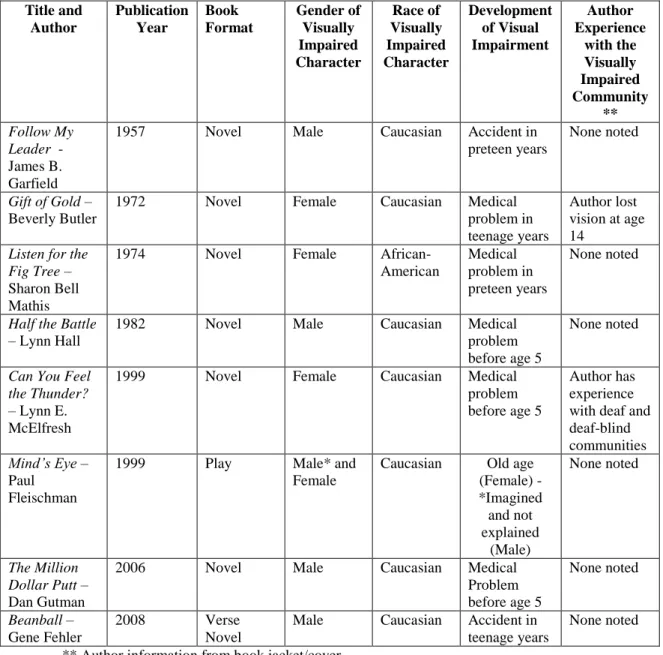
1). Four of those books were published before the Americans with Disabilities Act
(ADA) was enacted in 1990. The remaining four books were published after 1990.
Title and Author Publication Year Book Format Gender of Visually Impaired Character Race of Visually Impaired Character Development of Visual Impairment Author Experience with the Visually Impaired Community ** Follow My
Leader - James B. Garfield
1957 Novel Male Caucasian Accident in preteen years
None noted
Gift of Gold –
Beverly Butler
1972 Novel Female Caucasian Medical problem in teenage years
Author lost vision at age 14
Listen for the Fig Tree –
Sharon Bell Mathis
1974 Novel Female African-American
Medical problem in preteen years
None noted
Half the Battle
– Lynn Hall
1982 Novel Male Caucasian Medical problem before age 5
None noted
Can You Feel the Thunder?
– Lynn E. McElfresh
1999 Novel Female Caucasian Medical problem before age 5
Author has experience with deaf and deaf-blind communities
Mind’s Eye – Paul
Fleischman
1999 Play Male* and Female
Caucasian Old age (Female) - *Imagined and not explained (Male) None noted The Million Dollar Putt –
Dan Gutman
2006 Novel Male Caucasian Medical Problem before age 5
None noted
Beanball –
Gene Fehler
2008 Verse Novel
Male Caucasian Accident in teenage years
None noted ** Author information from book jacket/cover
Table 1. Study Sample
An attempt was been made to include titles that represent a variety of formats
within the realistic fiction genre. Six of the selected titles are written as novels, one is a
characters who developed their vision problems at various times throughout their lives.
Three of the titles feature characters whose vision problems developed between birth and
age five. Two of the books have characters who lost their vision due to an accident during
their preteen and teen years. Two selections feature a character who lost her sight during
her preteen and teenage years due to a medical condition. In one title the visually
impaired character is elderly and has developed her vision problems in old age. Only one
of the books features a visually impaired character who is African-American. Of the
remaining seven books four have a Caucasian male as the visually impaired character and
three use a Caucasian female character. According to the book jackets, of the eight
authors who penned the included titles one is herself visually impaired and one has had
personal experiences with the deaf and deaf-blind communities through her involvement
with the Girl Scouts.
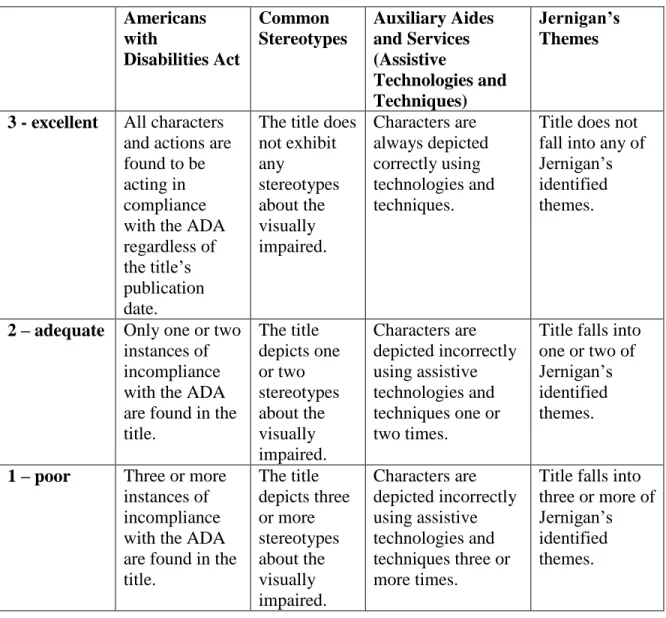
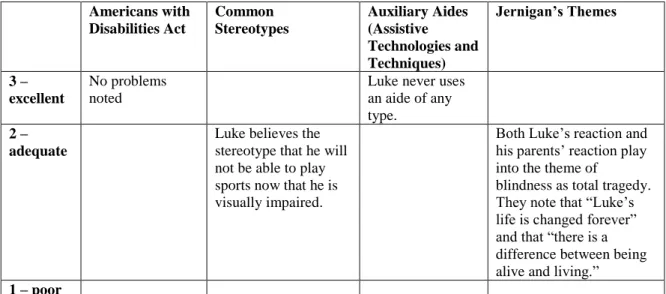
Table 2 shows the coding scheme used to evaluate each title. Each title has been
evaluated based on how it does or does not exhibit examples of the following four
criterion: compliance with the ADA, common stereotypes, auxiliary aides and services
(assistive technologies and techniques), and Jernigan‘s themes of blind literature. Each
criterion was evaluated on a three-point scale. A one (1) indicates a poor representation.
A two (2) signifies an adequate representation. A three (3) denotes an excellent
representation.
In terms of compliance with the ADA, I was looking to see if the actions of the
characters would be considered lawful or unlawful today based on the 1990 enactment of
information as described in Carroll‘s criteria for realistic portrayal of characters with
disabilities.
In regards to common stereotypes I was looking to see if the characters‘ actions,
words, and/or thoughts perpetuated myths or stereotypes about the visually impaired such
as the inability to accomplish everyday tasks or the inability to be attractive to a member
of the opposite sex. ―Avoidance of stereotypes‖ was Carroll‘s second criteria for
evaluating young adult literature (Carroll, 2000, p. 623).
In terms of auxiliary aides and services (assistive technologies and techniques) I
was looking to see if the aides used in the story were used correctly and appropriately
based on the ADA and guidelines from organizations for the blind thus demonstrating
Carroll‘s first criteria of ―accurate information and terminology‖ (Carroll, 2000, p. 623).
Finally, in regards to Jernigan‘s themes I was looking to see if I could identify any
of the nine themes described by Jernigan in the selected young adult titles. The presence
or lack thereof of Jernigan‘s themes also leads to the evaluation of Carroll‘s criterion of
―avoidance of stereotypes‖ (Carroll, 2000, p. 623).
The goal of this study is to see if human characters in young adult literature are
portrayed differently based on the four identified criteria in books published before and
Americans with Disabilities Act Common Stereotypes Auxiliary Aides and Services (Assistive Technologies and Techniques) Jernigan’s Themes
3 - excellent All characters and actions are found to be acting in compliance with the ADA regardless of the title‘s publication date.
The title does not exhibit any stereotypes about the visually impaired. Characters are always depicted correctly using technologies and techniques.
Title does not fall into any of Jernigan‘s identified themes.
2 – adequate Only one or two instances of incompliance with the ADA are found in the title. The title depicts one or two stereotypes about the visually impaired. Characters are depicted incorrectly using assistive technologies and techniques one or two times.
Title falls into one or two of Jernigan‘s identified themes.
1 – poor Three or more instances of incompliance with the ADA are found in the title. The title depicts three or more stereotypes about the visually impaired. Characters are depicted incorrectly using assistive technologies and techniques three or more times.
Title falls into three or more of Jernigan‘s identified themes.
Results Pre ADA
Follow My Leader - 1957
James B. Garfield published Follow My Leader in 1957 well before the passage of
the Americans with Disabilities Act (ADA). The only incident in this book that would not
be allowed to happen since the enactment of the ADA is the denial of Jimmy‘s right to
use his guide dog, Leader, while attending the public junior high school. In this case the
school superintendent tells Jimmy that if he were older and attending a school for older
students there would not be a problem, but at the junior high school ―it would cause too
much confusion‖ (148). The superintendent goes on to tell Jimmy, ―You might go to the
State School for the Blind, but I‘m quite sure that the dog could not go with you even
there‖ (148).
In regards to this matter Miss Thompson, Jimmy‘s welfare worker, says, ―The
dog would be very uncomfortable, cramped under a desk all day, and would be in the
way if he was in the aisle. You really don‘t need him indoors any more than you need
your white cane‖ (150). While Follow My Leader accurately reflects conditions in the
1950‘s Jimmy‘s situation would be dealt with very differently today. I personally know
guide dogs who have attended school and one who was raised in an elementary school by
a sixth grade class. In today‘s post ADA society a blind person cannot legally be
prohibited from using a guide dog in a public place. In one‘s home a blind person may
not need to use a dog for guidance as the person has undoubtedly learned the layout of
the home, however; maneuvering around the inside of other buildings is precisely part of
It is also noted that an eleven-year-old boy being allowed to obtain a guide dog is
not realistic as one must be at least sixteen years of age to be admitted to a guide dog
school. This unusualness is noted as Miss Thompson tells Jimmy ―it is not customary for
a guide-dog school to take an eleven-year-old boy‖ (76). The uniqueness of Jimmy‘s
position in terms of his age is not addressed again.
The reader is provided with accurate information for the time period in regards to
Jimmy learning to walk with a cane, read and write Braille, handle money, and perform
other daily tasks. When Jimmy‘s friends, Chuck and Art, comment on the ―goofy‖ Braille
primer Miss Thompson takes advantage of the opportunity to explain to the boys what
Braille is and how they should learn it as well (53-54). Likewise, when Jimmy is learning
to walk with a cane his friend Slats states that walking down the sidewalk is easy, so Miss
Thompson challenges him to do it blindfolded. Slats attempts it, but quickly gets angry
and gives up. Miss Thompson points out to him that Jimmy can‘t give up and could use
support and help rather than teasing and ridicule (39-40).
Jimmy‘s mother, Ruth Carter, initially reacts to his blindness with despair and
pity as is witnessed in her statements after learning that her boy is blind.
―There will be no morning for him. Jimmy is entering a long, dark corridor. I wonder where it will lead him. How can he play like other boys? He was always so active. What will his life be now?‖ (20)
Ruth exhibits feelings of pity for her son when he first learns to walk with a cane as well
as when she refers to him as ―my poor boy‖ (41). Miss Thompson quickly squashes that
statement my telling Ruth ―He isn‘t a poor boy. He got along beautifully‖ (41). Not
Other characters in the story exhibit feelings of awe and wonder upon meeting
Jimmy whether or not he is with his guide dog. Two ladies in the story are surprised that
Jimmy heard them talking about him and responded to their question.
―Look at that little boy,‖ one of them said. ―He‘s blind.‖
―Yes, I noticed,‖ the other woman answered. ―He has a bright little face. I wonder how old he is.‖
―If you‘re talking about me,‖ Jimmy said, ―I‘m eleven.‖
―Well what do you know about that?‖ the first woman said. ―He heard us.‖ ―Just because I can‘t see doesn‘t mean I can‘t hear.‖ Jimmy scowled.
―I guess we were talking too loud. I hope we didn‘t hurt his feelings,‖ one of them said as they walked away.
Jimmy was angry when his mother came back. ―People talk about me as if I was a table or a post.‖ (85)
Note that even at the end of the exchange the women do not actually speak to Jimmy.
They simply wonder between themselves as to whether or not they have hurt Jimmy‘s
feelings. Jimmy‘s comment to his mother indicates that they have hurt his feelings.
Other characters on the bus are awed that Jimmy is traveling by himself to guide
dog school (92). Although, I have to say that their awe may be just as much due to his
age as his blindness. During lunch the bus passengers are eager to learn how Jimmy
keeps track of his money. As Jimmy describes the different shapes and textures of coins
as well techniques for folding different denominations of paper money to tell them apart,
his fellow passengers pull out their coins to see if they too can feel the difference between
coins (93).
On his first day at the public junior high school Jimmy notices the reactions he
receives from his fellow students. As he arrives in the morning with his white cane in
hand, having been required to leave his guide dog with Aunt Martha, Jimmy notices that
enter the classroom they act ―shy‖ of Jimmy until they see how his friends, ―Art and
Chuck, treat him and they try to behave the same way‖ (155). After school a few students
followed Jimmy to his Aunt Martha‘s house in order to see his dog and how they walked
together (156). Would Jimmy have received different reactions from his fellow students
in a post ADA book? Probably not as humans don‘t learn how to deal with a situation
until confronted with it either in person or in a story.
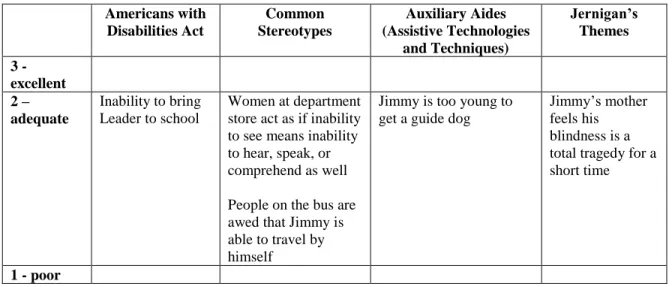
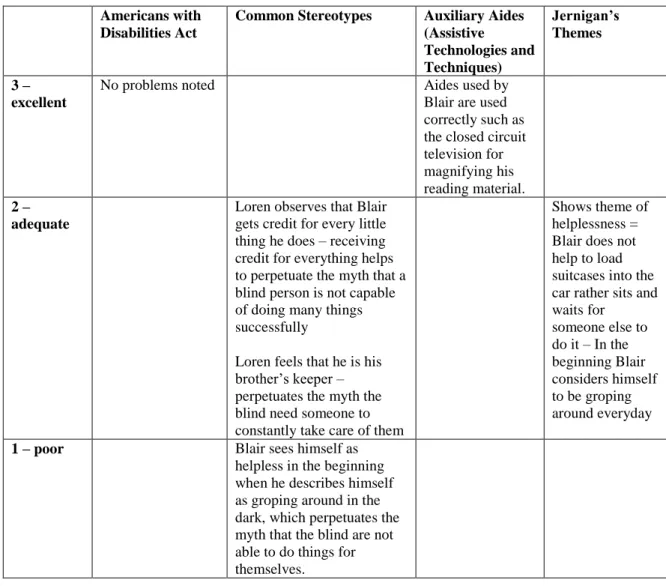
Follow My Leader scores an overall score of eight based on the scoring rubric
presented in the methodology section (Table 3). Americans with Disabilities Act Common Stereotypes Auxiliary Aides (Assistive Technologies and Techniques) Jernigan’s Themes 3 - excellent 2 – adequate
Inability to bring Leader to school
Women at department store act as if inability to see means inability to hear, speak, or comprehend as well People on the bus are awed that Jimmy is able to travel by himself
Jimmy is too young to get a guide dog
Jimmy‘s mother feels his blindness is a total tragedy for a short time
1 - poor
Table 3: Evaluation Score for Follow My Leader
Overall, Follow My Leader is a myth busting title. Miss Thompson corrects
Jimmy‘s friends when they make fun of his way of doing things and shows them what it
is like to be in Jimmy‘s place. These scenes lend themselves well to discussion about how
people see and treat others and how one might re-examine their current thinking. Jimmy
is also a myth buster in that his character shows the reader that it is possible for him to do
job, and going to school. Even those aspects of the book that have become inaccurate
through the passage of time and changing legal/societal norms, such as Jimmy not being
allowed to bring his guide dog to school, are appropriate topics for discussion and
reflection.
Gift of Gold - 1972
Gift of Gold published in 1972 is the second book written by Beverly Butler based
on her own personal experiences. Butler lost her sight at the age of fourteen as does the
main character of this book. Cathy Wheeler is a junior at St. Chrysostom College. She is
studying speech therapy and this year will be working with patients, young children, in
the school‘s clinic. During her high school years Cathy lost her sight to glaucoma. She
now uses a guide dog named Trudy to help her navigate the world.
There are a number of characters in this book that treat Cathy in a rather
despicable manner, but only one of those characters would be affected by the rules
enacted by the ADA. Dr. Paulus, the new director of the speech therapy program,
questions Cathy‘s ability to be a speech therapist, her acceptance into the program in the
first place, and whether she should be allowed to continue her studies.
Dr. Paulus released a light breath that might have been a sigh. ―Very frankly, Miss Wheeler, I‘m curious about how you happen to be studying speech therapy. I should think it presents a number of aspects that would be particularly difficult to master for a person with your handicap. Knowing Sister Bernard and her high standards as I do, I‘m interested in what conditions you had to meet for her to consent to training a blind student.‖
―Conditions? There weren‘t any conditions aside from the ones everybody had to meet – grade points, high school credits, and the like. Sister Bernard said I
much right in the program as any other qualified applicant.‖ Cathy‘s smile was for Sister Bernard, who not only taught that physical handicaps could be overcome but practiced what she preached. ―So far, the work hasn‘t been more than I can manage.‖ (19)
The idea that special restrictions should be placed upon you in the educational setting
simply because you have a visual disability would not be allowed today. In fact, now we
make a point of helping students with visual disabilities get services that will help put
them on an equal footing with their sighted peers. Dr. Paulus continues this discussion by
letting Cathy know that if she is not satisfied with her work in the clinic regardless of her
other grades Cathy will be removed from the program. To her credit, Dr. Paulus later
comes to realize that Cathy is a good therapist and fights to keep her in the program when
Cathy makes the decision to switch to special education.
Dr. Paulus‘ concerns regarding Cathy‘s abilities came from the mother of a clinic
client who exhibited her own prejudice towards Cathy. The mother was concerned that a
blind therapist was working with her child. In fact, she questioned Cathy very thoroughly
about whether or not she would be doing everything that the other therapists do including
the use of tongue depressors. She declared their conversation to be ―very inspirational‖
(8-9). Unlike Sister Bernard the child‘s mother does not practice what she appears to
preach when she describes speaking with Cathy as inspirational, as she then demanded
that Dr. Paulus switch her child to a different therapist. Clearly this woman could not see
past the fact that Cathy is blind. No law will help her get passed that. This is the type of
person who in real life will be helped by reading about positive experiences with visually
Another character who treats Cathy in an unsavory manner is her former high
school friend, Joan Norton. Joan is planning her wedding and asks Cathy to be one of her
bridesmaids not because she really values Cathy, but because having a blind bridesmaid
will surely make her wedding unique enough to be written up in the newspaper and
besides Cathy obviously owes her for all the help Joan gave her in high school.
And don‘t think I‘m asking you so that the wedding will be different enough for them to write it up in the paper. That‘s my cousin Olive‘s idea. Although, of course, how many brides are there around who‘ll be having a blind bridesmaid?‖ (72).
This sentiment turns Cathy‘s participation in the wedding into nothing more than a
novelty act that will gather attention for the real stars, the bride and cousin Olive.
Throughout the events leading up to the wedding Cathy is shown as a burden to
the other members of the wedding party who feel they must be responsible for Cathy and
lead her around rather than allowing her to use her guide dog, Trudy. This is evident in
the author‘s choice of words such as when the bride, mother of the bride, and bridesmaids
go shopping for dresses.
Cathy suspected that Mrs. Norton was just as well pleased not to be hampered by her presence on the shopping trip. A blind bridesmaid was very nice as a
conversational item to be submitted to the newspaper, but she was an awkward nuisance to have to pilot from store to store on a shopping tour. (79)
The use of words such as ―hampered,‖ ―conversational item,‖ ―awkward nuisance,‖ and
―piloted‖ give the reader the impression that the visually impaired character is unable to
get from place to place by herself and constantly needs help and watching as though she
were a small child. Later in this scene upon entering the second dress shop ―Olive steered
Cathy to a small wrought-iron chair placed against the wall.‖ She said to Cathy ―Why
character‘s attitude that a visually impaired person is a problem to have around and
should be neatly placed out of the way, so as not to be under the feet of the sighted
people.
Cathy‘s rights are further intruded upon by the bridal party at the wedding
rehearsal as Cathy is not allowed to bring Trudy with her for the evening nor will Trudy
be welcome at the wedding the following day.
―Or you could just step out into the aisle here and walk around like anybody else.‖ Steve‘s hand cupped her elbow, drawing her out beside him. ―I‘ll do the best I can to fill in for my pal Trudy. How come you didn‘t bring her tonight?‖
―A dog in a church?‖ Olive shrilled.
―Why not?‖ Steve asked. ―Trudy‘s no stranger to the inside of a church if I remember correctly.‖
―That‘s true,‖ Cathy nodded, ―but she‘s not a member of the wedding party.‖ ―That‘s all we need,‖ Olive said……..‖This wedding‘s going to be bizarre enough if Joan has her way, without adding a dog to it.‖ (167-168)
This passage illustrates the inability of some characters to see the importance of Trudy‘s
job in terms of Cathy‘s mobility. Olive is more concerned with the impression Trudy‘s
attendance would give other people than Cathy‘s right to be independent.
The ADA does give Cathy the right to use Trudy at church and from Steve‘s
statement I gather that Cathy did take Trudy to church with her. Later in the story Cathy
is given the chance to accompany her boyfriend, Greg, to Hawaii. Cathy questions the
logic of this trip as she would not be able to take Trudy with her.
―What will we do about Trudy?‖ she heard herself saying instead. ―You can‘t take a dog into Hawaii just like that. I read somewhere once that there‘s a quarantine of four months or more.‖
―So leave Trudy behind,‖ he said gaily. (200-201)
This is an aspect of the law that has changed since the writing of this book. As a result of
take a guide dog to Hawaii and return to the United States mainland with the dog without
having to put the dog in quarantine.
The fact that Cathy is shown to have a boyfriend with whom she regularly goes
out as well as an old high school friend who is interested in dating her helps to break the
myth held by many people that those with visual impairments cannot or do not date and
will never be married. This aspect of the story would be highly beneficial to a visually
impaired reader who needed to see a positive example of someone like herself living
through normal life experiences.
However, Greg‘s attitude towards elements of Cathy‘s life is not always positive.
This attitude is demonstrated when Greg makes fun of Cathy for studying too much,
changes plans without consulting her, and suggests that she won‘t need Trudy in the
future. Most examples of this attitude simply show that Greg was an inconsiderate
boyfriend and were not at all related to Cathy‘s visual impairment. His comments about
not needing Trudy, however, were related to Cathy‘s vision.
―So leave Trudy behind,‖ he said gaily.
―Give her to your brother. You won‘t be needing her in a little grass shack, anyway. Or in Los Angeles, either.‖ His voice softened to a caress. ―I promise you that.‖ (200-201)
These statements show how little Greg understood about how Trudy aided Cathy‘s
mobility. Of course, during the book he had few chances to observe the pair working
together as Trudy was regularly left at home when the two went out on a date.
Cathy is observed during the course of the book reading by listening to recorded
letters from a friend and her recorded school books on tape. It is also noted that Cathy
pictures, so she knows at which picture the boys are looking. All of these methods are
correctly used and are appropriate for the time in which the book was written.
During the shopping trip with Joan and her bridesmaids Olive initially grabs
Cathy by the elbow in order to propel her down the sidewalk, but Cathy is quickly able to
get Olive to switch her guiding method to the preferred one of Cathy holding Olive‘s arm
just above the elbow. Later during the wedding rehearsal one groomsman also grabs
Cathy by the elbow to lead her down the aisle, but is corrected by the preacher. In that
same scene Steve correctly guides Cathy to the back of the church.
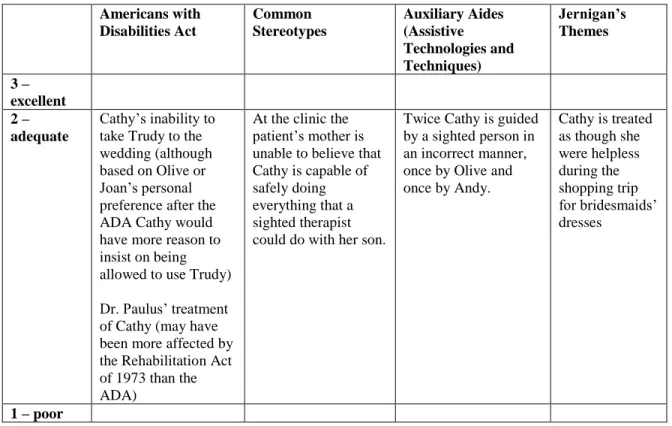
Gift of Gold scores an overall score of eight based on the scoring rubric presented
in the methodology section (Table 4). Overall, Gift of Gold provides the reader with
many issues to discuss and ponder in regards to how a visually impaired person should be
treated. As a teaching tool this book offers many opportunities to discuss how a situation
could be better handled in order to allow the visually impaired character to be more
independent and to keep her dignity. The book also offers many positive examples of a
visually impaired person‘s capabilities in terms of advanced learning and job
opportunities. The title provides the reader with the opportunity to see a visually impaired
person doing things that a teen may be concerned about such as dating. Of course, the
changes in technology that have made a difference in the way visually impaired people
communicate with friends and family, take notes in class, and read books could also be
Americans with Disabilities Act Common Stereotypes Auxiliary Aides (Assistive Technologies and Techniques) Jernigan’s Themes 3 – excellent 2 – adequate
Cathy‘s inability to take Trudy to the wedding (although based on Olive or Joan‘s personal preference after the ADA Cathy would have more reason to insist on being allowed to use Trudy) Dr. Paulus‘ treatment of Cathy (may have been more affected by the Rehabilitation Act of 1973 than the ADA)
At the clinic the patient‘s mother is unable to believe that Cathy is capable of safely doing everything that a sighted therapist could do with her son.
Twice Cathy is guided by a sighted person in an incorrect manner, once by Olive and once by Andy.
Cathy is treated as though she were helpless during the shopping trip for bridesmaids‘ dresses
1 – poor
Table 4: Evaluation Score for Gift of Gold
Listen for the Fig Tree – 1974
Sharon Bell Mathis‘ book Listen for the Fig Tree published in 1974 presents the
story of an African-American girl named Marvina who is trying to hold everything
together for her family as her mother falls apart with grief at the loss of her husband.
Marvina takes care of every day household tasks such as grocery shopping, cooking, and
sewing as well as keeping her mother from taking prescribed medications when she is
drunk or high. Marvina does all of this despite her blindness which is not a major focus of
the story.
Marvina has a boyfriend named Ernie and daydreams about marrying him and
having children (37). This breaks a stereotype that disabled people do not get married and
example to visually impaired teenage readers that it is possible to date and have a
relationship despite having a disability.
Marvina‘s mother, during one of her drunken moments, expounds on Marvina‘s
visual appearance in terms of her eyes. ―She been going blind since she was born but she
ain‘t got no nasty-looking eyes… Marvina‘s eyes look gooder than yours!‖ (20). This
element of describing the visually impaired character‘s looks in terms of her eyes was not
included in any of the other titles. The focus on the beauty of her eyes despite their
uselessness implies a need on the mother‘s part to show that her daughter is still just as
good as or better than the next person.
Marvina tells the reader of rocking, swaying back and forth without moving the
feet, a common trait among the visually impaired that she previously exhibited but was
taught by a therapist to stop. She says that at times it is easier to think when she rocks
(30). This too was an aspect of the visually impaired that was not mentioned in any of the
other titles.
Marvina acknowledges that ―people stare at [her] all of the time‖ (86) sometimes
because she is blind and sometimes because of the way her mother is acting. Most of the
time this does not bother her, but when people are staring because of her mother‘s antics
at the store Marvina has to will herself not to scream. ―Scream once. You‘re blind, you
can‘t see. People will allow you to scream. Scream once. Scream loud. Scream! But she
didn‘t scream‖ (50-51). Marvina is not embarrassed by her blindness. She is embarrassed
by her loud mother who drinks too much and gets high.
Marvina‘s mother says to her, ―You do everything just right like your father and
replies, ―I am a whole person, Momma.‖ This is a message that many people of all
abilities need to hear. A person with a disability is a whole person not a partial or a
percentage, but a whole person. These two lines also send the reader a powerful message
about the power of words and how words have the ability to hurt people.
When Marvina prepares to go grocery shopping she uses a ―stylus…to punch out
a grocery list on the small, three-by-five index-card-shaped slate‖ (28). Marvina uses a
Braille watch with a ―glass bubble dome‖ to tell time (9). Marvina carefully folds her
paper money in different ways so that she can easily distinguish between a ten, five, and
one dollar bill (96). All three of these examples demonstrate Marvina‘s proper use of
assistive technologies and techniques.
Americans with Disabilities Act
Common Stereotypes Auxiliary Aides (Assistive Technologies and Techniques) Jernigan’s Themes 3 – excellent No problems noted
The few aides used by Marvina are used correctly.
Marvina‘s blindness is not seen in the light of any of Jernigan‘s themes. 2 –
adequate
Blind people have ugly eyes – Marvina‘s mother makes a point of saying that Marvina does not have ugly eyes.
1 – poor
Table 5: Evaluation Score for Listen for the Fig Tree
Listen for the Fig Tree scores an overall score of eleven based on the scoring
rubric presented in the methodology section. Overall the book provides the reader with a
accomplished due to the lack of focus on Marvina‘s blindness as it is not a central
element of the story‘s plot.
Half the Battle – 1982
Lynn Hall wrote Half the Battle which was published in 1982. Blair and Loren
Lisky are not twins, but they are in the same grade at Rebano High School. Up through
5th grade Blair attended a special school for the blind, but when he was mainstreamed
into the public school system Blair was required to repeat the fifth grade. This put him in
the same class with his brother Loren and things have never been the same between them
since that time. Loren constantly feels that he lives in his brother‘s shadow and resents
Blair for that. Blair does not understand why Loren resents him because as he sees it
Loren has everything.
The technology that Blair uses to read a book was appropriate for the time Half
the Battle was written, but for the most part it has been replaced by technological
advances developed in the past thirty years. ―He…made his way to the closed circuit
television…and slid the opened book onto the surface before him (7). One by one, the
much-magnified words came into focus‖ (9). Today, Blair might use a magnification
system on a computer or text-to-speech software on the computer that would read the
book aloud to him.
Throughout most of the book Blair is shown working hard to train his horse and
doing things right along side of his brother. However, when the family is packing up the
vehicles and loading the horses into the trailer for their trip to the Sangre Trek
physical loading of the vehicles (98-102). This gives the reader the perception that Blair
is somehow unable to help lift suitcases, hay bales, and camping supplies like everyone
else. It is also perpetuating Jernigan‘s theme of blindness as helplessness.
Blair‘s growth as a character and in terms of how he sees his brother is quite
evident at the end of the story.
A slow smile lit Blair‘s face, but he was unaware of it. For the first time in eighteen years of an existence centered solely on himself, he was managing to cross over, in his imagination, into the thoughts and feelings of someone else. Suddenly he needed to talk to [Loren], to understand completely the reasons for Loren‘s abandonment of him. (163)
This personal growth on Blair‘s part enables the reader who originally held Loren‘s
grudge against Blair as his own viewpoint to begin to like the character of Blair as well.
As the reader‘s view of Blair changes, so will his attitude towards the visually impaired
population.
The beginning of the story takes place at high school where Blair sees himself as
―the one everybody feels sorry for‖ and ―groping around every day‖ (6). He also talks
about himself in terms of being ―alone in his [own] dark world while everyone around
him pushed so fast‖ (8). These statements express Blair‘s feelings of loneliness.
―Groping‖ also suggests that Blair feels helpless to find/achieve the things he desires thus
encouraging the stereotype that the blind are unable to help themselves. Blair‘s attitude
about himself begins to change as he and Loren train their horses. ―Blair felt relief, even
pride, at having survived the solo riding‖ (46). This is the first time in the story where
Blair exhibits any positive feelings about himself and his abilities.
Loren‘s opinion of Blair remains rather stagnant almost to the very end of the
school and ride his horse in front of Blair‘s horse in order to give directions (30). Loren
has seen their entire lives as a competition for attention, notoriety, and love whether the
boys were making a Mother‘s Day present for their mom or giving a book report in
English class Loren has always felt second best. Loren felt ―he could never really
compete with a blind brother. Blair simply got so much more credit for every little thing
he did‖ (49).
Loren‘s opinion does not improve leading up to the riding competition as
newspaper articles are written about Blair in both the local and state newspapers while
Loren‘s participation in the Trek is not noted at all in the articles. After the second of
these articles appears in the newspaper Loren laments on his lack of status.
Blair and I are doing the exact same identical thing, here. If anything my part‘s harder. All he has to do is follow along after me. But who gets the glory? Blair, naturally. Blair is the big hero, just because he‘s blind.
I could be a hero, too. I know I could. But to be a hero you need opportunity and, damn it, Blair‘s life is just one opportunity after another. But I could do it too, if I just had his advantages. Only nobody will ever know that. (64-65)
Note that Loren sees Blair‘s blindness as an advantage. Most people would not agree
with that sentiment. During the Trek itself Loren refers to himself as the ―invisible
brother‖ as the attention of the media continues to be focused solely on Blair. (101)
Overall, Half the Battle does incorporate the stereotype of blindness as
helplessness, but Blair is also shown overcoming the theme at the end of the book. This
title would be a positive one for encouraging a visually impaired reader and providing a
positive example of overcoming feelings of fear, uncertainty, and helplessness. The way
the story is written, alternating between Blair and Loren‘s viewpoints, it lends itself well
the matter. Half the Battle scores an overall score of nine based on the scoring rubric
presented in the methodology section (Table 6).
Americans with Disabilities Act
Common Stereotypes Auxiliary Aides (Assistive Technologies and Techniques) Jernigan’s Themes 3 – excellent
No problems noted Aides used by
Blair are used correctly such as the closed circuit television for magnifying his reading material. 2 –
adequate
Loren observes that Blair gets credit for every little thing he does – receiving credit for everything helps to perpetuate the myth that a blind person is not capable of doing many things successfully
Loren feels that he is his brother‘s keeper – perpetuates the myth the blind need someone to constantly take care of them
Shows theme of helplessness = Blair does not help to load suitcases into the car rather sits and waits for
someone else to do it – In the beginning Blair considers himself to be groping around everyday
1 – poor Blair sees himself as
helpless in the beginning when he describes himself as groping around in the dark, which perpetuates the myth that the blind are not able to do things for themselves.
Table 6: Evaluation Score for Half the Battle Post ADA
Can You Feel the Thunder? – 1999
Can You Feel the Thunder? was published by Lynn E. McElfresh in 1999. This
book tells the story of Mic Parsons, a junior high school student, who lives with his
parents, four-year-old brother, and fifteen-year-old sister Stephanie who is both deaf and
Mic is not only embarrassed by his parents, however, but he is also embarrassed
by Stephanie, so much so that he has not had any friends to the house in quite awhile
(13). When the new boy on the block stops by to borrow some sugar for his mother Mic
hopes to get him out of the house as quickly as possible, so that he will not meet
Stephanie. Mic notes embarrassing things about his sister such as how she clomps down
the hall and her very nasal and monotone voice which seems even louder to Mic when
other people are around (14-15). Embarrassment caused by someone who is different is
not an uncommon feeling, but that does not mean that is an acceptable feeling.
Some characters in the book are accepting of Stephanie while others have very
different reactions. After the church service one woman, Mrs. Randolph, approaches the
Parsons family and Mic notes that, ―She held her hand out toward Stephanie, but didn‘t
touch her‖ (28). A few minutes later Stephanie stands in the middle of the coatroom and
Mic states,
―Everyone was avoiding her like she was poisonous. She‘d reach out and touch people as they passed. People always looked startled. Then they‘ll smile
nervously and look around to see if anyone is watching them‖ (28-29).
These reactions show how people feel towards Stephanie almost as if they are afraid that
by touching her they will contract a disease. Note the use of the word poisonous helps to
illustrate the point of catching something from Stephanie that is horrible and possibly
deadly.
The following day at school a classmate expresses her amazement to Mic in
regards to the things that Stephanie is capable of doing such as ―doing most things like
Stephanie‘s ability to do everyday things this classmate helps to deepen Mic‘s
embarrassment and resentment of his sister. This classmate also helps to show the
ignorance of many people in regards to the abilities of the deaf-blind population.
Mic demonstrates his resentment towards Stephanie and the difference he
perceives in the way their parents treat the two of them. While listening to his parents
fight about Stephanie‘s future Mic thinks, ―She ruins everything‖ (74). Mrs. Parsons
implies that Mic has no excuse for having trouble in math and has no right to say, ―I
can‘t‖ as his sister never says ―can‘t‖ (12). When Gramps comes to visit Mic says of his
little brother, ―Poor kid. He was too little to know that only disabled grandchildren got
presents. I learned that a long time ago‖ (88). Mic‘s resentment continues to come out
when Mic asks his parents for a new baseball glove and is told no.
―We can afford a bowling pin model. We can afford special books and games, but we can‘t afford a baseball glove for me,‖ I said.
Mom stiffened. ―Don‘t try that,‖ she growled. ―Those items are pertinent to your sister‘s development. It‘s not—―
―It‘s not fair!‖ I finished for her.
―How can you talk about fair.‖ Mom glared at me. ―Look at your sister.‖ (102)
No wonder Mic has so much resentment built up towards his sister. Gramps obviously
has a double standard when it comes to showing affection towards his grandchildren.
Then there is Mic‘s mom using the guilt card on him in terms of Stephanie‘s life not
being fair.
It isn‘t until the end of the book when Mic can finally acknowledge his sister
without being embarrassed by her. Stephanie is Mic‘s biggest supporter at his first
baseball game of the season and Mic recognizes her support by giving her the game ball
Braille letter on the coffee table (Stephanie has gone to a special school in Boston) he
finds he is able to answer her questions without being embarrassed by Stephanie and even
suggests that Wendy meet Stephanie when she comes home (138). It does not hurt either
that Wendy is impressed by Mic‘s ability to read Braille and communicate in sign
language, which she expresses an interest in learning.
Stephanie is observed to be a bright student in her interactions with Mic as she
helps him learn to add, subtract, multiple, and divide fractions. They accomplish this
using a combination of a stylus and plastic manipulatives (91). With Stephanie‘s tutoring
Mic is able to earn an A- on his next math test.
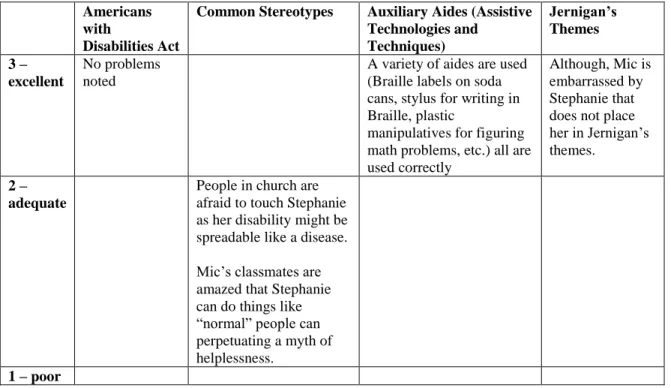
Can You Feel the Thunder? scores a score of eleven based on the scoring rubric
presented in the methodology section (Table 7). Overall, Can You Feel the Thunder?
leads the reader to some interesting discussion questions based on sibling rivalry. In
terms of the book‘s ability to present a visually impaired character free of the stereotypes
associated with the visually impaired this goal could have been better accomplished with
less resentment on Mic‘s part. Currently, Stephanie is a secondary character whose
function in the book is to be a catalyst for Mic‘s growth and development. Had the author
given Stephanie a more prominent role in the story, she could have been a more well
developed character who would serve as a role model for visually impaired readers.
Many readers will feel badly for Mic who always seems to get less positive attention
Americans with
Disabilities Act
Common Stereotypes Auxiliary Aides (Assistive Technologies and Techniques) Jernigan’s Themes 3 – excellent No problems noted
A variety of aides are used (Braille labels on soda cans, stylus for writing in Braille, plastic
manipulatives for figuring math problems, etc.) all are used correctly
Although, Mic is embarrassed by Stephanie that does not place her in Jernigan‘s themes.
2 – adequate
People in church are afraid to touch Stephanie as her disability might be spreadable like a disease. Mic‘s classmates are amazed that Stephanie can do things like ―normal‖ people can perpetuating a myth of helplessness.
1 – poor
Table 7: Evaluation Score for Can You Feel the Thunder?
Mind’s Eye – 1999
Paul Fleischman published a book written in play format titled Mind’s Eye in
1999. This story takes place in a convalescent home where sixteen-year-old Courtney has
been sent to live after an accident leaves her paralyzed. Courtney has two elderly
roommates, May who has Alzheimer‘s and Elva who is nearly blind. Courtney has a very
low opinion about life in terms of continuing to live and being able to do anything with
her life as a paralyzed person. Courtney does not receive visitors in her new home. It is as
if everyone has moved on without her now that she is neatly tucked away in a home.
For Elva the upkeep of one‘s mind is highly important. One way Elva and her
sister used to expand their minds was to read travel guides and imagine the adventures
they would have in those places. Elva asks Courtney to help her take one of these trips in
cannot with her current low vision. Initially Courtney is not interested in this idea, but
eventually decides to give it a try. During their imagined adventure in Italy Courtney
imagines for herself an interesting man who is also interested in her. She names him
Edward and decides that he will be a blind man.
Edward is a figment of Courtney‘s imagination. It says more about how Courtney
sees herself even in this imaginary world that she chooses to make Edward a blind man
than about the character of Edward. It shows how she feels that no one who could see her
imperfections/paralyzed limbs would ever want to be with her. Courtney describes her
first encounter on the train with Edward in the following lines.
―He reaches into the basket and hunts around a long time for something. The whole time, his eyes are on the floor. It‘s weird. His hand is sort of like an elephant‘s trunk, searching on its own. Then I see it, up on the rack with his luggage. A white cane. He‘s blind.‖ (80)
The universal sign of blindness, the white cane, is used as a visual signal for Courtney
and the reader. Note that Edward is said to keep his eyes on the floor rather than looking
into the basket as he searches for his item. This may also serve as a clue to the reader as
usually a sighted person would look inside the basket as they searched for their item
rather than simply feeling around for it.
Edward is described as having a keen sense of smell and hearing based on his
ability to tell that Courtney is an American. He claims to know this because the perfume
he smells on her is not an Italian perfume and her petticoats make a different sound than
Italian made ones because they are made of different materials (80). This ability to define
Courtney as American based on perfume smell and petticoat noise verges on the
Elva‘s vision problem is only mentioned once in the story when Elva explains to
Courtney why she cannot read the guidebook herself. Other than this one instance the
reader would not know that Elva has any sort of vision problem as when the pair are in
their imagined Italian world Elva chooses to make herself much younger, so that she can
pretend she is taking the trip with her husband who in real life has long since passed.
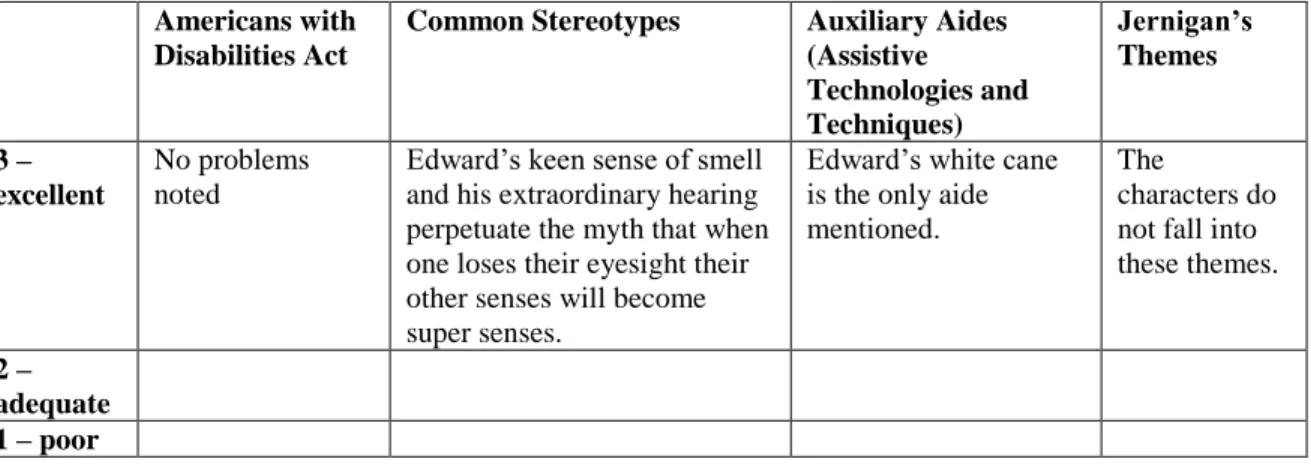
Mind’s Eye scores a score of twelve based on the scoring rubric presented in the
methodology section. Overall, Mind’s Eye has little effect on the reader‘s views of
visually impaired people as the issue is not a focus of the story at all.
Americans with Disabilities Act
Common Stereotypes Auxiliary Aides (Assistive Technologies and Techniques) Jernigan’s Themes 3 – excellent No problems noted
Edward‘s keen sense of smell and his extraordinary hearing perpetuate the myth that when one loses their eyesight their other senses will become super senses.
Edward‘s white cane is the only aide mentioned.
The
characters do not fall into these themes.
2 – adequate 1 – poor
Table 8: Evaluation Score for Mind’s Eye
The Million Dollar Putt – 2006
Dan Gutman published The Million Dollar Putt in 2006. The book tells the story
of Ed Bogard, aka Bogie, who has been blind since the age of four. Bogie like many who
have come to be visually impaired since the advancements of technology has not learned
to read and write Braille, but relies on technology to help him keep up with his sighted
peers.
Back before the days of computers, it must have been a lot tougher for blind kids in school. Braille was pretty much the only way to read or write, and Braille is really hard to learn. I never mastered it myself. I didn‘t have to. I‘ve got a computer with a scanner and a built-in speech synthesizer. So when I type, scan, or download text into it, it can take the words and speak them to me so I can hear them. There also plenty of books on CD now. A lot of blind kids don‘t learn Braille these days. (26-27)
The current trend away from learning to read and write Braille is seen as a decline in
literacy by some members of the visually impaired community and is a topic of much
debate (Brittain, 2007, para. 3-10). Likewise many people both sighted and visually
impaired have a difficult time accepting the act of listening to books on CD as a form of
literacy. In these respects this title opens the topic of literacy for discussion by its various
readers.
Of all eight books this is the only one that begins to describe for the reader
technological advances that enable the visually impaired character to learn alongside his
sighted peers. When a sighted person encounters a visually impaired student they
inevitably ask questions about how one does the reading, research, and paper writing
involved in the educational process. Readers of this book won‘t necessarily have to ask
how, but rather will have a small basis of knowledge to build from, so they can ask to
learn more.
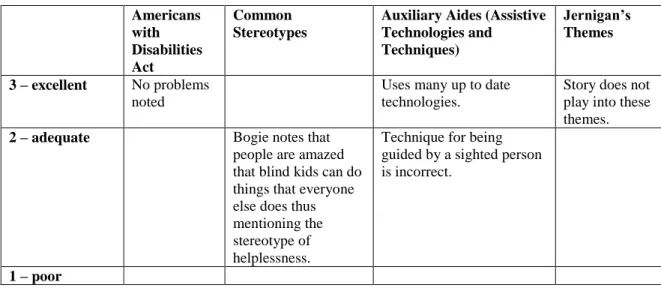
Not all information provided in this book is correct. The technique used in this
book for guiding on a sighted person is not considered to be the correct technique by
most visually impaired people.