Introduction
The use of health information systems (HIS) has spread to modern health care organizations,[1,2] with many health care organizations utilizing information technologies to provide quality services to their patients.[1] Nursing care is one of the most important health care services.[3] The central coordinating role of nurses in the patient care team has made them to be recognized as one of the most important groups of patient record registrar[4] and the main users of HIS.[5] Low quality of nursing documentation represents deficiencies in care programs.[6]
Hence, in recent years, information technology in the nursing departments of many hospitals has been introduced to support their daily tasks.[7] These duties are quite diverse and the main tasks include planning, execution, and documenting nursing care based on care process. Other tasks performed by nurses comprise
Address for correspondence: Nafiseh Shahrokhi,
Student Research Committee, Lorestan University of Medical Sciences, Khorramabad, Iran. E‑mail: [email protected]
Access this article online
Website: www.ijnmrjournal.net DOI:
10.4103/ijnmr.IJNMR_201_16 Quick Response Code:
Abstract
Background: In recent years, information technology has been introduced in the nursing departments
of many hospitals to support their daily tasks. Nurses are the largest end user group in Hospital Information Systems (HISs). This study was designed to evaluate data processing in the Nursing Information Systems (NISs) utilized in many university hospitals in Iran. Methods and Materials: This was a cross‑sectional study. The population comprised all nurse managers and NIS users of the five training hospitals in Khorramabad city (N = 71). The nursing subset of HIS‑Monitor questionnaire was used to collect the data. Data were analyzed by the descriptive‑analytical method and the inductive content analysis. Results: The results indicated that the nurses participating in the study did not take a desirable advantage of paper (2.02) and computerized (2.34) information processing tools to perform nursing tasks. Moreover, the less work experience nurses have, the further they utilize computer tools for processing patient discharge information. The “readability of patient information” and “repetitive and time‑consuming documentation” were stated as the most important expectations and problems regarding the HIS by the participating nurses, respectively. Conclusions: The nurses participating in the present study used to utilize paper and computerized information processing tools together to perform nursing practices. Therefore, it is recommended that the nursing process redesign coincides with NIS implementation in the health care centers.
Keywords: Information processing, Hospital information system, Nursing information system,
Evaluation, Iran
Information Processing in Nursing Information Systems: An Evaluation
Study from a Developing Country
Mahnaz Samadbeik1,
Nafiseh Shahrokhi1, Marzieh Saremian2, Ali Garavand3, Mahdi Birjandi4 1Student Research Committee, Lorestan University of Medical Sciences, Khorramabad, Iran, 2Social Determinants of Health Research Center, Lorestan University of Medical Sciences, Khorramabad, Iran, 3School of Allied Medical Sciences, Shahid Beheshti University of Medical Sciences, Tehran,
Iran, 4Department of Statistics and Epidemiology, School of Health and Nutrition, Lorestan University of Medical Sciences, Khorramabad, Iran
How to cite this article: Samadbeik M, Shahrokhi N, Saremian M, Garavand A, Birjandi M. Information processing in nursing information systems: An evaluation study from a developing country. Iranian J Nursing Midwifery Res 2017;22:377-82.
Received: October, 2016. Accepted: February, 2017. This is an open access article distributed under the terms of the
Creative Commons Attribution‑NonCommercial‑ShareAlike 3.0 License, which allows others to remix, tweak, and build upon the work non‑commercially, as long as the author is credited and the new creations are licensed under the identical terms.
For reprints contact: [email protected]
entering orders, dispensing and monitoring medication usage, managing the ward, documenting, and communicating with other specialists.[8]
Computer‑based Nursing Information System (NIS) is part of HIS that deals with nursing aspects and is used to better support nurses in their daily tasks.[9] The introduction and development of this system affects the overall processing of information in hospitals.[6] NISs help nurses to provide better care to patients and the possibility of assessment and exchange of clinical information with other health care providers. Thus, the proper functioning of NIS improves clinical data integrity and satisfies user needs.[10] This system results in easier access to health care information, readability of nursing documents, avoidance of repetition in the documenting process, better support of workflow, and greater respect for the legal rules and principles.[6]
The emergence of new information technologies has made some changes in the nursing documentation, the most important of which is the shift from traditional paper‑based records to electronic documentation system in a number of health care centers. Information technology solutions have freed health care providers from specific and important problems of paper documentation and have improved the quality of nursing documentation.[4,11,12]
Any changes in the HIS should be evaluated on a regular basis.[13] Assessment of information and communication technology systems in health care organizations is essential to determine their side effects. In addition, evaluation of these systems can provide the necessary information to improve knowledge, create better health information systems in the future, and guarantee the existence of efficient information systems.[14] As nurses constitute the largest end user group of HISs, evaluation of HISs should begin with the assessment of nursing subsystems. However, despite the increasing number of NISs, their evaluation has not been often done thoroughly and sufficiently.[9,15] In addition, no comprehensive theoretical and practical tools, methods, and guides exist for this type of evaluation.[16] The studies conducted in this regard have mostly emphasized on specific evaluation criteria such as the impact on nursing documentation,[15,17,18] the time required to perform the nursing duties,[19] information quality requirements of users,[18,20] and challenges to and facilitators of the nurses’ uses of the NIS.[9,21]
Furthermore, in Iran, few studies have been done to address issues such as the state of NIS in Iran,[22] the structural needs of nursing data classification in the computer system,[23] and nurses’ experiences of the impact of NIS on the efficiency of nursing service,[24] whereas none of them studied the changes in the nursing information processing after the introduction of computer‑based NIS. Nevertheless, achieving a full picture of NISs requires taking into account the different evaluation criteria, which encompass all nursing activities.[6] Therefore, this study aimed to evaluate the processing of data in the NISs utilized in many university hospitals in Iran from nurses’ viewpoint.
Materials and Methods
A cross‑sectional study method was used in this study carried out in the training hospitals of Lorestan University of Medical Sciences in 2016. The HISs used in these hospitals, developed by five HIS software vendors, are applied in many university hospitals with thousands of active clinical users in Iran. Based upon the census sampling method, the study population comprised all nurse managers (including matrons, supervisors, and head nurses) and NIS users of the all five training hospitals in Khorramabad city (N = 71).
The questionnaire utilized in this study was based upon the reliable and valid HIS‑Monitor questionnaire developed
by Ammenwerth et al.[6,15] The HIS‑Monitor comprises 107 specific questions and 12 general questions, focusing on how a HIS efficiently supports clinical and administrative tasks. It offers a quantitative score of HIS quality from the viewpoints of the professional groups. The questionnaire not only considers information technology aspects but also puts emphasis on the information processing tools used in various situations.[15] Thus, it serves as a useful tool for assessing HISs at the centers where computerized and paper systems are employed in parallel.
The adapted version of self‑administrated HIS‑Monitor questionnaire comprised personal characteristics (work ward, work experience, age, gender, education, and organizational position) as well as 41 specific and general questions, focusing on the quality of information processing in nursing. These questions were divided into the six major specific sections, including 7 questions on nursing admission, 18 questions regarding access to available patient‑related information, 6 questions on creation and updation of a nursing care plan, 2 questions on nursing care, 6 questions on the documentation of nursing care, and 2 questions on patient discharge.[6] At the end of the questionnaire, there were 2 open‑ended questions regarding the fulfilled expectations and problems of nurses about the nursing documentation and tasks. To assess nurses’ views about the quality of information processing, a 4‑point scale of Likert from very bad (very low) to very good (very high) was applied. The mean values were calculated by attributing the code “1” for the most negative answer to the code “4” for the most positive answer, thus higher values indicate a “better” quality of information processing.
The reliability and validity of this tool have been approved by the previous researchers.[6,15] To confirm the validity of the translation into the Persian language, WHO forward/backward translation protocol was used. The English version was first translated into Persian by a qualified translator. Next, the Persian version was examined for any inconsistencies by a panel of experts. Then, the instrument was translated back to English by an independent translator, whose mother tongue was English and had no knowledge of the questionnaire. The backward translated version was forwarded to a board of experts to identify any poorly translated items or expressions and the necessary modifications were made. The validity of the content of this tool to be used in Iran was approved by 5 faculty members of the nursing department. In addition, the average internal reliability of the questionnaire was high, α = 0.89.
The data analysis was performed using the computerized Statistical Software Package for Social Science (SPSS) version 17 developed by the Institute of Business Management (IBM). To investigate the association between the use of paper and computer information processing tools by the nurses to perform their tasks,
a paired t‑test was used. Moreover, the relationships between personal characteristics of nurses and the use of the data processing tools (computer and paper) applied to carry out the nursing responsibilities in the training hospitals were assessed by using multivariate analysis iof variance (MANOVA).
The open‑ended questions were analyzed using inductive content analysis and MAXQDA 12 qualitative analysis software. In the first stage of analysis, the nurses’ responses to those questions were read several times to ensure that the analyst had a clear grasp of the overall content. Then, the contents were reduced by changing the nurses’ basic statements into simple statements. The statements with similar meanings (semantic similarities) were clustered together and recorded in the frequency table. It should be noted that grouping of the statements was done independently by two researchers, whereas a third researcher was consulted if a consensus was not reached. Ethical considerations
Before starting the interview, written consent for filling evaluation questionnaires was obtained from all participants.
Results
The studied hospitals had 753 active beds and 706 nurses. The NIS was implemented at all the hospitals concurrent with the establishment of the HIS, and all the nursing stations were equipped with computers and covered by a Local Area Network (LAN). The paper‑based nursing documentation system in the hospitals included forms of physician order, nursing reports, nursing considerations at the time of patient’s admission, patient’s training, and vital signs measurement, vital signs chart, and absorption and excretion of fluids.
Questionnaires were completed and returned by 50 nurses (70.4% response rate). The findings of this study showed that 76% of the respondents were females and the rest were males, most of the respondents (94%) had a bachelor’s degree. Approximately, 68% of the respondents were under 40 years of age, and most of them (52%) had a work experience of less than 12 years.
The findings of the present study [Table 1] showed that all the respondents (100%) used both paper and computer information processing tools together to perform their nursing duties. Based on the scores assigned to the answers, the total mean scores of these tools revealed that the nurses participating in the study did not favorably take the advantages of using paper (2.02) and computer‑based (2.34) information processing tools to perform their nursing tasks; moreover, the information processing with any of the investigated tools was not satisfactory. The nurses’ least and most uses of computer tools to perform their tasks were related to nursing admission 1.57(0.49) and documentation of nursing care 2.63(0.73). However, paper tool showed the most and least uses for the access to available patient‑related information (2.11) and nursing care (1.89), respectively.
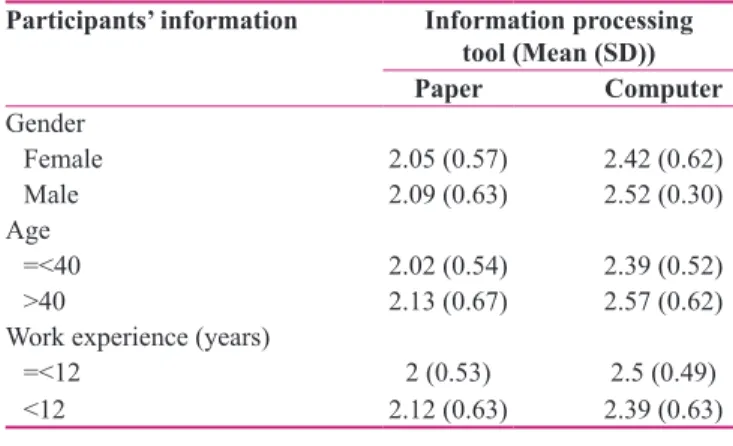
As shown in Table 1, significantly positive relationships were observed between the uses of paper and computer tools in the tasks of creation and updation of nursing care plan (P = 0.006, r = 0.38), nursing care (P = 0.013, r = 0.34), documentation of nursing care (P = 0.021, r = 0.33), and patient discharge (P = 0.026, r = 0.31). However, no significant relationship was found between these two tools (paper and computer) in the task taking of nursing admission and access to available patient‑related information (P > 0.05). The results of the current study [Table 2] revealed that all the participating groups further used the computer tool to perform their nursing tasks.
The results of the MANOVA [Table 3] showed that there was no significant relationship between gender, organizational position, and age with the information processing tool used for all studied nursing tasks (P > 0.05). Further, work experience only had an effect on the information processing tools (computer and paper) used for the task of patient discharge (3). Furthermore, the work experience groups of nurses participating in the study had significant differences at least in one of the tools used to carry out the nursing task of patient discharge (P = 0.04).
By separately comparing each tool in terms of work experience, it was seen that there was a significant difference between the two groups based on the computer Table 1: Assessment of the support of the nurses’ tasks by the information processing tools in the study hospitals
Tasks of nursing Information processing tool (Mean (SD)) Correlation coefficient
Paper‑based Computer‑based
Nursing admission 2.01 (0.69) 1.57 (0.49) 0.19
Access to available patient‑related information 2.11 (0.64) 2.46 (0.64) 0.11
Creation and update of a nursing care plan 2.01 (0.65) 2.46 (0.72) 0.38*
Nursing care 1.89 (0.86) 2.52 (0.99) 0.34*
Documentation or nursing care 2.10 (0.76) 2.63 (0.73) 0.33*
Patient discharge 1.99 (0.85) 2.42 (0.93) 0.31*
Total 2.02 (0.74) 2.34 (0.75)
tool used for the discharge duty (P = 0.01), but not based on the paper processing information tool (P = 0.46). Therefore, because of the higher average score of the nurses with less than or equal to 12 years of work experience in the use of computer tools for the information processing of patient discharge (2.73 (0.85)) compared to the corresponding group of more than 12 years of work experience (2.08 (0.90)), it can be concluded that the nurses with less work experience took a further advantage of computer tools for processing patient discharge information.
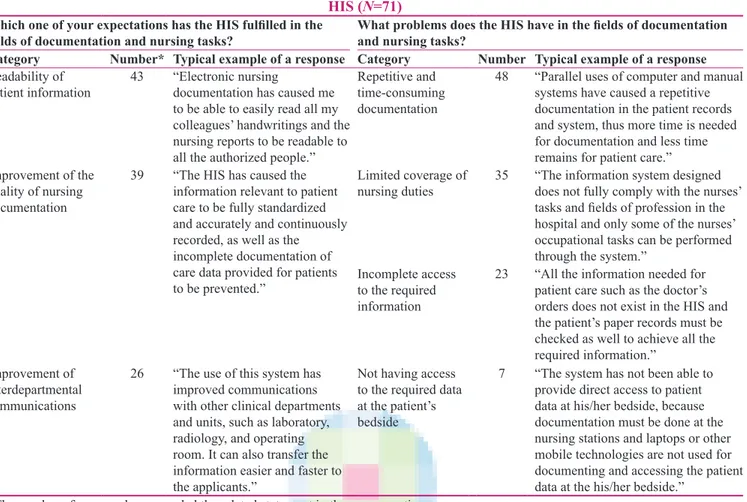
The met expectations and the most important problems of the nurses in the HIS were grouped in 3 and 4 categories using a content analysis method, respectively [Table 4]. The content analysis of the responses to the open‑ended questionnaire indicated that the readability of patient information was raised as the expectations met in the NIS by the most nurses (N = 43). In addition, the majority of the nurses (N = 48) pointed out the repetitive and time‑consuming documentation as the HIS problem.
Discussion
The nurses participating in the present study used to use paper and computer information processing tools together to perform nursing duties, although they did not desirably take advantages of any of the mentioned tools. The results of other studies conducted in Iran have also shown that the NISs are not in a good condition and do not comply with
the duties and areas of nursing work,[22,24] though based on the studies performed in other countries, the quality of information processing significantly improved after the introduction of computer‑based information systems.[6,25,26] The reason for this paradox can be the continuation of using dual processing tools in Iranian hospitals after learning and trusting the information systems, which leads to an enhancement of the nurses’ workloads and inappropriate application of NIS.
No significant relationships were found between gender, age, and organizational position and the information processing tool employed for all nursing tasks, however, the nurses with less work experience would take more benefit of computer tools for processing the information of patient discharge. Similarly, in their study, Kahouyi and Babamohamadi reached the conclusion that older nurses with less computer skills would be more likely to spend more time on the use of information technology.[24] The findings of the study by Mann also showed that those nurses and midwives who had good experiences of clinical information systems would be more willing to use this system.[27]
Repetitive and time‑consuming documentation as well as the limited coverage of nursing tasks were of the most important problems mentioned in the information systems used in the hospitals under study. Research studies have pointed to different findings in this regard. Some have stated the use of NIS saves time, accelerates nursing tasks, and provides more time for patient care,[24,28,29] and others have known it to impose more time for documentation and less time for patient care.[6,9,20,25] Therefore, it seems that if the NIS does not comply with the clinical care and nursing tasks, the documentation time will increase. In addition, a further time‑ saving will be possible by designing the information systems in a manner that provides facilities such as a coverage for all the nursing tasks, full description of nursing care, and a possibility of recording nursing data at the patient bedside. In the research conducted in this area, some other problems have been mentioned including the existing design flaws in the system content, hardware shortages, system down times, inadequate training of users, concerns about security, increase in nurses’ workloads, low number of portable computers, repetition in recording information, and poor communication with other HIS subsystems.[6,20,24,30] Improved readability of documents was of the most important expectations of the nurses fulfilled by the NIS in this study, which was in agreement with the other relevant studies indicating improvement of the documentation quality as one of the key benefits of the system.[9,17,24,25]
One limitation of the study is related to the difference between the hospitals in the time period that the HIS has been in operation, that is likely to affect the nurses’ viewpoint. Another notable limitation is the Table 2: Participants’ views about the processing
tools used for nursing tasks according to personal characteristics
Participants’ information Information processing
tool (Mean (SD))
Paper Computer
Gender
Female 2.05 (0.57) 2.42 (0.62)
Male 2.09 (0.63) 2.52 (0.30)
Age
=<40 2.02 (0.54) 2.39 (0.52)
>40 2.13 (0.67) 2.57 (0.62)
Work experience (years)
=<12 2 (0.53) 2.5 (0.49)
<12 2.12 (0.63) 2.39 (0.63)
Table 3: MANOVA of the variables of information processing tools used in the nursing task of patient discharge for the two groups of work experience
Significant Error df
Hypothesis df Value
Test name
0.04* 2
3.33 0.12
Pillai’s Trace
0.04* 2
3.33 0.88
Wilks’ Lambda
0.04* 2
3.33 0.14
Hotelling’s Trace
0.04* 2
3.33 0.14
small number of respondents (71), limiting the ability to generalize the findings of the present study.
Conclusion
Based on the results obtained, it is suggested that the nursing process redesign coincides with the NIS introduction in health care centers. If nurses are involved in the design and development of the system from the early stages to be able to transfer their expectations and needs to the system development team, they will find positive attitudes towards the new system and show less resistance to it.
Furthermore, it is recommended that the statistics and information technology office of ministry of health and medical education, HIS supplier companies, analysts, developers of NISs, and nursing profession communities work together to improve NISs and overcome the challenges. Consequently, the technology implementation in the field of nursing services will not fail and less workload will be imposed on nurses in contrast to the paper‑based systems. In this case, the use of health information technology will foster and support nurses in providing health care and improving its quality.
Acknowledgment
Research project from Student Research Committee at Lorestan University of Medical Sciences (research project number: 1887). The authors would also like to thankthe all the nurse managers and NIS users participated in this study. Financial support and sponsorship
Lorestan University of Medical Sciences. Conflicts of interest
There are no conflicts of interest.
References
1. Lin HC, Chiou JY, Chen CC, Yang CW. Understanding the impact of nurses’ perception and technological capability on nurses’ satisfaction with nursing information system usage: A holistic perspective of alignment. Comput Human Behav 2016;57:143‑52.
2. Lu CH, Hsiao JL, Chen RF. Factors determining nurse acceptance of hospital information systems. Comput Inform Nurs 2012;30:257‑64.
3. Chatterjee S, Chakraborty S, Sarker S, Sarker S, Lau FY. Examining the success factors for mobile work in healthcare: A deductive study. Decis Support Syst 2009;46:620‑33.
Table 4: Nurses’ fulfilled expectations and problems in the fields of documentation and nursing tasks in the HIS (N=71)
What problems does the HIS have in the fields of documentation and nursing tasks?
Which one of your expectations has the HIS fulfilled in the fields of documentation and nursing tasks?
Typical example of a response Number
Category Typical example of a response
Number* Category
“Parallel uses of computer and manual systems have caused a repetitive documentation in the patient records and system, thus more time is needed for documentation and less time remains for patient care.” 48
Repetitive and time‑consuming documentation “Electronic nursing
documentation has caused me to be able to easily read all my colleagues’ handwritings and the nursing reports to be readable to all the authorized people.” 43
Readability of patient information
“The information system designed does not fully comply with the nurses’ tasks and fields of profession in the hospital and only some of the nurses’ occupational tasks can be performed through the system.”
35 Limited coverage of nursing duties “The HIS has caused the
information relevant to patient care to be fully standardized and accurately and continuously recorded, as well as the incomplete documentation of care data provided for patients to be prevented.”
39 Improvement of the quality of nursing documentation
“All the information needed for patient care such as the doctor’s orders does not exist in the HIS and the patient’s paper records must be checked as well to achieve all the required information.”
23 Incomplete access to the required information
“The system has not been able to provide direct access to patient data at his/her bedside, because documentation must be done at the nursing stations and laptops or other mobile technologies are not used for documenting and accessing the patient data at the his/her bedside.”
7 Not having access to the required data at the patient’s bedside “The use of this system has
improved communications with other clinical departments and units, such as laboratory, radiology, and operating room. It can also transfer the information easier and faster to the applicants.”
26 Improvement of
interdepartmental communications
4. Gorzin A, Ahmadi R, Samadbeik M. Opportunities and Challenges Electronic Health Records Documentation from the Perspective of Nurses. J Clin Res Paramed Sci 2016;4:292‑300. 5. Oroviogoicoechea C, Elliott B, Watson R. Review: Evaluating
information systems in nursing. J Clin Nurs 2008;17:567‑75. 6. Ammenwerth E, Rauchegger F, Ehlers F, Hirsch B,
Schaubmayr C. Effect of a nursing information system on the quality of information processing in nursing: An evaluation study using the HIS‑monitor instrument. Int J Med Inform 2011;80:25‑38.
7. Ball MJ, Edwards MJ, Hannah KJ. Introduction to nursing informatics. Springer; 2006.
8. Wolf LD, Potter P, Sledge JA, Boxerman SB, Grayson D, Evanoff B. Describing nurses’ work: Combining quantitative and qualitative analysis. Hum Factors 2006;48:5‑14.
9. Rogers ML, Sockolow PS, Bowles KH, Hand KE, George J. Use of a human factors approach to uncover informatics needs of nurses in documentation of care. Int J Med Inform 2013;82:1068‑74.
10. Liaskos J, Mantas J. Nursing Information System. Stud Health Technol Inform. 2001;65:258‑65.
11. Poissant L, Pereira J, Tamblyn R, Kawasumi Y. The impact of electronic health records on time efficiency of physicians and nurses: A systematic review. J Am Med Inform Assoc 2005;12:505‑16.
12. Yu P. Electronic versus paper‑based nursing documentation systems: The carers weigh in. J Am Geriatr Soc 2006;54:1625‑6. 13. Ahmadian L, Nejad SS, Khajouei R. Evaluation methods used on health information systems (HISs) in Iran and the effects of HISs on Iranian healthcare: A systematic review. Int J Med Inform 2015;84:444‑53.
14. Ammenwerth E, Brender J, Nykänen P, Prokosch HU, Rigby M, Talmon J. Visions and strategies to improve evaluation of health information systems: Reflections and lessons based on the HIS‑EVAL workshop in Innsbruck. Int J Med Inform 2004;73:479‑91.
15. Ammenwerth E, Ehlers F, Hirsch B, Gratl G. HIS‑Monitor: An approach to assess the quality of information processing in hospitals. Int J Med Inform 2007;76:216‑25.
16. Yusof MM, Papazafeiropoulou A, Paul RJ, Stergioulas LK. Investigating evaluation frameworks for health information systems. Int J Med Inform 2008;77:377‑85.
17. Hariyati R, Sri T, Yani A, Eryando T, Hasibuan Z, Milanti A. The Effectiveness and Efficiency of Nursing Care Documentation Using the SIMPRO Model. Int J Nurs Knowl 2016;27:136‑42.
18. Langowski C. The times they are a changing: Effects of online nursing documentation systems. Qual Manag Health Care 2005;14:121‑5.
19. Marasovic C, Kenney C, Elliott D, Sindhusake D. A comparison of nursing activities associated with manual and automated documentation in an Australian intensive care unit. Comput Nurs 1996;15:205‑11.
20. Lee TT, Mills ME, Bausell B, Lu MH. Two‑stage evaluation of the impact of a nursing information system in Taiwan. Int J Med Inform 2008;77:698‑707.
21. Sockolow PS, Rogers M, Bowles KH, Hand KE, George J. Challenges and facilitators to nurse use of a guideline‑based nursing information system: Recommendations for nurse executives. Appl Nurs Res 2014;27:25‑32.
22. Ahmadi M, Habibi KM. Nursing information systems in Iran. Information Systems in Iran. Hakim 2010;13:185‑91.
23. Ahmadi M, Rafii F, Hoseini F, Koolaee H, Mirkarimi A. Informational and structural needs of nursing data classification in computerized systems. Hayat 2011;17.
24. Kahouei M, Babamohamadi H. Experiences of nurses in impact of nursing information system on nursing services efficiency. Health Inf Manage 2013;10.
25. Michel‑Verkerke MB. Information quality of a nursing information system depends on the nurses: A combined quantitative and qualitative evaluation. Int J Med Inform 2012;81:662‑73. 26. Saranto K, Kinnunen UM. Evaluating nursing documentation–
research designs and methods: Systematic review. J adv Nurs 2009;65:464‑76.
27. Mann C. Commentary on Darbyshire P (2004)‘Rage against
the machine?: Nurses’ and midwives’ experiences of using computerized patient information systems for clinical information. Journal of Clinical Nursing. J Clin Nurs 2008;17:2090‑1. 28. Bosman R, Rood E, Oudemans‑van Straaten H, Van der Spoel J,
Wester J, Zandstra D. Intensive care information system reduces documentation time of the nurses after cardiothoracic surgery. Intensive Care Med 2003;29:83‑90.
29. Korst LM, Eusebio‑Angeja AC, Chamorro T, Aydin CE, Gregory KD. Nursing documentation time during implementation of an electronic medical record. Evaluating the organizational impact of healthcare information systems. Springer; 2005. pp. 304‑14.
30. Jeddi FR, Hajbaghery MA, Akbari H, Esmaili S. Technological Feasibility of a Nursing Clinical Information System. Electronic Phys 2016;8:2942.