1
Table of Contents
Introduction
Foreword……….………...………....2
Methodology and Paper Format.......5
Chapter One - Historical Review: Geopolitical History and Mythology of Eastern Europe The Kievan Rus’...8
Muscovy and the Russian Empire………...……...11
The Soviet Period………...….…………14
Chapter Two - Case Studies Introduction………...…………..19
Case Study One: Ukraine Section Introduction………...…..23
Variable One……….………..………..….26
Variable Two……….……………………..…...29
Variable Three……….……….…………....….34
Case Study Two: Baltics Section Introduction………..37
Variable Two: Estonia……….……………..……...…....38
Variable Two: Latvia………..………41
Variables One and Three……….…..…..44
Chapter Three - Conclusion………….….….48
2
Introduction
Foreword
It goes without saying that 21st Century Russia, under Vladimir Putin, constitutes a regional hegemonic force more than willing to make some level of claim over the political happenings in the region. Whether or not Russia actually desires to expand its own borders as an end unto itself, it certainly desires to maximize its regional influence through whatever means necessary; the examples are myriad, from manipulation of Yanukovych’s Ukraine via gas contracts and other carrot-and-stick approaches to gaining economic influence, to its invasion of Georgia in 2008, to its current backing of rebels in Ukraine. However, though there is little disagreement on this issue, there has been significant disagreement over the motives behind it: some argue that Russia merely acts coldly and rationally to extend its influence and power, while others (particularly Westerners) tend to take the the ethno-mythological tales found in Russian history and promulgated by Russia’s leaders in the present (both of which will be discussed in Chapter One) at face value. This picture is muddied further by the presence of significant numbers of Russian minorities in many border states, as a result of Imperial and/or Soviet control over those areas, leading to questions among those who believe Russia’s government does desire to incorporate some part of their former territory or citizens into the Russian state regarding the details of that desire: does Russia want all Imperial territory back? All Soviet territory? Ethnic Russians and Russophones, only ethnic Russians, or perhaps only certain groups of ethnic Russians?
3
rational, non-ideological Russian approach to geopolitics. In essence, the ethno-mythological narratives that are very publically pushed by Russian leaders seem likely to be more likely aimed at fomenting nationalist support among Russians within Russia’s borders and providing a form of justification for aggressive diplomatic and military action in the region to Western powers than reflecting any deeply held ideology. Many neat narratives of reuniting of Russian peoples and retaking of Imperial and/or Soviet territory have circulated in the West (even in otherwise
well-considered analyses, for example Dmitry Shlapentokh’s well-conceived article “Baltic Russians: are they Sudetendeutsche?”), but this approach is guilty of taking leaders with high incentive to misrepresent their true intentions, like Putin, at their word. It seems much more likely that these ethnically and neo-imperially based view applies only to the rhetoric of today’s Russian leadership, and not their actions. It does not seem out of place to characterize Vladimir Putin as a calculating figure, generally dispassionate and desiring first and foremost to seek stronger government control over both the Russian people (as evidenced through increasingly corrupt elections and both
figurative and literal political assassinations) and its “near abroad” (English for ближнее
зарубежье, a rather imperialist term which essentially categorizes post-Soviet states as
not as foreign as others, thereby seemingly questioning their legitimacy and right to independence)
(Safire). Even accepting that it can never be proven that non-strategic goals such as the explicit and public ethno-nationalism evidenced above are unimportant in Russia’s modern geopolitical
4
effect has taken up its rightful pan-Slavic mantle through public declarations and gestures (for example, the unveiling of the statue of Saint Volodymyr in Moscow, which will be discussed in Chapter One), it is clear that Putin and the Russian leadership are doing much more than antagonizing Ukraine, or even suggesting that Russia has more right to rule over Ukrainian territory than Ukraine does. Rather, when taken in the context of Russian infringements on the sovereignty of its neighbor states in this century, it seems Putin is playing a complex double-game of wrapping short-term political gain and one-upmanship in a cloak of ethno-mythology that aims to obfuscate his true intentions, including those in the “near abroad”, potential Western security guarantors of these countries, and of course his selectorate, the Russian people themselves.
The regions this paper will focus on, Ukraine and the Baltics, constitute compelling examples of the primacy of clear strategic, rather than ideological, interest in Russian minority populations in these border states. In Eastern Ukraine and the Crimea, linguistic and particularly ethnic Russian minorities, which made up significantly more of the population here than elsewhere in the county, were and are ripe for Russia’s picking, facing stagnant income, little economic opportunity, and anger at the pro-Western leanings of the new government in Kiev, thus
5
uncanny similarities between their respective Russian minority populations. But what we observe is anything but similar treatment: Eastern Ukraine has been turned into a war zone by pro-Russian forces and Russian arms supplies and aid, while Estonia and Latvia (not-so-coincidentally NATO members) remain relatively unthreatened and secure.
In short, this paper will argue that the similarities between the Russian minorities in these
three states should make them almost equally compelling from an ethno-mythological, pan-Slavic
view, and yet in reality only the “weak links” are targeted. The paper will analyze factors on both the Russian and Russian minority sides, attempting to ascertain which characteristics of a Russian minority increase their geopolitical desirability to Russia, and the likelihood of Russian interference in the sovereignty of their state, while equally importantly addressing the qualities that make a Russian minority in a border state more open to Russian involvement (i.e., the difference between the Donbas and Tartu). Together, these factors will indicate which types of Russian minorities and which geopolitical circumstances pose the greatest security concern for the countries that they live in, and potential strategies for those nations and others with interests in the region to identify and contain those potential future threats, in order to avoid another Ukraine, or worse.
. . . . .
Methodology and Paper Format
6
will be detailed below. The last chapter will consist of a brief conclusion of important findings, and a discussion of how the examples of the two case studies can be applied to other potential areas of conflict in Russia’s “near abroad”.
In order to make the complicated issues surrounding Russian-linked minorities in Russia’s “near abroad” as simple and delineated as possible, I have split my analysis in the case studies and conclusion into three variables, which will aid and clarify the discussions in Chapters Two and Three. First is Russian strategic interest, arguably the most fundamental of the variables; it is vital to
understand where and why Russia is interested in intervening before any discussion on its modus operandi can occur, because without Russian interest, there is no need to worry about it intervening. Second is the variable most central to this thesis, exploitability of border-state Russian minorities; both the factors of ideology and identity that make minorities more likely to support Russian
interference and, more significantly, the factors that make a minority more suited to act as a cover and justification for Russian intervention, will be discussed. The third and last variable is the importance of institutional protections, specifically the existence of strong alliances with nuclear powers.
7
interested in would be ones in which the necessary precursor to Russian incursion, the Russian desire to incur in the first place, is present. The core of the paper will thus not focus on if Russia is interested in influencing or annexing a particular territory, but rather how they go about it if they are. Of particular interest is how the exploitability (due to identity, location, and other factors) of local Russian minorities can influence where Russia chooses to intervene, by lowering potential costs of intervention, and Russia’s strategy in doing so. Put another way, though of course Variable One is the most important (as without it, there is no cause for concern in Russia’s “near abroad”), and Variable Three, when present, can in effect completely nullify the presence of Variable One
regardless of its strength, Variable Two is by far the most interesting as it is perhaps the key factor in Russian intervention in marginal cases, of which Ukraine and Georgia were examples and many nations in the Caucasus and Central Asia could quite easily fall under in the future.
This paper will, through exploring the details of each case, posit that the following values are true for each case study and variable, presented in chart form to facilitate future reference:
Variable Number Variable Name Ukraine Value Baltics Value
Variable One Russian Strategic
Interest High High
Variable Two Exploitability of
Minorities High Low/Intermediate
Variable Three Institutional
Protections Low High
8
this region (and almost certainly higher than it is in the Donbas), create put up through their qualities in Variables Two and Three overwhelming barriers to Russian interference. After the details and narrow implications of the two cases are discussed in their respective case studies, the conclusion will attempt to discuss these narrower implications in the greater context of Russia’s “near abroad”, in an ultimate effort to apply the lessons of the turbulent recent past and present to help border states ensure a more secure future.
. . . .
Chapter One
Historical Review: Geopolitical History and Mythology of Eastern Europe
The Kievan Rus’
9
localized power system present before its rise, until the Mongol conquest of the 13th century ended its existence altogether (ibid).
10
asking the Russian government to not “forget what [the] real Prince Volodymyr monument looks like” (Walker 2016). Both nations claim Volodymyr/Vladimir, and claim Kiev as their birthplace, and that fact clearly still exists in the consciousness of each nation and its leaders; though such an example may seem trivial, taken in the today’s context of Russian intervention in Ukraine and intense and threatening rhetoric defining diplomacy in the region more broadly, it is clear that at the least the shared origins of the aforementioned three nations should not be overlooked as an informing factor in modern international relations, and even potentially military decision making.
Figure 1: The Kievan Rus’: Border Expansion and Dependencies During its 11th-century Peak.
Source: Yuri Koryakov (via Wikimedia Commons), Map of the Kievan Rus' realm, 1015-1113 CE (2009)
*Note: No Images in this work are my own. See the “Works Cited: Images” section on Page 57 for full citations.
11
Figure 2: The Kievan Rus’ and Byzantine Empire
Source: Encyclopaedia Britannica Inc., The Kievan Rus in the 11th Century (2009)
. . . . .
Muscovy and the Russian Empire
12
and his hordes, characterized the roughly two centuries after the Mongol conquest. Muscovy emerged as the ultimate victor of this struggle between rivals, earning its place as first among the Russian principalities and effective regional hegemon by the reign of Ivan III (“Grand Principality of Moscow”). Furthermore, by the reign of Ivan IV (known in Russian as “Иван Грозный”, or “Ivan Grozny”, traditionally translated as “Ivan the Terrible”, though more accurately translated “the Formidable”), the principality of Muscovy had grown sufficiently large and powerful to be declared an Empire. Ivan declared in 1547 that his title was no longer “Grand Prince of Moscow”, but was now “Tsar of all the Russias”, a signal of the hegemonic and expansionist vision of Ivan and Russia, and a title (and ideology) also utilized by his successors (Andreyev). The Russian Empire, as it was now known, continued to expand over the next several hundred years and by the end of the 18th century included most of the territory now comprising Ukraine and the Baltic States.
The history of the conquests of Muscovy and the Russian Empire, while surely interesting in their own right, are here described, similarly to the previous section, in order to introduce a point about historical geopolitics influencing modern geopolitics. While it is clear that Muscovy’s aggressive expansion was largely a result of its desire for wealth and power, and indeed this may be the only true explanation for its behavior, it is in either case important to note that Muscovite rulers used historical and ethnic justifications for the seizure of territory formerly belonging to the state they viewed as their origin point, the Kievan Rus’. In 1501, when the King of Poland
complained to Ivan III regarding Muscovy’s seizure of land from Poland’s junior partner, the Grand Duchy of Lithuania, he counterargued that instead Lithuania was guilty of seizing lands that
13
dominance and grand self-conception), and he was merely taking back what was rightfully Russia’s (Kalb, 41). Ivan III stated, “The Russian land which is in the hands of Lithuania - Kiev, Smolensk, and the other towns?...Why, not only is that our patrimony, the towns and districts which we now have, but all Russian land of old from our forefathers, too” (Kalb, 41). Kalb gathers from these statements that “In good times and bad, Moscow has always had a very expansive view on ‘Russian’ territory”, and has held that view at least since these articulations of Ivan III; in today’s context, “The territory to Ivan’s southwest, known today as the nation of Ukraine, fit into his broad
understanding of what constituted Russia” (Kalb, 42).
To draw a direct parallel between the geopolitical views of Ivan III and his successors to today’s geopolitical divisions and struggles based on this evidence would be reductionist and premature. However, Ivan III’s statements do evidence that even hundreds of years after the fall of the Kievan Rus’, and half a millennia after its heyday, it still proved important in Moscow’s conception of its political, social, and cultural role (or at the least its memory was deployed
strategically and, clearly, to significant effect). Thus, even if modern Russians do not actually believe Russia has a right to Ukrainian territory, which is not at all a given, narratives of the Kievan origins of the modern Russian state can be, and have been, at the very least deployed to legitimize practical geopolitical goals. While we do not know whether Ivan III genuinely believed his romantic claims of retaking old heartlands, we are well aware that it was he who retook Chernigov and Kiev, and his successors that took much former Kievan land which now constitutes the Russian border states of Eastern Europe.
14
Figure 3: The Growth of Muscovy and the Russian Empire in Europe, 1300-1796
Source: Encyclopaedia Britannica Inc., Russian Expansion 1300-1796 (2012)
. . . . .
The Soviet Period: Russian Immigration to Western S.S.R.’s and the Creation of the Ukrainian S.S.R.
15
these regions, this introduction, and paper, will focus on two particular aspects of its impact: that of Russian immigration into peripheral Soviet Socialist Republics (or S.S.R.’s) and the formation of the Ukrainian S.S.R., effectively an accident of history which enabled the formation of the modern Ukrainian state.
It goes without saying that the Soviet Period of Eastern European history involved massive and fundamental shifts in nearly all aspects of the region’s political, social, cultural, and religious identities and structures. One aspect of this societal reordering came in the form of waves of Russian migration, historically unparalleled in scope, into the Baltic S.S.R.’s, the nations we now know as Estonia, Latvia and Lithuania. There had been some Russian immigration into what are now the Baltic States over the Imperial period, but compared to the period from World War II to the present there were still low overall numbers of ethnic Russians in the Baltic States by the time of the Russian Revolution (surely not helped by Russia’s forced abandonment of Polish, Baltic, and Ukrainian territories as a result of their effective loss in the First World War, though it would reclaim Ukraine in 1921 after the Treaty of Riga)(Idzelis). By contrast, the Soviet period in the Baltics, technically starting in 1940 as a result of the infamous Molotov-Ribbentrop pact, but due to the Nazi invasion and occupation of these territories only beginning in earnest upon the Soviet counter-invasion of these territories in 1944, began a decades-long period of often
16
Baltic Sea now formed a sort of western frontier given the American-aligned states sharing the Baltic coastline (ibid). After Stalin’s death, the Baltic S.S.R.’s were granted greater autonomy over their immigration policies; Lithuania’s choice to limit Russian immigration, and Latvia and Estonia’s less restrictive policies, can probably at least partially explain the relatively lower prevalence of Russian ethnicity and language among inhabitants of Lithuania as opposed to the other two states (ibid). The overall quantity of Russians resettled in the Baltic States is difficult to pin down, but it is clear that the majority of Russian minorities in the Baltics today can trace their roots to Soviet-period Russian émigrés (ibid).
17
The second aspect of Soviet rule of particular concern is the creation of the Ukrainian S.S.R. and the granting of Crimea to it by the Russian S.F.S.R. (Soviet Federative Socialist Republic) in 1954. After World War I, and the rout of Russian forces followed by the Russian Revolution, as in much of the area which would become the U.S.S.R. there was intense fighting in Ukrainian
territories for several years, Bolshevik forces fighting against the “Whites” (a loose amalgamation of tsarists and foreign militaries who wished to see the communist uprising crushed). The fighting in Ukraine lasted for around five years, ending in 1922 with the victory of Soviet forces, allowing the creation of the U.S.S.R., of which the Ukrainian S.S.R. was a founding member. Though this hardly represented an end to Russian hegemony over Ukraine, it did represent at least a form of
acknowledgement of the validity of a Ukrainian state: before the revolution, most of the territory of what is now Ukraine was under Russian Imperial rule, which did not consider Ukraine as a separate entity in any respect. Indeed, in the 19th century, the period in which the Russian empire controlled the most ethnic Ukrainian territory and exerted the most control over it, tsarist forces strongly pursued policies of Russification, though this time not in the form of immigration but rather suppressing the Ukrainian language in both speech and print wherever possible, indicating a Russian disdain for Ukrainian identity that would not be soon forgotten (Remy 87-110). As a member of the U.S.S.R., Ukraine was at least recognized as not simply a territory of Russia, but as its own entity (though admittedly one still shackled to Russia, this time in the form of the
18
had far-reaching repercussions. The Russians in 1954 could not have predicted their own downfall and the fracture of the U.S.S.R., but their good-faith gesture cost them dearly when the Ukrainian S.S.R. seceded from the Soviet Union in late 1991, effectively dooming the U.S.S.R. to dissolution and taking with it the Crimean territory Russia had never planned on truly losing. Viewed in this context, as Russia has surely viewed it over the past 26 years, perhaps it is not surprising that Putin so brashly endeavored to return Crimea to Russian rule. It is surely not the sentimentality of old Soviet vacation spots that drove that decision, but rather a calculated risk to return to Russia a strategically important territory that had been lost in what was effectively, from Russia’s perspective, a particularly embarrassing and unfortunate accident of history.
Figure 4: U.S.S.R. and Aligned Nations 1949-89 (U.S.S.R. in dark red, aligned nations in light red)
Source: The Editors of The Economist, Soviet Union and Allied States 1949-1989 (2014)
19
Chapter Two: Case Studies
Introduction to Case Studies: Russian Minorities and Today’s Eastern Europe
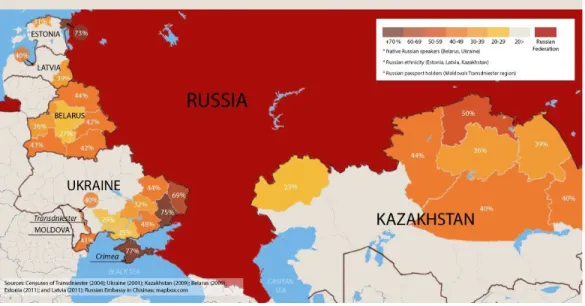
Now that we are familiar with the historical background of Eastern Europe, it is time to consider the effects of these past events on the location and characteristics of Russian minority groups today, and how that intersects with geopolitical institutions and political calculation in Russia’s “near abroad”. Let us begin this section with a map of the prevalence of Russian ties in Russia’s border states, in order to contextualize the subregion-specific discussions in the following case studies of Ukraine and the Baltic States:
Figure 5: Russian Ethnicity/Language Prevalence in Eastern Europe
Source: Jeremy Bender, Ties To Russia (2014)
20
However, there are other areas that catch the eye; for example, the extreme northeast of Estonia (Tartu County) actually has a higher percentage of ethnic Russians than does Crimea or the Donbas (this map uses ethnic data from Estonia, but linguistic data from Ukraine; more detailed maps for Ukraine are provided on page 24). However, far fewer events of international importance have occurred in Tartu over the past years than in either of those regions. Why the difference? Why did Russia see an opening in Ukraine while Tartu remains peacefully and uncontestedly Estonian, despite its strong ethnic, linguistic, and historical ties to Russia? This section will largely focus on teasing out the differing characteristics of Russian minorities in the relevant states, and the ways these different characteristics intersect with other important factors in the security of the states they reside in.
In terms of structure, the following case studies will be detailed and analyzed by variable. Thus, it is perhaps a good idea at this point to further refine our definition of the three variables. Variable One, as stated earlier, deals with Russian strategic interest, which can be defined in the context of this paper as the belief (to the extent we can understand it) of Russian policymakers that influence over a given foreign territory, people, or state will improve Russia’s geopolitical position, either directly or indirectly. Discussions of this variable will both defend that it is the most
21
strategically significant in itself, but useful for projecting regional and global political and military power).
Variable Two is probably the most complex of the three, exploitability of local Russian minorities being a concept that is multifaceted and difficult to define. Minority exploitability will be defined for the purposes of this paper as the level to which factors are present which make Russia more likely and/or able to utilize a minority in order to gain influence over the territory or nation in which they live, either directly or indirectly. These factors include both the identity of the minorities themselves (for example, discontent with their current governments, or level of affinity towards Russia) and other, more circumstantial vulnerabilities to being exploited by a Russia interested in influencing their region. These two are quite independent of each other: while minority identity, including minority willingness to protest or perhaps even take up arms against their government, certainly could increase their exploitability, so could other coincidental
circumstantial factors like situation along a border (potentially increasing the perceived legitimacy of an irredentist movement, whether it was truly organic or in truth fomented and aided by Russia). Essentially, this variable discusses all relevant aspect of the existence of Russian minorities,
22
Thus, when the term “Russian minorities” is used, it is used as a catch-all phrase to include people identifying with either, or both, factors, and when they are distinguished it is in order to facilitate some outside point, not to argue a difference in identity or geopolitical risk.
The third variable is the most straightforward, at least within these case studies. The “Institutional Protections” variable can be defined for the purposes of this paper as the level to which membership in alliances or other international institutions lowers the likelihood of aggression against a given nation or nations. Though this can and does apply to economic institutions, which are able to provide indirect support and an alternate source of economic development funds and trade besides Russia, this paper will focus on those which can provide a military deterrent to aggression. In our case studies, the first of these is surely NATO, given its strong backers and its history of acting as a military (and geopolitical) counterweight to Russia since Russia was the Soviet Union. The E.U. can also theoretically function as a defensive alliance, and though this threat is likely less credible (due to the nature of the organization and its lack of U.S. membership), the two combined indicate very strong institutional protection, and neither very little. Though there is surely more nuance in terms of institutional membership than this, our case studies provide polar opposite cases; for the purposes of this essay, we are mostly interested in the presence or lack of strong institutions with a history of impactful involvement in the region, rather than the varying and untested degrees of protection other, weaker institutions may offer.
23
we can gain from them will be simplified and then extrapolated in the conclusion, with particular reference to how these case studies can help us identify and analyze other potential areas of friction in the region, and thus perhaps help to prevent or diffuse them.
. . . . .
Case Study One : Ukraine
Section Introduction
The Russian minority in Ukraine is, and has been since Soviet times, concentrated in
precisely the areas causing problems today: Eastern Ukraine (the Donbas) and Crimea. As a result of hundreds of years of Russian hegemony, Russian has become at least a minority language and ethnic identity all across the country, but in non-border regions of Western and Central Ukraine,
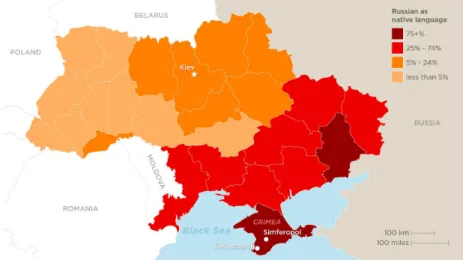
Ukrainian is the dominant identity in both respects. It must also be noted (comparing Figures 6 and 7) that Russian ethnic identity is in most regions of Ukraine less common than the use of Russian as a native language, indicating that the Imperial and Soviet periods more heavily involved
encouraging or forcing existing Ukrainian communities to use the Russian language than resettling Russians in these regions, as the Soviets did in the Baltic States (or at the least that the former efforts were more successful than the latter).
24
Figure 6: Location and Prevalence of Russian Ethnicity in Ukraine
Source: Kuban Kazak (via Wikimedia Commons), Map of Ethnic Russians in Ukraine (2007)
Figure 7: Location and Prevalence of Native Russian language in Ukraine
Source: Editors of CNN World, A Divided Ukraine: The Language (2014)
25
the country’s area is dominated by Ukrainian language speakers, but in the heavily industrial eastern part of the country, the Russian language dominates even more strongly than the larger number of ethnic Russians would suggest. For example, according to the 2001 Ukrainian census, though the inhabitants of the eastern city of Luhansk (now occupied by pro-Russian rebels) were almost evenly split between Ukrainian and Russian ethnicities, over 85% of residents spoke Russian as a native language. This disparity between ethnic and linguistic identity in industrialized areas of eastern Ukrainian, as compared with the relatively low and comparable prevalence of both identities in western and central Ukraine, indicates that Russification in Ukraine was highly geographically uneven in its effectiveness and/or permanence, indicating a potential framework in which to analyze the recent internal strife in the region.
Figure 8: Majority language in Ukrainian City, Town, and Village Council areas - Refinement of Fig. 7.
Source: Jakub Marian, Results from the Ukrainian 2001 Census (2016)
26
Variable One: Russian Motivations for Intervention
As suggested in the previous chapter, the Russian loss of Ukraine, a territory the Russian Empire (and later the U.S.S.R.) had held at least in part since the the reign of Ivan III, was in essence an embarrassing accident of history. All the more embarrassing was the loss of Crimea, which was never viewed by Russia (and perhaps even Ukraine itself) as being naturally Ukrainian, but rather was gifted to Ukraine in a seemingly harmless show of good faith which, upon the entirely
unforeseen dissolution of the U.S.S.R., resulted in a loss Russia had not foreseen nor accepted. This subsection will argue that, even if Russia would, given the choice, extend their control over all of Ukraine, there are multiple tiers of tactical objectives at which possession of Crimea sits at the top and direct administration of Ukraine sits at the bottom. Russia’s rush to take Crimea, but only after-the-fact exploitation of unrest in the Donbas and general lack of interest in pushing further into Ukraine (either via proxy war, direct war, or Crimea-like seizure tactics) indicates that Russia was only ever truly interested in directly taking Crimea, and all other goals revolve around keeping Ukraine tied to Russia, or at least not tied to anyone else. This view is seems reasonable due to the well-established strategic usefulness of Crimea and, more generally, has been borne out in the approach of strategically weakening the ever more western-oriented Ukrainian state that Russia has taken since 2014.
27
in June of 2014), Russia’s strategy had to change, as Ukraine would no longer be as susceptible to Russian soft power as it had been. Thus, an opportunistic, three-tiered plan arose, the first goal being to retake Crimea for Russia, the second to re-orient Ukraine towards Russia if possible, and the third, if the second proved impossible, to attempt to weaken Ukraine in order to make it less useful to the West as opportunities presented themselves (up to and including direct seizure of even more territory). As discussed earlier, the Russian embarrassment at losing Ukraine was significant, but that of losing Crimea was even worse, as it was both an accident of history within an accident of history (the creation of the Ukrainian SSR, and the granting of Crimea to it from Russia) and contained the significant strategic southward-facing naval Black Sea naval base of Sevastopol (Yuhas and Jalabi). Furthermore, Crimea presented a “soft target,” so to speak, as it had never truly identified with the Ukrainian state, language, or ethnicity to the degree that the rest of the country did; this “softness” was especially pronounced given its high strategic value. Thus, in the confusion and weakness of the Yanukovych-Poroshenko interregnum, Russia struck, providing a stellar example of Russia’s thoroughly rational, opportunistic, and pragmatic approach: a referendum was called, votes found overwhelmingly in favor of Russian control of Crimea, and Crimea was under de facto Russian control before Ukraine or its allies could produce any credible threats.
28
of actual invasion of Ukraine (both military and diplomatic) would certainly far outweigh any benefit Russia would gain from it. However, as it became increasingly evident in 2014 that Ukraine could not be swayed back towards a pro-Russian stance, cemented with the election of Petro Poroshenko, Russia’s first two goals in the country were eliminated, resulting in a turn to the weaponization of anti-Euromaidan sentiment in Eastern Ukraine as an attractive and low-cost method of projecting regional power, undermining Ukraine and perhaps even taking some of its territory. When revolts in Luhansk and Donetsk succeeded on the regional level in 2014, Russia supported these rebels with arms and troops, support which continues to this day. However, the fact of Russia’s relative lack of interest in these areas until Russian partisans proved their ability to constitute an effective proxy for Russia, compared with its heavily invasive actions in Crimea only a month before, indicates a strongly pragmatic approach by Russia, as does the timing of their
invasive actions during a time of great Ukrainian weakness. If an ethno-nationalist explanation for Russian interference in Ukraine were true, we would surely expect to see a more equal distribution of effort by Russia to retake all lands its rhetoric indicates it views as its own, not merely the ones which are convenient to take, militarily, politically, or socially. This does not mean that an
ethno-nationalist Russia would not start with easier targets and move to more difficult ones when considering using military force; rather, we would simply expect efforts on all fronts at all times, even if they differ in their strategy and intensity (perhaps including in better-protected areas strong propaganda campaigns, or significant economic incentives to entice Russian minorities abroad back to Russia). The fact that all three factors seemed to be heavily considered by Russia in its actions in Ukraine in 2014 and since indicate that pragmatism, not ideology, is driving its behavior.
29
impactful involvement in other high-value territories, despite their obvious ability to pursue more than one goal at the same time, indicates that Russia pragmatically seeks paths of least resistance in utilizing identity to pursue its broader, unrelated geopolitical ends.
. . . . .
Variable Two: Russian Minority Identity, Circumstance, and Reaction to Intervention
Since the dissolution of the Soviet Union, Ukrainians more ethnically and linguistically (and often politically) aligned with Russia have routinely sought political and cultural recognition by the Ukrainian state, efforts met with disdain from Kiev, including the striking down of local
30
support generally falling along the geographic lines of Russian ethnic presence (see Figures 6, 8 and 9). More recently, in March 2014, polling directly after the ouster of Viktor Yanukovych as a result of the Euromaidan protests found that around 27% of Southern and Eastern Ukrainians reported believing those actions constituted a coup d'état, and in that same poll 41% of Crimeans, 33% of Donetskians, and 24% of Luhanskians were found to favor a union between Ukraine and Russia (International Republican Institute).
This evidence, to say the least, does not easily fit into a neat narrative. Ethnic Russians largely did not identify with the Russian nation, yet even many who no longer identified with Russia voted against Ukrainian secession from the Russian-dominated U.S.S.R. Many Southern and Eastern Ukrainians, regions inhabited predominantly by ethnic and/or linguistic Russians, now support a union between Russia and Ukraine, but in all regions the support for such a union falls well short of the percentage of residents of Russian ethnicity, and even further below the
percentage of Russophones. In Ukraine, Russian identity clearly comes in many shades, far more than a paper of this scope could, or should, address. However, it seems fair to characterize the Russian minorities of Ukraine as feeling generally left behind by an increasingly nationalistic and westward-focused Ukrainian state, leading some small contingent of particularly angry protestors to initiate a snowball effect leading to open conflict (much as a relatively small contingent of
31
to create security concerns because of the relative prosperity of Estonia compared to Russia (Shlapentokh). Shlapentokh’s other arguments, for example the degree of assimilation of Russians into Estonian culture, only further emphasize the apparent importance of this factor, as, if anything, Russian language and culture is far more pervasive and well-integrated in Ukraine than Estonia. However, Shlapentokh’s economic argument does appear reasonable. Even through the tumultuous rise and fall of the two nations’ economies in the past decade, Russia’s GDP per capita has generally sat at least three times higher than Ukraine’s (in 2016, Russia’s $8,748 to Ukraine’s $2,185, and Estonia’s $17,575)("Estonia Data”)(“Russian Federation Data”)(“Ukraine Data”). Beyond the statistics, this trend is evidenced and contextualized in the deep anxieties of workers in Ukraine’s former industrial heartland, the Donbas region; it is no coincidence that an area which had already experienced significant post-Soviet industrial decline dissolved into chaos under threat of increased outside economic competition, competition which locals viewed the pro-EU forces in Kiev as supporting over their already diminished livelihoods (Harding). If indeed relative economic health is a factor in the political actions of Russian minorities in border states, we might expect Ukrainian Russian-identified people to be more receptive to Russian influence in their country compared with Russian-identified people in nations who would, if anything, likely suffer rather than benefit if Russia were to administer them instead.
Though Russian minorities in Ukraine have a complicated intersecting identities and opinions on the relative rights of Russia and Ukraine to rule them, it seems safe to say that relative impoverishment compared to Russia and both real and perceived privileging of Ukrainian identity and language over Russian identity in the new, post-Soviet Ukraine led Russian-identified
32
a cycle with its own momentum. The higher rate of disavowal of Russian identity than support for Ukrainian independence among ethnic Russians in 1991, along with recent data on fairly low support for a Russian-Ukrainian union, indicate that even most Russian-identified Ukrainians are not particularly keen on rejoining Russia. Rather, when the Euromaidan protests broke out, the aforementioned 26%-41% of those in Crimea and the Donbas who desired a Russian union with Ukraine in effect saw the “coup” against their preferred candidate Yanukovych in Kiev as a bridge too far in the quest for westernization. It was surely a particularly extreme part of this minority which utilized this unrest to the violently form the separatist “Republics” in Donetsk and Luhansk, working alongside opportunistic Russian operatives, taking advantage of general discontent, anger, and disorganization to engage in political behavior well outside the mainstream discourse. In the case of Ukraine, Russian minorities are much more moderate and cynical than the civil war being fought in their name suggests. Excellent timing on the part of Russia and its most ardent and violent supporters, operating under the cover of more general, non-revolutionary cultural and economic unrest, created a perfect storm for a relatively unwelcome war, the disillusionment of most
Russian-identified people in Eastern Ukraine with both Ukraine and Russia simply being too high to do anything but wait out the stalemate.
33
Figure 9: 1991 Ukrainian Independence Referendum Results by Oblast
Source: Chrystia Freeland, 1991 Ukrainian Independence Referendum by Region (2015)
Figure 10: 2010 Ukrainian Presidential Election Results by Oblast
Source: Chrystia Freeland, 2010 Presidential Elections (2015)
34
Variable Three: Institutional Protection
It does not take a particularly keen observer to postulate that Russian invasion of Crimea and paramilitary activity in the Donbas might be related to Ukraine’s lack of military alliances and institutional support. Ukraine, unlike most European states (including the Baltics), does not have membership in NATO or the EU; this made it a “soft target” for an ambitious Russia, which, though it already surely had designs on the Crimea, likely only struck in Ukraine because it was able to do so without significant risk to its own security. Below, the two main regional defensive and support institutions, NATO and the EU, will be discussed, as will the lack of Ukrainian institutional
membership in the context of its path to crisis.
35
potential Russian incursions, as Article 42.7 of the Treaty of the European Union obliges other states to “aid and assistance by all means in their power” if any member state is a victim of “armed aggression on its territory” (ECFR). These redundant defensive institutions provide a clear potential barrier to Russian incursion, as for relatively little gain it could risk war with several powers which lead the world in both conventional and nuclear military capabilities.
Unfortunately, unlike most European states, including the Baltics, Ukraine has joined neither NATO nor the EU. In 2008, Ukraine, then led by pro-Western president Viktor
Yushchenko, applied to join the NATO Membership Action Plan (the process by which nations can eventually join NATO, given that they fulfill certain conditions), a move reversed when the
pro-Russian Yanukovych took power in favor of closer cooperation with Russia (“Ukraine Makes it Official”). Despite significant support for accession to NATO among the Ukrainian population (though along the typical fault lines between nationalist east and pro-Russian west) and support from Yushchenko's government, ultimately Russian interests won out; Russia, which had long threatened Ukraine with military force should it join NATO due to its obvious desire to limit NATO’s eastward expansion, was ultimately able to take the more conservative route of influence (“Russia in Ukraine Missile Threat”). Similarly, though Ukraine had began the process to join the EU in 2012, the Yanukovych government dragged its feet in actually making formal progress in its application. Indeed, it was due to Yanukovych’s government’s unwillingness to free Yulia
36
To add insult to injury, the crisis in Ukraine has created something of a negative feedback loop in terms of institutional security. Because Ukraine did not have institutional support, especially in terms of firm mutual defense commitments, Russia was able to infringe on its sovereignty; however, because of the ongoing conflict in the Donbas and the general precariousness of Ukraine’s political and security situation, Ukraine is almost certainly precluded from obtaining those
protections. Russia, by intervening, has essentially placed NATO and the EU in a situation in which first, Ukraine would not be a useful partner due to its preoccupation with its own concerns (and its pre-existing vulnerabilities, such as location and poverty), and second, in effect by accepting Ukraine into those institutions they would be forced to trigger their own mutual defense
agreements in support of Ukraine, and thus risk armed conflict with Russia, a clearly aggressive and unscrupulous nuclear power. The lesson: Russia responds to hard power, and if border states wish to maintain their security, they must either maintain a sufficient arsenal (likely including nuclear weapons, as Ukraine once had) to constitute their own deterrent effect, or otherwise (and probably more practically) rapidly obtain firm mutual defense agreements with interested parties.
Anti-Russia Ukrainians probably believed they had more time to defend themselves, and obviously the pro-Russia Yanukovych administration believed that it could walk the line between
militarization against Russia via international institutions and becoming a Russian client state. The evidence in the case of Ukraine indicates that in cases similar to this one, what appears to be a line might instead be a tightrope, which can only be walked so far before one inevitably falls to one side or the other.
………....
37
Case Study Two: The Baltics
Section Introduction
The Baltic States fit a similar profile to Ukraine in many key dimensions, as the introduction intimated. As seen in Figure 3, most of the land which would become Estonia and Latvia was
annexed by Russia during the reign of Peter the Great, creating a similar timeline of Imperial and later Soviet control of the region compared to Ukraine’s (though clearly seized in a less piecemeal approach than the latter). The Baltic territories, like Ukraine, also underwent a Russification period, though starting later than Ukraine’s and focused more on the countering of undue perceived
influence of ethnic Germans and, after its unification, the rapidly strengthening German nation than a perception of local culture and language as inferior, as in Ukraine’s case (Karjahärm). Probably more important than either of these two in Russia’s eyes, the Baltic States, like areas of Ukraine, are of key strategic value. Their location extremely near the major Russian city of St. Petersburg, their proximity to key Baltic shipping lanes, and their physical separation of the Russian exclave of Kaliningrad from the mainland (which, in another accident of history similar to the loss of Crimea, Russia never intended or foresaw), all make the Baltic States territory prized by both Russia and those who would contain it.
38
aggression provided by NATO (and, theoretically, the EU). Each will be analyzed in turn, and though it is true that the third variable does likely preclude the first two from leading to Russian intervention, it is nonetheless important to analyze these factors; as the conclusion chapter will discuss, the example of the Baltics is ultimately most interesting once variables are manipulated, the lessons learned from it applied to other areas under different circumstances but with certain crucial similar qualities. To aid the logical flow of ideas, this section will first address Variable Two, and then discuss the complex interplay between Variables One and Three present in the region.
. . . . .
Variable Two, Part One: The Identity and Circumstance of Estonia’s Russian Minority
Estonia’s Russian minorities fit the same profile as Ukraine’s in many, perhaps even all, significant dimensions. Like Ukraine, Estonia has a sizeable Russian minority as a percentage of its population (25.2%), concentrated, like Ukraine’s Russian-identifying minority, in urban areas and the eastern section of the country bordering Russia (in Estonia’s case, largely greater Tallinn and the Tartu Region, as shown in Figure 11)(Statistics Estonia). Like Ukraine’s Russian minority, Estonia’s has also sought political representation and power in recent years. Estonia’s Centre party has become in large part a platform for minority issues: 75% of ethnic non-Estonians support the party, and as almost all ethnic non-Estonians are ethnic Russians, the Centre party must thus champion the causes of the sizeable Russian minority (Kangro).
However, beyond the admittedly striking demographic similarities between Estonia’s and Ukraine’s Russian minority populations, there seem to be few similarities between them.
39
minorities of Ukraine, their relative wealth and satisfaction with the state of the government in their nation leading them to have an arguably significantly lower potential threat to national security, and present a far less exploitable target for Russian leaders interested in increasing their influence in the country. As the aforementioned Dmitry Shlapentokh argues, the relative economic success of Estonia compared to Russia (Estonian GDP being roughly twice Russian GDP over the last 10 years) has led Estonians Russians to view Russia not as a potential economic savior, but rather as a poor place with little opportunity (Shlapentokh)(“Estonia Data")(“Russian Federation Data”). Indeed, Shlapentokh presents anecdotal evidence to the contrary, stating that many Russian visitors to Estonia are attempting to emigrate West for greater economic opportunity.
Furthermore, the concept of the “Estonian Russian” as an equal and legitimized entity in the eyes of the Estonian state and people, as compared with Ukrainian nationalistic fervor, also add to the sense that Estonian Russians present little threat of unrest, much less insurrection. Essentially,
40
multiple factors of Estonian Russian identity combine to indicate that, despite the facial similarity of Estonian and Ukrainian Russian minorities, the economic and political circumstances of the two groups could hardly be more different, far overcoming any superficial similarities they do have in terms of how their identities and geopolitics may intersect. `
Figure 11: Prevalence of Russian Ethnicity in Estonia
Source: Maarten van der Molen, Figure 3: Ethnic Russians in Estonia (2014)
Figure 12: Prevalence of Russian as a Native Language in Estonia
Source: “DVoit” (via Wikimedia Commons), Distribution of the Russian language in Estonia (2008)
41
Variable Two, Part Two: The Identity and Circumstance of Latvia’s Russian Minority
Latvia presents a case similar to Estonia and Ukraine in several of the superficial qualities of the minority groups; again, in Latvia’s case, Russian minorities tend to be clustered near the border with Russia, or in major industrial and urban centers (indeed, the major city of Daugavpils is majority-ethnic-Russian). The overall percentage of Russian minorities sits very near that of Estonia and Ukraine, at 27.0% and 37.2%, respectively (Central Statistical Bureau of Latvia). Furthermore, like the case of Estonia, Latvian Russian minorities have also evidenced increased political consciousness in the past decade, including a 2012 constitutional referendum which
attempted to designate Russian as an official second language of Latvia. However, as compared with Estonia, the case of Latvia also indicates that the identity of the Russian minorities themselves is not dichotomous, but rather exists on a continuum. The evidence from the language referendum
indicates that perhaps, though Russia’s motivations in the region are likely the same as in Estonia’s case, there is greater tension and less integration between Russian- and Latvian-identified residents of Latvia, thus perhaps constituting a middle ground between Estonia and Ukraine on that metric of stability.
Like Estonia, this lower political utility, from Russia’s perspective, can probably be largely attributed to two factors. Firstly, Latvia provides greater local economic opportunity compared with Russia, instead of the lower opportunity found in Eastern Ukraine: though not quite as wealthy as Estonia, Latvia’s per capita GDP is generally higher and less volatile and
42
the least a tense and adversarial relationship between those minorities and the ethnic majority in their nation (as the instability of 2013-14 and sharp divisions in political partisanship indicates is substantially true), and Estonia represents high levels of integration of Russian minorities into their nation, than Latvia provides a case study into the middle ground. Let us take the example of the Language Referendum of 2012: Russian minority leaders in the nation initiated a referendum proposing making Russian an official language, though they “admitted they had no chance at winning,” with the expectation of heavy support from ethnic Russians, in order to “force Latvia's centre-right government to begin a dialogue with minorities” (“Latvians Reject Russian”). As those organizers predicted, around three-quarters of the votes were nays, evidencing clear divisions between ethnic and linguistic Latvians and the ethnic Russian and Russophone population (who are, of course, largely the same people, given the relatively recent, Soviet origins of these
populations).
43
those they do not like. When compared with the often heated and sometimes violent opposition to policy aimed at furthering the Russian language in Ukraine (Elder), the Latvian referendum seems to more closely resemble a cry for respect and political concern from a relatively poor and politically limited regional minority (Latvian language skills being required to gain citizenship, even for Soviet-era migrants) than an angry and partisan movement, à la Ukraine, that could be taken advantage of by Russia (“Latvians Reject Russian”). Thus, even if the Latvian Russian minority population may on first glance have certain similarities to that of Ukraine, ultimately the means through which they approach political representation, the reasons for their dissatisfaction, and their nonviolent (and thus non-exploitable) reaction to failure all point to a fundamental difference between the Russian-identified people of the Baltic states and those of Ukraine. Whether politically integrated, as in Estonia, or somewhat apart, as in the case of Latvia, the identities and insecurities of Baltic minorities appear to be simply less exploitable compared with those of Ukrainian
minorities.
Figure 13: Native Russian Language Prevalence in Latvia
Source: “Xil” (via Wikimedia Commons), Use of Russian Language at home in Latvia (2011)
44
Variables One and Three: Russia’s Motivations in the Baltic and Institutional Limitations
The similarities in historical context and presence of Russian minorities between Estonia and Latvia and their southern counterpart Ukraine, discussed in depth in the introduction, would naturally lead one to expect an ideologically-driven, ethno-nationalist Russia to pursue gaining influence in and power over this region to at least the same degree as it would in Ukraine. Instead, Russian strategy in the Baltics, especially as compared with its recent opportunistic actions in Ukraine, constitutes some of the most compelling proof for a pragmatic approach over the pursuit of ideological goals in Russia’s policy towards its “near abroad”. If we assume fundamental
similarities between these regions from an ethno-nationalist Russian view, and given the clear Russian interest and intervention in Ukraine, the question then becomes: why hasn’t Russia
infringed on the sovereignty of these nations as it has in Ukraine? What distinguishes the two cases, and if it is purely practical consideration, has Russia evidenced any attempts to work around those limitations to achieve ethno-nationalist goals? Ultimately, the conclusion seems clear: while Russian interest is present in both regions, and if given its way it would exert its control over both regions, its actual, strategic approach leads it to ignore problematic areas like the Baltics and focus on weak areas like Ukraine (or Georgia), rather than pursuing a more diversified and human-centric, genuinely ethno-nationalist approach.
45
the EU charter, a Ukraine-like crisis is rendered nearly impossible in the Baltics without a
significant change in political and military circumstance. Russia was able to take advantage of the Ukraine crisis because of a lack of firm outside defensive commitments; in the Baltics, NATO and the EU certainly provides a strong and credible commitment, thus precluding any significant
opportunistic intervention by Russia. These redundant defensive institutions provide a clear barrier to Russian incursion, as it could risk war with several military powers which lead the world in both conventional and nuclear military capabilities.
The fact that the Baltics enjoy significant military protections Ukraine has no access to can plausibly explain in its own right the obvious differences in the Russian approach between the two regions. Even if Russia genuinely did target the Crimea and Donbas regions due to their
Russian-identified populations, rather than strategic or geopolitical value, they could be expected to not engage in similar behavior, however much they might wish they could, out of purely practical considerations, in this case the presence of strong defensive alliances. However, Russia in this case would still probably attempt to gain control over them somehow. Both an ethno-nationalist and a purely strategic Russia would pursue conventional economic and diplomatic influence channels in an attempt to secure their power in the region (though for different reasons). However, an
46
veneer. Measures could including utilizing the Donbassian tactics of supporting genuine protests and insurrections (though obviously Russia’s tactics would have to be moderated compared with its strategy in Ukraine), but also, in the event that land cannot be “retaken” for Russia along with local Russians, would likely involve attempting to entice ethnic Russians in particular back to Russia. After all, a truly ethno-nationalist state would ultimately view bringing its own back to it as a victory of at least as great a magnitude as taking territory, and indeed Russia has clearly used the presence of ethnic Russians as justification for its seizure of Ukraine. Thus, the institutional barrier posed by NATO and others in the case of the Baltics does not so much present a limitation to our analysis of Russian strategy than an opportunity to determine Russia’s true motivations in the region, uncomplicated by the practical considerations that actually proved in some ways obfuscatory in Ukraine. If there is evidence to be had of an ethno-nationalist approach anywhere, it would likely be here: by virtue of it being limited in its activity, we would likely see an ethno-nationalist Russia engaging in the aforementioned strategies, and a strategic Russia effectively ignoring the are for all intents and purposes and turn to more exploitable regions where its active engagement would have a higher marginal benefit.
47
meaningful way. In 2006, Vladimir Putin announced a repatriation plan targeting ethnic Russians living abroad, an apparently ethno-nationalist move, until one considers that Russia was even by that time suffering from a staggering demographic crisis draining the country of over 700,000 people per year. Furthermore, little support was provided for returnees: “most regional
administrators [made] it clear that they will accept only those applicants whose professional skills match the needs of their respective job markets” and some authorities warned that “newcomers will be offered only jobs that local residents do not want” (Peuch). It is perhaps thus unsurprising that
this program was unsuccessful: out of the stated goal of 100,000 returnees, only 143 families
returned in 2006 (Peuch). The utter failure of this program poses the question: if Russia genuinely
desired its countrymen to return from abroad for ideological reasons, why would their effort so
closely resemble careless and self-serving attempt at alleviating their own unrelated issues? Russian
migrants today seem to return to Russia mostly because of Russia’s own bad behavior, and the ire
that it brings upon expatriates in other nations, not due to active attempts by the Russian
government to attract them “home” (“Around 150,000 Russian Citizens Repatriated”). Indeed,
though 150,000 ethnic Russians returned to Russia in 2016, most came back due to perceived
economic or political persecution, while in a two year period before 2015, only 37 ethnic Russians
left the relatively tolerant and prosperous Estonia for Russia (Goble)(“Around”). In short, if Russia
genuinely cared about Russian-identified people in border states beyond their use as a justification
and cover for geopolitical maneuvering, one would expect very different trends in the above data. It
thus seems that the presence of institutional limitations on intervention serve to distinguish fact
48
The ultimate conclusion to be gleaned from the case study of the Baltic region is a simple one, combining well with the lessons we have learned from studying the Ukrainian crisis. Despite Russia’s bluster and strongly worded statements, and its attempts to mask its true intentions in order to threaten and intimidate both its neighbors and Western powers, ultimately it only intervenes in areas which are strategically valuable and where there are low barriers to do so. The conclusion of this essay will further explore the implications of Russia’s approaches to both regions, with particular concern for the lessons that can be learned and applied by other states in Russia’s “near abroad.”
………
Chapter Three: Conclusion
49
willing to intervene as they provide both a pretext and a cover for intervention. This means that Russia may intervene more rapidly in areas it already considered interesting if unrest spikes and/or it may intervene in areas it considered interesting, but below the normal threshold for intervention, before the spike. Thirdly, an institutional barrier to Russian military interference exists in NATO and other organizations in some cases; the threats that organizations can pose are obviously variable, but in the case study of the Baltics, they are fairly universally considered a credible and strong deterrent effect. However, these institutions only work if states in Russia’s “near abroad” have membership in them; as much as NATO and the EU dislike Russian aggression in Ukraine, they were unwilling to come to Ukraine’s aid directly as it was not a member state. No border state, apart from the Baltics, is a member of one of these major, deterrent institutions. Given this
structure, Ukraine can be considered a perfect storm for Russian intervention, as all variables in early 2014 favored it, Estonia presents a case study in which the first variable was present but the other two were anti-intervention, and Latvia a case in which the first variable is pro-intervention, the second intermediate to low, and the third anti-intervention.
The value in this framework is not in understanding the case studies better (or at least not primarily so); these case studies are deeply complicated and heavily studied as it is. Rather, the lessons from them, filtered through this variable approach, can be applied to find future points of potential Russian aggression and ascertain what Russia’s strategy might be if they choose to
50
in essence, if Variable Three is present, it puts the power in the hands of the border state, whereas in its absence the power lies with Russia to tailor its plans for potential intervention specifically for that region.
Let us take some examples to illustrate these points: for instance, suppose that minerals of great value were found under eastern Latvia, and the Russian-identifying populations there
happened to be greatly upset at their government at the time and desired to join Russia. Even in this scenario, one which would surely cause many Western pundits (likely even the more sensible ones like Shlapentokh, given that many fundamental assumptions about the stable nature of Baltic
Russians would have proven incorrect), seizure of that land would be unlikely as it would effectively constitute a declaration of war against many nuclear powers bound to protect Latvia due to their alliances. In essence, even in a worrying situation like this, the threat of NATO and like institutions would almost certainly preclude invasion, and probably even a Ukraine-style quasi-invasion.
51
being present and three being absent in a border territory in Kazakhstan (or in any of several nations in Central Asia or the Caucasus), immediate seizure of territory and rapid attempts at justifying this invasion through sham secession referendums would be a likely strategy, as it appears to have largely worked in Ukraine. If only variable one were present, this might still occur, as mentioned above; though in Crimea both were present, and thus separating the contribution of each is an inherently difficult proposition, the reason for invasion was surely a very strong Russian interest, and the second variable merely informed the timing and method of invasion.
If the hypothetical case were shifted in the other direction, and only Variable Two was present, Donbassian logic could be applied: after all, Russia clearly involved itself in that conflict not due to any advantage it could gain from holding that territory (or else it would have seized it
52
potential, and as that is the only use for intervention in such areas, post-Soviet states outside Eastern Europe should be less worried about a Donbassian situation than a Crimean one.
Of course, in any real-world situation in Russia’s “near abroad,” these variables are hardly ever fully one way or the other. Crimea and the Baltics largely present clear and distinct cases and overwhelming interests, for example the overwhelming Russian interest in Crimea, or the overwhelming threat posed by NATO, precluding any semblance of Russian intervention.
However, the truly useful aspects of the case studies in terms of discerning future behavior are likely in the areas in between, in areas of potential conflict, rather than in areas in which it is likely or near. The conflict in the Donbas, for example, is in effect Russia simply utilizing the available Russian-identified minority to intimidate and signal its regional power to other nations, and
Latvia’s moderate level of Russian-minority discontent could be a meaningful and complex factor in Russia’s calculus if that context were present in a different and less protected nation, say in the Caucasus or in Central Asia. These considerations are well outside the scope of this thesis, both in terms of the myriad conceivable outcomes of intermediate cases and the application of the evidence from the case studies to specific areas, which each have their own peculiarities which could
significantly increase or decrease Russian desire and/or ability to interfere.
53
states, if they possess any significant Russian minority population (especially near the border), should formulate policies towards them aimed at keeping them politically content with access to sufficient economic opportunity and, if possible, strengthening their claim on those border regions.
To provide an example of a potential successful deterrence of intervention, we can look to Kazakhstan in 1993. In that year, some Russian nationalists, notably the parliamentarian Vladimir Zhirinovsky, called for Russia to seize the predominantly ethnic-Russian northernmost region of the country (Barnard). While Kazakhstan’s leader, Nursultan Nazarbayev, downplayed the significance of this rhetoric at the time, later that year he announced that Kazakhstan’s capital would be moving from Almaty, a large city in the ethnically Kazakh south, to a new planned city in the north of the country, what is now Astana, in order to solidify Kazakhstan’s claim on the region despite its ethnic makeup (Barnard). While such drastic moves cannot and should not be applied in every case, this flexible and bold approach to assuring a strong claim over territory should be looked to as a model by other states facing similar demographic and strategic concerns in Russia’s “near abroad”. Myriad options exist to counter Russian expansionism and aggression, from this sort of bold nation-building to economic programs to initiatives incentivizing minority migration further into the nation in question, and while it is important to realize that Russian minorities are only rarely dangerous in and of themselves, they are in effect quite dangerous if Russia has any strategic interest in their region. Ultimately, the closer a post-Soviet state finds itself resembling Ukraine in 2013, the more rapidly and commitedly it should utilize some or all of the aforementioned tools to ensure its continued sovereignty, lest it fall prey to Russia and its ongoing struggle for regional hegemony.