Mining Dynamic Communities based on a
Novel Link-Clustering Algorithm
Hamideh Sadat Cheraghchi
Department of Computer Science and Engineering Shahid Beheshti University
Tehran, Iran [email protected]
Ali Zakerolhosseini
Department of Computer Science and Engineering Shahid Beheshti University
Tehran, Iran
Received: December 18, 2016- Accepted: February 27, 2017
Abstract— Discovering communities in time-varying social networks is one of the highly challenging area of research and researchers are welcome to propose new models for this domain. The issue is more problematic when overlapping structure of communities is going to be considered. In this research, we present a new online and incremental community detection algorithm called link-clustering which uses link-based clustering paradigm intertwined with a novel representative-based algorithm to handle these issues. The algorithm works in both weighted and binary networks and intrinsically allows for overlapping communities. Comparison with the state of art evolutionary algorithms and link-based clustering shows the accuracy of this method in detecting communities over times and motivates the extended research in link-based clustering paradigm for dynamic overlapping community detection purpose.
Keywords-social network; link clustering; dynamic network; evolutionary clustering; representative-based clustering
I. INTRODUCTION
So far, a large amount of research has been devoted to the task of understanding natural and hidden structures of different social, biological and information networks under the name of "graph clustering" or "community detection" approaches. In this rich area of research, communities are usually regarded as dense sub-graphs of networks. The existence of linked data is distinguishing feature of modern community detection in social network context versus traditional point-based data clustering.
Regardless of the definition, current trends in community detection present several challenges not present in traditional community detection. Dynamicity and overlapping features of the network are two key dimensions to be considered in the state-of-art algorithms due to the distinguished behavior of
individuals in different social networks [1]. In the first challenge, users’ joining and withdrawing behavior from communities is accounted. For the first challenge, there should be smooth changes in the discovered community, since many individuals may stay for a long time in their communities. In the case of non-overlapping community detection, this challenge is partly covered by the state-of-art evolutionary algorithms [2, 3]. However, there is always a trade-off between preserving community detection quality and smooth discovery of communities. On the other hand, there should be a mechanism to account for unforeseen dramatic shifts in the structure of communities due to the creation of new communities. The desired approach to handle this task should be computationally feasible and rapid, in order to adapt to changes. Evolutionary algorithms hardly can capture abrupt changes in the network and hence are suited for networks with small changes.
Other famous dynamic approaches such as LabelRankT [4] and QCA [5] face enormous challenge due to unpredictable behavior of networks [6]. We have recently proposed a representative-based approach called ARTISON [7] which can handle smooth community discovery while being able to handle abrupt changes in the network. Although, it is designed for non-overlapping case.
The second challenge, i.e. overlapping detection of communities in dynamic context, is a common feature of modern network. People are simultaneously members of multiple communities which create overlapping community structure. In this case, a user may hold the membership of multiple communities (e.g. family, friends, and college circles). For the case of overlapping feature, it is ideal to have solution which take intrinsically the overlapping nature of communities. Further, the challenge of handling abrupt changes still persist in overlapping context [8]. Link-clustering are the unique orthogonal solution to handle overlapping community structure intrinsically.
Our paper present a novel community detection algorithm called Link-ARTISON which target both of the challenges mentioned simultaneously. It handles abrupt changes while preserving smooth detection of communities based on the representative-based approach. Further, a novel approach in linked-based clustering is proposed which covers overlapping issue. To the best of our knowledge, simultaneous targeting of these issues is not yet covered in the literature. The contribution of the paper are as follows:
Link-ARTISON can determine the number of communities automatically and runs using local information.
It provides a novel dynamic link clustering algorithm by a two level linked-based similarity mechanism which can capture both low and abrupt changes.
It outperforms the sate-of-art dynamic incremental and link-based community detection in several experiments.
The paper is organized as follows: In Section II, we take a look at the background knowledge of dynamic and overlapping community detection algorithms. Section III explains our proposed approach and Section IV represents the experiments to evaluate our proposed algorithm. Finally, we present our conclusions and future directions.
II.LITERATURE REVIEW
First, Community detection in social network originally is a follow-up of a clustering approaches developed generally for data mining purpose. Survey paper [1] generally classify algorithms based on 1) Graph Partitioning methods, 2) hierarchical clustering methods, 3) Modularity optimization methods, 4) inference-based algorithms, 5) spectral methods and 6) Specific approaches developed for dynamic and overlapping communities. In this Section, we concentrate more on categories of works related to our proposed algorithm and cite the recent works on each domain. Among these methods, partitioning
clustering algorithms are very popular due to their simplicity and intuitiveness. In this class, a set of data points are assigned to a number of known clusters where each cluster is characterized by one prototype. Cluster are gradually constructed by iteratively mapping data points to clusters and updating representatives. One of the most popular algorithms in this category is k-mean algorithm applied in many domains. In fact, the algorithm is recognized one of the top ten influential algorithms (in 2nd place) in data
mining area [9] and researchers are encouraged to further explore and find the new application and research issues of this method. The high ranking of this algorithm is due to its simplicity, intuitive optimization process and scalability properties which has paved the way for its wide application for more half a century. However, the requirement of knowing the number of clusters before computation and sensitivity to initial seeds are among the limitation of these algorithms.
On the other hand, dynamic community detection is basically categorized in two branch: 1) the first called independent community mining is a follow-up of static community discovery in each time step and comparison of the results in different steps to have a whole picture of the network. 2) The other approach called incremental community detection incorporate the information obtained in other snapshots for extracting communities of the current time step. This improves the time and computational complexity compared to independent community detection approach [10, 11]. The evolutionary clustering are an important paradigm in which a cost-function is calculated in each time step trying to minimize the changes happening to communities in the following time step. Although, this approach assumes that abrupt changes in subsequent time steps are unlikely and these changes have small impact on the community structure.
For overlapping community detection algorithms, one can recognize two broad categories of node-based and link-based algorithms that address the problem of multiple belongingness of nodes to different communities [12]. In a more detailed view [8, 13], node-based methods are subcategorized by researchers into node-seeds and local expansion algorithms like OSLOM [14], clique expansion algorithms like CPM [15] as the pioneer of overlapping dynamic algorithms, label propagation methods like dynamic overlapping SLPA[16] and other inherently dynamic and overlapping algorithms such as AFOCS[8]. In the second main category, i.e., link communities, clustering is performed on links instead of nodes [17]. This helps to provide intrinsic overlapping discovery. By finding nodes incidents to links within each community, one can recognize the structure of overlapping communities. However, the algorithms in this domain do not account for non-neighbor links which usually produce small and highly overlapping structure. Instead, we propose an approach which account for non-neighbor nodes in different iterations which works in dynamic context too.
III.PROPOSED MODEL
Let us consider a temporal network by several snapshots of the network (G G1, 2, ...,Gs) . Each
snapshot of the network is represented by
( , )
t t t
G X E . We denote the members of the network in time step
t
as Xt { , ...,x1 xn} where each member includes its attribute including node id (vi),and weightof the interaction with their neighborhood ( ) i x
where
( )xi {xj X | ( ,x xi j) E}
, i.e. ( wij ). Further,
1 {C, ...,Ck}
is a family of communities (prototypes) classifying objects intokcommunities.
The overall procedure of the proposed algorithm are as follows: First, each node is taken iteratively and initialized by a specific link-based data structure. Then, a two-level selection process is performed to determine the assignment of the data structure to a link-based prototype structure. This two coarse and fine level process is similar to recognition and resonance state used in ART model [18]. Then, an update process takes place to update the affected prototypes and make the final link-based prototype structures. The details are elaborated in the following:
A. Initialization
First, the nodes are taken incrementally ordered by their degree. The local information of the node under examination and their direct neighbors are stored in the linked data structure of the node
( )xi asillustrated in Fig. 1. This linked data structure includes the ids of each edge, the weights and the timestamp of the interaction (
( ) : {
x
i
E( ),
x
i
W( ),
x
i
T( )}
x
i ).Notice that the output prototype structure store similar information to linked-data structure including ids, weights and time information. This structure includes non-adjacent nodes and links which are similar enough to each other based on the logic of the algorithm as described in the following.
Fig. 1. The representation of linked-data structure
B. First-level link-based selection
This step involves the first process for finding the best prototype (community) for the linked-data structure. The linked-input data structure under examination
(xi)
is compared with the attributes of the available prototypes(Cj(
j
1,.., ))
k
according to the following equation:1,..,
| ( ) ( ) |
( ( ), )
| ( ) |
i
i
E E
i j k
E
x C j
Sim x C
x
(1)
In this equation, the ratio of the size of the common members between the linked input data structure
( )xi and the candidate output prototype structure ((Cj(j1,.., m))
) and the size of the linked-data structure
( )xi under examination is calculated. The ratio is compared with the threshold value (
). The result of this equation may contribute to three cases: 1) if no similar community is found with respect to the specified threshold, a new community prototype is created to accommodate the properties of the new linked-data structure;2) If there is an exact match for the linked-data based on eq. (1), the unique prototype is selected for inclusion of the input; 3) If there are more than one prototype selected, the fine-level selection process in the third step handles this ambiguity.C. Second-level link-based selection
In this second-level similarity test which aims to determine the more preferred prototype (Cj
(
j
1,.., )
k
)
for the linked-data structure members
( )xi , the similarity is assessed based on the following equation:1,..,m
| ( ) ( ) |
( ( ( ), ))
| ( ) |
i
E E
i j
E
x C j
Max Sim x C
C j
(2)
It captures the ratio of the size
of the intersection of the pair of linked input data structure and output prototype structure and the size of the given prototype under examination. Then, the candidate prototype which has the highest value of this measure is selected to hold the members of the linked data structure.
D. Update
In this step, the structure of the candidate prototype(s) is updated to reflect the changes of the selection process. There may be only an update in the weights of the prototypes or in the case of adding new members, the first attribute- i.e. the edges of the prototypes- get changed too.
Notice that for the purpose of using the past data in future join/withdraw decisions, the prototype initialization in the beginning of each time step (t1 ) is committed. This is a key issue in incremental learning and compatible with the idea that members tend to preserve their membership to their old communities.
IV.RESULTS AND EXPERIMENTS
In this section, we evaluate the performance of Link-clustering on both static and dynamic real networks. The network are the famous benchmarks used for assessing the performance of the algorithms including Zachary Karate club network, Football network [19], Dolphin network [20] and Political Book [21] networks. Further, we use MIT Reality Mining [22] as a larger dataset which is typically used in the previous studies of dynamic community detection [23-25].
Since our proposed approach is a representative-based algorithm in dynamic context, the best comparison is achieved by comparing it to the state of art algorithm in representative-based category. For this reason, we choose the recent evolutionary representative-based algorithms for dynamic settings called Adaptive Evolutionary Clustering (AFFECT k-means [3]) where optimal smoothing factor is determined automatically using a statistical approach. Further, spectral algorithms are an important category of the algorithm which present high accuracy. Hence, we use the spectral version of AFFECT algorithm as another state of art evolutionary and incremental algorithm for the purpose of comparison. Further, to evaluate the strength of the algorithm in overlapping context, we use the pioneer and the most famous algorithm in link-based clustering1 [17] which uses Jaccard-based similarity measure for the discovery of the communities.
For the evaluation, we use three measures to determine the accuracy of the community detection algorithms in different time steps. The widely recognized measure of Rand Index [26] is utilized for the accuracy analysis which indicates the amount of disagreement between clustering algorithm and the ground truth labels. Further, Normalized Mutual Information (NMI) - more commonly used by physicists and taken from information theory- is used to assess the quality of community detection. This measure has proven to be a robust and accurate similarity measure for a number of modalities. Finally, we take advantage of F-measure to quantify how well detected community correspond to ground truth communities. All the mentioned measures reach their best at 1 and their worse at 0 value. Further, we use overlapping NMI measure [27] specifically designed to determine the disagreement between clustering algorithm and ground truth label in overlapping context. Finally, the threshold value ( ) of the algorithm is set to 0.3 according to the experiments. Since we did not access to overlapping ground truth values of datasets, ONMI will have lower value than NMI in disjoint structure.
A. Zachary Karate Club
The well-known Karate club network shows the friendship networks of the members in this club. After a dispute between the coach and the treasurer, the club split in two clubs. The results of the comparison are presented in Fig. 4.
1Available at https://github.com/rabbanyk/CommunityEvaluation
Fig. 2 Performance comparison of the proposed algorithm in Zachary Karate Club network dataset with two state-of-art dynamic algorithm AFFECT k-means and AFFECT spectral in three measures of a) Rand Index, b) NMI and c) F-measures.
he experiments on this network split the network perfectly into two partitions without any mismatch in different measures of Rand Index, F-measure and NMI. In all cases, the proposed linked-clustering shows much better performance. In Rand index measure, the accuracy is up to 20% better than both the state-of-art representative algorithm (AFFECT k-means) and the other dynamic spectral state-of-art algorithm (AFFECT-spectral). Further, in the case of NMI and F-measure the priority of link-clustering is more obvious which is the success of the proposed algorithm since they penalty false positive results too. In fact, the Rand index gives equal weight to false positives and false negative but F-measure penalize false negatives more strongly than false positives which is a more realistic case. Further, NMI correct the problem of comparing clusters with different number of clusters.
a)
b)
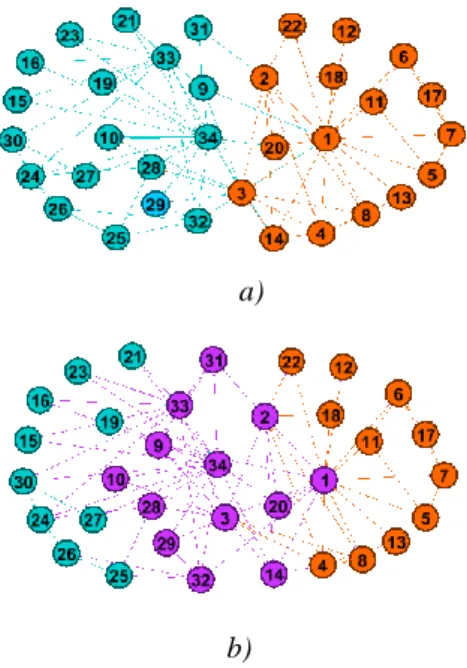
Fig. 3. Illustration of Zachary Karate Club network detected by the proposed algorithm in a) disjoint structure and b) overlapping structure.
The comparison of Link ARTISON algorithm with the pioneer link-based algorithm, Link Clustering [17] is presented in Table 1.
Table 1. Performance comparison of Link-ARTISON and Link-Clustering in overlapping context
Algorithm ONMI No. of clusters (Ground Truth = 2)
Link-ARTISON 0.25 2 Link-Clustering 0.16 22
ONMI measure in overlapping context also indicate almost 10% higher value than Link Clustering algorithm. Further, the number of algorithms in Link Clustering is far from the ground truth (22 cluster vs 2 clusters). Our algorithm detects the number of clusters correctly and the overlapping nodes lies in the margin between these two detected communities Fig. 3.
B. Football network
Network of American football games between Division IA colleges during the regular season Fall 2000 [19]. Edges exist if two teams played any game, and groups are conferences, scheduling groups joined by the schools for the purpose of regular season scheduling.
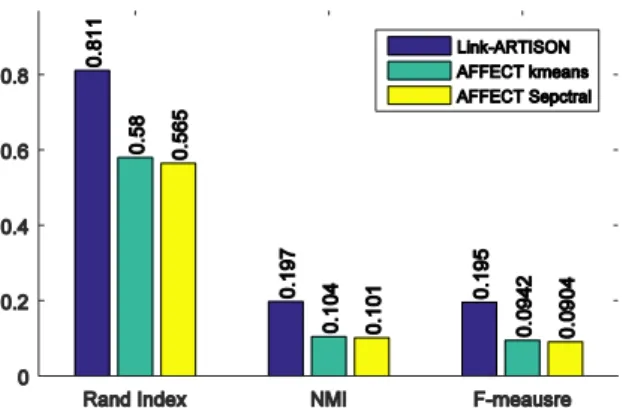
The results of the comparison are presented in Fig. 4. In all cases, the proposed linked-clustering shows much better performance. In Rand index measure, the accuracy is up to 20% better than both the state-of-art representative algorithm (AFFECT k-means) and the other dynamic spectral state-of-art algorithm (AFFECT-spectral). Further, in the case of NMI and F-measure the priority of link-clustering is more obvious which is the success of the proposed algorithm since they penalty false positive results too. Since NMI in disjoint setting shows a low value of 0.19% (possibly due to mistaken ground truth as indicated by Aloise et al. [28]), the ONMI also has lower value of this measure as indicated in Table 2. However, the number of communities discovered by Link-ARTISON is much closer to ground truth communities. Both of the measures are several order of magnitude better than the results obtained by Link-Clustering. Producing a large number of highly overlapping communities is the problem common in link-based clustering. However, our algorithm does not have such problem and produce natural overlapping communities.
Fig. 4. Performance comparison of the proposed algorithm in Football dataset with two state-of-art dynamic algorithm AFFECT k-means and AFFECT spectral in three measures of a) Rand Index, b) NMI and c) F-measures.
Table 2. Performance comparison of Link-ARTISON and Link-Clustering in overlapping context
Algorithm ONMI No. of clusters (Ground Truth = 10
[28])
Link-ARTISON 0.04 9 Link-Clustering -3.4 e17 166
C. Dolphins
The other network studied to test the accuracy of the proposed algorithm is a network of frequent associations between 62 dolphins in a community in Doubtful Sound [20]. In this network, dolphins are represented as vertices, and a link is attached between two nodes if the corresponding dolphins are observed together more often than expected by chance over a period of seven years from 1994 to 2001. The groups of dolphins are mainly divided into the male ones and female ones.
Fig. 5. Performance comparison of the proposed algorithm in Dolphins dataset with two state-of-art dynamic algorithm AFFECT k-means and AFFECT spectral in three measures of a) Rand Index, b) NMI and c) F-measures.
The superiority of ONMI and the closeness of the number of clusters found to ground truth information is preserved in this dataset, too (Table 3).
Table 3. Performance comparison of Link-ARTISON and Link-Clustering in overlapping context
Algorithm ONMI No. of clusters (Ground Truth = 4)
Link-ARTISON 0.29 2 Link-Clustering -2.9 e17 66
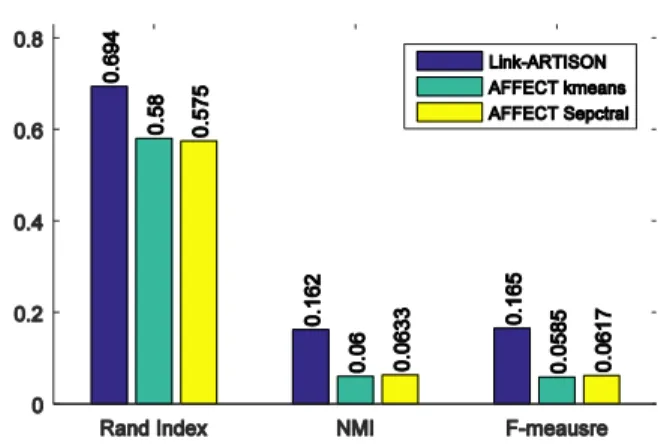
The result of comparison are shown in Fig. 5. As you can see, the performance of linked-clustering is again better than the other two compared algorithms. However, the difference is slightly smaller in this dataset. Further, AFFECT spectral works slightly better than the other representative-based algorithm. D. Political Book
The Political book dataset [21] is a network of books about U.S. politics published around the time of the 2004 presidential election and sold by the online bookseller Amazon.com. Edges between books represent frequent co-purchasing of books by the same buyers. Groups are based on political alignment of “liberal”, “neutral”, or “conservative” through human evaluation.
The proposed link-ARTISON has slightly better performance in Rand Index compared to the two other evolutionary algorithm as illustrated in Fig. 6.
Fig. 6. Performance comparison of the proposed algorithm in Political Book dataset with two state-of-art dynamic algorithm AFFECT k-means and AFFECT spectral in three measures of a) Rand Index, b) NMI and c) F-measures.
In addition, NMI and F measures of three algorithms show more positive differences of Link-ARTISON compared to others.
Further, the results for overlapping measures in Table 4 confirms better results for Link-ARTISON compared to Link-Clustering algorithm in both ONMI and number of clusters accuracy measure.
Table 4. Performance comparison of Link-ARTISON and Link-Clustering in overlapping context
Algorithm ONMI No. of clusters (Ground Truth = 3)
Link-ARTISON 0.38 2 Link-Clustering -5.2e-18 126
E. Reality mining network
The dynamic dataset of Reality Mining network analyzes the cell phone activity of 90 participants consisting of students and staff interacting over a period of nine months. The large volume of approximately 500,000 hours of data is extracted by monitoring different cell usage of participants logged as incoming and outgoing calls, cell tower id, and any Bluetooth devices discovered during their interactions. In this experiment, dataset recognizes a link between two participants by recording the IDs of nearby Bluetooth devices (student or student ID) every five minutes. Therefore, our networked data in each time step consists of two individual IDs located in nearby proximity of each other contributing to a link in network and the weight of this link is equal to the number of times these IDs are observed near each other during the time step. [22].
As the results of measures in Fig. 7 presents, the percentage of correct clustering decision reflected in Rand Index measure of link-clustering still outperforms the other three algorithm by at least 19%. For NMI measure, the trend is similar with link-clustering in the first place, AFFECT k-means in the second and AFFECT spectral in the last place of ranking. Again, link-clustering fares better than the other Evolutionary algorithms in the last two measures by almost 20%.
Fig. 7. Performance comparison of the proposed algorithm in Reality mining dataset with two state-of-art dynamic algorithm AFFECT k-means and AFFECT spectral in three measures of a) Rand Index, b) NMI and c) F-measures.
V.CONCLUSION
We proposed a novel linked-based incremental online community detection algorithm in social network context with several distinguishing features including the intrinsic recognition of the number of communities. The initialization of each time step with previous community structure allows for smooth transition of communities between different time steps while allowing for accounting for abrupt changes in the network. The experimental results displayed the good performance of this algorithm against the state of art evolutionary algorithms and encourage the ongoing works on linked-based dynamic community detection to take more advantage of this orthogonal paradigms.
REFERENCES
1. Fortunato, S., Community detection in graphs. Physics Reports, 2010. 486(3): p. 75-174.
2. Chi, Y., et al. Evolutionary spectral clustering by incorporating temporal smoothness. in Proceedings of the 13th ACM SIGKDD international conference on Knowledge discovery and data mining. 2007. ACM. 3. Xu, K.S., M. Kliger, and A.O. Hero Iii, Adaptive
evolutionary clustering. Data Mining and Knowledge Discovery, 2014. 28(2): p. 304-336.
4. Xie, J., M. Chen, and B.K. Szymanski, LabelrankT: Incremental community detection in dynamic networks via label propagation. arXiv preprint arXiv:1305.2006, 2013.
5. Nguyen, N.P., et al. Adaptive algorithms for detecting community structure in dynamic social networks. in INFOCOM, 2011 Proceedings IEEE. 2011. IEEE. 6. Meng, F., et al., Incremental Density-Based Link
Clustering Algorithm for Community Detection in Dynamic Networks. Mathematical Problems in Engineering, 2016. 2016: p. 11.
7. Cheraghchi, H.S. and A. Zakerolhosseini, Toward a novel art inspired incremental community mining algorithm in dynamic social network. Applied Intelligence, 2016: p. 1-18.
8. Nguyen, N.P., et al. Overlapping communities in dynamic networks: their detection and mobile applications. in Proceedings of the 17th annual international conference on Mobile computing and networking. 2011. ACM.
9. Wu, X. and V. Kumar, The top ten algorithms in data mining. 2009: CRC Press.
10. Takaffoli, M., et al. Tracking changes in dynamic information networks. in Computational Aspects of
Social Networks (CASoN), 2011 International Conference on. 2011. IEEE.
11. Greene, D., D. Doyle, and P. Cunningham. Tracking the evolution of communities in dynamic social networks. in Advances in Social Networks Analysis and Mining (ASONAM), 2010 International Conference on. 2010. IEEE.
12. Ding, Z., et al., Overlapping Community Detection based on Network Decomposition. Scientific reports, 2016. 6.
13. Xie, J., S. Kelley, and B.K. Szymanski, Overlapping community detection in networks: the state of the art and comparative study. ACM Computing Surveys, 2013. 45(4).
14. Lancichinetti, A., et al., Finding statistically significant communities in networks. PloS one, 2011. 6(4): p. e18961.
15. Palla, G., et al., Uncovering the overlapping community structure of complex networks in nature and society. Nature, 2005. 435(7043): p. 814-818.
16. Xie, J., B.K. Szymanski, and X. Liu. Slpa: Uncovering overlapping communities in social networks via a speaker-listener interaction dynamic process. in 2011 IEEE 11th International Conference on Data Mining Workshops. 2011. IEEE.
17. Ahn, Y.-Y., J.P. Bagrow, and S. Lehmann, Link communities reveal multiscale complexity in networks. Nature, 2010. 466(7307): p. 761-764.
18. Grossberg, S., Adaptive resonance theory: how a brain learns to consciously attend, learn, and recognize a changing world. Neural Networks, 2013. 37: p. 1-47. 19. Evans, T., American college football network files.
2012.
20. Lusseau, D., et al., The bottlenose dolphin community of Doubtful Sound features a large proportion of long-lasting associations. Behavioral Ecology and Sociobiology, 2003. 54(4): p. 396-405.
21. Krebs, V., Divided We Stand. URL: http://www. orgnet. com/leftright. html, 2003.
22. Eagle, N., A.S. Pentland, and D. Lazer, Inferring friendship network structure by using mobile phone data. Proceedings of the National Academy of Sciences, 2009. 106(36): p. 15274-15278.
23. More, J. and C. Lingam, Current trends in reality mining. 2013, IRJES.
24. Yang, T., et al., Detecting communities and their evolutions in dynamic social networks—a Bayesian approach. Machine learning, 2011. 82(2): p. 157-189. 25. Lin, Y.-R., et al. Facetnet: a framework for analyzing
communities and their evolutions in dynamic networks. in Proceedings of the 17th international conference on World Wide Web. 2008. ACM.
26. Rand, W.M., Objective criteria for the evaluation of clustering methods. Journal of the American Statistical association, 1971. 66(336): p. 846-850.
27. McDaid, A.F., D. Greene, and N. Hurley, Normalized mutual information to evaluate overlapping community finding algorithms. arXiv preprint arXiv:1110.2515, 2011.
28. Aloise, D., et al., Column generation algorithms for exact modularity maximization in networks. Physical Review E, 2010. 82(4): p. 046112.
Hamideh Sadat Cheraghchi
received the BSc degree from Azad University, South Tehran branch, in 2006; M.Sc. from Azad University, Qazvin branch in 2009 and she is currently pursuing a
Ph.D. degree in computer
architecture in the department of Computer Engineering and Science at Shaid Beheshti University.Her current research interests focuses on data mining in social network, and soft methods under the supervision of Dr. Ali Zakerolhosseini.
Ali Zakerolhoseini received the BSc degree from the University of Coventry, UK, in 1985, MSc from the Bradford University, UK, in 1987, and PhD degree in fast transforms from the University of Kent, UK, in 1998. He is currently an assistant professor in the
department of Computer
Engineering and Science at Shahid Beheshti University.His research focuses on Reconfigurable device and multi classifiers. His current research interests are Data Security, Cryptography and Social Data Mining.