The Quality and Accessibility of Family Support Resources in Pediatric Healthcare Settings from the Perspective of Certified Child Life Specialists
Morgan P. Wolfkill
University of North Carolina at Chapel Hill Undergraduate Honors Thesis
School of Education 2018
Approved by:
___________________________________________________ Dr. Martinette Horner – Thesis Advisor __________________________________________________
Dr. Kristin Papoi—Thesis Second Reader
__________________________________________________
Dr. Sharon Palsha—Thesis Course Professor
__________________________________________________
Abstract
The role families play in medical settings is critical across all environments and
circumstances, especially in pediatric settings. Research suggests that the functioning of a family and support they receive through the duration of a child’s illness or hospitalization can have an impact on the child’s physical health. As families are the legal decision makers for pediatric patients and hold the power in determining a child’s treatment plan, it is imperative that they are well supported and able to make clear and well-informed decisions. This research sought to explore from the perspective of Certified Child Life Specialists how well pillars of pediatric palliative care and family-centered care were being implemented in the hospitals in which they worked as well as the perceived effectiveness of various family resources in supporting the needs of the families of pediatric patients. One hundred seven Certified Child Life Specialists from across the country participated in an on-line survey. Additionally, respondents provided
suggestions regarding how they believe the quality and accessibility of family support resources could be improved. Results showed that Certified Child Life Specialists perceived that pediatric palliative care and family-centered care pillars were moderately to very effective in their
implementation. Additionally, participants indicated that family support resources that provided families with assistance in coping best supported families, followed by resources that provided information and those helping with everyday tasks. Respondents indicated the need for
Table of Contents
Abstract………2
Introduction………..4
Literature Review………...14
Methodology………..…18
Results………25
Discussion………..39
Conclusion……….49
References……….50
Appendix A: Survey………..53
Appendix B: Participant Contacts………...62
The Quality and Accessibility of Family Support Resources in Pediatric Healthcare Settings from the Perspective of Certified Child Life Specialists
In the United States, nearly one million children are estimated to be living with a life-limiting condition at any given moment (Legrow, Hodnett, Stremler, & Cohen, 2014). This statistic may seem staggering to some as pondering the suffering of a child is an unspoken and taboo subject that too often goes unaddressed. We live in a culture in which conversations
regarding the emotional and physical pain experienced by hospitalized children and their families are avoided due to uncomfortable and dismal feelings of the general public surrounding the topic (Battista & Laragione, 2015). A child developing an illness that could potentially result in immense suffering or death goes against the natural order of life, so it is logically a difficult subject to present for consideration. However, such discussions are needed to further our understanding of how best to support the needs of these patients and their families. Pediatric Life-Altering Illnesses
experiences of families caring for an ill child, the quality of support resources available to patients and families, and the understanding of the unique needs of each family becomes even more critical for the medical team to consider and understand.
Palliative Care
The World Health Organization (WHO) has developed a universally accepted definition of palliative care that encompasses all forms of palliative care, regardless of the age, diagnosis, or progression of the disease or illness of the patient in question. It is defined utilizing nine principle pillars (WHO, 2013):
Palliative care is an approach that improves the quality of life of patients and their families facing the problems associated with life-altering illness, through the prevention and relief of suffering by means of early identification and impeccable assessment and treatment of pain and other problems, physical, psychosocial and spiritual (WHO, 2013, para. 1). Palliative care:
• Provides relief from pain and other distressing symptoms;
• Affirms life and regards dying as a normal process (though not necessary for palliative care to take place);
• Intends neither to hasten or postpone death;
• Integrates the psychological and spiritual aspects of patient care;
• Offers a support system to help patients live as actively as possible until death;
• Offers a support system to help the family cope during the patient’s illness and in their own bereavement;
• Will enhance quality of life, and may also positively influence the course of the illness;
• Is applicable early in the course of illness, in conjunction with other therapies that are intended to prolong life, such as chemotherapy or radiation therapy, and includes those investigations needed to better understand and manage distressing clinical complications.
While the WHO presents this explanation to define the entire entity of palliative care, they also acknowledge that palliative care in the pediatric healthcare setting, while similar to that in the adult healthcare setting, differs in a few ways described below.
Pediatric Palliative Care
Pediatric palliative care (PPC) is the active and complete care of a child’s mind, body, and spirit, while also incorporating support designed to alleviate stress experienced by their family (WHO, 2013). PPC should be implemented from the onset of diagnosis (Brook & Hains, 2008). Implementation of palliative care from the onset of diagnosis allows for the child to live the best possible quality of life despite enduring an illness that would otherwise strip them of comfort (Bergstraesser, 2013). When considering both curative interventions and pain relief, what works for adults in these realms does not necessarily work for children whose psychosocial and developmental needs are not only different, but dynamic (Rogers et al., 2010). Most notably, pediatric patients are legally considered minors and therefore unable to make healthcare
Recognizing pediatric palliative care as a uniquely separate, yet related entity to normal palliative care, the WHO has established pillars of care that places the pediatric patient and their family as the focus of treatment (WHO, 2013, para. 2). While several of the ideals of pediatric and general palliative care overlap, the family’s role as the decision maker for the hospitalized child means including and recognizing them as an active part of the child’s care. Pediatric palliative care is presented by the WHO utilizing five complex pillars:
• Palliative care for children is the active total care of the child’s body, mind and spirit, and also involves giving support to the family.
• It begins when illness is diagnosed and continues regardless of whether or not a child receives treatment directed at the disease.
• Health providers must evaluate and alleviate a child’s physical, psychological, and social distress.
• Effective palliative care requires a broad multidisciplinary approach that includes the family and makes use of available community resources; it can be successfully implemented even if resources are limited.
• It can be provided in tertiary care facilities, in community health centers and even in children’s homes.
Pediatric Palliative Care vs. Pediatric Hospice Care
palliative care and pediatric hospice care is that while palliative care may include hospice care after the illness progresses in severity, palliative care extends beyond merely end-of-life care (Crozier & Hancock, 2012). As previously mentioned, pediatric palliative care yields the most effective results for both the patient and the family when implemented from onset of diagnosis.
Pediatric palliative care was developed once researchers and medical professionals discovered that the kind of compassionate and therapeutic care offered during pediatric hospice care could be incredibly beneficial for healing when paired with other medical treatment meant to cure patients and restore them to optimal health (Crozier & Hancock, 2012). What separates pediatric palliative care from hospice care is that pediatric palliative care works in conjunction with curative measures to holistically treat the patient, while pediatric hospice care involves the withdrawal of treatment with the primary goal being pain management as death draws near. The Family’s Crucial Role in the Pediatric Healthcare Setting
The pediatric patient’s family plays an integral role in what medical care the child receives and how the treatment plan will progress. No medical decisions can be made by pediatric patients themselves. Instead, their guardians are legally responsible for making
In addition to being responsible for making decisions that directly impact their children’s medical outcomes, the mere presence of the family in the pediatric hospital setting can be
beneficial for the patient. With the presence of parents, guardians, or family members with whom they trust, pediatric patients feel both more secure and comfortable, two emotions that contribute to the patient’s willingness to be cooperative and receptive to the various medical professionals they may encounter and the treatments they may endure (Foster, Whitehead, & Maybee, 2015). Medical decisions made by families (whether it be biological or legal guardians determine the outcome for pediatric patients. The calm presence of family members in the pediatric hospital setting creates a better environment for treatment to take its fully intended effect. As a result of both of these realities, tending to the various needs of family members is not only the compassionate route to take, but it also influences the child well-being and recovery. Family-Centered Care
The Institute for Patient- and Family-Centered Care (IPFCC) works directly with lawmakers, administrators, program planners, direct service providers, educators of health care professionals, researchers, design professionals, and patient and family leaders to ensure the values of the patient and their family are being respected and considered as treatment plans are being developed. The IPFCC advocates for and defends the belief that health care providers and the family are partners who work together to best meet the needs of the child. Within the realm family-centered care. Family-centered care is outlined and defined utilizing four core concepts (Johnson & Abraham, 2012):
impeccable assessment and treatment of pain and other problems, physical, psychosocial and spiritual. Family-centered care emphasizes:
• Dignity and Respect. Health care practitioners listen to and honor patient and family perspectives and choices. Patient and family knowledge, values, beliefs and cultural backgrounds are incorporated into the planning and delivery of care.
• Information Sharing. Health care practitioners communicate and share complete and unbiased information with patients and families in ways that are affirming and useful. Patients and families receive timely, complete and accurate information in order to effectively participate in care and decision-making.
• Participation. Patients and families are encouraged and supported in participating in care and decision-making at the level they choose.
• Collaboration. Patients, families, health care practitioners, and health care leaders collaborate in policy and program development, implementation and evaluation; in research; in facility design; and in professional education, as well as in the delivery of care.
WHO’s definition of pediatric palliative care, further supporting the critical nature of putting these core concepts into practice. This research will reveal and expound upon the overlap between pediatric palliative care and family-centered care, emphasize their value in pediatric care, and seek to discover, despite all of this knowledge, whether these
principles are being properly supported and implemented in pediatric healthcare settings. Pediatric Family Support Professionals
A variety of healthcare professionals present in pediatric hospitals help support the families of patients both during the duration and following their stay in the hospital. These professionals range from more medically-based roles like nurses, doctors, surgeons and specialists to more therapeutic roles like art therapists, music therapists, social
workers, child life specialists and support animal handlers. Together, these professionals can work together as part of a collaborative, multidisciplinary team with shared goals and cooperative communication to deliver the highest level of family-centered care to
pediatric patients and their families (Fisher et al., 2017). Although these professionals have unique skills and specialties, they each play a critical role in fostering a healthcare environment in which family-centered care is valued.
This study focuses on the perspectives and opinions of Certified Child Life Specialists. Child life specialists are professionals present in pediatric healthcare settings who strive to meet the needs of “infants, youth, and families as they cope with the uncertainty and stress accompanied with pediatric illness, injury and treatment”
Professionals, 2018, para. 1). Child life specialists are only one professional on the multidisciplinary team present in pediatric hospital. However, their role and
responsibilities on the team of professionals are deeply rooted in family-centered care principles, while the medical side of treatment is cared for by the various doctors, specialists, and nurses involved in the treatment. For these reasons, it is appropriate to explore pediatric palliative care principles, family-centered care principles, and the effectiveness of their implementations from the perspective of child life specialists. Purpose of Study
that highlights the importance of addressing the physical, emotional, and psychosocial needs of the family unit, little research is available that explores how well these support programs are being implemented from the perspective of one of the medical professionals responsible for putting them into action. Exploring the knowledge Certified Child Life Specialists have of family-centered care and their perspective on if they believe these practices are taking on their fully intended effect in their work settings in the form of family support resources has not been thoroughly investigated or researched. The hope of this study is to explore whether the principles and resources that have been supported as necessary through various studies are being
implemented and available from the perspective of someone who interacts with the intended recipients (families) on a daily basis.
Research Questions
The design of this research will seek to provide insight on the following questions in hopes of contributing to the field of pediatric healthcare. As supported in the literature, family support resources are found to ease the stress and anxiety of families
1. What kinds of family support resources are available to the families of pediatric patients? 2. Are these family support resources high in both quality and accessibility from the
perspective of Certified Child Life Specialists?
3. Are these family support resources utilizing a family-centered care approach as stipulated in the conceptual framework set forth in the WHO’s definition of pediatric palliative care?
Supporting the needs of the families of pediatric patients is well-supported, as will be discuss in later sections. As they are the ultimate and legal medical decision makers for pediatric patients, it is crucial pediatric healthcare programs are providing families and guardians with the resources they need in order to alleviate the stress and anxiety associated with seeing their child in the hospital. Supporting their needs will result in better outcomes for the pediatric patient as their decisions will be made with more clarity and understanding.
Literature Review
The purpose of this chapter is to review the literature on pediatric palliative care environments, family-centered care and the benefits resulting from various family support programs. This section will seek to provide contextual background that illustrates the current status of these entities and the outcomes on family functioning when initiatives and programs are implemented to support families.
Lack of Research Surrounding Pediatric Palliative Care Environments
in pediatrics. The other 97.3% of studies and articles were based within the adult realm of palliative care (Kumar, 2011). The massive disparity in studies conducted in adult and pediatric palliative care illustrates a major gap in research that warrants more investigation into the many factors that contribute to pediatric palliative care.
Need for Family-Centered Support Resources
Though not necessarily focused in the pediatric realm of palliative care, there are several studies whose findings support to need for more family involvement and inclusion in the
patient’s (both adult and pediatric) hospitalization experience. Soury-Lavergne et al. (2011) conducted a survey aimed at gauging the opinions of caregivers on the practicalities of family-centered care in intensive care units (ICU). ICUs are incredibly emotional and intense settings within the hospital (Soury-Lavergne et al., 2011). Due to the symptoms of anxiety and
depression felt amongst families of ICU patients and the quality of life of both patients and families alike being influenced by the ICU environment (Soury-Lavergne et al., 2011), hospital staff must work to provide family support in additional to patient care. Family support looks different in all environments and is highly dependent on the unique needs of each family. Many times, the best form of support a family can receive is being given timely and accurate
information regarding the patient. Though there are technological interventions that exist that allow for families who cannot be physically present to still be informed, granting family greater access to pediatric patients and the staff who treat them through initiatives like 24-hour visiting hours help to reduce the stress and anxiety felt by families, which would in turn to the same for the hospitalized child.
child and provide them with continuous care (Spathis et al., 2012). As a result, pediatric palliative care and family-centered care research and resulting implementation must reflect the interconnectedness of the pediatric patient and their family. With the importance of the family’s role in the treatment decisions for pediatric patients prominent, the hospitalization experiences of children with life-altering illnesses should not be considered as an isolated factor separate since families function in pediatric palliative care environments as an extension of the pediatric patient. As such, their needs and functioning should be valued and prioritized. However, after a systematic review of existing literature, Ullirch and Morrison (2013) found that much more research needs to be completed in order to understand both the current states of pediatric
palliative care models and family-centered resources and how families experience them in order to design and make resources available that reflect the true needs of pediatric patients and their families.
Bereavement Services
Effective and true pediatric palliative care is implemented from the onset of diagnosis and can include end-of-life measures, but includes care that extends beyond that as well (Crozier & Hancock, 2012). However, bereavement services are often at the forefront of family-centered care services in pediatric palliative care environments within hospitals. From a caregiver
the child’s illness and decline (Berrett-Abebe, Levin-Russman, Gioiella, & Adams, 2017). These families and the hospital staff who worked to heal and comfort their children will have a unique connection for the rest of their lives. As a result, families and caregivers have expressed their appreciation for ongoing communication and correspondence with member of the pediatric healthcare team even after their child has passed away (Berrett-Abebe et al., 2017). While professionals like doctors and nurses often come to mind first when considering the pediatric patient’s healthcare team, various other professionals comprise this team as well. Child life specialists, social workers, music therapists, psychologists, nurse aides and many other hospital staff members contribute to a child’s care in the healthcare setting. Due to parents and caregivers desiring continued correspondence and relationship with those who cared for their ill children, all staff members should receive education and training regarding family-centered care and support. Communication with Caregivers
Pediatric healthcare environments are stressful for families not only because of the diagnosis their child receives, but also because these settings require caregivers to relinquish some of their power and control (LeGrow, Hodnett, Stremler, & Cohen, 2014). Caregivers have, up until this point, served as their child’s protector against all possible threats. However,
admittance into the hospital means depending on other people to properly treat and ideally heal the child from threats out of the caregiver’s control (Foster, Whtiehead, & Maybee, 2016). Turning power and control over to someone else is no easy task, especially for a caregiver whose protective instincts have emerged. However, a productive way for the healthcare team to combat this frustration and anxiety felt amongst caregivers is by providing them with thorough
team with the opportunity to get to know families and families with the opportunity to feel included and exercise some control over circumstances that are largely uncontrollable. Knowledge is power, especially for those who cannot directly partake in improving the conditions.
Methodology
The methods section will outline the design of the survey that aimed to gauge Certified Child Life Specialists’ opinions on the extent to which the multidisciplinary medical team adheres to the family-centered care framework set forth by the IPFCC and the WHO’s
framework for pediatric palliative care. In addition, the survey also explored support programs that are currently available for families to utilize as they cope with their child’s illness and hospitalization from the perspective of Certified Child Life Specialists. This section will also describe the process of selecting participants to take part in the study as well as an overview of the data collection and analyses of that data.
Research Design
of Certified Child Life Specialists. The free response sections gave participants the opportunity to provide their own personal and professional recommendations for their pediatric program and relay any other information they thought to be relevant or important about the issue. A copy of the complete survey can be found in Appendix A. Prior to distribution, a complete proposal was submitted to the IRB at UNC and was approved cleared for distribution.
Instrumentation
The instrument of this study was an online survey created by the researcher designed to collect information in six different areas: 1) Certified Child Life Specialist demographics 2) Certified Child Life Specialist perspectives on how well their program implements WHO pillars of pediatric palliative care 3) Certified Child Life Specialist perspectives on how well their program implements IPFCC pillars of family-centered care 4) Certified Child Life Specialist beliefs on the importance of supporting the emotional needs pediatric patients and their families during pediatric hospitalization 5) Certified Child Life Specialist perspectives on what kinds of support resources were currently available to families 6) personal comments pertaining to the research topic (see Appendix A for the completed survey). When Certified Child Life Specialists clicked the link, the initial question was a statement that outlined the parameters of the study and included detailed instructions about how to remove themselves from the study at any point. Then, they confirmed their informed consent by continuing on to the first page of survey questions.
thanked for their willingness to participate in the research. This helped to maintain the validity of the results so that all data was truly from the perspective and of the opinion of Certified Child Life Specialists. Certified Child Life Specialists were asked basic demographic questions like gender, race/ethnicity, highest level of education obtained and age. Participants were given the opportunity to select a “prefer not to answer” option for these questions. Respondents were asked to select the pediatric units they previously and currently worked based on a list of units provided in the question. Respondents were also given the opportunity to write-in any units they had experience but were not given as an option to select within the question. This ensured that participants felt heard, respected and well represented. They were then asked how long they had been a Certified Child Life Specialist, the geographic region within the United States they served and the population size of the area in which their current hospital was located.
implementation (4), minimally effective implementation (3), not effective implementation (2), or if their pediatric program was not yet implementing that pillar of pediatric palliative care (1).
Certified child life specialist perspectives on family-centered care. The third section of questions in the survey covered Certified Child Life Specialists’ perspectives on if their pediatric program implemented IPFCC pillars of family-centered care and how effective they believed the implementation to be. The survey first presented the IPFCC’s general definition of family-centered care, as described in the Introduction of this thesis. This was done in order to ensure all participating Certified Child Life Specialists understood what information about their pediatric program they should reflect on and report. This section included eight questions that contained pillars of family-centered care as stipulated by the IPFCC. It included 5-point Likert Scale questions and asked the Certified Child Life Specialists to determine whether their pediatric program was implementing each pillar of family-centered care with either very effective implementation (5), moderately effective implementation (4), minimally effective implementation (3), not effective implementation (2), or if their pediatric program was not yet implementing that pillar of pediatric palliative care (1).
pediatric patients in their setting. Certified Child Life Specialists were then asked to evaluate and report their beliefs on how much of a priority the emotional support of the families of pediatric patients should be in their pediatric program. This question was included in order to explore the disparity, if any, between how much of a priority (from the perspective of Certified Child Life Specialists responding) the emotional needs of pediatric patients and their families were in pediatric programs and how much of a priority supporting these emotional needs should be. “Significant priority” was valued as four, “moderate priority” was valued as three, “minimal priority” was valued as two and “not at all a priority” was valued as a one.
Certified child life specialist perspectives on family support resources. The fifth part of the survey gauged Certified Child Life Specialists’ perspectives on what family support resources were available to the families of pediatric patients in their program. Participants were provided with a comprehensive list of family support resources to consider and indicated whether or not, from their perspective, these resources were available in their pediatric setting. From there, respondents were asked to evaluate how effective the resources available were in supporting the families of pediatric patients. This section of the survey also utilized a Likert-Scale model in order for Certified Child Life Specialists to evaluate how effective they believe the family support resources available in their program were in supporting the families of
Certified child life specialists’ additional thoughts on support programs. The final section of the survey included three open-ended questions, allowing Certified Child Life
Specialists to provide both suggestions and additional feedback on family support resources. The first question asked respondents to provide any suggestions they had on how to improve the availability/accessibility of family support resources for the families of pediatric patients in their program. The second question sought suggestions participants had on how to improve the quality of family support resources for the families of pediatric patients in their program. The last
question was a general appeal for the Certified Child Life Specialists to share any additional thoughts or comments on any topic addressed in the survey that they believed was important.
This was included in order to obtain information that may be helpful in the analysis of the data or general knowledge from the researcher perspective.
Survey Distribution
All of the Certified Child Life Specialists were contacted five times (see Appendix B) using the Dillman (2001) method for effective survey research. The results were stored in a
secure file through UNC’s School of Education and were analyzed using the Qualtrics program. At the conclusion of the survey, 106 Certified Child Life Specialists had participated (n=106).
survey to ensure that it was capable of reaching the maximum amount of Certified Child Life Specialists as possible. The total number of members on this forum stood at 4,810 at the time of this survey, with about 1,284 of these members being active. From here, it is not possible to determine what percentage of these members are actual practicing Certified Child Life Specialists, students, and retired members.
Two child life based Facebook groups were also utilized as outlets for distributing this survey. “Child Life Connection: Student Forum” and “Aspiring Child Life Specialists” were designed for child life students to interact with both peers and current professionals in the field. “Child Life Connection: Student Forum” has 1,936 current members while “Aspiring Child Life Specialists” has 1,650 members. While a majority of the members in these two groups were labeled as students, a portion of these members were also recently certified in the field of child life and were thus eligible to participate in the study. There is no way to determine how many of the members of one of these two Facebook groups are also members of the other. As a result, it is not possible to report an accurate number of Certified Child Life Specialists who received access to this survey. Additionally, it is also possible that members of these Facebook groups are also active on the ACLP General Forum Board. Overlapping membership in all three of the platforms utilized for distribution may have resulted in Certified Child Life Specialists being given access to this survey anywhere from one to three separate times. However, this was the most efficient way to distribute this survey to the maximum number of potential and eligible respondents.
Specialists completed the survey. After another five days, the third point of contact was made. This distribution resulted in 43 completed surveys. One week after the third point of contact, a post was made on all three distribution platforms informing the Certified Child Life Specialists that this was the second-to-last contact was sent, and this distribution resulted in an additional 24 completed surveys. The final distribution which was conducted one week after the fourth point of contact resulted in an additional 13 surveys being completed. In all, a maximum of 4,870 people actively received access to this survey. With a sample size of 106 respondents, approximately 2% of the total people contacted fully participated in the study.
Results
The results of this study were derived from Certified Child Life Specialists who
completed a survey to gather their perspective of family-centered practices and resources being utilized in the pediatric healthcare setting where they worked. The survey (see Appendix A) included a combination of Likert Scale responses and open ended questions. This section will include the demographics of the Certified Child Life Specialist respondents and the statistical analysis of Likert Scale questions. The qualitative questions are included as well, with some examples of how participants responded in the free response sections.
Demographics
responses were then eliminated before analyses were completed. Therefore, one hundred percent of the participants (n=106) surveyed were Certified Child Life Specialists.
Education. The minimum education requirement for being a Certified Child Life Specialist is a bachelor’s degree, which was the highest level of education received by 39% of respondents. However, a majority of respondents indicated that the highest level of education they had obtained went beyond the minimum bachelor’s degree requirement, with 57%
indicating a master’s degree and 4% indicating a Ph.D. as the highest level of education they had obtained.
Gender. Respondents overwhelmingly identified their gender as female (98%) while a few participants chose the “prefer not to respond” option. No one who identified as male participated in this study.
Age. There was ample diversity in the age of respondents, which ranged from age 22 to age 49. The mean age of respondents was 32.75 years old.
Race. A large majority of respondents identified their race as White (88.5%), followed by Hispanic or Latino (5.21%), Asian (4.17%), and Black (2.08%).
Years of experience. Years of experience as a Certified Child Life Specialist varied from new hires in the field to seasoned and experienced Certified Child Life Specialists. The mean years of experience reported was 7.12 years with years of experience amongst the entire population of respondents ranging from one to twenty-seven years.
Pediatric ICU (n=37), Oncology/Hematology (n=27) and Outpatient Unit (n=26) accounted for the most common settings the participants worked in currently or had worked in previously. However, each unit proposed in this question had participants who responded that they had experience in the environment. Respondents were also provided with the opportunity to write-in any units they had experience in case the unit was not represented as an option to select from. Forty-three respondents wrote in the units in which they had experience, with several of these overlapping with one another. These units included Rehabilitation, Cardiac Intensive Care Unit, Radiology, Endocrine, Hospice, Non-Surgical General Unit and Sedation.
Geographic region of hospital. There were a series of demographic questions that were targeted at learning more about the participant’s current pediatric setting. One question divided the 50 states into geographic regions based on divisions provided by the National Geographic Society (National Geographic Society, 2012). A majority of the respondents currently worked in the Southeast region (35%) and Northeast (26.5%) regions. However, the Southwest (11%), West (12%), and Midwest (16%) regions in the United States were also represented in the data.
Population size of hospital setting. After operationally defining areas based on
population size, most respondents reported working in medium-large communities (40%), large communities (31%) and medium-small communities (24%). Small towns and rural communities were the least served areas in which these respondents worked (5%).
Likert Scale Questions
Pillars of pediatric palliative care. The first set of questions sought to determine the Certified Child Life Specialists’ opinion on how effectively they believed their pediatric setting implemented the pillars of pediatric palliative care. “Very effective implementation” was given a value of five, “moderately effective implementation” was given a value of four, “minimally effective implementation” was given a value of three, “not effective implementation” was given a value of two and “I feel the Child Life Program in my hospital/pediatric setting does not
implement this yet” was given a value of one. Respondents selected one of these options for each pillar listed in the table. Figure 4.1 provides the mean value of the effectiveness of
implementation for each pillar as reported by respondents. See Appendix C for a comprehensive table of all descriptive statistics and pillars as they were presented in the survey.
Figure 4.1 Child Life Specialists’ Perceived Effectiveness of Pediatric Palliative Care Pillars
Some of the pillars of pediatric palliative care are more applicable to the purpose of this study than others. Although all of these pillars are valuable and work to serve patients and
3.75 3.95
3.24
3.85
4.47
4.18 4.05
3.74
3.57
2.62 2.63
1 1.5 2 2.5 3 3.5 4 4.5 5
families well, the pillars involving total care, inclusion of the family, physical distress,
psychological distress, social distress, a multidisciplinary approach and community resources are the most applicable parts of pediatric palliative care when considering the family-centered and emotional support approach in which this research is focused. Survey participants indicated the highest effectiveness in implementation for the pillars involving psychological distress, social distress and a multidisciplinary approach with mean values of implementation ranging from 4.05 to 4.47 in effectiveness. For the pillars involving total care, inclusion of the family, onset of diagnosis, physical distress, community resources and limited resources, the mean values of effective implementation were all above 3, indicating minimally to moderately effective
implementation. The remaining pillars that focused on pediatric palliative care in the community and in the child’s home were valued with a mean of 2, indicating no to minimally effective implementation.
Pillars of family-centered care. The second set of Likert Scale Questions sought to determine how effectively the participants believed their pediatric setting implemented the pillars of family-centered care. The same descriptors as the pediatric palliative care scale were used. “Very effective implementation” was given a value of five, “moderately effective
Figure 4.2 Child Life Specialists’ Perceived Effectiveness of Family-Centered Care Pillars
As observed from the data, survey participants ranked the implementation of family-centered care pillars at their hospital as high for seven of the eight total pillars presented, with the majority being ranked near a 5 for very effective implementation. The pillar focused on
researched was the only indicator below a mean of 4, but still at the high end of 3 with a mean of 3.61, making it regarded as closer to moderately effective implementation.
Emotional support of patients and families. The third set of Likert Scale Questions sought to determine how much of a priority Certified Child Life Specialists believed supporting the emotional needs of the pediatric patients and the emotional needs of the families of pediatric patients was in their pediatric program. “Significant priority was given a value of four,
“moderate priority” was given a value of three, “minimal priority” was given a value of two and “not at all a priority” was given a value of one. The results of the emotional support of patients and families Likert Scale Questions is listed below in Figure 4.3.
1 1.5 2 2.5 3 3.5 4 4.5 5
Honor family Beliefs
incorporated informationAffirming informationTimely Comfort in decisions collaborationPolicy collaborationResearch collaboratingEveryone
Figure 4.3 Child Life Specialists’ Perceived Priority of Emotional Support of Patients and
Families
In this set of Likert scale questions, each question was closely related but diverged in a few key ways. Question 1 asked, “On a scale of 1-4, how much of a priority is the emotional support of pediatric patients in your pediatric setting/program?” Question 2 said, “On a scale of 1-4, how much of a priority is the emotional support of the families of pediatric patients in your pediatric setting/program?” Question 3 asked, “On a scale of 1-4, how much of a priority should the emotional support of the families of pediatric patients in all pediatric settings/programs be?” All three questions received high levels of priority on a scale of 1-4 as illustrated in Figure 4.3. All three questions were valued close to a 4, which would indicate the respondents viewed them as a significant priority. The greatest disparity in means reported within this section existed between Questions 2 and 3. This disparity means that while participants believed that the emotional support of pediatric families should be a significant priority across all pediatric healthcare settings (mean=3.92), they did not, on average (mean=3.48), believe their pediatric
3.58 3.48
3.92
1 1.5 2 2.5 3 3.5 4
Question 1 Question 2 Question 3
healthcare setting regarded the emotional support of pediatric families to the priority level that they should.
Family support resources. The fourth set of Likert Scale Questions listed potential family support resources and asked the Certified Child Life Specialist participants how effective they believed the resource was in supporting families. “Very effective in supporting families” was given a value of five, “moderately effective in supporting families” was given a value of four, minimally effective in supporting families” was given a value of three, “not at all effective in supporting families” was given a value of two and “this resource is not available to families in my hospital/pediatric setting yet” was given a value of one. Respondents selected one of these options for each family support resource listed in the table. The results of the Certified Child Life
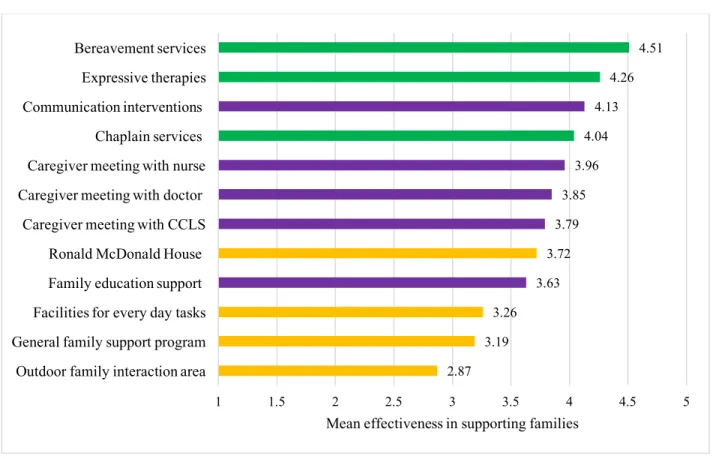
Specialists’ perspective on the effectiveness of family support resources Likert Scale Questions is listed below in Figure 4.4. For the purpose of this section, data on the most widespread and popular pediatric family support resources is included. Resources that had at least 50% (n=53) respondents indicating it existed and was available in their pediatric healthcare setting are organized in a Figure 4.4 based on what resources were, on average, reported to be the most effective in supporting the families of pediatric patients. There were 12 total support programs that fit this criterion.
Certified Child Life Specialists were also provided with the opportunity to list any additional family support resources available in their pediatric healthcare setting that were not listed as an option to consider in list within the survey. This ensured that respondents felt respected and well-represented. In addition, it allowed Certified Child Life Specialists to
Specialists in this section of the survey (n=2) included creative writing workshops and an Annual Pediatric Remembrance Day. The information for the write-in resources can be found in
Appendix C in addition to the complete, comprehensive list of all family support resources included in the survey.
Figure 4.4 Child Life Specialists’ Perceived Effectiveness of Family Support Programs
Family support resources that were more targeted at helping families cope with the realities of their circumstances (indicated with a green bar) were, on average, valued as being the most effective in supporting families. Respondents indicated that support resources that were designed to provide families with high quality and up-to-date information on their pediatric patient (indicated with a purple bar) were also effective in supporting families, but reported as slightly less effective than coping resources. Resources designed to assist families with everyday basic needs and promote normalcy within the family unit (indicated with an orange bar) was the
2.87 3.19
3.26 3.63
3.72 3.79
3.85 3.96
4.04 4.13
4.26 4.51
1 1.5 2 2.5 3 3.5 4 4.5 5
Outdoor family interaction area General family support program Facilities for every day tasks Family education support Ronald McDonald House Caregiver meeting with CCLS Caregiver meeting with doctor Caregiver meeting with nurse Chaplain services Communication interventions Expressive therapies Bereavement services
next set of resources reported by respondents in terms of their effectiveness in supporting families. As seen in the full table in Appendix C, reported effectiveness in supporting families correlated with their prevalence and availability in pediatric healthcare settings. The resources that had high levels of availability also had high reported levels of effectiveness.
Opinions on the Nature of Family Support Resources
Three of the questions on the survey were designed for subjective, qualitative answers to help contextualize the quantitative answers as well as provide insight into why the Certified Child Life Specialists chose to participate in the survey at all. These questions included: 1) asking Certified Child Life Specialists what suggestions they had to improve the availability and accessibility of support programs for the families of pediatric patients in their pediatric program 2) asking Certified Child Life Specialists what suggestions they had to improve the quality of support programs for the families of pediatric patients in their pediatric program 3) asking the Certified Child Life Specialists to share and include any additional comments or information related to pediatric palliative care, family-centered care and family support resources they felt were important. These open-ended responses were utilized to identify themes and provide more insight, clarity and significance to the data collected within the quantitative questions,
specifically those measured utilizing the Likert Scale.
Availability and accessibility of family support programs. Question 17 asked
Respondents indicated that they believed better internal coordination and communication within their pediatric healthcare setting would improve the availability and accessibility of support programs for families. One respondent said, “Our facility needs a check list or
comprehensive pamphlet of available resources so that all staff are able to make families aware of what is available.” Another participant wrote, “We desperately need hospital-wide initiatives that are coordinated by a committee. Right now I believe that our resources are being
implemented unevenly across our facility with minimal coordination. Imagine the progress that could be made if worked for the betterment of all patients and families by simply becoming more organized within the hospital.” Other internal operational adjustments that were suggested by respondents included required staff training on what support programs are available through the hospital and clear communication regarding who is responsible for informing families of support programs amongst team members.
To varying extents, all respondents indicated that improving relationships and collaborative measures between hospital departments, including care providers, the public relations department, community outreach department and internal staff education would improve the availability and accessibility of support programs for families. Intentional
implementation of protocol to follow was recommended, in order to ensure no steps in providing, as one respondent called it, “the highest level of family-centered care”, is not overlooked.
enhanced communication between the hospital and external organizations that provide and fund the support programs present in pediatric hospitals. One respondent said, “A large majority of our support programs for families come from outside organizations who may only be present in the hospital with families for a few days a week. We are interacting with families and other staff members on daily basis. I’m grateful for these programs and their willingness to support our families, but I think the quality of these programs would be improved through open and honest communication with these outside organizations. If they know what is and is not effective, they can help us in improving the quality of these programs.” Many respondents indicated that these organizations have the ability and means to improve hospital-based programs. However, many respondents agreed that these organizations must be made aware of the improvements that need to be made so that they can provide adequate support.
Related and important additional information. Question 19 asked participants to “Please feel free to share anything else on this topic that you think is important.” Responses to this question ranged from repeating previously discussed suggestions to providing new
that the items described on this survey could have been encouraged by other hospital staff, but as the expert in family-centered care, the hospital has not had the knowledge and the families have not had an advocate that recognizes their needs. There is lots of room for improvement, but I believe our growing child life department will help in that.” Respondents provided important context to their responses to ensure their feedback, opinions and suggestions were understood.
A few Certified Child Life Specialists who participated in this survey expanded upon previously asked survey questions. In the demographics section, the researcher asked each respondent to indicate in which region their pediatric healthcare setting was located across the United States. As some regions and states have greater resources than others, this question was included to take regional disparities in to account. Respondents indicated that although they selected their region based on the description, they felt it necessary and important to further clarify how their location is contributing to there being not as effective pediatric palliative care and family-centered care pillar implementation and less support programs available to families in their hospital. One respondent said, “Although you asked location, I feel it is important to specify that not only am I in the western region, but I am in Alaska! Unfortunately, not only is child life and the pillars and programs you discussed in this survey relatively new ideas in our area, but community resources are also incredibly limited. We work hard everyday to encourage staff members to better our psychosocial support for patients and families. It’s getting better but there is a lot of growth needed within our hospital AND our community!” Respondents utilized this section in order to explain some of the uncontrollable circumstances and conditions that
Resources
Every respondent who partook in the qualitative sections suggested that a lack in adequate resources was prohibiting the highest availability and quality in the family support resources in their pediatric healthcare settings. Resources described and listed by respondents included funding, staffing and education. Funding was mentioned by a large majority of respondents in this section, with all suggestions including a plea for increased funding so that family support programs can meet the complex needs of even more families. One respondent said, “I would love for every resource mentioned in this survey to be in my hospital. The reality is that these things cost money and our budget is very small. I think more funding would allow us to improve the resources we now have availability and make it possible to add some new resources to support our families.” Increased funding was noted as a suggestion to improve the availability and accessibility of family support programs by 53 (77%) respondents.
A resource discussed amongst 28 (41%) of the Certified Child Life Specialists surveyed was inadequate staffing in their pediatric setting. One respondent said, “We NEED more child life specialists! There is only so much you can do as a two-person child life department in a large hospital when patients and families have complex psychosocial needs, and we are spread too thin.” Another respondent commented, “We desperately need more staff hired to focus on family needs. We have lots of doctors and nurses and while their jobs are obviously important, more staff dedicated and focused on helping families cope with their new realities.” Respondents overwhelmingly reported that hiring more staff who are determined to improve family functioning is critical.
higher quality family support programs. One respondent said, “Better psychosocial education for medical members of the healthcare team – in the classroom BEFORE they become physicians and nurses. They need the foundation earlier in their training.” Another respondent said, “On-going and continued education regarding family-centered care in the workplace is vital and should be advocated for more. I think these continuing education opportunities would improve family support programs and establish a better sense of mutual respect amongst all of my peers.” Respondents who spoke on their opinions about staff education reported improved formal and professional education programs would ultimately improve the quality and availability of family support programs.
Discussion
most widely implemented and 3) addressing how effective Certified Child Life Specialists believe they are in supporting the complex needs of pediatric families.
Benefits of Establishing Family-Centered Care Environments
As indicated by the results, the Certified Child Life Specialists of this study felt that their pediatric healthcare settings were very effective in implementing the key family pillars of
pediatric palliative and pillars of family-centered care. Consequentially, the family support resources that were reported as widely available were also valued as being highly effective in supporting the needs of the families of pediatric patients (See Table 4.3). Within the qualitative sections, respondents repeatedly discussed cases in which they observed high quality family support and corresponding resources (that address a variety of social, emotional, and physical needs for families) resulting in improved health outcomes for the patient and better hospital experiences for the entire family unit. These perspectives and observations reported by Certified Child Life Specialists reinforce the findings of Soury-Lavergne et al. (2011): that health
outcomes for pediatric patients tend to be in the positive direction when their familial stress and functioning are satisfied and improved by a variety of family support resources. Findings from both of these studies should be considered consequential and impact hospital functioning for the hospital administrators and board members.
Difference Between Believed and Actual Priority of Supporting Families
The results of this survey suggest that overall, Certified Child Life Specialists believe that the emotional support of pediatric families should be a significant priority in all pediatric
emotional support should be across all pediatric healthcare settings. On average, respondents indicated that the emotional support of pediatric families was less of a priority in their pediatric healthcare setting than it should be. This finding was confirmed by some of the data collected within the qualitative responses. Certified Child Life Specialists indicated their desire to make improvements to how family-centered care and family support resources are implemented in their healthcare setting because they recognize the important role the family plays in a patient’s care. However, they also recognized that their setting had work to do in terms of implementing these pillars and resources to their most impactful extent.
Implications
The results and findings of this study have the ability to influence and make a difference in various realms. Stakeholders in this research include education and training and hospital administration and policy.
Education and training. The results of this study provide implications for multiple stakeholders, one of which is the education and training programs preparing young professionals for careers in pediatric healthcare settings. Education and training also extend to internal
different professionals designed to treat all aspects of the pediatric patient that are impacted by their disease and hospitalization. Naturally, each of these professionals comes in contact and communicates with the families of the pediatric patients. As a result, each member of the pediatric multidisciplinary team should be equipped with the knowledge and training regarding how, within their role and responsibilities, they can best support families in their healthcare setting. Undergraduate and various levels of graduate education programs should consider incorporating classes and curriculum that equip all types of healthcare professionals with the knowledge regarding family-centered care in pediatric palliative care environments.
Furthermore, administrators and continuing professional education teams in hospitals and other healthcare settings should consider this research and work to provide in-service education opportunities specific to their setting to all staff members regarding how best to incorporate family-centered care and support the diverse needs of each family in the hospital.
Hospital administration and policy. Perhaps one of the most important and
should be closely examined and considered by these stakeholders, in particular. These
professionals have the ability to not only impact how much funding is allocated to family support resources, but also make staffing and hiring decisions. Being adequately staffed with
professionals who can take the charge in monitoring and overseeing various family support programs would allow for these programs to function at their optimal level of effectiveness. Respondents overwhelmingly indicated that being underfunded and understaffed were two key factors prohibiting family support resources from being able to function at their highest potential. Hospital administrators who have the ability to make changes in these realms should consider allocating more funds annually for support resources and hiring staff to take the charge in
overseeing these resources and promoting family-centered care across the entire hospital at large. Additionally, hospital administrators should work to form more and stronger relationships with community members who could help contribute to the funding of current family support resources as well as the existence of new family support resources through their own financial contributions as well as assistance in coordinating fundraising and sponsorship efforts. Limitations
The limitations of this study have to be considered in order to analyze possible
applications for future research in the area of the effectiveness of implementation of pediatric palliative care and family-centered pillars. Additionally, limitations must be recognized and highlighted in order to improve and strengthen future research related availability of family support programs and their effectiveness in supporting the families.
Survey distribution and data collection. Data was collected from a self-report survey, and participants voluntarily chose to participate in the survey that was distributed in two
collected, the manner in which the survey was distributed is in itself a limitation. This method of survey distribution creates some bias as participants who completed the survey in its entirety have strong opinions about how their pediatric healthcare program implements pillars of
pediatric palliative care, family-centered care and the family support resources available in their setting, which also led to detailed qualitative responses. The use of an electronic survey allowed for participation from Certified Child Life Specialists all across the country. However, utilizing various forms of social media in order to distribute the survey meant that eligible Certified Child Life Specialists had to be active on these social media accounts in order to gain access to the survey. As a result, equally as qualified and eligible Certified Child Life Specialists who are less or not at all active on these social media forums were not able to take the survey. While the sample size (n=106) seems large, as described in the Methodology section, it is relatively small in comparison to the thousands of practicing Certified Child Life Specialists around the country.
There is no way to determine how many of the members of one of the two Facebook groups
utilized are also members of the other. As a result, it is not possible to report an accurate number
of Certified Child Life Specialists who received access to this survey. Additionally, it is also
possible that members of these Facebook groups are also active on the ACLP General Forum
Board. Overlapping membership in all three of the platforms utilized for distribution may have
resulted in Certified Child Life Specialists being given access to this survey anywhere from one
to three separate times. While a limitation in terms of collecting data on response rates, this was
the most efficient way to distribute this survey to the maximum number of potential respondents.
Survey length. Another limitation of this study was the length and format of the survey. Though only 19 questions from start to finish, a few of these questions had several parts and
with information regarding approximately how long it will take a respondent to answer each
survey question. Though participants were notified prior to beginning the survey of how long
they could expect it to take, response rate per question steadily declined as the survey
progressed. While the survey was comprehensive and provided valuable information regarding
pediatric palliative care, family-centered care and the support resources for families related to
both of these conceptual frameworks, less feedback was reported in the qualitative sections of
the survey. The qualitative sections were crucial because of the context they provided for the
quantitative responses. However, a few respondents utilized the write-in sections to state their
dislike over the length and time commitment required in order to fill out the survey.
Prohibition of eligible respondents from participating. Throughout the course of the study, a limitation that arose was hospital administrators and child life department managers
prohibiting Certified Child Life Specialists from responding to the survey. Although each of the
five contacts as outlined by Dillman’s method included statements guaranteeing participant
anonymity, some eligible Certified Child Life Specialists indicated via Facebook and forum
comment that their contract forbid them from participating in any research not conducted by their
hospital. One eligible Certified Child Life Specialist on the ACLP professional forum board
commented on the fourth Dillman notification, “Although I would love to contribute to your
research and that of other undergraduate and graduate level students hoping to enter our field, I
am legally not allowed to answer your survey questions due to my contract at my private
hospital. I wish you all the best!” This could indicate a wider trend of various hospital
administrators and board members forbidding hospital staff from participating in external studies
for a variety of reasons, which may have resulted in a smaller sample size. However, despite the
responded, the Certified Child Life Specialists who did respond provided valuable information
about how well pillars of pediatric palliative care and family-centered care are being
implemented in their setting, in addition to the current state of family support resources in their
setting and detailed suggestions on ways to improve them.
Lack of truly universal conceptual frameworks. Another limitation of this study rests in the conceptual frameworks for pediatric palliative care and family-centered care. For the
purpose of this research, the definitions and pillars of these two types of care were taken from the
WHO and IPFCC, respectively, in order to ensure all respondents had the same understanding of
these two types of care. While both governing boards are accredited and regarded highly within
the medical field, there are a variety of ways in which these entities are understood with the
pediatric community. While pediatric palliative care and family-centered care pillars address the
same basic themes across their various frameworks, there is no universal definition or set of
pillars for either of these types of care. Although conceptual frameworks are critical in order to
focus research and yield strong results and were necessary for this research, they do limit
respondents’ understanding of these types of care in this study.
Implications for Future Research
Implications for future research include utilizing different methods of survey distribution
and data collection, focusing on different perspectives of within the realm pediatric family
support professionals, and tailoring data collection that is targeted at exploring the perspectives
and opinions of the families of pediatric patients. Additionally, several studies could be
developed that each focused on exploring a specific section of this survey in a more in-depth and
This study utilized an online survey and was distributed on two different Facebook
groups and an online professional forum. Although online surveys like Qualtrics provide
researchers with useful data analysis tools that expedite the process, the online method of
distribution is less personal and could result in eligible participants not sensing the urgency and
importance that their opinions are to the research. If possible, a future study could conduct the
survey, especially the qualitative sections, in an in-person interview format in which participants
may be more willing to contextualize their quantitative responses even more due to not having to
type out paragraphs in the online survey format. In addition, strength of opinions and unfiltered
emotion and passion for the topics being researched may surface from utilizing an interview-like
format. If an online survey within this population is utilized, future researchers should consider
alternative ways of distributing the survey to potential respondents. The total number of
respondents for a survey distributed via social media, as the survey in this research was, is
dependent on eligible participants being active and engaged on their social media accounts. A
future study could investigate possibly distributing a survey to child life program managers or
other hospital administrators to then send out in weekly email correspondences.
This study was focused solely on the perspectives and opinions of Certified Child Life
Specialists. While these professionals are experts in promoting and advocating for the support of
the family unit, they are not the only pediatric healthcare professional interacting with patients
and families on a daily basis. Ideally, every member of the pediatric multidisciplinary treatment
team should strive to implement the pillars of pediatric palliative care and family-centered care,
as well as working to improve the quality and accessibility of family support resources. Future
studies should be conducted that focus on the perspectives and opinions of various members of
Studies that went beyond exploring these topics through the lens of Certified Child Life
Specialists could yield valuable implications in terms of professional education and training in
careers besides child life.
While the opinions of Certified Child Life Specialists contain valuable knowledge about
how families are currently being supported and how this support can be improved, future
research should include studies that focus on the perspectives of the people receiving this care
and support – the families of pediatric patients. Professionals in pediatric settings may
overestimate how well certain pillars of pediatric palliative care and family-centered care are
being implemented or how effective certain resources are in supporting families in their
healthcare setting. Future research should undoubtedly seek to explore the opinions and
perspectives of the families of pediatric patients regarding how well they are being supported in
pediatric healthcare settings. This population is particularly vulnerable, so extra sensitivity
should be applied in future studies with these families.
With the exception of the demographics section, this survey is composed of three distinct
parts that are similar to and impact each other. Those sections are pediatric palliative care pillars,
family-centered care pillars and family support resources. The pillars of pediatric palliative care
and family-centered care, though different in their specificity, are related in their mission to help
foster a healthy environment for the family system. Family support resources are closely tied to
both sets of pillars in that they are a way to involve and care for the families of pediatric patients.
All three of these entities are complex and worth deeper exploration, going beyond the broad and
basic research that was conducted in this study. Future research should tackle each of these
topics in separate studies in order to gain better focused insight into how effective they are in