Vol. 1, No. 4, pp 360-383 Winter 2008
Study of Scheduling Problems with Machine Availability Constraint
Hamid Reza Dehnar Saidy 1*, Mohammad Taghi Taghavi-Fard21
Young Researchers Club, Tehran’s Science and Research Branch, Islamic Azad University, Tehran, Iran [email protected]
2
Faculty of Accounting and Management, Allameh Tabataba’i University, Tehran, Iran [email protected]
ABSTRACT
In real world scheduling applications, machines might not be available during certain time periods due to deterministic or stochastic causes. In this article, the machine scheduling with availability constraints for both deterministic and stochastic cases with different environments, constraints and performance measures will be discussed. The existing body of research work in the literature will be completely reviewed and the NP-complete models will be identified.
Keywords: Sequencing, Scheduling, Unavailability period, Resumable, Breakdown, NP-hard 1. INTRODUCTION
Scheduling is the process of assigning activities to resources over time. At the end, jobs are
sequenced based on a problem performance metric. A variety of constraints such as activity
duration, release and due dates, precedence constraints, and resource availability might affect scheduling.
In this article, the effects of resource unavailability on scheduling will be analyzed. Most efforts in the area of scheduling adopt the assumption that machines are continuously available. While this assumption might be justified in some cases, in real world situation, continuous availability of a machine is not usually possible. The machine might not be available due to a deterministic or random cause. This limited availability of machines might result from preschedules, preventive maintenance, or the overlap of two consecutive time horizons in the rolling time horizon planning algorithm. The rolling horizons are used mainly, because most of the real world problems of production planning are dynamic. On the other hand, the input data are being frequently updated. The period in which a machine is not available has been sometimes named a hole for convenience (Kubiak et al. 2002).
In section 2, the characteristics and notations of machine scheduling problem under availability constraints will be defined for both deterministic and stochastic cases. In section 3, the existing literature will be reviewed for both cases and finally in section 4, the concluding remarks are presented.
2. PROBLEM CHARACTERISTICS
In production scheduling, orders are fixed in terms of starting and finishing times. When new orders arrive, since there are already orders from the past assigned to machines for processing during various time intervals, they have to be processed using the remaining free processing intervals. The time intervals occupied by the jobs from the previous periods can be thought of as machine unavailable periods for the new jobs to be scheduled. The shift pattern of the facility is another cause for machine unavailability. Workers are obviously needed to operate machines and they cannot be continuously available. They can only work for a certain period of time, for example eight hours a day. According to the number of workers and the demand for the product, the facility can be in operation for a particular period of time in a day. The remaining time can be thought of as unavailable period for the machines. This constraint may be relaxed by increasing the number of shifts. Still another cause for machine unavailability at the beginning of the planning horizon occurs when the machine has to complete the unfinished jobs of the previous planning period. Preventive maintenance is also a reason for machine unavailability. These are examples for which unavailability is initiated by a deterministic cause in the sense that processing times, release and due dates of the jobs and the time and duration of the unavailability period are known at time zero. Although deterministic models are easier to analyze, they have some drawbacks. Deterministic models assume that there are n jobs (events) to be scheduled and that after scheduling these jobs on the resources, the problem is solved. In real world, there might be n jobs in the system at any time, with new jobs being added continuously. Sequencing n jobs has to be done without a perfect knowledge of the near future and the schedule has to cope with unexpected events. One unexpected event might be the entrance of a job with a high priority. This is caused by the operating systems in which subprograms with higher priority interfere with the current ongoing program. Another event which is mostly considered in the models is the breakdown of machines. There may also be delays due to material, changes in release and tail dates, tool unavailability, and fluctuations in processing times. All of these events complicate the scheduling problem in most cases. The problem becomes a stochastic scheduling problem when the job processing times, their release dates and the starting and ending times (or duration) of the unavailability periods are not known in advance.
In sub-sections 3.1 and 3.2, the problem characteristics will be presented. Besides, the following notation will be used throughout the article:
j job index; j = 1, 2, …, n (= number of jobs),
i machine or resource index; i = 1, 2, …, m (= number of machines), Jj job j,
Mi machine or resource i (in identical processors it is replaced by Pi),
tij processing time of Jj on Mi; the subscript i is dropped for single machine and parallel
machine environments (it is also shown by pij);
rj release date (ready time or head) of the Jj,
qj latency duration or tail of operation (or job) j,
dj due date (deadline) of Jj,
wj weight of job j,
Cj completion time of job j,
k number of holes (unavailability periods),
sik starting time of kth unavailability period on Mi; in case there is only one hole, the
ei k
ending time of the kth unavailability period on Mi; in case there is only one hole, the
superscript k is dropped;
Sij setup time of the resource i on Jj,
nj number of operations of job j,
Bi beginning time of the availability interval of Mi; the subscript i is dropped for single
machine;
Fi finishing time of the availability interval of Mi; subscript i is dropped for single
machine;
tj′ availability change time point of a certain machine; 0 = t1′ < t2′ < … < tj′ < … < tQ′,
m(tj′) number of machines being available during time interval [tj′, tj+1′), Cmax makespan = max{Cj; j = 1, 2, …, n},
Lmax maximum lateness = max{Cj – dj; j = 1, 2, …, n},
tmax max{tj; j = 1, …, n},
t1,max max{t1j; j = 1, …, n},
Uj 1 if job j is tardy (Cj> dj) and 0 otherwise,
Tmax maximum tardiness = max{Uj; j = 1, …, n},
MS1 ∑n=
j 1tj, MS2 ∑nj=1(t1j +t2j),
κ fraction of the semi-processed part that needs to be reprocessed after the machine has become available (0 ≤κ≤ 1);
Xj processing requirement of Jj, a random variable,
Ak uptime (a random variable representing the time between (k - 1) and kth unavailability
periods),
Bk downtime duration (a random variable representing the kth unavailability period),
E[X] expectation of random variable X.
Throughout this paper the notation used by Pinedo (2001) and Blażewicz et al. (1996) will be adopted with some extensions and modifications. In their notation (α| β |γ), α = α1α2,α3,α4 denotes the machine (processor) environment, β denotes the problem characteristics and γ denotes the performance measure. Parameter α1 ∈ {∅, Pm, PF, F, J, O, FF, FJ} characterizes the processor environment where
∅ single machine,
Pm parallel machine system (flexible single machine): I or P (identical processors), Q
(uniform processors), R (unrelated processors),
PF permutation flow shop environment,
F
flow shop dedicated machines system,J job shop dedicated machines system,
O open shop dedicated machines system,
FF flexible flow shop (multi-processor flow shop, or hybrid flow shop) environment,
FJ
flexible job
shop processor environment
.Different patterns of machine availability are “often” discussed for the case of “parallel machine” systems. These are constant, zigzag, decreasing, increasing, and staircase. According to these cases, parameter α3∈ {∅, NC, NCzz, NCinc, NCdec, NCinczz, NCdeczz, NCsc} denotes the machine availability for which the following explanations are in order:
(1) If all machines are continuously available, the pattern will be called constant (α3=Ø).
(2) If there are only n or n - 1 machines available in each interval, then the pattern is called zigzag (α3 = NCzz).
(3) A pattern will be called increasing (decreasing) if for all j∈IN: m(tj′) ≥ max1 ≤u≤j−1{m(tu′)}
(m(tj) ≤min1 ≤u≤j− 1{m(tu′)}), i.e., the number of machines available in interval [tj′ - 1, tj′) is
not larger (smaller) than this number in interval [tj′, tj′ + 1) (α3 = NCinc (NCdec)).
(4) A pattern will be called increasing (decreasing) zigzag if for all j ∈ IN: m(tj′) ≥
max1≤u≤j−1{m(tu′) -1}(m(tj′) ≤min1 ≤u≤j− 1{m(tu′) + 1}) (α3 = NCinczz (NCdeczz).
(5) A pattern will be called staircase if for all intervals the availability of Mi implies the
availability of Mi− 1 (α3 = NCsc). Patterns (1)-(4) are special cases of (5).
(6) A pattern is called arbitrary if none of the conditions (1)-(5) applies (α3 = NC). Patterns defined in (1)-(5) are special cases of the one in (6). Some authors use NCwin instead of NC. An unavailability period that allows an operation to be interrupted and resumed after a period is called “crossable” while an unavailability period that prevents the interruption of any operation, even if the operation is resumable, is called “non-crossable”. We distinguish three cases: all unavailability periods are crossable, denoted by cr; all unavailability periods are non-crossable, denoted by ncr; some unavailability periods are crossable and some non-crossable, denoted by cr/ncr (α4∈ {cr, ncr, cr/ncr, Ø}).
Most of the models with availability constraints are derived without considering α3 condition and are applicable under conditions (2)-(6). In the literature, there are 4 cases relevant to this subject matter. When a job cannot be finished before the next down period of a machine and the job has to restart, then the job is called nonresumable (nr). If a job has to partially restart after the machine has become available, then it is called semiresumable (sr). If a task can continue to be processed on the same machine after the machine has become available, then the job is called resumable (rs). In this case, some authors say that pre-emption is allowed. If some operations are resumable and some others non-resumable, availability constraint will be denoted by rs/nr. β belong to {n = b, pmtn, ppmtn , prec, rj, chains, tree, no-wait, rs, sr, nr, rs/nr, (Mki), dj, Sij, tj = p, Ø}; b and p are constant
definite numbers and Mki shows that there are k holes on Mi, and if i isn’t defined by a constant
number, it means k unavailability periods exist on all processors. When there is only one hole, the superscript k is dropped. Some authors use hk,j instead of M
k
i. The pmtn (prmp), ppmtn and prec
indicate the preemption, partial pre-emption and general precedence in operations, respectively.
3. LITERATURE REVIEW
This work intends to collect all published cases (work issues) in the literature up to this date; hence, all models and problems - which have been cited or published with any cases, environments, constraints, characteristics and performance measures - are cited here. Note that if a single machine problem or model is NP-complete its extension to PF, F, J, O, FF and/or FJ environment will also be NP-complete and this rule is valid for other similar extensions. Furthermore, if a problem or model is NP-hard in deterministic case, it will be more complicated in stochastic case. Moreover, a problem will be NP with availability constraints if it is NP without those constraints.
3.1. Deterministic Case
In deterministic models, the time and the duration of the unavailability period is known in advance. It is assumed that Mi is unavailable during the period from si to ei (0 ≤si≤ei) when there is at most
one unavailability period. If there is more than one unavailability period, then the kth unavailability period on Mi will be started and finished at time si
k
and ei k
, respectively. In the case of preventive maintenance, generally at most one unavailability period is assumed; because it is unlikely that we have more than one preventive maintenance period on the shop floor during the scheduling horizon. Also, at most one unavailability period is assumed for the special case where the machine may not be available at the beginning of the planning horizon (si = 0) because of the uncompleted jobs
scheduled in the previous planning period. In the shift pattern of the facility, the number of unavailability periods may be more than one in the planning horizon.
Each job has a known processing requirement of tij time units. Each machine may process only one
job and each job may be processed by only one machine at a time. The aim will be to find a feasible schedule for n jobs, if one exists, such that all jobs can be processed within the given intervals of the machine availability while optimizing a performance criterion. The performance measures studied in the literature include minimizing the makespan, flow time, lateness, Lmax, Tmax, ∑Cj, weighted sum
of completion times (∑wjCj), number of tardy jobs (∑Uj), weighted sum of the number of tardy jobs
(∑wjUj) and greatest completion time of an operation (max1≤j ≤ n(Cj + qj)) as well as maximizing
node (resource) availability and minimum completion time. The last objective is used for balancing machines utilization levels.
Machine scheduling problems with availability constraints have been studied in the literature in the single machine, parallel machines, flow shop, job shop, open shop, flexible flow shop and flexible job shop environments. Some problems can be solved optimally by extending the classical algorithms used for the problems where the machines are continuously available. Most problems are NP-hard. For problems in class-NP dynamic programming (DP) algorithms have been proposed for finding optimal solution(s) and/or heuristics with error bound analysis. To show the efficiency of the proposed algorithms three types of error bounds are used. Let fH be the objective function value
obtained by applying some proposed heuristic H for the problem and f* be the objective function value of the optimal schedule. Then A = fH - f
*
is the absolute error, RH = (fH - f *
)/f* is the relative error and fH / f
*
is the performance ratio (Türkcan 1999).
3.1.1. Single machine problems
3.1.1.1. Nonresumable availability constraints
Lee (1996) showed that the problem 1| nr |Cmax is NP-hard when single (or multiple) period(s) of
unavailability (maintenance) occurs. The Longest Processing Time (LPT) algorithm has a relative tight error bound of 1/3. Adiri et al. (1989) and Lee and Liman (1992) have studied the problem 1|nr|∑Cj. They have shown that the problem is NP-hard. Lee and Liman (1992) have shown that the
SPT algorithm has a worst case relative error bound of 2/7 which is tight. Lee (1996) has shown that the problems 1| nr |Lmax, 1| nr |∑Uj and 1| nr |∑wjCj are also NP-hard. When the problem 1|nr|Lmax is
solved by EDD rule, the error bound is tmax and when the Moore-Hodgson’s algorithm (1968), MH,
is used to solve the problem 1| nr |∑Uj, the error bound is 1. For the problem 1|nr|∑wjCj, the
performance ratio of SWPT might be arbitrarily large even while ∀j: wj = tj.
The problem 1| nr |max(Cj+ qj) was initially solved by Leon and Wu (1992) by a branch and bound
(B&B) algorithm that can solve problems with up to 50 operations. Later, Balas et al. (1998) considered the single machine problem with delayed precedence constraints and deadlines.
For batch production on a single machine, Wang and Cheng (2006) proposed a heuristic with a worst-case error bound of 1/2 and showed that this bound is tight. Of course, they considered both production and job delivery at the same time where the objective is to minimize the arrival time of the last delivery batch to the distribution center (this metric is equivalent to Cmax). They also
assumed that one vehicle with at most K-job capacity is available to deliver the jobs in a fixed transportation time to a distribution center.
Gawiejnowicz (2007) has presented an algorithm to minimize Cmax for sequencing n deteriorating
jobs on a single machine time-dependent scheduling with non-availability periods (TDSNP) problem and k holes (disjoint periods); 1 ≤k < n and s1 > 0. In this problem, tj = αj.t, where αj > 0 is
deterioration rate and t > 0 is time (t is applied instead of the starting process time of Jj). He has
proved that if k = 1, TDSNP problem is NP-complete in the ordinary sense; else (k > 1), TDSNP problem is NP-complete in the strong sense.
Chen (2007) has considered a periodic maintenance scheduling problem on a single machine in a textile company. A periodic maintenance schedule consists of several maintenance periods and each maintenance period is scheduled after a periodic time interval. For simplicity, the processing times and due dates can take only integral values. He has developed a near optimal heuristic and an optimal B&B algorithm to minimize the performance measure Tmax. The computational results show
that the proposed heuristic is highly accurate and efficient (quick).
3.1.1.2. Resumable availability constraints
Lee (1996) studied the single machine problem for different performance measures. He showed that the makespan for a single machine problem with resumable availability constraint (1| rs |Cmax) is
minimized by an arbitrary sequence. The minimization of flow time with resumable availability constraint on a single machine problem (1| rs |∑Cj) is solved optimally by the Shortest Processing
Time (SPT) algorithm. In SPT, jobs are scheduled in a non-decreasing order of their processing times. 1| rs |Lmax can be solved optimally by the Earliest Due Date (EDD) algorithm, where the jobs
are scheduled in a nondecreasing order of their due dates. He showed that the MH algorithm can be modified to solve the problem 1| rs |∑Uj optimally in O(n.logn) time.
We know that the problem 1| |∑wjCj can be solved optimally by the Shortest Weighted Processing
Time (SWPT) rule; but when availability constraint is added, Lee (1996) has shown that the problem 1| rs |∑wjCj becomes NP-hard, even if wj = tj for all j. A DP algorithm of O(n.tmax.s1) -
which solves the problem with single unavailability period optimally - is provided by Lee (1996). Heuristics with error bound analysis have also been proposed for this problem. The error bound of SWPT rule is wj(e1 - s1). The performance of SWPT algorithm might be arbitrarily large even while
wj = tj for all j. Lee (1996) proposed a heuristic to solve this problem when wj = tj with a relative
error bound of 1.
Wu and Lee (2003) submitted an algorithm to minimize Cmax for scheduling linear deteriorating jobs
on a single machine for a for a TDSNP problem with 1 availability constraint. The model 1,α1| rj, β1(M
k
1) |max(Cj + qj) with β1∈ {rs, nr, rs/nr} is strongly NP-hard since the same model without unavailability periods is strongly NP-hard. Canon et al. (2003) solved the problem 1|rs|max1 ≤j≤n(Cj + qj) by a simple adapting Carlier’s B&B algorithm (1982). Problems with up to
500 jobs are solved in less than 1 minute in the worst case and in less than 1 second on the average by this method. The problem 1,cr/ncr|rs|max(Cj + qj) can be efficiently solved by embedding a B&B
For minimizing the arrival time of the last delivery batch to the distribution center (~ Cmax) in batch
production on a single machine, Wang and Cheng (2006) provided a polynomial algorithm to solve the problem optimally.
3.1.1.3. Resumable/ Nonresumable availability constraints
For the problem 1,cr| rs/nr |max(Cj + qj), a B&B algorithm was proposed by Mauguière et al.
(2003a), which makes it possible to solve most of instances with up to 100 operations, though some smaller instances seem to be intractable for the procedure.
Mauguière et al. (2003b) solved the problem 1,cr/ncr| rj, rs/nr(M k
1), dj |max(Cj + qj) by B&B
procedure. Another solution method has been proposed by Mauguière et al. (2005). They also solved the strongly NP-hard problem 1| ppmtn, rj, dj, qj |max(Cj + lj) by means of an approximation
algorithm which is a modification of Schrage’s algorithm (Schrage 1971). In this problem the latency duration for job j, lj, is equal to max {qj, K – dj}, where K is a constant number. The “rs”,
“cr/ncr| rs”, “nr”, “cr| rs/nr” and “ppmtn” problems are subsets of “cr/ncr| rs/nr” problem and so, 1,cr/ncr|rj,rs/nr, dj |max(Cj + qj) is too complicated and hard, but tests have shown that the algorithm
proposed by Mauguière et al.’s algorithm (2005) solves it in favorite time and accuracy.
3.1.2. Parallel machine problems
3.1.2.1. Nonresumable availability constraints
Mosheiov (1994) studied the problem Pm| nr |∑Cj where Mi is available in time interval [Bi, Fi] and
showed that SPT is asymptotically optimal as the number of jobs goes to infinity. Lee (1996) has shown that the problem Pm2| nr |∑wjCj is also NP-hard. When wj = 1 for all j and M1 is available all
the time, he provides a DP algorithm of O(n.MS1.s2) to solve the problem optimally. Moreover, Lee and Liman (1993) have studied the same problem where machine P1 is available all the time and the “identical” machine P2 is available from time 0 to a fixed point in time and have shown that the problem is NP-hard. They provided a DP algorithm and proposed a modified SPT based heuristic with a worst case error bound of 1/2. The modified SPT rule has the following form:
Step 1: Assign the shortest task to P1.
Step 2: Assign the remaining tasks in SPT order alternately to both machines until no other tasks can be assigned to P2 without violating F2.
Step 3: Assign the remaining tasks to P1.
Figure 1 illustrates how that bound can be reached asymptotically (when ε tends toward 0). The modified SPT rule leads to a large idle time for machine P1.
P2 J2 unavailability
P1 J1 J3 J4
0 ε 10 + ε 20 + ε
∑Cj = 30 + 4ε, optimum is 20 + 5ε (t1 = t2 = ε, t3 = t4 = 10)
Ullman (1975) was the first who studied the problem I,NC| |Cmax. Lee (1996) has shown that this problem is strongly NP-hard (3-partition is a special case). The List Scheduling (LS) algorithm has an error bound of m and the LPT algorithm has a tight error bound of (m + 1)/2. If machines have different beginning times Bi, the LPT rule will lead to a relative error of RLPT≤1/2 −1/(2m) or of
RMLPT≤1/3 if the rule is appropriately modified (see Lee 1991). Both bounds are tight. Note that a
LPT algorithm leads to a relative error of RLPT ≤ 1/3−1/(3m) for continuously available machines
(see Graham 1969). The modification uses dummy tasks to simulate the different machine starting times Bi. For each machine Pi, a task Tjwith processing time tj= Biis inserted. The dummy tasks are
merged into the original tasks set and then all tasks are scheduled according to the LPT rule under an additional restriction that only one dummy task is assigned to each machine. After finishing the schedule, all dummy tasks are moved to the head of machines followed by the remaining tasks assigned to each Pi. The LPT rule runs in O(n.logn) and MLPT in O((n + m)log(n + m) + (n + m)m)
time. Kellerer (1998) presented a dual approximation algorithm using a bin packing approach which leads to a tight bound of 1/4 (see Sanlaville and Schmidt 1998). Also for m = 1 the problem remains NP-complete as demonstrated by Lee (1996).
Unit Execution Time and Arbitrary Precedence Constraints
Unit execution time (UET) scheduling is for cases that all jobs (tasks) have equal operation time which can be assumed to be equal to 1. This is important in application for two reasons: first, it contains several frontier problems when looking at complexity issues, and second, it models a restrictive version of preemption, when interrupting a task is only allowed at specified [integer] moments. Of course, availability changes are also restricted to integer moments.
The considered models are applicable to single machine problems with non-resumable availability constraints as well. Based on the performance metric, we divide this case into 2 sections A and B.
A. Minimizing the maximum lateness
Brucker et al. (1977) proved that an Earliest Due Date (EDD) rule can be applied to modified due dates and is optimal if the precedence graph is an in-tree. Liu and Sanlaville (1995a) proved that this remains true, with a similar modification scheme, for increasing zigzag availability patterns. In the same way, Garey and Johnson (1977) proposed an off-line modification scheme so that EDD builds optimal schedules on two machines, for arbitrary task graphs. This result can also be extended to arbitrary availability patterns as it has been shown by Liu and Sanlaville (1995b).
B. Minimizing the makespan
Problem with arbitrary precedence constraints is NP-complete even for a constant (continuous) availability pattern. If the precedence graph is an inforest, the problem is still NP-complete for a decreasing pattern. Dynamic programming algorithms might be used for this case.
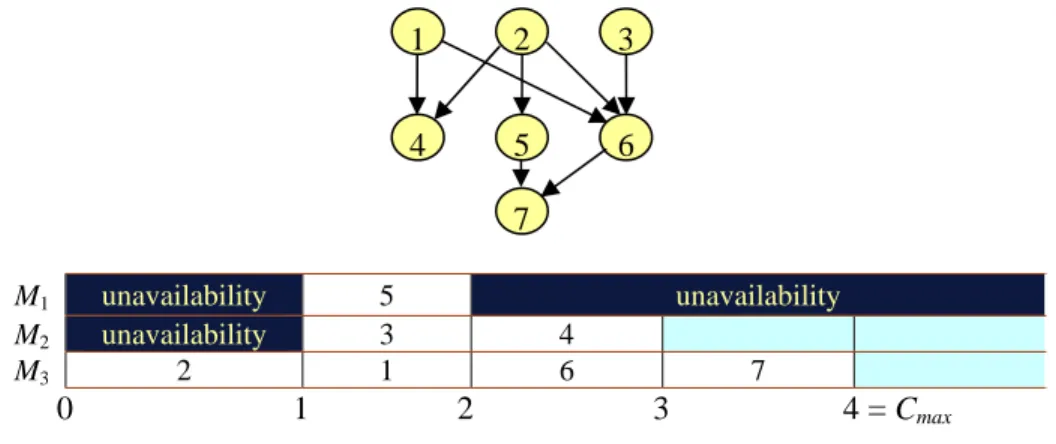
Some list algorithms are optimal for some specific availability patterns (see Sanlaville and Schmidt 1998). The list algorithm of Coffman and Graham (1972) is optimal for two machines with arbitrary precedence constraints and an arbitrary pattern (see Liu and Sanlaville 1995a). If the graph is an interval order graph, the list algorithm will choose the first tasks with the largest set of successors (Most Successor First (MSF) rule) that is optimal on an arbitrary availability pattern (see Liu and Sanlaville 1995b). Figure 2 shows an instance where any other choice for the first task to be scheduled leads to a sub-optimal solution (MSF priority list is J<2-1-3-5-6-4-7> for single and parallel machine). Interval order graphs attracted much attention as any precedence graph might be
transformed to an interval order graph by adding a set of precedence relations (refer to Papadimitriou and Yanakakis, 1979). Hopefully, optimal schedules for interval order graphs might lead to satisfactory schedules for arbitrary task graphs.
M1 unavailability 5 unavailability
M2 unavailability 3 4
M3 2 1 6 7
0 1 2 3 4 = Cmax Figure 2- Use of the MSF rule for interval order graphs.
Dolev and Warmuth (1985a) demonstrated that Highest Level First (HLF) schedules are optimal if the precedence graph is either an inforest (outforest) and the pattern is NCinczz (NCdeczz), or forms chains of tasks and arbitrary patterns (see Liu and Sanlaville, 1995a). Dolev and Warmuth (1985b), then showed that HLF policy leads to an O(n.logn) “flip-flop” algorithm for scheduling opposing forests to zigzag patterns with 2 or 3 machines. Opposing forests are the union of out-trees and in-trees as hinted by Sanlaville and Schmidt (1998).
3.1.2.2. Resumable availability constraints
Lee (1996) has stated that the problem Pm| rs |Cmax which is harder than Pm| |Cmax, is NP-hard. Lee
(1991) studied the problem when the unavailability period is at the beginning of the planning horizon and there is at most one unavailability period (si = 0, ei≥ 0 for all i). The LPT rule has a
tight error bound of 1/2 and the modified LPT algorithm has a tight error bound of 1/3 for it. Lee (1996) has provided an error bound analysis for the algorithms LPT1 and LPT2. LPT1 algorithm assigns jobs to the minimum loaded machine. In LPT2 algorithm, Jj is assigned to a machine such
that its finishing time is minimized. The performance ratio of LPT1 can be arbitrarily large even for m = 2 when si > 0 for all i. The RLPT2 bound is
(m - 1)
/2m which is a tight bound. Since 1|rs|∑wjCj is
NP-hard, Pm2| rs |∑wjCj is also NP-hard for n > 2. This problem is studied by Kaspi and Montreuil
(1988). When the unavailability period occurs at the beginning of the planning horizon, SPT gives the optimal schedule. Lee (1996) provided a Dynamic Programming approach of O(n.MS1.s2.tmax)
which solves the problem optimally. Lin et al. (1998) studied the parallel machine problem when the unavailability period is at the beginning of the planning horizon and there is at most one unavailability period. The objective is the maximization of the “minimum completion time”. They showed that LPT has a worst case error bound of (2m – 1)/(3m – 2).
Schmidt (1984) studied the problem Pm| prmp, rs |Cmax and gave the conditions for the existence of
a feasible preemptive schedule when all machines are available in an arbitrary number of time intervals. Such a feasible schedule can be constructed in O(n + m.logm) time. He showed that the number of induced preemptions is proportional to the total number of processing intervals of all processors. Later, Schmidt (1988) considered a more generalized problem which takes into account different release and due dates and can be solved in O(n.m.logm) time. For this model, if all machines are only available in one and the same time interval (B, F) and tasks are independent,
1 2 3
6 5
4
McNaughton (1959) has shown that there is a feasible preemptive schedule iff maxj{tj}≤(F-B) and ∑j tj≤m(F-B). He gave an algorithm of O(n) with at most m − 1 preemptions to construct this
schedule.
Lawler and Martel (1989) solved the problem Q2| pmtn, rs |∑wjUj. They used dynamic
programming to propose pseudo-polynomial algorithms (O(∑jwj.n
2
) or O(n2.tmax)). Nothing,
however, was say about the effort needed to compute processing capacity in one interval.
For the problem I| pmtn, rs |Lmax, Sanlaville (1995) suggested a nearly on-line priority algorithm
with an absolute error of A≤ (m - 1/m)tmax if the availability of machines follows a constant pattern,
and of A ≤ tmax if the machine availability refers to an increasing zigzag pattern. The priority is
calculated according to the Smallest Laxity First (SLF) rule, where laxity (or slack time) is the difference between the task’s due date and its remaining processing time. The SLF algorithm executes in O(n2.tmax) and it is optimal in the case of a zigzag pattern and no release dates. Also for
I| pmtn, rj, rs , dj |Lmax, if the number of changes of machine availabilities during any time interval
is linear in length of the interval, an algorithm can be implemented in O(n3.tmax3(logn + logtmax)) (see
Sanlaville 1995).This algorithm needs the knowledge of all the data at time 0 and hence is off-line. When no release dates are given but due dates have to be considered, Lmax can be minimized using
the approach suggested by Schmidt (1988) in O(n.m.logn) time. He has showed that the number of induced pre-emptions is proportional to the total number of processing intervals and deadlines. Liu and Sanlaville (1995a) studied the parallel machine problem with resumable availability constraints considering the precedence constraints. Problems with chains and arbitrary pattern of unavailability can be solved in polynomial time by the Longest Remaining Path (LRP) rule for minimizing the makespan (Pm,NC| prmp, chains |Cmax). In case of two parallel machines and
arbitrary patterns of availability, LRP solves problems with arbitrary task precedence relations (Pm2,NC| prmp, prec |Cmax) in time complexity and number of preemptions of O(n
2 ).
Liu and Sanlaville (1995a) showed that results on minimization of Cmax for inforest precedence
graphs and increasing zigzag patterns can be extended to minimization of Lmax, using SLF rule on
modified due dates (the modified due date is given by d′j = min{dj, ds(j) + ts(j)}, where index s(j) is related to successor job of the Jj when it exists). In the same way, minimizing Lmaxon two machines
with availability constraints is achieved using SLF with a different modification scheme.
Albers and Schmidt (1999, 2001, 2004) investigated an online version of a basic problem P,NC|pmtn |Cmax and presented an online algorithm that constructs schedules with an optimal
makespan if a lookahead period of one unit is given, i.e., the algorithm always knows the next point in time when the set of available machines changes. Also, they gave an online algorithm without lookahead that constructs nearly optimal schedules. They showed that no online algorithms can construct optimal schedules and online algorithms can achieve a bounded competitive ratio if there are time intervals during which no machines are available. Schmidt (2000a) also presented a paper on performance guarantee of two simple priority rules for offline and online production scheduling with limited machine availability.
The problem of scheduling n preemptive jobs on m machines with identical speed under machine availability and “eligibility” constraints for minimizing Lmax has been considered by Sheen and Liao
(2007). Network flow technique is used to formulate this scheduling problem into a series of maximum flow problems. They have proposed a polynomial time two-phase binary search algorithm to verify the feasibility of the problem and to solve the scheduling problem optimally if a feasible schedule exists. Finally, they show that if x is the total number of availability intervals on
all machines, and UB and LB are upper and lower bounds found for optimal Lmax by their proposed
algorithm, respectively; the time complexity of the algorithm will be O((n+(2n +2x))3log(UB - LB)). Blażewicz et al. (2000, 2003) investigate preemtable tasks and multiprocessor tasks on parallel processors with limited availability and show that this problem becomes NP-hard in the strong sense in case of trees and identical processors. If tasks form chains and also they are processed by identical processors with a staircase pattern (NCsc) of availability, the problem can be solved in low-order polynomial time for criterion Cmax and a linear programming approach is required for criterion
Lmax. The network flow and linear programming approaches are proposed for independent tasks
scheduled on uniform (Q) and unrelated (R) processors with arbitrary patterns of availability for schedule length and maximum lateness criteria, respectively.
Leangsuksun et al. (2005) proposed concepts of integrating high availability cluster mechanism with a secure cluster infrastructure. In high-availability problems, the resource (computer or node) availability is very important to optimize overall performance. Apon and Wilbur (2003) designed an advanced multi processor network (AmpNet) with a high availability in mind.
In batch production on two parallel machines while only one processor has an unavailable interval, Wang and Cheng (2006) proposed a heuristic to minimize the arrival time of the last delivery batch to the distribution center with a worst-case error bound of 2/3.
Blażewicz et al. (1996) edited a book about this field that can be regarded for detailed studying.
3.1.3. Flow shop and permutation flow shop problems
As demonstrated in Kubiak et al. (2002) and Aggoune and Portmann (2006), the problem F| rj, nr |Z
in which Z is one of the performance measures mentioned in this paper for m ≥ 2 is strongly NP-complete; hence, most researchers have just presented algorithms for 2 machines.
3.1.3.1. Nonresumable availability constraints
As stated in section 3.1.1.1, based on the work of Adiri et al.’s work (1989), the problem F| nr |∑Cj
(and so, F| nr(Mki) |∑wjCj) is NP-complete, because the problem 1| nr |∑Cj just by one unavailability
period is NP-complete. The SPT rule leads to a tight relative error non-greater than 2/7 for this problem. For fixed m, the SPT rule is asymptotic optimal if there is not more than one interval of non-availability for each machine (refer to Sanlaville and Schmidt 1998).
Allahverdi (1996) considered a two-machine flow shop problem and showed that if only the first machine breaks down, the LPT policy will minimize the maximum lateness; while if only the second machine breaks down, the SPT policy must be used.
Cheng and Wang (1999) studied the problem F2| nr(Mi2) |Cmax with two consecutive availability
constraints. They developed a heuristic and showed that it has a worst-case error bound of 2/3. Lee (1999) studied the two-machine flow shop problem with nonresumable availability constraints. He proposed a heuristic with a relative error bound of 1 when the availability constraint is imposed on machine 1. When the availability constraint is imposed on machine 2, Johnson’s Algorithm, JA, (Johnson 1954) has a tight relative error bound of 1. Braun et al. (2002) surveyed the problem of minimizing the makespan in the two-machine n-job flow-shop scheduling with k1 non-availability intervals on each of the two machines. This problem is binary NP-hard even if there is only one
non-availability interval either on the first machine or on the second machine. Aggoune and Portmann (2006) proved that the problem F,NCwin| n = 2 |Cmax is polynomial and its complexity by
using their graphic method is at most equal to O(k.m4).
Ng and Kovalyov (2003) studied a two-machine flowshop scheduling problem with an assumption that one of the two machines is not available in a specified time period. The problem is known to be NP-hard. Pseudo-polynomial dynamic programming algorithms and heuristics with worst case error bounds are given in the literature to solve the problem. Those are different for cases the unavailability interval is for the first or the second machine. The existence of a fully polynomial time approximation scheme (FPTAS) was formulated as an open conjecture in the literature. In this paper, it has been shown that the two cases of the problem under study are equivalent to similar partition type problems; then, authors derived a generic FPTAS for the latter problem with O(n5/ 4) time complexity. Espinouse et al. (1999) solved the two-machine no-wait flow-shop problem for minimizing maximum completion time by assuming each machine has one hole. Wang and Cheng (2001) provided 5/3-approximation algorithms for this problem with an unavailable interval. Cheng and Liu (2003a, 2003b) surveyed the approximation methods for this problem, too. Since the problem with an unavailable interval is NP-hard and the problem with two separate unavailable intervals has no polynomial time approximations with constant performance bounds unless P = NP (see Espinouse et al. 1999), they have presented a polynomial time approximation scheme for the problem when the unavailable interval is imposed on only one machine, or the unavailable intervals overlap on the two machines.
Aggoune (2004b) presented a heuristic based on the genetic algorithm and taboo search for the problem F| nr |Cmax. Afterwards, Aggoune and Portmann (2006) proposed a new heuristic algorithm
for this problem based on the development of Aggoune’ heuristic for 2-job (Aggoune 2004a). It consists of a procedure that schedules jobs two by two following an input sequence, combined with a tabu search (TS). Aggoune and Portmann’s algorithm is more exact than Aggoune’s algorithm (2004b), but their algorithm needs more time to access the schedule. The problem F,NCwin| |Cmax is
NP-hard in the strong sense. It has been shown by Kubiak et al. (2002) that it is impossible to find a heuristic with performance guarantee for the makespan minimization in a two-machine flow shop, if more than one unavailability period is considered on each machine.
3.1.3.2. Semiresumable availability constraints
Lee (1999) has shown that the two-machine flow shop with semi-resumable availability constraints imposed on both machines is NP-hard even if s1 = s2 = s and e1 = e2 = t. He provided a pseudo-polynomial DP algorithm of O(n.MS22.s1. t1,max) for the problem F2| sr(M1) |Cmax. The JA has a tight
relative error bound of 1 for this problem. Indeed, the JA has a tight relative error of max{1/2, κ} and it is optimal when s1 = s2 = 0 and has a relative error bound of κ when s1 = s2 = s and e1 = e2 = t.
3.1.3.3. Resumable availability constraints
Lee (1977) studied the two-machine flow shop model with availability constraints imposed on only one machine. He showed that the problems F2| rs(M1) |Cmax and F2| rs(M2) |Cmax are both NP-hard in
the ordinary sense. He also provided a DP algorithm of O(n.MS22.s1.t1,max) to solve the problem
F2|rs(M1)|Cmax optimally. The JA - which solves F2| |Cmax optimally - has a relative error bound of 1
and a heuristic was proposed by him with a relative error bound of 1/2 based upon the JA for the above model. The JA has a relative error bound of 1/2 for the problem F2| rs(M2) |Cmax. He
proposed a heuristic to solve this problem with a relative error bound of 1/3. In addition, he proposed heuristics with one hole on eitherM1 or M2 with relative errors 3/2 and 4/3, respectively!
Lee (1999) studied this problem again. He proved if s1 = s2 = s and e1 = e2 = t, then the JA will solve the problem optimally. He showed that the problem is NP-hard when s1≠ s2 and e1 - s1 = e2-s2. In this case, the relative error bound of JA might be arbitrarily large. Breit (2004) studied this problem, too. He presented an improved algorithm with a relative worst-case error bound of 5/4 while the best “fast” approximation algorithm for this problem guarantees a relative worst-case error bound of 4/3. The tight worst-case bound for the problem F2| rs(M2) |Cmax must be ¼. Kubiak et al. (1997)
proposed a B&B algorithm for a 2-machine problem, too.
The above results suggest that if there is to exist 1 hole in F2| rs(Mi) |Cmax, it will be better for
heuristics that it occurs on M2; but Kubiak et al. (2002) showed it isn’t generable when at least two holes are allowed to occur, unless P = NP. In other words, they proposed a simple heuristic based on JA that guarantees a relative error of 2 in O(n.logn) time if all holes occur on M1; but, such holes on M2 make polynomial time heuristics with constant relative error impossible, unless P = NP. The optimum sequence between each 2 holes is Johnson’s sequence. They developed a branch and bound heuristic based on the above property for F2| rs(Mki) |Cmax, too. In addition, their tests show
that there is no significant difference among computational times for sample examples if holes are allowed to occur at least on one of the two machines. There is no polynomial time heuristics with a relative constant error for F2| rs(M2i) |Cmax. The problem F2| rs(Mi) |Cmax ≤ y is usually
NP-Complete (see Blazewicz et al. 2001). Schmidt (2000b) proposed a parallel B&B algorithm for this problem. For more details, we refer to the survey of Schmidt (2000b), where existing methods for solving scheduling problems under availability constraints as well as complexity results are reviewed.
Cheng and Wang (2000) showed that the worst-case error bound 1/2 of the heuristic provided by Lee (1997) for the problem F2| rs(M1) |Cmax is tight and then, they developed an improved heuristic
with a worst-case error bound of 1/3. Wang and Cheng (2007a) have propounded 2 heuristics for the problem F2| rs(Mi), Sij |Cmax and show that their worst case error bounds are no longer than 2/3.
Wang and Cheng (2007b) have studied the problem PF2| rs(M1), Sij |Cmax and presented a
polynomial-time approximation scheme for it.
3.1.4. Job shop problems
3.1.4.1. Nonresumable availability constraints
The single machine algorithm of Balas et al. (1998) is used in a Shifting Bottleneck Procedure to solve the job-shop scheduling problem with deadlines. This algorithm can also be used to give an approximation algorithm for the problem J| nr, dj |max(Cj + qj) (see Carlier 1982). The problem
J|nr|Cmax was solved exactly by Aggoune (2002) using a B&B algorithm with lower bound based on
a two-job-shop problem with heads and tails and unavailability periods.
Aggoune (2004a) extended Akers’ geometric approach to J| nr(Mki), n = 2 |Cmax and named his
method temporized geometric approach (TGA) that is polynomial and its complexity is at most equal to O(k.u4), where u = max{n1, n2}.
3.1.4.2. Resumable availability constraints
Mauguière et al. (2003a) proposed a B&B algorithm for the problem J| rs(Mki) |Cmax. Computational
results show that solving the problem J| rs |Cmax is a little more difficult than the problem without
Aggoune (2004a) extended his nonresumable “TGA” to J| rs(Mki), n = 2 |Cmax that is polynomial and
its complexity is at most equal to O(ku4); u = max{n1, n2}.
3.1.4.3. Resumable/ Nonresumable availability constraints
Mauguière et al. (2003b) proposed a B&B algorithm for the problem J,cr| rs/nr(Mki) |Cmax. They
have extended their job-shop algorithms to J,cr/ncr| rj, rs/nr(M k
i) |Cmax afterward (Mauguière et al.
2005).
3.1.5. Open shop problems
3.1.5.1. Nonresumable availability constraints
Breit et al. (2001a, 2001b) studied a two-machine open shop scheduling problem without preemption, in which one machine is not available for processing during a given time interval. The objective is to minimize the makespan. They showed that the problem is NP-hard and presented an approximation algorithm with a worst-case ratio of 4/3.
3.1.5.2. Resumable availability constraints
Lorigeon et al. (2002) studied O2| rs |Cmax. This problem is NP-hard. They developed a dynamic
programming algorithm with pseudo-polynomial time to solve the problem optimally when a machine isn’t available at time si > 0. Then, they proposed a mixed integer linear programming
formulation that allows solving instances with up to 500 jobs optimally in less than five minutes with CPLEX solver. Moreover, they showed that any heuristic algorithm has a worst-case error bound of one for this problem. Kubzin et al. (2005) considered the problem O2| rs |Cmax, as well.
They presented two polynomial-time approximation schemes: one of which handles the problem with one non-availability interval on each machine and the other for the problem with several unavailability intervals on one of the machines. Problems with a more general structure of the unavailability intervals cannot be approximated in polynomial time within a constant factor, unless P = NP.
3.1.6. Flexible flow shop
Allaoui and Artiba (2006) surveyed the two-stage hybrid flow shop non-resumable scheduling problem to minimize Cmax with only one machine on the first stage and m machines on the second
stage. They considered that each machine is subject to at most one unavailability period and discussed the complexity of the problem and proposed a B&B model for its solution. Finally, they have calculated the worst-case performances of three heuristics: LIST algorithm, LPT algorithm and H-heuristic.
Jungwattanakit et al. (2007) have formulated a 0-1 mixed integer program for minimizing the convex combinations of Cmax and ∑Uj in FF problem scheduling with n independent jobs, unrelated
parallel machines in each stage, release dates, due dates, sequence- and machine-dependent setup times, which is often present in the textile industry. They assumed that only one unavailability period may occur for each machine in zero time (si = 0 ≤ ei) and the preemption of jobs isn’t
permitted (the problem is non-resumable). Since this problem is NP-hard in the strong sense, they have developed heuristic algorithms to solve it approximately. Initially, several basic existing dispatching rules and well-known constructive heuristics for flow shop makespan scheduling problems were extended to solve the problem under consideration. To improve the solutions,
polynomial heuristic improvement methods based on the shifting of the jobs were then applied. Finally, genetic algorithms were suggested to tackle this problem.
3.1.7. Flexible job shop (FJ)
Levitin (2000) provided some details about the flexible job-shop sequencing and scheduling problems. A genetic algorithm-based approach was developed by Chan et al. (2006) for assigning operations to machines and sequencing jobs on machines to optimize the system objectives in FJ resource-constrained problem iteratively.
Dehnar Saidy and Taghavi-Fard (2008) propounded an exact geometric algorithm for the problem FJ,cr/ncr| n = 2, rs/nr/sr(Mik), rj, mi≤ 2, Sij |γ, where mi is the number of identical processors in each
stage (work center) and γ is one of the performance measures based on the completion time. The operations of jobs can be nonresumable, resumable or semi-resumable (in general case). It is assumed that setup time is sequence-independent. Their algorithm can be applied to more simple models, too. This problem is general and strongly NP-hard.
3.2. Stochastic Case
In stochastic models, the processing times, the release dates, the starting time and the duration of the unavailability period are not known beforetime; but, it is assumed that the distributions of the processing times, due dates (deadlines), repair time and time at which breakdown occurs are known at time 0. The processing time of a job becomes known only when the Jj is completed. The uptime
(Ak) and downtime (Bk) of machines and the processing requirement of the job j (Xj) are assumed to
be independent identically distributed random variables.
We consider two sub-cases for the stochastic case: non-resumable and resumable problems. While distribution functions of the uptimes, downtimes and repair time of machines, jobs and the processing times are often the same before, during, and after the interruption(s), but other distribution functions may be different from the original period for the case of some special types of breakdowns.
In general, the breakdown process introduces serious complications. In the literature, single machine problems are often encountered. The performance measures used in the literature are the expected values of the weighted sum of completion times, the flow time, the weighted sum of number of tardy jobs, the maximum expected lateness, the expected maximum lateness, the availability of heterogeneous systems with average response time of multi-class tasks, the weighted discounted reward, the truncated cost, the number of tardy jobs under stochastic order, the maximum holding cost, and the “expected cost” where the cost function is proportionate to the completion time of Jj.
When preemption is allowed, the decision of which part should be processed is given at time t according to the state of the system. When preemption is not allowed, mostly the sequence of jobs won’t be changed if a breakdown occurs. Heuristics that are used for problems when machines are continuously available are also used for the problems in which breakdowns occur. In some studies the conditions under which optimal strategies exist are provided.
3.2.1. Non-resumable availability constraints
Adiri et al. (1989) studied the single machine problem with nonresumable availability constraint in which the machine is subject to breakdowns. The objective was the minimization of the expected
flow time. If the breakdown distribution function over the time is concave, then SPT will asymptotically minimize the expected flow time. For the case of multiple breakdowns, SPT minimizes the expected flow time when the breakdown times are exponentially distributed.
Birge et al. (1990) studied the single machine problem with multiple breakdowns. They considered a simple recourse in their analytical models, in which a permutation schedule - that is fixed a priori - is always maintained and also, certain completion times may be pushed back as a result of one or more breakdowns. The simple recourse has been studied with the objective of minimizing E[∑fj(Cj)], where fj(t) is a nondecreasing real-valued cost function of time t. For the case where we
intend to minimize E[∑wjCj], a strong bound on the difference between the optimal policy and the
SWPT policy has been provided. Li and Cao (1995) studied a more generalized version of the problem. The single machine is subject to several types of breakdowns according to different probabilities. After the machine breakdown occurs, the jobs’ processing times, uptime and the repair time of the machine might be different from the original period. There have been a number of attempts to arrive at the optimal nonpreemptive policies that minimize E[∑wjCj], E[∑wjUj] with
constant due dates, and E[∑wjCj] with random due dates. For the single-machine problem, Lee and
Lin (2001) assumed that the unavailable time is unknown but with a probabilistic distribution. They have studied the rate-modifying maintenance problems with objective functions such as: expected makespan, total expected completion time, maximum expected lateness, and expected maximum lateness.
A dominance relation for minimizing the makespan with probability 1 was established by Allahverdi (1995) for two-machine flowshop scheduling problem with set-up times and random machine breakdowns. Furthermore, it has been shown that Yoshida and Hitomi's algorithm (1979), YHA, which solves the deterministic problem PF2| Sij |Cmax optimally in O(n.logn) time,
stochastically minimizes the makespan when random breakdowns are present. Allahverdi (1997) published another paper in which he considered the removal times into this latter problem. Allahverdi and Mittenthal (1998) investigated two-machine flow shop scheduling problem with dual criteria (expected makespan and mean flow time) subject to random breakdown.
3.2.2. Resumable availability constraints
Glazebrook (1987) studied the problem 1| prmp, rs |E[∑f(Cj)], where f(t) is a linear or discounted
cost function of the time t. For the case of geometric uptimes, conditions were given under which breakdowns have no effects on optimal allocation strategies. Two different procedures were given which yield an upper bound on the loss incurred when a processing strategy is adopted under the assumption of no breakdowns or when breakdowns occur in fact. Birge et al. (1990) studied the simple recourse with the multiple breakdowns and the objective of minimizing E[∑fj(Cj)], where
fj(t) is a non-decreasing real-valued cost function of time t. Li and Cao (1995) studied a more
generalized version of the problem as mentioned in the section 3.2.1. Pinedo (2001) provided the results for the problem 1| prmp, rs |E[∑wjCj]. He has shown that shortest weighted expected
processing time (SWEPT) algorithm solves the single machine problem with multiple breakdowns in order to minimize E[∑wjCj] when uptimes are independent exponential random variables and
downtimes are independently and identically distributed geometric random variables. Birge and Glazebrook (1988) studied the single machine problem (1| prmp, rs |E[∑wjCj]) with multiple
breakdowns, too. The state of the system at time t is determined by machine’s condition (up or down), the time that machine has been in that condition and the set of completed jobs cumulative processing time up to time t for all unfinished jobs. The decision is made at time t to determine which uncompleted job to process during [t, t + 1). The objective is to minimize the expected weighted flow time (E[∑wjCj]). The error and the relative error bounds were provided for the
algorithm which selects the uncompleted job with the largest Gittins’ index to be processed. In addition to the nonresumable case, Lee and Lin (2001) studied the rate-modifying maintenance single machine scheduling problems for resumable case with the same assumptions and performance measures.
For minimization of E[Cmax], Schopf and Berman (1999) defined a stochastic scheduling policy
based on time-balancing for data parallel applications whose execution behavior can be represented as a normal distribution.
Cai et al. (2005) studied the problem of finding a dynamically optimal policy to process n jobs on a single machine subject to stochastic preemptive-repeat-breakdowns (nonresumable operations). Their study allows: 1) the uptimes and downtimes of machines to follow general probability distributions, not necessarily independent of each other; 2) the breakdown process to depend upon the job being processed; and 3) the processing times of jobs to be random variables following arbitrary distributions. They considered two possible cases for the processing time of a job interrupted by a breakdown: a) it is resampled according to its probability distribution or b) it is the same random variable as that before the breakdown. For the problem with resampled processing times, it has been deduced the optimal dynamic policies for criteria including: weighted discounted reward, weighted flowtime, truncated cost, number of tardy jobs under stochastic order, and maximum holding cost. For the problem with the same random processing time, a set of Gittins indices were derived that give the optimal dynamic policies under the criteria of the weighted discounted reward and the weighted flowtime.
Xie and Qin (2006) proposed an algorithm for stochastic scheduling with availability constraints in
“heterogeneous cluster” to improve the availability of heterogeneous systems while reducing
average response time of multi-class tasks.
A heterogeneous cluster consists of an array of
diverse computers, called computing nodes, which are connected by a high-performance
network. To date heterogeneous clusters have been emerging as popular computing
platforms for computationally intensive applications with diverse computing needs.
Processors operate at different speeds and are not continuously available for processing, in
heterogeneous clusters. Indeed, heterogeneous cluster scheduling is a parallel system
scheduling problem with high performance object.
Examples of such constraints can be foundin many areas. For instance, computational nodes in heterogeneous clusters need to be maintained periodically to prevent malfunctions (Lau and Zhang 2004). The “queue systems” can be considered in this area, as well.
4. CONCLUSION
Machine scheduling with availability constraint becomes increasingly more important as a better understanding of their importance in various applications is formed. The cause of the machine unavailability might be either deterministic or stochastic. In this paper, the related problems characteristics and literature were presented for both deterministic and stochastic cases with any famous performance metric, job (or operation) resumability and holes cross-ability in the single machine, Pm, PF, F, J, O, FF and FJ environments. This paper can be a good reference for those who are interested in doing research about the jobs sequencing and scheduling problems under limited resource availability.
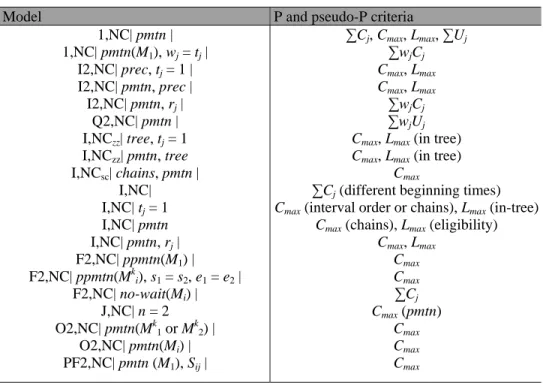
We have summarized the known polynomial (P) and pseudo-P models in Table 1. It is clear that the results of Table 1 are applicable to simpler problems with equivalent performance measures, as well.
Table 1- P and pseudo-P summary (the complexity is stable with the conditions within parentheses).
Model P and pseudo-P criteria
1,NC| pmtn | 1,NC| pmtn(M1), wj = tj |
I2,NC| prec, tj = 1 | I2,NC| pmtn, prec | I2,NC| pmtn, rj |
Q2,NC| pmtn | I,NCzz| tree, tj= 1 I,NCzz| pmtn, tree I,NCsc| chains, pmtn |
I,NC| I,NC| tj= 1 I,NC| pmtn I,NC| pmtn, rj | F2,NC| ppmtn(M1) | F2,NC| ppmtn(Mki), s1 = s2, e1 = e2 |
F2,NC| no-wait(Mi) | J,NC| n = 2 O2,NC| pmtn(Mk1 or Mk2) |
O2,NC| pmtn(Mi) | PF2,NC| pmtn (M1), Sij |
∑Cj, Cmax, Lmax, ∑Uj ∑wjCj Cmax, Lmax Cmax, Lmax
∑wjCj ∑wjUj Cmax, Lmax (in tree) Cmax, Lmax (in tree)
Cmax
∑Cj (different beginning times) Cmax (interval order or chains), Lmax (in-tree)
Cmax (chains), Lmax (eligibility) Cmax, Lmax
Cmax Cmax ∑Cj Cmax (pmtn)
Cmax Cmax Cmax
Most of the heuristics with error bound analysis have been gathered in this article. Some of the classical algorithms (for unlimited availability, such as: SPT, SWPT, SWEPT, LRP, JA) are used for the same limited availability models. In some cases those heuristics produce optimal solution(s). We have summarized the known polynomial (P) and pseudo-P models in Table 1. It is clear that the results of Table 1 are applicable to more simple problems and equivalent performance measures, as well. Most of the problems are NP-hard. Of course, majority of the problems of the FJ environment are strongly NP-hard. Some optimal procedures are provided for problems in class P. The DP approaches are intended for solving the NP-hard problems.
Günter Schmidt has been likely the most active author in this filed and McNaughton the first.
If availability constraints come from unexpected breakdowns, fully online algorithms will be needed; but in case of preemptive scheduling, many results of optimality concern the best nearly on-line algorithms. It is an open question to look for the optimality results from fully on-on-line algorithms and specific availability patterns, or at least to compute performance bounds.
The recent research efforts and papers are considering penalties after the interruption of an operation to enable one to investigate scheduling problems with some setup constraints (namely semi-resumable job sequencing with some extensions). A direction for authors is to assume that one operation cannot be interrupted on any time, but only at given instants. Furthermore, we suggest that authors work on more complicated problems such as sequencing n jobs on m resources in the FJ or O environment.
REFERENCES
[1] Adiri I., Bruno J., Frostig E., Rinnooy Kan A.H.G. (1989), Single machine flow-time scheduling with a single breakdown; Acta Informatica 26; 679-696.
[2] Aggoune R. (2002), Ordonnancement d’Ateliers sous Contraintes de Disponibilité des Machines; Ph.D. Thesis, Universite de Metz; France.
[3] Aggoune R. (2004a), Two-Job Shop Scheduling Problems with Availability Constraints. In: Proceedings of the Fourteenth International Conference on Automated Planning and Scheduling (ICAPS 2004), Whistler (Canada).
[4] Aggoune R. (2004b), Minimizing the makespan for the flow shop scheduling problem with availability constraints; European Journal of Operational Research 153; 534-543.
[5] Aggoune R., Portmann M.-C. (2006), Flow shop scheduling problem with limited machine availability: A heuristic approach; International Journal of Production Economics 99; 4-15.
[6] Albers S., Schmidt G. (1999), Scheduling with Unexpected Machine Breakdowns. In: Computer Science; Vol. 1671, Proceedings of the Third International Workshop on Approximation Algorithms for Combinatorial Optimization Problems: Randomization, Approximation, and Combinatorial Algorithms and Techniques, Springer-Verlag: London, 269-280.
[7] Albers S., Schmidt G. (2001), Scheduling with unexpected machine breakdowns; Discrete Applied Mathematics 110(2-3); 85-99.
[8] Albers S., Schmidt G. (2004), Scheduling with Unexpected Machine Breakdowns; In: Randomization, Approximation, and Combinatorial Optimization (Algorithms and Techniques), Springer: Berlin/ Heidelberg, Volume 1671; 269-280.
[9] Allahverdi A. (1995), Two-stage Production Scheduling with Separated Set-up Times and Stochastic Breakdowns; Journal of the Operational Research Society 46(7); 896-904.
[10] Allahverdi A. (1996), Two-machine proportionate flowshop scheduling with breakdowns to minimize maximum lateness; Computers & Operations Research 23; 909-916.
[11] Allahverdi A. (1997), Scheduling in stochastic flowshops with independent setup, processing and removal times; Computers and Operations Research 24(10); 955-960.
[12] Allahverdi A., Mittenthal J. (1998), Dual criteria scheduling on a two-machine flowshop subject to random breakdowns; International Transactions in Operational Research 5; 317-324.
[13] Allaoui H., Artiba A. (2006), Scheduling two-stage hybrid flow shop with availability constraints; Computers and Operations Research 33(5); 1399-1419.
[14] Apon A., Wilbur L. (2003), AmpNet - a highly available cluster interconnection network; Proceedings IEEE International Symposium on Parallel and Distributed Processing.
[15] Balas E., Lancia G., Serafini P., Vazacopoulos A. (1998), Job shop scheduling with deadlines; Journal of Combinatorial Optimization 1(4); 329-353.
[16] Birge J., Frenk J.B.G., Mittenthal J., Rinnooy Kan A.H.G. (1990), Single machine scheduling subject to stochastic breakdowns; Naval Research Logistics 37; 661-677.