R E S E A R C H A R T I C L E
Open Access
Key attributes of patient centered medical
homes associated with patient activation of
diabetes patients
Lori A. Bilello
1*, Allyson Hall
2, Jeffrey Harman
3, Christopher Scuderi
4, Nipa Shah
5, Jon C. Mills
6and
Shenae Samuels
7Abstract
Background:Approximately 24 million Americans are living with diabetes. Patient activation among individuals with diabetes is critical to successful diabetes management. The Patient Centered Medical Home (PCMH) model holds promise for increasing patient activation in managing their health. However, what is not well understood is the extent to which individual components of the PCMH model, such as the quality of physician-patient interactions and organizational features of care, contribute to patient activation. This study’s objective is to determine the relative importance of the PCMH constructs or domains to patient activation among individuals living with diabetes.
Methods:This study is a cross-sectional analysis of 1253 primary care patients surveyed with type II diabetes. The dependent variable, patient activation, was assessed using the Patient Activation Measure (PAM). Independent variables included 7 PCMH domains- organizational access, integration of care, comprehensive knowledge, office staff helpfulness, communication, interpersonal treatment and trust. Ordered logistic regression was performed to determine whether each PCMH domain was independently associated with patient activation, followed by a final ordered logistic regression that included all the PCMH domains in a single adjusted model.
Results:Using the full adjusted model, the odds of patients reporting higher activation scores (PAM) were found to be significant in the domains that represented organizational access (OR 1.56, 95% CI 1.31–1.85) and comprehensive knowledge (OR 1.44, 95% CI 1.13–1.85).
Conclusions:Many practices have struggled with the challenge to develop fully functional patient-centered medical homes. In an effort to become more patient-centered, this study aimed to address what factors activated diabetic patients to adhere to diabetes management plan. Understanding these factors can help identify PCMH attributes that practices can prioritize and improve upon to assist their patients in improving health outcomes.
Trial registration:Study was not a clinical trial; therefore it was not registered.
Background
The Medical Home has emerged as a major organizing construct in the delivery of primary care, having first been recognized by the American Academy of Pediatrics (AAP) in 1967. As the concept has been more fully ex-plored, researched and refined over the last half century, more clearly defined principles and practices have been adopted by key primary care professional societies. It
wasn’t fully recognized by the medical establishment until 2007 when the AAP, American College of Physicians, American Academy of Family Physicians, and the American Osteopathic Society published the Joint Prin-ciples for a Patient Centered Medical Home (PCMH). In 2008, the National Committee on Quality Assurance (NCQA) adopted criteria for practice recognition as a PCMH. There are 3 levels of NCQA recognition ranging from level 1 to level 3 and require medical practices to demonstrate that they have met certain criteria for the fol-lowing standards of care: patient centered access, team based care, population health management, care * Correspondence:[email protected]
1Center for Health Equity and Quality Research, College of Medicine, UF
Health Jacksonville, 6th Floor, Tower II, Suite 6015, 580 West 8th Street, T60, Jacksonville, FL 32209, USA
Full list of author information is available at the end of the article
management and support, care coordination and care transitions, performance measurement and quality im-provement [1].
Recent studies have provided evidence that PCMHs improve the quality of care, lead to better patient out-comes and experiences with the care process, and re-duce emergency department visits and hospitalizations [2–4]. The PCMH model is especially relevant to the care of patients with chronic diseases such as diabetes where it requires close monitoring by the provider, pa-tients involved in the management of their disease, a team-based approach in the continuum of care and adopts many of the components of Wagner’s Chronic Care Model [5, 6]. Several of the Centers for Medicare and Medicaid Services’(CMS) funded PCMH demonstra-tion projects have reported improvements in Hemoglobin A1c (HbA1c) control and provide encouraging results to support the PCMH model as a viable mechanism to im-prove the quality of diabetes care [7].
Patient centered care not only recognizes the patient as central to care provision, but it also requires the pa-tient to be involved in their care and to have the know-ledge, skills, and motivation to do so. Promoting patient activation is a key principle in a PCMH setting and is es-sential to the provision of high quality care and to achieve better patient outcomes. Patient activation is the ability of patients to take a pro-active role in managing their health and have the skills, knowledge, and confi-dence to do so [8] while patient engagement or motivation are often described as the preliminary steps to patient acti-vation where the patient is involved in learning about their condition and making decisions about their health but may not have taken a pro-active role in managing their health. Research has found that engaged, informed, confident, and skilled patients are more likely to perform activities that will maintain or promote their own health [9, 10]. A study by Remmers et al. showed that patients with diabetes who are more activated in their care had better HbA1c control and conformed to the diabetes guidelines in testing for HbA1c and LDL Cholesterol [11].
For practices that are adopting the PCMH model, an important consideration is whether certain constructs or domains of the model have a higher likelihood of acti-vating patients relative to other domains. As described in the Engagement Behavior Framework by the Center for Advancing Health, several components related to the patients’clinical care, such as seeking appropriate, high quality care, communication with health profes-sionals and organizational access, are important factors for patient engagement [12]. Understanding the relative importance of these medical home domains to patients can guide practices that are converting to the PCMH model develop specific strategies to improve patient activation. The goal of this study is to determine the
relative importance of certain well-established PCMH constructs or domains and their association to patient activation among individuals living with diabetes.
Methods
Patients with diabetes at 4 large family medicine centers were surveyed about their experiences with care and if they took an active role in their health and healthcare. These primary care practices have achieved the highest level of NCQA recognition (Level 3) as a PCMH, are affiliated with an U.S. academic medical center, and par-ticipate in a practice based research network in Florida. One practice was located at the academic medical center while the other three practices were located in various sections of a large metropolitan city and had diverse patient populations. There were over 5300 diabetic pa-tients being managed by these 4 practices. Papa-tients who met the inclusion criteria of being 18 years and older with an ICD-9 (International Classification of Diseases–9th Revision) code indicating type II diabetes (codes 250–250.9) who had at least 2 visits within the past 2 years (2012–2013), and who did not opt out were randomly selected to participate in a telephone survey administered by a university based Survey Research Laboratory in 2014. The survey took approximately 10 min for respondents to complete. A power analysis re-sulted in needing 1301 participants in order to detect a five point difference in domain ratings across the four clinics with 80% power. Sampling occurred until 1301 sur-veys were completed. The actual analytic sample was re-duced to 1253 after observations with missing data were excluded with minimal effect on the power. The response rate for each clinic (the number of complete interviews di-vided by the number of telephone numbers contacted) ranged from 65 to 73%.
The survey instrument included the Patient Activation Measure (PAM) and items from the Ambulatory Care Experiences Survey (ACES). The PAM is widely used to assess the knowledge, skills and confidence of indi-viduals in managing their own health and their health-care and has been tested to be a reliable and valid tool for patient activation [8, 13]. Numerous studies have used the PAM tool to assess patient activation in dif-ferent patient populations such as rural populations, patients with chronic conditions such as diabetes, mul-tiple sclerosis or mental health conditions that have shown that patient activation is positively related to pa-tient self–management [14–18]. Additionally the tool has been translated and validated in other languages included Dutch, German and Danish [19–21].
and used in numerous studies [22–24]. Using items from seven of the 11 available measures from ACES, we con-structed a shortened version of the survey with the fol-lowing medical home domains: organizational access, comprehensive knowledge, integration of care, commu-nication, office staff helpfulness, interpersonal treatment, and trust. Items selected from the ACES for each domain are listed in Table 1. The domains that were selected best fit the organizational structure of the PCMHs included in the study. The PCMH domains of organizational access, communication, integration of care and comprehensive knowledge are composite measures while office staff help-fulness, interpersonal treatment and trust are single item measures. The composites were developed based on scoring instructions provided by the ACES developers. The instructions provided by the developers pertained to a more comprehensive version of the ACES survey called the Primary Care Assessment Survey. The composite measures were tested for internal consistency and resulted in the following Cronbachsαscores: organizational access (0.86), comprehensive knowledge (0.76), integration and care coordination (0.65), and communication (0.86). Com-posite measures reflected the mean of the non-missing re-sponses from each item. If the respondent did not provide at least one response to an item within a domain then the observation was considered missing. We dichotomized all composite scores into binary variables to simplify inter-pretation of the results. We established the threshold of 4.5 based on distributional analysis of the original scores and conducted multiple sensitivity analyses to determine the impact of various thresholds on the outcomes. Sensi-tivity analysis produced similar results across different thresholds. Observations with a score of 4.5 (mean score for composites) or greater were coded as 1 (a high percep-tion of that PCMH domain) and those below were coded as a 0 (a low perception of that PCMH domain).
Analytic variables
The Patient Activation Measure (PAM) was used to assess the level of patient activation. PAM scores were on a 0 to 100 scale and converted into an ordinal categorical variable with four levels based on the PAM developers’ recommen-dations: 0 to 47; 47.1 to 55; 55.1 to 67; and over 67.
Covariates/socio-demographic variables were collected from questions in the ACES survey and included age; race (minority, non-minority); gender (female, male); health status (low, medium, high); education (less than high school, high school grad or higher); type of insur-ance (uninsured, Medicare, private, unknown); marital status (not married, married), and PCMH where the in-dividual was a patient.
Data preparation was performed using Statistical Analysis Software (SAS), Version 9.3 and because the PAM scores were divided into 4 ordered categories, ordered
logistic regression analyses was performed using STATA SE, Version 13.1. We first modeled each PCMH domain separately (adjusted for covariates). This was done in order to determine whether each PCMH domain was independ-ently associated with patient activation. Then we per-formed one final ordered logistic regression that included Table 1Survey questions from the Ambulatory Care
Experiences Survey grouped by PCMH Domains
PCMH domains Survey questions
Organizational Access When you needed care for an illness or injury how often did your personal doctor’s office provide care as soon as you needed it?
When you scheduled an appointment for a check-up or routine care how often did you get the appointment as soon as you needed it?
When you called your personal doctor’s office with a medical question during regular office hours how often did you get an answer the same day?
When you called your personal doctor’s office after regular office hours, how often did you get the help or advice you needed?
Integration of Care When your personal doctor sent you for a blood test, x-ray, or other tests, did someone from your doctor’s office follow-up to give you the test results?
How often did your personal doctor seem informed and up to date about the care your received from your specialist doctor?
Comprehensive Knowledge How would you rate your doctor’s knowledge of your medical history?
In the last 12 months, how often did your doctor seem to know all the important information about your medical history?
Office Staff Helpfulness In the last 12 months, how often were the office staff at your personal doctor’s office HELPFUL as you thought they should be?
Communication How often did your personal doctor listen carefully to you?
How often did your personal doctor give you clear instructions about what to do to take care of the health problems and symptoms that were bothering you?
How often did your personal doctor explain things in a way that was easy to understand?
Interpersonal Treatment How often did your personal doctor spend enough time with you?
Trust How often did you feel you could tell your personal doctor anything, even things you might not tell anyone else?
all the PCMH domains in a single adjusted model using the ordered logit procedure in STATA with PAM (4 or-dered categories) as the dependent variable. Since patients were sampled within physician practices, we used random effects to account for correlation of patients due to clinical practice characteristics.
Results
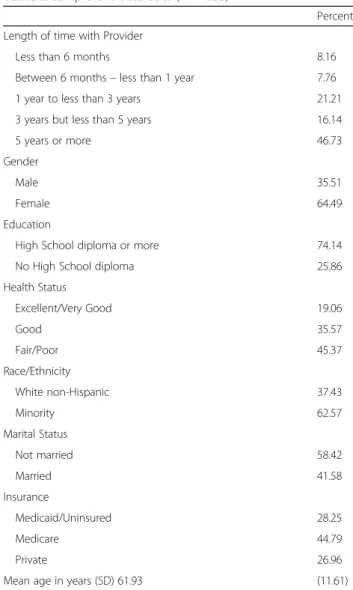
The study sample, which includes patients with dia-betes at the 4 PCMHs participating in the study, is rep-resentative of an urban population. The majority of participants consider themselves to be a racial or ethnic minority, with only 37.4% identifying as non-Hispanic white. The average age was 60.9 ± 11.61 with a range of 19 to 89 years. Other demographic characteristics in-clude: 74.1% reported having a high school education/ GED or higher, 41.6% were married, and 10.6% consid-ered themselves to have low health status. Medicare was the most common insurance coverage (44.8%) followed by Medicaid/uninsured (28.2%) and private in-surance (27.0%). Many of the patients have been receiv-ing care from the same medical practice for 3 years or more (62.9%). See Table 2 for details of the study sam-ple characteristics.
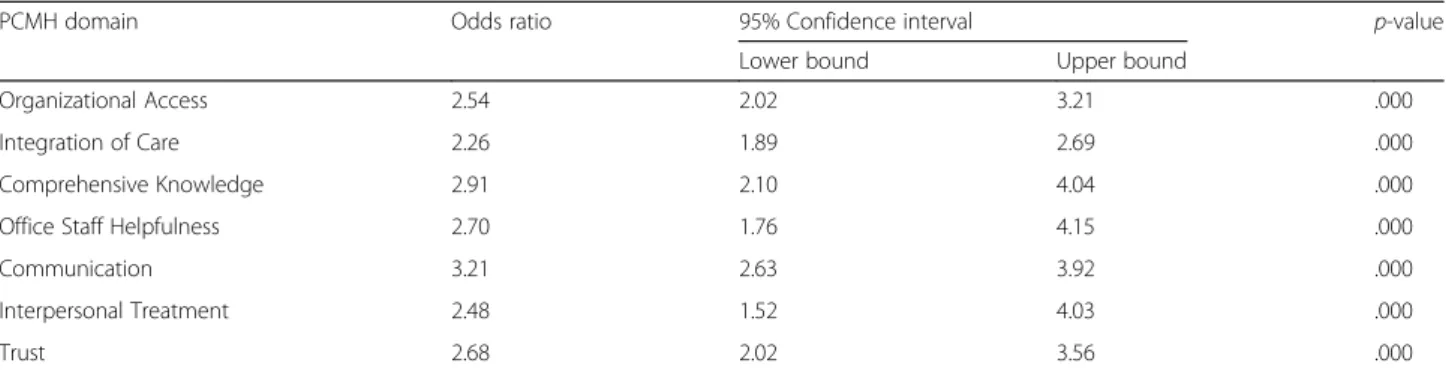
Table 3 shows the results from the ordered logit models showing the relationship between each PCMH domain in-dividually and PAM scores. The odds of patients reporting higher activation scores (PAM) were found to be signifi-cant for each of the PCMH domains: organizational access (OR 2.35, 95% CI 1.89–2.92), integration of care (OR 2.09, 95% CI 1.91–2.28), comprehensive knowledge (OR 2.90, 95% CI 1.07–4.04), office staff helpfulness (OR 2.50, 95% CI 1.70–3.67), communications (OR 3.27, 95% CI 2.94– 3.63), interpersonal treatment (OR 2.32, 95% CI 1.61– 3.34) and trust (OR 2.67, 95% CI 2.09–3.65).
Table 4 shows the results from the ordered logit model that included all PCMH domains and covariates in one model. The odds of patients reporting higher activation scores (PAM) were found to be significant for only two of the PCMH domains: organizational access (OR 1.56, 95% CI 1.31–1.85) and comprehensive knowledge (OR 1.44, 95% CI 1.13–1.85). Patients in excellent health or good health were more likely to have higher activation scores compared to those who self-rated their health as fair or poor. In addition, our analysis found that individuals who were high-school graduates and were white (non-Hispanic) had higher odds of having a higher PAM score, compared to individuals who were not high-school graduates. Also, as age increases the likelihood of having a higher activation score declined.
Discussion
Many practices have struggled with the challenge to de-velop fully functional patient-centered medical homes. In
an effort to become more patient-centered, this study aimed to address what factors motivated diabetic patients. Understanding these factors can help identify areas of the PCMH model that practices can prioritize to emphasize patient activation. This study suggests that patients’ per-ceptions regarding ready access to their doctor (organizational access) and their doctor’s knowledge of their medical history (comprehensive knowledge), are im-portant factors in motivating patients to take an active role in their health and healthcare. These findings are con-sistent with previous studies [25, 26] that showed modest improvement in patient activation in PCMH settings, es-pecially in minority patients [25]; however, other similar studies show mixed results [3, 27]. Overall, there have been very few studies that has examined how the PCMH organizing model motivates patients to be more active in their healthcare.
Results of the study suggest that patients value their doctor’s comprehensive knowledge of their medical Table 2Sample Characteristics (n= 1253)
Percent
Length of time with Provider
Less than 6 months 8.16
Between 6 months–less than 1 year 7.76
1 year to less than 3 years 21.21
3 years but less than 5 years 16.14
5 years or more 46.73
Gender
Male 35.51
Female 64.49
Education
High School diploma or more 74.14
No High School diploma 25.86
Health Status
Excellent/Very Good 19.06
Good 35.57
Fair/Poor 45.37
Race/Ethnicity
White non-Hispanic 37.43
Minority 62.57
Marital Status
Not married 58.42
Married 41.58
Insurance
Medicaid/Uninsured 28.25
Medicare 44.79
Private 26.96
Table 3Relationship between each individual PCMH domain and likelihood of higher activation score
PCMH domain Odds ratio 95% Confidence interval p-value
Lower bound Upper bound
Organizational Access 2.54 2.02 3.21 .000
Integration of Care 2.26 1.89 2.69 .000
Comprehensive Knowledge 2.91 2.10 4.04 .000
Office Staff Helpfulness 2.70 1.76 4.15 .000
Communication 3.21 2.63 3.92 .000
Interpersonal Treatment 2.48 1.52 4.03 .000
Trust 2.68 2.02 3.56 .000
Adjusted for: insurance status, age, gender, self-reported health status, racial/ethnic minority status, marital status, length of time with primary care provider (Ordered logit,n= 1253)
Table 4Predictors of higher activation score (Ordered logit,n= 1253)
Odds ratio 95% Confidence interval p-value
Lower bound Upper bound
PCMH domains
Organizational Access 1.56 1.31 1.85 .000
Integration of Care 1.14 0.93 1.41 .197
Comprehensive Knowledge 1.44 1.13 1.83 .003
Office Staff Helpfulness 1.37 0.86 2.19 .186
Communication 1.34 0.76 2.38 .310
Interpersonal Treatment 0.92 0.43 1.97 .838
Trust 1.43 0.94 2.18 .092
Length of Time with Provider (Less than 6 months)
Between 6 months–less than 1 year 0.47 0.31 0.72 .001
1 year to less than 3 years 1.23 1.02 1.49 .024
3 years but less than 5 years 1.08 0.98 1.19 .110
5 years or more 1.37 0.92 2.03 .112
Gender (Female)
Male 1.00 0.84 1.19 .990
Education (Did not graduate high school)
High school graduate or more 1.34 1.05 1.71 .016
Health Status (Fair/Poor)
Excellent/Very Good 2.57 2.21 2.99 .000
Good 1.50 1.08 2.07 .014
Race/ethnicity (Minority)
White, non-Hispanic 1.11 1.05 1.16 .000
Marital Status (Not married)
Married 0.93 0.74 1.17 .559
Insurance Type (Medicaid/uninsured)
Private 1.40 1.23 1.57 .000
Medicare 1.11 0.97 1.30 .133
history; perhaps allowing patients to feel more confident and hence, trusting that their doctor is com-petent in delivering the best care based on their med-ical history and overall needs. Physicians/providers comprehensive knowledge of their patients’ health is-sues and life circumstances may lead to a more person-alized care plan that meets the needs of the patient and takes into consideration their current level of self-management skills and resources available to them. Organizational access was also found to be an import-ant factor in patient activation. Study results indicate that patients value the ability to quickly receive care and/or appointments. Similar to the aforementioned domains, office staff helpfulness and communication may also play a vital role in contributing to trust as pa-tients are more likely to adhere to treatment when their doctor is able to give clear instructions and explana-tions, listens carefully and has a helpful office staff.
Unexpectedly, the results showed that interpersonal treatment was not associated with greater patient activa-tion when we control for other PCMH characteristics. The survey question that is related to this domain asked how often their doctor spent enough time with them. Several studies have shown that patient satisfaction is linked to the patient’s perceived adequacy of the length of time they spend with their physician [28–30]. This re-sult suggests that the time spent with the physician may not activate the patient as much as the quality of the time spent with the patient or other factors related to their office visit. The domains communication, office staff helpfulness, integration of care, interpersonal treat-ment, and trust became insignificant after controlling for other PCMH domain scores. This may be due to some overlapping concepts of these domains. In addition, the original ACES survey had at least 2 items for the office staff helpfulness, interpersonal treatment and trust domains and reducing these domains to a single item may impact the strength of their psychometric property.
It is important to note that this study has some limita-tions. First, it is a cross-sectional study, so we are unable to determine causality and the direction of the relation-ship between PCMH rating and patient activation. It is possible that more activated patients seek out well func-tioning medical practices or PCMHs. However, the fam-ily practice centers that participated in this study do not advertise themselves as PCMHs and each has a different population they serve (from inner city to suburbia) which is a strength of this study. Additionally, patients can chose their primary care doctor but there choice is usually limited by their insurance plans’ networks of participating physicians.
Our analysis did not collect data on the participants’ diabetes history, A1c levels, current treatments, or
diabetes-related complications. This limitation did not allow us to determine if any of these factors may have an impact on patient activation. Another limitation of the study is that participating practices were located in a single state and were affiliated with a single academic medical center, potentially reducing generalizability. Fur-thermore, due to the lack of availability of electronic clinical data prior to the implementation of the elec-tronic medical record (EMR), the authors were unable to compare pre vs. post assessment of medical home adoption. Future research should investigate, using a pre-post assessment, the impact of medical home adop-tion on patient activaadop-tion and how improvements in each domain increases patient activation. Nevertheless, these findings have important implications regarding the adoption of PCMH concepts and practices and the need to improve organizational access and com-prehensive knowledge of patients’ conditions to assist patients in having a more active role in their health and healthcare.
Conclusions
Findings from this study contribute to an area of PCMH research that remains relatively unexplored; that is, whether or not certain attributes of medical homes are linked to levels of patient activation and ul-timately better health outcomes. These findings may provide insights on the mechanism through which pa-tients may play a more active role in their health and healthcare and hence, an increased likelihood of treat-ment adherence. If efforts to transform the primary care delivery system are to succeed, understanding key practice characteristics that might achieve improve-ments in patient activation has implications on how the PCMH model is operationalized and implemented moving forward. The development and implementa-tion of practice strategies that improve access and pro-viders understanding of patients’ needs can be tested and monitored using the PAM to measure improve-ments in patient activation. As such, findings of this study as well as future studies addressing specific strat-egies as noted above may inform policymakers as they advocate policies that facilitate primary care practices to transform into PCMHs.
Abbreviations
ACES:Ambulatory Care Experiences Survey; EMR: Electronic medical record; NCQA: National Committee on Quality Assurance; PAM: Patient Activation Measure; PCMH: Patient Centered Medical Home
Acknowledgements
We gratefully acknowledge the members of the primary care practices who participated in this study.
Funding
promote wellness, health and access to high-quality health care for everyone. The foundation had no role in the design of the study and collection, ana-lysis, and interpretation of data and in writing the manuscript. The views pre-sented here are those of the authors and not necessarily those of those of The Aetna Foundation, its directors, officers, or staff.
Availability of data and materials
The datasets during and/or analyzed during the current study available from the corresponding author on reasonable request.
Authors’contributions
AH conceived of the study and was the Principal Investigator of the study. LB provided data analysis and drafted the manuscript. JH participated in the conception of the study, study design and participated in the analysis. CS and NS provided oversight of the implementation of the study at the primary care practices and data collection. JM and SS assisted in the data analysis. All authors participated in the drafting of the article and have read and approved the final manuscript.
Ethics approval and consent to participate
Ethics approval was provided by the University of Florida Institutional Review Board–IRB01 (expedited approval #18–2012). Survey participation was voluntary and patients had the choice of opting out of the study.
Consent for publication
Not applicable.
Competing interests
The authors declare that they have no competing interests.
Publisher’s Note
Springer Nature remains neutral with regard to jurisdictional claims in published maps and institutional affiliations.
Author details 1
Center for Health Equity and Quality Research, College of Medicine, UF Health Jacksonville, 6th Floor, Tower II, Suite 6015, 580 West 8th Street, T60, Jacksonville, FL 32209, USA.2Department of Health Services Administration, School of Health Professions, University of Alabama at Birmingham, 1720 2nd Ave S, Birmingham, AL, USA.3Department of Behavioral Sciences and Social Medicine, College of Medicine, Florida State University, 1115 West Call Street, Tallahassee, FL 32306, USA.4Department of Community Health and Family Medicine, UF Health Family Medicine and Pediatrics–New Berlin, 3122 New Berlin Road, Jacksonville, FL 32226, USA.5Department of Community Health and Family Medicine, College of Medicine, UF Health Jacksonville, 3rd Floor, LRC, 653-1 West 8th Street, C257, Jacksonville, FL 32209, USA.6Department of Epidemiology, College of Medicine, University of North Carolina–Chapel Hill, 2103B, 135 Dauer Drive, Chapel Hill, NC 27599, USA.7Department of Health Services Research, Management & Policy, College of Public Health and Health Professions, University of Florida, PO Box 100195, Gainesville, FL 32610, USA.
Received: 7 July 2017 Accepted: 20 December 2017
References
1. National Committee on Quality Assurance. Patient-centered medical home. 2014. http://www.ncqa.org/Portals/0/Programs/Recognition/PCMH/PCMH-2014_Brochure-web-1.pdf. Accessed 2 Dec 2015.
2. Nielsen M, Langner B, Zema C, Hacker T, and Grundy P. Benefits of implementing the primary care patient-centered medical home: a review of cost & quality results, patient-centered primary care collaborative. 2012. https://www.pcpcc.org/guide/benefits-implementing-primary-care-medical-home. Accessed 20 Dec 2015.
3. Jaén CR, Ferrer RL, Miller WL, et al. Patient outcomes at 26 months in the patient-centered medical home national demonstration project. Ann Fam Med. 2010;8(suppl 1):S57–S67; S92. doi: https://doi.org/10.1370/afm.1121. 4. Maeng DD, Graf TR, Davis DE, Tomcavage J, Bloom FJ Jr. Can a
patient-centered medical home lead to better patient outcomes? The quality implications of Geisinger’s ProvenHealth Navigator. Am J Med Qual. 2012;27: 210–6. doi: https://doi.org/10.1177/1062860611417421.
5. Bodenheimer T, Wagner EH, Grumbach K. Improving primary care for patients with chronic illness: the chronic care model, part 2. JAMA. 2002; 288(15):1909–14.
6. Wagner EH. Chronic disease management: what will it take to improve care for chronic illness? Eff Clin Pract. 1998;1:2–4.
7. Bojadzievski T, Gabbay RA. Patient-centered medical home and diabetes. Diabetes Care. 2011;34:1047–53. doi: https://doi.org/10.2337/dc10-1671. 8. Hibbard JH, Stockard J, Mahoney ER, Tusler M. Development of the Patient
Activation Measure (PAM): conceptualizing and measuring activation in patients and consumers. Health Serv Res. 2004;39(4):1005–10026. doi: https://doi.org/10.1111/j.1475-6773.2004.00269.x.
9. Mosen DM, Schmittdiel J, Hibbard J, Sobel D, Remmer C, Bellows J. Is patient activation associated with outcomes of care for adults with chronic conditions? J Ambul Care Manage. 2007;30(1):21–9.
10. Von Korff M, Gruman J, Schaefer J, Curry SJ, Wagner EH. Collaborative management of chronic illness. Ann Intern Med. 1997;127:1097–102. 11. Remmers C, Hibbard J, Mosen DM, Wagenfield M, Hoye RE, Jones C. Is
patient activation associated with future health outcomes and healthcare utilization among patients with diabetes? J Ambul Care Manage. 2009;32(4):1–8. doi: https://doi.org/10.1097/JAC.0b013e3181ba6e77. 12. Center for Advancing Health. 2010.“A new definition of patient
engagement: what is engagement and why is it important?”. Available at http://www.cfah.org/pdfs/CFAH_Engagement_Behavior_Framework_current. pdf. Accessed 15 June 2017.
13. Hibbard JH, Mahoney ER, Stockard J, Tusler M. Development and testing of a short form of the patient activation measure. Health Serv Res. 2005;40: 1918–30. doi: https://doi.org/10.1111/j.1475-6773.2005.00438.x.
14. Hung M, Carter M, Hayden C, et al. Psychometric assessment of the patient activation measure short form (PAM-13) in rural settings. Qual Life Res. 2013; 22:521. https://doi.org/10.1007/s11136-012-0168-9
15. Green CA, Perrin NA, Polen MR, Leo MC, Hibbard JH, Tusler M. Development of the patient activation measure for mental health. Admin Pol Ment Health. 2010;37(4):327–33.
16. Skolasky RL, Green AF, Scharfstein D, Boult C, Reider L, Wegener ST. Psychometric properties of the patient activation measure among multimorbid older adults. Health Serv Res. 2011;46(2):457–78. doi: https:// doi.org/10.1111/j.1475-6773.2010.01210.x.
17. Stepleman L, Rutter MC, Hibbard J, Johns L, Wright D, Hughes M. Validation of the patient activation measure in a multiple sclerosis clinic sample and implications for care. Disabil Rehabil. 2010;32(19):1558–67.
18. Rask KJ, Ziemer DC, Kohler SA, Hawley JN, Arinde FJ, Barnes C. Patient activation is associated with healthy behaviours and ease in managing diabetes in an indigenous population. Diabetes Educ. 2009; 35:622–10.1177/0145721709335004.
19. Maindal HT, Sokolowski I, Versted P. Translation, adaptation and validation of the American short form Patient Activation Measure (PAM 13) in a Danish version. BMC Public Health. 2009;9:209. doi: https://doi.org/10.1186/ 1471-2458-9-209.
20. Rademakers J, Nijman J, van der Hoek L, Heijmans M, Rijken M. Measuring patient activation in the Netherlands: translation and validation of the American short form patient activation measure (PAM13). BMC Public Health. 2012;12(1):577. doi: https://doi.org/10.1186/1471-2458-12-577. 21. Zill JM, Dwinger S, Kriston L, Rohenkohl A, Härter M, Dirmaier J.
Psychometric evaluation of the German version of the patient activation measure (PAM13). BMC Public Health. 2013;13:1027. doi: https://doi.org/10. 1186/1471-2458-13-1027.
22. Safran DG, Karp M, Coltin K, et al. Measuring patients’experiences with individual primary care physicians. Results of a statewide demonstration project. J Gen Intern Med. 2006;21:13–21. doi: https://doi.org/10.1111/j.1525-1497.2005.00311.x. 23. Rodriguez HP, Rogers WH, Marshall RE, Safran DG. The effects of primary
care physician visit continuity on patients’experiences with care. J Gen Intern Med. 2007;22:787–93. doi: https://doi.org/10.1007/s11606-007-0182-8. 24. Rodriguez HP, von Glahn T, Grembowski DE, Rogers WH, Safran DG.
Physician effects on racial and ethnic disparities in patients’experiences of primary care. J Gen Intern Med. 2008;23:1666–72. doi: https://doi.org/ 10.1007/s11606-008-0732-8.
26. Reid RJ, Coleman K, Johnson EA, et al. The group health medical home at year two: cost savings, higher patient satisfaction, and less burnout for providers. Health Aff (Millwood). 2010;29(5):835–43.
27. Martsolf GR, Alexander JA, Shi Y, et al. The patient-centered medical home and patient experience. Health Serv Res. 2012;47(6):2273–95.
28. Lin C, Albertson GA, Schilling LM, Cyran EM, Anderson SN, Ware L, Anderson RJ. Is Patients’perception of time spent with the physician a determinant of ambulatory patient satisfaction? Arch Intern Med. 2001;161(11):1437–42. 29. Camacho F, Anderson RT, Safrit A, Jones AS, Hoffmann P. The relationship
between patient's perceived waiting time and office-based practice satisfaction. NC Med J. 2006;67:409–13.
30. Anderson RT, Camacho FT, Balkrishnan R. Willing to wait? The influence of patient wait-time on satisfaction with primary care. BMC Health Serv Res. 2007;7:31. doi: https://doi.org/10.1186/1472-6963-7-31.
• We accept pre-submission inquiries
• Our selector tool helps you to find the most relevant journal
• We provide round the clock customer support
• Convenient online submission
• Thorough peer review
• Inclusion in PubMed and all major indexing services • Maximum visibility for your research
Submit your manuscript at www.biomedcentral.com/submit