By
Michelle K. Robinson
A Master's Paper submitted to the faculty of the University of North Carolina at Chapel Hill
In partial fulfillment of the requirements for the degree of Master of Public Health in
the Public Health Leadership Program.
ABSTRACT
Due to the dual burden of the HIV epidemic and health workforce shortages, experts at
the World Health Organization (WHO) promote the shifting of certain tasks traditionally
performed by health professionals to new cadres of health workers with shorter training and
fewer qualifications. Community health workers (CHWs) are natural candidates for task shifting
because they can be trained quickly, be mobilized in large numbers and build effective bridges
between communities and public health systems.Evidence of their effectiveness on general
health outcomes is mixed, but there is broad agreement that using CHWs has a lot of potential,
especially on HIV service provision, provided they are well integrated into the health system and
are well funded and well supervised.As South Africa struggles with a staggering HIV epidemic
and a significant workforce shortage in the public sector, it is important to assess the extent to
which task shifting to CHWs is a feasible option.
In 2009, South Africa published a policy framework for community health workers
entitled the Community Care Worker Policy Framework (CCWPF). In this paper, four policy
elements of this framework : 1) CHW’s position within the health system, 2) quality assurance
standards, 3) budgeting and financing, and 4) supportive supervision are compared with
corresponding WHO guidelines on the systems and structures needed for task shifting. These
elements reflect the critical factors for successful deployment of community health workers in
the literature. The intention of this comparison is to identify potential risk factors which can
undermine the overall goals of the policy and to evaluate the degree to which CHW deployment
M. Robinson Page 3 of 42 The comparison showed that the 2009 CCWPF brings many elements of improvement to
the regulation and oversight of CHWs in South Africa. Despite this, CHWs still remain
insufficiently incorporated in the health system and reliant on Non-Profit Organizations (NPOs)
for their support and supervision.In the four areas examined, it was determined that significant
gaps exist between the CCWPF and the WHO guidelines. Therefore, the sustainability and
effectiveness of shifting tasks to CHWs in South Africa is questionable.
TABLE OF CONTENTS
ABSTRACT ... 2
ABBREVIATIONS ... 5
LIST OF TABLES AND APPENDICES……….6
INTRODUCTION ... 7
COMMUNITY HEALTH WORKERS (CHWs) PERFORMANCE: A REVIEW OF THE LITERATURE ... 8
Definition and Role of CHWs ...8
CHW Effectiveness ...9
Issues with Scale-up and Sustainability ... 10
CHWs in HIV Service Provision: Celletti Study ... 12
History of CHWs in South Africa ... 14
2009 Community Care Worker Policy Framework... 15
CHW Challenges in South Africa ... 16
COMPARISON OF THE 2009 FRAMEWORK TO GLOBAL BEST PRACTICE ... 23
1: Position of CHWs within the Health System... 24
2: Quality Assurance Standards ... 26
3: Budgeting and Financing ... 28
4: Supportive Supervision ... 29
M. Robinson Page 5 of 42 ABBREVIATIONS
AIDS – Acquired Immune Deficiency Syndrome
ART – Anti-Retroviral Therapy
CBHS – Community-based Health Service
CCW – Community Care Worker
CCWPF – Community Care Worker Policy Framework
CHW – Community Health Worker
CHWPF – Community Health Worker Policy Framework
DHS – District Health Service
DoH – Department of Health
EPI – Expanded Program on Immunization
HCBC – Home and Community-based Care
HIV - Human immunodeficiency virus
M&E – Monitoring and Evaluation
NDoH – National Department of Health
NPOs – Non-Profit Organizations (includes domestic community-based organizations as well as
international Non-Government Organizations)
PHC – Primary Health Care
QA – Quality Assurance
RCT – Randomized-controlled Trial
STI – Sexually transmitted infection
TB - Tuberculosis
LIST OF TABLES AND APPENDICES
Table 1 Key Aspects and Relevant WHO Guidelines………. 24
Appendix A Schematic of parallel health system approach………... 33
Appendix B Continuous learning model (DoH, 2009; page 43)………. 34
Appendix C Funding guide (DoH, 2009; page 87)………... 35
M. Robinson Page 7 of 42
INTRODUCTION
The worldwide health workforce crisis is making headlines in global health. The World
Health Organization (WHO) estimates a deficit of more than four million health workers
globally (World Health Organization, 2006). The human immunodeficiency virus (HIV)
epidemic aggravates the situation, especially in sub-Saharan Africa. Almost two-thirds of people
with HIV/AIDS (acquired immune deficiency syndrome) live in this area of the world, yet the
region comprises only 3% of the world’s health workforce (World Health Organization, 2008).
Due to this dual burden, experts at the WHO promote the shifting of certain tasks traditionally
performed by health professionals to new cadres of health workers, who have shorter training
requirements and fewer qualifications, in an effort to provide rapid, universal access to HIV
services (World Health Organization, 2008). One such cadre receiving attention in this context is
the Community Health Worker (CHW). While task shifting to CHWs is not a new concept,
developing a sustainable strategy for this dedicated group of health workers, which also makes a
measurable impact on public health, is an ambitious objective.
This paper reviews the findings related to CHW effectiveness in both general and
HIV-specific settings, and four key factors relating to successful CHW deployment are identified.
Policy elements of the South African 2009 Community Care Worker Policy Framework (DoH,
2009) are compared with global best practice for these four factors. The comparison identifies
strengths and gaps in these key areas and addresses risks to the success of CHW deployment in
COMMUNITY HEALTH WORKERS (CHWs) PERFORMANCE: A REVIEW OF THE LITERATURE
Definition and Role of CHWs
While there is great variety in the definition and role of CHWs in the literature, recent
reviews provide a general consensus. CHWs can be defined as:
…any health worker carrying out functions related to health care delivery; trained in some way in the context of the intervention; and having no formal professional or paraprofessional
certificated or degreed tertiary education. (Lewin et al., 2005)
Their contemporary role is to provide basic health services in the context of professional
workforce shortages, especially in remote or under-served areas (Lehmann & Sanders, 2007).
Abbatt’s literature review, Scaling up health and education workers: Community health workers,
illustrates the wide range of general activities performed by CHWs in support of public health
(Abbatt, 2005):
Helping community members to live healthier lifestyles by providing information
and support;
Encouraging community members to seek health care at health facilities;
Supporting community members who are following courses of treatment that have
been prescribed by health professionals, e.g. for TB (tuberculosis) or HIV/AIDS;
Improving the health environment in communities, e.g. through taking part in
programmes to improve water supplies, sanitation, housing, or nutrition;
Supporting vertical health programmes such as EPI (expanded program on
immunization);
Diagnosing and treating in the community diseases and conditions such as
pneumonia and diarrhoea;
Supporting the provision of health care by working in health facilities.
(page 13)
CHWs are able to provide a critical link between communities and public health systems. They
support the ability to address many public health issues through health determinants related to
the physical environment, social support, access to health services, and personal behaviors.
M. Robinson Page 9 of 42 established within their own communities afford them a higher level of trust and a higher
likelihood of remaining in their own communities once trained. These factors make CHWs
natural candidates for task shifting.
CHW Effectiveness
Although the WHO supports the use of CHWs (World Health Organization, 2006; World
Health Organization, 2008), the literature demonstrates mixed or inconclusive results regarding
their effect on health outcomes.
Lehmann and Sanders (2007) affirmed that the work of CHWs can lead to improved
health outcomes by means of improved access to interventions, particularly in poor, marginalized
populations. They found CHWs to be effective in programs related to child and maternal health
(including reproductive health and family planning), malaria control, and TB care. However,
while many CHW programs demonstrated improved health outcomes and access to
interventions, they likewise found many others that provided poor quality service or did not
perform consistently to make a substantial impact on health. Additionally, they found that the
handful of large-scale CHW programs in current operation were not sufficiently documented to
provide adequate feedback on what works and does not work over time (Lehman and Sanders,
2007).
Other studies suggest that CHWs leverage scarce health resources by expanding clinical
and public health capacity (Kort, 2010) and foster positive social outcomes such as increases in
both social and family support (Callaghan, Ford, & Schneider, 2010; Schneider, Blaauw, Gilson,
Chabikuli, & Goudge, 2006). Lewin et al. (2005) found that CHW interventions that promoted
the uptake of immunization in children and adults and improved outcomes for malaria and acute
et al., 2005). However, their analysis of forty-three (43) randomized controlled trials (RCTs) of
various CHW interventions in primary and community health care identified the following
general problematic issues (Lewin et al., 2005):
Over 40 terms were identified in the literature to describe lay health workers (i.e., CHWs)
making it difficult to locate applicable RCTs for review;
There was no single widely accepted definition of a CHW;
CHW interventions are poorly described, especially in terms of training and support;
Study designs needed to be more rigorous and of better quality;
Primary outcomes were often not specified;
Indicators and measures were not standardized across studies, prohibiting statistical
pooling.
The review concluded that insufficient evidence exists on the effectiveness of CHW programs to
allow recommendations regarding policy and practice for a variety of other health issues,
including HIV/AIDS (Lewin et al., 2005). Additional criticisms of CHW interventions within the
literature include: (a) successful programs do not isolate the contribution of the CHW apart from
other program actors; (b) certain roles played by CHWs may only have an indirect impact on
health and are therefore difficult to quantify in terms of health outcomes; and (c) there is a
paucity of negative experiences reported despite the presumed failure of some CHW programs
(Abbatt, 2005).
Issues with Scale-up and Sustainability
While many programs have shown success at the local or sub-national level, history
shows that scale-up of these efforts to national CHW programs has frequently failed, mainly due
to poor quality service provided by CHWs and implementation challenges related to
sustainability (Hermann et al., 2009; Schneider, Hlophe, & van Rensburg, 2008). Scale-up
planning efforts have not accounted for sustained funding, resources required for supervision,
M. Robinson Page 11 of 42 linkages created by CHWs with the community (Schneider et al., 2008). Lehmann and Sanders
(2007) highlight several other key drivers responsible for poor or inconsistent effectiveness
including the absence of consultation with local health personnel, quick implementation,
insufficient monitoring of implementation fidelity, and inadequate remuneration of CHWs.
One of the most important factors contributing to the sustainability of large-scale CHW
efforts is its integration with other broad efforts to strengthen the overall health system (Philips,
Zachariah, & Venis, 2008; Schneider et al., 2008). To remedy health systems problems, and
therefore strengthen CHW deployment, parallel efforts are recommended for infrastructure
improvement, increased output from medical training institutions, enhanced capacity within the
health system to incorporate and manage a new mix of human resources, as well as significant
enhancements to financial, human resource, and policy frameworks (Samb et al., 2007).
While the literature reports variability in the effectiveness of CHWs on health outcomes,
it also concludes that CHW interventions have great potential and can produce good results
under the right conditions. Drivers of poor results are identifiable and preventable. Therefore,
careful planning and management of CHW deployment should maximize their impact on health
outcomes and allow greater understanding of their role in the improvement of health. To be
successful, scale-up efforts require special attention in planning for the sustainability of CHW
deployment and in overall health systems strengthening.
There are many publications which describe problems related to CHW deployment in
South Africa (DoH, 2009; I. Friedman et al., 2007; Lehmann, 2008; Schneider et al., 2008;
Schneider & Lehmann, 2010). From this literature, four factors pertinent to the success of future
quality assurance standards, budgeting and financing, and supportive supervision, will be further
examined later in this paper.
CHWs in HIV Service Provision: Celletti Study
The effectiveness and sustainability of CHWs in specifically providing HIV services was
evaluated by Celletti et al. (2010) in a multi-country study including Brazil, Ethiopia, Malawi,
Namibia, and Uganda. Overall, they found that the deployment of CHWs increased access to
HIV services and improved the quality of care. For example, people living with HIV made their
first contact with the health system through CHWs in 39% of cases, compared to 24% of cases
who made contact through doctors, and even fewer cases (15%), making contact through social
workers. One of the study countries, Ethiopia, saw a 3-fold increase in HIV testing and
counseling in the first year after training CHWs to take on this work (500,000 to 1,600,000
people tested). CHWs played a key role in improving outcomes among patients on anti-retroviral
therapy (ART) by means of improved adherence rates, patient follow-up, and psychosocial
support. In addition, they found user satisfaction with CHW programs was generally high with
more than 90% of people living with HIV/AIDS being “satisfied” or “extremely satisfied” with
their assigned CHW.
Although findings were favorable for the provision of HIV services by CHWs, the
authors concluded that the quality and sustainability of CHW services were dependent on the
following eleven areas:
Political will and commitment;
Collaborative planning;
Definition of scope of practice;
Selection and educational requirements;
Registration and licensure and certification;
Recruitment and deployment;
M. Robinson Page 13 of 42
Mentoring and supervision including referral system;
Career path and continuous education;
Performance evaluation;
Regular supply of equipment and commodities.
(page S55)
The findings of the Celletti study point to CHW deployment as a sensible approach to
address HIV epidemics with the caveat that “enabling factors” should be built into the planning
and management of this cadre of health workers. This conclusion is especially pertinent to South
Africa as it struggles with a staggering HIV epidemic and a significant workforce shortage in the
public sector. South Africa has the most people living with HIV of any country in the world (5.7
million in 2008) and has the largest ART program with 1 million people on treatment (UNAIDS,
2010). Despite the fact that South Africa manages to maintain an acceptable overall supply of
doctors and nurses according to WHO minimum standards (74 and 393 per 100,000, respectively
compared to WHO minimum of 20 and 100 per 100,000, respectively), the country approaches
the minimum when looking only at the public sector supply (24 and 110 per 100,000 in 2007)
(Lehmann, 2008; Medecins Sans Frontieres, 2007; World Health Organization, 2006). This
situation creates glaring health disparities between those who can afford to pay for private care
and those who are dependent on government health services since they experience differential
access to and quality of care. The National Strategic Plan for HIV & AIDS and STI (sexually
transmitted infection), 2007-2011 concedes that the biggest threat to successful implementation
of the plan is the lack of available skilled personnel and identifies task shifting and the use of
community workers as a means to increase access to services(DoH, 2007). In fact, the
deployment of CHWs has already become an established practice in an effort to adequately
History of CHWs in South Africa
Historically, South African CHW programs grew during the struggle against apartheid,
particularly in the 1980’s (I. Friedman, 2005; van Ginneken, Lewin, & Berridge, 2010). Many
programs operated through strong support of international donors, while one in KwaZulu-Natal,
the Valley Trust, received support from the provincial government. While empowering for staff
and communities, the transition from a minority-led government to a majority-led government
during the 1990’s resulted in a lack of support for CHW programs and most of them withered
away. The 1994 government withdrew support for CHWs due to concerns that CHWs would
provide sub-optimal care compared to health professionals such as doctors and nurses (van
Ginneken et al., 2010).
In the last decade, CHW programs in the country have been revived by the global
response to the HIV/AIDS epidemic. A massive investment of funds, supplies, and both research
and treatment programs required the mobilization of CHWs nationwide in order to respond
quickly to the epidemic and extend the reach and capacity of overburdened health professionals
(Schneider et al., 2008). As a result of this large-scale mobilization, CHW roles and processes
have become an integral part of the existing health system. Since 2000, both the South African
health sector and the social development sector have promoted the employment of CHWs
through non-profit organizations (NPOs). National audits show their numbers more than
doubling across both sectors, rising from 31,565 in 2002 to 65,000 CHWs in 2006. Comparison
to the number of professional nurses and doctors employed by the public health sector in 2008
(48,000 nurses and 10,700 doctors) shows how significant the community worker presence is
M. Robinson Page 15 of 42 In response to the revival of CHW activities, the South African government began
incorporating CHWs into national policy platforms (Schneider et al., 2008). The Community
Health Worker Policy Framework (CHWPF) implemented by the Department of Health (DoH)
in 2004 (DoH, 2004) served to introduce the overall concept of a national CHW program, some
standardized elements of CHW training, practice and support, and the distinct placement of
CHW employment within the hands of state-funded NPOs (Schneider et al., 2008). In 2009 the
DoH drafted a revision to this initial framework, called the 2009 Community Care Worker
Policy Framework, in order to address concerns raised under the 2004 framework
implementation.
2009 Community Care Worker Policy Framework
The 2009 Community Care Worker Policy Framework (CCWPF)1 aims to harmonize the
use of community workers across the health and social sectors, update and improve the
management approach, assure compliance with all relevant legislation, set clear requirements to
support service delivery and promote accountability, and encourage effective implementation
through a results-based monitoring and evaluation (M&E) approach (DoH, 2009). Specific goals
are to:
Provide an effective and efficient occupational workforce to support a
comprehensive, multidisciplinary HCBC (home and community-based care)
service.
Strengthen partnerships between government, civil society and communities to
consolidate, manage and focus the services offered by Community Care Workers.
Delineate strategies that address systemic change within the complex systems
both within the public sector and its partners.
(page 18)
The revised policy framework covers the following broad topics (DoH, 2009):
A macro-implementation strategy involving national and provincial departments;
A minimum, integrated package of services to be provided across multiple areas
of health (i.e. maternal and child health, HIV/AIDS, TB, mental health, nutrition, etc.);
The anticipated role of state-funded CHWs and NPOs;
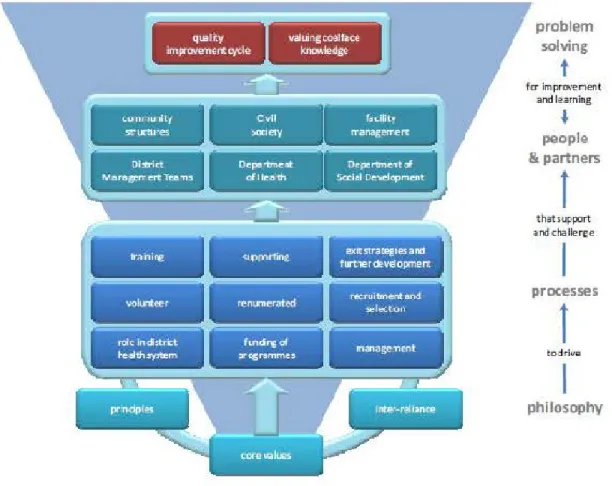
A management philosophy based on a continuous improvement model, guided by
core values;
A description of organizational relationships between government departments
and NPOs;
The minimum working conditions for state-funded CHWs (including recruitment
and selection, remunerative structure, benefits, etc.);
The CHW program management responsibilities at the national, provincial and
district level;
The supervision of CHWs, workforce planning, and a new skills development
framework;
The M&E approach;
The management of financial implications related to implementation of the
revised framework.
This framework is being used for comparison because it is the official policy document
related to CHW practice in South Africa. As the blueprint for future CHW deployment, it is
important to evaluate the success of it going forward in order to maximize its potential effect on
health outcomes.
CHW Challenges in South Africa
The 2009 framework address many issues pertinent to CHW deployment, but there are
four key factors that the literature points to as necessary for sustainable, effective health
outcomes. These are:
M. Robinson Page 17 of 42 2) Quality assurance standards,
3) Budgeting and financing, and
4) Supportive supervision.
The following explains how each of these aspects is uniquely experienced in the South African
context as well as how each aspect is addressed by the 2009 Framework.
Challenge 1: Position of CHWs within the health system
Context and Issues
South Africa operates a decentralized health service with the goal of delivering primary
health care at the district-level. The National Department of Health sets national policy, and
provincial departments of health (similar to U.S. States) are responsible for the development of
provincial policy within boundaries of the national framework. There are three tiers of public
hospitals at the provincial level: tertiary, regional and district. District hospitals and community
clinics are “closest” to the community and therefore meant to serve as the mode of delivery for
primary health care (PHC). Local government is responsible for these preventive and promotive
services at the district level through the public election of councilors (Coovadia, Jewkes, Barron,
Sanders, & McIntyre, 2009). NPOs are the preferred CHW employment mechanism and receive
funding to do so from provincial departments of health and/or social development. Provincial
representatives directly oversee these NPOs. Therefore, there appears to be no formal link or
integration between CHWs and district hospitals or community clinics at the local level. At the
end of 2008, more than 1,600 NPOs employed CHWs in South Africa through provincial
funding (Schneider & Lehmann, 2010).
Documented problems created by keeping CHWs separate from the formal health system
of PHC teams, poor relationships between CHWs and other health professionals, and no formal
career path opportunities for CHWs (DoH, 2009; Schneider et al., 2008; Schneider & Lehmann,
2010).
2009 Framework
The 2009 Framework aims to address the problem of integrated Home and Community
Based Care (HCBC)2 by harmonizing the use of CHWs across the health and social sectors. A
minimum package of services for HCBC is defined, which covers multiple health areas, and
places government funded CHWs in a generalist role.
Under the revised framework, the DoH continues to fully delegate the recruitment,
management and support of CHWs to NPOs. It is clearly stated that CHWs are not considered
government employees and therefore, they still remain peripheral to the formal public health
system. A stated intention of the revised framework is that CHWs form part of the service
delivery teams with the district health system to promote PHC and Community Based Health
Services (CBHS)3. The need to define CHW service activities and roles in this “arm” of the
government health delivery system is acknowledged, but no details are provided by the 2009
Framework on how this might be accomplished (see Appendix A).
The National DoH (NDoH) will formalize the CHW position by drafting regulations
which recognize them as an occupational workforce within the National Health System and by
making them subject to compulsory registration in order to practice. In order to provide
opportunities for career development or exit from CHW employment, provinces are to work with
2 Defined as: “…the provision of a comprehensive and quality health and social service within the home and
community in order to promote, restore and maintain a person’s maximal level of comfort, social functioning and health. HCBC services may also be offered within health or social development run facilities by Community Care Workers in support of public services.” (DoH, 2009; page 6)
3 Defined as: “…any activity that takes place within, or is targeted at a community and that aims to improve health
M. Robinson Page 19 of 42 other stakeholders to set up a range of further development programs for CHWs both within and
outside of the sector. NPOs are tasked to support CHWs in pursuing their own life goals even if
they lie outside of the sector.
Challenge 2: Quality Assurance Standards
Context and Issues
Though the 2004 CHW policy framework set minimum standards for state-funded
CHWs, implementation of the framework was not well monitored. For example, Lehmann
(2008) reports that CHWs are inadequately trained, and many operate without any training at all.
She also alludes to the inability of provinces to translate the CHW policy into satisfactory and
standardized results at the local level. The degree to which a suitable monitoring and evaluation
process was included or followed at the national, provincial, or local level is unknown. Some feel
that inconsistencies experienced in areas such as CHW deployment models, training programs,
and support mechanisms threaten the credibility of the entire South African CHW program (I.
Friedman et al., 2007).
2009 Framework
A significant portion of the 2009 Framework revision relates to the training of CHWs.
Included are a new competency-based skills development framework as well as guidelines for
the development of learning materials, training delivery, and accreditation of training providers.
To bridge the gap between “old” CHWs and new CHWs recruited under the revised framework,
a learning verification process for “old” CHWs will be developed. The revision also requires
NPOs to provide CHWs with a written job description which is reviewed annually.
Responsibilities for policy implementation are described for national, provincial, and
means of a results-based M&E approach is described utilizing the existing M&E mechanisms
developed for HCBC and the District Health Information System as a base. This will require
government departments and NPO partners to establish data capture of additional necessary
indicators in their own M&E systems. Provincial management is encouraged to use this data to
help districts identify problems and implement solutions using a continuous learning cycle
(Appendix B). Evaluation of the framework’s general performance is intended to take place after
two years of implementation.
Challenge 3: Budgeting and Financing
Context and Issues
South Africa’s public sector is under-funded (Lehmann, 2008), and public health
spending on HIV within the country has risen by nearly 22% since ART was introduced in 2004
(Schneider & Lehmann, 2010). This may pose a potential challenge to financing sustained and
remunerated deployment of CHWs, as a public health funding increase of 1.3% is estimated to
fully support CHWs as regular employees under the revised framework (Schneider & Lehmann,
2010).
With the positioning of CHWs outside of direct government employment, NPOs have
become more and more reliant on South African government funding to support community
projects through CHWs. Their relationships with the provincial government have experienced
strain due to unreliable funding transfers, with these “dry seasons” attributed to financial controls
and bureaucratic processes (DoH, 2009). Furthermore, NPOs are often dependent on other donor
funding for their operation, and any cash-flow problems at the source (i.e. due to the current
economic downturn) could impact their ability to sustain overall operation of CHW programs
M. Robinson Page 21 of 42 Schneider et al. (2010) report that remuneration of CHWs by NPOs is inconsistent and
benefits are variable. Furthermore, most CHWs interviewed in one South African study
perceived the government to be their true employer (Schneider et al., 2008). This led to CHWs
feeling that they were undervalued and exploited, since they fell outside the regulatory
framework for employment, lacking benefits such as vacation time, maternity leave, and
retirement earnings. Consequently, high turnover of CHWs, a negative organizational culture,
and strikes which halt all work-related activity for indefinite periods of time might result from
CHWs disenchantment with their benefits and remuneration.
2009 Framework
The 2009 Framework provides a guide that identifies expected funding sources for
specific aspects of the framework, although no estimated figures are provided (Appendix C).
NPOs are required to provide minimum remuneration and service benefits to CHWs. These new
benefits include annual leave, sick leave, family / maternity / paternity leave, unpaid leave, study
leave, and unemployment insurance. However, neither retirement nor health benefits are
included.
Financing of remuneration and benefits will continue be provided by the provincial
government in the form of grants to NPOs. Recommendations are provided in the framework to
guide provinces and NPOs on sustainable funding practices. A first generation financial planning
model is under development to assist with these efforts although it is not included in draft 6 of
Challenge 4: Supportive Supervision
Context and Issues
Due to the sidelining of CHWs to the edge of the health system, as well as the large
number of NPOs running CHW programs in South Africa, CHW supervision is not sufficiently
established or integrated (Lehmann, 2008; Schneider & Lehmann, 2010). CHWs in the country
are prevented from normalizing their roles and relationships with other health professionals at
the district and community level because their supervisory structure falls within the NPO. This
foils the development of supportive supervisory relationships with doctors and nurses, in the
form of health teams, working in government clinics and district hospitals. This type of
integrated supervision is instructive to CHWs continued learning, provision of quality service,
and integration of service delivery. The result of this deficiency in both NPO and health team
supervision is a lack of accountability which bodes poorly for patient protection (I. Friedman et
al., 2007). Similarly, this deficit leads to the frustration and burn-out of CHWs, often translating
into poor quality service.
2009 Framework
The 2009 Framework requires all CHWs to work under a qualified NPO manager. NPOs
are required to employ at least one professional supervisor (a nurse or social worker) who
oversees CHWs and reports directly to the management structure of the NPO. To provide
support to these supervisors, either the provincial health or the social development department is
required to employ a professional program supervisor (a nurse or social worker) to work with the
NPO supervisors in order to promote quality service and achievement of funding goals
M. Robinson Page 23 of 42 with supervision by other health professionals who are working on the ground as part of the
public health sector.
The objective of the next section is to compare how the 2009 CCWPF, addresses the four
key aspects of successful CHW deployment relative to global best practice in these same areas:
1) position within the health system, 2) quality assurance standards, 3) budgeting and financing,
and 4) supportive supervision. The intention of this comparison is to identify gaps and potential
risk factors which may undermine the overall goals of the policy effort. This type of comparison
is necessary in order evaluate whether CHW deployment under this framework will be
sustainable and will have the greatest chance of effecting positive health outcomes based on
global evidence.
COMPARISON OF THE 2009 FRAMEWORK TO GLOBAL BEST PRACTICE
Global best practices are derived from select WHO task shifting guidelines and
recommendations. These guidelines were developed to provide an authoritative framework in
support of countries wishing to implement task shifting at a national level in the context of
HIV/AIDS and constrained human resources for health (World Health Organization, 2008). They
identify and define key elements required to make task shifting safe, efficient, effective,
equitable, and sustainable. Even though the WHO guidelines are focused on HIV/AIDs, they are
general enough to apply to the use of CHWs across a broad health spectrum. Therefore, the
following comparison does not focus exclusively on HIV/AIDS service delivery. Of the 22
recommendations made in the WHO report, four were selected for comparison based on their
relevance to the four key aspects for CHW success (Table 1). More detailed comparison tables
Table 1: Key Aspects for CCWPF and Relevant WHO Guidelines
KEY ASPECTS FOR CCWPF WHO TASK SHIFTING GUIDELINES (WHO, 2008) 1. Position of CHWs within the
Health System
WHO Guideline #3: Countries deciding to adopt the task shifting approach should define a nationally endorsed framework that can ensure harmonization and provide stability for the HIV services that are provided throughout the public and non-state sectors. Countries should also explore a framework for the exploration of task shifting to meet other critical public health needs.
2. Quality Assurance Standards WHO Guideline #7: Countries should either adapt existing or create new human resources quality assurance mechanisms to support the task shifting approach. These should include processes and activities that define, monitor and improve the quality of services provided by all cadres of health workers.
3. Budgeting and Financing WHO Guideline #15: Countries and donors should ensure that task shifting plans are appropriately costed and adequately financed so that the services are sustainable.
4. Supportive Supervision WHO Guideline #11: Supportive supervision and clinical mentoring should be regularly provided to all health workers within the structure and functions of health teams. Individuals who are tasked with providing supportive supervision or clinical mentoring to health workers to whom tasks are being shifted should themselves be competent and have appropriate supervisory skills.
1: Position of CHWs within the Health System
WHO guidance (guideline #3) emphasizes harmonization and alignment of services
across a country. This occurs when all service providers are integrated with the health system
and with general health sector plans. The recommended mechanism to accomplish this is a
nationally endorsed framework which 1) defines the organization of service delivery, 2) supports
task shifting through regulatory structures and 3) generates accountability through QA systems.
While the WHO guideline recognizes the contribution of a variety of health-providers in both the
public and non-state sectors, it also stresses the unique position of government to oversee the
country’s public health.
The 2009 Framework incorporates many elements of best practice including government
M. Robinson Page 25 of 42 in order to alleviate fragmentation of services at the community level, plans to recognize CHWs
as part of the National Health System, and recognition of NPOs as contributors to a decentralized
health delivery model.
Despite these strengths, the organization of HCBC service delivery under this framework
appears to run parallel to PHC delivery through the district health system. Further, keeping
CHWs disconnected from the public sector through NPOs serves to continue the fragmentation
in the delivery of public health services in South Africa. The national government is essentially
promoting and sustaining a parallel service delivery model for public health by giving NPOs
wholesale responsibility for staffing and implementing HCBC. Sole sourcing the delivery of
essential public health services to non-governmental entities is not a sustainable, long-term
model as it diverts attention away from building the internal capacity of the public health system.
Another layer of complexity to the management of health services at the provincial and
district level is the required bridge between the delivery of HCBC via NPOs partners and the
delivery of PHC via the district health system. This connection is left to be built by district-level
management. These managers have to reconcile and integrate two functionally different service
approaches and likely have little authority to influence NPO cooperation other than pulling
financial strings. This is an additional burden on a management system that is already struggling
with implementation of basic PHC. It is questionable whether 1,600 NPOs can be managed well
without significant manpower, training and QA systems. Also of concern is whether core health
service delivery through NPOs is cost-effective compared to delivery through established public
sector channels.
The 2009 Framework asserts that NPOs are the “preferred mechanism” to gain
Freidman et al. (2007) found that a large percentage of NPOs did not solicit community input in
the course of their involvement with communities. Even if NPOs did an adequate job of
engaging the community, a parallel system of community involvement exists through the locally
elected councilors on the side of the district health system. This dual approach to community
involvement could serve to generate confusion amongst community members. Furthermore it is
questionable whether the NPO approach to community involvement would be as democratic as
the local election of councilors.
The 2009 CCWPF speaks primarily to CHWs working in the state-funded NPO sector;
therefore, other potential CHW partners such as private providers, non-state-funded NPOs,
private companies, and the public sector receive little or no attention. It is difficult to know how
similar services offered through these providers are integrated with overall service delivery
plans, are subject to CHW regulation, and are monitored for quality assurance. Another concern
raised under this model is how services will be equitably distributed if NPOs are not operating in
all communities. Will the government then be responsible for driving NPO development in
underserved areas? This does not appear to be an efficient manner to achieve greater access and
equity in public health delivery.
2: Quality Assurance Standards
WHO guidance (guideline #7) stresses the need for task-shifting to be implemented
within systems that have adequate checks and balances. These checks and balances are meant to
provide protection for both service users and health workers, enhance accountability, and
improve the overall quality of health services. Initial steps include setting agreed standards
M. Robinson Page 27 of 42 supervision, and evaluation (WHO, 2008). Existing QA mechanisms should be built upon to
ensure that these standards are being met and to allow for M&E of performance.
The 2009 CCWPF conforms to best practice by setting standards regarding roles,
competencies, recruitment, training, and supervision of CHWs, using existing QA mechanisms
as a basis for M&E, and including a new continuous learning philosophy to guide improvement
efforts.
It is not clear, however, whether the framework’s QA processes and mechanisms are
adequate. Existing mechanisms have failed in the past to help recognize and correct
implementation challenges. It is difficult to tell whether this was a problem with the type of data
collected, the skill of the user in analyzing the data, communication through appropriate channels
to bring correction, or some combination of the above. New framework mechanisms are loose
and not sufficiently described to assure that quality will be monitored and improved upon
effectively. For example, the M&E process under the 2009 Framework is results-based, which
tends to focus more on achievement of outcomes and goals. However, the fragmented
implementation of the prior 2004 Framework suggests an equal emphasis be placed on the
process of policy implementation at the national, provincial, district, and NPO levels.Without
this information, it may be difficult to determine where in the process things went wrong if
targeted goals and outcomes are not met. Although an evaluation is set to take place two years
after implementation of the revised framework, this may prevent the ability to make timely and
pivotal course corrections during the initial stages. Furthermore, the parallel service delivery
described earlier produces the need for parallel QA and M&E mechanisms on the part of NPOs.
Ensuring that 1,600 NPOs have adequate M&E systems in place is a further burden to provincial
and NPOs are a likely result as participants try to shift accountability for poor results to someone
else.
It is also uncertain whether the M&E indicators described in the 2009 CCWPF
adequately reflect attainment of set standards regarding roles, competencies, recruitment,
training, and supervision. Failure to measure attainment of set standards defeats the purpose of
QA. In addition, there are no targets set for the stated indicators and therefore no way to measure
success.
3: Budgeting and Financing
The WHO guidance (guideline #15) advises task shifting plans be costed and financed to
ensure sustainability. Budgeting and financing strategies should consider both one-time
(development costs) and recurrent costs, resources for training, supervision, quality assurance,
referral systems, retention measures, wages, essential equipment, health-care supplies and
physical infrastructure. These budget exercises must also account for the likely rise in demand
for health services due increased access to services provided under task shifting. Anticipating
increased costs for the expanded treatment of conditions such as HIV, due to larger portions of
the population transitioning to chronic lifelong care, must also be included. The DoH will need
to collaborate with Ministries of Finance, Labor, Education, donors, international financial
institutions, and the non-state sector to ensure funding is predictable, sustainable, and long-term.
Several aspects of the 2009 Framework align with budgeting and finance best practice.
These areas include: a defined remunerative structure for CHWs; guidelines for sustainable
M. Robinson Page 29 of 42 planning model for costing the policy implementation; and collaboration with NPOs to serve as
an additional resource base.
The most problematic issue in the 2009 Framework relative to funding is the heavy
reliance on NPOs who themselves may be reliant on external funders for adequate cash flow.
Consistent quality and CHW service levels may quickly become jeopardized if NPO funding is
uneven or mismanaged. This leaves the state in a precarious position since it has little control
over NPO sustainability. Financing a potentially unstable, independent vehicle for public health
delivery - which may not be distributed equitably or be cost-effective - appears to be a risky,
long-term strategy. Furthermore, sole funding of NPOs to deliver HCBC will likely serve to
foster the formation and/or expansion of more NPOs who see a ready opportunity for funding.
This model overlooks other potential partnerships that maximize the reach, equity, and
effectiveness of service delivery and minimize risk.
At this time there are no clear cost estimates for the 2009 Framework nor are there any
clear indications of what financial commitments key funders of the framework are prepared to
make. So there is no way to determine if the framework in its current form is financially
sustainable.
4: Supportive Supervision
WHO best practice in this area (guideline #11) requires that supervision be regularly
provided by competent individuals with appropriate supervisory skills. Improvements in the
delivery of healthcare have been observed where supportive supervision was integrated into
primary health-care models and within the structure and function of health teams. Commitment
existing human resource management system. New and additional supervision responsibilities
should be reflected in job descriptions and scopes of work. Supervisors should be trained in a
new model of supervisory skills to include management, communication, and mentoring skills.
Successful implementation of supervisory programs are found to occur when trainees are
assessed for competence and performance and helped to create a plan for self-improvement.
Adequate supervision may require the deployment of additional human resources, and health
workers in rural areas should be provided with on-site or technology-facilitated supervision
however possible.
Strengths of the 2009 Framework include required supervision of CHWs within the NPO
environment, the flexibility to allow non-professional CHW supervision where necessary, a
specific skill set requirement for non-professional supervisors, and limits on reporting
relationships to NPO-employed supervisors.
However, supervisory relationships are confined within NPOs and therefore disconnected
from PHC teams at the district and community level. This sidelining prevents CHWs from
developing productive supervisory relationships and establishing credibility with health
professionals working in the PHC system. In addition, placing CHW management within NPOs
and the province may encourage nurses and social workers to forego public service positions and
work for NPOs which puts further strain on the already understaffed public sector.
Additionally, there is no mention of the competencies and skills required for professional
CHW supervisors and therefore no assurance that their supervision will be supportive or
adequate. HCBC workforce planning does not include supervisory duties so manpower may be
M. Robinson Page 31 of 42 special forms of supervision in rural areas and these are not adequately emphasized in the 2009
Framework.
CONCLUSION
At this time in South Africa’s history, CHWs are a sensible approach to support HIV
scale-up efforts and to buffer the impact of the health workforce crisis in the public sector.
CHWs are currently engaged in large numbers and are featured in multiple health plans and
policies. The 2009 CCWPF brings many elements of improvement to the regulation and
oversight of CHWs in South Africa. Yet, under this revised framework, they remain
insufficiently incorporated into the health system compared with their importance and potential
impact on health outcomes.
The general weakness in South Africa’s public health sector service delivery has driven
dependence upon NPOs to provide basic public health services through CHWs. There is
consensus in the literature however, that unless national health systems are strengthened, CHW
deployment will not be sustainable (Abbatt, 2005; Hermann et al., 2009; Samb et al., 2007). Sole
sourcing the delivery of essential public health services to non-governmental entities is not a
sustainable, long-term model and abdicates the government from its primary role in assuring the
public’s health (WHO, 2008).
The NPO service delivery model fails to provide a standardized, comprehensive
framework to incorporate HCBC with PHC at the community level. There is no indication that
M&E mechanisms are clear or adequate to assure successful, standardized implementation. Over
1,600 different NPOs must operate their own internal M&E systems, further complicating the
QA effort. Financing the NPO model is risky because NPOs are usually reliant on other donors
are independent organizations which cannot always be strictly controlled by government in terms
of service delivery and health outcomes. Financing a parallel service delivery system may not be
cost efficient. Supervisory structures are also inadequate in this model because CHWs are
prevented from effectively integrating with health teams at the level of district hospitals and
community clinics. Provincial management has already demonstrated difficulty implementing
PHC at the community and district health level, so adding the NPO model for provision of
HCBC incorporates an additional layer of complexity and management burden.
Deployment of CHWs in South Africa based on the NPO service delivery model presents
risks to sustainability and effectiveness due to compromises in global best practices. This fails to
serve the government, communities and CHWs themselves. In addition, the 2009 CCWPF may
fail to meet its overall goals. The government needs to be the overall keeper of public health,
including HCBC and PHC, and a parallel system is not efficient. There is no real impetus for
partnerships supporting CHW deployment to grow stronger in this model outside of good will
and financing. Strategies for addressing systemic changes in the public and NPO sectors will be
insufficient unless the structure of the health service delivery system is streamlined and
M. Robinson Page 33 of 42 APPENDIX A
Schematic of parallel health system approach
Provincial Department of Health
Non-Profit
Organizations (NPOs) DHS
District Hospitals & Community Clinics Community Health
Workers (CHWs)
Community Other Donors
Councilors
Implementing PHC National
Department of Health
?
APPENDIX B
Continuous learning model (DoH, 2009; page 43)
Figure 2. The systemic approach and related elements in the policy framework
---
-qudf.y im!rovenEntOf(.le
vah.i1gtoalbce
knoo·led ..
volunteer
Ocpo-tment
oil Ieeth
, ren~.~t~erated
b!..tlih
rranagerrert
Oeper-tme,t, S«:iall:-e\oelopnent
ex1tstrate@1es and flrt..er deVEiopmen:
ru:n.utmcnt and
!IC.'I"'-lUII
problem
solving
t
fa impr~'enent
and l~arning
*
peopla & partners
f
thatsupport ind challereeprocesses
t
todrivo
Funding National Provincial Local Public Int. Dev.
partner generated
Area Depts. Depts. Aut h. Entities partners
grants income
ccw EPWP& equitable
learner
conditional ,/ ,/ ,/ ,/
remuneration grants share stipend
DoH
Initial training conditional RTCfunding . ,/ ,/ ,/ ,/
grant
Further vocational DoE ,/ . ,/ ,/ .
-Development qualification
Exit programme Bursaries Bursaries Bursaries learnership bursaries ,/ -
-funding work grants
General admin ,/ ,/ ,/ - ,/ ,/ ,/
Care kit - ,/ - - ,/ ,/ ,/
CCW travel and ,/ ,/ - ,/ ,/ ,/
subsistence
-Professional ,/ ,/ - ,/ ,/ ,/
supervision
-Non-HR
programme - ,/ ,/ - ,/ ,/ ,/
costs
Care and EPWP&
support for conditional equitable ,/ ,/ ,/ ,/ ,/
share
CCWs grant
NPO capacity - ,/ ,/ ,/ ,/ - ,/
development
Employee - - - - - - ,/
insurance
KEY
Depts: Departments; Auth: Authorities; lnt: International; Dev: Development CCWPF: Community Care Worker Policy
Framework; EPWP: Expanded Public Works Programme; DoE: Department of Education; DoH: Department of Health RTC:
Regional Training Centres (DoH}./ funding area supported
DESCRIPTIONS
CCW remuneration: CCW pay roll costs including UIF contributions. Initial training: ABET, minimum skills set and applied skills programmes.
Further development: In-service programmes or other programmes to improve a CCWs exit potential. Exit programme: Qualification that allows CCWs to further their careers in health or social development. General admin: Cost related to running an NPO excluding CCW payroll.
Care kit: Any item related to the activity being performed including HBC kits and protective gear. CCW Travel and subsistence: Actual costs related to travelling to offer care and support. Supervision: Remuneration and related costs to professional supervision.
Non·HR programme costs: Such as educational materials, equipment needed to run programmes and other consumables
not related to care kit.
Employee insurance: Insurance that an NPO may take out for their CCWs based on their operational policies.
DISTRIBUTION COPY 87
APPENDIX D
CCW (Community Care Worker) Supervision (DoH, 2009; page 58)
CCW Supervisor
(i) In this form of supervision, under the NPO partner, a CCW supervisor is a CCW who
through experience as well as the necessary training can supervise other CCWs.
(ii) The CCW supervisor is intended to work in situations where large numbers of CCWs
are active in a community or where supervision by a professional supervisor is not
regularly possible for example in remote areas.
(iii) Creating CCW supervisors is not however a requirement and is dependent on
operational requirements, provincial preferences and partner practices.
(iv) The CCW supervisor is attached to NPOs and is entitled to a higher level of
remuneration.
(v) Where CCW supervisors are deployed, there should not be more than 20 CCWs
reporting to them.
(vi) A CCW supervisor reports to the Professional CCW Supervisor.
Professional CCW Supervisor
(i) This level of supervision is offered by a professional health or social worker who is
experienced in HCBC.
(ii) It is recommended that a Professional CCW Supervisor should be able to consult a
professional health or social worker depending on their own field of practice.
(iii) An NPO partner must utilise at least one Professional CCW Supervisor who could be
part-time employed depending on the service workload.
(iv) It is recommended that a Professional CCW Supervisor has no more than 10 CCW
Supervisors or 50 CCWs report directly to them.
(v) The Professional CCW supervisor reports to the management structure of their NPO.
Programme CCW supervisors
(i) This is the third form of supervision and involves a professional health or social
worker employed by either of the departments to co-ordinate or manage the various
programmes associated with the core service package.
(ii) The role of this supervisor is to work with the other two supervisors listed above to
M. Robinson Page 37 of 42 APPENDIX E
THE 2009 CCWPF COMPARED TO GLOBAL BEST PRACTICE
1: Position within the Health System
2009 Policy Framework (DoH, 2009)
WHO Guidance on Task shifting (WHO, 2008; pages 17-19) Aims to harmonize the use of community workers
across the health and social sectors. As such, the term “Community Health Worker” (CHW) is replaced by the term “Community Care Worker” (CHW)
CHWs are civil society employees (not
government employees). Recruitment,
management, and support of CHWs delegated to NPOs
DoH intends for CHWs to form part of the service
delivery teams within the DHS (district health service) promoting PHC and CBHS. The need to define service activities and the role of the CHW in CBHS and PHC is stated.
A minimum service package is defined covering
multiple health areas, placing CHWs in a generalist role
NDoH to draft regulations to formally recognize
CHWs as an occupational workforce within the National Health System
The NDoH will make CHWs subject to
compulsory registration in order to practice
The NDoH will draft regulations for NPOs who
offer health services and are designated as health agencies under the act
To aid CHWs with their further development and
to provide adequate exit opportunities, provinces will work with other stakeholders to set up a range of further development programs
It is recognized that further training may lead to
CHWs taking professional roles within the health sector
Recommendation #3: Countries deciding to adopt the
task shifting approach should define a nationally endorsed framework that can ensure harmonization and provide stability for the HIV services that are provided throughout the public and non-state sectors. Countries should also explore a framework for the exploration of task shifting to meet other critical public health needs.
Recognizes contribution of variety of
health-providers in both the public and non-state sectors
Stresses unique position of government to oversee the country’s public health
Successful models of task shifting use standardized,
decentralized delivery models
Scale up of HIV services best achieved through
collaboration and coordination between a mix of providers (public sector, private providers, private companies and NPOs)
In order to assure that the variety of providers are
APPENDIX E
THE 2009 CCWPF COMPARED TO GLOBAL BEST PRACTICE
2: Quality Assurance Standards
2009 Policy Framework (DoH, 2009)
WHO Guidance on Task shifting (WHO, 2008; pages 24-26) A new skills development framework defines common
and quality skills based on workplace competencies
NPOs to provide CHWs a written job description which is
reviewed annually.
Training to align to national and provincial primary health
care and social development models and policies. Two-thirds of it should be experiential within the community.
Guidelines provided for training delivery, accreditation of
state-funded training providers as well as their use and management.
Provinces tasked with development of a learning
verification process for CHWs trained prior to implementation of the new framework.
Guidelines are provided for the development of learning
materials.
Three functional coordinating structures oversee and
monitor policy implementation (national, provincial, and district level) including the promotion of quality
improvement
Results-based HCBC M&E approach to be used
National departments of health and social development
(DoH and DSD) to engage provincial and district managers in promoting a continuous learning process
Systemic change in management culture and practice is
addressed through a continuous learning philosophy
Recommendation #7: Countries should either adapt existing or create new human resources quality assurance mechanisms to support the task shifting approach. These should include processes and activities that define, monitor and improve the quality of services provided by all cadres of health workers.
Quality assurance mechanisms must earn
confidence of users, providers, and governing bodies
Existing QA mechanisms should be built
upon vs. creating a parallel process
First steps are to set agreed standards
regarding roles and competencies of health workers, recruitment, training, continuing education, supervision, and evaluation
Strengthening and systematizing the QA
M. Robinson Page 39 of 42 APPENDIX E
THE 2009 CCWPF COMPARED TO GLOBAL BEST PRACTICE
3: Budgeting and Financing
2009 Policy Framework (DoH, 2009)
WHO Guidance on Task shifting (WHO, 2008; pages 37-38) CHWs move toward a remunerated
employment base with a defined minimum remunerative structure as well as service benefits such as annual leave, sick leave, family/maternity/paternity leave, unpaid leave, study leave, and unemployment insurance.
NPOs receive government grants to
provide for CHW remuneration
A guide is provided regarding expected
funding sources for specific areas of the framework
Recommendations made for sustainable
funding practices on the part of provinces and NPOs
A first generation financial planning
model is being developed to assist toward this effort (not available from the DoH website as of 2/15/2011)
Recommendation #15: Countries and donors should ensure that task shifting plans are appropriately costed and adequately financed so that the services are sustainable.
Budgeting and financing should consider one-time and
recurrent costs, and resources for training, supervision, quality assurance, referral systems, retention measures, wages, essential equipment, health-care supplies and physical infrastructure as well as likely rise in demand of health services under task shifting
Universal access to HIV services will generate escalating costs
for decades to come due to the requirement of lifelong care
The MOH will need to work with Ministries of Finance,
Labor, Education, civil service, donors, and international financial institutions to ensure funding is predictable, sustainable, and long-term.
Sustaining task shifting on a country-wide scale will require
APPENDIX E
THE 2009 CCWPF COMPARED TO GLOBAL BEST PRACTICE
4: Supportive Supervision
2009 Policy Framework (DoH, 2009)
WHO Guidance on Task shifting (WHO, 2008; pages 31-33) CHWs to work under a qualified manager
Three potential forms of supervision are described
A new skills development framework includes
applied skills for non-professional CHW supervisors
NPOs required to use at least 1 Professional CHW
Supervisor (professional health or social worker)
Provincial departments must employ at least 1
Programme CHW supervisor (professional health or social worker) to work with the NPO
supervisors
Non-professional CHW Supervisors entitled to a
higher level of remuneration and seen to work in situations where large numbers of CHWs are active in a community or in remote areas where regular supervision of a professional is not possible
Recommendation #11: Supportive supervision and clinical mentoring should be regularly provided to all health workers within the structure and functions of health teams. Individuals who are tasked with providing
supportive supervision or clinical mentoring to health workers to whom tasks are being shifted should themselves be competent and have appropriate supervisory skills.
Task shifting creates new and additional
responsibilities for supervision which should be reflected in job descriptions and scopes of work
Supportive supervision may require the deployment
of additional health workers
Concerted efforts should be made to provide on-site
or technology-facilitated supervision for health workers in rural areas
Task shifting yields better outcomes where health
workers are offered sustained and supportive supervision within the structure and functions of the health team
Commitment from top management is important as
well as integration into existing human resource management systems
New supervisors should be trained on management,
communication, and mentoring skills, assessed for competence and performance, and helped to create a plan for self-improvement
M. Robinson Page 41 of 42 REFERENCES
Abbatt, F. (2005). Scaling up health and education workers: Community health workers.
London: DFID Health Systems Resource Centre. Retrieved from
http://www.dfidhealthrc.org/publications/health_service_delivery/05HRScalingUp03.pdf
Callaghan, M., Ford, N., & Schneider, H. (2010). A systematic review of task- shifting for HIV
treatment and care in Africa. Human Resources for Health, 8, 8.
Coovadia, H., Jewkes, R., Barron, P., Sanders, D., & McIntyre, D. (2009). The health and health
system of South Africa: Historical roots of current public health challenges. Lancet,
374(9692), 817-834.
DoH, S. (2004). Community health workers policy framework. Pretoria: Department of Health.
DoH, S. (2007). HIV & AIDS and STI strategic plan for South Africa, 2007-2011. Pretoria:
Department of Health. Retrieved from www.doh.gov.za/docs/misc/stratplan-f.html
DoH, S. (2009). Community care worker management policy framework (draft). Pretoria:
Department of Health. Retrieved from www.doh.gov.za/docs/policy/ccwpf/index.html
Friedman, I. (2005). CHWs and community caregivers. Towards a unified model of practice.
South African Health Review, (Chapter 13), 176-188. Retrieved from
http://www.hst.org.za/uploads/files/sahr05_chapter13.pdf
Friedman, I., Ramalepe, M., Matjuis, F., Lungile Bhengu, L., Lloyd, B., Mafuleka, A., et al. (2007). Moving towards best practice: Documenting and learning from existing community
health/care worker programmes. Health Systems Trust. Retrieved from
http://www.hst.org.za/publications/714
Hermann, K., Van Damme, W., Pariyo, G. W., Schouten, E., Assefa, Y., Cirera, A., et al. (2009). Community health workers for ART in sub-Saharan Africa: Learning from
experience--capitalizing on new opportunities. Human Resources for Health, 7, 31.
Kort, R. (2010). 5th international AIDS society conference on HIV pathogenesis, treatment and prevention: Summary of key research and implications for policy and practice - operations research. Journal of the International AIDS Society, 13 Suppl 1, S5.
Lehmann, U. (2008). Strengthening human resources for primary health care. South African
Health Review, 163-177. Retrieved from http://www.hst.org.za/uploads/files/chap11_08.pdf
Lehmann, U., & Sanders, D. (2007). Community health workers: What do we know about them?
The state of the evidence on programmes, activities, costs and impact on health outcomes of
using community health workers. Geneva, Switzerland: World Health Organization.