Elizabeth M. Koehler. The School Library Can Do More to Counteract Homophobia. A Master‘s Paper for the M.S. in L.S degree. March, 2011. 44 pages. Advisor: Sandra Hughes-Hassell
This paper discusses the pervasiveness of homophobia in our culture and its impact on lesbian, gay, bisexual, transgender, and questioning (LGBTQ) teenagers. It argues that teacher-librarians can support LGBTQ teens by collecting and promoting young adult literature that portrays positive, realistic images of the LGBTQ community. It presents the findings of two studies—one that examined the library collections in North Carolina high schools for the inclusion of LGBTQ-themed titles and one that investigated the content of ten journals that are frequently read by teacher-librarians for articles about LGBTQ issues and collection development published since 2006. Results revealed that high school teacher-librarians are under-collecting LGBTQ-themed titles. Although 5.9 percent of American high school students identify as gay, lesbian, or bisexual, LGBTQ-themed collections in school libraries are minimal. Additionally, LGBTQ issues are rarely addressed in the scholarly journals. The paper concludes with recommendations to assist teacher-librarians in supporting LGBTQ students.
Headings:
Gay literature
Young adults‘ reading/Psychological aspects Young adults‘ library services
LGBTQ-THEMED LITERATURE IN SCHOOL LIBRARIES: COUNTERACTING THE HOMOPHOBIA EPIDEMIC
by
Elizabeth M. Koehler
A Master‘s paper submitted to the faculty of the School of Information and Library Science of the University of North Carolina at Chapel Hill
in partial fulfillment of the requirements for the degree of Master of Science in
Library Science.
Chapel Hill, North Carolina March 2011
Approved by
Setting the Context Introduction
In September 2010, a rash of teenage suicides drew national attention to the reality of many lesbian, gay, bisexual, transgender, or questioning (LGBTQ) teens in our country. After enduring years of anti-gay bullying, five young men who were gay or perceived to be gay by their peers took their own lives:
1. Seth Walsh, 13 years old. California. Hanging.
2. Asher Brown, 13 years old. Texas. Self-inflicted gunshot with his step-father's gun.
3. Billy Lucas, 15 years old. Indiana. Hanging.
4. Tyler Clementi, 18 years old. New Jersey. Jumped off of the George Washington Bridge.
5. Raymond Chase, 19 years old. Rhode Island. Hanging. (Mannino, 2010) Because of their sexual orientation, Seth, Asher, Billy, Tyler, and Raymond were all targets of harassment and bullying by their peers (Mannino, 2010). Regrettably, the experiences of Seth, Asher, Billy, Tyler, and Raymond are not isolated incidences.
The impact of homophobia and anti-gay bullying on LGBTQ students is not limited to their feelings of safety. The same 2009 National School Climate Survey (GLSEN, 2009) found that LGBTQ students who were harassed because of their sexual orientation and gender expression had significantly lower grade point averages than their peers (2.7 vs. 3.1). Increased victimization also leads to increased levels of depression and anxiety and decreased levels of self-esteem in LGBTQ students. The isolation and despair LGBTQ youth experience places them at high risk for a variety of other problems including homelessness, substance abuse, and suicide (Ryan and Futterman, 1998). One study, for example, found that LGBTQ teens were over four times more likely than their peers to attempt suicide (Massachusetts Department of Education, 2009).
These statistics confirm that homophobia is more than just a word. Homophobia has become a very real epidemic, one that is slowly draining the emotional, physical, and mental health of LGBTQ teenagers in this country. Homophobia is killing our nation‘s youth.
Controversy over LGBTQ Rights, Issues, and Materials
Recent controversies surrounding LGBTQ issues in our country illustrate that sexuality and gender are hot-button topics for many people, topics that invite
impassioned arguments from all sides and often expose homophobic attitudes and beliefs. Most notable in national news in recent months has been the debate over, and ultimately the repeal of, the United States military‘s policy restricting bisexual and homosexual persons from military service. Before the repeal, military policy specifically stated:
In 1994, the Clinton administration issued Defense Directive 1304.26, (United States, 1994) which directed that military applicants were not to be asked about their sexual orientation. This directive, commonly known as the ―Don‘t Ask, Don‘t Tell‖ policy, was a compromise reached by members of Congress and the President after Congress
overrode President Clinton‘s attempts to allow all citizens to serve in the military regardless of sexual orientation. In December of 2010, almost 17 years after the ―Don‘t Ask, Don‘t Tell‖ policy was put into effect, Congress repealed the law prohibiting openly homosexual or bisexual people from serving in the military. The repeal vote followed two filibusters, several delays, and much outspoken opposition from members of Congress (CNN Wire Staff, 2010).
National debate over the ―Don‘t Ask, Don‘t Tell‖ was heated. A December 2010 Washington Post-ABC News Poll found that 77% of the American public believed that homosexuals who publicly disclose their sexual orientation should be allowed to serve in the military (Washington Post-ABC News, 2010). However, 21% of responders in that same poll believed that openly homosexual persons should not be allowed to serve in the military, and that minority was outspoken in defense of their beliefs. Whether it was through comments on online articles and blog posts, actual protests, call-ins to radio shows, letters to the editors of newspapers and magazines, or other forms of public correspondence, those opposed to homosexuals in the military made their opinions clear. A commenter on a CNN.com article reporting about the ―Don‘t Ask, Don‘t Tell‖
controversy wrote:
never be swayed to agreeing with them. True Bible-believing Churches forgive the sinners but DO NOT CONDONE the Sin. (Galaxy57, 2010)
This type of comment is representative of the anti-gay sentiments found on public news forums like CNN.
The military is not the only institution that has seen fiery debate surrounding LGBTQ issues. Schools, which have long been popular arenas for moral- and value-based challenges, have also seen their fair share of disputes related to gay rights and LGBTQ materials and curriculum. In 2010, the Itawamba County Agricultural High School in Itawamba, Mississippi refused to let senior Constance McMillen bring her girlfriend to the prom. When McMillen appealed the decision with the backing of the ACLU, the school board responded by cancelling the prom altogether, preferring no prom to a prom attended by an openly lesbian couple (Miller, 2010).
In Alameda California in 2009, a group of parents sued the Unified School District upon discovery that their children were reading And Tango Makes Three, a picture book about two male penguins raising a baby penguin together, as part of a pro-tolerance lesson (Landan, 2009). And Tango Makes Three, in fact, was the most challenged book in 2006, 2007, and 2008, according to the American Library
Association, and it was the second most challenged book in 2009. Among other things, the book was challenged for homosexual content, for being ―anti-family,‖ and for being unsuitable for a young age group (American Library Association, 2007).
LGBTQ issues have undoubtedly become more visible in recent years, thanks to television, movies, books, news, and other media. Along with this increased exposure has come a slow shift in attitude from much of the general public as tolerance of and
―Don‘t Ask, Don‘t Tell‖ repeal, the controversy surrounding issues of gay marriage and adoption in this country (it is still illegal in many states for homosexual couples to marry or adopt children), and the types of challenges mounted in Itawamba and Alameda illustrate that not everyone is accepting of the LGBTQ community. Combine these controversies with the statistics cited above related to bullying and violence in schools, and the definitive truth is clear: homophobia is present in every aspect of our culture. Public Awareness and Response
The tragic deaths of Seth Walsh, Asher Brown, Billy Lucas, Tyler Clementi, Raymond Chase, and other suicidal teenagers have played an important role in increasing public awareness of LGBTQ issues and the increased risk for suicide among LGBTQ teens. In September 2010, Dan Savage created a YouTube video channel called ―It Gets Better‖, asking online users to post their own inspiring stories in video format in order to show LGBTQ teens that the harassment they experience in school may not last forever and that they are part of a community that includes other LGBTQ people as well as advocates and allies. The instructions on the YouTube channel state, ―Share YOUR STORY of How It Got Better! Create your video, post it to YouTube‖ (It Gets Better Project, 2011). The project website also asks visitors to join the movement and take the pledge:
Thousands of videos have been created, and many celebrities have taken part in the project. President Obama contributed a powerful video that contains a call to action for all Americans:
We've got to dispel this myth that bullying is just a normal rite of passage, that it's just some inevitable part of growing up. It's not. We have an obligation to ensure that our schools are safe for all of our kids. And for every young person out there, you need to know that, if you're in trouble, there are caring adults who can help. (Obama, 2010)
Educators have a particular responsibility to advocate for LGBTQ students and to work towards building safer school environments. While there is no denying that sexual orientation and gender expression are sensitive topics in many communities, the epidemic of homophobia that exists in many American schools cannot be ignored. Following the most recent wave of teen suicides, GLSEN, Parents, Families and Friends of Lesbians and Gays (PFLAG), and the Trevor Project (a grassroots suicide hotline for LGBTQ teens) issued a statement that contains a message that is especially pertinent to educators:
Studies show that when a young lesbian, gay, bisexual, transgender or questioning (LGBTQ) person knows there is an affirming teacher, school nurse, [emphasis added] clergy member or parent they can trust, they are much more likely to turn to them for help when they are bullied or depressed….The horrible instances of school bullying that have led young people to take their own lives reflect the growing need for a change in our culture to value the differences of our youth. That cultural shift must begin now, in communities, schools, and at home by recognizing and addressing the needs of LGBTQ youth, and letting them know they are not alone. It is now up to all of us to make sure it happens. (GLSEN; PFLAG; & The Trevor Project., 2010)
LGBTQ-Themed Literature in the School Library
Through language and literature we transmit values; we demonstrate virtues. If we are truly interested in promoting equity for all persons and minorities in our classrooms, we must demonstrate this in the curriculum development and material selection. Equity means the inclusion of all voices. If the gay and lesbian voice in literature is systematically and intentionally excluded, our attempts to promote equity of voice and experience have failed. (p. 34)
Curwood, Schliesman, and Horning (2009) agree, arguing that schools that fail to include LGBTQ literature may be viewed as condoning homophobia. From these authors‘ perspectives, lack of LGBTQ literature implies that the LGBTQ community is not
important, not worthy of inclusion. They note that, while most schools are mindful of multicultural issues, sexuality and gender issues often remain taboo in the curriculum and in conversations. Fear of challenges leads books to frequently be excluded, or even removed, from schools not only because they contain homosexual characters, but for the inclusion of characters who are even questioning their sexuality.
Teacher-librarians know that access to books that provide teens with opportunities to see themselves and their communities is important to all teens. But as Rauch (2010) points out, they are especially important for LGBTQ teens. Citing research by Alexander and Miselis (2007) and Martin and Murdock (2007), Rauch (2010) concludes that
LGBTQ-themed literature provides LGBTQ teens with the opportunity to understand what it means to be queer, to learn gay social norms, to vicariously experience the coming out process, to know they are not alone, to connect with others like them, to find positive role models, and, perhaps most importantly, to affirm the fact that they are normal (pp. 216-217). One teenager affirms the important role that LGBTQ literature has played in his life in a powerful testimony:
situations. Emotional and physical abuse, pregnancy, drugs, alcohol, morals, love, death, and attraction are all found within the books I buy and check out each day. I even review them, and I have learned more from them than from the books of my elementary years. I have found how things work, and that there are indeed people like me around the world, crying at night in their pillows because they, too, are not accepted by everyone. (John, 2010, p. 219)
It is also important to realize that quality LGBTQ-themed literature can have a positive impact on the entire school community, not just teenagers with same-sex orientation. By collecting tales of friendship, companionship, and romance, teacher-librarians can ―help to create a more complete portrait of the life of an LGBT[Q]
teenager‖ (Manfredi, 2009, p. 28). Manfredi argues that familiarity with LGBTQ-themed literature can help all teens understand what it means to have gay friends, family
members, classmates, peers, colleagues, and acquaintances. She outlines a process called ―advocating and integrating‖ (p. 28), in which teacher-librarians do not just add LGBTQ-themed titles to the collection, but actively promote them by featuring them on reading lists, including them in displays, booktalking them, recommending them to teachers for inclusion in the curriculum, and including them in library-sponsored book clubs.
Methodology
LGBTQ Collection in North Carolina High School Libraries Purpose.
The purpose of the first study was to uncover the degree to which public high school libraries in North Carolina are currently collecting LGBTQ-themed young adult literature. I conducted a search of high school library Online Public Access Catalogs (OPACs) in order to determine how well LGBTQ-themed fiction, nonfiction, and biography titles are represented in North Carolina high schools. Recognizing that just knowing the number of titles does not indicate of the quality of the collection, I also searched for the inclusion of a core collection of highly recommended LGBTQ-related young adult fiction. While this study focused only on high schools in one state, the research could easily be replicated in any other state or region using the same methodology.
Sampling.
The sample of high schools for the study was determined through probability sampling, meaning that all high schools had an equal probability of being selected for the sample. The Department of Public Instruction in North Carolina has divided the state into eight (unequal) geographic regions. I selected every third school on a list of each region for inclusion in my study, ensuring that the sample contained one-third of the schools in North Carolina (a generalizable sample) and that it equally represented all of the
geographic regions of the state.
campuses. Each early college is a public high school that has its own faculty (not affiliated with any other public high school), and the students there take all of their classes on the community college campus and use the campus libraries. They are part of the campus community that the college libraries serve. The students in these early colleges in North Carolina represent a significant portion of the total population of high school students in the state, thus it is vital that these schools be included in any valid sampling of North Carolina high schools. Because this study is designed to determine what types of LGBTQ-themed books high school students have access to at their schools, the libraries on the campuses of the community colleges that host early college high schools can be classified as high school libraries for the purpose of this study.
One drawback of the research methodology used in this study (searching high school OPACs remotely) is that not every school‘s catalog is searchable. Some schools only allow on-site access to their catalogs, and some do not have OPACs at all. Every school with an unsearchable collection was replaced with another school from the same region of the state, ensuring that the sample still contained one-third of the schools in North Carolina. I avoided sample bias by not searching any of the school OPACs until the entire sample had been identified and finalized.
The Search Process.
LGBTQ-themed books in general
For the purpose of this study, fiction, nonfiction, and biography titles were considered to be LGBTQ-themed if they contained any of the following five Sears subject headings: homosexuality, gay men, lesbians, transsexualism, or transvestites
school library OPACs. The subject terms were determined based on their correspondence to some of the terms included in the LGBTQ acronym: Lesbian, Gay, Bisexual, and Transgender/Transsexual.
The core collection of recommended LGBTQ-themed fiction
As stated previously, the quantity of LGBTQ-themed books in high school
libraries does not necessarily speak to the quality of the collections. In order to determine whether schools are currently collecting quality LGBTQ-themed young adult fiction titles, (titles that contain positive and accurate representations of the LGBTQ
community), I searched the high school library OPACs for a core collection of fifteen highly recommended LGBTQ young adult novels. The core collection was identified using Gay, Lesbian, Bisexual, Transgender and Questioning Teen Literature: A Guide to
Table 1.Recommended LBGTQ Young Adult Novels for High Schools Garden, Nancy. Annie on My Mind. Farrar, Straus & Giroux, 2007. 0374400113. Levithan, David. Boy Meets Boy. Knopf, 2005. 0375832998.
Peters, Julie Ann. Luna. Little, Brown Books for Young Readers, 2006. 0316011274.
Ryan, Sara. Empress of the World. Penguin, 2003. 0142500593. Sanchez, Alex. Rainbow Boys. Simon & Schuster, 2003. 0689857705.
Bauer, Marion Dane. Am I Blue? Coming Out from the Silence. HarperCollins, 1995. 0064405877.
Chbosky, Stephen. The Perks of Being a Wallflower. Simon & Schuster, 1999. 0671027344.
Freymann-Weyr, Garret. My Heartbeat. Houghton Mifflin Harcourt, 2002. 0618141812
Howe, James. The Misfits. Simon & Schuster, 2001. 0689839553. Wittlinger, Ellen. Hard Love. Simon & Schuster, 2001. 068984154X. Dole, Mayra Lazara. Down to the Bone. HarperCollins, 2008. 0060843101. Burd, Nick. Vast Fields of Ordinary. Penguin, 2009. 0803733402.
Hartinger, Brett. Geography Club. HarperCollins, 2003. 0060012218. St. James, James. Freak Show. Penguin, 2007. 0525477993.
Wittlinger, Ellen. Parrotfish. Simon & Schuster, 2007. 1416916229.
(From Webber, C.K. (2010). Gay, Lesbian, Bisexual, Transgender and Questioning Teen Literature: A Guide to Reading Interests. Santa Barbara, CA: Libraries Unlimited.
LGBTQ Issues in Professional Journals Read by Teacher-Librarians Purpose.
messages (if any) these professional journals have sent related to issues of collection development, advocacy, programming, and other issues that affect service to LGBTQ patrons.
Sampling.
All of the professional journals that were coded are relevant to the library services that teacher-librarians provide, and most are specifically intended for an audience of teacher-librarians or youth services librarians. They contain a mix of research studies, book reviews, and other articles of interest for librarians who work with children. In The School Library Media Manager (2008), Blanche Woolls identifies fifteen publications for teacher-librarians. The list of journals coded in this study (see Table 2) has been adapted from her list and modified based an examination of current circulation statistics and availability of past issues of journals.
Table 2. Professional Journal Titles Examined for LGBTQ Content School Library Monthly (formerly School Library Media Activities Monthly) School Library Journal
Library Media Connections (LMC) Knowledge Quest
Teacher Librarian
Voice of Youth Advocates (VOYA) Children & Libraries
Young Adult Library Services (YALS) Booklist
The Coding Process.
Professional journal articles were acknowledged as addressing LGBTQ issues if they were indexed under any subject terms that correspond with the LGBTQ acronym. In order to determine which articles fit this condition, I searched each journal electronically for the following subject terms: gay, lesbian*, homosexual*, transgender*, transsexual*, and transvestite*. In this case, the asterisk is used as a wild card, ensuring that any articles indexed under any form of these search terms will be included in the study. A search for ―homosexual*,‖ for instance, will bring up all articles indexed under subject terms that contain the words homosexual, homosexuals, or homosexuality.
Once all of the articles with these subject headings had been identified, I
performed open coding, reading the articles and abstracts in order to gain a sense of the ways in which LGBTQ issues have been addressed in professional journals. During this first pass through the articles, I created general categories which I refined and
conceptualized based on further analysis during the phases of axial and selective coding. Article Categories.
The articles were categorized based on their general purpose or theme. Eight distinct categories were identified. Not all articles fit into a singular category; many of the articles were placed into multiple categories. The categories included:
Reviews of materials: These articles reviewed LGBTQ-themed books, movies, or
other materials.
LGBTQ collection development: These articles discussed ways in which
recommendations for expanding collections, evaluating resources, and maintaining and promoting collections.
Personal testimonies/interviews: These articles contained interviews or
testimonies from LBGTQ persons dealing with their own experiences with LGBTQ-themed literature and library services or collections.
Debate of LGBTQ issues: These articles consisted of debate or opinions (both
positive and negative) about the controversy surrounding LGBTQ persons or issues.
Criticism of current practice: These articles criticized the current state of library
services for LGBTQ persons and/or the current state of LGBTQ collections in libraries. They asserted that librarians are doing a poor job of meeting LGBTQ persons‘ information needs or under-collecting LGBTQ-themed literature.
Highlight of a project/event: These articles followed up on special projects or
events that celebrated or promoted LGBTQ-themed literature or persons. They dealt with singular projects or events in specific libraries.
Commentary on the importance of serving LGBTQ teens: These articles were
intended to convince readers of the importance of serving LGBTQ teens. The arguments in these articles were based on proven evidence, personal anecdotes, and emotional convictions.
Information or history: These articles contained informational content dealing
Findings
LGBTQ-themed Books in the School Library Collections All LGBTQ-themed titles.
The total number of LGBTQ-themed titles held by high school libraries ranged from zero to 287, with the average high school holding 35.5 LGBTQ titles. All of the schools whose LBGTQ-themed books number in the triple digits are early college high schools, and many of their LGBTQ-themed books are actually electronic books. It can be assumed that the availability of these electronic resources, as well as better budgets and larger overall collections, contributes to the fact that some early college high schools have so many LGBTQ-themed resources. It should be noted, however, that not all of the early college high schools have a large number of LGBTQ-themed books. Some have fewer than many of the traditional high schools, and one does not have any LGBTQ-themed resources in its collection.
LBGTQ-themed books make up 0.24% of the average traditional public high school collection in North Carolina. The collection statistics of all of community college libraries were not readily available for use in this study. Without those numbers, it is impossible to know what percentage of their collections consist of LGBTQ-themed titles, and thus impossible to compare this percentage with the LGBTQ-themed titles in
traditional public high schools. Fiction titles.
fewer than 13 titles and 76% held fewer than 25. Only 5% of the schools had 50 or more LGBTQ-themed fiction titles in their collections. It is interesting to note that traditional high schools—that is, high schools that are not early colleges—had more fiction titles than nonfiction titles in 90.5% of the cases.
The lack of biographies about LGBTQ people was particularly surprising. Eighty-five percent of the schools had fewer than five biographies with subject headings indicating that they were about LGBTQ people, with over one-third (36%) holding none.
Core collection titles.
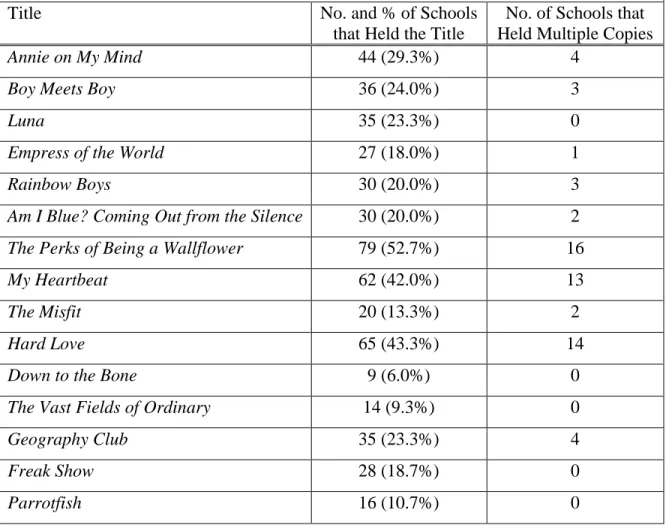
The 150 school libraries in the sample held an average of 3.54 of the core set of 15 recommended LGBTQ novels. The majority (65.3%) held fewer than five of the titles. Almost one-fifth (19.3%) held none of the titles. Only 5.3% had more than ten of the titles in their collections. No school held all 15.
The schools did not tend to collect multiple copies of the titles, either. One-hundred seven of the schools (71.3%) did not hold multiple copies of any of the books. Sixteen schools (10.7%) held multiple copies of The Perks of Being a Wallflower, while no schools had multiple copies of Luna, Down to the Bone, Vast Fields of Ordinary,
Freak Show, or Parrotfish.
As Table 3 shows, the title that was held by the most schools (52.7%) was The
Table 3. Recommended LBGTQ YA Fiction Held by the Schools in the Sample
Title No. and % of Schools
that Held the Title
No. of Schools that Held Multiple Copies
Annie on My Mind 44 (29.3%) 4
Boy Meets Boy 36 (24.0%) 3
Luna 35 (23.3%) 0
Empress of the World 27 (18.0%) 1
Rainbow Boys 30 (20.0%) 3
Am I Blue? Coming Out from the Silence 30 (20.0%) 2
The Perks of Being a Wallflower 79 (52.7%) 16
My Heartbeat 62 (42.0%) 13
The Misfit 20 (13.3%) 2
Hard Love 65 (43.3%) 14
Down to the Bone 9 (6.0%) 0
The Vast Fields of Ordinary 14 (9.3%) 0
Geography Club 35 (23.3%) 4
Freak Show 28 (18.7%) 0
Parrotfish 16 (10.7%) 0
LGBTQ Issues in Professional Journals
0 30 5 0 1 6 0 4 1 9 0 5 10 15 20 25 30 35 Num b er of Ar tic les Journal Name
Figure 4: Total LGBTQ Articles by Journal
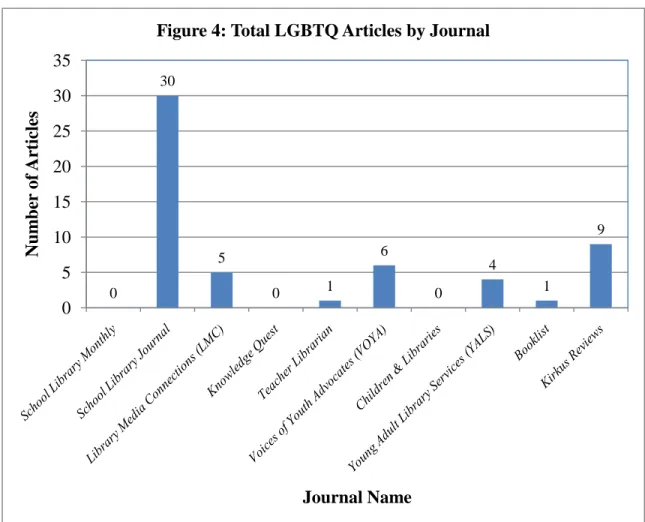
The vast majority of the articles (71.2%) were reviews of materials. The
4.1
0.4 0.3 0.5 0.5
0.2 0.6 0.4 0 0.5 1 1.5 2 2.5 3 3.5 4 4.5 A ve rage No. of Ar tic les Add re ssi n g E ac h of the Cat egor ies in E ac h Jou rn al Article Category Figure 5:
Topics of LGBTQ Articles in Professional Journals
Discussion
LGBTQ-themed Books in the School Library Collections
It appears that the high school teacher-librarians in the public schools in this study are currently under-collecting LGBTQ-themed young adult literature. Although 5.9% of the students in American high schools identify as gay, lesbian, or bisexual,
Further research might seek to determine whether specific subsets of LGBTQ literature are collected more often than others. The core recommended collection in this paper, for instance, is comprised of books dealing with a variety of issues related to homosexuality, bisexuality, gender questioning, and other LGBTQ topics. While the study here did not focus on how well subsets are comparatively collected in high school libraries, research in this area might reveal significant information about general attitudes or levels of comfort with specific LGBTQ issues or populations. It is safe to say that homosexuality is a topic addressed in literature more often than transsexualism. If there are more books dealing with homosexuality in high school libraries, for instance, than books about transsexualism, then perhaps the efforts of LGBTQ advocates should be put to use educating school communities about issues of transsexualism and campaigning to see more books about transsexualism in school libraries and in school curriculums. It would also be interesting to determine why there are fewer books about transsexualism (or another subset of LGBTQ issues) in print. Further research might seek to uncover whether the fault lies with a lack of writers who focus on this issue in their books, the attitudes of the publishers, or the demand from readers.
A lack of LGBTQ books in school libraries can send a message to LGBTQ teens that the school library is not the place for them, and that their lives and their concerns are not valued there. This is not the message these teens need to receive, nor do I believe it is the message these teacher-librarians intend to send. It is unfortunately the message
You‘ve got to understand. I‘m betting almost everything available featuring gay characters in books for kids and teens is here—and they fit on these two tabletops. You‘d need all the rooms in this building, and more, to fit the books that feature heterosexual kids and their families. They have a much better chance of finding themselves or what they‘re interested in. It‘s really great that you‘re trying, but I just don‘t see myself here. (p. 76)
The lack of LGBTQ-themed titles is not only potentially detrimental to LGBTQ teens, but also to all teens. As Rauch (2010) points out, ―access to stories with characters who may be like his/her classmates or friends can help a teen reader be more empathetic and understanding as s/he experiences vicariously the struggles and confusion many GLBTQ teens go through‖ (p. 217). Lack of understanding and empathy can lead to insensitivity, anti-gay bullying and harassment, or even physical abuse, and potentially contribute to the homophobic epidemic that we as a nation are striving to end.
It is also concerning that LGBTQ literature is not more widely available to students in the midst of current events in our country related to issues of sex and gender. The repeal of the ―Don‘t Ask, Don‘t Tell‖ policy, the debates over gay marriage and adoption, and other contentious LGBTQ issues are pervasive in the media, yet the
literature available for children and young adults does not adequately reflect the existence of such important questions, conversations, and events.
of challenges, the culture of the particular school, or the perceived values of the neighborhood surrounding the school.
Alexander and Miselis (2007) point out that ―homosexual acts [in our culture] are often criminalized, associated with pedophilia, and considered immoral and sinful‖ (p. 44). This stigma produces a barrier to LGBTQ collection development that can be difficult to overcome. Homosexuality has a history of association with negative values and behaviors, and the American Psychological Association actually classified
homosexuality as a disease or mental disorder until 1973. Alexander and Miselis write, ―The idea that children have to be protected from exposure to GLBTQ-related topics is a result of the misperception that homosexuality is a perversion that should be equated with pornography and pedophilia‖ (p. 45).
As Curwood, Schliesman, and Horning (2009) explain, it is not uncommon for educators‘ personal responses to the issues raised in LGBTQ-themed literature, as well as real or perceived pressure from school administrators or the community, to interfere with the inclusion of LGBTQ titles in schools. Rather than risk the negative publicity that materials challenges bring, some teacher-librarians choose not to promote, or even to collect, LGBTQ-themed literature:
It's easy to keep your head down. As it is, libraries are always struggling for support and recognition, so why create an opportunity for negative publicity? The result is a school hostile to free inquiry. It's also easy to say that there is already plenty of information "out there." But what you're really doing is pushing your kids onto the Web, with its risky mishmash of sites, when you could provide them with authoritative nonfiction and first-rate novels. (Kenney, 2006, p. 11)
LGBTQ Issues in Professional Journals Read by Teacher-Librarians
The vast majority of the articles in professional journals were book reviews of LGBTQ-themed books, but these reviews do not even scratch the surface of the wide array of positive, accurate LGBTQ titles that have been published since 2006. Some of the 41 reviews from the ten different journals overlap, discussing the same book or books. Most of the books from the core collection of recommended LGBTQ fiction for young adults identified in this paper were not even mentioned, despite the fact that many of them have been published in very recent years. While professional journals cannot realistically review every book that comes out each year, dozens of books that could benefit high school library collections have simply been ignored.
It is disturbing to think that teacher-librarians might only subscribe to a professional journal or journals that have not published a single article about LGBTQ issues in the last five years. Even the seven journals in this study that have published these articles have only put out, on average, 1.6 articles per year over the past five years.
It is possible that more articles (in addition to the ones identified in this study) addressing LGBTQ issues have been published in professional journals over the past five years, but those articles have not been indexed under LGBTQ subject headings. This could be due to the fact that LGBTQ issues are not the main focus of the articles, (if these issues are mentioned in conjunction with other issues of diversity, for instance), or due to indexing errors. Regardless of the reason, the possibility that there are more professional LGBTQ articles out there does little to alleviate the lack of LGBTQ discussion in
LGBTQ issues could not find them easily, and therefore these articles are of little use as LGBTQ resources after their initial publication.
While I do not intend to draw a causal relationship between the two studies in this paper, I do believe that the results of the qualitative coding of professional journals for teacher-librarians provide evidence that professional journals only exacerbate the under-collection of LGBTQ materials in high school libraries. Librarians look to professional journals for current trends, research, recommendations, reviews, and professional development. While teacher-librarians do need to be held accountable for the current state of LGBTQ services in their library, so too do professional journals need to be held accountable for the lack of advice and information they provide for librarians who want to take appropriate steps to improve their LGBTQ services.
While public awareness of LGBTQ issues, as well as the number of LGBTQ-themed books for teens, has been increasing, it appears that professional journals for teacher-librarians have not caught up with the trend. The journals have failed to do their part to provide librarians with the information they need to provide LGBTQ library services. The people behind the journals, people who play an important part in steering the profession of school librarianship, continue, perhaps unintentionally, to send the message that LGBTQ library services are not important for teacher-librarians.
Recommendations
information needs. The following are proactive steps that teacher-librarians can take to better serve LGBTQ teens and improve their LGBTQ collections.
Educate your Community
Alert teachers, administrators, school staff, and the community to the need for LGBTQ teens to see themselves in the literature that is made available to them in the school library and used in the classroom. Explain that doing so validates the lives of these students and sends the message they are not alone, and that the situations in their life are not unique or abnormal. Back your statements up with documented statistics and
research. Consider citing the articles referenced in this paper. Tie it into Anti-Bullying Initiatives
Articulate how collecting and using LGBTQ-themed literature in schools can combat bullying as often as you can. Many schools have current anti-bullying initiatives, so chances are that you can use some resources and policies that you already have in place to spread the word to your school community. Emphasize that providing themed literature in the library is a critical anti-bullying strategy. Including LGBTQ-themed literature in the library can open a world of understanding and tolerance to other students, to teachers, to administrators, and even to the broader community. It can also increase the likelihood that more members of the school community will become allies and advocates for LGBTQ teens—individuals who seek to educate the school
Analyze Your Collection
Analyze your library collection to determine the number and quality of LGBTQ-themed titles your library holds. Check the titles for authenticity, accuracy, and breadth of representation of the LGBTQ community. Make sure that the fiction titles in your collection are not just problem novels or ―coming out‖ stories. If you feel unqualified to judge the authenticity of a title, elicit the input of LGBTQ people in your school or community.
Seek Grant Funding
If analysis of your library collection shows that the gaps in your LGBTQ
collection are too big to fix with the budget that is available to you, search for grants that might provide extra funding to put LGBTQ resources in libraries. Look to local and national LGBTQ organizations, as well as organizations that support multicultural advancement and education.
Use Professional Resources
Utilize professional resources, such as Gay, Lesbian, Bisexual, Transgender, and
Questioning Teen Literature (Webber, 2010) or Serving Lesbian, Gay, Bisexual,
Know the Award Lists
Without previous knowledge of the books, it can be difficult to pick LGBTQ titles off of ―Best Books‖ lists. There are, however, awards specifically for LGBTQ literature. The Lambda Literary Awards are annual prizes awarded to the best LGBT books in several categories, including a category specifically for children‘s and young adult literature. According to the Lambda Literary Foundation website, the awards honor ―exceptional writing about queer lives across multiple genres‖ and ―brilliantly written and a meaningful examination[s] of the LGBTQ experience‖ (Lambda Literary
Foundation, 2011). Another award to know is the Stonewall Book Award. This award, given by the American Library Association's Gay, Lesbian, Bisexual, and Transgender Round Table, is the ―The first and most enduring award for GLBT books‖ (American Library Association, 2011). It also contains a special category for children‘s and young adult books.
Look to Your Students for Input
Update Your Policies
Revisit your selection policies and procedures, particularly the reconsideration policy, to ensure that it is inclusive and reflects the American Library Association‘s
Library Bill of Rights. Educate your faculty, staff, administration, parents, and the
broader community about the library‘s obligation set forth by section 53.1.15 of the ALA Policy Manual:
…Libraries and librarians have an obligation to resist efforts that systematically exclude materials dealing with any subject matter, including sex, gender identity or expression, or sexual orientation. The Association also encourages librarians to proactively support the First Amendment rights of all library users, regardless of sex, sexual orientation, or gender identity or expression. (American Library Association, 2010)
Prepare for Challenges
Be prepared to deal with challenges. As Martin and Murdock (2007) note, you are including LGBTQ-themed literature in your collection for a reason—to represent the LGBTQ teens in your school. They argue that you need to ―remind people of the reason and don‘t let censors off the hook‖ (Martin and Murdock, 2007, p. 73). As Rauch (2010) points out, you are not alone. There are numerous local and national organizations that work to defend libraries and schools in providing resources for all students. Some of those include ALA, the Southern Poverty Law Center, the ACLU, GLSEN, and PFLAG. Avoid Self-Censorship in Collection Development
Bisexual, Transgender and Questioning Teens: A How-To-Do Manual for Librarians for deciding how to provide LGBTQ materials that will work best in any community, whether it is conservative or liberal, or somewhere in between.
Add Internet Resources to Your Library Webpage
Help connect LGBTQ teens in your school to resources outside of your print collection by adding Internet resources designed specifically for LGBTQ youth to your library website. Examples include: Youth Guardian Services
(http://www.youth-guard.org/youth), Youth OUTreach (http://www.lambda.org), and Youth Resource (http://www.amplifyyourvoice.org/youthresource).
Contribute to Professional Journals
Finally, do your part to increase the number of articles about LGBTQ topics that appear in professional journals over the next five years. Write letters to the editors of the journals that you subscribe to asking them to include more articles about LGBTQ
collections and library services. Send in opinion pieces or write-ups about special events in your library to Teacher Librarian, School Library Journal, or another professional journal that prints articles from teacher-librarians in the field. Write book reviews about your favorite new LGBTQ books and submit them for publication. Encourage your LGBTQ students to send in their personal testimonies and reviews to Voices of Youth Advocates (VOYA). Keep writing.
Conclusion
welcoming places for all teenagers, but many schools do not acknowledge the unique issues that LGBTQ students face and do not include LGBTQ-themed books in the
curriculum or in the school library collections. These discrepancies require our immediate attention. All educators, including librarians, need to take immediate, active steps to communicate that they support LGBTQ teens and that they value their worth as individuals. By opening their library shelves to the LGBTQ experience in young adult literature, teacher-librarians may be providing ―a lifeline to the teenagers who need affirmation and support in their lives most‖ (Manfredi, 2009, p. 31).
We cannot expect the homophobia that is engrained in this nation to disappear overnight. We can, however, do our part to help make schools safe places for LGBTQ teenagers and to collect the literature that makes a real difference for them. One teenager illustrates the impact that literature can have in the life of a young homosexual person, testifying that books have prevented him from being counted among the ranks of the gay teenagers who have committed suicide in our nation:
You wonder why I am not drinking or jumping off a bridge onto cold, hard concrete at this very moment like so many gay teenagers do today? Why do I refuse to give up my fight to be accepted, to be able to tell my parents some day and have them understand? Books. These books—these books with characters who are gay, who live life honestly, who breathe through the pages like they are real—have gotten me through. My life has been fifteen years of a slowly sinking ship, and until the dawn arrives, these books are my life preservers, and if my library and bookstore had not carried them...I probably would have died a long time ago. These books make people feel safe and loved, and mean more and more to teens every day. (John, 2010, p. 219)
References
Alexander, L.B., & Miselis, S.D. (2007). Barriers to GLBTQ collection development and strategies for overcoming them. Young Adult Library Services, 5(3), 43-49. American Library Association. (2007). “And Tango Makes Three” tops ALA’s list of
most challenged books. Retrieved from
http://www.ala.org/ala/newspresscenter/news/pressreleases2007/march2007/mc06 .cfm
American Library Association. (2010). 53.1.15: Access to library resources and services regardless of sex, gender identity, or sexual orientation. In ALA policy
manual. Retrieved from
http://www.ala.org/ala/aboutala/governance/policymanual/
American Library Association. (2011). Stonewall Book Awards. Retrieved from http://www.ala.org/ala/mgrps/rts/glbtrt/stonewall/index.cfm
Clark, C. T., & Blackburn, M. V. (2009). Reading LGBTQ-themed literature with young people: What‘s possible? English Journal, 98(4), 25-32.
CNN Wire Staff. (2010). Obama signs repeal of ‗don‘t ask, don‘t tell‘ policy. Retrieved from http://www.cnn.com/2010/POLITICS/12/22/dadt.repeal/index.html
Curwood, J. S., Schliesman, M., & Horning, K. T. (2009). Fight for your right: Censorship, selection, and LGBTQ literature. English Journal, 98(4), 37-43. Ford, M. T. (1994). Gay books for young readers: When caution calls the shots – twenty-
Publisher’s Weekly, 241(8), 24-27.
Galaxy57. (2010). Comment on Shaughnessy, L, ―Headlines aside, ‗don‘t ask, don‘t tell‘ stays in place.‖ CNN. Retrieved from
http://www.cnn.com/2010/POLITICS/12/22/sweep.dont.ask.dont.tell/index.html GLSEN (2000). Staff Development on Homophobia Issues: Why Schools Need to Act,
and What They Can Do. Retrieved from
http://www.glsen.org/pages/sections/library/schooltools/033.article
GLSEN (2009). National School Climate Survey: The Experiences of Lesbian, Gay,
Bisexual and Transgender Youth in Our Nation’s Schools. Retrieved from http://www.glsen.org/binary-data/GLSEN_ATTACHMENTS/file/000/001/1675-5.PDF
GLSEN (2010). Four Steps Schools Can Take to Address
Anti-LGBT Bullying and Harassment. Retrieved from http://www.glsen.org/cgi- bin/iowa/all/library/record/2418.html
GLSEN; PFLAG; & The Trevor Project. (2010). Release statement on recent tragedies. Retrieved from http://www.glsen.org/cgi-bin/iowa/all/news/record/2634.html. Itgetsbetterproject (2011). YouTube – itgetsbetterproject‘s Channel. Retrieved from
http://www.youtube.com/user/itgetsbetterproject
It Gets Better Project. (2011). It Gets Better Project. Retrieved from http://www.itgetsbetter.org
John. (2010). Coming out in books. Voice of Youth Advocates, 33(3), 219. Kenney, B. (2006). Do the right thing. School Library Journal, 52(1), 11.
Lambda Literary. Retrieved from http://www.lambdaliterary.org/awards/
Landan, K. (2009). Gay curriculum proposal riles elementary school parents. Fox News. Retrieved from http://www.foxnews.com/story/0,2933,521209,00.html
Manfredi, A. (2009). Accept the universal freak show. Young Adult Library Services,
7(4), 26-31.
Mannino, J. (2010, October 11). Homophobia: The plague that is killing our youth. The
Huffington Post. Retrieved from http://www.huffingtonpost.com
Martin Jr., H. J., & Murdock, J. R. (2007). Serving Lesbian, Gay, Bisexual, Transgender,
and Questioning Teens: A How-To-Do-It Manual for Librarians. New York: Neal-Schuman.
Massachusetts Department of Education (2009). Massachusetts Youth Risk Behavior Survey. Retrieved from http://www.mass.gov/cgly/YRBS09Factsheet.pdf Miller, C. D. (2010). Constance McMillen wanted to take her girlfriend to the prom, so
the school board canceled it. CBS News. Retrieved from
http://www.cbsnews.com/8301-504083_162-20000321-504083.html
Miller, J., & McCarthy, S. (Eds.). (2010). Sears list of subject headings. New York, NY: H.W. Wilson Co.
Obama, B. (2010, October 21). President Obama: It Gets Better [Video file]. Retrieved from http://www.youtube.com/watch?v=geyAFbSDPVk
Potok, M. (2010). Under attack. Intelligence Report, 140, 26-30.
Rauch, E.W. (2010). GLBTQ Collections are for every library serving teens! Voice of
Ressler, P., & Chase, B. (2009). Sexual identity and gender variance: Meeting the educational challenges. English Journal, 98(4), 15-22.
Ryan, C. and Futterman, D. ( 1998). Lesbian and Gay Youth: Care and Counseling. New York: Columbia University.
Sumara, D. (1993). Gay and lesbian voices in literature: Making room on the shelf.
English Quarterly, 25(1), 30-34.
United States. (1994). Title 10, subtitle G, section 654. In United States Code. Retrieved from http://web.mit.edu/committees/rotc/code.html
Washington Post-ABC News. (2010). Washington Post-ABC News poll. Retrieved from http://www.washingtonpost.com/wp-srv/politics/polls/postpoll_12132010.html Webber, C. K. (2010). Gay, Lesbian, Bisexual, Transgender and Questioning Teen
Appendix A: LGBTQ Articles in Professional Journals by Category
Reviews of materials
Allen, S. K. (2009). David inside out. School Library Journal, 55(6), 115.
Allen, S. K. (2009). The vast fields of ordinary. School Library Journal, 55(6), 116. Allen, S. K. (2010). Out with it: Gay and straight teens write about homosexuality.
School Library Journal, 56(7), 100.
Between Mom and Jo. (2006). Kirkus Reviews, 74(7), 354.
Brenner, R. (2008). Boy meets boy and girl meets girl, Otaku style. Voice of Youth Advocates, 31(3), 212-215.
Brenner, R. (2009). The full spectrum: GLBTQ films for teens. Voice of Youth Advocates, 32(3), 212-213.
Burwinkel, J. (2009). Nothing pink. Library Media Connection, 27(4), 75.
Chow, A. J. (2009). How beautiful the ordinary: Twelve stories of identity. School Library Journal, 55(9), 152.
Draper, J. (2009). Nothing pink. School Library Journal, 55(3), 144.
Evans, B. S. (2008). Gay America: Struggle for equality. School Library Journal, 54(7), 109.
Evans, B. S. (2008). Encyclopedia of gay and lesbian popular culture. School Library Journal, 54(8), 78.
Evans, B. S. (2010). Gay and lesbian rights: A reference handbook. School Library Journal, 56(4), 70.
Family outing: A memoir: What happened when I found out my mother was gay. (2008).
Glantz, S. (2007). Serving lesbian, gay, bisexual, transgender, and questioning teens: a how-to-do-it manual for librarians. Library Media Connection, 26(2), 94.
Gray, A. M. G. (2009). Gay America: Struggle for equality. Library Media Connection, 27(4), 91.
Grl2grl: Short fictions. (2007). Kirkus Reviews, 75(15), 801.
Honig, M. (2009). Odd ones out: Transforming identity against the odds. School Library Journal, 55(6), 56.
Johnson-Doyle, M. (2006). M or F? School Library Journal, 52(1), 141. Jumpstart the world. (2010). Booklist, 6, 43.
Lloyd, S. (2009). In Mike we trust. School Library Journal, 55(3), 154. Love drugged. (2010). Kirkus Reviews, 78(15), 731.
Martin, H. J. (2008). The God box. School Library Journal, 54(1), 124.
Martin, H. J. (2008). What if someone I know is gay?: Answers to questions about what it means to be gay and lesbian. School Library Journal, 54(1), 66.
McClune, P.N. (2009). The boy in the dress. School Library Journal, 55(12). 136. Murphy, N. G. (2008). Absolute brightness. School Library Journal, 54(3), 204. Nothing pink. (2008). Kirkus Reviews, 76(19), 1069.
Outlet. (2008). Library Media Connection, 26(6), 62. Pink. (2011). Kirkus Reviews, 79(1), 66.
Rashid, L. (2007). In the garage. School Library Journal, 53(11), 122.
Schene, C. (2008). Another kind of cowboy. School Library Journal, 54(2), 118. Senser, S. (2007). Gay rights. School Library Journal, 53(1), 150.
Spencer, R. M. (2009). Say the word. School Library Journal, 55(6), 124.
Taniguchi, M. (2007). 7 days at the hot corner. School Library Journal, 53(4), 150. Thomarie, D. (2007). Hero. School Library Journal, 53(9), 204.
Tips on having a gay (ex) boyfriend. (2007). Kirkus Reviews, 75(7), 336.
Wickham, C. E. (2009). Freaks and revelations. Library Media Connection, 28(3), 83. Wide awake. (2006). Kirkus Reviews, 74(15), 15.
Wildthorn. (2010). Kirkus Reviews, 78(17), 854.
Wilson, R. D. (2006). Videos for professional development. Teacher Librarian, 33(5), 61-62.
LGBTQ collection development
Kenney, B. (2006). Do the right thing. School Library Journal, 52(1), 11.
Manfredi, A. (2009). Accept the universal freak show. Young Adult Library Services, 7(4), 26-31.
Whelan, D. L. (2006). OUT and ignored. School Library Journal, 52(1), 46-50. Personal testimonies/interviews
John. (2010). Coming out in books. Voice of Youth Advocates, 33(3), 219.
McCafferty, D. (2006). Love and accept yourself for who you are: An interview with Alex Sanchez. Young Adult Library Services, 4(4), 10-12.
Debate of LGBTQ issues Bailey, C. (2008). Objection. School Library Journal, 54(4), 12.
Grant, M. E. (2006). A difference of opinion. School Library Journal, 52(4), 14. It‘s good to be king. (2008). School library journal, 54(1), 16.
Nilsen, A. (2008). Give card his due. School Library Journal, 54(4), 11-12. Parrott, J. S. (2008). Try to understand Orson Scott Card‘s beliefs before passing
judgment. School Library Journal, 54(4), 11.
Criticism of current practices
Alexander, L. B., & Miselis, S. D. Barriers to GLBTQ collection development and strategies for overcoming them. Young Adult Library Services, 5(3), 43-49. Kenney, B. (2006). Do the right thing. School Library Journal, 52(1), 11.
Rauch, E. W. (2010). GLBTQ collections are for every library serving teens! Voice of Youth Advocates, 33(3), 216-218.
Taylor, B. (2010). Don‘t deny me the right to read. Voice of Youth Advocates, 33(5), 427.
Whelan, D. L. (2006). OUT and ignored. School Library Journal, 52(1), 46-50. Highlights of projects/events
King, K. A. R. (2006). Author visits, or hobnobbing with the semi-rich and literate. Voice of Youth Advocates, 28(6), 470-473.
Rainbow history project. (2008). School Library Journal, 54(5), 15.
Advocates, 32(3), 212-213.
Kenney, B. (2006). Do the right thing. School Library Journal, 52(1), 11.
Rauch, E. W. (2010). GLBTQ collections are for every library serving teens! Voice of Youth Advocates, 33(3), 216-218.
Whelan, D. L. (2006). OUT and ignored. School Library Journal, 52(1), 46-50. Information or history