Jody D. Smith. Deficiencies in the Collection of American Indian Children’s Literature in North Carolina’s Public Libraries. A Master’s Paper for the M.S. in L.S degree. December, 2014. 72 pages. Advisor: Sandra Hughes-Hassell
North Carolina is home to the largest population of American Indians east of the Mississippi River, and the state with the seventh largest Indian population overall. Likewise, the nationwide Indian population is growing at a rate almost twice as fast as the U.S. average. Anticipating the needs of a growing population, it is important that public libraries in North Carolina provide Indian youth with books which provide culturally-affirming representations of Indian peoples, traditions, and histories.
For this study, the nine counties in North Carolina with the largest Indian populations were isolated using 2013 U.S. Census estimates. Then, utilizing the online public access catalogs of the public libraries serving those counties, bibliographic searches were conducted for a selection of 206 books recommended by professional reviewing authorities. The data indicate that less than a quarter of the selected titles have been collected by a majority of libraries in the subset.
Headings:
Children--Books and reading
Children’s literature
Libraries and Indians
Multiculturalism in literature
North Carolina
DEFICIENCIES IN THE COLLECTION OF AMERICAN INDIAN CHILDREN’S LITERATURE IN NORTH CAROLINA’S PUBLIC LIBRARIES
by Jody D. Smith
A Master’s paper submitted to the faculty of the School of Information and Library Science of the University of North Carolina at Chapel Hill
in partial fulfillment of the requirements for the degree of Master of Science in
Library Science.
Chapel Hill, North Carolina
December 2014
Approved by
_______________________________________
Two hundred seventy Ghost Dancers died dreaming
That humanity would drown In a flood of White sins.
Then the renewed earth Would reclaim city and town,
Leaving only Ghost Dancers And those who lived by nature’s laws.
History books say the threat is gone. The Ghost Dance died with the ancestors—
Wovoka and his sacred dream Were destroyed.
Each time it rains, I go out to the sidewalk,
Where the tree roots Have broken the concrete Listening to the water’s whispering:
“It is coming soon.”
Table of Contents
Introduction ...3
Literature Review ...8
Methodology ...15
Results ...19
Discussion...30
Conclusion ...33
Notes ...35
Bibliography ...36
Introduction
A Map for Change
Fresh courage glimmers from planets.
And lights the map printed with the blood of history, a map you will have to know by your intention, by the language of suns.
“A Map to the Next World” – Joy Harjo
Recent headlines have drawn attention to the long history of offensive
depictions of American Indians in the United States (I use the terms American Indian or
Indian throughout this paper in keeping with U.S. Census Bureau terminology). This
debate has principally taken place in the realm of sports, where growing numbers of
people are questioning the use of Indian mascots and logos, along with the plethora of
associated iconography used for commercial merchandising purposes (feathers,
headdresses, tomahawks, face paint, war chants, etc.). While the media has fixed its
focus primarily on the Washington Redskins NFL franchise and its belligerent owner,
Dan Snyder, a report from Munguia (2014) found that there are at least 2,128 other
examples of Indian mascots in high school, college, professional, semi-professional,
and amateur sports teams in the United States. In the words of the National Congress
of American Indians (2013), these images “slander, defame and vilify Native peoples,
Native cultures, and tribal nations,” while contributing to a negative self-image for
Indian youth (p. 5). Perhaps as a result of this belated conversation currently taking
now call attention to the ways in which the same stereotypes and offensive
representations appear in many other spheres of American culture.
Children’s literature has historically been awash with stereotyped depictions of
Indian characters and subject matter. This is a fundamental dilemma, as the market for
children’s books continues to suffer from an alarming lack of diversity in its publishing
practices. The Cooperative Children’s Book Center (CCBC) (2014) reported that, of
approximately 3,200 books reviewed by its staff throughout the year during 2013, only
34 titles dealt with American Indian characters or themes, and only 18 were attributed
to Indian authors or illustrators. The numbers were equally dire for African Americans,
Asian Americans, and Latinos. Not a single non-white European group accounted for
so much as three percent of the sample.
One group working to counteract the current paucity of children’s and young
adult books with multicultural content is the We Need Diverse Books (WNDB)
campaign. WNDB began as an inadvertent exchange on Twitter in April 2014 between
authors Ellen Oh and Malinda Lo. Expressing their dissatisfaction with the lack of
diverse author panels scheduled for the upcoming Bookcon events in Manhattan, their
frustrations were quickly echoed from other corners of social media. A month later, Oh
and Lo had garnered enough interest to conduct a 3-day workshop titled Diversify Your
Shelves, which was intended to raise awareness, conceptualize new ideas, and form a
plan of action to address the lack of diverse voices in the publishing of children’s and
young adult literature. Of late, this long overdue movement has gained
acknowledgment from well-established publishing houses and professional journals. In
Journal (SLJ) to develop collaborative programming for the 2016 American Library
Association (ALA) Midwinter conference in Boston, as well as the 2016 WNDB
Diversity Festival in Washington, D.C. This partnership will also be tapped to develop
an educational kit for teachers, librarians, and booksellers.
If, as so many of us hope, this movement is a sign of larger systemic changes to
come in the world of children’s book publishing, then it could potentially lead to a vital
industry-wide revolution. It is a great tragedy gone largely unrecognized by the agents
of cultural capital that so many young people in the United States are unable to find
accurate and culturally sensitive representations of themselves in the books they read
(or, for that matter, the majority of other media they consume). However, with
persistence, hard work, and a greater commitment to cultural empowerment on the part
of the individuals who select books for young people, we may very well be on the
precipice of major changes.
Tonto’s Long Shadow
A name only once
crammed into the child’s fitful memory in malnourished villages,
vast deliriums like the galloping foothills of the Colorado: of Mohawks and the Chippewa,
horsey penny-movies
brought cheap at the tail of the war to Africa.
“America”— Kofi Awoonor
Arguably more than with any other group, the stereotypes and preconceived
notions of Indian peoples have become ingrained in the American subconscious.
Moreover, owing to the extraordinary success of the western genre of novel and film,
populations throughout the world. Karl May, who is by some estimates the most
widely read author in the German language, never set foot in North America but wrote
wildly popular cowboy and Indian books in the late-18th century. To this day, May’s
home city of Dresden holds an annual festival in which thousands of Germans don
Indian costumes, live outside in tipis, and stage powwows. In the mid-1960s, the
European appetite for westerns was so great as to spawn the so-called Spaghetti
Western industry, which produced hundreds of films over two decades (Frayling 2006).
These films, which were financed by European production companies, often starred
washed-up American actors and used the similar terrains of Andalucia and the Plitvice
Lakes to mimic the western frontier of the United States. In “America,” the poem
quoted in the epigraph to this section, the Ghanaian poet Kofi Awoonor recalls how his
West-African boyhood was steeped in these same images of western U.S. hegemony,
which for him became synonymous with America itself.
The global persistence of mass-produced depictions of American Indians–
almost all of which are taken from the Plains tribes–has compelled many non-Indian
writers to pen children’s books dealing with Indian characters and themes. The results
are not always objectionable, and indeed several of the texts included in the
bibliography from this study were written by non-Indian writers. However, the
negative cases generally outweigh the positive. As Hirschfelder, Molin, and Wakim
(1999) note, examples abound of Indians in books for young people that play into
several recurring stereotypes while generally ignoring tribal diversity, history, and
Insufficient research has been conducted which examines the extent to which
library collections contain accurate and affirming portrayals of Indian characters and
themes. This study is intended to address that gap by analyzing a subset of public
libraries in North Carolina in search of books that provide positive depictions of
Indians. To this end, I assembled a bibliography of 206 titles (see Appendix A), each
of which has been recommended by professional reviewing authorities. Utilizing the
online public access catalogs of the eight public library systems in North Carolina
which serve the largest Indian populations, I performed bibliographic searches to
determine the frequency with which these libraries are collecting culturally authentic
books for Indian youth.
American Indians in North Carolina are a young population experiencing
growth. According to official statistics from the U.S. Census Bureau (2012), North
Carolina is home to the largest Indian population east of the Mississippi River, and the
state with the seventh largest Indian population overall. It is the responsibility of
librarians and educators to make sure that there are books available to meet the
emotional and developmental needs of these young people. In so doing, we might work
toward rectifying a long history replete with stereotypes and demeaning
representations, many of which have negatively impacted the self-worth of countless
young readers. At its core, this paper is a rallying cry for three crucial changes to status
quo public library administration: 1) an aggressive and forthright reassessment of
current collection development policies and practices; 2) a greater commitment to
building library collections with culturally authentic representations of Indian peoples,
commissioning the removal of texts from the collection which are antiquated, offensive,
and harmful to the emerging self-esteem of young readers.
Literature Review
Books stand like enemies Rapists who’ll conspire to kill me
They wrestle me I wrestle back kicking their spines Splitting their black seeds with my knife the little
Black letters ejaculate from Their splintered and crushed chaff “Addiction to the Dead” – Margo Tamez
In Through Indian Eyes: The Native Experience in Books for Children, Michael
A. Dorris writes that, “It must somehow be communicated to educators that no
information about Native peoples is truly preferable to a reiteration of the same old
stereotypes, particularly in the early grades” (p. 15). Dorris goes on to assert that,
“Protecting children from racism is every bit as important as insuring [sic] that they
avoid playing with electrical sockets. Poison is poison, and ingrained oppressive
cultural attitudes are at least as hard to antidote, once implanted, as are imbibed
cleaning fluids” (p. 16). Taking this position, educators, librarians, and parents and
guardians (or any other adults in positions of assigning or recommending books to
young people) must be conscious of the choices they make on behalf of their
impressionable readers. As LaBonty (1995) observes, “School children are pretty much
a captive audience and they tend to accept the words of their teachers and the apparent
facts in books as truth” (p. 2). A book in the hands of a child might just as easily
Hirschfelder, Molin, and Wakim (1999) reissued a 1974 study by the League of
Women Voters in which 238 kindergarteners and 239 fifth graders in the Mounds
View School District in St. Paul, Minnesota were surveyed. The students were asked
twelve questions regarding their attitudes toward and knowledge about American
Indians.2 The League reported: “When children were asked where Indian people live,
they very clearly placed them ‘someplace else’ — in dwellings very different from their
own, such as tents and caves, in other states, in other time periods” (pp. 3-4). Many of
the children viewed Indians as warlike and hostile, and most of them saw Indian
peoples as one homogenized group (pp. 4-6). The study also indicated the influence of
media on children’s perceptions of Indians, with the League implicating storybooks in
particular, which tend to “focus primarily on the past and portray a stereotyped image
of Indian people” (p. 7). The results of this study highlight what might be considered
the “classic” stereotypes of American Indians in children’s literature: savage, bellicose,
residing in hinterland dwellings, curios of a distant past. This comes as little surprise
when one considers that many of these ideas have endured for centuries now in the
American subconscious.
Neubauer (2001) and Molin (2005) have both traced many of the most
persistent stereotypes of American Indians in children’s literature to narratives of
captivity. The very first of its kind is a story that most American adults and children
know well (thanks in no small part to the Walt Disney Company): the 1624 account by
Capt. John Smith of his capture by the Powhatan tribe and his rescue by the chief’s
daughter, Pocahontas. Neubauer writes that captivity narratives became “popularly
her own still well-known account of Indian captivity in Massachusetts (p. 70). Fixing
upon their textual lineage from from Smith and Rowlandson, Neubauer demonstrates
that captivity narratives written for children were so numerous in the years preceding
the Civil War as practically to constitute an original genre. Likewise, Molin analyzes
the ingrained stereotypes that have been telegraphed to young readers through these
narratives, writing: “In captivity fiction, the narrative generally includes brutal attacks,
accompanied by scenes of torture, murder, and the destruction, often by fire, of the
Euro-American family homestead” (p. 69).
Academia took a great interest in depictions of American Indians in various
media during the 1970s and 1980s. Portrayals in film seems to have been the most
popular subject, but these two decades also produced several studies of children’s
literature and school textbooks. Byler (1973) analyzed 600 children’s books with
American Indian characters, and in the overwhelming majority found instances of
caricature, inaccuracy, and stereotyping. Indians were typically imagined as living in
the distant past, and often depicted in illustrations as anthropomorphic animals. Fisher
(1974) reached essentially identical results in her review of children’s literature, and in
their study for the Council on Interracial Books for Children, Moore and Hirschfelder
(1977) found stereotypes and inauthenticity to be the norm in 75 picture books. Troy
(1975) compared representations of American Indians in adolescent novels from 1930
to those from 1960 and found that the same stereotypes of Indians had held strong
during the three decade period that separated the books. Kelly and Falkenhagen (1974)
surveyed 30 elementary school teachers and asked them to identify the most common
fairly successful at identifying the most glaring stereotypes (e.g., those dealing with
manners of dress, living conditions, and customs), but that they tended to overlook
subtler offenses.
A comparable set of studies from this same period also demonstrates that many
of these stereotypes extend into non-fiction for children and elementary through
secondary school textbooks. In his study of 34 social studies textbooks used in
elementary schools, Ferguson (1984) discovered that modern Indian history and
contemporary issues were frequently ignored, while Indians were depicted as living
only in the past. Charles (1987) examined American Indian excerpts in literary
anthology textbooks used in North Carolina high schools and found that they not only
lacked tribal diversity, but contained very few selections that were actually penned by
Indian writers. Cooper (1988) found evidence of bias against American Indians even in
reference materials such as dictionaries and encyclopedias, and Costo (1979) observed
that instructional materials were rife with inaccuracies about Indian history and
cultures. FitzGerald (1979) looked at history textbooks from five eras: 1830s-1840s,
the Civil War era, the 1890s, 1930s, and 1960s. Strikingly, she reached the conclusion
that the earlier texts presented more enlightened views of American Indians than the
ones from the 1930s and 1960s.
That all of the studies cited took place in either the 1970s or 1980s is not
surprising. As Mendoza and Reese (2001) note, non-European characters were
essentially non-existent in children’s literature prior to 1960 and, when they did appear,
were typically stereotyped and negatively depicted. The socio-cultural revolutions of
variety of media, and we can detect the fruit of this activity in the explosion of
scholarly interest in the 1970s. The relative dearth of present-day research may suggest
a waning interest on the part of academia in depictions of American Indians in
children’s literature, however one must take into account the advent of new media in
the late 20th and now 21st centuries. Much of the discussion has moved online.
Websites such as Oyate3, and blogs run by individuals like the scholar Debbie Reese4
and the writer Cynthia Leitich Smith5, continue the conversation with regular reviews
and analyses of contemporary children’s and young adult literature. Social media has
also taken on importance, as demonstrated by the success of the WNDB campaign.
These Web resources aim to provide adults with the information necessary to make
informed and prudent book purchases and recommendations to young people.
One promising change in the direction of contemporary research is that more
and more scholars are foregrounding the effects of stereotyping and negative
representations on the emotional and psychological development of Indian children
themselves (whereas much of the research from the 1970s and 1980s was more
concerned with the effects of stereotypes on non-Indian children’s perceptions of
Indians). Seale and Slapin (2005) record 23 “living stories” of Indian parents, children,
and teachers, several of which call attention to the negative impact that children’s
books have had on their lives. A woman named Raven recalls being taunted and teased
by classmates after reading Alice Dalgliesh’s 1955 Newbery Honor book, The Courage
of Sarah Noble (p. 17). In another narrative, a mother remembers how her daughter
A mother named Naomi recalls visiting her son’s class while they were reading
Elizabeth George Speare’s The Sign of the Beaver (another Newbery Honor title, 1984):
…on the wall I saw a brown leather belt with two curly black wigs and some feathers hanging from it. A kid had done his book report and this was his visual aid. So I walked over and read the material and they were supposed to be scalps. My heart dropped, I couldn’t believe it. It made me sick, it made me want to throw up. (p. 16)
In her discussion of problematic canonical children’s literature by the likes of
Laura Ingalls Wilder, Speare, and Lois Lenski, Stewart (2013) writes that these texts
not only inspire “troubling attitudes toward and views of Native Americans by
non-Native readers,” but that “they also foster an inferior sense of self within contemporary
Indian youth who encounter the depictions in these classics” (p. 217). Stewart quotes
an interview with Ojibwa writer Louise Erdrich, in which she discusses how, even as an
Indian youth, she read and internalized the racism in Wilder’s Little House on the
Prairie books6 only on a subconscious level:
I read them as a child and in rereading them as an adult, I was shocked to recognize that, not only was there no consciousness about the displaced people whose land the newcomers were taking, but also that there was a fair amount of racism. In the Little House books, there are always these moves from place to place. The fact is that any time land was opening up, it was land from which native people were displaced, and in every Ojibwa family there’s a similar series of moves. (pp. 215-216)
That Erdrich could not detect the racism inherent in the Little House books even
as an Ojibwa child is not surprising. Sims Bishop (1997) has proposed a
mirror/window metaphor for children’s literature. In this scenario, the mirror reflects
the child’s own world, while the window offers a view into the lives of peoples unlike
him/herself. Due to the general lack of multicultural representations in children’s
but seldom gains a vista on diverse peoples and cultures. On the other side, children’s
literature grants the child of color a plethora of windows but few mirrors.
A review of the literature stresses the importance of libraries collecting books
with positive and culturally-affirming representations of American Indians. This work
is necessary not only to counteract the decades-worth of books which have played a
detrimental impact on the developmental and emotional needs of Indian youth, but in
order to provide Indian children with the missing mirrors by which they might see their
own worlds reflected. The status quo has persisted for long enough. It is only through
persistence and honest reconsideration of our collections practices that we might set
about creating more affirmative and culturally authentic collections for future
Methodology
Based on 2013 U.S. Census Bureau estimates, the total population of the state of
North Carolina is 9,848,060 persons, of which American Indians account for 1.6
percent (around 122,110 persons). This makes North Carolina home to the largest
Indian population east of the Mississippi River, and the state with the seventh largest
Indian population overall. Contrary to the concept of Indians as a “vanishing race,” the
census projections for 2013 show population growth for Indians across the state from
the 2010 official data.
According to the North Carolina Department of Administration, Commission of
Indian Affairs, there are eight state-recognized tribes in North Carolina, with combined
populations totaling almost 80,000 persons.
Table 1: Estimated Populations of State-Recognized NC Tribes
STATE-RECOGNIZED NC TRIBE ESTIMATED ENROLLED MEMBERS
Lumbee Tribe of North Carolina 55,000
Eastern Band of the Cherokee Nation 13,000
Haliwa-Saponi Indian Tribe 3,800
Coharie Tribe 2,700
Waccamaw Siouan Tribe 2,000
Occaneechi Band of the Saponi Nation 1,100
Meherrin Tribe7 900
Sappony 850
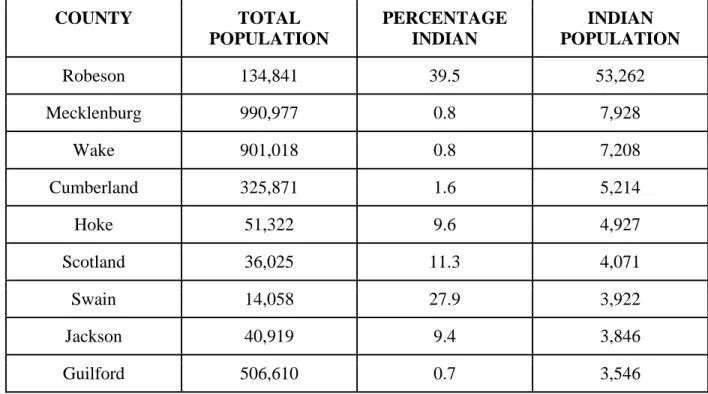
For the purposes of this study, I sought to isolate a subset of counties in North Carolina
nine counties account for 60 percent of the state’s Indian population: Cumberland,
Guilford, Hoke, Jackson, Mecklenburg, Robeson, Scotland, Swain, and Wake.
Table 2: NC Counties with the Largest Indian Populations
COUNTY TOTAL
POPULATION
PERCENTAGE INDIAN
INDIAN POPULATION
Robeson 134,841 39.5 53,262
Mecklenburg 990,977 0.8 7,928
Wake 901,018 0.8 7,208
Cumberland 325,871 1.6 5,214
Hoke 51,322 9.6 4,927
Scotland 36,025 11.3 4,071
Swain 14,058 27.9 3,922
Jackson 40,919 9.4 3,846
Guilford 506,610 0.7 3,546
Once I had established the counties that would be included in the study, I
compiled a bibliography of books with positive representations of American Indians
using four sources: the recommended American Indian book list from the CCBC8, the
American Indian Library Association’s biennial American Indian Youth Literature
Awards, Debbie Reese’s “Resources and Kid Lit About American Indians” list for
School Library Journal (2013), and the professional reviews found in Beverly Slapin
and Dorris Seale’s Through Indian Eyes: The Native Experience in Books for Children
(1998). The final assembled list (see Figure 1) consisted of 206 titles, which I divided
into four categories: Board Books (6 titles), Elementary Books (128 titles), Middle
To obtain my data, I performed bibliography searches for each of the 206 books
in my sample using the online public access catalogs (OPACs) for each of the public
libraries serving the nine counties in my subset. Three of the counties in the subset
were part of library consortiums. Two of the counties–Jackson and Swain–were part of
Table 3: Library Systems in the Study
LIBRARY SYSTEM COUNTIES SERVED
Charlotte Mecklenburg Library Mecklenburg
Cumberland County Public Library Cumberland
Fontana Regional Library Jackson, Macon, Swain
Greensboro Public Library Guilford
Robeson County Public Library Robeson
Sandhill Regional Library System Anson, Hoke, Montgomery, Moore, Richmond
Scotland County Memorial Library Scotland
Wake County Public Library Wake
After searching each library system’s OPAC for each of the titles in my sample,
I compiled the data into tables according to each category of book and the number of
libraries holding each title. I then performed searches for each of the books using the
Books in Print bibliographic database in order to obtain the following additional
information: publisher, publication year, extent of professional reviews, and any award
nominations or wins. Finally, the data was analyzed in search of any patterns or
Results
Figure 2 presents the composite data for the 206 titles in the sample along with
the number of libraries in which they are held, organized according to the categories in
Figure 1. The graph demonstrates a steady decline in the number of libraries holding.
More than three quarters (75.2%) of the titles have been collected by less than half of
the libraries in the study. In total: 48 titles were collected by none of the libraries, 40
titles by one library, 37 titles by two libraries, 30 titles by three libraries, 15 titles by
four libraries, 16 titles by five libraries, 8 titles by six libraries, 8 titles by seven
libraries, and just 4 titles were collected by all eight of the libraries.
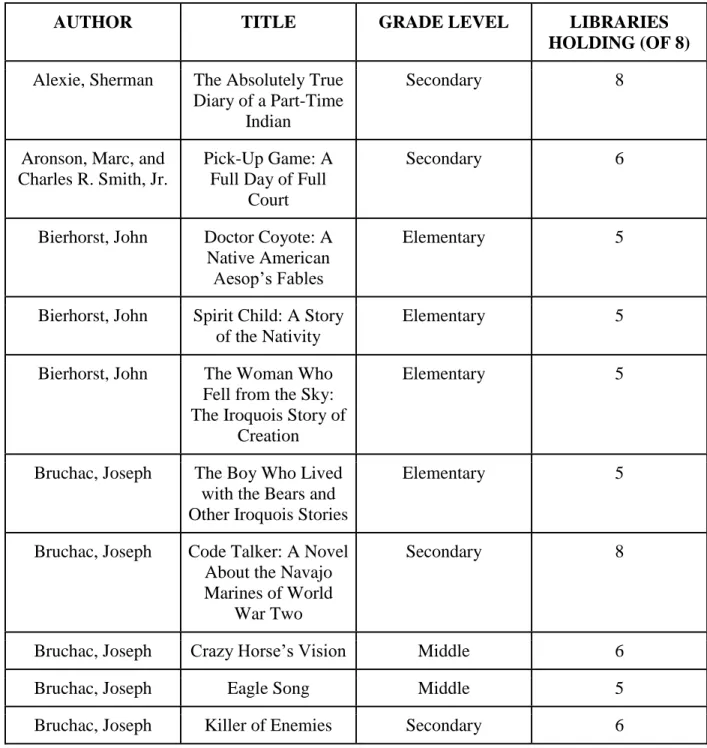
Table 4 lists the titles that were most frequently collected by the libraries in the
study. I consider a title to be frequently held if it was collected by more than half (i.e.,
were frequently collected. The authors who appear more popular than average in
library acquisitions, and who wrote multiple titles that were frequently collected are:
Joseph Bruchac (7 titles), John Bierhorst (3 titles), Louise Erdrich (3 titles), Russell
Freedman (2 titles), and Paul Goble (2 titles).
Table 4: Titles Most Frequently Held
AUTHOR TITLE GRADE LEVEL LIBRARIES
HOLDING (OF 8)
Alexie, Sherman The Absolutely True Diary of a Part-Time
Indian
Secondary 8
Aronson, Marc, and Charles R. Smith, Jr.
Pick-Up Game: A Full Day of Full
Court
Secondary 6
Bierhorst, John Doctor Coyote: A Native American Aesop’s Fables
Elementary 5
Bierhorst, John Spirit Child: A Story of the Nativity
Elementary 5
Bierhorst, John The Woman Who Fell from the Sky: The Iroquois Story of
Creation
Elementary 5
Bruchac, Joseph The Boy Who Lived with the Bears and Other Iroquois Stories
Elementary 5
Bruchac, Joseph Code Talker: A Novel About the Navajo Marines of World
War Two
Secondary 8
Bruchac, Joseph Crazy Horse’s Vision Middle 6
Bruchac, Joseph Eagle Song Middle 5
Bruchac, Joseph Native American Stories
Middle 5
Bruchac, Joseph, and Jonathan London
Thirteen Moons on Turtle’s Back: A Native American Year of Moons
Elementary 5
Cohen, Caron Lee Mud Pony: A Traditional Skidi
Pawnee Tale
Elementary 8
Cornelissen, Cornelia Soft Rain: A Story of the Cherokee Trail of
Tears
Middle 7
Dembicki, Matt Trickster: Native American Tales: A Graphic Collection
Middle 5
Edwardson, Debby Dahl
My Name Is Not Easy
Middle 5
Erdrich, Louise The Birchbark House Elementary 7
Erdrich, Louise Chickadee Elementary 5
Erdrich, Louise The Round House Secondary 8
Freedman, Russell Children of the Wild West
Elementary 7
Freedman, Russell Indian Chiefs Middle 6
Fritz, Jean The Double Life of Pocahontas
Elementary 7
Gansworth, Eric If I Ever Get Out of Here
Middle 7
Goble, Paul Crow Chief: A Plains Indian Story
Elementary 6
Goble, Paul Iktomi and the Buzzard
Elementary 5
Grace, Catherine O’Neill, and Margaret
M. Bruchac
1621: A New Look at Thanksgiving
Hoyt-Goldsmith, Diane
Cherokee Summer Elementary 5
Marzollo, Jean Pretend You’re a Cat Elementary 6
McCall, Guadalupe Garcia
Under the Mesquite Middle 7
Nelson, S. D. Black Elk’s Vision: A Lakota Story
Middle 5
Osofsky, Audrey Dreamcatcher Elementary 7
Rumford, James Sequoyah: The Cherokee Man Who
Gave His People Writing
Elementary 5
Scott, Ann Herbert On Mother’s Lap Elementary 5
Sneve, Virginia Driving Hawk
Dancing Teepees: Poems of American
Indian Youth
Middle 6
Swamp, Jake Giving Thanks: A Native American Good Morning
Message
Elementary 5
Walker, Sally M., and Douglas W. Owsley
Their Skeletons Speak: Kennewick
Man and the Paleoamerican World
Middle 6
Wilson, Daniel H. Robopocalypse Secondary 7
Of the popularly held titles from Table 4: 0 are board books, 19 are elementary books,
12 are middle grades books, and 6 are secondary books. Based on the total number of
books from each category (see Figure 1): 0% of board books are frequently collected,
14.8% of elementary books are frequently collected, 24% of middle grades books are
Another factor I took into account in my data analysis was the frequency with
which the books in the sample were reviewed by professional library journals. Of the
206 sample titles, only 25 (12.1%) were not reviewed by any professional journals (see
Appendix A). Most of the titles were reviewed in several publications, but four stood
out as the most popular sources for professional reviews: Booklist, Horn Book
Magazine, Publishers Weekly, and SLJ. As Figure 3 demonstrates, SLJ was the most
frequent source of professional reviews, having reviewed 161 (78.1%) of the 206 titles
in the sample. Booklist reviewed 137 (66.5%) of the titles, Horn Book Magazine
reviewed 124 (60.1%), and Publishers Weekly reviewed 76 (36.8%). Many of the titles
were reviewed in multiple issues of each journal.
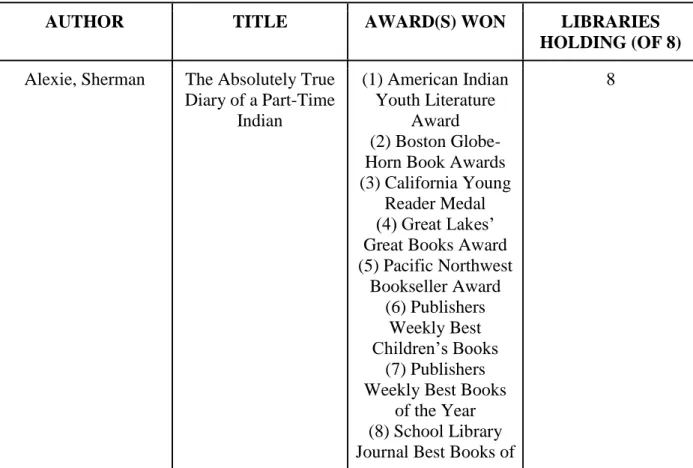
The final variable I looked at was the number of awards won by each book. Of
for awards). The awards ranged from regional accolades (e.g., Minnesota Book Award,
Oklahoma Book Award, etc.) to nationally recognized honors (e.g., American Indian
Youth Literature Award, National Book Award, etc.). As Table 5 illustrates, being the
recipient of awards did not necessarily translate into a higher prevalence of libraries
holding the title. However, one award which does appear to play a strong influence in
the likelihood of library acquisition is the National Book Award. Sherman Alexie’s
The Absolutely True Diary of a Part-Time Indian, as well as Louise Erdrich’s The
Round House, each won the National Book Award, and were both collected by all eight
libraries in the study (of only four books in the sample to hold that distinction).
Conversely, 26 of the other award-winning titles were collected by less than half of the
libraries.
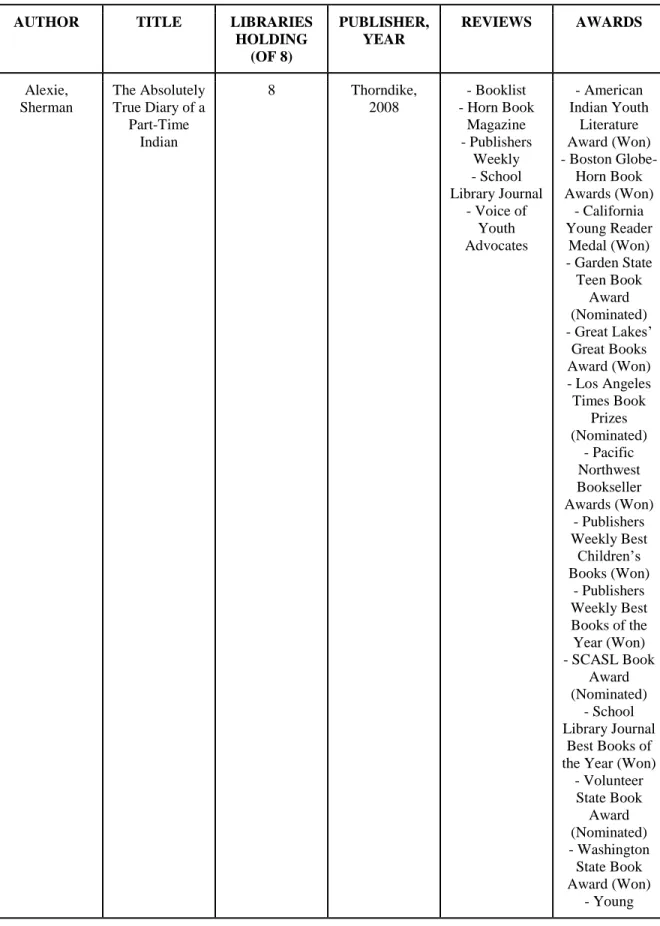
Table 5: Award Winning Books
AUTHOR TITLE AWARD(S) WON LIBRARIES
HOLDING (OF 8)
Alexie, Sherman The Absolutely True Diary of a Part-Time
Indian
(1) American Indian Youth Literature
Award (2) Boston Globe-Horn Book Awards (3) California Young
Reader Medal (4) Great Lakes’ Great Books Award (5) Pacific Northwest
Bookseller Award (6) Publishers
Weekly Best Children’s Books
(7) Publishers Weekly Best Books
of the Year (8) School Library Journal Best Books of
the Year (9) Washington State
Book Award
Bruchac, Joseph Code Talker: A Novel About the Navajo Marines of World
War Two
ALA Notable Books for Children
8
Bruchac, Joseph Crazy Horse’s Vision ALA Notable Books for Children
6
Bruchac, Joseph Hidden Roots American Indian
Youth Literature Award
2
Bruchac, Joseph Jim Thorpe’s Bright Path
Carter G. Woodson Book Award
4
Bruchac, Joseph Killer of Enemies American Indian Youth Literature
Award
6
Campbell, Nicola I. Shin-chi’s Canoe TD Canadian Children’s Literature
Award
2
Confederated Salish and Kootenai Tribes
Beaver Steals Fire: A Salish Coyote Story
American Indian Youth Literature
Award
2
Edwardson, Debby Dahl
Whale Snow Independent
Publisher Book Award
3
Erdrich, Louise The Birchbark House (1) ABC Children’s Booksellers Choices
Award (2) American Indian
Youth Literature Award
7
Erdrich, Louise Chickadee Scott O’Dell
Historical Fiction Award
5
Erdrich, Louise The Game of Silence ALA Notable Books for Children
Erdrich, Louise The Porcupine Year ALA Notable Books for Children
4
Erdrich, Louise The Round House (1) ALA Notable Books (2) Alex Award (3) Minnesota Book
Award (4) National Book
Award
(5) New York Times Notable Books of the
Year (6) Publishers Weekly Best Books
of the Year
8
Fortunate Eagle, Adam
Pipestone: My Life in an Indian Boarding
School
American Indian Youth Literature
Award
1
Fritz, Jean The Double Life of Pocahontas
Boston Globe-Horn Book Award
7
Gerdner, Linda, and Sarah Langford
Grandfather’s Story Cloth
ForeWord Magazine Book of the Year
Award
0
Guest, Jacqueline Free Throw American Indian
Youth Literature Award
0
Guest, Jacqueline Triple Threat American Indian Youth Literature
Award
1
Highway, Tomson Caribou Song American Indian
Youth Literature Award
1
Hirschfelder, Arlene Happily May I Walk: American Indians and Alaska Natives Today
Carter G. Woodson Book Award
1
Hoyt-Goldsmith, Diane
Buffalo Days School Library Journal Best Books of
the Year
Hoyt-Goldsmith, Diane
Cherokee Summer Oklahoma Book Award
5
Jenness, Aylette, and Alice Rivers
In Two Worlds: A Yup’ik Eskimo
Family
Carter G. Woodson Award
1
King, Thomas A Coyote Solstice Tale
American Indian Youth Literature
Award
3
Littlechild, George This Land Is My Land
Jane Addams Children’s Book
Award
0
Loyie, Larry, and Constance Brissenden
As Long as Rivers Flow
Norma Fleck Award for Children’s
Non-Fiction
0
Martin, Jacqueline Briggs
The Lamp, the Ice, and the Boat Called
Fish
(1) ALA Notable Books for Children
(2) Golden Kite Awards
3
Medicine Crow, Joseph
Counting Coup: Becoming a Crow
Chief on the Reservation and
Beyond
American Indian Youth Literature
Award
3
Nelson, S. D. Buffalo Girl: A Hidatsa Story
School Library Journal Best Books of
the Year
2
Nelson, S. D. The Star People: A Lakota Story
Spur Award 1
Rumford, James Sequoyah: The Cherokee Man Who
Gave His People Writing
ALA Notable Books for Children
5
Santiago, Chiori Home to Medicine Mountain
(1) ALA Notable Books for Children (2) American Book
Award
2
Genevieve Osage Indian Boy from Oklahoma
Youth Literature Award
Sneve, Virginia Driving Hawk
The Christmas Coat: Memories of My Sioux Childhood
American Indian Youth Literature
Award
2
Tingle, Tim Crossing Bok Chitto (1) ALA Notable Book for Children (2) American Indian
Youth Literature Award
4
Tingle, Tim How I Became a Ghost
American Indian Youth Literature
Award
2
Tingle, Tim Saltypie: A Choctaw Journey from Darkness into Light
ALA Notable Books for Children
3
Walker, Sally M., and Douglas W. Owsley
Their Skeletons Speak: Kennewick
Man and the Paleoamerican World
(1) Benjamin Franklin Book Award
(2) Independent Publisher Book
Award (3) School Library Journal Best Books of
the Year
6
Wilson, Daniel H. Robopocalypse Alex Award 7
Yerxa, Leo Last Leaf First Snowflake to Fall
(1) CLA Amelia Francis Howard-Gibbon Illustrator’s
Award (2) Elizabeth
Mrazik-Cleaver Canadian Picture Book Award
(3) Mr. Christie’s Book Award
1
One award that would ideally play a great impact on the likelihood of library
twelve titles from this study are recipients of that honor. However, of those twelve
titles, only two–Alexie’s The Absolutely True Diary of a Part-Time Indian and
Bruchac’s Killer of Enemies–were collected by a majority of the subset libraries. No
other American Indian Youth Literature Award winner was collected by more than
Discussion
The most striking aspect of the results from this study is that there are no
noticeable patterns to the collection development practices of the libraries in the subset.
A solid majority of the titles in the sample were collected by less than half of the
libraries, but there were also no underlying commonalities to the titles that were
collected more widely. The results indicate that, while elementary grades books
accounted for over 62% of the books in the sample, a greater percentage of middle
grades and secondary books are likely to be frequently collected by the subset libraries
than either board books or elementary books.
The awards won by any of the books appear to play little impact in the
likelihood that a library will collect a title. The only exception is the National Book
Award, as the two titles in the sample which received that distinction were among the
only four books total collected by all eight libraries. One would hope that selecting
librarians working in areas with high Indian populations would pay particular attention
to the American Indian Youth Literature Award. This award is presented every two
years by the American Indian Library Association (AILA) to the picture book, middle
grades book, and young adult book written by an Indian author or illustrator, upon
which AILA wishes to confer an endorsement of excellence. Those books which
received the American Indian Youth Literature Award are among (if not the) most
culturally relevant books in the sample. However, the data show that those books were
no more likely to be collected than others in the sample. This raises some pressing
follow-up questions, such as: How familiar with the American Indian Youth Literature
AILA is a division of ALA, how well of a job does ALA do of marketing and
promoting this award in official publications, conferences, etc.?
Of the 206 titles in the sample, only 25 were not reviewed in any professional
journals. Some library selectors might argue that reviews play an important role in
acquisitions, as those 25 titles were extremely unlikely to be included in library
collections. However, there are also plenty of examples of books that were reviewed
by several popular publications but were still collected by very few libraries. Thus, any
library professionals who would attempt to defend their collection practices by
referencing the infrequency of professional reviews would not be on solid grounding.
Simply put, there are no excuses. The overwhelming majority of books from the
sample were frequently reviewed by the most popular library journals, such as Booklist,
Horn Book Magazine, Publishers Weekly, and SLJ. In fact, reviewers are to be
commended, as they clearly are putting in the effort to promote culturally authentic
books to selectors. If librarians do not utilize these resources in order to shape more
diverse collections for their patrons, then it is no one’s fault but their own.
It was not the intention of this study to develop a comprehensive bibliography,
however I will comment on one aspect of the composition of the sample books. That
is, the extreme dearth of board books featuring Indian characters and themes for
preschool-aged infants. For my bibliography, I was only able to locate six board books
with positive Indian representations. This paucity is not surprising, but rather in
keeping with recent research. Hughes-Hassell and Cox (2010) performed a content
analysis of 218 board books published between 2003 and 2008, and found that only
only people of color.9 This only reinforces the importance of changing the current
practices in the publishing of children’s literature, and of movements like the WNDB
campaign mentioned in the introduction to this paper.
Finally, I will address one potential objection to this study. I recognize the
importance of honoring the diversity of Indian peoples and tribes. Too often in the
post-civil rights era push toward multiculturalism, disparate peoples have been thrown
together into groupings which imply false homogeneity. Thus persons of diverse
Spanish-American ethnicities all have become Hispanic or Latino, and culturally
distinct Native tribes are all simply Indians. While I believe that it is especially
important that libraries in North Carolina collect books that speak to the identities of
Indian children most likely to live in the state–Lumbee, Cherokee, Haliwa-Saponi, etc.–
I also would argue that it is important to collect books that reflect greater tribal
diversity. It is only through a more nuanced understanding of the multifariousness of
Indian peoples that we might set about rectifying centuries of sweeping stereotypes, and
shatter the myth of Indians as one inchoate oppressed group. Thus the bibliography
that I assembled for this study includes narratives from a multitude of tribal nations
Conclusion
Sometimes now, we dream our way back to the heron dance. Their long wings are bending the air
into circles through which they fall. They rise again in shifting wheels. How long must we live in the broken figures
their necks make, narrowing the sky.
“I Was Sleeping Where the Black Oaks Move” – Louise Erdrich
The importance of diverse collections in public libraries cannot be overstated.
While for this project I chose to focus on the library systems serving the greatest
number of American Indians in North Carolina, it would be equally important for
libraries in other counties and states to collect these and similar titles. I again return to
the mirror/window metaphor. The goal of early literacy as it relates to identity
formation ideally should provide an equal number of windows to mirrors, providing
young people with views of other worlds, while also authentically reflecting their own
lives.
The results from this study are disappointing. While many of the books from
my bibliography were nominated for or won awards, and a solid majority were
reviewed by standard professional journals, less than a quarter were collected by more
than half of the libraries in the study. Given that libraries seem unlikely to collect
books with positive representations of Indians, it begs the question: What if in place of
enabling texts, this study had looked at books with negative and offensive depictions of
Indians? Are libraries more likely to collect titles that in the past have proven harmful
to young Indian readers, such as Lynne Reid Banks’s The Indian in the Cupboard,
Elizabeth George Speare’s The Sign of the Beaver, or Laura Ingalls Wilder’s Little
Additional questions for further research are: What are the collection
development policies of these libraries, and do they include a focus on diverse
acquisitions? In the larger library systems and consortiums, do branches have
purchasing authority or is collection centralized? What are the budgets of these library
Notes
1
I use the term in the sense advocated by Edward Said in Orientalism (Vintage Books, 1979). Quoting Anwar Abdel Malek in Chapter 1: “…the Orient and Orientals [are considered by Orientalism] as an ‘object’ of study, stamped with an otherness … This ‘object’ of study will be, as is customary, passive, participating, endowed with a ‘historical’ subjectivity, above all, active, autonomous, non-sovereign with regard to itself…” (97).
2
This was a prevailing topic at the time especially in the Upper Midwest. The year prior, in February 1973, the “Wounded Knee incident” had taken place in neighboring South Dakota, during which hundreds of Oglala Lakota activists had occupied the town and engaged in a standoff with US Marshals for 71 days.
3
Oyate writes that their work “includes critical evaluation of books and curricula with Indian themes,” as well as workshops, administering a reference library, and the distribution of learning materials for young people.
www.oyate.org
4
Debbie Reese is Assistant Professor of American Indian Studies at the University of Illinois at Urbana-Champaign. On her blog, American Indians in Children’s Literature (AICL), she routinely reviews older and contemporary titles.
www.americanindiansinchildrensliterature.blogspot.com
5
Cynthia Leitich Smith is the author of numerous books for young people, and frequently blogs about American Indian themes in children’s and young adult literature.
www.cynthialeitichsmith.blogspot.com
6
Wilder’s Little House on the Prairie series has come under heavy scrutiny by academics and cultural critics for its depictions of American Indians during the era of westward expansion in the United States. In Little House, Long Shadow: Laura Ingalls Wilder’s Impact on American Culture (University of Missouri, 2008), Anita Clare Fellman argues that Wilder used the books as a platform to advocate her own libertarian politics, and perhaps influenced the emerging ideologies of countless young readers.
7
The Meherrin population is not available through the NC Commission of Indian Affairs website, but was determined via statistics from LEARN NC at the UNC School of Education: Morrow, C., and Chavis, D. (n.d.). About the Meherrin. Retrieved from http://www.learnnc.org/lp/editions/nc-american-indians/7272
8
The list can be located by visiting the following link (check the box next to American Indian under “Multicultural Categories,” and then click “Advanced Search” at the top of the page):
http://ccbc.education.wisc.edu/booksearch/advanced.asp
9
Bibliography
Byler, M. G. (1973). American Indian authors for young readers: A selected
bibliography. New York, NY: Association on American Indian Affairs.
Charles, J. (1987). For the sake of a fad: The misrepresentation of American Indians
and their literature in high school literature anthologies. Journal of Ethnic Studies,
15(2), 131-140.
Cooper, K. C. (1988). I is for Indian: Basic reference materials—Where it all begins.
The Eagle Wing Press, 7(3), 2.
Cooperative Children’s Book Center (2014, June 19). Children’s books by and about
people of color published in the United States. Retrieved from
http://ccbc.education.wisc.edu/books/pcstats.asp
Costo, R. (1977). Fact from fiction. Indian Historian, 10(1), 31-36.
Ferguson, M. J. (1984). Native Americans in elementary school social studies
textbooks. Journal of American Indian Education, 23(2), 10-15.
Fisher, L. (1974). All chiefs, no Indians: What children’s books say about American
Indians. Elementary English, 51, 185-189.
FitzGerald, F. (1979). America revised: History schoolbooks in the twentieth century.
Boston, MA: Atlantic/Little, Brown and Co.
Frayling, C. (2006). Spaghetti Westerns: Cowboys and Europeans from Karl May to
Hirschfelder, A., Molin, P. F., & Wakim, Y. (1999). American Indian stereotypes in
the world of children: A reader and bibliography. Lanham, MD: Scarecrow.
Hughes-Hassell, S., & Cox, E. J. (2010). Inside board books: Representations of
people of color. The Library Quarterly, 80(3), 211-230.
Kelly, I. K., & Falkenhagen, M. (1974). The Native American in juvenile fiction.
Journal of American Indian Education, 13(2), 9-23.
LaBonty, J. (1995). A demand for excellence in books for children. Journal of
American Indian Education, 34(2).
Mendoza, J., & Reese, D. (2001). Examining multicultural picture books for the early
childhood classroom: Possibilities and pitfalls. Early Childhood Research and
Practice, 3(2).
Molin, P. F. (2005). American Indian themes in young adult literature. Lanham, MD:
Scarecrow.
Moore, R. B., & Hirschfelder, A. B. (1977). Feathers, tomahawks and tipis: A study of
stereotyped “Indian” imagery in children’s picture books. In Council on Interracial
Books for Children, Unlearning Indian stereotypes. New York, NY: Council on
Interracial Books for Children.
Munguia, H. (2014, Sept. 5). The 2,128 Native American mascots people aren’t talking
about. Retrieved from
http://fivethirtyeight.com/features/the-2128-native-american-mascots-people-arent-talking-about/
National Congress of American Indians (2013, Oct.). Ending the legacy of racism in
sports & the era of harmful “Indian” sports mascots. Retrieved from
akbwthpmatcoroyolpn_ncai_harmful_mascots_report_ending_the_legacy_of_racis
m_10_2013.pdf
Neubauer, P. (2001). Indian captivity in American children’s literature: A pre-Civil
War set of stereotypes. The Lion and the Unicorn, 25(1), 70-80.
North Carolina Department of Administration, Commission of Indian Affairs (n.d.).
Tribes. Retrieved from http://www.doa.nc.gov/cia/tribes.aspx
Reese, D. (2013, Nov. 5). Resources and kid lit about American Indians. School
Library Journal. Retrieved from
http://www.slj.com/2013/11/collection-
development/focus-on-collection-development/resources-and-kid-lit-about-american-indians-focus-on/
Seale, D., & Slapin, B. (Eds.). (2005). A broken flute: The Native experience in books
for children. Berkeley, CA: Oyate.
Sims Bishop, R. (1997). Selecting literature for a multicultural curriculum. In V. J.
Harris (Ed.), Using multiethnic literature in the K-8 classroom (pp. 1-20).
Norwood, MA: Christopher-Gordon.
Slapin, B., & Seale, D., (Eds.). (1998). Through Indian eyes: The Native experience in
books for children. Berkeley, CA.: Oyate.
Stewart, M. P. (2013). “Counting coup” on children’s literature about American
Indians: Louise Erdrich’s historical fiction. Children’s Literature Association
Quarterly, 38(2), 215-235.
United States Census Bureau (2012, Jan.). The American Indian and Alaska Native
population: 2010. Retrieved from
http://www.census.gov/prod/cen2010/briefs/c2010br-10.pdf
United States Census Bureau (2014, July 8). State & county quickfacts: North
Carolina. Retrieved from http://quickfacts.census.gov/qfd/states/37000.html
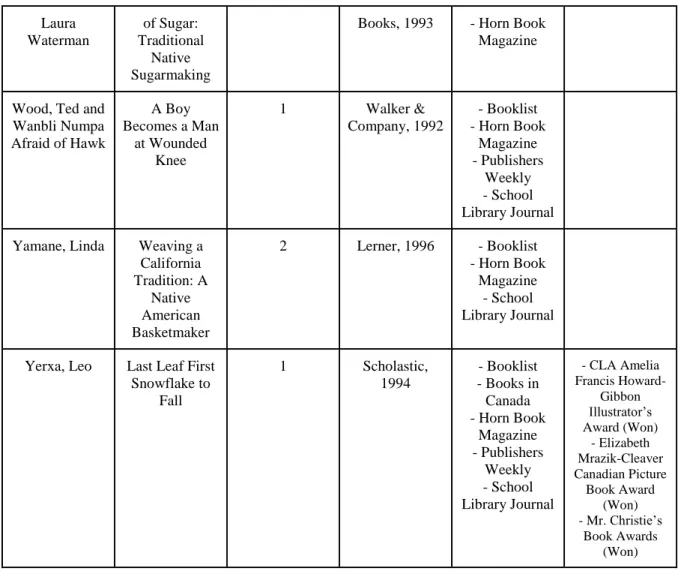
Appendix A: Complete Results
Table A: Board Books
AUTHOR TITLE LIBRARIES
HOLDING (OF 8)
PUBLISHER, YEAR
REVIEWS AWARDS
Blacksheep, Beverly
Baby’s First Laugh
0 Salina
Bookshelf, 2003
Flett, Julie Wild Berries 0 Simply Read
Books, 2013
- Horn Book Magazine - PW Annex
Reviews
Christie Harris Illustrated Children’s Literature Prize
(Nominated)
Himango, Deanna
Boozhoo, Come Play with Us
0 Fond du Lac
Headstart, 2002
Slier, Debby Cradle Me 2 Star Bright
Books, 2012
School Library Journal
Van Camp, Richard
Little You 0 Orca Book
USA, 2013
- Booklist - Publishers
Weekly - School Library Journal
Windsor, Paul Good Morning, World
0 Garfinkel, 2012 School Library Journal
Table B: Elementary Books
AUTHOR TITLE LIBRARIES
HOLDING (OF 8)
PUBLISHER, YEAR
REVIEWS AWARDS
Ancona, George
Powwow 3 Houghton
Mifflin Harcourt, 1993
- Booklist - Horn Book
Magazine - School Library Journal
Awiakta, Marilou
Rising Fawn and the Fire
Mystery
0 Fulcrum, 2007
Begay, Shonto Ma’ii and Cousin Horned
3 Scholastic,
1992
Toad: A Traditional Navajo Story Magazine - Publishers Weekly - School Library Journal
Bierhorst, John Doctor Coyote: A Native American Aesop’s Fables
5 Simon &
Schuster Books for Young Readers, 1987 - Booklist - Publishers Weekly - School Library Journal
Bierhorst, John Lightning Inside You and
Other Native American Riddles 2 HarperCollins, 1999 - Booklist - Horn Book
Magazine - School Library Journal
Bierhorst, John Spirit Child: A Story of the
Nativity
5 Chronicle
Books, 2001
- Horn Book Magazine - Publishers
Weekly
Bierhorst, John The Woman Who Fell from
the Sky: The Iroquois Story
of Creation
5 HarperCollins,
1993
- Booklist - Horn Book
Magazine - Publishers Weekly - School Library Journal Bird Grinnell, George and John Bierhorst The Whistling Skeleton: American Indian Tales of
the Supernatural 2 Collier Macmillan, 1982 Bourdeau Waboose, Jan
Morning on the Lake
1 Kids Can Press, 1997
- Booklist - Horn Book
Magazine - Publishers
Weekly - Quill & Quire
- School Library Journal
Bourdeau Waboose, Jan
SkySisters 1 Kids Can Press,
2000
- Booklist - Horn Book
Magazine - Quill & Quire
- School Library Journal
Ruth and Sylvia Schwartz Children’s Book Award (Nominated)
Books, 2002 - Horn Book Magazine
- School Library Journal
Braine, Susan Drumbeat … Heartbeat: A Celebration of
the Powwow
3 Lerner, 1995 - Horn Book
Magazine - School Library Journal
Brown, Craig Mule Train Mail
0 Charlesbridge,
2009
- Booklist - Horn Book
Magazine - School Library Journal Land of Enchantment Book Award (Nominated) Bruchac, Joseph
The Boy Who Lived With the Bears and Other Iroquois Stories
5 HarperCollins,
1995
- Booklist - Horn Book
Magazine - School Library Journal Boston Globe-Horn Book Awards (Nominated) Bruchac, Joseph
Children of the Longhouse
1 Penguin, 1998 - Booklist
- Horn Book Magazine - Publishers Weekly - School Library Journal Bruchac, Joseph
The Circle of Thanks: Native American Poems and Songs of Thanksgiving 3 Troll Communications, 2003 - Booklist - Horn Book
Magazine
Bruchac, Joseph
Jim Thorpe’s Bright Path
4 Lee & Low, 2004
- Booklist - Horn Book
Magazine - School Library Journal - Black-Eyed Susan Book Award (Nominated)
- Carter G. Woodson Book Awards (Won) - North Carolina Children’s Book Award (Nominated) - Rhode Island
Children’s Book Award (Nominated) - Spur Awards
Bruchac, Joseph
Pushing Up the Sky: Seven
Native American Plays
for Children
2 Penguin, 2000 - Booklist
- Horn Book Magazine - School Library Journal Bruchac, Joseph Seeing the Circle
1 Richard C.
Owen, 1999
- Horn Book Magazine
- Library Journal
Bruchac, Joseph
Tell Me a Tale: A Book About
Storytelling
1 Houghton
Mifflin Harcourt, 1997
- Booklist - Horn Book
Magazine - School Library Journal Bruchac, Joseph, and Jonathan London Thirteen Moons on Turtle’s Back: A Native American Year
of Moons
5 Penguin, 1997 - Booklist
- Horn Book Magazine - Publishers Weekly - School Library Journal Campbell, Nicola I. Shin-chi’s Canoe 2 Groundwood, 2008 - Booklist - School Library Journal - Governor General’s Literary Awards (Nominated) - Marilyn Baillie Picture Book Award (Nominated) - TD Canadian
Children’s Literature Award (Won)
Cohen, Caron Lee
Mud Pony: A Traditional Skidi Pawnee Tale 8 Scholastic, 1993 - Booklist - Publishers Weekly - School Library Journal Confederated Salish and Kootenai Tribes Beaver Steals Fire: A Salish Coyote Story
2 University of
Nebraska, 2005
- Booklist - Horn Book
Guide
American Indian Youth
Literature Award (Won)
Crum, Robert Eagle Drum: On the Powwow Trail
with a Young Grass Dancer
1 Simon &
Schuster Children’s,
1994
- Booklist - Horn Book
Dennis, Yvonne Wakim and Arlene Hirschfelder Children of Native America Today 2 Charlesbridge, 2003 - Booklist - Horn Book
Magazine - School Library Journal
Dorris, Michael Guests 2 Perfection
Learning Corporation, 1996 - Booklist Horn Book Magazine - Publishers Weekly - School Library Journal Edwardson, Debby Dahl
Whale Snow 3 Charlesbridge,
2003
- Booklist - Horn Book
Magazine - Publishers Weekly - School Library Journal Independent Publisher Book Awards (Won)
Erdrich, Lise Bears Make Rock Soup
0 Lee & Low, 2002
- Booklist - Horn Book
Magazine - Publishers Weekly - School Library Journal Minnesota Book Awards (Nominated)
Erdrich, Louise The Birchbark House
7 Disney, 2000 - Booklist
- Horn Book Magazine - Publishers Weekly - School Library Journal - ABC Children’s Booksellers Choices Awards (Won) - American Indian Youth Literature Award (Won) - Great Lakes’
Great Books Award (Nominated) - Maud Hart
Lovelace Award (Nominated) - Volunteer State Book Award (Nominated) - William Allen
(Nominated) - Young Reader’s Choice Award
(Nominated)
Erdrich, Louise Chickadee 5 HarperCollins,
2012
- Booklist - Horn Book
Magazine - School Library Journal Scott O’Dell Historical Fiction Award (Won)
Erdrich, Louise The Game of Silence
1 Hyperion, 1999 - Booklist
- Horn Book Magazine - Publishers
Weekly - School Library Journal
- Voice of Youth Advocates
- ALA Notable Books for Children (Won) - Bluegrass Award (Nominated) - Dorothy Canfield Fisher Children’s Book Award (Nominated) - Georgia Children’s Book Award (Nominated) - Maine Student
Book Award (Nominated) - Maryland Children’s Book Award (Nominated) - Rhode Island
Children’s Book Award (Nominated) - Young Reader’s Choice Award (Nominated)
Erdrich, Louise The Porcupine Year
4 HarperCollins,
2008
- Booklist - Horn Book
Magazine - School Library Journal ALA Notable Books for Children (Won) Fradin, Dennis Brindell Hiawatha: Messenger of Peace
1 Margaret K.
McElderry, 1992
- Booklist - Horn Book
Magazine - Publishers
Library Journal
Francis, Lee DeCora
Kunu’s Basket: A Story from Indian Island
0 Tilbury House,
2012
- Booklist - PW Annex
Reviews - School Library Journal
Freedman, Russell
Children of the Wild West 7 Houghton Mifflin Harcourt, 1983 - Booklist - Publishers Weekly
- Boston Globe-Horn Book
Awards (Nominated)
Fritz, Jean The Double Life of Pocahontas
7 Penguin, 1983 - Publishers Weekly - School Library Journal
- Boston Globe-Horn Book Awards (Won)
- Mark Twain Award (Nominated)
Fritz, Jean The Good Giants and the
Bad Pukwudgies
2 Penguin, 1982
Frost, Helen Salt: A Story of Friendship in a
Time of War
4 Farrar, Straus, Giroux, 2013
- Booklist - Horn Book
Magazine - Publishers
Weekly - School Library Journal
- Voice of Youth Advocates
Galvin, Glenda Chickasha Stories, Volume One: Shared Spirit 0 Chickasaw Press, 2011 Gerdner, Linda and Sarah Langford Grandfather’s Story Cloth
0 Lee & Low, 2008 - Booklist - School Library Journal ForeWord Magazine Book
of the Year Awards (Won)
Goble, Paul Crow Chief: A Plains Indian
Story
6 Scholastic,
1992
- Booklist - Horn Book
Magazine - Publishers
Weekly - School Library Journal
Iron Horse Schuster, 1993 - Publishers Weekly - School Library Journal
Goble, Paul Iktomi and the Buzzard
5 Scholastic,
1994
- Booklist - Horn Book
Magazine - Publishers
Weekly - School Library Journal
Goble, Paul The Return of the Buffalos: A
Plains Indian Story about Famine and Renewal of the
Earth
4 Cengage
Learning, 1996
- Booklist - Horn Book
Magazine Grace, Catherine O’Neill and Margaret M. Bruchac
1621: A New Look at Thanksgiving 5 National Geographic Society, 2001 - Booklist - Horn Book
Magazine - Publishers
Weekly - School Library Journal
Harjo, Joy The Good Luck Cat
4 Houghton
Mifflin Harcourt, 2000
- Horn Book Magazine - Publishers Weekly - School Library Journal Charlotte Zolotow Award (Nominated)
Hartman, Karen Dream Catcher: The Legend and
the Lady
0 Weeping Heart,
1993
Henry, Edna Native American Cookbook
1 Silver Burdett, 1983
Highway, Tomson
Caribou Song 1 Fifth House,
2013
- Quill & Quire - School Library Journal American Indian Youth Literature Award (Won) Highway, Tomson
Fox on the Ice 0 Fifth House,
2011
- Horn Book Guide - Quill & Quire
Hoyt-Goldsmith,
Diane
Arctic Hunter 3 Holiday House,
1992
- Booklist - Horn Book
Magazine - Publishers Weekly - School Library Journal Hoyt-Goldsmith, Diane
Buffalo Days 2 Holiday House,
1997
- Booklist - Horn Book
Magazine - School Library Journal
- Carter G. Woodson Book
Awards (Nominated)
- School Library Journal
Best Books of the Year (Won)
Hoyt-Goldsmith,
Diane
Cherokee Summer
5 Holiday House,
1993
- Booklist - Horn Book
Magazine - School Library Journal Oklahoma Book Award (Won) Hoyt-Goldsmith, Diane Lacrosse: The National Game
of the Iroquois
2 Holiday House,
1998
- Booklist - Horn Book
Magazine - School Library Journal Hoyt-Goldsmith, Diane Pueblo Storyteller
3 Holiday House,
1991
- Booklist - Horn Book
Magazine - Publishers Weekly - School Library Journal Carter G. Woodson Book Awards (Nominated) Hoyt-Goldsmith, Diane
Totem Pole 2 Holiday House,
1990
- Horn Book Magazine
- School Library Journal
Hunter, Sally M.
Four Seasons of Corn: A Winnebago Tradition 3 Turtleback Books, 1996 - Booklist - Horn Book
Magazine - School Library Journal
Ikuwa, Robert Lono
Mohala Mai ‘O Hau / How Hau
Became Hau’ula 0 Kamehameha Schools, 2010 Jordan-Fenton, Christy and
Fatty Legs: A True Story
4 Annick, 2010 - Horn Book
Guide
Margaret Pokiak-Fenton
- Quill & Quire - School Library Journal
of the Year Awards (Nominated) - Information Book Award (Nominated)
- Sheila A. Egoff Children’s Prize (Nominated) - Young Reader’s Choice Award (Nominated)
Katz, Karen The Color of Us
2 Henry & Holt, 1999
- Booklist - Horn Book
Magazine - School Library Journal Florida Reading Association Children’s Book Award (Nominated) Kawai’ae’a,
Kekauleleana’ole Kuamo’o: Kohala Nae’ole’s Race to Save a King
0 Kamehameha Schools, 2010 Keeshig-Tobias, Lenore Bineshiinh dibaajmowin (Bird Talk) 0 Turtleback Books, 1991
King, Sandra Shannon: An Ojibwe Dancer
0 Turtleback
Books, 1993
- Booklist - Horn Book
Magazine - School Library Journal
King, Thomas A Coyote Solstice Tale
3 Groundwood
Books, 2009
- Booklist - Horn Book
Magazine - School Library Journal - American Indian Youth Literature Award (Won) - Silver Birch
Award (Nominated)
Kirk, Connie Ann
Sky Dancers 2 Lee & Low,
2004
- Booklist - Horn Book
Guide - School Library Journal West Virginia Children’s Choice Book Award (Nominated) Lacapa, Kathleen and Michael Lacapa
Less Than Half, More Than
Whole
0 Northland,
1994
- Horn Book Magazine