Understanding Mental Contamination: Relationships with Scrupulosity, Thought Action Fusion, and Perfectionism
Siobhan Hsu
Abstract
Understanding Mental Contamination: Relationships with Scrupulosity,
Thought Action Fusion, and Perfectionism
Mental contamination is defined as the “feeling of dirtiness/pollution/danger provoked by direct or indirect contact with an impure, soiled, harmful, contagious, immoral human
source” (Rachman, 2006, p. 19). Unlike more conventional contact contamination concerns (e.g., of contracting an illness from touching a public restroom toilet), in the case of mental contamina-tion contact with a physical contaminant is not required (Rachman, 2006). Rather, an individual who experiences mental contamination may feel dirty and contaminated just from imagining a subjectively unpleasant or immoral person or scenario (e.g., thoughts of committing incest; a memory of a friend’s betrayal). In response to the resulting distress, this individual may feel the urge to physically cleanse his or her body. Despite much research on contact contamination (Rachman, 2006), further research on mental contamination specifically is needed, because not much is known about this phenomenon or how to treat it.
thought, or thinking of good thoughts to cancel out the memories of lying and restore a sense of morality.
Despite the fact that most research on mental contamination has investigated the extent to which this construct is associated with experiences of contact contamination (e.g., Radomsky et al. 2014), as is illustrated by the previous example mental contamination is often thematically linked to immorality and religion (Rachman, 2006). In these instances, individuals feel physical-ly contaminated because of the perceived immorality of a blasphemous or sinful urge or thought and experience the urge to wash or cleanse themselves (Rachman, 2006). Indeed, as other au-thors have previously stated (Berman, Wheaton, Fabricant, & Abramowitz, 2012), several reli-gious faiths emphasize the importance of having “pure” thoughts, and that sinful thoughts can leave one “unclean.” For example, the Christian Bible states, “I say to you that everyone who looks on a woman to lust for her has committed adultery already in his heart” (Matthew
5:27-28), suggesting that the thought of committing adultery is just as morally wrong as the actu-al act. Furthermore, in response to this uncleanliness, religious texts frequently make reference to symbolically cleansing one’s body and conscience (e.g., “Wash you make you clean; put away the evil of your doings before mine eyes,” Isaiah 1:16). Similar sentiments are also seen in other religions. For example, Abramowitz and Jacoby (2014) mentioned an Orthodox Jewish woman who had thoughts about desecrating the Torah scrolls in the synagogue she attended. In order to neutralize this thought, she compulsively washed her hands, as if physical cleaning were the so-lution and would cancel out the blasphemous thought.
com-pulsions that literally means “fearing sin when there is none” (Abramowitz & Jacoby, 2014, p. 140). Those with scrupulosity fear that they may have committed a sin or done something im-moral without realizing it, which causes significant distress. Thus, they may spend hours obsess-ing over possible moral or religious violations (e.g., “Did my mind wander while I was
praying”), and use repetitive prayer and reassurance-seeking (e.g., from religious figures) in or-der to reduce their distress. Accordingly, scrupulosity is associated with increased symptoms of depression and anxiety (Nelson et al., 2006). Although higher levels of scrupulosity are associat-ed with higher levels of religiosity, (i.e., strength of religious faith; Plante & Boccaccini, 1997), these two constructs are distinct. Indeed, the vast majority of religious individuals do not suffer from scrupulosity, and religiosity may serve as a protective factor (i.e., healthy religious practice is typically associated with positive emotions; Greenberg & Shefler, 2008). Thus, in summary, both mental contamination and scrupulosity can be centered on religious immorality and the de-sire to alleviate the distress associated with subjectively immoral thoughts, whether through physical washing (as seen in mental contamination) or through prayer and reassurance seeking (as seen with scrupulosity). To date, however, no researchers have empirically examined the po-tential overlap between mental contamination and scrupulosity.
Thordar-son, & Rachman, 1996). Specifically, there are two types of TAF: (a) Moral TAF refers to the idea that thinking an immoral thought is as bad as carrying out the associated action (e.g., think-ing about cheatthink-ing on an exam is morally equivalent to actually cheatthink-ing), and (b) Likelihood TAF refers to the idea that thinking of an event will make it more likely to occur (e.g., imagining a loved one getting in a car accident means that an accident is more likely to happen). While both aspects of TAF may certainly play a role, moral TAF in particular has been associated with scrupulosity symptoms (e.g., Nelson et al., 2006) and religiosity (e.g., Berman, Abramowitz, Pardue, & Wheaton, 2010; Rassin & Koster, 2003; Siev & Cohen, 2007), such that individuals with scrupulosity symptoms often believe that blasphemous thoughts are as immoral as blasphe-mous actions. Accordingly, TAF is likely to also contribute to feelings of mental contamination.
In summary, the conceptualization of both mental contamination and scrupulosity sug-gests that the two share similar characteristics because morality plays an important role in both constructs. Both moral TAF and maladaptive perfectionism, in particular, are robustly associated with scrupulosity symptoms. Based on these findings, I hypothesize that mental contamination will be associated with: (a) scrupulosity but not religiosity, (b) both moral and likelihood TAF, and (c) maladaptive but not adaptive perfectionism.
Method Participants
Measures
Vancouver Obsessive Compulsive Inventory Mental Contamination Subscale
(VOCI-MC; Rachman, 2006). The VOCI-MC is a 20-item self-report questionnaire designed to assess the severity of mental contamination symptoms. The items ask the extent to which partici-pants agree with a series of statements about mental contamination (e.g. “I often look clean but feel dirty”, “I often feel the need to cleanse my mind”). Participants rate how much they agree with each of the statements on a scale of 0 (not at all) to 4 (very much); total scores range from 0 to 80. The VOCI-MC demonstrated excellent internal consistency as well as convergent, diver-gent, and discriminate validity in previous studies (e.g., Radomsky et al. 2014). Internal consis-tency of the VOCI-MC in the present sample was excellent (α = .94).
Santa Clara Strength of Religious Faith Questionnaire (SCSRFQ; Plante & Boccacci-ni, 1997). The SCSRFQ measures the degree to which one is religious (i.e., religiosity) with a series of 10 questions (e.g., “I pray daily”, “My faith impacts many of my decisions”). Items are scored on a 4-point Likert scale ranging from 1 (Strongly disagree) to 4 (Strongly agree). Total scores range from 10 to 40, with higher scores indicating that an individual is more religious (Plante & Boccaccini, 1997). The SCSRFQ has excellent reliability and demonstrates conver-gent validity with other established measures of religiosity (Plante & Boccaccini, 1997). Internal consistency of the SCSRFQ in the present sample was excellent (α = .99).
reli-gious affiliation. The PIOS consists of two subscales: (a) fears of having unintentionally commit-ted a religious sin (i.e., Fear of Sin subscale; e.g., “I am afraid of having sexual thoughts”), and (b) fears of being punished by God (i.e., Fear of God subscale; e.g., “I worry that God is up-set with me”). Items are scored on a 5-point Likert scale ranging from 0 (Never) to 4 (Constant-ly); total scores range from 0 to 76. The PIOS has shown adequate psychometric properties in non-clinical samples (Abramowitz et al., 2002; Olatunji, Abramowitz, Williams, Connolly, & Lohr, 2007). Internal consistency of the PIOS in the present sample was excellent (α = .94).
Thought-Action Fusion Scale (TAFS; Shafran, Thordarson, & Rachman, 1996). The TAFS is a 19-item self-report measure of beliefs about the importance of thoughts. Specifically, it contains two subscales: Moral TAF (TAFS-M; 12 items, e.g., “Having a blasphemous thought is almost as sinful to me as a blasphemous action”), and Likelihood TAF (TAFS-L: 7 items, e.g., “If I think of a relative/friend losing their job, this increases the risk that they will lose their job” and “If I think of myself having an accident, it increases the risk that I will have an accident”). Each item is rated on a scale from 0 (Disagree strongly) to 4 (Agree strongly); total scores range from 0 to 76. Internal consistency and discriminant validity in previous studies was excellent (Shafran, Thordarson, & Rachman, 1996). Internal consistency of the TAFS in the present sam-ple was excellent (TAFS-M: α = .93; TAFS-L: α = .94).
that one’s high personal standards are not being met; e.g. “My best just never seems to be good enough for me.”). Factor analytic studies have identified two higher order dimensions of perfec-tionism: adaptive perfectionism (i.e., positive striving; comprised of standards and order sub-scales; APS-A) and maladaptive perfectionism (i.e., preoccupation with unrealistic standards and a feeling of falling short of these standards; comprised of the discrepancy subscale; APS-M). Each item is rated on a scale from 1 (Strongly disagree) to 7 (Strongly agree); total scores range from 23 to 161. Internal consistency and construct validity for the APS-R was good to excellent in previous studies (Slaney et al., 2001). Internal consistency of the APS in the present sample was excellent (APS-A: α = .91; APS-M α = .95).
Procedure
At the beginning of the VOCI-MC participants were given a definition of mental contam-ination and asked if they had ever had this experience. If participants answered yes (n = 111), they were then asked to describe two specific examples of mental contamination thoughts. Par-ticipants then were asked to report: (a) how long ago they last experienced an intrusion about mental contamination, (b) how often they experienced an intrusion about mental contamination in the last six months, and (c) the average level of distress they have when experiencing an intru-sion on a scale from 0 (None) to 5 (Extreme). Those who could not identify a mental contamina-tion experience were directed to the end of the survey.
Participants were allowed to skip any questions that they did not feel comfortable an-swering. At the end of the survey, participants were debriefed, and granted half an hour of course credit in exchange for their participation.
Data Analytic Plan
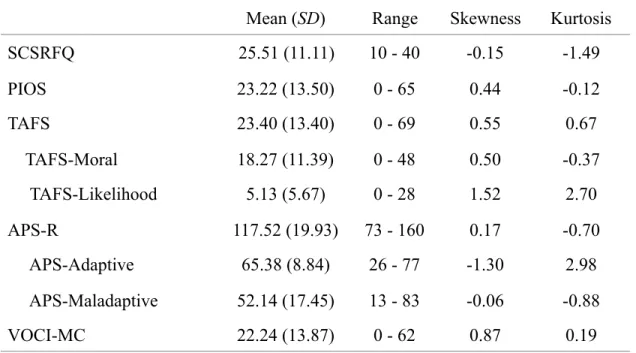
We used SPSS to compute descriptive statistics for all of the study variables. We then computed Pearson’s correlations to examine zero-order associations between the VOCI-MC, PIOS, SCSRFQ, TAFS-M, TAFS-L, APS-A, and APS-M. Finally,to examine the relative contri-butions of scrupulosity, TAF, religiosity, and perfectionism in predicting mental contamination, we computed a simultaneous multivariate regression using the PIOS, SCSRFQ, M, TAFS-L, APS-A, and APS-M to predict the VOCI-MC.
Results
Descriptive Statistics
score was comparable to a sample of undergraduate students in a previous study who were re-cruited based on elevated contamination concerns (M = 18.70, SD = 7.89; Coughtrey, Shrafran, & Rachman, 2014). Furthermore, the mean was higher compared to samples of unscreened un-dergraduates (M = 8.34, SD = 9.64) and lower than patients with OCD who had contamination concerns (M = 30.57, SD = 19.29) in another study (Radomsky et al. 2014). On average, partici-pants reported moderately strong religious beliefs (M = 3.18, SD = 1.52, range = 1-5).
Characteristics of Mental Contamination Thoughts
Participants reported a wide range of mental contamination thoughts. For example, one participant reported feeling the need to shower in order to wash away the shame she felt after she had failed a test. In addition, many participants reported experiencing mental contamination re-lated to thoughts about past emotional violations, thoughts about germy or dirty surfaces, and thoughts about unwanted sexual situations. Participants were asked how long ago they last expe-rienced an intrusion about mental contamination. Forty-two percent of the sample (n = 47) re-ported experiencing their mental contamination thought in the past week (22% in the last month; 36% in the last year). When asked how often they experience an intrusion about mental contami-nation in the last six months, 12% said once or more per day (36% once or more per week; 52% once a month or less). The average level of distress participants reported when experiencing an intrusion was between “a little” and “moderately” distressing (M = 2.32, SD = 1.05); distress levels covered the entire range of the scale (range = 0-5).
Correlational Analyses
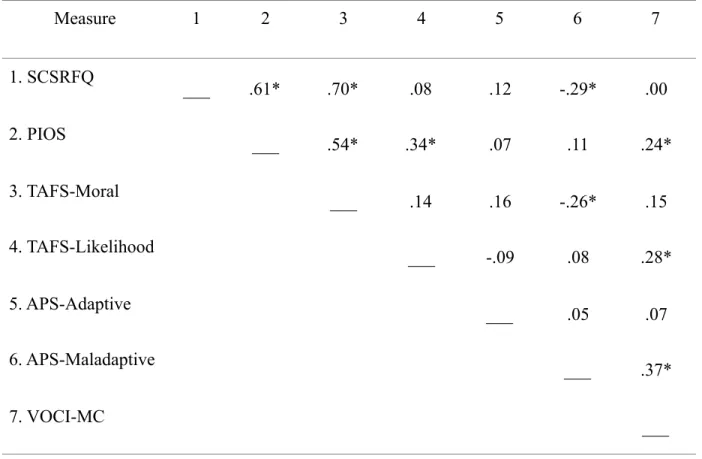
the PIOS was also moderately to strongly correlated with both TAFS-M and TAFS-L. The APS-M was weakly, negatively correlated with SCSRFQ and the TAFS-APS-M. Finally, as can be seen, the VOCI-MC was weakly, positively correlated with the PIOS and the TAFS-L, and was moderate-ly, positively correlated with the APS-M. There were no significant associations between the APS-A and any other study measures.
Simultaneous Regression Analyses
Finally, simultaneous regression analyses were conducted to determine the joint contribu-tions of the SCSRFQ, PIOS, TAFS, and APS in VOCI-MC. Summary statistics for these analyses appear in Table 3. When the SCSRFQ, PIOS, TAFS, and APS were entered as predictors, they collectively accounted for 26% of the variance in VOCI-MC scores (R2 = .26), which was
signif-icant, F (6, 104) = 5.96, p < .0001. As can be seen in Table 3, TAFS-M, TAFS-L and APS-M emerged as significant unique predictors.
Discussion
As previously discussed, mental contamination is defined as a feeling of physical
dirti-ness or contamination without contact with or the presence of a physical contaminant (Rachman,
2006). Despite some research examining relationships between contact and mental contamina-tion (e.g., Radomsky et al. 2014), little is known about mental contaminacontamina-tion, its predictors, or how to address it. Accordingly, the goal of this study was to gain an understanding of possible predictors of mental contamination in order to direct future research as well as generate hypothe-ses for possible treatments of this phenomenon.
re-ligious obsessive-compulsive symptoms (e.g., fears of having unintentionally committed a reli-gious sin) and experiences of mental contamination. For instance, relireli-gious individuals who have an immoral, blasphemous, or sinful thought or urge may feel physically contaminated as a result and experience the urge to cleanse themselves. However, scrupulosity did not emerge as a signif-icant unique predictor after controlling for other included study variables, suggesting that it may not be as central of a predictor of mental contamination as some other constructs discussed sub-sequently. Notably, strength of religiosity more generally, did not emerge as a significant predic-tor of mental contamination, suggesting that perhaps healthy religiosity serves as a protective factor against mental contamination. As mentioned in Greenberg and Shefler (2008), healthy re-ligious practice is often associated with various positive emotions, and rere-ligious doctrines pro-vide lessons (e.g., forgiveness of oneself and others) that may buffer individuals from developing anxiety-related problems.
mental contamination symptoms. However, when moral TAF was entered along with the other cognitive and symptom measures in predicting mental contamination symptoms it did emerge as a significant unique predictor. The fact that the squared semi-partial correlation between moral TAF and mental contamination (after controlling for other study constructs) was stronger than the zero-order relationship between these two variables suggests the presence of a suppressor system; specifically, moral TAF was associated with a unique portion of the leftover unexplained variance in mental contamination symptoms after accounting for the other cognitive and symp-tom predictors. This finding requires additional investigation in order to better understand the complex relationships between these phenomena.
Third, as hypothesized, higher levels of maladaptive perfectionism were associated with elevated levels of mental contamination (even after accounting for other related cognitions and symptoms). Individuals endorsing maladaptive perfectionism are hyper-focused on falling short of excessive personal standards, and this need for perfectionism could also translate to mental contamination-related thoughts. For example, as previously mentioned, one participant reported feeling the need to shower after she thought she had failed an exam in order to “wash the shame” off of herself. In this case, physical cleaning could be seen as an attempt to manage rigid feelings of imperfection (i.e., maladaptive perfectionism). In contrast, adaptive perfectionism was not significantly associated with mental contamination. Thus, there appears to be something unique to maladaptive perfectionism that explains its association with mental contamination. One hy-pothesis is that cognitive inflexibility (i.e., rigid beliefs and standards) accounts for this differ-ence. Future research might examine this more closely.
contam-ination. Based on these results, we are able to better predict which variables portend the presence
of this phenomenon (e.g., likelihood TAF and maladaptive perfectionism). This knowledge could
also help in addressing mental contamination through psychoeducation. For example, the
knowl-edge that likelihood TAF is associated with mental contamination suggests that therapists may
wish to educate individuals that simply thinking of something contaminated or disgusting does
not necessarily mean that one is physically more dirty. In addition, these results could have
im-portant implications for treatment itself. Knowing that both maladaptive perfectionism and
like-lihood TAF are positively associated with mental contamination suggests that similar treatment
strategies could be effective. For example, TAF is often seen in individuals with OCD, which can
be treated with cognitive behavioral therapy (CBT; Wilhelm & Steketee, 2006). Specifically,
pa-tients can conduct behavioral experiments in less anxiety provoking domains in order to “test
out” their TAF beliefs (e.g. buying a lottery ticket, thinking about winning every day for a week,
and seeing if they win). Similarly, perfectionism can be addressed with cognitive strategies in
which patients could be encouraged to take on an alternate perspective (i.e., imagining what rules
and standards a friend may have in a certain domain), and exploring any discrepancies in levels
of perfectionism that exist. Thus, similar strategies may be useful to implement with individuals
who experience mental contamination.
individu-als with clinically elevated levels of OCD or other anxiety symptoms). Future studies should consider examining these constructs in a more diverse, treatment-seeking sample, in order to see the extent to which our findings generalize to clinical populations.
Second, the data were collected using an online survey, and participants were asked to read a definition of mental contamination prior to answering the survey questions. Because of this methodology, we cannot be sure whether participants included in the study fully understood the definition of mental contamination. Thus, future studies should consider having participants complete survey measures in person after an experimenter (a) explains the definition, and then (b) asks participants to identify a mental contamination thought, in order gauge whether or not the participant is able to identify a thought consistent with the definition. Additionally, future studies should utilize methodology beyond self-report. For example, it may be beneficial to use behavioral approaches to experimentally induce mental contamination in a laboratory-based set-ting. For example, participants could be asked to identify a mental contamination thought that they experience related to morality or religion. The participants then would be asked to think or say a statement that triggers the thought (e.g., “I hope I go to Hell when I die”) and then report their in vivo levels of distress and urges to wash. They would also be given the opportunity to wash their hands (and the amount of time they spend washing could be quantified).
how the mind should be clean in response to their thoughts. In addition to experimental para-digms, future studies should consider longitudinal designs to examine the extent to which the study constructs predict later experiences with mental contamination over time.
References
Abramowitz, J., & Jacoby, R. (2014). Scrupulosity: A cognitive–behavioral analysis and implica-tions for treatment. Journal of Obsessive-Compulsive and Related Disorders, 3, 140-149. http://dx.doi.org/10.1016/j.jocrd.2013.12.007
Allen, G., & Wang, K. (2014). Examining religious commitment, perfectionism, scrupulosity, and well-being among LDS individuals. Psychology of Religion and Spirituality, 6(3), 257-264. doi:10.1037/a0035197
Badour, C. L., Ojserkis, R., McKay, D., & Feldner, M. T. (2014). Disgust as a unique affective predictor of mental contamination following sexual trauma. Journal of Anxiety Disorders, 28(7), 704–711. http://doi.org/10.1016/j.janxdis.2014.07.007
Berman, N., Abramowitz, J., Pardue, C., & Wheaton, M. (2010). The relationship between reli-gion and thought-action fusion: Use of in vivo paradigm. Behaviour Research and Ther-apy, 48(7), 670-674.
Berman, N., Wheaton, M., Fabricant, L., & Abramowitz, J. (2012). Predictors of mental pollu-tion: The contribution of religion, parenting strategies, and childhood trauma. Journal of Obsessive-Compulsive and Related Disorders, 1, 153-158.
Fergus, T., & Bardeen, J. (2015). Main and interactive effects of mental contamination and toler-ance of negative emotions in relation to posttraumatic stress symptoms following sexual trauma. Journal of Psychopathology and Behavioral Assessment.
Rachman, S. (2006). Fear of contamination: Assessment and treatment. Oxford: Oxford Univer-sity Press.
Rassin, E., & Koster, E. (2003). The correlation between thought–action fusion and religiosity in a normal sample. Behaviour Research and Therapy, 41, 361–368.
Plante, T. G., & Boccaccini, M. (1997). The Santa Clara Strength of Religious Faith Question-naire. Pastoral Psychology, 45(5), 375–387.
Shafran, R.,Thordarson, D. S.,& Rachman, S. S.(1996). Thought–action fusion in
Obsessive compulsive disorder. Journal of Anxiety Disorders, 10, 379–391. http://dx.-doi.org/10.1016/0887–6185(96)00018-7.
Siev, J. C., & Cohen, A. B. (2007). Is thought–action fusion related to religiosity? Differences between Christians and Jews. Behaviour Research and Therapy 45(4), 829–837. Slaney, R., Rice, K., Mobley, M., Trippi, J., & Ashby, J. S. (2001). The revised almost perfect
scale. Measurement and Evaluation in Counseling and Development, 34, 130-145. Nelson, E., Abramowitz, J. S.,Whiteside, S. P., & Deacon, B. J. (2006). Scrupulosity in patients
with obsessive–compulsive disorder: Relationship to clinical and cognitive phenomena. Journal of Anxiety Disorders, 20, 1071–1086.
Wilhelm, S., & Steketee, G. S. (2006). Cognitive therapy for obsessive compulsive disorder: A guide for professionals. Oakland, CA US: New Harbinger Publications.
Table 1. Means and standard deviations on study measures (n = 111)
Note. SCSRFQ = Santa Clara Strength of Religious Faith Questionnaire, PIOS = Penn Inventory of Scrupulosity, TAFS = Thought Action Fusion Scale, APS-R = Almost Perfect Scale – Revised, VOCI-MC = Vancouver Obsessional Compulsive Inventory – Mental Contamination
Mean (SD) Range Skewness Kurtosis
SCSRFQ 25.51 (11.11) 10 - 40 -0.15 -1.49
PIOS 23.22 (13.50) 0 - 65 0.44 -0.12
TAFS 23.40 (13.40) 0 - 69 0.55 0.67
TAFS-Moral 18.27 (11.39) 0 - 48 0.50 -0.37
TAFS-Likelihood 5.13 (5.67) 0 - 28 1.52 2.70
APS-R 117.52 (19.93) 73 - 160 0.17 -0.70
APS-Adaptive 65.38 (8.84) 26 - 77 -1.30 2.98
APS-Maladaptive 52.14 (17.45) 13 - 83 -0.06 -0.88
Table 2. Associations among cognitive and symptom study measures (n = 111)
Note. SCSRFQ = Santa Clara Strength of Religious Faith Questionnaire, PIOS = Penn Inventory of Scrupulosity, TAFS = Thought Action Fusion Scale, APS-R = Almost Perfect Scale – Revised, VOCI-MC = Vancouver Obsessional Compulsive Inventory – Mental Contamination
*p < .05
Measure 1 2 3 4 5 6 7
1. SCSRFQ
___ .61* .70* .08 .12 -.29* .00
2. PIOS ___ .54* .34* .07 .11 .24*
3. TAFS-Moral ___ .14 .16 -.26* .15
4. TAFS-Likelihood
___ -.09 .08 .28*
5. APS-Adaptive
___ .05 .07
6. APS-Maladaptive ___ .37*
Table 3. Predicting VOCI-MC scores from cognitive and symptom study measures (n = 111)
Note. SCSRFQ = Santa Clara Strength of Religious Faith Questionnaire, PIOS = Penn Inventory of Scrupulosity, TAFS = Thought Action Fusion Scale, APS-R = Almost Perfect Scale – Revised, VOCI-MC = Vancouver Obsessional Compulsive Inventory – Mental Contamination
Predicting VOCI-MC β t p sr2
SCSRF -.15 -1.08 .28 -.09
PIOS .07 0.55 .59 .05
TAFS-Moral .28 2.22 .03 .19
TAFS-Likelihood .21 2.25 .03 .19
APS- Adaptive .04 0.41 .68 .04