James
Charlier
Over
five years have passed since Florida enacted itslandmark growth
management
law. In that time, Floridaplanners
and
publicofficialshave gainedsome
hard-earned experienceinthe practical aspectsofimplementing
astate-wide
growth
management
program.As
expected,transporta-tion issueshave
been
atthe forefront ofthegrowth policydebatesduringthis
"shakedown"
period.One
oftheprimary motivatingfactors thatledFlorida topursue its ambitious
growth
management
program
in the firstplacewas
ageneral publicdissatisfactionwiththetrafficand
highway
congestionthataccompanied
thestate'ssurginggrowth duringthe1970s
and
1980s.Itnow
appearsthatsome
ofthese issues
may
notbeeasilyresolvedas stateand
localgovernments
wrestlewiththecomplex and competing
needsand
demands
ofthisbooming
Sunbeltstate.However,
Flo-ridiansaregainingabetterunderstanding ofthenature ofthe transportationchallenge and, as a result, are beginningtorethinksome
oftheiroriginalassumptions aboutgrowth and
mobility.
Florida
Population
Trends
In1950,Florida
was
aquietrural statewithapopulationof only2.8million,aboutas
many
peopleas lived inIowa
at thattimeon
aboutthesame
landarea.Thirty yearslater,in 1980, the state's populationhad
more
than tripled to 9.7 million.James Charlier is a transportation consultant specializing in
publictransitdevelopment
and
growthmanagement.
He
isaformerdirectoroftheFlorida
Department
ofTransportation OfficeofPolicyand
seivedon theGovernor's Task Forceon
Urban
Growth
Patterns.He
iscurrentlyunderconn-acttothe cityofOrlandoand Orange
Count)',Florida,workingonseveral localpublictransit projects.During
the 1980s, Florida'spopulationgrew
byabout900
peopledaily. Annually, the state
was
adding 350,000 (net)new
residents,roughly equivalenttoaddinganew
citythesizeof
Tampa
everyyear.By
1990,Miami
had
become
thefinan-cialcapitaloftheCaribbean,
Orlando had
become
thetourist capitalofNorth
America,and
over13 millionpeopleresidedin
what had
become
the nation'sfourthlargeststate.Forecasters predict 16 million people will call Florida
home
bytheend
ofthe century.The
conservative projection for2010
is18million,which
willmake
theSunshine
Statethe nation's thirdlargest,afterCaliforniaand
Texas.More
important, however,thantheamount
ofpopulationgrowth
hasbeen
the patternofnew
development
occurringoverthe pastthirtyyears.
Most
ofthepopulationhassettled inthestate'surban
counties,where
80 percent ofFloridiansnow
live.These
countiesare generally locatedin thestate's coastalareas. Infact,ofthesix Florida"secondtier"cities (urbanarea population overone
million),onlyOrlando
is locatedintheinterior.1While development
hasoccurred alongthe coastinurbancounties,
most
of thegrowth-both
in populationand
inemployment-has
been suburban
innature.Four
out offivenew
jobscreatedinFloridaduringthe 1980swas
inasubur-ban
location.From
1980to1990, thepopulation ofFlorida'sunincorporatedareas
grew
bynearly twicethe ratethatthepopulation of incorporatedareas grew.
As
aresult,the gross densityofthestate'surban counties has declinedsteadilyand
only
one
CBD
inFlorida hasreached 100,000employment
(Miami).
Florida Transportation
Trends
Obviously, this rapid population
growth
has placedfinancial resources
and
institutional arrangementsofstateand local government.
Although
this could be said aboutmany
kindsofpublic infrastructure-drainage, potable wa-ter,solidwastedisposal,schools,etc.-ithasbeen
the trans-portationissuesthathave tendedtoframethegrowthman-agement
debateinFlorida.Highways
As
rapidasFlorida's population growth has been,ithasbeen exceeded bythegrowthinhighwaytraffic.
The
increas-ingpopulationcombined
withincreasingautomobileowner-shiphaveled toannual
new
autoregistrationsequivalent toa 1,300-mile,
bumper-to-bumper
line ofcars entering the stateeachyear.It is important to recognize that the traffic growth
on
Florida'shighwaysisnotentirelyattributabletopopulation
growth. Florida's population grew by 34 percent
between
1980
and
1990, buttotalhighwaytravel inthestateincreasedby over50percentduringthat
same
period. Travelon
some
sections ofthe state's interstate highway system has
more
thandoubled duringthe pastdecade,atrend thatcannot be
entirelyexplainedbypopulationincreases.
What
arethefactorscontributingtotrafficgrowth,otherthanpopulation?
A
partiallistwould
include (with 1980to1990trends):
•
Number
oflicenseddrivers(up41 percent)• Percapitaautomobile ownership (up 9percent) • Total
employment
(up 35percent)•
Number
ofhouseholds (up 37percent)Other
more
difficulttomeasure
"travelbehavior"trends also are influencing the traffic growth in Florida's cities.More
peoplearedriving,peoplearemaking
more
autotripseachday,they are
making
more
ofthesetripsaloneintheircars, and they are driving farther
on
the average trip.An
economist mightsayFloridians areconsuming
more
trans-portation(how
much
theytravel),andthey aredoingitlessefficiently
(how
theytravel),thanever before.Over
the past thirty years,Florida has responded to itstraffic growth with an aggressive road-building program.
The
1,400-mile interstate highway system is nearly com-pleted.The
Florida Turnpike-'Tlorida'sMain
Street"-whichrunsdown
the spineofthe statetoMiami,
hasbeen
extended
around
the west side ofMiami
toHomestead,
providing adirectgatewaytothe Keys.
SeveralofFlorida's
major
citieshave turnedtotollroadsasa
means
of providing multi-lane capacity.The
state hasactivelyencouragedthisbyestablishingexpressway
authori-tieswithbroadauthorityto act as virtuallyindependentstate agencies. Jacksonvillebuilt
many
ofits rivercrossingsand
developed anextensiveexpressway system withtollfinancing
inthe1960s
and
1970s.Tampa,
Miami,
Ft.Lauderdaleand
Orlando
all havemany
milesofhigh-capacity tollexpress-ways.
During
the 1970sthestateof Floridawas
adding over300
lanemilesofnew
statehighways eachyear.However,
in spiteoftheroad-buildingeffortsoflocalandstategovernment,Floridahasnot
been
abletokeep
up
with trafficgrowth.By
1985, thepace ofnew
statehighway
con-struction
had
slowed to about 100 lane miles each year.During
thelatterpartofthedecade,the FloridaDepartment
ofTransportationpursued anobjectiveofbuildingat least
one
lanemile ofnew
highway
capacityforeverythree lane miles ofestimatednew
trafficdemand. While
thismay
seem
a
modest
objective,theDOT
estimatedthat,due
tofundingconstraints, it
was
actuallyadding only aboutone
lanefor everyfivelane milesofnew
trafficdemand.
The
DOT
now
estimates thatover50 percent ofthe lane milesofstate
high-ways are "congested," with the percentage in
some
urbancountiesevenhigher.
Public Transit
Florida's publictransitsystems have not
grown
withthestate.
Annual
ridershipon
public transit in 1980was
147millionpassengers.
By
1990,thishad
dropped
to143million.Many
of the state's cities have relatively underdevelopedtransitsystems. Orlando, forexample, with an urban area
population of over1.2million,hasafleetof only 100buses.
High
capacityguideway
transitsystemshavebeen
developedin
Miami
and
Jacksonville,buthave notmoved
pastconcep-tualplanningstagesinother Floridacities.
The
state's onlycommuter
rail system, Tri-RailinDade,Broward and
Palm Beach
Counties has disappointed itssponsors withridershipoffewer than 5,000
weekday
passen-gers.A
state-sponsoredintercity railexperiment,theSilverPalm,
which
provideddailyAmtrak
servicebetween
Tampa,
Orlando and
Miami
in the mid-1980swas
discontinued in1986
when
it failed toachieve the statutorily-mandated60 percent fareboxreturn.The
FloridaHigh Speed
RailProject,which
was
originally planned to provide servicebetween
Tampa, Orlando and
Miami
by 1995, hasbeen
scaledbackand
may
bepostponed
indefinitely.Aviation
Florida's airports have benefited directly
from
the twinboom
intourismand
population.Orlando,inparticular,has thrived, as the Disneycomplex and
other Central Florida touristattractionshave achievedasteadyrecord ofdouble-digitannual
growth
invisitors.Orlando
International Air-portsaw
18 million passengersin 1990,an increaseof280 percentover1980.While
themajor
airportshavemanaged
toachievecapac-ityexpansionsinresponsetoincreasing
demand,
theground
accesstothese airports hasnot keptpace.
Most
ofthestate'slarge airportsare
now
activelypursuingsome
sortof high-capacity transitserviceas ameans
ofmeeting
thisneed. InOrlando, for example, a
number
ofmajor
ground
accesssystemsareinplanningstages.
These
include theMagneticRailProject
(now
inquestion)and
aproposed
raillinkwithPortCanaveral
on
the eastcoast.Ft.Lauderdale,Tampa
and
Miami
are also planning fixedguideway
airport access sys-tems.The
Early
Growth
Management
Legislation
Florida
began
itsgrowth
management
efforts early,with sweeping legislation passed in 1972.That
year the stateembarked
on
aprogram
ofstatecomprehensive
planning,beganidentifyingareasofcriticalstateconcern,
and adopted
a far-reaching
Water
Resources
Act.Three
yearslater, in 1975, the stateimposed mandatory
localgrowth
manage-ment
planningon
itscitiesand
counties.2Of
the severalbillsadopted
in1972, theone
withthemost
lastingimpact
on
transportationplanningwas
the Environ-mentalLand
and
Water
Management
Act
(Chapter 380, Florida Statutes)which
established a processforevaluating"developments ofregional impact" (DRI).
The
DRI
law es-tablishedanextensivedevelopment
approvalprocess involv-ingregionaland
statereview ofprojects thatwould
impactcitizensof
more
thanone
county. Basically, thisimposed
amore-than-localevaluation
on
largeproposed developments
including
shopping
malls, office parksand
subdivisions.Under
Chapter
380,development
review ofDRI
projects is provided through regional planning councilsand
state oversightisprovided bythestate'slandplanningagency, theDepartment
ofCommunity
Affairs.A
systemof impactthresh-olds is used to determine
what
constitutesDRI
projects.Developers preparewrittenresponses toa series of
thirty-two questions designedto
compare
theirproposed
projects against these thresholds. Projectswhich
qualifyasDRIs
must
thenbesubjected tothe extensivereview
and
approvalproc-ess.
Although Chapter 380
requires athorough
review ofawide range ofimpacts,
highway
traffic(question 31) hasbeen
the principal issue for
most
DRI
projects, withenviron-mental impacts (wildlife habitat,wetlands) aclose second.
The
DRI
statutehashad
several positiveeffectson
transpor-tationplanningsincethemid-1970s.First,ithas exposedthetrafficimpacts of
proposed
largeprojectstointensivereview bylocalplanners,thereby providingtheinformationneeded
to
impose
impact fees, site-specific exactionsand
projectdesignrequirements
and
conditions.Itcouldbe arguedthat thewidespread use of impactfees byFlorida local govern-ments (not onlyon
DRI
projects, buton
all types ofnew
development)has
been
facilitated inpartbytheamount
and
qualityofdata
made
availablethrough the detailed analysis of largeDRI
projects. Second, it has built a high level ofprivate-sector expertiseinconductingtrafficcounts, evaluat-ingtrafficdata,runningtrafficmodels,
and
performingawide range of professional transportation analyses. Finally, ithelped create the statewide transportation expertise
and
knowledge needed
to refinesome
oftheconceptsthateven-tually
appeared
inthe 1985Growth Management
Act.Over
theyears, increasinglysophisticated forms ofDRIs
have evolved.
Of
particular interest are "areawideDRIs"
which
provideforplanningand
review ofmaster plans forlarge tracts of land with multiple land owners.
Another
important typeof
DRI
which
is beginning to see frequent applicationisthe"downtown
DRI."
For
example,thecityofOrlando wrote and
obtained ap-provalofa20-yearmaster planfordowntown
Orlando.The
result,an
approved
DRI,
veststhe entirelandareaofdown-town Orlando
withaspecificamount
ofgrowth between
now
and
2010.As
part of thedevelopment
order, the city hascommitted
to specific infrastructureimprovements,
tocer-tainregulatory actions(e.g.,controllingthe
amount
ofdown-town employee
parking),and
toongoing
monitoringactivi-ties. In return, the city will
be
able to grantdevelopment
approvals for large projects within
downtown
foryears tocome
withoutincurringthetimeand
cost (both todevelop-ers
and
toreviewingagencies) thatwould
beassociatedwithindividual
DRIs.
Inaddition toencouraginggood
planning, this use ofthe areawideDRI
tool also supports efforts to focusdevelopment
inexisting urbancenters rather than insuburban
or exurbanareas.The
1985
Growth
Management
Act
Afterseveral yearsofdebate, theFlorida Legislaturetook an ambitiousstep forward withaseries ofbills
now
collec-tivelyknown
as the 1985Growth Management
Act. This legislation,andminor subsequentrevisions,createdormodified the three principal state statutes governing planningand
growth
management
inFlorida.These
areChapter 186(Stateand
RegionalComprehensive
Planning Process), Chapter 187 (StateComprehensive
Plan)and Chapter
163 (LocalGovernment
Comprehensive
PlanningProcess).State
Comprehensive
PlanningProcessThisstatuterequires the preparation ofthree statewide "policyplans"--thestatewaterplan,thestate landplan,and
thestatetransportation plan.
Chapter
186alsorequires thedevelopment
of"agencyfunctionalplans"which
aretoguideand
control thestate'sbudgetaryprocess,ensuringthatstateexpendituressupportfulfillmentofthe goals
and
objectivesofthe State
Comprehensive
Plan.Most
observerswould
agreethatthestatehasnot success-fullyimplemented
thestateplanningprovisionsof Chapter186.Thestatewater,land
and
transportation planshave beenpublished,although with littleimpact.
The
Governor's Of-ficeofPlanningand
Budgetingdidattemptforseveralyears toleadstateagenciesthroughtheagencyfunctionalplanningprocess.Thiseffort
was
largelyunsuccessfulfortwo
reasons.First,theprocessitself
was
socumbersome
thatitcollapsedunder
itsown
weight.For
example,thefirstagencyfunctionalplan
completed
bythe FloridaDepartment
ofarrayed against thestate's transportation goals
and
objec-tives,
none
ofwhich had
much
impacton
appropriationsorpolicy.Second,the Legislatureitselfhas
shown
littleinterestinactuallyconforming annual appropriationstothe elabo-rateobjectives-driven processenvisioned inChapter186.
Inrecentyears,theagencyfunctionalplanningprocesshas
languished unattended, a lingering
shadow
ofthe original intentwhichhas neitherbeen implemented
nor eliminated fromstatute.StateComprehensive Plan
The
StateComprehensive
Planwas
an unusualpiece oflegislation
which
placedinFlorida Statutes alistof26state goalsand
supportingpolicies.These
tendedtobe statementsthatthe
major
interestgroupsinvolvedinpassage ofthebill could agreewith.The
result,Chapter
187, has a"mother-hood
and applepie"flavorandavoidssomeof
thefundamen-tal choices entailed in practical growth
management. For
example, whilea
good
partof thestate'sgrowthmanagement
effortshave addressedthe"urban sprawl" problem,thisterm does notappear
anywhere
inChapter
187.The
statute alsolacks cleardirectionforthestate's trans-portation programs.The
single transportation goal reads: "Floridashalldirectfuture transportationimprovements
to aid in themanagement
ofgrowthand
shall have a state transportationsystemthatintegrateshighway,air,mass
tran-sit,and
other transportation modes."3The
"policies" thataccompany
thisgoalinthe statuteprovidelittleguidancefor thedifficultbut importanttradeoffs thatmust
bemade
ifthestate'stransportation
programs
aretodo
more
thandriftin the direction ofleast resistance.Local
Government
Comprehensive PlanningThisistheportion ofthe1985
Act
thathasgeneratedthemost
activityand
themost
controversy.The
revisedlanguageFigure 1
Local
Comprehensive
Growth
Management
PlansRequired Elements*
AdditionalElements**
CapitalImprovements CoastalManagement
FutureLandUse Public Transit Traffic Circulation Ports,Airports
SanitarySewer,SolidWaste,PotableWater Recreational Traffic (Bicyles, Pedestrians) Conservation PublicBuildings
Housing CommunityDesign Recreation,OpenSpace Redevelopment Intergovernmental Coordination NaturalCatastropheSafety
Historical.ScenicPreservation Economic.Industrial,Commercial
L
*Requiredineverylocalplan ** Certainofthesemayberequired forsome
jurisdictions;others are optional.
in
Chapter
163requirescitiesand
countiestosubmit growthmanagement
planson
aschedulethatstaggers thedue
datesovera three-yearperiodthat
began
in 1988and
endsin1991(coastal counties
and
cities first, rural interior areas last).These
localcomprehensive growth
management
plans aretobe followedwithin
one
yearbyadoption oflanddevelopment
regulations that
implement
the plans.The
Department
ofCommunity
Affairshasdevelopedadetailed administrative rule,Rule
9J-5,implementing
these provisionsofChapter163.In1986, the Legislaturestrengthenedthelegalstature of
Rule
9J-5,incorporatingitbyreference intoChapter
163.The
statutemandates
certain elements that are to be containedinthelocalplans.These
arelisted inFigure1.In additiontothemandatory
elementsthere areelementsthat arerequiredonlyforcertainlocalgovernments and
elementsthatareentirelyoptional.
Under
Chapter
163, the localcomprehensive
plans aresubmittedforregional
and
statereviewforminimum
compli-ance withregional policyplansand
withstate statutes.The
statereviewis
performed
byaffectedstateagenciesand
coor-dinatedbythe
Department
ofCommunity
Affairs,which
has finaladministrativeapprovalauthority.Local
governments
must
have their plansapproved
byDCA
within thetimeframe
established by statute or face sanctions fornon-compliance.The
chiefsanctionsthreat-ened
instatuteare thewithholding ofstatefundingfor local projectsand
havingtheappropriateregionalplanningcoun-cilwrite thelocalplan.Inpractice,the
more
important sanc-tionsmay
bethe potentialforadefactodevelopment
mora-torium resulting
from
the uncertainty surrounding acon-tested plan,
and
the threat ofprotractedlitigation with itsattendantcosts.
Earlyintheplansubmittal process, as the coastal counties
and
citieswere
filingtheirplans,many
ofthelocalplanswere
foundinnon-compliance,oftenforreasonsrelatedto trans-portationissues.
Although
some
of theselocalgovernments
did challenge the state'sau-thority,thestatehas
been
ableto prevailinmost
ofthesecases.However,
out ofthisearly difficulty with the reviewand
approval oflocalplanshas
come
anegotiatedcompliance agreementprocess,which
theDepartment
ofCommunity
Affairsinitiatedtoprovidelocalgovernments
withmore
breathingroom
towork
outtheir differenceswiththestate.Under
theterms ofa
compliance
agreement,acityor countymight
agreetocorrect a deficiencyintheir plan within a certain
amount
of timeand
thus obtain a conditional approval oftheirplan.This administrativesettlementdevice
may, in fact, have significantly lowered the
temperature oftheplan reviewprocess.
An
importantfeatureofthe1985Act
was
re-view processes.
Under
thestatute, "affected citizens"may
challengelocal plans.Neighboring
localgovernments
may
alsointerveneiftheyfeelthey are adversely affectedby
some
featureofa
proposed
local plan.On
a statewidelevel,an advocacy group,the"1000
Friendsof Florida" hasservedas citizen
watchdogs
and
advocatesforthe full
implementation
oftheGrowth
Management
Act.This
group
hasbeen
activeinreviewinglocal plans priortoapprovalby
DCA
and
hasbeen
influential intheevolution and maturation ofthe local plandevelopment and
reviewprocessoverthe past severalyears.
The
Concurrency
Doctrine
A
centraltheme
inFlorida'sapproach
togrowth
manage-ment
hasbeen
the concept of assuring adequate publicfacilities.
For
betteror worse,thetermadopted
todescribethisconcepthas
been
concurrency, aword
which
hasitsroots in asingleobscuresectionofChapter
163: "Itisthe intent of the Legislature that public facilitiesand
servicesneeded
tosupport
development
shallbeavailableconcurrent withtheimpacts ofsuch
development
.. .." 4
LevelofSen'iceStandards
The
principalmeans
ofimplementing
the concurrencydoctrinehas
been
therequirementthatlocalcomprehensive
plans
must
set levelofservice(LOS)
standards for awide
range ofpublicfacilities
and
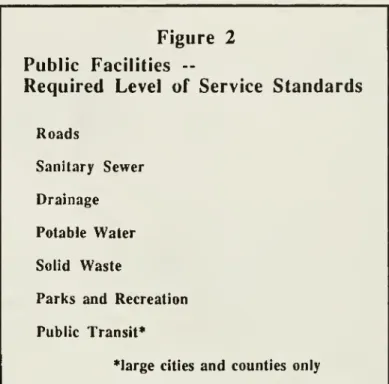
services.For
each ofthecatego-ries in Figure 2, local
governments must
specifywhat
the localLOS
standards will beand
must
compare
forecast conditionswith thosestandards.A
planthatidentifies stan-dardswhich
cannot actuallybemet
(funded)willnot passmusterinthestate'sreviewprocess.
The
LOS
device is adaptedfrom highway
engineeringwhere
it hashistoricallybeen
used to setdesigncriteriaforhighway constructionprojects. In recentyears,
highway
and
transportation planners have increasingly used the
LOS
concepttodescribe actualobserved operational
characteris-ticsof roads
and
streets.Thisapproach
hasbroad appealand
has
now
been
broadened
inFloridatoapplytoawider rangeofpublicfacilities
and
services.Another
importantfeatureoftheconcurrencydoctrineisthe requirement for a five-year capital
improvements
ele-ment
ineachlocalplan.The
capitalimprovements
element must be fullyfunded (itcannot bepredicatedon
hoped-forfuturereferenda orpublic actions)
and must
put infrastruc-tureinplaceatthetimeitisneeded.The
practical effectofthis
approach
toconcurrencymanagement
istoimpose what
might becalled"truthinplanning"
on
localgovernments.Itshould bepossibleforanycitizenorelectedofficialto
deter-mine from
the localcomprehensive growth
management
plan
what
future traffic conditions will prevailon
a givenstreet.
The
capitalimprovements
element shouldshow
what
projectsare planned for that street in
what
yearsand
how
those projects are funded. Finallyit should be possible to
Figure 2
Public
Facilities
--Required
Level
of
Service
Standards
Roads
Sanitary
Sewer
Drainage
Potable
Water
Solid
Waste
Parks
and
Recreation
Public Transit*
"large cities
and
counties onlydetermine
from
thetrafficcirculationelement whether
thiscondition
conforms
to theLOS
standard for that street classificationand
how
itcompares
to conditionson
otherstreets.
Although
the concurrency doctrine applies to severalcategoriesofpublic infrastructure, ithas
been
thehighway
capacity issue that has attractedmost
of the attention inFlorida since 1985.This
may
beinpart aresultofthefactthathighway
LOS
appearstobeeasilymeasured and
understood.The A-B-C-D-E-F
formulation isappealinglysimple (or at leastappearstobe).Also,thehighway
congestionproblem
may
bethemost
readilyvisiblemanifestationofpopulationgrowth
impacts.Nearly everyone observestheeffectsperson-ally,
on
adaily basis.Compare
thiswithstormwater
drainage,which
tendstobe "out ofsight."Similarlyitisdifficultfortheaveragecitizentoactually"see"ashortageof potablewater.
Highway
traffic congestion,on
the other hand, is visible, tangibleand
frustrating.LevelofSen'ice
and
StateHighways
Shortlyafterpassage ofthe1985Act, the Florida
Depart-ment
of Transportationbegan
work
on
thestate transporta-tion plan required byChapter
186.PublishedinSeptember
1986, the Florida Transportation Plan contained an itemwhich
ultimatelybecame
amajor
focalpointforthegrowthmanagement
debate inFlorida: a table entitled"Minimum
Acceptable Operating Level ofServiceStandards for State
Highway
System' 5The
FloridaDOT'S
initial reaction totheGrowth
Man-agement Act was
aconcernforthestatehighway
system.The
department's planners believed local
governments would
Figure
3
Florida's
Level
of Service
Standards-
-State
Highway
System
Basic Standards
Existing Other Urbanized Existing
Areas Cities
Transitioning Urbanized or Incorporated
Areas
Rural Areas
Freeways D C C C
Principal Aiterials D C C C
MinorArierials&Other E D D D
Special
Considerations
Parallelto Special Exclusive Transportation Transit
Areas Facility
Constrained
Facility
Backlogged Facility
Freeways D D Maintain Maintain&Improve Principal Aiterials E E Maintain Maintain&Improve
MinorAiterials&Other E E Maintain Maintain&Improve
by under-fundinglocalroads
and
streets,whileatthesame
time permitting a rapid pace ofdevelopment. This
would
havetheeffectofshifting"local"trafficontostatehighways.
Most
heavily-travelled,multi-lanehighwaysarestatehigh-ways
and
theseare usually themost
direct routesbetween
activity centers. Because ofthediscontinuity of
many
local streets,and
because, evenwhen
congested, state highwaysgenerallyofferbetterend-to-endtraveltimes,it
would
theo-reticallybepossibletocontinueshifting localtrafficto statehighways evenasthey
become
increasinglycongested.The
departmentbelievedthatbysetting
minimum
standards for these roads, the statewould
force localgovernments
to properlyfundlocalroadsand
streets,therebypreserving the statehighway systemforwhat
thedepartment
feltwas
itsin-tended purpose: ".. .
moving
peoplebetween
cities,notbe-tween shoppingcenters ...."
6
Followingthe processlaidoutinthe1985Act, thestate's
Regional Planning Councils
(RPCs)
considered the statehighway
LOS
issue astheywrotetheirregional policyplans. Ultimatelyall ofthestate'sRPCs
adoptedtheDOT'S
stan-dards,thereby giving theLOS
table thestatusof statewide policy to be followed inthe preparationofalllocalgrowthmanagement
plans.It isimportant tonotethat thestate
highway
LOS
stan-dards represent adeparturefrom
acentralphilosophyof the1985Act withrespectto localself-determination.Basically, the
Growth Management
Act
createdamandatory
planningprocess
and imposed
theconcurrency requirementon
localgovernments, but otherwiseleteachcity
and
countyset itsown
course.As
longas future infrastructure requirementswere
identifiedand
fundedtothelevelnecessarytomeet
thelocal
LOS
standards, thestatewas
generally willingtoallow localconditionsto getasbadas local politics
would
allow.However,
the state highwaysystem
became
an exceptionwhere
the statewould
allowconditionstogetonlyas
bad
asthestatestandards allowed.
Over
the years since the original FloridaTransporta-tion Plan
was
published, thedepartment's
LOS
table hasevolved
and
become
more
complex. Figure 3
shows
the tableinitscurrent form.The
familiar letter grades specify thelowestacceptableforecast operationallevelofservice for state highways,
measured
at the30thhighestannualhour
over a twenty-yearhorizoa
The
roadway
types correspond tothestate's functional
classifi-cationsystemforroads
and
streets.7The
applicationofthisapproach
toconcurrencyfor statehighwayshas givenrisetostatewide policydebates
surround-ing
two
subjects centraltoanygrowth
management
program: highway fundingand
urbansprawl.Concurrency
and Highway Funding
Developing
aworkable
system ofLOS
standardsfor statehighwayshas
been
complicatedbythechronicunderfundingof thestate
highway
program. Sinceat leastthemid-1970sthefunding available for capacity
enhancements
to the statehighway
systemhasbeen
much
lessthanwould
berequiredtokeep
pace withFlorida'strafficgrowth.As
aresult,a consid-erable backlog of needs(already congested highways) has builtup,withlittlefundingavailableforthe future capacityexpansions
needed
tosupportthegrowth most
localareasinFlorida
would
liketoseecontinued.The Magnitude
oftheHighway Funding
ShortfallEarly in 1987, after eighteen
months
of work, the StateComprehensive
PlanCommittee,
a blue-ribbon panel ofstateleaders,concludedthatthestate
needed
toincreaseits ten-yeartransportationprogram
by$16billion.A
yearlater,theFlorida
Department
ofTransportationreleasedits Stra-tegicTransportation Planwhich
estimatedthattheshortfallwas
closerto$25billionovertenyears.8Of
the$40billionthedepartment
recommended
the stateshouldspend
between
1989
and
1998($15 billionofwhich
was
funded), over $20the state's levelof
highway
fundingison
acollision coursewithitsconcurrencydoctrine.
In1990, thestateofFlorida raisedthestategastaxbyfour cents
and
increasedotheruserfees dedicatedtotransporta-tion.
The
increasedrevenuefrom
these actionshasallowedthe Florida
DOT
to increaseitswork
program
by over$600
million annually,some
ofwhich
will be invested in statehighway construction.
However,
this funding level is still substantially short ofwhat
would
be required tobuild the projects that stateand
local planners have identified asneeded.
At
thesame
time, stateand
local officialsare finding the tollwayconcept,which had
built somany
miles of limited accessurban highwaysinthe 1970sand
1980s,tobe increas-inglyout offavorwiththepublic. In1988, votersin Jackson-villeapproved
aplanthatwould
replace theexpresswayand
bridgetollswithalocalsales tax
and
refinance theoutstand-ingconstructionbonds.Similarly,arecent increaseintolls
on
Orlando's expressway system,
needed
tofundexpansion ofthe system, has generated a public grumbling that is not
quicklygoing away.
The
statehighway
fundingpicture,combined
withastrictinterpretationofthe concurrency doctrine,has given local
governments
adifficultchoice:slowthe rateofdevelopment
significantly,or
come
up
withlocalfundstoadd
capacityto the statehighway
system. Obviously, neither of these hasbeen
warmly
receivedbylocalleaders.Access
Management
Ifithas
been
clear thatthestatehighway
systemis insuffi-ciently funded, it hasbeen
equally clear thatmuch
ofthe existingcapacityisbeingsquandered
byinadequatecontrol ofaccess.Trafficengineersknow
thatunregulated driveways and entrances can rob an arterialroadway
ofmuch
ofits potential capacity by introducing excessive turningmove-ments
and impeding
the flow of traffic. Stripcommercial
development,
which
is the primary source ofthis problem,also tends to be built in a
manner
that virtually prohibits pedestrianortransitmovements
between commercial
enter-prises. This has the insidious effect of increasing highway trafficwithoutreallyincreasingtravel.
However,
it hasbeen
difficult or impossible forstateorlocal
governments
tocontrol this problem. Efforts to pre-servehighway
capacityby denying driveway permitswould
lead quickly into court
where
the propertyowners would
arguethat denialofaccessdeprived
them
offulluse oftheir property. Failure to grant access, then,became
a "taking"which
had
tobe compensated.The
courtsallowedstateand
localagencies to
deny
accesspermitsfor safetyreasonsbased on engineeringstandards,butgreatlydiscouragedthe denial of accessbasedon
otherpolicyobjectives.Inan attempttoaddressthisproblem,theFlorida Legis-laturepassedthe State
Highway
System
AccessManagement
Actin 1988.9This law recognizes the right to"reasonable
access"toproperty but establishes thatthisisnot the
same
thing as the right to anyparticular
means
of access.The
statute
and
the FloridaDOT
implementing
ruleshave cre-ated a system of classifying highwaysand
types ofaccess. Ultimately, theprogram
willbejointlyadministered bythe stateand
localgovernments
throughagreements
that, ineffect, delegate the
DOT's
permitting authority for statehighway
accessto localagencies.Improved
management
ofaccessto statehighways shouldhelpto preserve
some
of the capacitywhich
hasbeen
pur-chased at great cost to the taxpayers.
However,
it cannot retrievethe capacityalreadylostovertheyears.Concurrency,
Highways and
Urban
Sprawl
During
the past five years in Florida, there hasbeen
agrowing concern aboutthetendencyfor
new
development
toseek out
suburban
and
exurbanlocations.To
understandwhy
thisissuchaproblem,
and
such a sensitive issue,itmay
behelpfulto brieflyreviewthe structureoflocal
government
inFlorida.
Local Government and Urban
BoundariesAs
a"home
rule"state,Florida,throughitsconstitution, giveswide
latitudeto citiesand
a smallnumber
of charter counties to exercise local governance.There
are also two metro-consolidations in Florida,Metro-Dade
(Miami and
Dade
County)
and
Jacksonville (withDuval County) which
have
tremendous
localauthorityand autonomy.
Originally,thesixtyor sonon-chartercounties
were
littlemore
thanadministrativearms
ofthestate,providingcourts,lawenforcement, voter registration
and
taxcollectionserv-ices.
However,
overthe past several decades, counties haveincreasingly
moved
into the business of providing urbanservices.
Land
owners
have traditionally resisted beingab-sorbed by incorporatedjurisdictions and,
under
Floridalaw,annexation is difficult to accomplish.
At
thesame
time, counties,withthecollaborationofthe Legislature,havebeen
able to
employ
suchmechanisms
as special districtsand
specialutilitycorporationstoprovide
urban
services(roads, water,sewer)inunincorporatedareas.Thislackofadefinable
urban
boundary
combined
withtheinescapablearithmeticof lower rural land costs has led to predictableresults:thesuburbanization ofFlorida. In
most
areasofthestatethepopulation of unincorporatedareasis
growingsignificantly fasterthanthepopulation ofthecities.
There
arenow
several large(over100,000 population)unin-corporatedsubdivisions in Florida
and
many
ofthestate's largestcommercial
projects are planned forwhat
are cur-rently rural areas.Governor's
Task
Forceon
Urban Growth
PatternsThe
renewed
interest in"urban sprawl"inthelate 1980smarked
aturning point forthestate'sgrowth
management
serv-"Transportation
issues,principallythose
relatingtohighway
congestion,have
dominated
Florida'sgrowth
management
policydebates
locallyand
in
Tallahassee for
much
of
thepast
six years.What
initiallyseemed
tobe
an
infrastructuretiming
and
funding
problem
now
appears
substantiallymore
complex
and
the 'solutions'are
proving
tobe
elusive."
iceswere
availableor could beefficientlyprovided, theterm"urban sprawl" did not appear.
Nor
did "urbancontain-ment," "concentrated developcontain-ment," "high-density
devel-opment,"
"compact
urban form,"orany oftheothertermstypicalof the sprawl-related vocabulary.
In
May
1988,Governor
Bob
Martinezannounced
theformation of a statewide task force of planners, elected leaders
and
business representatives to study the sprawl issue.The
Governor'sTask
Forceon
Urban
Growth
Pat-ternswas
charged with the responsibilityofrecommending
programs that state
and
localgovernments
could use to
promote
more
efficient,
com-pact
urban
development
patterns.
The
task force
was
also to identifythecostsof sprawl
and
the savings thatcould berealizedfrom
reducingand
slowingsprawl.Followingayear ofspiriteddebateandstatewidehearings the task force, in
June
1989, issued a final reportwhich
concluded thatFlorida
was
facing". . .tremendous
urbansprawl-a
development
pattern characterized byscattered,unplanned,low-density
development
thatisnotfunctionally relatedtoadjacent landuses."The
reportwent on
toassert that "the proliferation of urban sprawl is creating urban growth patternswhich
are degrading the overall qualityoflifeinFlorida
and
increasingfiscalpressureson
ourstateand
localgovernments."10
Many
ofthe taskforce's findingsand
recommendations
were
importantand
far-reaching, including theproposalthat localgovernments
should be required to establish urbanserviceareas
and
urban expansionareasasameans
ofcon-trolling
where and
when
development would
occur.The
finalreport also contained a transportation chapter covering a
range ofsubjects including public transit, parking policy, transportation
demand management
and
interchangeloca-tion.
Highway
LOS
Standardsand Urban Development
PatternsOne
of themost
divisive issuesthe task force wrestledwithwas
the relationshipbetween
statehighway
LOS
standardsand the urban sprawl problem. In the end, the task force
concluded that".
. .locationally insensitive levelofservice
standardshavethe potentialtoencouragesprawling,
ineffi-cientland
development
patternsinourstate."n
What
the task forcehad
discoveredwas
the effect thatstrict enforcement of state
highway
LOS
standards couldeventually have
on development
patterns. Ifdevelopment
could only be permitted
where
adequate highwaycapacitywas
available, that, almost by definition,would
rule outexistingurbancenters
where
highway congestionisinvari-ablythe
most
severe. This couldhave
theeffectof sending developersoutintosuburban
and
ruralareas"shoppingforhighway
capacity"-theopposite oftheconcentrated urbanform
the task force believedFloridaneeded
toencourage.Emerging
Issues— 1991
and
Beyond
After nearlysixyearsof constantdebate
and
discussion, Floridians arenotyet tiredofthegrowth
management
sub-ject.
There
isatremendous
interest across thestate in the technicalde-tailsofgrowth
management,
and
inimprov-ingtheprocess. In 1991,witha
new
governorand
new
play-ers inmany
ofthe key state
agencypositions,thetime
may
beright tobeginaddressingsome
ofthe deficienciesofthe original1985Act.Amending
Growth
Management
PlansAs
the450-pluslocalcomprehensive
plansarecompleted
thisyear
and
the initialimplementation
phase ofthestate-wide growth
management
processwindsdown,
stategrowthmanagement
leadersare beginningtofocus theirattentionon
theprocessbywhich
localplanswillbeamended.
Even
the best plancanbequicklycompromised
bya fewwell-placed land usemap
changes accomplished through the political process.Although
bothChapter
163and
AdministrativeRule
9J-5addressthe subjectoflocalplanamendments,
this issue has not received the attention that itwill eventually require.Most
analysts expect further rule-makingon
thissubject,perhapsas
soon
asmid-1991. Intergovernmental CoordinationThe
need
forcoordinationand
consistencybetween
thecomprehensive
plansofneighboringlocalgovernments
hasbeen
acontinuingissuefrom
the early daysofgrowth
man-agement
inFlorida.During
thepassageand
implementationofthe1985
Act
thisissuewas downplayed
toprotect the basic processfrom
a destructivestatewidebattleoverlocalauton-omy.
However,
Florida will not be able to effectively dealwith the urban sprawl issue until the intergovernmental coordination
problem
isresolved.Most
ofthestate'smajor
urbanareas are
made
up
ofseveral countiesand
cities, allcompeting
fordevelopment and
tax base.Countiesthattodayare rural in character are experiencing
development
pres-sures fueled by lower land costsand
the attractiveness ofFlorida's natural(rural) environment.
While
plannersmay
decrythelossofruralland tolow-density
suburban
sprawl, local officials often seethisdevelopment
pressure as theirThe
Governor'sTask
Forceon
Urban Growth
Patternsrecommended
bettercounty-wide planning inurbancoun-ties,
and
astrengthening oftherequirements oftheintergov-ernmentalcoordinationelementinlocalcomprehensiveplans. It is possible that these proposals will eventually receive considerationbythe Legislature.
Compliance Agreements
The
adoption ofcompliance agreements
bytheDepart-ment
ofCommunity
Affairs as away
towork
outinadequa-cies in local
comprehensive
plansand
avoid protracted,expensivelegalconflicts
was
aboldstep. Ithasbeen
arguedthattheavailabilityofthisoption
may
have savedthegrowth
management
processfrom premature
revisionbythe Legis-lature.However,
thenegotiationofcompliance
agreementsbetween
staffoflocalgovernments and
theDepartment
ofCommunity
Affairscanresultinalocal planthat is consid-erablydifferentfrom
what was
presentedtothepublicand
to electedofficials inlocalpublic hearings.The
state willneed
to
examine
how
itcan preserve thecompliance
agreement
tool yetsafeguardthe public participation
and
citizen stand-ingfeaturesofthelocalcomprehensive
planningprocess. StateBudgetaryProcessFrom
the early days of Florida'sgrowth
management
effort,ithas
been
recognizedthat alanduse-basedapproach
to infrastructure planning could not easily co-exist with a politicallybased, project-specificstate appropriation
proc-ess.
The
Legislature hasbeen
unwilling to yield the all-importantpower
to targetspendingon
favorite projectsinhome
districts.Now,
however,thestateisinaseriousbudget crunch broughton
bythecombined
effectsofarecessionand
anover-reliance
on
thesales tax asarevenuesource.Thishasencourageda
renewed
interest inthestatebudgetaryprocessand particularly in the state budget-planning language in
Chapter186.
There
hasevenbeen
some
discussionthisyear of a"lumpsum,"
non-project-specificappropriations proc-essforcertain infrastructureprograms.Transportation
Concwrency
Management
Areas
As
anoutgrowth
ofthestatehighway
LOS
standardsissue,the
Department
ofCommunity
Affairs has recentlypro-posed an
amendment
toRule
9J-5 thatwould
allow localgovernments
to establish "TransportationConcurrency
Management
Areas."The
intentwould
betogivecitiesand
counties the authority to adopt a different
approach
toroadway
LOS
standards withinspecific areas. Thisapproach
would
entail monitoringand
controlling conditionson
anarea-widebasis.
The
"zonal"approach
hasbeen
advocated byanumber
oflocal
governments
buthasnotbeen
formallyaccepted bythe state.FloridaDOT
wantsstatehighwayLOS
standards appliedand enforced at the "link" level-in other words, to each
section
between
signalized intersections.However,
local transportation planners have argued that this can lead toillogical results, such as adding capacity to roadways that
should notbeenlarged,shutting
down
development
inareaswhere
itshouldbeencouraged
(urbancenters),and
pushingdevelopment
into areaswhere
itisnotdesirable (sprawl).An
example
ofthezonalapproach
canbe foundinthecityof
Orlando comprehensive
plan.12The
Orlando
trafficcircu-lation
element
establishes fifteen trafficperformance
dis-tricts.Conditions inthesedistrictswillbe evaluatedusing a "reportcard" thatmeasures performance
foreachcategoryof
roadway
(limitedaccess, arterialsand
collectors)ineachdirection (north-south
and
east-west).While
traffic condi-tionswillbemeasured and
evaluatedatthe linklevel, trafficperformance
will be reported as the percentage of streetmileagein each category withineachdistrictthat meetsthe
minimum
LOS
standardforthat typeofroad.DCA's
proposed
ruleamendment
was
puton
hold inJanuary, 1991, to allow the newly-appointed
department
secretaryan opportunity to
become
familiarwith theissue.The
rule-making processwill bereactivatedlater in 1991.Conclusions:
Transportation
and
Growth
Management
Transportationissues,principallythoserelatingto
high-way
congestion,havedominated
Florida'sgrowth
manage-ment
policydebates locallyand
inTallahassee formuch
ofthe pastsixyears.
What
initiallyseemed
tobean
infrastruc-turetimingand
fundingproblem
now
appearssubstantiallymore
complex and
the"solutions" areprovingtobeelusive.However,
there are a few conclusions to bedrawn from
Florida'sexperience sofar.
Highway
Capacity: IsMore
Better?Itis
becoming
apparentthat Florida's infrastructure-basedapproach
togrowth
management-defining
thetransporta-tion
problem
interms ofhighway capacity-may
beleadinginthe
wrong
direction. Clearly there are environmentaland
physical limitsto the
amount
ofhighway
construction itis practical topursue. Just asclearly,itisnotpossibletobuildhighwaysat a rate
matching
the rate oftraffic growth.The
money
isnot,and
willnotbe, available.The
originallogicbehinddefininggrowth
management
in infrastructure termswas
the desire to prevent a declining qualityoflifeforFloridaresidents.Yet, littleenhancement
of qualityofliferesults
from
theroadway
capacityimprove-ments needed
to fullyaccommodate
higher traffic flows.Freewaysaretense, stressful,
dangerous
places.Will buildingmore
ofthem
reallyimprove
qualityoflife? Localhighway"improvements"
thatremove
on-streetparkingincommer-cialareas,convertresidentialstreets to
one-way
operation,or
widen
streets into sidewalk areasand
front yardsmay
inflictas
much
lossofqualityoflifeasthecongestionthey areintended tocorrect.
Of
course,notallcapacityimprovements
are undesirable.beuseful tore-define the transportation objectives ofgrowth
management
intermsof qualityoflife,ratherthanpurelyintermsofrateofflow.Inso doing, a decisionmight be
made
toslow traffic
down
on
certain streets (lowering the level ofservice) to
enhance
the pedestrian circulationand
commer-cial vitalityofaneighborhood.
A
decisionmightbemade
toconcentratedensityin a
downtown
area, eventhough
statehighwaysinthevicinityarecrowded.
A
crowded
downtown
(lowlevelofservice) isa healthy
downtown
and
alotmore
funtowalk
around
thana 40-acresuburban
mall parkinglot.Highway
Funding:Whose
ResponsibilityIsIt?Concurrency
management
breaksdown
intheabsence ofa cleardelineation of financial responsibility for highway
construction. Inanycity,
most
dailytraffic,and
virtuallyall peakhour
traffic,is"local."To
definethestate'sresponsibil-ity as being limited to "through" traffic is equivalent to limitingthestateroletofundingruralsegments ofintercity highways.
Few
electedofficials-state, localorfederal-wantto raise taxes topayforinfrastructureifthatcanbeavoided.Ifcon-currency
management
systemsaretoavoidbecoming
finger-pointingexerciseswhere
the principalissueiswhose
faulttheproblem
is,some
fundamentalagreementsmust
be reachedup frontabout whichjurisdictionshave
which
responsibili-ties.InFloridathiswillrequire additionallegislation.Public Transit:
Making
itThroughthe UglyYearsFlorida'scitiesarenot deployingpublictransitasa
major
growth
management
strategy.Yet most
transportation plan-nerswould
agreethatextensive,well-patronized public tran-sit systems areessential to the future of the state'smajor
cities.
What
hasbecome
clear after dozens ofstudiesand
years ofanalysis is that there is a large gap
between
the density thatcan reasonably be served by highwaysand
the densityneeded
tosupport high capacity publictransit.As
aresult,the
community
thatattemptstoconcentratedevelop-ment
inorderto ultimatelyachieve the densityneeded
for transit willendureyearsofcrowded highways-an
ugly situ-ation.The community
thatembarks
on
ahigh-capacity public transitprojectbeforeithas the necessary densitywillendure
yearsof
poor
transitsystemperformance and
the associated financialburden-another
uglysituation.Neitherof thesestrategiesisworkableinan
environment
where
citiesand
countiescompete
witheach otherfordevel-opment.
The
bestway
to attractnew
commercial
develop-ment
projects (and the jobsand
tax base they bring) is toadopt a low-density sprawling urban
form
supported by acontinuing incremental expansion of the arterial highway system withan occasional
new
(toll-funded) freeway. Ulti-mately, theresult willbeahuge network
ofcongestedroad-ways and an urban
development
pattern that cannotbe
economicallyservedbypublic transit-afairly accurate de-scriptionofurbanFlorida today.
Avoiding this faterequires
two
parallel strategies. First,theunderpricing of
highway
travelmust
beaddressed.Thiswill entaila range ofpolicies including parking supply
and
price,higher roadusertaxes,
peak
period tollroadpricing,and
aggressivedemand management
regulations. Second,more
efficientmeans
of supplying public transit servicesmust be
implemented. Thiswillinvolvedevelopingactivitycentercirculators,concentratinghigh-frequencybusservice
on
commuter
routes,and
making
smarter capitalinvest-ments
in fixedguideway
systems. Attractive, fastand
fre-quent transit service can
compete
successfully with autotravel forashare ofdaily
urban
trips.Summary
The
stateofFloridahascome
a longway
in the pastsixyears toward
implementing
the original vision of awell-plannedstate
where
ahighqualityoflifeand
aclean naturalenvironment
couldbe achieved withoutsacrificingastrongand
growingeconomy.
The
transportationcomponent
is,however,still
something
ofa puzzle thatwill not easilybesolved.
The
factisthat,whilealotofplanninghasgone
on,no
cityinFloridahasdone
much
withtransportation infra-structure that representsanysignificantdeparturefrom what
has
been happening
elsewhereinthe Sunbelt.A
tremendous
amount
ofhighway
construction has taken place. Public transit isstill aminor
player.The
state has built fabulous airports.But
thedream
of usingcarefullyplanned transpor-tationsystem investments asa powerful force in achieving thestate'slargergrowth
management
objectiveshasyettoberealized.
Notes
1. Urban areas with populationsoverone millioninclude Jacksonville,
Orlando, Tampa/St. Petersburg/Clearwater, West Palm Beach/Boca Raton,Ft.Lauderdale/Hollywoodand Miami/Hialeah.
2.
A
moredetaileddiscussionof the1972 and 1975legislation,writtenby Dr.John DeGrove,appeared in this publication,Volume 16,No. 1, Spring 1990,at pp.26-34.3- Sec.187.201(20), FloridaStatutes. 4. Sec.163.3177(10)(h), FloridaStatutes.
5. Florida Transportation Plan,Table4-2,page4-8,FloridaDepartmentof Transportation,September,1986.
6. Thiswasaphrase usedoftenbytheGovernorandSecretaryof Transpor-tationduring1989whenthedebate overthisissue peaked.
7. Chapter334, FloridaStatutes.
8. Thedifferenceinthesetwoestimateswasattributable to the assump-tionseach study madeabout the costsof acquiringright ofwayfor highwayconstruction.
9. Section 335.18, FloridaStatutes.
10. FilialReport,Governor'sTaskForce onUrban GrowthPatterns,June, 1989. AvailablefromtheFloridaDepartmentofCommunityAffairsin
Tallahassee.
11. FinalRepon,p.51.