Learning Software Maintenance Tasks in Offshoring
Projects: A Cognitive-Load Perspective
Journal: International Conference on Information Systems 2012 Manuscript ID: ICIS-0780-2012.R1
Track: 07. Global and Cultural Issues in IS
Keywords: IS offshoring, software maintenance, individual learning, knowledge transfer, cognitive load theory, transition phase, cultural distance
Abstract:
Individual learning is central to the success of the transition phase in software maintenance offshoring projects. However, little is known on how learning activities, such as on-the-job training and formal presentations, are effectively combined during the transition phase. In this study, we present and test propositions derived from cognitive load theory. The results of a multiple-case study suggest that learning effectiveness was highest when learning tasks such as authentic maintenance requests were used. Consistent with cognitive load theory, learning tasks were most effective when they imposed moderate cognitive load. Our data indicate that cognitive load was influenced by the expertise of the onsite
coordinator, by intrinsic task complexity, by the degree of specification of tasks, and by supportive information. Cultural and semantic distances may influence learning by inhibiting supportive information, specification, and the assignment of learning tasks.
https://doi.org/10.7892/boris.39356
L
EARNING
S
OFTWARE
M
AINTENANCE
T
ASKS IN
O
FFSHORING
P
ROJECTS
:
A
C
OGNITIVE
-L
OAD
P
ER-SPECTIVE
Completed Research Paper
Oliver Krancher
University of Bern
Institute of Information Systems
Engehaldenstr. 8
3012 Bern, Switzerland
Jens Dibbern
University of Bern
Institute of Information Systems
Engehaldenstr. 8
3012 Bern, Switzerland
Abstract
Individual learning is central to the success of the transition phase in software mainte-nance offshoring projects. However, little is known on how learning activities, such as on-the-job training and formal presentations, are effectively combined during the tran-sition phase. In this study, we present and test propotran-sitions derived from cognitive load theory. The results of a multiple-case study suggest that learning effectiveness was highest when learning tasks such as authentic maintenance requests were used. Con-sistent with cognitive load theory, learning tasks were most effective when they imposed moderate cognitive load. Our data indicate that cognitive load was influenced by the expertise of the onsite coordinator, by intrinsic task complexity, by the degree of specifi-cation of tasks, and by supportive information. Cultural and semantic distances may in-fluence learning by inhibiting supportive information, specification, and the assignment of learning tasks.
Keywords: IS offshoring, software maintenance, individual learning, knowledge trans-fer, cognitive load theory, transition phase, cultural distance
Introduction
The practice of information systems (IS) offshoring has grown significantly since the late 1990s. Compa-nies have been relocating IS services to offshore units such as vendors or captive centers to leverage labor cost differences and to gain access to scarce resources. A considerable number of IS offshoring projects include software maintenance services such as correcting software faults and building software enhance-ments.
Yet, many software maintenance offshoring (SMO) projects do not meet the initial expectations. One fre-quent source of failure is unsuccessful knowledge transfer (KT) to offshore staff (Chua and Pan 2008; Dibbern et al. 2008; Rottman 2008; Westner and Strahringer 2010). In this study, we define KT as the process (Szulanski 2000) through which the offshore unit acquires the knowledge to solve software maintenance tasks. KT is most intense during the transition phase of SMO projects, the period that suc-ceeds the contract signing and involves transferring the ownership of activities to the offshore team (Tiwari 2009). During transition, members of the offshore unit are frequently placed on site to acquire project-specific knowledge by interacting with subject-matter experts (SMEs) such as former delivery staff (Dibbern et al. 2008). Transitions frequently occur in a two-stage process. First, SMEs transfer their knowledge to the onsite coordinators of the offshore unit; second, the onsite coordinators transfer their knowledge to the team members placed offshore. The KT to onsite coordinators in the first stage plays therefore a central role for successful KT to the offshore unit. Unsuccessful KT may yield extra costs for KT, specification, control, and coordination (Dibbern et al. 2008). In the worst case, failure in KT may re-sult in tasks not being taken over by the offshore unit (Chua and Pan 2008). Effective KT to onsite coordi-nators is therefore of central interest to the stakeholders in SMO projects.
Although knowledge may be transferred at various levels, we submit that individual learning is of particu-lar importance in SMO transitions because it is central to maintenance outcomes while being difficult. Software maintainers often have to rely on their tacit knowledge to identify where actions are to be made and to conceive solutions. Their individual performance is strongly driven by their individual knowledge of the specific software application, whereas knowledge of related or unrelated applications has a consid-erably lower impact on their task performance (Boh et al. 2007). This application-specific knowledge is frequently vast given the size and age of many corporate software applications. Cultural and semantic dis-tances between SMEs and onsite coordinators are a further source of complication (Bhagat et al. 2002; Dibbern et al. 2008). Considering the vast amounts of tacit knowledge that need to be transferred in rela-tively short time and across cultural and semantic distances, it is not surprising that information overload was found to significantly constrain individual learning in offshore projects (Chua and Pan 2008). Despite these contextual difficulties, stakeholders in SMO transitions have economic interest in concluding KT in a short time because of the costs imposed by coexistence and collocation of SMEs and onsite coordinators during transition.
If individual learning is at same time crucial and problematic in SMO, there is interest in understanding how to effectively organize it. Unveiling the design options, case studies on offshoring have revealed a set of key learning activity types, such as formal presentations, document study, on-the-job training, and sto-ry-telling (Blumenberg et al. 2009; Chua and Pan 2008; Oshri et al. 2008; Wende et al. 2009). However, little is known on how these learning activities should be effectively combined to meet the contextual con-ditions of a particular offshored maintenance task. This paper attempts to fill this gap by addressing the following research question:
How does the combination of learning activities impact the onsite coordinators’ learning effec-tiveness in the transition phase of SMO projects?
To answer this question, we draw, for the first time, on cognitive load theory (CLT) to explain individual learning effectiveness in SMO projects. In section 2, we develop a theoretical model based on CLT. In sec-tion 3, we describe how we tested the model through a multiple-case study at a Swiss bank. Secsec-tion 4 pre-sents the results of data analysis. Finally, the results are discussed and conclusions are drawn.
Our study contributes to the IS offshoring literature by suggesting how the combinations of learning activ-ities impact learning effectiveness in IS offshoring. We also propose how cultural and semantic distances may interfere with learning in IS offshoring.
Theory
In this section, we develop a theoretical framework to explain and predict individual learning effective-ness in SMO transitions. To this end, we first derive criteria for theory selection from the nature of the problem studied and we argue that CLT has a strong fit with these criteria. Subsequently, we outline the main assumptions of CLT and develop a theoretical model.
Theory Selection
We have selected our reference theory on the basis of the following four characteristics of the KT problem in SMO projects. First, the theory should explain individual-level rather than team-level or organizational learning because individual learning is central software maintenance outcomes while being problematic in IS offshoring. Second, the onsite coordinators strive to acquire the project-specific software maintenance knowledge that the SMEs hold. Hence, the theory should explain how existing knowledge is transferred rather than how new knowledge is created. Third, the theory should make claims about how the combina-tion of learning activities impacts learning. Fourth, the centrality of informacombina-tion overload suggests that the theory should explain how information load influences learning.
We performed a review of the learning literature based on these criteria. To our knowledge, CLT is the sole theoretical lens that meets all five criteria. CLT is currently considered one of the most influential theories in cognitive psychology (Ozcinar 2009; Schnotz and Kürschner 2007). Recent reviews of CLT are presented in Sweller et al. (1998) and in van Merriënboer and Sweller (2005). Next, we outline the main assumptions of CLT.
Cognitive Load Theory
CLT predicts learning outcomes based on the limitations of human memory (Plass et al. 2010). It assumes that working memory is limited in processing novel information, but that it may retrieve information from long-term memory without significant constraints. As a consequence, learners perceive cognitive overload when they need to process more than two or three novel information elements at the same time (Sweller et al. 1998). According to CLT, overload is detrimental not only to understanding but also to learning be-cause no mental resources remain for schema construction and automation, the processes through which learning occurs (Sweller et al. 1998). Effective learning therefore requires keeping the cognitive load on the learner at a medium level. These arguments may offer an explanation for why learning is so problem-atic in the transition phase of SMO. Onsite coordinators may simultaneously be exposed to a vast amount of novel information such as the description of a modification request, the commands of related software modules, and the structure and meaning of the data used in the software modules. Even if they succeed in making sense of this information through a tedious process, CLT predicts rather low learning as an out-come of the process. Next, we describe central constructs of CLT and clarify how they impact learning.
Learning tasks. CLT researchers concur with other instructional theorists (Hattie 2009; Merrill 2002; Reigeluth 1999) that effective learning hinges on the use of learning tasks (Van Merriënboer et al. 2003). We define the use of learning tasks as engagement in authentic tasks (Van Merriënboer et al. 2002) that are realistic for the particular maintenance context. Examples of the use of learning tasks include the de-sign and/or implementation of a modification request, making sense of a the solution to a past modifica-tion request, or observing an expert solving a maintenance task such as during job-shadowing. In con-trast, no learning task is involved e.g. when engineers study software documentation or code for their own sake.
Cognitive load. The central premise of CLT is that the positive effects of learning tasks depend on the cognitive load that the learning task imposes on the learner. The cognitive load should be at a medium level so that the learner is not overstrained by the learning task. According to CLT, cognitive load depends on the expertise of the learner and on the use of load regulation strategies. This implies that learning is ef-fective when load regulation strategies are chosen that are appropriate for the level of expertise of the learner.
domain-specific schemas in long-term memory that enable them to aggregate information to higher-order and therefore less numerous chunks (Chase and Simon 1973). A decrease in the number of novel information chunks is equivalent to a decrease in cognitive load. Hence, as expertise develops, learners are able to handle more complex tasks, while the cognitive load remains constant. Following these arguments, onsite coordinators who have prior experience in maintaining very similar software applications will perceive less load than onsite coordinators whose experience is less specific to the domain of the maintenance task. Moreover, an engineer is less likely to suffer from high load at the end of a successful transition than at its beginning, all else being equal.
Load regulation strategies. The use of load regulation strategies is a second predictor of cognitive load. Load regulation strategies influence the cognitive load imposed by learning tasks. In this study, we con-sider three load regulation strategies: the choice of the intrinsic complexity of the learning task1, the
de-gree of specification of a learning task2, and the supportive information provided to solve a learning task
(Van Merriënboer et al. 2002; Van Merriënboer et al. 2003). Intrinsically complex learning tasks require the learner to simultaneously process more information units than intrinsically simple learning tasks, in-creasing thereby the cognitive load on the learner. For instance, designing mutually dependent data cor-rections in different subareas of a software application is expected to impose higher cognitive load on an engineer than designing independent data corrections in a loosely coupled module. Although the intrinsic complexity of a given maintenance task may be difficult to alter, management may purposefully assign tasks to either onsite coordinators or SMEs depending on their level of complexity. Specification, a second load regulation strategy, refers to the degree to which solution steps for a learning task are given to the learner. Specification is highest in worked-out examples (Renkl 1997), in which the learner is presented the full solution to a problem. In SMO projects, job-shadowing may be seen as an analogous to worked-out examples because the onsite coordinator observes the entire solution process applied by the SME. Completion tasks provide medium specification to the learner because parts of the solution are given to the learner while some solution steps need to be completed. For instance, an SME may compile the design for a software enhancement while the onsite coordinator remains responsible for its implementation. Fi-nally, supportive information is “supportive to the learning and performance of nonrecurrent aspects of learning tasks” (Van Merriënboer et al. 2002, p. 43). This includes activities such as document study, formal presentations and informal discussions.
Taken together, our presentation of CLT suggests that configurations of learning activities may be de-scribed by four dimensions: the use of learning tasks and the three dimensions of load regulation strate-gies (choice of intrinsic task complexity, specification, supportive information). In most transitions, these four dimensions will not be constant over time. Engineers may subsequently work on learning tasks that differ in their intrinsic complexity, specification, or amount of supportive information provided. Configu-rations of learning activities may therefore change over time within the same transition. CLT makes pre-dictions for the learning effectiveness of each of these configurations. We define learning effectiveness as the extent to which learning activity configurations result in increases of expertise.
Theoretical Model
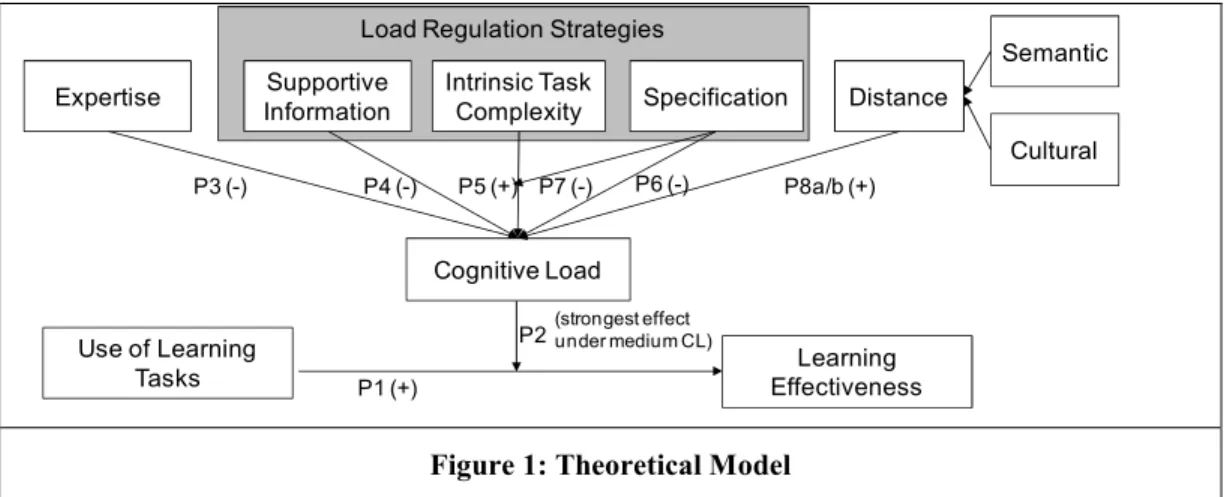
Drawing on CLT, we propose the theoretical model shown in Figure 1 to explain the learning effectiveness of learning activity configurations during the transition phase of SMO projects. The model suggests that the use of learning tasks is positively associated with learning effectiveness. This relationship is moderat-ed by the cognitive load on the learner. The impact of the use of learning tasks on learning effectiveness is strongest, when cognitive load is at a medium level. Cognitive load is influenced by learner’s expertise, by the use of load regulation strategies, and by the distance between the SME and the onsite coordinator. Definitions of the constructs of the model are given in Appendix 1. Next, we present the propositions of the model.
1 We use the qualifier intrinsic to distinguish influences from the complexity intrinsic to a task from
influences from the specification of a task.
2 Van Merriënboer et al. use the expression “simplified learning task types” instead of specification. We
Load Regulation Strategies
Use of Learning
Tasks EffectivenessLearning
Expertise Supportive Information Specification Cognitive Load Distance Intrinsic Task Complexity P3 (-) P4 (-) P5 (+) P6 (-) P8a/b (+) P1 (+) P2 Semantic Cultural P7 (-) (strongest effect under medium CL)
Figure 1: Theoretical Model
Consistent with other instructional theories (Hattie 2009; Merrill 2002; Reigeluth 1999), CLT researchers suggest that the use of learning tasks is positively related to learning effectiveness (Van Merriënboer et al. 2003). Learning tasks confront the learner with the multiple constituent skills that underlie the task and thereby promote the construction and automation of schemas (Van Merriënboer et al. 2002). A learner who is not exposed to a learning task may find fewer opportunities to acquire the multiple constituent skills required for task execution. Periods during which onsite coordinators only participate in and reca-pitulate face-to-face presentations are an example of this. This suggests that
P1: The use of learning tasks is positively associated with learning effectiveness.
A main proposition of CLT is that the positive effects of learning tasks only unfold when the cognitive load lies at a medium and thus manageable level. Low cognitive load may result in waste of time or effort (Schnotz and Kürschner 2007) and, consequently, in ineffective learning. Conversely, high load imposed by a learning task binds all available cognitive resources and leaves no resources for schema construction (Sweller et al. 1998). This suggests that the positive impact of learning tasks on learning effectiveness is moderated by cognitive load as follows:
P2: The impact of the use of learning tasks on learning effectiveness depends on the cognitive load; the impact is stronger under medium cognitive load than under low or high cognitive load.
A multitude of CLT studies provide strong evidence that expertise reduces the cognitive load on the learn-er (see Kalyuga et al. 2003 for an ovlearn-erview). The IS outsourcing litlearn-erature reports a similar effect in SMO projects. Absorptive capacity, i.e. the ability to assimilate and apply outside knowledge (Cohen and Levinthal 1990), was found to influence extra costs for KT (Dibbern et al. 2008). The constructs absorp-tive capacity and expertise overlap given that both indicate the ability to relate outside information to former experience. The extra costs for KT associated with low absorptive capacity suggest that the SMEs in Dibbern et al. (2008) needed to repeatedly provide similar supportive information, which is an indica-tion of high cognitive load. Hence, we propose that
P3: The higher the onsite coordinator’s expertise, the lower is cognitive load.
Supportive information enables the learner to construct schemas that can be used when working on learn-ing tasks (Van Merriënboer et al. 2003). These schemas can be activated durlearn-ing the work on learnlearn-ing tasks and thereby reduce the cognitive load imposed by the tasks. The IS offshoring literature provides anecdotal evidence of the use of supportive information during transition, e.g. through document study or face-to-face presentations (Blumenberg et al. 2009; Chen and McQueen 2010; Chua and Pan 2008; Tiwari 2009). We posit that
Different learning tasks may cause different cognitive load as a function of their intrinsic complexity. We adopt the definition of task complexity suggested by Wood (1986). We thereby consider tasks more com-plex when they involve more elements, when the relationships between these elements are more sophisti-cated, and when changes in the state of the world are more likely to interfere with the task (see Appendix 1 for a more comprehensive definition). We adopted Wood’s conceptualization because it is primarily fo-cused on the task performance of individuals (Wood 1986, p. 66) and because it has already been estab-lished in software maintenance studies (Banker et al. 1998). CLT purports that the more information ele-ments need to be simultaneously processed when working on a learning task, the higher is the cognitive load on the learner (Sweller and Chandler 1994). This suggests that
P5: The higher the intrinsic complexity of the learning task, the higher is cognitive load.
The load imposed by a learning task may depend on its degree of specification. CLT research provides strong evidence that learning task types with high degrees of specification, such as worked-out examples, impose significantly lower loads than conventional problem-solving tasks, in which no solution steps are specified (see Van Merriënboer et al. 2003 for an overview). We anticipate that specification will have both an independent relieving effect on cognitive load and an interaction effect with intrinsic task com-plexity on cognitive load. An independent effect may be expected because highly specified tasks focus the attention of the learner on the solution steps of the expert. As a consequence, the learner does not engage with information or heuristic steps irrelevant to the problem. This may result in lower cognitive load even for simple tasks. In addition, we anticipate an interaction effect with intrinsic task complexity suggesting that specification reduces cognitive load to a greater extent when problems are more complex. This is be-cause complex problems offer the learner more opportunities for engaging with information or solution steps that are irrelevant to the problem. The IS offshoring literature also indicates that specification may impact cognitive load. In the cases reported by Dibbern et al. (2008), client personnel increased the de-gree of specification of software tasks by taking over part of the requirements specification and design work after tasks were initially not feasible. A possible interpretation of this is that specification needed to be increased to mitigate high load invoked by the intrinsic task complexity. To summarize, we expect that
P6: The higher the specification of the learning task, the lower is cognitive load.
P7: The higher the specification of the learning task, the weaker will be the effect of intrinsic task complexity on cognitive load.
Load on the learner is imposed not only by the learning material itself, but also by the learning context. According to CLT, the way how learning material is presented may impact information processing de-mands and thus cognitive load. In onsite SMO transitions, cognitive load may be imposed by the semantic and cultural distances between project members (Dibbern et al. 2008). Semantic distance caused by lan-guage barriers may bind cognitive resources for semantically decoding messages which are in a foreign language or which are poorly crafted due to weak language skills. Cultural barriers may increase cognitive demands when onsite coordinators lack schemas to make sense of the local project context or when they struggle to interpret behavior according to their own cultural norms. This suggests that
P8a/b: The higher the (a) semantic and (b) cultural distances between the onsite coordinator and the SMEs are, the higher is the cognitive load on the onsite coordinator.
Methods
We adopted a positivist, embedded, multiple-case study approach (Yin 2009, p.50) to test the theoretical model. One transition of a software maintenance role to one onsite coordinator represented one case. The configurations of learning activities used within a case were the embedded units of analysis. Figure 2 illus-trates how learning activity configurations are embedded within one fictitious transition. The figure im-plies that the transition can be separated into phases that represent configurations of learning activities. Each configuration makes up one data point for each construct of the theoretical model.
We chose the case-study method because we investigated a how question in a context over which re-searchers rarely have control (Yin 2009, p. 8). In addition, the case-study method allowed us to gather da-ta in the natural setting, ensuring thereby realistic study conditions such as complex software applica-tions, onsite coordinators with previous related experience, and transition durations of several months. Finally, the case-study format permitted us to understand the sequence and context of events, which was essential to relate data to the units of analysis. In four of the five cases, we collected data at several points in time. This was intended to increase the accuracy of the information reported by the participants, such as information related to the cognitive load while they worked on a particular task. The simultaneous data collection prevented us from purposefully sampling embedded cases, which may have been possible in a retrospective study design. Yet, we assumed that learning activity configurations would naturally vary within transitions. Likewise, we expected that the expertise levels of the onsite coordinators would vary as a result of their learning over time.
Time Learning task 1 (low
intr. task complexity)
Learning task 2 (medium intr. task complexity) Study of
docu-ments and code
Spec.: Completion task Spec.: Com-pletion task Spec.: Job-shadowing Supportive information 1 (high) Supportive information 2 (medium) Learning activities Data analysis
Configuration 1 Configuration 2 Configuration 3 Configuration 4
Use of lear. tasks No Yes Yes Yes
Supp. Inform. Not applicable High Medium Medium
Intr. Task compl. Not applicable Low Medium Medium Specification Not applicable Medium Medium High
Figure 2: Illustration of Learning Activity Configurations
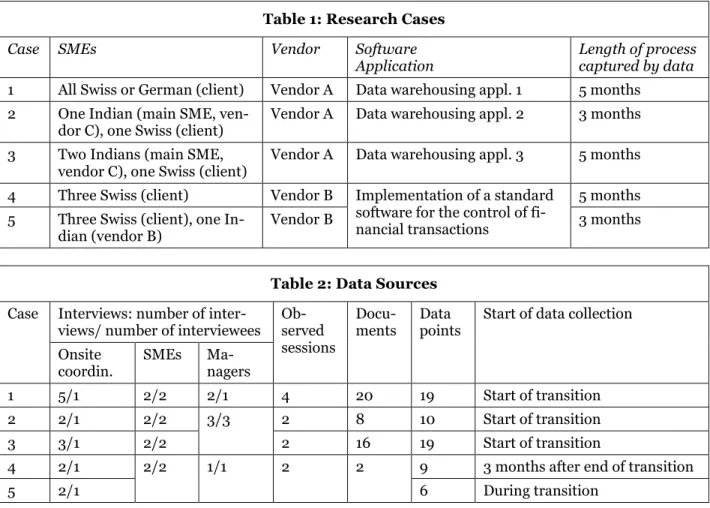
We analyzed five cases of SMO transitions to Indian vendor employees. Table 1 gives an overview of the research cases. The transitions were conducted on site in Switzerland on the premises of a Swiss bank, which represented the client in all five projects. The bank operates globally, held assets of over $1 trillion in 2011, and has considerable experience in offshoring IS work to India. Whereas the cases 2 and 3 were transitions from one vendor to another vendor, tasks were transferred from the client to the vendors in the cases 1, 4, and 5. The three vendors involved in the study were among the major Indian service pro-viders. Each of the transitions 1, 2, and 3 referred to a different software application. These were custom-built data warehousing applications. Each of the cases 4 and 5 referred to the same software system, an instance of a standard software for controlling financial transactions. The selection of cases allowed theo-retical replication (Yin 2009) at the transition level through variation in initial levels of expertise, average intrinsic task complexity, and cultural and semantic distances. In all transitions, the onsite coordinators were supposed to independently take over the design, implementation, and unit-testing of maintenance requests such as software defects or change requests. This provided a natural control for team-level learn-ing, which we assume to be considerably less influential in such settings than in software work with higher collaboration intensity. The transitions took place in 2011 or 2012.
Data Collection
Data were collected through semi-structured interviews, observation of sessions, and document analysis based on a case-study protocol (Yin 2009, p. 79). Table 2 gives an overview of the data sources. An im-portant goal related to the interviews was to understand in what activities the onsite coordinators were in-volved and how they related together. All interviews were tape-recorded and transcribed. In addition, the
first author observed sessions at the client’s premises. This resulted not only in field notes, but also in a basic understanding of the software maintenance tasks. In the cases 4 and 5, the sessions were formal presentations about components of the application, whereas they were coached knowledge elicitation ses-sions in the cases 1, 2, and 3. In the latter, a coach of the client firm facilitated codifying knowledge based on a methodology adopted by the client (see Ackermann 2011 for details). Interview transcripts and ob-servation notes amounted to 112,725 words. Documents were a third data source. The documents studied included requirements specifications, design documents, peer review feedback, defect extracts, docu-ments created as a result of knowledge elicitation sessions, software documentation, KT plans, and email notes. When data from multiple sources of evidence diverged, clarifying questions were addressed in sub-sequent interviews. We used multiple sources of evidence to increase construct validity (Yin 2009, p.41).
Table 1: Research Cases
Case SMEs Vendor Software
Application
Length of process captured by data
1 All Swiss or German (client) Vendor A Data warehousing appl. 1 5 months 2 One Indian (main SME,
ven-dor C), one Swiss (client)
Vendor A Data warehousing appl. 2 3 months
3 Two Indians (main SME, vendor C), one Swiss (client)
Vendor A Data warehousing appl. 3 5 months
4 Three Swiss (client) Vendor B Implementation of a standard software for the control of fi-nancial transactions
5 months 5 Three Swiss (client), one
In-dian (vendor B)
Vendor B 3 months
Table 2: Data Sources
Case Interviews: number of inter-views/ number of interviewees
Ob-served sessions Docu-ments Data points
Start of data collection
Onsite coordin. SMEs Ma-nagers 1 5/1 2/2 2/1 4 20 19 Start of transition 2 2/1 2/2 3/3 2 8 10 Start of transition 3 3/1 2/2 2 16 19 Start of transition
4 2/1 2/2 1/1 2 2 9 3 months after end of transition 5 2/1 6 During transition
Data Analysis
The data analysis involved coding, statistical analysis, pattern matching, and the triangulation of statisti-cal and qualitative results. In detail, we performed the following steps:
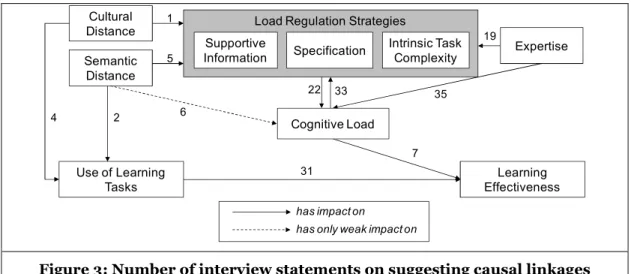
(1) We coded data to nodes and relationship nodes in NVivo 9. The nodes were based on the measures displayed in Appendix 1. In addition, we coded interview statements that indicated causal linkages to relationship nodes in NVivo. Relationship nodes indicate relationships between two nodes. The relationship nodes were displayed in a model (see Figure 3). Relationship nodes only depict relations between two nodes. They may therefore not reflect moderated relationships. (2) We displayed the chronology of learning activities in one event-flow network (Miles and
(3) We determined distinct learning activity configurations to obtain the data points of our embedded unit of analysis. To this end, we looked for discontinuities in learning activity configurations with-in the cases. Each distwith-inct learnwith-ing activity configuration was a data powith-int. Examples of disconti-nuities include the assignment of a new learning task or a change it its degree of specification (see Figure 2 for an illustration). This process resulted in 63 data points.
(4) We determined construct instances for each of the learning activity configurations. The instances were determined using the criteria that are partially displayed in Appendix 1 and a scale from 0 (low) to 1 (high). Rationales for the assignment of each value were documented in a framework matrix to maintain the chain of evidence. Examples for determining construct instances are given in Appendix 1. Values were set as missing when the available data did not allow to determine the construct instance. As a consequence of missing values, 59 data points could be used to predict cognitive load and 45 could be used to predict learning effectiveness.
(5) We performed pattern matching to compare theoretically predicted patterns with those observed in the cases (Yin 2009). For instance, to analyze the predictors of cognitive load, we looked for situations in which a change in only one of the predictors could be observed and we validated whether this resulted in the theoretically suggested outcome, such as a relief of cognitive load. (6) We built multiple linear regression models to test our predictions of cognitive load (n=59) and
learning effectiveness (n=45). The purpose of the statistical analysis was to increase the internal validity of our analysis by triangulating qualitative and quantitative findings (Yin 2009). The sta-tistical analysis was thereby intended to increase the confidence in the relationships found in our data rather than to enable statistical generalization beyond the contexts of the cases. In addition, the statistical analysis was useful to illustrate moderation relationships and the relative strength of relationships. However, significance levels established in the data need to be interpreted with caution. The reported significances are likely to be overestimated because our observations were not fully independent, being nested in the cases. This is particularly salient for the two distance dimensions, which have low within-case variation. We therefore did not include semantic and cul-tural distances into the regression models, leaving their influence subject to the qualitative analy-sis. To mitigate the impact of within-case interdependence on correlations among the remaining variables, we controlled for case-specific influences by adding dummy variables for the cases. We transformed expertise to -1/expertise to reflect a curvilinear relationship that puts greater empha-sis on expertise gains from a low level than from a high level.
(7) Finally, we triangulated the findings from the statistical analyses, from pattern matching, and from interview statements on causal linkages.
Results
We next present the results of the regression analyses. We then limit our presentation of the qualitative analysis to the results that extend the findings of the statistical analysis.
Results of the Statistical Analysis
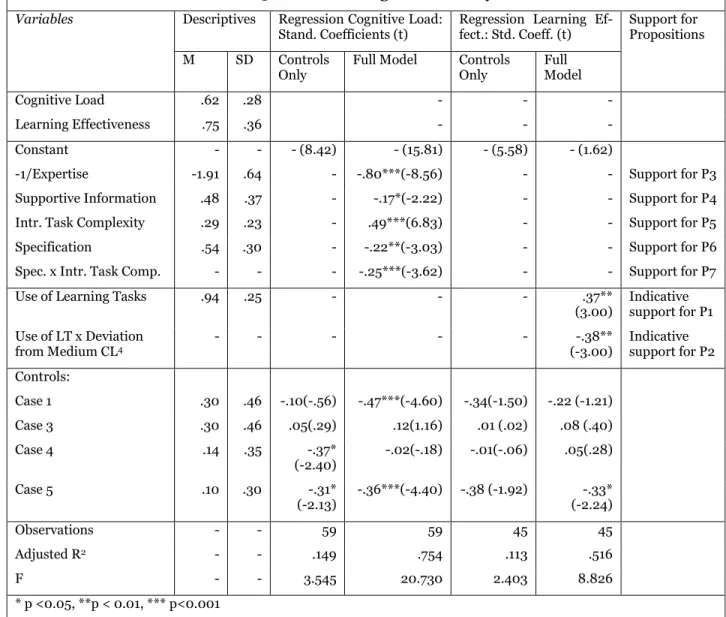
Table 3 shows the descriptive statistics and the results of the regression analyses. The regression model predicting cognitive load shows an adjusted R2 of .149 when only the control variables for the cases are
in-cluded. Adding the direct effects on cognitive load resulted in an adjusted R2 of .694 (not shown in Table
3). Adding the moderation effect of intrinsic task complexity and specification significantly (p=.0013)
in-creased adjusted R2 to .754. Although the R2 values may be inflated by within-case interdependence, they
suggest that the configurations of learning activities within cases explained a substantial part of the vari-ance. Expertise (p<.001), intrinsic task complexity (p<.001), and specification (p<.01) were strongly
3 We report the significance levels as they resulted from regression estimations. The true significance
lated to cognitive load in the hypothesized directions. The anticipated negative interaction effect of intrin-sic task complexity and specification also manifested strongly in our data (p<.001). The correlation of supportive information and cognitive load was in the expected direction and somewhat weaker (p<.05) than the other correlations. Overall, the regression results reflect the anticipated relationships, although the significance reported is likely to be overestimated due to within-case interdependence.
Table 3: Results of Regression Analyses
Variables Descriptives Regression Cognitive Load:
Stand. Coefficients (t)
Regression Learning Ef-fect.: Std. Coeff. (t)
Support for Propositions
M SD Controls
Only
Full Model Controls
Only Full Model Cognitive Load .62 .28 - - - Learning Effectiveness .75 .36 - - - Constant - - - (8.42) - (15.81) - (5.58) - (1.62)
-1/Expertise -1.91 .64 - -.80***(-8.56) - - Support for P3
Supportive Information .48 .37 - -.17*(-2.22) - - Support for P4
Intr. Task Complexity .29 .23 - .49***(6.83) - - Support for P5
Specification .54 .30 - -.22**(-3.03) - - Support for P6
Spec. x Intr. Task Comp. - - - -.25***(-3.62) - - Support for P7
Use of Learning Tasks .94 .25 - - - .37**
(3.00) Indicative support for P1 Use of LT x Deviation from Medium CL4 - - - -.38** (-3.00) Indicative support for P2 Controls: Case 1 .30 .46 -.10(-.56) -.47***(-4.60) -.34(-1.50) -.22 (-1.21) Case 3 .30 .46 .05(.29) .12(1.16) .01 (.02) .08 (.40) Case 4 .14 .35 -.37* (-2.40) -.02(-.18) -.01(-.06) .05(.28) Case 5 .10 .30 -.31* (-2.13) -.36***(-4.40) -.38 (-1.92) -.33* (-2.24) Observations - - 59 59 45 45 Adjusted R2 - - .149 .754 .113 .516 F - - 3.545 20.730 2.403 8.826 * p <0.05, **p < 0.01, *** p<0.001
The regression model predicting learning effectiveness showed an adjusted R2 of .113 when only the case
dummy variables were included. Adding the use of learning tasks as a predictor significantly (p<.001) in-creased adjusted R2 to .417 (not shown in Table 3). Adding the interaction of the use of learning tasks and
the deviation from medium cognitive load again significantly increased adjusted R2 to .516. This suggests
again that within-case variation in the configuration of learning activities may explain a considerable part of the variance. The results were as anticipated in P1 and P2. The use of learning tasks was positively asso-ciated with learning effectiveness and this effect was stronger when the deviation to medium cognitive load was lower, i.e. when cognitive load was closer to medium. Again, the calculated significance levels
need to be interpreted with caution given the limitations stated above. In addition, this regression model is affected by a lower sample size and by the asymmetric dichotomous distribution of use of learning tasks. The results related to the dependent variable learning effectiveness may therefore be regarded as indicative and thus dependent upon further corroboration with the qualitative analysis.
Triangulation with Qualitative Data
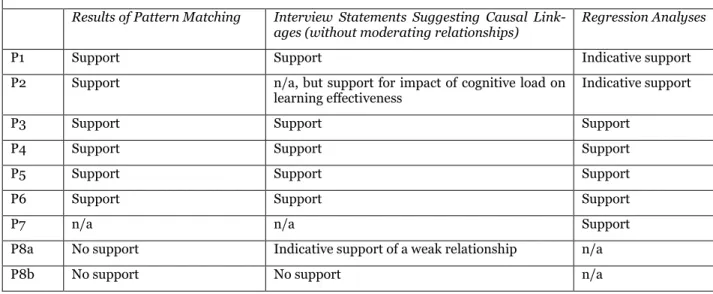
Pattern matching and interview statements on causal linkages gave further perspective on the results of the quantitative analysis. An overview of the results from qualitative and quantitative data analysis is giv-en in Table 45. The qualitative techniques largely corroborated those relationships that were at least
indic-atively supported in the statistical analysis. Moreover, the qualitative results shed further light on the roles of load regulation strategies and cultural and semantic distances.
Table 4: Triangulation of the Quantitive and Qualitative Results Results of Pattern Matching Interview Statements Suggesting Causal
Link-ages (without moderating relationships)
Regression Analyses
P1 Support Support Indicative support
P2 Support n/a, but support for impact of cognitive load on
learning effectiveness
Indicative support
P3 Support Support Support
P4 Support Support Support
P5 Support Support Support
P6 Support Support Support
P7 n/a n/a Support
P8a No support Indicative support of a weak relationship n/a
P8b No support No support n/a
Pattern matching and interview statements on causal linkages provide further insight into the role of load regulation strategies such as supportive information or specification. 33 interview statements suggested that load regulation strategies were used as a response to cognitive load:
“It is a totally new thing which I had not worked on before. I had to get the details.” (onsite coordi-nator, case 1)
“So we need to know what logic was implemented when the module was developed. So if I don't un-derstand it from the code, I contact [SME1] or [SME2].” (onsite coordinator, case 2)
These observations suggest that load regulation strategies were not only antecedents to, but also results of cognitive load. After a task was initially not feasible (i.e. cognitive load was high), the onsite coordinators made greater use of load regulation strategies such as supportive information and specification. While this may be classified as reactive use of load regulation strategies, there is also evidence for their planned use. Figure 3 shows 19 interview statements that suggest a causal link between expertise and the use of load regulation strategies. This indicates that the study participants also planned load regulation strategies considering the expertise of the onsite coordinator. For instance, the following statement is indicative of choosing simple tasks as a function of the onsite coordinator’s expertise:
5 Because relationship nodes in NVivo only depict direct relationships, but no moderated relationships, P2
and P7 are less accessible by the analysis of interview statements on causal linkages in NVivo. Likewise, the interaction effect of intrinsic task complexity and specification (P7) was not susceptible to pattern matching.
“Beforehand, we checked what tasks are appropriate at this initial phase – tasks which do not affect very complex parts.” (manager, case 1)
Load Regulation Strategies
Use of Learning Tasks Learning Effectiveness Expertise Supportive Information Specification Cognitive Load Semantic Distance Intrinsic Task Complexity 35 31 33 19 22 7 Cultural Distance 5 1 4 2 6 has impact on
has only weak impact on
Figure 3: Number of interview statements on suggesting causal linkages (without moderating relationships)
The qualitative analysis also helps understand the roles of semantic and cultural distances in the data. In pattern matching, we looked for indications of overall higher cognitive load levels in the cases 1, 4, and in case 5, in which onsite coordinators and SMEs were from different countries. Our analysis did not reveal any differences of cognitive load due to cultural or semantic distance. Yet, some interview statements sug-gest explanations on how distance might have affected the learning processes. Overall, the statements suggest that both cultural and semantic distances were rather a barrier to the use of learning tasks and load regulation strategies than a source of additional cognitive load (see Figure 3 for the counts of related interview statements). Put differently, distance was a negative antecedent condition to learning activities in some situations. Both cultural and semantic distances may have impacted the use of learning tasks and load regulation strategies because they influenced the willingness of the SMEs to interact with the onsite coordinators:
“The work load was so high. And then instructing someone who is new and doing this in a foreign language. I had the feeling this was a sort of barrier. So sometimes they said ‘I am faster if I do it on my own.’ ” (manager, cases 4 and 5)
“[If I give them this task] they involve me into a discussion. As said, this may require a change of mentality. They are simply different from us. […] They are always in a group, but I dislike if sudden-ly five people stand around my PC and debate. I can hardsudden-ly stand that and they work like this.” (SME, case not stated to protect the identity of the study participant)
In addition, semantic distance reduced the use of supportive information when documentation was only available in German by limiting opportunities to look up conceptual explanations. While distance might therefore have impacted the occurrence of learning activities, we find no interview statements suggesting a direct link between cultural distance and cognitive load and we find six interview statements that con-sistently indicate an only weak impact of semantic distance on cognitive load. In fact, language barriers may have imposed cognitive load on the SMEs rather than on the onsite coordinators, as one onsite coor-dinator suggests:
“Have you sometimes had difficulty in understanding [SME1] language-wise?” (first author) – “It’s the other way round. He finds it difficult to understand me (laughing). Their English is sometimes very broken English, but it is very clear. The English we speak is very fast. So it’s hard for them to understand my English. So he comes down to my desk and says: ‘Show me what you are trying to say.’ (laughing).” (onsite coordinator, case 5)
re-sults of cases 1, 4, and 5 suggest that onsite coordinators of Indian vendor companies may often times have sufficiently automated English skills to decode explanations given by SMEs of a German mother tongue without making significant cognitive efforts for translations.
Discussion
In this paper, we aimed to explain how the combination of learning activities impacts learning effective-ness during the transition phase of SMO projects. We proposed CLT as a theoretical lens and developed propositions, which we tested in a multiple-case study.
Before discussing implications, we acknowledge several limitations of our study. First, our findings are based on a single-site case study that involved only Indian, Swiss, and German participants and that ex-amined only two types of software applications. Other national cultures might possibly yield different re-sults. Similarly, other software application types might differ in some characteristics. This limits the gen-eralizability of our findings. Second, data has been coded by one author only. Yet, we believe that the cri-teria for evaluating construct instances, the chain of evidence established by framework matrices, and the use of multiple sources of evidence mitigated this problem. Third, our dependent variable learning effec-tiveness might have been affected by measurement error given that we partially relied on the perception of the study participants. While learning research frequently grounds findings on the task and transfer performance of many study participants in the same post-test, this was arguably not feasible in the case-study setting. However, we included transfer performance evidence wherever indicated in the data into the evaluation of learning effectiveness. Fourth, our statistical analyses may report higher significance due the interdependence of within-case observations. We mitigated these effects by adding controls for the cases. In addition, our findings on the predictors of cognitive load are based on some very high signifi-cance levels despite low sample sizes, making it more likely that independent observations might have yielded similar correlations and adequate significance. Furthermore, our qualitative analysis corroborated the results from the statistical analyses, increasing thereby the confidence in the results. Fifth, we have not used any structural equation model to statistically test for alternative explanations because our low sample size did not allow this. However, qualitative data analysis strategies such as modeling causal link-ages expressed in interview statements have been useful to check for alternative explanations. Sixth, our findings on the roles of semantic and cultural distances rely only on between-case analysis and on state-ments of participants. Hence, they may be considered rather exploratory. Finally, the presence of the first author may have influenced the study participants.
Prior work has suggested that offshoring projects may fail when significant client-specific knowledge needs to be transferred to offshore team members despite cultural and semantic distances and low ab-sorptive capacity (Dibbern et al. 2008). Our study extends this perspective by zooming in on the learning processes of onsite coordinators in SMO using the lens of CLT. Although project-level characteristics may ease or complicate KT, our results suggest that the design of learning within one project may account for a considerable variance in learning effectiveness. Drawing on instructional theories, we proposed that the use of learning tasks was positively related with learning. The quantitative analysis of our case-study data lends slight support to this claim, which is strongly corroborated by our qualitative analysis. CLT suggests that the benefits from learning tasks are dependent on the cognitive load imposed on the learner. The benefits are proposed to be highest under moderate cognitive load while either overload or too low load may be detrimental to learning. Again, our quantitative analysis provides slight evidence in favor of this claim, which was confirmed by the qualitative analysis. While future research may be required to substan-tiate these propositions, the combined perspectives from the quantitative and qualitative analyses support that the use of learning tasks imposing moderate cognitive load was positively associated with learning ef-fectiveness in our data.
The proposed role of cognitive load for effective learning and our test of predictors of cognitive load imply how learning activities may be effectively combined in SMO projects. Our results suggest that cognitive load is driven by the expertise of the onsite coordinators and by the use of three load regulation strategies: choosing tasks with lower or higher intrinsic complexity, specification, and supportive information. The lower the expertise of the onsite coordinator, the more use of load regulation strategies will be required to keep the cognitive load at a moderate level. This suggests that onsite coordinators with low domain-specific expertise benefit from working on less complex tasks, from learning activity types that involve
high specification such as job-shadowing or the analysis of past maintenance requests, and from being presented relevant supportive information. In contrast, onsite coordinators with relatively high domain-specific expertise will require less such support. It is important to note that the concept of expertise in CLT refers to the domain-specific schemas. For instance, onsite coordinators who maintained the same standard software application in past projects, such as the onsite coordinator in case 4 of this study, will have high levels of expertise at the outset of projects because they can relate information to prior experi-ence. Conversely, engineers who need to understand vast amounts of logic in custom-built software appli-cations, are less likely to have schemas specific to this domain even if they have experience with the same type of applications, such as the engineers in cases 1, 2, and 3 of this study. Our regression results also in-dicate the relative impact of expertise and load regulation strategies on cognitive load in our cases. Exper-tise had, by far, the strongest influence on cognitive load, whereas supportive information had the weakest impact on cognitive load.
Our qualitative results allow two extensions to these findings. First, our qualitative analysis sheds light on how load regulation strategies are chosen. They may occur as a reactive response to cognitive overload or they may be planned anticipating the need for load regulation strategies based on expertise. Second, the qualitative analysis produced propositions on how cultural and semantic distances may affect learning in SMO projects. Rather than imposing additional cognitive load on the onsite engineers, cultural and se-mantic distances may be barriers to the activities necessary for learning. In some episodes of the cases, this resulted in a lower use of learning tasks, in lower specification or in lower supportive information. More research is required to understand under what conditions these activities take place despite cultural and semantic distances.
We may propose further ideas for future research. Drawing on foundations built in this study, future work may test the theory in more controlled environments or involving more standardized measurement tech-niques. In doing so, future work may establish more reliable estimations for the strengths of the influence factors on cognitive load. Such work could examine, for instance, whether or under what conditions sup-portive information (such as extensive documentation) substitutes for expertise. Future work may also replicate this study in different countries, industries, software environments, or in the KT from onsite co-ordinators to offshore teams. This could result in a better understanding of the boundary conditions of the theory. Another possible extension is to investigate dynamic aspects of learning during transition. While our study used snapshots of the same cases at various points in time, we have not applied dynamic statis-tical analysis techniques. Such research could explain how sequences in the combination of learning activ-ities impact learning effectiveness. Although our work aimed at predicting learning outcomes, they are not the only outcomes in SMO transitions. Frequently, software delivery work continues during transitions. While some learning activities yield only learning outcomes, others yield both learning and delivery out-comes. Future research may examine how transition managers may balance these two goals. Finally, we proposed that the distance imposed by the offshore context inhibited interaction that is necessary for ef-fective learning. Future work can examine how stakeholders may ensure such interactions against the barriers imposed by distance.
Acknowledgements
We are thankful for the stimulating comments provided by the reviewer team. We acknowledge the financial support provided by the the Swiss National Science Foundation (SNSF) (Grant # 100018_140407 / 1) and by the Berne University Research Foundation.
Appendix 1: Definitions and Measures of Constructs
Measurement Example Interview Quotes Data
Sources
Cognitive Load: The cognitive demands that a task imposes on the learner (based on Paas et al. 2003)
Measured as the ratio of mental effort to task per-formance (Paas and Van Merriënboer 1994):
• Mental effort (i.e. cognitive capacity that is actu-ally allocated to accommodate the demands im-posed by the task) measured based on state-ments on mental effort, perceived task complex-ity, and the use of weak problem-solving me-thods
• Task performance (i.e. the learner’s achieve-ment) measured based on errors and time on task
Values:
• High: Task not feasible or information not un-derstood
• Medium-high: Task feasible under very high
mental effort (e.g. high perceived complexity)
• Medium: Task feasible under considerable
men-tal effort (e.g. medium perceived complexity)
• Medium-low: Task feasible under little mental effort (e.g. low perceived complexity)
• Low: Fully- or nearly-automated task execution
Examples of high cognitive load: “I said I want to reiterate this one please. So I asked him whether we can have a session on this again, once more.” (onsite coordinator, case 3)
“[When I read the requirements specifi-cation, ] at first it was like for a layman.” (onsite coordinator, case 1)
The combination of the following state-ments suggested medium-high cognitive load:
“It was highly complex.” (onsite coordi-nator, case 3)
“We had code freeze two days ago and everything was on time. So far, the whole release runs very smoothly.” (manager, case 3)
Interview state-ments, documents
Cultural Distance: Extent to which cultural differences are salient in the interactions of SMEs and onsite
co-ordinators
Evaluated based on interview statements and obser-vation notes indicating the salience of cultural dis-tance in the interactions of SMEs and onsite coordi-nators; cultural dimensions included in the analysis: individualism/collectivism, power distance, activi-ty/passivity, communication styles, IS designer val-ues (based on Winkler et al. 2008)
Indicating high cultural distance: “They are always in group, but I dislike if suddenly five people stand around my PC and debate. I can hardly stand that and they work like this” (source not stated to protect the identity of the study partici-pant)
Interview state-ments, ob-servation
Expertise: Power of schemas in the learner’s long-term memory, i.e. power of memory structures that
catego-rize information in a manner specific to perform a particular task (based on Chi et al. 1981) Measured per category in the Book of Knowledge for
IS (Iivari et al. 2004); weighted based amount * in-teractivity (Sweller and Chandler 1994) of required client-specific knowledge in each category:
• Application expertise
• Application domain expertise
• Technical expertise
• Organizational expertise
• IS development process expertise
Indicating high application expertise: “He knew a lot about [the tool]. […] He knew virtually everything. This is why he learned the ropes very fast. We just had to present our application, how did we set it up.“ (manager, case 4)
Indicating medium application expertise: “This whole area is like a large jigsaw. On my world map, Europe and Africa are quite complete, but America is missing. […] On his map, Switzerland looks quite okay, but Europe is slowly forming – in a figurative sense. He has been here for 2.5 or 3 months. You cannot expect that he accomplishes anything.” (SME, case 1)
Interview state-ments, ob-servation
Intrinsic Task Complexity: The sum of component complexity, coordinative complexity, and dynamic com-plexity associated with a particular task (Wood 1986)
Calculated as (Comp + Cord + Comp*Cord + Dyn)/4 with
• Comp: Component complexity (number of
dis-tinct acts to be executed and disdis-tinct infor-mation cues to be processed)
• Cord: Coordinative complexity (form, strength, and interdependencies of the relationships be-tween the information cues or cognitive acts)
• Dyn: Dynamic complexity (degree to which
changes in the states of the world have an effect on the relationships between task inputs and products)
Indicating high component complexity: “We had a lot of testing because it in-volved a lot of tables and changes.” (on-site coordinator, case 1)
Indicating high coordinative complexity (Note: In the software application of case 1, the values of metadata affected the program logic of some areas of the appli-cation. Hence, when making code chang-es in thchang-ese areas, the valuchang-es of metadata needed to be considered.)
„This area is very much driven by metadata.“ (SME, case 1)
Interview state-ments, re-quirements and design documents
Learning Effectiveness: Degree to which learning activities results in increasing expertise
Increase in expertise indicated by transfer perfor-mance (i.e. success in applying knowledge to a task other than the task through which knowledge was acquired), learning outcome statements, expertise statements, stakeholder satisfaction with learning outcomes
Indicating low learning effectiveness: “The documents were already present. I just uploaded them to the different loca-tions.” (onsite coordinator, case 3) – “So no huge learning impact for you?” (first author) – “Maybe impact for the others who need this knowledge, so for off-shore.” (onsite coordinator, case 3)
Interview state-ments, ob-servation, documents
Semantic Distance: Extent to which language barriers are salient in the interactions of SMEs and onsite
co-ordinators
Evaluated based on interview statements and obser-vation notes indicating the salience of language bar-riers in the interactions of SMEs and onsite coordi-nators
Indicating low semantic distance “Have there ever been communication barriers between you [and the Indian SME] because of language or culture?” (first author) – “No, because from our education, English is standard for all of us, it's not a problem.”
Interview state-ments, ob-servation
Specification: Degree to which the solution steps for a learning task are specified to the learner
Measured based on the task type (task types based on Van Merriënboer et al. 2003):
• High for worked-out examples (e.g. job-shadowing, story-telling, study of past mainte-nance requests)
• Medium for completion tasks, imitation tasks, and goal-free tasks (e.g. loosely specified docu-mentation tasks)
• Low for conventional tasks
Indicating a completion task (medium specification):
“The design was already ready for these CRs. I go through the requirement and the design. Then implementation, testing, and everything was left to me.” (onsite coordinator, case 3)
Indicating study of past maintenance re-quests (high specification):
"I tried to understand it for one particular case like one change request. I went through it starting from the requirements understanding, I tried to understand how the requirement has been given to us. …” (onsite coordinator, case 3)
Interview state-ments, re-quirements and design documents
Supportive Information: Degree to which activities besides the learning task itself provide the learner with schemas that can be used to solve nonrecurrent tasks
Measured based on statements about schema con-struction through the following activities (derived inductively from the data): code review, document study, document walk-through, document review, face-to-face sessions, Google search, informal dis-cussions, joint code walk-through, knowledge elici-tation sessions, questions & answers log files, re-quirement hand-over sessions, team meetings, and web-based training
Indicating high supportive information: “[We interacted] every day. […]. And she had some questions, which table should I look at? Or how do I know that I have to look at this table? It was just informal.” (SME, case 2) – “Was this daily?” (first author) – “It was daily.” (SME) – “Ra-ther 10 min?” (first author) – “I would say it was more than that, rather hours.” (SME) Interview state-ments, software documen-tation
Use of Learning Tasks: Extent to which the learner was engaged in a learning task (an authentic task that is
realistic for the particular maintenance context)
• High if the learner was engaged in a learning task
• Else: Low
Indicating low use of learning tasks: “[The SME] gave me also some docu-ments which we went through. […] These were technical specifications. […] [He] also informed about the project structure and how they maintain the documents in clear case. Whenever I had any doubts I asked him for help.” (onsite coordinator, case 1) – “How much time did you spend reading documents?” (first author) – “Two hours per day […] and three to four hours code review to understand how the code works.” (onsite coordinator)
Interview statements
References
Ackermann, B. 2011. "Structured Knowledge Transfer for a Continuous Organisational Development: Methodology in Theory and Praxis," in: Proceedings of I-KNOW ’11 and I-SEMANTICS ’11. Graz. Banker, R.D., Davis, G.B., and Slaughter, S.A. 1998. "Software Development Practices, Software
Complexity, and Software Maintenance Performance: A Field Study," Management Science
(44:4), pp. 433-450.
Bhagat, R., Kedia, B., Harveston, P., and Triandis, H. 2002. "Cultural Variations in the Cross-Border Transfer of Organizational Knowledge: An Integrative Framework," Academy of management review (27:2), pp. 204-221.
Blumenberg, S., Wagner, H.T., and Beimborn, D. 2009. "Knowledge Transfer Processes in It Outsourcing Relationships and Their Impact on Shared Knowledge and Outsourcing Performance,"
International Journal of Information Management (29:5), pp. 342-352.
Boh, W.F., Slaughter, S.A., and Espinosa, J.A. 2007. "Learning from Experience in Software Development: A Multilevel Analysis," Management Science (53:8), pp. 1315-1331.
Chase, W.G., and Simon, H.A. 1973. "Perception in Chess," Cognitive Psychology (4:1), pp. 55-81.
Chen, J., and McQueen, R.J. 2010. "Knowledge Transfer Processes for Different Experience Levels of Knowledge Recipients at an Offshore Technical Support Center," Information Technology & People (23:1), pp. 54-79.
Chi, M.T.H., Feltovich, P.J., and Glaser, R. 1981. "Categorization and Representation of Physics Problems by Experts and Novices," Cognitive Science (5:2), pp. 121-152.
Chua, A., and Pan, S. 2008. "Knowledge Transfer and Organizational Learning in Is Offshore Sourcing,"
Omega (36:2), pp. 267-281.
Cohen, W.M., and Levinthal, D.A. 1990. "Absorptive Capacity: A New Perspective on Learning and Innovation," Administrative science quarterly (35:1), pp. 128-152.
Dibbern, J., Winkler, J., and Heinzl, A. 2008. "Explaining Variations in Client Extra Costs between Software Projects Offshored to India," MIS quarterly (32:2), pp. 333-366.
Hattie, J. 2009. Visible Learning: A Synthesis of over 800 Meta-Analyses Relating to Achievement. London: Routledge.
Iivari, J., Hirschheim, R., and Klein, H. 2004. "Towards a Distinctive Body of Knowledge for Information Systems Experts: Coding Isd Process Knowledge in Two Is Journals," Information Systems Journal (14:4), pp. 313-342.
Kalyuga, S., Ayres, P., Chandler, P., and Sweller, J. 2003. "The Expertise Reversal Effect," Educational Psychologist (38:1), pp. 23-31.
Merrill, M.D. 2002. "First Principles of Instruction," Educational Technology Research and Development
(50:3), pp. 43-59.
Miles, M.B., and Huberman, A.M. 1994. Qualitative Data Analysis: An Expanded Sourcebook. Thousand Oaks: Sage.
Oshri, I., Van Fenema, P., and Kotlarsky, J. 2008. "Knowledge Transfer in Globally Distributed Teams: The Role of Transactive Memory," Information Systems Journal (18:6), pp. 593-616.
Ozcinar, Z. 2009. "The Topic of Instructional Design in Research Journals: A Citation Analysis for the Years 1980-2008," Australasian Journal of Educational Technology (25:4), p. 22.
Paas, F., Tuovinen, J.E., Tabbers, H., and Van Gerven, P.W.M. 2003. "Cognitive Load Measurement as a Means to Advance Cognitive Load Theory," Educational Psychologist (38:1), pp. 63-71.
Paas, F.G.W.C., and Van Merriënboer, J.J.G. 1994. "Instructional Control of Cognitive Load in the Training of Complex Cognitive Tasks," Educational Psychology Review (6:4), pp. 351-371.
Plass, J.L., Moreno, R., and Brünken, R. 2010. Cognitive Load Theory. Cambridge: Cambridge University Press.
Reigeluth, C.M. 1999. "The Elaboration Theory: Guidance for Scope and Sequence Decisions," in
Instructional Design Theories and Models: A New Paradigm of Instructional Theory, C.M. Reigeluth (ed.). Mahwah: Lawrence Erlbaum, pp. 425-453.
Renkl, A. 1997. "Learning from Worked out Examples: A Study on Individual Differences," Cognitive Science (21:1), pp. 1-29.
Rottman, J.W. 2008. "Successful Knowledge Transfer within Offshore Supplier Networks: A Case Study Exploring Social Capital in Strategic Alliances," Journal of Information Technology (23:1), pp. 31-43.
Schnotz, W., and Kürschner, C. 2007. "A Reconsideration of Cognitive Load Theory," Educational psychology review (19:4), pp. 469-508.
Sweller, J., and Chandler, P. 1994. "Why Some Material Is Difficult to Learn," Cognition and Instruction
(12:3), pp. 185-233.
Sweller, J., Van Merrienboer, J.J.G., and Paas, F.G.W.C. 1998. "Cognitive Architecture and Instructional Design," Educational Psychology Review (10:3), pp. 251-296.
Szulanski, G. 2000. "The Process of Knowledge Transfer: A Diachronic Analysis of Stickiness,"
Organizational Behavior and Human Decision Processes (82:1), pp. 9-27.
Tiwari, V. 2009. "Transition During Offshore Outsourcing: A Process Model," Thirtieth International Conference of Information Systems, Phoenix.
Van Merriënboer, J.J.G., Clark, R.E., and De Croock, M.B.M. 2002. "Blueprints for Complex Learning: The 4c/Id-Model," Educational Technology Research and Development (50:2), pp. 39-64. Van Merriënboer, J.J.G., Kirschner, P.A., and Kester, L. 2003. "Taking the Load Off a Learner's Mind:
Instructional Design for Complex Learning," Educational Psychologist (38:1), pp. 5-13.
Van Merriënboer, J.J.G., and Sweller, J. 2005. "Cognitive Load Theory and Complex Learning: Recent Developments and Future Directions," Educational psychology review (17:2), pp. 147-177. Wende, E., Philip, T., and Dubberke, S. 2009. "Storytelling–an Instrument to Bolster Knowledge Transfer
in Offshore Software Projects," The Third Global Sourcing Workshop, Keystone.
Westner, M., and Strahringer, S. 2010. "Determinants of Success in Is Offshoring Projects: Results from an Empirical Study of German Companies," Information & Management (47:5), pp. 291-299. Winkler, J.K., Dibbern, J., and Heinzl, A. 2008. "The Impact of Cultural Differences in Offshore
Outsourcing—Case Study Results from German–Indian Application Development Projects,"
Information Systems Frontiers (10:2), pp. 243-258.
Wood, R.E. 1986. "Task Complexity: Definition of the Construct," Organizational Behavior and Human Decision Processes (37:1), pp. 60-82.