In Person Assisters:
Lessons Learned from Enrolling the Uninsured in North Carolina
By:
Rachel Holtzman
Honors Essay
Health Policy and Management
University of North Carolina
Friday, April 25, 2014
Approved:
I. INTRODUCTION
Enactment of the Affordable Care Act (ACA) in 2010 marked a new era in the American
health care system. The ACA seeks to make health insurance more accessible and affordable, in
part by establishing new purchasing pools that the uninsured and small businesses can join. As
of October 1, 2013, millions of uninsured individuals are able to buy health coverage through
these new “marketplaces1.” The Congressional Budget Office estimates that 22 million individuals will enroll through the marketplaces, and altogether, including expanded access to
Medicaid, 25 million currently uninsured individuals could gain health insurance coverage by
2016.1 This potential influx of individuals seeking coverage has large implications for the American health care system and will require well-coordinated efforts by many different
stakeholders across the country.
Although the ACA aims to reduce barriers to purchasing insurance, millions of the newly
insured will come from difficult experiences of struggling to access health care and facing the
associated challenges of being uninsured. Without health insurance, uninsured individuals,
especially low-income individuals, may forego necessary medical care in lieu of other important
expenses, such as food, transportation, housing, utilities, and child-care.2 These persons are more likely than their insured counterparts to delay needed care, end up in the hospital with
preventable conditions, and ultimately die from avoidable conditions.3 Through expanded access to subsidized private insurance, the ACA could potentially reduce the number of uninsured by
997,770 income-eligible individuals in North Carolina alone4– although the Kaiser Family
1 Note that the words “marketplace” and “exchange” are used interchangeably throughout this paper. The ACA called these purchasing pools exchanges, but amidst the controversy
surrounding their establishment, the Obama Administration subsequently relabeled them as marketplaces.
2 Also referred to in the literature as consumer assistance and enrollment assistance.
Foundation predicts that only 398,000 of those who are eligible will actually gain coverage.5 Since 1,549,918 uninsured adults lived in North Carolina in 20106 – representing nearly one-fifth of adults, and almost one-half of low-income adults – the new coverage options through the
ACA represent a large opportunity to improve the health of the state.7
In spite of these potential gains, the uninsured have many misconceptions about the
ACA. Although nearly 75% of adults know that the ACA requires that they have health
insurance, only two in five were aware of the new health insurance marketplaces between July
and September of 2013.8 Those most likely to benefit from these marketplaces are even less likely to know about them, with 32% of the uninsured knowing about the marketplaces as
compared to 43% of their insured counterparts.9
Confusion about the ACA’s coverage provisions underscores the importance of outreach
and enrollment. Successful efforts are crucial if the ACA is to meet its projected target for
covering the uninsured. Due to their widespread unfamiliarity with the health insurance
marketplaces, more than half of (60%) uninsured individuals report that they want personalized
help navigating the new online system.10 The federal government has established in person assistance programs2 to identify, educate, and assist consumers with enrollment into the new health insurance marketplaces. These in person assistors (IPAs) include Navigators, Certified
Application Counselors, and Non-Navigator Assistance Personnel. They receive training by the
state and/or federal government to help the uninsured enroll through the marketplace and will
need to implement a variety of strategies in order to help enroll the uninsured.
Although IPAs will play a central role in new enrollment efforts, not much is known on
best enrollment practices for the marketplaces. While policy makers and IPAs can learn key
lessons from previous enrollment efforts conducted in Massachusetts in 2006, and nationwide for
Children’s Health Insurance Program (CHIP) and Medicaid, it is unclear which practices will
prove most effective for enrolling the uninsured through the ACA. As ACA enrollment efforts
move forward, it will be important to both document and analyze the enrollment experience of
IPAs.
Given the importance of IPAs to ACA implementation, this study aims to explore the role
that IPAs play in enrolling the uninsured across the state. This research will use semi-structured
interviews with IPAs to address the following two research questions:
(1) What barriers have the IPAs faced in enrolling the uninsured in North Carolina?
(2) What strategies and conditions have, according to IPAs, helped facilitate enrollment
II. BACKGROUND: THE ACA IN NORTH CAROLINA
The June 2012 Supreme Court ruling has had a major impact on ACA implementation.
The Supreme Court upheld the constitutionality of the “individual mandate” (a required that all
individuals obtain health insurance or else pay a tax penalty) as a valid exercise of the
constitutional power to impose taxes. But the court struck down the constitutionality of the
federal government defunding a state’s existing Medicaid program if the state chose to opt out of
Medicaid expansion (to 138% of the Federal Poverty Line, or FPL).11 The Congressional Budget Office (CBO) and Joint Committee on Taxation (JCT)estimate that the Supreme Court decision
will result in fewer individuals receiving Medicaid coverage, more individuals buying health
insurance through the health insurance marketplaces, and more individuals being uninsured.12 The CBO and JCT estimate that roughly 6 million people who would have been eligible
for Medicaid before the Supreme Court ruling will have incomes too low to qualify for subsidies
in the health insurance marketplace.13 The marketplace will automatically apply these subsidies for insurance enrollees with incomes between 100-400% of the FPL. Another 3 million
individuals who were previously eligible for Medicaid (with incomes between 100-138% of
FPL) will have incomes high enough to qualify for government subsidies. However, these
individuals will also be in a different position than they would have been had they received
Medicaid coverage, for they will have to pay a portion of the marketplace premiums – a fact that
may prevent some low-income individuals from enrolling into a health plan.14 Consequently, 4 million individuals who would have originally received coverage through the ACA will likely
States with high rates of uninsured individuals, like North Carolina, will be greatly
impacted by the Supreme Court decision. Nearly one-fifth of adults, and almost one-half of
low-income adults, are currently uninsured in North Carolina.16 Among the uninsured, 61.1% reported the main reason that they do not have health insurance is that they could not afford
premiums.17 Three hundred and seventy-seven thousand of these individuals would have enrolled in Medicaid if North Carolina had expanded the program, but will now remain uninsured.18 These uninsured individuals may not receive needed health care, for nearly one-third of
low-income adults in North Carolina in 2012 reported forgoing care in the last year due to it being
unaffordable.19 Furthermore, the uninsured are less likely to receive important preventive care, primary care, and assistance with chronic care management.20 With more than 70% of the uninsured nationwide having gone without insurance coverage for at least a year, the health
effects of uninsurance can accumulate with time.21
Although the North Carolina General Assembly under former Governor Beverly Purdue
(D) declared it would establish a state-run health insurance marketplace, under Governor Pat
McCrory (R), it shifted to a federally facilitated marketplace.22 As a result, the federal government is operating the health insurance marketplace in NC and it has selected four
Navigator entities to provide one-on-one assistance to consumers across the state.23 In fact, the ACA requires that every health insurance marketplace award grants to IPAs called navigators,24 who will help enroll uninsured individuals, self-employed individuals, and small businesses into
health plans.25 These navigator entities must demonstrate that they have a well-established relationship, or could establish a relationship, with consumers who will likely enroll into the
Community Care Networks.27 Together with the additional 62 entities identified as “Certified Application Counselors” on the https://localhelp.healthcare.gov/ database for North Carolina,
Navigators will work throughout the state to enroll individuals into the federally facilitated
marketplace.3
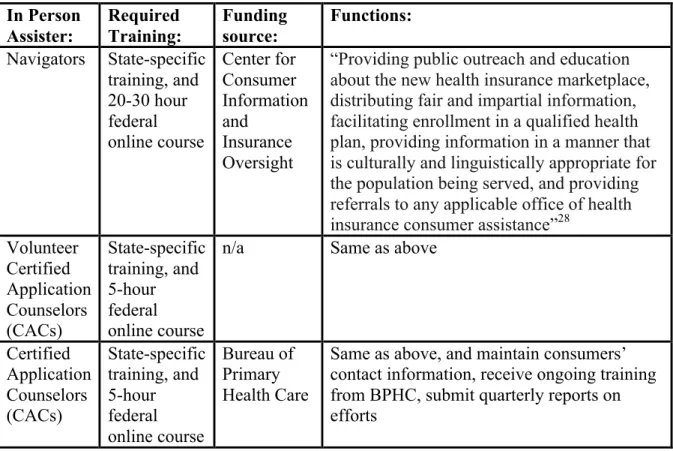
Table 1: Definitions of Three Types of IPAs in North Carolina
In Person Assister: Required Training: Funding source: Functions: Navigators State-specific
training, and 20-30 hour federal online course Center for Consumer Information and Insurance Oversight
“Providing public outreach and education about the new health insurance marketplace, distributing fair and impartial information, facilitating enrollment in a qualified health plan, providing information in a manner that is culturally and linguistically appropriate for the population being served, and providing referrals to any applicable office of health
insurance consumer assistance”28
Volunteer Certified Application Counselors (CACs) State-specific training, and 5-hour federal online course
n/a Same as above
Certified Application Counselors (CACs) State-specific training, and 5-hour federal online course Bureau of Primary Health Care
Same as above, and maintain consumers’ contact information, receive ongoing training from BPHC, submit quarterly reports on efforts
IPAs in North Carolina face significant challenges in facilitating enrolling into the health
insurance marketplace. With 51.8% of the state’s uninsured having gone at least five years
without insurance,29 some may be unfamiliar with key ACA provisions. In fact, 78% of the uninsured, and 72% of all individuals, reported no awareness of the new health insurance options
available through the health insurance exchanges between September and October of 2012.30 For
3Although there is a third type of consumer assister called Non-Navigator Assistance Personnel, North Carolina will not employ
those who are aware, many report feeling “confused,” “overwhelmed,” “worried,” and “helpless”
due to the ACA’s complexities.31 In order to meet enrollment goals, it is therefore critical that IPAs promote awareness of, and information about, the marketplace, including details about the
insurance affordability programs offered through the website. According to one study by the
Kaiser Commission on Medicaid and the Uninsured, the uninsured are less likely than their
insured counterparts to understand the availability of financial assistance for health insurance
through the online marketplaces: 31% of the uninsured said that they were aware of financial
assistance as compared to 43% of the insured.32 Since the uninsured typically lack coverage because of the cost and not because of a lack of desire for coverage,33 it is important that
consumer assistance efforts in North Carolina highlight the various affordability components of
the health insurance exchanges when working with the uninsured.
IPAs will thus be a vital component of statewide efforts to enroll the 997,770 uninsured
in North Carolina who are now eligible for coverage. All IPAs will work to provide public
outreach and education about the exchanges, distribute fair and unbiased information to
consumers, facilitate enrollment into Qualified Health Plans (QHPs), provide information in a
culturally and linguistically appropriate way, and address all unmet concerns by providing
referrals to any relevant office of health insurance consumer assistance.34 Regulations issued by the US Department of Health and Human Services also require navigators to complete an online
training by the federal government and to be free of any conflict of interest – for example,
navigators cannot receive any form of benefit from health insurance issuers by enrolling
III. LITERATURE REVIEW: A HISTORICAL LENS
Learning from the Experiences of Medicaid, CHIP, and SHIP
Although IPAs have just recently begun their outreach and enrollment efforts through the
ACA, previous efforts to promote enrollment in Medicaid, Children’s Health Insurance Program
(CHIP), and Medicare, and state programs such as the 2006 health reform in Massachusetts offer
potential lessons.
Medicaid is the nation’s premier health insurance program for low-income children,
parents, pregnant women, elderly, and disabled individuals. However, Medicaid’s eligibility
guidelines leave millions of low-income individuals ineligible for Medicaid every year. To fill
this hole, CHIP was enacted in 1997 as an extension of the Medicaid eligibility guidelines for
children.37 While enrollment into CHIP was modest in the first year, it increased quickly by the third year due to heavy marketing efforts.38 CHIP’s history is therefore especially relevant to current outreach and enrollment efforts through ACA because, prior to the enactment of CHIP,
states did little to actively market public programs.39 Through Medicaid and CHIP, stakeholders can examine the success of outreach efforts, the take-up rates for enrollment into health
insurance programs, as well as the assistance needed by consumers to overcome barriers to
enrollment.
One fundamental barrier to enrolling eligible individuals into Medicaid and CHIP is the
lack of awareness among the uninsured about their eligibility for the programs. In fact, Kenny et
al. (2009) found that over 90% of low-income parents would enroll their uninsured children in
Medicaid and CHIP if they were eligible, but half did not know that their children were
efforts to promote enrollment, including creating marketing materials in languages beyond
English and using images of families from different racial/ethnic backgrounds.41 Along with these broad messaging techniques meant to build brand recognition, state CHIP programs also
utilized more fine-tuned messages that highlighted the specific eligibility criteria and the value of
having one’s kids covered in CHIP.42 Many states found it helpful to keep outreach messages simple and utilize a “less is more” approach in order to not overload the public with potentially
confusing details.43 These ads did, however, often included information for a website or toll-free hotline that parents could contact for further details.44 Some states, such as Oregon, worked directly with members of racial/ethnic minority communities to create CHIP materials, in order
to ensure that they were linguistically, as well as culturally, appropriate for certain uninsured
communities.45
Despite the importance of outreach, Medicaid and CHIP’s experiences demonstrate that
enrollment efforts must take additional steps to address stigma and poor perceptions of public
programs that may hinder enrollment.46 IPAs must therefore address the barriers of stigma associated with public programs in order to enroll the uninsured. Medicaid and CHIP enrollment
efforts have utilized one-on-one enrollment assistance by trusted individuals in the community as
a successful method to address negative perceptions. Both the Medicaid and CHIP programs
have seen positive responses from their efforts to leverage partnerships with community-based
organizations, such as schools, faith-based organizations, child care centers, and human service
organizations, to enroll the uninsured.47 While the estimated Medicaid take-up rate, or rate of Medicaid enrollment among Medicaid-eligible individuals, was 54% for adults nationwide in
CHIP in 2010.49 A 2011 evaluation found that many states reported partnerships with
community-based organizations (CBOs) as the most effective partnerships for enrollment, due to
the “prominence and trust” that these organizations had within their communities.50 Three specific noteworthy examples of successful CHIP efforts to enroll children with CBOs include:
back-to-school campaigns Kentucky in which children and their families were encouraged to
enroll through their schools; another effort in southwest Georgia that had leadership from
African American ministers who led a community-wide faith-based initiative; and another
program in Georgia that gave a mini-grant to a local Goodwill agency which targeted enrollment
efforts through Goodwill stores, job placement agencies, and job fairs.51 These community-based efforts capitalized on the important role that trusted community-community-based organizations often
have with hard-to-reach populations who might otherwise not enroll into public programs.
Another challenge faced by families with children eligible for CHIP is the difficulty of
completing the enrollment process, and confusion surrounding the administrative complexities of
renewing one’s enrollment.52 In a study by Kenney et al. (2009), 55% of low-income parents found the CHIP application process difficult, and 51% did not know where to get more
information or help.53 Consequently, 64% of uninsured children in the study were eligible for Medicaid/CHIP but not enrolled.54 Because so many individuals were eligible for Medicaid and CHIP but not covered, states started to take new and innovative approaches to simplify
enrollment. Some of the efforts undertaken for CHIP included the use of one-on-one assistance,
offering multiple enrollment avenues by developing the capacity for enrollees to submit their
application by mail or online, eliminating the need for a face-to-face interview, implementing
continuous coverage for the child despite small changes in the family income, and extending
utilized web-based tools for CHIP enrollment that could be accessed through mobile devices,
which worked well with low-income communities;56 in fact, research demonstrates that low-income populations are faster adopters of the Mobile web than their higher-low-income
counterparts.57 States also placed an increased focus on “in-reach” by conducting education efforts to keep kids enrolled in CHIP and reduce “churning”.4,58 These statewide “in-reach” campaigns often promoted two main messages: families experience significant value from CHIP
coverage for their children, and families should appropriately use health insurance in order to
access care for their kids.59 Other states utilized data collected from other state programs – such as food stamps or the Women, Infant and Children program (WIC)60 – to simplify enrollment and decided to simplify their renewal process.61 Further simplification efforts, such as reducing paperwork requirements and ensuring that application forms are offered in plain language, as
well as multiple languages, helped consumers who had low literacy and/or for whom English
was not a primary language.62 As a result of these efforts, low-income families with children enrolled in CHIP faced less of an administrative burden when aiming to enroll or keep their
children in CHIP.
Whereas CHIP and Medicaid efforts provide valuable information about take-up among
low-income children and adults, Medicare Part D enrollment efforts provide valuable
information related to take-up among the elderly in a program that resembles the ACA’s
marketplaces since it offers numerous private insurance options. Medicare consumers feel that
the program is “confusing” and that the decision process is “overwhelming” because of the wide
array of plan choices associated with Medicare Part D.63 As a result of the difficulty comparing available plans, many potential enrollees into Medicare Part D ended up making choices that
4 Churning is the phenomenon when eligible children drop out of coverage and then reenroll within a short time frame such as
were not ideal for their personal circumstance.64 Consumer assistance programs are vital for the elderly, who may need help reading the forms, understanding the options, and applying for
coverage.
The federal government has implemented in-person consumer assistance efforts in every
state to help seniors with their Medicare options. Specifically, the federal government funds
State Health Insurance Assistance Programs (SHIP) across the country to provide one-on-one
assistance to Medicare beneficiaries;65 these programs are in fact the foundation on which the Navigator efforts were modeled.66 SHIP programs in different states have included in-person assistance efforts by local partners, such as senior centers, civic and social organizations, and
local government agencies.67 In North Carolina, this program is run through the North Carolina Department of Insurance, and is called the Seniors Health Insurance Information Program
(SHIIP). SHIIP trains volunteers to provide in-person counseling to Medicare beneficiaries
across the state. SHIIP volunteers counsel Medicare beneficiaries on a wide range of issues,
including: Medicare Part B premiums, Medicare supplement plans, Medicare
Advantage/Medicare Healthplans (Part C), Medicare Prescription Drug Plan (Part D), employer
health insurance, and long-term care information.68 There is no systematic study on SHIIP’s impact, however the program prides itself on the full range of services provided, as well as the
uniformity and quality of services provided across North Carolina. According to Carla Obiol
from the North Carolina Department of Insurance (NCDOI), “What has served SHIIP so well
through the years is the ability to provide uniform messaging and training across the state as well
as continuous training and updates to the volunteer counselors.”69 The NCDOI provides ongoing training and education to volunteers through e-mail updates, news bulletins, and monthly
all and receive consumer-oriented assistance. Obiol said that they “take pride in [the
counselors’] contributions and strive to honor their commitment by keeping them informed at all
times”.70 Statewide efforts to enroll the elderly into Medicare Part D, such as SHIIP, therefore provide valuable insight moving forward on the value of in-person assistance for groups that may
be confused about health insurance options.
The Massachusetts Experience with Health Reform
Massachusetts provides another example of government efforts to enroll consumers into
health insurance. In 2006, Massachusetts enacted a statewide health reform to expand health
insurance coverage that would later become the model for the ACA. Along with expanded
eligibility for Medicaid, new coverage provisions, and increased outreach efforts, Massachusetts
health reform allocated funding for IPAs to enroll uninsured communities. The 2006 law also
created the Connector, a statewide online website on which to purchase health insurance in
Massachusetts. This website offered private and subsidized health plan options for individuals,
families, and small employers in an easily comparable side-by-side format, and utilized
government data to check eligibility. The Connector became the model for the ACA’s health
insurance exchanges. With the aid of IPAs, tens of thousands of individuals in Massachusetts
navigated through the Connector to buy health insurance.71
One main challenge that IPAs observed was that consumers had a difficult time
determining their eligibility for, and understanding the various components of, health insurance
plans. Low-income communities, in particular, were confused about their eligibility because of
their unstable income and residential living situations. Although low-income communities in
subsidy programs remain constant.72 Some low-income consumers consequently faced the risk of getting rejected for subsidies, because their information no longer met the eligibility criteria.
Others were confused about how to document their living situation, as it changed often. Further
misunderstanding of concepts like premiums, deductibles, provider networks, formularies, or
coverage exclusions and limitations, made the selection of a health choice very difficult for
communities with low health insurance literacy rates, especially for those who had little or no
experience with health insurance.73 In fact 42% of Massachusetts citizens in one study found that the plan information offered in the Connector was difficult to understand.74 When faced with these complex decisions, consumers were more likely to make choices based upon shortcuts
– such as comparing their options with the sole consideration of brand, rather than formularies or
provider networks.75 This can lead to suboptimal plan selection, and in fact nearly one in two (45%) who were confused said that out-of-pocket costs were higher than they anticipated76 – a consequence that could also be associated with a lack of comprehensive coverage options offered
on the Connector. The lack of full understanding of eligibility for, and the various components
of, health insurance posed a major challenge for consumers shopping in the Massachusetts
Connector.
In order to help consumers, Massachusetts employed in-person assistance to answer
general questions, determine eligibility, and guide consumers with enrollment. Staff at
community health centers was central to enrollment efforts, because they were familiar with the
challenges of, and well trusted by, medically underserved communities.77 Other IPAs found that having direct access to important documents, such as wage information, was important for
screening consumers for eligibility in various subsidies and for helping with enrollment, but also
respondents reported incomes that would have made them eligible for subsidies had they known,
so it is clear that there was further need for in-person assistance.79 They also found that there was need for assistance at all points in the enrollment process, for “assistance is not a one-time
matter”.80
Another challenge in Massachusetts was the limited capacity of the staff working to
enroll the uninsured. Massachusetts underestimated the number of people who would be eligible,
and who would enroll, for free and subsidized coverage. Although the 2006 estimate was
140,000, enrollment reached a height in 2009 at 177,000.81 In total, there were 367,000 newly insured individuals in the first year alone of health reform.82 The statewide workforce of IPAs was thus inadequate for the high demand. Nearly one in three consumers (28%) thought that
selection would have been easier if there had been fewer options.83 Furthermore, health center staff noted that many of the individuals they worked with had no experience with health
insurance, and thus did not understand concepts such as provider networks, formularies,
premiums or deductibles.84 IPAs spent substantial time educating consumers about how to compare plans, on top of the time-intensive process of going through documentation for the
eligibility requirements of such plans. Consequently, there were backlogs of consumers seeking
help, and many individuals expressed frustration from the long wait times to speak with an
assistor over the phone.85 One-fifth of all respondents in one study wished they had help in narrowing their plan choices,86 indicating unmet demand for assistance.
The 2006 MA health reform included various online tools that mitigated some of the
unmet demand for staff support. With 82% of survey participants responding that they learned
uniform across all age groups, with younger respondents between 18-34 reporting higher rates
than respondents over 50 at 87% and 70% respectively.88 In-person enrollment assistance may be less necessary for younger groups, who might feel more comfortable relying on online
resources. Other enrollment efforts demonstrated that some consumers simply lacked access to
computers with Internet, and therefore needed access to mobile technology more than a
consumer assister. Consequently, some parts of the state set up “self-serve kiosks” in
community locations – such as health fairs, clinics, homeless shelters, unemployment offices,
etc. – for use by uninsured individuals.89 Lastly, for those individuals who simply needed to renew their existing coverage, experience from Massachusetts showed that passive renewal
efforts that automatically renewed coverage if no household circumstances had changed freed up
IPAs to work with individuals needed more personalized assistance.90
While the Massachusetts health reform experience offers potential lessons about the
challenges that IPAs may face in enrolling the uninsured in North Carolina, there are significant
differences between the situation in Massachusetts and that of North Carolina. First of all, there
were six commercial insurance carriers offering private health plans in the Connector,91 while there are only two in North Carolina – Blue Cross Blue Shield of North Carolina in all 100
counties and CoventryOne in 39 counties.92 Since nearly one-third of consumers in the
Connector reported that enrollment would have been easier had there been fewer plan options, it
is possible that the fewer commercial insurance carriers in North Carolina will ease some
enrollment-related confusion for consumers. However, given that Massachusetts citizens have a
towards the ACA, the challenges that IPAs face in North Carolina could be different than those
IV. METHODS
Design
This research uses a multiple case study design involving enrollment-related
organizations. The methodology comes from Robert Yin’s Case Study Research: Design and
Methods (2009) as well as Huberman and Miles’ Drawing Valid Meaning from Qualitative Data
(1983). As stated in the Introduction section, this study will address the following two research
questions:
(1) What barriers have the IPAs faced in enrolling the uninsured in North Carolina?
(2) What strategies and conditions have, according to IPAs, facilitated enrollment among
the uninsured?
Implementing the ACA in North Carolina
Due to the North Carolina General Assembly’s decision for North Carolina to utilize a
Federally-Facilitated marketplace, there are only two types of consumer assistance entities in
North Carolina: Navigators and CACs. These entities differ in the level of training; although
both have to complete the state-specific training, Navigators are required to complete a 20-30
hour federal online training course, while CACs must only complete a 5-hour federal online
training course.94 In North Carolina, four Navigator entities received federal grants, including: Randolph Hospital Inc., Mountain Projects Inc., NC Community Care Networks, and the
Alcohol and Drug Council of NC. Two distinct types of CACs also exist, based upon whether
they receive grant money. While all Navigators in North Carolina receive grant money funded
volunteers who receive no grant funding.95 Meanwhile, the grant-funded CACs operate through Federally Qualified Health Centers (FQHCs), and are funded through the Bureau of Primary
Health Care (BPHC).96 Consequently, these grant-funded CACs must fulfill additional requirements, such as: conducting outreach, maintaining consumers’ contact information for
follow-up and ongoing consumer education, receiving ongoing training from BPHC, and
submitting quarterly reports on outreach and enrollment efforts – these reports include: the
number of CACs trained, the number of individuals getting in-person enrollment assistance, the
number of applications submitted in the marketplace with assistance from a grant-funded CAC,
and the estimated number of individuals who will enroll in assistance.97
In North Carolina there are also enrollment facilitation groups working across the state,
such as Enroll America, the “Big Tent” collaboration, Legal Aid, and the North Carolina Justice
Center. While Enroll America is a nationwide organization that works to facilitate enrollment
efforts in every state, the “Big Tent” group is a statewide collaboration of different individuals
involved in enrolling the uninsured. Legal Aid employs Navigators to work in 93 counties (and
partners with other groups to cover the remaining seven counties in NC), and the North Carolina
Justice Center works on policy and advocacy work surrounding issues affecting low-income
populations in North Carolina.
Research Methods
It is important for policy makers and future enrollment-related individuals to understand
IPAs’ experiences and perceptions. This study utilizes qualitative methods to obtain first-hand
Because the perspectives of the interviewees will likely vary, qualitative methods will prove
important for the sake of portraying the richness and diversity of the findings.
Specifically, this study will utilize semi-structured in-person interviews with
enrollment-related individuals to collect qualitative data on the perceived challenges and barriers, as well as
perceived successful strategies, for enrolling the uninsured.5 This method is especially useful when the researcher has limited opportunities to interview someone. According to Bernard, the
semi-structured format allows the researcher to follow a general script and cover important
topics, while still remaining open-ended for the key informant to provide the information that he
or she thinks is the most important.98 Or as Bernard writes, “The rule is: Get people onto a topic of interest and get out of the way.”99 The structure also helps to ensure comparable data between key informants. I used an interview guide to guide the interviews, which included a general
script of important topics.100 I probed for additional information as needed throughout the interview.
Refer to section titled “Instruments” below to view the topics addressed in the interview
guides, and “Appendix A” and “Appendix B” to view the instruments.
Selecting the Case Counties
The sources of data were (1) interviews with Navigators, (2) interviews with Certified
Application Counselors (CACs), and (3) interviews with state enrollment personnel. All
interviews were conducted in person. The study examined enrollment work through three cases:
counties identified as “Metropolitan,” others as “Micropolitan,” and others as “Noncore.”
Cases were selected using convenience sampling, a method through which samples are
selected based upon how convenient it was for the study to access them.101 First, all counties in North Carolina were stratified into three Core Based Statistical Area classifications:
Metropolitan Statistical Area (urbanized areas of 50,000 population or more), Micropolitan
Statistical Area (10,000-50,000 population), and Noncore (less than 10,000 population).102 As of 2013 distinctions from the United States Office of Management and Budget, North Carolina
contains 46 Metropolitan Statistical Areas, 28 Micropolitan Statistical Areas, and 26 Noncore
Statistical Areas.103
The study then used a combination of purposeful and convenience sampling to select the
case counties. First, the study selected several possible counties to include in each of the three
classifications based on proximity to central North Carolina. Then, potential key informants
were contacted from each type of case county, using the “North Carolina ACA Outreach and
Enrollment: In Person Assister County Resource Directory.” This directory, compiled by the Big
Tent on January 17, 2014, lists in person assisters by type of organization (Navigator, FQHC, or
independent CAC) and by county.
For the state enrollment key informants, I worked closely with the CEO of the North
Carolina Institute of Medicine to identify stakeholders that would be most knowledgeable about
various forms of statewide enrolment facilitation work. I then contacted these four individuals,
and all four agreed to participate in the study.
This study then moved forward using convenience sampling, based upon which IPAs
responded with an availability and willingness to participate. As a result of time limitations, I
did not only select from three case counties, but instead from multiple counties that fell into each
Selecting Respondents within Each Case
Subjects for interviews acted as key informants into the perspectives and experiences of
IPAs, and were primarily defined by one of the four following types of enrollment-related
organizations: Navigators, Certified Application Counselors (CACs), FQHC CACs, and
enrollment facilitation groups. The individuals in each group provided a helpful overview of
enrollment efforts, as well as a different perspective from the CACs and Navigators who worked
directly with consumers.
At least one individual in each type of enrollment-related organization was contacted to
participate in interviews for each case county, and only one was interviewed when more than one
replied with interest. I initiated primary contact via e-mail, and then contacted the potential
participant by phone if there was no response to the e-mail within one week. If there was still no
contact after the initial e-mail and phone call, I sent a follow-up e-mail and phone call. If there
was no response after these two rounds of contact, I moved on to a new potential participant.
This study included interviews with thirteen enrollment-related individuals – three from each of
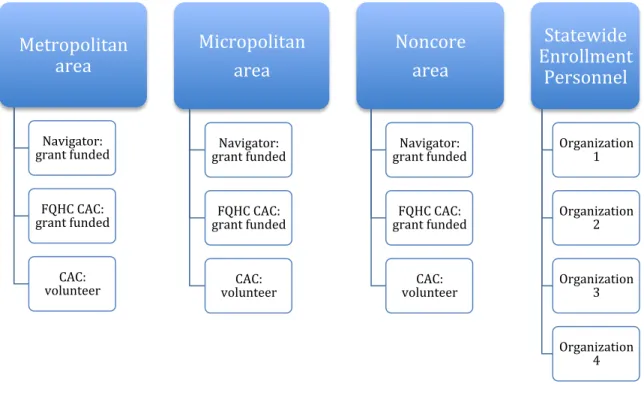
Figure 1: Research Design
Data analysis methods
Qualitative data collected from in-person interviews was recorded using a handheld
digital voice recorder and transcribed on Microsoft Word. All data were then analyzed for
common themes and trends using Atlas.ti data analysis software. I participated in a two-part
training, titled “Introductory Hands-on Workshop” on the Atlast.ti software through the Odum
Institute at the University of North Carolina at Chapel Hill on January 21, 2014 from
2:00-4:00pm and on January 30, 2014 from 2:00-2:00-4:00pm. I then analyzed interview data by
examining trends between all thirteen interviews, with a focus on trends between all interviewees
and trends exclusively between IPAs. This approach allowed the study to identify perceived
successes and challenges that various stakeholders faced in different settings. Metropolitan
area
Navigator: grant funded
FQHC CAC: grant funded
CAC: volunteer
Micropolitan area
Navigator: grant funded
FQHC CAC: grant funded
CAC: volunteer
Noncore area
Navigator: grant funded
FQHC CAC: grant funded
CAC: volunteer
Statewide Enrollment
Personnel
Organization 1
Organization 2
Organization 3
Ethnical considerations
As MQ Patton states, “Interviews are interventions. They affect people.”104 Due to this, Bernard states, “there is no ethical imperative in social research more important than seeing to it
that you do not harm innocent people who have provided you with information in good faith.”105 Maintaining confidentiality about sensitive information given the controversy surrounding health
care form was particularly important.
This study aimed to structure the interview tools, conduct the interviews, and analyze the
data as responsibly as possible to minimize potential ethical risks. However, I could not fully
predict what information the interviewee chose to offer. I therefore took into consideration how
to respond if the interviewees revealed information that put their position at risk – for example, if
they revealed personally-identifiable health information or experiential accounts of incorrect
assistance to consumers. In this study, the ethical considerations were especially important to
consider, because the interviewees explained their experiences working with other individuals
who were not in the room. This study therefore ensured the anonymity of its findings through a
variety of ways. First, any data related to personally identifiable information about the key
informants or their clients was anonymized. Furthermore, when analyzing the data, any data that
could potentially hinder the position of any of the key informants was omitted. These measures
also, in effect, minimized the risk of the key informants experiencing a loss of professional
standing or reputation, since the findings were not traceable back to any one key informant.
Instruments
This study utilized interview guides to prompt responses by the study participants. The
they utilize to enroll the uninsured, especially regarding the perceived effectiveness and
challenges associated with each strategy. MQ Patton’s Qualitative Evaluation and Research
Methods (1990), Bernard’s Interviewing: Unstructured and Semi-structured (1988), and Yow’s
A Practical Guide for Social Scientists: Interviewing Techniques (1994) informed the
development of these interview guides.
The interview guide for IPAs (Appendix A) addressed the following topics:
• Background
• Challenges
• Current Political/Demographic Environment
• Successful Strategies
• Training/Preparedness
• Future Efforts
The interview guide for statewide enrollment personnel (Appendix B) addressed the following
topics:
• Background
• Challenges
• Current Political/Demographic Environment
• Successful Strategies
V. RESULTS
Qualitative Analysis:
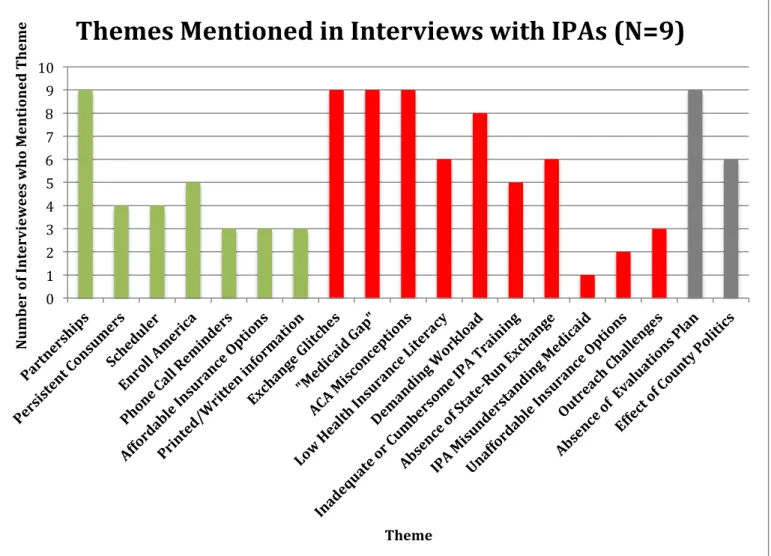
Qualitative data were categorized into three primary themes related to enrollment into the
marketplace: a) strategies and conditions that facilitated enrollment, b) barriers to enrollment,
and c) other themes. Interviewees identified several different facilitators, barriers, and other
themes. Strategies and conditions identified that facilitated enrollment include: 1) the
importance of partnerships; 2) the importance of the Scheduler; 3) the importance of Enroll
America; 4) the persistence of consumers; 5) the use of phone call reminders to consumers; 6)
the affordability of insurance options; and 7) the use of printed or written information for
consumers to review at home. The frequency of these themes can be found represented in green
in Figure 2 and Figure 3 below.
Meanwhile, factors identified as barriers to enrollment include: 1) the exchange glitches;
2) the existence of the “Medicaid gap”; 3) misconceptions about the ACA; 4) the challenges of a
demanding workload for IPAs; 5) low health insurance literacy among consumers; 6) the
absence of a state-run exchange; 7) an inadequate or cumbersome IPA training; 8) challenges of
outreach; 9) the unaffordability of insurance options; and 10) IPA misunderstanding of Medicaid
eligibility. The frequency of these themes can be found represented in red in Figure 2 and Figure
3 below.
Finally, two themes emerged that were not necessarily facilitators or barriers, and were
therefore categorized as “other themes.” These factors include: 1) the absence of a formal or
on enrollment. The frequency of these other themes can be found represented in grey in Figure 2
and Figure 3 below.
Meanwhile, Table 4 in the Appendix has a full list of all codes, as well as their frequency
from the interviews. Key findings are discussed in more detail below.
Strategies and Conditions that Facilitated Enrollment Table 2
Strategies and Conditions that Facilitated Enrollment: Major Themes (N = 13)
Percentage of Interviewees that Theme Mentioned Each Theme
A. Importance of partnerships 100
B. Importance of the Scheduler 62
C. Importance of Enroll America 54
D. Persistence of consumers 46
E. Use of phone call reminders to consumers 38
F. Affordability of insurance options 31
G. Use of printed or written information for consumers to review at home 23 Note: Percentages add up to more than 100, because some informants mentioned more than one major theme during their interview.
The Importance of Partnerships
Partnerships were unanimously identified as a crucial contributor to North Carolina’s
enrollment success (N=13). Informants spoke about a wide variety of organizations that
participated in outreach and enrollment work. Almost all informants mentioned that libraries and
churches were their core partners. In fact, one interviewee explained that most libraries have
gone above and beyond with their willingness and initiative in hosting outreach and enrollment
events. Furthermore, this interviewee explained that libraries have been useful places for
enrollment appointments because they tend to be quiet and have computers readily available with
Internet access. Another informant explained that churches have been particularly useful places
fellowship hall or Sunday school or a church, than they might at, say, DSS.” Informants also
spoke about other important partners, such as Departments of Social Services, hospitals
(especially large hospitals with big charity care programs), Smart Start programs, YWCAs, Food
Lions, K-Marts, League of Women Voters, local newspapers and radio stations, local electric
and water companies, local community colleges, universities, pharmacies, and laundry mats.
While some of these partners were used exclusively for outreach purposes (such as the electric
and water companies), other helped with both outreach and enrollment. Due to this wide variety
of partners, one informant explained that she approached the outreach portion of her job like a
“grassroots campaign” for a new and unknown political candidate.
As mentioned above, universities and community colleges were recognized as key
partners for enrollment purposes. Some IPAs mentioned that they targeted schools of law, social
work, and public health to recruit student volunteers for either outreach and/or enrollment work.
One informant explained that her organization has had more willingness from graduate rather
than undergraduate students to volunteer, perhaps because of more “maturity and [disposable]
time.” Another interviewee explained that her organization contacted schools with whom her
organization already had a relationship, in order to maximize on convenience given the limited
time for enrollment.
Additionally, collaborative partnerships existed between various IPA organizations. One
informant identified that the NC Navigator Consortium, a group described as “a little bit of
apples, oranges, pomegranates, [and] elephants,” has worked with “tremendous commitment to
really mak[e] sure that NC does the best it can in enrolling the uninsured in the state.” Another
important statewide coalition identified was the Big Tent, which comprises over 100
outreach and enrollment in NC. Other informants identified similar models to the Big Tent, but
carried out at a local or regional level rather than statewide level.
Overall, partnerships were identified as a crucial ingredient for North Carolina’s
enrollment success. One interviewee explained, “Funds are limited and resources are limited and
so strength is in numbers,” and therefore, that community groups recognized the benefit of
working together. However, one informant explained that local groups need additional regional
collaboration in the future, so that they can sit down and brainstorm specific challenges and
solutions faced regionally. Finally, it was clear that these partnerships were most effective when
IPAs made sure to enlist the help of partners who were already trusted by the community, such
as well-visited churches, libraries, or public health departments.
The Scheduler
The majority of interviews (N=8) spoke about the importance of the Scheduler, which is
the online appointment scheduling system created by the North Carolina Navigator Consortium
and the North Carolina Community Health Center Association (NCCHCA), with leadership and
initiative by staff at Legal Aid of NC. Individuals from across the state can use the Scheduler to
schedule an appointment near them by calling one toll-free statewide phone number, often
referred to as the “(855) number.” One informant therefore said that the Scheduler acts as “the
gate to everything.” The statewide and centralized aspects of this system were highly acclaimed
by many informants. One interviewee explained, “Having the centralized Scheduler is
something that is...almost non-existent in other places. [It] is a tremendous asset to be able to
give people one number.” This interviewee went on to explain that in other states, for example,
who need help, there is no way to directly schedule an appointment for them. The Scheduler is
important because it creates a de facto statewide system for appointments, despite the lack of a
state agency to coordinate efforts.
Furthermore, the Scheduler was identified as an important tool for consumers who do not
feel comfortable navigating the Internet or computers in general. Based on anecdotal evidence
from informants, these consumers ranged from elderly individuals who did not understand how
to turn on a computer, to individuals who did not know how to read or write. For these
consumers, it would have been difficult to go find local help using the www.healthcare.gov
website. It was especially helpful to have a number that they could call so that they could speak
with someone in order to schedule an enrollment appointment.
However, the Scheduler is not accessible to all IPAs; only Navigator and FQHC CAC
organizations in the North Carolina Navigator Consortium and the North Carolina Community
Health Center Association can enter in their appointments to the Scheduler, respectively.
Although many interviewees said that they would like the Scheduler to be a “one stop [tool] for
all the appointments in the state,” one interviewee explained:
There’s been a big hesitation to expand it beyond those groups [in the NC
Navigator Consortium and NCCHCA], because of uncertainty about … the
quality that those additional organizations would bring to the table, and how they
would be approaching the appointments.
Consequently, independent CACs each used their own personalized scheduling system
for appointments, such as their work agenda or another individualized work calendar. As a
result, some independent CACs struggled to conduct sufficient outreach to fill their available
any consumers coming in the door to see them.” IPAs without access to the Scheduler also
lacked access to a valuable source of data, in regards to the location and quantity of
appointments held in various places.
One unexpected insight into the Scheduler was that, in some parts of the state, IPAs
found it more effective to distribute the local number for their IPA organization, rather than the
statewide (855) number. One IPA explained that her colleague in a micropolitan county asked to
advertise her local office number as well as the (855) number, because people in that area felt
more comfortable calling a local number than a statewide number.
Enroll America
Enroll America, a national nonprofit that seeks to maximize the number of individuals
who obtain health insurance coverage, was often identified as an integral group for outreach
efforts related to the Affordable Care Act (N=7). It was clear that this organization serves a
unique role, especially for IPAs that were struggling with the outreach component of enrollment.
One informant explained that working with Enroll America “is great, because they’re doing more
of the motivating and directing and then we’re there to serve once they can do the handoff from
the outreach to the enrollment.” Several other interviewees also mentioned the importance of
this handoff between Enroll America and the IPA, and one interviewee even called the process
the “one-two enrollment punch.” When asked to explain further, the informant described how
Enroll America first conducts outreach in a community, and then uses Scheduler to directly
schedule appointments with interested consumers. The IPAs then return to that same location in
a few days to a week, and host a series of appointments with the interested consumers. By that
eligibility criteria], they’ve learned what they need, and then you basically just roll through the
enrollment process with them.”
Interviewees noted that another facilitator to successful enrollment was Enroll America’s
use of Commit Cards. These cards collect the names, contact information, and insurance status
of individuals who are interested in receiving more information about the Affordable Care Act,
and/or who would like to schedule an appointment with an IPA. Enroll America then puts this
information into the Get Covered Database, which is the comprehensive database kept by Enroll
America for their “Get Covered” campaign to enroll individuals into the ACA. Enroll America
then follows up with the individuals via telephone to provide more information and/or to
schedule an appointment for the consumer in the Scheduler. Navigators identified this strategy
as particularly helpful, because Navigators, unlike CACs or Enroll America staff, are legally
prohibited by federal rules from keeping consumers’ personal information. Without personal
information of consumers, Navigators could not make phone calls. One limitation of the
Commit Cards is that they were printed while the www.healthcare.gov exchange was still
experiencing major glitches; as a result, the Commit Cards do not have the www.healthcare.gov
website on them, nor do they have state-specific information printed directly on them.
Overall, many IPAs viewed their ability to rely on Enroll America for successful outreach
as a key component of successful enrollment work, which they might not have been able to do
otherwise. One IPA felt as though Enroll America was available to help her whenever she
expressed the need. Another informant explained that Enroll America “will work with anybody.
You know, if you’re willing to spread the word, [Enroll America is] willing to help you do it.”
This personal connection to Enroll America is better understood within the context of the initial
could fill their appointments with individuals in their existing FQHC patient population (a
process referred to as “in-reach”), some Navigators and independent CACs experienced outreach
challenges before they partnered with Enroll America. One interviewee explained that some
Navigators are “used to just advertising their phone number and having more appointments than
they can take, and that’s just not how this works. People are scared to sign up.” As a result, this
informant explained that some Navigators had appointments that went unfilled until Enroll
America came to conduct outreach, be it in the form of community education forums,
information tables set out in front of grocery stores, or other methods.
Consumer Persistence
About half of all interviewees (N=6), and the majority of IPAs (N=5), spoke about the
persistence of consumers with regards to enrollment. One informant remembered that her
organization saw individuals who came in as many as eight times to complete their application,
but still could not finish because of the glitches with www.healthcare.gov. However, the slow
pace of the enrollment process did not stop some consumers. It was especially interesting to hear
one informant explain:
The medically needy are the people who are [most] persistent about [enrolling]
because they have a need for insurance…it impacts the proportion of medically
needy versus non-medially needy people that are going to end up in the [health
The Use of Phone Call Reminders to Consumers
Several interviewees (N=5) mentioned that using reminder telephone calls to consumers
was a successfully strategy for reducing missed appointments and reducing the number of times
that a consumer had to return to complete their application. One CAC explained that she told
consumers about the necessary documents when they first scheduled their appointment, and then
also reminded them about these documents over the phone the day before their appointment.
Another CAC did not use phone calls to remind her consumers, but said that it was something
she would consider doing in the future as a strategy to decrease the number of missed
appointments that her organization experiences. Finally, all consumers who scheduled their
appointment through the Scheduler receive a phone call from the North Carolina Call Center
regarding which documents they need to bring to their appointment. These consumers then also
receive a follow up e-mail to confirm the date and time of their appointment. Strategies such as
these were seen as helpful to best utilize the limited time of IPAs.
Affordable Insurance Options
A few informants (N=4), and around one-third of all IPAs interviewed (N=3) spoke about
the importance of having affordable insurance options on the exchange. One informant said that
a family of four was able to buy a silver plan for just $45 a month. This informant explained that
one woman was able to buy a silver plan for just $12 a month, and another woman was able to
pay just $7.84 for a silver plan.6 The latter woman was noticeably happy, and “[she] danced [with the IPA] when they enroll[ed].” Another interviewee explained that she enjoyed turning the
6 These monthly premiums are in comparison to the North Carolina state average of $145, after
computer screen away from the consumer throughout the length of the enrollment appointment,
until the very end when the consumer’s premium was determined. At that point, if the premium
was inexpensive, she would look at the consumer and ask, “Well do you think... you might be
able to pay $2.41 for insurance?” This interviewee laughed while explaining her strategy, and
said “it’s just so much fun. There are some bad days, but the good days outweigh them.”
Another IPA explained that the presence of affordable options helped to overcome
negative perceptions that consumers have of the ACA. According to this interviewee, once the
consumers see the low price of their premium – some as low as 14 cents – they are immediately
excited no matter how they felt coming into the session. However, this informant explained that
some of these elated consumers cannot understand that this affordable insurance “has anything to
do with Obamacare. They think it’s something different.” She said that these consumers “can’t
bring the ideological hatred together in the room with the other piece,” but that ultimately the
most important thing is for people to get enrolled into health insurance, no matter how they
perceive the ACA.
The Use of Printed and Written Information for Consumers to Review at Home
One-third of the IPAs interviewed (N=3) spoke about printing or writing down insurance
plan options as a useful strategy for helping consumers decide on an insurance plan. A few
informants explained that navigating through the different options can be confusing for
consumers, and that most of their consumers wanted to go home and think about their options
before making a decision. As a result, another informant explained that she gave everyone
“homework” to go home and add up predicted health costs for the family in order to help make
organization would “print everything for them…we print their eligibility letter, we print the plans
for their families. We want them to understand.” The use of printing was especially important
for consumers who did not have access to a computer, Internet, nor printer at home. Another
interviewee explained that her organization photocopied consumers’ paper applications and sent
the photocopy back home with the consumer. All of these strategies seemed to help consumers
become more familiar with the process and with their options, and ultimately seemed to help
facilitate the selection and enrollment into a plan.
Barriers to Enrollment Table 3
Barriers to Enrollment: Major Themes (N = 13)
Percentage of Interviewees that Theme Mentioned Each Theme
A. Exchange glitches 100
B. Existence of the “Medicaid gap” 100
C. Misconceptions of the ACA 92
D. Challenges of a demanding workload for IPAs 77
E. Low health insurance literacy among consumers 69
F. Absence of a state-run exchange 69
G. Inadequate or cumbersome IPA training 54
H. Challenges of outreach 31
I. Unaffordability of insurance options 31
J. IPA misunderstanding of Medicaid Eligibility 23
Note: Percentages add up to more than 100, because some informants mentioned more than one major theme during their interview.
The Exchange Glitches
Every single informant spoke about the federal exchange glitches as a large barrier to
enrollment in North Carolina (N=13). Put simply, one IPA explained that, “It was just a mess.”
Another stated, “[The website] was probably working at 1%...[so] it was a major major
stumbling block in the beginning.” Interviewees identified the glitches as multifaceted and
was that the website was intended to be a one-stop place, and yet it actually required many
different steps since there were various organizations that needed to communicate to determine
eligibility and identification. Another informant explained, “When healthcare.gov is designed to
be the solution to everything and it doesn’t work, that absolutely impacts and derails the
process.” Unfortunately, some consumers chose to forgo tax credits because they didn’t “want to
have to deal with the hassle” of the website. In fact, some IPAs said that their consumers were
getting so upset by the exchange glitches, that the IPAs stopped their enrollment efforts during
the first two months of the Open Enrollment Period, and focused on outreach instead until
December 2nd. Furthermore, a few of the informants explained that the effects of the website glitches were only further compounded by negative press.
As a result of all of the exchange glitches, IPAs and consumers alike felt very upset. One
interviewee identified that it was particularly frustrating for IPAs and consumers when the
consumer had to delete their application and start from the beginning, especially after having
spent a lot of time on the initial application. Other informants expressed feelings of guilt,
because consumers were misdirecting their blame and frustration about the glitches onto the
IPAs. Overall, it appears as though the exchange glitches contributed to poor morale among
some IPAs.
Although the majority of the problems with healthcare.gov have since been fixed, one
major glitch still remains. Many of the IPAs who work with immigrants spoke about the legal
verification issues with lawfully present immigrants. One person explained, “The pull down
websites…don’t accommodate the special circumstances of lawfully present immigrants.”
Another explained that this problem occurs for any non-US born citizen, whether they are a
“Our best understanding of what’s going on is that the hub is not verifying their statuses
correctly, or at all. And so almost 100% of the time we’re seeing an error message.” As a result,
IPAs working with non-US born citizens have had to find a work-around. According to one
interviewee, the solution is to not submit any of the document numbers online, in order to not
allow the system to verify the applicant electronically. Instead, these IPAs would submit the
required paperwork via mail. Another informant explained that, after submitting the documents
by mail “to somewhere in Kentucky,” it may take another two or three weeks for these
documented to get verified. As a result, “It’s a very long process.”
When faced with these glitches, some IPAs and consumers opted to submit appeals.
However, a few IPAs explained that, despite advice from the federal government for IPAs to
submit appeals if the website was not working, nearly 22,000 appeals are now pending that the
government cannot process. Consequently, IPAs who encouraged consumers to submit appeals
are concerned about the lack of progress for their clients.
Another strategy used by IPAs facing exchange glitches, was to seek federal guidance
either though the live chat or the federal call center. However it is clear that federal guidance
varied widely in quality. One interviewee explained that IPAs often felt as though they knew
more than the live chat people with whom they were speaking. Another informant explained that
she:
Never found the chat function particularly helpful except to answer discrete
questions. The quality of customer service representative training at the call
center… the quality of skill and knowledge varies widely between staff members.
people who were utterly unhelpful and did not appear to know what they were
doing.
This sentiment was repeated by several interviewees. Consequently, one IPA suggested
that the federal government “give [IPAs] federal call people who know our state specifically,
[not] just whoever answer the phone. That would’ve been so much more helpful. Because then
we would’ve at least been speaking the same language.” Otherwise, this informant explained,
she sometimes had to give the federal call center person “a primer” on North Carolina insurance
law – and this only further slowed down and complicated the process.
The “Medicaid Gap”
The North Carolina General Assembly’s decision to turn down the federal money to
expand Medicaid Eligibility, and the resulting “Medicaid gap,” was identified by all informants
as a major barrier to enrollment (N=13). One theme brought up was how political the topic of
Medicaid Expansion has become in North Carolina. Some informants expressed fear or anxiety
about getting involved in these politics, because it had become such a charged issue. One
interviewee put it well, when she explained:
[They] have worked really hard to stay out of the political conversation around
the Medicaid Expansion, just because [they] feel like the work that [they’re]
doing is so important, [they] don’t want to taint it with any glimmer of politics.
Another informant expressed a similar sentiment that her organization preferred to avoid
politics, despite the fact that many of their poorest clients could not get Medicaid coverage. She