The Impact of Depression on Motivated Behavior in Autism Spectrum Disorder By
Jasmine S. Shah
Senior Honors Thesis
Psychology and Neuroscience Department The University of North Carolina at Chapel Hill
Acknowledgements
First and foremost, I would like to thank all the individuals that participated in the DARP and Patterns of Behavior Studies, and their families who took the time to coordinate with me and bring them to and from the assessment. Further, I would like to thank the Carolina Institute of Developmental Disabilities for allowing us to use their clinic space to conduct the assessments.
Second, I would like to thank my committee members. I completed this study under the instruction of my thesis advisor, Dr. Gabriel Dichter, and my graduate student mentor, Maya Mosner. They have taught me a great deal over the last 3 years of my undergraduate career at UNC-CH, and their guidance led me to pursue this project as a senior honors thesis. They both provided as much support and direction as necessary throughout the completion of this project, and I cannot thank them enough for this. Additionally, Dr. F. Charles Wiss took the the time to participate in my thesis defense and provided helpful feedback on both the document and my presentation.
Third, I thank the Clinical Affective Neuroscience Laboratory members for their support and contributions to my thesis work. Dr. Jessica Kinard and Sean McWeeny were instrumental in the collection of this data. Furthermore, the feedback of Dr. Kinard, Rachel Greene, Grace Lee Simmons and Shuting Zheng was instrumental in finalizing my oral presentation.
Abstract
Though Autism Spectrum Disorder (ASD) and Major Depressive Disorder (MDD) are distinct disorders, they have both been shown to present with reward processing deficits. Specifically, both disorders are characterized by decreased anticipation of rewarding stimuli. Because there is a 43% comorbidity rate of MDD in ASD, the present study examined the relation of depressive symptoms and hedonic capacity with effort-based decision-making in adolescents with ASD. We utilized a sample of 49 adolescents with high-functioning ASD garnered from a larger study in the laboratory. Depressive symptoms were measured with the Mini International
Neuropsychiatric Review (MINI), the Child Depression Inventory (CDI), and Beck Depression Inventory (BDI). The Temporal Experience of Pleasure Scale (TEPS) was used to measure hedonic capacity, and the Effort Expenditure for Rewards Task (EEfRT) was used to measure effort-based decision-making. Results showed significant relations between dimensional measures of depressive symptoms and hedonic capacity with effort-based decision-making, but no significant relations between categorical diagnoses of MDD and effort-based decision-making. These results suggest that depressive symptoms, specifically anhedonia, and hedonic capacity should be considered as important explanatory mechanisms for the impaired reward processing seen in ASD.
The Impact of Depression on Motivated Behavior in Autism Spectrum Disorder There has been recent emphasis on understanding the contribution of reward processing deficits to core autism spectrum disorder (ASD) symptoms. It is well documented that
individuals with ASD present with impaired socio-communicative skills (American Psychiatric Association, 2013). In an effort to explain the mechanisms behind these deficits, the “social motivation hypothesis of autism” suggests that individuals with ASD may derive or anticipate less pleasure (reward) from social stimuli than do neurotypical individuals. This would result in decreased motivation to cultivate social skills, and subsequently, the deficits seen later in life.
This theory considers ASD as an isolated disorder, though it often presents as comorbid with one or more other psychological disorders. Specifically, it has a 43% comorbidity rate with Major Depressive Disorder (MDD, Sterling et. al., 2008). One of MDD’s core symptoms is anhedonia, which is defined as a loss of pleasure in previously enjoyed activities (American Psychiatric Association, 2013). This means MDD presents with the same altered reward
processing suggested by the social motivation hypothesis of autism. Consequently, we must ask if the reward processing deficits in ASD are due to ASD or MDD symptomology.
As such, the present study asks if anhedonia contributes to reward processing deficits in a sample of adolescents with high-functioning ASD (HFA). Anhedonia will be measured in 3 ways: Diagnosis of MDD, severity of depressive symptoms, and hedonic capacity. Ultimately, we aim to determine whethercomorbid depression, and specifically the symptom of anhedonia, plays a role in reward-processing deficits seen in HFA.
Autism Spectrum Disorder (ASD)
domains: (1) social interaction and communication impairments and (2) restricted and repetitive patterns of behavior, interests, or activities (RRBs). In order to receive a diagnosis of ASD, an individual must present with (1) deficits in social communication and social interaction across multiple contexts and (2) at least two manifestations of RRBs. Additionally, symptoms must have been present in the early developmental period and cause clinically significant impairment in social, occupational, or other important areas of functioning. In adolescents with ASD, social communication deficits are characterized by unusual eye contact, impaired expressive language, lack of insight, and decreased quality and quantity of social overtures (Lord et. al., 2000). In other words, adolescents with ASD make fewer attempts to socially interact with others than their typically developing peers, and the social overtures they do make may come across as odd, immature, or inappropriate.
A potential explanation for the social communication and interaction impairments seen ASD was recently posited by Chevallier and colleagues (2012) who considered the role of motivational factors. The “social motivation hypothesis of autism” suggests that an early deficit in social motivation may contribute to the later social deficits. Most importantly, this theory suggests that while social interaction has an intrinsic motivational value in typically developing adolescents, this value is diminished in individuals with ASD. This means that those with ASD may demonstrate decreased pleasure (“reward liking”) or decreased reward anticipation (“reward wanting”) in the presence of social stimuli or while performing prosocial behavior.
Major Depressive Disorder
Psychiatric Association, 2013) as a change from an individual’s previous functioning for at least two consecutive weeks, during which time an individual experiences either a depressed mood or loss of interest or pleasure (“anhedonia”). Research has shown evidence for impaired reward liking in MDD (Whitton, Treadway, and Pizzagalli, 2015). More recently, researchers have explored the impact of motivational factors on reward processing in individuals with MDD and found marked reward-based decision-making impairments, such that those with MDD are less sensitive to increases in reward than typical controls (Treadway et al., 2012). Further, individuals with MDD often exhibit a decreased ability to use reward cues to modulate motivational
behavior as compared to typical controls (Whitton et al., 2015). These conclusions were
supported through neuroimaging studies with the observation of decreased putamen activation in response to reward anticipation.
MDD can be measured both categorically and dimensionally. A categorical diagnosis of MDD is dichotomous: a patient will either meet criteria for the diagnosis or they will not. The categorical measure of MDD used in this study was the Mini International Neuropsychiatric Interview (MINI). The MINI is derived from the Structured Clinical Interview for DSM Disorders (SCID) and is a reliable method to diagnose DSM disorders (Sheehan et. al., 1998). The MINI is parent-reported for individuals younger than age 18, and self-reported for
individuals ages 18 and over. Dimensional measures of MDD are continuous measures of depression symptom severity. The dimensional measures of MDD used in this study were the Child Depression Inventory (CDI; Helsel & Matson, 1984) for individuals under age 18 and the Beck Depression Inventory (BDI; Beck, Steer, Ball, & Ranieri, 1996) for individuals aged 18 and over.
The overlap in reward processing deficits between MDD and ASD in accompaniment with the high comorbidity rate calls into question whether MDD symptoms contribute to the social motivation impairments seen in ASD. Approximately 70% of individuals diagnosed with ASD meet criteria for at least one other psychiatric disorder (Mazefsky et. al., 2012).
Additionally, Sterling and colleagues (2008) found that nearly 43% of individuals diagnosed with ASD also met criteria for MDD. This study also found that within the ASD population, individuals with relatively high cognitive ability and low social impairment were most likely to endorse depressive symptoms. These symptoms are likely the result of an awareness of their struggles in social settings and that peers treat them differently from others (Sterling et al., 2008).
Further, there may be overlap between the underlying mechanisms of reward processing in ASD and MDD. As noted previously, both disorders present with a deficit in reward liking (Chevallier, Kohls, Troiani, Brodkin, & Schultz, 2012; Whitton et al., 2015). Whitton and colleagues (2015) noted that the reward-liking deficit in MDD could be attributed to reduced activity in the mesolimbic dopamine system (reward network of the brain), primarily in the ventral striatum. A similar deficit in ventral striatum activation was found in individuals with ASD during monetary reward anticipation (Delmonte et. al., 2012).
Effort-Based Decision-Making
to changing reward parameters (probaiblity and magnitude). This task was initially used to measure motivated behavior in adults with anhedonia and with frank MDD (Treadway et al., 2009; Treadway et al., 2012). Results revealed that both groups made fewer hard task choices for larger but uncertain rewards relative to the control groups. In other words, as the reward
magnitude and probaiblity of winning a reward fluctuated, willingness to expend effort on the task did not fluctuate accordingly. However, both the anhedonia and MDD groups showed a positive correlation between reward parameter flucutation and percentage of hard task/high reward choices, demonstrating sensitivty to changing reward parameters.
Effort-based Decision Making in ASD
Our research group has conducted two previous studies using the EEfRT in individuals with ASD. The first was conducted on adults with high functioning ASD, and the latter on adolescents with high functioning ASD (Damiano et al., 2012; Mosner et. al., 2016). Damiano et al. (2012) found that HFA adults showed decreased sensitivity to fluctuating reward parameters and chose more hard-task choices overall relative to the control group. This finding is in line with results from Treadway et al (2009; 2012), supporting the claim that both adults with ASD and adults with MDD display altered motivated behavior. However, contrary to on the findings of Damiano et al. (2012) in adults with ASD, adolescents with ASD did not differ significantly from the control group when earning rewards from themselves (Mosner et. al., 2016).
The Current Study:
As previously stated, MDD and anhedonia impact effort-based decision-making
the EEfRT (Mosner et. al., 2016). The goal of the current study was to explore whether
depressive symptoms and/or hedonic capacity were related to patterns of motivated behavior in adolescents with ASD. Based on the findings of Treadway et al. (2009) that anhedonia biases people to make more easy-task choices, we hypothesized the following:
1) We hypothesize that as the severity of depressive symptoms increases, sensitivity to increasing reward parameters will decrease in adolescents with ASD. This will be tested by correlating CDI/BDI composite z-scores with difference in percentage of EEfRT hard task choices. Additionally, we hypothesize that increased severity of depressive symptoms will correlate with decreased motivated behaviors when a greater reward or chance of reward is available. This will be tested by correlating CDI/BDI composite z-scores with percentage of hard task choices on individual EEfRT levels.
2) We hypothesize that participants with ASD who meet criteria for a categorical diagnosis of MDD will show decreased sensitivity to increasing reward parameters compared to those with ASD who do not meet criteria for that diagnosis. This will be tested by running a multivariate ANOVA on MINI diagnoses and difference in percentage of EEfRT hard task choices. Additionally, we hypothesize that those without MDD will exhibit greater motivated behaviors than those with MDD when a greater reward or chance of reward is available. This will be tested by running a multivariate ANOVA on MINI diagnoses and percentage of hard task choices on individual EEfRT levels.
will show increased sensitivity to increasing reward parameters compared to those with ASD who have smaller hedonic capacity. This will be tested by correlating TEPS scores with difference in percentage of EEfRT hard task choices. Additionally, we hypothesize that greater hedonic capacity will correlate with greater motivated behaviors when a greater reward or chance of reward is available. This will be tested by correlating TEPS scores with percentage of hard task choices on individual EEfRT levels.
Methods
The biomedical institutional review board at University of North Carolina (UNC) at Chapel Hill approved this study.
Participants
This project is part of a larger study that has been completed by Maya Mosner, M.A., a 4th year doctoral student in Dr. Gabriel Dichter’s research laboratory. As such, the sample used in this project is nearly identical to that of her master’s thesis (Mosner et al., 2016). However, this project only uses the subjects with ASD from her study. Forty-nine individuals with ASD (age M=15.98, SD=2.59) ages 12-20 participated in this project. Participants with ASD were recruited through the UNC Autism Research Registry, a resource at the Carolina Institute for Developmental Disabilities (CIDD).
Procedure
Prior to participation, consent was obtained for participants over age 18, and assent was obtained for those below age 18. Following consent, participants were administered the EEfRT as well as cognitive, diagnostic, and symptom assessments. Both the EEfRT and symptom assessments were administered on a computer, the former using MatLab software, and the latter using Qualtrics surveys. Participants were reimbursed at a base rate of $10.00, with an additional $10.00 per hour during the testing session, and an additional $2.00-$8.66 earned during the EEfRT task.
Materials and Measures
Effort-Based Decision-Making Task.
As a measure of motivation, participants completed the effort-based decision-making task (EEfRT) that was developed by Treadway and colleagues (2009). In this computer-based
measure, participants chose to complete either an “easy task” or “hard task” on each trial. For both the easy and hard task, participants worked to fill a virtual bar within a given amount of time by repeatedly pressing a key on the keyboard. The easy task required participants to press a key with their dominant pointer finger 30 times in 7 seconds, while the hard task required them to press a key with their recessive pinky finger 100 times in 30 seconds.
As noted previously, the EEfRT measures effort-based decision-making by examining how much effort participants are willing to expend at varying reward magnitudes and
Additionally, each time participants successfully completed a trial, they were not
guaranteed to win money. As such, they were also shown the probability of obtaining the reward (reward probability): high reward probability (88%), medium (50%), and low (12%). There were equal proportions of each probability level across the experiment, and each level of probability appeared once along with each level of reward magnitude (Treadway et al., 2009). Trials types (varying in reward magnitude and reward probability) were presented in the same randomized order for every participant and choice periods were untimed (i.e., participants had as long as they liked to make their choices). Finally, participants were informed that at the end of the measure, the computer would randomly choose two occurrences where they earned money, and that would be the money they actually received for playing the task.
Each trial proceeded as follows: First, participants saw a screen that informed them of the reward magnitude for the easy task and the hard task as well as the probability of earning a reward if they successfully completed the trial in the time limit. After the participants selected a task, the computer asked if they were ready. Once participants indicated that they were ready (pressed the space bar) the task began. After the timer ran out, the computer either told
participants “you successfully completed that task” or “you have failed to complete the task.” If the task was successfully completed, the computer indicated that participants earned “no money this trial” or “you have won [$X.XX] this trial.” Then, the next trial would begin, and the cycle would repeat.
Cognitive Assessments
ages 12-17. Both tests are in accordance with their unabbreviated counterparts (WASI; Axelrod, 2002; KABC-II; Kaufman & Kaufman, 2004) and both measures have been previously used in ASD samples (Bardikoff & McGonigle-Chalmers, 2014; Dichter, Damiano, et al., 2012).
Diagnostic Assessments
All participants in the ASD group were administered the Autism Diagnostic Observation Schedule, Second Edition (ADOS-2; Lord et. al., 2012) to confirm ASD diagnoses. This is a semi-structured interview with activities designed to assess for current ASD symptoms. A research reliable clinician administered each ADOS, and standard ASD algorithm cutoffs were used.
Participants were administered either the Mini International Neuropsychiatric Interview (MINI; ages 18-20) or a child version of the MIIN, the MINI-KID-P, (ages 12-17) to assess for past or current Axis-I psychopathology (Sheehan et al., 1998; Sheehan et al., 2010). These are semi-structured interviews that are administered with the participant or caregiver of the participant, respectively. The MINI gives a dichotomous diagnosis for each Axis I disorder - either participants meet criteria or they do not. As such, for this project, the MINI was used to categorically group participants into those with (“depression present”) and without MDD (“depression absent”).
Symptom Assessments
severity. Possible answers for the BDI include “I do not feel sad,” “I feel sad,” “I am sad all the time and can’t snap out of it” and “I am so sad and unhappy that I can’t stand it” (Beck et al., 1996). CDI possible answers are similar, but only include three choices instead of four. The comparable CDI answers include “I am sad once in a while,” “I am sad many times,” and “I am sad all the time.” The CDI and BDI were used as dimensional measures of depressive symptoms. In other words, these assessments allowed us to give participants scores of depression symptom severity, compared to the dichotomous diagnosis determined by the MINI.
The Temporal Experience of Pleasure Scale (TEPS) was administered to all participants as a measure of hedonic capacity (Gard et al., 2006). Participants are asked to rank on an 18-item Likert scale from 1 (very false for me) to 6 (very true for me) for statements such as “the smell of freshly cut grass is very enjoyable to me” and “a hot cup of coffee or tea on a cold morning is very satisfying to me.” There are two subscales of the TEPS: the anticipatory scale (TEPS-A) is related to reward responsiveness and imagery; and the consummatory pleasure scale (TEPS-C) is related to openness to different experiences and appreciation of positive stimuli.
Participants were administered the Social Responsiveness Scale (SRS), a dimensional self-report measure that examines the severity of social-communicative ASD symptoms as they occur in natural social settings (Constantino et al., 2003). This is a 65-item Likert scale, scored from 0 (not true) to 3 (almost always true). Raw scores on the SRS can range from 0 to 195. These scores are then converted to t-scores (M=50, SD=10), which are used for clinical
possibility of ASD symptoms influencing correlations between MDD/depressive symptoms and EEfRT performance.
Results
The current study examined the impact of MDD diagnoses, severity of depressive symptoms, and hedonic capacity on reward motivation in the context of ASD. Motivation was measured by effort-based decision-making on the EEfRT. Given that this is a pilot study, we did not correct for multiple comparisons.
Impact of MDD on motivation in ASD
The impact of MDD on motivation was addressed by examining the relation between MDD diagnoses, assessed via the MINI, and EEfRT performance. Measures of EEfRT
performance included percent hard task choices at high, medium and low reward magnitude and probability levels as well as sensitivity to reward parameter, defined as the difference in percent hard task choices between the three different reward levels.
To investigate relations between MDD status and EEfRT reward magnitude on EEfRT hard task choices, we rana 2 (Depression Status: Present, Absent) x 3 (EEfRT Magnitude Condition: Large, Medium, Small) multivariate ANOVA on percentage of hard task choices within the ASD sample. Results indicated a main effect of EEfRT, magnitude, multivariate F(2,43) = 17.10, p < 0.0001, reflecting that individuals with ASD made more hard task choices
with higher magnitude levels for successful completion of the task. There was no main effect of Depression Status and no interaction.
Next, to investigate relations between MDD status and EEfRT reward probability on EEfRT hard task choices, we ran a 2 (Depression Status: Present, Absent) x 3 (EEfRT
choices. Results indicated a main effect of EEfRT probability, multivariate F(2,43) = 23.65, p < 0.0001, reflecting that individuals with ASD made more hard task choices when there was an increased probability of earning a reward upon successful completion of the task.. There was no main effect of Depression Status and no interaction.
We further investigated relations between MDD status and sensitivity to EEfRT reward magnitude by examining difference in percent hard task choices at the three different reward levels. We conducted a 2 (Depression Status: Present, Absent) x 3 (Change in EEfRT Magnitude Condition: Large minus Small; Large minus Medium; Medium minus Small) multivariate
ANOVA on percentage of hard task choices. Results indicated a main effect of sensitivity to reward magnitude, multivariate F(2,43) = 19.46, p < 0.0001, reflecting that more hard task choices were associated with greater differences in reward magnitude. There was no main effect of Depression Status and no interaction.
Finally, we investigated relations between MDD status and sensitivity to EEfRT reward probabilities by examining difference in percent hard task choices between the three different reward levels. We ran a 2 (Depression Status: Present, Absent) x 3 (Change in EEfRT
Probability Condition: High Minus Low; High Minus Medium; Medium minus Low) multivariate ANOVA on percentage of hard task choices. Results indicated a main effect of difference in probability of earning rewards, multivariate F(2,43) = 23.65, p < 0.0001, reflecting that more hard task choices were associated with greater differences in reward probability. There was no main effect of Depression Status and no interaction.
Impact of depression symptom severity on motivation in ASD
noted, participants ages 12-17 received the CDI to measure depression symptom severity, while those ages 18-20 received the BDI. Given that the CDI and BDI include different scales (though both measure depressive symptoms), CDI and BDI values were converted into z-scores with a mean of 0 and SD of 1. Thus, depression symptom severity was operationalized as a CDI/BDI composite z-score.
We evaluated correlations between the CDI/BDI composite z-score and percentage of hard task choices in each of the six EEfRT magnitude and probability conditions (i.e. large magnitude, medium magnitude, small magnitude, high probability, medium probability, low probability). A weak negative correlation was found between percent of hard task choices made at low reward probability and depression symptom severity, such that percent of hard task choices decreased as depression symptom severity increased, r(47) = -0.29, p = 0.04 (see Figure 1). A partial correlation between these measures controlling for ASD symptom severity (as measured by the SRS) was completed, and the correlation remained significant, r(46) = -0.29, p = 0.04. The remaining five correlations yielded no significant results, p’s > 0.05.
Next, we examined correlations between the CDI/BDI composite z-score and sensitivity to changes in EEfRT magnitude and probability conditions (i.e., large minus small magnitudes; large minus medium magnitudes; medium minus small magnitudes and high minus low
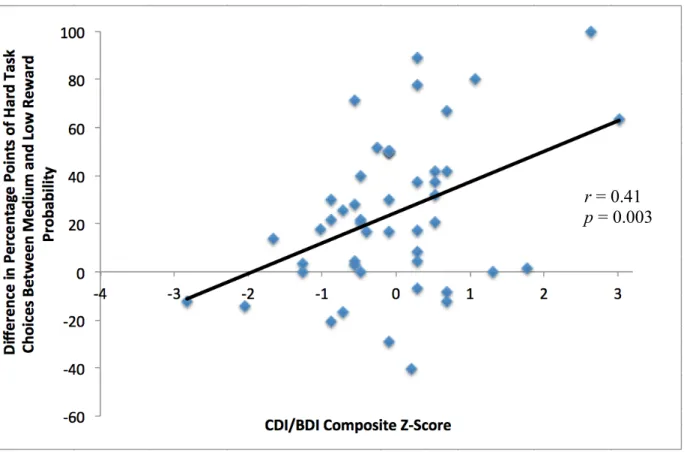
moderate positive correlation was also seen between difference in percent of hard task choices made from low to medium reward probability and depression symptom severity, such that reward sensitivity increased as depression symptom severity increased, r(47) = 0.41, p = 0.003 (see Figure 3). A partial correlation between these measures controlling for ASD symptom severity as measured by the SRS was completed, and the correlation remained significant, r(46) = 0.40, p = 0.004. The remaining four correlations yielded no significant results, p > 0.05.
Impact of hedonic capacity on motivation in ASD
This was analyzed by examining correlations between hedonic capacity, as measured by the TEPS Subscales (TEPS-Anticipatory, TEPS-Consummatory, and TEPS total scores), and percentage of EEfRT hard task choices in each of the six magnitude and probability conditions listed above. A moderate positive correlation was seen between percent of hard task choices made at high reward probability and consummatory hedonic capacity, such those with higher consummatory hedonic capacity were likely to make more hard task choices at a high reward probability, r(47) = 0.37, p = 0.008 (see Figure 4). A partial correlation between these measures controlling for ASD symptom severity as measured by the SRS was completed, and the
hedonic capacity increased, r(47) = 0.34, p = 0.016 (see Figure 6). A partial correlation between these measures controlling for ASD symptom severity as measured by the SRS was completed, and the correlation remained significant, r(46) = 0.34, p = 0.018. The remaining 15 correlations yielded no significant results, p’s > 0.05.
Next, we examined correlations between TEPS-A, TEPS-C, and TEPS total scores and sensitivity to changes in EEfRT magnitude and probability conditions, as listed above. These analyses yielded no significant results, p’s > 0.05.
Discussion
The aim of this study was to examine the effects of comorbid depression on reward processing in adolescents with ASD. We hypothesized that both categorical diagnoses and dimensional measurements of depression would correlate negatively with reward sensitivity, such that those with depression would have less reward sensitivity than those without, and as severity of depressive symptoms increased, reward sensitivity would decrease. Results showed that this was not the case. When diagnosing depression categorically (depression status), no significant relationship was seen between categorical depression diagnosis and reward sensitivity, as measured by the difference in percentage of hard task choices made between conditions.
This finding is in line with the results from previous literature demonstrating decreased motivated behaviors in individuals with MDD using the EEfRT (Treadway et. al., 2012). It especially makes sense in the low probability condition because it would require more
motivation to complete the hard task at low reward probability than in other conditions where the participant was more likely to obtain the reward. However, as reward probability increased, there was a positive correlation between depressive symptom severity and reward sensitivity, such that those with more severe symptoms were more likely to increase their effort when there was a greater probability of reward. This finding is in line with the “law of least effort,” which states that individuals will exert the least amount of effort possible to gain a reward (Salamone, 2006; Solomon, 1948), and thus reflects typical reward processing. However, the MDD literature suggests that depressive symptoms, specifically anhedonia, correlate with blunted activity in the mesolimbic dopamine system, and consequently, blunted reward sensitivity. This means that our participants showed typical reward processing results despite the literature suggesting that their results should have been atypical. However, MDD is also correlated with blunted emotional activity. It is possible that, in order to compensate for this deficit, participants chose the task that had a greater immediate reward value to them; that is, they chose the task that more immediately piqued their interest (Must, Szabó, Bódi, Szász, Janka, & Kéri, 2005). As the probability of earning money increased, the choice with more immediate reward value would be that with greater reward magnitude: the hard task. If this were the case, participants with more severe depressive symptoms and TDCs would have similar reward sensitivity results; both would make an increased percentage of hard task choices in response to a greater increase in reward.
would be motivated to increase their effort as necessary when there was a greater chance of earning a reward or an opportunity to earn a greater reward. Must et. al.’s (2006) explanation suggests that individuals with severe depressive symptoms would choose the option with the most emotional reward as a compensation for their lack of motivation. Because higher reward magnitudes and probabilities would have greater emotional valence, reward sensitivity results would appear the same in individuals with severe depressive symptoms as TDCs.
In addition to examining categorical and dimensional measures of depression, the current study also hypothesized that hedonic capacity would be positively correlated with reward
sensitivity. Results indicated that there was no correlation between the TEPS (or either of its subscales) and reward sensitivity, as measured by differences in percentage of hard task choices between levels of EEfRT magnitude and probability conditions. There were positive correlations with the consummatory subscale and high probability reward, medium magnitude reward, and low magnitude reward. This is in line with the previous literature which suggests an increased ability to experience pleasure in response to rewarding stimuli should result in increased motivated behaviors to earn those rewards (Whitton et al., 2015). However, previous research has also found hedonic capacity deficits in MDD and ASD to be related to reward anticipation, rather than reward liking (consummatory pleasure). Contrastingly, these results show no significant results in the way of reward anticipation, but do suggest that individuals with less hedonic capacity are less likely to experience reward in response to stimuli that are rewarding for individuals with typically development, such as money. Previous research supports atypical reward processing in ASD such that individuals with ASD have been found to present with decreased response to monetary reward (Dichter, Felder, et al., 2012). Atypical reward
Given that results suggest effort-based decision-making in individuals with ASD is related to the presence of depressive symptoms, there are important clinical implications in terms of ASD treatment. There is a ~43% comorbidity between ASD and MDD, and a significant proportion of this percentage is made of individuals with HFA (Sterling et. al., 2008). Individuals with HFA tend to present as socially awkward and thus struggle to develop social relationships both in casual and professional environments; however, given their average to above average level of intelligence, these individuals often have enough social awareness to understand they are being treated differently than those around them (Sterling et al., 2008). This may result in
feelings of loneliness, which can contribute to the social isolation already present in ASD and, consequently, depressive symptoms. Therefore, our findings of impaired hedonic capacity in an ASD sample may be a reflection of depressive symptoms. Though ASD symptoms are pervasive, if the impaired hedonic capacity in ASD is more related to depressive symptoms, treatment measures for HFA should consider incorporating treatment for depressive symptoms, specifically anhedonia.
depressive symptoms and reward sensitivity, making it appear typical. Regarding the possible impact of additional comorbidities, 61% (N = 30) of our sample met criteria for comorbid psychiatric disorders outside of MDD. More specifically, 43% percent of our sample (N = 21) met criteria for either an ADHD and obsessive-compulsive disorder, which have been shown to impact decision-making (Must et. al., 2005 & Paloyelis et. al, 2012). Accordingly, symptoms of these disorders may have acted as confounds in our study.
This limitation is also relevant in terms of hedonic capacity. Since hedonic capacity is related to dopamine, medication alleviating depressive symptoms could also affect the significant relationships seen between consummatory pleasure and high reward probability, as well as medium and low reward magnitude. Further, we incorporated two versions of the MINI: the MINI-KID in which parents report on symptoms versus the adult version of the MINI in which adolescents >18 reported on their own symptoms. This could have impacted our MDD diagnosis outcomes because individuals with ASD often lack insight into their own emotions, and thus may not be able to accurately report their depressive symptoms. The CDI and BDI present the same problem to our dimensional measure of depression symptom severity because they are both self-report as well. Finally, the MINI, CDI, and BDI were all limited in that our study was
References
Axelrod, B. N. (2002). Validity of the Wechsler abbreviated scale of intelligence and other very short forms of estimating intellectual functioning. Assessment, 9(1), 17-23.
Beck, A. T., Steer, R. A., Ball, R., & Ranieri, W. (1996). Comparison of Beck Depression Inventories -IA and -II in psychiatric outpatients. J Pers Assess, 67(3), 588-597. doi: 10.1207/s15327752jpa6703_13.
Chevallier, C., Kohls, G., Troiani, V., Brodkin, E. S., & Schultz, R. T. (2012). The social motivation theory of autism. Trends Cogn Sci, 16(4), 231-239. doi:
10.1016/j.tics.2012.02.007.
Constantino, J. N., Davis, S. A., Todd, R. D., Schindler, M. K., Gross, M. M., Brophy, S. L., . . . Reich, W. (2003). Validation of a brief quantitative measure of autistic traits: comparison of the social responsiveness scale with the autism diagnostic interview-revised. J Autism Dev Disord, 33(4), 427-433.
Damiano, C. R., Aloi, J., Treadway, M., Bodfish, J. W., & Dichter, G. S. (2012). Adults with autism spectrum disorders exhibit decreased sensitivity to reward parameters when making effort-based decisions. Journal of Neurodevelopmental Disorders 4(1). doi: 10.1186/1866-1955-4-13.
Dichter, G. S., Damiano, C. A., & Allen, J. A. (2012). Reward circuitry dysfunction in
Dichter, G. S., Felder, J. N., Green, S. R., Rittenberg, A. M., Sasson, N. J., & Bodfish, J. W. (2012). Reward circuitry function in autism spectrum disorders. Soc Cogn Affect Neurosci, 7(2), 160-172. doi: 10.1093/scan/nsq095
Delmonte, S., Balsters, J. H., McGarth, J., Fitzgerald, J., Brennan, S., Fagan, A. J., & Gallagher, L. (2012). Social monetary reward processing in autism spectrum disorders. Molecular Autism, 3(1). doi: 10.1186/2040-2392-3-7.
Gard, D. E., Gard, M. G., Kring, A. M., & John, O. P. (2006). Anticipatory and consummatory components of the experience of pleasure: a scale development study. Journal of Research in Personality, 40(6), 1086-1102.
Helsel, W. J., & Matson, J. L. (1984). The assessment of depression in children: the internal structure of the Child Depression Inventory (CDI). Behav Res Ther, 22(3), 289-298. Lord, C., Risi, S., Lambrecht, L., Cook Jr., E. H., Leventhal, B.L., DiLavore, P.C… & Rutter, M.
(2000). The autism diagnostic observation schedule- generic: a standard measure of social and communication deficits associated with the spectrum of autism. Journal of Autism and Developmental Disorders, 30(3), 205-223.
Mazefsky, C. A., Oswald, D. P., Day, T. N., Eack, S. M., Minshew, N. J., & Lainhart, J. E. (2012). ASD, a psychiatric disorder, or both? Psychiatric diagnoses in adolescents with high-functioning ASD. J Clin Child Adolesc Psychol, 41(4), 516-523. doi:
10.1080/15374416.2012.686102.
Must, A., Szabó, Z., Nikoletta, B., Szász, A., Janka, Z., & Szabolcs, K. (2006). Sensitivity to reward and punishment and the prefrontal cortex in major depression. J Affective Disorders, 90(2-3), 209-215.
Paloyelis, Y., Mehta, M.A., Faraone, S.V., Asherson, P., & Kuntsi, J. (2012). Striatal sensitivity during reward processing in attention-deficit/hyperactivity disorder. Adolescent
Psychiatry, 51(7), 722-732. doi: 10.1016/j.jaac.2012.05.006.
Salamone, J. D. (2006). Will the last person who uses the term 'reward' please turn out the lights? Comments on processes related to reinforcement, learning, motivation and effort. Addict Biol, 11(1), 43-44. doi: 10.1111/j.1369-1600.2006.00011.x.
Solomon, R. L. (1948). The influence of work on behavior. Psychol Bull, 45(1), 1-40.
Sheehan, D. V., Lecrubier, Y., Sheehan, K. H., Amorim, P., Janavs, J., Weiller, E., . . . Dunbar, G. C. (1998). The Mini-International Neuropsychiatric Interview (M.I.N.I.): the
development and validation of a structured diagnostic psychiatric interview for DSM-IV and ICD-10. J Clin Psychiatry, 59 Suppl 20, 22-33;quiz 34-57.
Smith, G.S., Ma, Y., Dhawan, V., Chaly, T., & Eidelberg, D. (2009). Selective serotonin reuptake inhibitor (SSRI) modulation of striatal dopamine measured with [11C]-raclopride and positron emission tomography. Synapse, 63(1), 1-6. doi:
10.1002/syn.20574.
Sterling, L., Dawson, G., Estes, A., & Greenson, J. (2008) J. Autism and Dev. Disord. 38(6), 1011-1018. doi: 10.1007/s10803-007-0477-y.
Treadway, M. T., Bossaller, N. A., Shelton, R. C., & Zald, D. H. (2012). Effort-based decision-making in major depressive disorder: a translational model of motivational anhedonia. J Abnorm Psychol, 121(3), 553-558. doi: 10.1037/a0028813.
Treadway, M. T., Buckholtz, J. W., Schwartzman, A. N., Lambert, W. E., & Zald, D. H. (2009). Worth the 'EEfRT'? The effort expenditure for rewards task as an objective measure of motivation and anhedonia. PLoS One, 4(8), e6598. doi: 10.1371/journal.pone.0006598. Whitton, A. E., Treadway, M. T., & Pizzagalli, D. A. (2015) Reward processing dysfunction in
major depression, bipolar disorder and schizophrenia. Curr Opin Psychiatry, 28(1), 7-12. doi: 10.1097/YCO.0000000000000122.
Wilkinson, L. A. (2011). Identifying students with autism spectrum disorders: A review of
selected screening tools. Communiqué, 40, 1, 31-‐33.
Appendix
Table 1. Mean (and Standard Deviation) scores on demographic and clinical measures for the ASD group.
ASD (n=49)
Mean (SD)
Age 15.98 (2.59)
Full Scale IQ (FSIQ) 102.94 (16.89) Male: Female ratio 44:5
ADOS SA 11.17 (3.52)
ADOS RRB 3.83 (1.66)
Participant Race
African-American 4
Caucasian 44
Hispanic 1
Asian American 0
Other 0
Note. ADOS SA = Autism Diagnostic Observation Schedule,
Social Affect domain; ADOS RRB = ADOS, Restricted and
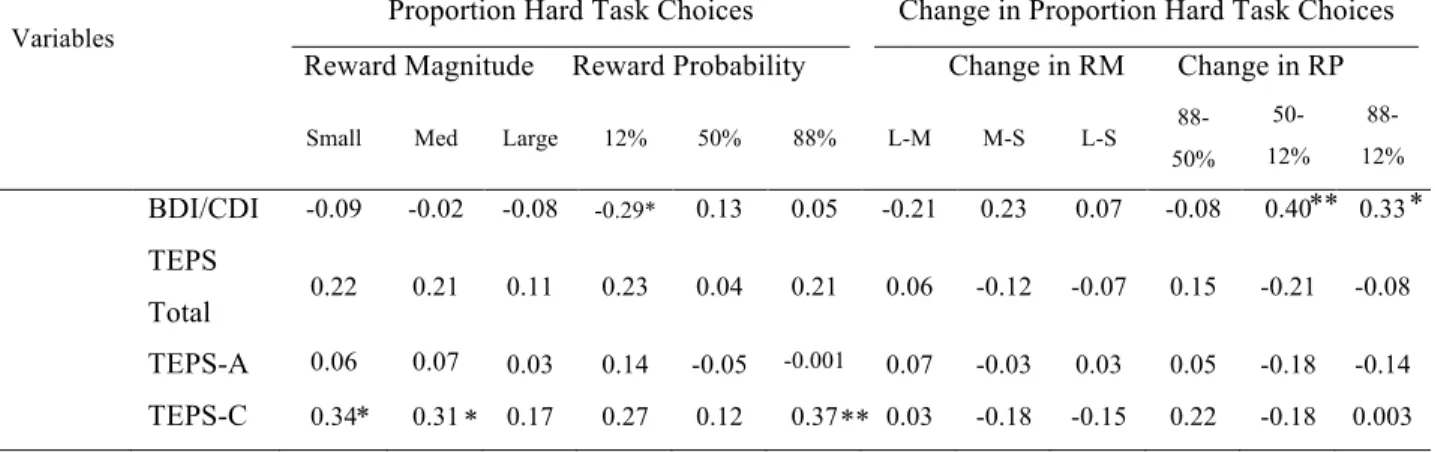
Table 2. Correlations between proportion of hard task choices on EEfRT and questionnaires in
the ASD group, controlling for severity of ASD symptoms with the SRS
Variables Proportion Hard Task Choices
Reward Magnitude Reward Probability
Change in Proportion Hard Task Choices
Change in RM Change in RP
Small Med Large 12% 50% 88% L-M M-S L-S 88-50%
50-12%
88-12%
BDI/CDI -0.09 -0.02 -0.08 -0.29* 0.13 0.05 -0.21 0.23 0.07 -0.08 0.40 0.33 TEPS
Total 0.22 0.21 0.11 0.23 0.04 0.21 0.06 -0.12 -0.07 0.15 -0.21 -0.08 TEPS-A 0.06 0.07 0.03 0.14 -0.05 -0.001 0.07 -0.03 0.03 0.05 -0.18 -0.14
TEPS-C 0.34 0.31 0.17 0.27 0.12 0.37 0.03 -0.18 -0.15 0.22 -0.18 0.003 *p<.05, **p<.01
L = Large, M = Medium, S = Small RM = Reward Magnitude
RP = Reward Probability
SRS = Social Responsiveness Scale
** *
* **
Figure 1. Correlations with CDI/BDI composite z-scores and percentage of EEfRT hard task
choices at low reward probability within the ASD group
Figure 2. Correlations with CDI/BDI composite z-scores and difference in percentage of hard
task choices made from high to low reward probability within the ASD group
Figure 3. Correlations with CDI/BDI composite z-scores and difference in percentage of hard
task choices made from medium to low reward probability within the ASD group
Figure 4. Correlations between TEPS-C scores and percentage of hard task choices at high
reward probability within the ASD group
r = 0.37
Figure 5. Correlations between TEPS-C scores and percentage of hard task choices at medium
reward magnitude within the ASD group
Figure 6. Correlations between TEPS-C scores and percentage of hard task choices at small
reward magnitude within the ASD group