Evolving communities
of practice: IBM Global
Services experience
by P. Gongla C. R. Rizzuto
In 1995, IBM Global Services began implementing a business model that included support for the growth and development of communities of practice focused on the competencies of the organization. This paper describes our
experience working with these communities over a five-year period, concentrating specifically on how the communities evolved. We present an evolution model based on observing over 60 communities, and we discuss the evolution in terms of people and organization behavior, supporting processes, and enabling technology factors. Also described are specific scenarios of communities within IBM Global Services at various stages of evolution.
C
onsiderable attention is being focused on com-munities1as an important element in the life of an organization. Driven by a knowledge economy, organizations need their employees to become “knowledge workers,” that is, individuals who con-stantly draw on a wealth of knowledge to devise new responses and solutions for a rapidly changing mar-ketplace. To perform well in this knowledge econ-omy, individuals must constantly apply and add to their own bodies of knowledge. They do this by find-ing ways to participate on a day-to-day basis in a flow of knowledge that consists, not only of the dissem-ination of data and printed material, but also of the exchange of ideas with other individuals who have experience and skill related to the same area of work. This interaction with others on work-related topics often leads naturally to the formation of communi-ties of practice. In addition, as “ . . . companies are beginning to recognize that these communities can be supported and leveraged to benefit the ‘member-ship’ of communities and the organization as awhole,”2
they are starting to sponsor the formation of communities and to support their ongoing activity. Our concept of a community of practice comes from the work of Wenger and Snyder who define it as “a group of people informally bound together by shared expertise and passion for a joint enterprise,”3
or sim-ilarly, as a collection of individuals bound by infor-mal relationships that share similar work roles and a common context.4Examples of communities of practice are found in many organizations and have been called by different names at various times, names such as “learning communities” at Hewlett-Packard Company, “family groups” at Xerox Cor-poration, “thematic groups” at the World Bank, “peer groups” at British Petroleum, p.l.c., and “knowledge networks” atIBMGlobal Services, but they remain similar in general intent.
As organizations start to recognize the role of com-munities of practice in helping them meet their bus-iness needs and objectives, efforts to better under-stand the workings of these communities have emerged. Knowledge-management-related confer-ences routinely include communities as a key agenda topic.5Organizations, like those mentioned above, support and report on the formation and ongoing maintenance of communities, recognizing the
influ-娀Copyright 2001 by International Business Machines Corpora-tion. Copying in printed form for private use is permitted with-out payment of royalty provided that (1) each reproduction is done without alteration and (2) theJournalreference and IBM copy-right notice are included on the first page. The title and abstract, but no other portions, of this paper may be copied or distributed royalty free without further permission by computer-based and other information-service systems. Permission torepublishany other portion of this paper must be obtained from the Editor.
ence they have in helping the organizations to be pro-ductive and innovative.
One such organization isIBMGlobal Services,6 which established a knowledge management program7in 1995 that depended heavily on forming and devel-oping communities of practice to benefit both the individual and the organization. In this paper, we first look at the overall program and the types of com-munities that emerged within the context of this pro-gram. Then we describe a general model for how these communities of practice evolved and explore the model further in terms of people, process, and technology differences and implications that emerge at each stage of evolution. We provide specific sce-narios of communities of practice, showing how they started and then progressed to a particular stage in the evolution model. Finally, we share what we learned about community development and conclude with some possibilities and questions related to the evolution of communities in a business environment.
Communities of practice within IBM Global Services
The communities of practice, commonly called “knowledge networks,” are referred to as institution-alized, informal networks of professionals manag-ing domains of knowledge. The common character-istics of and guidelines for forming a knowledge network are:
● They are global in scope, connecting practitioners worldwide and fostering a sense of community. ● They are responsible for a domain of knowledge.
This responsibility includes: –Handling explicit knowledge8
or intellectual cap-ital;9handling means gathering, evaluating, struc-turing, and disseminating knowledge that is shared among community peers and across cus-tomer projects and seeing to its evolution. The intellectual capital consists of methods, processes, tools, assets, reported experiences, and any other documentation associated with delivering services and considered of value by the business or com-munity.
–Adopting a small set of common roles10
for man-aging knowledge
–Providing opportunities for sharing tacit knowl-edge11among community members
–Using the common enterprise-wide Lotus
Notes** and Domino** application calledICM (intellectual capital management) AssetWeb12
● They are sponsored by a business unit and fostered where the business sees a need for managing knowledge for its core competencies or to meet customer or market demands.
● They are neither organization units nor teams. The domains of knowledge represented by these communities range fromIBMcore competencies(such as enterprise systems management, application
de-velopment, testing methods and practices, product platform, and organization change) to“go to mar-ket” competencies(such as e-business, package in-tegration, total systems management, mergers and acquisitions, and knowledge management) to indus-try sector competencies(such as automotive, chem-icals and petroleum, distribution, finance and insur-ance, and health care).
Today there are over 60 knowledge network com-munities with members from virtually every country thatIBMserves. By the end of the year 2000, over 76 000 professionals had access to theICMAssetWeb application and about 20 000 participated in some form of community activity. Many of these knowl-edge networks have existed for multiple years. This participation level and sustainability are indicators that the approach developed and used byIBMGlobal Services has a significant degree of success. All of these communities evolved with some assis-tance from the knowledge management program specialists, tools, and processes. However, the level of assistance varied widely. If the business identified a need for a knowledge network, the sponsor or lead-ers instigated its formation with the help of the spe-cialists. Sometimes, if there was an existing informal community and the business recognized the impor-tance of supporting that community’s further
develop-Communities of practice are institutionalized,
informal networks of professionals managing
ment, it would seek the guidance of the knowledge management program. Occasionally, a community on its own sought assistance from the knowledge management group for help with its development, usually to obtain some level of organizational rec-ognition, support, and access to the common tech-nology infrastructure.
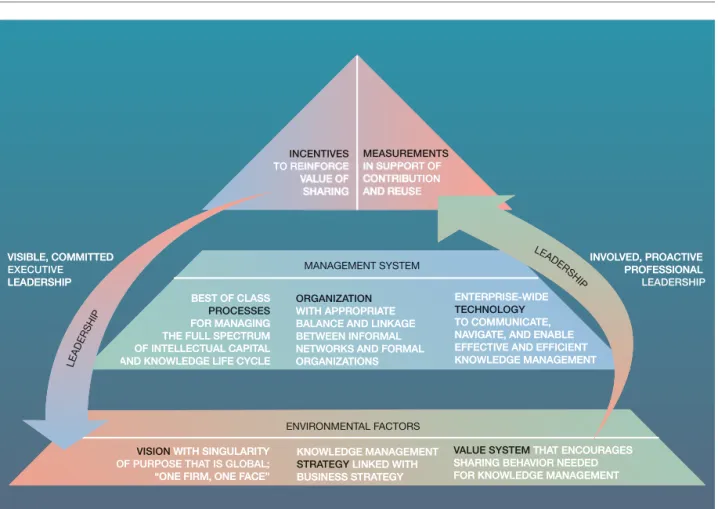
Organizational influences related to forming com-munities.Surrounding and supporting the communi-ties are the elements of a comprehensive knowledge management framework (Figure 1) that includes: vi-sion, business strategy, value system, measurements, incentives, processes, technology, and leadership. The framework is important because it helps link or align a community with the organization’s goals, management, value system, and infrastructure. Forming a knowledge network community inIBM
Global Services depends first on identifying the strengths and weaknesses of the sponsoring organi-zation in people, process, and technology factors re-lated to each element of the framework, and then on forming appropriate plans to address the frame-work-related issues raised. SinceIBMGlobal Services is a large, complex, global organization, the various lines of business that sponsor knowledge network communities vary widely on most of the framework elements, resulting in environmental variations for community development.
Even though the communities are affiliated with a common knowledge management program and are an integral part of the overall business model, they can and do act independently, responding to the needs of their members as well as the organizational and marketplace environments within which they
re-Figure 1 IBM knowledge management framework
LEADERSHIP EXECUTIVE
side. Consequently, there is wide variability in how they “look,” talk, organize, and work, even though they have some elements in common. For example, even performing one of the basic responsibilities— managing intellectual capital in its domain of knowl-edge—the approach varies significantly across the communities. Some have a highly structured process; others have a “loose” workflow. Some involve only a small core of committed specialists in review of the material; others create wide-ranging networks of sub-ject matter experts. Some cull material stringently from their knowledge bases; others loosely define what might be of importance to the community and leave much material for consideration. Some create highly detailed taxonomies; others produce a lim-ited number of general categorizations.
Our experience of this variability among these com-munities, despite their links to the overall knowledge management program and to any organizational di-rectives, coincides with and supports the observation made by Wenger:13
Communities of practice . . . reflect the members’ own understanding of what is important. Obvi-ously, outside constraints or directives can influ-ence this understanding, but even then, members develop practices that are their own response to these external influences. Even when a commu-nity’s actions conform to an external mandate, it is the community—not the mandate—that pro-duces the practice. In this sense, communities of practice are self-organizing systems.
Gathering knowledge about the
communities and applying the evolution model
A vast amount of information and data about the knowledge network community development was ac-cumulated. The profiles of the knowledge network communities and the evolution model proposed are
outgrowths of work done over the last five years and are derived from three primary approaches. (1) Par-ticipant observation: The authors and their team-mates worked directly with many of the communi-ties to help support their formation and functioning. As such, we “lived” with the communities, partic-ipating in their meetings, conference calls, report-ing, plannreport-ing, and so on. Sometimes we were actively involved in facilitation, but we were always observ-ing, sharobserv-ing, and learning. (2) Activity measurements: A number of indicators having to do with the man-agement and usage of the repository of intellectual capital of the knowledge network were tracked and reported on a monthly basis. Changes over time were analyzed and trends noted. (3) Structured interviews: On a periodic basis the leaders, executive sponsor, and a sample of members of the community were interviewed using a structured interview guide. These interviews were a “health check” to learn about over-all activities and functioning of the community in-ternally and also in relationship to its larger orga-nizational environment.
In addition, annual strategic and operational plan-ning data for the community-sponsoring lines of bus-iness and geographic regions were reviewed. These data provided insight into organizational recognition of, support for, and investment in knowledge net-work communities.
How the communities evolved in IBM Global Ser-vices.There is a pattern to how the communities evolved and the pattern is influenced by a dynamic balance of people, process, and technology elements. We observed this pattern across the range of com-munities regardless of the strategy and approaches to knowledge management of the sponsoring orga-nizations. The overall evolution pattern was summa-rized into five stages: potential, building, engaged, active, and adaptive. (See Table 1.) Using this pat-tern we developed an evolution model that helped us describe those characteristics that distinguish
com-Table 1 Community evolution model definition
Potential Building Engaged Active Adaptive
Definition A community is forming.
The community defines itself and formalizes its operating principles. The community executes and improves its processes. The community understands and
demonstrates benefits from knowledge management and the collective work of the community.
The community and its supporting organization(s) are using knowledge for competitive advantage.
munities in one stage from those in another. The model is intended to show that communities are dis-tinct at each stage, having different characteristics as they transform from one level to another. This model also presupposes that at each latter stage, the functions and characteristics of the previous stage(s) already exist.
At first glance our community evolution model ap-pears to be a form of life-cycle model similar to what Wenger13
or McDermott14
propose. Their models use a life-cycle concept to describe communities as developing through stages akin to birth, maturation, and death. Wenger sees communities of practice as progressing through five stages: potential, coalesc-ing, active, dispersed, and memorable, with levels of interaction and types of activities varying across the stages. Members’ interaction within the community generally increases through the active level and then declines through the dispersed stage, and pretty much disappears at the memorable level, although memories, stories, and artifacts of the community still remain.
McDermott views communities as living, human in-stitutions that “form spontaneously, grow, mature, change, age and die.”15
He uses this life-cycle per-spective to describe five stages of community devel-opment, similar to Wenger’s model but with more elaboration of the tensions and challenges that stim-ulate the community to develop and renew itself, but that eventually lead to the community’s death. Mc-Dermott’s series of stages include: plan, start-up, grow, sustain/renew, and close.
Our current evolution model is similar to Wenger’s and McDermott’s in recognizing formative and growth stages of development. However, the evolu-tion model is not a life-cycle approach. In this evo-lution model, a community can mature and dissolve at any one of these stages beyond the initial forma-tion level. The model describes instead how com-munities transform themselves, becoming more
capable at each stage, while at the same time main-taining a distinct, coherent identity throughout. The evolution model, then, is more similar in over-all intent to, for example, the capability maturity models developed by the Systems Engineering In-stitute for assessing software organizations16
than to the life-cycle-type development model for commu-nities of practice, such as Wenger and McDermott describe.
Looking at the communities withinIBMGlobal Ser-vices from the evolution model perspective, we no-ticed some interesting behaviors. Communities may stay at certain stages and not evolve to another lev-el; communities may move “backward and forward” between the stages; communities may have some characteristics of one stage while they are still pri-marily at another stage; communities may “rest” for extended periods at one stage and suddenly evolve quickly to another stage. By grouping our observa-tions into a capability-oriented model, we were able to describe the variations in behavior, process, and enabling technology as communities evolved. Certain variables that are acknowledged to be im-portant for understanding communities overall, such as the degree or intensity of participation by com-munity members, are not discussed throughout the evolution model because they did not emerge as dis-tinguishing features across the stages. For example, with this set of communities, participation generally showed as much variability within a stage as between stages once the community moved beyond initial for-mation.
Description of the stages of community evolution.
Each of the five stages has its defining characteris-tics as well as an underlying function that helps ex-plain why one stage is different from the next and shows what to build on from previous stages. Table 2 shows these fundamental functions at each stage of evolution.
Table 2 Fundamental functions for the stages of evolution Potential Stage Building Stage Engaged Stage Active Stage Adaptive Stage Fundamental Functions
Connection Memory and context creation
Access and learning
Collaboration Innovation and generation
At the first stage, thepotential stage, a community is just starting to form. It is in a “prebirth” stage, but a nucleus begins. This nucleus is made up of indi-viduals with something in common related to their work or interest, but the individuals have not yet dis-covered fully what that commonality is or how far it extends. At this potential stage,connectionis the fundamental function. Individuals who form the nu-cleus must be able to locate one another, then com-municate, and form relationships. A small nucleus of individuals is enough to start the process and pre-pare for movement to the next stage.
At thebuilding stage, a community begins to coalesce and define itself. The initial members, as a group, start to define what the community is going to be and how it is going to build and declare its existence. This core group of members begins to create a struc-ture and processes for how the community will op-erate, and how the members will work together over time.
At the building stage, bothcontext creation and mem-oryare fundamental functions. The core members of the community create things together, building a common understanding of what the community is and what it is not, why it is forming, and how it will function. The community then “remembers” those things, putting them to use over time. Through this process it begins a shared history. The core group of individuals building the community begins to rec-ognize what it means to be a member of the com-munity and can then, in turn, recognize and reach out to others—potential community members—who should belong.
During theengaged stagea community actually op-erates with a common purpose. It functions on a sus-tainable basis. The structure and processes designed in the previous stage are put into action. The com-munity grows in size and complexity.
Accessto one another as community members and access to what the group knows are key functions. Since the community is now running, with individ-uals playing their roles and executing processes, the community islearninga great deal about itself as an ongoing entity and alsolearningmore about the envi-ronment within which it operates. It starts using what it learns to adjust and improve. At this stage, the com-munity really begins building its capability to lever-age its explicit and tacit knowledge.
At theactive stage, a community reflects, analyzes, and really starts to understand, define, and assess the value of what it is doing and what it is contrib-uting to its membership and to the organization. The community further extends its membership and builds relationships to other communities.
Collaborationthat occurs on multiple planes is the fundamental function at the active stage. Members are working together to build and sustain the com-munity. They are also working together to solve bus-iness problems and to exploit busbus-iness
opportuni-ties. They leverage one another and the communi-ty’s shared knowledge to perform work external to the community. Indeed, it becomes the communi-ty’s responsibility to pool knowledge and work to-gether to address the business issues presented to it by the organization. Community members further collaborate to assess the value of what the commu-nity is doing and to publicize that value to the larger organization. Collaboration promotes an under-standing throughout the larger organization of the need for and distinct benefit from the community’s knowledge and work.
At theadaptive stage, a community has moved to a level where it senses and responds to external con-ditions. It can adjust continuously to create knowl-edge and to establish the new structures and pro-cesses it needs for leveraging its knowledge to compete effectively and to influence—and potentially redefine—its environment. Further, the community may expand into new environments.
At this stage, the communityinnovates and generates, creating significant new business objects—new so-lutions, new offerings, new methods, new processes, and new groups. The community identifies, influ-ences, and even creates trends in its area of exper-tise. The community’s innovation affects not just its members and the immediate domain within which
Each of the five stages
of community evolution has its defining characteristics
to differentiate one stage from the next.
it operates but other parts of the organization and external agencies as well.
We hypothesize, however, that few communities will ever reach or sustain themselves as a community at the adaptive stage. The work being done by the com-munity becomes too important to the organization for it to allow the community to continue as a self-governing body. There is a distinct likelihood that the organization will want more control and essen-tially convert the community into an organizational unit.
Through our observations and analysis we have ex-tensive experience with communities at the first three stages and some examples of communities at the ac-tive stage, but we have minimal experience with com-munities at the last level, the adaptive stage. We have fragments of community experience that point to a fifth stage, but we have not seen any one community actually existing and thriving at this level. What we have seen so far is: one community with one or two aspects of the adaptive stage, and another commu-nity with another one or two aspects. In the evolu-tion model we have projected from a combinaevolu-tion of (1) a few communities approaching this level and manifesting some of the characteristics and (2) vi-sions from community leaders that aspire to this stage and are actively working toward achieving it. Piec-ing these together has given us a profile of what the adaptive stage consists of.
The forces of people, process, and technology in com-munity evolution.We learned that a community’s evolution through these stages can be advanced or arrested, depending on the attention that a group pays to building a foundation at each developing stage. We have seen groups move forward quickly on some aspects of development and bypass others. Initially, this action may not impact the immediate performance of a community. However, if a com-munity wants to increase its effectiveness or aspires to a more advanced evolution stage, it usually needs to return to restructure or build elements from ear-lier stages that it may have shortchanged.
Before describing the characteristics that we ob-served in the behavior of people, the degree and type of process support, and the types of technology en-countered at each stage of community evolution, we should review working definitions of the scope of each element.
In talking about the behavior ofpeople, we are ref-erencing “people” in a very broad sense. We are con-sidering people as social individuals with their in-dividual and group behaviors, as well as the larger organizational behavior influence vis-a-vis a commu-nity.17
Processesare sets of documented steps with clearly defined roles and activities for people to perform. The knowledge network community-building pro-cesses inIBMGlobal Services include both internal, community-oriented processes and the external pro-cesses that are part of the larger organization. Some key processes internal to a community are: manag-ing the community’s intellectual capital, sharmanag-ing tacit knowledge, communications, socialization, member-ship management, and content management. The ex-ternal processes include incentive recognition, bus-iness strategy development and execution, and competency development. Measurement processes, a key cultural aspect ofIBM, span both internally and externally oriented community processes. Within the community evolution model, we consider primarily those processes that are internal to the community.
Technologyis the application of science and the body of information system knowledge that we use to fash-ion tools, practice knowledge arts, and extract data and information. Given the strong technical foun-dation ofIBMGlobal Services, the communities used a wide range of technologies from tried-and-true tools and techniques to groundbreaking and inno-vative experiments.
People, process, and technology at each stage.In the following subsections, the five stages of community evolution are described as to how people, process, and technology are involved with each one.
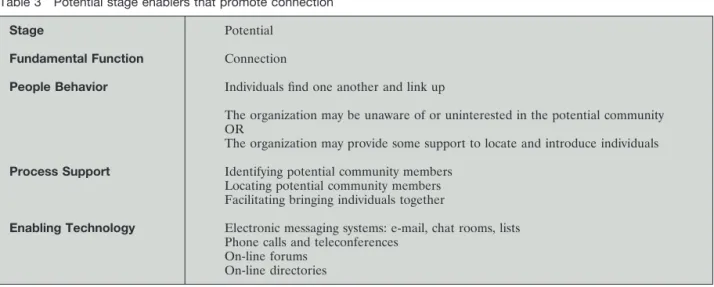
Potential stage.We now describe the enablers for pro-moting connection in the potential stage listed in Ta-ble 3.
People.In order for the individuals who will become members of the potential community to connect, they must find one another, communicate, and form a link. Simple socializing behavior is required at this stage. Some key skills or competencies that helped individuals to work well in this stage include: inter-personal communication, curiosity, networking, and the ability to associate ideas.
To form a community, it is not sufficient to have in-dividuals who may be doing the same job or existing
in the same organizational unit. In order to connect as a community, individuals need to establish per-sonal connections with each other. Each person looks at the others and seeks to answer the very basic ques-tion, namely: Who are you? The actual questions come out in myriad forms: What do you do? Where have you worked? What organizational unit do you report to? Do you know so-and-so? What groups are you in? And so on. All of these questions are aimed at finding out information about the other person and forming a connection. For the potential com-munity to form, the collective answer to that ques-tion of “Who are you?” must be: “You are like me.” Additionally, each member of the nascent commu-nity must receive a reciprocal answer: Not only do I recognize that you are like me, but you recognize that I am like you in something that you value. To-gether we must have at least one important common-ality related to our work or area of expertise that each of us recognizes.
We have seen dozens of potential communities form and dissolve without any particular organizational intervention. In fact, the organization usually does not know or care that these people are connecting. However, in some instances, the organization, mo-tivated by a business need, becomes the catalyst for the potential community. The organization actively seeks out people to form the knowledge network community and purposefully creates introductions and potential connections among them. The orga-nization may even create a “matchmaking” respon-sibility to help locate and link individuals. Such a
re-sponsibility may be part of a larger “knowledge broker” role where the broker has the responsibility to connect individuals seeking knowledge with oth-ers who have that knowledge.18
Process.The important types of processes are those that help identify and locate people who might form a community at the potential stage and those that facilitate bringing them together so that they can get to know one another. Common education and de-velopment processes, communication processes, and organization assimilation processes play an impor-tant role in connecting people. Individuals also ap-ply their own approaches to networking, communi-cating, and socializing, thus allowing natural or planned communities to form.
Technology.The needs of the potential community tend to be simple: any technology that facilitates communication and places to meet and talk— whether person-to-person, person-to-group, or group-to-group—are important. Basic phone calls and conference calls, electronic mail, chat rooms, electronic messaging systems, forums, and bulletin boards, all have their place. Technology that helps identify individuals and groups according to their do-mains of knowledge and expertise is valuable, includ-ing tools such as on-line directories, skill and resume databases, and search engines.
Given the dispersed nature of theIBMGlobal Ser-vices organization, individuals who share a work-re-lated area of expertise are located all over the world
Table 3 Potential stage enablers that promote connection
Stage Potential
Fundamental Function Connection
People Behavior Individuals find one another and link up
The organization may be unaware of or uninterested in the potential community OR
The organization may provide some support to locate and introduce individuals
Process Support Identifying potential community members Locating potential community members Facilitating bringing individuals together
Enabling Technology Electronic messaging systems: e-mail, chat rooms, lists Phone calls and teleconferences
On-line forums On-line directories
and may not be able to find one another easily. A solid communications infrastructure and good net-work management are essential enablers for poten-tial communities in this environment. Fortunately, e-business capabilities such as the intranet and In-ternet allow individuals to connect in ways not pos-sible even in the recent past.
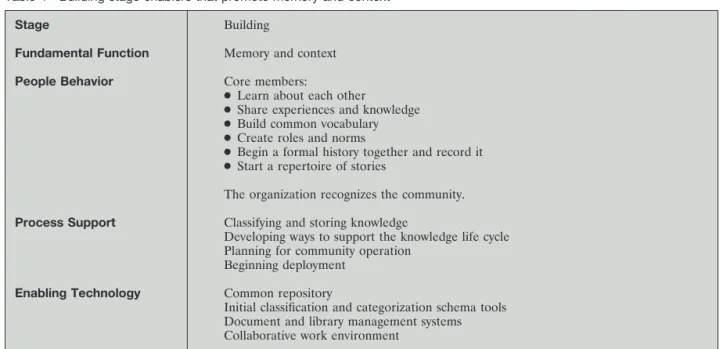
Building stage.Here we describe enablers that pro-mote memory and context in the building stage, as listed in Table 4.
People.Individuals have to learn about one another in the work environment. They have to actually share some experiences and exchange some tacit knowl-edge. They must learn to talk to one another using words in the same way and build a common vocab-ulary and common understanding. By doing this, in-dividuals begin to identify with all the others and, in a sense, make the decision to create a commu-nity. The key skills or competencies that helped peo-ple in this stage include: abstract thinking, organiz-ing ability, comprehensive subject matter expertise, leadership, and the ability to create and share a vi-sion and to develop stories.
At this stage, it is usually a small number of persons, a core group, that comes together. As in the
poten-tial stage, a fundamental question needs to be an-swered. The question now becomes: “Who are we?” However, it is the group rather than the individual formulating the answer. The questions related to de-termining the community identity include: What is our purpose? What do we know as a group? What do we do? How do we behave vis-a-vis one another? As the common identity is formed, the members be-gin creating a shared context, including the defini-tion of roles and norms and the descripdefini-tion of plans and processes for how the members will work to-gether. Thus begins the community’s history, marked usually by the emergence of stories that contribute to the early group memory.
From the organizational behavior point of view at the building stage, the organization often recognizes the identity of the community and records that it ex-ists. If the organization is taking an active role in com-munity formation, it will also contribute some direc-tion in defining the community’s identity and assist with the planning.
Process.At this stage, we found a number of sup-porting processes that are helpful. The core group may need methods that are oriented to helping them plan for the community’s growth and operation, in-cluding processes to:
Table 4 Building stage enablers that promote memory and context
Stage Building
Fundamental Function Memory and context
People Behavior Core members:
●Learn about each other
●Share experiences and knowledge
●Build common vocabulary
●Create roles and norms
●Begin a formal history together and record it
●Start a repertoire of stories
The organization recognizes the community.
Process Support Classifying and storing knowledge
Developing ways to support the knowledge life cycle Planning for community operation
Beginning deployment
Enabling Technology Common repository
Initial classification and categorization schema tools Document and library management systems Collaborative work environment
● Define the scope and membership for the commu-nity
● Create the roles for members to play and the norms for guiding behavior
● Determine ways in which to identify, attract, or re-cruit new members
● Discover what the community knows and deter-mine how to classify and categorize that knowl-edge in a way that is natural for the community ● Plan for how community members will share tacit
knowledge and manage explicit knowledge ● Align the enabling technology with the
member-ship needs and supporting processes
Technology.The community needs a place to put the explicit knowledge it is accumulating so that current and future members can easily access and use it. This requirement means having a common repository that is accessible no matter where members happen to reside geographically or in what organizational unit they happen to work.
It is also helpful if the community has technological support for designing and maintaining whatever tax-onomy is appropriate for its domain of knowledge. If that taxonomy support can be linked with other organizational taxonomy efforts, all the better. Systems for managing documents and code (if code assets are part of the knowledge base) and library management are useful.
A collaborative work facility (such as Lotus Quick-Place** or TeamRoom) helps the core group to have a place to organize and share its work. Using e-meet-ing technology to jointly design processes and infra-structure can also be helpful during this stage.
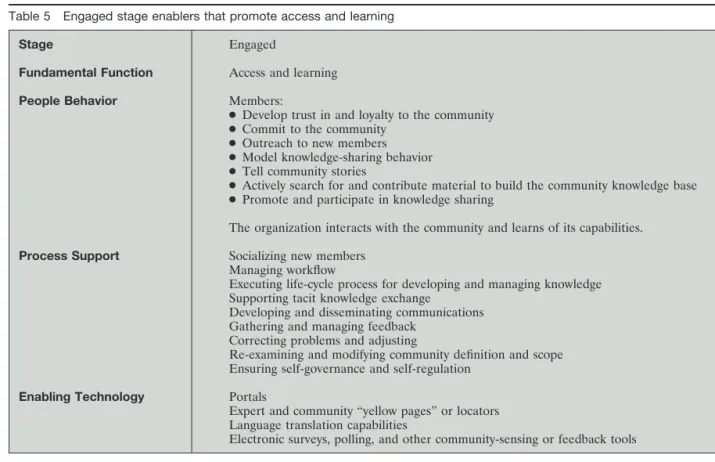
Engaged stage.The enablers that promote access and learning in the engaged stage are listed in Table 5 and are described below.
People.The engaged stage involves individuals mak-ing a commitment to the community. They learn how to perform the defined roles. Since they are learn-ing in the context of dolearn-ing, they also build tacit knowledge about how to make the community work. These activities and interactions help individuals to develop trust in the other members and in the com-munity as a whole. Some key skills and competen-cies that helped members in this stage include: teach-ing ability, leadership, marketteach-ing or publicity skills, ability to operationalize, multilingual and cultural proficiency, and general persistence and tenacity.
At this stage the community also expands beyond its core team. The new members must be given ac-cess to the other community members and to the group memory. Tacit knowledge and explicit knowl-edge about the community itself as well as its work-related domain of knowledge need to be shared, and the group stories must be told and further developed. Original members provide instruction in and model behavior for the newer members so that new mem-bers learn what the community is about, how they fit in, and what roles they play.
Just as important, the new members bring with them accumulated knowledge and behavioral preferences. The overall community adds to its knowledge and behavioral repertoire by learning from new mem-bers. This increased complexity carries new chal-lenges for the community in ensuring that all mem-bers have access to one another and to the knowledge they need. It also encourages the members to pe-riodically re-examine the community’s desired scope, both in terms of knowledge domain and member-ship.
The organization begins to be interested in access-ing community members, learnaccess-ing what the commu-nity does, and how it benefits the organization. The organization may set up regular interaction with the community at this stage to keep track of its activities and progress. The organization may also intervene in community work, typically by either supporting growth efforts or trying to redefine scope, mission, or mode of operation; occasionally these behaviors interfere with the community’s development. Process.At the engaged stage, processes that were previously developed at the building stage are im-plemented and are running. Supporting processes for gathering feedback and measuring community effectiveness to help the community learn about it-self and continuously improve are important. Managing a community’s intellectual capital tends to become more complex by this stage. Processes that facilitate acquiring, disseminating, and maintaining or furthering the evolution of knowledge are espe-cially helpful. The community needs to identify gaps in its knowledge base and fill those gaps, and it con-stantly looks for new ways to advertise for, create, pilot, harvest, and motivate contributions.
Recruiting and socialization at the engaged stage need to be treated as a process, although a commu-nity will still take advantage ofad hocopportunities,
such as fortuitous conversations between old and new members, to promote growth and development. Even if the community reaches a size that it decides is appropriate, it must still continue processes for recruiting and socializing members in order to en-sure vitality.
Finally, communities at this stage are increasingly aware of the importance of exchanging tacit knowl-edge. They seek ways to enhance person-to-person communication so that the tacit knowledge of the whole community is shared and developed, and members learn in the context of doing. A commu-nity that has never had the opportucommu-nity to meet face to face must find ways to compensate for this need. Since the organization is now conscious of the com-munity, there is mutual benefit to and opportunities for integrating the community’s knowledge manage-ment processes with other organizational processes and workflows, such as new project initiation, bus-iness planning, end-of-project reviews, research de-velopment and overall processes for developing in-tellectual capital.
Technology.The community needs tools to help it learn about itself— electronic surveys, polling, mea-surements gathering and analysis tools, and so on. Simple measurement reporting tools are often in-tegrated at this stage. Community members who work directly in managing intellectual capital ben-efit from workflow support.
As the explicit knowledge base grows, technologies that help with customized searches are valuable. A community portal can be particularly helpful for in-dividuals who are joining the community and need assistance with access.
To aid with the membership growth, expert locators are useful for identifying and finding new members, and a “yellow pages” for the community helps keep track of the membership.
Since many of these knowledge network communi-ties are cross-national and multilingual, natural lan-guage translation capabilities, although still limited, are helpful at this stage to handle the expanding knowledge and peer-to-peer communication needs.
Table 5 Engaged stage enablers that promote access and learning
Stage Engaged
Fundamental Function Access and learning
People Behavior Members:
●Develop trust in and loyalty to the community
●Commit to the community
●Outreach to new members
●Model knowledge-sharing behavior
●Tell community stories
●Actively search for and contribute material to build the community knowledge base
●Promote and participate in knowledge sharing
The organization interacts with the community and learns of its capabilities.
Process Support Socializing new members
Managing workflow
Executing life-cycle process for developing and managing knowledge Supporting tacit knowledge exchange
Developing and disseminating communications Gathering and managing feedback
Correcting problems and adjusting
Re-examining and modifying community definition and scope Ensuring self-governance and self-regulation
Enabling Technology Portals
Expert and community “yellow pages” or locators Language translation capabilities
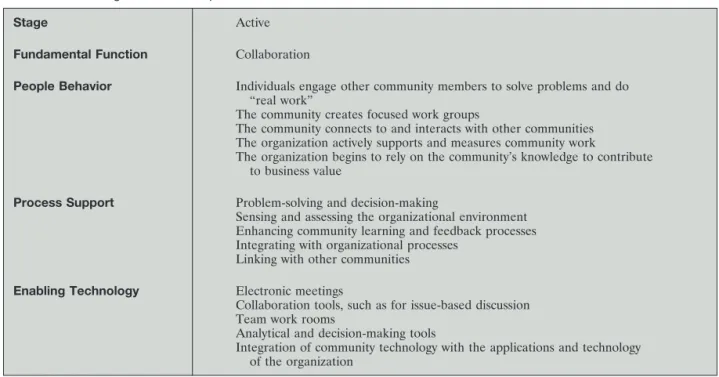
Active stage.In this subsection we describe the en-ablers that promote collaboration in the active stage as in Table 6.
People.Collaboration becomes a fundamental func-tion at the active stage. Community members call on one another to do work outside the community, focus together to solve business problems, and jointly pursue business opportunities. This function means that community members have gained detailed knowledge about one another’s capabilities, under-stand the value of intracommunity knowledge ex-change, and rely on the expertise and knowledge of the community. A key behavior is that members turn to the community early on when faced with a new or difficult work problem. Members respond to re-quests from other members as though it is their job. They circumvent organizational barriers in order to work with other community members.
Underlying skills and competencies that helped peo-ple work well at the active stage include: ability to team and work with others, skill in recognizing a per-son’s capabilities and building teams, facilitation, coaching, business acumen, and ability to leverage the formal and informal networks of the organiza-tion.
The community also reaches outward, connecting with other communities across the organization to share knowledge when needed and to help deal with business problems or opportunities.
The organization at this stage wants, and often relies on, the community to do work that will advance the business. The organization gives support, but it also ex-pects business value from the community’s actions. Process.Three types of group dynamics processes help a community effectively channel its capabilities to tackle the multiple business issues it faces: team building, group problem-solving, and decision-mak-ing. The community also needs highly flexible man-agement processes to coordinate multiple work groups and teams.
For the community to actively work with other com-munities and organizational units, process integra-tion is important. This integraintegra-tion enables the com-munity to have access to other experts as needed, be informed of business needs and direction, and learn of opportunities to develop intellectual capital in con-junction with customer and internal projects.
Table 6 Active stage enablers that promote collaboration
Stage Active
Fundamental Function Collaboration
People Behavior Individuals engage other community members to solve problems and do “real work”
The community creates focused work groups
The community connects to and interacts with other communities The organization actively supports and measures community work
The organization begins to rely on the community’s knowledge to contribute to business value
Process Support Problem-solving and decision-making
Sensing and assessing the organizational environment Enhancing community learning and feedback processes Integrating with organizational processes
Linking with other communities
Enabling Technology Electronic meetings
Collaboration tools, such as for issue-based discussion Team work rooms
Analytical and decision-making tools
Integration of community technology with the applications and technology of the organization
Overall learning processes improve significantly at this stage, not just for community members as in-dividuals, but also for the community as a whole. The community specifically develops feedback processes to learn about the effects and effectiveness of the bus-iness work that the community does. It then coor-dinates its feedback process with the reporting needs and processes of the organization.
Technology.Tools for both directive and nondirec-tive collaboration are important at this stage. The community makes strong use of tools such as cus-tomized collaborative spaces (e.g., TeamRooms or Knowledge Cafe19
). In addition, e-meeting technol-ogies enable the community subgroups to move for-ward with their collaborative work. An issue-based discussion facility20or other structured discourse tool can aid the groups in coming to decisions as well as recording and retaining, for future reference, the ar-guments and discussion that led to the decision. Other analysis and decision support tools may be brought in as they relate to the problem area being worked on.
At the active stage, technological effort is also di-rected toward integrating the community’s work with major organizational applications for both business delivery and for training and education.
By this stage, the community is not only using tech-nologies incorporated at previous stages, but it tends
to become a more sophisticated user of the tools and to place more requirements on the technology de-velopers to enhance the current tools and to imple-ment new technologies.
Adaptive stage.Below we describe the enablers that promote innovation and generation in the adaptive stage seen in Table 7.
People.At the adaptive stage, where innovation and generation are the fundamental functions, commu-nity members are engaged in work that is changing what the business does or sells. They assume respon-sibility for working with others to significantly ad-vance the knowledge of their field.
The community members seek to influence more than the supporting organization. They reach out to and interact with other communities and to other associations and organizations to generate new bus-iness, new products, even new markets.
The community has evolved so much that it can spon-sor new communities and may even create charters for them.
Underlying skills or competencies that may help peo-ple work well at the adaptive stage include: research and experimental orientation, marketing and sales skills, competitive intelligence, ability and willingness to be a thought leader, confidence, adaptability,
prag-Table 7 Adaptive stage enablers that promote innovation and generation
Stage Adaptive
Fundamental Function Innovation and generation
People Behavior The community changes its environment through creation of new products, new markets, new businesses.
Members working together advance the knowledge, and even the definition, of their field. The community sponsors new communities.
The organization uses the community to develop new capabilities and to respond to and influence markets.
Process Support Adapting responsively to the environment, exhibiting dynamic stability Developing advanced boundary processes
Mentoring the formation of new communities Focusing on innovation
Enabling Technology Pilot uses of technology
Integration with the technologies of external organizations Technology transfer
matism, and a desire to explore the unknown and to create and communicate a future vision. The organization is vested in the community and be-comes dependent on the community to help develop new capabilities for the organization and to respond to market demands. The tendency, however, may be for organizations to take over a community that reaches this level. The work being done by the com-munity becomes too important to the business for the organization to allow the community to continue without formal direction and management by the or-ganization. In essence, the organization converts the community into a business unit. However, the com-munity may not actually disappear, but simply “drop back” to a previous stage and either co-exist with the business unit or go “underground.”
Process.In the adaptive stage the community relies on flexible and adaptive processes that are oriented toward its external environment. The community works in “sense and respond” mode21so that it can stay constantly attuned to changing conditions and readily respond to and help direct those changes. The community focuses its existing collaboration and communication processes on innovation, and it in-corporates or integrates with processes for research and development. One of the outcomes of its inno-vation efforts is the creation of new processes, meth-ods, and techniques that advance the state of knowl-edge in the community’s domain.
The community, by this stage, has learned how to support the formation of new communities and now actively mentors their development. It is looked to as a leader, and other communities, groups, individ-uals, and organizational units will seek out the com-munity to learn from it. It needs processes to trans-fer its knowledge beyond its boundaries.
When a community tries to function fully at the adap-tive stage, however, it faces a danger, not only of be-ing co-opted by the larger organization as noted above, but of potentially losing its identity as a dis-tinct, separate entity because it becomes too fluid in its interactions with the myriad groups and agencies with which it deals. One potential counterbalance, and what may be a critical process at this stage, is for the community to develop a highly evolved boundary subsystem.22
This subsystem would give the community a degree of control over the speed and type of exchanges that occur.
Technology.At this advanced stage, the community employs whatever technologies will advance the field and allow the community to innovate. The commu-nity initiates and participates in pilot uses of tech-nology, both by bringing in new technologies and be-coming a pilot group for external agencies and also by sponsoring pilots within other groups.
The community expands its technological reach be-yond its own organization, integrating the use of ex-ternal technology with its own tools. The commu-nity might use external technology, such as an on-line electronic trading room or industry association bulletin board, to communicate and collaborate with the “outside world.”
The results of this technology experimentation and use foster the community’s taking a strong role and responsibility for technology transfer within the or-ganization, increasing not only the development and use of multiple technologies but also the overall tech-nical competence of the members.
Applying the evolution model to the knowledge net-work communities. After outlining the evolution model, the knowledge management team examined the full set of knowledge network communities in order to classify them according to stages of the model. We used information from health checks, an-nual strategic and operational planning, our enabling technology evaluations, and process improvement activities to position the communities.
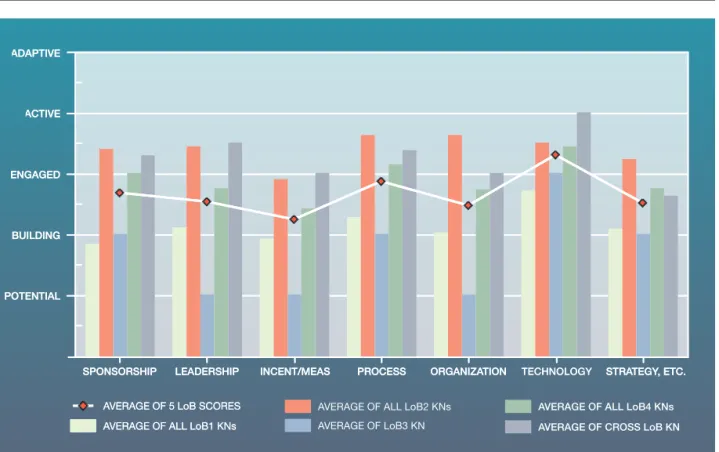
We aggregated the knowledge network community assessments by line of business to reveal variability across organization environments. Community as-sessments are based on the elements of the IBM Global Services framework referenced in Figure 1. Figure 2 shows the line of business (LOB) distribu-tion of knowledge network communities across the model stages. We saw that, as expected, the com-munities, on average, fell within the building, en-gaged, and active stages. We also saw that the av-erage stage development varies significantly across lines of business. We can speculate that this variabil-ity across lines of business is due to the level of line of business support, but the further discussion of this topic is beyond the scope of this paper.
Although these health check data provide a good view of knowledge networks at given points, they do not adequately show how a community evolves over time. In order to understand progression, we looked
at specific knowledge networks using a scenario and case study approach.
Combining the model, periodic assessment data, par-ticipant observation, and community stories from the set of knowledge networks, we can build scenarios and cases that describe the movement and charac-teristics of knowledge network communities through the stages of evolution. We discuss some of these scenarios for the building, engaged, active, and adap-tive stages.
Scenarios of building communities.We have seen sev-eral different scenarios that can apply to a commu-nity at the building stage: the commucommu-nity is contin-ually building; the community suddenly re-energizes; the community puts too much emphasis on technol-ogy at the expense of people and process; or the com-munity disappears.
Continually building.A few knowledge network com-munities have never completely made a transition
into the engaged stage. They have an identifiable community, a few processes to manage their intel-lectual capital, and one or two core group members who handle contributions. They provide value for the sponsoring organization by acting as a magnet for capturing intellectual capital, and they seem content to continue functioning at the building stage. Suddenly re-energized.Sometimes a knowledge net-work community that stayed at the building stage for a long time re-energizes. Triggered by a business environment change such as an emerging market op-portunity, it begins to move purposefully toward the engaged stage. The core team develops a renewed interest in reaching out to and attracting new com-munity members and in acquiring more intellectual capital. We have seen three different things happen: 1. Communities that have bonded and outlined a set of supporting processes at the building stage begin to execute those processes. These commu-nities move to the engaged stage very quickly.
Figure 2 Knowledge network evolution stages by framework element and by line of business
AVERAGE OF ALL LoB2 KNs AVERAGE OF LoB3 KN
AVERAGE OF ALL LoB4 KNs AVERAGE OF CROSS LoB KN
2. Communities that have bonded but have not es-tablished a set of processes move to the engaged stage but progress at a slower pace.
3. Communities that have not bonded sufficiently need to rediscover who they are and what they are about before they progress.
Too much technology, not enough process or people. In these building communities, the core group in-vests a significant amount of resources on technol-ogy at the expense of reaching out to the broader community and establishing community sustaining processes. They often use the term “community” to identify people assigned to a particular practice or business unit rather than people who share a com-mon interest or expertise. Usually the core group members are innovators and early adopters of nology who are very effective at applying new tech-nology to business problems. However, since they missed community-oriented operating principles and processes that make a community sustainable, they need to address these gaps and establish ways to en-courage people to participate in order for the com-munity to move beyond the building stage. Disappearing communities.We have seen three dif-ferent circumstances where building communities disappear. They struggle to define their collective identity but never actually accomplish their goal. They build a full process for managing intellectual capital for a broad group of persons but try to sus-tain this process with just the small core group. They fail to develop processes for incorporating and so-cializing new members.
In any of these three circumstances, the small core group tends to become frustrated because of the de-mands on them to manage the knowledge base, maintain a growing body of intellectual capital, and at the same time, act as experts sharing their tacit knowledge. As time goes on, the knowledge base be-comes dated. Would-be community members, who attempt to join but are not incorporated, become frustrated and stop any further attempts to contrib-ute.
At this point, the building community tends to dis-appear. If the knowledge domain is considered valu-able enough, the core members may be absorbed into an organizational unit and continue managing intel-lectual capital but not from a community perspec-tive. Alternatively, if the core group sees itself as sim-ilar to another existing community, it may try to merge with that community.
Scenario of an engaged community.This typical sce-nario involves a community that originates with po-tential members who are relative strangers. A se-lected group of experts are given a charter by a business unit to form a community for the purpose of capitalizing on the members’ expertise to provide high-value customer services.
At the potential stage.The potential members are in-vited by the sponsoring executive and the leader to participate on the knowledge network core team.
They meet together for the first time on a facilitated teleconference during which each person has the op-portunity to share what he or she does related to the domain of knowledge as well as his or her individual area of expertise and aspirations for the community. They learn together on these calls about the knowl-edge management strategy, intellectual capital man-agement concepts, activities, and roles. Each person decides whether to continue on the core team. At the building stage.Core group members need much time to learn about one another and discover how to operate as a community. If they are lucky, the ob-vious gaps in common understanding are identified and addressed early on. If not, and the gaps are dis-covered after they begin the business of building a structure and operating principles, the trust and loy-alty that is required to coalesce will develop more slowly.
Learning and modifying the processes together builds a foundation for the community by establish-ing a sense of common purpose. Activities of devel-oping a community plan are set up to maximize the opportunities for the group to work together so that trust can develop. The co-created processes and plan become an explicit part of the shared history. Determining who to include and who to exclude from the community is an important unifying decision pro-cess for the core team at this stage. The
decision-At the building stage, jointly establishing a taxonomy and knowledge base category
structure to manage explicit knowledge content is the
making process involves discussion, debate, and eval-uation of the community’s objective and how new members would contribute to meeting that objec-tive. A specialized technology for issue-based struc-tured collaboration is introduced if it suits the na-ture of the community.
Jointly establishing a taxonomy and knowledge base category structure to manage the explicit knowledge content is the important test of a community at the building stage. When a community has difficulty with this task, we found several factors are at work. First, diverse roles of the community members make it dif-ficult to find common ground. Second, the commu-nity’s knowledge and work—its offerings, services, and products—are changing, and the core team is attempting to build a structure that accommodates the old knowledge while preparing for the new. Fi-nally, the trust-building started in the potential stage is not solid enough.
At the engaged stage.The community moves into the engaged stage as it starts implementing its plans. The community begins a membership drive and training program, reaching out to the broader community to populate the knowledge base, and provides oppor-tunities for community knowledge sharing through activities such as publishing a newsletter or hosting conference calls. The community develops and pub-lishes something meaningful and useful to commu-nity members such as their methodology and work products. It demonstrates continuous improvement activities such as restructuring the intellectual cap-ital categories or tracking and publishing statistics on most-used intellectual capital. At the engaged stage members acknowledge that they derive ben-efit from the community, and the community pro-vides broader business value to the sponsoring or-ganization.
Scenario of an active community.Here we give some examples of what was done by communities consid-ered to be in the active stage.
Still in the engaged stage but with active stage char-acteristics. In their evolution, during the engaged stage, these communities went beyond the scope of the average community. They incorporated a broader set of professionals into the community than was originally planned. They held “sharenets”— global meetings of community professionals who come to-gether to present intellectual capital and new ideas and to have discussions and learn with their col-leagues from around the world. Such a meeting was
significant because it provided a forum to build a body of tacit knowledge and further developed and reinforced the community’s shared history. The processes were executed with exceptional dis-cipline. The community membership drives were aligned with service delivery practices that depended on the community’s domain of knowledge. The projects had specific goals, targets, and milestones. Progress was reported to the sponsoring executives.23
The communities provided requirements for process, operations, and technology changes to the knowl-edge management program team to drive improve-ments.
New community roles were identified and estab-lished. For example, one core team incorporated a language assistant role to help other subject matter experts handle contributions in multiple languages; another core team established a network of intel-lectual capital advocates who served as emissaries to project teams to promote the use of the commu-nity’s intellectual capital and harvest new contribu-tions.
All of these communities enlisted executive and tech-nical leadership to overcome organizational obsta-cles. For example, they changed priorities on work-station and application roll-outs; they leveraged investment funding for knowledge capture and de-velopment activities; they provided relief for mem-bers who had high service delivery commitments and wanted to contribute intellectual capital. These ac-tions demonstrate that the knowledge networks were learning to operate and establish their identities in the context of the organization and to evolve to the active stage.
At the active stage.We only have a handful of knowl-edge network communities at the active stage. These communities invested their time and resources to
Communities of knowledge do not have to reach
the later stages of evolution to contribute value to
adapt and refine processes, test new technology, and ensure that the community concept was firmly planted in the “hearts and minds” of the members. The members began to freely share their experiences and advise other developing knowledge networks, going beyond the boundaries of their knowledge do-mains.
One active stage community was able to weather a major organization change with the community not only intact but seemingly even stronger. The ability to align the community to the changing business di-rection, while maintaining its unique identity, dem-onstrated the ability of members of a community to pool knowledge and work together to address bus-iness issues— characteristics of a community in the active stage.
The same community was able to assimilate new members from a firm acquired byIBM. Another com-munity was able to support a rapid expansion of the practices that used their domain of knowledge. They were all able to establish alliances with other knowl-edge network communities in related competencies. They invited other communities to participate in their “sharenets.” They coached other evolving knowledge network community core teams.
Scenario of communities on the path to adaptive.The few communities that we recognize as moving into the adaptive stage have co-created, through global collaboration, something of tangible value that in-creased market share and service practice profitabil-ity.24
They have identified and pursued new markets in a changing business environment.
One of these knowledge networks took on the re-sponsibility to actively mentor the formation of other communities in related knowledge domains. There is evidence that these communities are estab-lishing the new structures and processes that they need for leveraging their knowledge, not only to com-pete effectively, but to influence, and potentially re-define, their environment. We are waiting to see and learn from them as to how they might evolve fully to the adaptive stage.
Concluding remarks
We conclude by looking back at what was learned and looking ahead at what must still be done.
What we learned.By taking a look back at what was accomplished by these knowledge network
commu-nities over more than five years, we discovered and learned several important lessons—lessons that are consistent with those learned by community devel-opment practitioners in other organizations. First of all, community development is not a “one size fits all” proposition. Each community that we observed had its unique “personality,” strengths, and challenges. After developing and then using the evo-lution model, we were able to sort out some of the individual differences and assess characteristics more objectively. It let us see that, although there are dis-tinct stages that communities transform to, they also move back and forth between stages. This movement often confounds and frustrates members, particularly the community leadership. Understanding a commu-nity evolution model might give a commucommu-nity, as well as any sponsoring organization, the confidence to proceed even when this back-and-forth movement occurs.
We also saw that communities do not have to reach the later stages to contribute value to the business. Even communities that are in a continual stage of building can provide a magnet for capturing and sharing intellectual capital and attracting skilled re-sources. And they are in a position to advance, if the business needs or community members require it. Finally, at any level in the evolution model, basic peo-ple, process, and technology factors work together to nurture and sustain the community. The approach taken byIBMGlobal Services that pulls together the people, process, and technology factors into a knowl-edge management framework facilitates both com-munity evaluation and successful development. We believe that this knowledge management framework might also be useful for other organizations that in-clude communities of practice in their business mod-els.
Where do we go from here?As we develop and test a comprehensive set of indicators of knowledge network community health and evolution and accumulate the information, it would be beneficial to compare our methods and results for assessing communities with those of other organizations. It would also be valu-able to refine the factors influencing health and fur-ther align them to the different stages of evolution. Multiple types of technology are available today that can be employed to enable community processes and
behavior. We would like to see how communities in-tegrate capabilities such as persona pages, personal Web spaces, enhanced discussion facilities, knowl-edge portlets, content organization, and advanced searching and retrieval techniques, and we would also like to see whether these new technologies facilitate functioning and growth at each evolution stage. There are many areas related to community of prac-tice evolution that we would like to explore partic-ularly in other organizations and environments; for example:
● How do adaptive stage communities develop, and can they exist and thrive over time, still remaining communities?
● How can organizations better learn to accommo-date communities of practice and contribute to their development?
● How do communities of practice develop and sus-tain themselves if their membership spans multi-ple organizations and groups?
● What can a community of practice do, at each stage of development, to attract and retain talented pro-fessionals? How might they provide the kind of cre-ative, social environment that attracts profession-als and appeprofession-als to thought leaders?
● How do key functions, such as the socialization of new members, change as the community evolves? ● What “techniques,” such as storytelling and other narrative techniques, are particularly valuable in community formation and in providing a thread of continuity during evolution?
Communities of practice will continue to be an im-portant aspect of the business model atIBMGlobal Services and other companies. As people become more acclimated to working in communities of prac-tice, as organizations learn how to better support communities, as processes become more robust, and as enabling technology becomes both simpler and more sophisticated, we believe communities will as-sume an even more important role in organizations, and new forms of community will develop. By em-ploying what we have learned with our knowledge network community experience and the community evolution model, and by continuing to observe and learn, we hope to facilitate the building of those com-munities withinIBMand to provide a foundation for achieving the results that will be expected from the communities of the future.
Acknowledgments
We would like to acknowledge and thank: ● All of the knowledge network core teams and
munities that have worked so hard to make com-munities of practice a reality withinIBMGlobal Ser-vices (IGS)
● The worldwideIGSknowledge management team members, past and present, and in particular those engaged in the community development program: Robert Alders, Jeanette Angelo, Renee Beauclair, Nancy Brandon, Anne Burkhardt, Chris Engeleit, Eric Klein, Peter Kluge, Renee Marsh, Lisa Mayer, Renate van Meurs, Barbara Osborn, Stephanie Pate, Lynne Marie Salinkas, Barbara Smith, Mary Stapleton, and Oscar Treur.
● The worldwideIGSBusiness Unit knowledge man-agement program managers, and in particular: Akinori Ishibashi, Dai Kirisawa, Dave Mann, Anita Privett, Troy Robinson, Theo van Rooy, Peter Schuett, and Jean-Jacques Schweitzer
● TheICM AssetWeb architects and development team, and in particular: Jessica Hu, Teresita Manipon, Masayuki Numao, Felicia Paduano, and Ko Yang Wang
Special thanks go to: Dave Livesey who is always ready to lend a hand, Emil Kloske for his nurturing, for his sharing extensive knowledge on team and community development, and for his willingness to help out with any detail at a moment’s notice, Ralph Rizzuto for helping make connections to the out-side world of community work, Barbara Smith for her wonderful enthusiasm, vision, and continuing en-couragement, and Rod Cowan for trying always to provide the time and space for us to work on these ideas.
There are others who contributed to the knowledge management program and to community develop-ment efforts; we, unfortunately, cannot list them all by name, but we do thank them all most sincerely. **Trademark or registered trademark of Lotus Development Cor-poration.
Cited references and notes
1. One of the well-known definitions of a community is provided by Sarason. He describes three major elements of a commu-nity: first, the community members perceive a similarity to others in the community; second, members recognize a mu-tual interdependence; and third, members feel that they are part of a larger structure that is both stable and dependable. Since these are elements applying to communities in general,