VOLUME 18 ISSUE 3 (2020), Page 337 – 347
DO INFLATION, INTEREST RATE AND COST OF RENTING
AFFECT THE PRICE OF TERRACE HOUSES IN PENANG?
Zaemah Zainuddin1, Rosylin Mohd Yusof2
1,2 Universiti Utara Malaysia
UNIVERSITI UTARA MALAYSIA
Abstract
In Malaysia, the housing ownership is reported to decrease from 85% in 1999 to 72.5% in 2010. This is due to the outstripped increase of house price over the income level and the unstable economic situation which creates unaffordability to own a house for many people. Therefore, the main objective of this study is to examine whether the price of terrace houses in Penang is being affected with fundamental factors such as inflation, interest rates and the cost of renting. This study uses multivariate regression analysis with quarterly data of terrace house prices (HPI terrace house in Penang), inflation (CPI) and interest rate (mortgage rates) from 2009: Q1 to 2016: Q4. Evidently, the cost of renting terrace houses in Penang does not have any impact on the price of terrace houses and the stable movement of cost of renting indicates that the growth of rental rate is at acceptable price for middle income earners.
INTRODUCTION
Housing is the basic necessity need for people. It is important to examine the relevant cost which can affect the price of houses as households spend a larger percentage of income on housing rather than on clothing and health care (Fieldman, 2002). In the housing market, there are two submarkets which are the rental market and the homeownership market. According to Quercia, Stegman and Davis (2002), both of these markets are being affected by the lack of affordable housing.
This study examines the fundamental shift, such as the interest rate, cost of renting and inflation on the price of terrace houses in Penang from 2009 to 2016 by using multivariate regression technique. The primary contribution of this paper relative to the existing literature is incorporating household cost of renting (rental payment of terrace houses) into a model of the housing market. The inclusion of this factor is important as it could give a general description about the trend of the rental market for terrace houses in Penang and the relationship it has on prices of terrace houses in Penang.
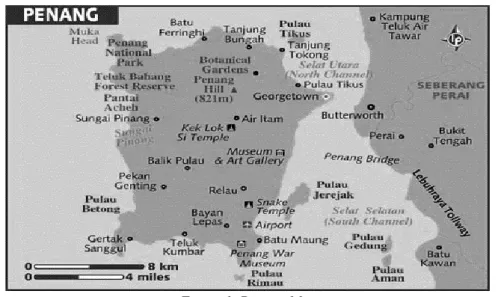
Penang, which is located on the northern west part of Malaysia, has 1.746 million population living in Penang Island and Seberang Perai (refer to Figure 1). Penang state is divided into five areas which are: 1) Utara (Seberang Perai Utara- SPU); 2) Tengah (Seberang Perai Tengah- SPT); 3) Selatan (Seberang Perai Selatan –SPS); 4) Barat Daya (DBD) and 5) Timur Laut (DTL). Among these areas, 53% of housing stocks are located in Penang Island (MacDonald, 2011).
According to the report by SERI (2011), the average house price in Penang has increased by 50% for the past 5 years, which mostly comes from the Island. The housing stock for Penang State is more concentrated in Penang Island with 41% of the houses are located in Timur laut (mainly the state housing) while 12% of the housing stocks are located in Barat Daya. Other housing stocks of Seberang Jaya located in Seberang Perai Tengah (22%), Seberang Perai Utara (14%) and Seberang Perai Selatan (11%) (MacDonald, 2011).
Figure 1. Penang Map
LITERATURE REVIEW
In Malaysia, research on the real estate market has been carried out in different areas, such as land regulation (Bertaud & Malpezzi,2001), customer satisfaction (Chee & Peng,1996), pricing of condominiums (Chau, Chin & Ng, 2004), the effect of regulations and tax on housing subsidy (Malpezzi & Mayo, 1997) and the role of the state in Malaysia housing market (Agus, 2002). There is a lack of research on modelling of relationship between house prices particularly the terrace houses with the cost of renting, inflation and interest rates.
In a developed country such as US, more research has been carried out to test the relationship between rental and house prices. Nevertheless, these researches are mainly focused on rent-price ratio variable. Using US housing data of rent-price ratio, Clark (1995) examined whether the future of rental rate can be predicted by using the rent-price ratio. The author concluded that the changes in rent is negatively related to rent-price ratio. Furthermore, the result of rent-price ratio in the study also indicates that house price will be higher in areas which have large increase in rents (Clark, 1995). Meese and Wallace (1994) examined a time-series data of house prices, rents and the cost of capital in Almaeda and San Francisco, counties in US. The result showed that rents and house prices are co-integrated, yet the short-run adjustment (equilibrium) between these variables has not being determined by the cointegration relationship.
priceand rent using US housing data. Evidently, the result indicates that house prices do not correct itself to the rents but the rents itself are correcting to the houses prices.
Favilukis, Ludvigson and Nieuwerburgh (2017) examine the impact of fluctuations of price-rent ratio to the housing and equity market in the US from 2000 to 2006. The result shows that the fluctuations of price-rent ratio is due to the response to aggregate shocks. Nevertheless, the authors do not include a rental market. The rent variable used in the study are imputed from distribution of the marginal rate of substitution (MRS) between homeownership consumption of non-durable goods and housing
In the Spain housing market, rental is an important factor in determining house price during higher demand as clearly expressed by Carreras-I, Mascarilla-i-Miro and Yegorov (2004). While in Japan, Kiyotaki, Michaelides and Nikolov (2008) examine the relationship between the price of housing equity and rent. According to the study, the determination of homeownership status of households depends on the size of the shelter service consumed relative to the holding of the shares. The authors concluded that rent is a factor price of the production capital
.
DATA AND METHODOLOGY
In Malaysia, the high percentage of homeownership (approximately 72.5% in 2010) are those who are buying a house for their own living. Therefore, the study focuses on examining the terrace house prices through demand factors which include cost of renting, interest rate and inflation. Using multivariate regression techniques, a total of four variables were employed from 2009: Q1 to 2016: Q4.
Interest rate
Many researchers have used interest rate as one of the independent variables to assess the effects on house prices (see Rangel & Pillay, 2007; Roehner, 1999; Thomsett & Kahr, 2007). Cheng, Chen and Mao (2009) described interest rate as a common factor affecting house prices and consumption. Thomsett and Kahr (2007) argued that one of the causes for the rapid increase in house prices is interest rate. The authors explained that when the interest rate
is
low, many peoplequalify for mortgages,thus increasing demand for houses..72 .74 .76 .78 .80 .82 .84 .86
2009 2010 2011 2012 2013 2014 2015 2016
interest rate
Figure 2: Movement of Interest rates in Malaysia
Cost of renting
As illustrated in Figure 3, the cost of renting terrace houses is stable from 2009 to 2014. However, the slight decrease of rental payment in 2014: Q4 do not last long as a sharp increase in the cost of renting from 2015 to 2016: Q2 occurred. According to Case (1965), the rents indicate an indirect measure of market trends and it will increase at about the same time as increasing real estate price.
-2,000 0 2,000 4,000 6,000 8,000 10,000 12,000
2009 2010 2011 2012 2013 2014 2015 2016
Rental Terrace
Figure 3: Cost of renting terrace houses in Penang (in RM)
Price of terrace houses in Penang (HPI Terrace houses)
(2004). Figure 4 shows the increasing trends of HPI-terrace houses from 2009 to 2014: Q2. The price of terrace houses seems to have decreased in 2014: Q3.
80 90 100 110 120 130 140 150 160 170
2009 2010 2011 2012 2013 2014 2015 2016
HPI Terrace
Figure 4: House price index for terrace houses in Penang
Inflation
Macroeconomic uncertainty, such as inflation is included in this study since price instability is one of the sources of uncertainties. Pain and Westaway (1997)
suggested the use of inflation as a proxy for people’s expectation of a future
increase in house price. The increase in house prices signals an inflationary pressure in the economy, which results in decrease in housing demand and lower price of an asset (house price) (Barot & Takala,1998). This study used Malaysia Consumer Price Index (CPI) as a proxy for inflation.
MULTIVARIATE LINEAR REGRESSION MODEL
The Multivariate linear regression model begins with the following equation:
Hsgt= β0+ β1Intr + β2Inf + β3Costr + εt ……… (1)
Where,
Hsgt = terrace house prices in Penang (HPI Terrace)
Int = interest rates Inf = inflation Costr = cost of renting
εt = error term is assumed to be an independently distributed random
variable εt iid N (0, σ)
Equation (1) is estimated using Ordinary Least Square (OLS) via Eviews 9.0
software. The parameters (β1 β2 β3) and εt the stochastic or residual are
The OLS regression has been tested in the housing market by several researchers such as Kim (2004) and Labonte (2003). For example, in the Korean housing market, Kim (2005) used an ordinary least square regression to explain the relationship between house prices and economic fundamental variables for the period 1998: Q1 to 2001: Q4.
ANALYSIS AND DISCUSSION
The estimated results of the multivariate regression using Equation (1) are presented in the Table 1 and yielded these estimates:
Hsgt = -598.96 + 445.96 Intr + 3.467 Inf + 0.000 Costr
(0.000) (0.000) (0.393)
Table 1. Multivariate Regression Result
Variable Coefficient Std. Error t-Statistic Prob.
C -598.9598 57.33666 10.44637 - 0.0000
INFLATION 3.467483 0.402600 8.612718 0.0000
INTEREST_RATE 445.9672 71.68856 6.220898 0.0000
RENTAL_TERRACE 0.000685 0.000791 0.866676 0.3935
R-squared 0.884101 Mean dependent var 129.3125
Adjusted R-squared 0.871684 S.D. dependent var 26.24975
S.E. of regression 9.402996 Akaike info criterion 7.436402
Sum squared resid 2475.658 Schwarz criterion 7.619619
Log likelihood -114.9824 Hannan-Quinn criter. 7.497134
F-statistic 71.19674 Durbin-Watson stat 0.757028
Result indicates that all variables are significant (p-values= 0.000) and have positive signs except for cost of renting (p-value=0.393). Interest rate and inflation have significant results which are consistent with other research on the housing market. The insignificant result on cost of renting to the determination of terrace house prices in Penang is due to the less concrete direct relationship between a house price (the price buyer needs to pay) and rental price (if you were to rent the house). The rental price is driven by the current rents for nearby houses (location) and the amount of mortgage that the owner has to pay. Meanwhile the house prices are driven by the supply and demand factors such as income, mortgage rates, inflation and the stock of housing available in the market.
The estimated coefficient for interest rate is positive and statistically significant at 1% significance level. It can be concluded that mortgage rates have a significant impact on the pricing of a house. As for inflation, the variable indicates a positive relationship and significant at 1 % significance level. The increase of inflation will cause terrace house prices to increase in Penang. Evidently, the movement of house prices (HPI Terrace) and inflation is similar with upward trending. Nevertheless, the inflation did decrease in 2009: Q2 to 2010: Q2.
CONCLUSION
This study examines the relationship between terrace house prices in Penang with interest rate, inflation and cost of renting terrace houses. The result indicates that from 2009 to 2016, the price of terrace houses in Penang is only driven by interest rate (mortgage rates) and inflation variables. Thus, the cost of renting terrace houses has no impact on the price of terrace houses.
The inclusion of the rental factor into the housing model is very important as it could explain more on the different market between rental and homeownership market. The stability of the growth in cost of renting allows future research to be carried out in different states which have more affordable houses such as Melaka, Kedah and Perlis. In addition, different types of residential could be used in examining the relationship between asset prices and economic fundamentals.
ACKNOWLEDGEMENT
The authors are grateful to the Ministry of Education for funding the research from which the study reported here to form part through the grant No 13166.
REFERENCES
Barot, B. & Takala, K. (1998). House Prices and Inflation: A cointegration Analysis for Finland and Sweden, Bank of Finland Discussion Papers, 12/98, 1-43.
Bertaud, A., & Malpezzi, S. (2001). Measuring the costs and benefits or urban land use regulations: A simple model with an application to Malaysia. Journal of Housing Economics, 10, 393-418.
Carreras-IS.M, Mascarilla-i-Miro, O. & Yegorov, Y. (2004). The Evolution and the Relationship of House Prices and Rents in Barcelona, 1970-2002. European Journal of Housing Policy, 4(1), 19-56
Case, F.E (1965) Real Estate. United State: Allyn & Bacon, Inc.
Case, K.E., & Shiller, R.J. (1989). The Efficiency of the Market for Single-Family homes. American Economic Review, 79(1), 152-137.
Chee, L. K., & Peng. (1996). Customer Orientation and Buyer Satisfaction: The Malaysian Housing Market. Asia Pacific Journal of Management, 13(1), 101-116Cheng, H.-L., Chen, N.-K., & Mao, C.-S. (2009). Identifying and Forecasting Housing Market Boom and Busts. Journal of Real Estate Finance and Economics, 1-38. Chau, K. W., Chin, T. L. & Ng. F.F. (2004). The impact of the Asian Financial Crisis on the pricing of condominium in Malaysia, Journal of Real Estate Literature. 12(1): 33–49.
Clark, T.E. (1995). Rents and prices of housing across areas of the United States: A cross section examination of the present value mode. Regional Science and Urban Economics, 25(2), 237-247.
Favilukis, J., Ludvigson, S.C. & Nieuwerburgh, S.V. (2017). The Macroeconomic Effects of Housing Wealth, Housing Finance and Limited Risk-Sharing in General Equilibrium. Journal of Political Economy, 125(1), 140-223
Fieldman, R. (2002). The affordable housing shortage: Considering the problem, causes, and solutions. The Region, 16(3), 7-14
Gallin, J (2004). The Long-Run relationship between House Prices and Rents, Working Paper of the Finance and Economics Discussion Series, 2004-2005, Federal Reserve Board, Washington D.C.
Kim, K.H. (2004). Housing and the Korean Economy. Journal of Housing Economics. 13(4): 321-341
Kim, K.H. (2005). Can Only Intelligent People Be Creative? A Meta-Analysis, Journal of Advanced Academics, 16, 57-66. Kiyotaki, N., Michaelides, A. & Nikolov, K. (2008). Winners and Losers in Housing Markets, Paper presented at the Macroeconomic and Policy Challenges Following Financial Meltdowns Conference Hosted by the International Monetary Fund Washington DC, (April 3, 2009). Labonte, M. (2003). U.S Housing Prices: Is There a Bubble? Retrieved, from http:///econ.jhu.edu/people/ccaroll/papers/COS-WealthEffects-Literature/Paper/Labonte.pdf. Lum, S.K (2004). Property Price Indices in the Commenwealth-Construction Methodologies and Problems. Journal of Property Investment and Finance, 22, 25-54.
MacDonald, S. (2011). Supply and Demand in Penang Housing Market: Assessing Affordability. Research Paper, Urbanisation & Environment Penang Institute. Malpezzi, S. (2001). The Long-Run Price Elasticity of Supply of New Residential
Malpezzi, S., & Mayo, S.K. (1997). Getting jousting incentives right: A case study of the effects of regulations. Taxes and subsidies on housing supply in Malaysia. Land Economics, 73 (3), 372-391.
Meese, R., & Wallace, N. (1994). Testing the present value relation for housing prices: Should I leave my house in San Francisco? Journal of Urban Economics, 35(3), 245-266.
Pain, N. & Westaway, P. (1997). Modelling structural change in the UK housing market: A comparison of alternative house price models, Economic Modelling, 14(4), 587– 610.
Quercia, R.G., Stegman, M.A, & Davis, W.R. (2002). Does a High-Tech Boom Worsen Housing Problems for Working Families? Housing Policy Debate, 13(2), 393-415. Rangel, G.J., & Pillay, S.S. (2007). Evidence of bubbles in the Malaysian stock market, Chapter 9 in Asia Pacific Fianncial Markets: Interpretation and Challenges. Kim, S-L and McKensie, M.D (eds). International Finance Reviews, 175-202.
Roehner, S. (1999). Spatial Analysis of Real Estate Bubbles: Paris 1984-1993. Regional Science and Urban Economics, 29, 73-78.
Thomsett, M.C., & Kahr, J. (2007). Beyond the Bubble. New York: AMACON.Socio-Economic and Environmental Research Institute (SERI). (2011). Penang Economic Outlook 2011. SERI, Penang.